Ah, Vindication

I love it when I get proven right, especially just days after my post, where I said:

I just don't know why conservatives are so afraid to let folks like Khatami speak in the US.
Sure, he is a lying dictatorial human-rights-suppressing scumbag, but
so what?  Its good to let people like this speak as much as they want.
They always give themselves away

And, shazam!  Both Khatami and Hugo Chavez bury themselves in a deep hole with their verbal idiocy.  Both did more for to rally support against themselves in the last few days than a hundred speeches by their detractors.

PS- My company is cutting up all its Citgo cards on Monday.

Cool Automation

My independent work in college was on interfacing micro computers with mechanical devices.  Most of the work was in assembler language on an S-100 bus CP/M computer tied to some simple devices.  In one project, for example, I used an ultrasonic range-finder stripped off a Polaroid camera (brand new auto-focus technology, for the time) and put it on a stepper motor.  I wrote a program to turn it into a radar that painted a picture of the room on the screen.  In the next iteration, I experimented with having it control a "gun"  (a pencil on a stepper motor) and keep it locked onto a moving target in the room.  Seems pretty basic but it was not that easy in 1982  (also, coincidently, the last year I ever ran a mainframe computer program from a card deck).  In the spring of 1983, we programmed electronic devices that managed various functions on an N-Scale model railroad, a dream class for me given that model railroading has always been my preferred hobby.

Anyway, in this context I thought this was really cool:  A Lego robotics machine that solves the Rubiks cube.

Cubesolver1_sm

You've Never Had It So Bad

I guess it's inevitable come election time, but a cottage industry has arisen of late to spread the word that the US economy is broken and that conditions for all but the rich are actually eroding.  This historically has been a winning strategy -- Remember, in late 1992 Bill Clinton campaigned with the absurd (but generally unchallenged in the media) contention that it was the worst economy since the Great Depression.  Most of the lamentations about the current condition of the poor and middle class are presented with the standard populist baggage that the economy is zero-sum, and these groups ills are somehow related to and the result of the income growth of the very rich.

Jacob Hacker of Yale now adds to the chorus, arguing that in addition to worse material fortunes, the middle class faces more risk.  As someone who gave up a good, high-paying job in corporate America for the risk roller coaster of running by own business, I have little sympathy -- after all, I am part of his trend and I happily chose my path.  And its astonishing to me in this day and age anyone can argue that we have too much of a culture of personal responsibility.  Please.

However, rather than fisking this in depth, I will leave the task to my much more capable ex-roommate from Princeton, who also happens to be a senior something-or-other at Cato, Brink Lindsey:

But if we're talking about
security from material deprivation, that's a different story. Let's
start with the biggest risk of all: that of premature death. Back in
1970, during Mr. Hacker's golden age of economic stability and
risk-sharing, the age-adjusted death rate stood at 12.2 deaths per
1,000 people. By 2002, it had fallen more than 30%, to 8.5 per 1,000.
In particular, infant mortality plummeted to 7.0 from 20.0, while the
number of Americans killed on the job dropped to three per 100,000
workers from 18.

Next, look at the two main
indicators of middle-class status: a home of one's own and a college
degree. Between 1970 and 2004, the homeownership rate climbed to 69%
from 63%, even as the physical size of the median new home grew by
nearly 60%. Back in 1970, 11% of Americans 25 years of age or older had
a college or higher degree. By 2004, the figure had risen to 28%.

As to consumer possessions, the
following comparison should suffice to make the point. In 1971, 45% of
American households had clothes dryers, 19% had dishwashers, 83% had
refrigerators, 32% had air conditioning, and 43% had color televisions.
By the mid-1990s all of these ownership rates were exceeded even by
Americans below the poverty line.

No matter how the
doom-and-gloomers torture the data, the fact is that Americans have
made huge strides in material welfare over the past generation. And
with greater wealth, as well as improved access to consumer credit and
home equity loans, they are much better prepared to deal with the
downside of increased economic dynamism.

Mr. Hacker leans heavily on his
findings that fluctuations in family income are much greater now than
in the 1970s. But research by economists Dirk Krueger and Fabrizio
Perri has shown that big increases in the dispersion of income have not
translated into equivalent increases in consumption inequality. In
other words, most Americans are able to use savings and borrowing to
maintain stable living standards even in the face of economic ups and
downs. And those standards are much higher than those of the
all-in-the-same-boat era.

Mr. Hacker, however, shows little
interest in providing such context or balance. Fully committed to what
could be called a "free market bad, big government good" narrative, he
simply ignores data that point in the other direction. Thus he
lambastes reforms such as Health Savings Accounts and Social Security
privatization for shifting risks onto individuals while failing to
mention that the policy status quo imposes massive risks of its own.

I know Brink has been finishing up his new book.  I would love to see him start blogging again.

More Thoughts:  I have a couple of thoughts of my own on the risk issue:

  • Risk, I guess defined as income volatility, may be higher for the average person today that it was in 1970.  However, in a broader context, it is still drastically lower than any time in history or than in most places in the world.  Certainly pre-WWII people had substantially more risk in their income, particularly in the agricultural sector, which dominated the economy of this and other countries through most of history.  In subsistence agricultural economies, every year even the most productive and competent people face not just the risk of income loss but starvation and extinction through factors wholly beyond their control.
  • The vast majority of the risk reduction people experienced in this country after WWII came from the operation of the private market economy, and not from government programs.  It was the incredible productivity growth, export growth, and technology growth of American industry that provided whatever security people might be nostalgic for.
  • Further, the author worries about a risk-shift.  But in the 50's and 60's, there was very little risk in the system.  Corporations faces little risk in world markets, executives at corporations faced little risk to their jobs, and most workers faced little risk.  There has not been a risk shift -- this implies there was once some Atlas that bore the burden of all this risk and has now shrugged.  One might argue that there is more risk in the whole system - corporations are not guaranteed their market share so workers are not guaranteed their jobs.  The author tries to make it a populist argument, as if rich folks are shrugging off risk onto the poor.  The fact is that everyone faces more income volatility today, from largest corporation to lowest paid worker.  The good news, as Mr. Lindsey points out, is that this volatility is around a much higher mean.
  • The costs of income security programs were always funded by workers
    themselves.  There was never a time when this security was provided by a mythical "someone else".  General revenue programs like welfare and defense over
    the last 30 years have been effectively funded by "the rich", since by
    any definition, that is who pays the income taxes.  However, programs
    like social security, Medicare, and unemployment are all based on
    payroll taxes with caps that mean that most of the tax is paid for by
    the poor and middle class themselves  (some of these are technically
    paid as a percentage of wages by the employer, but trust me that they
    have the same effect on take-home pay as if they had been deducted
    directly from the employee's check).  To the extent workers have
    security, it is only because they have been forced to buy and pay for
    an insurance policy.  So again, there can be no shift, because the workers bore the cost of the insurance themseleves.  Are they getting good value for this insurance?  I don't know --
    nobody knows.  Many reform proposals the author worries will further
    increase risk in fact are structured to put this insurance premium back
    in the hands of the worker, to let him or her decide if and how they
    want to spend it to insure themselves.
  • The current obsession with this topic of risk strikes me as a case of white collar bias.  I am not sure anyone but the highest seniority workers ever had this mythological income security in the blue collar sector.  Layoffs and technology-based job obsolescence that created turmoil for blue-collar workers never seemed to touch white collar workers in the same way.  My sense is that what's new today is that middle class white collar workers are now facing these same forces of change, in many industries for the first time.  In fact, a skilled machinist is probably more secure in his job today than an account paybables clerk.  For years, the left has joined unions in criticizing companies like GM for continually cutting blue collar jobs without touching bloated white collar payrolls.  It's odd to see them jump suddenly to the other side of the issue.
  • I hate to point out the obvious, but what government income-risk-management program has gone away since 1970, other than welfare reform?  Social Security, unemployment insurance, food stamps -- they all exist, most at levels higher than 1970.  Government-funded health care programs cover far more people for far more stuff.
  • Certainly some private practices have changed that may affect employee risk.  It is interesting that the author mentioned 401K's.  To Hacker, shifting from defined benefits pensions to 401K's is an increased risk.  I am sure he would point in part to plans like Enron's where 401K holders took a bath because they were encouraged to funnel a lot of their savings into Enron stock.  But most 401K plans don't work that way, and it does not matter since defined benefit plans are even worse.  Defined benefit plans presuppose that the company you work for will remain financially solvent for decades, and they assume workers will never switch jobs, since they are not very portable.  Defined benefit plans are horrible for workers  -- it reduces their flexibility and increases their risk.  401K's are a fabulous, worker-empowering invention and are bad only for a few union leaders and large pension fund managers (e.g. Calpers) who gain political power by virtue of the money they control.
  • Yes, many jobs are less stable, but there is no evidence that there are long-term unemployed people out there.  The nature of the people losing work and the job market today has changed, such that there are much better tools to find new work, and there is more work out there for their skills.  White collar workers today probably find new work easier than blue collar workers in West Virginia ever did in the 1950's and 1960's when the mines closed.  My guess is that most everyone from Enron has found a new job (or jail cell).  There are people in Appalachia who still haven't found a job 40 years after the mine closed.

Congress Votes to Make Schools Fourth Ammendment Free Zones

Via Reasons Hit and Run:

Yesterday, Students for Sensible Drug Policy reports, the House approved the Student and Teacher Safety Act of 2006, which threatens
to withhold federal funding from public schools that do not allow broad
student searches for flimsy reasons, by a voice vote. The bill applies
to any "search by a full-time teacher or school official, acting on any
reasonable suspicion based on professional experience and judgment, of
any minor student on the grounds of any public school, if the search is
conducted to ensure that classrooms, school buildings, school property
and students remain free from the threat of all weapons, dangerous
materials, or illegal narcotics."

An earlier version of the bill used the newfangled standard of
"colorable suspicion," which I reasonably suspect would have amounted
to little more than a hunch. The new standard is stricter in theory,
and the bill stipulates that "the measures used to conduct any search
must be reasonably related to the search's objectives, without being
excessively intrusive in light of the student's age, sex, and the
nature of the offense." Would this allow a mass search of the entire
student body if, say, a teacher suspects that one or two kids have been
smoking pot and is determined to root out the school's marijuana ring?
No doubt these details will be settled in litigation. Since such
litigation can be costly,
it's not surprising that the American Federation of Teachers, the
National Association of School Administrators, and the National School
Boards Association have come out against the bill.

It's sure good to see Congress overturning fundamental Constitutional principles on a voice vote.  Here is a good libertarian poll question:  Which do you think will be used more often in the next five years as an excuse to pare down the Bill of Rights, the "war on drugs" or the "war on terrorism"?

Sanction of the Victim

This has been an incredible week in the ongoing culture clash between the western democracies and radical Islam.  In a series of events right out of the Onion or Monty Python, radical Muslims around the world protested the Pope calling them violent with ... waves of violence.  Once his remarks were proven right in such an obvious and public way the Pope reacted by ... apologizing for his remarks.**   

I am tired of apologizing to radical Islam (for some silly, bland cartoons, for god sakes!)  I am tired of bending over backwards into pretzels to give them the benefit of the doubt.  I am extremely tired of being told these folks are just aggrieved and in reality they share my values, because it is very very clear that they don't share my values.  I am tired of being told most Muslims are peaceful --  when these peaceful folks give their sanction and support to the violent ones and accept the most radical as their leaders. 

Radical Islam is, with the downfall of soviet communism and the painfully gradual opening up of China, the most illiberal force in the modern world. By a long shot.  It treats individual life with contempt, has no concept of rights, and in particular treats women far worse than apartheid South Africa ever treated blacks.  The theocracy we fear from certain Republican 700 Club folks is like 3.2 beer compared to full 200 proof Islamic theocratic fascism. 

I don't know why the left in this country has been hesitant to call out illiberal practices in the Middle East as vociferously as they have in other circumstances.  A part of this hesitation is probably opposition to the Iraq war, and fear that denouncing radical Islam for its faults might somehow give the administration a stronger mandate for more military adventures.  A less charitable explanation is that the hesitation is an extension of political correctness and cultural relativism run wild).

Well, I opposed the Iraq war:  The Augean stables are just too dirty to clean up by sending the military from dictator to dictator. I will go further and say I actually think the terrorist threat is exaggerated (and yes I do remember 9/11) in order to keep giving the FBI more powers and help politicians get elected.  Get tough on terrorism is sort of the new get tough on crime election speak.

But I don't think the threat to liberal values posed by Islamic fundamentalism is exaggerated.  And the first step in fighting it is to not give it, as Ayn Rand would say, the sanction of the victim.  People sometimes email me and say "who are we to talk -- America is not clean."  I will agree we have our warts - and much of this blog is taken up with pointing some of them out.  But what I always tell people, and still believe, is the following:

The US does harm when we fail to live up to our values.  Radical Islam does harm when they successfully pursue what they value.

**Postscript:   I don't pretend to understand all the 13th century quotations in the Pope's speech.  I don't think it matters.  If he had simply said "radical Islam preaches too much violence and it has to stop" he would have gotten the same reaction.  By the way, every person in the world seems to say bad things about the US, many of these comments are untrue or apply only to a minority of our leaders and not to myself. I can't remember anyone ever apologizing to me.   This story  that Muslims will do more violence unless the Pope apologizes some more reminds me of Sir Robin in the Monty Python and the Holy Grail.  "Perhaps if we run away more..."

And here is my message to the right -- I acknowledge that radical Islamic leaders treat apologies, backing-down, etc. as weakness to be exploited rather than preludes to reasonable compromise.   For this reason, I thought the invasion of Afghanistan was a necessity.  However, this general fact does NOT automatically justify the Iraq war.  If it did, it would also justify invading any Islamic country we want.  I still don't understand the strategic sense of Iraq and now we are stuck there, because I agree that once in, backing off will only embolden the radicals in the area to further hi-jinx.

Requiem for the First Ammendment?

This study pops up every year or so, and every time I see it I can't believe the results.  100,000 high school students surveyed, along with 8000 teachers:

  • 54 percent of the students said all newspapers should be able to
    publish freely without government approval, up from 51 percent in 2004.
  • Students say they felt the First Amendment as a
    whole goes too far. In 2006, 45 percent said the First Amendment goes
    too far, versus 35 percent two years ago.
  • In 2004, 38
    percent of teachers thought the press had too much freedom. That figure
    dropped in 2006 to 29 percent. Student attitudes are improving as well,
    though more slowly. In 2004, 32 percent thought the press has too much
    freedom. In 2006, that figure dropped to 30 percent.

I guess I won't panic, as some of this is probably just high school kids being muddle-headed about everything.  It would be interesting to see if these attitudes are being caused more by leftish fears (e.g. political correctness, don't say anything bad about women or minorities or gays or handicapped or...) or by rightish fears (e.g. national security activities)

Hat Tip: Hit and Run

On Not Being Very Helpful

Apparently, my wife has some kind of event tomorrow she needs to look fabulous for, so we went through our usual ritual of her modeling a variety of outfits and soliciting my opinion of their relative merits.  This is hard for me for a couple of reasons.  First, I have no fashion sense (I was an engineer for god sakes).  Second, I have terrible visual memory.   I absolutely dread going to the eye doctor because I can't do those "which is clearer, A or B" tests.  The moment I see B, my mind totally purges what A looked like.  I have the same problem with helping my wife.  If I say I like an outfit, she'll ask if its better than the green outfit I saw a while back.  She might as well ask me the name of my 2nd grade PE teacher. 

Anyway, at the end I eventually say -- yeah, that's definitely the one.  Which is something I learned from golf.

Golf is the most mental of all games.  I can prove that in a simple way - in what other professional sport is every athlete accompanied by a paid psychologist (called a "caddy")?  Caddies will often discuss A or B choices with their golfers.  The golfer might say he wants to hit a soft 7-iron and the caddy will reply that he favors a hard-8.  Anyway, once a good caddy realizes his player has decided on the soft-7, he is supposed to go into support mode:  "That's it.  That's exactly the right club.  Put a good swing on it."

My error tonight was relating this golf caddy analogy to my wife during our discussion of whether she should wear the bustier and the fishnet stockings or the leather outfit with the bare midriff (just kidding, these were unfortunately not the choices I was presented with).  When I finally told her that she definitely had the right outfit, that she had made the right choice, etc., she seems to have lost some confidence in my opinion.  The bright side is that this may be yet another victory for the learned-male-helplessness task-avoidance strategy.

More Anti-Immigration Scare Stats

A while back, I pointed out that immigration opponents seemed to be depending on American's having poor match skills and a pathetic knowledge of history.  Today in this post from Captain's Quarters we find more statistical funny business.  Captain Ed, like many conservatives, have been stumping for the US to build a big honking fence at the border, nominally as part of the war on terrorism.

Of course according to supporters it is only about security, not xenophobia, which explains why the fence proposal in Congress covers both our northern and southern borders since both are equally porous to terrorists.  Oh, wait, the law only covers the southern border?  Oh.  Well, I hope terrorists can't read a map and don't notice that the northern border is three times as long and in many cases more unpopulated and unguarded than the southern border.

Anyway, another "security" argument by immigration foes is that hordes of criminals are apparently pouring across the border, and walls are proposed as a way to stop them.  The Captain quotes Bill Frist:

One of the most important and most effective ways that we can stop
illegal immigration is through the construction and proper maintenance
of physical fences along the highest trafficked, most commonly violated
sections of our border with Mexico.

Take the case of San Diego. According to the FBI Crime Index, crime
in San Diego County dropped 56.3% between 1989 and 2000, after a fence
stretching from the Ocean to the mountains near San Diego was
substantially completed. And, according to numbers provided by the San
Diego Sector Border Patrol in February 2004, apprehensions decreased
from 531,689 in 1993 to 111,515 in 2003.

Whoa. That sounds impressive.  But, remember what I often say on this site -- correlation is not causation.  Indeed, it is not just random chance that he picked the years 1989 - 2000.  Those were the years that nearly every part of the US saw a huge drop in its crime rate.  Using this data for these years, and presuming Frist is using the crime rate index per 100,000 people, which is the stat that makes the most sense, here are some figures for 1989 - 2000:

Crime Rate Change, 1989-2000:
US :  - 28%
Arizona:  -28%
California: - 45%
New York: -51%

Wow!  The border fence in San Diego even had a similarly large effect on crime in New York State!  That thing is amazing.  Oh, and note these are state figures.  My understanding is that the figures for large metropolitan areas is even more dramatic.  So what happened in 1989 to 2000 is every state and in particular every large metropolitan area in the country saw huge double digit drops in crime, and San Diego was no exception.   But Frist tries to give credit to the border fence.

In case you want to believe that Frist does not know what he is doing with these stats (ie that he wasn't intentionally trying to give credit for a national demographic trend to a border fence in San Diego) notice that 1989 was the US crime rate peak and 2000 was the US crime rate low point.  So with data for the years up to 2005 available, he just happens to end his period at 2000.  Oh, and the new style fences he wants to emulate were actually only started in 1996 (and here, search for "triple fence"), AFTER most of these crime gains had been made.  Correlation definitely does not equal causation when the proposed cause occurred after the effect.

For all of you who always wanted to live in Soviet East Berlin, you may soon get a good taste of that experience:

The first fence, 10 feet high, is made of welded metal panels. The
second fence, 15 feet high, consists of steel mesh, and the top is
angled inward to make it harder to climb over. Finally, in high-traffic
areas, there's also a smaller chain-link fence. In between the two main
fences is 150 feet of "no man's land," an area that the Border Patrol
sweeps with flood lights and trucks, and soon, surveillance cameras.

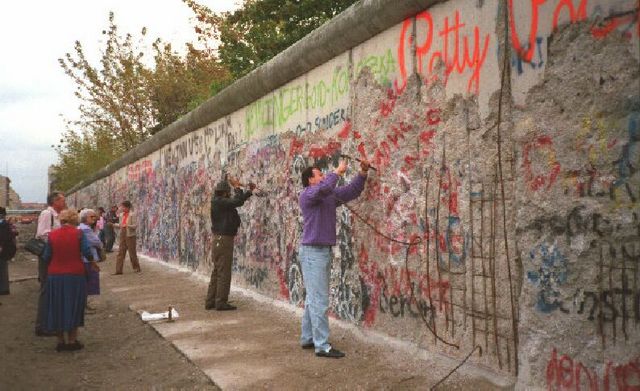
Below are views of Nogales, AZ and Berlin.  Nothing alike.  Nope.  Totally different.

Nogaleswall_1 Berlinwall

Finally, I will give the last word to Frist, bold added.

That's why I strongly support the Secure Fence Act of 2006 "¦ and that's
why I'm bringing this crucial legislation to the floor of the Senate
this week for an up-or-down vote. By authorizing the construction of
over 700 miles of two-layered reinforced fencing along our southwest
border and by mandating the use of cameras, ground sensors, UAVs and
other forms of hi-tech surveillance, this legislation would help us
gain control over every inch of our borders "“ once and for all.

"gain control over every inch of our borders," except, or course, for those 3000 5525 miles (350 million inches) to the north where the people on the other side have the courtesy not to speak a foreign language.  But its hard to demagogue well about a threat from Canadians, since they are mostly WASPs like we mostly are, or at least it has been for the last 100 years or so.  54-40 or fight!

Update: Here is that terrifying Canadian border barrier (from this site).  This demonstrates why our terrorist security dollars need to all be invested on the southern border, since this one is already locked down tight.  Heck, there is one of these babies (below) every mile!  Beware terrorists!

Canada

And don't forget these terrorist-proof border checkpoints along our northern frontier:

  Canada2

But it's not about race.

Update 2:  Yes, my emailers are correct.  I did not actually give Frist the last word like I said I would.  Gosh, I feel so bad about that.

Update 3:  Welcome to readers of my favorite site, Reason's Hit and Run.  It looks like Texas may soon consider a border fence, though with Louisiana instead of Mexico.

Broken Window Fallacy, On Steroids

Economics have a concept called the "broken window fallacy" that many of the media to this day do not understand.  Here is an example:  Every hurricane season, the media always writes a "silver lining" story about how recovery from a devastating hurricane spurred the local economy.  One might assume from this reasoning that it is good to go around breaking windows, since one will make a lot of work for glaziers and boost the economy.  The problem is what is not measured.  What would the money that was spent on window replacement have been spent on instead?  It is a safe presumption that had they not had to repair storm damage, they would have spent the money on something more productive  (test:  if this were not true, everyone would be breaking their own windows).  Advocating the broken window fallacy is a bit like saying that stealing money from banks would increase the savings rate, since people would have to deposit even more money to replace that which was stolen.

Anyway, I bring this example up because today I saw the most amazing example of the broken window fallacy I have ever seen, via Kevin Drum and Business Week:

 Business Week's cover story in their current issue tells us that healthcare inefficiency is what's keeping the American economy afloat:

The
very real problems with the health-care system mask a simple fact:
Without it the nation's labor market would be in a deep coma.  Since 2001, 1.7 million new jobs have been added in the health-care sector, which includes related
industries such as pharmaceuticals and health insurance. Meanwhile, the
number of private-sector jobs outside of health care is no higher than
it was five years ago.

.... The U.S. unemployment rate is 4.7%, compared with 8.2% and
8.9%, respectively, in Germany and France. But the health-care systems
of those two countries added very few jobs from 1997 to 2004, according
to new data from the Organization for Economic Cooperation &
Development, while U.S. hospitals and physician offices never stopped
growing. Take away health-care hiring in the U.S., and quicker than you
can say cardiac bypass, the U.S. unemployment rate would be 1 to 2
percentage points higher.

....Both sides can agree that more spending on information
technology could reduce the need for so many health-care workers. It's
a truism in economics that investment boosts productivity, and the U.S.
lags behind other countries in this area. One reason: "Every other
country has the payers paying for IT," says Johns Hopkins' Gerard
Anderson, an expert on the economics of health care. "In the U.S. we're
asking the providers to pay for IT" "” and they're not the ones who
benefit.

Let's go back to slow-motion instant replay.  What was that first line?

Business Week's cover story in their current issue tells us that healthcare inefficiency is what's keeping the American economy afloat

I am not seeing things, am I?  Did he really write that it is the inefficiency of one of the largest and most ubiquitous and perhaps most important industries in the country that is propelling the economy?  Do I really have to state the obvious?  Do you really think that if all those people were not hired to push paper around in health care they would be sitting unemployed today?  What about all the money either consumers or corporations would be saving from more efficiency -- would that really not have been spent on something else?

In a way, I guess this is sort of consistent with Drum's position on Wal-Mart.  If Wal-Mart is detroying the economy (according to him) by bringing increased productivity to retail, I guess this argument that health care inefficiency helps the economy is at least consistent.  Maybe if we could get our state drivers' license agency folks to take over the whole economy, we would have a boom! And the old Soviet Union must have been an economic powerhouse!

This is some of the worst economics I have seen in a while.  Lefties like Drum often rail against conservatives for being anti-scientific in their opposition to teaching evolution or approving the morning-after pill, but for God sakes the most fundamentalist Bible-belt home schooled conservative Christian probably knows more about the science of evolution than journalists understand about the science of economics.

Technology Bleg

I begin by assuming the answer to the following is "no."  However, just in case, here is my question:  A number of spammers seem to be using my email address as their "reply-to" return address on the spams they are sending out.  Unfortunately, this is all-too-easy to do.  Note, they are not using my account, but just entering my address in the from and reply-to lines (something even I know how to do) on an email sent from one of their accounts.  My question is:  Is there anyway to keep a third party from using your email address in this way?

Fortunately, a couple of layers of filtering (google, then a bayesian
filter) seem to have at least halted the growth of spam in my box and
perhaps even rolled it back a little.  By the way, I still stand by my solution to spam, which is to charge 0.1 cents per email.  Normal eavy users who might send 30-100 emails a day would pay 3-10 cents a day, ie nothing.  Spammers who send 10 million emails would be charged $10,000 for each mass mailing.   

I Do Not Think Your Data Means What You Think It Means

Kevin Drum, building on a story from the NY Times, uses data from the California Energy Commission to make the case that California is the most efficient user of electricity in the country and that this efficiency can be attributed sole to government intervention.  Drum, always on the lookout for an excuse for the government to take over some sector of the economy, concludes:

Anyway, it's a good article, and goes to show the kinds of things we
could be doing nationwide if conservative politicians could put their
Chicken Little campaign contributors on hold for a few minutes and take
a look at how it's possible to cut energy use dramatically "” and reduce
our dependence on foreign suppliers "” without ruining the economy. The
energy industry might not like the idea, but the rest of us would.

On its face, California's numbers are impressive.  The CEC's numbers show California to have the lowest per capita electricity use in the nation, using electricity at half the national rate and one quarter the "least efficient" states.

This would be really cool if it were true that a few simple public policy steps could cut per capital energy consumption in half.  Unfortunately, though I am willing to posit California is better than average (as any state would be with a mild climate and newer housing), the data doesn't say what Drum and the article are trying to make it say. 

The consumption data is from here.  You can see that there are three components that matter - residential, commercial, and industrial.  Residential and commercial electricity consumption may or may not be fairly apples to apples comparable between states (more in a minute).  Industrial consumption, however, will not be comparable, since the mix of industries will change radically state by state.  As an extreme example, states with high aluminum production or oil refining or steel making, which are electricity intensive, will have a higher per capita industrial electricity consumption, irrespective of public policy.  The graph Drum and the NY Times uses includes industrial consumption, which is a mistake -- it is more reflective of industry mix than true energy efficiency.

Take two of the higher states on the list.  Wyoming, at the top of the per capita consumption list, has industrial electricity consumption as a whopping 58% of total state consumption.  KY, also near the top, has industrial consumption at 50% of total demand.  The US average is industrial consumption at 29% of total demand.  CA, NY, and NJ, all near the bottom of the list in terms of per capital demand, have industrial use as 20.6%, 15.1%, and 16% respectively.  So rather than try to correlate electricity consumption to local energy regulations, it is clear that the per capita consumption numbers by state are a much better indicator of the presence of heavy industry. In other words, the graph Drum shows is actually a better illustration of the success of CA not in necessarily becoming more efficient, but in exporting its pollution to other states.  No one in their right mind would even attempt to build a heavy industrial plant in CA in the last 30 years.  The graph is driven much more by the growth of industrial electricity use outside CA relative to CA.

Now take the residential numbers.  Lets look again at the states at the top of the per capita list:  Alabama, South Carolina, Louisiana, Tennessee, Arkansas, Mississippi, Texas.  Can anyone tell me what these states have in common?  They are hot and humid.  Yes, California has its hot spots, but it has its mild spots too  (also, California hot spots are dry, so they can use more energy efficient evaporative cooling, something that does not work in the deep south).  These southern states are hot all over in the summer.  So its reasonable to assume that maybe, just maybe, some of these hot states have higher residential per capita consumption because of air conditioning load?  In fact, if one recast this list as residential use per capita, you would see a direct correlation to summer air conditioning loads.   This table of cooling degree days weighted for population location is a really good proxy for how much air conditioning is needed by state.  (Explanation of cooling degree days). You can see that states like Alabama and Texas have two to four times the number of cooling degree days than California, which should directly correlate to about that much more per capita air conditioning (and thus electricity) use.

In fact, I have direct knowledge of both Alabama and Texas.  Both have seen a large increase in residential per capita electricity use vis a vis California over the last thirty years.  Granted.  But do you know why?  The number one reason for increased residential electricity use in the South is the increased access of the poor, particularly poor blacks, to air conditioning.  It is odd to see a liberal like Drum railing against this trend. Or is it that he just didn't bother to try to understand the numbers?

OK, now I have saved the most obvious fisking for last.  Because even when you correct for these numbers, California is pretty efficient vs. the average on electricity consumption.  Drum attributes this, without evidence, to government action.  The NY Times basically does the same, positing in effect that CA has more energy laws than any other state and it has the lowest consumption so therefore they must be correlated.  But of course, correlation is not equal to causation.  Could there be another effect out there?

Well, here are the eight states in the data set above that the California CEC shows as having the lowest per capita electricity use:  CA, RI, NY, HI, NH, AK, VT, MA.  All right, now here are the eight states from the same data set that have the highest electricity prices:  CA, RI, NY, HI, NH, AK, VT, MA.  Woah!  It's the exact same eight states!  The 8 states with the highest prices are the eight states with the lowest per capita consumption.  Unbelievable.  No way that could have an effect, huh?  It must be all those green building codes in CA.  I suspect Drum is sort of right, just not in the way he means.  Stupid regulation in each state drives up prices, which in turn provides incentives for lower demand.  It achieves the goal, I guess, but very inefficiently.  A straight tax would be much more efficient.

Please, is there anyone in the "reality-based community" that cares that their data really is saying what they think it is saying??


Arizona Minimum Wage Ballot Initiative

Arizona has a ballot initiative here in November to raise the minimum wage to $6.75.  Perhaps more worrisome, the law has been structured to raise the rate every year based on some cost of living increase.  (As an aside - these cost of living escalators in government-mandated wage rates are insanely recursive.  The government raises wages, which increases prices, which leads to a further increase of the statutory rate).  An Arizona group opposed to the initiative has put out a nice Word document with the proposed laws language annotated with facts and refutations.

I will not be coy and pretend that I don't have an interest in this question.  The campgrounds we operate on public lands were run by volunteers in the past, until the courts decided that private companies were not legally allowed to use volunteers.  Most of our camp hosts, who tend to be in their 70's or older (we have many employees in their eighties and a few in their nineties!) get paid minimum wage plus a camp site in a nice park for the summer (the latter is what they really want).  Unlike private campgrounds that are built to be efficient to operate, the public campgrounds we operate tend to be small and labor-intensive.

We make about a 5% profit on sales in the camping business (yes, I know that is pathetically low).  Labor is 60-70% of our costs, if you include costs that are directly tied to wages like payroll taxes and workers comp. premiums.  This law would raise the minimum wage by 31%.  You do the math.  In a stroke, this ballot initiative would raise our costs by 20% (.31 x .65) in a business where costs are 95% of revenues.  Something has to give.  I am not going to work the hours I work and run the business for charity.  A 5% margin is almost there already.  We are therefore planning for two different contingencies.

  1. Camping fees will have to rise by approximately 20%.  This means that a camping fee of $16 will go up by $3.  I will not make any more money, this will all be a pass-through to my employees, most of whom really wanted to volunteer in the first place.  One could rename this ballot initiative the "vote yourself a camping fee increase" initiative.  A few years ago, an attempt to raise lodging taxes on camping by a few percent met with howls of opposition.  But in effect this is ballot initiative in in effect adding a 20% tax to camping fees.
  2. My labor model of hiring retired people may well have to change.  There is a real trade-off in hiring retired folks to maintain campgrounds.  On the plus side, we get a lot of honest and responsible people who have the time and the flexibility in their life to pick up stakes and go live in a campground all summer.  The down side, of course, someone who is 75, or 85, is not going to work as fast or as productively as younger folks.  My workers also tend to get injured more easily (my insurance company freaks every time it sees my employee list with dates of birth) which costs a lot in workes comp. premiums.

    When presented with the choice in the current market of hiring a retired person at $5.15 an hour or a younger, faster worker at $7.50 an hour, I have been happy to hire retired people.  This model has worked great for us.  Unfortunately, I must revisit this business model when my choice is between hiring a faster worker at $7.50 and a slower worker at $6.75 (and rising).  Already in high minimum wage states like CA, OR, and WA we have begun shifting away from hiring as many retired people.  I also hire a lot fewer people, having invested in automated fee collection in high labor cost areas.  (Think about this, at least for a few seconds, before all of you start sending me the inevitable emails I get for being a heartless brute for paying anyone minimum wage).

By the way, the federal government gets around this problem for the campgrounds it operates itself.   How?  Why, it exempts itself from these laws.  Most federal campgrounds employ retired persons as volunteers.  They don't pay campground workers minimum wage, they pay them ZERO.

I wrote a much longer post on minimum wage laws here.  Minimum wage laws are becoming hip in traditionally red-state border areas as a tool to keep immigrants from working.

Update:  I actually underestimated the amount of my costs directly tied to wages, and so I have updated some of the numbers to be more realistic.

Get Wal-Mart Out of the Public Trough

I have defended Wal-Mart on a number of occasions given its new whipping-boy-of-the-left status.  However, if it wants to get my further support, it is going to have to take it's nose out of the public trough.

It's hard to find reliable numbers on the total value to Wal-Mart of such subsidies. The leading report is Shopping for Subsidies: How Wal-Mart Uses Taxpayer Money to Finance Its Never-Ending Growth
by Philip Mattera and Anna Purinton was published by a left-leaning
advocacy group and funded in part by one of the very unions trying to
unionize Wal-Mart's work force, which will suggest to some a need for
caution. Yet, even if one applies a substantial discount to Mattera and
Purinton's results, Wal-Mart is still doing quite well at the public
trough:

  • In a sample of subsidy deals for individual stores, they found
    subsidies ranging from "$1 million to about $12 million, with an
    average of about $2.8 million."
  • In a survey of Wal-Mart regional distribution centers, they found
    that "84 of the 91 centers have received subsidies totaling at least
    $624 million. The deals, most of which involved a variety of subsidies,
    ranged as high as $48 million, with an average of about $7.4 million."

In a very real sense, Wal-Mart thus is in part a creature of big
government. From this perspective, Wal-Mart's recent hiring of
long-time Democratic operative Leslie Datch and significant increase in
contributions to Democratic politicians comes as no surprise. (Of
course, as Timothy Carney has argued,
it may also be that Wal-Mart is now using big government not just to
boost its own growth but as a tool to squash competition.)

Is Wal-Mart becoming the Archer-Daniels-Midland of retail?  In fact, the article does not even mention the egregious practice of getting local governments to use eminent domain to clear them a building location.  A while back I argued that Wal-Mart was using regulation as a club to pound on their competitors:

Apparently, though I can't dig up a link right this second, Wal-mart
is putting its support behind a higher minimum wage.  One way to look
at this is a fairly cynical ploy to get the left off its back.  After
all, if Wal-mart's starting salary is $6.50 an hour (for example) it
costs them nothing to ask for a minimum wage of $6.50.

A different, and perhaps more realistic way to look at this Wal-mart
initiative is as a bald move to get government to sit on their
competition.  After all, as its wage rates creep up, as is typical in
more established companies, they are vulnerable to competitors gaining
advantage over them by paying lower wages.  If Wal-mart gets the
government to set the minimum wage closer to the wage rates it pays, it
eliminates the possibility of this competitor strategy.  Besides, a
higher minimum wage would surely put more low-skilled people out of
work, increasing the pool of people Wal-mart can hire  (and please do
not bring up the NJ convenience store study that supposedly shows that
higher minimum wage increase employment - no one in their right mind
really believes that demand for labor goes up when the costs go up).  I
am not sure what the net effect on Wal-mart's customers would be --
some would have more money, from higher wage, and some would have less,
from fewer hours or due to being laid off.

I have defended Wal-mart in the past,
but I am going to stop if they become the new auto or steel industry
and use the government to protect their market position.  Already they
are losing my sympathy with their whoring for local relocation subsidies and eminent domain land grabs.

If Wal-Mart wants to seek public funding for its business and impose regulation on its competitors, and thereby make itself a semi-governmental entity, then I am no longer going to have any sympathy for them when governments want to single them out for special regulation, no matter how bone-headed the regulation may be.

Coyote's Law and 9/11

I am just amazed at how much bad science and ignorance gets pored into current 9/11 conspiracy theories.  For example, someone apparently did a small bit of research and found that structural steel melts at a higher temperature than aviation fuel burns.  From these two facts, each correct in the right context, comes the whole theory that the WTC towers came down in a controlled demolition rather than a collapse of fire-weakened structural members.  Of course, this is stupid. 

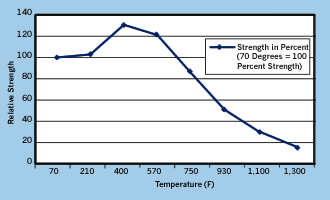
I did piping and boiler design for several years at a refinery.  Carbon steel, while it may not actually melt until you get it up to thousands of degrees, loses most of its structural strength between 700 and 1000 degrees(F), well below the temperatures in the WTC fires.  I lived with this frustrating fact every day, since many refinery processes crave higher temperatures.  Not only does steel's strength drop with higher temperatures, but it falls exponentially once it passes a certain threshold.  Some day soon I will post my refinery fire pictures, and show huge steel I-beam structures that collapsed from the heat of petroleum fires.  But here is a good reality check:  If skyscraper I-beams really won't fail at jet-fuel-fire temperatures, why do skyscraper builders waste millions of dollars insulating all the structural steel against building fires, which I can assure you burn much cooler than aviation fuel fires?

Beyond the basic science, most 9/11 conspiracy theories violate a couple of smell-tests.  The first and most obvious is Occam's razor.  Any theory that uses as a starting point a few small, minor uncertainties in events and explains these uncertainties with theories that have new, massive uncertainties in them is not necessarily wrong, but one has to treat it with huge dollops of skepticism.  As Jesse Walker described 9/11 cospiracy folks in Reason's Hit and Run, "They're the sort of people who will question whether a plane actually
hit the Pentagon on September 11, 2001, but won't question a theory
that can't explain just where the hijacked aircraft landed instead."

The other smell-test I use is a law I have dubbed Coyote's Law, and it goes like this:

When the same set of facts can be explained equally well by

  1. A massive conspiracy coordinated without a single leak between hundreds or even thousands of people    -OR -
  2. Sustained stupidity, confusion and/or incompetence

Assume stupidity.

Does anyone really believe that a Bush administration that can't keep a program involving a dozen people secret could keep the lid on a conspiracy this massive involving hundreds of people from any number of government agencies?  Isn't incompetence a more compelling answer here?

Alexander Cockburn thinks so, as quoted in Reason's Hit and Run:

One characteristic of the nuts is that they have a devout, albeit
preposterous belief in American efficiency, thus many of them start
with the racist premise that "Arabs in caves" weren't capable of the
mission. They believe that military systems work the way Pentagon press
flacks and aerospace salesmen say they should work. They believe that
at 8.14 am, when AA flight 11 switched off its radio and transponder,
an FAA flight controller should have called the National Military
Command center and NORAD. They believe, citing reverently (this is from
high priest Griffin) "the US Air Force's own website," that an F-15
could have intercepted AA flight 11 "by 8.24, and certainly no later
than 8.30."

They appear to have read no military history, which is too bad
because if they did they'd know that minutely planned operations -- let
alone responses to an unprecedented emergency -- screw up with
monotonous regularity, by reason of stupidity, cowardice, venality,
weather and all the other whims of providence....

August Bebel said anti-Semitism is the socialism of the fools. These
days the 9/11 conspiracy fever threatens to become the "socialism" of
the left, and the passe-partout of many libertarians.

By the way, can anyone tell me why the so called "reality-based" community, that so often criticizes the Right for theocratic attacks on science, is so quick to fall for this pseudo-scientific junk?

Update:  In case anyone cares, here is the temperature curve for the strength of carbon steel.

Steel

Update 2:  I am told by email that I will now be added to the long and growing list of those who are part of the conspiracy.  Cool!  Please make sure the CIA spells my name right on my payoff check.

Update3: And don't miss James Meigs here.

In every single case, we found that the
very facts used by conspiracy theorists to support their fantasies are
mistaken, misunderstood or deliberately falsified.

Here's one
example: Meyssan and hundreds of Web sites cite an eyewitness who said
the craft that hit the Pentagon looked "like a cruise missile with
wings." Here's what that witness, a Washington, D.C., broadcaster named
Mike Walter, actually told CNN: "I looked out my window and I
saw this plane, this jet, an American Airlines jet, coming. And I
thought, 'This doesn't add up. It's really low.' And I saw it. I mean,
it was like a cruise missile with wings. It went right there and
slammed right into the Pentagon."

We talked to Walter and,
like so many of the experts and witnesses widely quoted by conspiracy
theorists, he told us he is heartsick to see the way his words have
been twisted: "I struggle with the fact that my comments will forever
be taken out of context."


Amazing Disclaimer

My company runs recreation areas, and from time-to-time customers try to file claims against our company for dangers that are inherent to being out in nature  (example:  "I was climbing a tree out in the forest and fell down and hurt myself.  Your company needs to pay my medical bills.")

As a result of these experiences, I laughed when I saw this from the Nelson Rocks Preserve, who run a private nature park.  Here is just part of their disclaimer:


The Preserve does not provide rangers or security personnel. The other people in the preserve, including other visitors, our employees,
agents, and guests, and anyone else who might sneak in, may be stupid,
reckless, or otherwise dangerous. They may be mentally ill, criminally
insane, drunk, using illegal drugs and/or armed with deadly weapons and
ready to use them. We aren't necessarily going to do anything about it.
We refuse to take responsibility.

If you climb, you may die or be seriously injured. This is true whether
you are experienced or not, trained or not, equipped or not, though
training and equipment may help. It's a fact, climbing is extremely
dangerous. If you don't like it, stay at home. You really shouldn't be
doing it anyway. We do not provide supervision or instruction. We are
not responsible for, and do not inspect or maintain, climbing anchors
(including bolts, pitons, slings, trees, etc.) As far as we know, any
of them can and will fail and send you plunging to your death. There
are countless tons of loose rock ready to be dislodged and fall on you
or someone else. There are any number of extremely and unusually
dangerous conditions existing on and around the rocks, and elsewhere on
the property. We may or may not know about any specific hazard, but
even if we do, don't expect us to try to warn you. You're on your own.

Rescue services are not provided by the Preserve, and may not be
available quickly or at all. Local rescue squads may not be equipped
for or trained in mountain rescue. If you are lucky enough to have
somebody try to rescue you or treat your injuries, they may be
incompetent or worse. This includes doctors and hospitals. We assume no
responsibility. Also, if you decide to participate in a rescue of some
other unfortunate, that's your choice. Don't do it unless you are
willing to assume all risks.

By entering the Preserve, you are agreeing that we owe you no duty of
care or any other duty. We promise you nothing. We do not and will not
even try to keep the premises safe for any purpose. The premises are
not safe for any purpose. This is no joke. We won't even try to warn
you about any dangerous or hazardous condition, whether we know about
it or not. If we do decide to warn you about something, that doesn't
mean we will try to warn you about anything else. If we do make an
effort to fix an unsafe condition, we may not try to correct any
others, and we may make matters worse! We and our employees or agents
may do things that are unwise and dangerous. Sorry, we're not
responsible. We may give you bad advice. Don't listen to us. In short,
ENTER AND USE THE PRESERVE AT YOUR OWN RISK. And have fun!

Hat tip: Overlawyered.

Best 9/11 Footage

This is the best footage I have ever seen of the death of the WTC towers on 9/11, apparently just released by the folks who shot it from their apartment window.  I guess you can add these poor folks to the list of targets for conspiracy nut stalkers.

If You Want To Watch A Documentary on 9/11

I don't know much about the ABC 9/11 special everyone is arguing about, except to say that I am always suspicious of dramatic reenactments.  If you want a quick answer to whose fault the attacks were, I will give it to you and save you time:  The terrorists.  And if you want to to know which party's president ignored terrorism the most, I will answer that as well:  It's a tie.  Clinton ignored it for longer**, while Bush ignored it closer to the event.  To be fair, no one really expected the type of attack on September 11, so the blame game is kind of silly.

If you want to watch a great documentary that focuses on the terrorists and their victims, and not the politicians, the National Geographic special Inside 9/11, in two 2-hour parts, is being replayed tonight.  It is fabulous.

** By the way, Clinton supporters could defend their man and his attentiveness to terrorism by pointing out that most of the Patriot Act was actually proposed by Clinton in the mid-1990's.   Interestingly, but not surprisingly, I haven't heard many Democrats making this particular argument.

Greatest Onion Issue, Five Years Later

Few people in September, 2001 were willing to try to get us laughing again.  One notable exception was the Onion, which produced what was probably their greatest issue.  In particular, this is still dead-on five years later:

In a televised address to the American people Tuesday, a determined
President Bush vowed that the U.S. would defeat "whoever exactly it is
we're at war with here."...

Bush is acting with the full support of Congress, which on Sept. 14
authorized him to use any necessary force against the undetermined
attackers. According to House Speaker Dennis Hastert (R-IL), the
congressional move enables the president to declare war, "to the extent
that war can realistically be declared on, like, maybe three or four
Egyptian guys, an Algerian, and this other guy who kind of looks
Lebanese but could be Syrian. Or whoever else it might have been.
Because it might not have been them."...

Secretary of Defense Donald Rumsfeld said the war against terrorism will be different from any previous model of modern warfare.

"We were lucky enough at Pearl Harbor to be the victim of a craven
sneak attack from an aggressor with the decency to attack military
targets, use their own damn planes, and clearly mark those planes with
their national insignia so that we knew who they were," Rumsfeld said.
"Since the 21st-century breed of coward is not affording us any such
luxury, we are forced to fritter away time searching hither and yon for
him in the manner of a global easter-egg hunt."

"America is up to that challenge," Rumsfeld added....

Gramm said that the U.S. has already learned a great deal about the
details of the Sept. 11 terrorist attack on the World Trade Center and
Pentagon, and that a rough psychological profile of its mastermind has
been constructed.

"For example, we know that the mastermind has the approximate
personality of a terrorist," Gramm said. "Also, he is senseless. New
data is emerging all the time."

Five Years Ago

Five years ago today, I was in Manhattan on a business trip with my wife.  I almost never take my wife on business trips, but we had been living in Seattle for several years, and my wife, who had lived in NYC for years, wanted to go back and visit.

About 7:30 AM, I went down to breakfast in the W Hotel, where I was staying.  I was working at the time for an aviation startup, and in one of the great moments of bad timing, I was in New York that day to make presentations to investors, the theme of which was that commercial aviation was in the midst of a recovery, and the time was right to invest in a commercial aviation venture. 

Part way into breakfast, my wife came down to find me, and tell us we needed to see what was on TV.  We went up to one of my investor's rooms.  He had a terraced penthouse (its good to be the king) from which we watched the disaster unfold, with CNN on in the background.

The next 24 hours were among the weirdest of my life.  For a while, we actually tried to hold our scheduled meetings, but a number of attendees had friends and family who worked in the WTC, and we called it off.  I wandered the streets of Manhattan, where bizarre rumors were flying at every street corner.  People ducked in fear every time an airplane rushed over, by this time all air force fighter planes.  By noon, dust-covered people walking up from downtown got to our area, and streamed past for the rest of the day.  Strangely, I actually ran into a friend of mine who had the last Hertz rent-a-car in the city, and we made plans to drive out of the city the next day.

Phone and cell service were spotty, but we eventually got through to the person taking care of our kids back in Seattle as well as our parents.  I had not told my mom we were in NYC, so she began our call by saying "I'm so glad all my kids are no where near NY" and I had to tell her, "Uhh, mom..."

That night was like a scene out of some Charlton Heston post-apocalypse movie.  Police were only letting cars out of the island, not back onto it, so by nightfall the city was empty and dead quiet.  We finally found a restaurant in Times Square open, and the Square was empty.  There was maybe one car driving through every few minutes.  A few roller bladers where skating around Times Square, just because they could.

The next day we played find the exit from Manhattan.  We knew from various reports that there was at least one bridge off the island open, but from either confusion or misplaced security concerns, no one seemed to know which bridge.  We began to circumnavigate Manhattan, looking for an exit.  Finally, a police officer told us the only way out was to drive all the way north through Harlem on the surface streets and get on what I think was the GW bridge.  Anyway, that is what we did (finding out in the process that Harlem was not the hell-hole that gets portrayed in movies, at least the part we saw).  I have never, ever been so happy to get to New Jersey.  I wanted to kiss the ground.  Of course, we still had a short drive to Seattle ahead of us, but that was anti-climactic.

It was only later I began learning how many people I knew died in those buildings that day.  I guess I should have thought about it, given the schools I attended.  The death toll for Harvard Business School graduates alone was staggering.  Five years later, watching the retrospectives, nothing about that day seems any less horrible.  Time, at least for me, has not softened the magnitude of this disaster. 

The only silver lining I can come up with is that we have gone five years without a major terrorist attack on this country, though other's have been attacked.  Walking around on September 12, we were all sure that this was just the front-end of a wave of massive attacks.  So far, whether through luck or skill, we have avoided this fate. 

One thing I will say is that we always prepare for the last attack.  We have spent a lot of time making sure no terrorists can take over a plane with toenail clippers and fly it into another building.   But that kind of attack was obsolete 20 minutes after the second plane hit the WTC -- It didn't even work on United 93.

What are People Afraid Of?

I just don't know why conservatives are so afraid to let folks like Khatami speak in the US.  Sure, he is a lying dictatorial human-rights-suppressing scumbag, but so what?  Its good to let people like this speak as much as they want.  They always give themselves away.  There were counter-protests and lots of debate about Iran in the news and on the nets, and that is as it should be.

I suppose conservatives real fear is that the press will, as they sometimes do, throw away their usual skepticism and cynicism and report his remarks as if they were those of a statesman rather than a thug on a PR mission.  But that's a different problem, and not a good enough excuse to suspend free speech, even for a man who granted it to no one else in his own country.  (I have never bought into the "media bias" critique, either conservative or liberal, in the press, because this seems to imply some active conspiracy exists to manage the news to some end.  Rather, I think it is more fair to say that reporters tend to apply too little skepticism to stories with which they are sympathetic.  For example, many reporters think homelessness is a big problem, so they were willing to uncritically accept inflated and baseless numbers for the size of the homeless population, numbers they would have fact-checked the hell out of if they had come from, say, an oil company to whom they are unsympathetic or skeptical of.)

On the same topic, I don't know why conservatives are so worried about this story of an increase in students from Saudi Arabia.   It used to be that we had confidence that people from oppressive countries would have their eyes opened by living in the US.  We have always believed that intellectually, freedom was more compelling than dictatorial control, and would win over hearts and minds of immigrants.  Our foreign policy with China, for example, is counting on engagement to change China.  Have we given up on this?

I Have Never Even Been To Rochester

There is nothing bloggers enjoy more than ranking themselves. Brian Gongol issues the latest rankings, this time of Business and Economics blogs.  Coyote Blog actually makes the rankings, with between 8-9% of the traffic of the leader Marginal Revolution (which is a great site).  Gongol uses a newspaper analog to say that if Marginal Revolution is USA Today, I am the Rochester Democrat and Chronicle.  Uh, OK. 

Maybe someone can set up trade futures on business blog rankings.  If that were to happen, you know what Marginal Revolution would title the post....

By the way, he leaves off two of my favorites, probably because they are not in the NZ Bear data base:  Cafe Hayek and Mises Blog.

Kudos to the IJ

If you are not familiar with the Institute for Justice, the IJ is like the ACLU but from an alternate universe where the ACLU was not founded by a Stalinist and actually believed in property rights.  The IJ represented Ms. Kelo in her fight against eminent domain to aid Pfizer in Connecticut, and often takes on stupid government licensing programs.  For example, the IJ is representing some folks in New Mexico who think that it will not materially harm public safety if they do interior design without a government license:

If you need a license to arrange flowers
in a vase, it stands to reason that you'd need a license to arrange
furniture in a house"”not to mention picking paint and window
treatments. Or so the state of New Mexico (along with four other
states) seems to think. To be fair, you can do interior design in New
Mexico without a license; you just can't call it interior design, or
call yourself an interior designer, which makes it hard for potential
customers to find you. Today two people who in most states would call
themselves interior designers filed a federal lawsuit objecting to the
state's protectionist censorship on First Amendment grounds.

In the past, the IJ has also fought for the right of hair braiders and casket salesmen to operate without a state license.

Confirming What We've Suspected

I usually try to wait a while to let sources like this get vetted.  With the proviso that it may turn out that this guy didn't have the access he says he had, this certainly is pretty damning, though I don't think many Bush critics will be surprised.  This is a quote in a local paper from an interview of Brigadier General Mark Scheid, who claims to be one of the top planners for the Iraq war (Hat tip:  Orin Kerr at Volokh, emphasis added)

A day or two [after 9/11], Rumsfeld was "telling us we were going to
war in Afghanistan and to start building the war plan. We were going to
go fast.

Then, just as we were barely into Afghanistan ... Rumsfeld came and told us to get ready for Iraq." . . .

Planning was kept very hush-hush in those early days.

"There was only a handful of people, maybe five or six, that were
involved with that plan because it had to be kept very, very quiet."

There was already an offensive plan in place for Iraq, Scheid said. And
in the beginning, the planners were just expanding on it.

"Whether we were going to execute it, we had no idea," Scheid said.

Eventually other military agencies - like the transportation and Army materiel commands - had to get involved.

They couldn't just "keep planning this in the dark," Scheid said.

Planning continued to be a challenge.

"The secretary of defense continued to push on us ... that
everything we write in our plan has to be the idea that we are going to
go in, we're going to take out the regime, and then we're going to
leave," Scheid said. "We won't stay."

Scheid said the planners continued to try "to write what was called
Phase 4," or the piece of the plan that included post-invasion
operations like occupation.

Even if the troops didn't stay, "at least we have to plan for it," Scheid said.

"I remember the secretary of defense saying that he would fire the next
person that said that," Scheid said. "We would not do planning for
Phase 4 operations, which would require all those additional troops
that people talk about today.

"He said we will not do that because the American public will not back us if they think we are going over there for a long war."

If true, this is hard to defend.  I guess the administration could argue that they didn't want to clutter up their core planning effort with contingencies.  Beyond this being pretty bad planning practice, it also makes no sense because at the time this planning started, according to the administration time line, the Iraq War itself was just a contingency.

Circumscribing the "War on Terror"

One of the reasons I blog is that the act of writing helps me clarify my thinking on certain issues.  I have written a number of times about my concerns over the "war powers" this administration is taking upon itself.  Arnold Kling's article in TCS Daily helped me clarify a better framework for thinking about my issues.  I can now put my concerns in two categories:

  • The administration is going too far in using the war as an excuse to circumvent a number of Constitutional protections, from habeas corpus to search and seizure.  This does not mean that I am necessarily against all new activities, but they need to be initiated within our Constitutional framework.  Take surveillance activities.  Its not unreasonable to think that terrorism demands new surveillance tools.  But the principle we have always followed for surveillance is that Congress authorizes the power and the judiciary gets some type of review of the targets and methods.  Bush seems to have become impatient with separation of powers to the point that he does not even try to engage the other arms of the government, instead using the war to claim a fiat power.  (It should be noted that even when the separation of powers is respected, as with the Patriot Act, mistakes are made and we can go too far.  However, at least we can debate it and there are Congressmen we can hold accountable).
  • The second category of problem I have is with the open-ended nature of the war.  Calling this the "War on Terror" is only marginally more precise and limiting than saying we are fighting the "War against Bad Stuff."  If one asks, "Who are we fighting", the administration answers "Whoever the President says we are fighting against".  If one asks "When is it over" the administration either answers "Whenever the President says it is" or else, probably more honestly, they say "not for a long, long time."

In terms of civil liberties, the second point may be the most problematic.  Most citizens will grant the President some special war powers (as in fact the Constitution does), though we can argue whether the current administration has gone too far in defining these powers for themselves.   But if you combine this with letting the administration define exactly who the enemy is and how long the war lasts, it makes for a combination deadly to civil liberties.

Take the example of detention of enemy combatants.  Administration supporters argue that we have always been authorized to hold enemy combatants until the end of the war, as we did in WWII.  And so we did.  We were at war with Germany, so we detained German soldiers we captured until the end of the war.  Note that these are definitions that everyone at the time could agree on -- ie everyone knew what a German soldier was and everyone knew that "end of the war" meant when we marched into Berlin.  Few German detainees were held for much more than a year.  By the way, it is interesting to note that even in WWII, we abused this notion.  The administration defined "enemy combatant" as "anyone in the US of Japanese descent", so that we ended up interning innocent American citizens for years, much to our shame today.

However, in the current "war", an enemy combatant is anyone the administration says is an enemy combatant (at least in their theory) and "for the duration" means as long as the administration cares to hold them, up to and including "forever." 

Conservatives wish to argue that the "War on Terror" is a new kind of war and demands new tools to fight it, which they use to justify all kinds of secret searches and detainments.  Fine, but then it also needs new types of civil liberties checks.  Coming back to our detention example, in WWII it was not really necessary to have some kind of judicial review on the question of whether a captured German soldier was an enemy combatant;  the uniform was a pretty good giveaway.  However, such a review is necessary today, since the enemy combatants languishing at Gitmo (many of who I am willing to believe are bad guys) don't have any identifying uniforms or paperwork.

If I read him right, Kling is saying something similar:  Some security activities that were traditionally not allowed may be necessary, but for every civil liberties give-back there needs to be a countervailing new control or check on government activity:

On the whole, Posner makes a persuasive case for tilting the judicial
balance in favor of reasonable efforts to promote security rather than
strict-constructionist civil libertarianism. However, I believe that
what we need to do is re-build our civil libertarian fortresses, not
simply retreat from them. That is why I favor much stronger accountability for agencies engaged in surveillance. It is why I am proposing here a formal process for naming our enemies.

You Can't Make Decisions for Yourself

A frequent topic of this blog is to point out situations where technocrats translate their distrust for individual decision-making into the justification for government control

Kevin Drum provides me with one of the best examples I have seen of late of this phenomena of using distrust of individual decision-making to justify government intervention, in part because he is so honest and up-front about it.  I usually try not to quote another blogger's posts in total, because I want to give folks an incentive to go visit the site, but in this case I need to show the whole thing (the extensive comments are still worth a visit):

If we treat healthcare like any other market, allowing consumers
free rein to purchase the services they like best, will it produce high
quality results? A recent study suggests not:

Researchers
from the Rand Corp. think tank, the University of California at Los
Angeles and the federal Department of Veterans Affairs asked 236
elderly patients at two big managed-care plans, one in the Southwest
and the other in the Northeast, to rate the medical care they were
getting. The average score was high "” about 8.9 on a scale from zero to
10.

....In the second part of their study, the medical researchers
systematically examined 13 months of medical records to gauge the
quality of care the same elderly patients had received....The average
score wasn't as impressive as those in the patient-satisfaction
surveys: 5.5 on a 10-point scale. But here's the interesting part:
Those patients who graded the quality of their care as 10 weren't any
more likely to be getting high-quality care than those who gave it a
grade of 5. The most-satisfied patients didn't get better medical care
than the least-satisfied.

Surprise! Patients are
poor judges of whether they're getting good care. And if consumer
preferences don't map to high quality care, then a free market in
healthcare won't necessarily produce better results or higher
efficiency, as it does in most markets.

Back to the drawing board. Perhaps a national healthcare system
would be a better bet to reduce costs, cover more people, provide
patients with more flexibility, and produce superior outcomes. After
all, why are we satisfied with allowing the French to have a better
healthcare system than ours even though we're half again richer than
them?

There is it, in black and white:  Most of you individual slobs out there cannot be trusted to make good health care decisions for yourselves, so the government should do it for you.  (And by the way, who the hell thinks the French have a better health care system, but that's off-topic for today).

Here is the false premise:  If the intellectuals who ran the study judged that the individuals involved were getting poor care when the individuals themselves thought is was good care, this does not necessarily mean the individuals being studied were wrong.  It may very well mean they have different criteria for judging health care quality and value.  In fact, what goes unquestioned here, and I guess the reader is supposed to swallow, is that there is some sort of Platonic ideal of "high-quality care" that the people who run this study have access to.

But this is ridiculous.   Does high-quality mean fast?  painless?  private?  successful?  pleasant? convenient?  I, for example, have all the patience of an 8-year-old who just ate three pieces of birthday cake washed down by two Cokes.  I need stuff now, now, now.  I hate gourmet restaurants where meals take 3 hours.  Many gourmands, on the other hand, would probably shoot themselves before eating some of the food I eat.  We have different standards.

Let's take an example from another industry:  Cars.  Every year, the "experts" at Consumer Reports and Car and Driver try out all the new cars and publish the two or three they think are the best.  So, does this mean that everyone who does not buy one of these cars selected by the experts as the best are making a bad decision?  Does this fact tell us the government should step in and buy their cars for them because they can't be trusted to make the right evaluations?   NO!  Of course not.  It means that the people who buy other types of cars have different criteria and priorities in judging what a "high-quality" car is.  Some want high gas mileage.  Some want a tight interior with leather.  Some want a big honkin' engine.  Some want a truck jacked way up in the air.  Some want room to carry five kids.   You get the idea.

There are at least two better explanations for the study results.  Let's first be clear what the study results were:  The study found that the patients studied graded health care differently than did the people who ran the study.  That's all it found.  This could mean that the intellectuals who ran the study and the individuals studied judged care on different dimensions and with different priorities.  Or it could mean that the individuals studied had incomplete information about their care and their choices.  Neither justifies a government takeover of the industry.  (In fact, to the latter point about information, markets that are truly allowed by the government to be free, which health care has not, often develop information sources for consumers, like the car magazines mentioned above.)

The thinking in Drum's post betrays the elitist-technocratic impulses behind a lot of the world's bad government.  Look at "progressive" causes around the world, and you will see a unifying theme of individual decisions that are not trusted, whether its a poor Chinese farmer who can't be trusted to choose the right factory work or an American worker who can't be trusted to make her own investment decisions for retirement.

Postscript:  In some past era, I might have called this one of the worst excuses for fascism I had ever heard.  Unfortunately, Brad DeLong recently took that title with his post that the government needs to take even more money from the rich because the rich are ostentatious and that hurts other people's feelings.  No really, I don't exaggerate, he said exactly that.  If somehow you have missed this one, look here.