Uncovering Some Really Bad Science

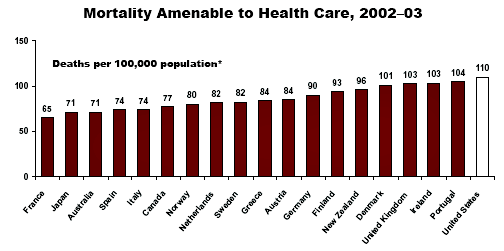
Kevin Drum thinks he has a killer analysis supporting government health care.  In a post he titles sarcastically "Best Healthcare In the World, Baby," Drum shares this chart:
Blog_deaths_amenable_healthcare

The implication is that the US has the worst healthcare system, because, according to this study, the US has the highest rates of "amenable mortality," defined as deaths that are "potentially preventable with timely and effective health care."

I get caught from time to time linking to studies that turn out to have crappy methodology.  However, I do try to do a little due diligence each time to at least look at their approach, particularly when the authors are claiming to measure something so non-objective as mortality that was "potentially preventable."

So, when in doubt, let's look at what the author's have to say about their methodology.  The press release is here, which gets us nowhere.  From there, though, one can link to here and then download the article from Health Affairs via pdf  (the site is gated but I found that if you go through the press release site you can get in for free).

The wording of the study and the chart as quoted by Mr. Drum seem to imply that someone has gone through a sampling of medical histories to look at deaths to decide if they were preventable deaths.  Some studies like this have been conducted.  This is not one of them.  The authors do not look at any patient data.

Here is what they actually did:  They arbitrarily defined a handful of conditions as "amenable" to care.  These are:

Ischemic Heart Disease (IHD)
Other circulatory diseases
Neoplasms (some cancers)
Diabetes
Respiratory diseases
Surgical conditions and medical errors
Infectious Diseases.
Perinatal, congenital, and maternal conditions
Other (very small)

All the study does is show how many people died in each country from this set of diseases and conditions.  Period.  It doesn't determine if they got care or if they in particular could have been saved, but just that they died of one of the above list of conditions.  This study was not an effort to identify people who died when their particular condition should have been preventable or amenable to care;  all it measures is the number of people in each country who died from list of conditions.  If Joe is talking to me and in the next second flops over instantly dead of a massive heart attack, the author's consider him to have died of a disease amenable to care.

We can learn something by looking at the breakdown of the data.  If you can't read the table below, click on it for a larger version

Amenablediseases_2

Let's take the data for men.   The study makes a big point of saying that France is much better than the US, so we will use those two countries.   In 2003, France has an "amenable disease" death rate 56 points lower than the US.  But we can see that almost this whole gap, or 42 points of it, comes from heart and circulatory diseases.  The incidence of these diseases are highly related to diet and lifestyle.  In fact, it is well established that the US has a comparatively high incidence rate of these diseases, much higher than France.  This makes it entirely possible that this mortality difference is entirely due to lifestyle differences and disease incidence rates rather than the relative merits of health care systems. In fact, this study is close to meaningless.  If they really wanted to make a point about the quality of health care systems, they would compare them on relative mortality with a denominator of the disease incidence rate, not a denominator of total population.

But in their discussion, the study's authors reveal themselves to be, if I am reading them right, complete idiots in terms of statistical methods.  The authors acknowledge that lifestyle differences may be a problem in their data.  This is how they say they solved this problem:

It is important to recognize that the development of any list of indicators of amenable mortality involves a degree of judgment, as a death from any cause is typically the final event in a complex chain of processes that include issues related to underlying social and economic factors, lifestyles, and preventive and curative health care. As a consequence, interpretation of findings requires an understanding of the natural history and scope for prevention and treatment of the condition in question. Thus, in the case of IHD, we find accumulating evidence that suggests that advances in health care have contributed to declining mortality from this condition in many countries, yet it is equally clear that large international differences in mortality predated the advent of effective health care, reflecting factors such as diet and rates of smoking and physical activity.16 To account for this variation, we included only half of the mortality from IHD, although, based on the available evidence, figures between, say, 25 percent and 70 percent would be equally justifiable.

I have a very smart reader group, so my sense is that many of you already see the gaffe here.  The author's posit that 50% of heart disease may be due to lifestyle, though the number might be higher or lower.   So to correct for this, they reduce every country's heart disease number (IHD) by a fixed amount of 50%.  WTF??  This corrects for NOTHING.  All this does is reduce the weighting of IHD in the total measure. 

Look, if the problem is that lifestyle contribution to heart disease varies by country, then the percentage of IHD deaths that need to be removed because the deaths are lifestyle related will vary by country.  If the US has the "worst" lifestyle, and the number for lifestyle deaths is about 50% there, it is going to be less than 50% in every country.  The correction, if an accurate one could be created, needs to be applied to the variance between nations, not to the base numbers.  Careful multiple regressions might or might not have sorted the two sets of causes apart, but dividing by 50% doesn't do anything.  This mistake is not just wrong, it is LAUGHABLE, and calls into question the author's qualification to say anything on this topic.  They may be fine doctors, but they don't know squat about data analysis.

There may be nuggets of concern for the US lurking in this data.  I don't know how they measure deaths from surgical conditions and medical errors, but its not good to be higher on this.  Though again, you have to be careful.  The US has far more surgeries than most other countries per capita, so we have more surgical deaths.  Also, medical error data is notoriously difficult to compare country to country because reporting standards and processes are so different.  In the US, when the government measures medical errors, it is a neutral third party to the error.  In Europe, the government, as healthcare provider, is often the source of the error, calling into question how aggressive these countries may be in defining "an error."  Infant mortality data is a good example of such a trap.  The US often looks worse than European nations on infant mortality because it is defined as infant deaths as a percentage of live births.  But the US has the most advanced neo-natal capabilities in the world.  Many pregnancies that would result in a "born dead" in other countries result in a live birth in the US.  Since these rescued births are much more problematic, their death rate is much higher.

There is good news for the US in the study.  The item on this list most amenable to intensive medical intervention is cancer (neoplasms in the study above).  In that category, despite a higher incidence rate than many of these countries, the US has one of the lowest mortality rates as a percentage of the total population, which implies that our cancer mortality in the US as a percentage of cancer incidence is much better than these countries.  This shows our much higher 5-year cancer survival rates.

Update:  I thought this was pretty clear, but some of the commenters are confused.  The halving of IHD numbers was applied to all countries, not just the US.  So the actual male US IHD number is about 100 before halving and the actual French number is about 40.  Again, this halving only reduces the weighting of IHD in the total index; it in no way corrects for differences in incidence rate. 
Worst Fears Realized

Frequent readers will know that unlike most other libertarian blogs, I have not plastered the site with hopeful articles and endorsements for Ron Paul.  I have always been 99% supportive of his work in Congress and was happy to have him there.  But I resisted even registering in the Arizona primary to vote for him.  Arizona requires that to vote in a primary, I have to register as belonging to that party, and I am just not going to do that.

Part of my reluctance to jump on the bandwagon has been my general disaffection with politics and some ambivalence as to whether my elected overlord is from Coke or Pepsi.  The rest, I think, was a subliminal fear of supporting any Libertarian candidate because they always seem to turn out to be wing-nuts.  QED.

Update:  The excuse that he didn't know what was in a series of ghost-written newsletters is just ridiculous.  I will accept that excuse for one issue, a mistake in selecting partners (I am sure there are bloggers out there who regret guest-blogger selections) but a long series of newsletters implies tacit approval or at least acceptance. 

What Goes Around, Comes Around

For years, protectionists in this country have tried to argue that "oh, I am really for free trade, but to be fair we must impose environmental and labor standards on our trading partners."  Well, now Europe is proposing doing exactly the same to us:

The European Commission is considering proposing a
carbon dioxide tariff on imports from states failing to tackle
greenhouse gas emissions, while also considering a toughening-up of the
EU's own emission trading system....


The plan reflects pressure by French president Nicolas Sarkozy who
argued in October that Europe should "examine the option of taxing
products imported from countries that do not respect the Kyoto
Protocol," referring to the 1997 international agreement on fighting
climate change.

Mr Sarkozy urged Brussels to discuss the implications of "unfair
competition" by firms outside the EU, which do not have to abide by
strict European standards on CO2 emissions.

This letter from Don Boudreaux seems relevant:

Hillary Clinton needs a
language lesson.  She favors only trade that is found by government to
"benefit[] our workers and our economy" and that promotes "rising
standards of living across the world" ("" December 3; my emphasis).  She then asserts that "There is nothing
protectionist about this."

Oh please.

Protectionism
exists whenever, wherever, and whyever government artificially raises
its citizens' costs of buying imports.  Protectionism has forever
rested on the false notion that government officials know best how
consumers should spend their money.  And it attempts today to hide its
ugly face behind the smiling mask of allegedly noble intentions, such
as those mouthed by Sen. Clinton.

The title of his post is "The Moment Somone Must Explain that He or She Isn't a Protectionist, You Can Bank on that Person Being a Protectionist."


Subsidize Biofuels, Destroy the Rainforest

Not much comment necessary for the following, except to say that I don't think one should be able to call this an unintended consequence of US biofuel and corn subsidies when 1) the results are utterly predictable and 2) folks like myself publicly predicted it.

The US is the world's leading producer of soy, but many American soy
farmers are shifting to corn to qualify for the government subsidies.
Since 2006, US corn production rose 19% while soy farming fell by 15%.

The
drop-off in US soy has helped to drive a major increase in global soy
prices, which have nearly doubled in the last 14 months. In Brazil, the
world's second-largest soy producer, high soy prices are having a
serious impact on the Amazon rainforest and tropical savannas.

"Amazon
fires and forest destruction have spiked over the last several months,
especially in the main soy-producing states in Brazil," said Laurance.
"Just about everyone there attributes this to rising soy and beef
prices."

High soy prices affect the Amazon in several ways. Some
forests are cleared for soy farms. Farmers also buy and convert many
cattle ranches into soy farms, effectively pushing the ranchers further
into the Amazonian frontier. Finally, wealthy soy farmers are lobbying
for major new Amazon highways to transport their soybeans to market,
and this is increasing access to forests for loggers and land
speculators.

Campground Bleg

Sorry, this is work-related, but we are considering bidding on the management of campgrounds on Lake Merwin, Yale Lake, and Swift Reservoir near Mt. St. Helens in WA.  Since these facilities are under a lot of snow, I won't be able to get a good feel for them.  Anyone out there familiar with these facilities?  If so, I would love an email or comment post about them, good or bad.

Time to Move on From Blaming Thimerosal

Kevin Drum observes that yet another study has put to rest the theory that Thimerosal, a preservative that used to be put in some childhood vaccines, causes autism:

However, despite the equivocal (at best) scientific evidence linking
thimerosal to autism, conspiracy theories abounded and the issue deeply
split the autism community. Firm evidence in one direction or the
other, though, had to wait until now. Thimerosal was ordered removed
from most childhood vaccines in 1999, and by the early 2000s children
had stopped receiving virtually all thimerosal-based vaccines. If
autism rates then decreased, it would be good evidence that thimerosal
really had been to blame.

But that didn't happen. Interim studies have shown no decrease in
autism rates, and a study released today puts the nail in the coffin of
the thimerosal story. It tracks children born in California and
includes enough years of data to show pretty definitively that autism
diagnoses continued to rise even after thimerosal was removed

I thought it was time to move on from this theory years ago, but Drum says that it continues to be carried forward by parents desperate to find an explanation for their child's autism.  I guess I am a bit more cynical, for I would argue that this bad science of Thimerosal has been carried forward, just like the bad science of breast implant caused immune deficiencies, by trial lawyers desperate for another easy extortion target.  And, just as medical studies did not stop lawyers from pressing forward implant lawsuits, I am sure the Thimerosal lawsuits are not going to go away either.

What Happens When You Abandon The Price Mechanism to Allocate Resources

When the government does not allow prices to float in real time in response to changes in supply and demand, then gluts and shortages are inevitable.  When shortages occur, due to prices that are capped or not allowed to move upwards sufficiently quickly, queues and/or spot shortages occur.  When the government decides it does not like this, the jack-booted thugs step in and we have government-enforced rationing.  California, famous for its stupidity in letting wholesale electricity prices float while capping retail prices and thus creating an economic disaster several years ago, is at it again in the electricity market:

What should be controversial in the proposed revisions to Title 24 is
the requirement for what is called a "programmable communicating
thermostat" or PCT. Every new home and every change to existing homes'
central heating and air conditioning systems will required to be fitted
with a PCT beginning next year following the issuance of the revision.
Each PCT will be fitted with a "non-removable " FM receiver that will
allow the power authorities to increase your air conditioning
temperature setpoint or decrease your heater temperature setpoint to
any value they chose. During "price events" those changes are limited
to /- four degrees F and you would be able to manually override the
changes. During "emergency events" the new setpoints can be whatever
the power authority desires and you would not be able to alter them.

In
other words, the temperature of your home will no longer be yours to
control. Your desires and needs can and will be overridden by the state
of California through its public and private utility organizations. All
this is for the common good, of course.

I can't think of anything that better illustrates the tie between free exchange and freedom.  And by the way, how long before the greenies in the legislature suggest using this mechanism even when there are not shortages to turn down everyone's air conditioner, just because they can.

Update: Exercise for the reader -- Figure out how, once this policy goes bad, the state of California will again blame Enron for their failure.

Rorchach Test

Over at Climate Skeptic, I administer a 20-second Rorchach test on a sea ice chart.

Finally Fixed

After several years and jillions of emails telling me I have a problem, I finally have https://coyoteblog.com  (without the www) pointing to this site rather than an under construction page. 

Staggering Arrogance

This is a story that most people who care for humanity would consider good news:

After years of secret preparation, the world's cheapest car will be unveiled in Delhi this week...At 100,000 rupees (£1,290), the People's Car, designed and
manufactured by Tata, is being marketed as a safer way of travelling
for those who until now have had to transport their families balanced
on the back of their motorbikes.

Ratan Tata, 70, chairman of the
family-run business, who has spearheaded the race for a cut-price car,
wrote on the company website: 'That's what drove me - a man on a
two-wheeler with a child standing in front, his wife sitting behind,
add to that the wet roads - a family in potential danger.'

But Tata hopes also to create a 'new market for cars which does not
exist', making them accessible to India's booming middle classes made
recently rich by an economy growing at around 9 per cent a year. ...

Last
year just over one million cars and seven million motorbikes were sold
in India. Tata wants to transform some of those motorbike buyers into
car owners and believes that the company can eventually sell up to a
million People's Cars a year. Analysts say the project could
revolutionise car prices, not just in India, but globally. Several
other manufacturers have similar products in the pipeline.

Awesome.  This is a story about three quarters of a billion people who have lived in poverty, well, forever, starting to join the middle class.

But many environmentalists, about 100% of whom I would venture to say own a car themselves, oppose this transition to prosperity:

'There is this mad rush towards lowering the prices to achieve mass
affordability,' said Anumita Roychoudhury, of the Centre for Science
and Environment in Delhi. 'If vehicle ownership increases very rapidly,
we'll have a time bomb ticking away. When you lower the price that
drastically, how will you be able to meet the safety and emissions
standards? There are no clear answers yet.'

I would challenge this person to design a car that doesn't crash test better than a motorbike.  This is just incredible arrogance, attempting to deny millions of people the prosperity which western environmentalists already share.  (via Maggies Farm)

Postscript: The fact is that environmental quality in every developing nation tends to follow a J-curve.  Early stage development tends to muck things up a bit (think air quality in 1018th century Pittsburg or in China today) but things improve as people get wealthier.  Places like China and India are in some of the lowest reaches of that J-curve.  Attempting to freeze their development in place not only arrogantly denies these folks prosperity, but also cuts off future environmental gains that come with wealth.

The Libertarian Foreign Policy Problem

Outside of trade policy and climate treaties, I very seldom discuss foreign policy.  First, because it is not my first interest.  Second, because I am not an expert and do not spend the time to keep myself sufficiently informed on the issues to have useful insights.  Third, because of exactly this problem stated so well my Megan McArdle:

I periodically flirt with isolationism, or if you prefer,
"non-intervention". Like most libertarians, I'm attracted to "high
concept" political philosophy: simple rules that can be stated in a
sentence or less. No arguments about causus belli, blowback, or
ultimately unknowable political ramifications; just a simple "yes or
no" test. Did a foreign army invade the United States? For "Yes", press
one; for "No", press two, and go back to arguing about what should
replace child welfare laws in the coming anarcho-capitalist society.

Besides, all the foreigners hate having us there. Why not leave, and
see if absence makes the heart grow fonder? (I suspect that many
nations which have come, over long decades, to regard regional peace as
some sort of natural law, will get a rather nasty surprise. This might
make our influence look, in retrospect, rather appealing.)

But anyone who thinks at all seriously about libertarianism will,
fairly early on, be faced with a very high hurdle. There are a handful
of wars in which American intervention unambiguously halted gross
abuses of human liberty. World War II is one, though many end up going
around, rather than over . . . arguing that the Nazis were the direct
result of American intervention in World War I; or that it was
justified because Japan attacked us1; or that Russia and Britain would have defeated Hitler anyway2.  The American Civil War, however, is by far the highest leap; and the hardest to dodge.

In theory, every state has the right to secede, and the stated
Federal rationale for the Civil War--preserving the union--was the
vilest tyranny. In practice, chattel slavery was a barbarism even
viler.

And so we killed 20-30% of the Confederate Army, not a few of our
own, and uncounted numbers of civilians. That's not counting the
wounded, who probably outnumbered the dead. All we managed to achieve,
at this horrendous cost, was a corrupt and brutal occupation, followed
by the "freedom" of Jim Crow, sharecropping, and "separate but equal". And it was worth it.
The good guys won. We didn't do everything we wanted to, or even
everything we could have, or should have. Jim Crow was putrid. But it
was nonetheless so much better than slavery that it was worth the
horrendous cost--in my opinion, and that of almost everyone in the
world.

For me, a big part of the problem is one of information -- generally, most of the information one might find useful in deciding if X is a good war to pursue is from the government, an institution that demonstrably cannot be trusted based on past history when it makes this case.  Non-interventionism seems the right way to go, except for the
(relatively few) times it is not.  The problems is, to paraphrase the
famous dictum about advertising money, "half (or more) of our wars are
a waste -- we just don't know in advance which half."  Megan uses the
example of the Civil War, saying that that war was worth it because we
got rid of slavery.  But the war by no means began that way.  It wasn't
really until well into the war that both sides were pretty much in
agreement that the war was about ending or retaining slavery. I would argue that in advance, that war looked like an awful, terrible, horrible proposition.  The initial value proposition was "let's go to war so the Feds can have a bigger empire to run."  Only later did it become, "let's go to war to free a large part of our population."  There was a female professor, I forget her name, who made the point that the Emancipation Proclamation changed the war from a bloody waste of time to a moral positive.  But that came years into the fight.

The other problem I have is that the war is fought by, well, the government, the institution for which I have no trust.  One way of thinking about it is that every time we go to war, we put our lives and treasure and very future as a country in the hands of the Post Office.  Eeek.

Using Copyright Law to Block Price Arbitrage

Movie producers sell DVDs cheaper in, say, Taiwan than they do in the US.  This is not an unheard of economic phenomenon -- it happens in every commodity and product.  The reason we don't notice these price differences too much is that traders and arbitragers and shipping companies will target the largest price differentials and take advantage of them by buying and shifting products around until the price differential is less than the transportation and transaction costs.  Basic economics.

However, despite a number of structural advantages that already serve to reduce this cross-flow (e.g. different languages), the media companies are trying to stretch copyright law far beyond what CopyOwner says is legally defensible:

Copyright owners (including the owners of the "works" embodied in
the copyrighted labels on common non-copyrighted goods) like to
discriminate in pricing by creating artificial markets so that
discounts in one market won't be resold at a lower price in over-priced
markets. The thinking goes, "Why let U.S. consumers get the benefit of
prices that are affordable to people in developing countries when we
know we can get more out of the U.S. consumer's pocket?"

The
"first sale doctrine," now codified as Section 109 of the Copyright
Act, makes clear that the copyright owner's right of distribution is
subject to the copy owner's right to sell it to anyone, anywhere, at
any price. And that's great policy. Entrepreneurs who see too big a gap
between the prices charged U.S. consumers and the prices charged
consumers elsewhere for identical copies can buy the cheaper product
and sell it at a profit, while still giving the U.S. consumer a better
bargain.

But that's not why I nearly fell out of my chair. I
was used to these anti-competitive price discriminators ranting about
perfectly lawful gray market goods. What this story does is label these
perfectly legal importers as pirates. That's right. Despite quoting the
Supreme Court in Quality King Distributors v. L'anza Research International,
that "once the copyright owner places a copyrighted item in the stream
of commerce by selling it, he has exhausted his exclusive statutory
right to control its distribution," a ruling that suggests that the
evildoers are those who try to circumvent the law by preventing gray
market imports, they go on to call the importers "pirates"

Big Round Number

It is always amazing how big round numbers hold the media in thrall.  Last week we saw the inevitable spate of articles about oil crossing the $100 mark, if only for a few minutes of trading  (actually, the more interesting milestone was somewhere back in the low $90 range when we exceeded the highest past price for oil in inflation-adjusted dollars).

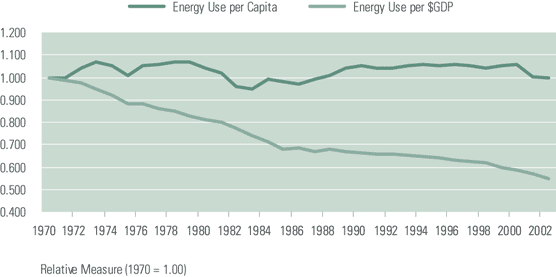
I don't get hugely worked up about gradual commodity price changes.  Oil price increases are signals, signaling marginal consumers to use less and suppliers with historically marginal sources and substitutes to consider their development.  Also, our economic dependence on oil per dollar of GDP has declined, meaning that $100 oil has less impact on the economy than, say, it would have 20 years ago:

Insightnov07energysec3

I would certainly prefer lower oil prices, and my business suffers to some extent when gas prices rise, but it is not a disaster  (it is interesting that higher oil prices are considered bad in the media, while lower home prices are considered bad in the media).  I know from past experience in the oil patch that oil price bubbles are often followed by oil price drops.  The high oil prices of the seventies were followed by rock-bottom oil prices in the eighties, and subsequent recession in the oil patch (causing the housing bust I discussed here). 

Also, given how we got to these higher oil prices, I tend to take them as good news.  Oil prices are not rising due to some drop off in supply.  Instead, they are rising because of a strong global economy, in particular with millions of people entering the middle class in Asia.  This is GOOD news. 

I have written on peak oil a bunch, so I won't get into it again.  Oil production at worst is going to flatten out for a long time, meaning we will have a steady rise in oil prices over time as the economy grows.  If you want a third party evaluation of peak oil theory, go ask climate catastrophists who believe that CO2 production is an impending disaster for the economy.  These guys know that there are lots of unproduced hydrocarbons out there, and it terrifies them.   Al Gore and James Hansen were running around last week trying to close off Canadian tar sands from development.

Finally, after this series of random thoughts, one more interesting take on this via Megan McArdle:  $100 oil was a stunt

Some observers questioned the validity of the price mark when it
emerged that the peak was the result of a trader "“ one of the "locals"
who trade on their own money "“ buying from a colleague just 1,000
barrels of crude, the minimum allowed, industry insiders said. The deal
on the floor of the New York Mercantile Exchange was at a hefty premium
to prevailing prices.

Insiders named the trader as Richard Arens, who runs a brokerage
called ABS. He was not available for comment. Analysts said he may have
been testing the ceiling of the crude price, but the premium he paid
surprised the market.

Before the $100-a-barrel trade, oil prices on Globex were at $99.53
a barrel. Immediately after the trade, prices went down to about
$99.40, suggesting a trading loss of $600 for Mr Arens.

Stephen Schork, a former Nymex floor trader and editor of the
oil-market Schork Report, commented: "A local trader just spent about
$600 in a trading loss to buy the right to tell his grandchildren he
was the one who did it. Probably he is framing right now the print
reflecting the trade."

False Sense of Certainty

Over at Climate Skeptic, I dissect the UK Met office's forecast a year ago for 2007 that the mean global temperature anomaly would be .54C and that we were 60% certain to exceed the 1998 record of .52C.  These two points allow me to infer a normal distribution for their forecast, and I find that the actual temperature anomaly for 2007 was in the bottom 0.00003% of the Met office's implied range of outcomes.

More on Burying Christmas Trees

A few weeks ago I argued that if we really thought that CO2 was the biggest threat to the environment (a proposition with which I do not agree) we should not recycle paper or Christmas trees - we should wrap them in Saran Wrap and bury them.  Earlier I wrote this:

Once trees hit their maturity, their growth slows and therefore the
rate they sequester CO2 slows.  At this point, we need to be cutting
more down, not less, and burying them in the ground, either as logs or
paper or whatever.  Just growing forests is not enough, because old
trees fall over and rot and give up their carbon as CO2.  We have to
bury them.   Right?

I was being a bit tongue-in-cheek, trying to take CO2 abatement to its illogical extreme, but unfortunately the nuttiness of the environmental movement can outrun satire.  These folks advocate going into the forests and cutting down trees and burying them:

Here a carbon sequestration strategy is proposed in which certain dead
or live trees are harvested via collection or selective cutting, then
buried in trenches or stowed away in above-ground shelters. The largely
anaerobic condition under a sufficiently thick layer of soil will
prevent the decomposition of the buried wood. Because a large flux of
CO2 is constantly being assimilated into the worldas forests via
photosynthesis, cutting off its return pathway to the atmosphere forms
an effective carbon sink....

Based on data from North American logging industry, the cost for wood
burial is estimated to be $14/tCO2 ($50/tC), lower than the typical
cost for power plant CO2 capture with geological storage. The cost for
carbon sequestration with wood burial is low because CO2 is removed
from the atmosphere by the natural process of photosynthesis at little
cost. The technique is low tech, distributed, easy to monitor, safe,
and reversible, thus an attractive option for large-scale
implementation in a world-wide carbon market

Its a little scary to me that I can anticipate this stuff.

I Wonder if Book Stores Have Tried This?

TJIC points out a dynamic in coffee houses I have also observed at work among restaurants:

"¦Strange as it sounds, the best way to boost sales at your
independently owned coffeehouse may just be to have Starbucks move in
next-door.

That's certainly how it worked out for Hyman. Soon after
declining Starbucks's buyout offer, Hyman received the expected news
that the company was opening up next to one of his stores. But instead
of panicking, he decided to call his friend Jim Stewart, founder of the
Seattle's Best Coffee chain, to find out what really happens when a
Starbucks opens nearby. "You're going to love it," Stewart reported.
"They'll do all of your marketing for you, and your sales will soar."
The prediction came true: Each new Starbucks store created a local
buzz, drawing new converts to the latte-drinking fold. When the lines
at Starbucks grew beyond the point of reason, these converts started
venturing out - and, Look! There was another coffeehouse right
next-door!

One wonders if smaller niche book stores, who complain about Borders and Barnes & Noble, have had any similar experiences.

As to the part about "When the lines
at Starbucks grew beyond the point of reason," I can say from my limited observations as a non-coffee drinker that there are a lot of things wrong with the Starbuck's model, particularly vis a vis lines.  First and foremost seems to be that their production process doesn't make a lick of sense.  I'd have been laughed out of the room in almost any operations course if I had proposed the production process they use to deliver coffees.  At some point, people are going to realize that waiting in lines does not have to be part of the coffee experience, and then Starbucks is in trouble. 

For years, the Einstein's Bagels near me had the worst production process I had ever seen.  People had to criss-cross one another constantly behind the counter just to complete one order, and the assembly line, from ordering through payment, always had a horrible bottleneck somewhere, thought the bottleneck moved around as they played with staffing.  Every Saturday morning the line and wait would be awful.  I pretty much had given up on them when they suddenly closed for three weeks.  When they reopened, they had a new layout behind the counter, new electronics, and a whole new process.  Since then, I have never seen a line longer than 2 people even in peak periods.  And look at Southwest Airlines.  They have reinvented their boarding process for about the third time  (and I like the changes).  Is it really possible that no one at Starbucks has thought about re-engineering the coffee delivery process?

Six Inches from Being Steve Bartman

Today I had to make my usual Sunday morning run to the hardware store to get ... something or other, I can't remember.  Anyway, as I was leaving, I looked behind be, saw no one there, and started backing up.  I have one of those backup warning thingies that been when you are about to hit something, and suddenly the things starts screaming at me, and I jam on the brakes.  There, cutting behind my car, is Randy Johnson, Diamondbacks pitcher and 27-time Cy Young winner.  I seem to have missed his knee by about 6 inches.  Gulp. 

By the way, if you think Johnson looks creepy on the mound, you should see him flashing a searing FU look.  This event effectively adds to my long history as scourge-to-the-stars, wherein I have stepped on Raul Julia's foot, spilled a big Gulp size diet coke on Brook Shields, added a big ink stain to Farrah Fawcett's blouse, hit Martina Navratilova in the face with a revolving door, and, uh, others I might share if my mom did not read this blog.

Now I'm Really Mad at Ethanol Subsidies

OK, I was mad at the waste of tax dollars for ethanol programs that do nothing for the environment or to reduce net fossil fuel consumption.  I was mad that a technology that in no way reduces CO2 production but does introduce radical new land-use-related environmental problems could be sold as an environmental panacea, rather than the corporate welfare it truly is.  I was mad we have decided it is more important to subsidize corn farmers than to continue to provide the world's poor with cheap food.  And I was flabbergasted that Congress could call for production of more corn-based ethanol than is physically possible with our entire corn crop.

But I really am mad now that ethanol subsidies are making craft beers rarer and more expensive to make:

A global shortage of hops, combined with a run-up in barley prices, is
sending a chill through Arizona's craft-beer industry.

The hops shortage threatens to boost prices, cut into profits and close
down brewpubs. It could change the taste and consistency of treasured
local ales.

In Bisbee, "hop heads" already are weaning themselves from Electric
Dave's India Pale Ale. Dave Harvan closed his 7-year-old Electric
Brewing Co. in November, citing the scarcity and high cost of
ingredients.

So why aren't as many farmers growing hops and barley?  Because the government is paying them ridiculous jack to grow corn so we can burn food into our cars:

Papazian attributed the barley prices to ethanol subsidies that have
raised the price of corn, the main ingredient in the alternative fuel.
As a result, farmers have switched to barley for livestock feed, which
has pushed up prices.

The hops situation is more complex. Years of overproduction and low
prices led farmers to replace hops fields with more profitable crops.
Add to that corn subsidies that have caused farmers to replace hops
fields with corn, a drought in Australia that affected yields and heavy
rains in Europe that ruined much of this year's crop.

Good Old Microsoft

I tried to open a complicated Excel file today and Excel told me that it was corrupted and that it would try to rebuild it.  Having tried to rebuild it, Excel reported the file was beyond repair.  Now I have a backup somewhere, but I tried an experiment.  I fired up the Open Office freeware clone of Excel (I think it is called Calc).  It opened the Excel file that Excel itself could not open or rebuild.  I re-saved the file using Open Office and now all is working fine and Excel can now read the worksheet again.  The $0 clone succeeds where the $400 original fails. 

Economics on Broadway

I went to a musical called "the Pajama Game" this evening.  I didn't entirely follow the plot, but it seemed to be a documentary about why all of our clothes are made in China.

The Health Care Trojan Horse in France

More on state-run health care as a Trojan horse for fascism, this time from France:

Writing in the left-wing Liberation newspaper, sociologist Henri Pierre
Jeudy suggested the ban marked "the end of an era" for France -- and a
danger for personal freedoms.

"Public health costs are being used to justify an ever more
coercive control over our private lives," he said, with France's yen
for smoky cafes now cast as "an unhealthy mistake".

My other posts on the same topic here.

Lost Some Points with My Wife

Last night I was working at my office up until about 1AM (that's something we of the exploitive class small business owners have to do from time to time) and as I was leaving I went around the back to the dumpster to throw some trash away.  The top was closed, and the lid is really large such that you have to really throw it upwards to get it to stay open.  Well, unfortunately, I had my car key in my hand and it went sailing through the air too.

So, with it pitch black and the key likely inside the dumpster somewhere, I was forced to call my wife, wake her up, and ask her mysteriously to meet me at my office with a flashlight and my spare car key.  She came through, and did it with pretty good humor, all things considered.  By the way, after a few minutes of dumpster diving with the flashlight, I found my key and everything turned out fine, though a late night shower was required before bed.

Tragically, it is not even close to the dumbest thing I have ever done in my life.  Probably not even in the top twenty.

Housing: Not At The Bottom

Here is a public service announcement for those of you who might be younger or who did not live through past housing bubbles (such as the mid-80's bubble in Texas).  Housing bubbles take a long time to sort out.  The typical pattern is that one sees a big build-up of yard "For Sale" signs around town, but no real movement or sales.  What happens is that people selling their houses resist accepting that a change in pricing levels has occurred, and list the homes at the old, higher price levels, particularly when any price cuts would put them underwater on their mortgage.

Eventually, the dam breaks, as sellers are forced to accept lower pricing because they can no longer bear the holding costs any longer.  In Texas, I had at least two friends who just left the keys in the mailbox and walked away, leaving it all to the bank to sort out.  But it can take a really long time for this to play out -- I am talking years, not months, depending on how inflated the bubble got.  From my experience (confirmed in the futures markets here) the bottom will not come until at least a year from now.  In Texas in the 1980's, it took as long as five years for the whole thing to play out and for prices to start recovering.

The Catastrophe Stems Completely From Feedback

Over at Climate Skeptic, I dissect climate models to show that the future warming in the models from CO2 alone is not much more than 0.5C.  All the catastrophe comes from positive feedbacks that modelers assume dominate the climate, an odd assumption for such a long-term stable system.  I summarize as follows:

  • Climate sensitivity is the temperature increase we might expect with a doubling of CO2 to 560 ppm from a pre-industrial 280ppm
  • Nearly every forecast you have ever seen assumes the
    effect of CO2 alone is about a 1C warming from this doubling.  Clearly,
    though, you have seen higher forecasts.  All of the "extra" warming in
    these forecasts come from positive feedback.  So a sensitivity of 3C
    would be made up of 1C from CO2 directly that is tripled by positive
    feedbacks.  A sensitivity of 6 or 8 still starts with the same 1C but
    has even higher feedbacks
  • Most thoughtful climate scientists will admit that
    we don't know what these feedbacks are -- in so many words, modelers
    are essentially guessing.  Climate scientists don't even know the sign
    (positive or negative) much less the magnitude.  In most physical
    sciences, upon meeting such an unknown system that has been long-term
    stable, scientists will assume neutral to negative feedback.  Climate
    scientists are the exception -- almost all their models assume strong
    positive feedback.
  • Climate scientists point to studies of ice cores and
    such that serve as proxies for climate hundreds of thousands of years
    ago to justify positive feedbacks.  But for the period of history we
    have the best data, ie the last 120 years, actual CO2 and measured
    temperature changes imply a sensitivity net of feedbacks closer to 1C,
    about what a reasonable person would assume from a stable process not
    dominated by positive feedbacks.

On Political Calibration

If I had to choose one word that describes why I despair of politics, it is "calibration."  Recently, it has been observed that Ron Paul, for example, cannot possibly win because he sticks to a basic set of beliefs and never calibrates his message to the electorate and recent polls.  On the other end of the scale, Hillary Clinton is famous for endlessly calibrating everything she does in the hopes of maximizing the votes she receives.

Calibration is one of those dangerous words that tend to obfuscate the underlying reality.  Because, there are only two possible definitions of calibration as used in this political context:

  • Lying, i.e. telling the electorate what they want to hear with the intention of acting differently once in office
  • Total nihilism,, i.e. willingness to shift beliefs based on whatever is effective

Russell Roberts describes the situation pretty well:

But there is little difference between Republican and Democratic
Presidents in what they actually do. In what they say? Sure. Both
Reagan and Bush talk about individual responsibility and the market
blah blah blah. Bill Clinton talked more about feeling people's pain
and the downtrodden blah blah blah. Similarly, in the current
presidential campaign, there are stark rhetorical differences between
say Giuliani and Romney on the one hand and Obama and Clinton on the
other.

But will the actual results be different? Will Hillary double the
minimum wage? Change our health care system to be more socialized?
Eliminate corporate welfare? Will Giuliani make the health care system
less socialized? Eliminate the minimum wage? Get rid of farm subsidies?
Stop spending federal money on education?

Most of it is talk and it's not just because change is hard to
achieve. It's because they really don't want change. Did Bill Clinton
get rid of income inequality? Dent it? The share of income going to the
top 1% rose throughout most of the Clinton administration. Was it his
policies? The steady rise in the share of income going to the top 1%
started rising in 1976. Was it Carter's doing?

Was Bush or Reagan a hard core free trader in practice? Nope. They
used protectionism when it was politically expedient. Just like Bill
Clinton signed welfare reform and NAFTA and then chose not to enforce
the truck provision of NAFTA because the Teamsters didn't like it.

Government gets bigger under both Republicans and Democrats. What
they spend money on is a little different, yes. But to hate George Bush
for being a free market guy is to miss what is really going on. And to
hate Hillary because she doesn't understand the power of markets and to
love, say, Mitt Romney, is to misunderstand both of them. They use
rhetoric to dupe you. Don't be duped.

This all leads to the question of into which category should we place Paul Krugman - lier or nihilist?

Paul Krugman worries that,
although trade between high-wage countries is mutually beneficial,
"trade between countries at very different levels of economic
development tends to create large classes of losers as well as winners"
- and so is suspect because it likely harms ordinary American workers
("Trouble With Trade," December 28).

A famous trade economist
argues that this concern is misplaced.  In a 1996 essay, this economist
- responding to a protectionist who fretted that western trade with
low-wage countries would harm workers in the west - wrote that this
protectionist "offers us no more than the classic 'pauper labor'
fallacy, the fallacy that Ricardo dealt with when he first stated the
idea, and which is a staple of even first-year courses in economics. In
fact, one never teaches the Ricardian model without emphasizing
precisely the way that model refutes the claim that competition from
low-wage countries is necessarily a bad thing, that it shows how trade
can be mutually beneficial regardless of differences in wage rates."

Oh - the economist who wisely warned against the pauper-labor fallacy is none other than Paul Krugman.