Political Correctness Gone Wild

Apparently, the Dire Straits song "Money for Nothing" has been banned from the Canadian airwaves:

The Dire Straits song "Money for Nothing" was ruled by the Canadian Broadcast Standards Council to be "extremely offensive" and thus inappropriate for airing on radio or television because it uses an anti-gay slur.

The decision against St. John's radio station CHOZ-FM in Newfoundland was released Wednesday. In it, the panel ruled that the word "faggot" "contravened the Human Rights Clauses" and its ethics code and is "no longer" permitted "even if entirely or marginally acceptable in earlier days."

This is stupid on its face, and even stupider if the song in question is understood.  If you have never heard the song before, it may seem an odd juxtaposition at first -- why does it alternate between jabs at rock stars on MTV and talk about moving appliances?  Because the song is exactly what it sounds like -- Mark Knopfler overheard some workers in an appliance store watching MTV and heckling the performers they saw for being rich and spoiled and overpaid and not working very hard.

The song is interesting not just because it has a great opening that is fun to play at maximum volume, but because Knopfler is one of those guys on MTV the workers are heckling.  Does he secretly agree with them, is he hurt by them, does he find them funny?   Anyway, the word "faggot" in the piece is essentially aimed at the performers themselves -- they are describing a critique they have received, repeated in all its salty blue-collar flavor.  As such the words feel utterly authentic, perhaps because they are -- Knopfler reportedly grabbed a piece of scratch paper right at the store and started jotting down notes.

I cannot imagine a less offensive use of the word.  There is absolutely no way to read the lyrics of the song and come to the conclusion the word was aimed at gays, or really at anyone else but the author and performer.   I presume by this standard  that Canada expects to ban the entire body of hip hop music?

I could have easily titled this post "the Left and Right converge," because in it I see the Left acting exactly like the religious Right I grew up around in the South that would try to ban any number of books and songs, often out of an incredibly poor understanding of what the story or song was really about.

By the way, the statists among you will be happy to know that this ban only applies to private companies -- the state is still allowed to play the song because, you know, government motives are pure and thereby sanitize any harm that might come from playing this song

Ron Cohen, the CBSC's national chairman, told The Washington Times on Thursday that the decision effectively sets a "nationwide" precedent binding on all private license holders for TV, cable-TV and radio broadcasting. It does not cover the state-run Canadian Broadcasting Corp. or "community and university" stations.

I have seen Knopfler live many times live.  To be fair, Knopfler himself seems to have some sympathy for this position, as I have seen him change the offending word to others in more recent live performances.  I don't know if this is an achnowlegement the word should be changed or he is knuckling under to pressure.    Here is the original video on YouTube.  Here is a live version where faggot is replaced.  Extra bonus cameo - Clapton in a pink suit.
Postscript: It is a fairly commonly-known bit of trivia that the first song played on MTV was "Video Killed the Radio Star."  But this was new to me:

When MTV Europe began airing in 1987, "Money for Nothing," which begins with Sting's opening falsetto whisper "I want my MTV," was the first video played.

Bleg

Anyone use Paycom for payroll?  Considering switching there from ADP, both for cost and what I think is a better IT platform.

Notice to Companies

Calling me with a robo-caller, and then putting me on hold for any amount of time other than about 2 seconds, is not going to reach me.  Today I actually was not busy and waited 30 seconds through such a hold before I hung up, and that is a record.  I know that you are concerned about the productivity of your workers, but I am concerned with mine as well.

Idea for a Novel

I was doing something today that I generally avoid, which is thinking about Sarah Palin.  How bizarre would it be to wake up one morning and find that some random maniac you had never met in a city you might never have visited had gone on a killing spree and prominent people were all over the media blaming you for the killing. Not your political party, not all those who shared your views, not all those from a similar group, but you personally. Blood on your hands.   How weird would that be  (and how pissed off would I be -- I can say that I would have lashed out publicly early and hard and often, much harder than Palin's video, though no one ever has called me "presidential" in temperament).

Seems like there should be a novel in there somewhere.  Yeah, I know the falsely accused thing is done all the time (e.g. the Prisoner) but I can't shake the feeling there is an interesting concept here.

A New Scientific Low

I am really just amazed by these remarks by NCAR's Dr. Ken Trenberth to be given, apparently planned for the American Meteorological Society gathering this month.   The and Anthony Watt has reprinted it on his blog.

It is hard to know where to start, but the following excerpt is an outstanding example of climate science process where 1.  Conclusions are assumed; 2.  Conclusions are deemed unequivocal by reference to authority; 3. Debate rules are proposed wherin it is impossible to refute the conclusion; 4.  All weather events that make the news are assumed to be caused or made worse by man-made warming, and thereby, in circular fashion, further prove the theory.

Normally, when I cite the above as the process, I get grief from folks who say I am mis-interpreting things, as usually I am boiling a complex argument down to this summary.   The great thing about alarmist Trenberth's piece is that no interpretation is necessary.   He outlines this process right in a single paragraph.  I will label the four steps above

Given that global warming is “unequivocal” [1], to quote the 2007 IPCC report [2], the null hypothesis should now be reversed, thereby placing the burden of proof on showing that there is no human influence [3]. Such a null hypothesis is trickier because one has to hypothesize something specific, such as “precipitation has increased by 5%” and then prove that it hasn’t. Because of large natural variability, the first approach results in an outcome suggesting that it is appropriate to conclude that there is no increase in precipitation by human influences, although the correct interpretation is that there is simply not enough evidence (not a long enough time series). However, the second approach also concludes that one cannot say there is not a 5% increase in precipitation. Given that global warming is happening and is pervasive, the first approach should no longer be used. As a whole the community is making too many type II errors [4].

Are you kidding me -- if already every damn event in the tails of the normal distribution is taken by the core climate community as a proof of their hypothesis, how is there even room for type II errors?  Next up -- "Our beautiful, seasonal weather -- proof of global warming?"

Remember that the IPCC's conclusion of human-caused warming was based mainly on computer modelling.  The IPCC defenders will not admit this immediately, but press them hard enough on side arguments and it comes down to the models.

The summary of their argument is this:  for the period after 1950, they claim their computer models cannot explain warming patterns without including a large effect from anthropogenic CO2.  Since almost all the warming in the latter half of the century really occurred between 1978 and 1998, the IPCC core argument boils down to "we are unable to attribute the global temperature increase in these 20 years to natural factors, so it must have been caused by man-made CO2."  See my video here for a deeper discussion.

This seems to be a fairly thin reed.  After all, it may just be that after only a decade or two of serious study, we still do not understand climate variability very well, natural or not.  It is a particularly odd conclusion when one discovers that the models ignore a number of factors (like the PDO, ENSO, etc) that affect temperatures on a decadal scale.

We therefore have a hypothesis that is not based on observational data, and where those who hold the hypothesis claim that observational data should no longer be used to test their hypothesis.    He is hilarious when he says that reversing the null hypothesis would make it trickier for his critics.  It would make it freaking impossible, as he very well knows.  This is an unbelievingly disingenuous suggestion.  There are invisible aliens in my closet Dr. Trenberth -- prove me wrong.  It is always hard to prove a negative, and impossible in the complex climate system.  There are simply too many variables in flux to nail down cause and effect in any kind of definitive way, at least at our level of understanding  (we have studied economics much longer and we still have wild disagreements about cause and effect in macroeconomics).

He continues:

So we frequently hear that “while this event is consistent with what we expect from climate change, no single event can be attributed to human induced global warming”. Such murky statements should be abolished. On the contrary, the odds have changed to make certain kinds of events more likely. For precipitation, the pervasive increase in water vapor changes precipitation events with no doubt whatsoever. Yes, all events! Even if temperatures or sea surface temperatures are below normal, they are still higher than they would have been, and so too is the atmospheric water vapor amount and thus the moisture available for storms. Granted, the climate deals with averages. However, those averages are made up of specific events of all shapes and sizes now operating in a different environment. It is not a well posed question to ask “Is it caused by global warming?” Or “Is it caused by natural variability?” Because it is always both.

At some level, this is useless.   The climate system is horrendously complex.  I am sure everything affects everything.  So to say that it affects the probability is a true but unhelpful statement.   The concern is that warming will affect the rate of these events, or the severity of these events, in a substantial and noticeable way.

It is worth considering whether the odds of the particular event have changed sufficiently that one can make the alternative statement “It is unlikely that this event would have occurred without global warming.” For instance, this probably applies to the extremes that occurred in the summer of 2010: the floods in Pakistan, India, and China and the drought, heat waves and wild fires in Russia.

Now he has gone totally off the scientific reservation into astrology or the occult or something.   He is saying that there is a high probability that if CO2 levels were 120ppm lower that, for example, the floods in Pakistan would not have occurred.  This is pure conjecture, absolutely without facts, and probably bad conjecture at that.  After all, similar events of similar magnitude have occurred through all of recorded history in exactly these locations.

Some Notes

1.  For those unfamiliar with the issues, few skeptics deny that man's CO2 has no effect on warming, but believe the effect is being enormously exaggerated.  There is a bait and switch here, where the alarmist claims that "man is causing some warming" is the key conclusion, and once accepted, they can head off and start controlling the world's economy (and population, as seems to be desired by Trenberth).   But the fact that CO2 causes some greenhouse warming is a trivial conclusion.  The hard part is, in the complex climate system, how much does it cause.  There is a an argument to be made, as I have, that this warming is less than 1C over the next century.  This number actually has observational data on its side, as actual warming over the last century, given past CO2 increases, is much more consistent with my lower number than various alarmist forecasts of doom.  Again, this is discussed in much more depth here.

2.  One interesting fact is that alarmists have to deal with the lack of warming or increase in ocean heat content over the last 12 years or so.  They will argue that this is just a temporary aberration, and a much shorter time frame than they are working on.  But in effect, the core IPCC conclusions were really based on the warming over the 20 years from 1978-1998.  So while 12 years is admittedly short compared to many natural cycles in climate, and might be considered a dangerously short period to draw conclusions from, it is fairly large compared to the 20 year period that drove the IPCC conclusions.

Update: More thoughts from the Reference Frame.

Stock Market Returns

This chart in the NY Times is pretty interesting, though I could quibble about the color coding.  You have to stare at it a minute to get it - each cell represents a combination of stock purchase and sales dates, with the color representing the average market inflation-adjusted return for that buy and hold period (click to enlarge, or click through to the source link where it is explained in more depth).

Whenever one uses red and green for coloring a chart, the reader is going to assume red is bad and green is good.  In this case, the light red represents returns from 0 to 3% above inflation.  Is that bad?  Maybe.  I would say inflation plus 3% is probably lower than people's expectation of stock market returns, but I think a lot of folks would equate red with capital erosion, which is not the case if returns are out-pacing inflation.

This is sort of a good-news-bad-news story.  The good news is that there is no 25-year period where returns fall below inflation.  The bad news is that the median return of inflation plus 4% is probably less than most folks are planning for -- including a lot of state pension funds that are still counting on returns like 8% for their entire portfolio (something like inflation + 5-6%), which is a blend of stocks and bonds, implying they are hoping for an equity return north of that.

HT:  Flowing Data

Raising Better College Students

Two great takes on the Amy Chua article on the superiority of Chinese moms.  I will begin by saying that I went to an Ivy League school and would love to see my kids go there as well.  But the be-all end-all drive to get into such a school, combined with 6% admissions rates, seems to be a recipe for a lot of unhappiness.  Especially since the vast, vast  (did I say vast?) majority of the most successful people I have met in my life went to non-name-branded schools.

The first take is from the Last Psychiatrist:

I'll explain what's wrong with her thinking by asking you one simple question, and when I ask it you will know the answer immediately.  Then, if you are a parent, in the very next instant  your mind will rebel against this answer, it will defend itself against it-- "well, no, it's not so simple--" but I want to you to ignore this counterattack and focus on how readily, reflexively, instinctively you knew the answer to my question.  Are you ready to test your soul?  Here's the question: what is the point of all this? Making the kids play violin, of being an A student, all the discipline, all of this?  Why is she working her kids so hard?  You know the answer: college.

She is raising future college students.

Oh, I know that these things will make them better people in the long run, but silently agree that her singular purpose is to get the kids into college.  Afterwards she'll want other things for them, sure, but for 18 years she has exactly one goal for them: early decision.

The second take is from TJIC:

Professor Amy Chua is part of two broken credentialist mindsets: the Chinese Confucian admissions-to-the-imperial bureacracy memset, and the American academic admissions-to-the-Ivy-League memeset. (But perhaps I repeat myself).

Heck, she’s risen to a top spot in the American conformist system – she’s a PhD and a professor at a top university. Of course she buys into the implied social hierarchy.

I climbed much of the way up that particular hierarchy, and then decided towards the end of the process to bag on a PhD. Why? Because I looked around and realized that PhDs, even professors at Ivy League schools, weren’t really accomplishing much, and weren’t really happy.

I do interviews for Princeton as part of the admissions process.  I am not sure that the admissions office would agree with my approach, but I spend time in the interviews trying to figure out if a high achieving student has succeeded by grimly jumping through hoops under his or her parents' lash, or if they have real passion and interest in the things they do.  I tend not to be impressed by the former.

Seriously, are we really celebrating the creation of a whole generation of our brightest kids who get all their motivation externally?  What happens when the motivation prosthetic they have been using goes away?

Postscript: From the first article

That's why it's in the WSJ.  The Journal has no place for, "How a Fender Strat Changed My Life."  It wants piano and violin, it wants Chua's college-resume worldview.

Oh how I wish my parents had forced me to play electric guitar rather than piano.

Obsessing over China?

Chinese exceptionalism, or do we just notice it because it is so large.  I clicked through to this chart from a link on Instapundit that said to note how Chinese fertility fell off the map.  When I watched the video though, what I saw was ALL the fertility rates falling at roughly the same pace, at roughly the same point.  The lesson seems to be that fertility tends to drop with increasing mortality, wealth, and technology -- which is what many of us have been saying in response to Paul Ehrlich for years.

I am probably over-reading this, but I am sensitive that there is a sort of storyline of Chinese exceptionalism -- due to their taking some sort of totalitarian third way -- that seems to be admired among certain US socialists and environmentalists and Thomas Friedman.  This hearkens back to all the admiration for the Japanese MITI-managed economy, right before their economy crashed for two decades or so.

China flourishes because it has a culture, never fully suppressed by Mao, whose people take well and quickly to capitalism -- much of the development around Southeast Asia in previous decades was led by expat Chinese.  The totalitarianism that is, depressingly, so admired by the US intelligentsia is just going to lead China into the abyss.  Already we can see bubbles emerging due to the state's forced mispricing of key economic inputs, from capital to oil.  The burden of spending on triumphalist projects like super-bridges and mega-buildings and Olympics and high speed trains is going to start appearing over the next few years.

Here is my prediction:  The Chinese are going to have a bubble burst that will rival any such economic explosion that we have seen in the last century.  I have been looking at the situation and by a number of metrics, the bubble is already huge.  I would bet against China, but the problem (as with all shorts) is timing.  Government officials, if they really dedicate themselves to the task, can extend bubbles for a long time.  Even in the US, which is less authritarian and more transparent, it can be argued that Fannie and Freddie and Barnie Frank and Alan Greenspan helped push off the reckoning by at least 5 years.   Of course, the longer you push it off, the worse it gets.  Which means the Chinese bubble is going to be a doozy.

Postscript: Here is a nice example -- admiration from US environmentalists for China gutting their economy to make arbitrary goals

It's interesting to note the dedication China has displaying in achieving its [energy efficency] target -- shutting down entire operations and even executing rolling blackouts. Surely there would have been some amount of embarrassment for the nation on the world's stage if it had missed its target, but that likely would have been minor. It's worth noting the difference in political culture: What do you think would have happened if the US had such an energy-reduction target to hit, but a sagging economy got in the way?

I can tell you with some certainty: We would have missed that mark.

Will there never be an end to Americans who take advantage of our uniquely strong speech protections to laud totalitarians?

Favorite Line of the Day

Jesse Walker

If you've ever gone browsing in an occult bookstore (and you really should; it's like browsing in a science fiction bookstore, only the authors really believe the stories they're writing, or pretend to)...

Never Waste a Crisis

If you had told me last week that half the media would be blaming Sarah Palin for the actions of a leftish nutcase, or that Keith Olberman would be accusing, well, anybody, of being too immoderate in their rhetoric, I would have said you were crazy.  Seldom have I found the tone and tenor of the media coverage of any event to be less satisfactory than with the Giffords shooting this weekend.  So of course, I have joined the fray with my own column on Forbes.

We libertarians cringe when presented with a “national tragedy” like the shooting of Gabriella Giffords.  Not because we are somehow more or less sensitive to vilence and loss of life, but because we begin bracing for the immediate, badly thought-out expansion of state power that nearly always follows any such tragedy, whether it be 9/11 or Columbine or Oklahoma City or even Pearl Harbor.  Those looking to expand the power of the state, and of state officials, make their greatest progress in the emotional aftermath of a such a tragedy.  These tragedies are the political equivilent of the power play in ice hockey, when defenders of liberty find themselves temporarily shorthanded, and those wishing to expand state power rush to take advantage.

Here is one example from later in the piece:

After 9/11, Republicans argued that it was time to put away political differences to rally around the President in a time of war.  They implied that criticizing the President in such a time was somehow unpatriotic and counter-productive.   Was this true?  I thought the opposite — that the momentous decisions to be made post-9/11 demanded more rather than less debate.  America would eventually wake up from this celebration of unity with a hangover in the form of the TSA, the Patriot Act, detention at Guantanamo Bay, and wars in Iraq and Afghanistan.

The fact is that politicians, particularly those in power, find every excuse to ask Americans to “moderate their public discourse,” in large part because this request translates in the real world to “reduce the criticisms of those in power.”    So it should not be surprising that many of those who represent our current ruling party blamed the Giffords shooting on the hate-filled rhetoric of the opposition party, even before we knew the name of the killer,.

From a larger historical perspective, I would argue that current political discourse is really rather tame.   Even the wackiest cable opinion show pales in comparison to the fire-breathing political attacks that could be found in nearly any 19th century newspaper.  In the 1960’s, political discourse became so heated that it spilled out into the streets in the form of urban riots.  In fact, what we should fear far more than our rhetoric is the current threats by politicians like Jim Clyburn of South Carolina to use this tragedy as an excuse to put new restrictions on speech.  A number of high-profile comentators have spent more time blaming this shooting on Sarah Palin than on the shooter himself.   Given the complete lack of evidence for any such connection, such efforts can only be viewed as an effort by those on power to silence a prominent opposition leader.

Rent-Seeking Gold Rush

The Thin Green Line reports that Renault recently fired a number of employees for espionage related to electric vehicles.  The site concludes:

The stakes are high: The French automaker, now partnered with Nissan, is betting its future on the popularity of the electric vehicle. It plans to introduce no fewer than three electric cars in Europe this year: a sedan, a light commercial vehicle, and a city car.

Unless the espionage thwarts its plans, Renault's gamble is probably a good one. Also last week, the judges of the Detroit auto show gave all their top awards to EVs and hybrids — proof, according the Guardian, that "analysts [are] bet[ting] on rising oil prices and wider acceptance of electric cars." Nissan's Leaf took second place to the Chevy Volt.

As I wrote in the comments, electric cars are a huge opportunity - there are tens of billions of dollars of corporate welfare from countries around the world to be captured. When it is the Left that is actively supporting huge transfers of funds from taxpayers to large corporations, that is an unprecedented rent-seeking opportunity that European companies, already well-schooled in how to be successful within a corporate state, are sure to avidly pursue. Not since corn ethanol has there been a similar gold-rush for taxpayer funds.

Rorschach Test & Contempt of Cop

It is kind of an interesting exercise to compare the police account of this encounter with the video.   What do your eyes see?

I find it fascinating that so many commenters seem to believe that the police are entirely in the right to physically assault anyone who diss them.    One example:

For the 3 of you who commented above, I hope you never really need the cops.. You have no idea "what's called for" as you have no law enforcement training (watching "police academy" doesn't count). the Metro police go out there and do their job as best they can....

Bottom line, don't mouth off to cops or plan on carrying really good dental insurance.

Or this  (remember, all she did was use words):

She was told to leave, she left and came back and started in with the officer. Too bad for her, she asked for it.

Thanks, police, for making sure we don't ever have to encounter people in public who are not like ourselves

Finally Metro does something right. I ride the Metro regularly and I am sick and tired of this type of behavior. As a senior citizen I get fed up by the unruly behavior of today's youth. ... As for the cop, thank you

Or this one, where it is implied that it is the state's duty to use physical violence to enforce etiquette:

What kind of home schooling did she have? Why is she acting like this? I can't have any pity for her. She needs to take her uncivilized behavior somewhere else. Show some respect please. It appears she has no respect for authority or right or wrong. I feel for her parents if they should see this. Shameful, just shameful. The cop seems to just be doing his job. All she had to do was shut her sailor mouth and act like an adult.

Those who don't show respect for the state will be tackled and taken to jail.  Metro police might as well come on over to my house and drag we away, because I have no respect for you either.

It pains me to admit that 30 years ago I was just such a "law and order" Conservative.  Bleh.

Congresswoman Shot

Our Arizona Congresswoman Gabriella Giffords has been shot, and perhaps killed (stories vary at this point) at a public meeting this morning

Rep. Gabrielle Giffords was shot in the head by a gunman at a public event in Tucson on Saturday. There are conflicting reports about whether she was killed.

The Pima County, Ariz., sheriff's office told member station KJZZ the 40-year-old Democrat was killed. At least nine other people, including members of her staff, were injured.

Giffords, who was re-elected to a third term in November, was hosting a "Congress on Your Corner" event at a Safeway in northwest Tucson when a gunman ran up and started shooting, according to Peter Michaels, news director of Arizona Public Media.

Beyond the base level tragedy here, this is really a terrible incentive for a Congress that already shows incredible reluctance to actually meets its constituents face to face.

Inherent Political Failure of Technocracy

Supporters of Obamacare argued that it would reduce costs because decisions to fund or not fund certain procedures and drugs would be left to panels of experts (later derisively labelled "death panels").

I have argued many times that these panel's job is hopeless.  Solutions and products that may be right for one person may be a waste for another situation, and there is absolutely no way they have the information or the scope to make decisions with any kind of granularity.  One-size-fits-all solutions result.

But let's hold that thought for a minute.  Let's presume that these supposedly non-political boards will make near-perfect decisions.  Then what?  Those decisions become the law of the land?

Hah.  We have a parallel situation in the military, where DoD procurement supposedly acts as the disinterested expert, which Congress frequently ignores to pay off various constituencies.

If Congress is looking for New Year's resolutions, it could start by breaking the habit of funding programs the government doesn't want. A case in point is the attempt to throw another $450 million at the development of a second engine for the F-35 Joint Strike Fighter, a plan that Defense Secretary Robert Gates says the military doesn't need.

In what has become an annual ritual, Congress is weighing whether one of the largest weapons programs in history should support the development of F-35 engines by both General Electric and Pratt & Whitney. In 2001, GE's engine lost in the procurement competition to the one designed by Pratt & Whitney, as F-35 developers Lockheed Martin and Boeing preferred the latter version.

To hedge its technological risk, the Pentagon nonetheless sought financing for the GE engine as a backup through 2006 in case the Pratt & Whitney version fell short. That hasn't happened, and as budgets have tightened the Pentagon has understandably decided that it needs only one engine design. As Secretary Gates put it, "Only in Washington does a proposal where everybody wins get considered a competition, where everybody is guaranteed a piece of the action at the end."

The Pentagon's opposition hasn't stopped Congress, where the usual parochial suspects are still stumping for GE. And the White House appears to be bending.

Of course they are -- the GE CEO carried a lot of water for Obama on health care and energy policy, and will be expecting a pay back.  Someone has to be terribly naive to believe similar shenanigans won't take place with health care.

But we don't have to wait to test this hypothesis.  The fifty states all have must-carry rules in their states, which have a lot more to do with political pull than science - more here and here.

I Do Not Think That Word Means What You Think It Means

I hate to cut and paste so much of another blogger's  post, but this is just excellent:

Last week Andrei Cherny wrote an Op Ed piece for the Republic in which he decried political labels and announced that he was the leader of Arizona's version of the "No Labels" movement.  Here's the creed of the "No Lables" movement.

We can overthrow the tyranny of hyper-partisanship that dominates our political culture today. We can break down the institutions of power that are corroding our system. We can do this because we have the power of numbers. All we have to do is join together.

This week Cherny announced he's running for Chairman of the Arizona Democratic Party.

It's Official: Trial Lawyers Manufactured the Vaccine Autism Scare

From CNN:

A now-retracted British study that linked autism to childhood vaccines was an "elaborate fraud" that has done long-lasting damage to public health, a leading medical publication reported Wednesday.An investigation published by the British medical journal BMJ concludes the study's author, Dr. Andrew Wakefield, misrepresented or altered the medical histories of all 12 of the patients whose cases formed the basis of the 1998 study -- and that there was "no doubt" Wakefield was responsible.

"It's one thing to have a bad study, a study full of error, and for the authors then to admit that they made errors," Fiona Godlee, BMJ's editor-in-chief, told CNN. "But in this case, we have a very different picture of what seems to be a deliberate attempt to create an impression that there was a link by falsifying the data."

Why anyone took a study serioiusly based on a population of 12 whole people always amazed me.  Anyway, to continue:

Wakefield has been unable to reproduce his results in the face of criticism, and other researchers have been unable to match them. Most of his co-authors withdrew their names from the study in 2004 after learning he had had been paid by a law firm that intended to sue vaccine manufacturers -- a serious conflict of interest he failed to disclose. After years on controversy, the Lancet, the prestigious journal that originally published the research, retracted Wakefield's paper last February.

The series of articles launched Wednesday are investigative journalism, not results of a clinical study. The writer, Brian Deer, said Wakefield "chiseled" the data before him, "falsifying medical histories of children and essentially concocting a picture, which was the picture he was contracted to find by lawyers hoping to sue vaccine manufacturers and to create a vaccine scare."

According to BMJ, Wakefield received more than 435,000 pounds ($674,000) from the lawyers. Godlee said the study shows that of the 12 cases Wakefield examined in his paper, five showed developmental problems before receiving the MMR vaccine and three never had autism.

"It's always hard to explain fraud and where it affects people to lie in science," Godlee said. "But it does seem a financial motive was underlying this, both in terms of payments by lawyers and through legal aid grants that he received but also through financial schemes that he hoped would benefit him through diagnostic and other tests for autism and MMR-related issues."

Wakefield has been responsible for a whole lot of misery and probably not a few deaths over the last decade.  Just losing his medical license, which happened earlier this year, is getting off cheap.

Intelligent Without Being Smart

Its hard to believe these kids at top schools can be so credulous, except that I attended an Ivy League school and saw many such dopes in action.  But even given that preparation, I still can't get over the feeling that this is some kind of elaborate performance art rather than an real effort.  If it's real, it does reinforce all my stereotypes about Brown, however.

A Question

Shouldn't a prosecutor who knowingly withheld exculpatory evidence in a death penalty case be treated as an attempted murderer?

Did Your SUV Cause the Haiti Earthquake?

The other day, environmental blog the Thin Green Line wrote:

At the American Geophysical Union meeting late last month, University of Miami geologist Shimon Wdowinski argued that the devastating earthquake a year ago may have been caused by a combination of deforestation and hurricanes (H/T Treehugger). Climate change is spurring more, stronger hurricanes, which are fueled by warm ocean waters....

The 2010 disaster stemmed from a vertical slippage, not the horizontal movements that most of the region's quakes entail, supporting the hypothesis that the movement was triggered by an imbalance created when eroded land mass was moved from the mountainous epicenter to the Leogane Delta.

I have heard this theory before, that landslides and other surface changes can trigger earthquakes.  Now, I am not expert on geology -- it is one of those subjects that always seems like it would be interesting to me but puts me in a coma as soon as I dive into it.   I almost failed a pass-fail geology course in college because in the mineral identification section, all I could think to say was "that's a rock."

However, I do know enough to say with some confidence that surface land changes may have triggered but did not cause the earthquake.  Earthquakes come from large releases of stored energy, often between plates and faults.  It's remotely possible land surface changes trigger some of these releases, but in general I would presume the releases would happen at some point anyway.  (Steven Goddard points out the quake was 13km below the surface, and says "It is amazing that anyone with a scientific background could attempt to blame it on surface conditions.")

The bit I wanted to tackle was the Thin Green Line's statement that "Climate change is spurring more, stronger hurricanes."   This is a fascinating statement I want to attack from several angles.

First, at one level it is a mere tautology.  If we are getting more hurricanes, then by definition the climate has changed.   This is exactly why "global warming" was rebranded into "climate change," because at some level, the climate is always changing.

Second, the statement is part of a fairly interesting debate on whether global warming in general will cause more hurricanes.  Certainly hurricanes get their power from warm water in the oceans, so it is not unreasonable to hypothesize that warmer water would lead to more, stronger hurricanes.  It turns out the question, as are most all questions in the complex climate, is more complicated than that.  It may be hurricanes are driven more by temperature gradients, rather than absolute temperatures, such that a general warming may or may not have an effect on their frequency.

Third, the statement in question, as worded, is demonstrably wrong.  If he had said "may someday spur more hurricanes," he might have been OK, but he said that climate change, and by that he means global warming, is spurring more hurricanes right now.

Here is what is actually happening (paragraph breaks added)

2010 is in the books: Global Tropical Cyclone Accumulated Cyclone Energy [ACE] remains lowest in at least three decades, and expected to decrease even further... For the calendar year 2010, a total of 46 tropical cyclones of tropical storm force developed in the Northern Hemisphere, the fewest since 1977. Of those 46, 26 attained hurricane strength (> 64 knots) and 13 became major hurricanes (> 96 knots).

Even with the expected active 2010 North Atlantic hurricane season, which accounts on average for about 1/5 of global annual hurricane output, the rest of the global tropics has been historically quiet. For the calendar-year 2010, there were 66-tropical cyclones globally, the fewest in the reliable record (since at least 1970) The Western North Pacific in 2010 had 8-Typhoons, the fewest in at least 65-years of records. Closer to the US mainland, the Eastern North Pacific off the coast of Mexico out to Hawaii uncorked a grand total of 8 tropical storms of which 3 became hurricanes, the fewest number of hurricanes since at least 1970.

Global, Northern Hemisphere, and Southern Hemisphere Tropical Cyclone Accumulated Energy (ACE) remain at decades-low levels.

The source link has more, and graphs of ACE over the last several decades (ACE is a sort of integral, combining the time-average-strength of all hurricanes during the year.  This is a better metric than mere counts and certainly better than landfall or property damage metrics).

So, normally I would argue with alarmists that correlation is not causation.   There is no point in arguing about causation, though, because the event he claims to have happened (more and stronger hurricanes) did not even happen.  The only way he could possibly argue it (though I am pretty sure he has never actually looked at the hurricane data and simply works from conventional wisdom in the global warming echo chamber) is to say that yes, 2010 was 40-year low in hurricanes, but it would have been even lower had it not been for global warming.  This is the Obama stimulus logic, and is just as unsupportable here as it was in that context.

Postscript: By the way, 2010 was probably the second warmest year in the last 30-40 years and likely one of the 5-10 warmest in the last century, so if warming was going to be a direct cause of hurricanes, it would have been in 2010.    And yes, El Ninos and La Ninas and such make it all more complicated.  Exactly.  See this post.

Post-Apocalyptic Detroit

Some cool pictures of abandoned buildings in Detroit.   How do you abandon a public library and leave all the books?  All these buildings appear vandalized.  Could it be a sign of Detroit's problems that no one bothered to even steal the books?

I can't find the link right now, but these pictures remind me of ones posted a few years ago of Russian towns abandoned after Chernobyl.

My Speaker Project, and Thoughts on a Businesses Liability Kills

I am in the process of building some speakers for my home theater.  This is something I have never done before, but the idea has always intrigued me.  So much so I have actually played around with software and designed a lot of cabinets and crossovers, but never built them.  I am finally going to build an L-C-R for my home theater, and since they go behind my projection screen (the screen is perforated for sound transmission, just like in movie theaters) the pressure to produce flawless cabinetry is reduced significantly.  In fact they will probably be built out of raw MDF finished in black, though I will try to make them look nice just for the practice.

Anyway, one of the reasons I have put off this endeavor is that I do not own a some of the key tools, and do not have the space for these tools.  I have a nice router, belt sander, jig saw, etc.  but I do not have, and really don't have the space for, either a table saw or a drill press.

Which led me to wonder if folks had well-outfitted workshops that they lease out by the hour for such work.  After all, with a good plan in hand, I probably don't need more than an hour on a table saw to get what I need -- most of the project will be in routing the speaker holes and counter sinks, assembly, and sanding/finishing which I can do at home.

Of course, I could not find such a thing.  I could not even find a storage locker that would let me use it as a work shop.  Thinking about this, I am not surprised.   No matter what I get a customer to sign, now matter how well maintained the tools, if someone cuts their hand off using a tool in a stupid and careless way, there is likely going to be a jury somewhere that still wants to assign me liability.

My readers tend to be very nice about rushing to help -- I got about 10 emails offering to help me with my server migrations.  I turned them down because part of the point was to learn to do it myself, and my learning process tends to be by trial and error doing things myself.  Anyway, please do not offer me your shop -- I have found a local community college that allows its shop to be used after one has completed a training and familiarization course (which seems a reasonable precaution).

I am excited about getting started, and am just starting to accumulate the materials.  BTW, in case it becomes relevant to you in the future, a full 4x8 sheet of 3/4-inch MDF is really heavy.

Postscript: I will let you in on my secret ambition.  I really, really want to build a pair of line arrays, as much for their shear bad-ass looks as anything else.  Of course, my wife would freak and I am not sure where they would go in my house, but someday....

Current Law Requires Bastiat's Unseen to Remain Unseen

I find it hard to be surprised nowadays by how low trade policy can sink.  So I was depressed rather than surprised when I read this update on Magnesium trade.

Those of us who complain about protectionism often complain that its proponents mindlessly cite the seen (ie jobs lost to foreign competition) without taking into account the unseen (numerous consumers and consumer industries benefited by imports).  What I did not know is that this is not just bad economics, but is cemented into legislation:

In 2005, U.S. Magnesium Corporation, the sole producer of magnesium in the United States, succeeded in convincing the U.S. International Trade Commission and U.S. Commerce Department to impose duties on imports of magnesium from competitors in Russia and China. Before toasting this outcome with some clichéd or specious utterance about how the antidumping law ensures fair trade and a level playing field for U.S. producers, it is important to understand that downstream, consuming industries (those U.S. producers that require for their own production the raw materials and intermediate goods subject to the antidumping measures) have no legal standing in these cases. Statute forbids the U.S. International Trade Commission from considering their arguments or projections about the likely consequences of prospective duties. Statute requires that the ITC consider only the conditions of the petitioning industry.  In other words, the analysis is slanted.  The antidumping law codifies these evidentiary asymmetries, which makes it easier for U.S. suppliers to cut-off their U.S. customers’ access to alternative sources of supply.

In other words, in the case of magnesium, on the interests of the US Magnesium Corporation can be considered by the US Government in evaluating trade policy - the interest of the other 300 million of us is illegal even to mention.

This was also funny, from the government as Abbot and Costello files:

But on trade policy formulation, it seems that the right hand doesn’t always know what the left hand is doing. Last year, while magnesium imports from China were subject to U.S. antidumping duties, the Obama administration launched a WTO case against China for its restraints on exports of raw materials, including magnesium. That’s right. The U.S. government officially opposes China’s tax on exported magnesium because it imposes extra costs of U.S. consuming industries, but it insists on enforcing its own antidumping duties on magnesium imported from China despite those costs.

Science and Complexity: The Convergence of Climate and Economics

I continue to be fascinated by the similarity between climate science and macro-economics.  Both study unbelievably complex multi-variable systems where we would really like to isolate the effect of one variable.  Because we only have one each of climates and economies  (we can define smaller subsets, but they are always going to be subject to boundary effects from the larger system) it is really hard to define good controlled experiments to isolate single variables.  And all of this is done in a highly charged political environment where certain groups are predisposed to believe their variable is the key element.

In this post by Russ Roberts, one could easily substitute "climate" for "economy" and "temperature" for "unemployment."

Suppose the economy does well this year–growth is robust and unemployment falls. What is the reason for the improvement? Will it be because of the natural rebound of an economy after a downturn that has lasted longer than people thought? The impact of the stimulus finally kicking in? The psychological or real impact of extending the Bush tax cuts? The psychological or real impact of the November election results? The steady hand of Obama at the tiller? All of the above? Can any model of the economy pass the test and answer these questions?

The reason macroeconomics is not a science and not even scientific is that the question I pose above is not answerable. If the economy improves, there will be much talk about the reason. Data and evidence will be trotted out in support of the speaker’s viewpoint. But that is not science. We don’t have a way of distinguishing between those different theories or of giving them weights to measure their independent contribution.

I’m with Arnold Kling. This is a time for humility. It should be at the heart of our discipline. The people who yell the loudest and with the most certainty are the least trustworthy. And the reason for that goes back to Hayek. We can’t measure many of the things we would have to measure to have any reasonable amount of certainty about the chains of connection and causation.

I have heard it said that the only way nowadays to advance pure science is to be working on arcana like the first microsecond of the universe or behavior of the 9th dimension in string theory.   There is still room for a ton of useful work on the analysis, solution, and forecasting of complex multi-variable systems, even if it is just a Goedel-like proof of where the boundaries of our potential understanding can be drawn.

By the way, I wrote my own piece about the limits of macroeconomics here.

News from the Corporate State

I have argued for a while that Obama is building a European-style corporate state, where a troika of powerful government officials, unions, and the largest corporations run the country for their own benefit.  As far as the economy is concerned, this means legislation that cements the position of large, powerful competitors against smaller competitors or future upstarts.  You can see this in Europe, where for decades the list of largest corporations seldom turns over, as they have entrenched themselves in government to protect their position  ().

Here is today's episode, from the Obamacare law:

Under the headline, "Construction Stops at Physician Hospitals," Politico reports today that "Physician Hospitals of America says that construction had to stop at 45 hospitals nationwide or they would not be able to bill Medicare for treatments." Stopping construction at doctor-owned hospitals might not seem like the best way to boost the economy or to promote greater access and choice in health care, but that exactly what Obamacare is doing.

Kenneth Artz of the Heartland Institute explains, "Section 6001 of the health care law effectively bans new physician-owned hospitals (POHs) from starting up, and it keeps existing ones from expanding." Politico adds, "Friday [New Year's Eve] marked the last day physician-owned hospitals could get Medicare certification covering their new or expanded hospitals, one of the latest provisions of the reform law to go into effect."

This little-noticed but particularly egregious aspect of Obamacare is, by all accounts, a concession to the powerful American Hospital Association (AHA), a supporter of Obamacare, which prefers to have its member hospitals operate without competition from hospitals owned by doctors.

Great Model Railroading

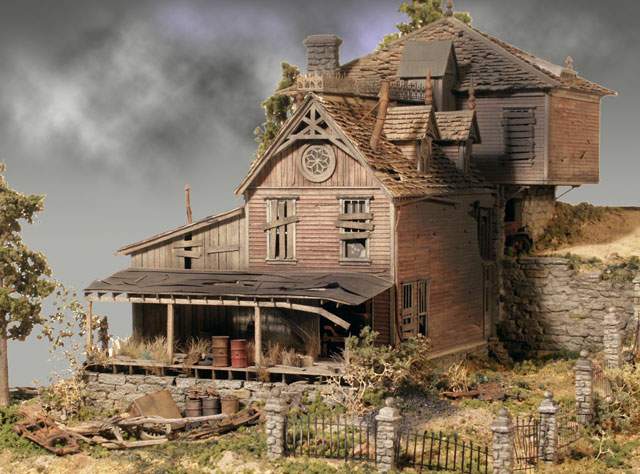
For those of you who, when I mention model railroading, think of Lionel trains on a grass mat with a few plastic buildings, check out some of the examples on this site.  In particular, you can't get a much better introduction to fine model railroad craftsmanship than the work of Karl Osolinski.  Enjoy.