Anti-Intellectual

In this article discussed in the last post, the author criticizes the Tea Party as having a worldview that is "anti-intellectual, anti-establishment, anti-elite."  It is interesting that liberals and progressives now suddenly consider being anti-establishment and anti-elite as bad things.  It just goes to show that the progressive movement is a long, long way from its roots, and is more about exercising power than the mythology it developed for itself in the 1960s.  I would gladly accept either of these labels for myself, even when I don't always agree with the Tea Party.

Moreover, when I was thirty years old and holding two Ivy League degrees, I would have jumped in with the author in attacking folks that were anti-intellectual.  But over the years, I have seen too many people exercising naked power in the name of being smarter and better able to make decisions for the rest of us.  I am exhausted with the technocratic governing urge, and while I still would not describe myself as anti-intellectual, I can sympathize with those who might.

Trashing Science is a Bipartisan Effort

Last week when I wrote this...

This is the whole history of the climate debate, with alarmists trying one technique after another to avoid engagement.  Skeptics are funded by Exxon — Don’t listen to them, they are just shills!  The science is settled — No need for debate!  Skeptics are violent and helped kill Gabriella Giffords — everything they say is hate speech and must be ignored!

... I left one off the list -- that rather than disputing a particular scientific hypothesis,  alarmists like to claim that skeptics are engaging in a "war on science."  I suppose I could ask the author, as she tries to shift the debate from science to politics, exactly who is politicizing science.  Certainly there are skeptical morons in the Republican party who understand none of the issues and knee-jerk oppose the alarmist position.  Just as there are numerous progressive morons who claim to be all about the science while signing petitions to ban dihydrogen monoxide.  When Judith Warner chooses to focus on the morons, rather than the skeptics making scientific arguments, what is she telling us by this choice?  In fact, she tries to take the very existence of the morons as evidence no one is doing fact-based science on the skeptic side, a proposition absurd not only by its tortured logic but also because its so easy to disprove by example.

This anti-science meme has, until recently, actually been a powerful argument in the alarmist arsenal.  Not particularly for its effect on the voters at large, though it certainly helps support the in-group progressive mythology about themselves and their enemies that helps confirm their own smugness.  No, I think for years this has had an effect on scientists outside of the climate community.  Normally such scientists would not wade in to a field they know little about to express an opinion, or, God forbid, sign a petition on issues in that field.  But so many academics were fooled into believing that skeptics were actually engaging in a war on science (a la evolution denying) that they felt the need to support climate alarmists.  Their signatures on petitions did not necesarily mean they agreed with the science, but represented for them a plea of support of science itself.

As scientists from outside the climate community have begun actually looking at the science, or observing the science via the climategate emails, they are horrified by what they see, e.g. the secretiveness, the resistance to replication, and the flat out shoddy science.  Many of them are starting to understand that when they signed these petitions supporting alarmists in the name of science, they were in fact supporting Jenna Jamison in the name of chastity.

By the way, lets not forget which side of this argument began the politicization and ad hominem attacks.   I will offer just this one example, from the Economist way back in 2002 (eight years before the tea party -- and note the key quote is over 20 years old)

Stephen Schneider, [who ironically has the famously corrupt "hide the decline" chart on his personal web page] spoke we suspect not just for himself when he told Discover in 1989: “[We] are not just scientists but human beings as well. And like most people we'd like to see the world a better place...To do that we need to get some broad-based support, to capture the public's imagination. That, of course, entails getting loads of media coverage. So we have to offer up scary scenarios, make simplified, dramatic statements, and make little mention of any doubts we might have...Each of us has to decide what the right balance is between being effective and being honest.” In other words, save science for other scientists, in peer-reviewed journals and other sanctified places. In public, strike a balance between telling the truth and telling necessary lies.

Constitution-Free Detainment

that this military detainment issue was a dangerous one, first in Gitmo, and now with Bradley Manning.   I understand the administration and the Army are pissed at the guy for embarrassing them and potentially giving away secrets to hostile parties, but the guy has not been tried or convicted of anything.  Hell, even if he had been convicted of something, I can't believe he would be sentenced to the punishments he is enduring in what is essentially pre-trial detention.   We are all pissed at Jared Loughner but we haven't treated him this way in detention.

The military is NOT doing anything to improve their case that they should be allowed to handle indefinite detentions, such as at Gitmo, through their procedures rather than civil ones.

The Left seems upset and surprised that Obama would allow such a thing, given his rhetoric on the campaign trail.  I was never surprised -- I wrote on inauguration day that candidates who want more transparency in politics and reductions in Presidential arbitrary authority generally change their tune once in office.  As I wrote then, "It seems that creeping executive power is a lot more worrisome when someone else is in power."  And if that wasn't enough, the Administration's about face on closing Gitmo was another reminder.

Local Paper Continues Its Relentless Campaign for Sports Team Subsidies

Several days ago, I wrote how our local paper, the Arizona Republic, was engaging in a coordinated campaign to get the city of Glendale to subsidize the private purchase of our professional hockey team with a $200 million bond issue.  The logic of this is mainly to save the previous $180 million bond issue the city unwisely issued several years ago to build an arena for this same hockey time as well as the sweetheart commercial real estate deals it has cut adjacent to the stadium.   All in all, the city proposes to spend a cumulative $380 million of public money to hold on to an asset valued by third parties at $ 116 million.  And through all of this spending, taxpayers will end up with not a dime of equity in this asset.

At the time, I thought the campaign had been relentless, going on day after day with both editorials and news articles making cases to subsidize the team, and hammering the Goldwater Institute for actually questioning the legality of transaction.  I mean God forbid anyone would actually interpret the Arizona Constitution "gift clause" that says governments in the state cannot give money to private businesses as potentially barring Glendale from giving money to a private investor so he can buy the hockey team.

But when I called the campaign relentless, little did I know it would continue day after day through the rest of the week.  Every day we get a new article that is basically an editorial in disguise, with the opposing position, if included, down around paragraph 25.   Today's is just a masterpiece of such yellow journalism, which includes no opposing viewpoint at all, and includes this classic gem that is almost a caricature of itself:

Rick Myers and his wife have worked as part-time ticket-takers since 2004, the year after Jobing.com Arena opened and they visited for the first time.

"This arena is not brick and mortar, ice and air-conditioning. This arena is a family," he said.

Craig Van Kessel, a disabled military veteran, agreed.

He said six months after getting a job with the team, when he had major surgery, his co-workers called, sent cards and offered help. The team also donates prizes each year for a Western Amputee Golf Association tournament that Kessel helps organize.

If the team leaves, he said, it affects "us little people."

John Minor, a guest services employee, said he counts friendships among the fans he meets at the arena, while Kyle Olson, director of arena events, said he's taught his toddler to howl like a coyote.

Can I barf now?  Seriously, if you were doing a caricature of bad anecdotal arguments for a typical concentrated-benefits-diffuse-costs government program, could you do any better than this?  We are talking about $200 freaking million dollars here.

Nowhere in any of its editorials or news articles acting as thinly veiled editorials does the AZ Republic reveal that it is an enormously interested party to the transaction.  The Sports Section sells papers, and the presence of an additional major league franchise adds a hard to measure but most definite contribution to the paper's bottom line.

Postscript: The key issue that spurred this is that the city's bond issue is facing higher than expected interest costs.  The city and the AZ Republic are trying to lay the blame on this on Goldwater for stirring up bad karma.  But in fact there are at least six factors for why bond interest rates might be higher:

  • The major bond ratings agencies recently put the city of Glendale on a credit watch list
  • Sales tax revenues that pay for the bonds are way down in AZ and Glendale
  • The city is investing $200 million in a $116 million dollar asset without getting any equity
  • The city has a history of failed bond issues, as evidenced by the previous $180 bond issue they are trying to bail out with this one
  • There is a general sense of wariness nationwide in government finances being overdrawn that may be spilling over into the bond market
  • A local think tank has raised legal questions about the deal — legal questions that turned out to be correct in a parallel case.

Incredibly, our paper has spend over a week harping on just one of these, which to my mind seems the most trivial.

Postscript #2: And by the way, this team is in bankruptcy.  Where is the plan for how that will be avoided in the future?  Won't we be in the same spot five years from now, just with twice as much bond debt?

Free Market Health Care: The Road Not Taken

My column is up at Forbes, and is the fourth in a series on Obamacare.  An excerpt:

Its amazing to me how many ways supporters of government health care can find to rationalize the bad incentives of third-party payers systems.  Take, for example, the prevelance today of numerous, costly tests that appear to be unnecessary.  Obamacare supporters would say that this is the profit motive of doctors trying to get extra income, and therefore a free market failure.   I would point the finger at other causes (e.g. defensive medicine), but the motivation does not matter.   Let’s suppose the volume of tests is truly due to doctors looking for extra revenue, like an expensive restaurant that always is pushing their desserts.  In a free economy, most of us just say no to the expensive dessert.  But the medical field is like a big prix fixe menu — the dessert is already paid for, so sure, we will got ahead and take it whether we are hungry or not.

It should be no surprise that while US consumer prices have risen 53% since 1992, health care prices have risen at nearly double that rate, by 98%.  Recognize that this is not inevitable.  This inflation is not something unique to medical care — it is something unique to how we pay for medical care.

Contrast this inflation rate for health care with price increases in cosmetic surgery, which unlike other care is typically paid out of pocket and is not covered by third party payer systems.  Over the same period, prices for cosmetic surgery rose just 21%, half the general rate of inflation and just over one fifth the overall health care rate of inflation.

This is why I call free market health care the road not traveled.  There are many ways we could have helped the poor secure basic health coverage (e.g. through vouchers) without destroying the entire industry with third-party payer systems.  Part of the problem in the public discourse is that few people alive today can even remember a free market in health care, so its impossible for some even to imagine.

Update: Coincidently, Mark Perry has a post that addresses just the issue I do in my article, that is the positive effects of high-deductible health insurance and out of pocket health expenditures on pricing transparency and reduced costs.  The high deductible health plans at GM seem to be having a positive effect on the health care market.  A shame they will probably be illegal under Obamacare.  Of course, since GM is owned by the government, it can get any special rules that it wants, unlike the rest of us.  But that his how things work in the corporate state.

Worst Sentences of the Day

From Clive Hamilton

Last month, Americans were shocked at the attempted murder of Arizona Congresswoman Gabrielle Giffords and the killing of six bystanders. The local County Sheriff Clarence Dupnik captured the immediate assessment of many when he linked the attempted murder to the rise of violent anti-government rhetoric and imagery, observing, “The anger, the hatred, the bigotry that goes on in this country is getting to be outrageous.”

When asked if the Congresswoman had any enemies her father replied: “Yeah. The whole Tea Party”. Many, including Giffords herself, had had a premonition that the inflammatory language of radical right-wing activists would sooner or later find real expression.

The same hate-filled rhetoric that created the circumstances in which Gabrielle Giffords was gunned down also stokes ferocious attacks on climate scientists and environmentalists in the United States.

Wow, you know you are in for a load of really stupid crap when someone, at this late date, still is out there blaming the Giffords shooting on political rhetoric.   When someone writes this, you can be sure they are about to attempt to shut someone up, most likely someone the author disagrees with.

The author goes on to relate how nearly every climate scientist (up to and including the serially-wrong Paul Ehrlich) is quaking in their house behind locked doors waiting for some crazed skeptic to gun him or her down in their sleep.  Look, just about every interest group develops a mythology, and this notion of bravely seeking truth in the face of crazed irrational wackos is part of the internal mythology of many interest groups.

I have no doubt that these guys get nasty comments and abusive emails.  But Hamilton is absolutely wrong to imply that climate alarmists are somehow unique in this.  He is not describing an unfortunate aspect of the climate debate perpetrated asymmetrically by one side in that debate, but an unfortunate aspect of all politically charged online debates by nearly every side of every issue.  Seriously, Hamilton has discovered the Internet troll in 2011?  What is next-- agriculture, fire, the wheel?

Welcome to the political arena.  Alarmist climate scientists expressly went political a number of years ago.  I could put up pages of quotes from climate alarmists like James Hansen urging their brethren that doing scientific research was not enough, that they had to get out there and openly advocate, be a part of the political process.   And politics is messy, especially when you are advocating what is in effect the most expensive single government program every proposed.  You can't be political when you are on the attack, and then claim you are a scientist immune from political debate when there is a response.

I am but a second-rate player in the climate debate at my site climate-skeptic.com.  I am not going to be one of the names of skeptics most alarmists would rattle off.  And none-the-less I get threatening emails about my climate positions.  In fact one of the reasons I am pretty sure bad behavior on the Internet crosses all political lines is that my top two threatening and irrational email sources are from anti-immigration conservatives and climate alarmists on the left.   But I grew up in a household where my parents worked for a major oil company.  Every time oil prices would rise, some crazed leftist would send us death threats, and several of our friends actually got letter bombs.  So its hard for me to wet my pants over a few anonymous threatening emails with poor grammar.  And unlike Mr. Hamilton, I don't attempt to tar the many people who disagree with me with the actions of a loony few.

I am sorry for folks on both sides who get such crazed threats.  But what Mr. Hamilton wants is to not have to deal with the specific arguments made by skeptics.  This is the whole history of the climate debate, with alarmists trying one technique after another to avoid engagement.  Skeptics are funded by Exxon -- Don't listen to them, they are just shills!  The science is settled -- No need for debate!  Skeptics are violent and helped kill Gabriella Giffords -- everything they say is hate speech and must be ignored!

Oh, and here is one more parting shot in his last paragraph

Like those whose opinions they value — shock jocks and television demagogues — climate deniers are disproportionately older, white, male and conservative — those who feel their cultural identity most threatened by the implications of climate change. While the debate is superficially about the science, in truth it is about deep-rooted feelings of cultural identity. This makes deniers immune to argument, and their influence will wane only as they grow old and die.

LOL, its all white male suppression!   I don't even have the energy to deal with this, except to repeat the obvious:  Capping white male American fossil fuel use at 1990 levels would be costly and reduce economic growth, but could be done.  Capping Indian or Chinese or African fossil fuel use at 1990 levels basically sends them back to the stone age.   So don't tell me who is shilling for the arrogant white male perspective.

Anyway, his last paragraph is a fantasy, a part of the internal alarmist mythology that gives them a smug feeling of superiority, that skeptics are all crude evolution-denying anti-science old cranks.  And, frankly, some are.  Just as some alarmists are human-hating totalitarian neo-communists.  To some extent, Hamilton's article is an exercise in self-esteem building among alarmists, making them feel better about themselves by supposed superiority to the incivility he enumerates.  Fine as far as it goes, all groups engage in the same kind of behavior.  But there is a lot of thoughtful work that goes on in the skeptic community that in a non-broken scientific process would be considered productive challenges and/or replications of various studies.   To the extent he is trying to hide this work from view and shut up skeptics in general, tarring those of use who are science-based with actions of the fringe, he is doing a severe disservice to the science he is supposedly defending.

Public Choice Theory and State Pensions

Good stuff from Josh Barro.  He discusses pension issues and pension accounting in depth, but this struck me as the key takeaway

Another major flaw is inherent in the very nature of pensions: They allow lawmakers to give valuable benefits to public workers (and to placate their unions) today without ever having to deal with the ugly future consequences. Handing out a wage increase, after all, generally requires coming up with a significant amount of money in this year’s budget, which can pose enormous financial (not to mention political) difficulties. Sweetening pension benefits, on the other hand, achieves much the same political end—and while it does increase a pension system’s unfunded liability, that cost is spread across pension payments that will be made for many years. In this way, legislators can please public employees now and leave it to future legislatures to clean up the mess....

Defined-benefit pension plans thus provide lawmakers with both the motive and the means to seriously abuse state finances. All over the country, state lawmakers face enormous temptation to appease government workers now, and let someone else figure out how to pay the bill in the future. At the same time, the complex accounting rules that govern defined-benefit pensions make it easy to cover up the costs of the scheme.

The only way out I see is not just a current fix (which can and often is undone in better times) but some kind of procedural fix, ala what CA Prop 13 did for property taxes, permanently binding the hands of legislators on these issues.  In addition, we really need to see the GASB adopt government pension accounting rules that parallel private standards, though I am not holding my breath on that one.  Of course the ultimate solution is to do what nearly every private company has done -- get out of the defined benefit pension business, and substitute a 401k with employer contributions and/or matching.

Is the Media Pro Big Government?

I have never really liked to wallow much in the accusation and counter-accusations of media bias.  But I am coming around to the hypothesis that the media is neither liberal or conservative but has a big government bias.  Recently, as in this article, the Arizona Republic (our daily paper) has been going after the Goldwater Institute for opposing what amounts to a $200 million subsidy to a buyer of our hockey team.

The short story is that after the city of Glendale blew a bunch of money for a hockey stadium in the desert, it turns out hockey is not very popular here (surprise).  So the team went bankrupt, and threatened to move.  To keep it from moving, the city of Glendale wants to throw more good money after bad and subsidize the new buyer.   Goldwater is challenging the subsidy as illegal under AZ law.

As I noted in the previous article, third parties value the Coyotes at $117 million.  So with this new bond issue, they will have run up $380 million in debt to keep a $117 million asset in town.  Further, they will have basically paid the entire purchase price of the team (and more) without getting a drop of equity in return.  All they get is the right to charge for parking around the arena, which is currently free.  This at first makes some sense (though the value of the concession is never mentioned) but in fact it is ludicrous as well.  The entire reason for the subsidy, supposedly, is to protect the mall/apartment/office complex around the stadium that the city cut sweetheart deals with developers to make happen.  So now they are going to charge for parking -- what is going to happen to all those businesses they supposedly are doing this for when their customer's parking is not longer free?

Anyway, the Republic editorialized against Goldwater on Sunday (in an editorial titled "Back off, Goldwater Institute") saying that they were hurting taxpayers because if the new bond issue and team sale fails, then there won't be any revenue to pay the old bond issue.  Its hard to figure how this is any different from doubling down at the roulette table in hopes of making back one's past losses.  And, Goldwater opposed the first bond issue too.

Now, the Republic has editorialized again, this time in a nominally news article.  They argue that by pointing out the potential illegality of the subsidy, Goldwater is messing up their bond interest rates.  I kid you not:

As Glendale prepares to sell bonds to finance its Phoenix Coyotes deal, the interest rates the city obtains make a big difference in how much debt Glendale would take on.

Team buyer Matthew Hulsizer says investors are demanding high interest rates due to nervousness among bond buyers about a potential Goldwater Institute lawsuit over whether the city is illegally subsidizing a private business. Glendale maintains it's on firm legal ground.

This is exactly the line the paper took in its Sunday editorial.  Now they are giving an interested party the ability repeat it in a supposed news article.  The author deliberately puts Goldwater on the spot and in the center of blame

Late Monday, Hulsizer questioned whether the Goldwater Institute wanted the team to stay.

"If they do indeed want the team to stay, then wouldn't they want the city to be able to complete financing at the best possible rate?" he said in a statement to The Arizona Republic.

He asked, if the Coyotes left Glendale, what Goldwater's plan was for the city to pay off its construction debt on the arena and for businesses nearby to survive without hockey customers. The city spent $180 million to open the arena in 2003.

Why in heaven's name is it Goldwater's problem that an earlier bond issue they actively opposed as a bad idea might turn out to, you know, have been a bad idea?  The article goes on and on this way, quoting other people of the same point of view. Goldwater doesn't get a quote until paragraph 24 or so, where Darcey Olson who heads the Institute says

She said Glendale has "unlimited options" to avoid a Goldwater lawsuit. "For instance, Hulsizer could get a private loan to buy this team like most businesses do," she said. "They finance their investments not on the backs of taxpayers but take the risk privately where it belongs."

The evidence of the article that Goldwater is shaking the very pillars of Wall Street is that the city expected one set of interest rates, but the market was giving them higher rates

Glendale officials in December hoped for a roughly 6 percent interest rate.

Todd Curtis, portfolio manager for Aquila Tax-Free Trust of Arizona, said he expected to see a 5 to 5.5 percent interest rate after Moody's Investors Service in mid-February gave the Coyotes bond sale a fairly high rating.

More than a week ago, Curtis was hearing of proposed rates around 7 percent.

Of course, they present no evidence as to why this might be. We are left to assume it is because Goldwater is somehow creating unfair bad vibes. Except then we get this oh-by-the-way near the end of the article:

Moody's and Standard & Poor's raised worries in February about the city's debt levels. As a result, Moody's downgraded several city bond ratings and Standard put the city on a watch list, though the city's ratings remain high.

Also, Glendale pledged to cover the Coyotes bonds with sales taxes, a revenue stream hurt during the recession. The city in its preliminary bond statement points out its sales-tax base is strong.

OK, lets check the reporter's decision-making here.  We have five facts

  • The major bond ratings agencies recently put the city on a credit watch list
  • Sales tax revenues that pay for the bonds are way down
  • The city is investing $200 million in a $116 million dollar asset without getting any equity
  • The city has a history of failed bond issues, as evidenced by the previous $180 bond issue they are trying to bail out with this one
  • A local think tank has raised legal questions about the deal -- legal questions that turned out to be correct in a parallel case.

So our lede is that it is all about the fifth one, just because millionaire Matthew Hulsizer, who is set to feed at the public trough to the tune of $200 million, says its so?

Ask yourself, what is the first section of the paper many folks look at?  The sports page?  An extra professional sports team adds a hard to quantify but definite amount to the paper's bottom line.  The AZ Republic clearly recognizes this and is all-in for any taxpayer subsidy that is required to keep this important part of their business running.

Things People Believe That Make No Sense

You often hear people say that one of the main reasons for health care inflation is the cost of all the new technology.  But can you name any other industries that compete in free markets where technology introductions have caused inflation rates to run at double the general rate of inflation?  In fact, don't we generally associate the introduction of technology with reduced costs and increased productivity?

Compare a McDonald's kitchen today with one thirty years ago -- there is a ton of technology in there.  Does anyone think that given the price-sensitive markets McDonald's competes in, this technology was introduced to increase prices?

Or look at medical fields like cosmetic surgery or laser eye surgery.  Both these fields have seen substantial introductions of new technology, but have seen inflation rates not only below the general health care inflation rate but below the CPI, meaning they have seen declining real prices for decades.

The difference is not technology, but the pricing and incentive system.  Cosmetic surgery and laser eye surgery are exceptions in the health care field -- they are generally paid out of pocket rather than by third parties (Overall, third party payers pay about 88% of all health care bills in the US).

The problem with health care is not technology -- the problem is that people don't shop for care with their own money.

Postscript:   Thinking some more after I wrote this, I can think of one other industry where introduction of technology has coincided with price inflation well above the CPI -- education.  It is interesting, but not surprising to me, that this is the other industry, along with health care, most dominated by third party payer systems and public subsidies of consumers.

Health Care Fail

For the last three weeks, I have been writing about the informationincentive, and rent-seeking issues that will doom Obamacare -- for example, how its impossible for a centralized board to set prices, and why a complete end to individual shopping will doom us to both rising prices and increasing frivolous demand.

I really didn't have to bother, though, because it is unnecessary to hypothesize -- we can just look at Massachusetts, which embarked on a proto-Obamacare several years ago.  John Calfee has a great column in the WSJ today.  Some excerpts

  • On costs

Massachusetts reformers deferred cost control to the vague prospect of a "Round 2" of reform—much as congressional Democrats did a year ago when they passed ObamaCare. Meanwhile, economists John Cogan, Glenn Hubbard and Daniel Kessler reported in the Forum for Health Economics & Policy (2010) that insurance premiums for individuals (alone or in employer-sponsored group plans) increased 6% to 7% beyond what they would have without the reform. For small employers, the increases are about 14% beyond those in the rest of the nation. Four years after reform, Massachusetts still has the highest insurance premiums in the nation, and the gap is getting wider.

In 2010, insurance firms announced premium increases of 10% to 30% in the individual and small-group market. Gov. Patrick, on the verge of a tough re-election race, had the state insurance commissioner deny the higher rates.

  • On frivolous demand

But the number of emergency room visits, which everyone expected to drop once people had to purchase insurance, is still going up. Surveys show roughly half the visits are unnecessary. Surveys also indicate that finding a primary care physician is becoming more difficult.

  • On the end game of a centralized price-control regime

Last month Round 2 arrived. Gov. Patrick introduced a bill that will impose de facto price controls on everyone from solo primary care doctors to prestigious academic hospital systems. An 18-member board will decide how and how much providers should be paid, and the bill gives regulators the power to force private insurers to accept these fiats. Some 30 states experimented with such rate-setting in the 1970s and '80s. Except for Maryland, all of them—including Massachusetts—deregulated in the 1990s because costs rose even as quality and choice declined

  • On politicization of decision-making

Insurance firms protested that they increased premiums because they had to deal with entrenched providers, especially hospitals, most notably the academic giants of Boston and Cambridge. Then the state prepared to introduce highly intrusive price controls over those providers—only to discover that this would provoke formidable political opposition while encountering myriad practical difficulties

To the last point, what happens to prices when providers know that a) consumers aren't shopping any more; b) consumers will take the service at any price, because they aren't paying; and c) insurance companies have to pay the bill, not matter how high, based on government rules.  Of course prices go up, because the entire price-discovery mechanism has been eliminated by government fiat.  Then the government has to step in with a doomed-to-failure price-setting plan.  In the end, those with political connections get the prices they want, and those who do not get throttled to make up the difference.

Have a Koch and a Smile

So we now discover yet another similarity between Left and Right -- they both seem to get powerful motivation by singling out a billionaire on the opposite side of the political spectrum and then blaming all manner of conspiracies on him.  The right has had fun for years vilifying George Soros and so the Left, sad to be left out of the fun, has latched onto the Koch brothers.  The objective is to tar an individual so thoroughly that mere suggestion that he supports a particular issue  casts so much doubt on the issue that its merits do not even have to be argued.  This is a game that climate alarmists were really pioneers at devising, tarring skeptics for years at the mere hint that some organization they are related to got 0.1% of its funding from Exxon.  I know folks play this game in my comment section from time to time.

This is a game I find utterly exhausting and absolutely without merit, a black hole of intellectual productivity.  For God sakes there are 524,000 Google results for "soros-funded."  Of what possible value is this adjective?  Perhaps at its best it is a proxy for "left-leaning" but then why not just use those more descriptive words?

Discretionary Spending: Support Thyself

Many of you may know that my business is engaged in private management of public recreation.  We get a lot of pushback from certain sectors who believe access to government lands or services should be free -- ie already paid for by their income taxes.

I often argue that this notion of discretionary services (like parks and campgrounds) being run with high cost government labor and funded by general revenue taxes is a dead one - in fact it has been dead for at least 10 years.  Just look around at public parks organizations.  Odds are that your state is facing parks closures and is very likely not fully funding park maintenance. I wrote about this failed model here.

In the future, anything discretionary government program that can charge use fees or be privatized or both will do so.  Or else it will be provided at terrible quality with long queues and frequent closures.  Don't believe me?  Lets look at the US government budget data from last year. This chart has been making the rounds -- I have not checked the data source but I presume it is correct (as usual click for larger version)

I have some interest in the science of chartmanship.  McKinsey & Company did a great job teaching me how to make a presentation, a skill I have honed somewhat in way too many planning and strategy jobs that seemed to revolve around Powerpoint  (one of the criteria for my current job is that it did not involve Powerpoint).

This chart is a case where the author used the wrong chart type.  The pie chart is not appropriate to show a changing total (as the author does with the size of the pie).  The eye has trouble assessing volumes.  I have taken the same data and put it in a slightly different form.  I did not take time to make it pretty, but I think it works better in this format:

Now do you see my point about discretionary spending?  Last year government taxes just about covered entitlements and interest on the debt.  Had we not borrowed, there was no money left over for any discretionary spending, including all of the Defense budget!  Now, even without action, the picture will improve in 2011 as taxes go up with a rising economy and some of the unemployment spending goes down.  But this might just get us to still having a defense department.  Either large swaths of discretionary spending is going to have to be zeroed out, or some sort of entitlement restructuring is necessary.

Of course, tax increases will likely be part of the mix as well, but look at the individual income tax bar.  Even doubling it would not close the budget gap!

Health Care Decisions by Politics, Not Science

In my Forbes columns over the past few weeks, I have been writing about information and incentive problems with any sort of Obamacare type system.  One of the points I made last week was this:

One of the key selling points of Obamacare was that it would reduce cost, in large part through smart public-spirited people making optimized decisions from the top in Washington.  Ignoring the fact that no other agency that has promised such angels of public service has ever delivered them, we discussed in the last few weeks how this task is impossible.  But we should have known that already through our past experience with the political process.  Political decisions are made politically, not by optimizing some public good equation.    Does anyone believe that come election time, Congress won’t vote to add mandates to procedures to placate powerful groups in their base, irrespective of the future costs this would incur?

Need an example?

In 2007 breast cancer was the third leading source of cancer mortality in the US, but it was by far the largest recipient of government cancer research dollars, nearly double that spent on any other type of cancer.    In 2009, out of hundreds of medical procedures, only two procedureswere on the mandated must-carry list of all fifty states – mammography and breast reconstruction.  It is no accident that both of these are related to breast cancer.  With its links to women’s groups and potent advocacy organizations, breast cancer is a disease that has a particularly powerful political lobby.    Similarly, we should expect that, at the end of the day, pricing and coverage decisions under Obamacare will be made politically.  Not because anyone in this Administration is particularly bad or good, but because that is what always happens.

This post from Q&O is a tad old but gets at just this point with a real-life Obamacare example

The opening line in a New York Times piece caught my attention.  It is typical of how government, once it gets control of something, then begins to expand it (and make it more costly for everyone) as it sees fit.  Note the key falsehood in the sentence:

The Obama administration is examining whether the new health care law can be used to require insurance plans to offer contraceptives and other family planning services to women free of charge.

Yup, you caught it – nothing involved in such a change would be “free of charge”.   Instead others would be taxed or charged in order for women to not have to pay at the point of service.  That’s it.  Those who don’t have any need of contraception will subsidize those who do.  And the argument, of course, will be the “common good”.   The other argument will be that many women can’t afford “family planning services” or “contraception”.

But the assumption is the rest of you can afford to part with a little more of your hard earned cash in order to subsidize this effort (it is similar to other mandated care coverage you pay for but don’t need).  Oh, and while reading that sentence, make sure you understand that the administration claims it has not taken over health care in this country.

The next sentence is just as offensive:

Such a requirement could remove cost as a barrier to birth control, a longtime goal of advocates for women’s rights and experts on women’s health.

So now “women’s rights” include access to subsidies from others who have no necessity or desire to pay for those services?  What right does anyone have to the earnings of another simply because government declares that necessary?

It is another example of a profound misunderstanding of what constitutes a “right” and how it has been perverted over the years to become a claim on “free” stuff paid for by others.

Administration officials said they expected the list to include contraception and family planning because a large body of scientific evidence showed the effectiveness of those services. But the officials said they preferred to have the panel of independent experts make the initial recommendations so the public would see them as based on science, not politics.

Really?  This is all about politics.  The fact that the services may be “effective” is irrelevant to the political questions and objections raised above.  This is science being used to justify taking from some to give to others – nothing more.

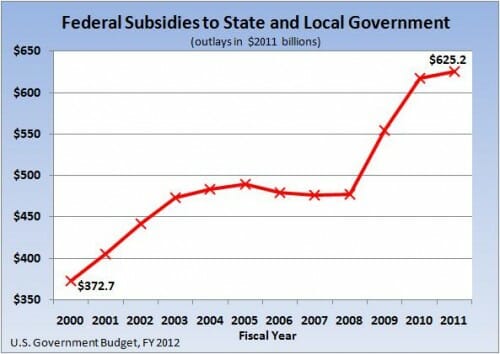
The Worst Federal Spending?

OK, I know there are lots of strong competitors for the title of worst Federal spending, but transfers to state governments is, to my mind, among the very worst (from here)

Specific problems with this spending include:

  • Terrible accountability, even worse than for most of Federal spending.  Feds appropriate the money but have only limited ways to enforce accountability and almost no ability to track its use
  • Awful incentives, as much of this money is given as matching funds that simply encourage more spending at the state level and create, in difficult budget times, the almost impossible problem of having to cut $2 of spending to save $1 of state appropriations.  Makes matching fund programs almost impossible to cut, though kudos to Wisconsin and Florida for doing the right thing with Federal matching funds for high speed rail
  • Frequently used to undermine the 10th recommended.   Seat belt laws and 55-mile-per-hour speed limits enforced by threats of withdrawal of Federal funds.  Ditto Title IX in state schools.   The Feds are like narcotics pushers, getting the states hooked early on easy money and then using their addiction to these funds in all kinds of abusive ways.

Nice Satire

If you want some enjoyable satire this Friday, this is a nice piece from Ken at Popehat, who has gone the libel tourism route by using French courts to sue a US editor for a bad review of a US book by a US author.

The article becomes all the sweeter as a recent email he received raises the possibility that this particular academic completely missed the heavy-handed irony and satire.

Brink Lindsey's New Column

In one of those strange small-world things, my college roommate and I both have columns at Forbes.com.  Brink Lindsey's first installment is here.  In it, Brink expresses optimism for the prospects for continued US income growth.

TARP Funds

This is old, I think, but I had never seen it.  Where TARP funds went.

Bank Regulation

This article by Mark Perry seems right to me -- the lightest touch (and probably the most effective) approach to bank regulation is to return to a regime that puts its major emphasis on capital requirements.

We can talk all day about causes of the recent financial crisis, but in my mind the root cause was taking real property with a volatile underlying value (e.g. homes) and leveraging the absolute crap out of it.   In the initial transaction, home buyers were allowed to come to the table with less and less equity, until deals were being cut with more than 100% debt.  This stupidity was a true public-private partnership, as the government kicked off the party and encouraged its growth via various community development policies as well as policies atFannie and Freddie, but private originators as well as home buyers eagerly jumped into the fray.

This debt backed by property that was already too highly leveraged was thrown into portfolios that were themselves highly leveraged, and then further leveraged again through CDS's and other derivatives.  And then the CDS's were put into leveraged portfolios.  I would love to figure out the effective leverage in the AIG portfolio.  For ever $1 million in real property that secured the mortgages they insured, how much equity did they have?  A thousand bucks?  Less?

These investors felt protected by diversification that didn't really exist.  The felt safe with AAA ratings from agencies who really didn't understand the risks any better than anyone else did.  They relaxed assuming everything was watched by government regulators who were in way over their heads.  But more than anything, they felt protected by history.  The system of putting mortgage risks into tranches, such that the top tranches could only be affected by default rates consider then to be wildly improbable, had never to that point failed to deliver its promise.   Default rates had always stayed withing expected norms.

And this is the most dangerous risk -- the risk that something will happen that has never happened before.  Default rates that seemed impossible suddenly became reality.  Tranches that were untouchable suddenly were losing large chunks of their value.  Sure, there were warning signs, but at the end of the day what happened was that events occurred that were worse than people had thought was the worst case scenario  (there is a whole body of interesting behavioral study on how humans tend to overestimate their understanding and underestimate the width of a probability distribution).

As new financial products are created and the economy evolves and the government pursues new forms of interventions in commerce, new failures can occur that have never happened before.  And never has there been invented a micro-regulatory approach that guards against new-type failures (they don't even do a very good job against old-style failures).  Capital requirements are the one approach that guard against catastrophic failures even for unanticipated risks.

It can be argued that this will raise the cost of capital, at it is true interest rates at any one point of time would have to go up.  But one can argue that the low interest rates of the 2000's greatly understated the true cost of capital, and that those additional costs were paid in a sort of balloon payment at the end of the decade.

I am still thinking this through -- I don't think any regular reader would be mistake me for someone who favors regulation in general, but I am coming around to some extent on the notion that banks are different.  I would ideally like to see a self-policing market where companies that choose to cut equity too fine just go bankrupt.  But the reality of the political-financial complex today is that this never happens -- costs of large failures are socialized, and executives who made bad choices get fat gold parachutes and Treasury jobs.

Postscript:  I have arguments all the time about whether the financial melt down was mainly caused by government or private action.  Was it a public or private failure.?  My answer is yes.

One thing that those of us who promote private action over public can never repeat enough is this:  Our support for private action does not mean that private actors don't screw up, that there are not bad outcomes, that people don't make bad decisions, etc.  They do.  Lots of them.  When these constitute outright fraud, there should be prosecution.  For the rest of the cases, though, libertarians believe that in a free society there are automatic corrections and sources of accountability.

Make a bad product - people stop buying it.  Sign a union contract with wages that are too high - you go bankrupt.  Treat your workers shabbily - and the best of them go work for someone else.  Take on too much risk - you will fail and lose all your capital.

The problem with our financial sector is not that it is not regulated -- it is the most regulated sector of the economy.   The problem is that, as always happens, there has been substantial regulatory capture.  There has been an implicit deal cut by large financial institutions - regulate me, but in return protect me.  In a sense, as is typical in a corporate state, large corporations and government have become partners.

As a result, many of the typical checks and balances on private action in a free economy have been disrupted.  In effect, certain institutions became too big to fail, and costs of failure and risk taking were socialized.

That is why the answer is not one or the other.  Certainly the massive failures were driven by the actions of private actors.  But they were driven in part by incentives put in place by the government, and their stupid behavior was not checked because traditional private avenues of accountability had been neutered by the government.    This is why the recent financial crisis will always remain a sort of political Rorschach test, where folks of wildly different political philosophies can all find justification for their position.

LOLing

I have to agree with Glen Reynolds that this is an awesome quote, from  a member of the teacher's union in Denver:

That’s your problem. You’re an entrepreneur, so you don’t work. You don’t know what work is until you get into an educational area.

Yep, some day I will have to stop loafing around and take on a brutal assistant principal job somewhere.  All I have to worry about is that every dollar I own (and more) is invested in my business and could disappear at any time if I make a mistake.  Thank God I don't have to sit around all day worrying whether the doctor that hands out no-questions-asked disability rulings will still be practicing when I am 45 and ready to retire.

I call this the "Dallas / Dynasty" perception of business, that businessmen just grab a phone call or two, go to a power lunch, and then head home to the mansion.

Update: Apparently this is a common misconception about entrepeneurs

The average number of working hours per week of a successful starting entrepreneur is seventy. This catches the typical American dreamer by surprise.

The teacher day:

Nor do teachers spend all of their time at school in the classroom. In fact, teachers spend fewer hours actually instructing students than many recognize. Stanford's Terry Moe worked with data straight from the nation's largest teacher union's own data - and found that the average teacher in a department setting (that is, where students have different teachers for different subjects) was in the classroom for fewer than 3.9 hours out of the 7.3 hours at school each day.

With several hours set aside at school for course-planning and grading, it strains plausibility that on average teachers must spend more hours working at home than do other professionals.

Not to mention, of course, summer vacation, Christmas break, spring break, fall break.... Oh, and the fact that they have lifetime job security because in public schools they can't be fired for even the most egregious incompetance

The Looming Failure of Obamacare, Part 3: Rent-Seeking

The third installment of my series on Obamacare is now up at Forbes.  An excerpt:

In the health care field, the Holy Grail of rent-seeking is to get one’s medical device, drug, or procedure added to state health insurance mandates.  Before Obamacare, health care insurance regulation had been a state function, and each state had written laws mandating that all health insurance policies written in the state must cover certain services.   By getting one’s particular service added to such a mandate, the service essentially becomes “free” to consumers in that state  (of course it’s not free — everyone pays in the form of higher premiums, but the marginal price for the service goes to zero).

Imagine you have a procedure — let’s use laser elimination of birthmarks as an example.   This procedures requires a series of treatments using a fairly expensive piece of equipment to produce results that are of enormous value to a few people with extensive birthmarks, and of smaller value to many other people with smaller birthmarks.  Business growth in such a field is typically good at first as those who most value the procedure pay for it.  But it can be hard to grow outside of a relatively small niche, as most potential customers may consider it to be an expensive elective cosmetic procedure that, given other uses for their money, they can do without.  What can an aspiring dermatologic surgeon do?  Run to the government!

In 1997, the University of Indiana conducted a study of the laser treatment of these birthmarks.  I don’t know who funded the study, but tellingly the study findings did not really touch on the efficacy of the treatment or its risks.  The study surveyed a number of dermatologic surgeons.  What was its primary finding?  ”Based on current health care policy guidelines, laser treatment of port-wine stains should be regarded, and covered, as a medical necessity by all insurance providers.”  In other words, the sole purpose of this research was to convince legislators to add this procedure to their state’s  insurance mandates.   To date, this procedure has been added to the must-carry list in only two states, but in those two states doctors no longer have to convince price-sensitive patients that this elective procedure is worth the cost – after all, its free!

As you can imagine, the cost of these mandates are staggering for those of us who pay the premiums.  State governments are requiring us to pay higher insurance rates in order to cover procedures we might never consider.   Four states have mandated coverage for naturopaths;  three for athletic trainers; one for oriental medicine; eleven for hair prosthesis; four for massage therapists; and three for pastoral counselors.  The state with the most such mandates is Rhode Island, with 70, a state which not coincidently also has the third highest insurance premiums in the country.

On a quasi-related note, John Goodman has thoughts on "government failure" (an analog to market failure) as it applied to health care.  It is a point that cannot be made too often.  Merely pointing out supposed imperfect outcomes from private action does not immediately justify government action -- too often people take the default position that if an improved outcome can be imagined, the government can achieve it.  But does this ever happen?  In health care, the irony is that many of the supposed market failures we are "fixing" with Obamacare are in fact results of past ham-handed government action.

Chutzpah Award

Many of my Conservative friends often rail on liberals and liberal politics as being driven by envy.  I find that sort of assignment of motivation to be fairly unhelpful in most debates, though I do understand the case they are making.

In this context, though, I have to say that Kevin Drum gets the Chutzpah award of the week for claiming that Conservative politics are being driven by envy of government workers.  LOL.  I made a response in his comments section that was so obvious I hesitate to even repeat it here, but I will.  He made the point that government did not lay people off because it still had demand for its services

Kevin, you have it backwards because you confuse two terms. Private businesses did not lay people off because people stopped wanting their product, they laid people off because people stopped paying for their product. I am sure everyone still would like a Porche, just no one is paying for them right now. Ditto houses, etc.

Businesses reacted to the reality of less money coming in. They probably had many important things they could have continued doing in R&D or manufacturing streamlining, but the reality was that less money was coming in the door so they reduced their expenses to match.

The public sector issue is not different but identical. Sure, there are still lot of things they would like to be doing, but the fact is that less money is coming in the door. But rather than adjust to that fact, they arrogantly ignored it, running up debt in the taxpayers name so a bunch of deputy assistant principals could keep earning $80,000 a year. That is why folks are angry.

Kevin Drum is one of the few team politics blogs I read from either the Coke or the Pepsi side of the aisle because I think he often makes the leftish case more intelligently than most.  But I have been critical of him all week in his comments section for repeatedly defending public employees unions based on the benefits of private unions.  The two are very different, as pointed out by, well, about everybody who is not specifically beholden to the public employees unions.  Here is just the first one of many I found in my reader.

Please, Please, Please Don't Let This Be Screwed Up Like Starship Troopers Was

Movie deal for Old Man's War.

Also heard that Ridley Scott is doing the Forever War.

By the way, I was working on a list of SF stories that were completed screwed up as movies in the 80's and 90's, so much so they would be worth a remake.  So far I have only a couple, but would appreciate suggestions

  • Starship Troopers
  • Running Man
  • Total Recall  (not as awful as the first two but had that same cheesy unserious style that brings it down for me)

I suppose some might put Robocop in this category but I am attached to that movie, in part because if there was an underlying novel I hadn't read it, and the campiness kind of worked.

Interesting Fellowship

From PERC, a group focused on free-market environmentalism

The Julian Simon Fellowship has an open application process, so applications are always welcome. Review of applications will begin as soon as they are received.

The Julian Simon Fellowship is one of the nation's most prestigious opportunities for scholars to develop policy-oriented research on natural resource and environmental conservation. The in-residence fellowship is intended to continue the legacy of the late Julian Simon, whose research led to a massive re-evaluation by scholars and policy makers of their views on the interplay between population, natural resources, and the environment.

The ideal candidate for this fellowship is someone like Julian; an excellent scholar with a focus on empirical work and an imaginative research agenda that emphasizes natural resource and environmental issues.

Each Julian Simon Fellow is expected to spend at least two months in residence at PERC developing a paper of publishable quality, one that has significant policy implications. During their stay at PERC, Julian Simon Fellows are expected to present a seminar on their work.

Each Julian Simon Fellow will receive an honorarium of $20,000 plus office space, office support, and a congenial, stimulating work environment. Fellows will be responsible for their accommodations in Bozeman, but PERC is happy to assist with arrangements.

Sorry, Already Been Done

Too late for this

while Paramount develops a Magic 8 Ball movie among many other projects that have been co-opted from the toy aisle

See Interstate 60.  Best movie about the meaning of "freedom" you have likely never seen.  And you can take that to the bank.

Department of WTF

From Valley Fever

As we noted yesterday, more than 40 Arizona state legislators have signed on to a bill that would make the Colt single-action Army revolver the official state firearm. Early this morning, the Senate Appropriations Committeevoted 9-4 to advance the measure to a full Senate vote.

Seriously?  What a complete waste of time.  If we are going to start naming official state _____ where the blank is a commercially sold product, could we at least auction the rights, like the Olympics does?  I understand that there are passionate 2nd amendment defenders that somehow think this is a statement they need to make, but I am a passionate first amendment defender as well and I see no need for an official state microphone or printing press model.