The Last Frontier in Worker Exploitation

Name a multi-billion dollar industry where all the competitors in the industry have formed a single cartel.  This cartel performs many functions, but one of its highest profile functions is to aggressively punish any member who pays its employees more than a cartel-enforced maximum.

Believe it or not, there is such an industry in the US... college sports.  The cartel is the NCAA, and whenever the NCAA makes the news, it usually is with an enforcement action punishing a school for allowing any of its athletes to make more than the agreed maximum salary, which is generally defined as free tuition.  As folks are learning at Ohio State, even trading your autograph for a free tattoo is not too small a transaction to attract ruthless NCAA retaliation.

This ESPN page (via Phil Miller) shows 2010 athletic revenue by school.  Take the top school on the list, the University of Texas.  In 2010 its athletic program brought in over $143 million in revenues.  It paid its workers (athletes) who helped generate this revenue $8.4 million (in the form of tuition), or 5.9% of revenues.  Its hard to decide whether this is high or low, though this percentage of labor for a service business seems low.  Looking for an analog, we can turn to the NFL, which is currently negotiating a revenue split with players.  The issue is still under negotiation, but for years players have been guaranteed over 50% of total revenues.

Even the Olympics finally gave up its stupid distinction of amateur status, allowing the best athletes to compete whether or not someone has ever paid them for anything.  This only makes sense - we don't have amateur engineers who work for free before they give up their amateur status for the professional ranks.  I can still continue to earn my degree at college in programming while being paid by outside companies to do programming.   I can still participate in the school glee club if I make money in a bar singing at nights.  I can still be student council president if I make money in the summers at a policy think tank.  Of all the activities on campus, the only one I cannot pursue if someone is willing to pay me for the same skill is athletics.

Only the NCAA holds out with this dumb amateur distinction, and the purpose is obvious -- it provides cover for what otherwise would be rightly treated as worker exploitation.  And they get away with it because most of the members of this cartel are actually state governments, who are really good at exempting themselves from the same standards the rest of us have to follow.

Paging Charles Babbage

This is really pretty cool -- a 1953 Navy training film on the components of a mechanical fire control computer.  Steampunk for our parent's generation -- this kind of gear/sprocket exercise is what my dad studied as a mechanical engineer.

Speaker Build Report

I wanted to share my build report on my new home theater speakers.  I built three matching speakers - left, center, right - to go behind my acoustically perforated projection screen.   Because they stay behind the screen, this is perhaps the last time they will ever be seen.  But I wanted to get better at wood-working skills, so I tried to build these as if they were to be visible (but at several steps I could have taken shortcuts which I will describe).

Here are the finished product:

I will put the rest below the fold so as not to bore those not interested.  My apologizes to feed readers, but I think you will see the whole thing.

Continue reading ‘Speaker Build Report’ »

Book Update

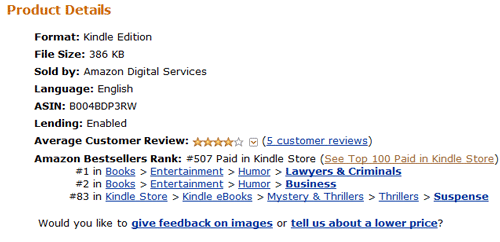
I had a nice Instalanche this morning on my post about the 99-cent price point on the Amazon Kindle for my book BMOC.  I also got a bit of attention at the KindleBoards forum.  So my book is nosing into the top 500 on Kindle, but until my kid noticed I did not see the other topical rankings:

LOL, #1 in Books>Entertainment>Humor>Laywers.  #2 on the same but for business.  Whole new niches beckon!  (Actually, these categories kind of make sense, though I am not sure who chose them --  I am not sure I did).

What is Happening at the Japanese Nuclear Plants

This is the most helpful article I have found yet on the problems at earthquake-damaged nuclear plants.  As one can imagine, it is a lot more sensible than some of the garbage in the general media.

It cleared up one point of confusion I had - I was not sure why there was still heat generation after the control rods slammed down, killing the fission process.  But apparently there are a number of intermediate fission products created that continue to decay for several days, producing about 3% of the heat of the full fission process.  This heat is what boiled away the water in the reactor vessel once flow of cooling water stopped.  It is this boiling that led to the necessity to release steam (to reduce pressure in the reactor vessel).  It was this steam that was partially disassociated into hydrogen and oxygen, which led to the explosion.

One fact that has been lost in all the hype, and may continue to be lost, is that the earthquake alone (which was 7 times larger than the plant was designed for) was necessary but not sufficient to lead to the current problems.  Everything probably would have been fine had it not been for the tsunami knocking off all the diesel generators the plant used in an emergency to keep the colling pumps running.  Apparently the generators they rushed to the site later could not be used due to various incompatibilities, the type of real-world frustrating problem that will be immediately recognizable to any engineer who has a troubleshooting background.

Update: Unfortunately, the author may have been overly optimistic.  The author implied the pile would stop producing new heat after a few days, but that does not seem to be the case, particularly since spent fuel rods apparently have to be kept in water to keep them cool months or years after they were in service.  With the apparent rupture of the main presure vessel around the core, all bets would seem to be off in terms of containing the most harmful radioactive elements.

I did troubleshooting at a refinery for years, and almost every time the worst disasters were from improbable event and/or screwup after improbable event.   The human mind seems to be unable to really grasp just how screwed up things can get.  The novel Jurassic Park was as much about this problem as it was about dinosaurs.

Update #2: This is the piece that was missing from the earlier linked report:

The sharp deterioration came after a frantic day and night of rescue efforts focused largely on the No. 2 reactor. There, a malfunctioning valve prevented workers from manually venting the containment vessel to release pressure and allow fresh seawater to be injected into it. That meant that the extraordinary remedy emergency workers had jury-rigged to keep the nuclear fuel from overheating no longer worked.

As a result, the nuclear fuel in that reactor was exposed for many hours, increasing the risk of a breach of the container vessel and more dangerous emissions of radioactive particles.

By Tuesday morning, Tokyo Electric Power said that it had fixed the valve and resumed seawater injections, but that it had detected possible leaks in the containment vessel that prevented water from fully covering the fuel rods.

Update #3:  Things are slightly better.

Sixth Annual NCAA Bracket Challenge (Sticky, New Posts Below)

Note: This post sticky through 3/17.  Look below for newest posts.

Back by popular demand is the annual Coyote Blog NCAA Bracket Challenge.  Last year we had over 140 entries.  Yes, I know that many of you are bracketed out, but for those of you who are self-employed and don't have an office pool to join or who just can't get enough of turning in brackets, this pool is offered as my public service.

Everyone is welcome, so send the link to friends as well.  There is no charge to join in and I have chosen a service with the absolutely least intrusive log-in (name, email, password only) and no spam.  The only thing I ask is that, since my kids are participating, try to keep the team names and board chat fairly clean.

To join, go to http://www.pickhoops.com/CoyoteBlog and sign up, then enter your bracket.  This year, you may enter two different brackets if you wish.

Scoring is as follows (its the same scoring we have always used)

Round 1 correct picks:  1 points
Round 2:  2
Round 3:  4
Round 4:  6
Round 5:  8
Round 6:  10

Special March Madness scoring bonus: If you correctly pick the underdog in any round (ie, the team with the higher number seed) to win, then you receive bonus points for that correct pick equal to the difference in the two team's seeds.  So don't be afraid to go for the long-shots!   The detailed rules are here.

Bracket entry appears to be open.  Online bracket entry closes Thursday, March 17th at 12:00pm EDT.  Be sure to get your brackets in early.  Anyone can play -- the more the better.  Each participant will be allows to submit up to two brackets.

They're Done

My speakers (L-C-R for a home theater) are complete!  They sound fine on the initial test, though they need to break in for many hours.  Here is how they look (the paint job is actually truck bed liner).  I will post a complete build report when I can get caught up.

99-Cent Kindle Book Update

For the second straight day, I have sold fifty copies of BMOC, for a total of a hundred in two days, at 99-cents.  Fifty copies is more than I was selling in several weeks at the old price.  Thanks to Glen Reynolds for linking the idea.

Quintessential News Story of This Generation

Woman waits in line for 41 hours to be first in line for the new iPad, then sells spot in line for $900 which she uses to buy Lady Gaga tickets.

Don't get me wrong - this is not meant to be some conservative rant against the vacuity of the younger generation.  It just strikes me as hitting a really interesting pop culture nexus.

Taking Local News Too Far

Perhaps this is just a pet peeve of mine, but I really hate it when local news organizations try to find a local angle to a huge international story.  This headline from the Arizona Republic today is a good example:

No injuries reported to workers in Japan employed by Arizona companies

When You Have A Hammer, Everything Looks Like A Nail

Via Tom Nelson, here is an article today at Grist about today's Tsunami's called "This is what climate change looks like"

So far, today's tsunami has mainly affected Japan -- there are reports of up to 300 dead in the coastal city of Sendai -- but future tsunamis could strike the U.S. and virtually any other coastal area of the world with equal or greater force, say scientists. In a little-heeded warning issued at a 2009 conference on the subject, experts outlined a range of mechanisms by which climate change could already be causing more earthquakes, tsunamis, and volcanic activity.

"When the ice is lost, the earth's crust bounces back up again and that triggers earthquakes, which trigger submarine landslides, which cause tsunamis," Bill McGuire, professor at University College London, told Reuters.

When I look at events today, I think not of "climate change" but of "development".  Compare the casualties from today in Japan and Hawaii and the US west coast to those in, say, Indonesia.  Development saves lives through better construction, better communication, better early warning systems, and better transportation networks.   If one really wants to think about today's events in the context of climate change, think about the alarmists' proposed tradeoff between small and uncertain changes in the climate vs. almost certain reduction in development through climate-change programs.

99-cent Book Experience, Day 1

Well, it may only be a short-term kick driven by you fine readers  (my thanks) but yesterday in the first day at the 99-cent price point I sold fifty copies of BMOC and jumped to number 2067 in the sales rank.  Since my main goal is to be read, rather than make money, this is great.

Amazon Bargain

My novel BMOC is now $0.99 at Amazon.  With my second book coming out sometime soon (I hope) I thought I would experiment with online pricing models.  I sold about 30 a month at the old price, but Glen Reynolds linked an article praising the 99-cent Kindle price point.  So what the heck, let's try it.  My loss is your gain, as the ads say.

Reasons you might like the novel:

  • It's a sort of combination of Harvard Business School case study and murder mystery, with some humor thrown in
  • The business at the center of the novel is actually the good guy (err gal, I guess, since the protagonist is female). While sympathetic to capitalism, the book is primarily a light crime novel, not some sort of Randian morality tale.
  • The villains include a media mogul, a tort lawyer, a local news anchor, and a US Senator  -- just like life!
  • Several of the business models were made up on the fly when I attended boring cocktail parties and entertained myself creating whimsical businesses for myself.  Since that time, readers of the book have emailed me with news stories of recent startup companies following almost identical strategies.
  • 4-stars at Amazon

Taxpayer Money and Professional Sports

My column is up this week at Forbes, and discusses the role of taxpayer money in professional sports.

A  critical battle is underway challenging the very heart of the professional sports economics model — and it is not the NFL labor negotiations.  The unlikely fight is between a struggling league (the NHL), a suburb with delusions of grandeur (Glendale, Arizona), and a small, regional think tank (the Goldwater Institute).   At stake is an important source of value for nearly every professional sports team:  taxpayer subsidies....

Consider the Arizona Cardinals new football stadium in Glendale, for example.  In part due to the promise of a Superbowl bid, the local taxpayers paid $346 million of the total $455 million cost of the facility — a building that will be used just three hours a day on ten days a year for its primary purpose.  By contrast, in 2010 Forbes valued the Arizona Cardinals at $919 million, meaning well over a third of the franchise’s value accrues from the public subsidy of its retractable roof palace.  It can be argued that much of the increase in player salaries and team owner wealth in the NFL over the last twenty years has come at the expense of taxpayers.

If anything, this example from the NFL understates the importance of public funding of stadiums.  Why?  Because of all the major sports leagues, the NFL gets the lowest percentage of its total revenues from its stadiums.  Leagues like the NBA, and in particular the NHL, are far more dependent on stadium revenue for their well-being.

Let’s return to precocious Glendale.  In 2003, the city agreed to publicly fund $180 million of the $220 million cost of building a new arena for the Phoenix Coyotes hockey team.  Whereas Glendale’s subsidy of the Cardinals represented about a third of that franchise’s value, their $180 million subsidy of the Coyotes represents over 130% of the current $134 million value of the team.  Stuck in Arizona and losing as much as $40 million a year, the team is literally worthless without ongoing public subsidies.

The column goes on to discuss yet another bond issue proposed by Glendale to subsidize these teams.

Official Announcement: Civil Rights Movement Can Declare Victory

The Civil Rights movement can officially declare victory, if this is the kind of racism being faced by African Americans today.  Seriously, if the harms are really this trivial, let's move on to other issues.  If there is still meaningful racism out there, let's stop clogging the courts and wasting our time with this kind of trivial BS and work the real issues.

Postscript:  It could be that I am just not hip to modern lingo.  I suppose that the words "please turn off your cell phones during the movie" is actually a well known code phrase meaning "back to slavery all of you" and I am just not aware.  If I am missing something, please let me know so I too can feel appropriately victimized next time I go see a movie.

I Have Had This Argument About a Zillion Times

From Arnold Kling

I think that (non-classical) liberals and libertarians see the problem of "special interests" differently. Liberals view special interests as exogenous to the policy process. You have to overcome special interests to create good policy. Libertarians see special interests as endogenous. Policy is what creates them.

Yep, I have had this argument about a million times with liberals.  Liberals will argue that government power is neutral to positive, and that it is private action corrupting government, and this corruption can be avoided if private action is aggressively policed (including campaign spending limits, etc).  Example:  If Wall Street money could be taken out of politics then financial regulation would work.

I argue that money in politics are a result of the stakes that we have put on the table -- the more power we give to government to reallocate wealth, the more money will be spent to have such decisions made in one's favor.  In the age old question of whether a bribe is more the fault of the politician that demanded it or the private party that offered it, I would answer that the fault is with the system that gives the politician enough power to make such a bribe pay.  And increasing the government's power to limit private involvement in politics (e.g. via campaign spending limits) only makes the government power problem worse.

The Left is Simply Unserious

This is the response from the Left to a proposed 1.6% cut in the Federal budget, that would reduce the annual deficit by a whopping 6%.  Greece here we come!

The Senate is expected to vote this week on alternative plans to approve spending for the rest of this year.  They will vote on whether to agree to the extreme cuts passed by the House (H.R. 1) - $65 billion less than last year's spending for domestic programs.  The House bill will deny vital services to millions of people, from young children to seniors. Please tell your Senators to VOTE NO on H.R. 1 and to vote FOR the Senate alternative. The proposed Senate bill cuts spending $6.5 billion below last year's levels, compared to more than $60 billion in cuts in H.R. 1.  Most of the extreme cuts in the House plan listed below are not made in the Senate bill.

Call NOW toll-free 888-245-0215 (the vote could be as early as Tuesday)
Please call both your Senators and tell them to VOTE NO on H.R. 1 and FOR the Senate full-year FY 2011 bill.  Tell them to vote NO on harsh and unprecedented cuts that will deny health care, education, food, housing, and jobs to millions of the poorest and most vulnerable Americans, while at the same time jeopardizing the economic recovery for all.

Seen and Unseen

Every time you see a politician claiming he created jobs with some expenditure of taxpayer money, you have to ask yourself, what would private investors have done with that money had it not been taken away from them?  Via John Stossel

In a new article, "The Myth of Green Energy Jobs: The European Experience", the environmental scientist and a resident scholar at the American Enterprise Institute writes,

"Green programs in Spain destroyed 2.2 jobs for every green job created, while the capital needed for one green job in Italy could create almost five jobs in the general economy."

Partial Proof of My Thesis

Several years ago, I offered the following hypothesis to a reporter:

I would argue that the current obsession with small changes to trace levels of CO2 in the atmosphere has in fact gutted the environmental movement.  Nothing else is getting done. ... My prediction– 10-20 years from now, environmentalists are going to look back on the current global warming hysteria as the worst thing ever to happened to the environmental movement.

Here is an example of that effect.  A study comes out that says the following about the health of the Great Lakes:

The Commission is troubled by nearshore eutrophication, aquatic plant growth caused by excessive nutrients, which causes adverse effects on ecosystems, the economy, recreation, and human health.  The reemergence of algal blooms is likely due to multiple factors, including inadequate municipal wastewater and residential septic systems; runoff from increased impervious surface areas and agricultural row-crop areas; discharges from tile drainage which result in more dissolved reactive phosphorus loading; industrial livestock operations; ecosystem changes from invasive mussel species; and impacts from climate change which include warmer water and more frequent and intense precipitation and stormwater events.

Of these listed potential causes, only the last, climate change, is not addressed at all in the main study document, nor is addressing climate change on their list of recommendations, which in fact emphasize that solutions tend to be local.   In fact the tone of the study is that the causes are complex and poorly understood, but never again beyond this sentence is climate change mentioned or any evidence of increased precipitation or runoff presented.

One is left with the impression it was a toss-in on the list, included because climate change is "hot" and sexy and a magnet for funding and attention.  Certainly the report provides no other evidence or detail as to why it is included in the list.  Certainly any intelligent reader would understand that the climate change item was, at best, included to round out the possibilities of a complex and poorly understood problem, but that the study points to many of the other items on the list as more productive places to seek solutions.

So, given this, what do environmental reporters pick up?  Here is the headline environmental reporter Cameron Scott uses on his SFGate blog "the Thin Green Line":

Climate change threatens Great Lakes

Yep, he latched on to the last, least important item that is completely un-adressed by the main report.  By doing so, he is in effect helping to distract attention from the real causes that can be addressed and diverting attention to issues that are tangential at best.  The solution will likely involve better managing agricultural runoffs and dealing with municipal wastewater plants which are under-treating discharges.

This is why I say that the global warming hysteria will be looked back on as a dead time for the environmental movement, when obsession with trace amounts of CO2 either caused folks to lose attention on important issues, or even caused environmentalists to advocate for ecologically detrimental programs (e.g. biofuels).

Measuring the New Economy

From Slate.com via Carpe Diem:

"Maybe it is not the growth that is deficient. Maybe it is the yardstick that is deficient. MIT professor Erik Brynjolfsson explains the idea using the example of the music industry. "Because you and I stopped buying CDs, the music industry has shrunk, according to revenues and GDP. But we're not listening to less music. There's more music consumed than before." The improved choice and variety and availability of music must be worth something to us—even if it is not easy to put into numbers. "On paper, the way GDP is calculated, the music industry is disappearing, but in reality it's not disappearing. It is disappearing in revenue. It is not disappearing in terms of what you should care about, which is music."

As more of our lives are lived online, he wonders whether this might become a bigger problem. "If everybody focuses on the part of the economy that produces dollars, they would be increasingly missing what people actually consume and enjoy. The disconnect becomes bigger and bigger."

But providing an alternative measure of what we produce or consume based on the value people derive from Wikipedia or Pandora proves an extraordinary challenge—indeed, no economist has ever really done it.

Ditto Facebook, free flash games, ichat, etc.  I think the point is dead on, though I have no idea how to fix it.  Maybe as a value of the consumer's time?  If your time is worth $15 an hour, and you spend it on Facebook, then your benefit must have been at least $15?

Thinking about this, it strikes me that there is no GDP credit for leisure time, either.  There is almost nothing more valuable to me .  If everything in my life stays the same but I can use technology or other factors to restructure my time to get one extra hour of leisure, isn't that of huge value?  But there is no credit for it in GDP or earnings accounts.

The article discusses consumer surplus, which strikes me as the heart of the matter.  GDP and earnings metrics track what we pay, not how much value we receive.  If one hypothesizes that consumer surplus is rising as a percentage of purchase price, then we are missing a lot of wealth creation.

A Difference Between Republicans and Me

Both I and most Congressional Republicans want to defund NPR.  Republicans want to do it because they perceive it as a government-funded liberal partisan voice;  I want to do it because broadcasting is simply not a role for government.

But note -- Republicans who want to count coup on NPR out of spite and frustration should recognize that defunding it could very likely make NPR a more, rather than less, potent leftish voice  (insert Star Wars quote "if you strike me down.... yada yada).  NPR's government funding is all that is really keeping it in sight of the political center.  Pull that funding and it will be free to tack left - in fact, this likely will be an imperative given its likely sources of additional private funding it will need.

All of which is fine by me, but I think the Republicans are expecting an Air America-type crash and burn, and I think they are mistaken.  There is a lot about PBS and NPR that are vital and unique -- their supporters are not wrong about that -- which I think will make them viable private (though still non-profit) entities.

Getting Really Close

I have decided to save the photo-essay of my speaker-building project until the project is finished and I can put it all in one long post.  However, just as an update, I am really close to done.  The three speakers (left, center, right) will go behind my accoustically-perforated projection screen.  As you can see, the enclosures are complete and primed and the crossovers are complete and installed.  The special paint I ordered arrived today so I can paint this weekend and install the drivers.

The funny shape of the openings at top are due to my choice of drivers -- the tweeter will be a horn-style driver, an approach I wanted to try for home theater in a large room (movie theater speakers use the same technology).  The cabinet is ported for bass response -- that is what the rectangular opening is in the upper right.   These are based on a design by Pi speakers.

Knock on wood but given my total and complete lack of carpentry skills and experience (think Anthony Michael Hall in the Breakfast Club, the geeky kid who fails shop), I am just thrilled with how they are coming out.

Just a teaser -- all will be explained soon....

Hope and Change

Via the WSJ, discussing the US's Siberian Gulag in the Caribbean:

The Obama administration on Monday announced plans for new Guantanamo Bay military trials and for the first time laid out its legal strategy to indefinitely detain prisoners who can't be tried but are too dangerous to be freed.

President Barack Obama issued an executive order to conduct periodic reviews of the cases of the nearly 50 detainees who will be detained indefinitely.

It used to be that people who had never been convicted of any crime but that certain people in the government considered dangerous were called "free men."

Don't Say I Didn't Warn You About Wind Power

From the printed version of the Daily Telegraph (does not appear to be online, but scan here).

The days of permanently available electricity may be coming to an end, the head of the power network said yesterday.

Families would have to get used to only using power when it was available, rather than constantly, said Steve Holliday, chief executive of National Grid.  Mr Holliday was challenged over how the country would "keep the lights on" when it relied more on wind turbines as supplies of gas dwindled.  Electricity provided by wind farms will increase six-fold by 2020 but critics complain they only generate on windy days.

Mr. Holliday told Radio 4's Today programme that people would have to " change their behaviour".

An Amazing Tale from Academia

I generally hesitate to publish links to such stories without having heard the other side or seen any objective reporting, but none-the-less, if true, this is a pretty amazing story.  In it, Oregon State University is being accused of seeking retribution against a Republican Congressional candidate by harassing and expelling his kids.  (via Green Hell Blog)