Meta

I have tried to write this post several times but we are having some kind of Internet problem and I keep losing the post just before I get it finished.  Anyway, let's try again.

Yesterday my daughter was reading after school.  Like many freshman English classes, they are doing Greek mythology.  I was asking her questions about her day when she yelled at me, "dad, I have one more paragraph left in Sisyphus, just let me finish.  Every time you interrupt me I have to start over".  So of course I had to wait about ten seconds, just when I estimated she was about done, and I interrupted her again.  I kept doing this for a while, thinking it was simply hilariously apt.  Unfortunately, I don't think she

Most Unfortunately Yet Appropriately Named Book Ever

Touched: The Jerry Sandusky Story (I kid you not).

Some of the reviews are classic, though I am disappointed many of them are "please remove this book."  Why should we let this jerk hide?  The book up with its amazing irony and spate of scathing review comments is much better than being disappeared.

Yeah, I am Sure Everyone Else Is Linking This Video Today. Deal With It.

Outright Theft by Public Unions

Though it's a high bar given what has been going on recently, this is the most aggravating thing I have read this week, via Glen Reynolds:

Robert and Patricia Haynes live in Michigan with their two adult children, who have cerebral palsy. The state government provides the family with insurance through Medicaid, but also treats them as caregivers. For the SEIU, this makes them public employees and thus members of the union, which receives $30 out of the family's monthly Medicaid subsidy. The Michigan Quality Community Care Council (MQC3) deducts union dues on behalf of SEIU.

Michigan Department of Community Health Director Olga Dazzo explained the process in to her members of her staff.  "MQC3 basically runs the program for SEIU and passes the union dues from the state to the union," she wrote in an emailobtained by the Mackinac Center. Initiated in 2006 under then-Gov. Jennifer Granholm, D-Mich., the plan reportedly provides the SEIU with $6 million annually in union dues deducted from those Medicaid subsidies.

“We're not even home health care workers. We're just parents taking care of our kids,” Robert Haynes, a retired Detroit police officer, told the Mackinac Center for Public Policy. “Our daughter is 34 and our son is 30. They have cerebral palsy. They are basically like 6-month-olds in adult bodies. They need to be fed and they wear diapers. We could sure use that $30 a month that's being sent to the union.”

This is a microcosm of the typical liberal fail -- a group or agency does initial good work (private unions in the early 2oth century, civil rights groups in the 60's and 70's, the EPA in the early 70's) but refuse to go away and declare victory, instead morphing into self-sustaining parasites whose only concern is their own survival.

Movie Trailer for Academy Award Winner

This has been around a while but it is worth a repost as we approach Oscar film season.

The True Cost of the Education Bubble

I hinted at it in my last post, but have addressed it in more depth in my column this week at Forbes.  A brief excerpt:

The theme from all these failures is distorted signals and corrupted communication.  People, no matter how savvy, cannot possibly research every nook and cranny of the economy before making an investment.  They make decisions, therefore, based on signals – prices, interest rates, perceived risks, and the profit history of other similar investments.  If these signals are artificially altered or corrupted, bad decisions that destroy wealth and growth will result.

Which brings me back to education.    I will tell you something almost every business owner knows:  We business owners may whine from time to time that banks won’t lend us money, but what really is in short support are great people.  Nothing has more long-term impact on an economy than amount and types of skills that are sought by future workers.  That is why everyone accepts as a truism that education is critical to economic health.

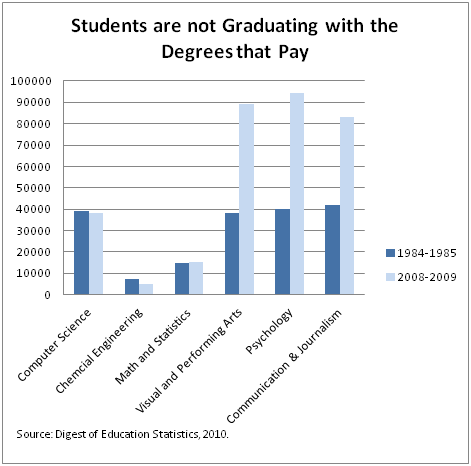
Unfortunately, there is good evidence that our education policies have already done long-term harm.   The signals we send to kids making their higher education plans have disconnected them from reality in a number of fundamental ways, causing them to make bad decisions for themselves and the broader economy.

Examples follow.  Read it all.

Wage Stagnation in One Chart

My Brief Conversation with the Homeland Security Department This Morning

I got a call this morning from Homeland Security about their e-verify immigration tracking system (which we are required by law to use in Arizona).  The caller said that Homeland Security was interested in the satisfaction of their customers.  I told her that I am not her customer.  I am a subject of the state who is forced by law against my will to use their system.  A customer is someone who is in a voluntary relationship.

The call ended soon after that.  I supposed I have just asked for some sort of audit, but at this point I don't care.

Christmas Tree Tax

Yes, its stupid, but perhaps for a different reason than has been mentioned.  The tax is on producers, and is meant to fund a promotion and marketing campaign.  Really.  Because Christian families in the US might forget to buy a tree this year if the government did not remind them.  Seriously, do any of these folks have kids.  "Dad, can we get the tree today, can we, can we, please?"

By the way, this kind of taxation authority that bypasses Congress is actually fairly often used by the Department of Agriculture.   If you see random TV ads for avocados or almonds, you probably are seeing one of these government marketing forced-cooperatives.

Two Lessons From the Last Five Years

I propose two lessons learned from the last five years:

  • There is no such thing as a risk-free return
  • There is no such thing as a perfect hedge
We are very, very close to seeing much of the financial system blow up because banks, particularly in Europe, have bought sovereign debt and leveraged it 30x to 40x.  The theory was that sovereign debt denominated in Euros, yen, or dollars was essentially risk-free.  Once that theory was proved to be bankrupt, financial institutions are now claiming all their sovereign debt is perfectly hedged.  I think we will find that untrue as well.  Hedging mechanisms don't work when the whole of the market is tanking -- its a similar problem to why earthquake insurance does not work.  No insurance company or counter-party can pay off when every single policy has a claim.

Bailed Out Banks Take On More Risk

I found this fascinating, if unsurprising, via Zero Hedge:

Ran Duchin and Denis Sosyura of the University of Michigan looked at the U.S.’ Capital Purchase Program. You may recall that this became the centerpiece of TARP once Hank Paulson decided that the money would be better spent directly buying into the banks as opposed to overpaying them for dodgy asset-backed bonds. (Mind you, other parts of TARP were spent overpaying for dodgy asset-backed bonds.)

The CPP lasted a little more than a year and invested $205 billion of taxpayer funds into various qualifying institutions. Not every bank that filled out the 2-page application was successful in gaining access. Others were approved but ultimately decided not to take the funds (probably because of the attached restrictions on pay and on paying out dividends.) In the end, 707 financial institutions received the funds.

Duchin and Sosyua looked at a sample of 529 public firms that were eligible for CPP and slotted them into categories based on whether they applied, whether they were approved and whether they ultimately took the money. They controlled for non-random selection (via measures of the banks’ financial condition, performance, size and crisis exposure); for changes in national and regional economic conditions; and finally for potential distinctions in credit demand.

They then viewed the banks’ CPP participation status in comparison with their subsequent risk appetite as demonstrated by (1) their consumer mortgage credit approvals or denials (viewed on a risk-profile controlled, application-by-application basis); (2) their participation in syndicated corporate loans for riskier credits and; (3) the risk profile of their investment asset portfolios. What did they find?

They found more risk, across the board.  There is a lot of detail, so I will leave it to you to go to the source for more, but Zero Hedge concludes:

The bail-out itself increased our chances of having the bail the banks out all over again. Moral hazard is no longer in the realm of the abstract

A few months ago I went through an unbelievable hassle refinancing my loan.  Based on current appraisals, my loan to value was less than 50%, but I still ended up coming to the table with more equity to reduce the new loan size.  I was staggered at how hard it was to close what should have been a dead-safe loan, given the LTV and my income and credit history.  The study actually has a finding related to that:

For mortgages the bailed-out banks increased their risk–

“after CPP capital infusions, program participants tilted their credit origination toward higher-risk loans by tightening credit standards for the relatively safer borrowers and slightly loosening them for riskier borrowers.”

–while at the same time ensuring that they didn’t trip off any alarms

“This pattern would be consistent with a strategy aimed at originating high-yield assets, while improving bank capitalization ratios, since the key capitalization ratios do not distinguish between prime and subprime mortgages.”

This is a fascinating sort of metric manipulation.  Having my loan go from 45% to 40% LTV does nothing, really, for the overall safety of the bank, but it improves their averages and makes them look safer, while all the way they are actually engaging in more risky behavior.

Act Now!

Its absolutely critical that you run over and sign this online petition.  Go now.

Greek Slow-Motion Bank Run

via

OWS and Philip Rearden

I have been reading a lot of the data flying around of late about income inequality and mobility.  And it struck me that income mobility may be a large part of what is driving many OWS protesters.

Despite assumptions to the contrary on the Left, wealth is not a zero-sum game.  Steven Jobs got richer by making me better off.  But the one thing that is zero-sum is presence in the top 1%.  When someone joins the club, someone, by operation of basic math, drops out.

That does not mean that the other person who drops out is poorer, it just means that they are no longer as rich relative to their peers.  This same effect works int he top 10% and 20%, etc.

Looking at OWS protectors, they seem to be disproportionately children of the upper middle class or even of the rich.  They have expensive college educations, live in nice homes, and have gobs of stuff (OWS must be the most iPhoned event in history).  My guess is that they are of the upper two quintiles, or at least their parents were.

I am wondering if the problem is not income inequality but too much income mobility.  After all, a third of the top two quartiles in 2001 had dropped into the bottom three in 2007 (while an equal number moved up). Are these the angry proletariat, or are they children of the well-off who are upset their college degree in puppetteering did not automatically keep them up with the Joneses?   Are they, in other words, Philip Rearden?


China Bubble Bursting

I don't have time today to link all the evidence, but the combination of crashing real estate markets and the Chinese government jamming liquidity into its banks tells me the China bubble is bursting as we speak.

This is an interesting test of the Austrian view of depressions vs. the Keynesian / Krugman / Thomas Friedman / MITI view of government-orchestrated prosperity.  If the latter are right, then China is doing more right to keep their economy going than any country in history and you should go invest all your money in Chinese real estate.

However, if one believes the Austrian model about government-enforced mis-allocation of capital and labor leading to bubbles and crashes; if one believes that the technocrat-beloved MITI was largely responsible for the Japanese lost decade; if one believes that the US govenrment through articially low interest rates and government-directed reductions in underwriting quality helped create the housing bubble -- then the mother of all crashes is looming in China.  Because no country has done more to reallocate resources and capital based on the whims of a few technocrats  and well-connected industrialists than has China.  After all, this is why Thomas Friedman loves China, that it does not rely on the judgement of millions of individuals to allocate capital, but instead on the finger pointing of a few at the top.

Journalistic Ethics

This is an interesting story on the AP and journalistic ethics

The Associated Press purchased an advanced copy of the book. It is set for release on Nov. 15.

Let's start with the second paragraph.  It's a lie, pure and simple--and the papers that reprinted the stories know it.  Giffords didn't sell any "advanced copy" of the book.  The book is strictly embargoed so that she can control the timing of the media stories that surround it.  Bookstores, however, have copies locked up in storage rooms so the copies can all be put on the shelves at the same time.  Someone stole one of those copies...or perhaps stole a proof text from the publisher...and then sold it to the Associated Press.

Rather than admit that they illegally purchased and then printed excerpts from a stolen copy, the Associated Press lied and said that they "purchased an advanced copy of the book."  That would be a big story by itself, but the newspapers that have contracts with the AP didn't want to blow a good story, so that meekly reprinted the lie.

What's worse is that the AP not only stole Giffords' book and disrupted the timing of her planned roll out...they botched the story and made Giffords issue a denial. ...

...faced with an ambiguous quote in a stolen book and no chance to verify it, the AP did just what they teach you in the ethics classes in Journalism school...they ran with the most tantalizing, headline grabbing interpretation and then made Gabby deny it.  Nice.

Emergent Disorder

This is a fascinating tale, from Occupy Wall Street, demonstrating how a group with assumptions including

  1. Its OK for one group to exercise power over another group
  2. Its OK to redistribute money on some basis other than earning it through voluntary commerce
can quickly devolve into emergent disorder.
There is no great brotherhood once you adopt the assumption that people may use coercion to achieve their goals - there is only victory by those most capable in the raw exercise of power.

Crony Capitalism

Perhaps I do not give Sarah Palin enough credit, because this is a really good passage, from one of her recent speeches (emphasis added by Mickey Kaus)

We sent a new class of leaders to D.C., but immediately the permanent political class tried to co-opt them – because the reality is we are governed by a permanent political class, until we change that. They talk endlessly about cutting government spending, and yet they keep spending more. They talk about massive unsustainable debt, and yet they keep incurring more. They spend, they print, they borrow, they spend more, and then they stick us with the bill. Then they pat their own backs, and they claim that they faced and “solved” the debt crisis that they got us in, but when we were humiliated in front of the world with our country’s first credit downgrade, they promptly went on vacation.

No, they don’t feel the same urgency that we do. But why should they? For them business is good; business is very good.  Seven of the ten wealthiest counties are suburbs of Washington, D.C. Polls there actually – and usually I say polls, eh, they’re for strippers and cross country skiers – but polls in those parts show that some people there believe that the economy has actually improved. See, there may not be a recession in Georgetown, but there is in the rest of America.

Yeah, the permanent political class – they’re doing just fine. Ever notice how so many of them arrive in Washington, D.C. of modest means and then miraculously throughout the years they end up becoming very, very wealthy? Well, it’s because they derive power and their wealth from their access to our money – to taxpayer dollars.  They use it to bail out their friends on Wall Street and their corporate cronies, and to reward campaign contributors, and to buy votes via earmarks. There is so much waste. And there is a name for this: It’s called corporate crony capitalism. This is not the capitalism of free men and free markets, of innovation and hard work and ethics, of sacrifice and of risk. No, this is the capitalism of connections and government bailouts and handouts, of waste and influence peddling and corporate welfare. This is the crony capitalism that destroyed Europe’s economies. It’s the collusion of big government and big business and big finance to the detriment of all the rest – to the little guys. It’s a slap in the face to our small business owners – the true entrepreneurs, the job creators accounting for 70% of the jobs in America, it’s you who own these small businesses, you’re the economic engine, but you don’t grease the wheels of government power.

So, do you want to know why the permanent political class doesn’t really want to cut any spending? Do you want to know why nothing ever really gets done? It’s because there’s nothing in it for them. They’ve got a lot of mouths to feed – a lot of corporate lobbyists and a lot of special interests that are counting on them to keep the good times and the money rolling along.

Pictures I Have Never Seen...

How the Left Analyzes Greece

I find the Left's opinions on Greece to be fascinating.  After all, Greece is essentially the logical end result of all of their love for deficit spending, so what kind of cognitive dissonance is necessary to write about Greece on the Left?  This kind:

OK, but they're spending too much money. Surely they know they have to cut back?

Sure, but the deals on offer are pretty unattractive. Europe wants to forgive half of Greece's debt and put them on a brutal austerity plan. The problem is that this is unrealistic. Greece would be broke even if all its debt were forgiven, and if their economy tanks they'll be even broker.

But that's the prospect they're being offered: a little bit of debt forgiveness and a lot of austerity.

Well, them's the breaks.

But it puts Greece into a death spiral. They can't pay their debts, so they cut back, which hurts their economy, which makes them even broker, so they cut back some more, rinse and repeat. There's virtually no hope that they'll recover anytime in the near future. It's just endless pain. What they need is total debt forgiveness and lots of aid going forward.

I certainly agree that Greece is now in a death spiral, but this analysis is just amazing.  The only way for other countries to avoid sharing Greece's fate is to, very simply, spend within their means.  If they do, problem avoided.  If they don't, and get hooked on deficit spending, then Greece is their future, the only question is when.

So what does Drum do?  He calls the spending withing their means strategy "unrealistic" and "brutal austerity."    So he occupies a long post lamenting what a totally SNAFU'd situation Greece is in, but takes off the table the only possible approach for other counties to avoid the same fate.   And in fact advocates a strategy that will push a few others over the cliff sooner, or even cause a few to jump on their own (after all, if the punishment for spending your way into financial disaster is to get, as Drum recommends, all your debt forgiven and years of aid payments, why the hell would anyone want to be fiscally responsible?)

And it is amazing to me that he calls forgiving half their debt, the equivalent in the US of our creditors erasing about $7 trillion, as "a little bit of debt forgiveness" while cutting government spending a few percent of GDP is "a lot of austerity."

His solution, of course, is not for Greece to face up to its problems but to transfer the costs of its irresponsibility to others and then remain nearly perpetually on the dole.

His mistake is to assume Greece faces endless pain.  It does not.  History has shown that countries that are willing to rip off the bandage quickly rather than over a few decades can recover remarkably quickly if sensible policies are put in place.  Heck, the Weimar Republic, which had inflation so bad people got paid 3 times a day so their family could buy something before the money became worthless a few hours later, got its house in order in a matter of months.
OK, I Double My Estimate to $200 Billion

I wrote quite a while ago I wrote that there was no way the estimated $43 billion California high speed rail project would be completed for less than $100 billion.  Well, now the agency itself is estimating it will cost $100 billion (or $98 billion and change, but that is likely a number picked to avoid going to three digits).  So I now officially raise my estimate to $200 billion for the complete line from Anaheim to San Francisco.  Anyone want the under?


Another Bankrupt Obama Investment

Via Business Week

 Beacon Power Corp., an energy- storage company that received $43 million in backing from the U.S. program that supported failed solar-panel maker Solyndra LLC, filed for bankruptcy after struggling to raise private financing.

The money-losing company, which makes flywheels that manage energy moving through a power grid, had sought to avoid the fate of Solyndra, which entered bankruptcy last month after receiving a $535 million loan guarantee from a U.S. Energy Department program designed to spur alternative energy development. Beacon faced delisting of its shares by the Nasdaq Stock Market and warned in an Aug. 9 regulatory filing that it might not remain a “going concern.”...

In addition, Beacon received $29 million in grants from the U.S. and Pennsylvania for a 20-megawatt plant in that state and hired Group Robinson LLC to help raise more funds for the $53 million project. Group Robinson, a Menlo Park, California- based renewable-energy consulting company, also was helping Beacon find customers outside the U.S.

This is not an accident.  By definition, the government is investing in companies that every other private lender and investor turned down.

My Most Difficult Customer Service Problem

The most frequent customer service fail we have in our company is when an employee, thinking they are doing me some kind of favor, go nuts on a customer trying to enforce some trivial rule or trying to collect the last $5 our company might be owed.

It is astronomically hard to train people to use their judgement the same way I would in a customer situation.  This is particularly true when ego gets involved, when the employee feels like they have somehow taken a ego hit, with the customer "winning" and them "losing."  I once had an employee drive out of the park we were operating and chase a woman down the road over a misunderstanding about whether $5 had been paid correctly.  Incredible.  Unfortunately,  I have found no amount of training can fix judgement this bad, and the only thing I know how to do is fire them as fast as possible so they can't do any more harm.

I have always supposed this over-zealousness was a general human train, but in certain am-I-crazy moments, I wonder if somehow I am preferentially selecting for this kind of nuttiness.  Apparently not:

A Hawaii couple’s 3-year-old daughter was taken away from them for 18 hours after they were arrested for forgetting to a pay for two $5 sandwiches.

“This is unreal this could happen to a family like ours,” Nicole Leszczynski told Hawaii’s KHON.

The outing-turned-nightmare happened Wednesday while the family was shopping at a local Safeway.

“We walked a long way to the grocery store and I was feeling faint, dizzy, like I needed to eat something so we decided to pick up some sandwiches and eat them while we were shopping,” Leszczynski told the news station.

Leszczynski, who is 30-weeks pregnant, her husband, Marcin, and daughter Zophia bought $50 worth of groceries — but forgot about their two chicken salad sandwiches.

“It was a complete distraction, distracted parent moment,” Leszczynski told KHON.

As the family left, they were stopped by store security, who asked for their receipt.

“I offered to pay, we had the cash. We just bought the groceries,” Leszczynski told the station.

Instead, the expectant mother told KHON that the Safeway manager called police. They were taken to the main Honolulu police station where they were booked for fourth degree theft. Then Zophia was taken into custody by Child Protective Services.

I will say that I think the public agencies we replace in operating these parks are generally worse at this than we are, simply because so many of their employees have law enforcement certifications.  Dealing with customer service issues using law enforcement officers is often a recipe for bad outcomes.

Friday Morning Test

Thought on Income Inequality

If the very rich got that way through special access to government power, then why is the solution to tax them more, and not just to reduce government power?

And if the very rich got that way through hard work and innovation, then why the hell are we proposing to take resources out of these people's hands?