Guns, Germs, Steel

The story I was always taught is that the Spanish conquistadors rolled over the Aztecs, Maya, and Incas in what would be an inevitable victory chalked up to guns, germs, and steel.  But I always found this conclusion a bit smelly.  Sure the Spanish had guns and horses, but they didn't have very many of them (a few hundred) and they were not very good.  Three and a half centuries later, the US struggled at times in its wars with North American tribes (just ask the Custer family) despite having FAR better guns, many more trained troops (just after the Civil War), numerical superiority rather than inferiority, and a much better logistics situation (land access by rail vs. sea access by wooden boat).  In addition, Latin American civilizations faced by the Spanish were better organized, far more numerous, and technologically more advanced than plains Indians.  So why the seemingly easy victory by the Spanish?

Apparently there is a new book discussing this topic, which claims the results were much more contingent than commonly believed.

The “steel and germs” explanation for the rapidity of conquest has not convinced all specialists. The newcomers’ technological advantages were insufficient and in any case only temporary; differential mortality was a long-term process, not something that happened at the moment of outsiders’ assault. Thinking about the endemic vulnerabilities of empires helps us understand the situation. The Aztecs and the Incas were themselves imperial formations of relatively recent origin, with highly concentrated power and wealth at the center and often violent relations with not entirely assimilated people at the edges of their empires. When the Europeans arrived, indigenous people were not sure whether the newcomers were enemies, gods, or evil spirits–or potentially useful allies against an oppressive power. These uncertainties made it harder for their rulers, who had no way of knowing what was in store for them, to respond effectively. Cortes and Pizarro recruited allies among disaffected peoples, thereby making their armies as large as the Aztec and Inca forces they fought against. The battle against the Aztecs was hard-fought, with Spaniards suffering reverses, despite their indigenous allies and the hesitations of the Aztec emperor Moctezuma. The conquest of the Inca empire–more centralized than that of the Aztecs–was also facilitated by turning those excluded under Inca power into indigenous allies.

You've Come A Long Way Baby (Drone Strike Edition)

Obama Secretary of State John Kerry, in his famous Winter Solider remarks to Congress about the Vietnam War:

... it seems the Government of this country is more concerned with the legality of where men sleep than it is with the legality of where they drop bombs.

Obama Spokeman Jay Carney, today:

these [drone] strikes are legal, they are ethical, and they are wise

Remember, Jay Carney is talking about the President's claimed right to bomb US citizens, as well as anyone else he thinks (but can't necessarily prove in a court) might kind of sort of have something to do with a terrorist group.  And civilian casualties, so much a part of Kerry's concerns back in the 1970's?  They are just asking for it.

Anyway, I have not had a chance to digest the Administration's white paper on targeted killing (I can't even believe I am writing that phrase -- our Constitution specifically banned bills of attainder but now the executive claims the ability to kill at whim).  Jacob Sullum has some thoughts at the link.  I will write more if and when I have a chance to read it, but I am sure I will find it horrifying.


California Invents New Way To Raise Revenues

Retroactive tax increases

Under the California Franchise Tax Board’s interpretation of a 2012 state Court of Appeals ruling, which found part of the tax law to be unconstitutional, anyone who acted in good faith to claim the now-deceased QSB incentive on their2011 California return owes the state back taxes on the excluded or deferred income.

And the same goes for 2010. And 2009. And 2008.

And, what’s more, these taxpayers will also be hit with back interest and possible penalties.

The penalties part is particularly hilarious.  We are going to penalize you for doing what we told you to do.

By the way, I likely would have opposed the QSB incentive had I known about it as just another crony giveaway.  So I have no problem ending it.  But retroactive tax increases are a bad, bad precedent.

Best and the Brightest May Finally Be Open To Considering Lower Climate Sensitivity Numbers

For years, readers of this site know that I have argued that:

  • CO2 is indeed a greenhouse gas, and since man is increasing its atmospheric concentration, there is likely some anthropogenic contribution to warming
  • Most forecasts, including those of the IPCC, grossly exaggerate temperature sensitivity to CO2 by assuming absurd levels of net positive feedback in the climate system
  • Past temperature changes are not consistent with high climate sensitivities

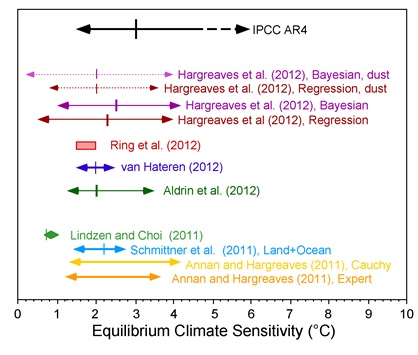
Recently, there have been a whole spate of studies based on actual observations rather than computer models that have been arriving at climate sensitivity numbers far below the IPCC number.   While the IPCC settled on 3C per doubling of CO2, it strongly implied that all the risk was to the upside, and many other prominent folks who typically get fawning attention in the media have proposed much higher numbers.

In fact, recent studies are coming in closer to 1.5C - 2C.  I actually still think these numbers will turn out to be high.  For several years now my money has been on a number from 0.8 to 1 C, sensitivity numbers that imply a small amount of negative feedback rather than positive feedback, a safer choice in my mind since most long-term stable natural systems are dominated by negative feedback.

Anyway, in an article that was as surprising as it is welcome, NY Times climate writer Andy Revkin has quite an article recently, finally acknowledging in the paper of record that maybe those skeptics who have argued for alower sensitivity number kind of sort of have a point.

Worse than we thought” has been one of the most durable phrases lately among those pushing for urgent action to stem the buildup of greenhouse gases linked to global warming.

But on one critically important metric — how hot the planet will get from a doubling of the pre-industrial concentration of greenhouse gases, a k a “climate sensitivity” — someclimate researchers with substantial publication records are shifting toward the lower end of the warming spectrum.

By the way, this is the only metric that matters.  All the other BS about "climate change" and "dirty weather" are meaningless without warming.  CO2 cannot change the climate  or raise sea levels or any of that other stuff by any mechanism we understand or that has even been postulated, except via warming.  Anyway, to continue:

There’s still plenty of global warming and centuries of coastal retreats in the pipeline, so this is hardly a “benign” situation, as some have cast it.

But while plenty of other climate scientists hold firm to the idea that the full range of possible outcomes, including a disruptively dangerous warming of more than 4.5 degrees C. (8 degrees F.), remain in play, it’s getting harder to see why the high-end projections are given much weight.

This is also not a “single-study syndrome” situation, where one outlier research paper is used to cast doubt on a bigger body of work — as Skeptical Science asserted over the weekend. That post focused on the as-yet-unpublished paper finding lower sensitivity that was inadvisedly promoted recently by the Research Council of Norway.

In fact, there is an accumulating body of reviewed, published researchshaving away the high end of the range of possible warming estimates from doubled carbon dioxide levels. Chief among climate scientists critical of the high-sensitivity holdouts is James Annan, an experienced climate modeler based in Japan who contributed to the 2007 science report from the Intergovernmental Panel on Climate Change. By 2006, he was already diverging from his colleagues a bit.

The whole thing is good.  Of course, for Revkin, this is no excuse to slow down all the actions supposedly demanded by global warming, such as substantially raising the price and scarcity of hydrocarbons.  Which to me simply demonstrates that people who have been against hydrocarbons have always been against them as an almost aesthetic choice, and climate change and global warming were mere excuses to push the agenda.  After all, as there certainly are tradeoffs to limiting economic growth and energy use and raising the price of energy, how can a reduction in postulated harms from fossil fuels NOT change the balance point one chooses in managing their use?

PS-  I thought this was a great post mortem on Hurricane Sandy and the whole notion that this one data point proves the global warming trend:

In this case several factors not directly related to climate change converged to generate the event. On Sandy’s way north, it ran into a vast high-pressure system over Canada, which prevented it from continuing in that direction, as hurricanes normally do, and forced it to turn west. Then, because it traveled about 300 miles over open water before making landfall, it piled up an unusually large storm surge. An infrequent jet-stream reversal helped maintain and fuel the storm. As if all that weren’t bad enough, a full moon was occurring, so the moon, the earth, and the sun were in a straight line, increasing the moon’s and sun’s gravitational effects on the tides, thus lifting the high tide even higher. Add to this that the wind and water, though not quite at hurricane levels, struck an area rarely hit by storms of this magnitude so the structures were more vulnerable and a disaster occurred.

The last one is a key for me -- you have cities on the Atlantic Ocean that seemed to build and act as if they were immune from ocean storms.  From my perspective growing up on the gulf coast, where one practically expects any structure one builds on the coast to be swept away every thirty years or so, this is a big contributing factor no one really talks about.

She goes on to say that rising sea levels may have made the storm worse, but I demonstrated that it couldn't have added more than a few percentage points to the surge.

Republican Branding

Someone from the National Council of Mayors or Cities or some such group called me wanting to meet.  I asked him what he wanted.  Blah blah blah.  I asked him after a bunch of doublespeak about learning about how my great business operates what he really wanted.  He said he wanted to share with me Federal and State and City programs to help my business.  The conversation then went approximately this way:

Me:  I don't want any of that stuff.  I don't want other people to be forced to pay for my business

Caller:  So you are a Republican?

I would love it if Republican's narrowly branded themselves as folks who don't take money by force from others.  I would call myself one.  But unfortunately Republicans and Chamber of Commerce type CEO's who nominally call themselves Republicans wallow all the time in such corporate cronyism.

Further, Republicans spend a lot of time on social crusades that drive me crazy.  The other day at a party, I was talking to a number of entrepreneurs who all should have found a natural home in the Republican party given their economic views.  But they were all Democrats, most of them for the simple reason that they did not want to be associated with Republican social crusades.  I talked to a guy for hours who despised Obamacare but voted for Obama twice because he did not want to be associated, for example, with Republican's anti-gay position (e.g. Rick Perry).

Of course, this is a double edged sword.  There are likely many Republican voters who are fiscally liberal but vote Republican for its commitment to opposing gay marriage and abortion and the like.

PS-  The call actually went on for a while.  He asked me what he could help me with.  What is my number one problem?  I told him, honestly, we have put everything else on hold, all our growth plans have been frozen, until we figure out how to minimize the costs of the PPACA on us.   This was not something he seemed to want to discuss.

Creative Destruction

Why Do We Need Electronic Medical Records? So Your Personal Data is More Readily Available to the Government

Given recent legislative and judicial decisions, there are vanishingly few electronic records that the government cannot rape at will.  Increasingly, government agencies can access electronic data without even bothering with silly stuff like warrants or judicial review.  

The Drug Enforcement Administration is trying to access private prescription records of patients in Oregon without a warrant, despite a state law forbidding it from doing so. The ACLU and its Oregon affiliate are challenging this practice in a new  that raises the question of whether the Fourth Amendment allows federal law enforcement agents to obtain confidential prescription records without a judge’s prior approval. It should not.

In 2009, the Oregon legislature created the Oregon Prescription Drug Monitoring Program (PDMP), which tracks prescriptions for certain drugs dispensed by Oregon pharmacies, including all of the medications listed above. The program was intended to help physicians prevent drug overdoses by their patients and more easily recognize signs of drug abuse. Because the medical information revealed by these prescription records is highly sensitive, the legislature created robust privacy and security protections for the PDMP, including a requirement that law enforcement must obtain a warrant before requesting records for use in an investigation. But despite those protections, the DEA has been requesting prescription records from the PDMP using administrative subpoenas which, unlike warrants, do not involve demonstrating probable cause to a neutral judge.

While the government needs a search warrant to access paper medical records, it apparently feels it can look at electronic records without a warrant,.  Which explains one reason why the Administration is so excited about the new medical records requirements in Obamacare.   You didn't think HIPAA applied to the government, did you?  And if you wondered why Obamacare requires doctors to ask medically-unrelated questions (e.g. on gun ownership), now you know.

Death of Another Cartel

A group of employers agree not to compete with each other on job offer timing, basically by making all students wait until a certain date to find out if they have a job.  Students, who for a variety of reasons may value an early decision / clarity on their job plans are denied this opportunity by the cartel.  Who is this?

Well, it could be the NBA, which operates this way, because historically Congress and the courts have cut sports leagues slack on such anti-trust issues.  But in this case we are referring to an agreement among Federal judges to restrain competition for law clerks.

As with most all cartels that are not backed up by force of law, the cartel has broken up because there was too much incentive to "cheat".  Which is exactly why anti-trust laws are not required, because such cartels always go kaput in a free market.  In fact, the only stable cartels in the US have tended to be those that are backed by the force of law and guns.

How Warm Were the 1930's?

Presented largely without comment, for those who got caught up in the summer-of-the-shark-style "hottest summer ever" coverage this year.  US only:

via

I think most would agree that the heat waves of 1936 had about zero to do with man-made CO2 (since it preceded significant increases in Co2 since 1950).  It was just freaking hot.  When it happened in 1936, people treated it as a natural disaster.  Today, we would likely treat it as an excuse to shut down the world economy.

PS - Most warming data you see is biased by the fact that it relies on a lot of thermometers that exist today but did not exist in the 1930's.  If you limit the official government data set to only thermometers that have existed  since at least 1920 you get this picture of us "warming".  This last year was historically quite hot, but not unprecedentedly so (again, US data only)

Tony Soprano Environmentalism

The Ecuadoran $18 billion court decision is turning out to be a monumental case of environmental fraud.  I am willing to believe that early critics of Texaco (now Chevron) had legitimate beefs about the company's stewardship in its drilling operations in the 1970's in the Amazon.  However, all semblance of principle has gone right out the window in a gigantic money grab.

A while back, it was reported that environmentalists (featured in the movie "Crude" were captured in the outtakes of the movie discussing how they lied about the science to the courts in order to score a big payday (bonus points for Obama appointing one of the fraudsters to the National Academy of Sciences).  See the link for the video evidence.

Past fraud revelations have cast doubt on the key scientific report submitted to the court as part of the proceedings, a report that is now known to have been ghost-written by the plaintiffs.  However, supporters of the judgement against Chevron have argued that the judge has always claimed that this study did not sway his decision in the case.  Now we know what did sway his decision:

Today new allegations of deceit and wrongdoing were leveled against the plaintiffs' lawyers bringing the already deeply troubled environmental suit against Chevron in Lago Agrio, Ecuador, which stems from Texaco's oil drilling in the Ecuadorian Amazon between 1964 and 1992. (Texaco was acquired by Chevron in 2001.)

In Manhattan federal district court this morning, Chevron filed the declaration of a former Ecuadorian judge, Alberto Guerra, who describes how he and a second former judge, Nicolás Zambrano, allegedly allowed the plaintiffs lawyers to ghostwrite their entire 188-page, $18.2 billion judgment against Chevron in exchange for a promise of $500,000 from the anticipated recovery.

Arguing Against Personal Interest

The best time to argue for general principles is when they work against one's own interest, to firmly establish that they are indeed principles rather than political opportunism.  Two examples:

First, from a topic rife with political opportunism, the Supreme Court a three-judge panel recently ruled Obama's NLRB not-really-recess appointments were unconstitutional.  I think that was the right decision,  but a President has got to be able to get an up or down vote in a timely manner on appointments.  As much as I would love to see all of Obama's appointments languish for, oh, four years or so, and as much as I really don't like his activist NLRB, having to resort to procedural hacks of this sort just to fill administrative positions is not good government.  The Senate rules (or traditions as the case may be) that even one Senator may put a hold on confirmations is simply insane.  While I am a supporter of the filibuster, I think the filibuster should not apply to certain Constitutionally mandated activities.  Specifically:  passing a budget and appointment confirmations.

Second, readers of this blog know how much I dislike our sheriff Joe Arpaio.  He was unfortunately re-elected a couple of months ago, though the vote was closer than usual.  This week, an Arizona group who also does not like Joe has announced it is going to seek a recall election against him.  Again, as much as I would like to see Arpaio ride off into the sunset, this practice of gearing up for recall elections just days after the election is over is just insane.  It is a total waste of money and resources.  While I don't like to do anything that helps incumbents, there has to be some sort of waiting period (perhaps 1/4 of the office term) before we start this silliness.

Cost vs. Value-Based Pricing

Cost-based pricing would say that digital media streamed to the home should always be less expensive than the same media delivered on physical disks in boxes delivered by UPS.

Value-based pricing says that someone with a Roku who wants to see a show right now, not two days from now, and doesn't have a DVD player and doesn't want to hassle with putting disks in and out to get through a whole season of a TV show might pay more for the digital delivery.

Sometimes cost-based pricing rules.  Sometimes value-based pricing dominates.  Sometimes pricing is weird due to temporary scarcity or gluts.  Sometimes pricing is inexplicable.  Which is this (click to enlarge):

Entire Season on physical DVD's with free Amazon Prime delivery:  $13.99

Entire Season streamed digitally:  $22.99

Since I like to buy the disks and then rip them to my video server at home running XBMC, I was happy to get the disks inexpensively.

Public vs. Private

In a critique of Obama's inaugural address, John Cohen writes:

To suggest that anyone who'd like to see less heavy-handed government regulation thinks one person can do everything alone is a straw-man argument. It indicates a lack of understanding of how the private-sector economy works and how libertarians or conservatives actually think about economics. The private sector isn't just a bunch of people "acting alone." As Matt Welch pointed out in his critique of the speech, making and selling an object as basic as a pencil is such a complex endeavor that it takes lots of different specialists. No one person has the knowledge to accomplish that seemingly simple task; that's how decentralized knowledge is in society. And with a truly complex product, like a computer or movie, the need for people to work together is even greater still. The private sector isn't fundamentally about everyone being secluded and isolated from each other; it typically involves many people working together.

With markets and private enterprise, cooperation occurs voluntarily, for mutual gain.  With government, "cooperation" occurs at the point of a gun, via coercion, generally solely to improve the interests of some third party who has clout with the political class.

Is The NFL Doomed?

I think Megan McArdle is being naive about the tort system in this country when she writes

So Junior Seau's family is suing the NFL over head injuries, which lead to chronic brain damage, and possibly his suicide.

...

But this lawsuit strikes me as pretty out there.  Junior Seau can't possibly have been unaware that football caused head injuries.  Nor even that multiple concussions are probably bad for you.  Note how many people are still playing, even though we now know this all too well.

Really?  I know of cases where people have successfully sued for drownings that occurred within feet of a no swimming sign.  I could easily ask if there are really people unaware that water can cause drownings.   Any sense of individual responsibility has been stripped from the tort system, such that it has become a way for folks who had bad outcomes of some sort to cash in from deeper pockets, irrespective of any reasonable sense of justice.

The NFL knows this and is clearly running scared.  How do we know?  Just look at Saints coach Sean Payton, who just went back to work after a one year suspension, a historically really large penalty for a coach.  He was accused of tangential association with a bounty system players and coaches had in place for great plays that may also have been a bounty system for injuring opposing players.  The NFL knows this goes on all the time, but must now prepare for the day they are in court getting sued for having an unsafe work environment.  They do not want a case based on negligence to be made far worse by accusations that the league was actively promoting behavior that created injuries.  So they threw the book at him.  The other folks who were suspended threatened the NFL with suits for all sorts of due process errors, but the NFL didn't care.  They can survive a judgement on an unjustified suspension of one or two players.   They cannot survive a judgement on causing hundreds to have brain damage.

Quoting from Walter Olson, who spends most of his time studying the tort system in this country:

 if subjected to the same injury liability rules that American courts apply to other businesses, organized football is unlikely to survive.

Ugh - Proposals for Loyalty Oaths

Arizona is generally more intelligently managed, at least fiscally, than California.  But while that state still is treated seriously for all its dysfunctionality, Arizona is often a media laughing stock.  This is in large part due to the fact that Conservatives in the Arizona legislature just can't seem to stop themselves from proposing a few absurdly goofy pieces of legislation each session.

House Bill 2467, sponsored by Republican state Representatives Bob Thorpe, Sonny Borrelli, Carl Seel, T.J. Shope, and Steve Smith, proposes the following:

"Before a pupil is allowed to graduate from a public high school in this state, the principal or head teacher of the school shall verify in writing that the pupil has recited the following oath:

"I, _________, do solemnly swear that I will support and defend the Constitution of the United States against all enemies, foreign and domestic, that I will bear true faith and allegiance to the same; that I take this obligation freely, without any mental reservation or purpose of evasion; and that I will well and faithfully discharge these duties; so help me God."

Smith and Shope are also in on House Bill 2284. Whereas current Arizona law says students in public schools can opt out of doing the pledge if they so choose, Smith's and Shope's proposal says only a child's parents can let them avoid reciting the pledge.

So they want to make it harder to opt-out of the current loyalty oath (Pledge of Allegiance) and then add a new loyalty oath.

Historically, loyalty oaths are the hallmark of dictators, the Caesers and Hitlers of the world.  In a free society, loyalty is earned by a government.  When government officials demand a blank check in the form of a loyalty oath that pledges allegiance no matter what the government does, watch out.

A few other observations:

  • I love the part in the oath above that says "I take this obligation freely."  Sure.  We won't give you the diploma you have in every other way earned without taking the oath, a diploma practically required to function in our society, but the oath is voluntary.  This is the kind of double speak that is a hallmark, along with loyalty oaths, of a dictatorship.
  • Apparently to graduate in Arizona, this would force every student to acknowledge the existence of God
  • I understand what it means for the President to preserve and defend the Constitution.  But what does it mean for the average high school graduate?  Just what is this obligating them to do?  And what is the penalty for not doing it?
  • I would gladly trade having all high schoolers in the state embrace this oath for simply having our state officials, in particular our Sheriff Joe Arpaio, being true to this oath.

Kevin Drum Says Arizona's Fiscal Discipline Allows Obama to Spend Like A Drunken Sailor

Kevin Drum, looking at this chart...

.... concludes

Republicans like to say we have a spending problem, not a taxing problem, but the evidence doesn't back that up. Total government spending didn't go up much during the Clinton era, and it's actually declined during the Obama era. In the last two decades, it's only gone up significantly during the Bush era, the same era in which taxes were cut dramatically.

I have several comments about this craziness, but I need to preface it with an observation, an observation that I presume my readers have already figured out, unlike the willfully blind of the reality-based community.  This is the total of all government spending at all levels, not just Federal.  In fact, had he shown Federal spending (likely more appropriate given he is trying to draw conclusions about Presidents), the numbers would have continued up over the last few years.  Only a substantial decline in state and local spending has offset the increase in Federal per capital spending.  Which leads us to a few conclusions, starting with the most obvious:

  • Under our Constitution, last I checked, the President had exactly zero to do with local spending.  Obama actually was a sort of exception to this, attempting to prop up local spending, or at least to prop up union civil service payrolls, in the 2009 stimulus.  However, this is well behind us and all this did was put off the financial reckoning in state and local governments.
  • It is odd that Drum should claim this proves that all is well, since if it is so, it is due to a lot of governments, many of them majority Republican, following exactly the opposite strategy than the one he advocates.  In other words, they showed fiscal restraint, which somehow allows Drum to argue that Obama should therefore show lack of restraint.  I am not sure how improving state and local financial position by doing the opposite of what Drum advocates is a logical justification for the Feds doing what Drum advocates.
  • This shift in the spending mix from state and local to Federal is actually a fiscal disaster in waiting.  Local spending has far more accountability, where spending stays close to voters so that those who pay taxes can assess the spending's merits and effectiveness.   Further, most state and local governments must operate with a balanced budget and are banned from deficit spending.  The Feds have no such restraints.
  • The fact that many state and local governments live within their means does not somehow make the federal government's debauchery justified.  Seriously, this is like saying that Greece does not have a spending problem because overall EU spending has declined.
  • Even state and local spending is declining only because the government is on cash rather than accrual accounting.  If states do not fund their pension obligations in a year, realistically they are still incurring the liability, but cash accounting would show that spending is declining.  In this sense, cash spending is a poor gauge of the real health of state and local governments.
  • Everyone always shows these spending charts by red / blue President.  It would be interesting instead to see them by red / blue Congress.

Update:  Drum responds to others making similar arguments here.  He modifies the chart to include just federal per capital spending, and unsurprisingly, it is up steeply in the first year of Obama's Presidency but flatish (not down) after that.  Drum draws the conclusion that Obama's spending is OK because Bush's was worse.  Huh?  This is the bizarre tu quoque team politics game that drives me insane.  Bush sucked on spending.  Bush with a Democratic Congress in his last years sucked worse.  Obama has sucked.   None of this somehow proves spending is not a problem.

His chart says this:  Real (meaning adjusted for inflation) per capita (meaning adjusted for population growth) Federal spending is up something like 47% in the last 10 years.  Anyone feel like they are getting 47% more value?

Coyote on HuffPost Live Discussing Parks

Here is  a link to the panel discussion.  I don't come in until almost 7 minutes in, but then I get a lot of innings after that.   For those who post the inevitable "you look nothing like I thought you would" comments, please post what you thought I looked like.  I am always curious.  What mental image am I projecting that I get this comment so often when my picture gets posted somewhere?

Huffington Post Live on Privatization and National Parks

Alarmism Fail

Anthony Watt has a nice catalog of past predictions of doom (e.g. running out of oil, food, climate issues, etc).  It really would be funny if not such a serious and structural issue with the media.   I would love to see someone like the NY Times have a sort of equivalent of their reader advocate whose job was to go through past predictions published in the paper and see how they matched up to reality.  If I had more time, it is the blog I would like to start.

Update:  One of his readers Dennis Wingo took the resource depletion table from Ehrlich's Limits to Growth and annotated it -- the numbers in red show the resources Ehrlich predicted we should already run out of.

However, rather than ever, ever going back and visiting these forecasting failures and trying to understand the structural problem with them, the media still runs back to Ehrlich as an "expert".

Media Starts To Discover Part-Time Fiasco

Last year I said that the biggest economic story of 2013 would be the conversion of the American service worker to part-time from full-time in order to manage the new costs imposed by the PPACA.  This has already been going on in restaurants and hotels for months, but no one seems to notice.  Ironically, it is only starting to become news when it hits university professors.

Modern Serfdom

The well of government absurdity is simply bottomless

In this case, the USDA imposed on the [raisin farming] Hornes a “marketing order” demanding that they turn over 47% of their crop without compensation.  The order—a much-criticized New Deal relic—forces raisin “handlers” to reserve a certain percentage of their crop “for the account” of the government-backed Raisin Administrative Committee, enabling the government to control the supply and price of raisins on the market.  The RAC then either sells the raisins or simply gives them away to noncompetitive markets—such as federal agencies, charities, and foreign governments—with the proceeds going toward the RAC’s administration costs.

I have seen estimates that a Medieval serf had to pay between 30 and 70 percent of his crop to his master.  The RAC seems to be right in line with these numbers.

I Would Go Where the Jobs Are

Bloomberg does a ranking of where one should go if he is unemployed.  Before we go to their ranking criteria, lets think about what criteria I would recommend to someone:

  1. Go where the jobs are.  Duh.  Pay particular attention to where there are jobs that match your skills, but in general a rising tide will lift all boats (e.g. you don't just have to be an oil field worker to find opportunity in North Dakota, they are paying a fortune for waitresses and retail clerks to handle the new demand).
  2. Look at pay for your skills vs. cost of living.  Manhattan may pay the most for waitresses but living costs there are insane.  You can get good work in Vail, Colorado over the winter but good luck finding a low cost place to live anywhere nearby.
  3. Think about tax rates.  You may be exempt now, but hopefully as things get better you will care about income tax rates, and if you are unemployed you certainly are going to care about sales tax rates

OK, so let's look at Bloomberg's ranking criteria.  They also have three:

  1. Unemployment rate.  So far so good.  Go where the jobs are.
  2. State unemployment payment rates.  Seriously, their criteria is not cost of living or average payments for new workers, but how much one can extract from the government for NOT working?  But OK, this still makes some sense  (though there are a lot of barriers to crossing state lines for a better unemployment deal).
  3. Income inequality.  WTF?  What in heavens name does this have to do with unemployed people and how easily they can improve themselves.  Is this psychological -- ie you will feel worse about being unemployed if there are a lot of rich people around?  The average unemployed American is a service worker (if you are a skilled manufacturing worker, say a machine operator, and can't find work, you are in a minority).  Rich people drive demand for service workers.

Who Pays the Price for Preservation?

From Mike Rizzo at the Unbroken Window:

Here is a recent example of the sorts of ways that this success has been enabled. Rather than entirely depending on the political process to get things done, environmental advocacy groups, recreation groups, conservation groups and private interests have frequently put their money where their mouths are and taken up the role of conservation themselves. Private landowners on a famous canoe carry to Raquette Lake around the Marion River rapids were planning on selling property for development purposes (why is another story). Rather than use the town zoning thugs or some obscure environmental law to prevent the sale and development, concerned groups who claimed the land was more valuable in recreation use took it upon themselves to purchase the land and keep it in its natural state:

The Open Space Institute has acquired the historic Marion River canoe carry and 295 surrounding acres in Hamilton County.  There has been concern about preserving access to the canoe carry in recent years, after the owner announced plans to build several homes along Utowana Lake. The acquisition will ensure the carry remains open to the public.

“The potential for development made the Marion River Carry a higher, more immediate priority for conservation,” said Kim Elliman, president and CEO of the private non-profi t land preservation organization.

The OSI is paying $2 million for the land …

A couple of months ago a local resident was going to tear down a Frank Lloyd Wright house for development.  Outrage poured from all quarters of this town that was once Wright's winter residence.  We have got to stop this!  So seemingly everyone in the area rushed to the city council to force this guy to keep his house intact.

I am a fan of the old master, though I also think (gasp!) he built a lot of crap, too.  I personally would never live in one of his houses.  Not even Falling Water, which is beautiful but not very liveable (and FLW definitely had a bias against tall people).

My argument all along was, well, if this house's continued existence is so valuable to so many people, why don't you buy it?  After all, shouldn't the people who value the house pay for the cost, including the opportunity cost, of its preservation?  Why should this guy who does not value the house be forced to bear a lot of the cost of its preservation?  Most people looked at me as if I was from Mars.

Eventually, someone who wanted to preserve the house made an offer for $2 million.  The buyer rejected it as less than what he would make from development.  Everyone went nuts again - they said the $2 million was more than the owner paid for the house, he should accept it.  Why?  He's held this house through the downturn and born the holding costs to make a profit, not just get his money back.  If supporters can't come up with another half million, is it really worth saving?

I actually missed the ultimate resolution.   A few weeks ago the city council was gearing up to "protect" the house, meaning that supporters could have the house without actually paying for it, a sort of eminent domain seizure this guy likely will never be compensated for.

PS- I love FLW's theaters.  He had a home theater in Taliesen West where all the chairs are skewed facing a bit right of the screen.  He observed people like to put their legs off to the side when they face the screen and tilt at the waist a bit.  He built the theater to match this position.  It is a very comfortable way to watch a film.  ASU's Gammage auditorium, originally designed for Bagdad I think, is not very attractive from the outside but is an incredibly comfortable place to see a show.  It has the widest spacing between rows of seats I have ever seen in a theater.  You do not have to stand up for people to move down the aisle.  Acoustics there are not great, but a lot of auditoriums of that era screwed up their acoustics.  LOL, until a recent renovation it had about 2 women's bathroom stalls for the whole place.   The lines for the women's room were the worst I have ever seen.  My son and I used to sing a song there (to the tune of the Village People's YMCA): "I'm glad I have a Y chromosome...."  I wonder if this was due to the original specs being from Iran?

Life in Phoenix

The first time I ever saw one of these coming at me, my first thought was to a Steven King novel (the Mist).  I had a moment where I honestly thought to myself, "I wonder if, five minutes from now, I am going to regret not jumping in my car and driving like hell to stay ahead of this thing."  More here

Basically an enormous dirt tsunami  once inside of it things are not as bad as they look, with it being like a medium-dense brown fog.  Of course, absolutely everything one owns outside or with the smallest non-airtight seal to the outside has to be hosed off afterwards.

Why the Government is Bankrupt

I couldn't resist clicking through to this article supposedly laying out a "trend" that increasing numbers of women were finding "sugar daddies" to pay for college.  I was considering an article calling BS on the whole trend when my attention was diverted.  I found the best single-statement illustration of the attitude that is bankrupting this nation.   First, the basic story:

Nearly 300 NYU co-eds joined the site’s service last year seeking a “mutually beneficial” arrangement with rich older men — a 154 percent jump over 2011.

It was the second-highest number of new members for any college in the country.

Hundreds more young women from Columbia, Cornell and Syracuse universities also have recently signed up for the service, the site said.

“I’ll admit that I’ve thought about doing something like that,” said a Columbia junior who gave only her first name, Karen.

“It would be easier in some ways than working, taking classes and then spending years paying back loans.”

The writer is obviously trying to get me to be outraged, but all I can do is shrug.  There are a lot of worse things in the world to worry about than people entering into "mutually beneficial relationships."   But this is the line that stopped me short:

“Clearly, we need more financial aid if those are the lengths people are going to pay for school,” sniffed Ashley Thaxton, 20, an NYU theater major.

God, is there ever going to be  a non-problem that doesn't require more government spending.  How about lowering tuition?  Cutting back on bloated administrative staffs?  Eliminating useless academic departments?  Channeling less money to the football team?  Or how about we just accept that some people make personal choices that might be distasteful to us, but are really their own god damned business.

Non-Precautionary Principle: Debt Denialists

Kevin Drum begins this post by making a point I have made forever -- that selling debt to Chinese investors does not somehow put the US in China's power.  In fact, one can argue just the opposite, that Chinese policy options vis a vis the US are circumscribed to some extent by the desire to get paid back on all this lending some day.

However, he goes on to make this incredible statement:

Rising U.S. debt hasn't caused inflation. It hasn't sent interest rates skyrocketing. It hasn't reduced Chinese demand for American bonds. It hasn't reduced demand for long-dated bonds. Really, it hasn't done any of the things that conservatives have been predicting with apocalyptic fervor for the past four years.

I am left agog at the incredible blindness of this position, and find it intriguing how it contrasts with Drum's position on rising atmospheric CO2 levels.  In the latter case, he constantly argues that lack of warming today is not an excuse for inaction, that CO2 is dangerous and its production must be greatly curtailed.  He takes this position despite any real historic evidence of harm from CO2 levels -- ie future harm is hypothetical and without precedent.  But still he wants action now.

On the other side, there is plenty of historical evidence for what rising deficit spending and government debt will do to a country and an economy.  Heck, you don't even have to look at history -- it is being pushed in our face every day by Greece and Spain and Italy.  And yet he councils full steam ahead.

Even most climate skeptics (including myself) would not make a statement about CO2 as denialist as Kevin Drum makes about debt.  We acknowledge CO2 is rising, believe it has some impact on rising temperatures, but differ from the most alarmist in the amount of future temperature increases expected.  We expect more modest anthropogenic temperature increases that make more sense to deal with by adaption -- but we don't generally deny its effect altogether (crazy talk show host and a few prominent bloggers notwithstanding).

 Postscript:  The Weimar Republic went from relative normalcy to hyperinflation in less than three months, the time between two quarterly meetings of the Fed.  In Europe, one day there was no problem in Greece and Spain and Italy and a day or a week later, boom, the crisis is upon them.