Coyote on HuffPost Live Discussing Parks

Here is  a link to the panel discussion.  I don't come in until almost 7 minutes in, but then I get a lot of innings after that.   For those who post the inevitable "you look nothing like I thought you would" comments, please post what you thought I looked like.  I am always curious.  What mental image am I projecting that I get this comment so often when my picture gets posted somewhere?

Huffington Post Live on Privatization and National Parks

Alarmism Fail

Anthony Watt has a nice catalog of past predictions of doom (e.g. running out of oil, food, climate issues, etc).  It really would be funny if not such a serious and structural issue with the media.   I would love to see someone like the NY Times have a sort of equivalent of their reader advocate whose job was to go through past predictions published in the paper and see how they matched up to reality.  If I had more time, it is the blog I would like to start.

Update:  One of his readers Dennis Wingo took the resource depletion table from Ehrlich's Limits to Growth and annotated it -- the numbers in red show the resources Ehrlich predicted we should already run out of.

However, rather than ever, ever going back and visiting these forecasting failures and trying to understand the structural problem with them, the media still runs back to Ehrlich as an "expert".

Media Starts To Discover Part-Time Fiasco

Last year I said that the biggest economic story of 2013 would be the conversion of the American service worker to part-time from full-time in order to manage the new costs imposed by the PPACA.  This has already been going on in restaurants and hotels for months, but no one seems to notice.  Ironically, it is only starting to become news when it hits university professors.

Modern Serfdom

The well of government absurdity is simply bottomless

In this case, the USDA imposed on the [raisin farming] Hornes a “marketing order” demanding that they turn over 47% of their crop without compensation.  The order—a much-criticized New Deal relic—forces raisin “handlers” to reserve a certain percentage of their crop “for the account” of the government-backed Raisin Administrative Committee, enabling the government to control the supply and price of raisins on the market.  The RAC then either sells the raisins or simply gives them away to noncompetitive markets—such as federal agencies, charities, and foreign governments—with the proceeds going toward the RAC’s administration costs.

I have seen estimates that a Medieval serf had to pay between 30 and 70 percent of his crop to his master.  The RAC seems to be right in line with these numbers.

I Would Go Where the Jobs Are

Bloomberg does a ranking of where one should go if he is unemployed.  Before we go to their ranking criteria, lets think about what criteria I would recommend to someone:

  1. Go where the jobs are.  Duh.  Pay particular attention to where there are jobs that match your skills, but in general a rising tide will lift all boats (e.g. you don't just have to be an oil field worker to find opportunity in North Dakota, they are paying a fortune for waitresses and retail clerks to handle the new demand).
  2. Look at pay for your skills vs. cost of living.  Manhattan may pay the most for waitresses but living costs there are insane.  You can get good work in Vail, Colorado over the winter but good luck finding a low cost place to live anywhere nearby.
  3. Think about tax rates.  You may be exempt now, but hopefully as things get better you will care about income tax rates, and if you are unemployed you certainly are going to care about sales tax rates

OK, so let's look at Bloomberg's ranking criteria.  They also have three:

  1. Unemployment rate.  So far so good.  Go where the jobs are.
  2. State unemployment payment rates.  Seriously, their criteria is not cost of living or average payments for new workers, but how much one can extract from the government for NOT working?  But OK, this still makes some sense  (though there are a lot of barriers to crossing state lines for a better unemployment deal).
  3. Income inequality.  WTF?  What in heavens name does this have to do with unemployed people and how easily they can improve themselves.  Is this psychological -- ie you will feel worse about being unemployed if there are a lot of rich people around?  The average unemployed American is a service worker (if you are a skilled manufacturing worker, say a machine operator, and can't find work, you are in a minority).  Rich people drive demand for service workers.

Who Pays the Price for Preservation?

From Mike Rizzo at the Unbroken Window:

Here is a recent example of the sorts of ways that this success has been enabled. Rather than entirely depending on the political process to get things done, environmental advocacy groups, recreation groups, conservation groups and private interests have frequently put their money where their mouths are and taken up the role of conservation themselves. Private landowners on a famous canoe carry to Raquette Lake around the Marion River rapids were planning on selling property for development purposes (why is another story). Rather than use the town zoning thugs or some obscure environmental law to prevent the sale and development, concerned groups who claimed the land was more valuable in recreation use took it upon themselves to purchase the land and keep it in its natural state:

The Open Space Institute has acquired the historic Marion River canoe carry and 295 surrounding acres in Hamilton County.  There has been concern about preserving access to the canoe carry in recent years, after the owner announced plans to build several homes along Utowana Lake. The acquisition will ensure the carry remains open to the public.

“The potential for development made the Marion River Carry a higher, more immediate priority for conservation,” said Kim Elliman, president and CEO of the private non-profi t land preservation organization.

The OSI is paying $2 million for the land …

A couple of months ago a local resident was going to tear down a Frank Lloyd Wright house for development.  Outrage poured from all quarters of this town that was once Wright's winter residence.  We have got to stop this!  So seemingly everyone in the area rushed to the city council to force this guy to keep his house intact.

I am a fan of the old master, though I also think (gasp!) he built a lot of crap, too.  I personally would never live in one of his houses.  Not even Falling Water, which is beautiful but not very liveable (and FLW definitely had a bias against tall people).

My argument all along was, well, if this house's continued existence is so valuable to so many people, why don't you buy it?  After all, shouldn't the people who value the house pay for the cost, including the opportunity cost, of its preservation?  Why should this guy who does not value the house be forced to bear a lot of the cost of its preservation?  Most people looked at me as if I was from Mars.

Eventually, someone who wanted to preserve the house made an offer for $2 million.  The buyer rejected it as less than what he would make from development.  Everyone went nuts again - they said the $2 million was more than the owner paid for the house, he should accept it.  Why?  He's held this house through the downturn and born the holding costs to make a profit, not just get his money back.  If supporters can't come up with another half million, is it really worth saving?

I actually missed the ultimate resolution.   A few weeks ago the city council was gearing up to "protect" the house, meaning that supporters could have the house without actually paying for it, a sort of eminent domain seizure this guy likely will never be compensated for.

PS- I love FLW's theaters.  He had a home theater in Taliesen West where all the chairs are skewed facing a bit right of the screen.  He observed people like to put their legs off to the side when they face the screen and tilt at the waist a bit.  He built the theater to match this position.  It is a very comfortable way to watch a film.  ASU's Gammage auditorium, originally designed for Bagdad I think, is not very attractive from the outside but is an incredibly comfortable place to see a show.  It has the widest spacing between rows of seats I have ever seen in a theater.  You do not have to stand up for people to move down the aisle.  Acoustics there are not great, but a lot of auditoriums of that era screwed up their acoustics.  LOL, until a recent renovation it had about 2 women's bathroom stalls for the whole place.   The lines for the women's room were the worst I have ever seen.  My son and I used to sing a song there (to the tune of the Village People's YMCA): "I'm glad I have a Y chromosome...."  I wonder if this was due to the original specs being from Iran?

Life in Phoenix

The first time I ever saw one of these coming at me, my first thought was to a Steven King novel (the Mist).  I had a moment where I honestly thought to myself, "I wonder if, five minutes from now, I am going to regret not jumping in my car and driving like hell to stay ahead of this thing."  More here

Basically an enormous dirt tsunami  once inside of it things are not as bad as they look, with it being like a medium-dense brown fog.  Of course, absolutely everything one owns outside or with the smallest non-airtight seal to the outside has to be hosed off afterwards.

Why the Government is Bankrupt

I couldn't resist clicking through to this article supposedly laying out a "trend" that increasing numbers of women were finding "sugar daddies" to pay for college.  I was considering an article calling BS on the whole trend when my attention was diverted.  I found the best single-statement illustration of the attitude that is bankrupting this nation.   First, the basic story:

Nearly 300 NYU co-eds joined the site’s service last year seeking a “mutually beneficial” arrangement with rich older men — a 154 percent jump over 2011.

It was the second-highest number of new members for any college in the country.

Hundreds more young women from Columbia, Cornell and Syracuse universities also have recently signed up for the service, the site said.

“I’ll admit that I’ve thought about doing something like that,” said a Columbia junior who gave only her first name, Karen.

“It would be easier in some ways than working, taking classes and then spending years paying back loans.”

The writer is obviously trying to get me to be outraged, but all I can do is shrug.  There are a lot of worse things in the world to worry about than people entering into "mutually beneficial relationships."   But this is the line that stopped me short:

“Clearly, we need more financial aid if those are the lengths people are going to pay for school,” sniffed Ashley Thaxton, 20, an NYU theater major.

God, is there ever going to be  a non-problem that doesn't require more government spending.  How about lowering tuition?  Cutting back on bloated administrative staffs?  Eliminating useless academic departments?  Channeling less money to the football team?  Or how about we just accept that some people make personal choices that might be distasteful to us, but are really their own god damned business.

Non-Precautionary Principle: Debt Denialists

Kevin Drum begins this post by making a point I have made forever -- that selling debt to Chinese investors does not somehow put the US in China's power.  In fact, one can argue just the opposite, that Chinese policy options vis a vis the US are circumscribed to some extent by the desire to get paid back on all this lending some day.

However, he goes on to make this incredible statement:

Rising U.S. debt hasn't caused inflation. It hasn't sent interest rates skyrocketing. It hasn't reduced Chinese demand for American bonds. It hasn't reduced demand for long-dated bonds. Really, it hasn't done any of the things that conservatives have been predicting with apocalyptic fervor for the past four years.

I am left agog at the incredible blindness of this position, and find it intriguing how it contrasts with Drum's position on rising atmospheric CO2 levels.  In the latter case, he constantly argues that lack of warming today is not an excuse for inaction, that CO2 is dangerous and its production must be greatly curtailed.  He takes this position despite any real historic evidence of harm from CO2 levels -- ie future harm is hypothetical and without precedent.  But still he wants action now.

On the other side, there is plenty of historical evidence for what rising deficit spending and government debt will do to a country and an economy.  Heck, you don't even have to look at history -- it is being pushed in our face every day by Greece and Spain and Italy.  And yet he councils full steam ahead.

Even most climate skeptics (including myself) would not make a statement about CO2 as denialist as Kevin Drum makes about debt.  We acknowledge CO2 is rising, believe it has some impact on rising temperatures, but differ from the most alarmist in the amount of future temperature increases expected.  We expect more modest anthropogenic temperature increases that make more sense to deal with by adaption -- but we don't generally deny its effect altogether (crazy talk show host and a few prominent bloggers notwithstanding).

 Postscript:  The Weimar Republic went from relative normalcy to hyperinflation in less than three months, the time between two quarterly meetings of the Fed.  In Europe, one day there was no problem in Greece and Spain and Italy and a day or a week later, boom, the crisis is upon them.

Boosting The Prestige of Phoenix City Officials

I am constantly amazed at just how dogged the support for even god-awful light rail projects is among city-leader-types.  The projects cost orders of magnitude more per passenger mile to move people, they are inflexible once built (you can't move them if commuter flows change) and they tend to actually reduce total transit ridership in a city because they suck resources from bus transit.  Readers will know I have been a critic of Phoenix light rail for years.  Its capital cost was something like $75,000 per daily round trip rider and it was built in the least dense major city (meaning the least appropriate major city for rail) in the world.

Well, Phoenix is just about to spend $100 million per mile (!!) to extend our line 3.2 miles.  The extension is expected (by the optimistic people who support it) to attract 5000 daily riders, which actually means 2500 daily round trip riders by the way they do the numbers.  Yes folks, that math is right -- using the optimistic sure-to-be-exceeded cost numbers from the supporters and the optimistic sure-to-be-too-high ridership numbers from supporters, this will cost $120,000 per round trip daily rider, or enough to buy each daily rider a Prius and still save nearly a quarter of a billion dollars.  (By the way, with the low density in Phoenix and the fact the most promising route was built first, it should be no surprise there is a decreasing bang for the buck, even including network effects).

Why?  Why, why, why spend $300 million to benefit 2500 people?  I think this is the answer:

“It’s critical to Phoenix and the area of 19th Avenue. We can’t be a great city unless we have a great light-rail system,” said Greg Stanton, mayor of Phoenix and chairman of the Metro light-rail board.

So, just like you can't be among the elite in Manhattan without a house in the Hamptons, you can't be a real city without a light rail system.  We are spending billions solely to enhance the prestige of our city officials.  Ayn Rand had a great essay decades ago on public officials and prestige, I think as an essay included in the Virtue of Selfishness.  For those of you who are libertarian-ish but perhaps are jaded on her novels (I am increasingly in that category), you should definitely check out some of her essay work.  All the great philosophical thinking and defense of capitalism without the cardboard characters.

PS-  at this rate, it will only cost us $384 billion to serve the entire 3.5 million people in the Phoenix metro area with light rail.

Claiming to Find One Variable That Explains Absolutely Everything in a Complex System

Of late I have been seeing a lot of examples of people trying to claim that complex, even chaotic multi-variable systems are in fact driven by a single variable.  Whether it be CO2 in climate or government spending in Keynesian views of the economy, this over-simplification seems to be a hubris that is increasingly popular.

The worst example I believe I have ever seen of this was in the editorial page today in the Arizona Republic.  Titled Arizona vs. Massachusetts,  this article purports to blame everything from Arizona's higher number of drunk driving accidents to its higher number of rapes on ... the fact that Arizona has lower taxes.  I kid you not:

In the absence of discernible benefits, higher taxes are indeed a negative. We would all like to keep more of what we earn. That is, if there are not other negative consequences. So, it is reasonable to ask: What do Massachusetts citizens get for these increased public expenditures? A wide range of measures from widely disparate sources provide insight into the hidden costs of a single-minded obsession with lower taxes at all costs.

The results of such an investigation are revealing: Overall, Massachusetts residents earn significantly higher salaries and are less likely to be unemployed than those who live in Arizona. Their homes are less likely to be foreclosed on. Their residents are healthier and are better educated, have a lower risk of being murdered, getting killed in a car accident or getting shot by a firearm than are Arizonans. Perhaps these factors explain the lower suicide rate in Massachusetts than in Arizona as well as the longer life spans.

None of this supposed causation is based on the smallest scrap of evidence, other than the spurious correlation that Arizona has lower taxes at the same time it has more of the bad things the authors don't like.  The authors do not even attempt to explain why, out of the thousands of variables that might have an impact on these disparities, that taxation levels are the key driver, or are even relevant.

Perhaps most importantly, the authors somehow fail to even mention the word demographics.  Now, readers know that I am not very happy with Arizona Conservatives that lament the loss here of the Anglo-Saxon mono-culture.   I think immigration is healthy, and find some of the unique cultures in the state, such as on the large tribal reservations, to make the state more interesting.

However, it is undeniable that these demographic differences create wildly different cultures between Arizona and Massachusetts, and that these differences have an enormous impact on the outcomes the authors describe.  For example, given the large number of new immigrants in this state, many of whom come here poor and unable to speak English, one would expect our state to lag in economic averages and education outcomes when compared to a state populated by daughters of the revolution and the kids of college professors (see immigration data at end of post).  This is made worse by the fact that idiotic US immigration law forces many of these immigrants underground, as it is far harder to earn a good income, get an education, or have access to health care when one does not have legal status.  (This is indeed one area AZ is demonstrably worse than MA, with our Joe-Arpaio-type fixation on harassing illegal immigrants).

By the way, it turns out Arizona actually does pretty well with Hispanic students vs. Massachusetts  -- our high school graduation rate for Hispanics is actually 10 points higher than in MA (our graduation rate for blacks is higher too).  But since both numbers are so far below white students, the heavy mix of Hispanic students brings down Arizona's total average vs. MA.   If you don't understand this issue of how one state can do better than another on many demographic categories but still do worse on average because of a more difficult demographic mix, then you shouldn't be writing on this topic.

Further, the large swaths of this state that are part of various Indian nations complicate the picture.  AZ has by far the largest area under the management of tribal nations in the country -- in fact, almost half the tribal land in the country is in this one state.  These tribal areas typically add a lot of poverty, poor education outcomes, and health issues to the Arizona numbers.  Further, they are plagued with a number of tragic social problems, including alcoholism (with resulting high levels of traffic fatalities) and suicide.  But its unclear how much these are a result of Arizona state policy.   These tribal governments are their own nations with their own laws and social welfare systems, and in general fall under the purview of Federal rather than state authority.  The very real issues faced by their populations have a lot of historical causes that have exactly nothing to do with current AZ state tax policy.

The article engages in a popular sort of pseudo-science.  It drops in a lot of numbers, leaving the impression that the authors have done careful research.  In fact, I count over 50 numbers in the short piece.  The point is to dazzle the typical cognitively-challenged reader into thinking the piece is very scientific, so that its conclusions must be accepted.  But when one shakes off the awe over the statistical density, one realizes that not one of the numbers are relevant to their hypothesis: that the way Arizona runs its government is the driver of these outcome differences.

It's really not even worth going through the rest of this article in detail.  You know the authors are not even trying to be fair when they introduce things like foreclosure rates, which have about zero correlation with taxes or red/blue state models.  I lament all the negative statistics the authors cite, but it is simply insane to somehow equate these differences with the size and intrusiveness of the state.  Certainly I aspire to more intelligent government out of my state, which at times is plagued by yahoos focusing on silly social conservative bugaboos.  I am open to learning from the laboratory of 50 states we have, and hope, for example, that Arizona will start addressing its incarceration problem by decriminalizing drugs as has begun in other states.

The authors did convince me of one thing -- our state university system cannot be very good if it hires professors with this sort of analytical sloppiness.  Which is why I am glad I sent my son to college in Massachusetts.

PS- If the authors really wanted an apples to apples comparison that at least tried to find states somewhat more demographically similar to Arizona, they could have tried comparing AZ to California and Texas.  I would love for them to explain how well the blue state tax heavy model is working in CA.  After all, they tax even more than MA, so things must be even better there, right?  I do think that other states like Texas are better at implementing aspects of the red-state model and do better with education for example.  You won't get any argument from me that the public schools here are not great (though I work with several Charter schools which are fabulous).  For some reason, people in AZ, including upper middle class white families, are less passionate on average about education than folks in other states I have lived.  I am not sure why, but this cultural element is not necessarily fixable by higher taxes.

Update- MA supporters will argue, correctly, that they get a lot of immigration as well.  In fact, numerically, they get about the same number of immigrants as AZ.  But the nature of this immigration is totally different.  MA gets legal immigrants who are highly educated and who come over on corporate or university-sponsored visa programs.  Arizona gets a large number of illegal immigrants who get across the border with a suitcase and no English skills.  The per-person median household income for MA immigrants in 2010 was $16,682 (source).  The per-person median household income for AZ immigrants was $9,716.  35.3% of AZ immigrants did not finish high school, while only 15.4% of MA immigrants have less than a high school degree.  48% of AZ immigrants are estimated to be illegal, while only 19% of those in MA are illegal.  11% of Arizonans self-report that they speak English not at all, vs. just 6.7% for MA (source).

Forgetting the Fed -- Why a Recovery May Actually Increase Public Debt

Note:  I am not an expert on the Fed or the operation of the money supply.  Let me know if I am missing something fundamental below

Kevin Drum dredges up this chart from somewhere to supposedly demonstrate that only a little bit of spending cuts are needed to achieve fiscal stability.

Likely the numbers in this chart are a total crock - spending cuts over 10 years are never as large as the government forecasts and tax increases, particularly on the rich, seldom yield as much revenue as expected.

But leave those concerns aside.  What about the Fed?  The debt as a percent of GDP shown for 2012 in this chart is around 72%.  Though it is not labelled as such, this means that this chart is showing public, rather than total, government debt.  The difference is the amount of debt held by federal agencies.  Of late, this amount has been increasing rapidly as the Fed buys Federal debt with printed money.  Currently the total debt as a percent of GDP is something like 101%.

The Left likes to use the public debt number, both because it is lower and because it has been rising more slowly than total debt (due to the unprecedented growth of the Fed's balance sheet the last several years).  But if one insists on making 10-year forecasts of public debt rather than total debt, then one must also forecast Fed actions as part of the mix.

Specifically, the Fed almost certainly will have to start selling some of the debt on its books to the public when the economy starts to recover.  That, at least, is the theory as I understand it: when interest rates can't be lowered further, the Fed can apply further stimulus via quantitative easing, the expansion of the money supply achieved by buying US debt with printed money.  But the flip side of that theory is that when the economy starts to heat up, that debt has to be sold again, sopping up the excess money supply to avoid inflation.  In effect, this will increase the public debt relative to the total debt.

It is pretty clear that the authors of this chart have not assumed any selling of debt from the Fed balance sheet.  The Fed holds about $2 trillion in assets more than it held before the financial crisis, so that selling these into a recovery would increase the public debt as a percent of GDP by 12 points.  In fact, I don't know how they get the red line dropping like it does unless they assume the current QE goes on forever, ie that the FED continues to sop up a half trillion dollars or so of debt every year and takes it out of public hands.

This is incredibly unrealistic.  While a recovery will likely be the one thing that tends to slow the rise of total debt, it may well force the Fed to dump a lot of its balance sheet (and certainly end QE), leading to a rise in public debt.

Here is my prediction:  This is the last year that the Left will insist that public debt is the right number to look at (as opposed to total debt).  With a reversal in QE, as well as the reversal in Social Security cash flow, public debt will soon be rising faster than total debt, and the Left will begin to assure us that total debt rather than public debt is the right number to look at.

A Partial Retraction on AIG

The story the other day that AIG was considering suing the taxpayers because the taxpayers did not give them a nice enough bailout was so vomit-inducing that I did not even look much further into it.

A couple of readers whom I trust both wrote me to say that the issues here are a bit more complex than I made them out to be.  The Wall Street Journal sounds a similar note today:

Every taxpayer and shareholder should be rooting for this case to go to trial. It addresses an important Constitutional question: When does the federal government have the authority to take over a private business? The question looms larger since the 2010 passage of the Dodd-Frank law, which gave the feds new powers to seize companies they believe pose risks to the financial system.

That vague concept of "systemic risk" was the justification for the AIG intervention in September 2008. In the midst of the financial crisis, the federal government seized the faltering insurance giant and poured taxpayer money into it. The government then used AIG as a vehicle to bail out other financial institutions.

But the government never received the approval of AIG's owners. The government first delayed a shareholder vote, then held one and lost it in 2009, and then ignored the results and allowed itself to vote as if the common shareholders had approved the deal.

In 2011 Mr. Greenberg's Starr International, a major AIG shareholder, filed a class-action suit in the U.S. Court of Federal Claims in Washington alleging a violation of its Constitutional rights. Specifically, Starr cites the Fifth Amendment, which holds that private property shall not "be taken for public use, without just compensation." The original rescue loans from the government required AIG to pay a 14.5% interest rate and were fully secured by AIG assets. So when the government also demanded control of 79.9% of AIG's equity, where was the compensation?

Greenberg is apparently arguing that he would have preferred chapter 11 and that the company and its original shareholders likely would have gotten a better deal.  Perhaps.   So I will tone down my outrage against Greenberg, I suppose.  But nothing about this makes me any happier about bailouts and corporate cronyism that are endemic in this administration.

Oil Drilling (or Lack Thereof) on Federal Lands

Via Mark Perry.  This issue came up in the debates, when Obama claimed that he tried to take credit for the recent oil and gas boom, when in fact all of the boom is occuring on public lands (oil and gas production on federal lands is actually falling during this boom).  Here is one reason whyL

Soft Head, Soft Heart Argument

Bryan Caplan asks:

So I propose a simple challenge to pave the way to my refutation: Tell me how to sell the abolition of the minimum wage to the typical Feeling American.

Please don't give me any "hard heads, soft hearts" answers.  Give me "soft heads, soft hearts" answers.  You're trying to persuade Oprah Winfrey, not Data from Star Trek after he gets his emotion chip.

I am not sure what makes for a soft head argument, but lots of talk about oppressors and racism combined with argument by anecdote rather than facts felt right, so this was my shot at it:

Bobby is a black teen in Chicago. Since he has just 9 years old, the only way he could support his family and survive in his neighborhood was to join a gang and deal drugs.

After his recent arrest, Bobby wants to go straight, to escape the cycle of crime and violence into which he has become trapped. But no one will hire him without experience. He needs a history showing he can do simple things, like show up reliably to work on time, cooperate with other employees, and interact well with customers.

Bobby would be willing to work for free to gain this experience, to get a toe-hold on the simple skills many of us take for granted. Be he can't. he is barred by law. He cannot legally be offered a job for less than $8.25 an hour, a wage he could one day earn but right now lacks the basic skills to justify.

The minimum wage raises the first rung on the ladder of success higher than Bobby can possibly reach. This is not an accident. Early proponents of the minimum wage in the early 20th century supported it precisely because it protected white workers from competition from blacks attempting to enter the work force. The minimum wage began as, and still is, a tool of oppression,preventing young men like Bobby from gaining access to good employment.

Today, the unemployment among black teens has risen to nearly 40%. This is because the government has been working for years to help older white workers with political clout keep men like Bobby out of the workforce, and the minimum wage is their most powerful tool for doing so.

Bizarre Alternate Reality

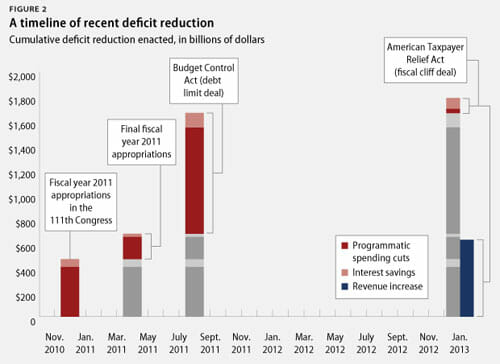
Kevin Drum is claiming that the government has already done much fine work on deficit reduction, reducing spending by $1.8 trillion and increasing taxes by $600 billion.

This is fantasy, pure and simple, and perhaps why the term "reality-based community" has fallen out of favor among Progressives.   There has been and will likely be no reduction in spending -- these "spending cuts" are merely reductions in spending growth rates from the Administration's initial wet dream spending proposals. I am sure the tax increases are probably real, but Obama and the Congress were already proposing to spend most of those in new stimulus and other boondoggles right in the end of year tax legislation.

The tax numbers are characteristic of the stupid budget games played by both parties.   For example, the recent tax law represents a tax increase over law in place on 12/31/2012, but represents a massive tax cut vs. law set to be in place on 1/1/2013.  This gives the administration cover to call it both!  When it wants to portray itself as a deficit hawk, as in this case, it was a tax increase.  When it wants to portray itself as being populist, it was a tax cut.

Charts like this are absolutely worthless.  We will likely get deficit reduction over the next few years, but it will be entirely due to rising tax revenues from an improving economy.

And here we are back to my constant theme -- if you want to posit a trend, then show the trend.

Fact-Checking

Matt Welch no the fact-checking genre:

But the real problem with such lists isn’t the lack of partisan diversity; it’s the glaring lack of lies told to the public in the service of wielding government force. Only one of PolitiFact’s Top 10—Obama blaming 90 percent of the 2009−12 deficit increase on George W. Bush—involved an official lying about his own record. The rest all focused on the way that politicians (and their surrogates) characterized their competitors’ actions and words. This isn’t a check on the exercise of power; it’s a check on the exercise of rhetoric.

And when it comes to rhetoric that motivates journalists into action, nothing beats culturally divisive figures from the opposing political tribe. So it was that in May 2011, the respected Nieman Journalism Lab set the mediasphere abuzz with an academic study of more than 700 news articles and 20 network news segments from 2009 that addressed a single controversial claim from the ObamaCare debate. Was it the president’s oft-repeated whopper that he was nobly pushing the reform rock up the hill despite the concentrated efforts of health care “special interests”? Was it his promise that “if you like your health care plan, you will be able to keep your health care plan,” something that has turned out not to be true? Was it the way Obama and the Democrats brazenly gamed and misrepresented the Congressional Budget Office’s scoring of the bill, claiming it wouldn’t add “one dime” to the deficit?

No. The cause for reconsideration of the ObamaCare coverage was not the truth-busting claims made by a sitting president in the service of radically reshaping an important aspect of American life but rather the Facebook commentary of a former governor, Sarah Palin.

Here is the issue with media bias:  It is not that journalists sit in some secret room and craft plans to overthrow their ideological opposition, Journolist notwithstanding.  It is that a monoculture limits the range of issues to which the media applies skepticism.  I am as guilty as anyone.  Hypotheses and pronouncements that do not fit with my view of how the world works are met with much more skepticism, checking of sources, etc.    The media is generally comfortable with a large and expansive role for government and seldom fact-checks the arguments for its expansion.

In fact, as I have written before, the media has an odd way of covering itself against charges of being insufficient skeptical about new legislation:  They raise potential issues with it, but only after it passes.

Quote of the Day

From Megan McArdle:

When I was reporting on Wall Street, I used to be told with some regularity that government was needed to counteract the short-term thinking of the business sector, who never thought much beyond the next quarterly earnings report.  This now seems as quaintly adorable as picture hats and daily milk deliveries.  An ADHD day trader with a cocaine habit and six months to live has considerably more long-term planning skills than our current congress.

Part of a generally awesome rant

He Who Has Two Clocks is Never Sure

I had no idea there were so many time standards

We already have way too many time standards, including:

  • TAI, time based on an atomic clock, which ignores all motion of the Earth
  • UT0 and UT1, time based on precise measurement of the Earth’s rotation
  • GPS, the time standard used by GPS satellites
  • UTC, the standard used in computing, which is like TAI but with leap seconds to keep it in sync with Earth
  • TDTTBTTCB, and TCG, which are all even worse

This leads to all kinds of little headaches, particularly for programmers. For example, the clock in your smartphone’s GPS is 16 seconds out of sync with the phone’s system clock. This is because the system clock uses Coordinated Universal Time (which has leap seconds), but GPS time doesn’t. They were in sync in January of 1980 and probably never will be again.

Modern Piracy

Modern pirates do not need a ship or swords or cannon, they only need lobbyists.  Ever wonder how Captain Morgan rum pays for all that expensive TV advertising?  They don't -- you do!   At President Obama's insistence, their subsidies (along with many others) were extended in the recent "fairness" tax bill.

Office Space, University Edition

The movie peters out a bit at the end, but the first 30 minutes or so of Office Space are a classic, and if you have not seen it, go find it somewhere.  If you have seen the movie, you will likely recognize this job description from an article on university administrative staff bloat:

 One $172,000 per year associate vice provost had been hired to oversee the work of committees charged with considering a change in the academic calendar-a change that had not yet even been approved.  Since the average Purdue graduate leaves school with about $27,000 in debt, the salary of this functionary is equivalent to the education loans of six students.
This new administrator blithely told the Bloomberg reporter, "My job is to make sure these seven or eight committees are aware of what's going on in the other committees."


The entire article is excellent.  For example:

A recent paper by two respected economists, Robert Martin and R. Carter Hill, shows that the fiscally optimal ratio of administrators to faculty at research universities is one full-time administrator for every three faculty.    Deviations from this ratio produced significantly higher costs per student.  The unfortunate reality as Martin and Hill found is that the ratio has almost been reversed--2 administrators to one faculty.  Martin and Hill's findings suggest, moreover, that about two-thirds of the growth in higher education costs between 1987 and 2008 can be attributed to the rise of administrative power during this period.

Ha! Not in California

Eugene Volokh is writing about a case against an attorney who defrauded his firm.  The details are not important, what caught my eye is what is highlighted below:

Once again, this case does not turn on the bare fact that Attorney Siderits wrote-down his time; this case is about Attorney Siderits abusing his write-down discretion and lying to his law partners in order to collect almost $47,000 in bonuses to which he was not entitled. Attorney Siderits cannot seriously contend that firms must have a written policy forbidding stealing and lying before a misconduct charge for one of these actions can be sustained.

That certainly makes sense, but it does not apply at the California EDD, which administers (among other things) the state unemployment insurance program.  We terminated an employee for accepting money from a customer to provide a service, then pocketing the money and not providing the service.  I call this "theft", and had assumed all would understand that stealing from customers is a firing offense.   When California sent out its unemployment paperwork, we said this employee had been fired "for cause", which in many states means that they are ineligeable for full unemployment payments.

However, after some back and forth, I was eventually informed by the EDD that since I did not have an explicit policy in the employee manual that said "employees may not steal money from customers", then they could not recognize that she was fired for cause.  Even if I had put that in the manual, it probably would not have counted because the next thing EDD asked for is something in writing proving, with the employee's signature, that she had read that passage.   And from past experience with the EDD, my guess is that they likely would not have accepted firing on the first offense, but would have insisted we needed to have her steal from multiple customers, with written warnings each time, before we terminated her.

Basically, what this all means is that while the law technically says people can't be paid unemployment if fired for cause, California has made the standards of proof so absurd that this requirement is meaningless.  Everyone is going to get unemployment.

As it turns out, there is a silver lining from this lack of diligence by the state.  My business is seasonal and I can only offer summer work.   Most of my employees are happy with this, as they like to take the winter off (many are retired).  One is not supposed to collect unemployment if he or she is not actively seeking work, but my employees have discovered that California does zero dilligence to check this.  So some of them lie and say they are looking for work over the winter when they are not, and collect unemployment.  I know of two couples who spend their winter in Mexico but still collect their California unemployment like clockwork.   Not only is California not dilligent about it, but when I tried to report someone I knew who was collecting unemployment but not even in the country, I was threatened by the EDD official that I was risking substantial personal liability by submitting such a claim and opening my self up to civil suits and even prosecution for harassing the worker.  So of course I dropped it.

So what is the silver lining?  California is so eager to hand money in the off-season to support my employees' seasonal vacations that my unemployment insurance premium rate is already the worst possible.  My rates can't go any higher.  So if they insist on giving state money to a thief, it's not coming out of my pocket.

Corporate Crony Entitlement

This story is simply  unbelievable.  Shareholders of AIG should have been wiped out in 2008 in a bankruptcy or liquidation after it lost tens of billions of dollars making bad bets on insuring mortgage securities.  Instead, AIG management and shareholders were bailed out by taxpayers.

It is bad enough I have to endure those awful commercials with AIG employees "thanking" me for their bailout.  It's like the thief who stole my TV sending me occasional emails telling me how much he is enjoying it.

Now, AIG managers and owners are considering suing the government because the the amazing special only-good-for-a-powerful-and-connected-company deal they got was not good enough.

Directors at American International Group Inc., AIG -1.28% the recipient of one of the biggest government bailout packages during the financial crisis, are considering whether to join a lawsuit that accuses the U.S. government of too-onerous terms in the 2008-2009 rescue package.

The directors will hear arguments on Wednesday both for and against joining the $25 billion suit, a person briefed on the matter said. The suit was filed in 2011 on behalf of Starr International Co., a once very large AIG shareholder that is led by former AIG Chief Executive Maurice "Hank" Greenberg. It is pending in a federal claims court in Washington, D.C....

Starr sued the government in 2011, saying its taking of a roughly 80% AIG stake and extending tens of billions of dollars in credit with an onerous initial interest rate of roughly 15% deprived shareholders of their due process and equal protection rights.

This is especially hilarious since it coincides with those miserable commercials celebrating how AIG has successfully paid off all these supposedly too-onerous obligations.  And certainly Starr and other AIG investors were perfectly free not to take cash from the government in 2008 and line up some other private source of financing.  Oh, you mean no one else wanted to voluntarily put money into AIG in 2008?  No kidding.

Postscript:  By the way, employees of AIG, you have not paid off all the costs of your bailout and you never will.  The single largest cost is the contribution to moral hazard, the precedent that insurance companies, if sufficiently large and well-connected in Washington, can reap profits on their bets when they go the right way, and turn to the taxpayer to cover the bets when they go wrong.

Random Death From the Sky

I fear this same thing:

"What scares me about drone strikes is how they are perceived around the world," [retired General Stanley McChrystal] said in an interview. "The resentment created by American use of unmanned strikes ... is much greater than the average American appreciates. They are hated on a visceral level, even by people who've never seen one or seen the effects of one."

Oddly, Obama Democrats used to feel the same way, at least until their guy was pushing the button (in fact, pushing the button far more frequently than Bush did).  We are overusing this tool.

Anti-Trust Law and the Corporate State

Kevin Drum is uncomfortable that Google got off the hook on anti-trust charges merely because it was not harming consumers

Google made a number of arguments in its own defense, and consumer welfare was only one of them. Still, it was almost certainly the main reason they won, and it's still not clear to me that this is really what's best for consumers in the long run. Did Google users click on the products they highlighted? Sure. Did they buy some of the stuff? Sure. Were they happy with their purchases? Sure. Is that, ipso facto, evidence that there's no long-run harm from a single company dominating the entire search space? I doubt it. After all, John D. Rockefeller could have argued that consumers bought his oil and were pretty happy with it, so what was the harm in his controlling the entire market?

The tech industry moves fast enough that antitrust might genuinely not be a big issue there. In the end, it wasn't antitrust that hurt IBM and Microsoft. It was the fact that the industry moved rapidly toward smaller computers and then the internet, and neither company was really able to react fast enough to dominate these new spaces. Nonetheless, I'm skeptical of the tautology at the heart of the consumer welfare argument. If a company is successful, then by definition people must be buying its stuff. On this basis, bigness is simply unassailable anymore. That has broad societal implications that I suspect we're not taking seriously enough.

He seems to be arguing that we consider returning to a pure bigness standard without reference to consumer harm.  I am not sure that we ever followed such a standard, but certainly today the alternative to a consumer harm standard is not a bigness standard but a competitor harm standard.  Whether he knows it or now, this is essentially what Drum is advocating.  We see this in the article he quotes:

But while the F.T.C. said that Google’s actions might have hurt individual competitors, over all it found that the search engine helped consumers, as evidenced by Google users’ clicking on the products that Google highlighted and competing search engines’ adopting similar approaches.

I am not sure what Drum really wants, but the result of eliminating the consumer-harm standard would be an environment where every failed company can haul its more successful competitors in front of the government and then duke it out based on relative political pull rather than product quality.  It is pretty well understood out there that this anti-Google FTC claim was initiated and championed by Microsoft, certainly not among the powerless typically championed by progressives, and a company well known to have missed the boat on Internet search and which is apparently trying to do now through government fiat what it has not been able to do in the marketplace.  Microsoft learned this technique from Sun and Oracle, which took Microsoft to the FTC in the famous browser case where Microsoft faced years of anti-trust scrutiny for the crime of giving the public a free product.

Already, anti-trust law is an important tool of the corporate state, to allow politically powerful companies to squash competition from those who invested less money in their Washington office.  I am not a legal expert at all, but this consumer standard in anti-trust strikes me as a critical shield stopping a hell of a lot more abuse of anti-trust law.

By the way, there is a modern bigness problem with corporations that is very troubling -- we have made government tremendously powerful, giving it many tools to arbitrarily choose winners and losers without any reference to justice or rights.  As private entities get larger and richer, they are better able to access and wield this power in their own favor.  The libertarian solution is to reduce the government's power to pick winners and losers.  The progressive answer is to regulate business more with tools like anti-trust.

But the progressive solution has a built-in contradiction, which why Drum probably does not suggest a solution.  Because the very tools progressives suggest to regulate business typically become the tools with which politically connected corporations further tilt the game in their own favor.  Anti-trust is a great example.  We want to reduce the number of large companies with an eye to reducing corporatism and cronyism, but the very tool to do so -- anti-trust law -- has become one the corporate crony's best tools for stepping on competitors and insulating their own market positions.

And by the way, Rockefeller's Standard Oil did a HELL of a job for consumers.  It was nominally punished for what it might some day hypothetically do to consumers.

Here are the facts, via Reason

Standard Oil began in 1870, when kerosene cost 30 cents a gallon. By 1897, Rockefeller's scientists and managers had driven the price to under 6 cents per gallon, and many of his less-efficient competitors were out of business--including companies whose inferior grades of kerosene were prone to explosion and whose dangerous wares had depressed the demand for the product. Standard Oil did the same for petroleum: In a single decade, from 1880 to 1890, Rockefeller's consolidations helped drive petroleum prices down 61 percent while increasing output 393 percent.

By the way, Greenpeace should have a picture of John D. Rockefeller on the wall of every office.  Rockefeller, by driving down the cost of kerosene as an illuminant, did more than any other person in the history to save the whales.  By making kerosene cheap, people were willing to give up whale oil, dealing a mortal blow to the whaling industry (perhaps just in time for the Sperm Whale).

So Rockefeller grew because he had the lowest cost position in the industry, and was able to offer the lowest prices, and the country was hurt, how?  Sure, he drove competitors out of business at times through harsh tactics, but most of these folks were big boys who knew the rules and engaged in most of the same practices.  In fact, Rockefeller seldom ran competitors entirely out of business but rather put pressure on them until they sold out, usually on very fair terms.

From "Money, Greed, and Risk," author Charles Morris

An extraordinary combination of piratical entrepreneur and steady-handed corporate administrator, he achieved dominance primarily by being more farsighted, more technologically advanced, more ruthlessly focused on costs and efficiency than anyone else. When Rockefeller was consolidating the refining industry in the 1870s, for example, he simply invited competitors to his office and showed them his books. One refiner - who quickly sold out on favorable terms - was 'astounded' that Rockefeller could profitably sell kerosene at a price far below his own cost of production.