... because that may make it easier for the Democrats to summon the political will to kill ethanol subsidies, though don't hold your breath. Certainly, though, the NYT, after years of cheerleading ethanol, may finally be coming around:
Congress must take a hard look at the effect of corn ethanol on food
supplies in the same way the new energy bill requires it to review the
environmental effects. It must move toward ending subsidies that will
become even more difficult to justify as oil prices rise and the costs
of producing corn ethanol decline. And it must press other wealthy
countries to do the same before hunger turns to mass starvation.
By the way, these problems with ethanol we are experiencing today were are inevitable as night follows day, yet we still had to blunder into it before we started questioning the economics. The power of political correctness to trump science and logic is amazing.
Megan McArdle has a good post and excerpts from Adam Shepard, who set out with $25 to see how hard it was to escape from poverty. I won't re-quote that post here, you should see her site, but I wanted to comment on one thing Shepard says about his early days trying to convince supervisors they should hire a homeless guy:
So, he gave me the secret. To paraphrase, he told me to go to these
managers and tell them who you are, that you are the greatest worker on
the planet and that it would be a mistake not to hire you. If they take
you on, great. If not, move on down the line. By day's end, you're
gonna have a job.
So I did. The next day, I went to see Curtis at Fast Company, a
moving company where I'd already applied. "Curt!" I said. "I'm Adam
Shepard, and I'm the greatest mover on the planet. It would be a
mistake for you not to hire me." He looked at me across the table and
smiled, knowing I was lying like hell to him. But he liked my attitude
"“ especially after I offered to work a day for free "“ so he hired me on
the spot.
This is very normal -- if you want someone to take a risk, you try to reduce the cost for him. Not sure you want to try our product? We'll give you a free sample. In this case, he agreed to work for free to convince the manager he was a good worker. This makes sense -- to emerge from homelessness and to get a job with no skills and no work history, one needs to be willing to give a bit of a discount on your labor, at least at first, to get someone to give you a chance.
But here is the interesting part -- the arrangement Curtis and Adam Shepard made is ILLEGAL. The Fair Labor Standards Act, which includes Federal minimum wage law, does not allow Curtis to accept unpaid labor and does not even allow Mr. Shepard to offer it. The fact that the deal makes so much sense and it so clearly is in the mutual best interest of both parties is absolutely irrelevant under the law. Fast Company could be busted, should the DOL choose to focus its attention their way.
When people argue that the minimum wage is most harmful to the poor, because it prices the first rung of the labor ladder beyond what their minimal skills can justify, this is what they mean.
For a while, I have been worried that the next decade may well be a return to 1970's economics, with bipartisan commitment to large government, ever-expanding government micro-management of... everything, growth-destroying taxes, and consumer-unfriendly protection of dead US industries.
Now, Megan McArdle points to an article that hints that the stagflation of the 1970's may be back as well.
Inflation and sluggish growth haven't joined in that ugly brew called
stagflation since the 1970s. They may not be ready for a reunion, but
they are making simultaneous threats to the economy and battling one
might only encourage the other.
Among a batch of economic readings today, the Labor Department
reported that import prices jumped 1.7% last month. The data included
troubling signs that consumer products, many imported from China, have
caught the inflation bug. The signs pointing to slowing growth included
a sharp deterioration in consumers' mood, as measured by the
Reuters/University of Michigan Surveys of Consumers, and a worsening
outlook for manufacturers, revealed in the Federal Reserve Bank of New
York's Empire State Manufacturing survey for February. The government
also reported that U.S. industrial production only increased slightly
during January, as colder weather elevated utilities output and offset
sharp declines in the auto and housing sectors. If indeed inflation is
teaming up with slower growth, it means big headaches for policy
makers, in particular Ben Bernanke. The Federal Reserve chief in
congressional testimony yesterday suggested that he is willing to keep
lowering interest-rates if the economy stalls. But, naturally, he will
have less room to do so if those lower rates would accelerate inflation
to unacceptable levels.
Yesterday, I had what will likely (given ticket prices) be a once in a lifetime experience for me -- I got to take my son to the Superbowl. Our ability to afford this event really was a result of our living in the same city as the Superbowl. The obvious reason for this is that we did not incur any significant travel costs and did not have to pay peak demand level hotel pricing. The less obvious, but ultimately more important, reason was because we could afford to watch the ticket prices on the secondary market up until the absolute last minute. If your were bringing a group from New York, waiting until Friday or Saturday to buy tickets might have been a bit uncomfortable, given other sunk costs.
As it turned out, Superbowl ticket prices this year on the secondary market (e.g. TickCo, Stubhub, et al) followed a parabola. They were below their peak early-on, particularly since sellers did not have the tickets in hand. You can buy tickets weeks before the Superbowl, but they will be listed as "for this general area." You could end up in the front row or the back -- it is a bit of a crap shoot. So they are cheaper because of this. The peak pricing came the week before the AFC and NFC championship games when many sellers had tickets in hand and could advertise specific seats. All along, I was looking for a ticket to just get in the door, so I was looking for the cheapest seats (likely upper deck end zone). At their peak, there was nothing gong for less than about $3800 (when you included the seller commission or transaction fees, typically 10-20% for this type of ticket). Beginning the Monday before the game, prices started falling -first 10%, then 20-30%, and finally as much as 50%. I jumped in towards the end of the week because a pretty good (or at least better than the worst) seat came up for a good price. I am told by a friend who showed up on game day at the ticket company office that he got in for less than $1500.
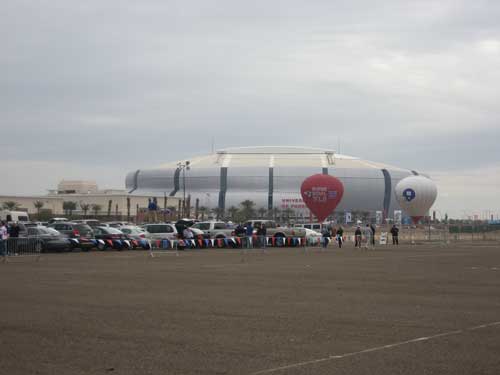
Anyway, here is the stadium - yes it is kind of odd looking. This was taken about halfway through our walk from the car to the stadium. We just barely parked in the same county. We showed up about 6 hours before game time and were in the last half of arrivals:
The stadium is a taxpayer-funded boondoggle that is a good hour away (on the complete opposite side of a very large city) from old Scottsdale where most of the parties and social activities and player hotels were.
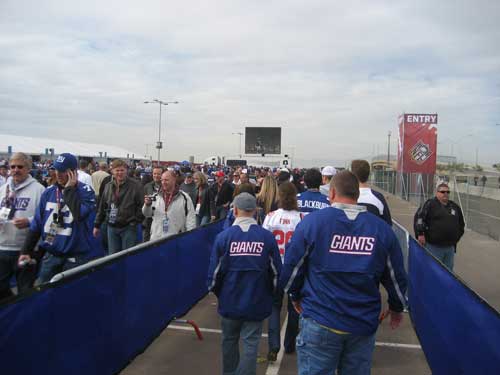
The security included a ban on any bag over 12x12x12 inches, a pat down, and a metal detector. And the NFL did a MUCH better job than the TSA. MUCH. It is hard to see, but the tent on the left is about 1/4 of the length of the full security screening area. They had at least 25 lanes open in parallel. Despite thousands of people, we had no wait at all (the lines below are all moving briskly and continuously).
And look! We must be in the front row! Well, of the upper deck, but these turned out to be great seats and, having watched prices for weeks, a very good price-value point (in context). My son braves the wrath of all the surrounding Giants fans by wearing his Cowboys jersey.
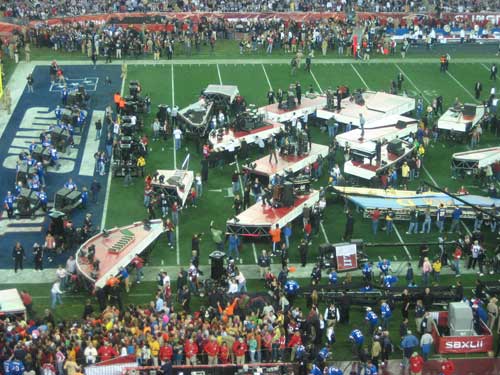
I thought the fast set up and takedown of the stages was pretty amazing, and something you miss on TV. Here is Tom Petty's stage going out (or in, I can't remember). The funniest part was the crew of NFL guys who followed along with rags and buckets to dust off the grass after the equipment passed to make sure it looked good for TV.
We had a decent view of Tom Petty's back, which once I saw his scraggly beard was probably a good thing. The crew of screaming fans at the stage was pretty funny. They ran these folks out for Alicia Keyes, then kicked them out of the stadium, then ran them back in for Tom Petty, and then back out again. I saw one show on TV last night, and the audience looked young, but to my eye the great mass of the crowd was middle aged women, which I thought was kind of funny.
And here is the last play and confetti burst:
It was a great, perhaps historic game, and we loved the whole experience. Now back to work to pay those bills.
So, here are the [sports-related] events on my must-see list I have tackled:
Baseball all-star game, Superbowl, game at Fenway, game at Yankee stadium, 16th hole at the Phoenix Open, center court at Wimbledon, BCS Championship game, Daytona 500, personally playing golf at St. Andrews, Big 10 home football game, Rose Bowl, Cowboys home game [update: and an original 90s-vintage American Gladiators filming live]
Yet to be tackled:
the Masters, Packers home game, game at Wrigley, NCAA final four, SEC home football game (maybe Tennessee or the cocktail party), maybe at World Series, maybe a World Cup
The Boston Globe, in its usual blundering math-challenged media way, blithely published an editorial the other day that included this hilarious "fact"
Since June, Israel has limited its exports to Gaza to nine basic
materials. Out of 9,000 commodities (including foodstuffs) that were
entering Gaza before the siege began two years ago, only 20 commodities
have been permitted entry since. Although Gaza daily requires 680,000
tons of flour to feed its population, Israel had cut this to 90 tons
per day by November 2007, a reduction of 99 percent. Not surprisingly,
there has been a sharp increase in the prices of foodstuffs.
OK, the Gaza has over a million residents, but do these 1.4 million people really require 1.36 million pounds of flour a day?? I find that hard to believe, and amazing that no editor even asked the question, much less checked.
Update: Did a search. Found this. The Palestinian ministry puts consumption around 350 tons per day. That makes a bit more sense. Congratulations on missing the number by over 3 orders of magnitude. You can bet they are doing a lot of quality fact-checking on those global warming estimates too.
Update 2: I agree with the commenter that the number they should have used was something like 680,000 pounds rather than tons. I would have written it off as a typo, transposing tons for pounds, but the math was based on it being tons, not pounds, so it is not just a typo issue.
If the word "environmentalist" wasn't so corrupted, I would consider myself to be one. For years, the main charity I have supported with my money and my advocacy has been private land trusts like The Nature Conservancy. Just because I don't think that governments should quash individual rights to force people not to develop their own land does not mean that I don't think certain pieces of land are worth protecting from development. But I do it the old-fashioned way -- I and others spend money to buy that land. Here is more on why I (mostly) like groups like the Nature Conservancy and here is a post wherein I lament the shift in charity from spending your money to achieve goals to spending money to lobby the government to force other people to achieve your goals.
Of course, my claim to be an environmentalist just because I, you know, spend my money and time on private conservation efforts would be laughed off because I take the wrong stand on certain litmus test environmental issues (e.g. global warming, of course). In this world, someone who buys a silly and environmentally worthless $19.99 carbon offset has more environmental street-cred than I do.
The government's bid to make fuel consumption more environmentally
friendly will involve petrol and diesel being mandatory blended with
2.5pc biofuel from this April and the country's leading supermarket
chain is aiming to use twice this amount at over 300 of its petrol
stations.
But campaigners believe this is not the green alternative people think they are getting.
Jenn
Parkhouse from Norwich Friends of the Earth said: "From April, people
will have no choice but to contribute to the destruction of forests,
the eviction of small farmers and rising food prices which will mean
more hunger.
"More and more people now realise the need for a
strong movement to stop the destruction caused by the biofuel industry
and the legislation which encourages it."
I saw these twoposts one after the other on Q&O. One is about Chavez's food regulations in Venezuela, the other is about a government health care plan in California. One is about government takeover of a critical industry, price controls, supply rationing, and demonizing large private corporations, and the other is about the same thing, but in Venezuela. Since Chavez is further along with his program, we might see how things are working out for him:
Venezuela's top food company has accused troops of illegally seizing
more than 500 tonnes of food from its trucks as part of President Hugo
Chavez's campaign to stem shortages.
The leftist Chavez this
week created a state food distributor and loosened some price controls,
seeking to end months of shortages for staples like milk and eggs that
have caused long lines and upset his supporters in the OPEC nation.
The
highly publicised campaign has also included government crackdowns on
accused smuggling, with the military seizing 1,600 tonnes of food and
sending 1,200 troops to the border with Colombia....
He also threatened to expropriate companies selling food above regulated prices.
"Anyone
who is distributing food ... and is speculating, we must intervene and
we must expropriate (the business) and put it in the hands of the state
and the communities," Chavez said during the inauguration of a new
state-run market in Caracas.
Yep, sounds about the same. Fortunately, people in the West can still travel across borders to get health care when government rationed and price-controlled services are not available, as many Canadians and British do. So in the US, when we implement all these same steps, we'll be able to travel to..., travel to... Where will we be able to go?
The Arizona Republic this morning had some goofy headline in their print edition that said something like "How should you spend your $800 tax rebate?" Far be it for me to presume to tell people how to spend their own money (what do I look like, a Congressman?) but here is a bit of advice: Save it. Because this is not a grant, it is a loan.
All of these rebates will be paid for with additional deficit spending. This means that everyone will eventually pay for their rebate in the form of a) higher future taxes; b) higher future prices due to inflation; or c) increased job insecurity and/or lower future earnings due to reduced output in the economy; or d) all of the above.
It HAS to be this way. Unlike private wealth creation, the government can't get wealth from nowhere.
People have been defaulting on mortgages for all of recorded history. In Roman times, such a default could well result in the mortgage-holder getting sold into slavery, so things have improved a bit. But seriously, people default on their mortgages all the time. So what makes those currently in default more deserving of taxpayer aid than those before them or after them? I mean, other than the fact that the press is paying attention to these particular defaults? A similar question was reasonably asked of 9/11 victims who scored government compensation when victims before or after of other transportation accidents and building fires have not been so rewarded.
I challenge any politician to answer this question with an answer other than "well, these people are in the media spotlight right now and as a politician, I want to be in the spotlight with them."
Update:More analysis here, including the bright side of the burst housing bubble:
Countrywide wants to be
able to take its loans that the market won't accept and refi them under
FHA or FNMA. That's what this is all about. Don't forget that.
It's
not about homeownership. Let's look at the latest 25th percentile
(starter homes) list prices for a range of CA cities, compared to the
price in January 2007:
What
you see above is great news for all the people who would like to buy
homes without going bankrupt a few years down the line. It's VERY bad
news for banks and financial companies that made the original bad loans
without bothering to check whether the borrowers could pay the danged
loan. You figure out who this country should reward - responsible
aspiring home owners or stupid banks.
Venezuela launched a new currency with the new year, lopping off three
zeros from denominations in a bid to simplify finances and boost
confidence in a money that has been losing value due to high inflation....
"We're ending a historical cycle of ... instability in prices,"
Finance Minister Rodrigo Cabezas said Monday, adding that the change
aims to "recover a bolivar that has significant buying capacity."
Prices have risen as Chavez has pumped increased amounts of the
country's oil income into social programs, reinforcing his support
among the poor and helping to drive 8.4 percent economic growth in 2007.
The Central Bank is promoting the new monetary unit with an ad
campaign and the slogan: "A strong economy, a strong bolivar, a strong
country." Officials, however, have yet to clearly spell out their
anti-inflationary measures.
Good to see the government taking meaningful steps. Next up will be "Whip Inflation Now" buttons.
The 8.4 percent growth cited above may be illusory, given this:
Venezuela has had a fixed exchange rate since February 2003, when
Chavez imposed currency and price controls. The government has said it
is not considering a devaluation any time soon.
But while the strong bolivar's official exchange rate will be fixed
as 2.15 to $1, the black market rate has hovered around the equivalent
of 5.60 to $1 recently.
I just don't understand the enthusiastic support for Mitt Romney and his description as an heir to the Reagan legacy. In particular, he claims to single-handedly have implemented HillaryCare in Massachusetts, the program that was arguably responsible for sweeping the Republicans into Congress in 1994. My sense is that Hillary in the intervening years has moved on to an even more socialist plan, but everything I see in the Romney plan looks very much like Hillary's original proposal.
The plan is command and control at every turn -- for example, I am a huge believer in high deductible health insurance. My family has saved a ton with it, and it shifts health insurance to be more like, you know, insurance -- meaning it covers catstrophic, bankrupting problems but not day to day expenses. Well, this sort of very reasonable plan, which has the added benefit of bringing some price competition to medicine because people like me now care about prices, was made illegal in Massachusetts by Romney and Company. Romney strikes me as just another 1970's-style big government Nixonian Republican, like nearly every other Republican in the race this time around.
Previous posts on Romney's plan here and here and here.
Prime Minister Wen Jiabao
responded Wednesday to growing public anxiety about inflation by
announcing that China would freeze energy prices in the near term, even
as international crude oil futures have continued to surge....
Last November, China raised gasoline and diesel prices by almost 10
percent, partly to appease officials at state-owned refineries.
Refiners had complained that price controls were forcing them to
swallow the difference between higher prices for crude oil on the world
market and regulated consumer prices at home for refined products. So
refineries cut back production of gasoline and particularly diesel,
causing long lines at fuel stations around the country.
I got my driver's license in 1978, just in time to spend the first few months of my driving life sitting in gas lines with the family car, a result of a series of market distorting actions by the US government.
The Economist says,
of the state of economics education in France and Germany, "I
desperately hope it's not really this bad." Unfortunately, I think it's
really that bad. When the 35 hour work week was proposed, I was talking
to someone in the French consulate who did economics and trade. "Aren't
you worried that this will raise employer's costs and lead to business
failures or higher unemployment?" I asked.
"That's just Anglo-saxon economics" was his rather stunning reply. Apparently, in France, demand curves do not slope downwards.
Not much comment necessary for the following, except to say that I don't think one should be able to call this an unintended consequence of US biofuel and corn subsidies when 1) the results are utterly predictable and 2) folks like myself publicly predicted it.
The US is the world's leading producer of soy, but many American soy
farmers are shifting to corn to qualify for the government subsidies.
Since 2006, US corn production rose 19% while soy farming fell by 15%.
The
drop-off in US soy has helped to drive a major increase in global soy
prices, which have nearly doubled in the last 14 months. In Brazil, the
world's second-largest soy producer, high soy prices are having a
serious impact on the Amazon rainforest and tropical savannas.
"Amazon
fires and forest destruction have spiked over the last several months,
especially in the main soy-producing states in Brazil," said Laurance.
"Just about everyone there attributes this to rising soy and beef
prices."
High soy prices affect the Amazon in several ways. Some
forests are cleared for soy farms. Farmers also buy and convert many
cattle ranches into soy farms, effectively pushing the ranchers further
into the Amazonian frontier. Finally, wealthy soy farmers are lobbying
for major new Amazon highways to transport their soybeans to market,
and this is increasing access to forests for loggers and land
speculators.
When the government does not allow prices to float in real time in response to changes in supply and demand, then gluts and shortages are inevitable. When shortages occur, due to prices that are capped or not allowed to move upwards sufficiently quickly, queues and/or spot shortages occur. When the government decides it does not like this, the jack-booted thugs step in and we have government-enforced rationing. California, famous for its stupidity in letting wholesale electricity prices float while capping retail prices and thus creating an economic disaster several years ago, is at it again in the electricity market:
What should be controversial in the proposed revisions to Title 24 is
the requirement for what is called a "programmable communicating
thermostat" or PCT. Every new home and every change to existing homes'
central heating and air conditioning systems will required to be fitted
with a PCT beginning next year following the issuance of the revision.
Each PCT will be fitted with a "non-removable " FM receiver that will
allow the power authorities to increase your air conditioning
temperature setpoint or decrease your heater temperature setpoint to
any value they chose. During "price events" those changes are limited
to /- four degrees F and you would be able to manually override the
changes. During "emergency events" the new setpoints can be whatever
the power authority desires and you would not be able to alter them.
In
other words, the temperature of your home will no longer be yours to
control. Your desires and needs can and will be overridden by the state
of California through its public and private utility organizations. All
this is for the common good, of course.
I can't think of anything that better illustrates the tie between free exchange and freedom. And by the way, how long before the greenies in the legislature suggest using this mechanism even when there are not shortages to turn down everyone's air conditioner, just because they can.
Update: Exercise for the reader -- Figure out how, once this policy goes bad, the state of California will again blame Enron for their failure.
After years of secret preparation, the world's cheapest car will be unveiled in Delhi this week...At 100,000 rupees (£1,290), the People's Car, designed and
manufactured by Tata, is being marketed as a safer way of travelling
for those who until now have had to transport their families balanced
on the back of their motorbikes.
Ratan Tata, 70, chairman of the
family-run business, who has spearheaded the race for a cut-price car,
wrote on the company website: 'That's what drove me - a man on a
two-wheeler with a child standing in front, his wife sitting behind,
add to that the wet roads - a family in potential danger.'
But Tata hopes also to create a 'new market for cars which does not
exist', making them accessible to India's booming middle classes made
recently rich by an economy growing at around 9 per cent a year. ...
Last
year just over one million cars and seven million motorbikes were sold
in India. Tata wants to transform some of those motorbike buyers into
car owners and believes that the company can eventually sell up to a
million People's Cars a year. Analysts say the project could
revolutionise car prices, not just in India, but globally. Several
other manufacturers have similar products in the pipeline.
Awesome. This is a story about three quarters of a billion people who have lived in poverty, well, forever, starting to join the middle class.
But many environmentalists, about 100% of whom I would venture to say own a car themselves, oppose this transition to prosperity:
'There is this mad rush towards lowering the prices to achieve mass
affordability,' said Anumita Roychoudhury, of the Centre for Science
and Environment in Delhi. 'If vehicle ownership increases very rapidly,
we'll have a time bomb ticking away. When you lower the price that
drastically, how will you be able to meet the safety and emissions
standards? There are no clear answers yet.'
I would challenge this person to design a car that doesn't crash test better than a motorbike. This is just incredible arrogance, attempting to deny millions of people the prosperity which western environmentalists already share. (via Maggies Farm)
Postscript: The fact is that environmental quality in every developing nation tends to follow a J-curve. Early stage development tends to muck things up a bit (think air quality in 1018th century Pittsburg or in China today) but things improve as people get wealthier. Places like China and India are in some of the lowest reaches of that J-curve. Attempting to freeze their development in place not only arrogantly denies these folks prosperity, but also cuts off future environmental gains that come with wealth.
Movie producers sell DVDs cheaper in, say, Taiwan than they do in the US. This is not an unheard of economic phenomenon -- it happens in every commodity and product. The reason we don't notice these price differences too much is that traders and arbitragers and shipping companies will target the largest price differentials and take advantage of them by buying and shifting products around until the price differential is less than the transportation and transaction costs. Basic economics.
However, despite a number of structural advantages that already serve to reduce this cross-flow (e.g. different languages), the media companies are trying to stretch copyright law far beyond what CopyOwner says is legally defensible:
Copyright owners (including the owners of the "works" embodied in
the copyrighted labels on common non-copyrighted goods) like to
discriminate in pricing by creating artificial markets so that
discounts in one market won't be resold at a lower price in over-priced
markets. The thinking goes, "Why let U.S. consumers get the benefit of
prices that are affordable to people in developing countries when we
know we can get more out of the U.S. consumer's pocket?"
The
"first sale doctrine," now codified as Section 109 of the Copyright
Act, makes clear that the copyright owner's right of distribution is
subject to the copy owner's right to sell it to anyone, anywhere, at
any price. And that's great policy. Entrepreneurs who see too big a gap
between the prices charged U.S. consumers and the prices charged
consumers elsewhere for identical copies can buy the cheaper product
and sell it at a profit, while still giving the U.S. consumer a better
bargain.
But that's not why I nearly fell out of my chair. I
was used to these anti-competitive price discriminators ranting about
perfectly lawful gray market goods. What this story does is label these
perfectly legal importers as pirates. That's right. Despite quoting the
Supreme Court in Quality King Distributors v. L'anza Research International,
that "once the copyright owner places a copyrighted item in the stream
of commerce by selling it, he has exhausted his exclusive statutory
right to control its distribution," a ruling that suggests that the
evildoers are those who try to circumvent the law by preventing gray
market imports, they go on to call the importers "pirates"
It is always amazing how big round numbers hold the media in thrall. Last week we saw the inevitable spate of articles about oil crossing the $100 mark, if only for a few minutes of trading (actually, the more interesting milestone was somewhere back in the low $90 range when we exceeded the highest past price for oil in inflation-adjusted dollars).
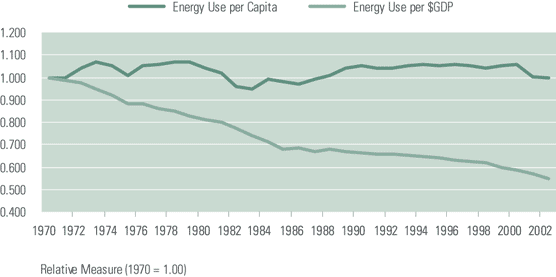
I don't get hugely worked up about gradual commodity price changes. Oil price increases are signals, signaling marginal consumers to use less and suppliers with historically marginal sources and substitutes to consider their development. Also, our economic dependence on oil per dollar of GDP has declined, meaning that $100 oil has less impact on the economy than, say, it would have 20 years ago:
I would certainly prefer lower oil prices, and my business suffers to some extent when gas prices rise, but it is not a disaster (it is interesting that higher oil prices are considered bad in the media, while lower home prices are considered bad in the media). I know from past experience in the oil patch that oil price bubbles are often followed by oil price drops. The high oil prices of the seventies were followed by rock-bottom oil prices in the eighties, and subsequent recession in the oil patch (causing the housing bust I discussed here).
Also, given how we got to these higher oil prices, I tend to take them as good news. Oil prices are not rising due to some drop off in supply. Instead, they are rising because of a strong global economy, in particular with millions of people entering the middle class in Asia. This is GOOD news.
I have written on peak oil a bunch, so I won't get into it again. Oil production at worst is going to flatten out for a long time, meaning we will have a steady rise in oil prices over time as the economy grows. If you want a third party evaluation of peak oil theory, go ask climate catastrophists who believe that CO2 production is an impending disaster for the economy. These guys know that there are lots of unproduced hydrocarbons out there, and it terrifies them. Al Gore and James Hansen were running around last week trying to close off Canadian tar sands from development.
Finally, after this series of random thoughts, one more interesting take on this via Megan McArdle: $100 oil was a stunt
Some observers questioned the validity of the price mark when it
emerged that the peak was the result of a trader "“ one of the "locals"
who trade on their own money "“ buying from a colleague just 1,000
barrels of crude, the minimum allowed, industry insiders said. The deal
on the floor of the New York Mercantile Exchange was at a hefty premium
to prevailing prices.
Insiders named the trader as Richard Arens, who runs a brokerage
called ABS. He was not available for comment. Analysts said he may have
been testing the ceiling of the crude price, but the premium he paid
surprised the market.
Before the $100-a-barrel trade, oil prices on Globex were at $99.53
a barrel. Immediately after the trade, prices went down to about
$99.40, suggesting a trading loss of $600 for Mr Arens.
Stephen Schork, a former Nymex floor trader and editor of the
oil-market Schork Report, commented: "A local trader just spent about
$600 in a trading loss to buy the right to tell his grandchildren he
was the one who did it. Probably he is framing right now the print
reflecting the trade."
A global shortage of hops, combined with a run-up in barley prices, is
sending a chill through Arizona's craft-beer industry.
The hops shortage threatens to boost prices, cut into profits and close
down brewpubs. It could change the taste and consistency of treasured
local ales.
In Bisbee, "hop heads" already are weaning themselves from Electric
Dave's India Pale Ale. Dave Harvan closed his 7-year-old Electric
Brewing Co. in November, citing the scarcity and high cost of
ingredients.
So why aren't as many farmers growing hops and barley? Because the government is paying them ridiculous jack to grow corn so we can burn food into our cars:
Papazian attributed the barley prices to ethanol subsidies that have
raised the price of corn, the main ingredient in the alternative fuel.
As a result, farmers have switched to barley for livestock feed, which
has pushed up prices.
The hops situation is more complex. Years of overproduction and low
prices led farmers to replace hops fields with more profitable crops.
Add to that corn subsidies that have caused farmers to replace hops
fields with corn, a drought in Australia that affected yields and heavy
rains in Europe that ruined much of this year's crop.
Here is a public service announcement for those of you who might be younger or who did not live through past housing bubbles (such as the mid-80's bubble in Texas). Housing bubbles take a long time to sort out. The typical pattern is that one sees a big build-up of yard "For Sale" signs around town, but no real movement or sales. What happens is that people selling their houses resist accepting that a change in pricing levels has occurred, and list the homes at the old, higher price levels, particularly when any price cuts would put them underwater on their mortgage.
Eventually, the dam breaks, as sellers are forced to accept lower pricing because they can no longer bear the holding costs any longer. In Texas, I had at least two friends who just left the keys in the mailbox and walked away, leaving it all to the bank to sort out. But it can take a really long time for this to play out -- I am talking years, not months, depending on how inflated the bubble got. From my experience (confirmed in the futures markets here) the bottom will not come until at least a year from now. In Texas in the 1980's, it took as long as five years for the whole thing to play out and for prices to start recovering.
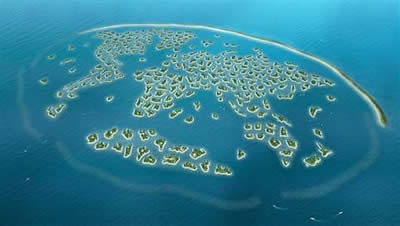
In the book Ringwold and its sequels, Larry Niven wrote of an artifact-world so large that 1:1 scale models of various planets, like earth, were created as islands in its vast oceans. Not quite 1:1, but here is the same idea:
The World is a man-made archipelago of 300 islands in the shape of a
world map. The World is being built primarily using sand dredged from
the sea. Each island ranges from 23,000 m2 to 84,000 m2
(250,000"“900,000 square feet or 5.7"“21 acres) in size, with 50"“100 m of
water between each island. The development will cover an area of 9 km
in length and 6 km in width, surrounded by an oval breakwater. The only
means of transport between the islands will be by boat and helicopter.
Prices for the islands will range from $15-45 million (USD). The
average price for an island will be around $25 million (USD). Dredging
started in 2004 and as of March of 2007 The World is around 90%
complete.
Update: I have long contended that, at least if you eliminate all entries from the list involving women, that owning an island is the ultimate male fantasy. Also a good way to "short" global warming predictions, if you are so inclined
From the Washington Post, via Tom Nelson, comes a nice summary of the consequences of Congress's addiction to ethanol mandates and subsidies. The last sentence in particular is one I have warned about for a while on this issue.
To be sure, some farmers in these countries benefit from higher prices.
But many poor countries -- including most in sub-Saharan Africa -- are
net grain importers, says the International Food Policy Research
Institute, a Washington-based think tank. In some of these countries, the poorest of the poor spend 70 percent or more of their budgets on food.
About a third of the population of sub-Saharan Africa is
undernourished, according to the Food and Agriculture Organization of
the United Nations. That proportion has barely changed since the early
1990s. High food prices make gains harder. ... It's
the extra demand for grains to make biofuels, spurred heavily in the
United States by government tax subsidies and fuel mandates, that has
pushed prices dramatically higher. The Economist rightly calls
these U.S. government subsidies "reckless." Since 2000, the share of
the U.S. corn crop devoted to ethanol production has increased from
about 6 percent to about 25 percent -- and is still headed up. ... This
is not a case of unintended consequences. A new generation of
"cellulosic" fuels (made from grasses, crop residue or wood chips)
might deliver benefits, but the adverse effects of corn-based ethanol
were widely anticipated. Government subsidies reflect the careless and
cynical manipulation of worthy public goals for selfish ends. That the
new farm bill may expand the ethanol mandates confirms an old lesson:
Having embraced a giveaway, politicians cannot stop it, no matter how
dubious.
PRIME Minister Kevin Rudd last night did an about-face on deep cuts to
greenhouse gas emissions, days after Australia's delegation backed the
plan at the climate talks in Bali.
A government representative at the talks this week said Australia backed a 25-40 per cent cut on 1990 emission levels by 2020.
But after warnings it would lead to huge rises in electricity prices, Mr Rudd said the Government would not support the target.
The
repudiation of the delegate's position represents the first stumble by
the new Government's in its approach to climate change.
Bowing to American pressure on the eve of high-level talks to reduce
economic tensions, China agreed Thursday to terminate a dozen different
subsidies and tax rebates that promote its own exports and discourage
imports of steel, wood products, information technology and other goods.
Thanks a lot. The Bush Administration crows that:
This outcome represents a victory for U.S. manufacturers and their workers
Um, not if they are consumers too, as they all are. And not if their company buys any inputs from Chinese manufacturers.
Napoleon said to never interrupt an enemy when he was making a mistake. I don't consider China an enemy, but it just flabbergasts me that the Chinese taxpayers and consumers see fit to subsidize lower prices for our consumers, and we feel the need to stop them. More here and here.
It is good that doom mongers like Paul Ehrlich have been so thoroughly discredited. But could anyone have imagined that not only are we not facing "Population Bomb" style famines, but we are in fact spending billions of dollars of taxpayer money to promote burning food in cars?
I am not sure how anyone thought this was a good idea, since
Every scientific study in the world not conducted by an institution in Iowa have shown that corn-based ethanol uses more energy than it produces, does not reduce CO2, and creates new environmental problems in terms of land and water use.
Sixty seconds of math would have shown that even diverting ALL of US corn production to ethanol would only replace a fraction of our transportation fuel use.
With three new plants
added in November, annual corn demand for ethanol production in
Nebraska passed the 500-million-bushel mark for the first time, using
37% of Nebraska's corn.
How much fuel has this produced?
"Today, that ambitious
directive has become a reality." Sneller says "At current rates,
Nebraska plants will use 514 million bushels of corn annually to
produce 1.4 billion gallons of ethanol. By the end of 2008, Nebraska
plants will process 860 million bushels into 2.3 billion gallons of
ethanol. Distillers grain, a co-product of ethanol production, is
widely accepted and marketed as a superior livestock feed."
This is enough ethanol to replace about a billion gallons of gasoline (since ethanol has less energy content than gasoline). This represents about 0.7% of US gasoline usage. The cost? Well, I don't know how many billions of subsidy dollars have flowed to Nebraska, but there is also this:
Corn prices have
remained virtually unchanged since World War II. Increased demand from
ethanol production has raised average corn prices by 70% and is driving
an economic resurgence in rural Nebraska, according to Todd Sneller,
administrator of the Nebraska Ethanol Board.
So we have spent billions of taxpayer dollars, have diverted about 40% of Nebraska's corn output, and we've raised prices on corn 70% all to replace less than a percent of US gasoline usage. If we could really do the fuel balance on the whole system, we would likely find that total fossil fuel usage actually went up rather than down through these actions.
Never have I seen an issue where so many thoughtful people on both sides of the political aisle united in agreement that a program makes no sense since... well, since farm subsidies. Which, illustratively, have not gone away despite 80 years of trying. As I wrote here:
Companies are currently building massive subsidy-magnets
biofuel plants. Once these investments are in place, there is going to
be a huge entrenched base of investors and workers who are going to
wield every bit of political power they can to retain subsidies forever
to protect their jobs and their investment. Biofuel subsidies will be
as intractable as peanut and sugar subsidies and protections.
Pursuing what has become a familiar theme on Coyote Blog, we again revisit anti-trust, and in the process, discover why the NY Times might be better off putting its editorial inanities back behind a firewall.
The abuse of market power to protect a monopoly hurts consumers and
hinders innovation "” locking out smaller rivals that may have better
products with new features or lower prices. With an 80 percent to 90
percent share of the microprocessor market, Intel wields much more
power than your local supermarket. Its threat to raise prices the
moment a customer tries to buy from rival A.M.D. can lock in even the
largest computer makers "” which depend on Intel for most of their
products and can't simply swap all their processors overnight. And with
such a level of control, Intel doesn't have to exert itself to come up
with new and better products.
Which I guess is why Lotus 1-2-3 must still have a hammerlock on the spreadsheet market, Creative must still dominate in MP3 players, IBM must still own the computer market, and GM must still rule the automotive roost. How can any sentient human being who has lived through the past 20 years doubt that, particularly in technology, market dominance is as fleeting as the next technology cycle. In fact, AMD several years ago made a huge penetration of the market with a series of processors a year or two ahead of Intel. Most average consumers who can't even figure out how to attach a photo to an email never noticed, but among those who understood and cared, AMD ruled the roost.
Oh, and what was Intel's crime?
They say Intel is improperly protecting its stranglehold of the
microprocessor market by offering big discounts and rebates to computer
makers who minimize the use of processors made by rival Advanced Micro
Devices, and punishing those who stray with higher prices.
Oh my god, they are offering discounts to loyal customers! Don Boudreax gets right to the heart of it:
Monopolists raise prices; firms facing competition do not. Intel keeps its prices
low, meaning that it behaves competitively. Yes, Intel's pricing
practices make life more difficult for AMD and other rivals, but that's
what competition is supposed to do.
The popular myth is that anti-trust policy is about protecting consumers. Well, it may have been at one time or another, but currently it is all about protecting competitors who have political pull. The Europeans are shameless about this, using anti-trust as a bludgeon to hamstring US companies who are out-competing EU home-grown competitors. Now the NY Times wants to emulate this practice, explicitly calling on the government to force Intel to raise prices to make things easier for its competitors.
Update: By the way, is there anyone out there who thinks Dell or H-P don't get the best possible pricing from Intel, with or without AMD purchases? The coy little personal shopping example in the opening paragraph of the editorial is probably to help the reader forget that we are talking about Intel selling to customers who are big boys too.