Posts tagged ‘prices’

I am Going to Break Every Window in Chris Plummer's House to Stimulate the Economy

We all know that the media is perfectly capable of ignoring even the most basic precepts of economics, but I thought Chris Plummer's article was especially heroic in doing so.  Even more so, it is absolutely stunning in its arrogance.  In his article, he writes on all the great ways that $8 a gallon gasoline will help make the world a better place.  I will stay away from the global warming related issues -- I have a whole other blog dedicated to that -- but here are a couple of the most egregious parts:

They may contain computer chips, but the power source
for today's cars is little different than that which drove the first
Model T 100 years ago. That we're still harnessed to this antiquated
technology is testament to Big Oil's influence in Washington and
success in squelching advances in fuel efficiency and alternative
energy.


Given our achievement
in getting a giant mainframe's computing power into a handheld device
in just a few decades, we should be able to do likewise with these
dirty, little rolling power plants that served us well but are overdue
for the scrap heap of history.

OK, this first one is a science problem and not an engineering problem.  Here is the problem:  Gasoline contains more potential energy by weight and volume than any power storage source we have been able to invent (OK, its actually second, nuclear fuel is first, but I presume Plummer is not going there).  That is the problem with electric cars, for example.  Electric traction motors are demonstrably better sources of motive power than internal combustion engines.  Even Diesel railroad engines are actually driven by electric traction motors.  The problem is energy storage.  Batteries store much less energy per pound and per cubit foot than gasoline.  Ditto natural gas and hydrogen (except at very high pressures).

This claim that only the political power of oil companies keeps no-brainer alternative technologies at bay is absurd, though it is one that never dies in the lunatic fringes.  Mr. Plummer is more than welcome to make himself a billion dollars by selling one of these mystery technologies he fails to disclose.  I will be first in line to buy.

Necessity being the mother of invention, $8 gas would trigger all
manner of investment sure to lead to groundbreaking advances. Job
creation wouldn't be limited to research labs; it would rapidly spill
over into lucrative manufacturing jobs that could help restore
America's industrial base and make us a world leader in a critical
realm.

This is the broken window fallacy on steroids.  I am a HUGE optimist about the limitless capabilities of the human mind, probably more so than Mr. Plummer (by the way, if he is such an optimist, he should read some Julian Simon).  But the best that humanity can probably do any time soon is offset a goodly percentage of the damage from $8 gas.  There is no net win here.  If there were, he should also be advocating $10 bread, $2,000,000 starter home prices, and $200 a month internet service.  Just think about all the innovation that would be required to react to these!

On a similar note, Venezuela's Hugo Chavez and Iran's Mahmoud
Ahmadinejad recently gained a platform on the world stage because of
their nations' sudden oil wealth. Without it, they would face the
difficult task of building fair and just economies and societies on
some other basis.

Yes sir.  Chavez would be much worse off if he was getting $8 for his gas rather than $3.  What is this guy thinking?  Well, he says this:

In the near term, breaking our dependence on Middle Eastern oil may
well require the acceptance of drilling in the Alaskan wilderness

OK, but that can be done at $3 gas,and should have been allowed at $2 gas.  This oil could have been developed in an environmentally friendly way years ago.  Only Congressional stupidity stands in the way  (probably with the past support of Mr. Plummer).

The recent housing boom sparked further development of
antiseptic, strip-mall communities in distant outlying areas. Making
100-mile-plus roundtrip commutes costlier will spur construction of
more space-efficient housing closer to city centers, including cluster
developments to accommodate the millions of baby boomers who will no
longer need their big empty-nest suburban homes.


Sure, there's plenty of
land left to develop across our fruited plains, but building more
housing around city and town centers will enhance the sense of
community lacking in cookie-cutter developments slapped up in the
hinterlands.
This is an aesthetic and taste argument (note the "antiseptic") - the author thinks that suburbs are un-aesthetic and he thinks that urban life is superior.  Not surprising, as he chooses to live in San Francisco, and people there have self-selected for that kind of life.  Fine.  But I don't want it.  And the idea that it is good to pay $8 for gas to conform to his aesthetics is sickening.  (By the way, the opposite of antiseptic is germ-ridden.  Why don't people ever therefore use that as a modifier for urban communities?)

OK, I can't really get to all his points, but I have saved perhaps the best for last.  Here is one of the most incredibly condescending, authoritarian, and insensitive arguments I have ever seen.  He thinks it is better for poor and middle class Americans to pay $8 a gallon for gas because:

Far too many Americans live beyond their means and
nowhere is that more apparent than with our car payments. Enabled by
eager lenders, many middle-income families carry two monthly payments
of $400 or more on $20,000-plus vehicles that consume upwards of
$15,000 of their annual take-home pay factoring in insurance,
maintenance and gas.


The sting of forking
over $100 per fill-up would force all of us to look hard at how much of
our precious income we blow on a transport vehicle that sits idle most
of the time, and spur demand for the less-costly and more
fuel-efficient small sedans and hatchbacks that Europeans have been
driving for decades.

So, doubling the cost of necessities for the average American will make them financially healthier?  His argument is that people do all kinds of dumb things financially that a smart person like he would never do, and if gas prices drained everyone's wallet, they would not have any money left to make dumb purchases he does not approve of.  If this is such a great idea, shouldn't we all just move to North Korea and have done with it?

The anti-planner, where I got the link, has his own response.

This "Price" Thingie

Wow, this is unexpected:

The FHWA's "Traffic Volume Trends" report, produced monthly since 1942, shows
that estimated vehicle miles traveled (VMT) on all U.S. public roads for March
2008 fell 4.3 percent as compared with March 2007 travel. This is the first time
estimated March travel on public roads fell since 1979. At 11 billion miles less
in March 2008 than in the previous March, this is the sharpest yearly drop for
any month in FHWA history.

Someone really should research this phenomenon.  It is almost if gasoline prices, which we all know exist solely for the benefit of oil company profits and to support oil company CEO pay, have this heretofore unsuspected utility to modify demand for scarce resources. 

Not to be deterred by this spurious data point, the US Congress is moving ahead with this:

The current high price of gas has led to a lot of crazy proposals from
gas tax holidays to creating a tax deduction based upon energy
consumption. But Rep. Paul Kanjorski's (D-PA) may top them all in terms
of its stupidity. From the Times Leader, Kanjorski's plan would do the
following:

    "¢ H.R. 5800 would tax industries' windfall profits.

"¢ The bill would set up a Reasonable Profits Board to determine when
these companies' profits are in excess, and then tax them on those
windfall profits.

    "¢ As oil and gas companies' windfall profits increase, so would the tax rate for those companies.

"¢ Kanjorski said his legislation will encourage oil companies to lower
prices to prevent them from receiving higher tax rates.

The Oil Reality

Yesterday we saw the people who have done the most to keep oil prices high (e.g. Congress) trying to blame shift their policy failures onto oil company executives.  Hilariously, Maxine Waters thinks she would do a better job for consumers if she were in charge of the US oil companies. 

Beyond the realities of supply and demand, which I guess we all despair of teaching Congress, there were these remarks by Shell's John Hofmeister (via Powerline):

While all oil-importing nations buy oil at global prices, some, notably
India and China, subsidize the cost of oil products to their nation's
consumers, feeding the demand for more oil despite record prices. They
do this to speed economic growth and to ensure a competitive advantage
relative to other nations.

Meanwhile, in the United States, access to our own oil and gas
resources has been limited for the last 30 years, prohibiting companies
such as Shell from exploring and developing resources for the benefit
of the American people.

Senator Sessions, I agree, it is not a free market.

According to the Department of the Interior, 62 percent of all
on-shore federal lands are off limits to oil and gas developments, with
restrictions applying to 92 percent of all federal lands. We have an
outer continental shelf moratorium on the Atlantic Ocean, an outer
continental shelf moratorium on the Pacific Ocean, an outer continental
shelf moratorium on the eastern Gulf of Mexico, congressional bans on
on-shore oil and gas activities in specific areas of the Rockies and
Alaska, and even a congressional ban on doing an analysis of the
resource potential for oil and gas in the Atlantic, Pacific and eastern
Gulf of Mexico.

The Argonne National Laboratory did a report in 2004 that identified
40 specific federal policy areas that halt, limit, delay or restrict
natural gas projects. I urge you to review it. It is a long list. If I
may, I offer it today if you would like to include it in the record.

When many of these policies were implemented, oil was selling in the
single digits, not the triple digits we see now. The cumulative effect
of these policies has been to discourage U.S. investment and send U.S.
companies outside the United States to produce new supplies.

As a result, U.S. production has declined so much that nearly 60 percent of daily consumption comes from foreign sources.

The problem of access can be solved in this country by the same
government that has prohibited it. Congress could have chosen to lift
some or all of the current restrictions on exportation and production
of oil and gas. Congress could provide national policy to reverse the
persistent decline of domestically secure natural resource development.

This is a point I have made for a while:

Exxon Mobil is the largest U.S. oil and gas company, but we account for
only 2 percent of global energy production, only 3 percent of global
oil production, only 6 percent of global refining capacity, and only 1
percent of global petroleum reserves. With respect to petroleum
reserves, we rank 14th.
Government-owned national oil companies dominate the top spots. For an
American company to succeed in this competitive landscape and go head
to head with huge government-backed national oil companies, it needs
financial strength and scale to execute massive complex energy projects
requiring enormous long-term investments.

Lots more good stuff, check it out.

Not Sure this Is A Point of Pride...

I actually found out about this early last year:

Mom-and-pop service stations are running into a problem as
gasoline marches toward $4 a gallon: Thousands of old-fashioned pumps
can't register more than $3.99 on their spinning mechanical dials.

We operate a marina in the back-end of nowhere in Colorado where, since we can only accept less-than-full-truckload gas shipments, we were paying wholesale prices over $3.50 last summer.  We attempted to go to $4.09 on the retail pump, and wham, we ran up against this retail equivalent of the Y2k bug.

Zoning and the Housing Bubble

The Anti-Planner links an article by a Federal Reserve Bank economist on the housing market in Houston and how it is affected by zoning:

"Given that Houstonians had access to the same new types of
mortgages as the rest of the country and that Houston has had greater
population growth than other large metros, we might expect price
appreciation to be stronger in Houston than elsewhere," says the
article. "However, the opposite has been true."

The reason? Houston's lack of zoning and its large supply of land
available for development allowed builders to respond to easy credit by
increasing the pace of construction. Slow and unpredictable permitting
processes prevented builders in many other regions, including Florida
and the Pacific Coast states, from similarly stepping up production.

While some cities and regions have further delayed construction by imposing adequate public facilities or concurrency ordinances, Houston allows developers to create their own municipal utility districts.
Through these districts, the developers install the sewer, water, and
other facilities needed by their developments and charge the property
owners over time.

The result is that housing prices did not bubble, and they are not
significantly declining today. As of the fourth quarter of 2007, in
fact, they were still increasing. Anecdotal evidence from local
realtors and developers indicates that the tightening credit market has
soften the demand for homes under $200,000, but homes above that price
are still selling well.

Whatever correction Houston faces, says the article, "takes place in
the context of prices that are squarely in line with local construction
costs and without the painful supply-induced downturn under way in many
other markets." This leaves Houston relatively immune to the ups and
downs of housing prices experienced in regions with planning-induced
housing shortages.

I need to think a bit about how that relates to this.

Congress, Sue Thyself

This is almost beyond parody:

The House of Representatives overwhelmingly approved legislation on
Tuesday allowing the Justice Department to sue OPEC members for
limiting oil supplies and working together to set crude prices, but the
White House threatened to veto the measure.

The bill would
subject OPEC oil producers, including Saudi Arabia, Iran and Venezuela,
to the same antitrust laws that U.S. companies must follow.

The measure passed in a 324-84 vote, a big enough margin to override a presidential veto.

The
legislation also creates a Justice Department task force to
aggressively investigate gasoline price gouging and energy market
manipulation.

"This bill guarantees that oil prices will reflect
supply and demand economic rules, instead of wildly speculative and
perhaps illegal activities," said Democratic Rep. Steve Kagen of
Wisconsin, who sponsored the legislation.

I am sure, either through scheming or more likely incompetance, that OPEC countries are under-supplying their potential capacity for oil production.  But if we want to deem this a crime, who is the biggest criminal?   The US is the only country I know of that has, by statute, made illegal the development of enormous domestic reserves.  Just last week, Democracts in Congress, in fact the exact same folks sponsoring this bill, voted to continue an effective moratorium on US oil shale development.  No country in the world is doing less to develop the most promising oil reserves than is the US.  Congress, sue thyself.  I mocked this idea weeks ago when Hillary first suggested it.  If this passes, I would love to see the US counter-sued for not developing ANWR.  Or large areas of the Gulf.  Or most of the Pacific coast.  Or all of the Atlantic coast.  Or our largest-in-the-world oil shale deposits. 

Comparing Phoenix to Seattle and Austin

Chad Graham of the Arizona Republic writes an article this week that begins with this headline:

Phoenix can learn economically from robust Seattle and Austin

Already, my BS antenna are deployed.  Why?  I don't know anything about Mr. Graham, but nearly every 20- or 30-something journalist would like all the world to be hip and freaky and trendy and cool like Seattle or Austin (or Boulder or San Francisco).  So they have a natural predisposition to writing a story and interpreting facts to say that Phoenix (or whatever uncool city they hail from) should do everything it can to emulate Seattle or Portland or whatever is the hip city of the moment. 

I have lived in Phoenix and Seattle and Boulder, and have done business in Portland and Austin.  And if you want to find a really great music club, Austin would be your place.  And if you are a really rich guy who wants a unique lake front home and a dock for his floatplane, Seattle would be the pick.  But if you were a middle class family trying to get the most home for your money, you would take Phoenix all the way.  And if you wanted to start a real business that makes stuff, you would be insane to do it in any of these cities except Phoenix (and perhaps Austin).  Portland and Seattle and Boulder and (more recently) Austin are what one might call rich snob - poor snob towns.  They appeal to the millionaire with the fractional ownership jet and the pierced and tattooed slacker club goer.  Which is fine, but does every city really need to be like them?

Unlike the Valley, some parts of the U.S. such as Seattle and Austin
have been only slightly affected by the national economic slowdown.

Neither area has experienced the Valley's level of falling home prices, increased foreclosure rates nor its slowed job growth.

Those regions are places that Phoenix could learn from as it charts
a future based less on housing and growth and more on competing in the
global economy.

OK, lets start with the home thing, since the article focuses A LOT on housing.  I am willing to concede that in some recent period Austin and Seattle had less of a home price drop than Phoenix.  Ignoring for a moment the absurdity of extrapolating 30 year trends from 6-12 months of data, we should look structurally at these housing markets.  It turns out that Seattle, for example, has MUCH higher median home prices than Phoenix, in large part due to structural regulatory factors that I would presume the author would like Phoenix to emulate. 

As a result, the median home price in Seattle is about $450,000 while the median in Phoenix is closer to $275,000.  In fact, the Seattle median is very close to the Phoenix 75th percentile.  [note figures do not match those in article - I could not find any two median home price numbers that were the same for a market] One comment on Seattle housing was this:

The pattern is very strong: In Seattle you have affluent, largely
single people chasing a small supply of urban housing. The result is
small household size, an exodus of families to the suburbs, and very
high housing prices in the city.

Is this really what Phoenix should emulate, just because our home prices dropped more over a 6 month period?

One year ago, the Valley's job growth ranked No. 7 among
metropolitan markets with more than 1 million workers, according to the
latest Blue Chip Job Growth Update released by the W.P. Carey School of
Business at Arizona State University.

It now ranks No. 20, while Seattle is  No. 2.

In job markets with less than 1 million workers, Austin ranks  No. 14.

So, until recently, Phoenix led both cities in job growth.  In the last year, we have fallen behind.  Can anyone on the planet tell me why the last year of data is more relevant than the previous five, or ten, when Phoenix dusted these markets?  One year of downturn and suddenly Phoenix's economy needs to be restructured by some massive government 5-year plan?

But here is the really funny part.  Let's take Seattle, the economic juggernaut with which the author is so enamored.  In 1960, Seattle had a population of about 550,000 people.  In 2000, Seattle had a population of about.... 550,000.  In the same time period Phoenix grew from 726,000 to 3.2 million.  Wow, that Seattle is a growth juggernaut.  But it is hard to get apples and oranges on MSA's and such, so here is data from a single source:  From 1990-2000, the Austin MSA added 400,000 people, Seattle MSA added 382,000 people and Phoenix added 1.01 million, more than the other two combined.  Presumably, most of these folks found work, so where are all the jobs being added?

In Phoenix, "housing-related employment is falling fast, and the
impact on the economy is extreme since the industry comprises over 15
percent of total employment . . . compared to 10 percent nationwide,"
an April Moody's Economy.com report said.

This is hilarious.  We happen to be in a housing market downturn, so Phoenix is doomed because it is overweighted towards home construction.  But did anyone visit Seattle or Austin in 2001/2002 after the tech bubble crash?  It was a bloodbath, far worse than what Phoenix is experiencing today.  This kind of analysis is so short-sighted as to be absurd. 

Maricopa County's average weekly wages increased 3.8 percent to $822
in the third quarter of 2007, according to the latest numbers available
from the U.S. Department of Labor.

Weekly wages in King County, home to Seattle, rose 8 percent to
$1,129. Wages in Travis County, home to Austin, rose to $911, a 2.7
percent jump.

Meanwhile, Arizona's average per person income ($33,029) grew by the
smallest percentage among states in 2007, according to the U.S. Bureau
of Economic Analysis.

One word for you:  immigration.  Arizona has gotten hundreds of thousands of new immigrants with relatively low skills, so they come in at the bottom of the income scale and drive median wages down.  Seattle and Austin immigration, to the extent they have it, are high-skilled and highly paid.  Does every city have to be a high-income yuppie white-Asian enclave like Seattle?  I like Arizona and its Hispanic influences, even if this immigration means the governor can't puff her chest out at the governors' conference over average wages.

The two cities have a greater percentage of employment in tech jobs,
with 9.2 percent in Austin and 8.8 in Seattle compared with 4.6 percent
in Phoenix.

Sorry, but I have never thought it a goal of government to subsidize and maximize "tech jobs."  The other 95.4% of us in Phoenix without a job statistically categorized by the government as a tech job are happy not to be subsidizing the other 4.6%.  This is the kind of effort that does nothing to help the average person, who will never have a tech job, but makes government officials feel really good about themselves.  Another way of putting it:  The author is suggesting the government single-mindedly focus on subsidizing a class of jobs that 90+% of the people in all three cities do not hold.

Postscript: For those of you who want to laugh yourself silly, you really need to read the "vision" in the sidebar of this article.  It is the most incredible collection of politically correct notions without any relationship to real value creation that I have ever seen.  I can't really do it justice, but here are some highlights:

2010

The latest housing bust finally convinces the Arizona Legislature to
fund an aggressive international-economic-development program that
invests in science, engineering, technology and higher education.

Incentives draw nutraceutical firms, which use food substances to make
products that provide health benefits, such as lycopene.
Green-technology firms partner with universities to launch companies
that turn a profit...

2035

High-paying technology jobs are clustered in three major areas from
Prescott to Phoenix to Tucson. The economy boasts an $800 billion
nutraceutical industry and the world's largest solar facility with
10,000 acres of sun power.

I bet they include no offset in their study for lost growth due to higher taxes to fund this.  And our city of 5-10 million people is going to build its economy on nutraceuticals?  We're going to have a vitamin water business that, at $800 billion, is 6% the current size of the entire US economy?  I sure hope some of the business school students who wrote this either wise up or go into academics, because if they try to walk in to a real corporate board room with this stuff they are going to get skewered.

Incumbent Protection

So much of government regulation boils down to the protection of politically connected incumbent competitors against new competition.  This is an astonishing example, sent in by a reader:

BEMIDJI, Minn. - Assistant House Majority Leader Frank Moe says people
who rent out their lakefront homes may be hurting the state's resort
industry.

The Bemidji DFLer has authored a bill ordering the
state's tourism agency to study whether the increased competition is
hurting resorts. It's now awaiting Governor Tim Pawlenty's signature.

If you are willing to make up your own bed, there are a lot of reasons why private home rentals are a more attractive vacation option than resorts, particularly when you consider the high price of those ancillary resort services.  Why the government needs to be involved in what is, to my eyes, just a normal consumer preference is beyond me.  This last line caught my eye:

The state's resort industry is struggling as lakefront property values
soar but the market restricts what they can charge for cabin rentals.

Uh, OK.  I have the same problem -- land for cabins and campgrounds in areas people want to spend the weekend is really expensive, labor costs are up, but rental rates remain low.  So what?  Through their preferences and how they translate to prices, consumers are saying that there is better uses for prime land than lakefront rental cabins.  I can accept that.

Things No One Mentions When They Whine for the Good Old Days

Via Eugene Volokh:

Year Food spending as share of disposable income
1929 23.4%
1939 21.3%
1949 22.1%
1959 17.8%
1969 13.7%
1979 13.4%
1989 10.9%
1999 10.2%
2000 9.9%
2001 9.9%
2002 9.8%
2003 9.8%
2004 9.7%
2005 9.8%
2006 9.9%

My sense is the same pattern would emerge for gasoline prices, electricity (if you had it), phone service (if you had it), cross-country transportation, air conditioning, etc.


The Times Blunders on Ethanol (Even After I Explained it to Them)

Last week I tried to explain why the choice of plant, whether it be a food plant or a non-food plant, that is used to make ethanol is mostly irrelevant to whether ethanol mandates raise fuel prices, at least with current technologies.  I wrote:

Food prices rise not because food is converted to ethanol per se, but
because the amount of grains going into the food supply decreases.  The
issue is the use of farmer's time and resources and the use of prime
cropland to grow plants for fuel rather than food for consumption.  The
actual crop used to make the fuel, whether corn or switchgrass, does
not matter to food prices -- it is the removal of farmers and cropland
from food production that matters.  The only way cellulosic ethanol is
likely to improve food prices in substitution for corn is by being more
efficient per acre in fuel yields than corn  (which may turn out to be
the case, but has not yet been proven in this country).  But even so,
incremental improvements in yield don't help much, because we are
talking about enormous (40-50% or more) amounts of US cropland that
would have to be dedicated to fuel, whatever the plant technology, to
meet the current ethanol mandates.

I almost didn't post this the first time around, because I thought it was so obvious.  But on Sunday the NY Times blundered right into the same silly assertion:

This does not mean that Congress should give up on biofuels as an
important part of the effort to reduce the country's dependency on
imported oil and reduce greenhouse gas emissions. What it does mean is
that some biofuels are (or are likely to be) better than others, and
that Congress should realign its tax and subsidy programs to encourage
the good ones. Unlike corn ethanol, those biofuels will not compete for
the world's food supply and will deliver significant reductions in
greenhouse gases.

Of course, the ability to produce such biofuels with these magic powers has never actually been demonstrated, but I am all for them when and if someone invents them.  Efficient conversion, for example, of corn stalks, rather than corn itself, to fuel would be great and would solve this trade-off.  This technology does not exist today -- and only a lot of hand-waving can translate cellulosic ethanol successes in switchgrass to corn stalks.  Also recognize that even this has costs hidden to us non farmers, because corn stalks are used for a variety of purposes today.  My guess is that cellulosic ethanol from corn may be economically feasible, but only after some genetic modifications of the plant itself.

Where is the Windfall Profits Tax on Farmers?

This week, we have been given a chance to see a real contrast.  Two consumer staples, gasoline and food, have both seen their prices go up substantially over the last several months.  Both price spikes have been due to a combination of market forces (particularly increasing wealth in Asia) and US government policy that has the effect of restricting supply.

However, the political response from Congress has been completely different.  In the very same week that Democrats in Congress have introduced bills to punish oil companies for high prices with windfall profits taxes, they have passed a farm bill that rewards farmers who are already getting record high prices with increased price supports and direct subsidies.  This despite the fact that on a percentage basis, the increase in crop prices has been far larger than the recent increase in gas prices.  The contrast in approaches to two industries in very similar situations couldn't be more stark.

The only reason I can come up with is votes:  There are a lot more farmers and people who feel themselves dependent on the agricultural industry than there are oil workers.  The oil industry is incredibly efficient on a revenue per employee basis, and I guess that comes back to haunt them.  There is no oil industry equivalent of the Iowa Caucuses to cause politicians to fall to the ground groveling and shoveling out taxpayer money to buy votes.

Inventory Theory

Inventory theory says that the amount of total inventory that needs to be held to satisfy demand is proportional to the number of inventory stocking points.  The most efficient (from purely an inventory size standpoint- there are other efficiency issues that mitigate against this) is one big single shared inventory.  The least efficient is every individual holding his/her own inventory.  Glen Reynolds points to this effect in food:

I SAW A FEATURE BY TONY CAVUTO last night on food stockpiling, in which
one of his correspondents explained how he'd spent $1500 at Costco
stocking up against shortages. You know, if you have stories like this
on TV regularly, you'll get food shortages at stores even if there's no
actual shortage in supply, because today's just-in-time inventory
practices mean that there's no real slack for sudden increases in
demand. The empty shelves will then promote panic and more stockpiling,
setting the stage for the equivalent of a bank-run on grocery stores
even if there's no actual reason.

The exact same thing happened in the early 1970s with gasoline**.  Imagine that there are 100 million cars, and each fills up when the tank is 1/4 full.  On average, then, every tank is 5/8 full.  If tanks are all 16 gallons, then there are a billion gallons of gas in people's personal gasoline "inventory."  Now imagine due to some perceived crisis everyone changes their policy and fills up when the tank is only half empty.  Then, on average, every tank is 3/4 full, giving a total inventory of 1.2 billion gallons.  If this panic occurs over a period of a few days, suddenly there is an incremental demand, above and beyond normal demand, of 200 million gallons to expand personal inventories.  That as much as 30,000 tanker truck loads of extra demand at retail in a few days.  When stations run out, and people change their policy to fill up at 3/4 (as many did in those times, in panic) then that causes another 200 million gallons to disappear into personal inventories.  Logistics systems are not built to handle these demands.

**Postscript:
By the way, don't let the US government off the hook.  In the wake of the 1972 oil crisis, the main Congressional "contribution" was to pass a law that mandated oil companies deliver gasoline to each geographic area (probably by county, but I am not sure) in the same proportion as they did in the previous year.  A sort of directive 10-289 for gas distribution.  Well, we all know that things change, and among the biggest changes was the fact that with uncertain supplies and higher prices, a lot fewer people were driving on highways.  Because of Congress's action, rural interstate gas stations were swimming in gas, and the cities were out.  In a cruel but totally predictable twist, a number of the Congressmen who voted for this law later demagogued against oil companies for their poor distribution of gasoline that summer. 

A Thought on Cellulosic Ethanol

I am exhausted by people making policy suggestions by looking at small parts of complex inter-related systems in isolation.  One such example is the recent response of some ethanol mandate defenders to recent charges that corn-based ethanol is net harmful to the environment and its mandated and subsidized use is driving up world food prices.

The response by some (certainly not in the corn lobby, of course) has been that our problems would all be solved if we switched to cellulosic ethanol, which is generally made from non-food plants.  Supporters argue that this eliminated the food for fuel problem.

Huh?  Sure, in the narrowest possible sense, I guess, since we are no longer using food crops but rather grasses and such to make ethanol.  But at any reasonably holistic level of analysis, this is simply absurd.  Food prices rise not because food is converted to ethanol per se, but because the amount of grains going into the food supply decreases.  The issue is the use of farmer's time and resources and the use of prime cropland to grow plants for fuel rather than food for consumption.  The actual crop used to make the fuel, whether corn or switchgrass, does not matter to food prices -- it is the removal of farmers and cropland from food production that matters.  The only way cellulosic ethanol is likely to improve food prices in substitution for corn is by being more efficient per acre in fuel yields than corn  (which may turn out to be the case, but has not yet been proven in this country).  But even so, incremental improvements in yield don't help much, because we are talking about enormous (40-50% or more) amounts of US cropland that would have to be dedicated to fuel, whatever the plant technology, to meet the current ethanol mandates.  And remember, the net effect on fossil fuels may still be zero no matter how much land is dedicated, since no one has demonstrated large scale ethanol operations in the US that don't use more fuel to produce the ethanol than they produce. 

Postscript:  Related to this topic of thinking about economic systems narrowly, Lubos Motl discusses the supposed positive green impact on the economy in light of the open window fallacy.

California Energy Leadership: Leading the Race to the Bottom

California is apparently trumpeting its "leadership in energy."  The centerpiece of its claims is its low per capita electricity use.  Arnold is making the claim now, but Kevin Drum was pushing this a while back when he said:

Anyway, it's a good article, and goes to show the kinds of things we
could be doing nationwide if conservative politicians could put their
Chicken Little campaign contributors on hold for a few minutes and take
a look at how it's possible to cut energy use dramatically "” and reduce
our dependence on foreign suppliers "” without ruining the economy. The
energy industry might not like the idea, but the rest of us would.

Max Schulz of the Manhattan Institute is not impressed:

California's proud claim to have kept per-capita energy consumption
flat while growing its economy is less impressive than it seems. The
state has some of the highest energy prices in the country "“ nearly
twice the national average "“ largely because of regulations and
government mandates to use expensive renewable sources of power. As a
result, heavy manufacturing and other energy-intensive industries have
been fleeing the Golden State in droves.

Neither am I.  I addressed this issue a while back in response to Drum's post, but since the meme is going around again, I will excerpt from that old post.

The consumption data is from here.
You can see that there are three components that matter - residential,
commercial, and industrial.  Residential and commercial electricity
consumption may or may not be fairly apples to apples comparable
between states (more in a minute).  Industrial consumption, however, will not be comparable, since the mix of industries will change radically state by state.....

Take two of the higher states on the list.  Wyoming, at the top of
the per capita consumption list, has industrial electricity consumption
as a whopping 58% of total state consumption.  KY, also near the top,
has industrial consumption at 50% of total demand.  The US average is
industrial consumption at 29% of total demand.  CA, NY, and NJ, all
near the bottom of the list in terms of per capital demand, have
industrial use as 20.6%, 15.1%, and 16% respectively.  So rather than
try to correlate electricity consumption to local energy regulations,
it is clear that the per capita consumption numbers by state are a much
better indicator of the presence of heavy industry. In other
words, the graph Drum shows is actually a better illustration of the
success of CA not in necessarily becoming more efficient, but in
exporting its pollution to other states.
  No one in their
right mind would even attempt to build a heavy industrial plant in CA
in the last 30 years.  The graph is driven much more by the growth of
industrial electricity use outside CA relative to CA.

Now take the residential numbers.  Lets look again at the states at
the top of the per capita list:  Alabama, South Carolina, Louisiana,
Tennessee, Arkansas, Mississippi, Texas.  Can anyone tell me what these
states have in common?  They are hot and humid.  Yes, California has
its hot spots, but it has its mild spots too  (also, California hot
spots are dry, so they can use more energy efficient evaporative
cooling, something that does not work in the deep south).  These
southern states are hot all over in the summer.  So its
reasonable to assume that maybe, just maybe, some of these hot states
have higher residential per capita consumption because of air
conditioning load?
  In fact, if one recast this list as
residential use per capita, you would see a direct correlation to
summer air conditioning loads.   This table of cooling degree days weighted for population location is a really good proxy for how much air conditioning is needed by state.  (Explanation of cooling degree days).
You can see that states like Alabama and Texas have two to four times
the number of cooling degree days than California, which should
directly correlate to about that much more per capita air conditioning
(and thus electricity) use....

OK, now I have saved the most obvious fisking for last.  Because
even when you correct for these numbers, California is pretty efficient
vs. the average on electricity consumption.  Drum attributes this,
without evidence, to government action.  The NY Times basically does
the same, positing in effect that CA has more energy laws than any
other state and it has the lowest consumption so therefore they must be
correlated.  But of course, correlation is not equal to causation.
Could there be another effect out there?

Well, here are the eight states in the data set above that the
California CEC shows as having the lowest per capita electricity use:
CA, RI, NY, HI, NH, AK, VT, MA.  All right, now here are the eight
states from the same data set that have the highest electricity prices:  CA, RI, NY, HI, NH, AK, VT, MA.  Woah!  It's the exact same eight states!  The 8 states with the highest prices are the eight states with the lowest per capita consumption.
Unbelievable.  No way that could have an effect, huh?  It must be all
those green building codes in CA.  I suspect Drum is sort of right,
just not in the way he means.  Stupid regulation in each state drives
up prices, which in turn provides incentives for lower demand.  It
achieves the goal, I guess, but very inefficiently.  A straight tax
would be much more efficient.

The Profit Motive Rocks

This post from TJIC, which is really about something entirely different, mentions that the price of cocaine has been dropping sharply over the last 10 years.  This is something I have heard police officials lament as well.

Does the profit motive rock or what?  The largest and most powerful government in the world stations armed men and ships around the country.  It has a legal system in place with huge penalties that has of late been nearly entirely dedicated to drug enforcement.  The US has even subverted 200 year old Constitutional restrictions on searches and property seizures (the Patriot Act is mostly used for drug, not terrorism, actions).  All to stop the importation of certain valuable substances.  And even so, the human mind is powerful enough to subvert all of these restrictions and bring in so much supply that the price continues to drop.

Al Gore believes that alternative energy efforts in the US are being subverted by the oil companies:

Apparently, according to Gore, the oil companies drive up prices
reducing supply and then depress them in a telling pattern. As soon as
the political will swells to a light boil, the companies reduce
prices/increase supply.

Really?  Independent drug traders are able to subvert a million government officials with guns to keep cocaine prices low, but Exxon, with a 5% market share (at most) in oil, is able to hold the line on oil supply?

Sure.  In 1972 and 1978 there were a series of oil price shocks (to real levels about where they are today) that convinced everyone that oil prices would keep going up and up and that oil would run out within a few decades.  Of course, in about 1984 oil prices crashed, and stayed down for almost 20 years.  Depending on how you date it, it took oil supply development between 6 and 12 years after the price signal to flood the world with oil, and that was in an environment with price controls and windfall profit taxes that reduced development incentives. 

Right now, we are about 5 years in to the current oil price spike.  Go long at your own risk.

More on supply and demand vs. price manipulation in oil here.  More on Al Gore, including a fisking of his solar plan, here.

Update: Of course, the Democrats in Congress are doing everything possible to keep oil prices up.  If I wanted to ensure high oil prices, I would 1.  Kill incentives to increase supply, perhaps with a "windfall" profits tax and 2.  Put the most promising potential new exploration areas off-limits to new development.  Congressional scorecard:  #2 is in place, and both Obama and Hillary and Pelosi are proposing #1.

Update #2:   Another thought on Gore's statement:  The boom-bust
patterns in oil are characteristic of nearly every other commodity out
there, which therefore presupposes that if oil prices are the result of
manipulation, then every other commodity must be as well since their
prices demonstrate the same patterns.  We see these patterns in
commodities that politicians have never even heard of and in which they
have never thought to exercise their "political will."  (political will
in this context defined as use of government force against a segment of
the populace).

A reasonable person might
suppose that the surge in prices followed by a drop a number of years
later is better explained by the time delay in increasing oil
production after oil prices spike. In many ways, Al's theory is simply
delusional.  If your friend started trying to tell you, in all
seriousness, that every action Microsoft takes is actually aimed at
thwarting him personally, you would think him insane.  But this is
effectively Gore's argument, showing the immensity of the politician's
ego.  Oil prices move not because of supply and demand, but because of
us politicians.  Every tick up and down is carefully managed to thwart
us brave Congressmen!

When a politician describes price signals as mainly influencing political actions, rather than the actions of free producers and consumers, they are probably a socialist.

Cognitive Dissonance

As a follow-up to this post on gas-price demagoguery, I would like to observe that the very same people who are most likely to demagogue about high gas prices in this country are the very same ones who advocate that the US adopt European-style taxation levels, regulatory policy, and CO2 targets, the results of which can be seen here:

Gas1

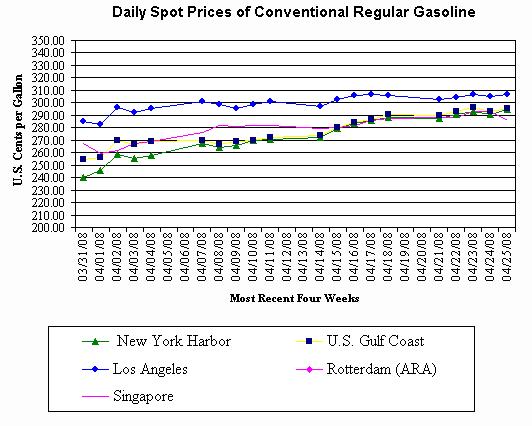
If you can't read the colors on the scale well, I think you can guess which is the US price line and which are the European gas prices.  Source here.  Just to be clear, this has nothing to do with wholesale gasoline prices, which are substantially similar between the US and Europe:

Gas2

Since the difference in price does not go to the producer, I will leave it as an exercise to guess where the extra $5 per gallon is going (hint:  Uncle Francois)  The cognitive dissonance required to call for 80% CO2 reductions while simultaneously decrying $3.50 gas prices is just stunning to me.

Update:  From the same source, here are the gas prices in dollars per US gallon EXCLUDING taxes:


Date Belgium France Germany Italy Nthrlnds UK US
4/14/2008 3.32 3.28 3.18 3.61 3.85 3.09 3.21

Update #2:  More here on Hillary's sleight of hand.  And this from Robert Samuelson, at how this cognitive dissonance extends to exploration limits:

We could be producing more, but Congress has put large areas of
potential supply off-limits. These include the Atlantic and Pacific
coasts and parts of Alaska and the Gulf of Mexico.
By government estimates, these areas may contain 25 billion to 30
billion barrels of oil (against about 30 billion barrels of proven U.S.
reserves today) and 80 trillion cubic feet or more of natural gas
(compared with about 200 tcf of proven reserves).

What keeps these areas closed are exaggerated environmental fears,
strong prejudice against oil companies and sheer stupidity. Americans
favor both "energy independence" and cheap fuel. They deplore imports
-- who wants to pay foreigners? -- but oppose more production in the
United States. Got it? The result is a "no-pain energy agenda that
sounds appealing but has no basis in reality," writes Robert Bryce in
"Gusher of Lies: The Dangerous Delusions of 'Energy Independence.' "

Arthur C. Clarke Was Wrong, So Progress Must Have Stopped

Neo-Erlichism from Paul Krugman:

Much of what I did back then was look for estimates of the cost of
alternative energy sources, which played a big role in Nordhaus's big paper that
year. (Readers with access to JSTOR might want to look at the
acknowledgments on the first page.) And the estimates "” mainly from
Bureau of Mines publications "” were optimistic. Shale oil, coal
gasification, and eventually the breeder reactor would satisfy our
energy needs at not-too-high prices when the conventional oil ran out.

None of it happened. OK, Athabasca tar sands have finally become a
significant oil source, but even there it's much more expensive "” and
environmentally destructive "” than anyone seemed to envision in the
early 70s.

You might say that this is my answer to those who cheerfully assert
that human ingenuity and technological progress will solve all our
problems. For the last 35 years, progress on energy technologies has
consistently fallen below expectations.

I'd actually suggest that this is true not just for energy but for
our ability to manipulate the physical world in general: 2001 didn't
look much like 2001,
and in general material life has been relatively static. (How do the
changes in the way we live between 1958 and 2008 compare with the
changes between 1908 and 1958? I think the answer is obvious.)

My goodness, its hard to know where to start.  Forgive me if I do not remain well-organized in this post, but there is so much wrong here it is hard to know where to start.

A forecast is not reality

First and foremost, the fact that forecasters, whether they be economists or science fiction writers, are wrong on their forecasts does not say anything about the world they are trying to model -- it merely says that the forecasters were wrong.  The fact that the the Canadian will be wrong in its prediction that 4.5 billion people will die by 2012 due to global warming does not mean that the physical world will somehow have changed, it means that the people at the Canadian are idiots.  The fact that an ice shelf in Antarctica collapsed earlier than one forecaster expected does not mean global warming is accelerating, it means the forecaster was wrong.

In fact, I can play this kind of game in exactly the opposite way in the energy field.  I can point out that economists like Krugman predicted that we were going to be out of oil (and food, etc) by 1980, then by 1985, and later by 1990, and by 2000, and by... now.  Does the fact of their continuing forecast errors on oil supply and demand tell us anything meaningful about oil markets, or does it tell us something about economists?  He practically begs for this counter-example by titling his article "limits to growth..." which hearkens back to the horribly wrong sky-is-falling forecasts in the 1970s by the likes of the Club of Rome and Paul Ehrlich. 

Advances in Energy

But his key statement is that progress on alternative energy technologies has consistently fallen below expectations?  Whose expectations?  Certainly not mine, or those of the knowledgeable energy industry insiders, who have been consistently pessimistic about most of these alternatives over the last decade or two.   Perhaps they have fallen below Krugman's or Greenpeace's expectations, but so what?

At this point, though it is embarrassing to have to point this out to a man who once was a real economist rather than a political hack, I must remind Mr. Krugman that since we are talking about substitutes for oil, then perhaps oil prices might have something to do with this "lack of progress."  Because, while we may tend to forget the fact over the last few years, for 20 of the last 25 years oil prices have been, on a real basis, near all-time lows.  They languished for decades at $20 or less, a price level that made the economics of substitutes impossible.  Nobody is going to put real money into substitutes when oil is at $16 or so.  Exxon, for example, had huge money invested in LaBarge, WY oil shale in the late 70's until decades of middling oil prices in the eighties and nineties forced them to pull the plug.  Ditto everyone and everything else, from shale oil to coal gasification.  And I can't even believe any sentient adult who lived through this period actually needs it pointed out to him that maybe there are non-technical reasons breeder nuclear reactors have not advanced much, like say the virtual shutdown of the nuclear business by environmentalists and local governments.

I will myself confess to being a bit surprised that solar efficiencies have not advanced very much, but again I remind myself that until the last few years, there was virtually no economic justification for working much with the technology. 

But all this masks another fact:  One of the reasons that these technologies have not advanced much is due to the absolutely staggering advances in oil exploration and production technology.  The last 35 years has seen a revolution, from computer reservoir modeling to horizontal drilling to ultra deep sea oil production to CO2 floods, it is in many ways a totally new industry.

Here is the way to decode what Mr. Krugman is saying:  It is not that the energy industry is not making huge technology gains, but that it is making gains in areas that Mr. Krugman did not expect, and, even more likely, it is not making its gains in the areas that Mr. Krugman wanted them to be.

Other technological advances

But Mr. Krugman did not stop there.  He could not resist throwing out a bit more red meat when he posits that all of our advances over the last 50 years in manipulating the material world have been disappointing.  Really?  Again, by what metric?  The revolution in computing alone has been staggering, and I feel like I could just say "Moore's Law" and leave my rebuttal at that.  Kevin Drum, oddly, suggests that Krugman means to say "besides computers" by using the "manipulate the physical world" wording.  If so, that is pretty hilarious.  Saying that "when you leave out computing and semiconductors, we haven't done much with technology over the last 50 years" is roughly equivalent to saying "leaving out the energy revolution and the application of steam power, there was not much progress in the early industrial revolution."   It's a stupid, meaningless distinction.  I am sure he would include a "car" in his definition of manipulating the physical world, but then how would you explain all those semiconductors under the hood?

But, that being said, I will take up the challenge.  Here are a number of technological revolutions besides computing and semiconductors over the last 50 years that clearly outstrip the previous 50:

  • Cost / Affordability Revolution.  One can argue that many of the technologies we enjoy today existed, at least in primitive form, in 1958.  But the vast majority of these items, from television to automobiles to air conditioning to long distance travel were playthings for the rich.  Over the last 50 years, we have found a way to revolutionize the cost and availability of all these items, such that most are available to everyone  (more on this below)
  • Reliability revolution.  In 1958, and even in 1968 and to a lesser extent in 1978, it was critical to have an address book full of good repair people.  Cars, televisions, home appliances, radios, air conditioners -- all were horrendously unreliable.  They could fail on you at any time, leaving you in an awkward or even dangerous spot, and repairs were common and expensive.  When I was a kid, we used to have a guy in our house at least twice a year fixing the TV -- when was the last time you saw a TV repair man?  I would argue that reliability (and this applies to industrial products as well) barely budged from 1908 to 1958, but has improved exponentially in the last 30-40 years.
  • Environmental and efficiency Revolution.  This one is no contest.  The environmental improvement -- in air quality, in water quality, in litter, in just about every category -- has shown substantially more improvement since 1958 than it did in the first half of the century.  This one is no contest
  • Safety revolution.  While there are ways in which this has gone too far, there is no denying that a huge amount of engineering over the last 50 years has gone into making products and services safer to use and operate.  And by the way, on the topic of flying cars (everyone likes to lament, "where is my flying car") could one not imagine that one reason we don't have flying cars is that anyone who is smart enough to design one is smart enough to know the government is never going to let people fly around willy-nilly, so maybe there is no mass market for them worth the investment and time?
  • Bio-medical revolution.  In less than 20 years from the time the world really recognized and understood the AIDS virus, science had a fairly good treatment for it.  And people complained it took too long!  Think of it -- a new, totally foreign virus that is extremely deadly appears nearly out of nowhere, and science cracks it in 2 decades.  No such ability existed before 1958.
  • Communications and Entertainment revolution.  1958:  Three US TV networks.  2008: 300 million people with the ability to broadcast their thoughts, their movies, their works of art to the world.  'nuff said.

In many ways, all of these thoughts come together if we look at a car.  Its easy to say that cars have not changed much - no wings yet!  But in fact, a car mechanic from 1909 would have a fighting chance to work on a 1958 engine.   No way a 1958 mechanic could make much progress with a 2008 internal combustion engine, much less a hybrid.  A car in 1958 was nearly as unsafe, and unreliable, and inefficient, and polluting, as a car in 1908.  Today, all of these have improved by orders of magnitude.  In addition, our cars have air conditioning and leather seats and hard-top convertible roofs and satellite radios and DVD players for the kids.  And mostly, the don't rattle like they used to after 6000 miles.

Material Life

But Krugman is still not done throwing out red meat, as he concludes that material life has not improved much over the last 50 years, and the answer is "obvious", to him at least, as to whether it has improved more in the last 50 years or the previous 50 years. 

Well, first I would observe that one should probably not trust people in data-based professions like economics who say that the answers to complicated questions are obvious without feeling the need to put any facts on the table.  By so positing, he looks extraordinarily lazy compared to folks like Steven Levitt who are out there trying to quantify the seemingly unquantifiable.

But the question is not at all obvious to me.  I suppose one could argue that the very rich have not seen much change in their material condition.  In 1958 they could jet around the world and had televisions and air conditioning and could afford the costs of unreliable products  (it does not matter so much if your car breaks down a lot if you can afford to have five or six cars).

But is strikes me that the material condition of the poor and middle class have improved markedly over the last 50 years.  As I mentioned before, there has been a revolution in the price and availability of what used to be luxury items:

The following are facts about persons defined as "poor" by the Census Bureau, taken from various gov­ernment reports:

  • Forty-three
    percent of all poor households actu­ally own their own homes. The
    average home owned by persons classified as poor by the Census Bureau
    is a three-bedroom house with one-and-a-half baths, a garage, and a
    porch or patio.

  • Eighty percent of poor households
    have air conditioning. By contrast, in 1970, only 36 percent of the
    entire U.S. population enjoyed air conditioning.

  • Only 6 percent of poor households are over­crowded. More than two-thirds have more than two rooms per person.
  • The
    average poor American has more living space than the average individual
    living in Paris, London, Vienna, Athens, and other cities throughout
    Europe. (These comparisons are to the average citizens in foreign countries, not to those classified as poor.)

  • Nearly three-quarters of poor households own a car; 31 percent own two or more cars.
  • Ninety-seven percent of poor households have a color television; over half own two or more color televisions.
  • Seventy-eight percent have a VCR or DVD player; 62 percent have cable or satellite TV reception.
  • Eighty-nine percent own microwave ovens, more than half have a stereo, and more than a third have an automatic dishwasher.

What has not improved

To bring us back full circle, the one thing I would argue that definitely has not improved much is forecasting and modeling.  It appears from Krugman in this article (and form global warming modelers)  that orders of magnitude increases in computing power have improved neither the hubris of the modelers nor the quality of their forecasts.  I am sure I could as easily find someone in 1958, or even 1908, out there crying "My forecast is fine - its reality that's broken!"

OK, I am spent.  I am sure there is more that could be said on this, but I will leave the rest to you guys.
Dumbest Thing I Have Read Today

I agree with Kevin Drum, this is the dumbest thing I have read today:

There is a solution to the rising cost of oil, but it is a painful
one. Let's say there is a lot of $20-a-barrel oil in the world "”
deep-sea oil, Canadian tar sands. But who would look for $20-a-barrel
oil if someone else (Saudi Arabia) has lots of $5-a-barrel oil? The
answer is: no one.

Basically, American taxpayers have to guarantee potential producers
that the price in the future will not fall below $20 a barrel and that
they will not lose their investments.

This is easy to do. The U.S. needs to guarantee that it will buy all
of its oil at $20 a barrel before buying anything from OPEC. This
forces the price of oil down to $20 a barrel, but it eliminates the
possibility that it will ever go back to $5 a barrel.

The implication that no one will add capacity if there is anyone at all to the left of them on the supply curve is just silly, and defies history in any number of industries, including oil.  By this argument, no one would be building super-deep water oil platforms today.  The reason there is not more oil exploration today in certain areas of North America is that there are formal and informal government restrictions that make it hard and/or impossible.  And to the extent that oil companies are treating current oil prices as a bubble that will inevitably fall, all I can say is, bring it on. 

Will Mexico Follow Chavez?

As in Venezuela, the Mexican government is facing the problem of declining oil production in a state whose national government relies on oil revenues for much of its operating funds.  And, like Venezuela, this is a problem that is self-imposed. 

The ignorance with which most of the media writes about oil reserves is staggering.  Most writers fall in the trap of talking about oil reserves as if they are big pools underground that will eventually be sucked dry and have a fixed recoverable size.  The reality is that the amount of oil that can be pumped from any field depends greatly on how much capital investment one puts into the field.  In the short term, wells even in perfectly viable fields will start to fall off in production unless they are reworked every so often.  Longer term, addition of pumps, water/steam/CO2 injection, drilling deeper, etc. all can greatly extend the life of fields.  There are fields in Texas just as old as those in Mexico which continue to be reinvigorated by investment.  And we continue to find new fields in the US through exploration investment, and would find more if the government did not restrict the most promising areas from exploration.  (by the way, this is why much of the peak oil analysis is BS)

The problem, then, is not that Mexican oil reservoirs are going dry but that the amount of investment required to keep them producing is rising as they age (the converse of the law of diminishing returns is the law of increasing capital investment requirement).  And the Mexican government, like that in Venezuela, is committed to siphoning off oil revenues for short term political spending and to provide gas at below-market pricing rather than reinvest the money in the fields.  In this context, the Mexican government is seeking foreign investment to help bail them out of this problem, while the socialist elements want to keep foreign corporations out.

For once, I agree with the socialists.  I see no reason why US oil companies should venture back into a country that still celebrates as a holiday the day in 1938 when the Mexican government stole the assets of US oil companies.

Postscript: 
special recognition to the AZ Republic writer who gratuitously tried to justify nationalization of assets owned by US citizens by claiming that the US oil companies essentially asked for it by "evading Mexican taxes and paying meager salaries."  The entire history of the third world oil industry can be written as follows:
1.  US companies invest huge amounts of capital and know-how to build oil industry
2.  Once things are producing, local government steals it all
3.  Oil fields go into extended decline due to short-term focused and incompetent government management
4.  US companies invited back int to invest huge amounts of know-how and capital
5. repeat

Update: Here is a great example of why peak oil analysis is probably flawed -- such analysis assumes that the size of reserves are static.  But in fact they are not.  They can vary greatly with the price of oil, because the size of the recoverable reserves, as discussed above, depends on how much one is willing to invest in recovering them and that depends on price.

In the next 30 days the USGS (U.S. Geological Survey) will release
a new report giving an accurate resource assessment of the Bakken Oil
Formation that covers North Dakota and portions of South Dakota and
Montana. With new horizontal drilling technology it is believed that
from 175 to 500 billion barrels of recoverable oil are held in this
200,000 square mile reserve that was initially discovered in 1951. The
USGS did an initial study back in 1999 that estimated 400 billion
recoverable barrels were present but with prices bottoming out at $10 a
barrel back then the report was dismissed because of the higher cost of
horizontal drilling techniques that would be needed, estimated at
$20-$40 a barrel.

Global Warming / Biofuel Tragedy

Time, not always my favorite publication, hit on a couple of points I have made recently in an article called the Clean Energy Scam.  This article has been around for a few weeks but I am only just now getting to it.

First, I made the point just the other day that inordinate focus on global warming is crowding out other more important environmental issues, sucking the oxygen out of causes like private land trusts that are attempting to preserve unique areas.  As Time says:

The Amazon was the chic eco-cause of the 1990s, revered as an
incomparable storehouse of biodiversity. It's been overshadowed lately
by global warming

Much has been made of Brazil's efforts to reduce imported oil.  Too much credit has been given to ethanol -- most of Brazil's independence came from a number of domestic oil developments.  However, Brazil has been a leading promoter of ethanol through government policy, and this focus on ethanol has had a lot to do with deforestation in the Amazon, as rising crop prices due to biofuel mandates have spurred a rush to clear new land.  Now, US and European ethanol policies are just accelerating this trend:

This land rush is being accelerated by an unlikely source: biofuels. An
explosion in demand for farm-grown fuels has raised global crop prices
to record highs, which is spurring a dramatic expansion of Brazilian
agriculture, which is invading the Amazon at an increasingly alarming
rate.

it never made any sense that a fuel that requires more energy to produce than it provides could ever be "green," but only now are the politically correct forces accepting what I and others have been saying for years:

But several new studies show the biofuel boom is doing exactly the
opposite of what its proponents intended: it's dramatically
accelerating global warming, imperiling the planet in the name of
saving it. Corn ethanol, always environmentally suspect, turns out to
be environmentally disastrous. Even cellulosic ethanol made from
switchgrass, which has been promoted by eco-activists and eco-investors
as well as by President Bush as the fuel of the future, looks less
green than oil-derived gasoline.

The rest of the article is quite good.  I don't like to criticize where other people choose to spend their charitable dollars, but it is just amazing to me that environmentally-concerned people could give $300 million to Al Gore just to squander on advertising.  (By the way, Al Gore claims to have not only invented the Internet, but to have "saved" corn ethanol from government defunding).  I think about how much $300 million could have achieve in private land trusts trying to buy up and preserve the Amazon, and I could cry.  But all I can do is plug along and give what I can.  I donate to both the Nature Conservancy and World Land Trust.

Blaming A Collective Bargaining Issue on the Oil Companies

Everyone wants to blame their industry's poor economics on banks or the oil companies: (via a reader)

Truckers angry about the high price of fuel staged a rolling protest on
Tuesday, using their big rigs to slow traffic to a crawl on the New
Jersey Turnpike.

The protest was part of a loosely organized
nationwide effort by independent truckers to draw attention to the high
prices they face....

"The gas prices are too high," said one of them, Lamont Newberne, a
34-year-old trucker from Wilmington, N.C. "We don't make enough money
to pay our bills and take care of our family."

Newberne said a
typical run carrying produce from Lakeland, Fla., to the Hunt's Point
Market in The Bronx, N.Y., had cost $600 to $700 a year ago. It now
runs him $1,000...

"The oil company is the boss, what are we going to be able to do about
it?" said Rotenbarger, who was at a truck stop at Baldwin, Fla., about
20 miles west of Jacksonville. "The whole world economy is going to be
controlled by the oil companies. There's nothing we can do about it."

Well, we talked the other day about how oil industry profits, even at this historic high, amount to twenty cents of current gas and diesel prices.  But lets take a more direct comparison.  I looked at Google finance for ExxonMobil and Knight Transportation (a large trucker based here in Phoenix).  If you sum up sales and net income for 2006 and 2007, ExxonMobil earned 10.2% of sales.  During the same period, the trucker earned 9.9% of sales.  This is a statistical dead heat.  So it is kind of hard to say that trucking companies are suffering at the hand of oil companies when they earn the same profit margins.

So what might be the problem?  The article gives a big fat hint that it might not actually be an oil company problem:

Jimmy Lowry, 51, of St. Petersburg, Fla., and others said it costs
about $1 a mile to drive one of the big rigs, although some companies
are offering as little as 87 cents a mile. Diesel cost $4.03 a gallon
at the Jacksonville-area truck stop.

I would certainly be willing to believe that trucking companies are paying independent drivers a price per mile that hasn't kept up with fuel costs.   In particular, it may be that the independent truckers have the same problem that Bear Stearns had, ie their revenues are tied into long term contracts while their costs float short term.  I'd certainly be bargaining for either higher mileage rates or a new rate structure with a fuel surcharge.

How I Stopped Demagoguing and Learned To Love The Oil Companies

I am on the road this week, and still do not have time to write the post I want to write about Obama demagoguing against oil companies.  Fortunately, I do not have to, because Q&O has this post.

Here is the short answer:  companies like ExxonMobil, even in the best of times (or most rapacious, as your perspective might be), makes 9-10% pre-tax profit on sales.  They make something like 5-6% when things are not so good.  This means that if gas prices are $3, when you take out the 45 cents or so of tax, Exxon is making between 13 and 25 cents a gallon profit.  Call it 20 cents on average.  So, wiping out profits completely with various ill-advised taxes or regulations would achieve the substantial goal of ... cutting about twenty cents off the price of gas, or about $2.50 off the price of a fill-up.  Of course, that is at the cost of eliminating all investment incentives in the world's most capital intensive resource extraction business.  Which in turn will mean that that price cut will last for about 2 years, and then be swamped by price increases from disappearing gas supplies  (exactly what happened in the late 1970s). 

Part of the problem is that most people do not understand the supply chain in crude oil.  It would seem logical that if the price of oil rises form $30 to $100, then all that $70 price increase is pure profit to Exxon.  That would have been true in 1905, but is not true today.  Exxon, even when it does the exploration and drilling, gets its oil via complicated agreements with state-owned corporations which in the main are structured so that the country in question, and not Exxon, gets windfall.  This means that if Obama wants to tax windfall profits, he needs to seek out Venezuela and China and Saudi Arabia.

The article covers all this and more.

Solar Has A Ways to Go

I have not ever been able to make solar installation on my house get a reasonable payback, even with rising electricity rates, the best location in the country for solar, and huge government subsidies.  Large solar installations remain a publicity stunt, a sort of really expensive indulgence bought to garner the "green" title:

Scott Gustafson runs the numbers on the solar installation at the revamped Phoenix convention center:

capital cost:  $850,000
operating costs:  not provided
annual electricity savings:  $15,000
return on investment (ignoring operating costs and interest):  1.7%

Solar is still a fine toy for the rich and public figures like Al Gore looking to disguise their true carbon footprint.  But the economics aren't there yet for big boy investors -- its still off by an order of magnitude, at least.

Hopefully, this will change as high energy prices encourage innovation.

Government as Price-Maker vs. Taker

Megan McArdle makes a great point that should be absolutely uncontroversial:

government is much better as a price taker than a price maker.
Government procurement is all kinds of tedious and cluttered with red
tape, but in the end there's no gigantic problem with the government
pencil supply. Defense procurement, on the other hand, is pretty well
agreed to be godawful-expensive for what we get, the only excuse being
that we can't think of another way to buy fighter planes.

That means that government procurement alongside a free market looks a lot
different from government procurement when the government is the only
buyer. Yes, the health care market is extremely screwed up, but the
prices in it do tell you something about demand for various services,
and provide some signals about cost/benefit. You may think that viagra
is a prime example of wasted pharmaceutical R&D spending (though if
you do, I am willing to bet that you are either under forty, or
female), but the fact that a lot of people are willing to pay a fair
amount of coin for it tells you that they probably feel it is improving
their lives in some significant way. Governments can estimate
cost-benefit when the benefit is limited to crude mortality
improvements, but they are pretty much at sea when it comes to
quality-of-life. America's price signals are wildly distorted by its
insurance markets--but they're almost certainly better than no signal
at all.

Europe's governments operate their health care systems in the
context of an existing US market that provides information about demand
for new treatments (and of course I would argue, also the new
treatments). They don't use that price information to set what they pay
for drugs, but it does filter through to their markets--for example,
more widespread use of Herceptin for breast cancer in the US is putting
pressure on the British government to provide it. I think an American
shift to single-payer would be more problematic than the European
example for a variety of reasons related to our government structure.
But one important reason is that if we did, we'd have no where left to
get prices from.

Thank God George Bush Supports Ethanol...

... because that may make it easier for the Democrats to summon the political will to kill ethanol subsidies, though don't hold your breath.  Certainly, though, the NYT, after years of cheerleading ethanol, may finally be coming around:

Congress must take a hard look at the effect of corn ethanol on food
supplies in the same way the new energy bill requires it to review the
environmental effects. It must move toward ending subsidies that will
become even more difficult to justify as oil prices rise and the costs
of producing corn ethanol decline. And it must press other wealthy
countries to do the same before hunger turns to mass starvation.

Via Tom Nelson

By the way, these problems with ethanol we are experiencing today were are inevitable as night follows day, yet we still had to blunder into it before we started questioning the economics.  The power of political correctness to trump science and logic is amazing.