Archive for the ‘Government’ Category.

More on My Light Rail Bet

Thanks to Tom Kirkendall for the link to my light rail post.  For quite a while, he has been "railing" against Houston's light rail proposals (where I was born and raised).  By the way, he is right that Phoenix is even less amenable to a rail-based system than Houston.  Houston has low population density and its downtown area is small compared to metro-friendly cities like New York, making rail an iffy proposition.  But Phoenix is even less dense and its downtown is tiny compared even to Houston.

A previous post of Tom's also gives me data to feel even more confident about my proposed bet, which was this:

If we take the entire cost of the system's construction, plus its
annual operating losses/subsides, I will bet that we could have bought
every regular rider of the rail system a nice car instead and gas for
life cheaper than the cost of the rail system.

Obviously we don't have Phoenix numbers yet, but he links an LA Times story with Los Angeles numbers:

Three light-rail lines have been added to L.A. county's transit system
in the last 20 years. Together, these cost $2.5 billion in capital
costs, they serve about 125,000 passengers per day and account for a
fiscal loss of approximately $252 million per year -- if one
acknowledges that capital costs are real, something that transit
operators and boosters often neglect.

Note that LA's system is actually a more desirable system from a rider standpoint than the one in Phoenix, since in some areas the trains avoid traffic lights, making them closer to heavy rail, and thus have a faster speed.  So lets run my bet against LA's numbers.  We don't really know what the core ridership numbers are.  Certainly its less than the 125,000.  And we don't know if an out in the morning and back at night commute counts in these numbers as one passenger or two (From here, it looks like 125,000 passengers making 2 trips each).

If the core ridership number is 125,000, the highest possible choice, then the total capital cost of the system per rider is $20,000 per rider.  This means I was right, that we could have instead bought ever rider a car for the same money.  Since the real ridership is probably less than that number, this means we could have bought ever rider a car and had money left over.  Concerned about the environment?  Then make every car a Prius, which the money would just about cover even without the volume purchasing discount they would likely get.

But what about gas?  Well, they say they have a $252 million per year operating loss.  This subsidy, which is above and beyond ticket sales, equates to $2,106 (!) per daily rider, even using the higher 125,000 figure.  At $2.50 per gallon, this equates to 15.5 gallons of gas per rider per week. 

So you can see with the LA numbers, even using the largest possible interpretation of their ridership numbers, the money used for the train could have instead bought every passenger a new car and filled the tank up with gas once a week for life.

Yes, I know, the argument is that the train reduces congestion.  Supposedly.  I have two responses:

  • Rail has never reduced congestion in any city.  Go see London and Manhattan.  In fact, rail seems to encourage urban density that increases congestion. 
  • In Phoenix, where rail will often replace existing lanes of roads, the train will likely carry fewer people than the lanes of traffic used to, so congestion will increase.

Worst Government Abuse I Have Seen Lately

I didn't think much could top some of the ridiculous stuff I have read of late on the government abuse and rent-seeking front;  the milk cartel, for example, seemed hard to top.  But I think this has jumped into the lead:

In Didden v. Port Chester, the government decided to redevelop
an area of the city, and chose a developer who drew up development
plans. One of the property owners, Bart Didden, owned a piece of
property that he wanted to lease to CVS to build a pharmacy. The
developer, on the other hand, wanted to use the land for a Walgreen's
instead. So the developer told Didden that if he would pay the
developer $800,000 and give him a percentage in the CVS, that he
wouldn't condemn the property. Didden, of course, rejected this
offensive offer, and the next day, the city condemned the land to give
to the developer.

This is much worse than Kelo, and I thought that case was bad.  Didden lost his appeal, but is trying to get the Supreme Court to hear the case:

"What the developer and Village of Port Chester did is nothing short of
government-backed extortion," said Didden. "I had an agreement to
develop a pharmacy, a plan fully approved by the Village, and in the
eleventh hour I was told that I must either bring this developer in as
a 50/50 partner or pay him $800,000 to go away. If I didn't, the City
would condemn my property through eminent domain for him to put up a
pharmacy. What else can you call that but extortion? I hope the Supreme
Court sets things right."

I guess the case has a bit of utility -- it does set a market value on government pull.  In this case, the developer has priced his "in" with the local city establishment at $800,000.   

To my untrained eye, this case seems not to be covered by the Kelo logic.  In Kelo, the justices (insanely) decided that a valid public purpose for eminent domain was to replace one landowner with another who will pay more sales and property taxes.  But its hard to argue that a CVS pharmacy would pay more or less than a Walgreen's pharmacy.  In addition, Didden's supporters are hoping that the Supreme Court will finally rule on the more general issue of "exactions":

What's interesting is how this case parallels something called
"exactions," which we see in a lot of cases involving building permits:
government demands that a property owner give up some value to the
government"”a portion of the land, or sometimes outright cash"”in
exchange for a building permit. Now, this case didn't involve a
building permit, but the issue is the same: in exchange for the right
to use the property, you have to give up your property rights. That is
what the "an out and out plan of extortion."

These exactions are rampant throughout America. They're causing housing prices to soar.
And yet despite PLF's repeated requests, the Supreme Court has refused
to take one of these cases to clarify that they do violate the
Constitution. Meanwhile, we hear that the Supreme Court can't find
cases to fill up its docket! Here's hoping the Court grants cert. in
this case and declares once and for all that government can't use its
power to regulate land use as leverage to demand money from property
owners.

I Don't Get Light Rail

Phoenix is in the process of tearing up half the city to put in its first light rail line.  There seems to be a hard core of people out there who get a huge hard-on for light rail, and I just don't get it.  Some random observations:

  • We are building light rail that is essentially a "trolley."  This means it runs at street levels, often down the median strips of roads, and has to stop at stoplights just like cars and buses.  My question is, in this configuration, how is light rail any different than a bus?  Except for the fact, of course, that it is far more expensive and far less operationally flexible. 
  • The system is not up and running yet, so I have not seen ridership numbers, but I will make a bet:  If we take the entire cost of the system's construction, plus its annual operating losses/subsides, I will bet that we could have bought every regular rider of the rail system a nice car instead and gas for life cheaper than the cost of the rail system.
  • It looks to me like the rail system will actually increase congestion.  For most of its route, it is removing lanes from busy roads, and by running down the middle it will make left turns more difficult and complex. 
  • Supporters of these systems point to NY or London as examples of what we can achieve.  Bullshit.  No city that has embarked on this light rail stuff has had the success or the political will or the money to build out a network with the critical mass that these larger cities have.  Most end up with orphaned routes (see LA, for example) that don't tie into anything. 
  • Phoenix is the last city on the planet that a rail based system should work for.  I don't have the book in front of me, I will have to get it from home, but I remember a book on urban development that showed Phoenix had the flattest population density distribution of any city studied.  What this means is that we don't have a city center and suburbs - it means that we are basically all one big suburb.  So there are no single routes (for example in Chicago from the northern suburbs into downtown) that have any critical mass of traffic.  People are driving from everywhere to everywhere.  In fact, my suspicion has been that there are a group of politicians and business people who want to try to create a downtown area, and are using massive public funds in the form of light rail lines converging on the city center to try to jump-start such development.
  • The Commons Blog has a link-rich post on the failure of the Portland light rail system, supposedly the model all light-rail promoters point to.

Update:  Jackalope Pursuivant has more on Phoenix light rail

Here We Go Again

It looks like my local and state governments are gearing up to take money from my business and give it to US Airways.  Because, you see, politicians don't have problems in elections if they lose a few anonymous small businesses, but they do feel vulnerable if their city loses a major corporate headquarters:

Metropolitan Phoenix has not faced losing such a significant hometown
company since America West Airlines went bankrupt in 1991.

"The decision will be driven by what's in the best interest of
the stakeholders, which includes the creditors, the shareholders and
our employees," said C.A. Howlett, US Airways' senior vice president of
public affairs.

Tempe may have the hometown advantage, but Atlanta will no doubt vigorously and publicly fight to capture the headquarters....

Valley lawmakers, business leaders and economic development officials,
who have been largely silent in public, are having informal, quiet
discussions with the airline. They say they want to keep the
headquarters local but disagree about how to accomplish that goal and
when to move forward with a plan.

"I don't think we're at a phase where we should be panicking," said
Darcy Renfro, Gov. Janet Napolitano's policy adviser on higher
education and economic development. "The governor is very engaged.
We've jumped on this as soon as we could to make sure that we are
ready."

Even as Napolitano and Phoenix Mayor Phil Gordon plan to meet with US
Airways CEO Doug Parker, possibly this week, some maintain it is too
early to devise a strategy.

Just great.  If they don't want to stay, let them go.  They can have Atlanta.  I have lived both places and wouldn't move from Arizona to Atlanta for any reason.  By the way, the Arizona politicians are downright subdued in their response vs. this craziness from Atlanta:

Atlanta Mayor Shirley Franklin opposes the merger and recently blasted US Airways' customer service in a column in the Atlanta Journal-Constitution.

What theory of government could possibly make it Ms. Franklin's job to opine about the relative merits of various private company's products in her official capacity as mayor?  Why does the Atlanta city government need to have an official position on a merger of two private companies?  The last time I remember public authorities vociferously opposing a merger, it was the Pennsylvania government trying to stop (successfully, in the end) the buyout of local company Amp by AlliedSignal.  And what did this achieve?  It allowed Amp to be bought by Tyco, which has been rocked by scandal.  Pennsylvania stockholders who ended up with Tyco rather than AlliedSignal (now Honeywell) stock were much worse off several years later, as were Amp employees who traded AlliedSignal for Tyco as their boss.

One of the reasons I like Arizona is that we actually have a pretty strong libertarian streak here, going back to Barry Goldwater and extending today with Congressman Jeff Flake.  So I must admit that this made me feel better, and is something you would hear from a politician in very few states:

"We would like to have that company here, but it will not make or break
Arizona. We have companies that are moving all the time," said Barrett
Marson, director of communications for the Arizona House of
Representatives. "We're growing by leaps and bounds. Arizona does not
have many headquarters, but it does just fine, thank you very much."

I have written about government subsidies of corporate relocations here and here, among many other places.

Its All Monopoly Money

A lot of bad legislation has been passed to protect consumers from the "scourge" of monopoly.  The most common fear is that some company will lock up the market and then start raising prices.  This never happens in real life, because entry in most markets is far easier than most people imagine, particularly in modern America where there are so many accumulations of capital looking for a way to be spent.  In fact, the only time such price-gouging monopolies are ever sustainable is when they are backed by the coercive power of government.

The milk market, for decades one of the most egregious examples of government price-fixing for the benefit of producers over consumers, provides us with a perfect example of this phenomena:  A cartel charging too high of prices that is taken on by a maverick price-cutting outsider, who was on a path to success until the feds slapped him down.

In the summer of 2003, shoppers in Southern California began getting a break on the price of milk.

A
maverick dairyman named Hein Hettinga started bottling his own milk and
selling it for as much as 20 cents a gallon less than the competition,
exercising his right to work outside the rigid system that has
controlled U.S. milk production for almost 70 years. Soon the effects
were rippling through the state, helping to hold down retail prices at
supermarkets and warehouse stores.

That was when a coalition of giant milk companies and dairies, along
with their congressional allies, decided to crush Hettinga's
initiative. For three years, the milk lobby spent millions of dollars
on lobbying and campaign contributions and made deals with lawmakers,
including incoming Senate Majority Leader Harry M. Reid (D-Nev.).

Last
March, Congress passed a law reshaping the Western milk market and
essentially ending Hettinga's experiment -- all without a single
congressional hearing.

The most hilarious (or disgusting, depending on my mood) part is listening to the statements of other milk producers complaining about the new competition and price-cutting, something the rest of us in business face as a matter of routine, but from which the privileged few in the dairy business are shielded:

Hettinga's operation was "damaging to the marketplace," said Elvin
Hollon, director of economic analysis for Dairy Farmers of America.
"Nobody ever envisioned there would be such large handlers" outside the
pool.

"So," Hollon said, "the regulations had to change."

and this:

In an interview later, Nunes called the milk legislation a victory for
"every dairy farmer in America except those who were gaming the
system." He added, "People out there were making millions of dollars a
year off the backs of America's dairy farmers . . . that was a wrong
that was finally righted.

That last paragraph is so brazen you may not even get it ... he is referring to competitors that are charging lower prices.  They are "making millions of dollars off the backs of America's dairy farmers" the same way the Honda Civic made millions of dollars off the back of the Yugo.  Under the new law passed by the dairy industry's cronies, Hettinga can still operate like he has been, as long as he pays $400,000 each year to his competitors to make up for the fact that he is out-competing them.

I will say I probably would like this guy -- he is able to look on the bright side:

"I still think this is a great country," Hettinga said. "In Mexico, they would have just shot me."

Yeah, we're much better here.  The government only rapes rather than kills you.

Proposal: No New Federal Funds to Louisiana

We have a federal system in this country, so Louisianans are welcome, I guess, to run their state any way they please.  However, in light of recent events, I propose that the US Government stop sending any of our federal tax money to the state.  Maybe we could send the money instead to a country with a better government that is more likely not to use it corruptly, like maybe Haiti.

All of this is in light of recent events.  I guess most will consider the 1991 gubernatorial election between a convicted felon and a Klansman old history (the felon won).  More recently I think anyone who isn't just looking to blame every problem in the world on GWB would come to the conclusion that local Louisiana government had more to do with the worst aspects of Katrina (both before, in the corrupt levee districts and after, in the pathetic disaster response) than any other public entity.  The final straw comes today as the Congressman who was found with $90,000 in bribe money in Tupperware in his freezer (and god knows whatever he carried off with the aid of the National Guard during Katrina) was apparently reelected. 

Maybe we can find a better investment than sending our money to Louisiana.  Anyone have any Enron stock for sale?

Funny Video

This is a pretty funny video a reader sent me called "state employees."  Pretty much the video version of a "blonde" joke I heard years ago.

Cui Bono?

Richard Paey lost his appeal, and so will likely spend the next 25 years in jail for self-medicating pain relievers.  All parties, both prosecution and defense, agreed the painkillers were solely for his use and no drug distribution was involved.  Of course, its for his own good.... somehow or other.

For most of this country's history, prison was for people being punished for hurting others.  Their incarceration protected the rest of society from them.  Today, though, we are increasingly filling the prisons with people whose actions affected only themselves.  In particular, thousands languish in jail for petty drug possession charges, crimes that if they hurt anyone, hurt only themselves.  (Drug war proponents argue that few go to jail for marijuana use.  Sortof.  Actually, only a small percentage of marijuana possession arrests go to jail,  but there are three quarters of a million marijuana arrests every year.  A small percentage of a big number is still a big number)

I am reminded of the old George Carlin joke "do you know the worst thing that can happen to a kid that smokes marijuana?  He can go to jail!"  I find this wholly parallel to Mr. Paey's situation.  The Florida legislature thinks Mr. Paey is ruining his life by using too many painkillers for his, uh, pain.  So their solution is to .. ruin his life even worse, by throwing him in the prison for the rest of his useful life.  Good plan.  Next up: lobotomies for people who still insist on smoking.

This is one of those tough cases made to make judges look bad.  The Florida legislature bent over backwards to make sure that judges had absolutely no discretion in reducing the sentences of people like Mr. Paey.  And the judges acknowledged they were beaten, and would have to let Mr. Paey's sentence stand.  Where are those activist judges when you need them?  Well, there was one in the dissent:

With no competent proof that [Paey] intended to do anything other
than put the drugs into his own body for relief from his persistent and
excruciating pain, the State chose to prosecute him and treat him as a
trafficker in illegal drugs. Instead of recognizing the real problem
and the real behaviors that led to his real crimes and holding him
appropriately accountable, the State decided to bring out the artillery
designed to bring down the drug cartels....

The sentence in this
case for a lone act"”the mere possession of unlawfully obtained medicine
for personal use"”is illogical, absurd, unjust, and unconstitutional...

I
suggest that it is cruel for a man with an undisputed medical need for
a substantial amount of daily medication management to go to prison for
twenty-five years for using self-help means to obtain and amply supply
himself with the medicine he needed. I suggest it is cruel for
government to treat a man whose motivation to offend sprang from urgent
medical problems the same as it would treat a drug smuggler motivated
to obtain personal wealth and power at the expense of the misery
his enterprise brings to others. I suggest that it is unusual,
illogical, and unjust that Mr. Paey could conceivably go to prison for
a longer stretch for peacefully but unlawfully  purchasing 100
oxycodone pills from a pharmacist than had he robbed the pharmacist at
knife point, stolen fifty oxycodone pills which he intended to sell to
children waiting outside, and then stabbed the pharmacist.

Update:  Radley Balko has more stories about ridiculous drug sentencing.  He also has comments on Paey's case:

I'd add only a few of things to Jacob's post
on Richard Paey's horrible story below.  First, Paey's 25-year sentence
stems from two troubling decisions on the part of the prosecutor.
Prosecutor McCabe threw the book at Paey because,  (1) he refused to
admit he's an addict (and he wasn't, any more than a diabetic is
"addicted" to insulin), and (2) because he'd done nothing wrong, he insisted on his constitutional right to a jury trial.  The latter is an absurdity that often creeps up in a modern criminal justice system so rife with plea bargaining.  Charge stacking"and overcharging, combined with the possibility that you could even get extra time even for the charges you're acquitted of, mean that insisting on exercising your right to a trial is usually going to cost you. 

Second, as I noted a few months ago,
when police apprehended this paraplegic, frail man -- along with his
wife and two kids -- they brought the SWAT team in full paramilitary
gear. 

And third, why after Paey talked with New York Times columnist John Tierney
did prison officials moved him to a higher-security prison, several
hours from his family?  Paey says it's because a guard complained
about  what he said to Tierney, and was punished.  If that isn't true,
it'd be interesting to hear the official explanation for
suspiciously-time decision to move Paey to a higher-security facility.

Corporate Welfare and Equal Protection

No state shall ... deny to any person within its jurisdiction the
equal protection of the laws  - 14th Amendment

The Arizona Republic had an article in the lead position on the business page that really got me fuming.  Here is the headline:

Bioscience push paying off.  But analysis says Arizona must do more

Apparently the Arizona and Phoenix governments decided several years ago it was their job to preferentially invest in getting biotech companies to move to Arizona.  And this article was about a consulting study the government engaged to see how they were doing against this original plan. 

Arizona's lucrative bet on the biosciences is yielding more high-wage
jobs, federal research dollars and new buildings that are expected to
birth scientific breakthroughs for decades to come.

But the state needs to accomplish a lot more to establish a thriving
research-based economy, particularly providing enough money, lab space
and support that will allow small research companies to grow and
prosper.

The study can be summarized as "The government spent lots of money.  Biotech jobs increased in Arizona, though we can't establish a link between the government spending and the job growth.  The government needs to spend even more money in the future."  These conclusions are from Battelle, a technology consulting company whose fortunes depend almost entirely on government spending for technology projects, and, magically, they came to the conclusion that government needs to spend a lot on technology projects.

Equal Protection

I seldom hear this argument about corporate welfare, but what the hell ever happened to the equal protection clause?  From the perspective of an Arizona corporation, my government is taxing me and every other business and handing our money over to businesses that call themselves "biotech."  What suddenly gives these other businesses such favored status?  Why is biotech somehow more desirable such that they are more equal under the law?   Or, for those of you on the Left who don't think businesses have equal protection rights, what about Arizona workers?  Why are workers in every other industry taxed so biotech workers can have more secure, higher paying jobs? 

The Worst Investor

Government is the worst investor.  I won't go into how bad they are historically at picking winners, but will make a different point this time.  Consider this hypothetical: 

You have some money to invest in real estate, and engage a consultant to invest your money for you.  The consultant comes back and says that he chose to invest in the most sought-after single property in town, where hundreds of other people were bidding against you for the project, but eventually you outbid them all and got it. 

What would be your reaction?  Mine would be rage and horror.  Why the hell did my consultant choose the project with the most competition, so prices were bid up into the sky?  How am I ever going to get a good return from that?  (Ask yourself what return the Japanese got for their high-profile real estate purchases of the eighties and nineties).

But this is exactly what Arizona has done.  They picked the sector to subsidize and fight for corporate relocations - biotech - that every other state and municipality in the US has also chosen as their highest priority.  They even admit this in their report:

Battelle representatives said Arizona's challenge is that bioscience is
an ultracompetitive field, and states across the nation are pursuing
initiatives to bring the good-paying jobs that the sector promises.

In business school, I would get an "F" for this.  Choosing to subsidize biotech means that for every potential company relocation, Arizona and Phoenix are up against ten other cities and states also throwing subsidy and tax abatement packages out there.  Stupid.

Circle Jerk

It just symbolized for me how stupid all this is when I saw that the big payoff of this state government spending was to attract ... federal government spending:

National Institutes of Health grants issued to Arizona-based
institutions jumped 30 percent from 2002 through 2005. That funding
growth outpaced the nation's top 10 research states.

No Linkage of "Investment" to "Returns"

When private firms make investments, they carefully track the returns from this investment to see if it was worth it.  However, when government makes what it calls "investments", this is impossible.  The study claims that biotech jobs in Arizona have risen faster than the national average, but shows no link to the government spending that had taken place.  Probably because there was little relation.  The fact is that just about any job sector you can name in Phoenix -- from electronics to garbage sorting -- has grown faster than the national average because Phoenix as a whole has grown faster than the national average.  Taking credit for the rising tide is a classic politician behavior.  Companies and individuals are moving to Phoenix because they like the climate and relatively low taxes and regulation, of which the latter are only hurt by corporate welfare programs for favored few.

Prisoner's Dilemma

I have written before how much the government subsidization of corporate relocations looks like a prisoner's dilemma game

I hope you can see the parallel to subsidizing business relocations
(replace prisoner with "governor" and confess with "subsidize").  In a
libertarian world where politicians all just say no to subsidizing
businesses, then businesses would end up reasonably evenly distributed
across the country (due to labor markets, distribution requirements,
etc.) and taxpayers would not be paying any subsidies.  However,
because politicians fear that their community will lose if they don't
play the subsidy game like everyone else (the equivalent of staying
silent while your partner is ratting you out in prison) what we end up
with is still having businesses reasonably evenly distributed across
the country, but with massive subsidies in place.

The practice of state governments spending massive amounts of tax money to move a few jobs over the state line, and then having other state governments spend even more money to move the jobs back, is a war of escalation that leaves everyone worse off except a few players with political pull or who work in a fair-haired favored industry.

It's all About the Sex Appeal

Here is the bottom line:  Programs like this are for politicians.
Period.  They benefit politicians by giving them things they can say in
elections, like "I brought biotech jobs to Arizona,"  which sounds
better than "I brought garbage-sorting jobs to Arizona."  This in
effect answers the equal protection question of "why biotech?"  The
answer is that biotech is currently sexy, and politicians in their focus
groups have found that tbiotech resonates the best among voters.  All of
which makes for a really crappy approach to "investing."
I Am Tired of Paying for People's Vacations

Unemployment insurance is a disaster for a seasonal business like mine.  As background, most of my employees are retired, and don't really need to work.  They work for me in the summer, and then frequently take the winter off.  Unfortunately, some of the more unscrupulous ones will file for unemployment over the winter, telling the state office they are looking for work (usually a requirement) when in fact they have no intention of working.  I had two employees last year for whom I received a notice of their unemployment filing the very same day they called me to tell me what a great time they are having over the winter fishing in Mexico.

For those who don't know how it works, if I get a lot of unemployment claims I am punished with a higher rate the next year, despite the fact that by the nature of the business I have absolutely no work I can offer people in the winter.  Not surprisingly, I guess, my worst problems with such behavior are in the three Pacific coast states (CA, OR, WA) where the prevalent culture of big government benefits and limited individual responsibility combine to make people feel totally OK about such malfeasance  (this behavior is 20 times more prevalent for me in these three states vs. the other ten we operate in).  In fact, I have challenged several people who I knew were not looking for work and cheating me and the unemployment system and, rather than deny the charges, they threatened me with a lawsuit if I either reported them to the state or disciplined them in any way.

I'm not really going anywhere with this -- this is just my annual rant I post every year when I get my unemployment insurance rates for CA and OR.  I pay over 6% of wages as premiums in CA, and there is not a thing I can do about the fact that all the facilities we run are under 10-20 feet of snow in the winter and don't need employees.

Congress is Nuts

The Democrats are in the process of making some really silly choices for their leadership positions, so the Republicans take the opportunity to grab the moral high ground by... bringing Trent Lott back into the leadership?  Huh?  Other than being perhaps a convoluted FU to John Conyers, who has been dissing Mississippi, what sense does this make?  I thought Jeff Flake made a convincing argument on 60-Minutes that the Republicans had blown their own foot off in this last election.  It seems that rather than putting down the gun, they are just raising their aim.

I don't know where I got the link from, but this is the best comment I have seen on the whole Trent Lott election, from Dean Barnett:

If
there's one message that the electorate sent the Republican Party last
week, it's that we hadn't given them enough of Trent Lott. I cannot
adequately express my delight that Senate Republicans have moved with
such expediency to right this egregious wrong.

Small Government in Seattle?

Well, probably not.  But Seattle voters did take the great step of banning public subsidies for pro sports teams, which usually take the form of sweetheart stadium deals.  Of course, this being Seattle, the proposition's promoters were motivated less by libertarianism than by the desire to spend more government money on other things.  But since public funding of stadium's is a personal pet peeve, I will give them one cheer.

A while back I compared the escalating public subsidies of pro sports teams to a prisoner's dilemma problem:

To see this clearer, lets take the example of Major League Baseball
(MLB).  We all know that cities and states have been massively
subsidizing new baseball stadiums for billionaire team owners.  Lets
for a minute say this never happened - that somehow, the mayors of the
50 largest cities got together in 1960 and made a no-stadium-subsidy
pledge.  First, would MLB still exist?  Sure!  Teams like the Giants
have proven that baseball can work financially in a private park, and
baseball thrived for years with private parks.  OK, would baseball be
in the same cities?  Well, without subsidies, baseball would be in the
largest cities, like New York and LA and Chicago, which is exactly
where they are now.  The odd city here or there might be different,
e.g. Tampa Bay might never have gotten a team, but that would in
retrospect have been a good thing.

The net effect in baseball is the same as it is in every other
industry:  Relocation subsidies, when everyone is playing the game, do
nothing to substantially affect the location of jobs and businesses,
but rather just transfer taxpayer money to business owners and workers.

This subsidy game reminds me of the line at the end of the movie Wargames

A strange game.  The only winning move is not to play.

Parties are Partisan, so Get Over It

There is nothing I think is dumber than the standard post-election plea for bipartisanship you see in newspapers after every election.  This election is no exception.  Get over it.  The Democrats won, they have been out of power for a while, and have a backlog of stuff they want to do.  I won't agree with a lot of it, which will put me in the same place I was with the Republican Congress.  I'm going to be pissed when the Democrats try to increase the minimum wage, roll back NAFTA, impose oil windfall profits taxes and raise income taxes.  Just as I was pissed when the Republicans passed McCain-Feingold, the prescription drug boondoggle, steel tariffs, and gave up on social security reform and any meaningful ethics and earmark reform.

Chris Edwards at Cato agrees:

That's nonsense. In a closely divided legislature, partisanship and
attacks on the other team are the logical course for both parties.
Because both parties know that either House or Senate could easily
switch back over in 2008, they will do their best to deny the other
side any legislative victories. The GOP's strategy now will be to show
that the Dems can't get anything done, so they block, filibuster, and
veto. They are the opposition in the House, so their job is to oppose.

The Dems will use their chairmanships and control of the House floor
to schedule partisan hearings and votes to try and make the Republicans
look bad any way that they can. The most important thing for Nancy
Pelosi will be to hold onto the majority and line up some divisive
issues to hammer on to help the party's 2008 presidential nominee. Note
that she won't be scheduling votes on tax hikes anytime soon, because
that would immediately revive the GOP and jeopardize 2008.

I do think the two parties are going to have to figure out how to get some judgeships filled, but I am not holding my breath.  My real wish is that Pelosi would pursue impeachment, not because I think it is justified but because it would tie Congress up into a magnificently entertaining gridlock.  Unfortunately, she has pledged she would not do so.

Postscript:  McCain-Feingold limits expired yesterday, so you have your free speech back.  You may criticize politicians again.

Rumsfeld Out

Donald Rumsfeld is resigning.  About time.  In the NFL, a head coach with his track record would have been fired a couple of seasons ago.  And I don't think any plan for Iraq going forward, no matter how enlightened, would be trusted at this point under his leadership.

Update:  Better and better, Hastert out too, at least from a leadership role.  Elections do matter.

Update 2:  It appears the Rumsfeld thing was in the works for a while.  Why didn't Bush drop him 2 months ago, a move that might have helped the Republicans in the elections?  I know everyone thinks Karl Rove is an evil genius but I just don't see it.  I don't see any brilliance in how the administration has communicated or the moves they have made.

AZ Votes for Recreation Fee Increases

Tonight, it appears that AZ voters will pass Prop 202 to raise recreation use fees in Arizona.  Oh, you say that's not what Prop 202 was for?  It was minimum wage?  That's right.  Prop 202 raises the minimum wage in AZ by 31%. 

I have written about the minimum wage many times.  For a variety of reasons, many seasonal recreation workers in AZ, and in fact in the US, are retired folks who work for minimum wage and a camp site to take care of a facility.  They love the job, and do great work, while filling seasonal jobs that younger folks trying to raise a family can't really take on.  When you take all wage related costs -- wages, payroll taxes, unemployment insurances, workers comp, liability insurance, etc. -- wages drive about 2/3 of recreation costs.  That means that a 31% increase in wages equates to a 20% increase in recreation use fees for camping, boating, day use, etc.

What, you say?  That's not what we meant!  We consumers aren't supposed to pay this extra, you business guys are!  Well, my profit margin is about 5% of revenues, which is a pathetically low number for a service business.  Basically, I do this for fun -- I could probably make a better return investing in government bonds.  So, to avoid bankruptcy, wage increases get passed right through to use fees.  And since the law requires that the minimum wage be increased every year, it means that use fees will have to go up every year (for comparison, we have been able to hold many use fees flat for 3-4 years at a time, despite fuel and other costs).

Sorry.  My employees were happy to work for $5.15 an hour.  They did not ask for a raise.  In fact, I have a waiting list of people who want jobs at $5.15.  It was the voters of Arizona who decided that my employees could no longer legally accept this amount for their labor.  And, unfortunately, it is the voters of Arizona who will have to pay for this raise my employees did not even ask for.

Libertarians are Screwed

There are those of a libertarian bent who want to believe that the current bitch-slapping that Congressional Republicans are being handed right at this moment portends well for libertarians:  I beg to differ.  Don't get me wrong, the Republicans deserve what they get.  But this election should not be taken as a sign that the electorate is going all libertarian.  Forget exit polls and what the news says about why people are voting the way they are -- that stuff is always garbage.  Look past the people races and look to the ballot initiatives.

All over America, I don't think voters are punishing Congress for wielding too much power over their lives.  Because when the voters themselves are being offered legislative power via propositions to use the full coercive power of government to compel their neighbors to do the majority's bidding, they are jumping on the statist bandwagon gleefully.  Minimum wage hikes, smoking bans, new regulations, bans on gay marriage, restrictions on immigrants; heck, we even have ballot initiatives with micro-regulations for animal cage sizes.   They are all passing in Arizona and across the country. 

Currently 77% of Arizonans have voted to make Arizona prisons mini-Gitmo's for illegal immigrants, denying them bail for any crime.  75% want to make sure no Spanish is spoken in the statehouse.  66% want to interfere in employer/employee wage negotiations.  55% want to give bar owners no choice in whether they allow smoking in their own private establishment.

Note that there is no consistent theme of conservatism or liberalism in these issues.   The first two might be seen as "conservative" issues and the second two as "liberal" issues.  But the same 2/3 are voting for each.  This is not a victory for the left or the right, but for big government populism.  The voters are getting a taste of bending their fellow citizens to their whims via the government, and they seem to like it.

Update: I am trying not to get mad, but 75% - 3/4 of the people in this state - are voting to not allow illegal immigrants to collect punitive damage awards.  I'm sorry, I understand that people are frustrated with the immigration topic, but there are certain things that strike me as basic under any notion of equal protection, that should apply irregardless of citizenship status.  Protections we should offer to any human being that happens to be in our borders.  And the ability to seek redress for damages in court should be one of them.

In addition, 57% are currently supporting the initiative to ban probation for meth users, so that even minor meth possession charges will lead to a jail term.  This means that the hugely enlightened and highly successful policy of filling up jails with marijuana users is going to be emulated and applied to meth use.

On the positive side, so far the gay marriage amendment is not passing, and the proposition to put limits on Kelo-type eminent domain takings looks like it will pass.

There just seems to be a huge philosophical muddle behind the voting here.  The electorate votes to limit kelo-type government takings and to require compensation in zoning cases where private land values are reduced, but at the same time votes strongly to ban smoking in bars and to raise the minimum wage, both of which are effectively government actions that takes value away arbitrarily from certain private individuals and businesses.

For years I have lamented tthat the average American has no philosophy -- he or she only has a hodge-podge of inconsistent political views stitched together from his/her parents, from peer pressure of their social group, and from random encounters with the media.  Never have I felt this as strongly as I do tonight.

Go Vote

There was some discussion at Reason's Hit and Run blog about whether it made sense for libertarians to vote.  Here is my take:  Even if you can't find any of the human beings on the ballot worth voting for, your state probably has a variety of propositions on the ballot.  Unlike a people vs. people races, where both choices can suck, propositions generally have a "right" answer.  On your ballot, someone is probably trying to raise taxes or restrict freedoms, or, if you are lucky, there is a proposition to limit government power in some way.  Whatever the case, it's worth it to vote on them.  I talked about my approach to propositions here.

Here was one eloquent response to the same idea:

Reason is an awesome blog and offers logical, well
articulated points of view. This is why I was so disappointed when I
saw so many staffers (including yourself) not voting in the upcoming
election. The idea that anyone's vote "doesn't count" is ridiculous and
slightly offensive. I will grant you that rarely, if ever, an election
of any sort is decided by a single vote, however in a country where
government is growing out of control on every level the limited
government folks need to show up, not so they can get their candidate
elected, or their issue passed or defeated, but to make their voice
heard. If even 5% voted consistently to limit government, one of the
two pro-government growth parties would have to take notice and at
least modify their platform a little to win those votes back, or risk
having a third player (heaven forbid) be considered as a potential
winner.

I am more frustrated than anyone at the intrusion of
government into nearly every aspect of our lives, and the continued
growth of said intrusion. However, I think it is critical that I show
up at the poles and vote for every limited government candidate, and
vote down every tax-spend-regulate proposition offered.

Update:  Done.  Very easy.  I know there was a lot of hoo-hah about showing ID's at the polls, but it felt pretty natural, especially since it is but one of about 20 transactions I make each week that requires an ID.  I cast votes for members of three different parties, which surely puts me in a minority.

My Approach on Ballot Initiatives

Arizona has pages of ballot initiatives (or propositions) up for vote on the ballot tomorrow.  Here is my approach to voting on these initiatives:

  • My default is a no vote on everything.  After all, most of these initiatives are regulations and tax increases that even the legislature, not shy about passing either, has not wanted to take on.   Having a default vote is very helpful - if I am unsure, if there is doubt, if I don't fully understand the issue, then it gets a "no".  Like "not guilty" in a criminal trial, its my default answer.
  • I then look for tax cuts and regulation relief.  There tends to be little of this.  We have one ballot initiative that looks like it will help keep property taxes under control, and one that does a nice job circumscribing eminent domain takings as well as regulating "soft" takings (changes to zoning or land use that make a property less valuable without compensation).  On these I will switch my vote to "yes".
  • I then look at bond issues.  A growing city like Phoenix needs facility expansions, and bond issues are a reasonable way to do so.  However, a lot of crap gets loaded in these.  Typically they will say the bond issue is "for schools" to get everyone to vote for it and then load a lot of garbage in it.  I believe California has some of this going on.  We have no bond issues up for vote in my district but we do have a proposition to increase the size limit of future bond issuances.  I am still thinking about this one, but if I can't get excited about it, it gets the default vote - "no".
  • I will then consider procedural changes in government, but with a heavy bias towards "no" due to the laws of unintended consequences.  I don't understand the procedural changes being suggested in two initiatives on public land use so I will vote no on both.  I will definitely vote no on the proposal to pay people to vote with a lotter ticket.  The proposal to effectively switch Arizona to all absentee balloting with virtually no polls is intriguing, but seems fraught with possibilities for unintended consequences (or secretly intended consequences I don't understand) so I will vote no there too.

Are Army Recruits Poor and Dumb?

The Republicans are having fun beating on John Kerry again.  The stated reason for their anger is that Kerry implied only the lazy and uneducated dregs of society go into the military.  The real reason for their focus on Kerry is that he was such a terrible, weak candidate last time around, they would love to run against him again, rather than whomever they are actually facing in their Congressional races this year.

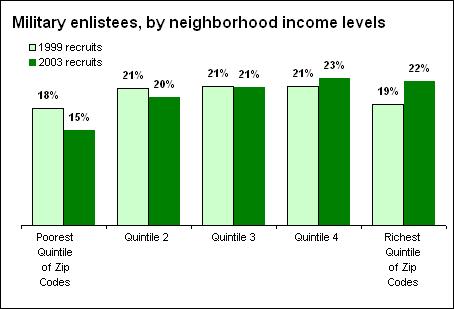
I do think Kerry's remark betrayed a general liberal assumption that the army is made up mainly of uneducated southern rednecks and poor urban blacks.  Its hard to get an exact demographic handle on this, because the army does not really ask how much money your parents make when they recruit you.  However, they do ask you what zip code you are from, and this analysis seems to belie the common liberal assumption, showing the army is actually made up disproportionately of recruits from the richest rather than the poorest zip codes

Military_demographics

More on this analysis here.

Update: LOL;  Also this

This is Happening Way Too Often

Police are getting way too aggressive with SWAT teams conducting raids for minor drug offenses.  Here is another story from Houston, via Tom Kirkendall:

Based on the evidence in the trash, a regional SWAT team arrived at
the home. Police say they knocked, waited 30 seconds, and then broke in
with guns and a concussion grenade. The house suffered $5,000 damage
and one officer shot and killed Margot's golden lab, Shadow, when
police say it charged toward one of the officers. What did officers
find inside?

"A joint half the size of my pinky fingernail and then one about
this big," she said, showing a length on her finger. "And not anywhere
near this big around."

We have the same problem with our egomaniacal sheriff in Phoenix.

Learning to Eat at the Trough

I am sitting in an industry meeting listening to people tell me all the opportunities, as a tourism-based business, to feed at the public trough and get government funding.  Example topic:  "How to turn your business slowdown into a natural disaster to get disaster-relief funds."  Yuk.  I feel dirty.

Also, my business gets taxed (via sales-tax-like lodging taxes) to support government tourism marketing (in this case, California).  Of course, I don't think any of it returns the money invested in it.  Also, the type of recreation I represent (camping) is totally unrepresented in the ads.  As is typical, these public-private tourism promotion tend to disproportionately benefit the politically connected businesses.

Failure of the War on Drugs

Frequent readers of this site will know that I support the legalization of most illegal narcotics for adult use, not because I am a secret user who wants to come out of the closet, but because prohibition and efforts to save people from themselves always result in failure.  In particular I remember the old joke that communicates so well the inherent contradictions embodied in the drug war.  It goes: "What is the worst thing that can happen to a teen who smokes marijuana?  Answer: He can get thrown in jail."

Whenever I make the argument for drug legalization, 100 out of 100 times the first response is "what kind of message does that send to kids."  They argue that even if kids under 18 are not allowed access to drugs, legalization for adults will send the message to kids that drug use is more acceptable, and their use of drugs will increase.

What is most surprising about this statement is how easy it is to test.  The approach was suggested to me by something I read in Reason the other day.

Check out this press release from the Department of Health and Human Services on youth drug use:

The Substance Abuse and Mental Health Services Administration today
announced that current illicit drug use among youth ages 12-17
continues to decline.   The rate has been moving downward from 11.6
percent using drugs in the past month in 2002 to 11.2 percent in 2003,
10.6 percent in 2004 and 9.9 percent in 2005....

The  rate of past month cigarette use among youth ages 12-17 declined from 13.0  percent in 2002 to 10.8 percent in 2005.

The counter proof to the "what about the kids" argument is right here in these two paragraphs.  Tobacco today, which is illegal for teens while legal (but frowned upon) for adults, is a good proxy for post-legalization narcotics.  Note therefore that illicit drug use among teens is 9.9 percent, while tobacco use is 10.8 percent.  There is virtually no difference!  The legal-for-adults substance is used by teens at only slightly higher a rate than illicit drugs, and this from the drug warriors' own figures.  At most, the"message" sent by legalizing tobacco seems to be no different than the "message" sent by making narcotics illegal. Tobacco is legal for adults, does not carry nearly the same stigma as illegal drugs, is far easier for a teen to obtain, and carries much lower penalties for its use, and still it is used by teens at about the same rate as illegal drugs.  In fact, in the figures you can see the legal tobacco use falling faster than illegal drug use.

So what has prohibition, prohibition-related drug violence, and hundreds of thousands of people in jail for drug use achieved?

OK, the Post Office Still Sucks

I had been lulled into thinking maybe the US Postal Service was modernizing, but I was wrong.  I have a PO Box in Colorado where I have my mail for our business forwarded to our Phoenix office for the winter months.  However, there is apparently absolutely no way to have all the mail coming to that box forwarded.  It can only be forwarded by name.  So, if I have 7 business names and 12 employees with mail in that box, I have to submit 19 change of address cards.  And, if anyone makes a typo in mailing to one of these 19 names, it won't get forwarded - only if the letter is addressed to the name exactly as it is written in the change of address card will it get to me.  Anyone want to guess how often that happens?

The Feds May Have to Come Clean

From Marginal Revolution:

The FASAB has asked
that the United States government start including future Medicare and
Social Security liabilities in current budget deficit figures:

Monday,
the Federal Accounting Standards Advisory Board released a proposal in
which the government would have to account for the cost of future
Social Security payments year by year as people build up entitlements.

Seen in advance of its release by the Financial Times, the switch in
accounting practices would be an international accounting anomaly, as
most other governments treat social insurance as a political commitment
to pay future benefits rather than a financial liability, the newspaper
said.

The FASAB is made up of six independent members who support the
proposal and three opposing members from the U.S. Treasury, the White
House Office of Management and Budget and the Government Accountability
Office.

I support this change despite the fact it may result in what I consider bad outcomes (e.g. big tax increases) as the magnitude of future liabilities become clear.  Tyler Cowen also argues it may make these programs harder to scale back, since it shifts the future payments from a political promise to a financial commitment.  But just like free speech, one has to be consistent in one's support for transparency.

If this all seems arcane to you, let me give you some perspective.  Today, Jeff Skilling was given over 30 years in jail for various accounting-related frauds, supposedly hiding losses and liabilities from shareholders's view.  But what Skilling was convicted of doing were minor, subtle accounting tricks involving penny-ante sums of money compared to the egregious games Congress plays with accounting for the federal government's future liabilities.  Skilling was accused, for example, of booking future liabilities in certain joint ventures where they were hard to find; the feds, in contrast, do not book future liabilities at all.

Does the Left Really Believe this?

When I see statements like this, I am left to wonder whether folks on the left really believe this, or if it is just throwaway political rhetoric which no one really expects intelligent people to believe (key passage in bold):

But how are people dealing with these drops on their own today?
Mostly by going into debt. As I show in my book, median household debt
as a share of income for married parents was more than 125 percent of
income in 2004. The economist Herb Stein once said, "If something can't
go on, it won't." And the debt hemorrhage of the American family simply
can't go on.

If the returns of rising risk add up to the ability to borrow more
to dig oneself out of short-term holes (thus digging a deeper long-term
hole), then I think we can safely say that most Americans would be
happy to give up the returns to obtain greater security.

But here's the kicker: We can provide security and help our
economy. Just as businessmen and entrepreneurs are protected against
the most severe economic risks they face to encourage economic
investment and growth,
we are most capable of fully participating in
our economy, most capable of taking risks and looking toward our
future, when we have a basic foundation of financial security.

How are businessmen and entrepeneurs protected?  By who?  I own and run my own small business, and I have yet to encounter
anyone who has given me any help or succor in our bad years. Or good
years. I don't even get covered by the minimum safety net type stuff my
employees have (workers comp, unemployment) without paying extra out of
my own pocket, which they don't have to do.

This is exactly the kind of throwaway absurdly false statement that
makes it impossible for me as a small business owner to take anyone on
the left seriously
, however much I am attracted to them for their
position on a variety of social and war issues. I am sure that this is
the type of statement that most of his readers on the left nod their
heads to, sure that all of us business owners are all dialed into the
fat life somehow via the government, when in fact I spend most of my
life dealing with the myriad of government-required wastepaper that
makes it nearly impossible to run a business at all.

  I am certainly willing to believe that there are certain Fortune
100 companies that recieve all sorts of government rents -- Steel
companies, in the form of protectionism; Wal-mart, in tax abatements
and eminent domain handouts; ADM, in the form of ethanol subsidies;
tobacco companies, in the form of government roadblocks to new
entrants.

However, these type of large politically connected corporations make
up about .001% of the total mass of corporations. And, entrepeneurs,
unless they are already rich and powerful from a previous business,
never get any breaks and in fact often face government roadblocks set
in place by powerful incumbents with political pull. I am all for
eliminating these coporate welfare handouts and incumbent protection
schemes. Before you scream aha! remember that 3 of the 4 government
rent recipients I listed as examples are beneficiaries of programs from
the left side of the aisle.

I discussed this risk-shift concept in more depth here.  One thing I didn't mention in the previous article was the author's attempt to tie household debt to income risk.  I skimmed the book and didn't see any
empirical linkage between rising income uncertainty and household debt.
I am willing to believe they both went up at the same time, but
correlation is not equal to causation. Ten years ago, when folks
lamented rising household debt, it was an issue of personal
responsibility and having the discipline to live within one's means.
Are we past that now? Is debt really going to be added to the list of
things nowadays that are-not-my-fault?

Update:  If he is referring to stuff like this, I share his outrage.  But it doesn't justify his general statement.