Archive for the ‘Government’ Category.

New New Deal Programs?

Hit and Run, trying to make a different point, quoted this statement from Harold Meyerson (my emphasis added):

But the new growth of selective libertarianism in the Democratic ranks
is hardly going to be the main source of controversy in coming party
debates. More likely, that debate will pit those who think retraining
is the answer to our more layoff-prone society (that's the Bob Rubin
solution) against those who think that retraining needs to be
supplemented by, for instance, publicly funded alternative energy
programs that would generate millions of jobs
(that's the solution of a
number of union leaders, and one that I favor as well). The latter
position is clearly more in the New Deal liberal mode, but Rubin's is
hardly libertarian.

Do serious people actually favor publicly funded alternative energy programs of the scale that would employ millions of people?  Note that since the total civilian labor force is approximately 150 million people, he is talking about a program encompassing several percent of the US workforce.  I am supposed to be on vacation this week, but here are a couple of random thoughts:

  • A huge government make-work program seems to be an odd response to an increase in employment volatility, which is how the problem is framed, even by Meyerson.  He calls it our "layoff-prone society."  I don't accept that this is necessarily a bad thing, but even if it is, a jobs program does not solve it.  Our unemployment today is at a low level (less than 5%) so that the problem, if it exists at all, has to be volatility, not the absolute size of employment.  So a jobs program helps, how?
  • I will confess a big government-funded jobs program would reduce employment risk in one way:  once someone is hired by the government, whether it be a teacher or bureaucrat,  it is impossible short of a felony conviction to fire them, no matter how horribly destructively incompetent they are.  So anyone hired by this new job program would have a job for life, I guess, though at an enormous dead-weight-loss of the overall economy.
  • The current economy hovers near full employment.  That means that millions of people sucked by the government into an alternative energy program would be pulled out of areas the market currently says is the most productive place for them.  Unless the government has identified a massive market inefficiency, such a program will net reduce the productivity and output of the economy.  Remember -- these millions of people are likely employed somewhere else today, so those places they are employed either have to scale back or pay more for labor.
  • Does anyone really think the government is going to make the right technology and investment choices in such a program?  It will take about 47 seconds before the investment process is politicized and spending is handed out as pork to valued supporters in key Congressional districts. (just look at ethanol and the Midwest Archer Daniels Midland lobby). Remember, the government has been pouring all its investment and subsidies and regulations (e.g. zero emissions requirements) into plug-in electric cars, which still are not there technologically.  In the mean time, the market has latched onto hybrids, a technology actually opposed at first by government energy czars in places like California (because they were not zero emissions).  Hybrids have done more to reduce automotive fuel consumption than any of the technologies, from plug-ins to fuel cells, that the US government has supported in any big way.

Postscript:  Yes, I know plug-in hybrids may be here soon, but batteries are apparently still not where they should be.  I would love to have a plug-in hybrid.  Note, of course, a plug-in hybrid is very very different from a straight electric car, which was the choice of the bureaucrats.  Also, I know that some areas have started to subsidize hybrids, for example by allowing their use by one passenger in the car-pool lane.  These are late-to-the-party efforts to claim some government credit for a private market trend already in progress.

Update:  In fact, today's SJ($) brings us a relevent example:

[Former Airbus CEO] Mr. Streiff talked of moving production jobs between
partner countries, running Airbus like a business. For the first time,
there was talk of apportioning work on the basis of competitiveness,
not national entitlement. There were hints that Airbus should emulate
Boeing with major risk-sharing partnerships, looking beyond Europe for
new product development resources and production sites. He even
committed the ultimate sin"”publicly admitting that Airbus had fallen
over a decade behind Boeing in new product development.

In his exit statement, Mr. Streiff said, "I
progressively came to the conviction that the mode of corporate
governance at Airbus didn't allow for the success of my plan." In other
words, the now former CEO implies, he was blocked by people who like
the status quo. So who would be happy with the status quo when the
situation is degenerating with each day? Well, any government official
who wants governments to stay in charge of the economy. The last thing
they want to see is private sector cash reinventing the fruit of their
state-directed industrial policy.

For the best clue to this dysfunction, consider
France's finance minister, Thierry Breton. He recently told reporters
that Airbus is a "European success," but vowed to "defend this model."
Now why would a model need defending if it were successful?

Airbus was created when European governments
orchestrated their economies, creating new national and continental
champions according to politicians' whims. As far as industrial policy
goes, Airbus was a no-brainer: The jetliner industry offers guaranteed
growth rates and extremely high barriers to entry. Take some legacy
industrial assets, insert government cash, find some talented sales
people, and watch it go. Every other European industrial
scheme"”shipbuilding, cars, Concorde"”obliterated value. Airbus was the
only state-supported success. Unfortunately, Europe's politicians
forgot a crucial fact: Airbus succeeded despite government industrial
policy, not because of it. In fact, this government interference has
created some serious trouble.

Look at the Airbus record: a series of moderate
successes (A300/310, 330), one huge home run (A319/320/321), and some
lamentable but forgivable near misses (A340, A340-500/600). But with
the full support and connivance of parent governments, they launched a
spine-breaking disaster, the superjumbo. Without the A380, Airbus would
still be a tremendous success. Instead, they've got a serious
industrial crisis, right in the middle of the best jetliner market in
years. Mr. Breton's "model" of state-guided industries is alchemy in
reverse: spinning gold into straw.

The "Compassionate" Politician

Ted Roberts gets at a pet peeve of mine when he says:

Everything that's wrong with government can be summarized by a single
sign that stands eloquently at the entrance to my neighborhood park. A
plot of green with tennis courts and soccer fields for athletes and
playground paraphernalia for junior swingers. I mean the kind that
really like to swing. Cursed with a civic attitude that makes me wary
of gifts from politicians, I note A boastful sign. "This playground
made possible by the city of Huntsville and the Madison County
Commission," it says. Not a blatant lie - just a fuzzy deception. About
as far from the truth as the mayor's office downtown is from this
suburban playground.

I think it's the tone of our "governors" (using the word in a literal
sense) that bothers me. Their proclamations of achievement. They are
ignoring the contribution of me and my fellow taxpayers to this oasis.
They forget that we are a society of the taxpayers, by the taxpayers
and for the taxpayers.

I would go further.  I hate it when politicians are called "caring" or "compassionate" when the sole evidence for this is the fact that they take my money and give it to someone else or build something with it that they can put their name on.

Update: Fixed link

Like Finding Out Kennedy Was Killed By Lee Harvey Oswold

Holy foregone conclusions, Batman.  It turns out the secret hold on the earmark transparency bill was finally traced to two senators:  Ted Stevens and Robert Byrd.  Knock me over with a feather.

A New Reason to Vote Democrat

If true, the notion discussed here that the media will portray the same economy as better if a Democrat is in the office and worse if a Republican is in the office may be as good a reason as any to vote Democrat.  Then the media will get off the current silly "worst economy in forever" meme and maybe the presure on the goverment to step in with some sort of silly, ill-considered, and long-term destructive intervention will be reduced.  Viva gridlock and divided government!

World's Ugliest Currency

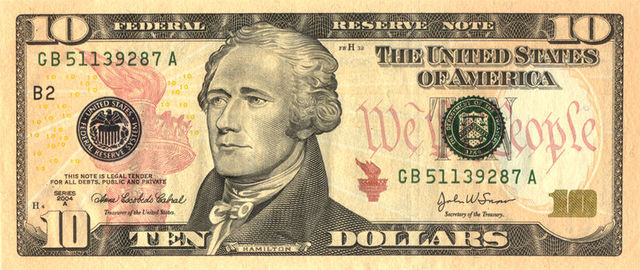
My vote for the world's ugliest bank note is the new US $10 bill (click for larger pictures)

800pxus_10_series_2004_face

800pxus_10_series_2004_back

Really these images don't do justice to just how butt-ugly this bill is.  I understand the need to introduce color and anti-counterfeiting technologies.  I also understand that they are trying to maintain elements of the historic greenback.  But this bill marks the point where it is now impossible to sustain both these goals.  If we need color, then its time to go color -- maybe Peter Maxx could design a new bill.

Really, who designed this thing?  The combination of colors is god-awful. And what's that blank oval on the back that looks like a misprint?  This thing is a mess.

(Note to my wife:  Yes, I am actually blogging about this.  She thinks that some of the things I get worked up about are kind of trivial.)

Update:  One of the commenters reminded me that there were for a while calls to replace Hamilton with Reagan.  I guess Hamilton was singled out because like Franklin, he is a non-president.  Which is kind of ironic, since Hamilton probably knew more about money and banking than all the presidents on the other bills combined.  I'd be a lot happier if they instituted some kind of waiting period, like for the Hall of Fame, of say 50 years before you can get your face on currency.  Besides, everyone know that the Gipper is supposed to be on the quadrillion dollar note.

The Government Disaster Monopoly

I have written a number of times that one of the problems with the Katrina aftermath was not that the federal government did too little, but that they try to do too much.  For example:

While turning down offers to help, when everyone agrees not enough
is being done, may seem unthinkable, these are actually predictable
outcomes from a [government] bureaucracy of technocrats.  Technocrats value process
over results, order and predictability over achievement.  More
important than having problems fixed is having an ordered process,
having everything and everyone under control.  In this context, you can
imagine their revulsion at the thought of having private citizens
running around on their own in the disaster area trying to help
people.  We don't know where they are!  We don't know what they are
doing!  They are not part of our process!  Its too chaotic! Its not
under control!

Nearly everyone who is in government has a technocratic impulse -
after all, if they believed that bottom up efforts by private citizens
working on their own was the way to get things done, they would not be
in government trying to override those efforts.  But most emergency
organizations are off the scale in this regard.  99% of their time,
they don't actually have an emergency to deal with - they are
planning.  They are creating elaborate logistics plans and procedures
and deployment plans.  Planners, rather than people of action,
gravitate to these organizations.  So, once a disaster really hits, the
planners run around in circles, hit by the dual problem of 1) their
beautiful plans are now obsolete, since any good general can tell you
that no plan ever survives first contact with the enemy and 2) they are
by nature still planners, trying to get order and process underway and
create a new updated plan, rather than just getting every possible
resource out there fixing the dang problem.

Kerry Howley in Reason's Hit and Run discusses a similar problem in Southeast Asia in the aftermath of the deadly Tsunami:

A year and a half after the deadliest tsunami in recorded history, a
pan-Asian warning system seems about as likely as, say, competent
airport security stateside. So Sri Lankans have poured donations into
DIY monitoring stations, using the Web and volunteers to watch for quakes...

How do officials react to the exciting new world of distributed warning technology?

But the government does not want ad-hoc tsunami warning centres handing out advice to local communities.

"Only the Met Department is authorised to give tsunami warnings and
evacuation orders. They cannot do it. It is illegal. That creates
unnecessary panic," Darmaratne said.

Just as in the Katrina aftermath, the government answer is that we would rather have nothing happen than positive efforts occur that we don't control (or take credit for).

Double Secret Probation

Why even bother to filibuster when you can put legislation on secret hold.  While this story is highly ironic, I suppose the Senator involved has to at least be credited with consistency in his/her opposition to transparency for putting a "secret hold" on a bill to increase the public's visibility of the earmark process:

Yet most Senators clearly have no desire to shine a light on their
spending practices, and at least one -- perhaps more -- has placed a
"secret" hold on the legislation. Normally the architects of these
holds are exposed within a few legislative days, but with Congress on
recess the masked spender has so far evaded capture and public scrutiny.

Porkbusters, a grassroots outfit that fights government waste, found
this untransparent move to stymie government transparency a bit rich,
and last week launched a campaign to unveil the blocker's identity. It
has asked its members to call on their Senators to disavow the hold,
and the responses are trickling in. The group, which is tracking the
results on its Web site (www.porkbusters.org), still has the pictures
of 91 Senators under its "Suspect" list. The nine Senators who have
denied placing the hold are now listed as "In the Clear"; they are
Senator Coburn, Barack Obama, Mary Landrieu, David Vitter, John McCain,
Ron Wyden, Richard Shelby, Jim Inhofe and Jeff Sessions.

If Congress insists on spending like there's no tomorrow, at least
the Members could let the voters see what they're spending it on by
passing Senator Coburn's reform. Will the real secret Senator please
stand up?

Anatomy of an Earmark

I was fooling around with a great web page run by the Sunlight Foundation linking earmarks from a recent Health and Human Services bill to Google maps.  Here are some of the earmarks in the Phoenix area:

  1. $ 400,000 -- Midwestern University for a rural postgraduate educational program at Sierra Vista Regional Medical Center
  2. $ 150,000 -- St. Joseph's Hospital for facilities and equipment for its mobile maternity outreach program
  3. $ 750,000 -- Translational Genomics Research Institute for facilities and equipment
  4. $ 250,000 --  Arizona State University Institute of Civil Rights, for dropout prevention and other education projects
  5. $ 125,000 --  Mesa Community College for nursing recertification curriculum
  6. $ 175,000 --  Mesa Community College for the Enfermeras En Escalera program
  7. $ 200,000 -- Marc Center for job training for adults with disabilities
  8. $ 500,000 -- Scottsdale Healthcare for an electronic medical records system
  9. $ 100,000 -- Arizona Dental Foundation to provide dental services to low-income residents of Arizona

Note that this is just from one narrowly focused bill and for one single metropolitan area.  For this one post, I will not be a libertarian and wonder why the government is spending money on some of this crap.  Instead, for one post, I will be a good little technocrat and assume that the government should be doing all these things and criticize the process.

If I were a technocrat, I would argue that Congress already funds an ENORMOUS beauracracy to route federal money to theoretically the most productive spots.  I mean, that's the whole technocratic argument for all this government spending, isn't it?  That the government run by experts in the field can top-down allocate resources better than some bottom up market process?

Ideally, in any budgeting process, you look at your goals for a pool of money - say to cure breast cancer or to provide worker retraining, and you rank projects and allocations against this goal.  I believe this to be an impossible task for a variety of reasons, some of which are described here.  But even if you buy into this theory of technocratic fascism, you STILL have to be appalled by these earmarks.  Because each and every one are an override of any kind of prioritization and thoughtfullness that might exist in the budgeting process.

Take #9.  So the government has a goal of providing dental services to low-income people.  Fine.  Then shouldn't it take its dental services budget and allocate it on the best cost per patient served basis?  Does the Arizona Dental Foundation fit into this picture?  I bet no one in Congress knows.  In fact, I bet it DOESN'T fit this efficient allocation of funds criteria, because otherwise someone in Congress wouldn't have overrrided the funding process to push $100,000 their way in an earmark.  And even if this is a non-profit, shouldn't this kind of thing be bid on -- say ask for proposals of who can do the most with $100,000?

Some of these others are pretty obscure, and say something in and of themselves about the reach of the federal government these days.  But take #3.  Is the Translational Genomics Research Institute the best place to spend 3/4 million to get the most bang for our health research dollars?  No one probably knows, but what I can tell you is that it is the darling of our local political establishment (just read its history, all about political namedropping, new facilities, and whoring for taxpayer funds without mention of any actual research).  It has political figures such as our current governor on the board, so you might be able to guess how they got their earmark.

Or look at #8.  Scottsdale Healthcare is a private company, though a not-for-profit.  It is a large provider of private, paid medical services in our area.  It, out of all of its competitors in town, both non-profits and for-profits, was chosen by Congress to get its medical records system upgraded by the US taxpayers, why?

Congressman Shadegg, What are you Doing?

My Congressman, John Shadegg, is a generally reliable opponent of taxes and expansions of government.  So why is he sponsoring this garbage:

The House last week overwhelmingly approved and sent to the Senate
bipartisan legislation by Congressmen Brad Sherman and John Shadegg to
fund joint research by Americans and Israelis into alternative energy
sources.

"Cutting-edge research by top scientists from the United States and
Israel could reduce our reliance on foreign oil by promoting more
efficient uses of traditional energy sources and by developing energy
alternatives," Sherman said.

The Shadegg-Sherman legislation would establish in the Department of
Energy an International Energy Advisory Board to advise the secretary
on the $20-million-a-year grant program authorized by the bill. The
United States-Israel Energy Cooperation Act would encourage cooperation
on research, development, and commercialization of alternative energy,
improved energy efficiency and renewable energy sources.

Why, why, why?  I understand, but don't accept, the political pressure to increase alternative energy spending (though see here on its effectiveness) but why are we creating yet another program and grant bureaucracy?  And why should the funds not be spent on the most promising research out of the entire superset of possible projects but be narrowly focused on only investing in a portfolio of projects presumably combining US and Israeli citizens?

Katrina was Government Revealed

It frustrates me some when the government's Katrina response is cited as an example of government failure.  This implies that the government should perform better, but just didn't in this particular case because of some process or personnel problem.  But the government's Katrina response was not the government failing, but the government doing exactly what it always does.  Governments of all types are hard-wired to produce the mess we saw.  And it was a mess, as Ralph Reiland summarizes a recent NY Times article:

  • An estimated 1,100 prison inmates across the Gulf Coast collected in excess
    of $10 million in rental assistance and disaster-relief money. Crime pays! FEMA,
    in addition, distributed millions of tax dollars to people who used names and
    Social Security numbers belonging to state and federal prisoners.
  • A hotel owner in Sugar Land, Texas, has been charged with submitting
    $232,000 in invoices for evacuees who allegedly never stayed at his hotel,
    billing FEMA for purportedly empty rooms or rooms occupied by paying guests or
    hotel employees.
  • An Illinois woman who was living in Illinois at the time of the storm sought
    relief benefits by claiming she had watched her two daughters drown in the flood
    waters of New Orleans. The children never existed.
  • A Department of Labor employee in Louisiana, appropriately named Wayne
    Lawless, has been charged with handing out nearly 100 falsified disaster
    unemployment benefit cards in exchange for kickbacks of up to $300 per card.
  • In New Orleans, two FEMA officials have pleaded guilty to pocketing $20,000
    in bribes in exchange for inflating the count on the number of meals a
    contractor was serving to relief workers.
  • With the $2,000 debit cards distributed by FEMA for disaster relief, an
    estimated 5,000 people have double dipped, receiving both the $2,000 plastic
    card and a second $2,000 by check or electronically.
  • Two men, one a representative of the Army Corps of Engineers, have pleaded
    guilty to taking kickbacks in exchange for approving payments for removal of
    nonexistent loads of hurricane debris. In contrast, with loads of debris that
    were not nonexistent, a councilman in St. Tammany Parish, Louisiana, has been
    charged with attempting to extort $100,000 from a debris-removal contractor.
  • One creative scam artist is charged with collecting 26 federal disaster
    relief checks totaling $139,000 by using 13 Social Security numbers and fake
    claims of damage at bogus addresses. Others collected and pocketed hurricane
    relief donations by posing as Red Cross workers.
    All told, what the above
    represents is "one of the most extraordinary displays of scams, schemes and
    stupefying bureaucratic bungles in modern history," reports the Times, "costing
    taxpayers up to $2 billion."

Note that this isn't a unique failure - this story can be written about any government handout program.  And this wasn't a case of FEMA moving too fast without restraints when everyone around it was signaling caution - in fact just the opposite.  Everyone on the sidelines at the time was criticizing FEMA for being too slow in handing out money willy-nilly.

One of the problems never discussed very often is that increasingly, the government has insisted on an exclusive monopoly position for itself in providing disaster assistance.  In effect, past disaster assistance was provided by people you never see or hear about, private people taking private action.  In Katrina, the government worked hard to shut most of these people out.  So, in this sense, Katrina was probably a worse response than in other disasters because the bottom-up, thousands-of-people-helping-out response was not allowed.  FEMA, under pressure from both sides of the aisle, increasingly take the Al Haig "I'm in charge here" approach, much to everyone's detriment. 
Unfortunately, most analyses of Katrina are saying the government did not do enough.  I think it did too much.

Welfare for Everyone

Congrats to Santa Barbara for breaking new ground in government paternalism:

The City Council here had already created a class of affordable housing
several years ago for people making up to 200% of the median income.
Last week, they agreed to tailor the Los Portales project for people
making up to 240%, or nearly $160,000. (To keep these affordable condos
affordable, buyers would be subject to price controls on resale that
would restrict any price increase to about 2% a year.)

Wow, government housing projects for people who make $160,000!  I loved this quote:

"it's hard to get sympathy for people making $160,000 a year if you're
down in Texas or something," said Bill Watkins, head of the UC Santa
Barbara Economic Forecast Project.

No shit.  So, why the project? 

But this is Santa Barbara, a built-out city hemmed in by the Santa Ynez
Mountains to the north, the Pacific Ocean to the south and politics in
every possible direction. And this is believed to be Santa Barbara's
last vacant lot big enough to hold a housing development.

So this is just the fault of geography and the bad old supply and demand system, right?  Well, it turns out the government had just a little to do with it too:

The city is zoned for 40,005 housing units. About 38,000 have been
built, and the only housing construction these days is in-fill: a few
units here, a few there. Unlike other land-poor cities, Santa Barbara
has been loath to tear down large swaths of outdated structures and
rebuild, said Paul Shigley, editor of the California Planning &
Development Report.

"They think they've got paradise," Shigley said. "They don't want it to change."

The tallest building here is the eight-story Granada Theatre, built in
1924. It could never be replicated today, in part because the City
Charter strictly limits buildings to 60 feet, about four stories. And
even four stories is a hard sell.

Oh, so the lack of new lots is an artificial government zoning limit, AND the government limits the height of new building to just a few stories AND the government won't allow tear down and gentrification of old neighborhoods.

By the way, housing projects like this in expensive areas are really just massive corporate welfare subsidies of local businesses.  If workers really need their housing subsidized to live there, and the government does nothing, one of two things happen:  Either busineses go somewhere else cheaper, or else they have to pay their employees more to live in the area.  By subsidizing this housing, the local government is in effect subsidizing local businesses by letting them pay lower wages.  In particular, this is typically a subsidy of tourist businesses (hotels and restaurants) which have a hugely disporportionate influence on local governments and who typically are tied to the local area and can't leave.  The town of Vail, for example, has subsized similar housing under presure from the ski resorts.

Hat tip: Hit and Run

The Pain of Single Payer

Expect the next Democratic presidential nominee to run strongly on single-payer (ie socialized) medicine.  Vodkapundit reminds us what this is like, with the latest from England:

Hospitals across the country are imposing minimum waiting times -
delaying the treatment of thousands of patients.

After years of Government targets pushing them to cut waiting lists, staff
are now being warned against "over-performing" by treating patients too quickly.
The Sunday Telegraph has learned that at least six trusts have imposed the
minimum times.

In March, Patricia Hewitt, the Secretary of State for Health, offered her
apparent blessing for the minimum waiting times by announcing they would be
"appropriate" in some cases. Amid fears about £1.27 billion of NHS debts, she
expressed concern that some hospitals were so productive "they actually got
ahead of what the NHS could afford".
...

The Sunday Telegraph has learned of five further minimum-waiting-time
directives. In May, Staffordshire Moorlands PCT, which funds services at two
hospitals and is more than £5 million in the red, introduced a 19-week minimum
wait for in-patients and 10 weeks for out-patients. A spokesman said: "These
were the least worst cuts we could make." In March, Eastbourne Downs PCT,
expected to overspend by £7 million this year, ordered a six-month minimum wait
for non-urgent operations. Also in March, it was revealed that Medway PCT, with
a deficit of £12.4 million, brought in a nine-week wait for out-patient
appointments and 20 weeks for non-urgent operations.

Doctors are also resigning. One gynæcologist said that he spent more time
doing sudoku puzzles than treating patients because of the measures. Since
January, West Hertfordshire NHS Trust, with a deficit of £41 million, has used a
10-week minimum wait for routine GP referrals to hospital. Watford and Three
Rivers PCT, £13.2 million in the red, has introduced "demand management": no
in-patient or day case is admitted before five months.

Note that this is not a bug with single-payer systems, it is a feature.  Any 3rd party payer system has to impose some sort of artificial rationing or bankruptcy will ensue.  Would you drive more if your gasoline costs were all covered by a single-payer system, such that you did not pay directly for gas.  Would your choice of cars be affected?

Along the same lines, from Marginal Revolution comes this story of new scholarship showing the enormous spike that occurs in health care demand under third party payer (e.g. insurance) systems.

AZ and Small Government

One of the good things about living in AZ is that it is the home of several of the unfortunately dwindling number of Republicans who consistently cast votes for lower taxes and smaller government. 

Recently Arizona Congressman Jeff Flake, who I have given props to in a number of columns on this blog, sponsored a series of 19 bills aimed at cleaning up the appropriations process and making it harder for Congress to slip earmarks through the appropriations process, at least without having gone explicitly on the record as having done so. 

The Club for Growth has a scorecard of how each Congressman voted on these bills.  In each case, a 'YES' vote is a vote against pork and a vote to clean up the Congressional appropriations process. 

My Congressman, John Shadegg, who is another reliable small government low tax voter, came through with 19 of 19 'Yes' votes.  Way to go Congressman!

From Rags to Riches at Taxpayer Expense

Some of you may have heard of him -- about a year ago blogger Kyle MacDonald started on a quest to make a series of barter transactions with a red paper clip as his starting item that would result in his owning a home.  Since to make this work he had to get a higher monetary value out of each successive transaction, one had to believe either that he was a really really good exploiter of market inefficiencies, or, more likely, would advance in each trade with a premium related to the publicity value of his effort.  In other words, people would trade him value X for something less than value X to either garner publicity for themselves or because they just wanted to participate.

Well, for most of the effort, all proceeded well.  People traded with him voluntarily, in many cases knowing that on a strictly financial market value assessment, they may have lost in transactions with him but making up for it with the non-tangible benefit they got from participating.  Well, I say it was voluntary, and it was, right up to the final transaction.  But then it fell apart.  Because in that last transaction, the town government of Kipling, Saskatchewan bought Mr. MacDonald a house with taxpayer money, in exchange for a movie role (the article is not clear on how the town will use a speaking part in a movie) and I am pretty sure this was not done with the voluntary consent of every taxpayer in Kipling.

Intriguingly enough, he was offered this item of value (a movie role) from actor director Corbin Bernsen as pure gift, rather than a trade.  Macdonald, interestingly enough, did not accept the role as a gift because he "feared the integrity of his journey would be compromised if he
accepted the role without trading Bernsen something he really could
use".  And the taxpayers of Kipling really could use a movie role, how?  It says volumes about the philosophic state of western man that accepting a gift freely offered challenged the "integrity" of what he was doing but accepting taxpayer money taken by force without the owners' permission is A-OK.

Arizona Pioneers a Really, Really Bad Idea

A group in Arizona has pioneered what may turn out to be the greatest tool for promoting socialist redistributionist government in this country since income tax withholding:  Having the government pay people to vote.

There's going to be a new reason for Arizonans to go to the polls this year:
They could win $1 million.

The Secretary of State's Office certified Thursday that backers of the
voter lottery plan had submitted more than enough signatures to qualify for the
November ballot.

But the measure is worded in a way to actually encourage people to vote
both in the primary this September as well as two months later when the actual
initiative will be on the ballot. If it is approved in November, it will be
retroactive: One lucky person who voted in this year's primary and another who
cast a ballot in the general election each will get $1 million.

A number of people have made the obvious point:  just how informed is the incremental voter who votes only because of this lottery ticket incentive really going to be?  I think most people's answer is "not".  The backers of the referendum poo-poo this concern, but do any of you really share this man's confidence:

Osterloh said he believes that providing a carrot for would-be voters would
increase participation in the democratic process. The Tucson physician dismissed
concerns that the kind of people who would vote solely for a chance to win the
lottery are likely to be ill-informed about the candidates and the issues.

"Once they decide they're going to vote, they will study the issues and
candidates," he said. "And they will vote in their own enlightened
self-interest."
Yeah, right. 

However, I am even more concerned because the incremental voter will be someone whose interest in the government is only as a source of money.  The new process will attract people who believe, and in fact train people to believe, that the purpose of voting is to direct money from the government to oneself.  I am convinced that the incremental voter attracted by this approach will tend to be strongly redistributionist, and further I believe that the backers of the plan know it. 

Update:  I am waiting to see how long it will be before we see this ballot initiative on some state ballot:  "Resolved:  That each year, the richest 40% of taxpayers in the state, as defined by last year's income, shall pay 10% of their income, above and beyond all other taxes, into a state fund that will be divided evenly and given to the remaining 60% of state residents."

Universities Becoming Their Own Country (and a repressive one at that)

Both based on outside pressure (mostly from torts) and internal desire, universities are rapidly modeling themselves into mini-governments, really mini-super-nanny-states.  FIRE, the Foundation for Individual Rights in Education, observes of a recent gathering of University attorneys:

At one panel I attended, San Francisco lawyer Zachary Hutton explained
Williams v. Board of Regents, a recent case in which a University of
Georgia student alleged having been raped by two student-athletes while a third
student watched. The police charged the athletes with rape, and the university
decided not to conduct its own investigation until the criminal case was
resolved.
That turned out to be a mistake. The plaintiff then sued the university for
sexual harassment, and the 11th Circuit held this year that the university could
be liable because, by waiting to conduct an independent investigation until the
criminal case was resolved, it had exhibited deliberate indifference to the
alleged rape. "The court emphasized," Mr. Hutton told the college lawyers, "that
the pending criminal trial . . . did not affect the university's ability to
institute its own proceedings, and the criminal charges would not have prevented
future attacks while the charges were pending."
There are excellent reasons for the university not to conduct its own
investigation. For one thing, instead of police detectives and professional
prosecutors conducting the investigation, you are likely to get Campus Public
Safety and the Associate Dean for Student Affairs. How having inexperienced
college administrators and college safety officers conduct a rape investigation
is likely to benefit either the victim or the accused is beyond me. The
potential for violating the Fifth Amendment, damaging evidence, and coming to
wildly inaccurate conclusions is immense, and if any of these things were to
happen, the university would risk botching an important criminal case. Rape is a
serious crime; victims and the accused deserve better than college justice.

In some ways, this was even more illuminating of the drive to mini-nanny-statehood:

The most entertaining discussion I heard at the lawyers' convention
centered on what to do about facebook.com and myspace.com--how to prevent
slander, harassment and rumor-mongering on these online communities popular with
undergrads.
What these attorneys were talking about is wholesale regulation of online
speech. Slander is, of course, a tort, and engaging in slander or libel can get
a person sued. It's hard to see how or why a college should be involved in this,
though. If I libel someone online, it's the business of those affected, not the
college. As for harassment, one of its main characteristics is that the person
being harassed finds the harassing behavior hard to avoid. Unless the "harasser"
is hacking into the victim's MySpace page, it's hard to see how going to a
"harassing" website isn't completely avoidable. As for "rumor-mongering," horror
of horrors! Regulating that on a college campus will mean tripling the number of
administrators (and probably tuition), but I suppose no expense is too large to
make sure that everyone stays comfortable.

College campuses were probably among the first and most vociferous critics of GWB's various domestic surveillance programs.  Its interesting to see that while opposing such programs at the national level, they are crafting far more far-reaching speech monitoring and restriction programs on their own campuses:

The room was evenly divided: Some lawyers recommended ignoring the students' Web
sites unless something offensive was brought to administrators' attention, while
others suggested taking aggressive action....

By my calculations, if half the lawyers thought that "offensive" speech that is
reported should be punished, and half the lawyers thought that administrators
should spend their time cruising the websites and proactively stamping out
"offensive" speech, that leaves ZERO lawyers who believed that perhaps merely
"offensive" speech should be protected, as the First Amendment (at public
schools), or respect for fundamental freedoms (at all schools), requires.

State of Arizona Channeling Enron

In May of this year I got a form from the Arizona Department of Revenue that said my company was now large enough to make estimated sales tax pre-payments.  Some states do this when you are large enough - they don't like you holding their sales tax money a whole month until the reporting deadline, they want their cash in hand.  It's a pain, so I sighed, but we did it.  We prepaid estimated full-month June sales tax in mid-June as required, rather than in mid-July when the payment would normally be due.  Note that we still have to fill out all the sales tax reports in July, so paperwork is doubled, not to mention the extra work to reconcile between the estimate and actual results.

So this month, I was looking for the July pre-payment form.  I figured the July pre-payment must be due soon, so I called the Department of Revenue and asked where my form was.  They said there was no form for July.  The pre-payment is only one time.  I said, "its only for June?" and they said yes.

Then it dawned on me:  Arizona is on a June 30 fiscal year.  The entire point of this exercise is to pull July revenues into June to artificially inflate the prior fiscal year financials.  Wow - all those pious government workers artificially manipulating results just like an evil old corporation.  Because there is absolutely no other reason to do this for just one month.  The time value of money gained is dwarfed by the costs of changing your payment processing approach for just one month, and is certainly dwarfed if you consider the extra taxpayer effort required (which of course the government never does).

But it's even worse!  Because, in effect, this only worked one time -- the first time.  The first time they did this, they helped the fiscal year.  But now, pulling forward July this year just offsets losing the July revenues from last year.  So politicians have saddled us with a tax process that costs the government more money and the taxpayer more time and has no benefit beyond generating a slightly more positive press release about the budget for some politician several
years ago (whatever year this was first implemented).

As Good A Theory as Any

For those who, like me, have trouble decoding why certain SCOTUS justices make the rulings that they do, Richard Epstein propounds an interesting theory in the WSJ ($) today.  He says that you can't relay on traditional conservative or liberal monikers to predict when a justice will back an expansion of government and when she/he will rule to reign it in.

In principle, it would nice if both sides of the
ideological spectrum displayed a sound and consistent position on
statutory construction. Unfortunately, each bloc is opportunistic. The
litmus test for this erratic behavior boils down to a factor not found
in any statute: trust.

The court's two wings share one trait: They defer only
to the government officials they trust. Otherwise, they read a statute
carefully to rein in the authority of officials they don't trust. The
two factions don't differ in their philosophy of language, or in their
on-again, off-again adherence to the rule of law. Rather, the court's
liberal wing profoundly distrusts this president, but has great
confidence in the domestic administrative agencies that regulate
matters such as the environment. The conservative wing of the court
flips over. It willingly defers to the president on national security
issues while looking askance at expansionist tendencies of the
administrative agencies.

This feels as right as any theory I have read of late.  And I certainly can get behind this:

Our Constitution starts out with a presumption of distrust of all
government actors, which is why it drew a sharp line between the
legislative and executive branches. We can argue until the cows come
home whether national security or environmental protection presents the
greater threat of executive or administrative misuse. But that ranking
really doesn't matter, because there is no reason why the Supreme Court
has to defer to overaggressive public officials in either context.
Justice Stevens rightly chastised the president for flouting the rule
of law in Hamdan. But he was tone deaf on the easier question
of statutory construction when blessing the Corps' extravagant reading
of the statute in Rapanos.

Statism Bites its Creators

A while back, I observed that liberal statists and technocrats were upset that conservative statists were using the machinery of big government they created for the "wrong" ends:

I am reminded of all this because the technocrats that built our
regulatory state are starting to see the danger of what they created.
A public school system was great as long as it was teaching the right
things and its indoctrinational excesses were in a leftish direction.
Now, however, we can see the panic.  The left is freaked that some red
state school districts may start teaching creationism or intelligent
design.  And you can hear the lament - how did we let Bush and these
conservative idiots take control of the beautiful machine we built?  My
answer is that you shouldn't have built the machine in the first place
- it always falls into the wrong hands.  Maybe its time for me to again invite the left to reconsider school choice.

Today, via Instapundit, comes this story about the GAO audit of the decision by the FDA to not allow the plan B morning after pill to be sold over the counter.
And, knock me over with a feather, it appears that the decision was
political, based on a conservative administration's opposition to
abortion.  And again the technocrats on the left are freaked.  Well,
what did you expect?  You applauded the Clinton FDA's politically
motivated ban on breast implants as a sop to NOW and the trial
lawyers.  In
establishing the FDA, it was you on the left that established the
principal, contradictory to the left's own stand on abortion, that the
government does indeed trump the individual on decision making for
their own body
  (other thoughts here).
Again we hear the lament that the game was great until these
conservative yahoos took over.  No, it wasn't.  It was unjust to scheme
to control other people's lives, and just plain stupid to expect that
the machinery of control you created would never fall into your
political enemy's hands.

Suprisingly, James Taranto in Best of the Web, who I sometimes find too partisan and socially conservative for my tastes, makes a similar point:

Liberal Democrats take credit for creating an enormous government, which, according to them, doesn't work--but would work just fine if only the populace were smart enough to elect liberal Democrats.

In sum: Republicans favor small government but embrace big government when they have the power to control it. Democrats favor big government but insist that it can work only when they have the power to control it. Politicians in both parties, then, seem to see government as a means to the same end: their own political power. Little wonder that voters are suspicious of government.

No Surprise Here

Marginal Revolution links to a list of the most corrupt states, measured by the number of government corruption convictions per capita.  I bet you can come pretty close to the top three without even looking.  Here they are:

  1. Alaska.  For all those who want to believe that pork is unrelated to corruption, look no further than the king of pork itself, Alaska, which also turns out to be the king of government corruption.  Kudos to Arizona Congressman Jeff Flake, who is about the only one brave enough in that lost and floundering body to connect the dots between Abramoff, cash-filled tuperware, corruption and pork.
  2. Mississippi.  Who would have ever thought the state best known for being the #1 home of jackpot torts and the home state of the Senator who claims to be above the law would be a hotbed of corruption? 
  3. Louisiana.  Probably the only surprise on the list, since one would expect the home state of Huey Long to be in first rather than third.  Heck, in 1991 the state got to choose between a wanna-be Nazi Klansman and a serially corrupt felon for Governor.  And God only knows where the money that should have been spent on building levees actually went.

LOL

Congress_sticker

Congress Finally Stirs Itself Over Separation of Powers

A while back, I lamented that all three branches of government seemed to be conspiring to weaken Constitutional limits and separation of powers.

The good news is that Congress has finally gotten worked up about protecting separation of powers.  The bad news is that the issue at hand is the justice department's investigation of Congressional bribery.  Unbelievable.  These guys are totally lost.  More on the Jefferson bribery chargesGlenn Reynolds comments and has a roundup.

Ed Morrissey provides a bit of Constitutional analysis, as well as this excellent point:

This can't be the same Congress that issues subpoenas for all sorts
of probes into the executive branch and the agencies it runs. Does
Congress really want to establish a precedent that neither branch has
to answer subpoenas if issued by the other, even if approved by a judge
-- which this particular subpoena was?

The FBI had a valid subpoena for the information in Jefferson's
office. He refused to provide it. The FBI had little choice but to go
in and take it, and from the description given in the Washington Post,
they took extraordinary care not to confiscate legitimate data relating
to his legislative responsibilities.

Fortifying the Border

So we're going to build a wall and send an army to the border.

Maintaining a military to defend a group of people against outsiders who wish to use force against them is one of the core functions of government.  Even crazed libertarian anarcho-capitalists like myself concede it as a function of government.  If libertarians were to have their version of the ten commandments, the only phrase that would have to be on the stone is "Thou shalt not deal with thy neighbor through force or fraud."  The government maintains police and a military to handle the people who wish to violate this one commandment.

Throughout the years, countries have built armies and fortifications to defend against invaders who wanted to loot their lands, or steal their property, or impose their own version of racial or religious uniformity.  The US Army itself has fought for freedom, it has fought to restore democracy and individual rights, it has fought to stop genocides. 

Today, the US Army sallies forth again, to fight for and defend .... what? 

It fights to stop waves of Mexican immigrants that are dangerous because they ... want to freely exchange their labor with US Citizens?

It fights to protect Americans from ... competition for unskilled labor jobs?

It valiantly rides forth to make sure Americans never face the horror of ... interacting with someone with only broken English?

The soldiers racing to the borders are not fighting for me, because I am not in danger.  And neither is anyone around me here in Arizona -- no one from outside the border is threatening me with force or fraud (surprisingly frequent emailers sending me messages about Mexicans all being diseased criminals notwithstanding).  Its not like I live blithely ignorant of the border area in Kansas.  I life in Phoenix, and run businesses  right down on the border.  I don't feel a threat or danger.  In fact, the only danger I see is that the army may come down and drag families who are my friends out of their homes and out of the country (or into concentration camps, as one conservative writer longed for).

Immigration opponents are sometimes a little hazy about what danger they are trying to fix.  I agree there is a problem with the welfare state when it meets immigration, which I discussed here and proposed a solution for it here.  Democratic politicians still are confused on this particular problem, wanting some immigration solution but refusing to consider limiting access to the welfare state.   If the problem is infrastructure (police, prisons, schools, etc.) then it could be possible to provide national funds to border regions for this purpose, rather than for armies and walls (the Feds, after all, are handing out hundreds of billions to New Orleans).  And if the problem is too many people who don't look like us Anglo-Saxons, well, sorry  (If you don't think that this is the real issue for many anti-immigration folks, think about the recent scare headlines that soon a majority in the US may be Hispanic.  Can you imagine similar anxiety over the headline "majority of US may soon be of Canadian descent"?)

Update:  Nick Gillespie comments on the fact that Congress has given its official sanction to my speaking English.

Thank you, Middle Eastern 9/11 hijackers, for finally getting the point
through our thick skulls (forgive our slowness, but all too many of us are
descended from immigrants) that the greatest security threat to the United
States is the influx of Spanish speakers from across the border with Mexico.

Christ, it's bad enough that we have to eat foreign food, live in states
with Spanish-derived names, and answer that extra question about which
language to use at the ATM. (Thought experiment: How much is that extra
second or two of time slowing down the U.S. economy and driving down our
productivity, precisely at the moment when the Chinese are breathing down
our
necks like a bunch of post-industrial railroad coolies? You can be damn sure
that the Chinese government doesn't allow ATM users to pick their own
language.)

As I have written before, I have gotten more bizzaro emails on my pro-immigration stand than anything else I have written about.  Gillespie apparently has had the same experience.

Yes, It Bothers Me

Just before my body decided to purge itself for a few days, USA Today ran a story that the NSA was doing more than just listening in on overseas calls to suspected terrorists.  It claimed that the NSA was also compiling a database of domestic call records.

The National Security Agency has been secretly collecting the phone
call records of tens of millions of Americans, using data provided by
AT&T, Verizon and BellSouth, people with direct knowledge of the
arrangement told USA TODAY.

This bothers me, as much for separation of powers issues that I will describe below as for any  worry about the data being collected.  Conservatives, however, immediately criticized the article, as summarized well here, making a number of points:

1.  Its old news
Shame on conservatives.  This is the same tired line that Clinton used to drive them crazy with.  The theory here is that once a story has run a full news-cycle, it is then too late to report on it or show any further outrage about it.  Once the political boil is lanced, its time to "move on".  Sorry, I don't buy it.

2.  USA Today is exaggerating
The USA Today and those who picked up on the story  are indeed sloppy, perhaps purposefully to make a better story, in blurring the line between collecting phone numbers and eavesdropping.  To date, the evidence is only that phone numbers were collected, which is in fact less intrusive than eavesdropping.  It still pisses me off, for reasons below.

 3.  The IRS already has more data
Yes, and that bothers me too.  Does anyone really doubt that IRS data has been peeked at and used for political purposes?  And I am flabbergasted at how far conservatives have wandered over the last several decades that they hold up the IRS as a model to be emulated.  But here is the key difference that I will get into in a minute:  The IRS is allowed to collect this data by legislative statute passed by Congress.  This statute includes rules for data management and access, with steps for judicial review and criminal penalties for its violation.  The NSA data base has ... none of this.  No legislative authorization.  No process and privacy protections.  No penalties for misuse of data.  No judicial review steps.

4.  Its no big deal, and its good for you
Maybe.  Or maybe not.  The trouble is that we are only getting tiny leaked glimpses into whatever the administration is doing.  The President has created the theory that he can declare war against a vague and in fact impossible to define target, and then take on absolute dictatorial non-reviewable powers to prosecute this war in any way he likes, and that any steps taken in this war can be considered legitimate steps (rather than overstepping his bounds) based on his say-so alone. 

The problem is not the database per se, but the fact that the NSA and this administration feels it can do anything it wants outside the bounds of traditional separation of powers.  If the NSA needs a phone call database, then the President can go to Congress and solicit such an authorization.  A well-crafted piece of legislation would put strict limits on how the data is used, would provide some sort of outside review of its use, and would provide for stiff penalties for its misuse.  This is what I wrote previously:

Here is how we have generally interpreted the 4th amendment:  The
legislative branch sets the ground rules, as followed by the
Administration.  The administrations selection of targets is reviewed
by the Judiciary (warrants) and is also subject to later review at
trial (via the admissibility of evidence).  What we try to avoid is
allowing the same person to set the rules, choose the target, and
perform the surveillance, all in secret and without outside review.
The problems with the NSA wiretapping program is not that it is wrong
per se, but that it may violate this process.  The administration is
claiming the right to choose the target and perform the surveillance
under the own rules and in secret with no possibility of review.   

What really irks me about this is the crass politics going on.  Does anyone doubt that if a Clinton White House had been revealed doing this that Conservatives would have been screaming in outrage?  And liberals are, if anything, even funnier.  These are the folks that trust the government but distrust corporate America.  So why is it that they are upset about a transfer of phone records from evil old AT&T to benevolent old Uncle Sam?  Except, of course, because it is being done by a Republican.

More on eroding separation of powers here and here.

Update: This database may be being used to see who reporters are talking to in order to root out leaks.  Anyone uncomfortable now?  And this is priceless:

Under Bush Administration guidelines, it is not considered illegal for
the government to keep track of numbers dialed by phone customers.

Duh.  Under Bush Administration guidelines, nothing the administration wants to do is considered illegal.

More: Several sources have used the Supreme Court decision to make the case that collection of the phone records is legal without a warrant.  Here is a key passage:

Petitioner in all probability entertained no actual expectation of
privacy in the phone numbers he dialed, and even if he did, his
expectation was not "legitimate." First, it is doubtful that telephone
users in general have any expectation of privacy regarding the numbers
they dial, since they typically know that they must convey phone
numbers to the telephone company and that the company has facilities
for recording this information and does in fact record it for various
legitimate business purposes. And petitioner did not demonstrate an
expectation of privacy merely by using his home phone rather than some
other phone, since his conduct, although perhaps calculated to keep the
contents of his conversation private, was not calculated to preserve
the privacy of the number he dialed. Second, even if petitioner did
harbor some subjective expectation of privacy, this expectation was not
one that society is prepared to recognize as "reasonable." When
petitioner voluntarily conveyed numerical information to the phone
company and "exposed" that information to its equipment in the normal
course of business, he assumed the risk that the company would reveal
the information  to the police,

First, it would be interesting to see if the SCOTUS would agree that this ruling extends to sharing such information with non-law-enforcement branches of the government (NSA is not a law enforcement arm).  Second, it would be interesting to see if the Court came to the same conclusion if the target for the the data sweep was "every citizen in the US" and not just targets of law enforcement investigations.

Third and most importantly, this decision seems to suck.  This exact same logic seemingly applies to any piece of data submitted to any private third party unless the data is specifically protected (e.g. medical records).  Sorry, but this is wrong.  I should be able to have commercial transactions with third parties without the expectation that the government can take the records for its own use without any kind of a warrant. 

Also, the premise that this ruling is based on is provably false, though only by technology instituted after the decision.  There is an entire industry of phone company services and 3rd party technologies aimed right at this area of phone call (and email; and Internet surfing) anonymity and privacy.  With the Internet for example, there is a very, very clear expectation that sharing information with a company for one purpose (e.g. to complete a transaction) does NOT authorize the company to use or share the data for any other purpose.  This use of transaction data and its limits is a CRITICAL and front-of-mind issue for modern communicators.  It is absurd to say, as the justices did, that:

When
petitioner voluntarily conveyed numerical information to the phone
company and "exposed" that information to its equipment in the normal
course of business, he assumed the risk that the company would reveal
the information  to the police

The implication is that by giving a company data for use in a transaction, we are giving them an unwritten license to do whatever they want with the data.  Do you believe you are granting this?  Is it true that you "entertain no expectation of privacy" in such transactions?  If you agree with this ability, then I assume you also agree that the government should be able to see all your:

  • Credit card bills
  • Records of who you have emailed
  • Records of which Internet sites you have visited
  • Records of what searches you made in search engines

These are all 100% amenable to the logic the Justices used in this decision.

I don't mean that law enforcement shouldn't be able to subpoena these records ever.  But they need to at least go to a judge and say "we want to see Warren's phone records from X to Y date because we suspect him of Z for the following reasons."

Can't The Government Ever Make Sense?

Per the WSJ($):

The Internal Revenue Service dealt a serious blow to
organizations that provide down-payment assistance to home buyers in a
ruling that could curtail the ability of lower-income U.S. citizens to
purchase homes.

In the past eight years or so, a number of large
nonprofit organizations -- including Nehemiah Corp. of America, of
Sacramento, Calif., and AmeriDream Inc., of Gaithersburg, Md. -- have
doled out hundreds of millions of dollars of cash down-payment
assistance to mostly low- and moderate-income home buyers. According to
industry estimates, as many as 625,000 people were assisted by such
groups with their down payments between 2000-05. The programs have been
widely viewed as helping to increase the nation's homeownership rates,
which rose to 69% last year from 67% in 1999.

Why?  A lot of the tax code is skewed to promote home ownership.  So why is the IRS penalizing a program that seems to make a lot of sense?

In its ruling yesterday, the IRS said these aid groups funded largely
by home builders and other sellers no longer qualify for tax-exempt
status because the benefits of the programs are going to sellers and
profit-making entities. In its statement, the IRS said it has found
"that organizations claiming to be charities are being used to funnel
down-payment assistance from sellers to buyers through self-serving,
circular-financing arrangements."

Uh-oh.  Its those nasty profit making ventures again.  What's going on here?  Basically a home-builder gives the down payment for a home to a charity which in turn gives it to a buyer who in turn gives it back to the home-builder.  Let's say the down payment is 10%.  This arrangement acts as if the home-builder is giving the buyer a 10% discount, just circuitously.

So why is it so circuitous?  Why don't they just give the discount directly?  Is it some kind of tax dodge?  The answer to the latter is probably not.  From a corporate tax standpoint, the current circuitous charity method produces a 10% charitable donation on a 100% price sale.  The discount approach just produces a 90% price sale.  Tax wise, these are equivalent.  So why doesn't the home-builder, if it wants to be generous to low-income buyers, just give them the discount?

The answer is, because the government does not allow it! 

The majority of home buyers affected by this ruling are those who
qualify for mortgages insured by the Federal Housing Administration, a
federal agency responsible for aiding first-time and lower-income home
buyers. Under FHA guidelines, home buyers seeking mortgages must have
their own funds to use for a down payment or they can get assistance
from a relative, employer or a charity. They can't get assistance
directly from the seller.

The only argument against this practice made by the IRS is that the price of the house is increase by a fee added in the process by the charity that facilitates the transaction.  But this is one of those classic government regulatory jobs where the result that instead of getting a home with a bit of extra fee in the transaction, people will instead not be able to get a home at all.  No one points to anyone being hurt, and in fact the article points out that 35% of FHA loans depend on these charities for down payments.  (There is also some hint that this process may increase default rates, but the only evidence is that default rates for this type of transaction are up --  but default rates on mortgages are up across the board right now.)

And, by the way, what is wrong with charity by a business that, in addition to helping out a charitable cause, also helps out its business?  For example, my company gives coupons for free one-day jetski rentals at Lake Havasu all the time to charity auctions in our area.  We do it to support charity, but also because it provides us some free advertising and often people who win the certificate also show up with friends who become paying customers.  So what?  Is my charity tainted because I have created a win-win?