Even More Niche Blogs

I try to keep on the lookout for odd, niche blogs out there.  Previously I linked to the remote (as in TV remote) blog and the NFL Cheerleader Blog

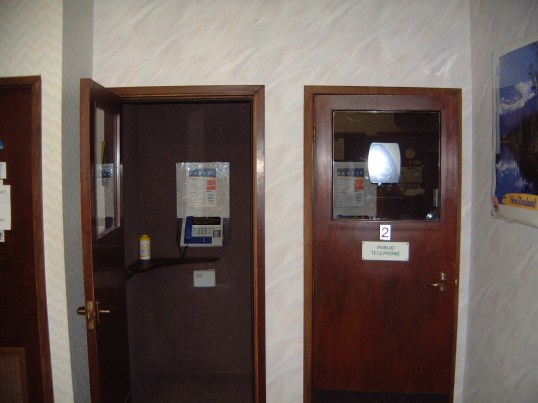
The niche blog today is the Payphone Project, which is both a photo blog as well as a news site about payphones.  Make sure to look at the pictures, but here is my favorite-- The Antarctic Payphone at Scott Base, Antarctica  (uhhh, anyone here have 426 quarters they can lend me?)

Kiwiphonebooth

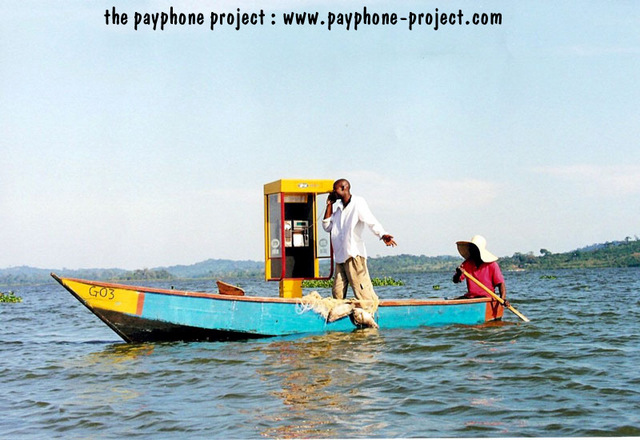
Though I must admit that this one on Lake Victoria is cool:

Lake_victoria_solar_payphone_01

I actually first ran into this site when I was working in the online directory world at Whitepages.com

Update: While I called this a niche, it must be a big niche, because the Payphone Project has competitors (and here, and jeez, here too)

Coming soon: Carnival of the Payphones?

Home Improvements

Blogging is light this weekend due to home improvements.  However, we found a cool new product for our house at the Phoenix home show, and, when I finish getting it installed, I will share some pictures.

More Parking Lot Blogging!

I bet you thought I was kidding here when I said I might pursue my new niche in parking lot blogging.  Not so - here today is an idea from Ross Mayfield:

My uncle was a guru on wall street when I asked him where I should invest my paper route money. He said to visit the parking lots of Silicon Valley companies during the weekend. If the parking lot was full, there was a good chance they were close to a breakthrough or release.

At the corporations I worked for, this would probably just mean that everyone was working on Powerpoint presentation for an upcoming planning conference.  Anyway, I don't know much about Silicon Valley, so I don't know if it will work, but this is an interesting suggestion to use the Internet to gather intelligence:

But with enough mobloggers, a panopticon of performance may be a great leading indicator.  So this weekend I started the Parking Lot Indicatr group and people have taken interest.

Hopefully, the cars are not all there responding to an SEC inquiry.

Charlie's Grandpa Joe is Really Scum

We were watching the old Gene Wilder version of Willy Wonka and the Chocolate Factory on DVD the other day.  This movie choice was made by the kids in anticipation of the new Johnny Depp version coming soon (since Pirates of the Caribbean, my kids are huge Johnny Depp fans).

I guess I really never paid much attention,  but Charlie's Grandpa Joe (played by Jack Albertson) is a real schmuck.  This little boy and his mother slave away for pitiful wages all day to support their four grandparents who are infirm and stuck in bed.  Grandpa Joe has laid in that bed for years, maybe decades, and never once tried to get out and help his family.  But, given the chance to go on a special trip to the Chocolate Factory with Charlie, Joe soon bounces out of bed and dances around the room.  Where was this energy when the family needed a wage-earner?

I don't know if this was intentional or not.  My guess is that this might not have been intentional - the early 1970's were the height of welfare sensibilities, and it would probably have been unlikely that Hollywood would try to include any messages about a slacker dad who failed to support his family.

Update:  By the way, in response to one of the comments, I am mostly just having fun with this.  I love Willie Wonka and am not so much of a Scrooge to turn on the movie because of an issue like this - heck, if I only enjoyed movies I was in complete ideological agreement with, I would have a very small movie collection. 

But, I do beg to differ with the commenter who said that Grandpa Joe provided the best adult supervision of all the parents.   This is actually not true, at least in the factory itself.  When each child pursued their fatal screw-up, in most cases their parents were trying to stop them, however lamely:  Augustus's mom says to stop drinking from the river, etc.  Charlie's Grandpa Joe actually was the one parent (or I guess guardian) who took an active role in encouraging their child into breaking their host's rules (i.e. drinking the fizzy lifting drink). 

I sit here thinking - jeez, am I really arguing about this?  I feel silly, but it does beat arguing about 30-year-old events in the military service of presidential candidates.

Why do People Back into Parking Spaces?

OK, since I am car-blogging tonight, I will tackle another critical and substantive automotive topic.  Why do some people back into parking spaces?  And further, why are a large percentage of the people who back into spaces driving pickup trucks?  Here I am talking about backing into perpendicular spaces, like at the mall, not parallel parking.  Also, I am not talking about parking at a busy sporting event, where I often back in so that I can more easily pull forward into the inevitable post-gram traffic.

Backing up is at least 10 times harder than going forward.  Just try to drive a straight line backward - you will probably look like someone who is DWI. 

So lets think about parking.  When you are pulling in, you are generally going from a wide area to a very narrow area.  When you are pulling out, you are conversely going from a narrow area to a wide area.  If you did both of these forward, just to make things apples and apples, I think most people would agree that pulling in to the space is much harder than driving out.  So why do people do the harder move (pulling in) the harder way (backing up)? 

I have only had two people even try to give me an explanation for this.  The first was that they had read that most parking accidents happen pulling out of spaces, which is probably true.  But this is sloppy analysis.  I would argue that most accidents happen pulling out because people are backing up.  I would restate this stat as most parking accidents happen when people are backing up.  If everyone backed into spaces, most parking accidents would probably occur pulling in.  The second person told me that "this is how his dad always did it".  That explanation I buy.  I have found a lot of small habits like this that people stick by all their life stem from the way one of their parents taught them.

The only other advantage I can come up with is that backing in / pulling forward out might be safer in very busy lots where pedestrians and cars are constantly passing across the space and there is some danger of backing into them pulling out.  This may be, though I still see people laboriously backing up into narrow spaces at my office, where there is zero traffic in the parking lot.  And none of this explains why pickup trucks do it so much more often than sedans.  I would think that pickups would especially want to head in , since this leaves the bed accessible.

Update:

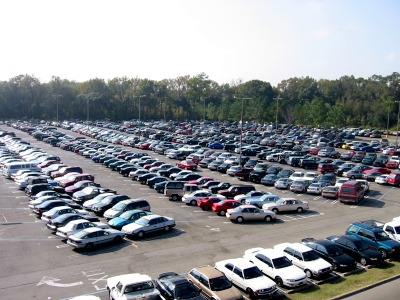
Parking_lot

In the picture below, note the one car that is backed in along the line of perpendicular spaces at the bottom - a pickup!

Update #2: LOL - getting more comments on my parking lot observation than my post that questioned why drugs and prostitution were illegal.  I guess I may be finding my niche in the blogosphere.  Parking blogging.  Anyway, thanks to all the backer-uppers out there for the comments.  I have come to the conclusion that maybe I am just a bad driver in reverse.  If I tried to back into a space between two cars, I would probably scratch a car a week.  I do understand that at least that does not hurt anyone, while backing out can indeed hurt someone, particularly small hard-to-see kids.  (By the way, I will think the best of my readers and not assume they are attracted by one other benefit of backing in -- that if you back in and hit a car, it is likely unoccupied and you can make a run for it; if you hit a car backing out, it will be occupied and you are busted).

Review of Volvo XC90 SUV

Five years ago, I probably would sooner have had my head held underwater in a toilet bowl than drive a Volvo.  This probably wasn't a fair bias, but they just looked so unappealing and seemed to embody "uncool" like no other car out there.

Anyway, things have changed, and Volvo is now offering several compelling vehicles.  A few months back I was looking for an SUV to replace my Lincoln Navigator and tote my kids around.  I had several complaints with my Navigator:

  • It was too large and unwieldy around town
  • The fit and finish was terrible.  It started rattling after about 8000 miles
  • At $2 a gallon for gas, its terrible mileage started bankrupting me.
  • Its cargo space was poorly engineered - the seats didn't fold down all the way and the space in the rear was not very usable.

Volvoxc90

I chose the XC90 for a number of reasons:

  • It was the smallest, tightest SUV with a third seat in the back, allowing me to take up to five kids with me.  No other small SUV's had this third seat - you have to go to Suburbans or Navigators to find another car that has it
  • The rear cargo area is superbly engineered.  Both the back seats fold down flat making a totally usable flat space all the way up to the front seats.
  • The car maneuvers and parks really well, especially with the ultrasonic sensors when backing up.
  • The fit and finish is really nice
  • The car's exterior looks pretty good; its actually remarkably similar to the BMW SUV.
  • The car handles pretty well, particularly with the AWD (all-wheel drive) and is a hell of lot better at cornering than the large SUV's. 
  • Its very safe - it consistently ranks as safest car on the road - not just SUV but safest car period
  • I got a good deal on it at the end of the last model year, though even then it certainly can't be called inexpensive

The car does have a couple of flaws.  The biggest one is the engine.  Both the 5 and the 6 cylinder options are fairly weak.  I ended up buying the smaller engine, because it was cheaper and the larger engine wasn't noticeably more powerful.  The pickup in the car is pretty mediocre, though I would not call it dangerous - there is enough power to get on the freeway without getting smushed.  However, it is disappointing that this small and under-powered engine is simultaneously weak on gas mileage.  I am getting about 16-17 mpg with the car, which is certainly better than my Navigator, but low given how much smaller the car is and how small the engine is.  I would have hoped it got at least 20.  This would probably be the perfect car if Honda or Toyota would make an engine for it (By the way, I heard on the radio the other day that Volvo is adding a V-8 option).

I Want A Hard Power Switch on My Computer

Most computers today do not have a true hard power switch, meaning that you flip it and the computer loses power.  Most of them have some kind of electronics and software in the middle.  The reason for this, ostensibly, is that Windows used to do really bad things if you just flipped the power off without letting the OS shut down first.  So when all is well, pushing the power switch causes windows to shut down, and then the computer powers off.

The problem is that if the computer crashes bad enough, the power switch won't work, because the software or electronics behind it have crashed or locked up with everything else.  Every few days I find myself in a situation where I am crawling on the floor having to pull the plug out of the wall to reboot, or, on a laptop, having to pull the plug and remove the battery.

Give me my hard power switch back!

Myth of Peak Oil

Note:  I have posted a more recent article with updated data here.

Mises Blog has a good article on the "Peak Oil" meme.  You may have gotten investment solicitations urging you to invest in oil because production is supposedly going to peak in 2006.

Oil production will peak some day.  I do not know when.  I do know that when I was in high school debate in the late 1970's, the topic one year was on resource policies.  I read everything there was at the time on oil supply as well as other critical mineral supplies.  Most "experts" at the time were predicting that oil would "run out" in about 1985 or 1990.  As you can see below, folks who invested in oil in 1980, after a price run-up similar to the one we have seen lately, got slaughtered.

Usgasoilprices19181999_1

Think twice or maybe three times about this graph before you invest.  Notice that there is no long term trend in real oil prices, even over one hundred years!  To make money buying oil, you have to do it on timing, buying ahead of sharp temporary increases.  And given that we are at the top of one of those sharp increases, can now really be the time to buy?

You can never get all the oil out of a field, and the exact amount of oil you can recover is dependent on how much you want to spend to do it, which in turn is related to oil prices (or expectations of oil prices).  The first 20% of the oil in a field might just squirt out under its own pressure.  The next 20% might have to be pumped.  The next 20% might need high pressure water injection to help it.  The next 20% might need expensive CO2 injection to help it.  If you ask the field manager how much oil was left, he would give you different answers at $20 and $45 a barrel, because he would make different assumptions about how far along this investment curve he would go.

If you are still thinking about investing, do one more thing: Study the famous bet between Paul Ehrlich and Julian Simon:

In 1980, economist |Julian Simon| and biologist Paul Ehrlich decided to put their money where their predictions were. Ehrlich had been predicting massive shortages in various natural resources for decades, while Simon claimed natural resources were infinite.

Simon offered Ehrlich a bet centered on the market price of metals. Ehrlich would pick a quantity of any five metals he liked worth $1,000 in 1980. If the 1990 price of the metals, after adjusting for inflation, was more than $1,000 (i.e. the metals became more scarce), Ehrlich would win. If, however, the value of the metals after inflation was less than $1,000 (i.e. the metals became less scare), Simon would win. The loser would mail the winner a check for the change in price.

Ehrlich agreed to the bet, and chose copper, chrome, nickel, tin and tungsten.

By 1990, all five metal were below their inflation-adjusted price level in 1980. Ehrlich lost the bet and sent Simon a check for $576.07. Prices of the metals chosen by Ehrlich fell so much that Simon would have won the bet even if the prices hadn't been adjusted for inflation. (1) Here's how each of the metals performed from 1980-1990.

A Quick Tort-Related Thought Experiment

Read this story at Overlawyered.com (you are welcome to try the linked article in the KC newspaper, but take my word for it, the registration is a pain with lots of attempted spamming (you might try bugmenot instead).  Here is the gist:

Car veers into truck's lane...and so a jury has ordered the trucking company, Auction Transport Inc., to pay $22.5 million over the resulting injuries to a young passenger in the accident, which occurred at rush hour on Kansas City's I-435. Mary Coleman's car, allegedly sideswiped by a third vehicle, had careened in front of the truck, but attorneys argued that the truck driver had been "driving too fast in congested traffic and not watching the road." The jury found the trucking company responsible for just less than half the fault of the accident -- a greater share of fault than the allegedly sideswiping driver -- and Coleman for hardly any of it.

So, surprisingly enough, three vehicles involved, two with limited resources and one with deep pockets.  Guess who is liable - the deep pockets of course, despite the fact that he was the only driver among the three who stayed in his lane!

Now, here is the thought experiment.  Move the truck with deep pockets into any of the other two roles.  Imagine first that it was the car that nudged the plaintiff into the other lane.  Imagine next that the truck was the one nudged into oncoming traffic and hit the plaintiff.  In these two cases, if they had gone to trial, who would have gotten the blame?  I would bet you that in either case, the truck with the deep pockets would have been given most of the blame in either of these cases.

So where is the fairness?  Why should blame be based on bank account size, and not actual actions?  Is there anything more than coercive wealth transfer going on here?  Does this constitute justice? 

By the way, I continue to say that limiting damages misses the point of what is wrong with the tort system and the malpractice system.  Congress and state legislatures have got to find a way to bring some sanity to the tort process, where legitimately harmed people can still get compensated for damages, however large those damages may be, but otherwise innocent people who happen to have deep pockets and somehow find themselves nearby a legitimate accident don't have to worry about being held at fault.  Babies are sometimes born with birth defects, people sometimes slip on perfectly safe sidewalks, and car accidents are sometimes just that: accidents.  I make this same point over and over here.

Update:  oops, left off the link.  Fixed now

Might "Red Statism" Cause the Left to Embrace School Choice?

After the last election, the Left is increasingly worried that red state religious beliefs may creep back into public school, as evidenced in part by this Kevin Drum post on creationism.  My sense is that you can find strange things going on in schools of every political stripe, from Bible-based creationism to inappropriate environmental advocacy.  I personally would not send my kids to a school that taught creationism nor would I send them to a school that had 7-year-olds protesting outside of a Manhattan bank.

At the end of the day, one-size-fits-all public schools are never going to be able to satisfy everyone on this type thing, as it is impossible to educate kids in a values-neutral way.  Statist parents object to too much positive material on the founding fathers and the Constitution.  Secular parents object to mentions of God and overly-positive descriptions of religion in history.  Religious parents object to secularized science and sex education.  Free market parents object to enforced environmental activism and statist economics.   Some parents want no grades and an emphasis on feeling good and self-esteem, while others want tough grading and tough feedback when kids aren't learning what they are supposed to.

I have always thought that these "softer" issues, rather than just test scores and class sizes, were the real "killer-app" that might one day drive acceptance of school choice in this country.  Certainly increases in home-schooling rates have been driven as much by these softer values-related issues (mainly to date from the Right) than by just the three R's.

So here is my invitation to the Left: come over to the dark side.  Reconsider your historic opposition to school choice.  I'm not talking about rolling back government spending or government commitment to funding education for all.  I am talking about allowing parents to use that money that government spends on their behalf at the school of their choice.  Parents want their kids to learn creationism - fine, they can find a school for that.  Parents want a strict, secular focus on basic skills - fine, another school for that.  Parents want their kids to spend time learning the three R's while also learning to love nature and protect the environment - fine, do it.

Yes, I know, private schools to fit all these niches don't exist today.   However, given a few years of parents running around with $7000 vouchers in their hands, they will.  Yes, there will be problems.  Some schools will fail, some will be bad, some with be spectacular (though most will be better than what many urban kids, particularly blacks, have today).   Some current public schools will revitalize themselves in the face of comeptition, others will not. It may take decades for a new system to emerge, but the Left used to be the ones with the big, long-term visions.  The ultimate outcome, though, could be beautiful.  And the end state will be better if the Left, with its deep respect and support of publicly-funded education, is a part of the process.

Of course, there is one caveat that trips up both the Left and the Right:  To accept school choice, you have to be willing to accept that some parents will choose to educate their kids in a way you do not agree with, with science you do not necesarily accept, and with values that you do not hold.  If your response is, fine, as long as my kids can get the kind of education I want them to, then consider school choice.  However, if your response is that this is not just about your kids, this is about other people choosing to teach their kids in ways you don't agree with, then you are in truth seeking a collectivist (or fascist I guess, depending on your side of the aisle) indoctrination system.  Often I find that phrases like "shared public school experience" in the choice debate really are code words for retaining such indoctrination.

In other words, are you OK if Bob Jones high school or Adam Smith high school exist, as long as Greenpeace high school exists as well?  Or do you want to make everyone go to Greenpeace high school exclusively?

I honestly don't know how folks on the left would answer this question.  Is Kevin Drum hoping that all parents have the choice of a secular education available to their kids, or is he hoping that all parents are forced to have a secular education for their kids?  Is he trying to protect his kids from intrusive creationism supporters or is he trying to impose his beliefs on the children of those creationism supporters?  I can read the article and his fear of creationism either way. 
Putting Politicians Names on Government Forms

I am spending the day filing all our sales tax returns (10 states, 4 counties) and have noticed something about state and county tax collectors and treasurers.  They put their name all over everything.  Take Lake County, Florida.  The sales tax form says "BOB MCKEE" and in little letters underneath that it says "Lake County Tax Collector".  The pre-addressed envelope is to BOB MCKEE.  I have to make my sales tax check to, you guessed it, BOB MCKEE.

Why is BOB MCKEE's name all over this?  What happens when BOB MCKEE retires or fails to get reelected?  Isn't the county stuck with a huge printing bill to replace all the forms and send out new ones?  And, assuming this is an elective office, don't BOB MCKEE's political opponents object to tens of thousands of dollars of free advertising paid for by the county.  Heck, I can't always name all my Congressman here in Arizona but I sure as hell know that BOB MCKEE is the tax collector for Lake County, Florida.  Conversely, I don't know who the head of the IRS is and I certainly don't address my checks to him or her on April 15.

By the way, this is just one example.  I get sales and property tax forms and such from many many counties in 10 states and it is much more the rule than the exception that the person, rather than the office, dominates the letterhead.  Stupid.  And, given the taxpayer subsidy implied for the incumbent, mildly corrupt.

Iceberg Collision

Courtesy of Nature Noted, comes this article on two enormous blocks of ice set to collide in the next week in Antarctica.

104274main_iceberg_story_pic

As the Nasa site linked above puts it:

It is an event so large that the best seat in the house is in space: a massive iceberg is on a collision course with a floating glacier near the McMurdo Research Station in Antarctica. NASA satellites have witnessed the 100-mile-long B-15A iceberg moving steadily towards the Drygalski Ice Tongue. Though the iceberg's pace has slowed in recent days, NASA scientists expect a collision to occur no later than January 15, 2005.

Is CBS For Executive Accountability or Against It?

Its amazing to me that Andrew Heyward still has his job at CBS.  Many others are asking the same question, including Ernest Miller, Rathergate & Captains Quarters.  The overriding question is this one:

The report clearly shows that the head of the embattled news organization did not perform as one would expect the head of a news organization to perform. Though Heyward clearly realized that there were problems with the reporting on the segment and issued a directive to clear up the matter, he does not appear to have provided sufficient overview or leadership to ensure that his directive was followed promptly and systematically. Instead of focusing on good reporting, as the head of a news organization should, he seems to have been primarily interested in damage control and not following up on his own directive.

Here is CBS's opinion of Heyward's performance in this matter, from Les Moonves:

But Heyward is an executive of integrity and talent, and the right person to be leading CBS NEWS during this challenging time

OK, so their position now is that the subordinates are at fault, and that the leader is not responsible for their actions or for the climate and controls in the organization that allowed the problems to occur.

This is really, really different than CBS's editorial position on OTHER organizations and leaders.  Check out the CBS editorial here on Enron.  Should Ken Lay be held accountable or was he an innocent dupe?  Hah, the editorial jumps right past this question, moving up a notch and asking why the board of directors weren't being held accountable. 

Ken Lay argues that he was duped and didn't know what was going on.  Note that this is his criminal defense - which may or may not work - but it certainly would not have worked to keep his job, even if Enron were alive today.  In Heyward's case, he admits he knew what was going on, but didn't get things fixed.  Heyward had his chance in the first 24 hours to save the credibility of CBS News and he blew it.

Will iTunes kill Albums?

Video killed the radio star (appropriately the first video shown on MTV) but will iTunes kill albums?

I was driving today listening to Pink Floyd's Dark Side of the Moon, which I ripped in its entirety to my mini iPod.  I noticed the iPod staggered a little bit on the song transitions, which are seamless on the CD.

And oddly, this got me thinking about the revolution in digital music and what effect it might have on albums.  Back in the 50's and early 60's, the rock/pop music marketplace was dominated by singles.  A great visual demonstration of that era is the "what's on the flip side" scene in Diner between Kevin Bacon and Daniel Stern, a scene that makes no sense to later generations.  Albums, to the extent they were purchased, were merely collections of singles.

A revolution, at least in the world of rock & roll, began to occur in the mid-1960's.  Many folks point to Sgt Pepper by the Beatles as the first concept album, where the songs hang together in a way that the album was greater than the sum of the parts (note that this had always been true in jazz, and of course classical -- but it was new to the rock/pop world).  Over time, many rock albums were produced that were true albums.  Even when the songs don't follow a theme (as in the Moody Blues Days of Future Passed) or tell as story (as in the Who's Quadrophenia), there are many albums I think of as albums, where I can't seem to enjoy the single when it is taken out of context of the other songs (including Fleetwood Mac's Rumors and Genesis's Trick of the Tail)

Pink Floyd, however, probably pursued the album more than any other band.  Few songs from Pink Floyd albums like Wish You Were Here or Dark Side of the Moon or of course the Wall even make sense on their own, any more than a single chapter ripped from a book will be viable on its own.

Today, we may be on the front end of a trend where the market moves back to singles, as market models like iTunes gain traction and put emphasis back on individual songs that have to stand alone.  My son, for example, does not buy albums - he buys individual songs off iTunes.  The only difference from the 50's is that there are no flip sides.

Or, it may be that we are on the brink of still yet another medium, maybe of third parties mixing together tracks from multiple artists into custom collections, much like people have been doing for their friends for years, but with wide open new distribution channels.

Doctored Han Solo Memos, errr, Evidence

This (Link courtesy Professor Bainbridge) is a pretty funny parody based on a scene from the original Star Wars movie that has famously been changed a couple of times by George Lucas in reissuing the movie.  It is especially funny in light of today's CBS memogate report.  If you don't know the story behind the changes to the movie, they are summarized in the intro page, or you can just dive into the comic by pressing "1".

Geography Quiz

This one is for Europe, but there are others for the rest of the world.  I got 107 of 111.  I mixed up Latvia and Lithuania and got a couple of pieces of the old Yugoslavia mixed up.  I will admit that I guessed at which half of the old Czechoslovakia was Czech and which was Slovakia.

Carnival of the Capitalists

New Carnival of the Capitalists up at Odyssey of the Mind.

Government Paying Journalists for Coverage

This is a real low both for journalistic and governmental integrity (via Captains Quarters):

The blogosphere buzzed yesterday with the revelation that pundit Armstrong Williams received $241,000 from the Department of Education to promote the No Child Left Behind Act and push other commentators to do the same. Williams did not disclose the payment while pushing NCLB in several columns and on his television appearances; instead, he represented his opinions as his own independent views.

This is simultaneously wrong and stupid.

Microsoft Anti-Spyware Beta

The beta for Microsoft anti-Spyware is a free download here.  They created most of the vulnerabilities, so presumably they may be best able to plug them.

I installed and ran the beta and it looks good.  I ran the program after running several other programs like adAware and spybot S&D and it found a bunch of things that the others missed (though how you know for sure, I don't know.  This message about found problems could be like the little dial that xerox machine repairmen set to determine when they get to come back).  The program even claims to have found and cleaned out TV media, which tops my all-time frustration list.  After the run, the program lists the threats found, and actually has good information about each threat so you know what you are eliminating. 

Update:  PCMag review

Applying Coyote's Law to King County

Professor Bainbridge posted:

it's starting to look like the folks who ran the election in King County either (1) really did emulate old man Daley's Cook County elections or (2) are among the most incompetent morons in government.

Wow, the perfect application to test Coyote's Law in real time.  Coyote's law states:

When the same set of facts can be explained equally well by

  1. A massive conspiracy coordinated without a single leak between hundreds or even thousands of people    -OR -
  2. Sustained stupidity, confusion and/or incompetence

Assume stupidity.

Applying this to King County, I will assume stupidity.  I must say that having lived in King County, this is not the first time Meyer's Law has come up.  The city has made so many colossal blunders, including having a major bridge sunk in 1990 when someone accidental left the stopcocks open (that bridge, ironically, had been named after the State Highway director on whose watch was built the Tacoma Narrows Bridge, which tore itself apart famously).  There have for years been rumors that the ridiculous constriction created in downtown Seattle on Interstate 5 by the building of the convention center (and which is almost impossible to fix) was made on purpose by anti-growth planners.

Private Land Trusts and the Environment

I have written that many forms of environmental regulation, such as pollution limits, are not in conflict with property rights, but are in fact essential to their preservation.

However, one area where statist environmentalism and property rights do conflict is over "preservations".  Whether it be preserving species or habitat or forests or open space or wilderness or whatever, preservation is often used as an excuse for raping property owners.

Which is a shame, since there are very viable free market alternatives open to environmentalists as a substitute for state coercion.  I have supported the Nature Conservancy for years, because it (generally) works to bring together private funds to purchase lands for various preservation goals.  This organization and other sets up private land trusts, generally using private money but sometimes with a public contribution to buy out landowners.  The blog Nature Noted focused on the activities of these trusts, including this recent deal in Michigan.  This deal in particular is cool, because we run most of the public campgrounds in this area.  Thanks to the Commons for the link to this site.

Roads and Peak Pricing

Todd Zywicki at Volokh has an interesting post on what is driving hybrid car purchases in certain cities.  While certain segments are driven by environmentalism and fuel economy, the real boom in certain cities has come with the legal change in some cities allowing single persons in hybrid cars to use the carpool lanes.

"'I'd say 95 percent of the people who buy a Prius say it's to get into HOV,'" said Jay Taye, sales manager at Ourisman Fairfax Toyota. "'They talk about the tax break and the HOV, and once in a while they say they prefer it for the gas mileage as well.'"

By the way, he links an absolutely dead-on article about public transit in the Onion here called --"Report: 98 Percent of Commuters Favor Public Transportation For Others"

The link between the Onion article and the Washington Post story referred to by Zywicki is that what people really want is a fast commute in their car, and they are willing to pay for it.

Several years ago, I sent in a proposal to the Arizona Dept. of Transportation for their new HOV lanes in the Phoenix area, though I never got a response back.  I suggested that HOV lanes probably did not really increase carpooling, since they probably just shifted vehicles that would have already been carrying 2+ people into the faster lane.  Why should I get this artificial subsidy of a dedicated lane when I am driving my kid to a soccer game but not when I am driving myself to do productive work?  Either way, the lane is not changing my behavior.

Anyway, I suggested that instead, AZ DOT should create a number of special passes for exclusive use of the HOV lane.  The number of passes should be set as the largest number that could be issued while keeping the HOV lane moving at the speed limit at rush hour.  Maybe 5000?  Anyway, they would have the stats to set the number, and it could be adjusted over time.  I proposed that they then auction off these passes in a dutch auction once a year.  I posited that the clearing price might be as high as $1000, thus raising $5,000,000 a year that could be used for other transportation projects.

I have friends that said I was crazy, that no one would spend $1000.  Back then, I argued it in two ways.  First, thousands of people in town spend not $1000 but tens of thousands of dollars, in the form of purchasing a nicer-than-basic-car, to make their driving experience better.  In those terms, to the Mercedes or Lexus owner, $1000 was nothing and in fact the price might go higher.  Second, if each pass holder saved 15 minutes per commute, or 30 minutes per day over 250 work days, they would save 125 hours of their time each year.  Bidding just $1000 for this would mean that people would have to value their free time (since commuting generally comes out of free and family time) at $8 an hour.  I certainly value my free time at a MUCH higher rate than this.

This article cited above effectively adds another data point to what people might pay.  To buy a Prius, they are spending at least $5000-$10,000 more than a similar car that can't go into the HOV lane, and probably even more when you consider features they may be giving up to have the car.   

Today, I would bet that the clearing price for 5000 such passes may be $3000-$5000, thus increasing the annual revenue to the city/state as high as $25,000,000.

By the way, though it is a bit different than what I am suggesting, the best related plan that I know of that has actually been executed succesfully is congestion pricing in central London.

UPDATE:  Dang, reading up further in Volokh, Zywicki anticipated my post with a similar one here.

Tsunami Before and After Part 2

Best laid plans.... I try to run a small business and economics blog and 90% of the hits I have gotten over the last 2 days have been on Tsunami before and after pictures.  OK, well, I have have been updating the original before and after post with links to people who really are blogging the tsunami and its aftermath.  Nature has some amazing before-after satellite shots, including these, which are wider angle views of the original shots I posted:

Beforeafter1a_1 Tsunamibeforeafter1b_1

These shots are chilling, and help explain the death toll better than any single photos I have seen:

Tsunamibeforeafter2a Tsunamibeforeafter2b

Makes me think of Atlantis.  Hat tip to the Nature site to Marginal Revolution.

For more before and after images, look here and  here and here (in this last link see the powerpoint download in the lower left).  This site has a ton of tsunami blog links, including pictures and video.  Here is a link-filled roundup (new 1/4) and an older one here, and another here.  And here is a dedicated blogHere is a 1/5 roundup of Indian blog posts about the tsunami and its aftermath.  And here is a local blog with news.  And here is the Amazon Red Cross donation page.

Update:  A more recent roundup as of 1/11 here.

Tsunami Before and After Part 2

Best laid plans.... I try to run a small business and economics blog and 90% of the hits I have gotten over the last 2 days have been on Tsunami before and after pictures.  OK, well, I have have been updating the original before and after post with links to people who really are blogging the tsunami and its aftermath.  Nature has some amazing before-after satellite shots, including these, which are wider angle views of the original shots I posted:

Beforeafter1a_1 Tsunamibeforeafter1b_1

These shots are chilling, and help explain the death toll better than any single photos I have seen:

Tsunamibeforeafter2a Tsunamibeforeafter2b

Makes me think of Atlantis.  Hat tip to the Nature site to Marginal Revolution.

For more before and after images, look here and  here and here (in this last link see the powerpoint download in the lower left).  This site has a ton of tsunami blog links, including pictures and video.  Here is a link-filled roundup (new 1/4) and an older one here, and another here.  And here is a dedicated blogHere is a 1/5 roundup of Indian blog posts about the tsunami and its aftermath.  And here is a local blog with news.  And here is the Amazon Red Cross donation page.

Update:  A more recent roundup as of 1/11 here.

Giving Thanks For the Lack of Gold and Silver

Hey, what does a good capitalist have against gold and silver?  Nothing, per se, but I have been reading John Steele Gordon's An Empire of Wealth and it got me to thinking how important for the eventual success of the US it was the English and the Dutch, rather than the French and the Spanish, colonized most of the eastern US.

Very few countries colonized by Spain have been able to recover from the experience, even hundreds of years later.  When people decry imperialism, they should be thinking first of the old Spanish empire.  Their colonization was nearly entirely extractive - focused on pulling out gold and silver and some tropical agricultural products.  There was no thought of developing a colony that might grow in value over time through investment and entrepreneurship.  Perhaps worse, Spanish and French imperialism were entirely micro-managed top-down by the state, leaving a legacy of bad statist economics in the countries they colonized.  My previous post, though it focused on France rather than Spain, shows through statistics the legacy of poverty and bad government that this approach left behind.

So, how does silver and gold come into play?  Well, the US eastern seaboard is singularly devoid of precious metal ore deposits, which kept Spanish attention to the south, seeking more lucrative immediate spoils in Mexico and South America.  The lack of abundant fur animals like beaver kept the French to the north.  As a result, the US was left to be colonized by the Dutch and the English.  Unlike the Spanish and the French, most of this colonization was not military or state-run.  Most of the major colonization pushes were actually for-profit private enterprises.  Though these early colonies would have loved to find gold and silver, lacking this they had to find ways to develop the land and the New World to make returns for their investors.