Anatomy of a Tax Increase

Via the Club for Growth:

[San Francisco's] Commission on the Environment is expected to ask the mayor and board of supervisors Tuesday to consider a 17-cent per bag charge on paper and plastic grocery bags. While the goal is reducing plastic bag pollution, paper was added so as not to discriminate.

"The whole point is to encourage the elimination of waste, not to make people pay more for groceries," said Mark Murray, executive director of Californians Against Waste.

Environmentalists argue that plastic bags jam machinery, pollute waterways and often end up in trees. In addition to large supermarkets, other outfits that regularly use plastic bags, including smaller grocery stores, dry cleaners and takeout restaurants, could eventually be targeted.

Officials calculate that the city spends 5.2 cents per bag annually for street litter pickup and 1.4 cents per bag for extra recycling costs.

What might have started out as a desire to change behavior or pay for a specific problem has become, as is typical, a general revenue grab.  Note two things:

  • They want to reduce plastic bag use, but put the tax on all bags.  Therefore, it will have no effect on behavior in the market when someone asks "paper or plastic" since they still will cost the same.  If they had put it only on plastic, then people might well have shifted en mass to asking for paper - I certainly would, as I am usually indifferent as to bag type.  But someone probably pointed out that if they only taxed plastic, everyone would shift to paper and they would get no extra revenue, despite the fact that the behavior shift was what started the proposal in the first place.
  • If they really only wanted to pay for cleanup costs, which presumably were calculated based on plastic since paper biodegrades pretty fast, they would not have made the tax 2.5 times their calculated cost.  What is the extra amount over 6.6 cents for?  General revenue of course.

If you think I am reading too much into this, ask how much of the cigarette taxes imposed by the tobacco liability settlement really went towards education and the health care costs of smoking-related illnesses (the original intent).  The answer is well less than half, and in some states, none.  In fact, the tobacco settlement has become such a strong general revenue source for states that some states are now supporting legislation to protect the business of large tobacco companies in the settlement. 

By the way, in a story only related because it involves taxes in California, all I can say is go, Arnold, go.

Its Not the CEO's Company

Too many CEO's of public companies in the 80's and 90's seemed to act like they owned the company.  In particular, the CEO's of Tyco and Adelphia appeared to be more interested in lining their own pockets with shareholder financed perks than with managing the company.  And, I highly recommend "Barbarians at the Gate" as not only a great story about the largest LBO of all time, but also as a narrative about CEO perks gone mad.

The fact is that public company CEO's are the hired help.  Talented, well paid, but hired help none-the-less.  Professor Bainbridge has a good post on the demise of the Imperial CEO

In theory, a corporation is run by its board of directors, whose decision-making is guided by the principle of shareholder wealth maximization. In practice, however, all too often corporations are run by their top managers for the benefit of those managers. Times are changing, however. In particular, the cult of the imperial CEO that dominated the business world in the 1980s and, especially, the 1990s is dying a slow death.

I hope he is right - it is past time for do-nothing OK-everything boards to reassert their primacy and fiduciary responsibility.

Its a Chicken-Little World

Over the last two days, Phoenix put out an order to boil tap water before drinking and not to bathe or shower.  Many restaurants closed for the two day period, and many many people went out and loaded up on expensive bottled water.

What I found interesting was that through the whole "crisis", and now after the fact, Phoenix officials continued to say that they thought the water was safe, that they had not gotten any bad test results, but that people still shouldn't use the water "as a precaution".

Given the current state of liability and torts, I probably would have done the same in their shoes, but is this really the world we want?  There are costs to shutting off water in a city of 2 million plus people.  Shouldn't those costs be justified by some real risk? 

When I was an engineer, my job was often to rule on whether some condition was "safe".  Every day I had to make decisions like "should we shut this part of the plant down, or can we keep running it safely".  Certainly we wanted to err on the side of safety, but ruling every little concern as cause for shutdown would have caused the plant to be shut down almost all the time.  In that job, I had to take responsibility and make a decision, balancing risks and costs.  People want to say that shutting the plant (or the water system) at every hint of a problem is the "responsible" thing to do -- but in fact it is just the opposite.  It is an avoidance, both of decision-making and responsibility.

Unfortunately, no one wants to make such decisions anymore.  My wife's mammogram had something on it the doctor said he was 100% sure was just an artifact of the photography, but to cover his butt he said he had to get her to go have a biopsy (painful, expensive, and time-consuming) which was of course negative.  We are loading the economy down with risk-defense costs, an invisible tax that is already hammering the medical field.

But beyond just the costs, at what point does this hair-trigger defensive posture lead to a chicken-little syndrome where no one pays attention to warnings any more?  I know that the next time we get a warning about Phoenix water, I will be much less likely to be careful, because I remember that the last time nothing was really wrong with the water.  How many people pay attention to homeland security alerts any more?  Do you even bother to read warning labels any more, on the off chance it is a useful warning and not a "this toaster should not be used as a water ski" type warning?

The Church of Kyoto

After a number of posts on global warming, several of my friends and family have sent me various links and tracts and articles, apparently concerned about me as a Kyoto "unbeliever".  It reminds me a lot of my neighbor giving my wife religious pamphlets when she found out we didn't go to church on Sunday.  Jerry Pournelle has a good series of posts about getting roughly the same reaction

So here is a bit of advice:  First, keep sending me anything thing that has science in it, I always enjoy reading it.  Second, if you are going to send me climate science, make sure you understand where my agnosticism lies:  I don't need more articles saying "see, the world has warmed, therefore we need the Kyoto treaty" or "look at the CO2 rise at Hilo station".  In my mind, there are five logic steps you need to make to justify Kyoto-type emissions limitations.   Everyone sends me proof of the first two steps, but I seldom see science on the last three, which are the most problematic.  Here they are, and where my current thinking is on each:

1.   Is the world warming?  The answer is yes, though ground-based measurements influenced by urban heat islands may be over-estimating the rise, despite corrections.  Also, one needs to remember that some of the warming occurred in the early parts of the century, where man-made CO2 is unlikely to be to blame. 

By the way, be very careful of advocates' graphs - often the time scale is "managed".  Someone sent me this link, of rising temperatures in Central Park.  Unfortunately, the graph is carefully selected, and here is the graph with all the data (same data source) shown.  I have seen the same game played with this chart several times, showing only the data since 1965, which obviously would tell a very different story.  All that being said, I am still convinced the earth is warming some, but what does it tell you when organizations play such exaggeration games with the data - are they being objective scientists or advocates? 

2.  Is the warming due to man-made CO2?  The answer is partially, though perhaps not as much as global-warming activists want to believe.  Yes, man-made CO2 has almost certainly increased CO2 concentrations in the atmosphere, but solar activity has also been at a cyclical peak in this century, and many point to this activity as another contributor to warming.  Also, something other than man-made CO2 drove a half-degree warming early in the century, so whatever caused that warming may well be contributing to warming in the second half of the century (unless you want to take the dangerously untenable position that whatever drove early century warming stopped at the same time that CO2 started having an effect).  Finally, there are still arguments about the quality of the statistical analysis in looking at long term climate trends.

3.  How much will man-made CO2 raise temperatures in the future?  My answer is some, but not nearly as much as models predict.  First, recognize that funding levels for climate research today tend to rise in proportion to how dire the forecast is, so organizations have a financial incentive to over-predict.  Second, when current models are applied to history, they over-predict temperature rise.  This leads me to worry that they may be over-predicting for the future as well.   Yes, they claim to have "corrected" this problem, but in fact they just added fudge factors -- whole fortunes have been lost on Wall Street this way.  Third, and the one thing I can confirm from my own knowledge and analysis, climate models GROSSLY over-estimate man-made CO2 production in the future due to enormously flawed economic models.  I spend a lot more time disecting these mistakes here, but to summarize, the models take the most inefficient nations, assume little efficiency improvements, then grow their economies like crazy:

Because of this economic error, the IPCC scenarios of the future also suggest that relatively poor developing countries such as Algeria, Argentina, Libya, Turkey, and North Korea will all surpass the United States [in terms of GNP]

4.  What is the net cost to the world of global warming?  This is where climate science really begins to break down.  The answer is that, scientifically, we don't know.  We don't even know if it is net bad - warming may be net beneficial.  The "bad things" claims have tended to have a "day after tomorrow" sloppiness to them, but the main bad things cited are rising sea levels and increases in violent weather patterns.  Note that the second is entirely unproven, and, no matter what any media article says, we have not yet seen any increase in violent weather recently -- the data so far does not support it.  As to rising sea levels, there is more science behind the claim but again, we have not yet seen any evidence of it.  Most climate scientists will admit that the majority of the warming will occur on winter nights in the coldest regions (e.g. lots of warming of Siberian winters).  But arctic ice melt in sea level rise scenarios mainly occurs during summer days.  How can this be reconciled?  In fact, NASA data shows little or no warming to date in Antarctica or in the Arctic, despite the fact that models say that it should show the most (and therefore the most melting ice).

Beyond the lack of proof is the fact that most global warming activists don't consider or don't want to admit that there are positive effects.  For example, warming would lengthen growing seasons in most areas, potentially increasing food production.  For example, the Cato Institute reported:

The weather can, of course, be too warm, but that is unlikely to become a major problem if the globe warms. Even though it is far from certain that the temperature will rise, the Intergovernmental Panel on Climate Change (the U.N. body that has been studying this possibility for more than a decade) has forecast that, by the end of the next century, the world's climate will be about 3.6° Fahrenheit warmer than today and that precipitation worldwide will increase by about 7 percent. The scientists who make up this body also predict that most of the warming will occur at night and during the winter. In fact, records show that, over this century, summer highs have actually declined while winter lows have gone up. In addition, temperatures are expected to increase the most towards the poles. Thus Minneapolis should enjoy more warming than Dallas; but even the Twin Cities should find that most of their temperature increase will occur during their coldest season, making their climate more livable.

5.  What is the Cost-Benefit trade-offs of mandated CO2 limitations?  Again, no one knows and if there is any good science on this, I have not seen it.  You can guess that if we have not even figured out if warming is net-bad or net-good, we probably don't have a good handle on cost-benefit trade-offs of treaties like Kyoto.  Even without this trade-off analysis, though, we can come to a few conclusions about Kyoto:

  • Even global warming activists admit that Kyoto will at best reduce temperatures 50 years from now by something like a tenth of a degree.
  • Whatever the benefit of reducing CO2 is, Kyoto takes one of the highest cost approaches (see study here).  The main reason is fairly obvious based on the laws of diminishing returns:  The cheapest place to reduce emissions is in the most inefficient countries, and vice versa.  But Kyoto focuses all its reductions on the most efficient industrialized countries, so it is seeking reductions in the highest possible cost locations.
  • Kyoto is mainly a slam-America treaty.  The way it was constructed, with its 1990 reference date, was cleverly chosen to put most of the burden on the US.  The US has experienced fabulous growth since 1990, while Japan and European nations have experienced slow growth as well as structural changes that make the target artificially easy to reach for them (see more here).   Fast growth developing countries are excluded from the treaty entirely.

So here is my point -- it is possible to believe in the theory of man-made CO2 driving temperature increases and still be skeptical of government action on emissions.  Jerry Pournelle has a good series of posts on the same topic

For other reading, probably the first place to look is the Skeptical Environmentalist by Bjorn Lomborg. Lomborg in this book has probably the best counter-case to the enviro-disaster stories filling the media. He has become an object of absolute hatred among the anti-growth anti globalization fanatics who have latched onto climate change as the key to advancing their anti-technology and anti-capitalist political agenda. The attacks on him have become nearly as edifying about what drives the environmental movement as his book itself. The Economist has a nice article about his book and about the wild-eyed furious reaction of environmental activists to it. The Economist also editorializes here, and you can follow all the criticism and response here on Lomborg's site.

Other sources: This paper is a good roundup of all the issues I have addressed. Cato has a lot of other material here as does the Heartland Institute and at The Commons.

UPDATE:

A great post from Silflay Hraka that is much more eloquent (and concise) than I am is linked here

Great Moments in Labeling

This is pretty funny, as highlighted in Reason's Hit and Run:

Under the plan, any person seeking a new job would be required to obtain an updated "counterfeit-proof" Social Security card, equipped with a digitized photo and an electronic identification strip containing the person's legal status. To offset fears of government intrusion, the card would be clearly marked, "This is not a national ID card," [California Republican congressman David] Dreier said.

Gosh, what a great solution.  Think of the applications.  All Phillip Morris has to do is write "this is not a cigarette" on each Marlboro and poof: all that nasty regulation and litigation goes away.  I guess I would not need a liquor license to sell Budweiser's labeled "this is not beer".  Or maybe Pamela Anderson can get a T-shirt that says "these are real".  LOL.

By the way, for business owners, don't miss this gem later in the article:

Employers would have to check a prospective employee's legal status against a new employment eligibility database either by swiping the card or calling a hot line. Those who fail to do so, or knowingly hire an undocumented worker, would face fines of up to $50,000 and five years in prison for each occurrence.

Nothing like spending 5 years in the slam for having one of your managers forget to check the ID of someone they hired.

Employment at Will

Yesterday I mentioned employment at will in this post about police officers who were fired for assaulting a handcuffed man and who successfully sued for wrongful termination.

Via George's Employment Blawg comes this article on employment at will and things a small business should consider to reduce the possibility that fired employees will sue:

Here's where things get tricky. In between employment at will and the law is a whole mess of claims, counterclaims, lawsuits, disputations and confusion. It's enough to make anybody scratch their head.

We have had several instances where employees have threatened legal action over termination.  I have observed at least three reasons for this:

  • Employees sometimes have a skewed view of the termination process, thinking that a company must hold to some kind of courtroom "beyond a reasonable doubt" standard in amassing reasons for termination.
  • The most inept employees never seem to know that they are inept
  • Some employees are far more adept at working the system than they are at their jobs.

We do several things to help make things go smoother:

  • Unless the violation was outrageous, where we fire on the spot, we try to give employees written warnings and coaching before they get terminated
  • Every new employee signs a 60/90 day probationary period letter.  If there are problems, they almost always occur in the probation period -- ie they turn up quickly -- and the probationary period gives us more leeway to quickly terminate.  Update:  This article says why this policy can be a mistake, or at least you have to be careful with it.  This is less of a problem for us since most of our employees only work a 5 month season anyway.
  • We don't give references.  I have said that this makes me feel guilty, but negative references about fired employees are a big source of litigation, and frankly, I am sorry to admit, the treat of wrongful termination suit is greatly reduced if the ex-employee finds a good job somewhere else.  Kind of the business version of hot potato.
  • Being a seasonal business saves us.  For many employee problems, we limp along until the end of the season when we can terminate the person for lack of work, then we make sure not to rehire them in the spring.

Update: Via Overlawyered, this story in the New York Post (gotta love the headlines) about a teacher fired 17 years ago and still filing suits:

But the Clifton, N.J., instructor never got over it. Instead, he has filed 15 lawsuits in Manhattan federal court and three others in Brooklyn and New Jersey courts, seeking reinstatement and millions of dollars in damages.

Each lawsuit has been tossed out as meritless. But a defiant Malley hasn't gotten the message or doesn't care.

Why Not Have The Government Approve Our Car Choices Too?

As a follow-on to the issues I raised in this post about the FDA making our risk-reward choices for us, comes this tongue-in-cheek suggestions from Café Hayek:  Lets start the FCA, the Federal Car Administration, to approve cars for consumer use:

Choices would be few.  Because of the high costs of the approval process, only cars that appealed to large numbers of consumers would receive attention from the manufacturers.  On the plus side, the cars that did survive the process would be very safe and very good cars.  They'd have to be.  Manufacturers would want to reduce the odds of failure to avoid a ten year approval process that resulted in rejection.

It would be great, assuming the bureaucrats in Washington would make exactly the same choices that you would.  In other words, it would be great if we all wanted to drive identical Ford Taurus's.

If you think this suggestion is just ridiculous humor, ask yourself whether this is what Ralph Nader has been after all along.

The Rules of Alias

I just finished watching 3 seasons of Alias in about 2 weeks.  I love the show, except maybe in the early part of the third season, which I thought dragged a bit.  Given the way each show is structured with cliff hangers, this is a much better way to watch the show -- not to mention that each show is only about 41 minutes long which implies that I am missing a good 19 minutes of commercials every episode for a total of 1,254 minutes of commercials over the three seasons.

From watching these episodes, I have distilled certain "rules" of Alias:

  • There is always a next Rambaldi device, which are probably just part of a 500 year practical joke scavenger hunt (see the Amazon film tooth fairy to get the idea)
  • Your wife is probably an enemy agent
  • Satellites can do anything
  • Competing spies always show up at the same place and at the same time
  • There is always an arbitrary time limit set by the technology, usually under 4 minutes
  • Spies never run missions to Dayton or Bloomington.  Always to Berlin or Kazakstan.
  • The bad guys always shoot worse than Imperial Storm Troopers.
  • Marshall Rules.

No Water

My disdain for the local news media got me in a little trouble today.  Apparently, something happened to the local Phoenix water system such that they had to declare the water contaminated in some way.  Everyone was told not to drink or take showers, and many restaurants closed.  I totally missed this for most of the day (what does it say about me that I notice Internet outages within 5 minutes but it takes all day to figure out we have no water). 

The media is not giving many details, but apparently drinking water supplies were contaminated by storm runoff.  Two of my doctor friends were more specific- they said that the rumor around the hospitals was that "human remains" had been found in the water systems.  Yum.

Fortunately, we have plenty of bottled water around the house.  I usually laugh at people's perceptions of bottled water -- I bet if you asked most people, they would say the water came from some spring or glacier runoff or whatever.  The fact is that most bottled water comes right from the tap.  I almost bought a water company here in Phoenix that sells most of the private label water to local supermarkets, and I know for a fact they just filter and bottle good old Phoenix tap water.  Anyway, I am happy to have the bottled water today.

This is Nuts Too

I must be going crazy.  First this, and now comes this story, via Overlawyered.com:

A former Inglewood police officer [Jeremy Morese] who was fired for punching a black teenager and slamming him against a patrol car was awarded $1.6 million Tuesday by the jury in a discrimination lawsuit he and his partner brought against the city [note that the teenager was handcuffed at the time]

OK, we won't even get into the fact that employers should be able to fire "at-will" employees for just about any old reason.  How, though, have we gotten to a world where a police department can't fire an officer who abused a handcuffed man? 

It gets better, though:

the jury was unanimous in awarding $810,000 to Morse's partner, Bijan Darvish, who had been disciplined in connection with the 2002 incident.

Darvish was suspended 10 days (presumably without pay) for falsifying a report to cover up for his partner's abusive actions.  Ignore for a moment whether a 10 day suspension is the right punishment for his actions (I would have fired the guy), but ask - how is $810,000 proper recompense for a 10 day suspension, even if the suspension was totally invalid?  The main damage was lost pay -- but on this basis the $810,000 for 10 days pay would represent $29,565,000 for a whole year.   I guess I need to quit my job and go sign up as a police officer in Inglewood, because they sure as heck make more money than I do.

By the way, if I was an African-American, I would sure as hell stay away from Inglewood, or any other community that pays million dollar rewards to cops that beat the hell out of black people.

Reality is Nuttier than the Onion

Please, someone tell me this is a hoax or an urban legend or something.  But it does appear to be a legit Reuters story (via Reason):

The U.S. military rejected a 1994 proposal to develop an "aphrodisiac" to spur homosexual activity among enemy troops but is hard at work on other less-than-lethal weapons, defense officials said on Sunday.

The idea of fostering homosexuality among the enemy figured in a declassified six-year, $7.5 million request from a laboratory at Wright Patterson Air Force Base in Ohio for funding of non-lethal chemical weapon research.

I am speechless.

More Fun with Statistics

I didn't really pay much attention to the typical 24-hour partisan finger-pointing flurry accompanying the stats showing an uptick in US infant mortality rates.  However, looking back on it, it is a good lesson about how statistics are routinely misused in this country (via Captain's Quarters).  Critics of the administration and the health care system used the statistics to try to show something is wrong with the US. 

Two weeks ago, Nicholas Kristof wrote a column on the first increase in the American infant-mortality rate in decades, taking the opportunity to excoriate Americans and the Bush administration as uncaring and unresponsive to the deaths of children. He compared the US unfavorably with Cuba and China

Unfortunately, this conclusion was flawed:

babies that would die in the womb or at stillbirth elsewhere are born alive in the US. Many of these survive completely, but because of their precarious state, they tend to die at higher percentages than normal births. That's why the numbers rose slightly for 2002. The CDC doesn't expect to see another increase like it.

The solution might be to look at the survival rate at year one as a percentage of total pregnancies, not just births (though you would have to exclude abortions).

Individual Choice and Vioxx

I mentioned in this post on individual choice the example of the FDA risk-reward decisions for Americans as a whole, an impossible task when each individual's needs and decision making are different (also see here).  This is a couple of weeks old, but is a good article from USAToday about the millions of people who are suffering in the wake of Vioxx's removal from the market. 

Sales of the drug were halted worldwide on Sept. 30, after a study showed it doubled the risk of heart attack and stroke. But, for Rubinstein, relief trumps risk.

Vioxx "was the best pain drug I had been on in 27 years," says the 47-year-old Manhattan resident, who has fibromyalgia, a chronic condition that causes pain in muscles and joints. "I felt good enough to do some exercise. Getting to work was not such a difficult thing.

These people would gladly accept the increased risk of heart problems to reduce their debilitating pain, if only the government and/or the courts would allow them to make this choice.  (yes, I know that Vioxx was pulled by the maker, but this is only anticipation of a tort system that punishes the manufacturer for informed choices made by individual users).

Update:

This is a good post from Cafe Hayek on presecription drugs and individual choice

If You Are Buying A Plasma TV...

I know that flat screen Plasma and LCD TV's are very popular right now, especially as prices are falling.  They provide a good platform for viewing HDTV and widescreen DVDs.  As a longtime fan of widescreen, even before DVD's and HDTV, I understand the attraction well (and yes, you could get widescreen format movies on VHS and Laserdisc, but it was a pain in the butt and DVD is great).

If you are looking at a plasma TV for your main viewing or home theater room, I would like to encourage you to look at front projection before you make a purchase.  No, I don't have any financial interest in the technology, and no, it is not right for everyone.  For some applications, though, front projection can offer a dramatically better movie experience than plasma for the same money.  Why?  Two words:  110" Diagonal  (OK, thats sort of more than two words when you say it rather than write it, but you get the idea).

Screen

A projection system can be almost as big as you have space for.  You have never, never experienced the Superbowl until you have seen it on a 95" wide widescreen in HDTV.  If you get one, do not tell the neighbors unless you want them in your house every Sunday.  We almost never go to theaters any more - we have a great experience in our own house.  I have practically paid for this installation just from birthday party savings, as my kids now prefer to have movie parties at home. 

The installation in the picture above is my 95" wide 16x9 screen, and I took the photo so you could also see the projector hanging on the ceiling (the photo overemphasises the projector - it is actually not so prominent).  The screen is actually a special acoustically perforated kind, and the speakers are behind it (this is more expensive and hides the speakers but is not at all required).

OK, there are some downsides to this installation, which is why you do not see them everywhere:

  • The wiring is tougher, since the projector usually is a long way from your video equipment - I had to get an electrician to run some wires for me
  • The room has to be dark -- either with few windows or, in my case, with blackout shades on all the windows -- to be able to watch during the day.  If you look carefully in the picture above you can see the shade above the windows.
  • They are harder to find -- Best Buy type stores do not sell these systems
  • They are different esthetically than you are used to.  They take up less space than a big box rear-projection, but more space than a plasma. Yes, you can put in mechanisms to roll up the screen into the ceiling or even pull the projector up out of site when not being used, but these add a lot to the cost.
  • Good systems are not at all cheap, and cost about as much as a good plasma - about $4000 for the projector and $1000 for the screen.  Really good systems go for crazy amounts of money - as much as $60,000 and more.  Don't be scared off - there are many good inexpensive projectors made today.

We have loved this system and have gotten more prolonged enjoyment out of it than anything else in our house.  It is not for everyone, and I don't expect everyone to choose to do the same thing I did, but I do think it is worth your time to take a peak at one when you are out shopping for that plasma TV.

Pricing and Marginal Cost

Café Hayek has a good post on pricing and marginal cost:

Economists: loose your devotion to marginal-cost pricing. The best prices are not necessarily those that equal marginal cost. Prices above marginal cost help convey important information "“ namely, information about the value of the capital invested that makes provision of the good or service possible in the first place. This information, in turn, is important to entrepreneurs searching for profitable places to invest their money and energies.

This article is particularly helpful in the context of pharmaceutical cost regulation.  Activists of the socialist/progressive bent consider any pricing above marginal cost to be evidence of monopoly, market failure, rapacious greed or all of the above -- but in any case a call for government action.  This article helps reinforce the case of why pricing above marginal cost is not necessarily a market "failure".  In the case of US Pharmaceutical pricing, drug pricing today is evidence of market failure only if one wishes to see the market fail to develop any new drugs in the future.

Don't Get Hung Up on the Degrees

Last Thursday I spoke at the the Phoenix Enterprise Network about buying your own business, a topic I discuss in more depth here.  The audience was pretty full, not for me, but in expectation of Sharon Lechter of Rich Dad, Poor Dad fame.  Since Ms. Lechter and her partner Robert Kiyosaki have become the chief evangelists of starting your own business, a lot of people were there who were interested in that topic.

I found that for at least one reason, I was probably the wrong person to speak at this function.  Many people in the audience seemed fixated on my Harvard MBA and felt intimidated that somehow they were under-qualified or undereducated to be entrepreneurs. 

I tried as hard as I could to convince folks that everything I learned at Harvard was virtually useless for running a small business.  I told them (truthfully) that my Harvard diploma hangs in my laundry room, since that was the only thing I really learned to do well at school.  I emphasized that knowledge and passion about the business you want to start is much more important, and that everything else could be learned.  Night courses in certain areas could help, and I would focus on two areas:

  • accounting:  it is always good to know accounting.  It is never good to entirely trust someone else with the books.
  • marketing and competitive advantage:  the one "framework" that still serves me well from my MBA is that I never look at an idea or business without asking what I am going to do with it that is different than competitors. 

In reality, the Harvard sheepskin on my wall actually hurts me running a small business as often as it helps me.  For example, many of my employees when they first work for me seem intimidated by the degree, and assume I must know everything and therefore they are afraid to raise concerns or share ideas.  Any of my managers who read this will probably laugh, because most have gotten some version of my speech on this topic:

DO NOT assume Warren has a secret plan or brilliant idea on any subject that he has not told you yet.  Assume that if you have not heard from Warren on a topic, he either has no clue there is an issue at all or else he has no idea what to do.  Therefore, do what you think needs to be done, and call Warren if you need help.

By the way, if you are in the Phoenix area, the Enterprise Network not only has one of those exceedingly rare and valuable two-letter URL's, but it is a great group if you are an entrepreneur or you business sells to entrepreneurs.

My Desire for Tort Reform Does Not Mean That I Deny Malpractice Exists

I have written a lot on my frustration with the tort system.  If I had to summarize my issue in one sentence, it is that the system has moved away from assessing damages against parties truly guilty of substantial negligence or malpractice and has instead shifted to granting payouts to the injured, charging whoever happened to be nearby with deep pockets with the cost (see the tort thought experiment here). 

The result in this current system is that the innocent at best get high insurance premiums and at worst have to fight for years against ridiculous suits.  At the same time, the truly harmed fail to get compensation in a system clogged with BS claims, and the worst, truly bad doctors continue to practice.

But, as I said in the title, just because I am passionate about the tort system being broken does not mean that real damages aren't occurring.  For example, this story via Kevin Drum about medical interns:

In New York City residents routinely begin their day at six or seven in the morning, work twelve hours, then stay on call all night. In a practice that I think is particularly cruel, they typically don't get home until noon the following day "” several hours after morning rounds.

I have never, never understood why having interns practice medicine while sleep-deprived makes them better doctors.  This is fraternity hazing, plain and simple (not to mention cost reduction for hospitals).  I find it astounding that this practice still exists today, with the complexity that is modern medicine.  Astonishingly, most doctors seem to support this practice.  I find it even more astonishing that some smart attorney's haven't found a way to bring suit against hospitals for the plainly dangerous practice.  It is a great example of what I said above about what is wrong with the system - OB's are getting sued every day for birth defects they had no power to correct or prevent, but hospitals get away with this clearly dangerous practice?

UPDATE:

Reason has more here.  They make the interesting point that doctors support this hazing because it is a way to deter doctors from the field, in the same way as does occupational licensing, thus raising salaries. 

Dan Rather Replacement

Apparently, CBS is still mulling over candidates to replace Dan Rather.  Apparently, they have reduced the candidates of a "short list" of the people who might improve ratings over those garnered by Rather.  Unfortunately, this criteria has limited the list to ... just about everybody.  While this and other articles bandy about candidates, I still think my list was pretty good:

Improve ratings approach #1:  Finally get rid of the pretense that anchors are journalists rather than pretty talking heads.  Hire Nicolette Sheridan, or maybe Terri Hatcher.  Or, if you feel CBS News deserves more gravitas, in the Murrow tradition, how about Meryl Streep?

Improve ratings approach #2:  Go with comedy.  Bring in David Letterman from the Late Show to anchor the evening news.  "Tonight, we start with the growing UN oil for food scandal.  Uma - Anann.  Anann - Uma."  Or, if you want to segment the market differently, how about Tim Allen and the CBS News for Guys.  Or, if CBS wants to keep hitting the older demographic - what about Chevy Chase - certainly he already has anchor experience from SNL.

Improving Credibility Choice:  No one in the MSM really has much credibility left after the last election, but there is one man who would bring instant credibility to CBS News -- Bob Costas.  CBS should hire him away from NBC, like they did with Letterman.  Make him the evening news anchor.  Heck, if Bryant Gumbell can make the transition to the news division, certainly Costas can.

Become the acknowledged liberal counterpoint to Fox:  Hire Bill Clinton as anchor.  Nothing would generate more buzz than that hire, and he is at loose ends anyway (and think about all those wonderful business trips away from home...)  If Bill is not available, try James Carville.  I might even have to watch that.

Let the public decide:  Forget making a decision, and just create a new reality show like ESPN's Dream Job to choose the next anchor.  Each week the 12 finalists can be given a new task.  In week one, they have to pick up incriminating evidence about the President at a rodeo.  In week 2, they have to forge a believable set of documents from the early 70's, and survive criticism from about 10,000 bloggers.  They can kick one off the island each week based on the viewers votes.

CBS, and in fact all the network news programs, have a problem which caused me to rename them from the Tiffany network to "the Buick network":  Their median age news viewer was born while Hitler still ruled Germany.  As I wrote in that article,

It turns out that the network news programs have exactly the same problem, though none of them profess to be worried, despite the fact that the networks are losing share to competitors at a much faster clip than are US auto makers.  Journalism.org reports that the median age of an ABC News viewer is about 59, of an NBC News viewer is 60 and of a CBS News viewer is over 61.  Everyone who is younger has switched to cable, switched to the Internet, or switched off altogether.

More here.

The Check is NOT in the Mail

I have not asked my wife yet, but she certainly must be proud today to be a Harvard (B-school) alumna today, given recent comments by Harvard President Larry Sommers:

The president of Harvard University prompted criticism for suggesting that innate differences between the sexes could help explain why fewer women succeed in science and math careers.

My gut feel, though, without having talked to her, is that the annual giving check is probably not in the mail.

By the way, I do think there are innate differences in the sexes - it is almost impossible not to see this having raised kids of both genders.  It is also fun to joke about women and math skills - I joke with my wife all the time.  However, I am not speaking as the representative of the leading university in the country.  Mr. Sommer's remark is pure supposition, without any real research behind it (he admits as much).  That said, given that he is in charge of an educational institution whose job is to push people of both sexes up to and beyond their potential, it was a stupid statement from the wrong person.

Is this hypocritical on my part - criticizing Mr. Sommers for something I have done myself?  No.  Here is an analogy:  Its may be fun for all of us to joke about French military prowess, or lack thereof (Q:  Why are the streets of Paris lined with trees?  A: Because the Germans like to march in the shade) but it would be absolutely wrong for the president or the state department to do so in any public venue, because they are representing our country in an official capacity.  Mr Sommers is representing Harvard University, and to suggest publicly that half his student body is biologically incapable of being successful in a substantial part of his University's course work is stupid and irresponsible.

UPDATE:

Virginia Postrel comes to Sommers defense here and here.  She argues that Sommers did indeed have quite a bit of good analysis behind him, and that those of us who criticize him are being politically correct and hindering academic inquisitiveness.    Hmmm, maybe.  I have a lot of respect for Ms. Postrel, so if she says I am missing something, I am willing to think about it some more.  However, I will say that all I saw in the write-ups was data that women are underrepresented in math and science related careers (duh) and speculation but no evidence that this may go beyond socialization to biology. 

I still have trouble buying the biology thing.  For two reasons:

  • The distribution of careers data is loaded with social factors that are really, really hard to control for.  Based on the same data, you might come to the conclusion that blacks are biologically less suited to be corporate CEO's or that men are less suited to being nurses or flight attendants.
  • We are in the middle of a radical change with women and education.  A wave of women more comfortable with educational and intellectual achievement in general is moving through the system.  It is therefore dangerous to read data ahead of the wave - say with 30 and 40 year olds, since everything will change when the wave rolls through. 

How do I know there is such a wave?  If you graduated high school 20 or more years ago, look at the picture of the honor society in the yearbook.  Likely as not, the picture will be mostly boys.  Now go to just about any high school and look on the wall.  Taking my kids to chess tournaments and the like, I have been in a lot of high schools lately, and it is not at all unusual that the pictures of the honor society are ALL girls - not more girls than before, but all girls.  Then, take a look at college enrollment and the huge influx of women there.  Yes, for various reasons, these women may still not be choosing careers in the sciences, but you can't tell me that they are somehow biologically less prepared to do math.

UPDATE#2:  I really did not intend for this to be such a long post, but there is another good defense of Sommers here at Asymmetrical Information.  Apparently most of the left is explaining the "gap" with bias rather than biology.  Which is funny, because I thought much less about bias but rather personal choice - that for a variety of reasons women were not choosing math/science careers.  Anyway, the post from McCardle had this humorous observation:

Interesting, isn't it, how many of the liberals proclaiming that it's utterly ridiculous to think that a department running 95% leftists might be, consciously or unconsciously, discriminating against those of a more right wing persuasion, find it completely obvious that if a physics department is 80% male, that must be because they're discriminating

lol, anyway, no more.  I have decided to cut Sommers some slack, in part because I obviously don't have all the facts, and in part because I am sympathetic to him since I know for a fact that Harvard University is somewhat less governable than, say, Haiti. 

How's the Snow?

This headline today on the front page of the AZ Republic (our crappy local paper with the worst sports section of any major paper):

79º vs. 0º WE WIN

You never have to shovel sunshine off the walk
I am not sure what the motivation was for this headline, but I guess its nice to live in a big city where the news is slow enough that this can dominate the front section.  A bit more:
It's sunny. It's January. And it's almost 80 degrees outside.

In official meteorological terms, what we're experiencing is "a strong area of high pressure aloft."

In simpler terms, it's "this is why we live here" weather, which on Tuesday produced a Chamber of Commerce high of 79 degrees. That's just 1 degree shy of the record for the date but a full dozen degrees above normal.

See more of our weather forecast here (no registration for this one).  Have a nice day.

Outsourcing to Your Customers

So what does valet parking, soft drinks, and firewood have in common?  More in a second.  First, some background.

We have had a problem over the last few years in our California campgrounds.  We sell a lot of firewood to campers, usually in bags of 6-8 sticks.  We are having difficulties getting a good, inexpensive firewood source in the Owens Valley.  We can find a bunch of people who will deliver stacks of firewood by the cord for a very good price, but only one person in the valley bags the wood.  As a result, the bagging step alone is effectively costing us between $1 and $2 a bundle, which is a lot for something we sell for $5-$6. 

In kicking the problem around, we considered what is becoming an increasingly common approach - if bagging is labor intensive and costly, lets see if we can outsource that step to our customers.  Outsourcing to your customers has been around for a while, but has gotten more popular of late.  Many furniture and equipment makers have been doing this for years, by outsourcing final assembly to customers.  While some of this is to reduce shipping costs, part of the benefit to manufacturers is that they save on assembly labor.

Service industries have started to get into the act of late.  Banks have been outsourcing teller functions for years via ATM's.  Most fast food restaurants have outsourced soft drink cup filling to the customers.  Grocery stores (and now Home Depot) have hopped on the bandwagon, providing self-service checkout for those who don't want to wait in line.

What all these examples have in common is that they seem to meet with customer acceptance if they provide some sort of value to the customer(short-circuiting lines, easier drink refills, the right amount of ice in the cup) , and not just cost-savings to the company.

Which brings me to the examples that really irritate me - of companies outsourcing their payroll to me.  [Note, I am a libertarian -- please do not interpret the following as a call for government action!]  Tipping, in its purest form, is a way to reward exceptional (meaning - beyond the standard or expected) service.  Unfortunately, restaurants and other service establishments have twisted this act of reward and generosity into having customers pay the wages of their staff.  Restaurants are simultaneously increasing tipping expectations (from 15% to 20%+) while requiring tips on more and more occasions by building them automatically into the bill.

The event that brought my irritation to a boil the other day actually happened valet parking my car at a restaurant.  As background, the establishment charged $4 to valet park your car.  Now, I am not a socialist, so I accept that value is not driven by cost but rather by what I am willing to pay for it, and I was willing to pay $4 to avoid having to walk a few blocks from the free lot  (those of you from Boston or NY are wondering what the fuss is about -- a valet parking charge of any amount is virtually unprecedented in Phoenix, at least until recently).

So I paid my $4, and then I saw the sign:

"Our employees work for tips"

What?  You mean I just paid your company $4 for what amounts to about 5 minutes of labor, and now you are telling me that in addition, I need to pay your employees' wages for you too?  This is pretty nervy - I mean, other than a percentage concession payment they are probably making to be the parking company at that location, what other costs do they have?  I didn't want to hurt the young guy actually doing the parking, but for the first time in years I didn't tip the valet.  That little sign turned, for me, an act of goodwill into a grim obligation, extorted from me by guilt. 

Which brings me back to firewood.  In outsourcing bagging to the customer, I did not want to tick off our customers like I had been angered by similar steps, so I set two criteria for my managers and any plan they came up with:

  • It had to save a substantial amount of money, some of which we could pass back to customers as a price savings
  • It had to offer the customer more value - a better product somehow.

The plan my managers hit on was to purchase a number of small milk crates that customers could fill with wood for the same price as the old bag.  These crates would hold a bit more than the old bag, so customers can get more wood for their money.  In addition, customers can pick out their own pieces of wood from the stack.  This is actually something that has been requested in the past - some customers complained the bags had too many small sticks, some complained they had too many large sticks.  Now people can get what they want.  We will try this out in a few sites to see what customer reaction is, and, perhaps more importantly, to see if we can hold on to our milk crates without them walking away.

More Distrust of Individual Decision-Making

I thought I had written myself dry on this topic with this long post, which got a lot of nice links around the blogospere.

However, this article by Michelle Cottle quoted approvingly by Kevin Drum is such a great example of government-as-mom fascist control of individual decision-making that I had to link it:

As a nation, Americans are apparently too stupid (or stubborn) to recognize that Big Macs and Big Gulps aren't the foundation of a healthy diet, but thanks to several gazillion dollars in direct-to-consumer drug advertising, we all consider ourselves experts in pharmacology.

....No matter what kind of qualifiers, disclaimers, and helpful tips Merck scrawls across Mevacor's box (or, more likely, crams onto a package insert printed in type so tiny it will make your eyes bleed), a fair number of self-medicating geniuses will think that the best way to prevent heart disease is to take two Mevacor for every six pieces of fried chicken they plan to eat that night. Don't laugh. It will happen and happen frequently.

It must be so wonderful to be in Ms. Cottle's shoes, to have your life so absolutely perfectly put together that you have both the time and the superior intellect to take over my life as well.  In two short paragraphs, she manages to highlight a number of statist tendancies that it took me thousands of words to describe.  At the same time, she makes a hash of my categorization scheme by simultaneously combining traits of three of my four categories, including Nanny's (you can't be trusted with your diet), technocrats (we can make more informed medication choices for you than you can yourself), and socialist-progressives (you are merely an zombie reacting mindlessly to advertising).  Wow.

Zooms from Space

I find these NASA animated zooms from space down to a single building or landmark to be totally addictive.

New Floor for the Atrium

As promised (threatened?) here is a report on my home improvement project from this weekend.

We have a small (about 10x15) atrium area in the center of the house.  We have never really been happy with this area, and wanted to develop it as a sitting area when the weather is nice out.  We put in a ceiling fan and ordered some relatively inexpensive furniture, which of course won't get delivered for decades.  However, we were dissatisfied with the floor.  The original owners had a dirt floor, but the plants all apparently died.  They then laid in brick paving stones in the atrium.  Today, many of these paving stones are cracked and water stained, but I did not really have the energy or the money to dig them up and start over.

Last Friday we were at the Phoenix home show and saw a 12"x12" outdoor wooden interlocking floor tile advertised (they are called "interlocking keruing floor tiles").  The tiles have strips of finished wood that looks like teak (but are keruing, whatver that is) attached to a flexible rubber mat.  See the pictures below for the top and bottom respectively (click on any picture to get a larger version):

Pr_top  Pr_bottom

They can be laid with all the strips running the same way, or, as we did it, alternating for a parquet look.  The tiles were $3.25 each, not cheap but less expensive than alternatives, so we purchased enough to cover the area.  They look pretty good, but not perfect - you can see the plastic milk-crate pattern through the wood strips if you look at the right angle.

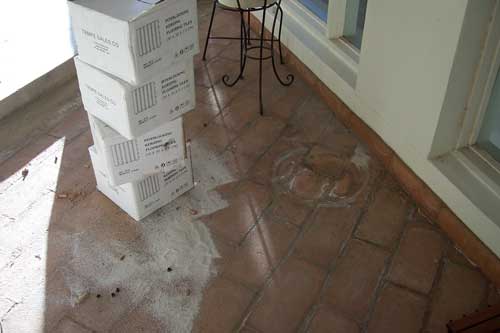
Here is the area before - note the water stains and the sand which is filling in big cracks and dips in the pavers:

Pr_before

Here is the floor after about 15 minutes -- they do go down fast.  They just lay on the ground with no adhesive.  The design of the bottoms keeps them from sliding around. 

Pr_middle

And finally, here we are mostly done.  The company offers edge pieces that are designed like little ramps so a mat of these tiles can stand alone, but we did not need them since I was filling a depressed space wall-to-wall.  Here is the final effect:

Pr_after2

We love the result.  I am just finishing a few diagonal cuts to finish off the last side - these were really the only hard part of the job.  I made them with some careful measuring and a circular saw (got a new one with a laser guide - awesome!)

Pr_almost_done

Anyway, this is not really the kind of thing I normally blog, but this product was something I had never seen before and came out so well and was so easy to put down, I had to share.  Besides, if VodkaPundit can share this (which made me really jealous by the way), I thought I could show my weekend project too.

Dear Pittsburgh Steelers:

Boy, did you luck out.