A Skeptics Primer for "An Inconvenient Truth"

Update:  Please enjoy this post; however, I have published a (free) more comprehensive guide to the skeptics arguments concerning man-made global warming.  You can find the HTML version here and a free pdf download here.

A few days ago, my wife announced to me that she wanted me to take her to
"An Inconvenient Truth", the recent movie vehicle for communicating
Al Gore's views on climate change.  I told my wife that I found the
climate issue incredibly interesting -- I have always had a passion for
inter-disciplinary science and climate requires integration of bits not just
from climate science but from economics, statistics, biology, and more.  I
told her I would love to see a true documentary on climate change, but I was as
interested in seeing a "science" film from the group that put this movie
together as I presume she was in seeing a "even-handed" movie on
abortion produced by the Catholic Church.

Never-the-less, she has insisted, so I put together a skeptic's primer for
her, which I will also share with you.  Note that I am not actively involved in climate research myself, so the following is my admittedly incomplete understanding of all the issues.  It is meant to raise issues that you may not find discussed in most global warming accounts.

Overview:  The earth has warmed by 2/3 of a degree to as much as a degree (all temperatures in Celsius)
over the last 100 years, of which man may be responsible for no more than half
through CO2 emissions.  The poles, which are important to all the global
deluge scare scenarios, have warmed less than the average.  Man's CO2
emissions will warm the earth another degree or so over the next 100
years.  There is a possibility the warming will be greater than this, but
scary-large warming numbers that are typical of most climate reports today
depend on positive feedback loops in the climate that are theoretical and whose
effect has not yet been observed.  The effects of warming will be a mix of
positive and negative outcomes, recognizing that the former never seem to get
discussed in various media scare stories.  If the effects of warming are a
net negative on mankind, it is not clear that this negative outweighs the costs
in terms of lost economic growth (and the poverty, disease, and misery that
comes with lower growth) of avoiding the warming.  In other words, I
suspect a warmer but richer world may be better than a cooler but poorer world.

The Hockey Stick:  The Hockey Stick graph as become the emblem,
the sort of coat-of-arms, for the climate change intelligentsia.  Until
recently, the climate consensus for the last 1000 years, taken from reams of
historical records (things like the history of X river freezing in winter or Y
region having droughts) was this:
1000yearold

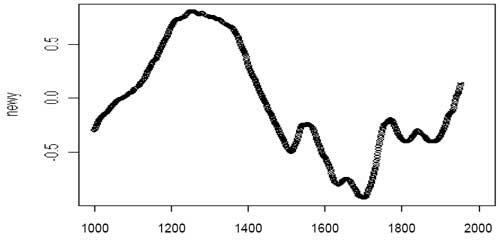
This chart is from the 1990 IPCC climate report, and in it you can see
features that both historians and scientists have discussed for years -- the
warm period during the Middle Ages and the "little ice age" of the
late 17th century.  Of course, this chart is barely better than a guess,
as are most all historical climate surveys.  For example, 3/4 of the earth
is water (where few consistent observations were taken) and only a small percentage of the rest was "civilized" to
the extent of having any historical records.  In addition to historical
records, scientists try to use things like ice cores and tree rings to get a
sense of long-term global climate patterns.

This long-held consensus changed with Mann, et. al., a study that created a new climate
picture for the last millennia that has immediately caught the fancy of nearly
every advocate of climate Armageddon.

1000yearold

For obvious reasons, this graph is called "the hockey stick" and
it is beloved by the global warming crowd because it hammers home the following
message:  Climate has been incredibly steady over the past 900 years with a flat to declining temperature trend until
man came along and caused a dramatic shift.  Based on this analysis, Mann
famously declared that the 1990's were the warmest decade in a millennia and
that 1998 was the hottest year in the last 1000 years.  (For real hubris, check
out this recent USAToday
graphic
, which purports to know the world's temperature within .001 degree
for every year going back two thousand years)

In fact, what Mann's chart shows for the last 100 years is about what I said in my overview - that
the world has warmed a degree and that man maybe has contributed up to half of
this.  Notice that tacked onto the end of the previous consensus view, the
last 100 years seem like it might just be the start of another natural cyclical
climate variation.    Not necesarily a reason for panic.  Ah,
but Mann's chart!  That's a chart that anyone eager to have the government
intervene massively in the economy is bound to love. It says that we are currently entering an unprecedented anomoly, and that the chief suspect for creating this change must be human civilization.

So is Mann right?  Well, a couple of things to note.  First, its
instructive to observe how eagerly the climate community threw out its old
consensus based on years of research in favor of Mann's study.  It's
unusual for a healthy
scientific community
to throw out their old consensus on the basis of one
study, especially when no one had replicated its findings independently.
Which no one has ever been able to do, since Mann has refused to share his
models or methodology details.  In fact, it took a US Congressional subpoena
to get any of his underlying models into the public domain.  This behavior
by a scientist would normally engender ENORMOUS skepticism in the community --
normally, I mean, except for in climate science, where mountaintop revelation without 3rd party repeatability
is OK as long as it supports a dire man-made climate catastrophe model.
In short, climate change advocates wanted the study to be true, because it was such a
powerful image to show the public.

Despite Mann's reticence to allow anyone to check his work, skeptics still
began to emerge.    Take that big temperature bulge in the Middle
Ages shown in the previous concensus view.  This bulge was annoying to climate
interventionists, because it showed that large variations in temperature on a
global scale can be natural and not necessarily the fault of modern man.
But Mann made this whole medieval bulge go away.  How?  Well, one of
the early revelations about Mann's work is that all the data before 1450 or so
comes from studying the tree rings of one single tree.  Yes, that's one tree
(1).  Using the evidence of this one tree, Mann flattened the temperature
over the 500 year period from 1000-1500 and made the Medieval warm period just go poof.  Wow!

The bigger criticism of Mann has come from statisticians.  Two Canadian
statisticians began questioning Mann's methodology, arguing that his
statistical approach was incorrect.  They demonstrated that Mann's
statistical approach was biased towards creating hockey sticks, and they showed
how the Mann model could be applied to random noise and produce a hockey
stick.   The climate change establishment did not take this criticism
well, and tried their hardest to rip these two guys up.  In fact, you might have believed that the two had been molesting little boys or declaring the world is flat rather than just questioning another scientist's statistical methodology. 

Recently, a US Congressional Committee asked a group of independent statisticians led by
Dr. Edward Wegman, Chair of the National Science Foundation's Statistical
Sciences Committee, to evaluate the Mann methodology.  Wegman
et. al. savaged the Mann methodology
as well as the peer review process
within the climate community:

It is important to note the isolation of the paleoclimate community; even
though they rely heavily on statistical methods they do not seem to be
interacting with the statistical community. Additionally, we judge that the
sharing of research materials, data and results was haphazardly and grudgingly
done. In this case we judge that there was too much reliance on peer review,
which was not necessarily independent. Moreover, the work has been sufficiently
politicized that this community can hardly reassess their public positions
without losing credibility. Overall, our committee believes that Dr. Mann's
assessments that the decade of the 1990s was the hottest decade of the
millennium and that 1998 was the hottest year of the millennium cannot be
supported by his analysis.

Further, Wegman concurred on almost every point with the Canadians, coming to the conclusion that the hockey stick was deepfly flawed.  In most other scientific communities, the Mann analysis would have been sent
to the dustbin along with cold fusion and Archbishop James Ussher's dating of
the earth to October 23, 4004 BC.
The problem is that the Mann chart has become too politically important.  Prominent men
like Al Gore have waved it around for years and put it in his books.  No
one in the core of the climate community can back away from the hockey stick
now without the rest of the world asking, rightly, what else is wrong with your
analyses?  If I seem too hard on the climate science community, then
consider this
quote
from National Center for Atmospheric Research (NOAA) climate researcher and global warming action promoter,
Steven Schneider:

We have to offer up scary scenarios, make simplified, dramatic statements,
and make little mention of any doubts we have. Each of us has to decide what
the right balance is between being effective and being honest.

Now you know why, for all its flaws, you will continue to see the hockey
stick in the press.  Because it is not about the facts, but about "scary scenarios" and "dramatic statements".

Has Man Been Causing the Warming?

Yes, some of it.  But its a little more complicated than the global
warming community lets on.   First, note the last 100 years of the
hockey stick.  The big upwards spike begins in 1900, long before any large
man-made concentrations of CO2 were put into the atmosphere.  In fact,
even those most fanatical about assigning maximum blame for climate change to
man don't blame man-made effects for most of the first half of the 20th century
temperature spike. 

Which begs the question, what caused the 1900-1940 spike of about 1/2 a
degree?  Answer:  Nobody really knows.  Which begs the follow-on
question:  If we don't know what caused the 1900-1940 run-up, how do we
know that this same force is not responsible for some of the run-up since
1950?  Answer:  We don't.  As I will explain below, climate
scientists trying to validate their models have reasons for wanting the
post-1950 temperature rise to be all man-made.  But just because they
assume it to be due to man-made rises in atmospheric CO2 concentrations does
not make it so -- correlation does not equal causation.

Well, what else could be causing this increase?  It could at least partially be
natural
cyclical variations in climate that we don't really understand.
Or it could be something more obvious, like, say, the sun was brighter.  I
can imagine your reaction -- no way it could be just a brighter sun,
Coyote.  I mean, that's the first thing the climate scientists would check
if earth temperatures were rising, right?

Irradiance

This chart compiled from data by Judith Lean of the Naval Research Library
and charted from her data at NOAA by Junkscience.com
shows that interestingly, the sun's output does appear to be higher today than they have been in many, perhaps hundreds of years.  Would such increased activity be
expected to result in higher earth temperatures?  I don't know, but if you
think it odd that scientists talk about global warming without mentioning how
hot the sun is, well, welcome to the world of climate science.   Its kind of like scrambling to find out why your room is too hot without first checking to see where the thermostat on the furnace is set.  More
on the sun's variance
and climate change here
.

Future Warming:  The key question, of course, is about future warming - i.e.,
based on man's economic growth and projected output of CO2, how much can the
world be expected to warm, say over the next 50-100 years.  I don't know
what the movie "An Inconvenient Truth" will claim until I see it, but
most recent studies have shown warming from 2-8 degrees (consistent with what is depicted by the
USAToday graphic linked above).

There are lots of issues with these forecasts that occasionally might even get
mentioned in the popular press.  Some issues are unavoidable, like the
inherent complexity and unpredictability of climate.  Some issues probably
could be avoided, like the egregiously bad economic forecasting that drives CO2
output forecasts in many of these models.  I won't delve into these issues
much, except to say that we are dealing with massively complex systems.
If an economist came up with a computer model that he claimed could predict the
market value of every house in the world in the year 2106 within $10,000, would
you believe him?  No, you would say he was nuts -- there is way to
much uncertainty.  Climate, of course, is not the same as housing
prices.  It is in fact, much, much more complex and more difficult to
predict. 

All these forecasts are created by a pretty insular and incestuous climate
science community that seems to compete to see who can come up with the most
dire forecast.  Certainly there are financial incentives to be as aggressive
as possible in forecasting climate change, since funding dollars tend to get
channeled to the most pessimistic.   The global warming community spends
a lot of time with ad hominem attacks on skeptics, usually accusing them of
being in the pay of oil and power companies, but they all know that their own
funding in turn would dry up rapidly if they were to show any bit of skepticism
in their own work.

Leaving aside all the other modeling problems and focus on one fact:
Most climate scientists would agree that if you focus narrowly just on the
effects of CO2 on warming, that even under the most extravagant assumptions of
CO2 production, the world will not warm more than a degree or two in total,
some of which we have already seen.  The reason is that the effect of CO2
concentration on global temperature is logarithmic.  This means that
increasing concentrations of CO2 have diminishing returns on temperature.
For example, if the first doubling of CO2 concentration raises temperatures by
a degree, then the next doubling may only raise it by a tenths of a
degree.  This is because CO2 only absorbs sunlight and energy in certain
frequency bands and this ability to absorb energy gets saturated, much like a
pot of water can only dissolve so much salt before it is saturated.

There is fair amount of argument over just how saturated the CO2 layers are
in terms of energy absorption, but most scientists will agree that at some
point, in isolation, additional CO2 added to the atmosphere by man stops having
any significant effect on global temperature.

So how do we get these dire forecasts of 6, 7, 8 degrees of warming?
Well, I was careful to say the effect of CO2 in isolation maxes
out.  To get to higher levels of warming, scientists posit "positive
feedback loops" that augment the warming effect.  Positive feedback generally means that once a process gets going in a direction, there is some force that will accelerate the process
faster or farther in the same direction.  Negative feedback means that
once a process is moving there is some force that tends to try to slow the process back down.
Positive feedback is a boulder balanced on the top of a mountain, where one
push will cause it to roll down the mountain faster and faster; Negative
feedback is a boulder in a valley, where despite lots of effort, the rock will
keep coming to rest back where it started.

In global warming models, water vapor plays a key role as both a positive and a negative feedback loop to climate change.  Water vapor
is a far more powerful greenhouse gas than CO2.  It comes into play because CO2 driven warming will
put more water vapor in the atmosphere, because greater heat will vaporize more
water.  If this extra vapor shows up as more humid clear air, then this in
turn will cause more warming as the extra water vapor absorbs more energy and
accelerates warming.  However, if this extra water vapor shows up as
clouds, the cloud cover will tend to reflect energy back into space and retard
temperature growth. 

Which will happen?  Well, nobody knows.  And this is just one
example of the many, many feedback loops that scientists are able to posit but
not prove. And climate scientists are coming up
with numerous other positive feedback looks.  As one skeptic put it:

Regardless, climate models are made
interesting by the inclusion of "positive feedbacks" (multiplier
effects) so that a small temperature increment expected from increasing
atmospheric carbon dioxide invokes large increases in water vapor, which seem
to produce exponential rather than logarithmic temperature response in the
models. It appears to have become something of a game to see who can add in the
most creative feedback mechanisms to produce the scariest warming scenarios
from their models but there remains no evidence the planet includes any such
effects or behaves in a similar manner.

So, is it reasonable to assume these feedback loops?  First, none have
really been proven empirically, which does not of course necessarily make them
wrong.  More damning is the fact that models using mostly positive feedback
loops do a terrible job of modeling the last 100 years.  It is a perfectly
reasonable back check on any model to see if it predicts history.   Most of the aggressive climate models (ie the ones that tend to get quoted in the press) turn out to predict a warming for the
last 50 years far above what we have actually observed, which of course might make one
suspicious of their ability to predict the future.  A while back, I said
that climate scientists had a strong incentive to "claim" as much of
the 20th century warming as possible and attribute it to man.  This is
why:  The need to validate models that predict a lot of manmade warming
over the last 50 years that hasn't shown up.  Scientists will tell you
that they have fixed these problems, but we skeptics are fairly certain they have done it by adding artificial
fudge factors of dubious scientific merit  (I will confess to my embarassment that I have done exactly this when I have created industry models for a consulting client).

But one can also answer these questions about positive feedback loops from a
broader perspective.  Positive feedback loops are not unknown in nature
but are much rarer than negative feedback loops.  The reason is that
positive feedback loops lead to runaway processes that we seldom see in
nature.  Atomic fission is one of these thankfully rare process, and one can see that it is
probably lucky our universe is not populated with many such positive feedback
processes.  In our daily lives, we generally deal with negative
feedback:  inertia, wind resistance, friction are all negative feedback
processes.  If one knew nothing else, and had to guess if a natural
process was governed by negative or positive feedback, Occam's razor would say
bet on negative.  So, what about climate?  The evidence is equivocal,
but to be fair there is an example in our near universe of a runaway global
warming event - on Venus - though it occurred for reasons very different than
we are discussing with man-made climate change.

Negatives (and Positives) of Warming: While I have some trouble with
the science employed by global warming activists up to this point, it is on the
topic of the effects of global warming that the science really gets
flaky.  Now, certain effects are fairly likely.  For example,
hurricane activity will likely increase with warmer ocean temperatures.
Warmer ocean temperatures will also cause sea levels to rise, even without ice
melting, due to thermal expansion of the water.  And ice will melt, though
there is a really broad range of forecasts.

One reason that the ice
melting forecasts are hard
is because while me may talk about the world
warming a degree, the world does not warm evenly.  Most climate models
show the most warming on dry winter nights  (Siberian winters, for
example, get a disproportionate share of the warming).  An extra summer
degree in Arizona would suck; an
extra winter degree in Siberia would probably be
welcomed, and would likely extend growing seasons.

And it is here that you get the greatest silence from warming
fanatics.  Because
it should be self-evident that warming can be good and bad
.  Warming
can raise ocean levels and lead to droughts.  It can also extend growing
seasons and increase rain.  It all depends on where you are and what
forecast you are using.  The only common denominator is that most official
warming reports, such as those from the UN, spend an inordinate amount of time
discussing the negatives and very little time, if any, mentioning positive
offsets.  One of the reasons for this is that there is a culture in which
every environmental activist has been steeped in for years -- that man always
ruins nature.  That everything man does is bad.  Growth is bad.
Technology is bad.  To be fair, its not that many environmental scientists
are hiding the positive offsets, it's that they have been programmed for years to be
unable to recognize or acknowledge them.

Shouldn't We Fix it, Just to Be Safe:  If you get beyond the
hard core of near religious believers in the massive warming scenarios, the
average global warming supporter would answer this post by saying:
"Yes there is a lot of uncertainty, but you said it yourself: 
Though the doomsday warming scenarios via positive feedback in the climate
can't be proven, they are so bad that we need to cut back on CO2 production
just to be safe."

This would be a perfectly reasonable approach if cutting back on CO2
production was nearly cost-free.  But it is not.  The burning of
hydrocarbons that create CO2 is an entrenched part of our lives and our economies.
Forty years ago we might have had an easier time of it, as we were on a path to dramatically cut back on CO2 production
via what is still the only viable technology to massively replace fossil fuel
consumption -- nuclear power.  Ironically, it was environmentalists that
shut down this effort, and power industries around the world replaced capacity
that would have gone nuclear mostly with coal, the worst fossil fuel in terms
of CO2 production (per btu of power, Nuclear and hydrogen produce no CO2,
natural gas produces some, gasoline produces more, and coal produces the most).

Just halting CO2 production at current levels (not even rolling it back)
would knock several points off of world economic growth.  Every point of
economic growth you knock off guarantees you that you will get more poverty,
more disease, more early death.  If you could, politically, even
make such a freeze stick, you would lock China and India,
nearly 2 billion people, into continued poverty just when they were about to
escape it.  You would in the process make the world less secure, because
growing wealth is always the best way to maintain peace.  Right now, China can become wealthier from peaceful internal growth than it can from trying to loot
its neighbors.  But in a zero sum world created by a CO2 freeze, countries
like China would have much more incentive to create trouble outside its borders.  This
tradeoff is often referred to as a cooler but poorer world vs. a richer but
warmer world.  Its not at all clear which is better.
 

One final  statement:  I have lost trust in the scientific
community on this.  There are just too many statements floating around like
this one
that make it clear that getting people converted to the global
warming cause is more important than getting the science right.  Mann's
refusal to share his data so that his results can be validated (or invalidated,
as seems more likely now), the refusal
to consider any dissenting views
in its "scientific" conferences,
the sloppy
science
uncovered, the willingness to absurdly blame
every natural event on global warming
  -- all these create the
impression that global warming is a religion with doctrines that can't be
questioned, rather than what it actually is -- a really, really chaotic and complex area
of science we have only just begun to understand.

For other reading, probably the first place to look is the Skeptical Environmentalist by Bjorn
Lomborg
. Lomborg in this book has probably the best counter-case to the
enviro-disaster stories filling the media. He has become an object of absolute
hatred among the anti-growth anti globalization fanatics who have latched onto climate
change as the key to advancing their anti-technology and anti-capitalist
political agenda. The attacks on him have become nearly as edifying about what
drives the environmental movement as his book itself. The Economist has
a nice article about his book and about the wild-eyed furious reaction of
environmental activists to it. The Economist also editorializes
here
, and you can follow all the criticism and response here on Lomborg's site.

The site junkscience.com is
invaluable, in fact with a better compendium of data on climate than most
climate sites.  A good
place to start is this article
.

Other sources: This paper is
a good roundup of all the issues I have addressed. Cato has a lot of other
material here
as does the Heartland
Institute
and at The
Commons.
  A great post from Silflay Hraka that is much more eloquent
(and concise) than I am is linked here.

Update:  I have published a (free) more comprehensive guide to the skeptics
arguments concerning man-made global warming.  You can find the HTML version here and a free pdf download here.

Maintaining the Lawyer Cartel

Frequent readers of this blog will know that this quote from Milton Friedman on licensing is one of my favorites:

The justification offered is always the same: to protect the consumer. However, the reason
is demonstrated by observing who lobbies at the state legislature for
the imposition or strengthening of licensure. The lobbyists are
invariably representatives of the occupation in question rather than of
the customers. True enough, plumbers presumably know better than anyone
else what their customers need to be protected against. However, it is
hard to regard altruistic concern for their customers as the primary
motive behind their determined efforts to get legal power to decide who
may be a plumber.

Ilya Somin at Volokh has an interesting post (though right this moment their site seems to be down) about the American Bar Associations (ABA) role in accrediting colleges.

To my mind, the problem goes beyond the shortcomings of specific ABA standards.
The real mistake is allowing an organization with a blatant conflict of interest
to take over the accreditation role in the first place. As an interest group
representing lawyers, the ABA has an obvious stake in limiting entry into the
profession so as to decrease the competition faced by its members. One way of
doing so is by restricting the number of accredited law schools, at least in the
vast majority of states that require all or most aspiring lawyers to attend an
ABA-accredited school in order to take the bar exam.  We would not allow an
organization run by Chrysler, GM, and Ford to set regulatory standards
determining who has the right to sell cars in the United States. Requiring ABA
accreditation for law schools is the exact equivalent in our industry....

To be completely clear, I am NOT arguing that the ABA should be prevented from
certifying schools as meeting what it considers to be appropriate standards. I
am merely suggesting that ABA accreditation should not be required by law as a
prerequisite for allowing a school's graduates to take the bar. If ABA
accreditation really is a sign of school quality, then applicants can take that
into account in making their decisions on what school to attend, just as they
currently consider US News rankings and other data. If some form of legally
mandated accreditation is needed (and I highly doubt that it is), the system
should be run by an independent agency insulated as much as possible from
control by the ABA and other interest groups representing practicing lawyers.
There should be similar insulation, by the way, from influence by established
law schools, since we too have an obvious self-interest in limiting competition
by preventing new entry into the legal education market.

Guilt or Innocence is Irrelevant, I Guess

I thought this article by Robert Johnson (via Instapundit) about the Duke Lacrosse case was interesting in that it highlighted how many people on the Duke campus believed that the actual guilt of innocence of the players involved was irrelevant.

First, there was the Duke administration.  I don't think anyone can doubt at this point that the players' guilt or innocence was irrelevant to the actions of the Duke administration, since they meted out their punishments long before the investigation into the facts of the case had even really begun.  Duke was clearly worried most about its reputation and about protecting itself from lawsuits, a not unreasonable fear given this.

It is the actions of the faculty that are truly amazing.  Johnson shows us the thinking of a number of members of the Duke faculty, known as the group of 88, that came out with public statements about the matter.

[Duke Professor Wahneema Lubiano] was pleased "that the Duke administration is getting the point":
the banging of pots and pans had hammered home that a specific claim to
innocence in this case mattered little. "Regardless of the 'truth'
established in whatever period of time about the incident at the house
on N. Buchanan Blvd.," she mused, "the engine of outcry in this moment
has been fueled by the difficult and mundane reality that pre-existed
this incident." To Lubiano, the "members of the team are almost perfect
offenders in the sense that [critical race theorist Kimberle] Crenshaw
writes about," since they are "the exemplars of the upper end of the
class hierarchy, the politically dominant race and ethnicity, the
dominant gender, the dominant sexuality, and the dominant social group
on campus."

Professor Alex Rosenberg added:

The sole defenders of the lacrosse players in this case, the professor
suggested, are extreme advocates of the economic status quo

Though its not really news nowadays, I guess, the article is a nice reminder that universities tend to have a hard core of faculty that see the world in terms of race, class, and gender rather than individuals and individual action.  Makes you wonder how they go about assigning grades.  In fact, their desire to see the Duke case cast in terms of race and gender apparently caused them to ignore outright political abuses one would normally expect them to decry:

Most stunningly, Rosenberg claimed that every member of the
Group of 88 believed that Nifong was motivated not by the pursuit of
justice but by the looming Democratic primary for D.A. If true, this
breathtaking assertion means that the Duke faculty, despite recognizing
that a local prosecutor was abusing his office to railroad their own
institution's students, chose to go public instead with a mass
statement denouncing the students targeted by that very same prosecutor.

From Rags to Riches at Taxpayer Expense

Some of you may have heard of him -- about a year ago blogger Kyle MacDonald started on a quest to make a series of barter transactions with a red paper clip as his starting item that would result in his owning a home.  Since to make this work he had to get a higher monetary value out of each successive transaction, one had to believe either that he was a really really good exploiter of market inefficiencies, or, more likely, would advance in each trade with a premium related to the publicity value of his effort.  In other words, people would trade him value X for something less than value X to either garner publicity for themselves or because they just wanted to participate.

Well, for most of the effort, all proceeded well.  People traded with him voluntarily, in many cases knowing that on a strictly financial market value assessment, they may have lost in transactions with him but making up for it with the non-tangible benefit they got from participating.  Well, I say it was voluntary, and it was, right up to the final transaction.  But then it fell apart.  Because in that last transaction, the town government of Kipling, Saskatchewan bought Mr. MacDonald a house with taxpayer money, in exchange for a movie role (the article is not clear on how the town will use a speaking part in a movie) and I am pretty sure this was not done with the voluntary consent of every taxpayer in Kipling.

Intriguingly enough, he was offered this item of value (a movie role) from actor director Corbin Bernsen as pure gift, rather than a trade.  Macdonald, interestingly enough, did not accept the role as a gift because he "feared the integrity of his journey would be compromised if he
accepted the role without trading Bernsen something he really could
use".  And the taxpayers of Kipling really could use a movie role, how?  It says volumes about the philosophic state of western man that accepting a gift freely offered challenged the "integrity" of what he was doing but accepting taxpayer money taken by force without the owners' permission is A-OK.

Arizona Pioneers a Really, Really Bad Idea

A group in Arizona has pioneered what may turn out to be the greatest tool for promoting socialist redistributionist government in this country since income tax withholding:  Having the government pay people to vote.

There's going to be a new reason for Arizonans to go to the polls this year:
They could win $1 million.

The Secretary of State's Office certified Thursday that backers of the
voter lottery plan had submitted more than enough signatures to qualify for the
November ballot.

But the measure is worded in a way to actually encourage people to vote
both in the primary this September as well as two months later when the actual
initiative will be on the ballot. If it is approved in November, it will be
retroactive: One lucky person who voted in this year's primary and another who
cast a ballot in the general election each will get $1 million.

A number of people have made the obvious point:  just how informed is the incremental voter who votes only because of this lottery ticket incentive really going to be?  I think most people's answer is "not".  The backers of the referendum poo-poo this concern, but do any of you really share this man's confidence:

Osterloh said he believes that providing a carrot for would-be voters would
increase participation in the democratic process. The Tucson physician dismissed
concerns that the kind of people who would vote solely for a chance to win the
lottery are likely to be ill-informed about the candidates and the issues.

"Once they decide they're going to vote, they will study the issues and
candidates," he said. "And they will vote in their own enlightened
self-interest."
Yeah, right. 

However, I am even more concerned because the incremental voter will be someone whose interest in the government is only as a source of money.  The new process will attract people who believe, and in fact train people to believe, that the purpose of voting is to direct money from the government to oneself.  I am convinced that the incremental voter attracted by this approach will tend to be strongly redistributionist, and further I believe that the backers of the plan know it. 

Update:  I am waiting to see how long it will be before we see this ballot initiative on some state ballot:  "Resolved:  That each year, the richest 40% of taxpayers in the state, as defined by last year's income, shall pay 10% of their income, above and beyond all other taxes, into a state fund that will be divided evenly and given to the remaining 60% of state residents."

Universities Becoming Their Own Country (and a repressive one at that)

Both based on outside pressure (mostly from torts) and internal desire, universities are rapidly modeling themselves into mini-governments, really mini-super-nanny-states.  FIRE, the Foundation for Individual Rights in Education, observes of a recent gathering of University attorneys:

At one panel I attended, San Francisco lawyer Zachary Hutton explained
Williams v. Board of Regents, a recent case in which a University of
Georgia student alleged having been raped by two student-athletes while a third
student watched. The police charged the athletes with rape, and the university
decided not to conduct its own investigation until the criminal case was
resolved.
That turned out to be a mistake. The plaintiff then sued the university for
sexual harassment, and the 11th Circuit held this year that the university could
be liable because, by waiting to conduct an independent investigation until the
criminal case was resolved, it had exhibited deliberate indifference to the
alleged rape. "The court emphasized," Mr. Hutton told the college lawyers, "that
the pending criminal trial . . . did not affect the university's ability to
institute its own proceedings, and the criminal charges would not have prevented
future attacks while the charges were pending."
There are excellent reasons for the university not to conduct its own
investigation. For one thing, instead of police detectives and professional
prosecutors conducting the investigation, you are likely to get Campus Public
Safety and the Associate Dean for Student Affairs. How having inexperienced
college administrators and college safety officers conduct a rape investigation
is likely to benefit either the victim or the accused is beyond me. The
potential for violating the Fifth Amendment, damaging evidence, and coming to
wildly inaccurate conclusions is immense, and if any of these things were to
happen, the university would risk botching an important criminal case. Rape is a
serious crime; victims and the accused deserve better than college justice.

In some ways, this was even more illuminating of the drive to mini-nanny-statehood:

The most entertaining discussion I heard at the lawyers' convention
centered on what to do about facebook.com and myspace.com--how to prevent
slander, harassment and rumor-mongering on these online communities popular with
undergrads.
What these attorneys were talking about is wholesale regulation of online
speech. Slander is, of course, a tort, and engaging in slander or libel can get
a person sued. It's hard to see how or why a college should be involved in this,
though. If I libel someone online, it's the business of those affected, not the
college. As for harassment, one of its main characteristics is that the person
being harassed finds the harassing behavior hard to avoid. Unless the "harasser"
is hacking into the victim's MySpace page, it's hard to see how going to a
"harassing" website isn't completely avoidable. As for "rumor-mongering," horror
of horrors! Regulating that on a college campus will mean tripling the number of
administrators (and probably tuition), but I suppose no expense is too large to
make sure that everyone stays comfortable.

College campuses were probably among the first and most vociferous critics of GWB's various domestic surveillance programs.  Its interesting to see that while opposing such programs at the national level, they are crafting far more far-reaching speech monitoring and restriction programs on their own campuses:

The room was evenly divided: Some lawyers recommended ignoring the students' Web
sites unless something offensive was brought to administrators' attention, while
others suggested taking aggressive action....

By my calculations, if half the lawyers thought that "offensive" speech that is
reported should be punished, and half the lawyers thought that administrators
should spend their time cruising the websites and proactively stamping out
"offensive" speech, that leaves ZERO lawyers who believed that perhaps merely
"offensive" speech should be protected, as the First Amendment (at public
schools), or respect for fundamental freedoms (at all schools), requires.

Estate Tax Confusion

It is not surprising that that a debate like the one over estate taxes that attracts so many class warfare fanatics should miss the point on a lot of issues.  However, the estate tax debate has been handled in the media perhaps worse than even other tax debates, which is a pretty low bar to try to crawl under.  The reason I say this is that the most serious "end the estate tax" type proposals out there have two parts, only one of which I have ever seen mentioned in the press:

  1. End the federal tax on estates (this, of course, is the part that gets the press)
  2. End the stepping-up of the cost basis of financial assets at death (this part never gets mentioned)

This 2nd piece of the proposal may seem arcane to some -- let me explain.  Most large estates (ie, the ones that estate tax supporters are concerned about) are dominated by financial assets (e.g. stocks, bonds).  These financial assets, typically held for years, tend to have a cost basis far below their current market value.  An example might be shares of Microsoft held for 10 years that were purchased for only a small fraction of the current price.  The cost basis of a financial asset is generally its purchase price plus commissions and other transaction charges.

Lets take a gentleman who dies and whose estate is made up entirely of $10 million worth of Coca-Cola stock bought years ago for just $5 million.  The estate all goes to his one daughter.  Under estate law, two things would happen.  The estate pays a large tax on the $10 million, and the remainder flows through to his daughter.  Lets say taxes take half, and his daughter now has $5 million of stock with an original price of $2.5 million.  The other thing that happens is the basis of assets is stepped up to current market value.  That means that as far as the IRS is concerned, his daughter owns stock worth $5 million with a basis of $5 million.  If she immediately sold the stock, she would have no capital gains tax.

There are a couple of good arguments against the estate tax.  From an efficiency standpoint, it diverts large pools of capital from private investments into the hands of the Federal Government, where only the most ardent statist would argue that it is better spent.  Also, billions and billions of dollars are spent every year with lawyers, accountants and financial planners to find ways to dampen the impact of the estate tax.  This is all wasted, unproductive effort that would immediately be redirected to more productive uses if the estate tax were eliminated.

From a fairness standpoint, the estate tax acts as a second tax on income that has already been taxed before.  In our example, though the $5 million capital gain is getting taxed for the first time in the estate, the $5 million original costs, which must have come from taxed income at one time, is getting taxed for at least a second time.  The other fairness problem becomes visible if we change the name of the stock from Coca-Cola to "Dad's private company."  For family businesses, ownership is not as easily divisible - you can't sell half or two-thirds that easily in part because there is not much market for minority shares of small family businesses.  What therefore happens in practice is that the daughter must sell the family business to pay the taxes.

The estate tax reform plan outlined above eliminates both these latter problems.  Under these rules, the daughter would inherit the full $10 million of stock, but, unlike today, her basis would remain the same as her dad's -- in this case, $5 million.  She would not pay any tax until she sold any of the assets.  And then she would pay capital gains taxes using the lower basis of her father's.

This results in two beneficial outcomes:  a)  taxes are only charged on the part of estates that have not already faced income taxes and b)  taxes are only paid when the individuals who inherit choose to make an asset sale and convert assets to cash.  The timing of assets sales drive taxes, whereas today, in all too many cases, taxes drive the timing of asset sales.  (By the way, supporters of the estate tax also argue that it is good because the estate tax incentivizes charitable giving.  The argument is that the tax is so confiscatory, and that the government so well-known as a black hole for money, that rich people decide it is better to give it away than to let the government take it all.  This is an odd argument for statists to make, but they do.  Note that in this estate tax proposal, the daughter would inherit a lot of low-basis stocks.  The same charitable giving incentives exist for low-basis stocks, since the IRS will give you credit for the market value as a deductible gift but you don't have to pay the capital gains).

Asymmetrical Information has been on this case for a while:

There is no case for saying, as the New York Times inexplicably does, that "Repeal would shield
the estates of the very wealthiest Americans from the tax." It does not. It
does, however, defer taxation. Because basis will no longer be 'stepped-up'
after death (except for a $1.3 million exemption) they will simply be taxed like
all other capital gains - at the time those gains are realized.

Stepped-up basis is one of the four legs of the estate-planning stool along
with the life insurance tax exemption, minority discount valuations and the division of income and
principal interests (such as the "estate
freeze
"). It is not entirely clear that beneficiaries of large estates are
better off after repeal when the full toolkit of estate planning techniques is
taken into account - unless capital gains tax is done away with altogether and
the states stop taxing estates. Neither is likely to happen.

Given the large estates I've seen avoid taxes, I am skeptical of analyses
that suggest an enormous impact to revenues from this repeal. I don't believe
they factor in the new potential revenues from carryover basis outside the
traditional estate tax shelter vehicles. Certainly, the capital gains rate is
lower than the estate rate, but when estate tax shelter vehicles dwindle away,
more assets will ultimately be subject to capital gains taxation. Based on what
estate planning professionals tell me, it will be a wash in many cases and more
expensive in some significant estates. In other words, with respect to the
Estate Tax, we may still be in the fat part of the Laffer curve, where a lower statutory rate may yield higher
revenues over time (due to avoidance behavior, not a lack of work
incentives).

This post also cites a study that says that increased capital gains taxes on inherited assets could offset estate tax losses to the government.  That seems aggressive, assuming a lot of assets are getting passed in vehicles (trusts?) that avoid or limit estate taxes, but the offset is there never-the-less and is something you will never ever see in a newspaper article about the estate tax.

I haven't paid attention to the current Congressional proposals out there, but the post goes on to argue that Congress, as is its wont, has chosen the worst of both worlds while maximizing rent-seeking opportunities.

postscript: By the way, shame on all of those accountants, lawyers, and others in the estate planning profession.  They all tell their clients that the estate tax is confiscatory, and can go on for hours with a client about various things that are unfair in the system.  But at the same time they run to Congress begging them to keep the whole tottering complex system in place to protect the rent they extract from inefficiencies in the system

How to Steal a Moped in England

Answer: Don't wear a helmet!(via Overlawyered)

Police refused to chase a thief who had stolen a moped because
the youth was not wearing a helmet, the victim said yesterday.

Max Foster, 18, said officers told him they feared being sued if
the thief fell off the moped and injured himself....

The Association of Chief Police Officers said: "There is no blanket ban on
calling off chases where a rider has no helmet, however most forces will adopt
similar stances."

In Case You Thought Anti-Trust Was About Consumers

I could spend all day discussing the follies of anti-trust law.  But one of the memes that still seems to hang on is that anti-trust was designed as a form of consumer protection, with the government protecting consumers from the monopoly power of consolidated enterprises.

I am not enough of a business historian to comment on whether anti-trust has ever been used for consumer protection, but it is clear that it is not any more.  That has been one very expensive lesson we can all learn from the Microsoft anti-trust cases, both in the US and Europe. 

If you remember the US cases, Sun, Netscape, Oracle and other Microsoft competitors, having failed to best Microsoft in the marketplace, went running to the FTC to get them to sit on Microsoft for them.  And they were successful, with a series of high-profile settlements.  Nowhere was there even a hint that these cases were about the consumer -- in fact, the settlement demanded was to remove functionality and free add-on components from the Windows OS, making it less attractive to consumers.

We can see this again in the recent decision by an EU court, which seems very happy to use anti-trust law to step on an American competitor in favor of local companies (my emphasis added).

Microsoft was fined $357 million, on top of the record $613 million
fine it paid in the original order. It also faces new penalties of
$3.82 million a day beginning July 31....

The commission has said that it is concerned about Vista's Internet
search capabilities and method of managing digital rights. Regulators
also are worried about the implications for competitors of a new
technology for saving documents that is similar to the Portable
Document Format developed by Adobe Systems Inc.

Microsoft's chief crime is not doing enough to help competitors compete against them:

The fines announced Wednesday come after the EU told Microsoft to
supply "complete and accurate technical specifications" to developers,
so they could make software for servers that help computers running
Windows, printers and other devices on a network talk to each other. It
accused Microsoft of using its monopoly position with Windows to elbow
into the server software market.

Kroes said Microsoft's earlier efforts had not come even close to a readable manual developers could use.

Again, settlements are taking the form of defeaturing the product consumers get:

Smith said Microsoft had suggested various ways it could offer Vista in
Europe, to address concerns about XPS. One option is to ship Vista
without it, while another is to include ways for PC makers or others to
either remove certain XPS utilities or make them invisible.

And, by the way, this certainly gives one a lot of confidence in the due process the courts in Europe are going to give you as an American:

"In some ways, these fines are only partially about complying with the
... prior case, and half about sending a message to Microsoft that the
European Commission is not going away,"

You get that?  It sounds like a mafioso beating someone up because they didn't show him enough respect.

By the way, I am frustrated with Microsoft and their pricing as well.  Rather than run to the government, though, I have employed this and this and this.

State of Arizona Channeling Enron

In May of this year I got a form from the Arizona Department of Revenue that said my company was now large enough to make estimated sales tax pre-payments.  Some states do this when you are large enough - they don't like you holding their sales tax money a whole month until the reporting deadline, they want their cash in hand.  It's a pain, so I sighed, but we did it.  We prepaid estimated full-month June sales tax in mid-June as required, rather than in mid-July when the payment would normally be due.  Note that we still have to fill out all the sales tax reports in July, so paperwork is doubled, not to mention the extra work to reconcile between the estimate and actual results.

So this month, I was looking for the July pre-payment form.  I figured the July pre-payment must be due soon, so I called the Department of Revenue and asked where my form was.  They said there was no form for July.  The pre-payment is only one time.  I said, "its only for June?" and they said yes.

Then it dawned on me:  Arizona is on a June 30 fiscal year.  The entire point of this exercise is to pull July revenues into June to artificially inflate the prior fiscal year financials.  Wow - all those pious government workers artificially manipulating results just like an evil old corporation.  Because there is absolutely no other reason to do this for just one month.  The time value of money gained is dwarfed by the costs of changing your payment processing approach for just one month, and is certainly dwarfed if you consider the extra taxpayer effort required (which of course the government never does).

But it's even worse!  Because, in effect, this only worked one time -- the first time.  The first time they did this, they helped the fiscal year.  But now, pulling forward July this year just offsets losing the July revenues from last year.  So politicians have saddled us with a tax process that costs the government more money and the taxpayer more time and has no benefit beyond generating a slightly more positive press release about the budget for some politician several
years ago (whatever year this was first implemented).

Not Happy

I spent much of the morning blogging yesterday, and typepad has managed to lose all the data.  I will say this is the first time I have been unhappy with Typepad, but I am very unhappy.

As Good A Theory as Any

For those who, like me, have trouble decoding why certain SCOTUS justices make the rulings that they do, Richard Epstein propounds an interesting theory in the WSJ ($) today.  He says that you can't relay on traditional conservative or liberal monikers to predict when a justice will back an expansion of government and when she/he will rule to reign it in.

In principle, it would nice if both sides of the
ideological spectrum displayed a sound and consistent position on
statutory construction. Unfortunately, each bloc is opportunistic. The
litmus test for this erratic behavior boils down to a factor not found
in any statute: trust.

The court's two wings share one trait: They defer only
to the government officials they trust. Otherwise, they read a statute
carefully to rein in the authority of officials they don't trust. The
two factions don't differ in their philosophy of language, or in their
on-again, off-again adherence to the rule of law. Rather, the court's
liberal wing profoundly distrusts this president, but has great
confidence in the domestic administrative agencies that regulate
matters such as the environment. The conservative wing of the court
flips over. It willingly defers to the president on national security
issues while looking askance at expansionist tendencies of the
administrative agencies.

This feels as right as any theory I have read of late.  And I certainly can get behind this:

Our Constitution starts out with a presumption of distrust of all
government actors, which is why it drew a sharp line between the
legislative and executive branches. We can argue until the cows come
home whether national security or environmental protection presents the
greater threat of executive or administrative misuse. But that ranking
really doesn't matter, because there is no reason why the Supreme Court
has to defer to overaggressive public officials in either context.
Justice Stevens rightly chastised the president for flouting the rule
of law in Hamdan. But he was tone deaf on the easier question
of statutory construction when blessing the Corps' extravagant reading
of the statute in Rapanos.

Spanish Derangement Syndrome

I have written several times about the phenomena of certain nativist Americans who get absolutely freaked out whenever they even encounter Spanish in the good old USA.  Here is another example of what I have started calling Spanish Derangement Syndrome:

A Spanish-language billboard promoting iced coffee is getting a chilly reception from some Bogota officials.

Mayor Steve Lonegan said the McDonald's billboard on River Road near
Elm Avenue and the railroad overpass is offensive because it sends the
message that Spanish speakers and immigrants do not need to learn how
to speak English.

Boy would this guy ever blow a gasket here in Phoenix!  So I have a counter proposal.  Everywhere that Steve Lonegan travels overseas, I think they should remove their English signs and everyone should refuse to speak English.  No English signs in airports, no English-speaking people at the hotel desk, no International Herald Tribune on the newsstand.   After all, having English signs and English-speaking customer contact people all over, say, Germany, just sends the message that Americans don't have to learn German to travel there.

I am reminded that nearly every country in the world has an "American School" where expats send their kids to learn in English and avoid as much contact and assimilation as possible with the local populous.  For example, I had several business associates in Singapore who all sent their kids to the local American School.  Can you imagine what a hissy-fit nativists in the US would throw if there were similar Mexican schools in the US?

Update:  By the way, I don't have any particular problem with English as a criteria for citizenship, but not for mere presence in the country.  Note that I don't consider citizenship the restrictive license that nativists do, as I explained here, among other places.

Also, one would be hard-pressed to argue that the Constitution somehow restricts first amendment speech protections to speech made in English.

Update #2:  Formatting has wigged out a couple of times with this post, with the word "English" formatted out on separate lines each time it appears.  Weird.  Hacker?

Botox and Boob Jobs

I am sure that, since I sort-of live in Scottsdale, you have all been waiting for me to comment on this:

  It started out small, with people all across the country nicknaming this city "Snottsdale."

Then came the reality television show about a local women's book club
where members spend almost no time delving into fine literature but
endless hours discussing Botox, marrying for money and the latest
fashions.

Soon after began the headlines about America's most
famous porn queen buying a Scottsdale strip club and the city's rapid
response: an ordinance that would prohibit dancers from being closer
than 4 feet from clients.

And then--as if all that hadn't been
enough--a guy from Las Vegas carpetbagged into town and opened a
restaurant named after a not-to-be-mentioned-in-polite-company part of
the female anatomy.

I say that I sort-of live in Scottsdale, because I actually live in neighboring Paradise Valley, another suburb of Phoenix, but since almost all the famous people listed in the article as Scottsdale residents actually live in PV, I guess I must count as Scottsdale too.

Anyway, here is my comment:  I think it is freaking hilarious.  Any city that actually spends tax money and chamber of commerce funds to advertise itself nationally as a rich enclave deserves what it gets.  If you try to advertise yourself as the next Beverly Hills 90210, you shouldn't be surprised when the media treats you like, well, Beverly Hills 90210. 

I will say that growing up in Houston and living in Dallas for years has somewhat immunized me to the hijinx of the tacky biologically-augmented nouveau riche.  While those who grew up in the Scottsdale that was the quiet horse town seem to be pretty bent out of shape by the town's new reputation, I don't see many of them complaining about the increases they have had of late in their real estate values.  And if the rich scene is more like Paris Hilton than like a Literary Lions Ball at the Met, well, at least it has some entertainment value.  (Though not too much, since CBS is cancelling their reality show).

The best feature of Scottsdale has to be school functions, because Scottsdale does lead the nation on the hot mom index.  I remember when we first moved here both my wife and I were floored at the women at the first school function we attended.  Heck, I still volunteer to drive the kids to school in the morning.  And don't even get me started about women at the Phoenix Open -- there is a reason the tournament is still a favorite among tour players despite the roudy crowds.

In conclusion, returning to the article, I couldn't have said it better than this:

"Oh, get over it," she said. "So what
if people want to make fun of us? Every city has its own particular
brand of strangeness. For some it may be gangs or drugs or troubled
youth. We just happen to have some over-Botoxed blonds with oversexed
tendencies."

Pirates Review

I loved the original Pirates of the Caribbean, and so I was excited to go see the sequel.  I won't write a long review, except to say that this movie is to the original what Star Wars Episode 3 was to the original Star Wars.  It seems to have forgotten what made the original a success, and focused instead on elaborate special effects and a confused plot.  The effects are amazing, and may be alone worth the price of one viewing, but the movie itself was only so-so. 

The plot wandered around aimlessly at times, and key elements, such as exactly how Jack got crosswise with Davy Jones in the first place, get a very very short exposition, which seem odd in a 2-1/2 hour movie.  This is the same mistake many action movie sequels make - the Indiana Jones movies come to mind in particular.  The sequels go for action action action continuously on the screen, forgetting that the original had long stretches of quiet periods that actually moved the plot and characters along.

Of all the plot elements, the sudden introduction of the ex-commodore Norrington seems the most forced.  There feels like there are one two many characters in the movie, with Sparrow, Will, the governor, the east India guys, Norrington, Davy Jones, etc. all having independent agendas.  This is fine for a taught character drama, but for a light action movie it is overly complex, and feels like Mission Impossible 2 where the writers tried to outdo the original in twists and turns and betrayals.  The introduction of Norrington does set up an interesting 3-way fight (kind of reminiscent of the awesome final scene in God, Bad, and the Ugly).  Like much of the film, the fight is kindof fun but falls short somehow.  And looking back on the movie, I can't figure out why the whole first part of the movie with the cannibals was even in there.  Basically, it did nothing to advance the plot.

The worst offense of the movie in my mind is that it underutilized Johny Depp.  Depp, whose performance really made the first movie, is OK but is not really allowed to be great.  The writers have him reprising his best bits from the first movie, rather than doing anything new.  It all feels a bit stale.

Oh, and by the way, does every single Hollywood movie have to find a way to make a large corporation the villain?  I mean, is it a writers guild requirement or something?  Even this movie set in the 18th century has to seek out the one and only large corporation in the world and use it as a villain.

WSJ on Immigration

I was happy to see the Wall Street Journal come forward with an editorial favoring open immigration (this one is in their non-subscription area).  I am even happier to see that they lead with the issue of fundamental human rights, not with the weak argument of who is to pick the lettuce.

Our
own view is that a philosophy of "free markets and free people"
includes flexible labor markets. At a fundamental level, this is a
matter of freedom and human dignity. These migrants are freely
contracting for their labor, which is a basic human right. Far from
selling their labor "cheap," they are traveling to the U.S. to sell it
more dearly and improve their lives. Like millions of Americans before
them, they and certainly their children climb the economic ladder as
their skills and education increase.

We
realize that critics are not inventing the manifold problems that can
arise from illegal immigration: Trespassing, violent crime, overcrowded
hospital emergency rooms, document counterfeiting, human smuggling,
corpses in the Arizona desert, and a sense that the government has lost
control of the border. But all of these result, ultimately, from too
many immigrants chasing too few U.S. visas.

Those
migrating here to make a better life for themselves and their families
would much prefer to come legally. Give them more legal ways to enter
the country, and we are likely to reduce illegal immigration far more
effectively than any physical barrier along the Rio Grande ever could.
This is not about rewarding bad behavior. It's about bringing
immigration policy in line with economic and human reality. And the
reality is that the U.S. has a growing demand for workers, while Mexico
has both a large supply of such workers and too few jobs at home.

The WSJ argues that polls show that most conservatives are similar-minded.  I'm am not a conservative and don't speak for them, but from the flavor of my email on my pro-immigration posts and from reading various conservative blogs, I have trouble believing it.

I have a number of posts on immigration, but you should start with this one.

Penalty Kick Stupidity

Well, yet another key international soccer match, this time the most important game of all, the World Cup Finals, was decided by penalty kicks.  Penalty kicks are the most absurd way to determine a championship that I can imagine.  They are barely one step removed from a coin toss in terms of their ability to really determine who the best team is.   Its like giving up on a baseball game in the 12th inning and settling it with a home run derby.

I understand that in regular matches and probably in pool play, logistics require that games not go on for hours and penalty kicks make sense.  But by the time you get to the quarterfinals, and certainly the finals, why can't they just play the freaking game until someone wins?  That's what they do in the Stanley Cup, and in US pro football -- each have ways of settling ties quickly for regular season games, but once crunch time comes, they play until there is a winner.  In Wimbledon, they settle sets with tie breakers but come the fifth set, they play until someone wins.  Its not like the stadium is booked for anything else the rest of the day.  And do they really think anyone in the stands is going to get tired and go home?  Pro hockey fans will tell you there is no more compelling time in their sport than overtime in a Stanley Cup Final.  How great would it have been to have just left the two teams on the field until one was a winner, even if that took two more hours?  I mean, they have waited four years for this moment, they can't put in a few more minutes on the field?

As an American non-soccer guy, I have really given this World Cup a chance.  I was in England for much of the tournament, so I not only watched but got to experience some of the excitement of the populous.  And I have, excluding the silly play-acting fake injury thing, mostly enjoyed the games.  But they lost me right at the end.  Settling their once-every-four-years world championships with ridiculous penalty kicks demonstrates to me that soccer types have no respect for their own game.  After just 30 minutes of overtime, they give up on their own game and have teams play a different game to determine a winner. So if they don't have respect for their own game, why should I have any?  Americans are never going to fall in love with a game that decides its championships with the moral equivalent of a coin flip.

Update:  First, though this post was applied to soccer, its not just a soccer rant.  I went on the same rant several years ago when the Olympic ice hockey gold was awarded with a shootout.

Second, I get it that the athletes are tired.  I'm not going to put my toe in the water on the "what sport requires the most athleticism" debate, except to say that soccer is right up there, with its 45 minutes of continuous play each half.  (But I will say that, having personally played rugby for years, rugby is right up there too -- one thing soccer aficionados don't acknowledge is how much physical contact and going down on the ground frequently -- for more than just a fake injury -- takes out of you above and beyond just continuous running.)

My point is that shoot-outs are a different game - they are not real soccer.  Yes they use the same equipment and have roughly the same goal (to get the ball in the net) but by that definition "horse" is real basketball.  Anyone up for settling an NBA finals after two overtimes with a game of horse?  The beauty of soccer is in the passing and the assists, in the clever footwork, in the wing trying to use his speed to turn the corner.  Where are those in a shootout?

If athletes are getting exhausted, it just increases the likelihood that someone will score and end the game, since it is as true in soccer as any other sport that fatigue hurts defense more than offense.  And this might stop teams that play a defensive game in overtime, who are clearly playing for the shootout.

And think of posterity.  No one is going to remember this World Cup final game except to say that Italy beat France on penalty kicks.  But what if the game went 3-1/2 hours in a grueling test of endurance before France finally punched it in, all the players too exhausted to celebrate.  People would talk about the match for years.  I'm not saying you play this way for every run of the mill international competition.  But wouldn't it be nice once every four years to actually decide the championship actually playing soccer, rather than horse?

Update #2: Per a couple of commenters, nothing in this post is meant to imply that sports that are more popular in the US are not without their flaws.  Silly set-piece fist fights in hockey and the unfairness of overtime rules in football (putting too much emphasis on winning the coin toss) come to mind immediately.

London Recommendations

I love London and spent weeks there as a teenager enjoying all the museums.  I took my kids there for the first time (they are 9 and 12) and after a week of touring around, here are some impressions:

Worth It
London Eye - Awesome!  Stunning views from what is essentially a 400 foot Ferris wheel with enclosed cars.  Make sure to make a reservation in advance to save time
Science Museum - Great interactive area for kids in the basement.  Fabulous exhibits - I liked Babbage's difference engine in particular.  And its free
Somerset House - The best museum you never heard of -- fabulous collection of Impressionist paintings that I thought was better than the national gallery, and, in another area, a wonderful collection of the most amazing stone mosaic work you will ever see
Theater - my kids love Broadway shows.  We saw the musicals Mary Poppins and Mamma Mia and the play Mousetrap and all three were great, though expensive.  There is a TKTS office in Leicester Square that sells same day discounted tickets.
Imperial War Museum - Tanks and Missiles, what more could you want?  The collection is huge, and most kids will tire of the uniforms and such, but its free and worth a quick visit.
St. Pauls:  Just spectacular.  The downside is that the admission is expensive, but I found it worth it just to stand under the dome in awe.
Cabinet war rooms: The underground chamber used as a senior command post in WWII, it sits (with papers, maps and all) just as it was in the final days of WWII.
Tower of London: Great, even before you see the jewels.  However, take the beefeater tour.  It is free and you will miss 90% of the experience without it.
Harrods:  My kids loved seeing this unique store, particularly the food courts
Hamlys:  6 floors of toys.  Say no more.
Buckingham Palace, Windsor Castle, Hampton Court. Day trips to the latter two are recommended, particularly to Windsor Castle.  Buckingham Palace is only open for tours a few months of the year, so we missed it, but I toured it a few years ago when they opened it after the Windsor Castle fire and it is beyond amazing.

Maybe / Maybe Not
British Museum - I love it.  This may be the greatest museum of archaeological finds in the world.  However kids, after some initial enthusiasm for the mummies, tire quickly.  Its just so big
Museum of London.  Again, I loved it.  My wife and kids were bored.  If you are the type that likes to read all the little cards in museums, this one is a great history lesson.  If you like to breeze through and look at the cool stuff, there is not as much here for you.
Westminster Abby - If you go, take the tour.  Its expensive, but it is not as architecturally interesting as St. Paul's.  The interesting stuff is in the history of the tombs and who is buried there, and there are very few signs explaining what you are seeing, so you will miss most of it without a tour.
Tate Modern - We did not go to this relatively new museum but friends of ours took their young kids and said it was great
Double Decker Bus Tour:  There are two major companies that operate these, and you get a day pass so that you can get on and off the bus all day.  The tour was pretty good, but we found by the end of the week it mostly covered ground we retraced later in the week on our own.
Royal Mews: The Queen's  stables and  carriages.  This was OK, but not great.

Not worth it
Madame Tussuad's:  Expensive, ridiculously crowded, and pretty short (we took our time and were done in about 30 minutes).  If you go, make a reservation in advance or you will be stuck in a very very long admission line.  My kids thought is was OK, if only to have a picture of themselves with James Bond and Saddam Hussein
Natural History Museum:  Despite its incredibly rich history, we found this museum disappointing.  The entry is beautiful, and the museum is free, so its worth just checking out briefly.  We, however, found the layout to be awkward and not very interesting.  The post-renovation natural history museum in New York I think is both more entertaining and laid out better to really teach you something about nature and evolution.
National Gallery: I have given this museum several chances, and I find it disappointing every time I go.  It doesn't stand up in my mind to galleries in other cities like Paris, NY or even Chicago.  Its free, but I don't think it will satisfy either art lover or non art lover.  Go to Somerset House instead.
The underground:  Wow, has the tube gotten expensive!  Three pounds per person one way.  This meant for our group, it was less expensive to take a taxi.  We tried to walk as much as possible, took taxis when we could go no further, and took the tube only once or twice.  The tube may work better financially if you buy a weekly pass - we did not look into this.
Hot Weather:  It was in the high 80's and low 90's when we were there.  Note that much of London is not air conditioned and the rest is inadequately air conditioned.  We roasted in the museums and in the theaters.  If it is hot, get used to hot, uncirculated air in crowded places.

We found a pretty good hotel for families called the Ascot-Mayfair.  It has a great location near Hyde Park Corner and has multi-room suites for decent rates (at least for London).  The one bedroom suite has a sofa bed in the living room that will sleep the kids and get them out of the parents room.  We splurged on the 2 bedroom suite, and got it for a rate less than the tiny one room place we had in Paris last summer.

I posted earlier about the strange bias against kids out in the English countryside.  We saw little of this in London.  A few hotels would not let us rent rooms if we had children, but otherwise no problems.  Restaurants were all very accommodating, many with children's menus (which is a big change over a decade ago).  Also, restaurants and shows are quite informal so that we had a lot of nice dinners without taking any really nice clothes.  For restaurants, we particularly liked Ping Pong (Trendy Chinese dim sum), Yauatcha (also trendy chinese dim sum) and Lucio (Italian).

Politically Correct War Memorial

Until my visit to London, I would have said that a "politically correct war memorial" was an oxymoron, since political correctness nowadays seems to embrace a disdain for all things military.  However, I was proved wrong by this memorial:

Animals_in_war1

Yes, that is a memorial to all the fallen animals in British wars.  There are statues of dogs, donkeys, horses, and elephants.  Remember that the UK is a country that finds it politically uncorrect to build a holocaust memorial (though the Imperial War Museum has a holocaust exhibit) and may well abolish its annual holocaust remembrance day because its considered insulting to Muslims (my history here must be a bit rusty -- I don't remember many Muslims in the SS).  Well, never-the-less, we can all rest easier now that we know that the donkey's will be remembered.  I know this was supposed to be serious and solemn, but I must admit that the key "tag line" on the monument only got me laughing:

Animals_in_war2

Yeah, as if the human victims of Hitler, Stalin, Pol Pot, Mao, etc. did have a choice.

OUCH! My Ankle!

Not being much of a pro soccer fan, I have been surprised to find that the sport can be compelling, at least in stretches.  For example, the 30 minutes of overtime between Italy and Germany was quite exciting.

However, I think the sport should be ashamed at the state of affairs in its refereeing.  In any one game, you might see players rolling around on the ground faking injuries as many as 15 or 20 times.  It became a source of immense amusement for my son and I to see not only how much faking was going on, but how often the faking involved holding a body part that seemed unrelated to any contact  (e.g. holding their head as if they received a concussion when they were accidentally tripped).  If these were all real injuries, the field would look like Omaha beach by the end of the game.

Why do they do it?  Because the referees reward them for it, of course.  It was pretty clear that on many occasions acting and injury-faking turned accidental falls into penalties and minor penalties into yellow and red cards.  It's disgraceful.  I know refereeing is hard given the speed of today's athletes, but for god sakes soccer has got to be an order of magnitude easier to referee than say basketball or particularly American football. 

Even more, I wonder why fans tolerate the pretend injuries?  Can you imagine Pittsburgh Steelers fans fondly embracing a wide receiver that faked ankle injuries two or three times a game to try to get an interference call?

Most all the regulation goals in later games of the world cup have been
scored on penalty kicks.  It seems that the game has devolved into
lofting the ball into the box and then hoping to draw a penalty, sort
of like a hail Mary play at the end of a football game.  I would love
to see the game opened up a bit to allow more scoring of real goals in
regulation -- how about eliminating the offsides penalty?

Happy Fourth of July

Happy Birthday to the greatestn nation on earth.  I spend a lot of time criticizing our leaders and their policies, but there is no place else I would live.  The US Constitution is still, over two-hundred years after its creation, the greatest single document ever written.  Many other countries since have written constitutions and spilled tons of ink pontificating on theories of government, but none have had similar success in protecting individual rights while creating an environment where every individual can focus their productive energies in whatever direction they choose with generally minimal interference.

A while back I wrote about how wealth was created, and I pointed out that the great leaps we have made in human well-being over the last two hundred or so years stem from two effects:

  1. There was a philosophical and intellectual
    change where questioning established beliefs and social patterns went
    from being heresy and unthinkable to being acceptable, and even in
    vogue.  In other words, men, at first just the elite but soon everyone,
    were urged to use their mind rather than just relying on established
    beliefs
  2. There were social and political changes that greatly increased
    the number of people capable of entrepreneurship.  Before this time,
    the vast vast majority of people were locked into social positions that
    allowed them no flexibility to act on a good idea, even if they had
    one.  By starting to create a large and free middle class, first in the
    Netherlands and England and then in the US, more people had the ability
    to use their mind to create new wealth.  Whereas before, perhaps 1% or
    less of any population really had the freedom to truly act on their
    ideas, after 1700 many more people began to have this freedom.
Many revisionist historians struggle to find some alternate explanation for the wealth and power the US enjoys today -- natural resources, isolation, luck, etc.  But the simple and correct explanation is that more than any other country past or present, we created a country where more people are free to use their minds and more freely pursue the implications of their ideas.

Sure, our leaders, our military, and sometimes the nation as a whole screws up.  I and others are quick to point these screw-ups out and sometimes we find ourselves wallowing in them.  But at the end of the day, unlike in the majority of countries in the world, these screw-ups are treated as such, talked about and debated, and dealt with rather than treated as the norm. 

Take the US military in an occupying role in Iraq.  Out of 100,000 or so people, you are going to have some criminals who commit criminal acts, even in the military.  The US army, unlike nearly every occupying army in history, generally treats its soldiers' crimes as crimes, and not as the inherent right of victors to rape and pillage.  US soldiers who have committed crimes in Iraq will generally go to jail, while worse malefactors in most armies, even the holier-than-thou UN peacekeepers who seem to be engaging in rape and white slavery around the world, generally go unpunished.  For all the crap the US military takes around the world, I bet you that if you took an honest vote on the question of "Which world army would you choose to occupy your country if you lost a war" most people would answer the US.  If for no other reason because, despite all the charges of imperialism, our armies eventually leave rather than remain on as lingering masters.

So tomorrow, I will start dealing out more crap to our leaders, to the administration, to Congress, to the SCOTUS, and most especially to most every bureaucrat who thinks they can better manage my business or my property.  But today I will step back and see the forest rather than the trees, and observe I am dang lucky to be an American.

For further thoughts, I refer you to .  They tend to celebrate first the "right to vote", when in fact many people get to vote but few enjoy the freedoms we do.  The greatness of our country is in our protection of individual liberties and the rule of law.  And the great insight our country was founded with is that rights flow from the very fact of our humanity -- they are not granted to us by kings or Congress.  This last is perhaps most important, as I wrote:

At the end of the day, our freedoms in this country will only last so
long as we as a nation continue to hold to the principle that our
rights as individuals are our own, and the government's job is to
protect them, not to ration them.  Without this common belief, all the
other institutions we have discussed, from voting to the rule of law to
the Constitution, can be subverted in time

Now I am off to see Buckingham Palace.  If I see the Queen, would it be in bad taste to wish her a happy Fourth of July?

Home Improvement in London

I write in this blog often on my frustrations with regulation, but last night I learned, if I did not know it already, that things could be much worse.  I had dinner with some friends in London who are in the middle of a home improvement and renovation project on their 1830's era townhouse.  Now, I just completed a renovation of my own (1980's era) home in Phoenix, and, while home improvement is always frustrating, I at least had few problems with the city.  Phoenix will let you do about anything you want to your home as long as you respect your setbacks and don't install a nuclear reactor.

My London friends were not so lucky.  Their home is rated a class 2 historic structure, which means it gets a bit less scrutiny than class 1 palaces and stuff, but it still comes in for a lot of regulation.  Their plans had to be approved in detail, and I mean in gory detail, with the local history Nazis.  And this is for a building that really has little historic or aesthetic value (the owners would be the first to admit this) in a neighborhood that was nearly blighted thirty years ago. 

My hosts pointed out the dining room lighting, which was really dim (you could not see your food very well) band told me that the authorities would not let them add lighting fixtures to the room.  No doorways, moldings, or walls could be changed.  The funniest example of this was a doorway cut in a wall 20 years ago.  The government inspector came through the house and said "well, that door is not historic but I like it so you can't change it."  They thought the inspector was joking, but, after a lot of effort to get approval to change the door, found out she was not kidding. 

The staircase to the top floor (originally the servant's quarters) was steep and unsafe for their children, but the inspector insisted it could not be changed because the "logic" of having the servant's quarters accessible by a difficult staircase needed to be maintained.  The homeowners rebuttal that they had no servants and were more concerned with safety than the history of class differences in Britain had no effect.  In several cases where the homeowners argued that the portions of their house they wanted to change was not original to the house (and therefore not covered by restrictions) it was made clear that the burden of proof was on them, the homeowners, and not on the government.

As one other funny sidebar, the basements and below grade areas of these homes apparently don't fall under this scrutiny or are exempted in some way.  As a result, everyone in his neighborhood seems to be tunneling out into their backyards to expand their house.  One homeowner bought three adjacent homes and tunneled out enough area for an indoor underground swimming pool.

Can you imagine if someday the US government decided that those 1970's homes were subject to such historic restrictions?  Suddenly, by government fiat, instead of being stuck forever with insufficient lighting and unsafe staircases, you might get stuck with orange shag carpet and gold-mirrored walls.  If you think this is ridiculous, read this.

Suffice it to say, I am tired of a relatively small group of people imposing their wishes on other people's property, a practice I call eminent domain without compensation.  If you want something specific done to a piece of property, then buy it and have at it.

Thoughts on Detentions

One of the problems I have making common cause with many of the civil rights critics of the Bush administration is that they tend to hurt legitimate civil rights by exaggerating their claims into the ridiculous. 

A good example is detentions at Gitmo.  I believe strongly that the Bush administration's invented concept of unlimited-length detentions without trial or judicial review is obscene and needed to be halted.  But critics of Bush quickly shifted the focus to "torture" at Gitmo, a charge that in light of the facts appears ridiculous to most rational people, including me.  As a result, the administration's desire to hold people indefinitely without due process has been aided by Bush's critics, who have shifted the focus to a subject that is much more easily defended on the facts.

Interestingly, as I watch the Beeb this morning, Britain is having a similar debate.  Its hard to figure the whole thing out from the TV coverage and sound bites, but apparently Britain has the ability to detain suspected terrorists for 90 days, and wants the power to extend this.

Many people have told me that I am an insanely naive Pollyanna for not accepting the need for indefinite detention without trial of suspected terrorists.   I have explained in the past that we don't have the right to do this with our own citizens, but we also don't have the right to do this with any other human being (the short explanation:  The individual rights we hold dear are our rights as human beings, NOT as citizens.  They flow from our very existence, not from our government and not from the fact of our citizenship.   In some ways, the government probably has less right to abuse non-citizens, not more).

Here is a test:  If the government had always had this power, ie to detain indefinitely people it thought somehow "dangerous" to "someone"  (with the government getting to define both these terms), how abused would it have been in the past.  My answer is "very much".  Who would J. Edgar Hoover have detained?  Would Martin Luther King have spent his life in jail, much like Nelson Mandela?

By the way, I have no idea what Hamdan vs. Rumsfeld means for all this, since I haven't read it and pundits seem to disagree on what it means  (unfortunately, this may be something we live with a while, a feature of the new muddled "Justice Kennedy compromise" we seem to have to live with on a number of decisions).  If anyone thinks they have seen a definitive analysis, please link it in the comments.

Widescreen Abuse

I am kind of a video snob so you can take this rant with that in mind. 

I am getting tired of looking at five thousand dollar flatscreens with the picture distorted.  As most of you will know, the new generation of TV sets are wider than the old sets, with a ratio of length to width of 16:9 rather than the old 4:3.  Unfortunately, most current broadcasting and all legacy TV shows are filmed in 4:3.  To watch these programs without distortion on a new flatscreen HDTV, you will either have black bars on the sides or you will have to zoom it such that you lose the top and bottom of the picture. 

Instead of these two options, most people have their widescreen TV's set to stretch the picture horizontally to fit the wider screen.  What this results in is a picture that is distorted and stretched by 33% in width, giving you lots of fat faces.  Yuk!  Why would someone buy a $5000 (or more) TV set with state of the art high-definition picture and then set it up so most of the programming looks like it was viewed in a fun-house mirror?  Especially when you only have to press one button usually to cycle the setup between regular and widescreen programming. 

Anyway, the teli is always on here in the breakfast room of the hotel (one of the realities of modern travel is that you can't seem to escape the blaring TV in either hotels or airports) but I have no idea what the BBC announcers look like.  The way the TV is set up, it looks like they all are fat with cheek fulls of acorns.

Eek! Children!

A while back Glenn Reynolds had a series of posts on European birth rates and the social costs of having children (I would link the articles but my timer on this computer in the library is running out and I don't have time to search). 

Our first few days here in the [English] countryside have really reinforced different cultural attitudes about children.  The first night here, we walked into a restaurant with our kids, and the whole place went silent, staring at us.  We were told children were not allowed.  In retrospect, it felt like that scene in Chitty Chitty Bang Bang when the townspeople are all staring at the family because in that town kids are illegal.  The next restaurant did not let kids in after 7.  The next saw us and said that they had a large group arrive and couldn't serve us (despite the fact the parking lot and restaurant were empty). 

We thought at first this might have something to do with liquor laws, since many local restaurants are also the pub.  But that first night when we finally found a restaurant that would serve our children, they said we could not sit in the restaurant but they could seat us in the bar!

Not sure I have a conclusion here, except to observe how different attitudes about children and families are here.  Kids here are also much quieter in public than American kids, perhaps because they have learned to keep a low profile in a society that doesn't always want them around.  It will be interesting to see if London is any different.

Bonus trivia question, answer below the fold:  The writer, producer and several of the actors in Chitty Chitty Bang Bang also were responsible for what other quite famous series of movies?

Update:  I left off that it was in the English countryside (near the border of England and Wales).  Sorry.  I am finally on a decent Internet connection and just caught onto the confusion.

Continue reading ‘Eek! Children!’ »