Tragedy of the Commons

I have been a Tiger-lover for years, going back even before my days at Princeton.  Over the years, I have given to various tiger defense funds, generally with a feeling of hopelessness.  The total dollars someone can gain from stripping a tiger of all of its lucrative parts is almost drug-money high, due to the popularity of tiger bits in various Asian "medicines."

This proposal from Barun Mitra, as quoted by Cafe Hayek, is the first one I have seen that might have a chance.  He proposes to allow ownership and commercial farming of tigers, to give incentives to breed and preserve the species.  This is a classic tragedy of the commons problem, where current lack of clear ownership of the valuable assets (here, tigers) lead to harvesting without heed to the long-term value of the asset.

At present there is no incentive for forest dwellers to protect tigers, and
so poachers, traffickers and unscrupulous traders prevail. The temptation of
high profits, in turn, attracts organized crime; this is what happens when
government regulations subvert the law of supply and demand.

But tiger-breeding facilities will ensure a supply of wildlife at an
affordable price, and so eliminate the incentive for poachers and, consequently,
the danger for those tigers left in the wild. With selective breeding and the
development of reintroduction techniques, it might be possible to return the
tiger to some of its remaining natural habitats. And by recognizing the rights
of the local villagers to earn legitimate revenue from wildlife sources, the
tiger could stage a comeback.

I've met a lot of World Wildlife Federation folks in my life, and can say that few of them trust capitalism and many hate it.  My gut feel is that these guys would rather see Tigers die off than end up as commercial herd-beasts, so I am pretty sure this proposal will never, unfortunately, get adopted.

Welfare for Everyone

Congrats to Santa Barbara for breaking new ground in government paternalism:

The City Council here had already created a class of affordable housing
several years ago for people making up to 200% of the median income.
Last week, they agreed to tailor the Los Portales project for people
making up to 240%, or nearly $160,000. (To keep these affordable condos
affordable, buyers would be subject to price controls on resale that
would restrict any price increase to about 2% a year.)

Wow, government housing projects for people who make $160,000!  I loved this quote:

"it's hard to get sympathy for people making $160,000 a year if you're
down in Texas or something," said Bill Watkins, head of the UC Santa
Barbara Economic Forecast Project.

No shit.  So, why the project? 

But this is Santa Barbara, a built-out city hemmed in by the Santa Ynez
Mountains to the north, the Pacific Ocean to the south and politics in
every possible direction. And this is believed to be Santa Barbara's
last vacant lot big enough to hold a housing development.

So this is just the fault of geography and the bad old supply and demand system, right?  Well, it turns out the government had just a little to do with it too:

The city is zoned for 40,005 housing units. About 38,000 have been
built, and the only housing construction these days is in-fill: a few
units here, a few there. Unlike other land-poor cities, Santa Barbara
has been loath to tear down large swaths of outdated structures and
rebuild, said Paul Shigley, editor of the California Planning &
Development Report.

"They think they've got paradise," Shigley said. "They don't want it to change."

The tallest building here is the eight-story Granada Theatre, built in
1924. It could never be replicated today, in part because the City
Charter strictly limits buildings to 60 feet, about four stories. And
even four stories is a hard sell.

Oh, so the lack of new lots is an artificial government zoning limit, AND the government limits the height of new building to just a few stories AND the government won't allow tear down and gentrification of old neighborhoods.

By the way, housing projects like this in expensive areas are really just massive corporate welfare subsidies of local businesses.  If workers really need their housing subsidized to live there, and the government does nothing, one of two things happen:  Either busineses go somewhere else cheaper, or else they have to pay their employees more to live in the area.  By subsidizing this housing, the local government is in effect subsidizing local businesses by letting them pay lower wages.  In particular, this is typically a subsidy of tourist businesses (hotels and restaurants) which have a hugely disporportionate influence on local governments and who typically are tied to the local area and can't leave.  The town of Vail, for example, has subsized similar housing under presure from the ski resorts.

Hat tip: Hit and Run

Distracted by My Novel

Blogging has been light, as I have been working on the publication of my new novel called "BMOC".  We're a number of weeks from getting it through Ingram and onto Amazon, etc. but it is available today at my Lulu storefront.  If you order the printed version from Lulu, be careful!  The Lulu UPS shipping options are really overpriced.  Only the regular US mail delivery is a very good deal.  For those of you who have the version with the old purple cover, this is an updated version.

Bmocfrontcover300

Once it gets some broader distribution, I'll be running a special event on this site.  Details later.

Update: Web site for BMOC book by Warren Meyer

Identity Theft

My wife and I signed up for Lifelock this week.  Lifelock is a company that puts rolling 90-day fraud alerts on your credit files at the major credit companies.  In practice, this means that the credit agency must call you and get your verbal permission to issue a credit report or check to any third party.  They also claim to stop most pre-approved credit offers.  Their approach to identity theft is the best one that I have heard about yet.   I will see how it works in practice.  Anyone with experiences with this or similar companies are encouraged to post comments.

By the way, I saw a week or so ago that there is a bill in Congress that touches on this practice in some way, but now I can't find the link.

Postscript:  I had trouble with their web sign-up using Firefox.  It went smoothly when I switched to IE.

Vioxx Update

Ted Frank has this update on Vioxx litigation, and it couldn't possibly be more depressing:

Take, for example, the last
case Merck lost, that of Leonel Garza in south Texas. Mr. Garza, who
was said by plaintiffs to have taken Vioxx for three weeks, was a
71-year-old overweight smoker, with high cholesterol, decades of heart
disease, and a history of a heart attack and a quadruple bypass, yet a
jury awarded his survivors $7 million in "compensatory" damages, and
punitive damages to boot

He goes on to recount the very reasonable suspicion that Garza may not have even taken Vioxx at all, as he never had a prescription and his doctor has denied that he passed Garza a series of free samples in little brown bottles.

So out of eleven cases that
have gone to trial or almost gone to trial, there is a reasonable
suspicion that plaintiffs faked Vioxx usage in as many as five of them.
How many more of the tens of thousands of pending plaintiffs have
similar flaws?

He concludes with this excellent point:

Perhaps appellate courts
will get around to correcting these travesties, but the plaintiffs' bar
is counting on enough bad verdicts to slip through the cracks to make
these cases profitable.

The equation of expected returns is certainly helped by the fact
that no one is even suggesting that presenting this sort of
questionable evidence is unethical, much less illegal. Drug safety is
important, but so are the health costs from vaccines and drugs not
marketed because of liability risks. If the judicial system cannot
police itself adequately, the question then becomes why we want to
entrust national drug safety policy to an elected judge and a handful
of randomly selected jurors in Starr County, Texas?

Props to Merck for fighting each and every case so far and resisting the mass tort pressure to start offering settlements to anyone who asks for one.

The Pain of Single Payer

Expect the next Democratic presidential nominee to run strongly on single-payer (ie socialized) medicine.  Vodkapundit reminds us what this is like, with the latest from England:

Hospitals across the country are imposing minimum waiting times -
delaying the treatment of thousands of patients.

After years of Government targets pushing them to cut waiting lists, staff
are now being warned against "over-performing" by treating patients too quickly.
The Sunday Telegraph has learned that at least six trusts have imposed the
minimum times.

In March, Patricia Hewitt, the Secretary of State for Health, offered her
apparent blessing for the minimum waiting times by announcing they would be
"appropriate" in some cases. Amid fears about £1.27 billion of NHS debts, she
expressed concern that some hospitals were so productive "they actually got
ahead of what the NHS could afford".
...

The Sunday Telegraph has learned of five further minimum-waiting-time
directives. In May, Staffordshire Moorlands PCT, which funds services at two
hospitals and is more than £5 million in the red, introduced a 19-week minimum
wait for in-patients and 10 weeks for out-patients. A spokesman said: "These
were the least worst cuts we could make." In March, Eastbourne Downs PCT,
expected to overspend by £7 million this year, ordered a six-month minimum wait
for non-urgent operations. Also in March, it was revealed that Medway PCT, with
a deficit of £12.4 million, brought in a nine-week wait for out-patient
appointments and 20 weeks for non-urgent operations.

Doctors are also resigning. One gynæcologist said that he spent more time
doing sudoku puzzles than treating patients because of the measures. Since
January, West Hertfordshire NHS Trust, with a deficit of £41 million, has used a
10-week minimum wait for routine GP referrals to hospital. Watford and Three
Rivers PCT, £13.2 million in the red, has introduced "demand management": no
in-patient or day case is admitted before five months.

Note that this is not a bug with single-payer systems, it is a feature.  Any 3rd party payer system has to impose some sort of artificial rationing or bankruptcy will ensue.  Would you drive more if your gasoline costs were all covered by a single-payer system, such that you did not pay directly for gas.  Would your choice of cars be affected?

Along the same lines, from Marginal Revolution comes this story of new scholarship showing the enormous spike that occurs in health care demand under third party payer (e.g. insurance) systems.

Thanks, China!

From Don Boudreaux at Cafe Hayek:

In yesterday's Wall Street Journal, Lawrence Lindsey wrote
about the Chinese government's policy of not allowing the value of the
yuan to rise against that of the dollar:

America, however, benefits from this arrangement. The Chinese clearly
undervalue their exchange rate. This means American consumers are able
to buy goods at an artificially low price, making them winners. In
order to maintain this arrangement, the People's Bank of China must buy
excess dollars, and has accumulated nearly $1 trillion of reserves.
Since it has no domestic use for them, it turns around and lends them
back to America in our Treasury, corporate and housing loan markets.
This means that both Treasury borrowing costs and mortgage interest
rates are lower than they otherwise would be. American homeowners and
taxpayers are winners as a result.

The Chinese are holding on to a Trillion dollars in US currency, with the main effect of subsidizing lower prices and interest rates for US consumers.  What a deal!  (I took a more tongue-in-cheek approach to the same issue here)  I know most commentators instead want to focus on the threat of China suddenly dumping those dollars, disrupting US markets.  People need to understand that the cost of doing the latter is enormous for China, not only in lost value of their dollar-denominated assets but in lost exports as the value of the Yuan would spike.  To test the hypothesis of holding dollars as a strategic weapon, would you feel more secure in the US if the government held a trillion dollars of yuan?  Why?  I would in fact feel more vulnerable to China, dependent on the health of their economy.  I personally am a big believer that Chinese investments in the US are great, and will act as a stabilizing influence in the future. 

By the way, while the above refers the Chinese government holdings of US financial assets, Cafe Hayek also points to an article by John Makin of the AEI who observes that the trade deficit is a misnomer, as the US is providing services that are not counted, specifically wealth-protection services:

In summary, Makin argues that one of the reasons foreigners sell so
many goods and services to Americans and then consistently refrain from
buying an equivalent amount (in value terms) of goods and services from
Americans is that foreigners have a high demand for "wealth-storage"
services supplied by dollar-denominated assets.

The fact that global savers accommodate U.S.
consumers by keeping U.S. interest rates lower than they otherwise
would be and the dollar stronger than it otherwise would be is simply a
manifestation of America's comparative advantage at supplying wealth
storage facilities.

In
other words, there's no real imbalance.  If the services supplied by
"wealth-storage facilities" were counted in international commercial
accounts as "services," then the U.S. current-account would not be in
deficit.

I have written before about why we should not fear the trade deficit with China, and why the word "deficit" is itself a misnomer, here and here.

The Problem With Sanctions

For years I have argued against economic boycotts against nations such as Cuba and China, arguing instead for business interaction and engagement.  In China, for example, I think Pandora's box is open, and there's no reversing the effects of China's engagement with the US, no matter how much the Chinese government may think they can control the tide of modernity. 

Jacob Weisberg has similar thoughts in Slate, and argues further that sanctions merely play into the hands of dictators:

America's sanctions policy is largely consistent, and in a certain sense,
admirable. By applying economic restraints, we label the most oppressive and
dangerous governments in the world pariahs. We wash our hands of evil, declining
to help despots finance their depredations, even at a cost to ourselves of some
economic growth. We wincingly accept the collateral damage that falls on
civilian populations in the nations we target. But as the above list of
countries suggests, sanctions have one serious drawback. They don't work. Though
there are some debatable exceptions, sanctions rarely play a significant role in
dislodging or constraining the behavior of despicable regimes.

Beyond the propaganda value Weisberg discusses, sanctions also create scarcity which is useful to the most brutal dictators, as they can use their powers of allocating resources to reward supporters and starve out opponents.  My guess is that Saddam Hussein used his oil for food resources in this way.

I would be interested in a historical analysis of the effect of sanctions in the South African decision to end apartheid.  Was this more due to sanctions or engagement, since a mix were employed.

God Bless America

I love random but harmless hobbies.  This certainly qualifies as such.

Hat tip:  Market Power.

Martial Law in Washington DC

I thought the city of Washington DC had declared a "Crime emergency" because there was too much crime.  Apparently not, since they have created a whole new class of criminals:  16-year-olds who are ... shudder ... out and about after 10PM.

D.C. Police Chief Charles H. Ramsey said yesterday that the city had to
set the new 10 p.m. curfew for youths 16 and younger because of
"irresponsible" parents who don't control their children.

"You shouldn't need a curfew if you've got parents who are
responsible," Ramsey said on Washington Post Radio. "But unfortunately
we've got some parents here that are totally irresponsible. Their idea
of raising a kid is throwing a kid out of the house and letting them
straggle back in at 2 o' clock in the morning."

Hat tip to Reason's Hit and Run, which had this comment:

It's not that city officials want to play parent to every kid in the district. It's just that, gosh, turns out law enforcement professionals are better parents.

I hate to think what ideas this will give our local stormtrooper Joe Arpaio, the Sheriff with the largest PR budget in the nation. 

Props by the way to Phoenix New Times reporter John Dougherty, whose longstanding reporting on Sheriff Joe is reminiscent of the tough, confrontational local reporting of old.  Of course, there's no room for that in the milquetoast pander-to-the-local-pols reality of big-city newspapers today, so Dougherty is relegated to the local alternative paper (which may not be fair -- I don't know Mr. Dougherty -- he may prefer to be where he is).   Sheriff Joe is popular here in Phoenix, so the Arizona Republic (the big paper here) panders to him rather than risk confronting a popular figure.  The fact that one of Sheriff Joe's family helps run the Arizona Republic's editorial page may also have something to do with it.

More on Climate

A week or so ago, I tried my best to lay out what I thought was a reasonable position on man-made global warming, while at the same time criticizing some of the Al Gore-type over-hype that's out there as climate change evangelists, to put it charitably, get out ahead of the current science. 

In a similar manner, I thought this article by Ron Bailey does a pretty good job at trying to find some stable ground in the climate change debate.

I Have Government Derangement Syndrome

Alex Tabarrok of Marginal Revolution makes a point I have been trying to communicate for some time now:

It's naive to only blame particular people (Bush, Cheney et al.) and
depressing when people at CT claim that if only "our guys" had been in
power everything would have been ok.  When you see the same behaviour
again and again you ought to look to systematic factors.  And even if
you do believe that it is all due to Bush, Cheney et al. it's not as if
these guys came to power randomly, they won twice.  The worst
get on top for a reason.  As a result, government ought to be designed
(on which see further below) so it works when the knaves are in power and not just when the angels govern.

I made a similar point in this post:

Over the past fifty years, a powerful driving force for statism in this
country has come from technocrats, mainly on the left, who felt that
the country would be better off if a few smart people (ie them) made
the important decisions and imposed them on the public at large, who
were too dumb to make quality decision for themselves.  People aren't
smart enough,they felt, to make medication risk trade-off decision for
themselves, so the FDA was created to tell them what procedures and
compounds they could and could not have access to.  People couldn't be
trusted to teach their kids the right things, so technocrats in the
left defended government-run schools and fought school choice at every
juncture.  People can't be trusted to save for their own retirement,
so  the government takes control with Social Security and the left
fights giving any control back to individuals.  The technocrats told us
what safety equipment our car had to have, what gas mileage it should
get, when we needed to where a helmet, what foods to eat, when we could
smoke, what wages we could and could not accept, what was and was not
acceptable speech on public college campuses, etc. etc....

the technocrats that built our regulatory state are starting to see the
danger of what they created.  A public school system was great as long
as it was teaching the right things and its indoctrinational excesses were in a leftish direction.
Now, however, we can see the panic.  The left is freaked that some red
state school districts may start teaching creationism or intelligent
design.  And you can hear the lament - how did we let Bush and these
conservative idiots take control of the beautiful machine we built?  My
answer is that you shouldn't have built the machine in the first place
- it always falls into the wrong hands.

I am particularly amazed of late at the popular leftish criticism of Bush that he was too slow after 9/11 (spending 10 extra minutes with the school kids), too slow during Katrina, and too slow entering the diplomatic fray in Lebanon.  I can't remember who, but someone lately was quoted publicly saying that they were frustrated with Bush taking vacations and that they would never vote for someone with a ranch.  Is that really the dual criticisms that people have of Bush?  That 1) he is evil and an idiot and 2) they want him to get involved faster and more aggressively in more types of problems?

Here's something everyone should know, which I have embodied in Coyote's Second Law (here's the first) which states:

Any person elected to government office has their effective IQ cut in half

I don't know if politicians wake up from this fog when they leave office or not.  I can easily imagine Bill Clinton, a man who is supposed to have a high out-of-public-office IQ, slapping his head and saying "did I really go running into Somalia and running right back out after the first casualties?' or maybe even better "jeez, I can't believe I turned down the chance to take Bin Laden into custody -- what was I thinking".  Whichever the case, governments are always stupid, even those made up of people provably of high IQ in their private lives.  Tabarrok has this humorous but depressing observation:

The Pentagon is the Post Office with nuclear weapons

Like Tabarrok, I think the bar has to be pretty high to send our military into battle, and I never thought the situation in Iraq justified the excursion.  However, perhaps differing from Tabarrok, I am sensitive to historic precedent and thus doubt that defense can always just end at our borders.  While I think the Bush administration is overly optimistic to think that Iraq will become a shining beacon of democracy that will help rally the democratic forces in neighboring countries, I also think Bush opponents are overly optimistic when they say that terrorists and Middle Eastern fascists will leave us alone as long as we just keep our distance.  There are too many historical reminders that the latter is not true.  Sometimes you do have to go over there to kick their ass before they come over here.  Afghanistan probably met this criteria, but I don't think Iraq did - Iraq feels more like the Gulf of Tonkin, a war certain people in power wanted to fight and for which they needed a public excuse.

All this means that I think that the number of times we need to go out and fight wars overseas is greater than zero and less than what we actually do.  I'm not smart enough, I guess, to make a clearer policy statement, but I would be really interested to ask all those who think they would have prevented Israel and its neighbors from going to war for the 47th time if only they had been in office what their coherent policy statement would be.

Thoughts on Net Neutrality

I have had several readers email me asking my opinion on net neutrality, at least as embodied in the regulations passing through Congress.  I really haven't gotten worked up about it one way or the other, but here is where I am on it:

  1. It seems to be solving a "problem" that doesn't exist, but is mostly hypothetical.  So the current benefit of the law is zero.  Which makes the law at best currently useless, and at worst a negative given inevitable unintended consequences.  It seems crafted out of general distrust of phone and cable companies than for any other reason.  Couldn't we at least have waited not just until some company was giving preferential access to certain sites, but until there was some demonstrable harm from the practice?
  2. I dislike the precedent of the government increasing its regulation of the Internet.  I know folks want to argue to me that this law is just to "keep the Internet like it has always been" but that is the justification of half the regulations on the books -- locking the the status quo against new business models, technologies, and competitors
  3. I can imagine situations where net neutrality might be bad.  I think in particular with fledgling wireless networks, that might want to put certain limits on high-bandwidth sites to try to reduce the load on their key nodes.
  4. I know it is not a direct analog, but net neutrality smacks a bit of the awful "must carry" rules applied to cable and satellite.  These must-carry rules were crafted to force people like cable to carry every local TV station, worthy or not, on their cable and to force satellite providers to only bring the network feed to a city via its city's local affiliate.  Another government incumbent protection act, it basically said that incumbent terrestrial broadcasters got first call on cable bandwidth ahead of new entrants.   The sattelite rule has always irritated me - it means that to provide NBC to 60 cities, DirecTV has to carry 60 nearly identical feeds in its limited satellite bandwidth instead of just one, all to protect technologically dated but politically influential local TV businesses. 
  5. Ironically, the same "progressives" pushing net neutrality also pushed, just 6 months ago, legislation to require cable TV to provide content a la carte rather than just one price for everything bundled.  Aren't these two initiatives effectively opposite of one another?  And why is either the government's business?

Virtues of a Carbon Tax

Michael O'Hare and Matt Yglesias (via Megan McArdle subbing at Instapundit) makes this very good point about carbon taxes:

Tragically, if you tell people you're going to tax their ft ossile
fuels, they freak out and your political career dies a swift and
merciless death. But if you tell people you're going to subsidize alternative energy sources
the people will like that. Functionally, however, these are basically
the same thing, except for the fact that the tax method works much,
much better.

This is unfortunately true.  As I have posted a number of times, I am skeptical that man-made global warming and the net of the problems (and opportunities) it brings will be bad enough to justify the economic cost of slowing or reversing CO2 emissions.  However, I can imagine being convinced that efforts to limit CO2 emissions are necessary.

Regulations on emissions, whether to the air or into shared waterways, is one of the few areas of government action that actually facilitate the smooth operation of strong property rights.  As I explained before, one could easily imagine a world of strong property rights bogged down in constant suits and counter-suits, as any property owner could rightfully sue over molecules of emissions that crossed their property line from another.  Certainly I can imagine private solutions and agreements that could have developed in the absence of government to sort this out, but government emissions restrictions, when done well, are not an unreasonable approach.

Of course, there are a lot of bad ways to manage emissions, and the government has tried about all of them.  New source controls, which are still debated and, incredibly, supported, represent all the worst of government hubris in trying to micro-manage solutions and technologies rather than just defining the desired outcome.  If anything, new technology subsidies (think ethanol) have been even worse, acting more like political pork and rent-seeking than intelligent pollution policy.

However, the government, especially the environmental lobby which tends to be full of technocrats and statists, greatly prefer the government micromanagement approach.  The impossibility of the task should be clear.  Take CO2 reduction -- to micromanage the reduction, the government would have to sort through every source of CO2, every available technology, and come up with a prioritized plan for investment to get the most reduction for the least $.  And even if the tried, they would be wrong, because this is a problem with a billion variables.  And even if they happen to get it right, they would not implement it, changing their plans the minute the Archer Daniels Midland lobbyist walked in the door. 

To understand the complexity, take one example: electric cars.  Hey, everyone loves the idea of electric cars -- they are zero emissions, right?  Well, sort of.  Actually they are emissions outsourcing devices, shifting emissions from the individual car's tailpipe to the power plant where the electrical charge is coming from.  Now, that power plant is a lot more efficient at burning fossil fuels, so often the net is better, but what if the marginal electricity production is coming from coal?  Does that net reduce CO2?  And, if electric cars reduce carbon emissions, does $10,000 investing in electric cars reduce more or less carbon emissions than $10,000 in solar?

These decisions are impossible to make, but we don't have to.  Every day, markets and price signals help individuals make such tradeoffs rationally.   That's why a carbon tax, that raises the price of CO2 emissions fairly directly, would be a much more efficient approach to managing emissions.

Update: People have asked about emissions trading.  Emissions trading schemes are OK, in that they help push emissions reductions towards the people who can do it most efficiently.  What I don't like about them is they are a government form of incumbent subsidy - basically industry incumbents get a tradeable asset of value, while new and future entrants do not.

Answer: Wealth

From the NY Times:

People of Valentin Keller's era [mid 19th century], like those before and after them,
expected to develop chronic diseases by their 40's or 50's. Keller's
descendants had lung problems, they had heart problems, they had liver
problems. They died in their 50's or 60's.

Now, though, life has changed. The family's baby boomers are reaching middle age and beyond and are doing fine.

"I feel good," says Keller's great-great-great-grandson Craig Keller.
At 45, Mr. Keller says he has no health problems, nor does his
45-year-old wife, Sandy.

The Keller family illustrates what may
prove to be one of the most striking shifts in human existence "” a
change from small, relatively weak and sickly people to humans who are
so big and robust that their ancestors seem almost unrecognizable.

Scientists are looking for the explanation of a generation of humans so much stronger and healthier than those who preceded them.  Hypotheses seem to center on pre-natal maternal health and early life nutrition.  But I can give the bigger picture answer:  wealth.  Not Bill Gates wealth, but the generally enormous increase in wealth, even among the poorest Americans.  I discussed this issue along with other related ones in this article on wealth creation.  And this cartoon seems relevant.  Also makes you wonder about whether the obsession with obesity nowadays makes much sense.

The biggest surprise emerging from the new studies is that many chronic ailments like heart disease,
lung disease and arthritis are occurring an average of 10 to 25 years
later than they used to. There is also less disability among older
people today, according to a federal study that directly measures it.
And that is not just because medical treatments like cataract surgery
keep people functioning. Human bodies are simply not breaking down the
way they did before.

Even the human mind seems improved. The
average I.Q. has been increasing for decades, and at least one study
found that a person's chances of having dementia in old age appeared to
have fallen in recent years....

People
even look different today. American men, for example, are nearly three
inches taller than they were 100 years ago and about 50 pounds heavier.

A nice perspective to maintain during modern media-fed health panics.

Update:  Brian Doherty makes a similar observation.

World's Largest Banana Republic

Unfortunately, it is behind the WSJ paid firewall and not on their opinion journal site, but Gary Kasparov has a very interesting editorial that confirms my fears about Russia:

Russia may not have much industry or democracy left, but we do have
massive amounts of oil and gas plus other natural resources. When
combined with our nuclear weapons, these resources are sufficient to
buy entry into the G-8 despite Mr. Putin's transformation of Russia
back into a one-party dictatorship. This newfound international sway is
also having serious repercussions inside my country. Many here would
like to believe that Mr. Putin is ushering in a return to our Soviet
superpower glory

He tells some pretty amazing tales of self-dealing by government officials on a massive scale. 

In perhaps the best example, the giant energy company Yukos was
dismembered and its chairman jailed. Next, Yukos assets were put up for
auction and the crown jewel, oil unit Yuganskneftegaz, was purchased at
a bargain price by the state-owned company Rosneft, which received
billions in mysterious loans. On July 14, Rosneft had an IPO in London
to sell these stolen assets and, of course, the money didn't go into
the treasury. This isn't nationalization, it's simple robbery. In
Russia the expenses are nationalized and the revenues are privatized.

That last line is a great one.  I for one have scratched my head at why Bush as consistently given Putin a pass.  My only guess is that he has prioritized his war with Muslim fundamentalism so high that he needs Putin as a potential ally in the area, though Kasparov presents evidence that Putin is likely exactly the opposite.  He concludes:

The West is making a terrible mistake by mixing realpolitik with a
battle of values. Drawing and defending moral lines is the first and
most essential step in combating extremism and there is no room for
double standards. If the West is keeping track of its friends, it's
time to take Mr. Putin off the list.

Photography Bleg

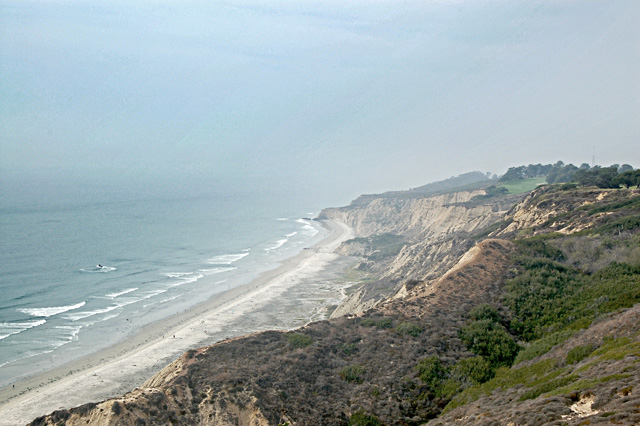
I am only a novice photographer, but am trying to get better results than I used to with just a compact digital camera.  I am using a Nikon D50, in this case with a 18-55 zoom lens and a UV filter.  I am shooting at maximum res. and quality because I have a big memory card so what the heck.

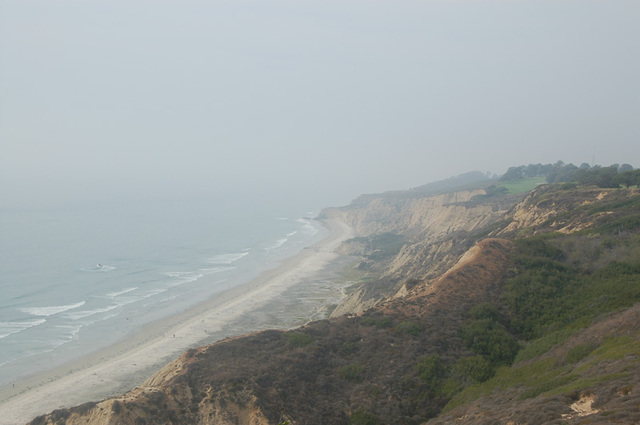
This is the kind of shot that is frustrating the heck out of me.  This was taken in the afternoon down the beach from the Torry Pines glider port.  The problem is that the subject on this day looked gorgeous through the viewfinder, but the pictures are coming out looking much hazier than I remember it being.  Is this a filter issue, a settings issue?  Or is it just normal under certain light conditions?  And is there anything in post-processing (e.g. photoshop) that I can do to get rid of some of the haziness?  On the latter note, I played around with contrast and color saturation but couldn't get anything that looked natural.  [click on thumbnail below to see larger version]

Torrypines

Update:  I played around with this link in the comments, and got this, which is OK but I introduced some noise, but with some practice I got better.

Test_beach

After practicing, I tried it with my photos out the window of the London Eye and saw a great improvement, with before and after below:

BeforeAfter

Nothing substitutes, of course, for taking the right picture with the right initial settings at the right time of day, something I need a lot of practice on.

On the upside, I took some closeups of flowers that just looked gorgeous:

Flower

Bathroom Liability?

I was in the Peoples Republic of Santa Monica this weekend.  Yes, I'm glad I don't have to live there (but I paid $50 per night in hotel taxes -- wow!) but the beach is gorgeous and the weather usually good.  We were shopping down the 3rd Avenue outdoor mall and were in a fairly large (3 story) Borders Books store when we found there was no bathrooms for customers.  The manager told us that it was for liability reasons.

Liability?  Has it really gotten this bad, or is this just becoming the convenient excuse nowadays when any public service is not offered?  I did a search and found that Santa Monica is ruthless in going after ADA access issues, so my guess is that they could not bring their bathroom into compliance in this older building for the 0.1% of customers who were handicapped so they closed it for the other 99.9%.  My other guess is that it might have something to do with the huge homeless population in Santa Monica, perhaps with them having trouble barring access to them (the public restroom we finally found had a homeless man camped out in it).

Climate Web Site

A couple of days ago I expressed frustration at finding a source for even-handed analysis of climate issues.  As someone who accepts more warming than zero but less than Al Gore espouses, I'd like to find a source of climate analysis that I could count on to look at all sides of the issue.  Recently the Prometheus web site was recommended to me.  I am still reviewing it, but you might want to check it out.

By the way, coming soon is the climate cage match to be held by the US House of Representatives.

Asking for Conservation

Have you ever heard of government authorities making public statements around Valentine's Day to please conserve on roses since we are entering our peak demand season for them and rolling shortages could ensue?  No?  Never?  Well, the demand spike for roses on Valentines is much more dramatic than the demand spike for power on a hot summer day.  So why no urgent government messages for conservation of the former but constant ones for the latter?

Because the rose market is not heavily regulated.  Producers are free to manage their capacity without government interference, and, perhaps more importantly, producers are free to charge peak pricing in high demand periods.  In fact, prices for roses on Valentines go for a multiple of everyday pricing that a similar differential in a peak supply period at, say, a gas station would likely get the proprietor arrested for price gouging.  But we recognize that its tough to manage a business to supply all its capacity in one day of the year, and accept the higher pricing.  Why is it we can't accept the same facts of life in electrical generation, where capacity is orders of magnitude more expensive to manage than rose growing?

More from Llewellyn Rockwell at the Mises Blog and Lynn Kiesling at the Knowledge Problem

AZ and Small Government

One of the good things about living in AZ is that it is the home of several of the unfortunately dwindling number of Republicans who consistently cast votes for lower taxes and smaller government. 

Recently Arizona Congressman Jeff Flake, who I have given props to in a number of columns on this blog, sponsored a series of 19 bills aimed at cleaning up the appropriations process and making it harder for Congress to slip earmarks through the appropriations process, at least without having gone explicitly on the record as having done so. 

The Club for Growth has a scorecard of how each Congressman voted on these bills.  In each case, a 'YES' vote is a vote against pork and a vote to clean up the Congressional appropriations process. 

My Congressman, John Shadegg, who is another reliable small government low tax voter, came through with 19 of 19 'Yes' votes.  Way to go Congressman!

A Final Note on "Don't Know Much About History"

In an earlier post, I observed that my audio CD of the bestselling book "Don't Know Much About History" struck me as extremely odd, focusing on only the lowest points in American history.  I can report after finishing the CD that it stayed on this path to the end.  After the Cuban Missile Crisis we had conspiracy theories of JFKs death, then the Mai Lai massacre, then Watergate, then Iran Contra, then Monica Lewinsky.  Yes, the last 40 years were summed up in total as Mai Lai - Watergate - Iran Contra - Lewinsky and essentially nothing else.  Wow, what a view of history!  As a libertarian, I am happy to showcase the foibles of government, but this seems like a crazy loss of perspective even to me.

In addition, bits of the history were just terrible.  For example, he said that the Puritans who came to America were much like a cult today and treated as such.  That is a lame simplification of history.  Sure, one can argue that today's religions were yesterday's cults, but it is silly to say that the Puritans were treated poorly in England for the same reasons a cult might be today.  This completely ignores the whole reality of having a state religion in England at the time of the Puritans.  A state religion trying to purge itself of dissent is a really different dynamic than a modern cult getting shunned by mainstream society  (except perhaps when Janet Reno controls some tanks).  This distinction is also important because avoiding state religions is an important foundation block of our government, and its prohibition is buried in that arcane and little discussed thing called, uh, the First Amendment. 

It's clear the author is not a big fan of capitalism, and I would generally not even comment on such a thing because it is so common in academia.  I managed to mostly ignore numerous off-the-cuff quips he makes about evil corporations and greed and the assumption that any action by a rich person had to be out of a desire to repress the masses rather than from principle.  However, his bias creates some really bad history in at least one instance.  In discussing Hoover and the depression, he really lays into Hoover for how block-headed and absurd Hoover was for not initiating massive government welfare programs earlier in his administration.  I mean, he absolutely hammers Hoover for being a total cretin, and the author laughs at various Laissez-Faire speeches by HH. 

But this is a stunning loss of context for a historian.  While government handouts to people who are out of work may seem a no-brainer today, it was absolutely unprecedented at the time.  It had never been done.  And, nowhere in the Constitution, whose 10th Amendment specifically says that Congress only has the specific powers enumerated in the Constitution, does it say Congress has the power to tax one person and give the proceeds as a handout to another to relieve economic distress.  In fact, it was enough of a Constitutional question mark that the Supreme Court would later rule unconstitutional most of FDR's new deal, at least until FDR could repack the Court with his guys.  HH had good reason, beyond just his principles, to believe that he would be breaking the law and violating the Constitution to do as the author suggests.  But nothing of this context is mentioned.  The author only portrays Hoover as an idiot for not being interventionist enough. 

In fact, the author leaves out a point I would tend to make first -- that the Depression would have been much better off if Hoover had in fact been truly Laissez Faire.  Unfortunately, his tightening of money supply in the face of a depression and liquidity crisis via the relatively new Federal Reserve, his acquiescence to the Hawley Smoot tariffs, and his tax increases to close the budget deficit all contributed far more to sending the train off the rails than any intervention could have ameliorated.

This is Sick - Dukakis Advocates Jobs Go To White People First

Many of you will know that a big impetus for the original minimum wage laws in this country were a racist effort by unions (almost exclusively made up of white workers at the time) to protect white jobs from competition by low-skilled blacks.  [note:  This is not the only impetus, however.  Many of the original minimum wage supporters were not racist at all.  However, a large number of the original supporters of the legislation liked it in part because it was seen as sheltering higher skilled white workers from black competition, particularly in northern states experiencing substantial migration of black workers from the deep south]

This week, in the New York Times of all places, Michael Dukakis and Daniel Mitchell return to these same racist roots to justify a substantial hike in the minimum wage.  Their logic is that it will protect white workers from competition from immigrant (read: Mexican) labor:

But if we want to reduce illegal immigration, it makes sense to reduce the
abundance of extremely low-paying jobs that fuels it. If we raise the minimum
wage, it's possible some low-end jobs may be lost; but more Americans would also
be willing to work in such jobs, thereby denying them to people who aren't
supposed to be here in the first place

By the way, note that we finally have prominent liberal voices who will acknowledge that raising the minimum wage reduces the number of jobs.  Also note that while the authors try to narrow their focus to illegal immigrants, no such narrowing of effect would occur in real life:  All low skilled people, legal or illegal in their immigration status, would lose jobs.  But for the authors this is OK as long as more brown people than white people lose their jobs.  I mean really, that's what they are saying:  We like this law because it will preferentially put low-skill people, particularly brown people, out of work.  If Rush Limbaugh had said the same thing, there would be a freaking firestorm, but there's the good old NYT lending their editorial page to this sick stuff.  Marginal Revolution has more comments along the same lines.

I am sick of the condescension and arrogance that comes with statements like theirs that Americans won't work for the minimum wage.  That's ridiculous, because many do, and have good reason to.

Take my company.  A number of my workers are paid minimum wage. Am I the great Satan? Why do my employees accept it?  Because 99% of my workers are over the age of 70 -- they work slower and are less productive, but I like them because they are reliable.  There's no way anyone is going to pay them $15 an hour to run a campground -- for that price, someone younger and faster will be hired, but at or near minimum wage they are great.  And they are generally happy to start at minimum wage (plus a place to park their RV for the summer).  In fact, I have more discussions with employees trying to get paid less (conflicts with social security and retirement benefits and disability payments) than I have people asking for more. 

Granted, my situation is fairly unique.  But Michael Dukakis in his infinite wisdom thinks no one under any circumstances should be allowed to accept less than $8 an hour for his labor.  What does he know about campgrounds or my employees?  Nothing, but he is going to try to override my and my employees' decision-making if he can.  Because he knows better. 

Maybe Mr. Dukakis can write a note to all my older, slower employees after the new minimum wage passes and explain to them why they should be happier without a job camp-hosting (which most of them love to do, probably more than you like your job) than having to accept a wage that Mr. Dukakis thinks to be too low. 

Continue reading ‘This is Sick - Dukakis Advocates Jobs Go To White People First’ »

Don't Know Much Good About America

One of the ways I like to pass the time on long drives (we went to San Diego this week with the kids) is to listen to audio books in the car.  For this trip, my wife picked out Kenneth Davis's Don't know much About History.  This particular version had been edited down to a quick 3-1/2 hours.

Its of course impossible to edit American history down to this short of a time, but we thought it might be enjoyable for the kids.  Also, I am used to the general "America sucks and its heros suck too" tone of most modern revisionist history, so I was kind of prepared for what I was going to get from a modern academician.   But my God, the whole history of this country had been edited down to only the bad stuff.  Columbus as a source of genocide -- the pettiness of American grievances in the revolution -- the notion that all the ideals of the Revolution were so much intellectual cover for rich men getting over on the masses -- the alien and sedition acts -- slavery -- massacre of Indians and trail of tears -- more slavery -- civil war -- mistreatment of the South after the war by the North -- more massacre of Indians -- Brown vs. board of education -- the great depression as the great failure of laissez faire economics -- did Roosevelt know about Pearl Harbor in advance -- McCarthyism -- racism and civil rights movement.   All of this with numerous snide remarks about evil corporations and rich people and the never-ending hosing of the poor and women/blacks/Indians (often in contexts entirely unrelated to what he is talking about, such that the remark is entirely gratuitous).

That's as far as we have gotten so far, but I am really giving you a pretty honest outline of the segments.   I have zero problem admitting that America's treatment of its native populations was shameful and worth some modern soul-searching.  Ditto slavery.  But to focus solely on this litany, with nothing about the rising tide of standard of living for even the poorest, of increasing health and longevity, of the intelligent ways we managed expansion (like the homestead act), of having the wealth and power to defeat fascism and later communism in the 20th century when no one else could do it.  Of creating, in fits and starts and with many long-delayed milestones, the freest country in the world.  Of a history where every other democratic revolution of the 18th and 19th century failed and fell into chaos and dictatorship but this one succeeded.  He begins the book by saying that he is bravely going to bust all the myths we have grown up with, but in essence helps to reinforce the #1 myth of our era:  That America is a bad actor on the world stage and less moral than the countries around us.

Which of course, is insane.  And remember, I am the first one to criticize our government over any number of issues, but the moral relativism that academics apply to America represents a shameless lack of correct context.  To borrow from a famous saying, I am willing to admit that America has the most shameful history, except for that of every other country in the world.

Postscript:
I don't even deny that a book with the premise that "schools and media often gloss over the bad stuff, so I want to let you know that America has a dark side too" would be a perfectly viable project.  However, this book represents itself as a general history text, and does not claim this particular mission as its context.  By the way, I am not sure what country he is living in if he thinks this stuff is not taught in schools.  My kids' schools totally wallow on all the bad stuff - the racism, the environmental problems, etc.  I would be willing to bet more graduates of public schools today could answer "Maintenance of slavery" to the question "what was the biggest failure of the Constitution" than they could answer the question "Why did the US Constitution succeed when so many other democratic revolutions failed?"  The latter is a much more interesting question.  Of course, in this audio book, predictably, Mr. Davis addresses the former in great depth and never even hints at the latter.

Special Minimum Wage for Big-Box Retailers

Chicago has become the latest city to try to impose special wage requirements solely on one sector of one industry, ie on big-box retailers like Wal-mart.  One wonders how anyone can bend the notion of "equal protection" to support this kind of hash, but rather than again refuting this silliness for about the 89th time on this blog, I will leave it to Cafe Hayek and Russel Roberts.  I particularly liked the way he rewrote the story for the Chicago papers:

Imagine a different world. A world where the City Council was blamed for the
failure of Wal-Mart and Target to pay a decent wage. Here's how the story might
read:

After years of disastrous decisions in running the public
schools, it has become clear that Chicago's City Council has failed the children
of the Chicago area. After attending these mediocre schools, many children of
the city have inadequate skills to be successful in the labor
market.

"Something must be done," declared Ald. Johnson. "If we had
decent schools, we wouldn't have this problem and people could live on the money
they made."

Johnson has proposed a bill that would require all Chicago
City Council members and teachers and administrators in the Chicago school
system to pay a special tax. The proceeds of the tax would help provide workers
in the member's district with a living wage.