The 41st Worst Jobs Report Ever

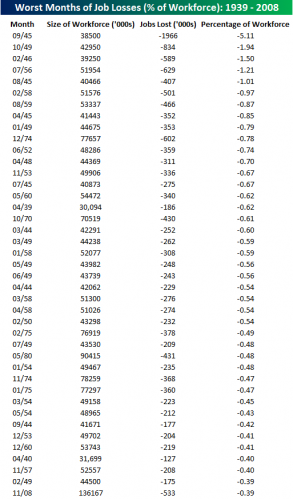
This was sent to me by a reader:  Much as looking at percentage moves in the Dow is much more meaningful than looking at nominal points moves (500 points means a lot less when the average is at 10,000 than when it is at 1,000), it is useful to look at the recent jobs report in the same way.  While 553,000 lost jobs is certainly a lot, it is only the 41st worst loss since WWII when looked at as a percentage of the workforce  (and it would be much further down the list if we had similar metrics back into the 1930's and 1920's).  Via Bespoke Investment Group:

jobloss

This tends to confirm the statement I made last week, that this recession is likely worse than anything a 20-something Obama supporter can remember, but is not yet even close to some of the problem years of the 1970's, much less the 1930's.

By the way, it is interesting to see all those 1950's dates in there but no dates in the last 25 years, given there are many who have been writing about the current economy being so much riskier for workers than the 1950's.

The Glass Floor

I also thought about titling this post "Recession:  Rich, white males hardest hit."  This is one of the more interesting economic/demographics charts I have seen of late  (of course from Mark Perry):

malefemale

See Mark Perry's post for more, and some guesses at explanations.

Depression Doubt

MaxedOutMamma (an economist somewhere but she seems to only drop tantalizing clues as to where she plies her trade) is concerned:

I was troubled by how many people seemed to feel the economy wasn't in deep trouble.   Profound skepticism and the belief that this is all media/political highjinks seem almost to be the consensus.

I guess you may have to put me in the majority.  I certainly don't doubt that we are headed for a recession.  And it would not surprise me if this is the worst recession that most 20-something Obama voters have experienced, though that is not saying much.  But I am not sure we are even facing the Seventies in this one and we certainly are not facing the 1930s.

Here is the problem that we more casual consumers of economic news must struggle with -- the media has fairly accurately predicted 20 of the last 3 economic downturns.  Everywhere you turn, you see analogies to the Great Depression, a period of time where unemployment topped 25%.  Given the media's track record and the nearly breathless panic about the looming economic disaster, any sane person has to put a divide-by-X filter on economic news.  It is certainly possible that I and other are using too large of an X as a correction factor, but is that my fault, or the fault of the purveyors of information who can't tell any story straight.

By the way, for us Polyannas, here are several interesting posts from Mark Perry

Debate on the Left

Apparently, there is a debate on the Left as to whether the 0.01% change in the world's atmospheric composition over the past century is sufficient justification for implementing fascist rule in the US.  David Roberts argues yes.  Kevin Drum, to his credit, argues no.

A Civics Lesson in One Sentance

A month or two back, I was participating in the California Regional Council of Rural Counties annual meeting.  At this conference, I was there to have a sort of informal debate on climate change with Joe Nation, a former California State legislator and currently a private consultant on climate issues.

To some extent my role was frustrating for the audience, because they were already stuck with complying with California's AB32 (a sort of state CO2 cap and trade system) and arguing that such legislation was pointless only served to upset them  (my presentation, both in powerpoint and video is here).  By the way, we often lump "government" together, but I can tell you that while the governor and the legislature of California may be 100% behind CO2 alarmism, the county commissioners were very sympathetic to the skeptic position.

Anyway, towards the end of my presentation I made a plea for a carbon tax over cap-and-trade, and said in fact that California's AB32 was living proof of my argument.  The California Air Resources Board (CARB), which is tasked with implementing the plan, has already added hundreds of people to its staff and worked for over two years, is still no where near finished with rule-making.  The complexity, and the battling political constituencies, is simply mind-boggling.  It is already clear that the result is going to be a Byzantine, Rube Goldberg structure of detailed industry-specific reporting and permitting rules.  Nearly 100% of CARB's time is taken up today with various groups running to them begging for some sort of special treatment (think "carbon bailout" and you will get the idea).  No one thinks the process is fair or rational.

Under cap-and-trade, every single industry will report greenhouse gasses, have industry and firm-specific limits, myriads of permits, etc.  For example, we had detailed discussions that day of how cattle flatulence will be treated and measured.  The alternative is a carbon tax, which is dead simple.  There is one single rate to set - the tax per weight of carbon in fuel.  Fuels with more carbon per BTU, like coal, thereby get higher taxes.  The system works like a sales tax, and could be administered by the BOE (who runs the California sales tax system) in its sleep.

The cap-and-trade system is far more expensive than a carbon tax.  By the basic laws of supply and demand, both systems have to raise the cost of burning certain fuels by about the same amount to get about the same reduction in use.  But the cap-and-trade system brings a huge overhead burden, both in government bureaucracy as well as compliance costs, that make it far, far more expensive for the same amount of benefit.  Until he started sitting on the boards of companies who depend on these inefficiencies in the cap and trade system to make money, Al Gore advocated a straight carbon tax over cap-and-trade.

But we had an opportunity that day.  Because the man who claims to be the author of AB32 is none other than Joe Nation, who was right there in the room.  So we asked him why he took this approach.  Here is what he said, really a civics lesson in one sentence:

I tried pass a carbon tax first, but there was absolutely no support for it among legislators [the same ones who overwhelmingly supported AB32]

If you can understand why this is, you can understand a lot about government.   Because all these concerns that you and I might have about crafting rational public policy are not important to legislators.  Here is how they think about it:

  • Private implementation and compliance costs are meaningless to legislators.  There is no public measurement or accountability for these costs, and most of these costs fall on businesses, who can be ignored as unsympathetic in political discourse.  I operate in Mono County, California, and they put out a new set of reporting requirements driven, they said, by the needs to save a few hours a year of their auditors' time.  But compliance with these new rules costs our company 10-20 hours, at least, a year.  And we are just one of many, many companies reporting.  I complained that it was crazy for them to ask taxpayers to spend hundreds of hours of labor to save them just a few, but they could not have cared less.
  • For legislators, particularly in California, creating large new bureaucracies is good.  It creates a patronage relationship between the legislators and these new government employees that is almost quasi-feudal.  Public employees are an enormous source of support for incumbent politicians, and these bureaucracies also offer future employment opportunities for legislators once they leave office (nice article here).
  • First, last, and always, the vast majority of politicians are gutless.  That means if they can pass the same tax in a way that is more hidden (ie cap-and-trade vs. carbon tax) they will prefer this approach, even if it means the tax is substantially less efficient.  In the case of cap-and-trade, since costs are hidden and spread around like peanut butter rather than easily identifiable, they can pretend the costs don't exist and, if someone starts worrying about rising electricity costs that result, simply blame the rising costs on the evil power/oil/coal/etc companies.  Obama has brilliantly taken this one step further, by outrageously claiming, in the broken windows fallacy of all time, that cap-and-trade will actually boost the economy through green job creation.
  • A carbon tax gives politicians very little room to extract personal value from the electorate.  Really, there is only one number for everyone to argue over.  But cap-and-trade is a Disneyland for lobbyists.  There can be special exemptions, industry specific caps, firm-specific caps, geography-specific caps.  Once everyone sees the first few guys giving campaign donations and parading into CARB for special treatment, everyone feels like they have to in order to avoid being the one guy left out.  My guess is that cap-and-trade will spawn more lobbying than any other legislation in US history.  And politicians, no matter what their public stance, love lobbying, because everyone who comes to ask them for something knows there has to be a quid pro quo.

Update:  A number of related thoughts and posts here, at Reason.

Jon Stewart on Mumbai

Pretty funny.  Even funnier when you consider it is probably the most dead-on analysis of terrorism you will see in the MSM this week.

Person Who Will Lose a Lot of Money in GM Bankrupcy Says that GM Bankrupcy Would Be Bad

Via the AZ Republic:

Fritz Henderson, president and chief operating officer of GM, said that choosing the bankruptcy route would further erode consumer confidence in the automaker and "we want them to be confident in their ability to buy our cars and trucks."

In order to save the value of their executive stock portfolios, which are a large part of their compensation, auto executives are promoting the line now that consumers will for some reason stop buying GM cars if the company is operating under Chapter 11 protection.

The auto-makers real strategy is to get some kind of money, almost any amount will do, from the government ASAP.  It really doesn't matter how much, because with their cash burn rate almost any amount Congress gives them right now will not last much more than 6 months, and certainly will not be enough to reach recovery (their requests go up by a few billion each time they appear in front of Congress).  Automakers are facing potentially several years of recession, and any real restructuring would take 5 years or more (and even that is doubtful since the industry has had 30 years of notice on these issues and have not done anything).  But if they get some cash, then there will be a psychological pull for Congress to put in more.  They will say -- well, you've already put in $5 billion.  If you don't put in another X billion, that first 5 will have been wasted  (few people understand that "sunk costs are sunk" and Congress is no exception).  This is how expensive transit projects are funded.

The position that customers will stop buying the product due to some loss of confidence in chapter 11 doesn't hold up.  Most every airline traveler has flown on an airline operating under chapter 11 in the last 10 years or so, and if I can have enough confidence that an aircraft is being adequately maintained in bankruptcy, I can probably muster the courage to buy a car.  I presume the issue here is downstream warranty support.  But this is about the last thing that would ever be slashed in a chapter 11.   For God sakes, airlines have never even substantially disavowed frequent flier miles in a bankruptcy, surely a much more obvious target than warranty repairs.

I would argue that it is uncertainty that is driving any loss of confidence  (in fact, sales have plummeted already, ahead of any chapter 11).  A chapter 11 filing would actually increase certainty, as those running the receivership could quickly communicate principles to be followed in the bankruptcy, such as protection of warranties. Right now, people have a perception that in a bankruptcy, GM would go *poof*.  Once it actually files a chapter 11, the media and executives would switch modes from fanning panic to actually explaining how receivership works.

In fact, if there is any fear on the issue of long-term warranty support, it is being created by executives like Henderson who are fanning the flames of fear in a brinkmanship game to try to avoid chapter 11.  If he were really worried about this loss of confidence, he and other auto executives would be out there assuring people that their cars and servicing and dealers will also survive a chapter 11 filing.  But he is not.  This is totally disingenuous.

More on why GM should be allowed to fail here and here.

So, We Are All to Blame

I blame the English and all of us in the media for the 9/11 attacks on Manhattan.  If we had just stuck with "New Amsterdam" rather than having the name forcibly changed to New York by Anglo chauvinists, the WTC would never have been attacked.  We all conspired in this tragedy by continuing to call it "New York."

Crazy?  I would have thought so, but apparently this logic is quite in vogue


Postscript:  I find it moderately hilarious to see folks on the left defending names imposed by western colonialists over indigenous names.  But if it makes us Westerners to blame for terrorism, I guess it's in a good cause.

United In Film Criticism

Kevin Drum and I disagree about many things.  I read his blog specifically to find things to refute.  But it turns out we had the exact same two reactions to Quantum of Solace:

Now, I also happen to think Quantum of Solace wasn't a very good movie. The pace was so frenetic "” chase, fight, chase, fight, chase, fight "” that there was hardly any story that seemed worth following, and what story there was just wasn't very interesting. (Cornering the water supply of Bolivia? Seriously? And you thought the later Roger Moore movies were ridiculous?)

My reactions were here and here.

If Only the US Been Part of the Soviet Economy...

... then it would be much easier to reduce CO2 production, because we could just shut down stupid-inefficient boneheaded and outdated Soviet-era industry, like Poland has:

Polish Prime Minister reminded that the economy of Poland, who has cut carbon emissions by about 30 percent since 1988, relies on coal for up to 90 percent of its energy needs. This, he argued, entitles Poland to encourage other countries, for whom climate protection is a hard nut to crack.

Amount of Polish CO2 reduction that would not have happened anyway in the course of modernizing their economy and is instead due to focus on CO2:  Zero.

More on how the vast majority of European progress towards Kyoto goals is due to the shutdown of Soviet industry, and how this is the primary reason the 1990 benchmark date was chosen, here.

New Climate Presentation (From the RCRC Climate Debate)

I have finally been able to publish a video of my presentation at the climate debate held by the Regional Council of Rural Counties last September.  The entire video is about an hour long.  As usual, I am offering several ways to view it.  First, it has been posted on YouTube but had to be broken into seven parts.  The playlist of all seven parts is below:

The playlist link is here:  RCRC Climate Debate (Skeptic's Side)

Unfortunately, YouTube crushes the resolution so many of the charts are hard to read.  You can download the full resolution windows media version (about 96MB) as long as my bandwidth holds out by right-clicking and downloading form this link:  Download RCRC Climate Debate (wmv)

Also, you can stream higher resolution version of this film (and all my other climate films) at this site.  The resolution is not as good as the downloadable version but is much better than YouTube.  Again, bandwidth pending.

Finally, you can download the actual powerpoint presentation shown in this video here or you can view the presentation online here.

In the future, all of my videos and presentations will be available via the links just under the banner at Climate Skeptic.

Random Thought on Home Ownership

I'm thinking of the three major consumer purchases that are probably at the base of the hierarchy of needs:  Fuel, food, and shelter.  Its interesting how very different the media and public perception is of price changes in these areas.

The reaction to fuel price increases is easy to predict - they are always portrayed as bad.  Rising prices hurt everyone, producers are evil, and speculators who make bets on rising prices are even more evil.

The reaction to rising food prices is more mixed.  That's because we have come to the collective decision that producers of food are sympathetic figures whereas producers of oil are unsympathetic.  So media laments about rising food prices are often tempered by good news stories about rising farm profitability.

And then there is shelter.  For this category of consumer expenditure, everything is flipped on its head.  Rising prices are good, and falling prices are bad.  One might argue that housing is different, because consumers often take an equity position in shelter that they do not take in food or fuel.  But all this means is that home buyers are speculating on the price of shelter, going long on bets that prices will rise.  They could easily just rent, and pay for their shelter month-to-month like they pay for their food or fuel, but many consumers bet on rising rents and shelter prices by buying shelter futures (ie purchasing a home).  In a real sense, home buyers are all speculators (using margin accounts at that!), but this is one case where we encourage speculation, and even have tax subsidies for it.

If the reader finds this a funny way to think of home ownership, here is a thought experiment.  Let's say at the age of 30 I wanted to take an equity stake in my current and future fuel needs.  I take out a loan to buy enough Exxon stock such that the annual dividends will cover my fuel purchases for the year.  If fuel prices go up, the dividends likely go up as well, so I am sheltered from the vicissitudes of worrying about my monthly fuel bill, and all I have to do is pay off a regular and predictable mortgage on my Exxon stock.  In 30 years, when the note is paid off, likely I have a big capital gain in my Exxon stock, which I could cash in at retirement if I want to downsize to less driving and fuel use.  Or I can pass it on to my kids.

The only difference I can come up with, economically, between this example and how we do housing is that in my example, consumer capital is invested in productive enterprises rather than dead real estate.

Fight Price Gouging

LOL, via Phil Miller:

Please join me in support for poor, beleaguered gas station owners, the victims of unconscionable price gouging by ruthless consumers who are taking advantage of market conditions to reduce their demand for gasoline,  riving down the price by nearly $2 per gallon over the last four months. Fortunately, governments are swinging into action. Georgia governor Sonny Perdue issued this statement:

"The financial crisis has disrupted the consumption of gasoline, which will have an effect on prices. However, we expect the prices that Georgian gasoline station owners receive at the pump to be in line with changes in consumers' incomes and the prices of substitutes and complements. We will not tolerate consumers taking advantage of Georgian business owners during a time of emergency."

Concert Review: Trans-Siberian Orchestra

If it's almost December, it must be time for the Trans-Siberian Orchestra tour.  My son describes them as the "rock electronic Christmas band," and that is as fair a label as any.  Many tend to compare TSO to Mannheim Steamroller, the other band that has created a niche for themselves with modern takes on Christmas music, but TSO tends to skew more towards heavy rock than Mannheim Steamroller.  I think TSO is similar in many ways to Emerson Lake and Palmer, both with their tendency to cover classical songs as well as their flirtations with pretentiousness in some of their productions.  For those unfamiliar with TSO, probably their most famous work of late was "Wizards in Winter," parts of whose music video I think was included in a beer commercial last year.

My son and I got tickets to the concert because we had a couple of TSO albums (we tend to like the instrumentals and think less of the vocals).  What we had not realized is that TSO has quite a cult following.  Most of the folks around us in the audience had been to 3,4,5 or more of their shows.  Many go every year, in a ritual similar to how other folks might go to the Nutcracker every year.

There is no doubt that TSO delivers value to its fans.  We saw their second show of the day (!) and they played for a full three hours.  Members of the band at different points went all through the audience, down aisles and up stairs while playing some of the final tunes -- far more intimate contact than you will get in most other bands.  The key band members all were present after the show in the lobby for a meet and greet with their fans. 

OK, so what about the show?  Well, I was a little disappointed.  To be fair, their leader had a knee injury which forced him to play sitting down, and this tended to reduce some of the band's energy.  The music was generally good to very good.   The keyboard solos and the high-energy songs at the end were terrific. 

The problems were twofold.  First, the opening half of the show was stitched together with a narration that was just painful.  The poetry was Touched by an Angel meets Dr. Seuss.  It was a Night Before Christmas crossed with LA noir.  It just did not work for me, and I know it was weak because my 14-year-old son was laughing at it.  We both thought we were watching Spinal Tap 2.

The other problem is one that TSO fans will call me out for, but the light show through all the songs was just too much.  Don't get me wrong, I have never, ever seen anything to rival the floor show here - 6 trillion lights on the fastest-changing programming I have ever seen, zillions of lasers, flames, more flames, a ten-minute snow storm, band members descending from the sky, band members ascending to the sky, etc. etc.  You can get an idea of about 1% of it with this video  but any digital camera image of the show is worthless because the ccd can't possibly keep up.  Seriously, this video grossly understates the full effect.

The problem was that my eyes could not keep up either.  I have walked away from concerts thinking I had a perforated ear drum, but never before thinking I had a burned-out optic nerve.  My son said he needed to wear eye-plugs.  90% of the effects would have been OK had it not been for the direct audience facing lights at about 6 trillion candle power they kept insisting on flashing in my face.  Anyway, we both are quite experienced with loud, heavy metal concerts and we both walked away with a headache from this one.

Anyway, it was interesting and I am glad I went.  And I may even go back next year, but I will be prepared - I am bringing my RayBans next time.

Additional Thoughts on Letting GM Die

I have gotten a lot of email on my posts about allowing GM to die.  Here are a few thoughts:

  1. No matter what our mutual preferences, GM is not actually going to die.  It will go in to chapter 11 and reorganize, and, as that law intends, will continue to operate through that reorganization.  While Lehman and Enron liquidated, they were really special cases having more to do with financial than operating assets.  In the last 20 years, Texaco, PG&E, Worldcom, Delta, and UAL have all passed through chapter 11, and all operated their businesses through bankruptcy.  In fact, all of Enron's pipelines and other operating assets are running A-OK right now, just under new ownership.  Do you remember all those news stories about massive natural gas shortages because Enron's pipelines all stopped operating when it declared bankruptcy?  Yeah, neither did I.
  2. You are welcome to write me about how I suck because your job at GM (or retirement, or health care, or all of the above) is important to you if that helps you psychologically to manage a terrible and stressful time.  But, to cause me to back off my opinion about GM and the bailout, you need to tell me why your job is more important than someone else's job.  Because, unlike private enterprise, the government does not create wealth, but can only move it around (with a leaky bucket, at that).  GM has wasted hundreds of billions of dollars of investment, so having the government invest money to save your job will likely cost >1 job somewhere else.  Just because we don't, and may never know, who that specific person is does not make this an ethical choice. 
  3. I too, all things being equal, value having a healthy auto industry in the US  (which in fact we still have -- it just happens the headquarters of many of the companies that run the plants are over in Japan).  However, if you wish to argue that the bailout is necessary to save a US auto industry, you in fact need to argue that the current set of managers/contracts/systems/performance measures/organization/etc. of GM are better able to manage the employees and assets of GM than a different owner with different managers and approaches.  Because having GM fail does not make the assets or trained people disappear, it merely makes it more likely they will be managed by a different entity.  So all a bailout does is save the GM entity that manages these assets and people.

Perversity of Government-Selected Winners

Technocrats love to pick winners.  Leftish technocrats, in particular, love to believe that the complex operations of the entire economy choose technologies that are inferior to those the technocrat would have imposed on the economy had she been in charge.  But here is what happens when they try, in a cautionary tail that is particularly relevant given the number of specific technologies Barack Obama has said he would promote (e.g. a million plug-in hybrids by 2015) (via Tom Nelson)

The federal government has invested billions of dollars over the past 16 years, building a fleet of 112,000 alternative-fuel vehicles to serve as a model for a national movement away from fossil fuels.
But the costly effort to put more workers into vehicles powered by ethanol and other fuel alternatives has been fraught with problems, many of them caused by buying vehicles before fuel stations were in
place to support them, a Washington Post analysis of federal records shows.

"I call it the 'Field of Dreams' plan. If you buy them, they will come," said Wayne Corey, vehicle operations manager with the U.S. Postal Service. "It hasn't happened."

Under a mandate from Congress, federal agencies have gradually increased their fleets of alternative-fuel vehicles, a majority of them "flex-fuel," capable of running on either gasoline or ethanol-based E85 fuel. But many of the vehicles were sent to locations hundreds of miles from any alternative fueling sites, the analysis shows.

As a result, more than 92 percent of the fuel used in the government's alternative-fuel fleet continues to be standard gasoline. A 2005 law -- meant to align the vehicles with alternative-fuel stations -- now requires agencies to seek waivers when a vehicle is more than five miles or 15 minutes from an ethanol pump.

The latest generations of alternative vehicles have compounded the problem. Often, the vehicles come only with larger engines than the ones they replaced in the fleet. Consequently, the federal program --
known as EPAct -- has sometimes increased gasoline consumption and emission rates, the opposite of what was intended....

The Postal Service illustrates the problem. It estimates that its 37,000 newer alternative-fuel delivery vans, which can run on high-grade ethanol, consumed 1.5 million additional gallons of gasoline last fiscal year because of the larger engines.

The article does not even mention that E85 ethanol made mostly from corn does absolutely nothing to reduce total CO2 production (it just shifts it around, due to the amount of energy required to grow corn and convert it to ethanol) while raising food prices.

California did something like this years ago, putting the force of subsidies and state law behind zero-emission vehicles.  This wasted a lot of money on electric and hydrogen vehicles that were not yet technologically mature enough to prosper, while missing out on low (but now zero) emissions approaches that could have had much more impact because they were technologically ready (e.g. CNG for fleet vehicles).

Y'all know where I stand on the dangers of CO2.  But if we really have to do "something", then the only efficient way to do it is with a carbon tax.  But politicians hate this idea, because they don't want to be associated with a tax.  But the fact is, that every other action they are proposing is a tax of some sort too, but just hidden and likely less efficient.  There is no magic free lunch that Barack Obama and his folks can think of and impose, no matter how smart they are.  In fact, to some extent, smarts are a hindrance, because it tempts people into the hubris of thinking that they are smart enough to pick winners.

Postscript: If you are reading this and thinking "well, if I were in charge, I would not be that stupid and I could make it work" then you don't get it.  1)  No one can make it work, for the same reasons the Soviets could not plan their economy from the top -- its just too complex.  At best, policy-makers are choosing between a handful of alternatives to back.  In contrast, every individual has a slate of opportunities to reduce his/her CO2 production at the least cost, and when you add up all these individual portfolios, that means there are hundreds of millions of individual opportunities that must get prioritized.  That is what pricing signals do, but government bureaucrats cannot.  2) The morons and knaves ALWAYS take over.  Even if you are brilliant and well-motivated, your successor likely will not be. For years, folks have generally been comfortable with the outsized role of the Federal Reserve because they thought Greenspan  (and Volker before him) ran it brilliantly.  Well, there are arguments to be made about this, but even if we accept this judgment, what happens when the next guy is in charge and is not brilliant?

Postscript #2: If you want a specific example, let's take plug-in hybrids.  How can anyone be against these?  I personally like the concept of cars being driven by electric traction motors (I like the performance profile of them) and would love a good plug-in hybrid.  But what happens when we find out that many of these cars were bought in coal-burning areas where electricity is particularly cheap, and discover coal-fired electricity pollutes more than an internal combustion engine?  Or when we use a cap and trade system to cut back on coal fired plants, and find that the huge number of plug-in hybrids are exacerbating brown-outs and electricity shortages?  Or we find that the billions of dollars of capital diverted by the government to expanding plug-in hybrids could have easily yielded far more CO2 reduciton had it been applied in another area?  That is why a carbon tax is the only way to go (if we are going to do anything) because it allows individuals to make capital expenditure decisions to reduce CO2 based on their vastly higher knowlege of the opportunities and the pricing signal of the tax.
One Word

Are We All Incapable of Doing Anything For Ourselves Any More?

Apparently for some reason having to do with screw-ups and protests in contracting, the State of Arizona is not going to publish a Visitor's Guide.

I run a decent-sized business in Arizona, and have never paid much attention to these guides.  Every state and city and town and county and school district seems to put out some kind of visitors guide, and I could go bankrupt paying for ads in all the ones who hit me with marketing calls.  Customers have a jillion ways to find out about our business, either from Internet searches or private guidebooks and directories.  Heck, when I travel, I usually hit places like TripAdvisor and then run down to Borders to pick up whatever Fodor's guide covers my destination.  I have never even thought about calling the government and asking them to send me a visitors guide, but perhaps some of y'all have.

Anyway, what do I know?  I am just a little small business trying to run a few campgrounds.  Just because I can handle my own marketing needs doesn't mean that billion dollar multinational hotel chains are capable of doing so without the government:

Greg Hanss, director of sales and marketing for the new InterContinental Montelucia Resort and Spa in Paradise Valley, couldn't believe it. "For me, the fact that we don't have a state visitors guide in what is the most challenging economic time of our tourism lives is really disappointing."

Pathetic.  It is interesting to see that, for every 20-something anxiously awaiting the government's takeover of healthcare because they are really bummed about all the work it takes to find the right health care plan, there is a corporation waiting for the US govenrment to do its work for them.

WordPress as a Content Management Tool

My company has over 20 URL's for various recreation facilities we manage.  I do all the design and maintenance of these myself, generally using a shared core design with some color and content changes.  Since this is just a side job for me, I often put it off and unfortunately things get dated fast.

For a while now I have been wanting to experiment with a content management system to ease the maintenance of multiple web sites.  So over the past couple of weeks, I have played around with various CMS's.  I was intrigued for a while by ExpressionEngine, but the fact it was not public domain (ie it charges per site licenses that would be prohibitive for me) finally killed the deal.  I also looked at Joomla and Drupal. 

Eventually, I settled on what many will consider an odd choice:  WordPress.  Yeah, I know, its a blogging engine.  I know quite well, because I am in the process of converting both my blogs from Typepad to WordPress.  I chose WordPress for a few reasons:

  • I understand the blogging paradigm, and so I have a good sense for how the content will be handled, and the limitations.
  • I am, having messed around with my blogs, comfortable with the WordPress templating system.  Though certainly more limited than ExpressionEngine, it does what I need to do. I am moderately facile in CSS and PHP, the two real requirements to make a good template.
  • Most of my sites are simple.  The only two API's I really need to plug in to are Google Maps and Flickr, and I have tested and am comfortable with the available WordPress plugins for these.
  • I want to begin, carefully, to let some of my employees be able to add and edit some content (e.g. changing store hours).  I think the wordpress interface is pretty accessible to some folks who may be new to online content and gives me the amount of control I need as an editor.  For a noob content contributor, WordPress is far more accessible than other CMS's.
  • With a static site, I have an advantage over a blog in that I can turn on full site caching to speed up the site (via WP-super-cache).  I also added an SEO plugin to make my permalinks and pages more SEO friendly, something I don't care that much about on my blog.

I think that the first site came out pretty well, and I don't think its obvious that it is built on a blogging engine (site here, for our Arizona snow play area).  The biggest internal debate I had was whether to go with fixed or variable widths.  I actually went the opposite way of most modern programmers, moving from variable to fixed rather than vice versa.  Most of my customers, as shown by my server logs, have slow and dated computers and monitors, so I think fixed width makes sense. 

Yeah, I know that no one will ever consider me a l33t h4x0r for using WordPress, or even for using a CMS at all, but I was absolutely thrilled how fast the second site is going up now that I have built all the templates and functions I need.  More reports to come  (and hopefully this site will soon be on WordPress, but I am not holding my breath.  Still having trouble with brinking over the permalinks so they all work right).

Wikipedia's Highest and Best Use

Wikipedia is virtually useless as a source for anything controversial, such as global warming.  However, it is absolutely fabulous as a dictionary of pop culture.  Where else can you find 5500 words on h4x0r l33t speech?

Garden Art

My wife and I went to see the opening of Dale Chihuly's new exhibit at the Desert Botanical Garden in Phoenix.  Chihuly is, if not the leading, certainly the most famous modern glass artist  (he is perhaps best known for the lobby at the Bellagio, though this is far from my favorite work).  He has done garden exhibits before, but the shapes and colors were perfect for the desert landscape.

I don't have pictures yet from Arizona (we saw the exhibit at night), but here are some examples of his work:

glass1

And from a garden show in New York:

glass2

Information on the exhibit is here.  Highly recommended for anyone visiting Phoenix this winter.  I think one of the reasons my wife and I like his work is that his work is in some way reminiscent of the handbags she designs.

The Original 9/11, Except it was on 9/16

This was a bit of history I never knew:

wall-street-bomb

"Wall Street bomb." Aftermath of the explosion that killed dozens of people in New York's financial district on September 16, 1920, when a horse wagon loaded with dynamite and iron sash weights blew up in front of the J.P. Morgan bank at 23 Wall Street. The attack, which was attributed to Italian anarchists, was never solved. 5x7 glass negative, George Grantham Bain Collection.

This is from Shorpy.com, a blog that has daily posts with really nice photography from the 19th and early 20th centuries.  The photo above is actually just a thumbnail - go to the original post and click on the full size image.  All of their photos are posted in huge, high-resolution scans.

Yep, This Is The Perfect Antidote for a Recession

Kevin Drum is off his meds, and is generating a lot of good fodder for me today. I made a couple of small edits in the name of intellectual honesty:

The news keeps getting better and better. The House Democratic caucus just voted 137-122 to replace John Dingell (D"“General Motors) as chair of the Energy and Commerce Committee. The new chair will be Henry Waxman, who cares deeply about [0.01% changes in atmospheric composition] and will be a huge ally in the fight to get serious[ly high fuel and electricity prices] next year. This is change we can believe in.

I am willing to put my disagreement with a lot of the world on whether on not global warming is dangerous into the "reasonable people can disagree" category.  But it just strikes me as outright insanity to try to push forward and pretend that anything that makes a meaningful dent in CO2, and so which has to make a meaningful dent in fuel and electricity consumption, will require either massive shortages or much higher prices.  Even a third-way plan that says we will evade this trade-off with new technologies  (whatever the hell those are) faces the massive dead-weight-loss of having to obsolete perfectly good power generation or transportation infrastructure and replace it wholesale with trillions of dollars of new stuff.  If we found out tomorrow that exposed brick caused global warming, and all of our houses had to be knocked down and rebuilt, would anyone really think we were all richer for that?

The amazing thing to me is that the left has all gotten on the "this will be a net positive for the economy, 5 million jobs, blah blah" message.  This is nuts.  This is the broken windows fallacy on Barry Bonds' entire steroid inventory.  Folks often respond to me, "but we will gain because we will reduce the cost of global warming."  But reasonable, non-loony folks don't really honestly think we are incurring any costs right now from global warming.  There is an argument that they might exist 50 years from now and that they might be high enough to get started on now, but for the next 10 years or more, there is just cost, no benefit.

Gut Them Like Trouts

Kevin Drum is glad the Democrats are ready to body-slam the health insurance companies, and is rooting them on:

It means the health insurance industry is scared that we might actually do something in 2009 and they want to be seen as something other than completely obstructionist. That means only one thing: they've shown fear, and now it's time to bore in for the kill and gut them like trouts. Let's get to it.

Because everyone knows that most of the costs of healthcare reform can be paid for by ripping the excess profits out of the health insurance business like a liver from a fish.  Just to remind everyone, these are net profit margins reported by Google Finance for 3Q2008 of the largest health care providers and insurers:

Cigna: 3.50%
United Health Group: 4.56%
Aetna: 3.64%
WellCare:  4.08%
Amerigroup: 3.51%
Humana 2.56%
WellPoint: 5.49%

Napolitano to Homeland Security

Yeah, I know it is not a done deal, but the rumors are that our governor Janet Napolitano will be Obama's choice for Homeland Security.

On its face, this both makes a ton of sense, and simultaneously is odd.  It makes sense because Napolitano is one of those rising Democratic stars who get special love in part for not being white males.  It is odd because pulling her up to Washington would, by law, pass the governorship for the next two years to the Republicans (the Secretary of State completes the term, and she is a Republican).  It also strikes me as odd because I think Homeland Security would be an absolutely awful platform for launching a run for higher office.  That job has no upside - it is all downside.

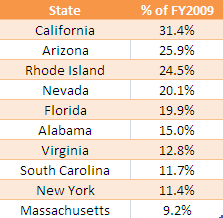
But the final reason in the end that this may make sense can be seen in this table below from Paul Kedrosky on projected state budget deficits as a percentage of state revenues:

state_deficits

Arizona is almost in as bad of shape as California, and California is a disaster area.  So the financial chickens are about to come to roost here in Arizona for the drunken spending spree the state has been on, presided over by Napolitano.  To preserve her from going to the Gray Davis Memorial Retirement Home for Failed Governors, Obama is likely to beam her up to Washington.