Concert Review: Sarah Brightman

I took my wife to see Sarah Brightman last night in Glendale, AZ.  For those who do not recognize the name, she is most famous for playing Christine in Phantom of the Opera, which was essentially written for her by her husband at the time, Andrew Lloyd Weber.  She made an appearance at the recent Beijing Olympic opening ceremonies singing from on top of that big ball-thing.

Her solo career defies characterization.   The two concerts I have seen are a mix of pop/rock remixes (e.g. "Dust in the Wind", of all things),  new agey sounding stuff, opera, and Broadway.  A couple of notes on this concert:

  • Brightman seems to be a bit of a flake.  Her costumes can be downright loony  (think Bjork at the Academy Awards in the swan outfit).   Her stage backdrops all seem to be taken from 1970's Yes and Genesis album cover art.  Her staging is often odd, which leads to some numbers that are really cool and some that I found myself laughing out loud at  (the swimming sequence was cool, as was little Red Riding Hood in the forest).   It was like she was auditioning for her own show in Vegas.
  • In most shows she has one or two male tenors to sing duets with her.  This always tends to be the best part of the show.  She gets top talent here, and, like as not, if you see a guy singing with her this year he probably will be famous next year.  We saw a guy named Mario Frangoulis who was freaking amazing.
  • I really have to criticize the song selection.  Way too much new agey stuff that really didn't seem very challenging.  All I could think of on these songs was that her singing them was like driving the kid's carpool in a Ferrarri.  Because at the end of the day, with the right material, she has a really heart-stopping voice.  But only 3-4 songs really pushed the envelope.

Zappos is the Bomb (Plus Last Minute Gift Idea)

I'm not an affiliate, and I get no remuneration for plugging them, but I must say that Zappos.com is absolutely terrific if you are looking to buy any kind of clothes online.  Originally mainly a women's shoe and accessory store, now it sells all kinds of stuff.

Just as an example, my wife ordered some shoes the other day, and found them to be the wrong size.  She contacted them and got a shipping label for a free return.  Before we even got the box out the door to UPS, the replacement shoes in the correct size showed up at our house.

Guys, if you have not heard of Zappos, the odds are very high that your wife has.  In a feature that reminds me of the heyday of the dot.com bust, they are offering free shipping to arrive by Christmas for orders received before 1PST December 23.  That includes free shipping and overnight delivery of gift cards.

Whew! Done

OK, I think I have finally, successfully migrated both my blogs from the Typepad ASP service to self-hosted WordPress, with the completion of Climate Skeptic last night.  Now I can get back to real posting.

In Medias Res

You certainly don't have to spend very long convincing me that a significant government action can be distortive of markets, so I won't argue too much with Kevin Drum that the capital gains tax changes maybe played a contributing factor to the housing bubble  (though it is hilarious that the left considers tax reductions as the only distortive government actions).

However, thinking back on events, its a little hard for me to ascribe the lion's share of the bubble to capital gains tax changes, as opposed to, say, the mortgage interest deduction or Federal Reserve interest rate policies or local zoning controls.

I probably wouldn't have bothered blogging on this, but I found the chart Drum uses from the NY Times to be hilarious:

19tax-graf01-190

Do you see the problem?  I will help by simplifying the chart:

trand

Its a pretty heroic assumption to say that Event B caused Trend A.

Update:  Russel Roberts thinks the Times is right, but that they are using the wrong data to prove it.  1997 looks much more like the critical inflection point if you look at prices rather than sales  (chart via Roberts, from a different NY Times article, click to enlarge)

house_prices

Back to the 1970s

I have argued for a while that the US appears to be regressing back to the 1970s.  George Bush is showing every sign of rivaling Richard Nixon for the award for most heavy-handed, misguided economic interventions by a President nominally espousing free market principals.  And there is no reason to think that Obama's outsider appeal and leftish economics will clean things up any better than did Carter.

Another sign the 1970's are back is Obama's appointment of Paul Ehrlich buddy John Holdren as his Science Adviser.   The Reference Frame has more on his work and "credentials", but suffice it to say there is very little there.

He is a strong practitioner of what I call post-modern science, where being fact-based and rigorous is far, far less important than coming to politically correct conclusions that are wrapped in just enough pseudoscience to wow science-illiterate media and most of the public.  His only highly cited works are Club-of-Rome type stuff with Ehrlich in the 1970s, and, not surprisingly, climate alarmist work today.   He is the type of scientist that is more comfortable (and better received) on an Oprah episode than in a detailed science debate.  He has a tendency to declare issues settled without having ever produced any evidence, and a history of eventually backing down from ludicrous positions he adopted without evidence in earlier phases of his life, only to then make the exact same mistake again in a slightly modified form.

The title comes from perhaps his most famous work, and is a great example of exactly what this guy is about.  I=PAT is supposedly an equation to measure man's impact (generally interpreted to be negative impact) on the Earth.  The letters stand for Impact (or Influence) = Population x Affluence x Technology **

The fact that he has an "equation" makes it look like science.  But in fact, it is not an equation at all.  He never tries to put any numbers to it, and in fact one cannot put numbers to it.  It is merely a political point of view popular on the left - that growth and technology and wealth are all bad - made to look like there is some science behind it.   It gives the scientific impremateur to something that is no such thing, so limits-to-growth supporters could yell back at their critics that is was "settled science."  Its a kind of voodoo, where activists could wave Holdren and Ehrlich at their critics, to try to keep the fact-Gods at bay.  Similar forces are at work in climate, though climate scientists have learned not to put their equations on paper (since then churlish outsiders can criticize it) but to bury them in a black box climate model.

In fact, even as a concept I=PAT fails.   Because at least two of the three terms have exactly the opposite relationship.  What do I mean?  Well, I guess I could be convinced that, all things being equal, rising human population has a net negative impact on the environment.   But affluence and technology should be in the denominator, not the numerator.  I won't bother with an extensive proof, since Holdren never proves his equation, but I will offer up a couple of thought experiments:

  • Imagine 6-7 billion people on the earth today but with the wealth and technology of the pre-Jethro Tull 17th century.  It would be a freaking disaster.  The catastrophe, to humanity and the environment, would be unimageable.   We are able to have the P we have today only because it is offset by A and T.  Or, in a point made in an earlier post, poverty is not "sustainable."
  • America is demonstrably less polluted and cleaner than in 1970, despite a higher population.  Many areas are cleaner than in 1920, and we have more untouched land and more forest coverage today than we did in 1920.  Why?  Technology and affluence.

If one really wanted to be scientific about it, and studied actual data, I think he would find that environmental impact follows a parabola with development.  Initial increases in population and industrialization lead to messy problems, which are then fixed with increasing wealth and technology.  There are many places in the world where halting growth would merely freeze the country at the top of this parabola.  China is a great example.  China's environmental problems will get solved through increasing wealth.  Stopping it from growing would actually increase the negative impact on the environment.

Anyway, I just spent more time on the proposition than it deserves.  If Holdren ever steps down, I suppose there's always Rosie O'Donnell to replace him.

** This is based on the popular interpretation of the equation.  In fact, in its original form, T was not technology but just a plug factor, something like impact per population-dollar.  At this level, the equation is certainly true, as mathematically it is hard to argue against the equation impact = population x dollars x impact per population-dollar!  So, at some level, the finding was not wrong but simply trivial.  However, in popular mythology, T was changed to technology, and the authors really did nothing to correct this interpretation, because essentially they agreed with it, even if they hadn't proved it.  (more here)  This approach, of proving one thing that is trivial and then claiming the proof is of something broader and more robust is now typical of climate science.

I'd Hate to See Winter

There is some discussion over at Climate Audit about Ojmjakon, Russia in the context of trying to debug some recent NASA temperature measurement glitches.  But I could not get past this data, which really seems a bit nippy for late Autumn:

ojmjakon

Well, as long as its sunny.

Perhaps the Real Issue

I have mixed feelings about the Republican basing of automotive unions.  On the one hand, I see no reason why individuals in a free society shouldn't be able to organize and bargain as a group on wages.  However, this is not a free society, and the union organizing process is one of the most regulated in the country, with numerous state and federal laws that artificially tilt the bargaining and financial power towards unions.  Unions, for example, are the only private organization that I know of in this country that have taxation power, ie the ability to apply non-voluntary financial assessments on a population with the full force of government behind their collection.

But it may be that so much attention has been applied to wages and health care that this issue has been under-reported.  Below is apparently the Ford-UAW 2,215 page contract. Eeek.

rules

How can it be possible to run a company where even the smallest operational improvement idea has to be screened against this document?

Whatever Is The Most Important to You, We Are Cutting That First

The very essence of business decision-making is prioritization and trade-offs.  The same is true in the government, its just that the objective function is reversed:

GM is warming up the propaganda engine for the next run at Congress. "Look, the first thing we had to cut was our electric car program!".

And here I thought that because GM has still, after 30 years, failed to realize their business model needs to change that maybe management there were slow learners.  But they seem to be very, very adept at learning the government game.

When I was in the corporate world, if I wanted extra funds for my projects, I would have to go in and say "Here are all my projects.  I have ranked them from 1-30 from the most to least valuable.  Right now I have enough money for the first 12.  I would like funding for number 13.  Here is my case."

But the government works differently.  When your local government is out of money, and wants a tax increase, what do they threaten to cut?  In Seattle, it was always emergency services.  "Sorry, we are out of money, we have to shut down the fire department and ambulances."  I kid you not -- the city probably has a thirty person massage therapist licensing organization and they cut ambulances first.   In California it is the parks.   "Sorry, we are out of money.  To meet our budget, we are going to have to close down our 10 most popular parks that get the most visitation."  The essence of government budgeting brinkmanship is not to cut project 13 when you only have money for 12 projects, but to cut project #1.

I can just see me going to Chuck Knight at Emerson Electric and saying "Chuck, I don't have enough money.  If you don't give me more, we are going to have to cut the funds for the government-mandated frequency modification on our transmitters, which means we won't have any product to sell next month."  I would be out on my ass in five minutes.  It just floors me that this seems to keep working in the government.  Part of it is that the media is just so credulous when it comes to this kind of thing, in part because scare stories of cut services fit so well into their business model.

So of course, with billions of dollars of waste, absurdly high labor costs, stupid-large executive compensation, etc., GM chooses to cut funding the project that is most important to Congressional Democrats and the new Obama administration.

Ditto

Via TJIC, Radley Balko shares almost exactly my position on the death penalty:

I'm opposed to the death penalty not because I don't think there are some crimes so heinous that they merit death as a punishment. I'm opposed to it because I don't think the government is capable of administering it fairly, competently, and with adequate protections to prevent the execution of an innocent person.

This is an issue that I have moved pretty far on since my high school conservative days.  I used to be a death penalty hawk --  I suppose this was in part due to the natural tendency to take the opposite side of folks making bad arguments.  Death penalty opponents would argue that we just don't have the right to take away the life of that lady who drowned her three kids by sinking them in a car in a lake because she was tired of taking care of them.   Well, I felt she had pretty much forfeited her ability to fall back on the sanctity of life defense.

But I am increasingly pessimistic of the justice system's ability to adequately separate guilt from innocence (it is run by the government, after all).  We have far too many examples of people who have exhausted their normal appeals and have sat in jail, and even on death row, for years or decades before exculpatory evidence came to light (or, in situations of bias like in the deep south, where courts were finally willing to consider exculpatory evidence).   We can only tremble to think of how many innocent men were never cleared before the day of the fatal injection came.  Prosecutors, who often are using the position as a springboard for higher office, generally have the incentive never to back down from a case and to defend every conviction, no matter how clear the evidence becomes that an innocent person is in jail, to the very end  (see Janet Reno, for example, who in a twist of terrible irony now sits on the board of the Innocence project, while men falsely convicted in her day care pogrom still sit in jail).

Update: Speaking of prosecutorial abuse....

Sizing the Bailout

From here and here:

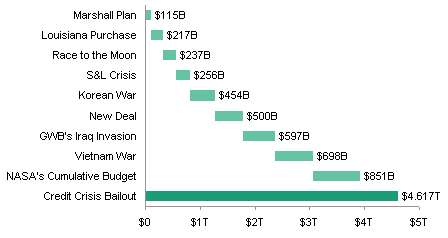
cumbarchartbailout

I haven't checked these numbers, and they are supposed to be all in real dollars, but YMMV.

So we are going to spend 33% of GDP to avoid a recesion, when the worst recession in history (the Great Depression) had a peak-to-trough GDP loss of about 20%.

Update: This chart is obviously based on a lower estimate.  But it does give one pause when considering the "bailout all due to US laissez faire."

sovereign_2

Worst Economic Prescription of the Week

I hate to pick on Kevin Drum twice in a row, but my God is this the worst economic prescription you have read of late:

The only sustainable source of consistent growth is rising median wages. The rich just don't spend enough all by themselves.

The flip side of this, of course, is that rich people are going to have to accept the fact that they don't get all the money anymore. Their incomes will still grow, but no faster than anyone else's.

How do we make this happen, though? I'm not sure. Stronger unions are a part of it. Maybe a higher minimum wage. Stronger immigration controls. More progressive taxation. National healthcare. Education reforms. Maybe it's just a gigantic cultural adjustment. Add your own favorite policy prescription here.

This isn't just a matter of social justice. It's a matter of facing reality. If we want a strong economy, we can only get it over the long term if we figure out a way for the benefits of economic growth to flow to everyone, not just the rich. This is, by far, Barack Obama's biggest economic challenge. Until median wages start rising steadily and consistently, we haven't gotten ourselves back on track.

This is so crazy, its is hard to know where to begin.  And since it is after midnight, I will keep it short.  But here are a few thoughts:

  • Note the embedded theory here of income and wealth, which is really startling.  For Drum and most of the left, income is this sort of fountain that spews forth on its own out in the desert somewhere.   Rich people are the piggy folks who crowd close to the fountain and take more than their fair share of what is flowing out.  There is absolutely no recognition that possibly wealth is correlated with individual initiative, work, intelligence, and behaviors.  More on zero-sum economic thinking here and here.
  • I am sick and tired of the "stagnant median income" meme.  How many times does this have to be debunked?  But the quick version is
  1. Median total compensation per individual is not stagnant, it has risen steadily.  The only way to show stagnant incomes is to look only at cash wages, and ignore the shift in compensation value to health care and other non-cash benefits.  Also, folks trying to push this meme typically look at household income rather than individual income, but since household sizes have been shrinking rapidly, it skews the data.
  2. Median income numbers are weighed down by strong (legal and illegal) immigration.  New immigrants entering at the bottom bring the median down.  If one were to look at apples and apples, ie the same people without immigrants ten years ago and today, one would see strong median income growth.  Just to drive the point home, if there have been 10 million new immigrants at the poor end of the economy, then one needs to count up the list of incomes 10 million spaces to get the true apples-to-apples median income comparison.
  3. Individuals matter, not medians.  Even with a stagnant median income, all individuals can and probably are doing better as incomes improve with age.
  4. A lot more here
  • I feel like I am living in some weird new incarnation of Brave New World or Midas World where the government sets its highest purpose as promoting ever-higher consumer spending.  The last such goal the government set for itself was increasing home ownership.  And that worked out really well.
  • This is back to the 70's time, something I have been predicting for a while.  How is it that educated people can believe that protectionism + strong restrictions on the free movement of people + higher taxes + government tilt of the labor management bargaining power further towards the unions + creation of a massive new government bureaucracy = increased prosperity?  I think of all the crap I catch from leftists that I am somehow anti-science and anti-reason for being a climate skeptic.  But economics is a science too, and willful ignorance of that science is far more destructive than other instances of scientific ignorance to which they point.
  • Isn't protectionism + strong unions + comprehensive 3rd party-paid health care + high government regulation exactly the approach the US auto industry has taken.  How's that working out?

My Education Secretary Pick

Obama has picked Arne Duncan of Chicago as Secretary of Education.  Unwilling to send his own kids to schools run by Mr. Duncan, he is never-the-less putting Duncan in charge of the rest of our schools.

My appointment for the Secretary of the Department of Education would have been the head of a liquidation firm.  As a libertarian, I can find fault just about everywhere in Washington, but nothing better illustrates the modern disregard for the Constitution and the 9th and 10th Amendments than the Federal education infrastructure.  My daughter asked me what I would do first if I were President.  I would put blowing up this department first (though its demise would be neck and neck with the Department of Energy).  I would even be willing to do it in a funding-neutral way, such that Federal funds currently allocated to education would still be so allocated, and simply distributed on some kind of per head basis to local districts.  Which, in fact, would actually increase real education funding, eliminating the great Washington leaky bucket as well as the cost of compliance with reams of rules and regulations that is born by local districts.

It is possible to find a few  (though very few, on a percentage basis) anecdotes of public schools that have been turned around  (in fact, I think there are few enough that a movie can and has been made about every one).  There are no examples that I know of a large school district being turned around.   As to this guy Duncan picked by Obama today --  I am willing to believe he had some point successes at individual schools.  But he certainly didn't turn around the whole district  (certainly not to the Obama family's standards, since they refused to send their kids to the schools Duncan ran).  So what hope does he have at a national level?  Answer:  none.  But I am sure he will ask for more money to do it.

Purposeful Obfuscation

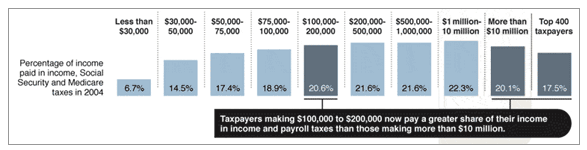
What better way to inaugurate the new blog site than to rant about a Kevin Drum post?  Drum posts this chart today from the NY Times showing a drop-off in the effective total tax rate (income+social security+other stuff) at very high income levels.

drum-tax-image

Well, no freaking duh.    I suspect that this has been true practically forever.  Why?  Because this is NOT an income tax chart, it is a total tax chart.  And as such, it includes social security and medicare taxes (collectively, with a couple of other minor things, called "payroll taxes".  These taxes, about 8% of total income, are a flat tax with a cap around $100,000.  This means that everyone with income under $100,000 pays 8% of all income.  Someone at $5,500,000 (midpoint of the $1 million to $10 million band) pays only 8%  of the first $100,000 or an effective rate of 0.146% of total income on payroll taxes.  For someone in the top 400 taxpayers, the rate is close to zero.   So you really have to add 8 percentage points or so to the higher rates to make them comparable ex-Social Security to rates for earners under $100,000.

Now, we can argue about the regressive structure of Social Security.  But many on the left have opposed making it more progressive.  They want Social Security to perceived as an insurance program, not a welfare/transfer program.   To be insurance rather than welfare, effectively the same income that is used as the basis for benefits must also be the income basis for taxation.  Income over $100,000 is not used to calculate benefits, so it is not taxed.

Here is one person on the left making this point in 2005:

...when his aides presented him with their initial Social Security proposals 70 years ago, FDR balked: "No dole," he said, "mustn't have a dole" "” because he knew instinctively that welfare programs are both fundamentally unpopular as well as corrosive to the human spirit. Conservatives understand this better than liberals, and know perfectly well that the best way to kill something is to convince the public that it's actually a welfare program.

But that's not what Social Security is. It's a modestly progressive social insurance program that's paid for by everyone and that benefits everyone. If it ever stops being that, if it ever stops being universal, it will eventually cease to exist. Don't let anyone fool you into thinking otherwise.

The person who wrote this was ... Kevin Drum.  It is wildly disingenuous to look at income taxes and payroll taxes mixed together.  It is even more so given Drum fully understands why payroll taxes are structured as they are.

Which is all not to say that there is not a really halide point in the article that people in the 100,000-200,000 range are getting hosed.  But I would submit this hosing is more due to work by Drum's intellectual allies than the reverse.  Phase-outs of deductions  occur mostly in this range in the tax code, as does phase-in of the AMT.  Both are leftish creations.

Also, there has clearly been something regressive in the tax code for the top 1% of earners over the last 10+ years.  I am not sure what it is, because it certainly is not in the base rate schedule.  My guess is that they just spend a hell of a lot more on managing their tax bill than you or I do.  I am sure if I spent a million dollars on tax advice, I would cut my bill by 3 percentage points.  Of course, that is a losing proposition for me, but a winning proposition for someone who makes $100 million a year.  But hasn't this always been the case?  And won't it always be the case, at least until we decide to radically simplify the tax code?

I wrote more about Drum's 2005 post here.  I demonstrated how Social Security is promising me a negative rate of return on my money here.  I showed despite Drum's protestations that Social Security is in fact mostly a transfer program here, if one defines a transfer as the difference in the return I get from SS and the return I would get on the private market.

Site Migration is Done (I Hope)

As of this evening, the site migration from the Typepad service to self-hosted WordPress is mostly complete.  I have gotten a few emails about broken links and such, but I am fairly certain most are chased down now (though you are welcome to email me if you have problems).  The RSS feed is the last thing I need to test -- which I will do with this post.  For those of you who have been accessing this site via the feeds.feedburner.com/CoyoteBlog feed, I am hoping nothing has changed -- that should still be the primary feed in the future  (though you may experience about 10 duplicate posts from this weekend).  Folks who have been using other feed locations will have to migrate -- all those other feeds are now off (well, almost, I will put a few more messages on the old feeds to remind people to switch).  If you are seeing this post in your feed reader, you are good to go.

I have really tried to make the site more attractive, and I rejoiced in the much greater flexibility I had on WordPress.   Since several people have asked, I did all the design myself, though I paid a whopping $7 each for two stock images I used in creating the banner image.  Most folks read this blog via text feeds, but do me one favor and check out the new design just to make me feel better for all the work that went into it.

Actually, the vast majority of work went into migrating the site from Typepad without breaking hundreds of inbound links.  It is not impossible to maintain the permalink structure of the old Typepad blog, just hard, and I will post on how I did it soon.  On thing I will say now, though -- the new Typepad platform implemented for my site in October made it MUCH harder to migrate.  The last 50 days of posts took more time to migrate than the previous 4+ years.  That is one reason I have dropped a lot of my posting and really pushed up the priority of moving the site -- Every day I waited created a lot more work.

I have posted on my dissatisfaction with the new Typepad platform several times.  Suffice it to say that while the WordPress platform is a much better one, I would not have moved had it not been for three issues:

  • Typepad eliminated the blockquote option from the editor.  Yeah, I know, this seems a trivial concern.  But it is telling that a blog software provider could be so clueless about their customers as to think blockquotes to be unnecessary to bloggers
  • Typepad really screwed up the image functionality.  I have been on and off to customer service for weeks on images that simply would not post or would not post correctly.  Further, perhaps in an effort to make it impossible in the future for anyone to leave, Typepad implemented a new image storage system where it is impossible to actually access your image file.  What this meant for me was that, in blogging, the same images had to be uploaded over and over again, for every post in which they were used.  Further, it meant that my program that I used to scrape the old blog site and put all the images on my new site could not copy these images.  I had to painstakingly go into every post, right click and download the image, and then re-post it.  And I use a lot of images.
  • OK, so Typepad would have been fine if I did not ever quote any other sites and used no images (lol).  But it had one more problem-- when switching to the new platform, they built a new spell check program which is awful.  Folks who read my blog a lot know I DESPERATELY need a good spell checker.  But the new Typepad spell checker did not have an "add to dictionary" or even a "slip all occurrences" option, and somehow it disabled the built-in Firefox checker.   Image spell-checking a 3000 word piece on global warming and having to hit skip 150 times for each occurrence of "CO2" in the piece.

So, one blog down and one to go.    The second should be a lot easier with what I have learned.  My one screw-up on this one is I imported some old posts with Carriage Returns on each line so they don't wrap right, but I will just have to live with that -- I know how to avoid it with the next migration.  Expect blogging to be light, as I need to get my other site off Typepad before I post too many more items that I have to port manually.  I also still need to get the caching system up and tuned, so the site may be a tad slow for a few days.

Thanks to all those who complained about my site being the visual equivilent of nails on a chalkboard -- you gave me the final push to get this done.  In retrospect, an intervention was clearly necesary and I appreciate those who were forthright enough to provide it.

Corporate DNA

In a post on letting GM fail, I discussed what I called "corporate DNA"

A corporation has physical plant (like factories) and workers of various skill levels who have productive potential.  These physical and human assets are overlaid with what we generally shortcut as "management" but which includes not just the actual humans currently managing the company but the organization approach, the culture, the management processes, its systems, the traditions, its contracts, its unions, the intellectual property, etc. etc.  In fact, by calling all this summed together "management", we falsely create the impression that it can easily be changed out, by firing the overpaid bums and getting new smarter guys.  This is not the case - Just ask Ross Perot. You could fire the top 20 guys at GM and replace them all with the consensus all-brilliant team and I still am not sure they could fix it.

All these management factors, from the managers themselves to process to history to culture could better be called the corporate DNA.  And DNA is very hard to change. ...

Corporate DNA acts as a value multiplier.  The best corporate DNA has a multiplier greater than one, meaning that it increases the value of the people and physical assets in the corporation....Every company that has ever grown rapidly has had a DNA that provided a multiplier greater than one... for a while.

But things change.  Sometimes that change is slow, like a creeping climate change, or sometimes it is rapid, like the dinosaur-killing comet.  DNA that was robust no longer matches what the market needs, or some other entity with better DNA comes along and out-competes you. When this happens, when a corporation becomes senescent, when its DNA is out of date, then its multiplier slips below one.  The corporation is killing the value of its assets.  Smart people are made stupid by a bad organization and systems and culture.  In the case of GM, hordes of brilliant engineers teamed with highly-skilled production workers and modern robotic manufacturing plants are turning out cars no one wants, at prices no one wants to pay.

This seems to match the take of many insiders.

To John Shook, a former Toyota manager who worked at a joint-venture plant run by the Japanese company and GM in Fremont, California, that explains why the two automakers are in such different shape today. When it comes to engineering and manufacturing, Shook says, Toyota and GM are about equal. Where they differ is in their corporate cultures.

"Toyota is built on trial and error, on admitting you don't know the future and that you have to experiment," Shook said. "At GM, they say, "˜I'm senior management. There's a right answer, and I'm supposed to know it.' This makes it harder to try things."

The whole Bloomberg article this comes from is quite good.  Its pretty clear that GM had every reason to anticipate the current mess 3-4 years ago, and basically fiddled while the cash burned.  My strongest reaction from the article was, please let me have an epitaph better than this one:

Wagoner, a 31-year GM veteran, was the embodiment of its culture, an apostle of incremental change. Exciting as a Saturn, quotable as an owner's manual....

We're All Technocrats

The auto bailout is dead, at least for now:

A bailout-weary Congress killed a $14 billion package to aid struggling U.S. automakers Thursday night after a partisan dispute over union wage cuts derailed a last-ditch effort to revive the emergency
aid before year's end.

Republicans, breaking sharply with President George W. Bush as his term draws to a close, refused to back federal aid for Detroit's beleaguered Big Three without a guarantee that the United Auto Workers would agree by the end of next year to wage cuts to bring their pay into line with U.S. plants of Japanese carmakers. The UAW refused to do so before its current contract with the automakers expires in 2011.

Good.  Chapter 11 was made for this kind of situation, and folks will quickly come to understand that productive assets don't go *poof* in a bankruptcy  (though equity values can).

By the way, you will note that Senate Republicans did not suddenly become economic libertarians.  Their objection seems to be that the bill does not micro-manage the auto industry they same way they would want to micro-manage the auto industry.  You can see in these political battles that Congress brings its usual identity politics to these decisions:  Republicans want to hammer the unions, Democrats want to hammer executive pay.  Which is why these restructuring discussions don't belong in Congress.

Add GM, Ford, and Chrysler to this List

Via TJIC, who had a much better title, "poor credit risks remain poor credit risks, even after you give them a free pony"

Recent data suggests that many borrowers who received help with mortgage modifications earlier this year tended to re-default on their payments, a top U.S. banking regulator said on Monday.

"The results, I confess, were somewhat surprising, and not in a good way," said John Dugan, head of the U.S. Office of the Comptroller of the Currency, in prepared remarks for a U.S. housing forum.

"Put simply, it shows that over half of mortgage modifications seemed not to be working after six months," he said.

You can absolutely, without a doubt, add the Big 3 to the list of folks who will be facing default once again just months after getting their first dollop of federal money.

No Issue Too Small To Get Attention from the State

Criminalizing everything:

License-plate frames that celebrate your favorite college or sports team become illegal next month if the frame obscures the state's name.

Starting Jan. 1, police can stop you if "Arizona" isn't clearly visible at the top of the plate. Violators will be fined an average of $135, plus court fees, depending on the city where the violation is discovered.

Wow, while the police are chasing after that guy with a joint, lets make sure we also have the boys in blue vigilant for this.  And I am sure this new law will be enforced as equally and fairly as all the others and these guys will be he first to get tickets:

On Tuesday, half the 26 vehicles in the Arizona Senate parking lot bore frames obscuring the word "Arizona."

Yeah, right.  This is just another "probably cause" for Sheriff Joe Arpaio and his boys to pull over every person with brown skin they run into.

I Want Design Input

I run this blog mainly for my own enjoyment, so I mostly am just designing the new WordPress version whatever the hell way I want it.

But, I am split on the issue of fixed vs. variable width.  This blog currently is variable width.  Text expands and contracts to fill the screen width.  The pro of variable width is that it allows people with wider monitors to actually take advantage of the real estate they invested in.  The con is the site almost never looks as aesthetically nice as a fixed width site, where everything is a bit more in control  (example here of fixed width).

Any preferences out there?  Please comment.

More Auto Bailout Thoughts

I don't think I have ever gotten as much mail from as many different readers as I have received on the auto bailout.  Readers seem fairly unified in their outrage and horror at the prospect.

Via insty:

Nancy Pelosi calls the deal a barber shop, where everybody will take a haircut.

There is already an available process for operating companies that cannot meet their obligations where all the parties take a haircut:  Its called chapter 11.  We have about a zillion man-years of experience with it, in companies great and small.  And it does not take idiotic Senators flashing billions of our tax money to mediate it.

The auto industry is tremendously magnetic for wannabee technocrats in Congress, in large part because in perhaps no other industry is there a bigger gap between what the average American wants to buy and what the country's intelligentsia things they should buy.

But US automakers are failing because they have not been very responsive to customers; they have grown fat and complacent, feeling protected by their monopoly power position; they have consistently failed over decades-long periods to make tough decisions vis-a-vis labor and costs; and they have refused to make real prioritization decisions (GM brand strategy is a good example).  It is therefore hilarious that Congress thinks it can do better, because wouldn't these same traits be high on the list of failings of the Federal Government itself?

And this is funny, if you have not seen it yet.

More Thoughts On Recent Employment Losses

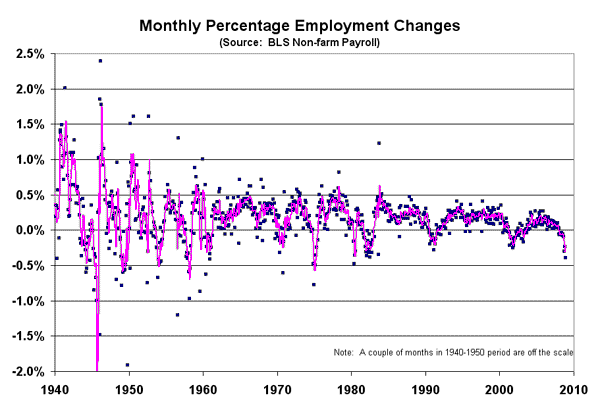
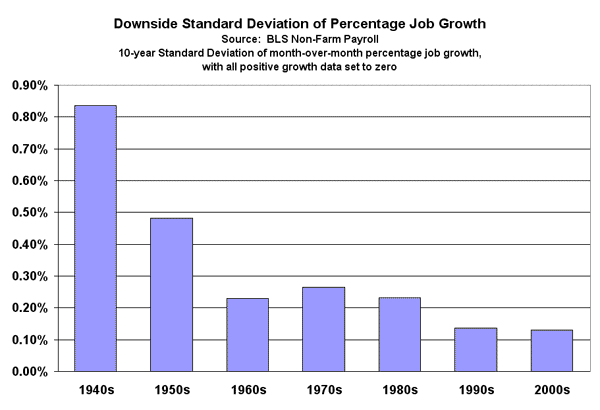
I posted some data this morning showing the current jobs report ranked not on absolute job losses but as a percentage of the total work force.  I have now pulled the whole data set from the BLS, which goes back to about 1939, and this is what the entire monthly series looks like of employment changes as a percentage of total employment (the purple line is a 3-month moving average).

jobs1

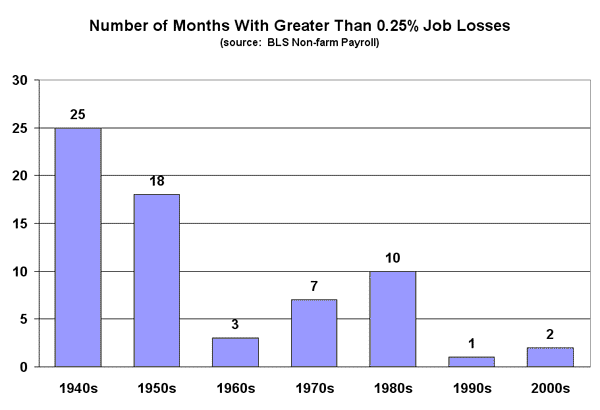
Folks familiar with this data base may know of reasons the data has become less volatile (perhaps improved seasonal adjustments?) but never-the-less, I have a hard time reconciling this with the popular leftish notion that the decline of traditional American manufacturers (e.g. autos) and unions have led to increasing risk and job/income volatility.  I played around with a couple of ways to summarize the trends.  Here is the number of substantially negative (monthly losses greater than 0.25% of the workforce) jobs reports per decade:

jobs2

And here is a metric of the volatility of the jobs number.  Since most folks don't really buy the classic economic argument that "risk" equates to volatility up or down, but feel that risk is only to the downside, I have looked at what is sometimes called the downside standard deviation of the jobs change numbers, in which all monthly data greater than zero are set to zero, and then a normal standard deviation is taken on the data.

jobs3

You've Been Warned

I am switching over domain registrars as the first step in the porcupine mating ritual that will eventually lead to a migration of this blog to WordPress.  There may be short downtimes of the site or of the email associated with this blog as I futz around with nameservers and cnames and such.  But since I am unable right now to publish any content on typepad that includes a graph or drawing, I am willing to bear some problems to get on a new platform.

Typepad is Sick Again

Something is wrong in the Typepad editor such that trying to include images is causing the system to hang.  This is the third or fourth time I have had to stop posting until Typepad cleans this up, all since Typepad introduced its new editor which is really driving me crazy.  As soon as I can get the site to migrate correctly with all links intact to WordPress, I am moving off Typepad.

Q: What's The Fastest Way to Get 5 Million Green Jobs?

A:  Start with 10 million current jobs.

Kenneth Green argues that Obama's claim that obsoleting current infrastructure and requiring its replacement with new, greener infrastucture creates jobs is just the broken windows fallacy  (where have you heard anyone else say that?)

If Obama's energy promises rely on questionable science, they rely on even more questionable economics. We are to believe that replacing conventional energy sources (especially coal) with renewables (especially wind) will create 5 million new "green jobs." The hope is that armies of workers will be enlisted to build
tens of thousands of windmills; to manufacture and deploy solar-power installations; to harvest, transport, and process huge amounts of biofuel feedstock; and to string the power lines that will allow the U.S. power grid to incorporate a major expansion of intermittent energy.

Unfortunately, the idea of government "job creation" is a classic example of the broken window fallacy, which was explained by French economist Frédéric Bastiat way back in 1850. It is discouraging to think that nearly 160 years later, politicians still do not understand Bastiat's basic economic insight...

Now consider Obama's "green jobs" plan, which includes regulations, subsidies, and renewable-power mandates. The "broken windows" in this case would be lost jobs and lost capital in the coal, oil, gas, nuclear, and automobile industries. Currently, these industries directly employ more than 1 million people.
Conventional power plants would be closed, and massive amounts of energy infrastructure would be dismantled. After breaking these windows, the Obama plan would then create new jobs in the renewable
energy sector. The costs of replacing those windows would ultimately be passed on to taxpayers and energy consumers.

New Era in Race Relations

Our new era in race relations begins this week with the Federal government sending me a nasty-gram that I have not yet proven to the government that I know the race of every one of my employees.  The EEO-1, a quite distasteful annual requirement from the feds, is a report we must file showing the number of people we have employed of various races and ethnicities.  Rest assured, readers, I have, after naively believing that race was irrelevant in evaluating my employees, now educated myself as to the race and gender of all my employees and reported this understanding to the government.