State-Created Entities

One aspect of the recent debate about the Supreme Court's Citizen's United decision that really irritates me is the notion, propounded by the NY Times among others, that corporations and the individuals assembled in them do not have free speech rights because corporations are "state-created entities."

This is wildly untrue, or alternatively, if you accept the logic, then nearly every aspect of our lives is state-created.  Take your pick.  Basically, the argument is that because the government has set the rules for corporate incorporation, and that these incorporations require state approval, that makes corporate entities "state-created."  But corporations are nothing more than a structure by which people can assemble and aggregate their capital and share ownership of an enterprise that employs that capital.  If government incorporation law did not exist, individuals still would have the incentive to assemble in some sort of entity.

I don't know of anything in the corporate structure that could not be duplicated with contract terms.  People point to the liability limitation as some sort of government gift to the corporate world, but that could easily be written in to every contract of, say, a partnership  (certain torts are an exception I would have to think about).  Vendors might choose not to accept such contracts, preferring to be able to pierce the partnership to go after individual owners to settle debts, but that choice exists today.  I have many, many vendor contracts in my corporation, and nearly all of my bank loans, that require the personal guarantee of all the owners, effectively waiving the liability limitation for those transactions.

My point, though, is that corporate forms have evolved as they are because that is what the sum of investors and business people were working towards on their own, and government merely enshrined these forms into law.  In fact, this basic rules-setting of the contracts playing field is one of the few arguably useful things government has done.  If we allow government rules-setting over certain activities to be the test of whether it can further restrict our Constitutional rights, then nearly every aspect of our lives would be subject to such restrictions.

At its heart, this is the classic "heads I win, tails you lose" argument of statists.  They claim that individuals must petition the state to register their corporation and license their business, and then use the fact of these required registrations to argue that the business is a "state-created entity" and that individuals give up their ability to exercise their rights when assembled into these entities.  By the same logic, the fact that every commercial transaction is subject to license and taxation by the state would make our every transaction a "government-created exchange."  Think I am exaggerating?  Just look at this from our Arizona state web site:

The Arizona transaction privilege tax is commonly referred to as a sales tax; however, the tax is on the privilege of doing business in Arizona and is not a true sales tax. Although the transaction privilege tax is usually passed on to the consumer, it is actually a tax on the vendor.

Rights, like the ability of free exchange between individuals, supposedly can't be revoked, but privileges can.   Thus the name.   For folks who treasure individual liberty, we have already lost the battle when we allow the state this kind of language.

Anyway, I feel like I am having a failure of eloquence over this issue.  Ilya Somin got me started thinking about these issues, so I will turn it over to him here.

Third, it's important to consider what is meant by "state-created entity." If the term refers only to institutions that literally would not exist absent state authorization, it does not accurately characterize many, perhaps most corporations. If the federal government passed a statute abolishing corporate status tomorrow, most actual corporations would still exist and still continue to engage in the same business or nonprofit activities. They just would do so under different and perhaps less efficient legal rules (maybe as LLCs, partnerships, or sole proprietorships). But they wouldn't all just collapse or go away. There would still be a demand for most of the products produced by corporations.

If "state-created entity" doesn't refer to the mere existence of organizations currently defined as corporations but to the particular bundle of legal rights currently attached to the corporate form, then it turns out that virtually all other organizations are state-created entities as well. Universities, schools, charities, churches, political parties, partnerships, sole proprietorships, and many other private organizations all have official definitions under state and federal law. And all have special government-created privileges and obligations that don't apply to other types of organizations.

Even individual citizens might be considered "state-created" entities under this logic. After all, the status of "citizen" is a government-created legal entitlement that carries various rights and privileges, many of which the government could alter by legislation, just as it can with those of corporations (e.g. "” the right to receive Social Security benefits, which the Supreme Court has ruled can be altered by legislation any time Congress wants). In that sense, "citizens" are no less "state-created" entities than corporations are.

By the way, in case I was not careful with my language, I offer the same proviso as does Somin:

I should clarify that in this post, as before, I'm not arguing that corporations themselves are "persons" with constitutional rights. Rather, I'm asserting that their owners and employees are such persons and that that status enables them to use corporations to exercise their constitutional rights. Similarly, partnerships, universities, schools, and sole proprietorships aren't people either. But people can use them to exercise their constitutional rights, and the government can't forbid it on the sole ground that they are using assets assets assigned to "state-created entities." This distinction was unfortunately obscured in the current post by my shorthand references to "corporations'" rights. I only used that terminology because it's cumbersome to always write something like "people exercising their constitutional rights through corporations."

In Search of Skepticism

PHP4B5A1EED0E9E1Why can't our newspaper here in Arizona apply any skepticism to alternate energy technologies?  Sure, I think this technology is cool, where large solar dishes concentrate heat on what appears to be Stirling cycle engines  (the article, true to form, does not explain the technology, but a few hints plus the name of the company "Stirling Energy Systems" seems to point to that answer).  Other concentrator technologies focus on boiling water, so this a new approach to me.

However, why can't the article actually address real issues, like "how does this technology stack up, based on cost and efficiency, vs. other solar technologies."  It says it uses less water than other concentrator technologies, but is it more or less efficient?  No answer.

We can figure a few things out.  First, as with many "renewable" energy technologies, the company selling it engages in nameplate capacity abuse.  A 1MW coal plant produces 1MW all day long.  A 1MW wind plant produces 1MW when the wind is blowing hard, and less at other times.  And a solar plant produces 1MW when the sun is at its peak.   We can address this latter because folks have calculated sun equivalent hours, the number equivalent max sun-hours per day a site gets through the year.  For the best desert sites in the US, this number is around 6.  This means that the actual capacity of this plant is not 1.5MW, as stated in the article, but about a fourth of that, or  0.375MW.

This matters for a couple of reasons.  They state their build cost as $2.8 million per MW, which seems competitive to coal plants which cost $1.0-2.0 per MW, but in fact the reference number for this solar based on an apples to apples capacity comparison is actually  $11.2 million per MW.   The solar plant gets some credit for having no fuel costs, so it might be possible still for its power to be competitive, but it appears form the limited information in the article that it is not:

Singleton would not disclose what SRP will pay for the electricity, but said the utility will pay a premium for the environmental benefits of the power, and that the price is competitive with other sustainable-energy sources such as wind and geothermal power.

In other words, it is not competitive, so much so that they will not even reveal the price, and only subsidies and government mandates make it possible for a power company to buy the power.

Let's do a reality check.  At best, they get 8 dishes per acre, and 25Kw per dish at max sun.  So this is 8 x 25 x 6/24 = 50Kw per acre.   Lets say we want to get rid of coal.  The US generating capacity of coal plants is about 336,000 MW, or 336,000,000 KW.  To replace it with this solar technology would require 6,720,000 acres (10,500 sq miles or 10% of the state of Arizona) and cost $3.76 trillion dollars if located in the best possible solar areas.   This is not cheap but is not awful.

If I am doing the math right, I get something like $70,000 per dish   (1 dish = 25Kw, $2.8 million per MW).  I would think there are a lot of rich folks with some acreage that would pay $70,000 for one of these bad boys.  It would look much cooler than solar panels on the roof.

Lots of Snow

Its almost like Utah up in Northern Arizona at our snow play area.  Many feet of new snow this week, probably more than we had all last year combined.  Below is Mike, the manager of our snow play area, who does a fabulous job.

wing 9 008

Further Thoughts on Corporate Speech

The reaction by the left to the Supreme Court decision yesterday overturning speech limitations on corporations seems tremendously hypocritical.  No one seems to complain on the left when certain groups/corporations (call them "assembly of individuals") get special access to the government and policy making.  Jeffrey Immelt and GE, Goldman Sachs, the SEIU, and the UAW all get special direct access to shape legislation in ways that may give special privileges to their organization -- access I and my company will never have.

Deneen Borelli wrote, in response to Keith Olberman's fevered denunciations of free speech for corporations

"It also seems as if the pot is calling the kettle black. MSNBC is currently owned by General Electric. GE Capital was bailed out by the taxpayers. GE CEO Jeff Immelt is a close advisor to President Obama, and GE would profit from Obama policies such as cap-and-trade. Olbermann has served as a cheerleader for all of this. Are Immelt and Olbermann simply afraid to allow others to possibly gain the attention and influence GE has had all along?"

Here is an example -- has the health care bill considered my company's situation, where we have 400 seasonal workers, almost all of whom are over 70 and on Medicare already?  How, in these circumstances, do we offer health care plans?  Are we relieved of the penalty for not offering a plan if they are on Medicare or a retirement health plan already?  The legislation does not address these issues (see Hayek) and I am sure numerous others, but I will never be able to cut a special deal for my workers or my industry as GE or the UAW have.

Further, corporate paid speech is alive and well in this administration, you and I just can't see it.  Lobbyists are all having record, banner, unbelievable revenues, in large part because the government is putting such a large chunk of the economy in play for forced redistribution and everyone who can afford it is paying to influence the process.

But nothing in any of the good government reforms have (rightly) ever put any kind of restrictions on this kind of speech directly to legislators.  The only speech they limit is speech to the public at large.  In effect, McCain-Feingold said that it is just fine to spend gobs of money speaking directly to us government folks, but try to go over our heads and talk directly to the unwashed masses, well, we have to make that illegal.  Far from tilting the balance of power to a few rich elite firms, the recent Supreme Court decision gives new power to the rest of us who don't have privileged access.

Update: Speaking of hypocrisy, the NY Times Corporation is outraged other corporations have been given the same rights it has had all along.  In a sense, the Times is lamenting their loss of a monopoly.

Update #2: Ilya Somin:  Corporate speech is actually an equalizer for far worse inequalities of political influence and access that already exist.

The Anti-Industrial Revolution

I stole this post title from Ayn Rand, but it seems appropriate to this story by James Delingpole.  Apparently James Hansen, leader of NASA's GISS, which does most of its climate research, wants to turn back the clock on industrialized civilization.    A new book by Keith Farnish writes:

The only way to prevent global ecological collapse and thus ensure the survival of humanity is to rid the world of Industrial Civilization.

And continues:

I'm rarely afraid of stating the truth, but some truths are far harder to give than others; one of them is that people will die in huge numbers when civilization collapses. Step outside of civilization and you stand a pretty good chance of surviving the inevitable; stay inside and when the crash happens there may be nothing at all you can do to save yourself. The speed and intensity of the crash will depend an awful lot on the number of people who are caught up in it: greater numbers of people have more structural needs "“ such as food production, power generation and healthcare "“ which need to be provided by the collapsing civilization; greater numbers of people create more social tension and more opportunity for extremism and violence; greater numbers of people create more sewage, more waste, more bodies "“ all of which cause further illness and death.

I wonder what Mr. Farnish thinks the average life expectancy was before the industrial revolution, or even "civilization?"  But my intention here is not to shoot fish in Mr. Farnish's barrel.  What is interesting is who approached Farnish and offered, unsolicited, to blurb his book:  James Hansen.  Here is Hansen's endorsement:

Keith Farnish has it right: time has practically run out, and the 'system' is the problem. Governments are under the thumb of fossil fuel special interests "“ they will not look after our and the planet's well-being until we force them to do so, and that is going to require enormous effort.

Does anyone believe that a person who believes this wouldn't misrepresent the science or fudge his temperature metrics to support his cause.  If he expects civilization to crash, why do we expect him to operate by the rules of civilized society?

Good News for Free Speech

Until today, we had the right to free speech, and the right to assembly, but not the right to free speech when we were assembled.  The Supreme Court has thankfully corrected that absurdity.  Quick roundup:  Jonathon Adler, John Stossel, Katherine Mangu-WardJD Tuccille, Jacob Sullum

Farm Tigers to Save Them?

Mark Perry suggests allowing tiger ranching to save tigers, and offers the alligator example as an analog of how commercial use helped revive an animal' fortunes.  This kind of ownership rights has revived a number of fisheries, and hasn't hurt either buffalo or ostriches either.

This video below is pretty funny, and gets at these issues towards the end.  "There might be a few polar bears left if people wanted one for breakfast."

Awesome Takedown of Homeopathy

I have written about it before, but here is Matt Parker:

I have just purchased a packet of Boots-brand 84 arnica homeopathic 30C Pills for £5.09, which Boots proudly claim is only 6.1p per pill. Their in-store advice tells me that arnica is good for treating "bruising and injuries", which gives the impression that this is a very cost-effective health-care option.

Unlike most medication, it didn't list the actual dose of the active ingredient that each pill contains, so I checked the British Homeopathic Association website. On their website it nonchalantly states that to make a homeopathic remedy, they start with the active ingredient and then proceed to dilute it to 1 per cent concentration. Then they dilute that new solution again, so there is now only 0.01 per cent of the original ingredients. For my 30C pills this diluting is repeated thirty times, which means that the arnica is one part in a million billion billion billion billion billion billion.

The arnica is diluted so much that there is only one molecule of it per 7 million billion billion billion billion pills.

It's hard to comprehend numbers that large. If you were to buy that many pills from Boots, it would cost more than the gross domestic product of the UK. It's more than the gross domestic product of the entire world. Since the dawn of civilisation. If every human being since the beginning of time had saved every last penny, denarius and sea-shell, we would still have not saved-up enough to purchase a single arnica molecule from Boots.

The amazing thing to me is that the folks lining up to be fleeced by this industry, and who will vociferously defend that they are not being fleeced, are the types of folks who are typically the first to throw up the barricades in the street when gas prices rise by 5 cents.

By the way, Arizona has a state board of homeopathic examiners to check ... what, exactly?  To guarantee no active ingredient made its way into the product?

Here is a funny related video:

Licensing is Anti-Competitive -- This Time, Its Personal

I have written any number of times about how the justification for licensing is usually consumer protection or safety but the actual purpose is to protect larger, entrenched incumbents against competition.  However, most of those stories have been about caskets or hair braiding or other businesses that don't really affect me.  This time, its personal.

Sometime last October we needed a boat moved across the country from one of our marinas to another.  We found a local guy who was going in the right direction anyway and paid him a couple hundred bucks to haul the boat on a trailer behind his pickup.  Note that this is a perfectly ordinary pickup truck and a perfectly normal pontoon boat, the kind of car-trailer rig you can see thousands of people driving to the lake every Saturday morning.

The driver was stopped at a checkpoint in Wyoming.  And was busted there, at least long enough until he could give them my name and number and escape.

Why was he busted?  Because a) the truck/boat combination apparently weighed a tad more than 10,000 pounds and b) the boat was being moved for a commercial purpose  (i.e. it was a business asset).  Unknown to me, the combination of these two takes this transport event to the realm of "commercial carrier," which requires a Department of Transportation (DOT) license and a slew of regulatory responses.   Technically, the contractor we paid was at fault, but he escaped any legal problems because 1) he claimed he was our employee (untrue) and 2) he claimed he was driving our truck (untrue).  This led to Wyoming and later the DOT calling me asking for my DOT number (which I didn't have), my employment records (for a person who is not my employee) and my vehicle records (for a truck I have never owned).

Months later, I am still going back and forth with the cops in Wyoming.  But in the mean time I decided that since I was likely to move my stuff across state lines again, I might as well get my DOT number.  So I started that process.

As it turns out, there is absolutely no difference in regulation and compliance requirements between driving my own boat across state lines once a year and running United Van Lines.   The regulations one has to know are hundreds of pages long.  The user-friendly summary is 162 pages long! And it is careful to state, "Please do not use this guide as a substitute for the Federal Motor Carrier Safety Regulations."  There are driver and vehicle files that have to be maintained, special driver certifications, driver medical tests and certifications, etc.

In other words, there is absolutely no accommodation for a company like ours that is doing nothing different than you are driving you boat to the lake, but we have to set up a compliance and record-keeping system that trucking companies have whole departments for.  Which, of course, is the point.  Compliance costs for regulations can always be born easier by large companies and by incumbents.  The idea is to make it so onerous for individual companies to move their own boats that they are willing to pay over-priced Teamster-friendly trucking corporations to do it for them.  The point is not to make us safer - the average individual unregulated boater hauls boats more miles a year than we do - the point is to make sure we don't compete, even in the smallest way, with established trucking firms.

By the way, the issue that is likely to kill the deal totally on our getting a DOT number is the government mandate that I drug test my employees.  The relationship I wish to have with my employees is not one that encompasses my demanding samples of their bodily fluids on a regular basis.  I have turned down at least two potentially lucrative management contracts because both had drug-testing requirements and I am not going to do it.

Beyond Satire

From the TaxProf:

President Obama today issued a presidential memorandum directing the Office of Management and Budget, the Treasury Department, and other federal agencies to block contractors who are delinquent on their taxes from receiving new government contracts. The memorandum also directs the IRS to review the accuracy of companies' tax delinquency claims and asks Congress to enact enforecement tools.

This administration continues to follow the consistent principle that taxes should be applied ruthlessly to out-of-favor and unsympathetic groups, and forgiven or exempted for friends of the Administration.  Does anyone else find it odd that our first black President is doing so much to undermine the equal protection clause of the 14th Amendment?

Obama's Bosses Say No to Senate Health Care Bill

Our Out of Control County Attorney

Radley Balko has a great article on Maricopa County Attorney Andrew Thomas, the wingman for Sheriff Joe Arpaio in any number of abuses of power.  I have tried to write about Thomas before, but some of his exploits are so bizarre and complex that they make simple description difficult, but Balko is clearly a better journalist than I and does a good job summarizing some of his most egregious actions.

The common denominator for both Thomas and Arpaio tends to be their near vendetta responses to anyone who either criticizes them or tries to limit their power (ie by denying a search warrant or dismissing one of their cases).

The most recent mess in Maricopa pits Thomas and Apraio against...well, just about everyone else. The two have been squabbling with members of the county board of supervisors for years over the construction of a $341 million county courthouse tower, which both feel is a waste of money. They might have a point. But Arpaio and Thomas are using criminal law as a cudgel in the dispute.

Last month, Thomas indicted two county supervisors on some petty financial disclosure violations. When Maricopa County Superior Court Judge Gary Donahoe issued a ruling pertaining to the court tower investigation that Arpaio and Thomas didn't like, Thomas then indicted Donahoe for bribery, on the absurd premise that as a judge who works in the courthouse, Donahoe (who is retiring soon) would have benefited from the new tower. That indictment came shortly after Donahoe held one of Arpaio's deputies in contempt after a highly-publicized incident in which the deputy was caught on video stealing documents from the file of a defense attorney in open court.

Using criminal charges"”or the threat of them"”to silence political opponents has become something of a habit for Thomas. He has indicted more than a dozen public officials who have criticized him or Arpaio. He has launched or threatened criminal investigations into dozens of others, including politicians, columnists, and other media figures who have dared to criticize him or the sheriff. When Phoenix Mayor Phil Gordon asked for a federal investigation of Arpaio's immigration enforcement tactics, Arpaio and Thomas investigated him too, attempting to snoop on Gordon's email, appointment book, and phone records. Thomas even recently threatened to criminally investigate a defense attorney for issuing public statements in support of his client.

These guys are from the bad, statist end of the Republican pond.  Interestingly, Thomas and Arpaio have alienated most of the Republican leadership in Arizona, and rely on their continued popularity with national conservative media and the local populace.   The latter is hard to describe to outsiders.  Its often hard for me to understand.  My best guess is that people ignore Thomas and Arpaio's worst behavior as aimed at people who somehow "don't count," particularly immigrants from Mexico.   Balko quotes Clint Bollack of the Goldwater Institute:

Bolick says their perseverance is also due to the polarizing effects of the immigration debate. Immigration "is extremely divisive," he says. "In the eyes of a lot of people, because they're cracking down on illegal immigrants, Thomas and Arpaio can do no wrong. So there's justification for whatever they do, and any criticism of them on any issue is a betrayal of the cause. It's really unfortunate that it's causing a lot of good people to turn a blind eye to ineffective law enforcement and abuses of power."

I don't want to violate Godwin's law here, but this quote springs to mind about the reactions to Thomas and Arpaio (from a member of the German protestant clergy in the 1930s)

First, the Nazis went after the Jews, but I wasn't a Jew, so I didn't react. Then they went after the Catholics, but I wasn't a Catholic, so I didn't object. Then they went after the worker, but I wasn't a worker, so I didn't stand up. Then they went after the Protestant clergy and by then it was too late for anybody to stand up.

One Year Later

I think my post from Inauguration Day one year ago holds up pretty well, though I caught a lot of grief for it at the time  [a few spelling errors fixed]

OK, I was really going to remain silent today, because no one seems to want to hear a rant about today's imperial coronation.  But as I sit here watching the press coverage and waiting for John the Baptist to show up, and as I observe the general cultish hysteria and the swooning of normally serious adult people, I just can't help myself.  For a libertarian like myself, its like watching people line up at 3am to be the first to be in the store when McDonald's switches its fountain drinks from Coke to Pepsi.   Heck, I was creeped out by the cult following of Ron Paul this year, a politician I agree with a lot, so I certainly am going to get the willies from the love-fest for an admitted statist like Obama.

I am not enough of a historian to speak for much more than the last thirty years, but the popularity of non-incumbent political candidates has typically been proportional to 1) their personal charisma and 2) our lack of knowledge of their exact proposals.  Seriously, can you name any other difference (on the plus side) between Obama and Hillary other than these two?  We forget, but GWB was the unknown newcomer in 1992.  As was Clinton and Carter.  Reagan was an exception, but was running against an incumbent who really had a terrible four years, and Bush I was an exception as well, though he was running against one of the weakest candidates and campaigns the Democrats have fielded in 50 years.  Folks are excited about Obama because, in essence, they don't know what he stands for, and thus can read into him anything they want.  Not since the breathless coverage of Geraldo Rivera opening Al Capone's vault has there been so much attention to something where we had no idea of what was inside.  My bet is that the result with Obama will be the same as with the vault.

There is some sort of weird mass self-hypnosis going on, made even odder by the fact that a lot of people seem to know they are hypnotized, at least at some level.  I keep getting shushed as I make fun of friends' cult behavior watching the proceedings today, as if by jiggling someone's elbow too hard I might break the spell.  Never have I seen, in my lifetime, so much emotion invested in a politician we know nothing about.   I guess I am just missing some gene that makes the rest of humanity receptive to this kind of stuff, but just for a minute snap your fingers in front of your face and say "do I really expect a fundamentally different approach from a politician who won his spurs in "¦. Chicago?  Do I really think the ultimate political outsider is going to be the guy who bested everyone at their own game in the Chicago political machine?"

Well, the spell will probably take a while to break in the press, if it ever does "” Time Magazine is currently considering whether it would be possible to put Obama on the cover of all 52 issues this year "” but thoughtful people already on day 1 should have evidence that things are the same as they ever were, just with better PR.   For God sakes, as his first expenditure of political capital, Obama is pushing for a trillion dollar government spending bill that is basically one big pork-fest that might make even Ted Stevens blush, a hodge-podge of every wish-list of leftish lobbyists that has been building up for eight years.  I will be suitably thrilled if the Obama administration renounces some of the creeping executive power grabs of the last 16 years, but he has been oddly silent about this.  It seems that creeping executive power is a lot more worrisome when someone else is in power.

It has been suggested by some that today is less a cultish coronation but a big victory party in the battle against racism.  Well, I am certainly willing to accept it on those terms.  I have been arguing for years that it is time to declare victory on the worst aspects of race and gender discrimination, and move on to problems of interest to all races (like individual freedom or giving kids options to escape crappy public schools).   Unfortunately, I fear that too many folks in power are dependent on the race/gender/class wars continuing, so you and I may think we are declaring victory, but those with power over our lives have not.

Forced Loans

Every year, the government forced nearly every working American to give it an interest-free loan.   Each person pays his taxes (via legally required withholding) as much as 16 months early, with not a cent of interest from the government for this loan of funds.  Several states have been toying of late  (and California actually implemented) schemes in which the required withholding rates are jacked far above any conceivable level of tax liability.  These are desperate financing approaches from entities who are no longer able to borrow (or afford the interest of) money at arms length, and so much use the coercive power of the government to force its citizens to fork over interest free loans.

Apparently, the Obama administration is looking at such a scheme, but on steriods:

The U.S. Treasury and Labor Departments will ask for public comment as soon as next week on ways to promote the conversion of 401(k) savings and Individual Retirement Accounts into annuities or other steady payment streams, according to Assistant Labor Secretary Phyllis C. Borzi and Deputy Assistant Treasury Secretary Mark Iwry, who are spearheading the effort.

Whatever their stated justification (I am sure it is somehow for the children), I think Dale Franks gets at the actual motivation:

There literally isn't enough money in the world to float the T-notes the Treasury must issue in order to prop up our unsustainable spending path.  There are, however, about $3.6 trillion in funds just sitting in 401(k) accounts.  If the government can urge"“or force"“you to convert your 401(k) into T-note funded annuities, the Treasury can continue to issue those notes to float the government's deficit.  Essentially, you'll be converting your retirement funds into an IOU from the government"¦just like your social security account has already done.

This will allow the Treasury to keep borrowing money"“from your retirement"“in order to keep issuing more debt that they may or may not be able to pay back to you

Internet Out in Front? Or All Alone?

OK, I am a pathetic loser and was tuned in to sports talk radio all day in my office.  That being said, I have heard nothing about this incident on the radio and a quick Google search shows that only sites on the case are all internet sites.  Hopefully this will get more attention tomorrow in larger outlets, as it is always scary to see what appears to be a pretty substantial abuse of power.  In the video, a Jets fan gets hauled out of the Charger stadium, apparently for too much boisterousness in favor of the visiting team.  Watch in particular the Charger fans sticking up for the guy, which is about as good of evidence as I can think of to say there wasn't any legitimate reason for the arrest.

Climate Interview

Last week I did a very enjoyable interview Stefan Molyneux of FreeDomain Radio. My presence was almost superfluous, as Stefan was incredibly well-informed as well as passionate on climate topics. Our discussion hits on many critical topics related to the science of the skeptics position, from positive feedbacks to urban heat biases to hockey sticks. The interview is embedded below, but I encourage you to check out his site, he seems to get a lot of interesting interviews of which I appear to be the most pedestrian.

Arizona Parks Privitization

The AZ Republic has an editorial today saying that privatization is not the answer for the Arizona State Parks budget woes.   On the plus side, they did actually call me for my opinion yesterday before they published it.  On the down side, they ignored everything I said.  Here is my response:

I run one of the larger private parks management companies in the country, which is based right here in Phoenix. Like many Arizona residents, I am a frequent visitor to our state parks and am sympathetic to their current budget pain. Further, I am not one to offer up privatization as a panacea for all the park's woes -- the state parks organization fulfills a variety of public missions that cannot be undertaken well privately. But I think you missed a couple of important considerations in your editorial today counseling against privatization options.

First, from my experience with public recreation agencies around the country, these budget pressures on parks organizations never really end. Recreation is almost always a key pawn in budget fights, and even if Arizona State Parks funding is restored this year, we likely will be fighting the same battles in a few years. Private concession management of parks has the advantage of taking parks off the budget, so they no longer can fall victim to budget fights. For example, in the famous 1995 federal government shutdown, private concession run facilities in the US Forest Service were the only federal recreation options that remained open through the whole budget battle.

Second, while small low-visitation parks, on a standalone basis, may not represent a very good business opportunity, there are a variety of ways to handle privatization of smaller parks. We run approximately 175 public parks and campgrounds across the country, and well fewer than half of these stand on their own as private business opportunities. But many public agencies have learned to package smaller, low-visitation parks with higher-visitation parks into multi-park packages that both provide operators a business opportunity as well as meet the public's goal of keeping all of its parks open. Further, states like California have found many creative ways to keep historic sites open using private management. These solutions, at places like Columbia State Park, not only keep historic buildings open to the public but also create events and services that bring history alive and make it more interesting, particularly to children.

I know that private management is often sloughed off with statements like, "they would just build a McDonald's or put in a bunch of billboards." But thousands of parks nationally are managed privately, and this never happens. In part, this is because business people should get some credit for intelligence, and they understand what attracts people to outdoor parks in the first place and don't want to mess with the ambiance. In addition, we often have 100+ page operating agreements in place that carefully set out the quality of our services and the approvals we must obtain to make any changes to the facilities.

Further, it is sometimes suggested that private companies would just jack up the price. Well, Arizona State Parks is proposing to raise the Slide Rock entrance fee to $20. In contrast, we run nearby picnic and day use areas at places like Grasshopper Point and we rapacious capitalists only charge $8.

I am not advocating that Arizona State Parks turn off the lights and throw the keys to a private company; but I do think that private concession management could offer a piece of the long-term solution to keeping state parks open, both now and in future budget battles.

US vs. Europe: Standard of Living

NY Times | Paul Krugman | Learning From Europe

Europe's economic success should be obvious even without statistics. For those Americans who have visited Paris: did it look poor and backward? What about Frankfurt or London? You should always bear in mind that when the question is which to believe "” official economic statistics or your own lying eyes "” the eyes have it.

This is just silly.  Its like walking out on a single day and saying, "well, it doesn't seem any hotter to me" as a rebuttal to manmade global warming theory.  I am sure I can walk the tourist and financial districts of a lot of European cities with their triumphal centuries-old architecture and somehow be impressed with their wealth.  But the number of upscale shopping options on the Champs-Élysées has little to do with the standard of living of the average Frenchman.

South Bend Seven put it well:

Okay, where did you go in London? Covent Garden? St. James? Soho? Westminster? The City?

Oh, you didn't go to North Peckham, or Newham, or Hackney? You went to the rich areas of the most prosperous city in the country, and not, I don't know, Liverpool, or Leicester, or Middlesbrough? No, you've never been to those places, have you?

Well several million people live there, and no offense to them, but they're not quite as charming as the tourist districts in London. I don't think they'd look to kindly on some rich American spending a vacation watching the Changing of the Guard and taking in a show on Haymarket and concluding he knows about their country and their life.

This really gets back to my post the other day on triumphalism.  This is EXACTLY why states build pretty high-speed trains and grand municipal buildings and huge triumphal arches  -- as a way to distract both their own citizens (and outsiders) from their own well-being relative to others.  Its the magician waving something shiny around in his left hand to take your eyes off the right.  And it is pathetic that not only does a former Nobel Laureate fall for it, but he doubles down by telling everyone else to fall for it.

Relevant actual data, via Mark Perry (click to enlarge, this is 1999 data from a 2004 Swedish study but I don't think the relative positions have changed):

EUUSAHOUSEHOLDS

Triumphal arches and high-speed trains don't make people wealthy.  Wal-Mart has done far more to make the average person wealthier than any number of government projects you can mention.

Along these lines, I have said for years that one of the reasons we spend more on health care than Europe is because we can.  We are wealthier, and (rationally in my mind) people choose to spend this incremental wealth on their health and well-being.

More on the Thomas/Arpaio RICO

I will say that I have a certain fondness for the idea of tossing everyone in Congress in jail on a giant RICO prosecution.  So Thomas and Apraio's crazy RICO suit naming most everyone of any importance in the county government and judicial system as conspirators has a certain appeal.  Unfortunately, unlike my dream RICO suit, the basis for the suit is that Arpaio and Thomas were consistently prevented from excercising unchecked power

In essence, the lawsuit alleges that any county official who at any point attempted to stop Thomas and Arpaio from doing anything -- whether it's prosecuting Don Stapley, "investigating" the $341 million court tower project, or repeatedly suing Thomas' own clients -- is part of a criminal enterprise. That includes judges who ruled against them, attorneys who opposed them in court (like Ed Novak and Tom Irvine) and county employees who attempted to stop the insanity.

Hostage Crisis

The Florida sales tax auditor has been in my office for 2 days and shows no sign of leaving.  Most of the audit is as expected and I ceased long ago getting ticked off about it;  but the new focus on use tax - ie, not just did you collect and pay sales tax on your retail sales but did you pay proper sales tax on every purchase, is really annoying.  We are going to have to be pulling invoices and xeroxing for weeks.  Somehow, if as a retailer I don't collect enough sales taxes, I am liable for the shortage.  But if someone else sells me something and there is not enough sales tax collected, I am again apparently liable for the difference.  The latter makes no sense to me.    Apparently I owe taxes in this non-symmetric way based on the deep philosophic principle that he is sitting in my office, not theirs.

Update: Now he suddenly thinks that I am getting over because there is no sales tax shown on my liability insurance premiums.    AAArrrrggghhh.  Two entire days lost.

Pink Jumpsuit for Sheriff Joe

Via Expresso Pundit:

It's becoming increasingly clear that Sheriff Joe--and probably County Attorney Andy Thomas--are going to be indicted on multiple felony counts.Maricopa County Manager David Smith issued this statement today.

Today's grand jury appearance was a welcome opportunity to tell our story on behalf of County employees.  Dozens and dozens of County employees, and some County vendors, have been targeted by Sheriff Arpaio and Maricopa County Attorney Andrew Thomas with retaliatory criminal investigations without cause, and disruption of their working lives without justification.

Sandi Wilson and I expect to return to the grand jury to give even more detailed testimony in three or four weeks about the many abuses of power by Sheriff Arpaio and his office that were generally described to the grand jury today.  We look forward to that next opportunity in the interests of justice.

Heroic Assumptions

Previously, I have criticized the proposed California high speed rail line (from San Diego to San Francisco) as grossly underestimating potential costs.  Brian Doherty has an article this week reality-checking its projected ridership, after the California legislative analysts' office questioned the contingency analysis in the high-speed rail plan.

Eric Thronson, a fiscal and policy analyst for the office, called a risk assessment in the business plan "incomplete and inappropriate for a project of this magnitude.''

Thronson warned that there is no backup plan to keep the rail system solvent if it fails to draw 41 million people yearly. A bond measure approved by voters to help pay for the train network prohibits public funds from being spent on operating costs.

Doherty provides this reality check:

The future: where all of California's fiscal messes wait to be addressed! By the way, that ridership figure of 41 million averages to over 112,000 train riders every single day of the year. The average daily usage of I-5--the entire road--is around 71,000, according to the Federal Highway Administration.

Here are a couple of other reality checks

  • The entire passenger traffic from LAX to and from every other city in the country is 44 million a year (excludes international passengers)
  • The current air passenger traffic between LAX and SFO is 2.7 million a year
  • The passenger traffic of Amtrak in its entire national network is 28.7 million (including local commuter operations)

But What Happens if People Actually Change Their Behavior?

The Senate health care bill relies for much of its funding on a tax on so-called "Cadillac" health care plans.  But what happens when employees and employers inevitably change their behavior in the face of different incentives?

History teaches us that tax policy has a huge effect on behavior.  Witness the fact in health care the non-nonsensical fact so many people rely on their employer for health care.  As we see today, this is a really bad idea, but it was hatched because tax law provided incentives for paying compensation in the form of health insurance premiums, since these are not subject to either income or payroll taxes.

Already, employers are offering employees what are effectively buy-outs of health care -- higher pay in return for reduced health care benefits.  For employers, the upside risk on health care costs now outweigh the tax advantages of health insurance as a compensation tool.  Given this trend, what do you think will happen when employees suddenly have the same incentive, to roll back health care coverage to get under whatever bar is set for an insurance package Congress thinks is too rich (hint:  wherever the bar is set, it will be below the health insurance Congress provides itself).  Employers and employees are now going to have a shared incentive to back off on health care benefits in exchange for more cash.  Think of the sharp minds on both sides of a UAW contract negotiation - does anyone really think that these guys won't figure out a win-win to avoid paying the surtax?

Three to five years from now, even before the system goes bankrupt from inevitably expanding costs  (you didn't really buy that stuff about the operator of Amtrak and the Post Office improving the industry's efficiency, did you?), we are going to be talking about the gross shortfall in tax revenues to support these programs, all because people change their behavior in the face of changing incentives.

Top Arizona Campgrounds

Camp Arizona has put out its list of the top 10 campgrounds in ArizonaMy company runs three of the top five  (#2 Christopher Creek, #4 Cave Springs and #5 Manzanita).

The Timeless Appeal of Triumphalism

What is it about intellectuals that seem to, generation after generation, fall in love with totalitarian regimes because of their grand and triumphal projects?  Whether it was the trains running on time in Italy, or the Moscow subways, or now high-speed rail lines in China, western dupes constantly fall for the lure of the great pyramid without seeing the diversion of resources and loss of liberty that went into building it.  First it was Thomas Friedman, and now its Joel Epstein in the Huffpo, eulogizing China.    These are the same folks who tried, disastrously, to emulate Mussolini's "forward-thinking" economic regime in the National Industrial Recovery Act.    These are the same folks who wanted to emulate MITI's management of the Japanese economy (which drove them right into a 20-year recession).  These are the same folks who oohed and ahhed over the multi-billion dollar Beijing Olympics venues while ignoring the air that was unbreathable.  These are the same folks who actually believed the one Cuban health clinic in Sicko actually represented the standard of care received by average citizens.  To outsiders, the costs of these triumphal programs are often not visible, at least not until years or decades later when the rubes have moved on to new man crushes.

Epstein, like Friedman, seems to think that the US is somehow being left behind by China because its government builds much more stuff.  We are "asleep."  Well, I have a big clue for him.  Most of the great progress in this country was built when the government was asleep.  The railroads, the steel industry, the auto industry, the computer industry  -  all were built by individuals when the government was at best uninvolved and at worst fighting their progress at every step.

Epstein in particular thinks we need to build more trains.  This is exactly the kind of gauzy non-fact-based wishful thinking that makes me extremely pleased that Epstein in fact does not have the dictatorial powers he longs for.   High speed rail is a terrible investment, a black hole for pouring away money, that has little net impact on efficiency or pollution.   But rail is a powerful example because it demonstrates exactly how this bias for high-profile triumphal projects causes people to miss the obvious.

Which is this:  The US rail system, unlike nearly every other system in the world, was built (mostly) by private individuals with private capital.  It is operated privately, and runs without taxpayer subsidies.    And, it is by far the greatest rail system in the world.  It has by far the cheapest rates in the world (1/2 of China's, 1/8 of Germany's).  But here is the real key:  it is almost all freight.

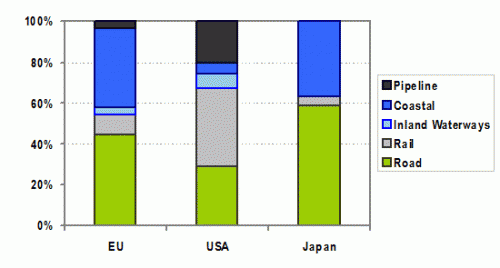
As a percentage, far more freight moves in the US by rail (vs. truck) than almost any other country in the world.  Europe is not even close.

modalsplieuusjapan (source)

You see, passenger rail is sexy and pretty and visible.  You can build grand stations and entertain visiting dignitaries on your high-speed trains.  This is why statist governments have invested so much in passenger rail -- not to be more efficient, but to awe their citizens and foreign observers.

But there is little efficiency improvement in moving passengers by rail vs. other modes.   Most of the energy consumed goes into hauling not the passengers themselves, but the weight of increasingly plush rail cars.  Trains have to be really, really full all the time to make an energy savings for high-speed rail vs. cars or even planes, and they seldom are full.  I had a lovely trip on the high speed rail last summer between London and Paris and back through the Chunnel -- especially nice because my son and I had the rail car entirely to ourselves both ways.

The real efficiency comes from moving freight.  More of the total energy budget is used moving the actual freight rather than the cars themselves.  Freight is far more efficient to move by rail than by road, but only the US moves a substantial amount of its freight by rail.    One reasons for this is that freight and high-speed passenger traffic have a variety of problems sharing the same rails, so systems that are optimized for one tend to struggle serving the other.

Freight is boring and un-sexy.  Its not a government function in the US.  So intellectuals tend to ignore it, even though it is the far more important, from and energy and environmental standpoint, portion of transport to put on the rails.  In fact, the US would actually probably have even a higher rail modal percentage if the US government had not enforced a regulatory regime (until the Staggers Act) that favored trucks over rail.   If the government really had been asleep the last century, we would be further along.

The US has not been "asleep"  -- at least the private individuals who drive progress have not.  We have had huge revolutions in transportation over the last decades during the same period that European nations were sinking billions of dollars into pretty high-speed passenger rails systems for wealthy business travelers.   One such revolution has been containerization, invented here in the US and quickly spreading around the world.  Containerization has revolutionized shipping, speeding schedules and reducing costs (and all the while every improvement step was fought by the US and certain local governments).  To the extent American businesses are not investing today, it has more to do with regime uncertainty, not knowing what new taxes or restrictions are coming next from Congress, than any lack of vision.

I would argue that the US has the world's largest commitment to rail where it really matters.  But that is what private actors do, make investments that actually make sense rather than just gain one prestige (anyone know the most recent company Warren Buffet has bought?)  The greens should be demanding that the world emulate us, rather than the other way around.  But the lure of shiny bullet trains and grand passenger concourses will always cause folks like Epstein to swoon.

Update #2: The author Joel Epstein emailed me a response to this post.  I will give it to you in its entirety:  "You should get out of the country more often."  Wow, he played the provincial American card on me.  Except that I have been to about 20 countries, from Singapore to Argentina to Hungary.  Besides, I really don't understand what the hell he means by this in the context of my post, except as a bid for some sort of intellectual superiority.   Anyone else understand?

Postscript

Boring, but environmentally friendly and cost-effective:

10.9.2004-04

Sexy, but environmentally useless (at best) and tremendously costly:

high-speed-rail21

So, explain to me what drives these guys investment thinking.  Can it be anything but triumphalism?

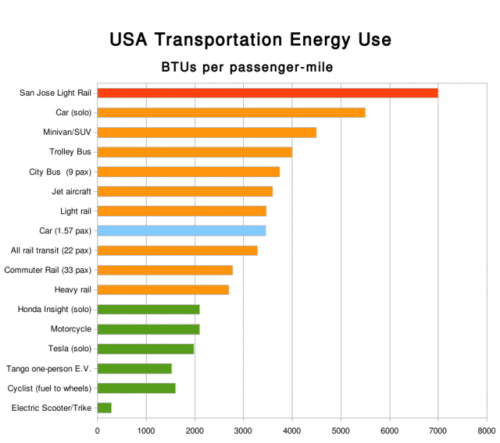
Update: Energy use comparison of passenger modes. Note how close rail transit and cars, both at average occupancies, are in this analysis.  The differences in freight are much larger:

transenergy