Posts tagged ‘prices’

Awesome Rant

Kudos to Kimberly Strassel for going off on a world class rant against their airlines, and their desire to blame their woes on "oil speculators."

I want to say thanks for the July 10 email you sent to
all your customers seeking to explain why today's air travel experience
is so painful. The letter, signed by 12 of you, explained that "oil
speculators" -- presumably by betting on future oil prices -- are
killing your industry and thus requested that I, as a consumer,
pressure Congress to rein in this "unchecked" market "manipulation."

I admit that just lately I'd begun to feel that flying
was something akin to having my intestines fished out with a long hook.
Actually, I'd been wondering whom to blame for the fact that it would
probably be cheaper, easier and maybe even faster to drive to wherever
I want to go than to board one of your planes. Suddenly, all is clear.

I now understand that it is oil speculators who set
your hiring policies and who must have outlined the three types of
people you may employ: those who grunt at me, those who sigh deeply as
if my presence has ruined their day and those who are actively hostile
to my smallest request.

She goes off for quite a bit more.  Check it out.  I guess I am glad somebody's futures are going up in value.  My airline travel futures, also known as frequent flier miles, seem to get devalued constantly.

Water and Pricing

I while back, I wrote that I could fix our Arizona water "shortage" in about 5 minutes.  I pointed out that we in Phoenix have some of the cheapest water in the country, and if water is really in short supply, it is nuts to send consumers a pricing signal that says it is plentiful. 

David Zetland (via Lynne Keisling) follows up on the same theme:

The real problem is that the price of water in California, as in most
of America, has virtually nothing to do with supply and demand.
Although water is distributed by public and private monopolies that
could easily charge high prices, municipalities and regulators set
prices that are as low as possible. Underpriced water sends the wrong
signal to the people using it: It tells them not to worry about how
much they use.

Unfortunately, water is one of those political pandering commodities.  Municipal and state authorities like to ingratiate themselves with the public by keeping water prices low.  At the same time, their political power is enhanced if shortages are handled through government rationing rather than market forces, since politicians get to make the rationing decision -- just think of all those constituencies who will pour in campaign donations to try to get special rights to water from the water rationers.

Oil at $140 is Still a Modern Miracle

Over the weekend, I was reading an article about T. Boone Pickens' energy plan, a thinly disguised strategy to grab government subsidies for his wind investments.  And I started to think how amazing it is that electricity from wind has to be subsidized to compete with electricity from fossil fuels.  Here's what I mean:

  • To get electricity from wind, one goes to a windy area, and puts up a big pole.  I presume that there are costs either in the land acquisition or in royalty payments to the land holder.  Either way, one then puts a generator on top of the pole, puts a big propeller on the generator, add some electrical widgets to get the right voltage and such, and hook it into the grid. 
     
  • To get electricity from petroleum is a bit more complex.  First, it's not immediately obvious where the oil is.  It's hidden under the ground, and sometimes under a lot of ocean as well.  It takes a lot of technology and investment just to find likely spots where it might exist.  One must then negotiate expensive deals with often insanely unpredictable foreign governments for the right to produce the oil, and deal day to day with annoyances up to and including rebel attacks on one's facilities and outright nationalization once the investments have been made.  Then one must drill, often miles into the ground.  Offshore, huge, staggeringly expensive platforms must be erected -- many of which today can be taller than the worlds largest skyscrapers.  Further, these oil fields, once found, do not pump forever, and wells must be constantly worked over and in some cases have additional recovery modes (such as water flood) added. 

    The oil, once separated from gas and water, is piped and/or shipped hundreds or even thousands of miles to a refinery.  Refineries are enormously complex facilities, each representing billions of dollars of investment.  The oil must be heated up to nearly 1000 degrees and separated into its fractions  (e.g. propane, kerosene, etc.).  Each fraction is then desulpherized, and is often further processed (including cracking and reforming to make better gasoline).  These finished products are in turn shipped hundreds or thousands of miles by pipeline, barge, and truck to various customers and retail outlets.

    To make electricity from the oil, one then needs to build a large power plant, again an investment of hundreds of millions of dollars.  The oil is burned in huge furnaces that boil water, with the steam driving huge turbines that produce electricity.  This electricity must then go through some electrical widgets to get to the right voltage, and then is sent into the grid.

Incredibly, despite all this effort and technology and investment required to generate electricity from fossil fuels, wind generators still need subsidies to compete economically with them.  In a very real sense, the fact that fossil fuels can come to us even at today's prices is a modern day business and technological miracle.

Of course, in the press, the wind guys begging at the government trough are heroes, and the oil companies are villains. 

Peak Pricing for Parking

From my point of view, the NY Times buried the lede in this story about installation of parking sensors on San Francisco streets.  The article focuses mainly on the ability of drivers at some time in the future to get locations of empty parking spots on the streets via smartphone or possibly their GPS.  But I thought the pricing changes they were facilitating were more interesting:

SFpark, part of a nearly two-year $95.5 million program intended to
clear the city's arteries, will also make it possible for the city to
adjust parking times and prices. For example, parking times could be
lengthened in the evening to allow for longer visits to restaurants.

The
city's planners want to ensure that at any time, on-street parking is
no more than 85 percent occupied. This strategy is based on research by
Mr. Shoup, who has estimated that drivers searching for curbside
parking are responsible for as much of 30 percent of the traffic in
central business districts.

In one small Los Angeles business
district that he studied over the course of a year, cars cruising for
parking created the equivalent of 38 trips around the world, burning
47,000 gallons of gasoline and producing 730 tons of carbon dioxide.

To
install the market-priced parking system, San Francisco has used a
system devised by Streetline, a small technology company that has
adapted a wireless sensor technology known as "smart dust" that was
pioneered by researchers at the University of California, Berkeley.

It
gives city parking officials up-to-date information on whether parking
spots are occupied or vacant. The embedded sensors will also be used to
relay congestion information to city planners by monitoring the speed
of traffic flowing on city streets. The heart of the system is a
wirelessly connected sensor embedded in a 4-inch-by-4-inch piece of
plastic glued to the pavement adjacent to each parking space.

The
device, called a "bump," is battery operated and intended to last for
five and 10 years without service. From the street the bumps form a
mesh of wireless Internet signals that funnel data to parking meters on
to a central management office near the San Francisco city hall.

This is actually really cool, but my guess is that politicians will not have the will to charge the level of peak prices the system may demand.

Postscript:  As many of you know, there is a new wave of urban planners who want to impose dense urban living on all of us, whether we like it or not.  I have no problem with folks who want to fight the masses and live in downtown SF or Manhattan, but the world should also have a place for the majority of us who like to have an acre of land and a bit less congestion. 

Anyway, in singing the praises of the urban lifestyle (which often is as much an aesthetic preference vs. suburbia as anything else), you seldom hear much about this type of thing:

Solving the parking mess takes on special significance in San Francisco
because two years ago a 19-year-old, Boris Albinder, was stabbed to
death during a fight over a parking space....

The study also said that drivers searching for metered parking in just
a 15-block area of Columbus Avenue on Manhattan's Upper West Side drove
366,000 miles[!!] a year.

And here we suburbanites are complaining when we have to park more than 5 spaces from the door of the supermarket.

Oil Prices and State-Run Corporate Incompetence

Over the last year or so, I have been relatively optimistic for a relatively significant drop in oil prices over the next 2-4 years followed by a number of years of price stability at this lower level.  This would be a direct analog to what happened in the 80's after the 1978 oil price spike.

One argument readers have made against this scenario is that a much larger percentage of the world's oil potential is controlled by lumbering state oil companies than was the case in 1978, particularly given the US Congress's continued cooperation with OPEC in keeping US oil reserves off-limits to drilling.  The theory runs that these state run oil companies have a number of problems:

  • they move and react very slowly
  • they don't have the technical competence to develop more difficult  reserves
  • they don't have the political will to divert oil profits from social programs (including oil industry over-employment and patrimony) to capital spending

This latter issue is a big one - even keeping current fields running at a level rate requires constant capital and technological infusions.  I have written about this issue before, and I am sympathetic to this argument.  Here is Jim Kingsdale on this issue:

Events in Iran since the Revolution are an eery echo of what has
happened in Venezuela since the advent of Chavez.  Skilled workers and
foreign capital and technology have fled.  Corruption has become
rampant  along with incompetence.  Production of over 6 mb/d fell to
below 3 mb/d after the Revolution and is currently about 3.8 mb/d.  The
pre-revolutionary head count of 32,000 employees has grown to 112,000.

Since the Revolution Iran has exported $801.2 billion of oil but
nobody knows where that money has gone.  "Certainly none of it was
invested in Iranian oil infrastructure which badly needs renovation and
repair, upstream and downstream."  The author claims the Iranian
petro-industry is "on the brink of bankruptcy" although such a claim is
not documented.

It is clear that Iran, Venezuela, Mexico, Nigeria, and Iraq together
represent an enormous percentage of the world's oil deposits and
production that is being mismanaged.  The political and management
dysfunctions in all of these countries simultaneously is a major reason
for the world's current energy crisis.  If these countries all operated
in a standard capitalist mode, I suspect oil would be below $50 a
barrel and the ultimate supply crisis might be five or ten or even
fifteen years beyond when we will see it fairly soon
.  There seems to
be little hope that any of these countries will make a dramatic change
in their oil productivity soon.

I am coming around to this argument.  I still think that oil prices are set for a fall, but lower prices may not last long if this analysis is correct.

Update: Of course Maxine Waters would like to add the United States to this list of countries with incompetent government management of oil reserves.

Regulation and Incumbents

One of the most prevelent misconceptions about the political economy is the assumption that business universally opposes government licensing and regulation.  Often this misconception manifests itself as someone making a statement like, "Even [name of large competitor in the industry to be regulated] supports the proposed regulation so what are you libertarians complaining about."

In fact, regulation tends to protect incumbents at the expense of new entrants or new business models.  Large competitors can pass on the costs of regulation to customers, but new entrants have substantial investments to make just to build the systems and knowledge for compliance.  Perhaps worse, regulation like licensing tends to lock in current business models, by making current business practices part and parcel of becoming licensed.

For these reasons, I am excited by the book In Restraint of Trade by Butler Shaffer:

This extremely important study by Butler Shaffer--professor of law
and economist--will change the way you think of the relationship
between the state and business. It makes a deep inquiry into the
attitudes of business leaders toward competition during the years 1918
through 1938 to see how those attitudes were translated into proposals
for controlling competition, through political machinery under the
direction of trade associations.

What he finds is a business sector not only hostile to free markets
but aggressively in favor of restrictions that would protect their
interests. This, he finds, is the very source of the origins and
development of the regulatory state.

The author chooses this period because it was a time when the entire
relationship between American business and the federal government
underwent dramatic upheaval. It was in this time that business forged a
consensus about the scope and intensity of competition behavior that
they would tolerate. This began to exhibit a disposition favoring
collectivist authority over one another via government-backed
enforcement agencies.

Free and unrestrained competition required more of them than they
were willing to tolerate. It required constant innovation, a fight
against falling prices, a continued effort to seek out new markets, and
the willingness to subject their bottom line to consumer preferences
for lower prices and better products. They saw the vibrancy of free
enterprise as a threat to their firms and well being, so they used
anti-business sentiment in politics to hamper the market in ways that
would benefit them....

If you ever thought that the struggle for free enterprise was about
business versus government, this study, which is written in exciting
prose and beautiful English, will change the way you understand the
essential struggle. The evidence is vast that big business cooperated
closely with big government in building the essential architecture of
the mixed economy.

Ethanol Updates

Y'all may have already seen these -- being on vacation, I am a little late to the table on both.  The first is a report on the Missouri state ethanol mandate:

A report from a Missouri-based research organization
debunks the claim that Missourians are saving money through a state law
requiring that retail gasoline contain a minimum of 10% ethanol. The
report is in reaction to an assertion by the Missouri Corn
Merchandising Association (MCMA), alleging that Missourians will save
more than US$ 285 million through the E-10 mandate in 2008, and nearly
US$ 2 billion over the following decade.

The MCMA arrived at these numbers by taking the price
difference between pure-grade gasoline and E-10 blended fuel, and
multiplying it by Missouri's projected annual consumption.

However, the report by the Show Me Institute reveals two fundamental flaws with this calculation. One
is that it fails to take into account the fact that E-10 blended fuel
is cheaper because ethanol producers receive tax credits and other
subsidies.

"Government officials cannot simply take tax dollars from
the public, give those tax dollars to ethanol blenders, and then have
ethanol supporters tell the public that ethanol is saving them money
with cheaper fuel as though the subsidy never existed," write the
report's authors, Justin P. Hauke and David Stokes.

The MCMA also does not take into account that E-10
blended fuel is about 2.5% less efficient than pure-grade gasoline,
meaning that Missourians will be filling their tanks more often.

When both of these factors are taken into account, the ethanol blending mandates are shown to be costing Missourians about US$ 118 million per year.

The second is a World Bank report on the effect of ethanol mandates on food prices:

Biofuels have forced global food prices up by 75% - far
more than previously estimated - according to a confidential World Bank
report obtained by the Guardian.

The damning unpublished assessment is based on the most
detailed analysis of the crisis so far, carried out by an
internationally-respected economist at global financial body.

The figure emphatically contradicts the US government's
claims that plant-derived fuels contribute less than 3% to food-price
rises. It will add to pressure on governments in Washington and across
Europe, which have turned to plant-derived fuels to reduce emissions of
greenhouse gases and reduce their dependence on imported oil.

Senior development sources believe the report, completed in
April, has not been published to avoid embarrassing President George
Bush.

"It would put the World Bank in a political hot-spot with the White House," said one yesterday....

[The report] argues that production of biofuels has
distorted food markets in three main ways. First, it has diverted grain
away from food for fuel, with over a third of US corn now used to
produce ethanol and about half of vegetable oils in the EU going
towards the production of biodiesel. Second, farmers have been
encouraged to set land aside for biofuel production. Third, it has
sparked financial speculation in grains, driving prices up higher.

Other reviews of the food crisis looked at it over a much
longer period, or have not linked these three factors, and so arrived
at smaller estimates of the impact from biofuels. But the report
author, Don Mitchell, is a senior economist at the Bank and has done a
detailed, month-by-month analysis of the surge in food prices, which
allows much closer examination of the link between biofuels and food
supply.

The report points out biofuels derived from sugarcane, which Brazil specializes in, have not had such a dramatic impact.

All this stuff was known long before Congress voted for the most recent ethanol mandates.  Why is it that the media, who cheerled such mandates for years, is able to apply any institutional skepticism only after the mandates have become law?  Are we going to have to actually pass some awful version of carbon trading before anyone will consider its inherent problems?

The World's Safe Haven

We have rising oil prices and falling housing prices.  Mortgages are defaulting and stocks have been falling of late.  The dollar is in the tank.  But at the end of the day, the world still sees the US as the safest and most productive place to invest its money:
Fdi2

Its odd to me that from time to time we go through periods of angst (e.g. the late 1980s panic that the Japanese were "buying up America") about this effect, but we should instead be assured by this vote of confidence from the rest of the world.  One might argue that folks are simply buying US assets today because they are cheap, and certainly the dollar's fall makes US assets relatively less expensive.  But assets are cheap in Russia and Nigeria and Venezuela too, and you don't see the world rushing to invest a few trillion dollars in those locales. 

Postscript:  This foreign ownership of US assets also makes the world a more stable place.  I am always stunned when people argue that Chinese ownership of a trillion dollars of US debt securities gives them power over us.  Huh?  Since when does holding someone's debt give you power?  I don't think Countrywide Mortgage is feeling too powerful today.  The fact is that holding our debt and owning US assets gives China (and other nations) a huge shared interest in our stbility and continued prosperity.

Keeping Some Perspective

If past presidential elections are any guide, by the time this one is over, it will have been said that this economy is the worst economy since the Great Depression.  W. Michael Cox and Richard Alm of the Dallas Fed write a fabulous article in the American putting current US economic conditions in historic context:

When a presidential election year collides
with iffy economic times, the public's view of the U.S. economy turns
gloomy. Perspective shrinks in favor of short-term assessments that
focus on such unpleasant realities as falling job counts, sluggish GDP
growth, uncertain incomes, rising oil and food prices, subprime
mortgage woes, and wobbly financial markets.

Taken together, it's enough to shake our
faith in American progress. The best path to reviving that faith lies
in gaining some perspective"” getting out of the short-term rut, casting
off the blinders that focus us on what will turn out to be mere
footnotes in a longer-term march of progress. Once we do that, we see
the U.S. economy, a $14 trillion behemoth, is doing quite
well, thank you very much.

I can't really excerpt the article and do it justice, but suffice it to say that you won't see much of this in any Obama speeches this year.  Here are two charts from the article I particularly liked:

Fig_7_less_work_more_leisurefinal

Of course, the rejoinder will be, but what about the poor?  Well...

Figure_2_now_even_the_poor_have_mor

Go read it all in advance of the campaign season.

Oh My God! 40% of Sick Days Taken on Monday or Friday!

I thought this was kind of funny, from the false hysteria department.  The Arizona Republic begins ominously:

If you're already mad about gas prices, prepare to get madder.  Besides paying prices at the pump that were unthinkable a few months
ago, many consumers also are getting ripped off by the pump itself.

Uh, Oh.  I can see it coming.  The AZ Republic has smoked out more evil doings from the oil industry.  I shudder to think what horrors await.

About 9 percent, or about 2,000, of the 20,400 gas pumps inspected this
fiscal year by the Arizona Department of Weights and Measures since
July 1, 2007, failed to pass muster.

Oh my freaking God!  Every fill up, I have a one in 11 chance of my gas being measured wrong.  I just bet those oil companies are coming out in the night to tweak the pump so I get hosed. 

Half of those were malfunctioning to the detriment of customers.

See!  There you go!  Half are to the detriment of customers! 

Oh.  Wait a minute.  Doesn't that mean the other half are to the benefit of customers?  Why would those oil guys be doing that?  This sure isn't a bunch of very smart conspirators.  Could it be that this is just the result of random drift in a measurement device, with the direction of drift equally distributed between "reads high" and "reads low"?

As it turns out, I worked for a very large flow measurement instrument maker for several years.  For a variety of reasons, flow measurement devices can drift or can be mis-calibrated.  To fail the state standard, the meter has to be off about 2.5%, which is about 6 tablespoons to the gallon.  State governments have taken on the task of making sure commercial weights and measures are accurate, and though I think this could be done privately, I don't find it a terribly offensive government task.  Having taken this task on, it is reasonable to question whether it is doing its oversight job well.  But let's not try to turn this into a consumer nightmare by only discussing one half of the normal distribution of outcomes.

Post title stolen from an old Dilbert cartoon.

Your State's Gas Tax

I find that in discussing gasoline prices, a lot of people don't know what their state's gasoline tax is.  So, as a public service (hat tip to Mark Perry)

Gastax

Economic Impact of Gas Prices

Are gas prices high or low by historical standards?  That seems like a nutty question, with prices at the pump cracking $4.00 a gallon, but one can argue that in terms of household pain, gas prices are nowhere near their historical highs.

Economist Mark Perry, at his blog Carpe Diem, shows that gas prices are far from their highs as a percentage of household income:
Gas

I thought the analysis could be taken one step further.  Mr. Perry was generous enough to send me his data, and I added a fourth piece of data to the analysis:  the average passenger vehicle MPG by year, as reported at the BTS here.  The MPG data set is spotty, and required some interpolation.  Also, data since 2004 is missing, so I assumed 2004 MPG's for more recent years (this is conservative, since the long-term trend would indicate fleet MPG's probably improved since 2004). 

From this data I was able to create what I think is a slightly improved analysis.  The key for households is not how much it costs to buy 1000 gallons, but how much it costs to buy the gas required to drive their typical annual miles.  Using 15,000 as an average driving miles per year per person, we get this result:

Gas_prices_2

So, while I too think paying $4 for gas is not my favorite way to dispose of my income, in terms of average household pain created, gas prices are quite far from their historic highs.

Dumbest Thing I Have Read Today

Apparently from the lips of Barack Obama, via the WSJ and Tom Nelson:

"I want you to think about this," Barack Obama said in Las Vegas last
week. "The oil companies have already been given 68 million acres of
federal land, both onshore and offshore, to drill. They're allowed to
drill it, and yet they haven't touched it "“ 68 million acres that have
the potential to nearly double America's total oil production."

Wow.  I would not have thought it possible to blame government restrictions on drilling, which the oil companies have decried for years, on the oil companies themselves.  But apparently its possible. 

1.  Just because the Federal Government auctions an oil lease, it does not mean that there is oil there.  And if there is oil there, it does not mean the oil is recoverable economically or with current technology.  Does this even need to be said?

2.  The implication is that oil companies are intentionally not drilling available reserves (to raise prices or because they are just generally evil or whatever).  But if this is the case, then what is the problem with issuing new leases?  If oil companies aren't going to drill them, then the government gets a bunch of extra leasing money without any potential environmental issues.  Of course, nobody on the planet would argue Obama's real concern is that the new leases won't get drilled -- his concern is that they will get drilled and his environmental backers will get mad at him.

Dumbest Thing I Have Read Today

Apparently from the lips of Barack Obama, via the WSJ and Tom Nelson:

"I want you to think about this," Barack Obama said in Las Vegas last
week. "The oil companies have already been given 68 million acres of
federal land, both onshore and offshore, to drill. They're allowed to
drill it, and yet they haven't touched it "“ 68 million acres that have
the potential to nearly double America's total oil production."

Wow.  I would not have thought it possible to blame government restrictions on drilling, which the oil companies have decried for years, on the oil companies themselves.  But apparently its possible. 

1.  Just because the Federal Government auctions an oil lease, it does not mean that there is oil there.  And if there is oil there, it does not mean the oil is recoverable economically or with current technology.  Does this even need to be said?

2.  The implication is that oil companies are intentionally not drilling available reserves (to raise prices or because they are just generally evil or whatever).  But if this is the case, then what is the problem with issuing new leases?  If oil companies aren't going to drill them, then the government gets a bunch of extra leasing money without any potential environmental issues.  Of course, nobody on the planet would argue Obama's real concern is that the new leases won't get drilled -- his concern is that they will get drilled and his environmental backers will get mad at him.

Other Thoughts on Oil Prices and "Speculation"

As a followup to my point on oil prices, here are a selection of posts on oil prices and speculation that have caught my eye of late:

McQ writes about the charge of "inactive" oil leases, which Democrats attempted to use as an excuse for not opening up new lease areas for drilling

Tyler Cowen has a big roundup on the topic, with many links, and Alex Tabarrok has a follow-up.  Cowen discusses rising oil prices in the context of Julian Simon here.

Michael Giberson also addresses speculation, while observing that non-industrial buyers have not increased their position in the futures market as oil prices have risen

Finally, via Scrappleface:

When the U.S. Supreme Court reconvenes on the first Monday in
October, the nine Justices may consider whether the Constitutional
preamble clause "secure the Blessings of Liberty to ourselves and our Posterity" guarantees an individual right to drill for oil.

Now that the court, in a 5-4 ruling on the Heller case, has upheld
the Second Amendment right of "the people," not just state-run
militias, to keep and bear arms, some scholars say the court may be
willing to go the next logical step and recognize the peoples' right to
acquire their own fuel.

Repairing Years of Protectionism

Often, government interventionism is like a wack-a-mole game, with one set of regulations that create unintended consequences that are the justification for more regulation, and so on.

On the bad-worse scale of government interventionism, this is probably one of the better ideas, the State of Florida's buyout of US Sugars cane growing operations around the Everglades  (via bird dog).

Not mentioned anywhere in the article is the fact that sugar-cane production in the US likely would not even exist at all were it not for the substantial import quotas and tariffs placed on foreign sugar.  The US government has had a policy of propping up US Sugar via enforced higher prices.  So after years of the government in effect paying US Sugar to grow cane around the Everglades, the Florida government is now paying it not to.

My View on Oil Markets

A number of readers have written me, the gist of the emails being "you have written that X or Y is NOT causing higher oil prices -- what do you think IS causing high oil prices?"  Well, OK, I will take my shot at answering that question.  Note that I have a pretty good understanding of economics but I am not a trained economist, so what follows relates to hard-core economics in the same way pseudo-code relates to C++.

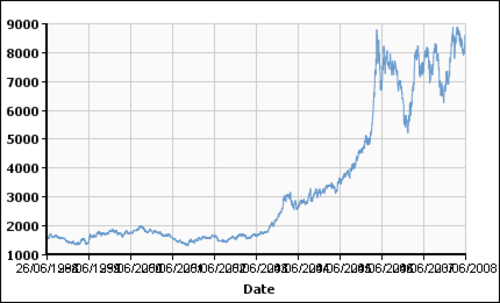
My first thought, even before getting into oil, is that commodity prices can be volatile and go through boom-bust periods.  Here, for example, is a price chart of London copper since 1998:
Copper

While oil prices have gone up by a factor of about four since 1998, copper has gone up by a factor of about 15!  But the media seldom writes about it, because while individual consumers are affected by copper prices, they don't buy the commodity directly, and don't have stores on every street corner with the prices posted on the street.

For a number of years, it is my sense that oil demand has risen faster than supply capacity.  This demand has come from all over -- China gets a lot of the press, but even Europe has seen increases in gasoline use.  Throughout the world, we are on the cusp of something amazing happening - a billion or more people in Asia and South America are emerging from millennia of poverty.  This is good news, but wealthier people use more energy, and thus oil demand has increased.

On the supply side, my sense is that the market has handled demand growth up to a point because for years there was some excess capacity in the system.  The most visible is that OPEC often has been producing below their capacity, with Saudi Arabia as the historic swing producer.  But even in smaller fields in the US, there are always day to day decisions that can affect production and capacity on a micro scale.

One thing that needs to be understood - for any individual field, it is not always accurate to talk about its capacity or even its "reserves" as some fixed number.  How much oil that can be pumped out on any given day, and how much total oil can be pumped out over time, depend a LOT on prices.  For example, well production falls over time as conditions down in the bottom of the hole deteriorate  (think of it like a dredged river getting silted up, though this is a simplification).  Wells need to be reworked over time, or their production will fall.  Just the decision on the timing of this rework can affect capacity in the short term.  Then, of course, there are numerous investments that can be made to extend the life of the field, from water flood to CO2 flood to other more exotic things.  So new capacity can be added in small increments in existing fields.  A great example is the area around Casper, Wyoming, where fields were practically all shut-in in the 1990's with $20 oil but now is booming again.

At some point, though, this capacity is soaked up.  It is at this point that prices can shoot up very rapidly, particularly in a commodity where both supply and demand are relatively inelastic in the short term.

Let's hypothesize that gas prices were to double this afternoon at 3:00PM from $4 to $8.  What happens in the near and long-term to supply and demand?

In the near term, say in a matter of days, little will change on the demand side.  Everyone who drove to work yesterday will probably drive today in the same car -- they have not had time to shop for a new car or investigate bus schedules.  Every merchandise shipper will still be trucking their product as before - after all, there are orders and commitments in place.  People will still be flying - after all, they don't care about fuel prices, they locked their ticket price in months ago. 

However, people who argue that oil and gas demand is inelastic in the medium to long term are just flat wrong.  Already, we are seeing substantial reductions in driving miles in this country due to gas price increases.  Demand for energy saving investments, from Prius's to solar panels, is way up as well, demonstrating that prices are now high enough to drive not only changed behaviors but new investments in energy efficiency.  And while I don't have the data, I am positive that manufacturers around the world have energy efficiency investments prioritized much higher today in their capital budgets.

There are some things that slow this demand response.  Certain investments can just take a long time to play out.  For example, if one were to decide to move closer to work to cut down on driving miles, the process of selling a house and buying a new one is lengthy, and is complicated by softness in the housing markets.  There are also second tier capacity issues that come into play.  Suddenly, for example, lots more people want to buy a Prius, but Toyota only has so much Prius manufacturing capacity.  It will take time for this capacity to increase.  In the mean time, sales growth for these cars may be slower and prices may be higher.  Ditto solar panels. 

Also, there is an interesting issue that many consumers are not yet seeing the full price effects of higher oil and gas prices,and so do not yet have the price incentive to switch behavior.  One example is in air travel.  Airlines are hedged, at least this year, against much of the fuel price increase they have seen.  They are desperately trying not to drive people out of air travel (though DHS is doing its best) and so air fares have not fully reflected fuel price increases.  And since many people buy their tickets in advance, even a fare increase today would not affect flying volumes for a little while.

Another such example that is probably even more important are countries where consumers do not pay world market prices for gas and oil, with prices subsidized by the government (this is mostly true in oil producing countries, where the subsidy is not a cash subsidy but an opportunity cost in terms of lost revenue potential).  China is perhaps the most important example.  As we mentioned earlier, Chinese demand increases have been a large impact on world demand, as illustrated below:
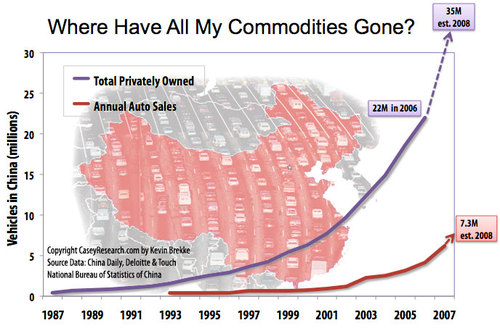
Chinaautos

All of these new consumers, though, are not paying the world market price for gasoline:

While consumers in much of the world have been reeling from spiraling
fuel costs, the Chinese government has kept the retail price of
gasoline at about $2.60 a gallon, up just 9% from January 2007.

During that same period, average gas prices in the U.S. have surged
nearly 80%, to about $4 a gallon. China's price control is great for
people like Tang, who drives long distances in his gas-guzzling Great
Wall sports utility vehicle.

But
Tang and millions of other Chinese are bracing for a big jump in pump
prices. The day of reckoning? Everybody believes it's coming right
after the Summer Olympics in Beijing conclude in late August.

Demand, of course, is going to appear inelastic to price increases if a large number of consumers are not having to pay the price increases.

Similarly, there are factors on the supply side that make response to large price increases relatively slow.  We've already discussed that there are numerous relatively quick investments that can be made to increase oil production from a field, but my sense is that most of these easy things have been done.  Further increases require development of whole new fields or major tertiary recovery investments in existing fields that take time.  Further, we run up against second order capacity issues much like we discussed above with the Prius's.  Currently, just about every offshore rig that could be used for development and exploration is being used, with a backlog of demand.  To some extent, the exploration and development business has to wait for the rig manufacturing business to catch up and increase the total rig capacity.

There are also, of course, structural issues limiting increases in oil supply.  In the west, increases in oil supply are at the mercy of governments that are schizophrenic.  They know their constituents are screaming about high oil prices, but they have committed themselves to CO2 reductions.  They know that their CO2 plans actually require higher, not lower, gas prices, but they don't want the public to understand that.  So they demagogue oil companies for high gas prices, while at the same time restricting increases in oil supply.  As a result, huge oil reserves in the US are off-limits to development, and both the US and Canada are putting up roadblocks to the development of our vast reserves of shale oil.

Outside of the west, most of the oil is controlled by government oil companies that are dominated by incompetence and corruption.  For years, companies like Pemex have been under-investing in their reserves, diverting cash out of the oil fields into social programs to prop up their governments.  The result is capacity that has not been well-developed and institutions that have only limited capability to ramp up the development of their reserves.

One of the questions I get asked a lot is, "Isn't there a good reason for suppliers to hold oil off the market to sustain higher prices?"  Well, let's think about that.

Let's begin with an analogy.  Why wouldn't Wal-mart start to hold certain items off the market to get higher prices?  Because they would be slaughtered, of course.  Many others would step in and fill the void, happy to sell folks whatever they need and taking market share from Wal-mart in the process.  I think we understand this better because we know the players and their motivations better in retail than we do in oil.  But the fact is that Wal-mart arguably has more market power, and in the US, more market share than any individual oil producer has worldwide.  Oil producers have seen boom and bust cycles in oil prices for over a hundred years.  They know from experience that $130 oil today may be $60 oil a year from now.  And thus holding one's oil off the market to try to sustain prices only serves to miss the opportunity to get $130 for one's oil for a while.  People tend to assume that the selfish play is to hold oil off the market to increase prices, but in fact it is just the opposite.  The player who takes this strategy reduces his/her own profit in order to help everyone else. 

This is a classic prisoner's dilemma game.  Let's consider for a moment that we are a large producer with some ability to move prices with our actions but still a minority of the market.  Consider a game with two players, us and everyone else.  Each player can produce 80% of their capacity or 100%.  A grid showing reasonable oil price outcomes from these strategies is shown below:
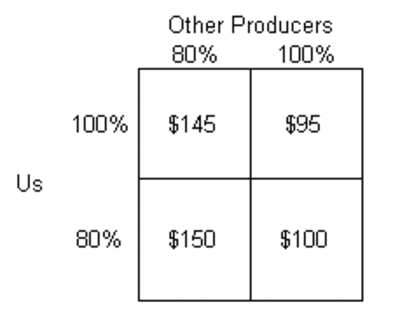
P1_3

Reductions in our production from 100% to80% of capacity increases market prices, but not by as much as would reductions in production by other producers, who in total have more capacity than we.  Based on these prices, and assuming we have a million barrels a day of production capacity, the total revenue outcomes for us of these four combinations are shown below, in millions of dollars (in each case multiplying the price times 1 million barrels times the percent production of capacity, either 80 or 100%):

P2

We don't know how other producers will behave, but we do know that whatever strategy they take, it is better for us to produce at 100%.  If we really could believe that everyone else will toe the line, then everyone at 80% is better for us than everyone at 100% -- but players do not toe the line, because their individual incentive is always to go to 100% production.  For smaller players who do not have enough volume to move the market individually (but who make up, in total, a lot of the total production) the incentive is even more dramatically skewed to producing the maximum amount.

The net result of all this is that forces are at work to bring down demand and bring supply up, they just take time.  I do think that at some point oil prices will fall back out of the hundreds.  Might this reckoning be pushed backwards a bit by bubble-type speculation?  Sure.  People have an incredible ability to assume that current conditions will last forever.  When oil prices were at $20 for a decade or so, people began acting like they would stay low forever.  With prices rising rapidly, people begin acting like they will continue rising forever.  Its an odd human trait, but a potentially lucrative one for contrarians who have the resources and cojones to bet against the masses and stick with their bet despite the fact that bubbles sometimes keep going up before they come back down.   

I don't have the economic tools to say if such bubble speculation is going on, or what a clearing price for oil might be once demand and supply adjustments really kick in.  I do have history as an imperfect guide.  In 1972 and later in 1978 we had some serious price shocks in oil:
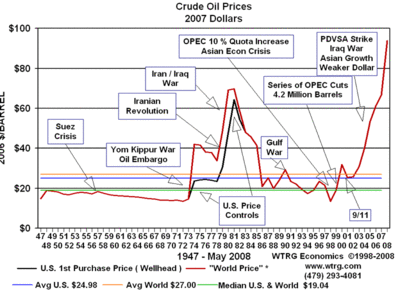
Oilprice1947

Depending on if you date the last run-up in prices from '72 or '78, it took 5-10 years for supply and demand to sort themselves out (including the change in some structural factors, like US pricing regulations) before prices started falling.  We are currently about 6 years into the current oil price run-up, so I think it is reasonable to expect a correction in the next 2-3 years of fairly substantial magnitude. 

Postscript:  I have left out any discussion of the dollar, which has to play into this strongly, because what I understand about monetary policy and currencies wouldn't fill a thimble.  Suffice it to say that a fall in value of the dollar will certainly raise the price, to the US, of oil, but at the same time rising prices of imported oil tends to make the dollar weaker.  I don't know enough to sort out the chicken from the egg here,

Economic Morons in Europe, but is Congress Much Better?

Via Tim Worstall, Gawain Towler reports this bill in front of the European Supreme Soviet Parliament:

Written declaration on fixing fuel prices
The European Parliament,"“ having regard to Rule 116 of its Rules of Procedure,
A.
Whereas we are witnessing an unprecedented rise in fuel prices, and
this scandalous surge is having a devastating effect on economic
activity in various sectors: transport and other services, industry,
agriculture and fisheries,
B. Whereas in Portugal, the major oil
companies in the first quarter of this year, vis-à-vis the first
quarter of 2007, made net profits of 22.9% (GALP), and consolidated
profits of 36.5% (REPSOL) and 63.4% (BP), which were fundamentally the
result of practising speculative pricing, as a result of the
speculative valuation of oil stocks
bought at lower prices,

1.
Calls for the establishment of a tax, for each Member State, to be
levied exclusively on these profits so as to bring them back into the
coffers of the Member State. This tax should be paid within 60 days
after the end of each quarter, with the value and scope of the levy
depending on the readiness of the oil companies to reduce their
speculative gains thanks to the 'stock effect';
2. The revenue
generated by this tax should be returned on a proportional basis to the
various economic sectors in each Member State;
3. Instructs its
President to forward this declaration, together with the names of the
signatories, to the Council, Commission, and Parliaments of the Member
States.

"depending on the readiness of oil companies to reduce their speculative gains thanks to the 'stock effect'"??  What the *&#$@% does this mean?  What economic concept are they even trying to get at?

Further, I was amazed at the statement that BP made net profits of 63.4%.  It took me a while to figure out that this was the quarter over quarter profit growth, not the profit margin.  I can't tell if these guys are just ignorant or if this is a translation issue into English, so i will give them the benefit of the doubt.  In case you are wondering, BP's net profit margin in the first quarter of 2008 was 8.3% of revenues, which in the grand scheme of industry is actually below average.

One reason fuel prices are so high in Europe is because the government takes more than half of fuel revenues in taxes:

Fuel taxes are also the central issue for truckers in Europe, because
they account for a large portion of the retail price of fuel. Unleadedgasoline
sold for $8.65 per gallon and diesel for $9.62 per gallon Tuesday in
Britain, which charges a flat $3.77 per gallon in fuel duty and imposes
a 17.5 percent consumptiontax on the total price

So, 61% (44% from the $3.77 plus the 17.5%) goes to government and 8.3% goes to the BP shareholders.  So lets tax BP shareholders more to lower the price!

So Where Are They Storing All the Oil?

I find the current political demagoguery that oil speculators are now the ones responsible for higher oil prices to be absolutely laughable.  I am willing to believe that oil supply and demand are perfectly inelastic over very short time periods, meaning that we might expect little change in supply or demand over a couple of days or weeks after a price change, allowing for a fairly free range of speculative excesses.  However, there is every evidence that oil is by no means perfectly price inelastic, and supply and consumption do change with price.  Already in the past few months we have seen, for example, substantial reductions in passenger car miles in this country. 

For any period of time longer than hours or days (or perhaps weeks), any cabal that is somehow manipulating oil prices well above the natural market clearing price is going to have to deal with a problem:  Extra oil.  Lots of it.  Even if the supply side is sticky due to shortages currently in drilling equipment, demand is not.  People are going to use less, and at the same time, every supplier is going to be trying to send every barrel to market as quick as they can  (oil producers know that prices that rise will eventually fall again -- that is the history of oil.  They are all programmed to move as much product as possible when prices are at all time highs).

A lot of dynamics, such as a short squeeze, can create a speculative bulge, but if speculators are somehow purposefully keeping oil prices high for long periods of time, they must be doing one of three things:

  1. Storing a lot of oil somewhere
  2. Creating an extensive system of production controls that keeps oil supply off the market.
  3. Have someone with deep pockets subsidize consumer demand for oil by selling excess oil off at below market prices.

One is just not possible, not in the quantities that would be required.  Two sort of happens in a haphazard and not very consistent way with OPEC, though it is hard to convince me that futures traders in Chicago have an active partnership with large state-run oil companies.  Three is actually happening, with the Chinese government continuing to sell gasoline and other petroleum products at below market prices, but there is evidence that there are limits to how much further they will take this.  Again, I think this is being done for reasons other than cooperation with mercantile exchange traders in the US.

To a large extent, this theory, if it is anything more than just populist capitalism-bashing, is a result of extreme ignorance.  There are an incredible number of people involved in the oil markets every day in numerous countries with numerous different incentives, such a large number that it is impossible to imagine a conspiracy.  There have been a couple of cases of proven petroleum commodity price manipulation in these trading markets - most of these have involved manipulation of prices at the end of the day on certain futures expiration and/or Platt's pricing windows.  The time frame for these manipulations have been on the order of 1-2 minutes.

But here is the best argument against this manipulation for higher prices, and it is amazing to me that no one ever thinks of it.  Sure, there are a bunch of really savvy people in the commodity trading business who are long on oil and want the price to be higher.  But for every seller, there is a buyer on the other side, someone who is at least as savvy and is desireous of lower prices.  Yes, I know it is a complicated concept, but for every trader selling there is one buying.  If there is an extended conspiracy to push up oil prices by speculators, do you really think the buyers are just going to sit on their hands and take it?  And do you really think the exchanges are going to be happy with this behavior, threatening the integrity of their trading system (really their only asset)?  Just ask the Hunt family, which attempted to corner the market and drive prices up in silver, only to have major buyers and the exchanges stop them cold, driving the Hunts in the process into bankrupcy. 

I wrote about this same topic previously here.

Those Short-Term, Quarterly Focused Corporations

Everyone has heard the knock on corporations -- they are supposedly short-term focused and incapable of making investments that don't pump up the current quarter.  We hear this in particular from government officials, right before they try to sell some egregious bit of pork-spending that is supposedly for "investment" in things these awful corporate guys won't invest in.

But of course the entire existence of the oil industry is proof-positive that this knock on large corporations can't be universally true, or else the oil industry would have gone out of business for lack of reserves some time in the late 19th century.  The oil industry routinely makes huge investments that take 10 years or more to even start to pay out (e.g. Alaska pipeline, shale oil, deep Gulf).  One major reason that supplies are currently tight is that most of the world's oil reserves are held by state companies (like Pemex) that are incapable of making the long-term investments their fields needs because there is so much pressure on the government to divert the oil profits into social programs rather than into renewing the reserve base.

And now look who is singing the same tune as Hugo Chavez and the other oil producing kleptocrats - Barack Obama:

"Opening our coastlines to offshore drilling would take at least a
decade to produce any oil at all, and the effect on gasoline prices
would be negligible at best since America only has 3 percent of the
world's oil," Obama said in a statement that did not explicitly
distinguish between oil and gas drilling."

Of course, offshore drilling was approved 10 years ago, but was vetoed by Bill Clinton.  I don't believe for a second that this is his real reason for opposing drilling (in fact, I believe him to be in the pocket of radical environmentalists and perfectly happy to demagogue oil companies for high prices rather than take responsibility for past government action).  However, if we take him at his word, this is an absolutely unbelievable lack of long-term focus from a man people like to call "visionary."

Homes are Becoming More Affordable; Minorities, Poor Hardest Hit

It is interesting that with home prices and gasoline prices going in opposite directions, the media can declare both trends to be disasters for Americans.  Via Scrappleface:

The U.S. housing crisis reached fever pitch this month, with potential foreclosures up 48 percent compared with May 2007.

The devastation of receiving foreclosure notices has now swept
through a full 2/10ths of one percent of American homes. About 1/10th
of one percent of owners may lose their homes. For some of those
people, it's actually their primary residence in jeopardy, rather than
a second home, rental property or vacation condo.


To add insult to misery, mortgage rates skyrocketed this month to
6.32 percent, a shocking figure a full third of what it was during the
Carter administration.

As a result of the flood of homes on the market, real estate agent
commissions have dipped precariously, and home buyers increasingly
wrestle with the guilt of paying bargain prices for excellent
properties.

Market analysts say home prices could plummet as much as another 10
percent by the end of 2009, leaving first-time home buyers to face the
specter of owning a more spacious residence. The additional square
footage inequitably boosts the burden of cleaning, heating and air
conditioning.

My Addiction to Health and Prosperity

Kevin Drum titles a post on providing government incentives for high MPG cars "Ending the Addiction,"  by which I presume he means addiction to gasoline.   I really struggle with the point of view on life that describes consumer affinity for enormously value-producing technologies to be an "addiction."  One could equally well refer to our preference for good health or prosperity to be an "addiction," particularly when fossil fuels have played such a central role in fueling the industrial revolution and the prosperity which it has brought.  With the current jump in oil prices tied so closely to growing wealth in China, never has the tie between fossil fuel use and prosperity been more obvious.

Drum advocates for what he calls a "progressive" proposal:

For cars, the most effective thing would be a "feebate": In the
showroom, less-efficient models would have a corresponding fee, while
the more-efficient ones would get a rebate paid for by the fees. That
way when choosing what model you want you would pay attention to fuel
savings over its whole life, not just the first year or two. It turns
out that the automakers can actually make more money this way because
they will want to get their cars from the fee zone into the rebate zone
by putting in more technology. The technology has a higher profit
margin than the rest of the vehicle.

I will say that this is probably less bad than other "progressive" proposals I have heard, but the logic here is based on consumer ineptness.  Higher gas prices, which drive higher lifecycle costs, are presumably providing exactly this incentive without any government program.  The problem, it seems, is that progressives don't think very much of the common people they wish to defend.  Just as the justification for Social Security is that the average person can't be trusted to make good decisions about their retirement savings so we elites will do it for them, this seems to be the logic here, but even more patronizing.   Here is the best bit which really demonstrates the point I am making:

Here's a further suggestion: require stickers to list the estimated cost of fuel consumption over a five year period.

Basically this calculation is total estimated miles per year divided by mpg times estimated gas prices times five. A simple piece of math with four numbers that can be completed on a calculator in 10 seconds or by hand in less than 30 seconds.  Mr. Drum, a big supporter of our current monopoly government school system, apparently does not think that people educated in this system can do this math for themselves.  Could it be clearer that "progressivism" is really about disdain for the common man and a belief that elites should make even the smallest decisions for them?

The Oil Prices We Deserve

A good column on gas prices by George Will.

Can a senator, with so many things on his mind, know so precisely how
the price of gasoline would respond to that increase in the oil supply?
Schumer does know that if you increase the supply of something, the
price of it probably will fall. That is why he and 96 other senators
recently voted to increase the supply of oil on the market by stopping
the flow of oil into the Strategic Petroleum Reserve,
which protects against major physical interruptions. Seventy-one of the
97 senators who voted to stop filling the reserve also oppose drilling
in the Arctic National Wildlife Refuge.

One million barrels is what might today be flowing from ANWR if in 1995 President Bill Clinton
had not vetoed legislation to permit drilling there. One million
barrels produce 27 million gallons of gasoline and diesel fuel.
Seventy-two of today's senators -- including Schumer, of course, and 38
other Democrats, including Barack Obama, and 33 Republicans, including John McCain -- have voted to keep ANWR's estimated 10.4 billion barrels of oil off the market.

In Search of the Good Life

Tim Harford Via TJIC:

Superficially, it seems that many people seek sunny climes,
especially now that air conditioning is available. For example,
long-run population growth in the "Sunbelt" "” the US South - is often
attributed to a demand for, well, sun.

Harvard economists Ed Glaeser and Kristina Tobio think
otherwise. They argue that before 1980, the boom in the South was
thanks to the region's growing productivity. After 1980, population
continued to grow, but house prices lagged behind those elsewhere in
the US, suggesting that the driving force was not high demand but
permissive planning rules. Certainly balmy California, with its tighter
restrictions on building, did not enjoy the same population growth.

All of this tends to suggest that people don't value sunshine quite as much as is supposed.

I have pretty convincing anecdotal evidence that the first part, at least, is true.  I worked for a large manufacturing corporation called Emerson Electric (no relation to the electronics company).  They are one of the few Fortune 50 companies not at all coy to admit that they move factories around the world chasing lower wages.  They had an epiphany decades ago, when in their planning, they assumed the move overseas was always a trade-off of wages for productivity... until they visited at motor plant in Brazil that had first world automation and productivity combined with third world wages.  That got their attention.  To their credit, they have pushed this further and further, such that not only are their factory workers in Mexico, but their plant superintendents and skilled workers and even their engineers are now Mexican too.

Anyway, if you listen to the company tell this story, phase 1 of the story was not a move to Mexico or Asia but to the south.  They must have moved probably 50 manufacturing plants over a decade from the northeast to the south during the sixties and seventies. 

This constant movement seems to be a natural life-cycle of locations as they grow wealthy.  Poorer regions eagerly welcome newcomers who may bring jobs and prosperity.  But, once the prosperity is there, the prosperous in town begin using government and other institutions to try to lock in their gains.  Corporations use government to fight new competitors.  Wealthy homeowners pass zoning to keep home prices high and rising.  Unions tend to increase and lock in gains for current workers at the expense of new workers.  A kind of culture of hostility emerges to any new job that makes less than $54,000 a year, any house that costs less than $400,000, and any immigrant who doesn't have a pale face.

Prices vs. Government Action

Very often on this blog I criticize some ill-conceived government intervention as being bloated and/or ineffective and ill-conceived.  A great example is corn-ethanol, where the government has spent billions and caused consumers to spend additional billions in higher food and gas prices, all for a technology that does nothing to reduce oil consumption or CO2 output.

Too often, I criticize these programs for being stupid and ill-conceived, which they are.  But what I don't take the time to also point out is the necessarily narrow focus of these government actions.  No matter how hard Congress works to stuff energy and farm bills with every micro-managing pork barrel project their campaign donors could wish for, Congress still only has the bandwidth to affect a tiny fraction of a percent of what a single change in market prices can achieve.  Prices have absolutely stunning power of communication.  When gas prices go up, every single citizen likely reassesses his/her behavior and spending in a myriad of ways.  Thousands of entrepreneurs sit at their desk staring at the walls, trying to dream up business opportunities that these new prices may signal.  And thousands of energy producers, from the tiniest to the largest, rethink their investment plans and priorities.