I have been trying to find a word to describe the legislative style we have seen prominently over the last 9 months (though it was used long before this administration -- the Patriot Act comes to mind). Unable to think of any other name, an in homage to "murder-death-kill" in "Demolition Man," I am going to call it Crisis-Emergency-Rush.
TARP was a Crisis-Emergency-Rush. As was the Stimulus bill, Waxman-Markey, and now Health Care. (The last two are particularly hilarious when one needs to evaluate the need to rush. Waxman-Markey is implemented over decades, and the health care bills as currently written don't really begin to take effect until 2013).
So here is my prediction for the next Crisis-Emergency-Rush: Raising taxes. Obama already has his boys out sending trial balloons about new taxes, even beyond those required in Waxman-Markey and to fund the health care bill. Having spent over a trillion dollars on useless spending to support favored political constituencies, Obama will now declare a fiscal crisis that can only be solved by increased taxes on his non-favored constituencies.
Any person with a room temperature IQ can figure out that the Obama "jobs saved" metric is complete BS, a measure that is totally unmeasurable, and therefore can be set to any value the Administration wishes.
How much are politicians straining to convince people that the government is stimulating the economy? In Oregon, where lawmakers are spending $176 million to supplement the federal stimulus, Democrats are taking credit for a remarkable feat: creating 3,236 new jobs in the program's first three months.
But those jobs lasted on average only 35 hours, or about one work week. After that, those workers were effectively back unemployed, according to an Associated Press analysis of state spending and hiring data. By the state's accounting, a job is a job, whether it lasts three hours, three days, three months, or a lifetime.
"Sometimes some work for an individual is better than no work," said Oregon's Senate president, Peter Courtney.
With the economy in tatters and unemployment rising, Oregon's inventive math underscores the urgency for politicians across the country to show that spending programs designed to stimulate the economy are working "” even if that means stretching the facts.
At the federal level, President Barack Obama has said the federal stimulus has created 150,000 jobs, a number based on a misused formula and which is so murky it can't be verified.
On a full-time FTE basis, the report figures Oregon has "created" 215 full-time jobs. They don't even attempt to do the math on how many jobs were destroyed when $176 million was taken from other productive uses. But does anyone else syspect that the private hands the $176 million was formerly in probably would employ more than 215 people for that chunk of change?
I had trouble believing this chart (ht Maggies Farm) until I looked at the HHS data here and saw it was dead on. On the chart below, the width of the band at the left is percentage of the US population, and to the right is percentage of the US welfare roles.
The second biggest band, in green, I believe is New York. Its incredible that California's financial problems can be in the news for months and I have never seen a whiff of this in the media.
Local swimmers have gotten a court order forcing the City of San Diego to chase away the seals from the Scripps children's pool in La Jolla. But it is not my intention to blog on that specifically, but on this bit:
The city said it would blast recordings of barking dogs to scare away the pesky pinnipeds at the cost of $688,000 a year. San Diego cannot use force because the seals are a federally protected marine species.
Please, oh please can I get paid $688,000 a year to play loud recordings on the beach? I have not even cracked a spreadsheet on this, but I am betting I can turn a profit on that.
Those of you who may be encouraged by the reports of disagreements and problems among Democrats in reachi9ng consensus on a health care takeover, don't be too encouraged. This appears to be exactly like the run up to Waxman-Markey. If this is the case, these cries by certain Democrats of problems in the bill are really thinly disguised pleas for bribes.
Recalcitrant Democrats in Congress know that Obama will be happy to spend tens of billions in taxpayer money to buy off the votes he needs to pass these bills. This is how they got over the hump in the House with Waxman-Markey, and you can expect the same thing to happen again, and happen fast, on health care. In fact, I expect the bribes to be higher than the $3.5 billion per vote clearing price on Waxman-Markey. Obama knows that only steamroller tactics will pass a bill -- if he pauses even for a second to let opponents have time to take their case to the public (or even to finish reading the bill) he will likely lose. Sunlight is his worst enemy right now, and he will gladly spend our money for porkbarrel projects in key districts to avoid it.
Normally, if I were to contemplate resorting to bribery to change someone's decision, I would have to face two hurdles. First, of course, I would face legal consequences because in many contexts., bribery is illegal. Second, I would have to consider the cost -- is the price being demanded worth it. After all, it makes little sense to spend a million dollars to bribe someone to make a decision worth a hundred thousand dollars to me.
But, unfortunately, neither of these problems exist when Congressional leadership seeks to bribe recalcitrant lawmakers to vote their way. Bribery in this context is not illegal, its just "horsetrading." And the cost is meaningless, because folks like Nancy Pelosi do not bear the cost of the bribe, taxpayers do.
It is totally clear to me that Obama and Pelosi will spend any amount of money to pass their key legislative initiatives. In the case of Waxman-Markey, the marginal price per vote turned out to be about $3.5 billion. But they didn't even blink at paying this. That is why I fear that some horrible form of health care "reform" may actually pass. If it does, the marginal cost per vote may be higher, but I don't think our leaders care.
Waaaay back, before the stimulus was even passed, I did an analysis of the proposed spending in 2009-2010 and said that very little of it was for the infrastructure type projects that were being promised. I concluded:
The reason so much of this infrastructure bill can be spent in the next two years is that there is no infrastructure in it, at least in the first two years! 42% of the deficit impact in 2009/2010 is tax cuts, another 44% is in transfer payments to individuals and state governments. 1% is defense. At least 5% seems to be just pumping up a number of budgets with no infrastructure impact (such as at Homeland Security). And at most 6% is infrastructure and green energy. I say at most because it is unclear if this stuff is really incremental, and much of this budget may be for planners and government departments rather than actual facilities on the ground.
So don't call this an infrastructure bill. This is a tax cut and welfare bill, at least in 2010 and 2011.
Via the Atlantic (hat tip to TJIC) we get a GAO report that comes to the same conclusions (they leave out the tax cut part and look at only the spending side):
But most federal stimulus funds aren't necessarily being spent to create $250K jobs out of thin air -- they're being spent to plug in the ongoing decay in state budgets. That was the conclusion of the GAO report early this month. Here's a graph they provided breaking down stimulus spending by program:
Of the $29 billion spent this year, 90 percent has gone to assist Medicaid and to stabilize tottering state budgets, according to the report. That's not just job creation -- that's emergency rescue, a fiscal crutch propping up our humpback deficit-ridden states. So what exactly is the logic in kicking the crutch away? If you see an old man with a cane who's barely managing to place one foot in front of the other, the logical commentary seems to me to be "Thank God for that crutch," not "Well obviously that crutch isn't doing much for him, he probably won't mind if I borrow it for a while."
But we're talking about job creation, so let's take a look at shovel-ready, highway spending, which the GAO puts at 6 percent of the spent stimulus. I suppose this would be a good place to knock the administration for not spending fast enough to create construction jobs, but Conor Clarke notes here (with a chart, of course), highway spending is actually ahead of schedule is all 16 states the GAO studied for the report.
Only $29 billion spent so far? Can we please just stop it now before the other $700 billion or so get spent? Why are we planning spending in 2015 to prop up the 2009 economy?
The other day, there was an intriguing story in the USA Today that a disproportionate share of stimulus money is flowing to counties that voted for Obama. In fact, counties that voted Obama are getting twice as much per capita so far as counties that did not. Matt Yglesias writes:
The insinuation of the piece is that the stimulus bill's funding streams are being artfully manipulated or something to disproportionately direct resources toward Obama-loving constituencies....[But] the secret to the riddle seems to be that areas that benefit from federal spending formulae tend to support the Democrats. Not as a result of short-term fluctuations in voting patterns or federal spending levels, but as a structural element of American politics.
Kevin Drum misses Matt's point, I think, when he responds:
Actually, that's not quite right. It's weirder than that. I just got around to reading the piece, and aside from the factual statement in the lead, it doesn't insinuate that the money is being unfairly distributed. In fact, every single paragraph after the lead quotes people saying that there's nothing dubious going on and the money is just being distributed by formula. The piece doesn't quote a single person, not even Sarah Palin, suggesting that there's any monkey business going on here.
But this does not refute Matt's point as I understand it, that "tinkering" is not necessary because the formulas themselves have been worked over time to preferentially send money certain places. I would use the analogy that there are well worn channels where the money preferentially flows.
I must disagree that a story that money tends to flow preferentially (on a ratio as high as 2:1) to Democratic districts should be spiked, as Kevin Drum advocates. I think there is a story in this, though certainly I agree with Kevin it is not the story the author set out to write (one of micro-manipulation by Administration employees).
My sense is that the causality involved would be impossible to discover. Does money flow preferentially to these districts because Democrats are better or more focused on bringing home the taxpayer largess to their districts? Or does our money preferentially flow to these districts based on, say, economic or demographic factors that line up well with Democratic constituencies. Or is it, more likely in my mind, a virtuous circle with both factors involved.
Either way, this is an interesting story and some interesting new data in our endless red state-blue state analyses.
GM is apparently emerging from bankruptcy. It will have the same (though fewer) managers, employees, and assembly plants. It will have the same product designers, marketers, strategists, and planners. It will have roughly the same organization systems, the same culture, and the same history. Though it was able to shed some plants and employees, it will have most of the same stifling work rules on the shop floor. It did, however, manage to shed a lot of interest payments to creditors who entrusted their money to GM in return for claims on GM assets, only to be given the shaft by the Obama administration,
The main difference in the new GM is that it will have an ownership group whose primary concerns are NOT the financial success of the company. The UAW will be primarily concerned with keeping union members employed and happy and not shifting any manufacturing to lower-cost venues. The US Government will be primarily concerned with making sure the UAW is happy and promoting a number of its own goals, like "sustainable" plants and smaller cars, irrespective of whether these goals make business sense. It will be a company more concerned with whether plants have recycling programs and workers with American passports rather than cost or quality. Both the UAW and the US government can pursue such non-business goals secure in the knowledge that financial success is virtually irrelevant, as the US taxpayer can be counted on to make up any shortfalls.
I predicted the climate bill would likely pass the House as Obama and Co. would happily pull out the checkbook to spend taxpayer money to bribe Representatives to pass his legislative agenda. I wrote:
I am again hearing rumblings that the climate bill may pass the House. If so, it will be interesting to see what last minute bribes were added to make this happen. The most recent bribe we know about is the commitment to pay farmers not to grow crops with the weak window dressing that this is somehow a carbon offset.
When House Democratic leaders were rounding up votes Friday for the massive climate-change bill, they paid special attention to their colleagues from Ohio who remained stubbornly undecided.
They finally secured the vote of one Ohioan, veteran Democratic Rep. Marcy Kaptur of Toledo, the old-fashioned way. They gave her what she wanted "“ a new federal power authority, similar to Washington state's Bonneville Power Administration, stocked with up to $3.5 billion in taxpayer money available for lending to renewable energy and economic development projects in Ohio and other Midwestern states.
This is part of that mysterious 310-page ammendment that was revealed just hours before the vote.
House Majority Leader Steny Hoyer (D-Md.) said Tuesday that the health-care reform bill now pending in Congress would garner very few votes if lawmakers actually had to read the entire bill before voting on it.
"If every member pledged to not vote for it if they hadn't read it in its entirety, I think we would have very few votes," Hoyer told CNSNews.com at his regular weekly news conference.
Hoyer was responding to a question from CNSNews.com on whether he supported a pledge that asks members of the Congress to read the entire bill before voting on it and also make the full text of the bill available to the public for 72 hours before a vote.
In fact, Hoyer found the idea of the pledge humorous, laughing as he responded to the question. "I'm laughing because a) I don't know how long this bill is going to be, but it's going to be a very long bill," he said.
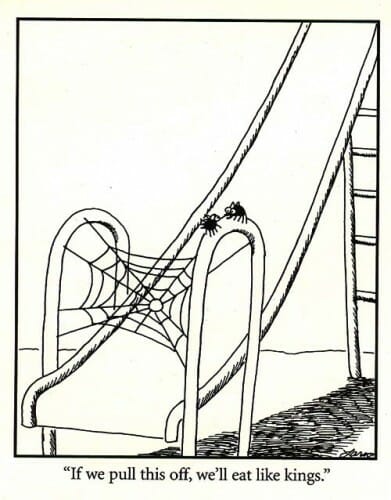
Chris Horner of NRO used this Far Side cartoon as a good way to illustrate why many large corporations have jumped on the Waxman-Markey bandwagon:
Waxman-Markey is not climate or energy policy, its a pillar in Obama's attempt to build a European-style corporate state, where a clique of large unions, large corporations, and selected politicians run the state to their own mutual benefit.
PS- I'm not buying the Goldman Sachs as trilateral commission conspiracy in Horners article. But the direct line from Enron to the current cap-and-trade bill is an important one that is under-reported. Enron was on the cap-and-trade lobbying bandwagon very early on.
Bruce McQuain has a really good post debunking the meme that Medicare overhead costs are lower than those of private insurers. You should read the whole post, but the short answer is:
Medicare participants are older and less healthy than those insured privately, so the denominator for their overhead ratio is much higher
Comparing overhead costs per plan participant, Medicare costs are higher than private
The comparison is apples and oranges, because private firms pay account differently than does the government
Lower Medicare overhead has tradeoffs, as it lets fraud through which is not counted as a cost
I can't add to Bruce's post, except to say that as someone in the business of trying to privatize government functions, we see the apples and oranges problem all the time. I am constantly having cost discussions with government bodies, and they frequently leave out most of the following when they compute their costs:
Insurance (e.g. liability, property). They say the government is self-insured, but the government does not charge its divisions any cost for this implicit guarantee. I have to pay real money for it.
State / local taxes. Private companies have to collect and pay many state and local sales, excise, and property taxes that the feds do not pay.
Pensions / retirement benefits. The government grants fat pensions and retirement medical benefits to its employees but does not accrue or put any funds away in the present to pay for these. Private companies do (and in fact would go to jail for not doing so).
Capital spending and rent. This varies by entity, but most government bodies do not see full depreciation of the capital assets they are using in their budgets. Ditto for the value of the space they are occupying - they often get valuable space rent and/or depreciation free.
Services from other government divisions. Sometimes transfer prices are charged, and sometimes they are even close to market rates, but most times they are not
Now comes the CBO with yet more news of the sort that neither Capitol Hill nor the White House is likely to welcome: its freshly released report on the federal government's long-term financial situation. To put it bluntly, the fiscal policy of the United States is unsustainable. Debt is growing faster than gross domestic product. Under the CBO's most realistic scenario, the publicly held debt of the U.S. government will reach 82 percent of GDP by 2019 -- roughly double what it was in 2008. By 2026, spiraling interest payments would push the debt above its all-time peak (set just after World War II) of 113 percent of GDP. It would reach 200 percent of GDP in 2038.
This huge mass of debt, which would stifle economic growth and reduce the American standard of living, can be avoided only through spending cuts, tax increases or some combination of the two. And the longer government waits to get its financial house in order, the more it will cost to do so, the CBO says.
Unfortunately, the answer to the question of when Obama will take ownership of the debt crisis he is causing is likely "never." The most likely scenario is that Obama demands that we taxpayers, many of us who opposed his actions that led to this run-up of debt, take ownership for this debt via substantially higher taxes.
Good to know they're at least working hard to make flattering photographs of the president "more accessible" to the public. Who says Obama has dropped the ball on transparency?
In partnership with regional chapters of the charity group Crimestoppers U.K., multiple local police forces have launched a program called "Too Much Bling? Give Us a Ring." The object of the program is to encourage people who suspect that a neighbor or acquaintance is living off the proceeds of crime to anonymously provide information about that person to the police...
A key component of the "Too Much Bling?" program is its effort to tap into any resentment and anger members of the public may feel toward suspected criminals.
In a release issued by the Sussex Police Department, which used the program to help seize more than £1.5 million between April and December of last year, Detective Sergeant Mick Richards said, "Members of the public are sick and tired of seeing people with no legitimate income living a lavish lifestyle. We are working hard towards taking the cash out of crime making use of all the powers granted to us under the Proceeds of Crime Act and other legislation.
"I am very aware that in these difficult times how disheartening it is to see people 'flashing the cash' when you know that it has come from a life of crime and that they appear to be 'getting away with it,'" he said.
In one e-mail exchange, University of Illinois Chancellor Richard Herman forced the law school to admit an unqualified applicant backed by then- Gov. Rod Blagojevich while seeking a promise from the governor's go-between that five law school graduates would get jobs. The applicant, a relative of deep-pocketed Blagojevich campaign donor Kerry Peck, appears to have been pushed by Trustee Lawrence Eppley, who often carried the governor's admissions requests.
When Law School Dean Heidi Hurd balked on accepting the applicant in April 2006, Herman replied that the request came "Straight from the G. My apologies. Larry has promised to work on jobs (5). What counts?"
Hurd replied: "Only very high-paying jobs in law firms that are absolutely indifferent to whether the five have passed their law school classes or the Bar."
Props to Heidi Hurd for such a sharp response. The scale is pretty staggering:
Gov. Pat Quinn convened a state commission to investigate the U. of I. admissions process after the Tribune revealed that more than 800 undergraduate applicants in the last five years received special consideration because they were backed by U. of I. trustees, legislators and others in powerful posts.
That's 160 a year! I don't know how large the law school is, but that must be a respectable portion of the class. via Glenn Reynolds
There is some sort of weird mass self-hypnosis going on, made even odder by the fact that a lot of people seem to know they are hypnotized, at least at some level. I keep getting shushed as I make fun of friends' cult behavior watching the proceedings today, as if by jiggling someone's elbow too hard I might break the spell. Never have I seen, in my lifetime, so much emotion invested in a politician we know nothing about. I guess I am just missing some gene that makes the rest of humanity receptive to this kind of stuff, but just for a minute snap your fingers in front of your face and say "do I really expect a fundamentally different approach from a politician who won his spurs in "¦. Chicago? Do I really think the ultimate political outsider is going to be the guy who bested everyone at their own game in the Chicago political machine?"
As I wrote before, Waxman-Markey puts most of the onus for CO2 reduction on refiners and transportation fuels, so that is the area we will see the most price increase if the bill passes.
So I ask you, after putting this huge effective tax on refiners, which will also in some cases force refiners to shut down capacity and produce less fuel, how long will it be before a politician starts to demagogue oil companies for rising gasoline prices and/or fuel shortages?
This is at the end of the day why Congress wanted cap-and-trade rather than a carbon tax. By putting the tax on unsympathetic targets like oil companies, Congress and Obama can pretend that inevitable consumer price increases are the oil companies greedy fault, and not related to the actions in Washington.
The Antiplanner observes, in the context of the Washington metro crash, that governments are happy to appropriate funds for expensive new facilities, but almost never want to appropriate funds for capital replacement and refurbishment of such facilities 20-30 years later. Such refurbishment is nearly always necessary. Private businesses plan for it -- for example, oil companies plan and budget on the assumption that all of their gas stations will need to be torn down and rebuilt every 20-25 years.
I work with public recreation a lot and can say that the exact same problem exists -- politicians love funding a new park or visitor center or museum expansion, particularly if they can get their name on it, but consistently refuse to fund capital replacements decades later when these are needed. I guess they are unsexy.
This is OK, because when it inevitably creates problems, those problems can again be blamed on a failure of free-market capitalism.
Two U.S. Democratic lawmakers want Fannie Mae and Freddie Mac to relax recently tightened standards for mortgages on new condominiums, saying they could threaten the viability of some developments and slow the housing-market recovery....
In March, Fannie Mae said it would no longer guarantee mortgages on condos in buildings where fewer than 70 percent of the units have been sold, up from 51 percent, the paper said. Freddie Mac is due to implement similar policies next month....
In a letter to the CEO's of both companies, Representatives Barney Frank, the chairman of the House Financial Services Committee, and Anthony Weiner warned that a 70 percent sales threshold "may be too onerous" and could lead condo buyers to shun new developments....
In addition to the 70 percent sales threshold, Fannie Mae will also not purchase mortgages in buildings where 15 percent of owners are delinquent on condo association dues or where one owner has more than 10 percent of units, as the firm sees these as signals that a building could run into financial trouble, the paper added.
I am just looking over a report on "Smart Growth" as the be-all end-all to carbon emissions reductions (and everything good up to and including world peace). I haven't read it in depth, but just skimmed it and had a few thoughts.
First and most interestingly, the entire study is about the effects of "smart growth" but I can find no definition of the term. I have a general idea of what it means -- zoning and land use policies that prevent the physical expansion of cities and strive for increased urban population densities combined with transportion policies that defund roads and highways in favor of mass transit, biking, and walking. But it is odd that a real scientific study of the effects of X can be conducted without making sure everyone is talking about the same X.
Second, as with most such studies, the issue of individual liberties is carefully avoided. Smart Growth is about living in the way planners prefer, not the way you individually might prefer. Discussing the benefits of Smart Growth without once considering the impacts of individual liberty is a bit like blithely proving that killing everyone at the age of 70 will reduce health care costs without once discussing nagging ethical issues with such a plan.
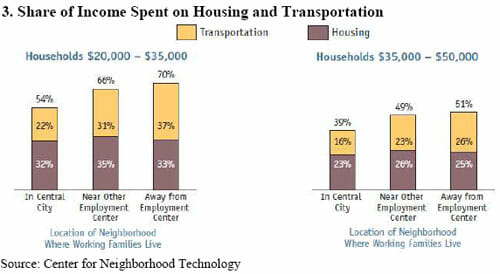
I may do a more in depth debunking of this report (and I can bet Randal O'Tool will do one) but I want to show you one example of the difference between a scientific study and advocacy marketing materials like this one. Here is a chart from page 10 of the report. It is trying to show that higher urban densities will help all of our personal budgets.
First, we can probably assume the numbers here are complete BS. Does anyone really believe that the average family outside the central city making $50,000 or less is spending more on transportation than they are on housing?
But that is almost tangential. The real purpose of this chart is to deal with the number 1 criticism of smart growth -- that by limiting land use and restricting growth and forcing everyone to live in the city center, then housing prices skyrocket (and, by the way, help contribute to bubbles - it is no accident that many of the counties hit hardest by the recent housing bubble collapse are in growth managed counties).
This chart is meant to refute this by saying - see, housing in the center city is not more expensive -- the average person spends just as much on housing in the city as in the suburbs. But hopefully you see the flaw -- what do they get for that money? It may well be that for people $35,000 a year and under, the amount they can spend on housing is capped by other expenses they have, such that 1/3 of the total is about what they have to spend. But this does not mean that people in the center city are just as well off as people outside of it. It is very likely the suburban folks are getting far more for their money. After all, people are rational, and if they really are spending so much more money for transportation to live in the suburbs, there probably is a good reason.
Postscript: It would also be interesting to know what the rest of the spending pie does from urban to suburban. My guess is that folks living in city centers making less than $35,000 are not saving a ton - so where is all that "found" money going they are supposedly not spending on transit. Could something else be more expensive in the city than in the suburbs? Does anyone really believe it is cheaper to live in the city center than out in the suburbs for equivilent quality of life. Sure, there are reasons to live in the city, and for some people's preferences it represents a better quality of life. But not a cheaper one.
Postscript #2: In fact, the best single critique of all the smart growth analysis that purports to show that people will be better off when the planners intervene is "If so, then why are they not pursuing their own rational self-interest today?" Smart Growth folks will say it is due to lack of choice, but that is silly -- if people want it, someone is going to make money giving it to them. The only exception might be publicly supplied goods, particularly transportation. I am sure there is a huge demand for having an expensive rail line run from one's house to one's business with low fares subsidized by other people, but I am not sure this is a realistic good to promise.
In any number of posts, I warned that, based on past precedent, Presidents almost never roll back executive power, even if they promised to do so in the election campaign. For example, I wrote on innauguration day this year:
...thoughtful people already on day 1 should have evidence that things are the same as they ever were, just with better PR. For God sakes, as his first expenditure of political capital, Obama is pushing for a trillion dollar government spending bill that is basically one big pork-fest that might make even Ted Stevens blush, a hodge-podge of every wish-list of leftish lobbyists that has been building up for eight years. I will be suitably thrilled if the Obama administration renounces some of the creeping executive power grabs of the last 16 years, but he has been oddly silent about this. It seems that creeping executive power is a lot more worrisome when someone else is in power.
My own hunch is that presidents try to keep campaign promises that expand the government and their own power, and either back down from or are unwilling to expend much capital on promises that make government smaller and more accountable, thus limiting their own power.
Looking over PolitiFact's report card on Obama's campaign promises, that seems to be about right thus far. By my count (and some of this is certainly subjective) of the of the 31 promises the site says Obama has kept thus far, 20 in some way grow or expand the federal government. Just six make the government smaller, more transparent, or more accountable. The remaining five have no effect, or amount to a wash.
Of the six campaign promises PolitiFact says Obama has unquestionably broken, five would have limited his own power, provided tax breaks, or provided more accountability and transparency to the federal government. One was mostly symbolic (recognizing the Armenian genocide). So far, he hasn't broken a single promise that would grow or expand the government, though he has compromised on a few, and many have been stalled.
$1.445 million for an Oklahoma water project, where stimulus-required procurement and other rules subsequently increased the cost of the project by $1.94 million. So the local folks lost a net of $500,000 by taking our money. Serves the right.
$800,000 for a backup runway for the now famous airport to nowhere, also known as the John Murtha airport in Johnstown. This is critical, because if they were to lose their current runway, all three flights a day and 20 daily passengers (I am not kidding) might have to find an alternative airport. This brings the total airport subsidy to $15,411 per annual passenger.
A California skate park will get a $620,000 "facelift." Plans to refurbish the skate park in Long Beach, California, had stalled for months as local funds put towards higher priority park projects. With $620,000 in federal stimulus funding available to upgrade the skate park, the city council decided to move forward. Daniel Johnson, a skater, said, "If most of us weren't skating right now, we'd be doing some bad stuff." Because nothing says "gateway activity to adult productivity and preparation for the job market" like a skateboard park.