Archive for the ‘Government’ Category.

Double Standard

When private companies in financial distress pay out employee bonuses that were contractually obligated:  bad.  When governments in financial distress pay out employee bonuses that are entirely discretionary: A-OK.

Amid the downturn in the economy, the city of Phoenix handed out more than $300,000 in cash bonuses, a CBS 5 News investigation found.

The bonuses, which ranged from $500 to $6,000 for a grand total of $354,800, were paid in October, according to public records...

Nevertheless, records show former Parks and Recreation Director Sara Hensley received a $3,500 cash award; the same month, she resigned to take a similar job in Texas.

Library Director Tony Garvey received a $4,000 cash award. Shortly after, libraries were forced to shorten hours and cut positions.

Politicians and Personality Cults

One of the things I had never noticed before was just how prevalent George Washington's image is around the capital.  The city is named after him, there are statues of him all over the place, the capital and the White House are full of paintings of him, and of course there's that big phallic symbol out on the mall.   I found it a bit off-putting, something I would expect more of Napoleon or a Roman Emperor than a US President.  The oddest site of all was the mural on the dome of the capital, which actually shows the deification of George Washington, a leitmotif taken from Roman emperors and tyrants like Julius Caesar, who were often deified by Senate proclamation after their deaths.

deification-of-george-washington

Which brings me to our current president.  The cult of personality around Obama as seen in the Washington area is just startling, and horribly troubling for those concerned about the power of the state and individual liberty.  Pictures of him and his family are seemingly on every wall, with whole souvenir shops dedicated to everything Obama.  Searching for some kind of analog, I actually found two:

  • Princess Diana -- Little of what Princess Diana said or did bore up under much scrutiny, but it didn't matter.  For some reason, huge numbers of people totally invested themselves in her personality cult.   In fact, the more screwed up she was, and the more mistakes and weakness she admitted to, the more people rushed to support her.   I was in London a few days after her funeral, and it was the only occasion I had ever seen as much merchandise sales for a government figure as I did this week for Obama.
  • Augustus Caesar.   Gaius Julius Caesar Octavianus, or Augustus, had the problem of wanting all the power of a tyrant, but he knew the dangers because his [adoptive] father Julius Caesar had been killed for being a tyrant.  So he brilliantly built over time a personal loyalty among those in the state to himself, and exercised power with good PR.  He was more powerful and more autocratic than Julius Caesar, but cleverly disguised the fact.  He gave the people the illusion of freedom without the reality, and they ate it up.

Government and Cost-Cutting

Government officials have mastered the cost-cutting game, or should I say the cost-non-cutting game.  The trick they have learned is that whenever budget or tax cuts are proposed, they threaten to cut the most critical expenditures.

Now, as I have pointed out, such behavior in a private company would result in one's termination.

When I was in the corporate world, if I wanted extra funds for my projects, I would have to go in and say "Here are all my projects.  I have ranked them from 1-30 from the most to least valuable.  Right now I have enough money for the first 12.  I would like funding for number 13.  Here is my case."

But the government works differently.  When your local government is out of money, and wants a tax increase, what do they threaten to cut?  In Seattle, it was always emergency services.  "Sorry, we are out of money, we have to shut down the fire department and ambulances."  I kid you not "” the city probably has a thirty person massage therapist licensing organization and they cut ambulances first.   In California it is the parks.   "Sorry, we are out of money.  To meet our budget, we are going to have to close down our 10 most popular parks that get the most visitation."  The essence of government budgeting brinkmanship is not to cut project 13 when you only have money for 12 projects, but to cut project #1.

I can just see me going to Chuck Knight at Emerson Electric and saying "Chuck, I don't have enough money.  If you don't give me more, we are going to have to cut the funds for the government-mandated frequency modification on our transmitters, which means we won't have any product to sell next month."  I would be out on my ass in five minutes.  It just floors me that this seems to keep working in the government.  Part of it is that the media is just so credulous when it comes to this kind of thing, in part because scare stories of cut services fit so well into their business model.

Matt Welch has a great 8-point takedown of similar scare story on the current California budget crisis.  You should definitely read it, but I wanted to add a #9 -- this idea that the core, rather than the marginal, expense is always the first to be cut.  From the LA Times:

Gov. Arnold Schwarzenegger has proposed slashing state spending on education by $3 billion to help close the budget gap, and the state would pay dearly for canceling classes, firing instructors, cutting class days and shortening the school year, experts said.

Promising students would go to other states, taking their future skills, earnings and, possibly, Nobel Prizes elsewhere. California companies would then find it harder to attract high-value employees who might be dubious about moving to a state with sub-par schools. [...]

John Sedgwick, co-founder of Santa Clara solar-energy company Solaicx, agreed.

"When you think about the genesis of Silicon Valley, it really started from its superior educational base" at Stanford and UC Berkeley, said Sedgwick, whose company makes the building blocks for photovoltaic cells. "That indicates that you don't want to kill the goose that's laying the golden eggs." [...]

The only way the most "promising" students would be affected is if, when the schools cut back, the best professors (rather than the worst) are fired and the most promising students (rather than the most marginal) are denied admission for limited spots.  Really?  If Berkeley has 10 fewer spots, it's going to start cutting admissions with the Physics wiz kid who had a 2400 on her SAT?

Further, is it really true that California only attracts people to its work force who went to school in California?  A top Michigan or Harvard grad won't do just as well?  I went to college in New Jersey yet have never held a job in that state.

Now, I understand that part of the argument is that workers may not come if the local primary schools for their kids are bad.  And that is true.  But California has had poor performing schools despite years of high and increasing spending.  Matt has much more on this in his piece.

Postscript: Of course, as crazy as it seems, there may be some reality to this threat.  I could easily see the University of California system, when faced with the choice of cutting back on some post-modernist social science program or a physics program that has produced 7 Nobel Laureates, choosing the latter to cut in a fit of outrageous political correctness.

At the primary level, it is very possible that the bloated school administrations filled with rafts of useless assistant principals will choose to fire teachers rather than themselves.  So unfortunately the plans to cut the most useful spending in a crisis and keep the most useless is not just a threat, it is a reality.

Bait and Switch

Bruce McQuain points out this statement by Obama that is just staggering in its mendaciousness (emphasis added)

In a sobering holiday interview with C-SPAN, President Obama boldly told Americans: "We are out of money."

C-SPAN host Steve Scully broke from a meek Washington press corps with probing questions for the new president.

SCULLY: You know the numbers, $1.7 trillion debt, a national deficit of $11 trillion. At what point do we run out of money?

OBAMA: Well, we are out of money now. We are operating in deep deficits, not caused by any decisions we've made on health care so far. This is a consequence of the crisis that we've seen and in fact our failure to make some good decisions on health care over the last several decades.

WTF?  The current deficit is because of health care decisions?  What happened to TARP and that crazy-large trillion dollar "stimulus" package and Chrysler and AIG and GM and all those other bailouts?  Sure, there is a looming Medicare bankruptcy, but that has little to do with the deficit numbers quoted.

We libertarians have always warned that the modus operandi of government is the following:  The government creates a problem.  Then the government uses that problem as justification for more government action.  Repeat.  Is there any clearer evidence than this from Obama?  He wastes a couple of trillion dollars in his first months in office propping up the constituent groups who got him elected, and then blames the spending on health care, which gives him an entree to ... spend more money on health care.

I couldn't be more depressed about the state of our country than I am right now.

The Inevitable Result of Government Bailout of Newspapers

A great morality play is running in southern California that gives a pretty clear view into where government funding of newspapers will lead.  Unfortunately, the article I have (via Glen Reynolds) is not written very clearly.  Here are the key facts:

  1. New ownership buys San Diego Union-Tribune, apparently the city's largest newspaper
  2. The new ownership group is funded in part by investments from public pension funds
  3. Public officials argue that since the paper is owned in part with some of their money, the newspaper should no longer be allowed to criticize public officials

Here is their demand:

As [police union] League President Paul M. Weber views it, that makes the League part owner in the flagging Tribune and League officials are none to happy with the paper's consistent position that San Diego lawmakers should cut back on salaries and benefits for public employees in order to help close gaping budget deficits.

"Since the very public employees they continually criticize are now their owners, we strongly believe that those who currently run the editorial pages should be replaced," Weber wrote in a March 26 letter to Platinum CEO Tom Gores.

Seems pretty plain to me.  And I see no reason why government officials, who always long to avoid criticism, wouldn't use investments of public funds to exercise the same leverage.  By the way, I loved this line:

"It's just these people on the opinion side. There is not even an attempt to be even-handed. They're one step away from saying, "˜these public employees are parasites,' " Weber said.

OK, if they won't say it, I will: "Those public employees are parasites."

Paging Bill Simon

I am terrified that Obama will feel the need to bail out California.  I can't possibly think of  a worse use of my money, nor a worse precedent for the future.   Does anyone think that, in retrospect, Bill Simon's refusing to bail out New York City was the wrong decision.  NYC is not what I could call financially responsible, but they are paragons of virtue compared to what they were in the 1970's, and would have been had they not been forced to take ownership of their budget problems.

Postscript: My prediciton if Obama intervenes:  bondholders will get 10 cents on the dollar, and the SEIU will be given 55% ownership of California.

No Shame

I can't even believe he can say this with a straight face:

President Barack Obama, calling current deficit spending "unsustainable," warned of skyrocketing interest rates for consumers if the U.S. continues to finance government by borrowing from other countries.

"We can't keep on just borrowing from China," Obama said at a town-hall meeting in Rio Rancho, New Mexico, outside Albuquerque. "We have to pay interest on that debt, and that means we are mortgaging our children's future with more and more debt."

Holders of U.S. debt will eventually "get tired" of buying it, causing interest rates on everything from auto loans to home mortgages to increase, Obama said. "It will have a dampening effect on our economy."

No duh.   And whose name is scribbled on the bottom of the stimulus bill?  Isn't this the type of concern one expresses before spending a couple of trillion dollars?  Obama reminds me exactly of the young students he lectured at ASU the other day about not getting into too much debt.  He already sounds like kids calling their dad -- it wasn't my fault!  I didn't know!  The only difference is there is no one left out there to bail out the US - no dad, no friendly government, nobody.

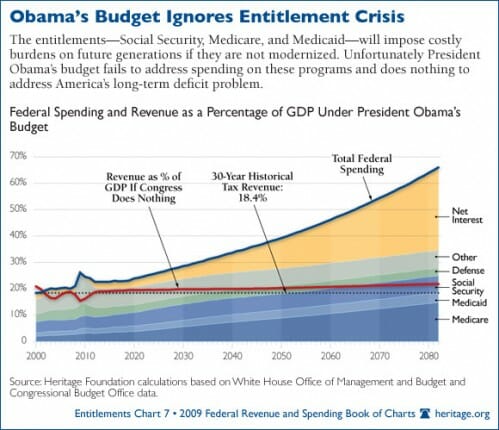
By the way, if you are worried about current deficits, read this post Q&O calls "fun" with charts -- there is absolutely nothing fun about it.  A sample:

entitlements_07-580

Eugene Lawson for the Supreme Court

From the Liberty Papers:

President Obama says that he wants to nominate a Supreme Court Justice who has "empathy" as opposed to a jurist who makes decisions based on "some abstract legal theory." Not surprisingly, I'm not the only one troubled by his selection criteria. Thomas Sowell has written an excellent 3 part series "Empathy" Versus Law" (Part 1, Part 2, Part 3).

Title reference here and here

"My objective was social progress, human brotherhood and love. Love, Ms. Taggart. That is the key to everything. If men learned to love one another, it would solve all their problems"

Incentives Matter

Right now, local, state and federal governments are closing schools and curtailing civil liberties in what will likely turn out to be a vain attempt to curb the spread of swine flu.  For those, like me, who are shaking their heads at some of the unbelievable over-reaction going on in government in response to swine flu, we should not be surprised.

We have trained government officials, just like Pavlov's dogs, to over-react to hypothetical crises.  Just as one example -- the Homeland Security department has a history, in disasters, of being both grossly ineffective and for wasting billions of dollars.  Which do they get punished for?  Sure, there are a few stories about Katrina waste, but the enduring legacy is the sense that the Bush Administration moved too slowly and did too little.

As a result, we see a massive multi-trillion dollar government waste-fest in response to a deep but not unprecedented recession.  We saw civil liberties thrown out the window in reaction to 9/11.  And we see the government issuing orders left and right to be seen as "doing something" about the impending flu epidemic.  Because politicians currently fear the charge of inaction far more than the charge of wasting a trillion dollars or curbing civil liberties.

Global warming alarmists lament that Americans don't understand the precautionary principle.  I would say just the opposite -- the whole government is run by the precautionary principle -- that near infinite prophylactic spending is justified by even minuscule risks of something really bad happening.  This is the recipe for bankruptcy.

Update:  And, right on queau, a precautionary principle link between global warming and flu from arch-alarmist Steven Scneider:

Stephen Schneider of Stanford University who paints a worst case scenario for global warming in a commentary in the journal, said the studies make it seem like scientists know where there's a solid danger line for emissions, when they don't. The papers acknowledge there is a 25 percent chance the limit should be lower. Schneider said that's a pretty big risk when the consequences of being wrong are severe. "If you had a 25 percent chance that walking into a room would give you serious flu, would you?" Schneider asked.

Here is the problem with this an all similar analogies -- they ignore cost, both in terms of dollars and individual rights.  Better examples would be:

  • Would you walk out of a prison cell into freedom if there was a 25% chance of catching the flu when you rentered society?
  • Would you walk into a room if there was a million dollars sitting on the floor for the taking but there was a 25% chance you might get the flu by picking up the money?

By the way, Steven Schneider is the hero of hard science who said this:

We have to offer up scary scenarios, make simplified, dramatic statements, and make little mention of any doubts we have. Each of us has to decide what the right balance is between being effective and being honest.

More on this kind of post-modernism in the sciences here.

Smearing Risk Around Like Peanut Butter

My kids have  a trick that I am sure is not unique to our household.  Faced with some type of food they do not like, they have become quite creative and artistic in spreading the mass of food around their plate, in a (generally) vain attempt to fool mom and dad that some of the food has disappeared.

After reading the scathing WSJ article this morning on the BofA / Merril Lynch deal, one has to wonder whether the feds were attempting the same trick with risk.

Like Welch, I welcome the WSJ as late arrivers to the bailout-skeptics party.

Public vs. Private

I believe most of my regular readers know that in my day job I am involved in privatization of public recreation.  For fairly obvious reasons, I never blog about the public recreation agencies with whom I work.  In particular, I don't think its fair that an agency that is at least visionary enough to consider private management of its recreation have its dirty laundry spread all over my blog.

But there is one situation with a particular state parks organization that is driving me so crazy that I must share the story publicly, but I will do so without revealing the state. I have no reason to believe that what I describe is unusual.

The state parks organization runs a bit fewer than thirty parks and campgrounds, whereas our company runs over 150 public parks and campgrounds.  Their total operation budget for parks is about the same as my company's annual expenses.  The state parks organization gets about 20% of all its labor hours donated for free by volunteers, whereas we are prohibited by the Fair Labor Standards Act from accepting volunteer labor.  Their parks are spread all over a large state, ours are spread from Washington to Florida.

By scale and scope, our company is reasonably considered larger and more complex, though the state has some reporting requirements I do not have.  There are two major differences between us, though, which are telling:

  1. Including myself, our company has 3.5 people on the corporate staff with total corporate office space of about 700 sq ft. -- everyone else is dedicated to and works at a particular facility.  This state parks organization has scores of people working in a dedicated headquarters building with tens of thousands of square feet of space.
  2. Demand for public recreation is booming, as people are looking for low cost recreation opportunities.  Our pre-season camping reservations, for example, are at an all time high.  We have had to scrape deep, but we are investing hundreds of thousands of dollars in expansion money this year to address opportunities to serve more visitors.  This state parks organization is cutting back parks.  It has closed a number of parks, and plans to close more, and has cut most of its investment.  To my knowledge, it has done nothing to address headquarters staff costs, nor is it able by state rules to take any credit in its budget for expected increases in park fee collections.

The staff level bureaucracy problem is just endemic to government.  I would love to look at the growth of staffing of public schools by type of employee over the last 30 years -- my bet would be that the total number of teachers is flat to down while the number of administrators and assistant principals have skyrocketed.

Update: I have had parks employees writing me guessing that I was writing about their organization.  They made the point that their parks organization is not comparable to ours, as their organization had been saddled with a number of non-recreation missions that were expensive (e.g. preservation, certain environmental goals, historical interpretation, etc)  This is certainly true, though not of every parks organization or necesarily the one about which I was writing.  But one could argue that this kind of mission creep is a failure point in public agencies.  While there are incentives for this to occur in both public and private organizations, there are fewer corrective mechanisms in the publis sphere to push back.  In fact, in the public sphere, new missions are a blessing because they often carry new funding.  In the private sector, new missions threaten to dillute results and are more resented.

100% Surveillance of Congress

Apparently the  NSA is under some heat for proposing to monitor the communications of a member of Congress thought to be meeting with terrorist suspects:

While the N.S.A.'s operations in recent months have come under examination, new details are also emerging about earlier domestic-surveillance activities, including the agency's attempt to wiretap a member of Congress, without court approval, on an overseas trip, current and former intelligence officials said. . . .

The agency believed that the congressman, whose identity could not be determined, was in contact "” as part of a Congressional delegation to the Middle East in 2005 or 2006 "” with an extremist who had possible terrorist ties and was already under surveillance, the official said. The agency then sought to eavesdrop on the congressman's conversations, the official said.

The official said the plan was ultimately blocked because of concerns from some intelligence officials about using the N.S.A., without court oversight, to spy on a member of Congress.

I have a counter idea.  Why don't we monitor all the communications of all of Congress all the time and post it on a web site.  If they want to exercise ultimate power over us, we can then exercise ultimate scrutiny over them.  Unfortunately, in the world of the future, Congress is likely to be the only group exempted from monitoring.

Absolutely Inevitable

If you move solar panels out of the Arizona desert, they are going to produce less electricity.  You almost don't have to tell me where they are going -- if they are currently close to the optimal spot for maximum solar energy production, then moving them is bound to reduce their output.

Seems obvious, huh?  So why is it so difficult to understand that when the government moves capital and other resources away from the industries where the forces of market optimization have put it, output is going to go down.

Subsidizing renewable energy in the U.S. may destroy two jobs for every one created if Spain's experience with windmills and solar farms is any guide.

For every new position that depends on energy price supports, at least 2.2 jobs in other industries will disappear, according to a study from King Juan Carlos University in Madrid.

U.S. President Barack Obama's 2010 budget proposal contains about $20 billion in tax incentives for clean-energy programs. In Spain, where wind turbines provided 11 percent of power demand last year, generators earn rates as much as 11 times more for renewable energy compared with burning fossil fuels.

The premiums paid for solar, biomass, wave and wind power - - which are charged to consumers in their bills -- translated into a $774,000 cost for each Spanish "green job" created since 2000, said Gabriel Calzada, an economics professor at the university and author of the report.

"The loss of jobs could be greater if you account for the amount of lost industry that moves out of the country due to higher energy prices," he said in an interview.

We all know from reading the media that the Obama administration is 1) full of brilliant people way smarter than the rest of us and 2) driven by science.  So this insightful exchange between a reporter and White House spokesman Robert GIbbs vis a vis this Spanish study should come as no surprise:

Q: Back on the President's speech today, a Spanish professor, Gabriel [Calzada] Álvarez, says after conducting a study, that in his country, creating green jobs has actually cost more jobs than it has led to: 2.2 jobs lost, he says, for every job created. And he has issued a report that specifically warns the President not to try and follow Spain's example.

MR. GIBBS: It seems weird that we're importing wind turbine parts from Spain in order to build "” to meet renewable energy demand here if that were even remotely the case.

Q Is that a suggestion that his study is simply flat wrong?

MR. GIBBS: I haven't read the study, but I think, yes.

Q Well, then. (Laughter.)

In two sentences, Mr. Gibbs demonstrates that 1) He is an idiot and 2) He has no respect for science.  The correct, intelligent response would be "I can't comment, I have not read the study yet."  Mr. Gibbs does deserve credit for being an apparent master of the non-sequitur.  I have been trying to think of an eqivilent formulation.  The best I can come up with is to suppose someone said that "publicly funded sports stadiums generate no new economic activity and are just a taxpayer subsidy of sports owners, players, and ticket holders" and getting the response that  "how can this be when people still go to the games?"

I was afraid that all this braininess in the White House was going to eliminate the humor from Administration pronouncements but I see that won't be the case.

The Dead Hand's Apprentice

Via the WSJ

The Treasury Department has decided to extend bailout funds to a number of struggling life-insurance companies, helping an industry that is a linchpin of the U.S. financial system, people familiar with the matter said.

The department is expected to announce the expansion of the Troubled Asset Relief Program to aid the ailing industry within the next several days, these people said.

sorcerers-apprentice

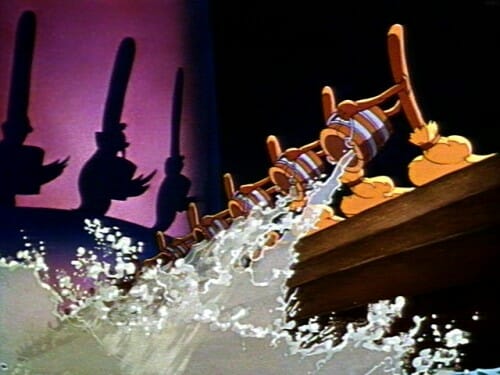
Seriously, how far does this go?  Does anyone else picture scores of brooms with pales of water exiting the Treasury building?  It's like one of those farces where each new action to fix a crisis creates a new crisis that is even larger.

Only 3-1/2 More Years Until We Go To The Polls To Select A New GM CEO

Russel Roberts deconstructs Obama's auto speech.  Well worth the read.

I have worked with folks in the government for years.  One of the common syndromes I see in government officials of all levels is something I call "arrogant ignorance."  I see a lot of it in this administration.

Haiti on the Potomac

The Liberty Papers thinks we have become a lawless Banana Republic.  George Will is thinking along the same lines, snarkily observing that Sweden, China, and Mexico have all observed in one way or another that the Feds seem to be acting outside the rule of law.

I have opined in the past that what really extended the Great Depression was not any real underlying economic issue, or even vast increases in government spending per se.  It was that arbitrariness with which the Roosevelt administration dealt with economic matters.  With nutty programs like the Mussolini-inspired National Industrial Recovery Act coming and going, investors and businesses never knew from day to day what the rules of the game would be next year, or even next week.

I fear that this is exactly the climate Obama and Congress are creating today.

  • When Congress reacts to CNN headlines by retroactively confiscating legal compensation that it had protected just weeks before, what will happen to my compensation?
  • When government deficits soar by trillions of dollars, what will taxes look like next year?
  • When the Administration says that Co2 will have to be reduced by 80%, what numbers do I plug into my forecasts for fuel and electricity?
  • When the government decides on a whim to print a trillion dollars more money to pay off government debt, what will inflation look like in the coming months and years?

As of two months ago, my company was still investing.  We were still getting bank credit, particularly for equipment financing, though it took more work than in the past to secure it.  We still saw opportunity in our business, and in fact saw increased opportunity in the recession for low-cost recreation options and outsourcing of public recreation facilities.

But today, I am reluctant to make any new investments.  Investing $5000 now for $8,000 a year from now normally sounds good, but what happens now that the Feds have more than doubled the money supply?  How much will $8,000 really be worth a year from now?  What will my taxes be on the increase?**  What new costs or liabilities  might be retroactively placed on me for making the investment?  What happens if beltway pundits start thinking I am making too much money?

All this commotion of government intervention started when Paulson and other Bush appointees started screaming that the banking system was going to shut down and therefore crash the whole economy.  As my readers know, I believe to this day that this was all sky-is-falling over-reaction and panic-mongering, and most of the credit crunch resulted from uncertainty about the Treasury and its statements, not due to realities on the ground.   However, whatever tightening of credit we might or might not have avoided by government action, it pales in its effect on investment in comparison to the arbitrariness and trillion-dollar-plan-of-the-day that has been the first 60 days of the Obama administration.

** footnote: For those of you who have not lived through high inflation times, taxes and inflation are a deadly combination.  That is because the Federal Government, after creating inflation, then taxes each of us on its effects.  Here is an example:  Invest $5000 now at a fixed 10% a year.  Suddenly, inflation goes up to 8% a year.  In five years, I now have a bit over $8000.  In economic terms I have made a small profit of, since $8000 in five years at 8% inflation is worth $5,445 today.

But the IRS thinks I have made $3000, not just $445, and will tax me on the full $3000.  If they take a third, I only have $7000 at the end, or $4,764 in current dollars, meaning that after taxes, I actually lost money.

Maybe Mark Sanford Was On To Something

As has been the case for decades (the gun-to-the-head federal strategy to force 55 mph speed limits and seat belt laws come to mind), the feds are sending money to the states with many strings attached.  Apparently, Arizona is running afoul of one of those provisions:

Arizona's receipt of $1.6 billion in stimulus funding, including more than $300 million already being spent to help keep the state in the black, is at risk because a federal agency says the state is not in compliance with a prohibition against health-care rollbacks.

Arizona could lose the money if the federal determination stands or if state law isn't changed to eliminate a health-care requalification provision that was the basis of the determination, state officials said Monday.

According to Brewer's letter, the agency determined that the Arizona Health Care Cost Containment System's requirement that some enrollees requalify every six months instead of annually violated a stimulus-program prohibition against tightened eligibility standards, methodologies or procedures for a state's Medicaid program.

There is something supremely irritating about Federal bailouts to states that are tied to restrictions that make it more difficult for states to close their budget shortfalls on their own.  It's almost as if Congress wants to institutionalize dependency on the Feds  (where have we seen that before?)

Apparently, in the spirit of the retroactive tax-taking of the AIG deferred compensation payments, the restrictions are retroactive to state actions taken as early as July 1, 2008, meaning that Obama is asking states to roll back legislation that was passed months before he was even elected as a condition of getting the cash.

The actions causing problems for Arizona occurred in September, 2008, and were, according to our governor, the result of legislation passed in June of 2008.

Follow the Money

aigbailout

via Paul Kedrosky (click to enlarge)

I guess the disputed $175 million in deferred compensation payments should be on here as well, though the line would be too infinitesimally thin to draw.   The CDS stuff gets the attention, but the securities guarantees are the largest flow.  Are these guarantees of traded securities, like bonds and equities?  If so, it sure is a happy notion for all of us taxpayers with portfolios that are well under water that we are going to send some of our money to help bail out the losses in the Goldman Sachs portfolio.

Wrapped in the Flag of "Systemic Risk"

A couple of questions about AIG:

1.  Is there any real legal difference between the contractual commitment by AIG to pay bonuses to employees and their contractual commitment to pay off mortgage bond guarantees to companies like Goldman Sachs? **

2.  In a bankruptcy, how senior would contractual promises of deferred compensation to employees be?  Everyone comes after the government, of course, but would such claims be more or less senior to, say, commitments to pay counter-parties?

** before claiming one commitment was outrageous and unjustified, one needs to be clear which commitment he is referring to, since both commitments in retrospect seem crazy to me.  It is just that one party (ie Goldman Sachs), which has the added advantage of being represented by many of its former employees in the Treasury department, has convinced Congress and the Administration that not paying them carries systemic risk to the economy.

That seems to be the new key to government largess:  Carrying systemic risk.  It used to be one wanted to be poor or female or black to merit special consideration in the government spending sweepstakes.  But nowadays, in our post-racial society, the key is to be the one who can wrap himself in the flag of "systemic risk."  Here is .

LOL, Best Line I Have Read This Week

Referring the Senator Grassley's statement that AIG executives who are receiving bonuses should "resign or go commit suicide," David Harsanyi responds:

C'mon. If suicide were a proper penalty for piddling away taxpayer dollars, the National Mall would look just like Jonestown after refreshments.

Positive News About the Economy

A bit over a week ago, I forecast that we had passed the economic bottom and would soon be back on the way up.  The IBD lists a number of reasons why I may be correct:  (ht:  Carpe Diem)

"¢ A broad rally in stocks, confirmed last Thursday, continuing into this week and led by the beaten-down financials.

"¢ A surprising 22% surge in February housing starts to a seasonally adjusted annual rate of 583,000 units.

"¢ A back-to-back jump in retail sales ex autos, in both January and February.

"¢ A return to profitability at several major banks, including Citigroup, Bank of America and JPMorgan.

"¢ A doubling in the obscure but important Baltic Dry Index, a key indicator of global trade flows.

"¢ An upwardly sloping yield curve, which Fed research suggests all but ensures a rebound by year-end.

"¢ A Housing Affordability Index that has hit an all-time high.

"¢ A two-month improvement in wholesale used-car prices, measured by the Manheim Index.

"¢ A rise in Monster's Employment Index in February, suggesting a turn in the job market may be around the corner.

"¢ A 4 1/2-year high in the dollar against other major currencies, on a trade-weighted basis.

"¢ A sharp increase in the money supply, as measured by M2 and M1. Weekly M2 growth has averaged 10.1% year-over-year since the start of 2009, while M1 has grown at a 14.6% rate.

"¢ A two-month rally in the Index of Leading Indicators.

"¢ A growing body of evidence that the "liquidity crunch" is dead. Data show nearly $14 trillion in liquidity on the sidelines of the markets, ready to boost consumer spending, credit growth or further stock market gains.

Of course, this makes the entire argument for the trillion dollar plus stimulus bill moot.  If my company had started spending itself into debt to fight some sort of emergency, and then found the emergency did not exist, you can bet we would be spending every hour of the day to stop as much of that emergency spending as possible.  Not so in Washington.  Despite now forecasting an improving economy, and basing his budget on this being a milder-than-normal recession, Obama has not even suggested any roll-back in the massive spending and debt-creation program.  Which just goes to prove that the "stimulus" bill had nothing to do with stimulus in the first place, but was a leftish spending plan sold based on panic, in exactly the same way the Bush administration sold the Patriot Act.

In fact, much of Obama's remaining legislative agenda (including nationalization of parts of the health care system and a Co2 cap-and-trade system) include what are effectively large tax increases that cannot realistically be passed in the depths of a recession.  So expect a lot of talking up of the economy to prepare the way for these tax increases, not to mention the tax increases that will be necesary, but have not yet been proposed, to pay for the servicing of the huge debt and new spending we just took on.

One final prediction:  As the economy improves enough for the average person to see the improvement, expect the Obama administration to be spinning like mad.  Their first objective will be to take credit for the recovery.  This is absurd, as it appears that the recovery will start long before the first dollar of spending occurs.  The media may, however, let him get away with this.  If it does not, his second story will be that the confidence exuded by the passing of the stimulus bill created the recovery.  This is also absurd on its face, given the crash in equity prices after the stimulus bill was passed and the extreme general skepticism about the stimulus in poll numbers.

Postscript: By the way, I would argue the whole story of this stimulus bill is a microcosm of the climate debate.  Extreme panic was generated based on a fear that their might be some possibility of a catastrophe (ie a second Great Depression) and that on the precautionary principle, we spent a trillion dollars just in case.  Remember that in January, Obama said there will be - not might be - another 5 million job losses, a number we will come nowhere near.

As it turned out, there was never a realistic chance of a catastrophe, but the costs will remain, and all the while the panic over the issue was used as cover to pass a whole range of freedom-reducing initiatives.   Naomi Klein was half right in the shock doctrine -- there are folks who use emergencies to successfully push for radical change, but it is almost always the forces of more government control who win out, not the supporters of laissez faire.

Update: A similar list here from Forbes.

For Those Who Still Thought the Stimulus Bill Was About Infrastructure

I demonstrated a while back from the CBO report that less than 7% of the 2009-2010 spending was infrastructure in the stimulus bill.  In fact, this percentage barely increases past 2010.  Below is a piece of a Washington Post graphic (whole chart here).  I have colored orange the areas that include infrastructure.

I have generously included all of the highway, transportation, interior, energy, water, Corps of Engineers, school renovation and parks spending, though my bet is that a bunch of that never turns into steel and concrete.  I have also included some of the rural and urban development money.  I have excluded facilities that are by bureaucrats for bureaucrats, such as improvements in federal office buildings.  I have tried to keep things proportional, but note, as always, actual spending does not match the rhetoric.  For example, you might think that the school spending, from Obama's speeches, was all infrastructure, but in fact only $20 out of over $90 billion is for school renovation.  The rest is for  ... something or other.

stimulus2

The $43 Billion Dollar Propaganda Film

I think everyone was blown away by the Olympic opening ceremony last year in Beijing.  I usually yawn at such events, but this one was spectacular.  I enjoyed it, even though I knew in my heart I was watching the modern version of "Triumph of the Will."  I would have enjoyed it much less if I had been paying for it, and probably even less if I was organizing the show in London four years hence and expected to top such an event.

Well, it appears that it was not just the opening ceremony that was a one-off propaganda push, but the entire rebuilding of the city center (via the Sports Economist)

Reporting from Beijing -- "Empty," says Jack Rodman, an expert in distressed real estate, as he points from the window of his 40th-floor office toward a silver-skinned prism rising out of the Beijing skyline.

"Beautiful building, but not a single tenant.

"Completely empty.

"Empty."

So goes the refrain as his finger skips from building to building, each flashier than the next, and few of them more than barely occupied.

...The government spent $43 billion for the Olympics, nearly three times as much as any other host city. But many of the venues proved too big, too expensive and more photogenic than practical.

...The National Stadium, known as the Bird's Nest, has only one event scheduled for this year: a performance of the opera "Turandot" on Aug. 8, the one-year anniversary of the Olympic opening ceremony. China's leading soccer club backed out of a deal to play there, saying it would be an embarrassment to use a 91,000-seat stadium for games that ordinarily attract only 10,000 spectators.

The venue, which costs $9 million a year to maintain, is expected to be turned into a shopping mall in several years, its owners announced last month.

A baseball stadium that opened last spring with an exhibition game between the Dodgers and the San Diego Padres, is being demolished. Its owner says it also will use the land for a shopping mall.

Ant and the Grasshopper

It has been interesting to watch the reaction to Obama's mortgage-holder bailout.  Certainly the plan is expensive, likely largely ineffective, and has terrible long-term impacts on incentives.   To my libertarian eyes the plan is awful, but no more awful, and actually less expensive (incredibly!) than other bailouts and legislation pouring out of Washington of late.  Like everything else we are seeing, it is a hair-of-the-dog plan:  fix government over-promotion of home ownership with more government promotion of home ownership;  Fix the fact that individuals are over-leveraged by trying to keep them in their mortgages.

But this issue changes the political map to some extent.  The usual rhetoric about milking one group to help another who are "on the outs by no fault of their own" is just stretched past credulity on this one.  Sure, there are enough folks who were really tricked or scammed in their mortgages to fill up any length of a news segment with tearful anecdotes.  But the 50% of the country that rents or the large percentage of homeowners that didn't chase around after zero-down house-flipping deals don't seem to be buying that their tax money is now flowing to innocent victims.

Postscript:  I know there is a tendency to leap onto this "fraud" excuse to help assuage one's ego.  Yeah, I wasn't stupid, I was tricked!  Well, I am in some financial tough times, and I will declare it here publicly:  It is all my fault.   I got overly exuberant in expanding the business, and doubled down on my mistake by agreeing to a large financial commitment based on a bank's loan commitment letter, rather than an actual loan (a commitment letter that was pretty much worthless as the bank went into FDIC receivership).   I have found, by the way, that my banks have been very reasonable about restructuring commitments as long as I come to the table with a plan showing how I intend to pay them back every cent that is theirs  (yes, I said it, it is theirs -- it is their money) though just with altered terms and timing.  The good news is that a ebbing tide reveals a lot of rocks, and the business has been vastly improved by the thorough review and restructuring we have put it through of late.

Observation About the US Mail

We do payroll at headquarters and send checks all over the country.  We built the payroll process years ago to allow for one week for the US Mail to carry the paychecks from our office to arrive at their destinations in time.  Steadily, over the last five years, office by office, we have had to replace the US Mail with UPS.  It apparently is increasingly impossible for the US Mail to get a letter across the country in a week (which is six working days for the USPS).

Today was the final straw.  For the third payroll in a row, the US Mail has not been able to get mail from our office in Phoenix to our office just outside of Los Angeles in a week.  The payroll was mailed last Monday and it is not there now onthe following Tuesday.  Pathetic.