Archive for the ‘Government’ Category.

Government Strongarm Tactics in the Chrysler Bankrupcy

This is an interesting video from the State Treasurer of Indiana about his state's experience as a secured creditor of Chrysler, and how their legal claims were pushed aside as the Administration moved more politically-favored constituencies (e.g the UAW) ahead of the secured creditors in line.

One side issue here.  Early in the video he explains that the State of Indiana held a lot of Chrysler bonds because Chrysler is a big employer and they try to support companies with a big footprint in the state.

Isn't that terrible risk management policy, closely akin to Enron employees putting all of their savings in Enron stock?  If Chrysler goes down, this means loss of investment returns in key retirement funds at the same time there is a large loss of tax money that will likely be the source of replacement funds.

Fortunately, Pregnant Women Can Easily Get A Big Mac

I liked TJIC's response to the story of the pregnant woman who could not find any available supplies of the government-provided flu vaccine:

Man, it's a good thing that the flu vaccine isn't being left in the hands of the free market "“ we might have the same horrible production and distribution bottlenecks that we run into with Coke, pizza, books, and pajamas "“ you can't find those things anywhere.

And, hey, on the bright side, socialized medicine is coming!

Classic Government

This is just so typical.  In response to demands for transparency, the Norwegian government starts publishing ... tons of private data about its citizens.  I wonder how much detail they put online about how the government spends the tax money?   Via maggies farm.

Hair of the Dog, Part 3

In general, legislative responses to the recent financial crisis just amaze me, and I am a fairly jaded observer of Congress with very low expectations.

First, Congress responds to a crisis caused by too much debt and overleverage by ...borrowing a trillion or so dollars and deficit spending.

Second, Congress responds to a crisis caused by too much subsidiazation of  home ownership by ... subsidizing home ownership

Now, Congress has apparently responded to a crisis where risky debt was mispriced by... passing a law to reduce debt costs for the riskiest borrowers and shift that cost to the least risk.

Nice job.

This Won't End Well

Steve Chapman via Ilya Somin:

Watching Washington policymakers in action, I sometimes think they make mistakes because of unrealistic goals, flawed thinking, blind obedience to party, or dubious information. And sometimes I think they make mistakes because they are"”how to put this?"”clinically insane.

There is no other way to explain what is going on at the Federal Housing Administration, which provides federal guarantees for home mortgages. Given the collapse in real estate prices, the weak economy, and the epidemic of foreclosures, banks are acting with more caution than before. They now commonly require home buyers to make down payments of 20 percent to qualify for a loan. But the FHA often requires only 3.5 percent.

That's the equivalent of playing pool with a guy named Snake, and it's had two predictable effects. The first is that the agency is insuring about four times as many home loans as it did just three years ago. The other is that the number of FHA-approved borrowers who are not repaying their loans is climbing. Since last year, the default rate has jumped by 76 percent.

Another likely consequence looms: you and I eating the losses. A former executive of mortgage giant Fannie Mae told a congressional subcommittee that the FHA "appears destined for a taxpayer bailout in the next 24 to 36 months." Commissioner David Stevens had to assure the subcommittee that it would not need help"”well, unless there is a "catastrophic home price decline." But who says there won't be? It's not as though anyone at the FHA foresaw the housing bubble or the housing bust. Yet now it feels confident betting its $30 billion cash reserve that prices won't fall.

Somin comments:

Unlike Chapman, I don't think the policymakers are "insane." They are responding rationally to perverse incentives. If another mortgage crisis occurs, they hope to shift the blame to a supposedly insufficiently regulated private sector "“ which is more or less how many of them managed to escape blame the last time around. The public did punish the Republican Party in the 2008 presidential election. But most of the members of Congress and federal bureaucrats who supported the GSEs got off scott-free. Moreover, the full negative effects of risky government-backed lending may not become evident for years to come "“ perhaps at a time when some other administration and Congress will be in office. In the meantime, the administration, the FHA, and key members of Congress can reap the political benefits of getting support from grateful borrowers, real estate developers, and other interest groups that benefit from easy credit.

Missing the Whole Point

The Bill of Rights were originally restrictions on government power.  Period.  Many people do not want to read them this way today, because they have a strong interest one way or another in the increase in government power.

Take the First Amendment.  "Congress shall make no law..."  In other words, there can be no justification of any kind for the government taking away free speech, press, association, religion, etc.

Unfortunately, forces have been at work for decades from both political parties to undermine this hard and fast protection.  Our most recent assault comes from the Democrats in the guise of the hate crimes bill:

Republican Sam Brownback offered an amendment to the Senate version which said the bill could not "construed or applied in a manner that infringes on any rights under the First Amendment" and could not place any burden on the exercise of First Amendment rights "if such exercise of religion, speech, expression, or association was not intended to plan or prepare for an act of physical violence or incite an imminent act of physical violence against another."

With that amendment, GOP Senators supported the final bill. However when the bill went to the conference committee, key changes were made to the Brownback amendment by the Democrat controlled committee:

Where Brownback had insisted, and the full Senate had agreed, that the bill could not burden the exercise of First Amendment rights, the conference changed the wording to read that the bill could not burden the exercise of First Amendment rights "unless the government demonstrates "¦ a compelling governmental interest" to do otherwise.

That means your First Amendment rights are protected "” unless they're not.

"A compelling governmental interest" leaves the door wide open for your free speech rights to be trampled on the government's whim. Where the First Amendment was designed as a limit on government power (as was the entire Constitution), this law is a blatant attack on those limits and an attempt to expand government power.

So, the government's power is checked unless there is a "compelling governmental interest" in not having its power checked. We're doomed.

The End Game In Residstribution Politics

Evan Bayh pretty much gives away the game.  We rob from the unpopular and give to the popular.

You can sort of see this coming. The savings from the pharmaceutical companies and the insurance industry, you can kind of count on that because they're not very popular.

The hospitals are a different story.  People, you know, like their hospitals; they tend to trust their hospitals. The hospitals have pledged big savings. I can easily forecast at some point in the not-too-distant future the hospitals coming in and saying, "You know what, this isn't working exactly the way we expected. Please spare us from this," and them getting a good hearing in [Congress].

This Is Not A Kickback, How?

Readers will know that I am not a fan of publicly-funded stadiums.  Had the mayors of the 40 largest cities in the US signed a no-public-funding pledge 30 years ago, and stuck to it, we would still have the same number of sports teams in roughly the same places, but without all the taxpayer subsidies.  It is rivalry among cities the creates a sort of prisoners dilemma problem and we end up with rampant public subsidies.

What I hadn't realized was the role of outright bribery and kickbacks in this process.  Apparently, it is routine that city and county officials take compensation, in terms of free personal access to luxury boxes, in return for approving these public stadiums

In late August, when the Mobile City Council and Mayor Sam Jones first toured the $2.5-million addition to Ladd-Peebles Stadium, including 11 new skyboxes, District 6 Councilwoman Connie Hudson said she was surprised to hear the city council would have a suite separate from the mayor's, which is located just between the 40- and 50-yard lines.

"It was announced to me on the day we toured," Hudson said. "We've always shared, like we do with the Baybears."

The 11 new skyboxes bring the total at city-owned Ladd-Peebles Stadium up to 14, as three were built in 1997 in part of the press box addition. In addition to the two skyboxes available to the city, the Mobile County Commission also has a suite, which brings the total of skyboxes for local government use to three, or 21 percent of the skyboxes in the 61-year-old stadium.

Speaking generally, and taking into consideration the differences between facilities in other cities, Bud Ratliff of the Mobile Bay Sports Authority says most stadiums have only two skyboxes reserved for city and county use, but doesn't see a problem with the current arrangement at Ladd-Peebles.

Chrysler Update

Apparently, Chrysler is toast.  Which is what a lot of us were saying before taxpayers put billions of dollars into it.  (ht:  Maggies Farm)

Rumors, credible rumors, are beginning to circulate in the car industry and the automotive press, that Chrysler may not make it another year primarily due to its falling sales and growing financial losses at partner Fiat....

The Congressional Oversight Panel has already said taxpayers will not see most of the $81 billion that they put into the American car industry. The $14.3 billion put into Chrysler is more and more likely to be lost completely. The biggest single loser if Chrysler cannot survive is the UAW which owns 55% of the company.

I struggle to cry much for the UAW with that last part.  They only own 55% because the President intervened to give what should have belonged to the secured credit holders over to the UAW in exchange for being so helpful in getting him elected.

In January 2009, Chrysler stood on the brink of insolvency.  Purporting to act under the Emergency Economic Stabilization Act, the Treasury extended Chrysler a $4 billion loan using funds from the Troubled Asset Relief Program (TARP).  Still in a bad financial situation, Chrysler initially proposed an out-of-court reorganization plan that would fully repay all of Chrysler's secured debt.  The Treasury rejected this proposal and instead insisted on a plan that would completely eradicate Chrysler's secured debt, hinging billions of dollars in additional TARP funding on Chrysler's acquiescence.

When Chrysler's first lien lenders refused to waive their secured rights without full payment, the Treasury devised a scheme by which Chrysler, instead of reorganizing under a chapter 11 plan, would sell its assets free of all secured interests to a shell company, the New Chrysler.  Chrysler was thus able to avoid the "absolute priority rule," which provides that a court should not approve a bankruptcy plan unless it is "fair and equitable" to all classes of creditors.

I had more here.

Update: A firsthand account from a hosed secured creditor (pdf)

Details of the bankruptcy were unprecedented. For the first time in American history and totally counter to all established laws of bankruptcy, secured creditors would receive less than nonsecured creditors....

Indiana's legal filings in the Chrysler, LLC bankruptcy sale made three essential points: First, the bankruptcy laws which have been in place protecting the rights of secured creditors cannot be arbitrarily overthrown by an act of the Executive. This is a violation of Article I, Section 8 of the U.S. Constitution in that Congress is solely assigned the role to determine uniform bankruptcy law. Neither the Courts nor the Executive can do this arbitrarily. Our funds suffered a "taking" in violation of the Fifth Amendment in that there was no "due process of law". There was, and is in all financial arrangements between debtor and creditor, a contractual relationship, which is here being rendered null and void. If allowed to stand, this violation of two party contracts undermines a basic and essential tenet of debt financing in the capital markets.

Second, money provided by the federal government to Chrysler is being provided illegally and clearly counter to the intent of Congress. When TARP was being debated then Secretary of the Treasury Henry Paulson testified the money was NOT for the auto companies. It was targeted to aid the ailing financial industry, i.e, those with "Troubled Assets" that needed a "Recovery Program." Evidence that the money was NOT intended to be an automotive bailout bill could not be more clearly illustrated than to review the failure of the separate automobile bailout bill presented in Congress in December 2008. If Congress had intended the TARP bill to cover the auto companies when it passed in October 2008, why were they even attempting to pass a separate automobile bailout bill just two months later? We believe both the Bush and Obama administration have acted illegally in this use of TARP funds.

Third, we argue that a sub rosa or "under-the-table-arrangement" between the Treasury and Chrysler prevented a fair valuation of the assets. In a legitimate auction sale, no potential bidder would be allowed to set the value of the assets being auctioned. But that is precisely what happened in this case as the Treasury was assigning values to creditors, determining which assets would be liquidated, what new parties, (i.e., Fiat SpA), would be brought into the deal, and how a new dealership network would be defined, etc. It was known from the outset that when the Chapter 11, Section 363 sale of the assets would occur, there would be only one bidder: the U.S. Treasury. Secured creditors could not have their rights protected or fairly valued in such an arrangement. Such an "insider-deal" reeks of impropriety.

Great Suggestion

Brad Warbiany has a great suggestion in response to new FTC rules requiring that

Under the revised Guides, advertisements that feature a consumer and convey his or her experience with a product or service as typical when that is not the case will be required to clearly disclose the results that consumers can generally expect. In contrast to the 1980 version of the Guides "“ which allowed advertisers to describe unusual results in a testimonial as long as they included a disclaimer such as "results not typical" "“ the revised Guides no longer contain this safe harbor.

Brad has suggested this disclosure is in order:

Barack Obama, Sept 12, 2008
And I can make a firm pledge: under my plan, no family making less than $250,000 will see their taxes increase* "“ not your income taxes, not your payroll taxes, not your capital gains taxes, not any of your taxes.

* Results not typical. Families making less than $250,000 can expect to see rises in cigarette taxes, increased energy costs through cap and trade and/or gasoline taxes, soda taxes, and mandates to buy costly insurance plans they can't afford. They can expect to pay all the taxes levied on "corporations", as well as the cost of new regulations, who will pass those on in the cost of goods. Families can expect taxation through the form of inflation, eating away at the buying power of their paychecks. Firm pledges have not taken Viagra and should not be expected to last more than 4 hours.

Update: From Ann Althouse, couldn't have said it better myself:

The most absurd part of it is the way the FTC is trying to make it okay by assuring us that they will be selective in deciding which writers on the internet to pursue. That is, they've deliberately made a grotesquely overbroad rule, enough to sweep so many of us into technical violations, but we're supposed to feel soothed by the knowledge that government agents will decide who among us gets fined. No, no, no. Overbreath itself is a problem. And so is selective enforcement.

Your Idea Sucks -- Here's Your Money

Having read this:

In his proposed budget for 2010, Chu wanted $480 million to start eight Energy Innovation Hubs, or "Bell Lablets," as he called them, to stimulate research in areas ranging from solar energy to new materials for the electric grid. Each would receive $35 million to get started, and $25 million more in each of the following 4 years.

Last week Congress poured semi-cold water on the idea....Its skepticism was no surprise, having been included this summer in reports accompanying the spending bills in the House of Representatives and Senate (House, Senate versions). In August, Science reporter Jeffrey Mervis described how Chu admitted to a mediocre job of selling the idea and overcoming congressional concerns that the concept was poorly thought out and not well-coordinated with other energy research at the Department of Energy. House appropriators were particularly unkind to the idea, noting:

A new set of centers with overlapping research goals risks adding confusion and redundancy to the existing fleet of research and development initiatives

So since everyone agreed it was a bad idea, they killed it right? Ha ha, cute idea, actually voting and spending money based on efficacy. In fact, they gave Chu quite a bit

Conferees to the Energy and Water spending bill approved funding for three of the centers, two in energy efficiency and renewable energy and one in nuclear energy.

If they really make no sense, how about "zero"

Michigan's Job Creation Plan

Michigan has  a huge problem with jobs and capital leaving the state for more favorable climates.  Which makes it incredible that the ruling Democrats in the state have this plan to improve things:

  • Hiking the minimum wage to $10 an hour for all workers.
  • Imposing a blanket moratorium on home foreclosures for 12 months.
  • Cutting utility rates 20% across the board.
  • Requiring all employers to provide health care to their employees.
  • Hiking, by $100 a week, and extending, for six months, unemployment benefits.

Wow, that should really bring companies running to the state to invest their capital.  This is always a powerfully attractive package:

  • Raise the price of unskilled labor and entry-level employees
  • Reduce protections for lenders investing capital in the state
  • Set the state up for power shortages
  • Increase the price of labor by $12,000 or more per year
  • Increase employment-related taxes  ( a sure outcome of raising unemplyment benefits)

God Forbid

NY Major Bloomberg:

We can't just say everybody can go everyplace and do anything they want.

To his final query, I do work in a building without security and I am fine, thank you.

Subsidies Beget Subsidies

For years in Arizona we have been told by the state government that we need to subsidize science.  I have never really figured out why my life would be better if scientists lived in Arizona instead of California, but apparently when governors get together and compare their states' penis lengths, this is one of the key topics that come up.  Why we need to subsidize, for example, bio-science in Arizona to keep up with California but folks in Kansas don't need to subsidize, say, awesome golf resorts to keep up with Arizona has always escaped me.  I have always felt that if we just keep taxes low and wait long enough, California is going to blow up and we will collect a lot of the best and brightest with no extra effort.

Well, I am starting to understand why we needed to subsidize bio-science with our Arizona taxes.  We apparently need to do so to ... attract large grants for Federal tax money.  So by subsidizing this sector locally, we built it up enough to attract Federal subsidies.  Great.  Actually we probably did not build up the sector per se, we just built a quality private bureaucracy that had the skills and incentives to write lots of successful grant applications.  Apparently there is still work left to do, though, as other states have invested in even larger grant-magnets:

States with strong science bases such as California, Massachusetts and New York, each landed more than 1,000 grants.

Twenty states secured fewer grants than Arizona's haul of 101 awards.

Arizona scientists will study things such as predicting asthma in babies, prostate cancer and the behavioral responses of kissing bugs, which are blood-sucking insects linked to a blood-borne disease that afflicts 11 million to 13 million people in Mexico and Latin America.

Arizona scientists say the batch of stimulus dollars through the NIH is a welcome change from years of stagnant federal funding for scientific research.

"There was no increase in federal funding for cancer research for five years - that was devastating," said Dr. David Alberts, director of the Arizona Cancer Center in Tucson. "Now, I'm encouraged."

Wow - thus we see why government spending grows so much faster than inflation.  Flat spending = devastating.

If I were in academia, the study I would like to do is to try to assess the total value destroyed by state and local governments merely in trying to move businesses and facilities from one part of the country to another.

Will It Have A Bar?

Via Matt Welch, from the USA Today:

The measure contains funding for a new destroyer and 10 C-17 cargo planes that the Pentagon did not ask for. It also includes hundreds of smaller earmarks for projects of special interest to individual lawmakers, among them $25 million for a World War II museum in New Orleans and $20 million for the Edward M. Kennedy Institute for the United States Senate in Boston, a kind of think tank dedicated to the legacy of the late senator.

Maybe its not as bad as it sounds.  Maybe its just a driving school.

The CRA and the Mortgage Meltdown

There always have been good, logical reasons to discuss the Community Reinvestment Act (CRA) as one contributor to the mortgage meltdown last year.  After all, the act is effectively a prod to banks to lend to people who would not normally meet their lending criteria, and to do so on terms (e.g. no money down) they might not usually offer.

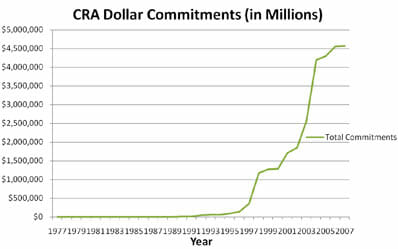
The usual response from supporters is that the numbers are too small to matter.  I tended to agree with this -- until I saw this graph, from Peter Schweizer via Carpe Diem.

chart_398x249

Unfortunately he does not have a source or methodology, so I have to retain some skepticism, but if true these numbers are far from trivial.  He writes:

According to the National Community Reinvestment Coalition, in the first 20 years of the act, up to 1997, commitments totaled approximately $200 billion. But from 1997 to 2007, commitments exploded to more than $4.2 trillion. (Keep in mind this is more than four times the size of the current health bill being debated in Congress.) The burdens on individual banks can be enormous. Washington Mutual, for example, pledged $1 trillion in mortgages to those with credit histories that "fall outside typical credit, income or debt constraints," and was awarded the 2003 CRA Community Impact Award for its Community Access program. Four years later it was taken over by the Office of Thrift Supervision.

This effort was backed by a parallel effort at Fannie Mae and Freddie Mac to buy up these loans:

Beginning in 1992, Congress pushed Fannie Mae and Freddie Mac to increase their purchases of mortgages going to low and moderate income borrowers. For 1996, the Department of Housing and Urban Development (HUD) gave Fannie and Freddie an explicit target "” 42% of their mortgage financing had to go to borrowers with income below the median in their area. The target increased to 50% in 2000 and 52% in 2005.

For 1996, HUD required that 12% of all mortgage purchases by Fannie and Freddie be "special affordable" loans, typically to borrowers with income less than 60% of their area's median income. That number was increased to 20% in 2000 and 22% in 2005. The 2008 goal was to be 28%. Between 2000 and 2005, Fannie and Freddie met those goals every year, funding hundreds of  billions of dollars worth of loans, many of them subprime and adjustable-rate loans, and made to borrowers who bought houses with less than 10% down.

Fannie and Freddie also purchased hundreds of billions of subprime securities for their own portfolios to make money and to help satisfy HUD affordable housing goals. Fannie and Freddie were important contributors to the demand for subprime
securities.

Obama has a personal history with this effort, actually suing banks who would not provide the sub-prime lending that he later, as President, blamed them for undertaking

Obama's battle against banks has a long history. In 1994, freshly out of Harvard Law School, he joined two other attorneys in filing a lawsuit against Citibank, the giant mortgage lender. In Selma S. Buycks-Roberson v. Citibank, the plaintiffs claimed that although they had ostensibly been denied home loans "because of delinquent credit obligations and adverse credit," the real culprit was institutional racism. The suit alleged that Citibank had violated the Equal Credit Opportunity Act, the Fair Housing Act and, for good measure, the 13th Constitutional Amendment, which abolished slavery. The bank denied the charge, but after four years of legal wrangling and mounting legal bills, elected to settle. According to court documents, the three plaintiffs received a total of $60,000. Their lawyers received $950,000.

Now, Congress and Obama want to strengthen the CRA -- talk about not learning from mistakes.

Now comes Rep. Eddie Bernice Johnson, D-Texas, and 50 other co-sponsors (all Democrats) of H.R. 1479 the "Community Reinvestment Modernization Act of 2009," who want to expand the CRA to include not just banks but also credit unions, insurance companies and mortgage lenders. Congressman Barney Frank, chairman of the House Financial Services Committee, has supported the idea in the past. The SEIU and ACORN, along with a host of other activist groups, are also behind the effort.

President Obama has been a staunch supporter of the CRA throughout his public life. And his recently announced financial reforms would make the law even more onerous and guarantee an explosion in irresponsible lending. Obama wants to take enforcement of the CRA away from the Federal Reserve, the FDIC and other financial regulators who at least try to weigh bank safety and soundness when enforcing the law, and turn it over to a newly created Consumer Financial Protection Agency (CFPA). This agency's core concerns would not be safety and soundness but, in the words of the Obama administration, "promoting access to financial services," which is really code for forcing banks to lend to those who would not ordinarily qualify. Compliance would no longer be done by bank examiners but by what the administration calls "a group of examiners specially trained and certified in community development" (otherwise called community activists). The administration says, in its literature about the reforms, that "rigorous application of the Community Reinvestment should be a core function of the CFPA."

Looks like there may be jobs available after all for all those folks who got fired from ACORN.

Make Sure You Don't Catch More than The Limit...

...because the US Fish and Wildlife service has a SWAT team and is not afraid to use it.   Yet another heavily armed government team making sure our nation does not teeter over the brink of anarchy.  Because if everyone were allowed to freely import orchids, our civil society would come to an end.  Fortunately at least one such miscreant was thrown in jail for a well-deserved two years for having the gall not to fill out his import paperwork correctly on otherwise legal orchids.  Thank god Fish and Game had a SWAT team -- who knows what kind of violence 66-year-old orchid terrorists are capable of.   I sure hope I filled out my clock importation paperwork correctly.

But's Its My Hard Work Paying Your Unemployment

I found this story, from a Marketplace segment via Carpe Diem, especially irritating.  Our company has to pay for a lot of unemployment fraud, so seeing such fraud in action really annoys the hell out of me.

Quick background:  Employers pay unemployment taxes generally as a percentage of wages.  These taxes are based on a direct relationship with past claims from ex-employees.  The more of my ex-employees who make claims, the more premiums I pay.

Since I only have jobs for 6 months a year (it is a seasonable business), employees have the opportunity to file for unemployment the other 6 months.   BUT, the rule is generally that you have to be looking for work.

Unfortunately, I have numerous employees who work for me over the summer and take the winter off, but tell the unemployment office they are looking for work so they can collect unemployment anyway.  I have had employees call me from Mexico telling me about the great winter vacation they are having on the exact same day I see their names on the roles of those collecting unemployment (and thereby supposedly "looking for work").

In California, where such behavior is rampant (and where the state unemployment agency has established penalties for employers who even think about asking the state to investigate one of his ex-employees for fraud) I pay over 7% of wages in unemployment taxes, vs. less than 1% in states without such fraudulent behavior.

So, with this background, I am thrilled this guy is showing the initiative to find work but am frustrated he is still fraudulently taking my money:

Michael: I'm getting $272 a week [in unemployment benefits]. Which is just, bare bones. It's so bad that at one time I was going to the food bank. And, you know when you're really hungry and when you're facing eviction, you've got to do something.

Marketplace: So he started looking for work on the side. He found it pretty quickly.

Michael: So right now I have Craigslist open. And what I've done is I've opened three different tabs: I've opened free stuff, all gigs and all jobs.

Marketplace: He's found all sorts of work this way: software testing, landscaping, bouncing and lots of focus groups. All have paid cash. He says some weeks he's earned three times as much as his benefits check. Like everyone on unemployment, he's meant to report any earnings to his unemployment insurance office. Then they adjust his benefits down. So how does Michael answer the question, have you earned any money this week?

Michael: I opt to say, you know, no. I opt to say no, I have not. Because this is my own hard work, this is my own ingenuity, this is my own genius, and I am still looking for work every day.

You are absolutely right Michael, yours the same argument all productive folks make in the face of government expropriation.  In fact, I couldn't have said it better - "this is my own hard work, this is my own ingenuity, this is my own genius."  Brilliant.  But recognize that the unemployment money you are taking fraudulently was paid for with my hard work, my ingenuity, and my own genius.

Local Governments Mining for Dollars

As a small business owner, a huge portion of my time is spent feeding governments with all the paperwork they demand.  But this year has been twice as bad.  Every local authority we operate in has started mining for dollars.  What this has meant is a whole slew of property "reassessments" that have no basis in reality (e.g. values put on non-existent assets) that I have to spend a lot of my time fighting.  The general modus opperandi is to declare my company owes money for something fictitious, and then make us prove we don't.  Have you ever tried to prove you don't own an asset that doesn't exist?  Think about it.  How would you go about it, short of inviting the assessor out to your property to search for it.

Maricopa County, the county that includes Phoenix where my headquarters resides, has been the worst.  We buy assets for properties all over the country, and have the bill sent to our headquarters.  Often, if a registration is required, we will put our headquarters address on the government registration to make sure we get the renewal paperwork (long experience is that if anything gets sent out to an address in the field, it is lost).  The concept that an asset might be in location X but the paperwork should be sent to location Y is a really, really hard concept for a lot of state registration authorities to get their head around/

This year, Maricopa County has started sending us personal property tax notices for all kinds of assets that have never even existed in this county.  They were bought in state A, shipped to state B, with the bill sent to us here in Arizona.  But the County is in financial distress.  It probably understands that the asset does not exist in the County.  I am sure it knows that I don't, for example, have 24 cabins sitting on the fourth floor of this building, where they have them located.  But they need money.  If they send out enough fraudulent bills, and then tell taxpayers it is the taxpayer's responsibility to prove the bill is wrong, then they will likely get some money.   Yet again, the government is engaging in abusive practices that not private company could get away with for long.

I was pretty calm today on the phone with the assessor until this came up:

Me: Look, these are cabins I bought from a factory in Maricopa County but which were shipped immediately from the factory to California.

Assessor: I don't see where you filed for permission to move the cabins

Me: Excuse me?

Assessor: Your xxxyyy form [I forget the numbers].  You never filed for permission to relocate

WTF?  I know we have problems with declining tax roles, but do I really have to ask permission to move an asset out of the county or state.  What, did I violate directive 10-289?

So beware small businesses.  Your government is mining for dollars -- do not assume that tax bill is correct.

Does Anything Exceed the Commerce Clause Nowadays?

A question has been going around on legal blogs -- "Does a Federal Mandate Requiring the Purchase of Health Insurance Exceed Congress' Powers Under the Commerce Clause?"

My answer is:  Nowadays (not in the original intent) is there anything the Feds can do that exceeds current interpretations of the commerce clause?  In Raich, the Supreme Court decided that a product (marijuana) that was grown in state for personal consumption, like tomatoes in your own garden, and was used legally under state law, can still be regulated under the commerce clause.    As Clarence Thomas wrote in dissent:

Diane Monson and Angel Raich use marijuana that has never been bought or sold, that has never crossed state lines, and that has had no demonstrable effect on the national market for marijuana. If Congress can regulate this under the Commerce Clause, then it can regulate virtually anything and the Federal Government is no longer one of limited and enumerated powers

No kidding.

Unfortunately the theory that this personal use in California could somehow affect marijuana pricing in other states (by growing their own, they reduced demand for out of state weed which might affect prices in Arizona -- again similar to an argument that growing your own tomatoes might affect prices in another state) won the day in the Court.   With the Supreme Court accempting this "butterfly effect" argument  (because truly the demand of one person in a national market is like a butterfly flapping its wings in China and affecting a hurricane in the Gulf of Mexico), anything falls under the commerce clause.

I Finally May Be Understanding Something

This year has been a frustrating year for my business.  As many of you know, I am in the business of privatizing public recreation.  We take over the management of public recreation facilities, and are generally able to run them to the same or better standards as the government for less money.  Whereas before we take over, the government typically loses money on a park, we often can run it at a profit AND pay the government rent for the concession rights.

This year, numerous state parks have been threatened with closure in states all across the country.  In many of these states, I have communicated with everyone I could think of, from the governor to state parks leaders, trying to say that companies like ours could probably keep many of these parks open. I told them I wasn't looking for a sweetheart deal - we weren't afraid to bid against other companies, but it was crazy to close parks that could easily remain open.   We have been told any number of times by numerous state leaders that they would prefer to close the park rather than put it under private concession management.

To some extent, this is due to the pressure of public employees unions, who have every incentive to play brinkmanship and force closure of parks rather than set the precedent of having them managed by a non-union private company.  This is unsurprising.

I also understand that there is a fear of private management of public recreation facilities.  I swear the first think I hear almost every time I present on what we do  is that they fear we would put a billboard or a McDonalds in front of Old Faithful.  I kid you not, this charge is as regular as clockwork.  Fortunately, we manage about 175 public recreation facilities to a pretty high standard, and not one billboard or McDonalds can be found at any of them.  A large part of the bid process for any facility management contract is not just the rate or the rent but also the detailed operating standards to which it will be managed.  So this is a normal, but surmountable hurdle.

But even taking into account these usual sources of resistance, I am always just amazed at how vociferous the opposition is to even experimenting with private management.  States like California are simply hell-bent on closing parks a company like ours could easily keep open for the public (to be fair, Ruth Coleman, head of California State Parks, is very open to new models but she gets absolutely no support either within her organization or in the legislature for such new ideas).

But I think I understand this phenomenon better now after reading Kevin Drum today. This is what Drum wrote in response to the DNC ad, which clearly stretched the truth, claiming that Republicans voted to end Medicare:

Why not just tell the truth: Republicans essentially voted in favor of turning Medicare over to private industry.  With only a few words of explanation, this could easily be more effective than the ad that actually ran.  Like so:

Republicans voted to turn Medicare over to private insurance companies!  You heard right: they want to hand Medicare over to the same companies that [insert two or three insurance company outrages here, maybe a Wall Street reference, something about profits over people, etc.].  Democrats will never do that.  Blah blah blah.

Would that really be any less scary than the ad that actually ran?

So for Drum, and I presume for much of the Left, the suggestion that a government service be managed privately is just as bad as the suggestion that the service be ended. In essence, Drum is saying he would almost rather have no Medicare than Medicare provided privately.

It certainly explains a lot, and puts the phenomenon I see in public recreation into a larger context.

Update: A couple of the comments hpothesize the problem is that many in government and on the left just hate profits and the profit motive in general.  One related story -- I was in a meeting with a large state parks organization where a senior person raised the idea of private park management.  Well, everyone hated the idea, but when it looked as if the leadership might still seriously consider the private option, one person in the room said "well could we at least mandate that they can't make a profit."  There was a lot of head nodding at this.

I didn't go off on this and kept a smile on my face.  But I did lose it in an earlier meeting with the head of some government parks we actually did run.  We were discussing park fee increases for the next year (the state had just raised minimum wages about 30% and we were scrambling to make ends meet).  He said he was uncomfortable with the level of profits we made.  I asked him, "Jim (not his real name) does this state pay you more than $25,000 a year to run this park?"  He nodded.  I said, "then you make more profit in this park than I do, and what is more, you didn't have to invest $100,000 in equipment to get your job, nor do you have to rebid for your job every 5 years, nor does you salary go down if for some reason park visitation decreases."

Sometimes I wish I had stood up in that state meeting and said something similar, as in "Why is the money I make in a park somehow tainted because it is the difference between my revenues and expenses and the result of substantial investments and subject to extraordinary risks, while the virtually guaranteed-for-life salary you make, paid for by the same visitors, is somehow pristine?"
A Tribute to Norman Borlaug

Norman Borlaug, the founder and driving force behind the revolution in high-yield agriculture that Paul Ehrlich predicted was impossible, has died at the age of 98 95.  Like Radley Balko, I am struck by how uneventful his passing is likely to be in contrast to the homage paid to self-promoting seekers of power like Ted Kennedy who never accomplished a tiny fraction of what Borlaug achieved.  Reason has a good tribute here.  Some exceprts:

In the late 1960s, most experts were speaking of imminent global famines in which billions would perish. "The battle to feed all of humanity is over," biologist Paul Ehrlich famously wrote in his 1968 bestseller The Population Bomb. "In the 1970s and 1980s hundreds of millions of people will starve to death in spite of any crash programs embarked upon now." Ehrlich also said, "I have yet to meet anyone familiar with the situation who thinks India will be self-sufficient in food by 1971." He insisted that "India couldn't possibly feed two hundred million more people by 1980."

But Borlaug and his team were already engaged in the kind of crash program that Ehrlich declared wouldn't work. Their dwarf wheat varieties resisted a wide spectrum of plant pests and diseases and produced two to three times more grain than the traditional varieties. In 1965, they had begun a massive campaign to ship the miracle wheat to Pakistan and India and teach local farmers how to cultivate it properly. By 1968, when Ehrlich's book appeared, the U.S. Agency for International Development had already hailed Borlaug's achievement as a "Green Revolution."

In Pakistan, wheat yields rose from 4.6 million tons in 1965 to 8.4 million in 1970. In India, they rose from 12.3 million tons to 20 million. And the yields continue to increase. Last year, India harvested a record 73.5 million tons of wheat, up 11.5 percent from 1998. Since Ehrlich's dire predictions in 1968, India's population has more than doubled, its wheat production has more than tripled, and its economy has grown nine-fold. Soon after Borlaug's success with wheat, his colleagues at the Consultative Group on International Agricultural Research developed high-yield rice varieties that quickly spread the Green Revolution through most of Asia.

The contrast to Paul Ehrlich is particularly stunning.  Most folks have heard of Ehrlich and his prophesies of doom.   But Ehrlich has been wrong in his prophesies more times than anyone can count.  Borlaug fed a billion people while Ehrlich was making money and fame selling books saying that the billion couldn't be fed -- but few have even heard of Borlaug.   Today, leftists in power in the US and most European nations continue to reject Borlaug's approaches, and continue to revere Ehrlich (just this year, Obama chose a disciple of Ehrlich, John Holdren, as his Science czar).

Continuing proof that the world moves forward in spite of, rather than because of, governments.

Update: More here.

Update #2: Penn and Teller on Borlaug

Libertarian Oddity of the Day

I found this a bit odd.  In Arizona, you can actually make a voluntary contribution to certain causes or political parties via your tax return.  This is not a checkoff, but an amount that is added to the amount you owe in taxes and then passed on by the state to a short list of approved organizations.  As a libertarian, I find it unsettling that the state acts as a collection or sales agent for certain political causes.  In particular, how can the state make fair and reasonable choices as to who is on and not on the list of eligible recipients?

I found this data for 2009 FY giving:

taxes

What was odd for me is that of all the political giving, libertarians had the highest average donation.  I find it weird that libertarians would want to financially support the libertarian cause but they want to do it via the mechanism of the state income tax return.

The good news here is that the combined $28 thousand or so in political donations was dwarfed by every other cause.

From Our Department of WTF

Under what theory of government is this a proper activity of government with our tax dollars?

Gov. Jan Brewer took the stage Thursday with rocker and restaurateur Alice Cooper to persuade Arizonans that dining out is good for the state. Announcing a three-month public-awareness campaign called Dine 4 AZ, they said going to restaurants supports businesses and helps preserve jobs. Brewer noted that restaurants generate 10 percent of Arizona's tax revenues.

"We are working hard to lead the Grand Canyon State forward and out of this recession, and Dine 4 AZ fits perfectly into our plan," she said. "Please treat your family to a meal and we'll get through this together."

It is just seriously freaking frustrating to see the government spend my money promoting other people's businesses.   And since when has dining out been a sign of patriotism?  Why is buying food from a restaurant more stimulative than buying food from a supermarket? On the plus side of all this is the spectacle of politicians taking the stage with Phoenix favorite son Alice Cooper to make a policy speech.  The only thing that would be better would be for the governor to appear with Phoenix-area resident Jenna Jamison to promote the, uh, stimulative effect of spending an evening at your local strip club.

Postscript - by the way, there is almost no point in challenging the numbers in such a stupid article, but I will bet anything I own that restaurants do not generate 10 percent of Arizona's tax revenues.  Update - In fact, based on this report, restaurants were 9.4% of sales tax collections which in turn are 61% of major state taxes, which makes restaurants and bars about 5.7% of state tax revenue, which I will admit is higher than I would have guessed but still well off the number in the article.

Update #2: OK, I am probably overworking this, but the same report referenced above showed Arizona individual income taxes dropping 32.4% in 2009, presumably due to large drops in income.  However, sales taxes only dropped 13.9% in that period.  And within sales taxes, restaurant and bar sales taxes only dropped 5.8%.  I say only, because except for some stable utility and telecom categories, this is the lowest drop of any business sector subject to sales taxes.   General retail down 12.2%.  Amusements down 8.1%.  Hotel/Motel down 11.9%.  So, in response to the down economy, the state government has thrown their weight behind shifting business to... the single retail category that has been least hurt by the recession.

That Great Public Service

Via Cafe Hayek:

American Postal Workers Union president William Burrus complains that "It is deeply troubling that Journal editors advocate ending the Postal Service's exclusive right to sort and deliver mail.  The Postal Service must remain a public service if we are to honor our nation's commitment to serve every American community "“ large or small, rich or poor, urban or rural "“ at affordable, uniform rates"


My family has  a ranch that is absolutely in the middle of nowhere in Wyoming - it is 30 minutes by dirt road from a town of 2,000.  The USPS delivers mail to a box 3 miles away from the ranch, and does it 3 days a week.  The USPS will not deliver overnight mail.   UPS delivers 6 days a week right to our door, including overnight mail.

The word "uniform" is the key -- what the USPS government protected monopoly buys us is a massive cross-subsidy, where city dwellers subsidize rural communities, Alaska, and Hawaii.   Further, because the USPS knows that these subsidized routes are cost black holes, they tend to cut back on service to try to save money.  The result is that no one is served well, as is often the case when a large cross-subsidy exists -- cities pay more for their mail, and everyone gets worse service.