Archive for 2008

If They Could Do Math, They Wouldn't Have Been Journalism Majors

Further proof that no one in the media is capable of even the simplest reality-checks when it comes to publishing numbers they get from activist press releases.  This whole concept below is a howler (the idea is that global warming causes volcanoes) but it is the last paragraph that really caught my eye:

So much ice in Iceland has melted in the past century that the pressure on the
land beneath has lessened, which allows more of the rock deep in the ground
to turn to magma. Until the ice melted, the pressure was so intense that the
rock remained solid.

Carolina Pagli, of the University of Leeds, led research which calculated that
over the past century the production of magma had increased by 10 per cent.

The research team, reporting their findings in the journal Geophysical
Research Letters
, said an extra 1.4 cu km of magma has been created
under the Vatnajökull ice-cap in the past 100 years.

Since 1890 the ice-cap has lost 10 per cent of its mass, which has allowed the
land to rise by up to 25m (82ft) a year. The volume lost between 1890 and
2003 is estimated at 435 cu km.

Leaving aside cause and effect (e.g. does ice cap melting cause more hot stuff in the ground or does more hot stuff in the ground melt ice), consider the statement that the ground has risen under the ice cap by 82 feet per year for 118 years.  This gives us a rise in the land of 9,676 feet after just 10% of the ice mass has supposedly melted.  Note that this is an enormous, totally non-sensical value.  It implies that a full melting of the ice might increase the land height by 10x this amount, or nearly 100,000 feet  (airplanes stay away!!)  As another check, 9,676 is more than the entire depth of the Iceland ice sheet (it is about the same as what scientists think the Greenland ice sheet depth is).  Another way of looking at this is this is about 1/8-inch land surface rise PER HOUR for the last century. 

I am not sure how any writer or editor on the planet could look at "82 feet a year for 118 years" and not smell a rat.

Math Geek Humor

In his analysis of his hockey stick temperature reconstruction, Michel Mann claimed that his results were robust to changes in certain weighting factors.  Humorously, Steven McIntyre demonstrates that it is robust because when you do the math, the weighting factors actually cancel out of  all the equations.  In effect, Mann was saying that y =3x/x  gives the answer "3" robustly for all values of x (well, except zero).  True, but scientifically meaningless.  But worrisome when a scientist has to run numerous simulations to discover the fact.  I presume he thought his weighting factors were actually doing something in his model.

Reason #4163 to be really, really confident in those climate models these guys are building.

Bracket Challenge Update

With just three games to go in the tournament, here are the standings:

3 games remaining Must wins for best finish
Current
rank

(score)
Player
(125 total)
Best
finish

(chance)
Worst
finish

(chance)
Final Few Champion
1 (109) Jeff Charleston 1 (25%) 13 (12.5%) Kansas Kansas
2 (108) Ron Gallagher 1 (12.5%) 11 (12.5%) UNC UCLA UCLA
3 (107) Kevin Clary #2 1 (12.5%) 18 (25%) Kansas UCLA UCLA
4 (104) Craig 1 (12.5%) 21 (25%) UNC Memphs UNC
5 (104) Jeff Charleston #2 1 (12.5%) 19 (12.5%) UNC UCLA UNC
6 (103) Jeffrey Peterson 2 (12.5%) 21 (12.5%) UNC UCLA UNC
7 (102) Stan Brown 13 (25%) 32 (12.5%) Kansas UCLA
8 (101) briain's 2 (12.5%) 25 (12.5%) UNC UCLA UCLA
9 (100) Bennett Johnsen 2 (12.5%) 34 (12.5%) Kansas Memphs Kansas
10 (100) Tom Kirkendall 1 (12.5%) 29 (12.5%) UNC Memphs Memphs
11 (100) Wade Condict #2 11 (12.5%) 35 (12.5%) Kansas Memphs Memphs
12 (100) Nathan Lambert 3 (12.5%) 35 (12.5%) Kansas UCLA UCLA
13 (99) Andy Nemenoff 4 (12.5%) 33 (12.5%) UNC Memphs UNC
14 (99) Keith Ehlers 1 (12.5%) 39 (12.5%) Kansas Memphs Memphs
15 (97) Warren Meyer #2 5 (12.5%) 47 (12.5%) Kansas Memphs Kansas

I had show the top 15, of course, just to sneak myself in.  In fact, there are still 6 people who can win.  If you think of the three games yielding 8 possible game outcomes,  Jeff Charleston wins on three of those outcomes, and Ron Gallagher, Kevin Clary, Craig, Tom Kirkendall and Keith Ehlers each will win if one specific combination comes up.

Freedom of Association

It is not at all uncommon that voters support restrictions on employers that they would never accept on themselves.  For example, the government has made it pretty clear that normal rights to freedom of association don't really exist in the workplace -- numerous restrictions exist on who I can and cannot hire (or at least not-hire) in my business.

So it will be interesting when the government steps in and tells folks that a very basic freedom of association -- say, the ability to choose who one wants to share an apartment with -- does not really exist.

Biofuel Update: They Still Suck

I feel like I have said what needs to be said on biofuels.  Subsidizing and mandating biofuels with current technologies is terrible fiscal policy, bad environmental policy, ridiculous energy policy, and, perhaps most important, disastrous for the world's poor.

In case you missed all these arguments, Q&O has a pretty comprehensive post here.

Selection Bias

I thought it was kind of interesting that upon reading this McKinsey & Co study (currently the top one in the list) on education, Kevin Drum and a number of other left 'o center blogs pulled out this one chart to highlight.  It shows starting teacher pay  (i.e. out of college) as a percent of the economy's average)

Blog_mckinsey_teacher_starting_pay

The author's of the study argue that the countries higher on this list also have better student results.  Now, I will confess that this is a pretty interesting finding in the study -- that starting teacher pay is more important than teacher pay in later years, because the key is to attract talented people right out of college away from other professions.  Interesting. 

But here is the quite fascinating selection bias by the lefty blogs:  I have read the whole report, and this is absolutely the only chart in the whole study that in any way, shape, or form might be interpreted as a call for higher government education spending.  Even more interesting is what these bloggers left out.  This is the other half of the starting teacher pay analysis Drum et. al. chose note to include, and makes clear that even this chart is not a call for more total spending:

South Korea and Singapore employ fewer teachers than other systems; in effect, this ensures that they can spend more money on each teacher at an equivalent funding level.  Both countries recognize that while class size has relatively little impact on the quality of student outcomes (see above), teacher quality does.  South Korea's student-to-teacher ration is 30:1, compared to an OECD average of 17.1, enabling it in effect to double teacher salaries while maintaining the same overall funding level as other OECD countries....

Singapore has pursued a similar strategy but has also front-loaded compensation.  THis combination allows it to spend less on primary education than almost any other OECD and yet still be able to attract strong candidates into the teaching profession.  In addition, because Singapore and South Korea need fewer teachers,  they are also in a position to be more selective about who becomes a teacher.  This, in turn, increases the status of teaching, making the profession even more attractive.

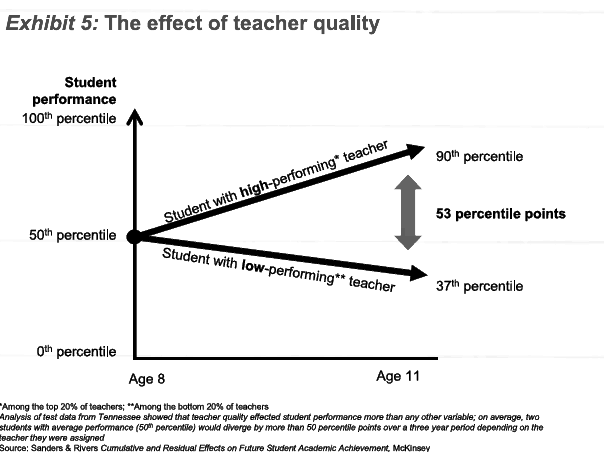
Whoops!  Don't want our friends at the NEA to see that!  Most of the study turns on McKinsey's finding that teacher quality drives student results, way ahead of any other factor, from class size to socioeconomic background:

Teacherquality

Well, now the NEA might be getting really nervous.  Something like this might cause parents to do something rash, like demand that low-performing teachers get fired.  Gasp.

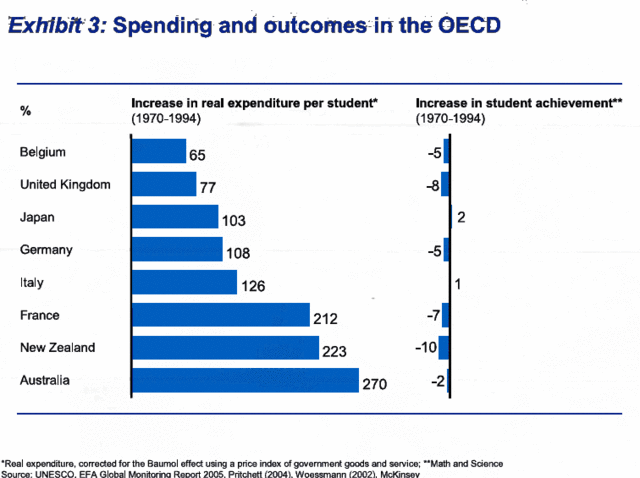
Anyway, to get back to the cherry-picking and selection bias issue, the study is pretty clear that it thinks that "more spending" is a failed strategy for improving public education
Education1

If school choice is off the table, then I would be very supportive of a program to increase starting teacher pay, funded by larger class sizes and substantial reductions in useless administrators and assistant principals.  Anyway, it is kind of an interesting study, though you may find the pdf file format really irritating to try to read.  Lots of funny formatting. 

Fighting the Competition, One Legislature at a Time

Thanks to an email from a reader, comes this bizarre but all-too-common tale of an industry group supporting licensing to protect itself from competition:

Imagine you were a state legislator and some folks
asked you to pass a law making it a crime to give advice about paint
colors and throw pillows without a license. And imagine they told you
that the only people qualified to place large pieces of furniture in a
room are those who have gotten a college degree in interior design,
completed a two-year apprenticeship, and passed a national licensing
exam. And by the way, it is criminally misleading for people who
practice interior design to use that term without government permission.

You might stare at them incredulously for a moment,
then look down at your calendar and say, "Oh, I get it -- April Fool!"
Right? Wrong.

These folks represent the American Society of Interior
Designers (ASID), an industry group whose members have waged a 30-year,
multimillion-dollar lobbying campaign to legislate their competitors
out of business. And those absurd restrictions on advice about paint
selection, throw pillows and furniture placement represent the actual
fruits of lobbying in places like Alabama, Nevada and Illinois, where
ASID and its local affiliates have peddled their snake-oil mantra that
"Every decision an interior designer makes affects life safety and
quality of life."

Legislative analysis by a half-dozen states that
rebuffed ASID's attempts to cartelize interior design -- including
Colorado, Washington and South Carolina -- has failed to support ASID's
claim that the location of your couch or the color of your bedroom
walls is literally a matter of life and death. As the Colorado
Department of Regulatory Agencies put it, there is "no evidence of
physical or financial harm being caused to . . . consumers by the
unregulated practice of interior designers."

I am not sure this even needs comment.  I traditionally end my posts on licensing with this Milton Friedman quote:

The justification offered is always the same: to protect the consumer. However, the reason
is demonstrated by observing who lobbies at the state legislature for
the imposition or strengthening of licensure. The lobbyists are
invariably representatives of the occupation in question rather than of
the customers. True enough, plumbers presumably know better than anyone
else what their customers need to be protected against. However, it is
hard to regard altruistic concern for their customers as the primary
motive behind their determined efforts to get legal power to decide who
may be a plumber.

Many other posts in the same vein here

Blaming A Collective Bargaining Issue on the Oil Companies

Everyone wants to blame their industry's poor economics on banks or the oil companies: (via a reader)

Truckers angry about the high price of fuel staged a rolling protest on
Tuesday, using their big rigs to slow traffic to a crawl on the New
Jersey Turnpike.

The protest was part of a loosely organized
nationwide effort by independent truckers to draw attention to the high
prices they face....

"The gas prices are too high," said one of them, Lamont Newberne, a
34-year-old trucker from Wilmington, N.C. "We don't make enough money
to pay our bills and take care of our family."

Newberne said a
typical run carrying produce from Lakeland, Fla., to the Hunt's Point
Market in The Bronx, N.Y., had cost $600 to $700 a year ago. It now
runs him $1,000...

"The oil company is the boss, what are we going to be able to do about
it?" said Rotenbarger, who was at a truck stop at Baldwin, Fla., about
20 miles west of Jacksonville. "The whole world economy is going to be
controlled by the oil companies. There's nothing we can do about it."

Well, we talked the other day about how oil industry profits, even at this historic high, amount to twenty cents of current gas and diesel prices.  But lets take a more direct comparison.  I looked at Google finance for ExxonMobil and Knight Transportation (a large trucker based here in Phoenix).  If you sum up sales and net income for 2006 and 2007, ExxonMobil earned 10.2% of sales.  During the same period, the trucker earned 9.9% of sales.  This is a statistical dead heat.  So it is kind of hard to say that trucking companies are suffering at the hand of oil companies when they earn the same profit margins.

So what might be the problem?  The article gives a big fat hint that it might not actually be an oil company problem:

Jimmy Lowry, 51, of St. Petersburg, Fla., and others said it costs
about $1 a mile to drive one of the big rigs, although some companies
are offering as little as 87 cents a mile. Diesel cost $4.03 a gallon
at the Jacksonville-area truck stop.

I would certainly be willing to believe that trucking companies are paying independent drivers a price per mile that hasn't kept up with fuel costs.   In particular, it may be that the independent truckers have the same problem that Bear Stearns had, ie their revenues are tied into long term contracts while their costs float short term.  I'd certainly be bargaining for either higher mileage rates or a new rate structure with a fuel surcharge.

Progressives Hate The Poor

Yeah, I know they seem to care so much, but nearly every policy they actively advocate turns out to be a disaster for the poor.  Here is a great example:

In May 2002, in the midst of a severe food shortage in sub-Saharan
Africa, the government of Zimbabwe turned away 10,000 tons of corn from
the World Food Program (WFP). The WFP then diverted the food to other
countries, including Zambia, where 2.5 million people were in need. The
Zambian government locked away the corn, banned its distribution, and
stopped another shipment on its way to the country. "Simply because my
people are hungry," President Levy Mwanawasa later said, "is no
justification to give them poison."

The corn came from farms in the United States, where most corn
produced"”and consumed"”comes from seeds that have been engineered to
resist some pests, and thus qualifies as genetically modified.
Throughout the 90s, genetically modified foods were seen as holding
promise for the farmers of Africa, so long as multinationals would
invest in developing superior African crops rather than extend the
technology only to the rich. When Zambia and Zimbabwe turned away food
aid, simmering controversy over the crops themselves brimmed over and
seeped into almost every African state. Cast as toxic to humans,
destructive to the environment, and part of a corporate plot to
immiserate the poor, cutting edge farming technology is most feared
where it is most needed.

This is simply awful, and is driven by progressive politics in Europe that abhor GM food, despite reams of scientific evidence and years of experience that it has no demonstrable health effect.  (It is particularly ironic that GM corn should be the target, since corn as we know it is a man-made genetically modified food, albeit by the slow process of cross-breeding.  The very existence of corn is one of the great triumphs of pre-Columbian agriculture.)

A key element of progressive politics is to apply western middle class perspectives to Third World problems.  In this case, Europeans who are wealthy and well-fed have time and capacity to worry about problems at the margin, such as "might GM corn somehow have a negative health effect on one in a million people?"  I believe this concern is absurd even at the margin in western society, but it becomes criminally insane when applied to countries beset with abject poverty and starvation.  So we would rather let a million people starve than have one person face some hypothetical health risk?

This same approach can be seen in a myriad of other instances.  For example, progressive wish to prevent Nike from building factories in the Third World that hire locals for fifty cents a day.  Again, the middle class western perspective:  I would never take a job that paid $5 a day for ten hours of labor, so they should not either.  But this is in countries where more than half of the population makes less than $1 a day performing subsistence farming for perhaps 12-14 hours a day, and even then risk starvation when the crop fails.  The Nike factory represents incredible salvation for many.  Do we all hope they will do even better economically in the future?  Sure, but you can't step from unskilled subsistence farming for a dollar a day to middle manager at GE all in one step.

And then there is climate.  The climate change hysteria, and the associated calls for reductions 80% or higher in CO2 output, is the greatest threat to the world's poor that has existed since the bubonic plague.  And yes, I mean the hysteria, not climate change itself.  Because if the world gets warmer because of man's CO2  (an iffy proposition), the poor might or might not be worse off.  After all, it was during warm periods of the past that the poor thrived, such as the population boom in Europe during the Medieval warm period.  But if the world's governments agree to shut down fossil fuel production and reduce the size of economies, over a billion people who are set to emerge from poverty over the next few decades will instead be doomed to remain poor.  Progressive environmentalists are not even subtle about what they want -- they are seeking a poorer, lower-tech worldThey are selling poverty.

Brendan O'Neil writes in this vein:

In these various scandalous schemes,
we can glimpse the iron fist that lurks within environmentalism's green
velvet glove. "˜Cutting back carbon emissions' is the goal to which
virtually every Western politician, celebrity and youthful activist has
committed himself. Yet for the poorest people around the world,
"˜reducing carbon output' means saying no to machinery and instead
getting your family to do hard physical labour, or it involves
collecting cow dung and burning it in an eco-stove in order to keep
yourself warm.... Carbon-offsetting companies have encouraged Kenyans
to use dung-powered generators and Indians to replace kerosene lamps
with solar-powered lamps, while carbon-offsetting tree-planting
projects in Guatemala, Ecuador and Uganda have reportedly disrupted
local communities' water supplies, led to the eviction of thousands of
villagers from their land, and cheated local people of their promised
income for the upkeep of these Western conscience-salving trees....

Carbon
offsetting is not some cowboy activity, or an aberration, or a
distraction from "˜true environmentalist goals' - rather it expresses
the very essence of environmentalism. In its project of transforming
vast swathes of the developing world into guilt-massaging zones for
comfortable Westerners, where trees are planted or farmers' work is
made tougher and more time-consuming in order to offset the activities
of Americans and Europeans, carbon offsetting perfectly captures both
the narcissistic and anti-development underpinnings of the politics of
environmentalism. Where traditional imperialism conquered poor nations
in order to exploit their labour and resources, today's global
environmentalist consensus is increasingly using the Third World as a
place in which to work out the West's moral hang-ups....

Carbon-offsetting also shines a light on the dangerously anti-development sentiment in environmentalism....

In the near term, countries are already using global warming as an excuse for protectionism, and in particular are cutting off imports from poorer countries that are trying to make some economic progress:

There is little
that angers me more than disingenuous attempts to employ "˜global
warming' as an argument against trade, especially against trade from
the developing world. More often than not, blatant self-interest - that
is, old-fashioned protectionism by another name -  is being masked
beneath self-righteous, middle-class gobbledygook.               


Such a case is brilliantly exposed today by Dominic Lawson writing in The Independent ["˜Food
miles are just a form of protectionism. Middle-class neurosis is being
exploited to protect an archaic form of agriculture'
(April 1)]:


"Was
Prince Charles' chum Patrick Holden, director of the Soil Association,
expecting the Kenyan High Commissioner to fall to his knees in
gratitude? It rather sounded like it yesterday morning, when the two of
them met in a BBC radio studio.


They
were there to discuss the Soil Association's proposals to discriminate
against the "˜organic food' which is air freighted into this country,
mostly from East Africa. "˜One option was to ban it altogether,'
declared Mr Holden, but instead he and his colleagues had decided that
such food would only be banned if it was "˜not produced ethically' -
whatever that means....

"On the whole it
is a "˜lifestyle choice' limited to middle-class mothers in the
South-east of England who are neurotic enough to believe the
insinuations of the Soil Association that little Henry and Caroline are
more likely to get cancer if mummy doesn't buy organic (at twice the
price).    
Now
another largely middle-class neurosis - we are all doomed unless
everybody stops flying! - is being exploited to protect an archaic form
of agriculture which could never feed this country, still less the
world. It
is, at best, an exercise in self-delusion. At worst, it is a way of
using food as the instrument of a deliberate policy of racial
discrimination
."

Maxed Out Mamma has more on the global warming excuse for protectionism:

I am genuinely concerned
that environmental concerns are being used as a proxy for protectionist
economic legislation and may have severe consequences. I would like to
discuss this article from a Canadian source about carbon taxation:

Imposing
carbon tariffs on emerging economies with low manufacturing costs and
high greenhouse gas emissions could drive some manufacturers back to
Western countries
, according to two economists.

Jeff
Rubin, chief strategist and economist at CIBC World Markets, thinks
such tariffs could emerge quickly. Countries in Europe are already
becoming publicly intolerant of emissions elsewhere and the next
president of the United States is expected to institute a cap on
greenhouse gas emissions alongside the trading of carbon credits.

...Europe is in an extremely
protectionist mood, and I believe one of the reasons for the
non-scientifically based focus on carbon is that it serves as a
justification for tariffs. If the next president does institute carbon
tariffs, the result will have a real impact on world trade.

I
believe that many politicians are being deeply dishonest about their
"environmental" concerns. I also believe that instituting a carbon
tariff will cause Asian growth to slow remarkably and further
destabilize the world economy. The rise in food prices is very
dangerous because it has an impact on the ability of emerging market
countries to support consumption increases necessary to rebalance
trade. If you add to the situation by doing something like this, you
could recreate the conditions which caused the Great Depression.

It's Rick Astley's World, And We Are Just Living In It

YouTube seems to be RickRolling visitors, no matter what video one requests when you click on one of the featured videos.  Pretty funny.  Happy April Fools Day.

Libertarians Are Losing

How do I know libertarians are losing?  Because our local paper can write 396 words on rising "weed complaints" and ensuing city citations for weeds without once even questioning whether the government needs to be enforcing landscape aesthetics.  Here is one local house that is endangering the Republic enough to require government intervention:
Grweeds03

Is the Global Warming Hysteria Killing Environmentalism?

Of late, I have been getting the strongest sense that the global warming hysteria is sucking all the oxygen out of the rest of the environmental movement.  Quick, what is the last environment-related article you read that didn't mention global warming?

Here is an example:  I give a lot of my charity money to groups like The Nature Conservancy, because I personally value preservation of unique areas and habitats and I don't sit around waiting for the government to do it for me.  But it has become almost impossible of late to drum up enthusiasm from contributors for such causes, unless the land can be labeled a carbon-sink or something.  In fact, the global warming hysteria has really been a disaster for private land conservation because it has caused politicians to subsidize ethanol.  This subsidy is bringing much more wild land into cultivation in this country and has been the single biggest driver for deforestation in the Amazon over the last decade. 

Or take China.  China's cities are an unhealthy mess.  But focus on global warming has led environmentalists to take the position with China they have to stop coal combustion and growth in auto-miles entirely.  This is a non-starter.  There is no WAY they are going to do this.  But it is much more achievable to start getting China focused on a Clean-Air-Act type of attack on vehicle and coal plant emissions of real pollutants like SO2.   China could be made much more healthy, as the US has done over the last 30-60 years, but instead of working with China to get healthier, the focus is on getting them to shut down their growth altogether.

The UPI published a survey of people's environmental priorities:

  1. drinking water
  2. pollution of rivers, lakes, and ecosystems
  3. smog
  4. forest preservation
  5. acid rain
  6. tropical rain forests
  7. national parks
  8. greenhouse emissions
  9. ozone layer
  10. nature around "my" home
  11. urban sprawl
  12. extinction.

I feel like #1 is overblown based on a lot of media scare stories, but most of the top 6 or 7 would all be things I would rank well above global warming fears as well.  There are still real issues to be dealt with in these areas which can have far more of a positive impact on health and quality of living than CO2 abatement, but they are being suffocated by global warming hype.

Update on the "Right Not To Be Offended"

Every decade or so, enemies of free speech adopt a new strategy for trying to curtail the First Amendment.  The current effort consists of attempting to define a "right not to be offended", and college campuses are a leading laboratory for this approach (see here and here).

Chris Robinson was recently brought up on trial at the University court for violating this right not to be offended of some of the women at Colorado College (you may notice that this "right not to be offended" seems to be enforced suspiciously asymmetrically, like all speech restrictions).  He has fired back with a marvelous editorial, of which I include one short excerpt:

Hyper-sensitivity in service to a purported greater good became the
justification for an authoritarian lock-down on speech. It's the same
logic every time: the state comes down hard on behalf of "community."
Changing the rhetorical justification only masks the tyranny. The
effect of this on citizens, in the words of John Adams, is "reducing
their minds to a state of sordid ignorance and staring timidity."...

The simple fact that we were brought before a Soviet-style show
trial has already sent a message to campus, and it is a clear one,
namely that every other potential bearer of heterodox views
should think long and hard about expressing them for fear of ending up
in the same situation as us. In order to avoid even the possibility of offending one group or another, nobody outside the "approved" ideological categories will say anything.

This
is precisely the chilling effect that the First Amendment is
specifically designed to guard against, and to sanction it is a
fundamental violation of the mission of this college. Transparently
selective enforcement against ideologically disallowed speech is
categorically the same as those abhorrent thought-control missions
carried out by the Saudi Ministry of the Propagation of Virtue and the
Prevention of Vice, a perfect example of what John Adams called "the
most mischievous of all doctrines, that of passive obedience and
non-resistance." It's Orwell and Kafka, together at last.

Bonus judos to Mr. Robinson for recognizing that as a private institution, Colorado College can legally implement whatever speech restrictions it likes, and so frames the question as an issue of "should it" rather than "can it?"

Frightening Incompetence

Every food service operation has some problems matching supply with demand, but strikes me as staggering incompetence (via a reader):

Hospitals are throwing away as much as half of their food, NHS figures show.

Close
to 13 million meals were thrown away last year, with 33 hospitals
dumping more than a quarter of their food, including two that discarded
more than was eaten.

Meanwhile, almost 140,000 patients left hospital malnourished, double the figure a decade ago.

Last year, Ivan Lewis, the health minister, admitted that many elderly
people were in effect being starved in hospitals. He said that some
were given a single scoop of mashed potato as a meal, while others were
"tortured" with trays of food placed beyond their reach and no help
with eating.

Maybe the last bit shows that the Brits are enshrining the same "duty to die" that is being discussed in Canada.

Long Overdue: Some Style In Manufactured Homes

Now, I will confess to be a lover of quite modern home designs, but with that in mind, I really think that this design is a breath of fresh air in manufactured homes.  A lot of people are buying these as vacation homes or cottages for land they have bought, either permanently or as a temporary solution until they build their dream vacation home  (Don't click the "decor" button though - it seems that furniture design for manufactured homes is still stuck in the 50's).

Can't Anyone Solve Problems Without the Government?

Here is today's lament in the Arizona Republic:

Government plans to more than double the size of Petrified Forest
National Park appear to be in jeopardy because Congress has failed to
come up with the cash to buy surrounding properties.

The upshot: An irreplaceable treasure of dinosaur bones and Indian
ruins may be lost as ranchers sell off their properties for subdivision
and development.

And Petrified Forest is not alone. A study to be released April 8 by
the non-profit National Parks Conservation Association, says 56 federal
historic and recreation sites "could lose
land inside their borders to developers this year." Others on the list
range from Gettysburg National Military Park near Philadelphia to
Golden Gate National Recreation Area in San Francisco.

Here is an idea:  All you folks who are worried about these "treasures" can pool your money and buy the properties yourselves.  That way you can either take charge of the preservations or donate the land to the government to do so.  This is how many public parks came into being in the first place, from private donations.

Of course, this was back in the days when environmental groups actually spent their money on the environment.  Today, they spend their money instead on lobbying.  The more modern approach is not to spend your own money on the environment, but to lobby the government to force other people to spend their money on the environment.  That is why people have apparently donated $300 million dollars (!) to Al Gore to create an advertising campaign dedicated to trying to spur government action on CO2.  Rather than donating money to help solve the problem, people now donate money to push for government coercion.

Besides representing the modern approach to environmentalism  (ie don't work the problem, just lobby the government to force other people to work the problem), Gore's campaign also represents a new frontier in rent-seeking.  He has managed to get people to donate $300 million dollars to advocate government action that will likely have very little actual impact on the climate, but may have a huge impact on Al Gore's managed $5 billion investment fund.  Congrats, Al.  Even the kings of rent-seeking at ADM would not have had the cojones to ask folks to donate to a charitable advertising fund to support their subsidy requests.


Day Late, Billions of Dollars Short

The NY Times has finally published a comprehensive take-down on the insanity of biofuel subsidies here.  All well and good, but this is at least five years too late.  For years, while this and other blogs have tried to point out that the biofuel emporer's has no clothes, the NY Times has been publishing breathless articles in support of biofuel subsidies and mandates, in fact criticizing the Bush administration and Congress for not moving faster on them. 

So is this what we must expect from the NY Times and the rest of the media?  Shameless pandering to politically correct policy goals that make no scientific sense until it is virtually too late to halt their momentum?  If so, everyone should read the Times' coverage on climate with a jaded eye, because it would not surprise me in the least to see the Times publish the definitive article on why the global warming alarmists are full of hot air only after Congress has gutted our economy with new climate taxes and mandates. 

The Statist Trap

I thought this comment was kind of interesting for what it reveals:

And to some degree, doctors are the property of the state. It
is impossible to have medical education without significant state
subsidization, and although I don't know the specifics of every single
country in Africa, that's a safe generalization to make.

For instance, here in the US, your medical education is
heavily subsidized by the state. Probably on the order of 100k/student.
Resident training programs also receive about 100k/resident from
government entitlement programs.

I haven't a clue whether or not there is a net subsidy of medical education in this country, but assume it to be true.  This is the statist trap in a nutshell.  Statists insist that the government should subsidize (or, in more extreme cases, entirely fund) public education.  But once you have attended these government schools, which one virtually has to do because of the steps the government takes to maintain its education monopoly, you then become the property of the state because the statists claim "well, you took our money for your education..."

How I Stopped Demagoguing and Learned To Love The Oil Companies

I am on the road this week, and still do not have time to write the post I want to write about Obama demagoguing against oil companies.  Fortunately, I do not have to, because Q&O has this post.

Here is the short answer:  companies like ExxonMobil, even in the best of times (or most rapacious, as your perspective might be), makes 9-10% pre-tax profit on sales.  They make something like 5-6% when things are not so good.  This means that if gas prices are $3, when you take out the 45 cents or so of tax, Exxon is making between 13 and 25 cents a gallon profit.  Call it 20 cents on average.  So, wiping out profits completely with various ill-advised taxes or regulations would achieve the substantial goal of ... cutting about twenty cents off the price of gas, or about $2.50 off the price of a fill-up.  Of course, that is at the cost of eliminating all investment incentives in the world's most capital intensive resource extraction business.  Which in turn will mean that that price cut will last for about 2 years, and then be swamped by price increases from disappearing gas supplies  (exactly what happened in the late 1970s). 

Part of the problem is that most people do not understand the supply chain in crude oil.  It would seem logical that if the price of oil rises form $30 to $100, then all that $70 price increase is pure profit to Exxon.  That would have been true in 1905, but is not true today.  Exxon, even when it does the exploration and drilling, gets its oil via complicated agreements with state-owned corporations which in the main are structured so that the country in question, and not Exxon, gets windfall.  This means that if Obama wants to tax windfall profits, he needs to seek out Venezuela and China and Saudi Arabia.

The article covers all this and more.

News Stories You Really Don't Want to See

I know there are people who take the position that all PR is good PR, but really, do you really want newspapers running a photo spread entitled "Hookers Made Famous by [Fill In Your Name]"?

No Bias Here

Via Tom Nelson comes this interview with climate "scientist" Dr. Kate Rawles:

Greenbang: What do you think is wrong with the debate on climate change?

Dr Kate: It hasn't really got to grips with the fundamental problem,
which is that Western, industrialised lifestyles are literally
unsustainable. Climate change is just one symptom of this. WWF famously
calculated that if everyone on earth were to enjoy the lifestyle of an
average Western European, we would need three planet earths.

Not even the most optimistic believers in technology think that we
can technofix this problem so that 6 billion people (let alone the
projected 9 billion) can enjoy a western lifestyle without ecological
meltdown. It follows that we urgently need to rethink what we currently
mean by a "˜high standard of living' and move away from materialistic
versions of this to an understanding of quality of life that could be
enjoyed by everyone, without causing environmental mayhem. This is
about values, not just about technology.

To a large extent, understanding the passion of climate alarmists is a chicken and egg problem.  Normally, scientists identify a problem and then we seek to solve it.  But, as you can see with this woman, climate science works in reverse.  The debate began with people who believed that technology and economic growth needed to be diminished, and then found global warming as a conveniently manufactured "problem" that pointed to their already preferred solution. 

This, by the way, is her complete answer to the question about what is wrong with climate debate.  You can see her answer to this climate science question has nothing to do with climate, but everything to do with her pro-poverty position.  She actually states her position as anti-western-standard-of-living, because that plays better with the soccer moms, but this is exactly the same as pro-poverty.  And get a load of this great scientist quoting WWF advocacy press releases as if they were peer-reviewed science.

By the way, I personally believe that the world could easily sustain 6 billion people in a western standard of living, and love humanity enough to root for this to occur, so here statement is untrue  (by the way, why are people who advocate for universal poverty like this person considered "sensitive" while folks like me who would love to see all the world wealthy considered evil and cold-hearted?)  I don't know exactly how this will happen, but if I stood in the year 1908 I would not know how (or probably believe) even a single person could  enjoy what we call a western standard of living today, but billions do.  The human mind is a wonderful thing, and can achieve a lot, at least when scientists pursue new possibilities rather than simply shrieking that we need to turn the clock back.

Update:  Here is one faulty assumption she is making:

Current levels of consumption in industrialised societies are too high
- as the three planet earth analysis clearly shows. This presents a
major problem for current economic thinking, which is premised on
growth, and which requires us all to keep consuming more, not less.
Clearly we can't grow infinitely, and consume infinitely, on a finite
planet.

Her assumption is that the Earth is somehow at capacity.  How do we know that?  If a scientist bases all of her beliefs on an assumption like this that has never been proven and the scientist is perfectly comfortable taking on faith, can we really call her a scientist?  Or do we call her a religionist? 

AMEN

Cheap Cables? Well Mostly

This post advocates always buying the cheap home theater cables.  I agree up to a point.  I have never been able to hear the difference in really, really expensive cables, say for 3 foot interconnects.

But there is an exception to this, and it is interesting the author Glen is quoting actually uses this example -- long runs of video cable, particularly HDMI.  If your TV sits on top of your video source, and the video run is 6 feet or less, then the average person with the average equipment will not notice the difference in video cables.  But should your cable run extend to, say, 25 feet or more, then you are going to have problems.  Video is both very high bandwidth and very susceptible to noise.  HDMI and other digital cables are no exception  -- the only thing that changes are the symptoms. 

In an analog cable, you will start getting a lot of video noise with longer cable runs.  Computer VGA cables were notorious for this -- if you went more than 6 feet, your picture could be a real mess.  SVGA S-video also had such problems.  Now, with digital cable, the picture does not gain noise but at some point the signal is lost altogether and the picture drops out completely -- think of a youtube video streaming over a bad wireless connection.   I will about gaurantee this will happen with 25 feet of JC Penny HDMI cable.

Another Government Program that Misses the Point

Apparently, the state of Arizona, fearing the coming old-folks demographic boom, is looking to create programs to keep older Americans working longer (and by extension off the government teat longer).

The thought of millions of boomers taking their early-retirement
benefits is causing concern about the stability of Social Security and
Medicare.

"We know not everybody is going to up and retire all at once," Starns
said, "and we will have younger workers coming in. But if you look at
all the demographics, there just won't be enough people to fill all the
jobs that could be vacant."

Add that possibility to existing shortages of workers in health-care
and other fields, she said, and "there could be some pretty significant
problems in society."

Arizona, which launched its Mature Workforce Initiative in 2005 to
avert such a crisis, was one of five states lauded last month for
efforts to engage people 50 and older in meaningful jobs and community
service.

The San Francisco-based Civic Ventures think tank also cited
California, Maryland, New York and Massachusetts, saying the five
states recognize older workers as "an experience dividend," rather than
a drain on resources.

Of course, since it is government, the state of Arizona is, with one hand, patting itself on the back for instituting vague and meaningless but well publicized programs nominally targeted at this issue, while with the other taking steps that have real and substantial effects in exactly the opposite direction.

First, Arizona has some of the toughest laws in the country to penalize businesses for hiring, even accidentally, young vigorous immigrants who don't have all their government licenses in order.   Young workers are pouring into this state every day, but Arizona is turning them away and locking them up. 

Second, Arizona has been legislating as fast as it can to make it nearly impossible to hire older workers.  I know, because the vast majority of my work force managing campgrounds is over 65.  These workers tend to work for a free camp site plus minimum wage.  They like the job despite the low pay because they get a place to park their RV and because the job is part time and very flexible in how they work (not to mention offers the opportunity to take whole chunks of the year off).  I like these workers because they are experienced and reliable and paying them minimum wage helps offset their slowing productivity and higher workers comp costs as they age. 

Here is the math:  Older workers might work 30-50% slower than a younger worker (I have workers right now in their nineties!)  They also have higher workers comp costs, maybe equating to as much as 10% of wages.  This means that an older worker at the old minimum wage of $5.15 an hour might be financially equivalent to a younger worker making $9.50 an hour, which is about what we might have to pay for such a worker. 

However, many states have implemented higher minimum wages with annual cost of living escalators.  States like Oregon and Washington now have minimum wages over $9.00.  At $9.00 an hour, an older worker is now financially equivalent to a younger worker making $16.50 an hour, well above what I can hire such a person for.  This means that as minimum wages rise, I have to consider substituting  younger workers for older but slower workers.

Last year, Arizona adopted just such a minimum wage system with annual escalators.  Though we have not reached the point yet, the state soon may make it impossible economically to hire older workers.  Already, we are looking at some automation projects to reduce headcount in certain places.  This is sad to me, but in a business where a 12% rise in wages wipes out my entire profit, I have to think about these steps.  I have to react to the fact that, no matter how many "policy advisers on aging" the state hires, in reality it is increasing the price to my company of older people's labor vis a vis younger workers.

Unfortunately, the EU Is What Many US Politicians Long to Emulate

From the Times, via Daniel Mitchell at Cato:

An award-winning winemaker whose wares are sold at the royal palaces is
facing a £30,000 bill after European bureaucrats ruled that he was
using the wrong-shaped bottles. Jerry Schooler, who sells 400,000
bottles of fruit wines and mead a year, has been threatened with
prosecution over his determination to use traditional measurements. The
proprietor of the Lurgashall Winery in West Sussex, has been told to
halt the sale of beverages such as mead, silver birch wine and bramble
liqueur in 75cl and 37.5cl bottles. If he continues to sell them, he
could be taken to court under a new EU directive that permits the sale
of such products in 70cl, 50cl or 35cl measures only. "¦Mr Schooler now
faces costs of about £30,000 to change his production line. "We are
going to have to change all our bottling, the labels, machinery, boxes
and maybe the corks as well and it is going to cost me thousands to do
it," he said. "¦West Sussex County Council's trading standards
department said that the winery was bound by EU Directive 2007/45/EC,
which was drawn up in September to "lay down rules on nominal
quantities for prepacked products". It said the directive meant that
the use of 37.5cl bottles for liqueurs was illegal.

Don't miss his other story of passengers having to hop off buses every 30 miles to satisfy EU regulations.  The latter regulation is actually one that is remarkably similar to railroad regulation in the US, where a crew day was defined as something like 100 miles.  Modern freight railroads were having to change crews every two hours - I don't know if that one is still on the books.