Rising Economic Nationalism

A pair of news stories has me spooked tonight.  This first is via Instapundit, and is a story of human pettiness that would be funny if the stakes were not so high:

President Chirac and three of his ministers walked out of the room
when Ernest-Antoine Seillière, the leader of the European business
lobby UNICE, punctured Gallic pride by insisting on speaking the
language of Shakespeare rather than that of Molière.

When M Seillière, who is an English-educated steel baron,
started a presentation to all 25 EU leaders, President Chirac
interrupted to ask why he was speaking in English. M Seillière
explained: "I'm going to speak in English because that is the language
of business."

Without saying another word, President Chirac, who lived in
the US as a student and speaks fluent English, walked out, followed by
his Foreign, Finance and Europe ministers, leaving the 24 other
European leaders stunned. They returned only after M Seilière had
finished speaking.

That's the silly part, but the underlying issue that was being discussed is not so silly:

In the absence of his President, M Seillière gave warning about the
dangers of the "economic nationalism" being pursued by the French
Government. The summit, aimed at restoring confidence in the future of
the EU, has been overshadowed by a row over the tide of protectionism
sweeping the continent, with Tony Blair and Angela Merkel, the German
Chancellor, cautioning about the danger of raising barriers to foreign
competition.

What has me really worried is that the US, the only vaguely consistent defender of free trade in the world for the last 60 years, is having the same discussion, initiated not so much by the economic problems in Europe but by security issues.  As I warned earlier, Congress seems ready to use the events of the Dubai ports mess and the fear of 9/11 to clamp down on foreign investment (sorry, $ required I think):

Building on their win in the Dubai ports deal, U.S.
lawmakers are moving to gain leverage over a swath of foreign
investments in the U.S., an effort that business leaders and President
Bush's aides warn could harm the U.S. economy.

In the first serious legislative move, Senate Banking
Chairman Richard Shelby (R., Ala.) released the summary of a bill
Friday that would greatly expand the array of foreign acquisitions
subject to automatic scrutiny and would require the administration to
notify lawmakers as soon as it begins to review any foreign
transaction. The bill also would require the administration to rank all
countries according to their relations with the U.S. and their support
for weapons-control deals. Approvals would then depend in part on the
ranking of a company's home country.

The administration would have to report to Congress on
why it approved or rejected any transaction, but the bill wouldn't give
lawmakers the power to veto a deal, as many critics feared.

Business groups and Bush administration officials
expressed immediate alarm over several provisions in the bill, which
Shelby aides claim has the support of other members of the Banking
Committee. In a letter to Sen. Shelby this week, seven groups
representing the nation's top banks and finance companies warned that
legislative proposals making the rounds of Congress "would threaten
job-creation prospects for the U.S. economy" and "reduce U.S. economic
growth."

Building on their win in the Dubai ports deal, U.S.
lawmakers are moving to gain leverage over a swath of foreign
investments in the U.S., an effort that business leaders and President
Bush's aides warn could harm the U.S. economy.

In the first serious legislative move, Senate Banking
Chairman Richard Shelby (R., Ala.) released the summary of a bill
Friday that would greatly expand the array of foreign acquisitions
subject to automatic scrutiny and would require the administration to
notify lawmakers as soon as it begins to review any foreign
transaction. The bill also would require the administration to rank all
countries according to their relations with the U.S. and their support
for weapons-control deals. Approvals would then depend in part on the
ranking of a company's home country....

The administration would have to report to Congress on
why it approved or rejected any transaction, but the bill wouldn't give
lawmakers the power to veto a deal, as many critics feared.

Business groups and Bush administration officials
expressed immediate alarm over several provisions in the bill, which
Shelby aides claim has the support of other members of the Banking
Committee. In a letter to Sen. Shelby this week, seven groups
representing the nation's top banks and finance companies warned that
legislative proposals making the rounds of Congress "would threaten
job-creation prospects for the U.S. economy" and "reduce U.S. economic
growth."

This sucks, particularly in the light of a president who has at best been only a luke-warm defender of free trade and who seems to have entirely misplaced his veto pen.  It is an interesting statement on how far this president has wandered from his party's traditional roots that I would greatly prefer to have his predecessor Bill Clinton in office for this fight.  Clinton was certainly a mixed blessing for us anarcho-capitalists, but he was always a strong and articulate defender of free trade, even to the extent of opposing the strong protectionist wing of his party.

In addition to the security issues involved, I have also tackled the overblown fears about trade deficits here, among other places.  For those of you in Arizona concerned about free trade, I know that Congressman Jeff Flake, one of the few remaining folks in Congress who understands free markets and small governments, shares some of these same concerns about rising protectionism.  I hope those of you in his district will continue to send him to Washington to serve us, and I would like to see where our other AZ Congresspersons stand on free trade.  I don't want to pre-judge, but this is one of those issues where I have no trust that McCain (for example) will land on the correct side of the issue.  I fear that conservatives are going to feel the need to flog the security horse right through the November elections, no matter what other principles get trampled in the process.

As a final note, I could add the current backlash against immigrants as
the third leg of this story on rising economic nationalism.  One of the
things that has surprised me the most in getting comments to this blog
is how many people who accept global free trade as right and beneficial
in turn support strong restrictions on immigration (Cafe Hayek comments on economist Robert Samuelson as one such person).
I see free trade and free immigration as having exactly the same
philosophic roots, based in the fact that our rights to trade,
associate, etc. stem from our humanity, not our citizenship.  I won't repeat my argument but you can read it here;
if you are pro-free-trade but anti-immigration, I ask that you give me
five minutes to make the case that no one else seems to want to make
today.  And even if you don't accept the philosophic similarities,
economicly open immigration and free trade are nearly identical issues,
each involving the free flow of labor, capital, and goods across
borders.  If you still can't see the similarity, here is a quick
example:  If I decide that my best sourcing decision is to subcontract
my tech support to Claude in France, I can do this equally well by
either straight outsourcing to Claude where he lives today (global
trade) or by encouraging Claude to move to the US to do the work for me
here (immigration).
 

Bankrupcy of Advocacy Journalism

I have never been one to wade much into the whole "media bias" issue.  Whenever I have discussed it, my main point of view is that journalists of whatever political stripe tend to suspend necessary skepticism when writing about an issue they are really passionate about.  That is why advocacy journalism can yield such crap.  I have never once dug into a strong advocacy journalism piece and not found any number of "facts" to be without attribution and often to not even make any sense.

Most people have now heard the origins of the now-famous "million homeless families" non-statistic, which was reprinted over and over but has been admitted to have been just made up by a leading homeless advocate.  And lets not forget Mary Mapes, who proudly describes herself as an advocacy journalist, and her now famous use of forgeries in her Bush-National Guard reports, leading to the classic "Fake but Accurate" meme.  People who believe in a cause, whether it be homelessness or GWB's fundamental corruption, suspend skepticism for "facts" and "statistics" that fit their point of view on the subject.  Usually they will shrug off challenges to the fact, saying "well, it may not be exactly X but we know the problem is a really big number."  In other words, fake but accurate.

Angela Valdez has a nice analysis of one such advocacy journalism effort, in this case the Oregonian's over-one-hundred part series on the "meth epidemic".  For example, she writes:

On Feb. 20 of this year, columnist S. Renee Mitchell wrote, without
offering data to back up her claim: "The number of meth addicts"”and the
crimes they commit to support their habits"”is exploding."....

In fact, meth use during the past four years has either declined or
stayed flat, according to two major national drug-use studies. The
National Survey on Drug Use and Health shows that meth use did not
increase at all from 2002 (two years before The Oregonian
started its carpet-bombing coverage) through 2004, the last year for
which there is data. The University of Michigan's Monitoring the Future
Study, which examines drug use among youth, actually shows a decline in meth use among high-school students from 1999 to 2005....

Despite The Oregonian's reliance on this figure, there is no good evidence that meth causes 85 percent of the property crimes in Oregon.

Portland State University criminology professor Kris Henning
says the number just doesn't make sense. Department chair Annette Jolin
says the unsupportable statistic has become "something of a joke"among
statistical researchers in the department.

For one thing, Oregon property crimes are much lower than they
were 10 or even 20 years ago, the time period of the supposed meth
"epidemic."

"If meth causes property offenses, and meth use has gone up,"
Henning says, "then property offenses should have gone up. And they
haven't. It's either that, or all the people who commit property crimes
have disappeared and been replaced by a small number of meth users."

I looked at the silliness of meth hysteria statistics here.  But my point is that this is not a meth issue - this is an advocacy journalism issue.  You could write the same article challenging any number of articles in the paper every day.

PS-  But on the subject of meth, I will make one prediction:  I predict that the meth hysteria will do more to create legislation and police practices that will undermine civil liberties than did 9/11.  In fact, much of the Patriot Act is already used more to fight the drug war than to fight terrorism.

More on the Health Care Trojan Horse for Fascism

Frequent readers will now that I have long warned of government-funded health care acting as a Trojan horse for micro-management of our personal lives, the logic being that if our lifestyles or behaviors make us less healthy, then the government that funds medical care may claim an interest in regulating those behaviors.  I often post examples of this phenomena, the most recent of which is here.

This installment comes via Reason, and looks at the NYC Health Commissioner Thomas Friedan's new fascism to prevent diabetes program.  I am not sure I even need to comment on the following for you to get the picture:

New York City is at the forefront of this new public health movement. In
January, city health officials began
requiring
that medical testing labs report the results of blood sugar tests for all
the city's diabetics directly to the health department. This is first time
that any government has begun tracking people who have a chronic disease.
The New York City Department of Health will analyze the data to identify
those patients who are not adequately controlling their diabetes. They will
then receive letters or phone calls urging them to be more vigilant about
their medications, have more frequent checkups, or change their diet....

So what could be wrong with merely monitoring and reminding people to take
better care of themselves?  New York City Health Commissioner Thomas Friedan
has made it clear that it won't necessarily end there. If nagging is not
sufficient to reduce the health consequences of the disease, other steps
will be taken. Friedan
argues
that "modifications of the physical environment to promote physical
activity, or of the food environment to address obesity, are essential for
chronic disease prevention and control." Friedan envisions regulations for
chronic disease control including "local requirements on food pricing,
advertising, content, and labeling; regulations to facilitate physical
activity, including point-of-service reminders at elevators and safe,
accessible stairwells; tobacco and alcohol taxation and advertising and
sales restrictions; and regulations to ensure a minimal level of clinical
preventive services."

The NYC health department starred in a previous post for their brave attack on restaurants that give patrons too much for their money.

Congrats to John Scalzi

Congrats to John Scalzi for his Hugo nomination for "Old Man's War".  I hope he wins.  I read a lot of science fiction including several of the other nominated books but Old Man's War was one of those instant classics, a book that 25 years from now could easily be included in a best of science fiction series.  I also have to agree with Glenn Reynolds on the accesability of his work.  If I wanted to get someone excited about science fiction, I would likely hand them "Enders Game", "The Foundation", and "Old Man's War"*.  I just finished Vernor Vinge's "Deepness in the Sky", which was awesome.  It and his previous book "Fire Upon the Deep" are beautiful and rich and deep and textured masterpieces, but I would never hand them to a SciFi first-timer.  SciFi needs writers who bring the general population back to SciFi, and Scalzi along with Card and a few others will certainly help.

* Honestly, if you rank yourself as someone who hates or just doesn't read science fiction, give just one or two of these three a try.  Scifi is not all cute robots and Imperial Star Destroyers.  And for those looking for the next step beyond these books for more hard-core stuff I might suggest classics like "Mote in God's Eye", "Ringworld",  "Dune", or about anything by Louis McMaster Bujold.  After that, your ready for anything, from Charles Stross to Harlan Ellison (the latter if you want a good downer).

One Thing Every Employee Should Take Away from Enron, Quattrone, etc.

The recent government pursuit of Enron, Frank Quattrone, Arthur Anderson, and any number of other firms has established one "principal" being followed by the government in all of these cases:  They will let large corporations off the hook with fines but no criminal charges IF the corporation agrees to sell out all of its employees.  A large part of this deal, being cut all over the place (and for which Arthur Anderson was destroyed mainly for not agreeing to) is that the corporation will waive attorney client privelege for discussions between employees and corporate attorneys.  Frank Quattrone has been tried twice and will likely get tried a third time mainly based on evidence of emails he sent back and forth with corporate council.  Tom Kirkendall has other examples.

Ten years ago, I would have naively given the advice "don't break the law."  Still good advice, but nowadays in business its hard to tell just what is the law and what is illegal (antitrust is a great example).  So my new piece of advice is "when in doubt, don't use corporate council."  Get your own lawyer.  If the company will pay for it, all the better but do it even if it's out of your own pocket, because it is clear that corporate lawyers are NOT your lawyers, and they will cooperate with the corporation who employs them to put you in jail if that helps protect their real client who pays their salary.

Lawyer Tax on Workers Comp in Florida

First, a little background as I understand workers comp:  Years ago, government, workers and employers effectively made a deal that has worked pretty well for everyone.  In that deal, workers gave up the right to sue for workplace injuries in exchange for a program where employers were required to contribute to a workers comp fund and employees are paid by a government bureaucracy for their health care and lost time.  The system is "no-fault" to the extent that it does not matter if the worker is hurt because the employer had unsafe conditions or if the worker is hurt because he did something boneheaded in violation of rules - either way he gets paid the same.  The system avoids moral hazard at least on the employers side by charging higher premiums to employers that have higher claims rates  (based on an experience mod system explained here).  Employee moral hazard (ie cheating) is supposed to be policed by the bureaucracy, and one can evaluate how much cheating is going on by how high the rates in the state are.  California used to have very high rates and lots of cheating, but has cracked down of late and things are better.  Florida is the king of workers comp fraud and employee cheating, so much so that many national insurers won't touch Florida and our rates are twice as high (or more) in Florida than in other states.

Already frustrated with Florida over the high amount of cheating and high rates, two things I have seen here of late make me doubly depressed.  First, in the last year or so we have started to see claims paid where in addition to, say, $20,000 in actual compensation to a worker, there is an equal amount paid to lawyers.  The first time, I was irate.  Why are my workers comp dollars going to lawyers?  The whole point of the workers comp system is to substitute an administrative no-fault claims system for expensive lawyers and trials.

So this week I get my second surprise about Florida workers comp.  I am down in Florida, doing some business as well as visiting the in-laws (which is why blogging has been light) when I start to hear radio commercials by law firms that say "If you have been hurt at work, call us first before you claim workers comp."  The message is not even, "call us if you think the administrative decision was unfair" but was "get us involved with every little claim."  Does this mean that I am going to start seeing a lawyer 'tax' on every workers comp claim in Florida?  If so, Floridians must have passed some pretty dumb legislation somewhere along the way.  Now, I might understand this if this was a worker backlash in some state that administratively is over-tough on workers in filing their claims, but Florida has historically been the most generous already.  I am sure most of the employers in this state have experienced the "debilitating injury the day before I was going to quit,"  a tried and true Florida technique for supplementing unemployment insurance for a bit of paid vacation. 

Maybe some of the readers can confirm if Florida did something new legislatively over the past few years that opened this up.  By the way, and I apologize in advance to all my hard-working readers in Florida, but I don't think there is any other state with a larger population of searching-for-something-for-nothing freeloaders than one can find in Florida.  Something culturally seems to be wrong here, and I wonder if Florida might not be the next California, with businesses heading for the exits.

Indentured Employertude

Per the BBC News:

More than 160 people were arrested after clashes erupted
in eastern Paris following a day of largely peaceful demonstrations
across France.

Vehicles were set on fire and stores were damaged as masked youths clashed with police.

Twenty-four people, including seven police officers, were injured in the violence, which lasted about six hours.

So what is the provocation?  Are youth being drafted to go to war?  Are fundamental civil rights being taken away?  No, the reason for millions of people on the street and outbreaks of violence is...

Protesters are bitterly opposed to the new law, which
allows employers to end job contracts for under-26s at any time during
a two-year trial period without having to offer an explanation or give
prior warning.

The government says it will encourage employers to hire
young people but students fear it will erode job stability in a country
where more than 20% of 18 to 25-year-olds are unemployed - more than
twice the national average.

 Oh my god, its, its....at-will employment.  Head to the barricades!

In reality, what has happened is that Europe has invented a new type of indentured servitude that works in reverse.  If you remember you history, poor Europeans bought their passage to America in the 16th and 17th century by essentially enslaving themselves for a fixed but finite (as opposed to African slavery) period of time.  They got to come to America, but were forced to work for the same employer without the ability to quit for seven years.

The French have taken this same concept, and flipped it on its head.  If an employer hires someone, the employer is prevented by law from ever firing that person.  In effect, an employer enslaves himself to every employee he hires.  Which might just explain why unemployment is so high over there.  I call it indentured employertude. 

These recent riots also turn history on its head.  In the past, many countries with legalized slavery have faced devastating slave riots and uprisings.  In this case, though, it is not the slaves (employers) doing the rioting to be freed, it is the slave holders (ie the employees) rioting to keep the employers captive.

Is France a total loss?

Rising Tide of Protectionism

As a followup to this post on security as a Trojan horse for protectionism, I wanted to link this article in the WSJ($) called The Perils of Protectionism:

Fifty-six percent of the economists polled in the latest WSJ.com
forecasting survey -- conducted in the aftermath of a flap over foreign
management of U.S. ports -- say protectionism will lead to some
slowdown in U.S. growth over the next several years, and 8% predict
that the slowdown will be significant....

The ports controversy came at a time of growing concern about
protectionism around the world. It followed the blocked bid by China's
Cnooc Ltd. to acquire Unocal Corp. last year and emerged as European
governments angle to prevent high-profile utility deals within their
borders. The fear is that if governments take steps to shield their
countries' businesses, international trade and investment flows could
be reduced. Corporations will find it more difficult to reach new
markets.

Protectionism is unambiguously bad," said David Berson, chief economist
at Fannie Mae. Indeed, the free flow of capital across national borders
is conventionally looked upon by economists as a long-term good, and
69% of those surveyed say foreign ownership of U.S. assets is positive
for the economy in the long run.

One example of why the protectionist arguments are short-sighted is demonstrated by this passage from the same WSJ article:

While the ports row has receded, the U.S.'s large bilateral trade
deficit with China, which was $17.91 billion in January, remains a
flashpoint. Some lawmakers complain the imbalance has been inflamed by
an artifically low exchange rate for China's yuan against the dollar.
Though Beijing modestly revalued the yuan last summer, allowing it to
float in a narrow range against a basket of foreign currencies, critics
have continued to lash China's currency policy and call for further
revaluation.

So the Chinese government is artificially subsidizing the US economy through reduced prices of Chinese goods via a low valuation for the yuan vs. the dollar.  And that's a bad thing?  If the Chinese government is holding down the exchange rate, then they are in fact taking their money and the money of their citizens and pumping it into lower prices for US consumers and lower interest rates on US government debt.  Ooooh, color me really concerned.

As far as the "well, we're going into debt to pay for our consumerism" argument, I and others have tried and tried to educate the world that the trade deficit is not a debt, and running a trade deficit is not bad.

George W. Bush: Champion of the Left

I've made this point myself, but David Boaz says it great:

So here's your challenge, lefty bloggers: If you don't like the
tree-chopping, Falwell-loving, cowboy president - if you want his
presidency fatally wounded for the next three years - then start
praising him. One good Paul Krugman column taking off from that USA Today story on the surge in entitlements recipients under Bush, one Daily Kos
lead on how Clinton flopped on national health care but Bush twisted
every arm in the GOP to get a multi-trillion-dollar prescription drug
benefit for the elderly, one cover story in the Nation on how Bush has
acknowledged federal responsibility for everything from floods in New
Orleans to troubled teenagers, and maybe, just maybe, National Review
and the Powerline blog and
Fox News would come to their senses. Bush is a Rockefeller Republican
in cowboy boots, and it's time conservatives stopped looking at the
boots instead of the policies.

And the Game is On...

We had over thirty entries this year for our bracket pool.  Good luck.  After three games, your host Coyote is in.... Last!  Woohoo.

Lawsuit Perpetual Motion Machine

A guy in Lodi, California seems to have discovered the lawsuit-equivalent of perpetual motion by suing himself (via Overlawyered)

When a dump truck backed into Curtis Gokey's car, he decided to sue the
city for damages. Only thing is, he was the one driving the dump truck.
But that minor detail didn't stop Gokey, a Lodi city employee, from
filing a $3,600 claim for the December accident, even after admitting
the crash was his fault.

Wow, up to this point, you needed an accomplice for this kind of thing, but now you can just do it yourself -- hop in the company car, run it into your house (or maybe the wife and kids for a really big payday) and sue the company.  Genius.

More Reasons to Fear the Patriot Act

There have been any number of stories about how provisions of the Patriot Act are used more routinely to proecute drug cases than to pursue, you know, terrorists.  Note, however, this provision in the Patriot Act that has nothing to do with national security (via Overlawyered).

Quietly slipped into the reauthorization of the Patriot Act:
first-time-ever authority for the Justice Department to engage in
wiretapping and bugging of private premises for purposes of going after
antitrust violators.

Given the fact the the feds regularly prosecute companies with large market shares for A) raising prices (i.e. monopoly pricing); for B) lowering prices (i.e. predatory pricing); and for C) keeping prices the same (ie price fixing), this becomes an open mandate to listen into any private conversation at any company with a non-trivial market share.  Have fun at your next staff meeting over there at Microsoft or Exxon. 

From the Incredible Bread Machine by G.W. Grant:

"Now let me state the present rules,"
The lawyer then went on,


"These very simple guidelines,
You can rely upon:
You're gouging on your prices if
You charge more than the rest.
But it's unfair competition if
You think you can charge less!
"A second point that we would make
To help avoid confusion...
Don't try to charge the same amount,
That would be Collusion!
You must compete. But not too much,
For if you do you see,
Then the market would be yours -
And that's Monopoly!

Coyote Blog NCAA Bracket Challenge

Note: This post sticky through 3/16.  Look below for newest posts.

As promised, we are proud to announce the first annual Coyote Blog NCAA Bracket Challenge.  Yes, I know that many of you are bracketed out, but for those of you who are self-employed and don't have an office pool to join or who just can't get enough of turning in brackets, this pool is offered as my public service.  In particular, I invite bloggers who are experiencing post-Weblog-Award depression to reignite the spirit of online competition.  I mean, why should NZ Bear have the monopoly on ranking bloggers? 

I don't know if we will get 1 or 100 entries, but all are welcome, so send the link to friends as well.  There is no charge to join in and I have chosen a service with the absolutely least intrusive log-in (name, email, password only) and no spam.  The only thing I ask is that, since my kids are participating, try to keep the team names and board chat fairly clean.

To join, go to http://www.pickhoops.com/Coyote and sign up, then enter your bracket.

Scoring is as follows:

Round 1 correct picks:  2 points
Round 2:  4
Round 3:  6
Round 4:  8
Round 5:  10
Round 6:  20

In honor of the Blogfaddah, we have added the special "Army of Davids" bonus scoring:  If you correctly pick the underdog in any round (ie, the team with the higher number seed) to win, then you receive bonus points for that correct pick equal to the difference in the two team's seeds.  So don't be afraid to go for the long-shots!

OK, so what about the prizes?  Well, fame and recognition on this weblog should be enough, but, for those who enjoy recreation, my company will give the winner a choice of 3 nights free camping at one of the public campgrounds we run, or a half-day jet ski rental at Lake Havasu, or a half-day boat rental at Burney Falls State Park in California, Blue Mesa Reservoir in Colorado, or Patagonia Lake in Arizona.

Disclaimer: I sincerely hope that there is something about this purely recreational activity that violates the ridiculous gambling laws we have in this country, because I feel the need to protest them at every turn.  For example, can any politician explain to me why gambling in many Midwestern states is moral on a boat but immoral and therefore illegal on dry land next to the boat?

Update:  We already had a number of entries in the first hour this was up, so it looks like it is going to be a lot of fun.  Go ahead, sign up, it just takes a few minutes.  You don't have to know that much about basketball -- last year our family's tournament was won by an 11-year-old girl.

Taliban at Yale, and Advice for Princeton

Everyone seems worked up about Yale admitting an official of the Taliban as a student.  While I find the guy in question pretty bankrupt, I'm not sure I am very excited about starting down the path of vetting potential college applicants against some political extremism standard.  I am sure there are any number of Ivy League freshmen whose beliefs I would find horrifying, but I don't feel the need to start culling them out.  I do find it odd that Yale would have recruited this guy like he was some kind of rock star, and celebrated his choice of Yale as if he was some prize. 

As I have written to my Alma mater Princeton on any number of occasions, I think that Ivy League schools are making a huge mistake which is tangentially related to Yale's Taliban student.  If the University of Texas had accepted him as one of 10,000 or so in their freshman class, there would not be so much outcry.  But this is an Ivy League school, with 20,000 or more kids competing for 1500 freshman spots.  Every parent tends to think, "so my kid with straight A's and a 1350 SAT and 200 hours of community service got turned down at Yale so a misogynist fascist with a 4th grade education can attend?"

Instead of arguing about admitting one less Taliban guy, I urge Ivy League schools to find a way to bring their higher quality of education to many more people.  Princeton, Harvard, and Yale each have endowments over $10 billion each, and they use this money every year to increase the education intensity to the same 1500 people per class.  Every time I go back to visit campus, I see more buildings, equipment, facilities, professors for the same 1500 folks.  Enough!  At some point there has got to be a diminishing return.  It is time for someone in the Ivy League to take the leadership to redefine their mission away from the current facilities arms race with the other Ivy's and towards a mission to broaden their reach in the country.  Instead of yet more molecular biology equipment for the same 1500 people per class, lets find a way to bring a Princeton education to, say, 6000 people a class.  Lets quadruple the size of the Ivy League.

Of course, the Ivy League conservatives (which means, in this context, everyone who graduated before this year and all of the faculty) fear this change.  The last thing the faculty, who we know to be in charge of the asylum from the whole Sommers affair, want is to have more students to teach -- they want the toys.  And alumni fear that somehow the "essential essence" of the university might be lost, though everyone made that same argument when these schools went coed and few today would argue to reverse this decision.   Administrators argue that the freshman pool would be diluted, sort of like the argument about pitching in baseball after expansion.  But one only has to look at admissions numbers to see that quadrupling the freshman class size would cause the Ivy's to lower their standards to... about where they were when I got in!  (If your SAT scores are in the 98th percentile you still have only a 10% chance of getting into Princeton or Harvard.)  The fact is that the pool of high school students in the upper echelons and Ivy-ready has grown tremendously in the past few years, causing Ivy's to narrow their admissions qualifications to near ridiculous levels, with average SAT scores in the stratosphere, hundreds of hours of community service, multiple sports letters, and consultant-aided choices of special activities to differentiate students from the crowd (e.g. bagpipes or falconry).

I understand that this is difficult -- just the issue of physical space is daunting.  But these are the leading Universities in the world.  Surely there is enough brainpower to figure it out if the mission is accepted.  The University of California has of late been doing a lot of interesting things to bring college education to the masses, and dealing with the fact that the number of people who can afford the cost and time of a college degree has increased exponentially.  I think the Ivy League needs to work through the same exercise at the top end of the bell curve.  They need to address a similar near exponential expansion in the number of students who are "Ivy-ready."

The Source of Wealth

I was stuck in the airport at Salt Lake City on Sunday for a bit due to a large snowstorm** and I was trapped watching the CNN airport channel (which certain airports make unavoidable -- you can't get away from the TV's in a way reminiscent of a variety of distopian novels).  Anyway, I heard some discussion about differences between poor and rich nations, and all the usual easy-to-prove-false memes came out to explain the differences.  Natural Resources:  So why do resource-rich Russia and sub-Saharan Africa do so poorly?   Colonialism:  How do you explain Hong Kong, Australia, and Canada?  Exploiting labor:  So why aren't the most populous countries the richest?  Luck:  How do countries like Haiti have so consistently bad luck for over 200 years?

So here is Coyote's First Theorem of Wealth Creation, first expounded in this post on the zero-sum economics fallacy:

Groups of people create wealth faster in direct proportion to the degree that:

  1. Their philosophical and intellectual
    culture values ordinary men (not just "the elite", however defined) questioning established beliefs and social patterns.  This is as opposed to having a rigid orthodoxy which treats independent thinking as heresy.
  2. Individuals, again not just the elite, have the ability through scholarship or entrepreneurship to pursue the implications of their ideas and retain the monetary and other rewards for themselves.  This is as opposed to being locked into a rigid social and economic hierarchy that would prevent an individual from acting on a good idea.   

China, for example, just by cracking open the spigot on #2, however inadequately, has gone from a country with mass starvation in three or four decades to one where the worry-warts of the world are scared of juvenile obesity.  To a large extent, this theorem is really just a poor restatement of Julian Simon's work.  Simon's key point was that the only relevant resource was the human mind, from which all wealth flows.  All I have done is break this into two parts, saying that to create wealth a society has to value the individual's use of his mind and has to allow that individual free reign to pursue the products of his thinking.

One of the applications where I think this is useful is to explain the great millennial hockey-stick curve.  No, not the temperature hockey stick, which purports to show acceleration of global warming, but the wealth curve.  The world's growth of per capita wealth was virtually flat for a thousand plus years, and then took off in the 19th and 20th centuries.  I previously explained this hockey stick using my wealth creation theorem:

Since 1700, the GDP per capita in places like the US has
risen, in real
terms, over 40 fold.  This is a real increase in total wealth, created
by the human mind.  And it was unleashed because the world began to
change in some fundamental ways around 1700 that allowed the human mind
to truly flourish.  Among these changes, I will focus on two:

  1. There was a philosophical and intellectual
    change where questioning established beliefs and social patterns went
    from being heresy and unthinkable to being acceptable, and even in
    vogue.  In other words, men, at first just the elite but soon everyone,
    were urged to use their mind rather than just relying on established
    beliefs
  2. There were social and political changes that greatly increased
    the number of people capable of entrepreneurship.  Before this time,
    the vast vast majority of people were locked into social positions that
    allowed them no flexibility to act on a good idea, even if they had
    one.  By starting to create a large and free middle class, first in the
    Netherlands and England and then in the US, more people had the ability
    to use their mind to create new wealth.  Whereas before, perhaps 1% or
    less of any population really had the freedom to truly act on their
    ideas, after 1700 many more people began to have this freedom. 

So today's wealth, and everything that goes with it (from shorter
work hours to longer life spans) is the result of more people using
their minds more freely.

The problem (and the ultimate potential) comes from the fact that in
many, many nations of the world, these two changes have not yet been
allowed to occur.  Look around the world - for any country, ask
yourself if the average
person in that country has the open intellectual climate that
encourages people to think for themselves, and the open political and
economic climate that allows people to act on the insights their minds
provide and to keep the fruits of their effort.  Where you can answer
yes to both, you will find wealth and growth.  Where you answer no to
both, you will find poverty and misery.

Update:  This article from Frank Moss, linked at Instapundit, takes these same concepts forward into the future.

What role will startups play in the future?

I see tremendous economic growth from startups from 10 years ago.
Entrepreneurs will go from the 1,000 startup ventures funded in the
last 10 to 20 years to ideas coming from people working together in
network-based environments, using computers to dream up innovations in
a way they never did before. It could be people in developing countries
with low-cost computers.

You talk about education and the bottom-up effect that millions
more people will play in societal advances. How do you see this
unfolding?

We will undergo another revolution when we give 100 million kids a
smart cell phone or a low-cost laptop, and bootstrap the way they learn
outside of school. We think of games as a way to kill time, but in the
future I think it will be a major vehicle for learning.

Creative expression (is another area). No longer will just a few
write or create music. We will see 100 million people creating the
content and art shared among them. Easy-to-use programs allow kids to
compose everything form ringtones to full-fledged operas. It will
change the meaning of creative art in our society.

We are already seeing early signs of it in blogs. The source of
creative content is coming from the world. That revolution will go well
outside of the written word to all forms of visual and performing arts.


** Kudos by the way to the SLC airport - when I drove in, I couldn't see 10 feet in front of me on the road due to the snow, and I was sure that I would be trapped for the day.  Living in Phoenix, where air traffic is backed up if someone sneezes on the runway, I didn't think any planes would be landing and taking off for hours.  In fact, operations continued right through the blizzard, and my flight was delayed less than an hour, including de-icing time.  Amazing.  Now if only the SLC airport could increase their security capacity - its only been, what, 4.5 years since 9/11 and most airports seem to have licked this problem.

Security as Trojan Horse for Protectionism

I can't help but suspect of late that the whole Dubai ports mess signals an intent by protectionists of many stripes to hop on the security bandwagon as a way to repackage protectionism.  One had but to observe the many Congressmen who up to date have shown very little interest in security issues suddenly becoming born-again hawks with on the Dubai issue.  Democratic politicians who up to this point had opposed any actions targeted at Arabs or Muslims as profiling and hate-based suddenly saw the light and opposed the deal based on absolutely no other evidence than the fact the owners were from Dubai.  I particularly laughed at the quote by Howard Dean lamenting that "control of the ports of the United States must be retained by American companies" (funny, since Dubai-ownership was taking over operations from a British company, not an American company).  The Dubai ports deal opposition was first and foremost protectionism, begun at the behest of a domestic company that lost a bid in Miami and a number of domestic unions.

Now we can start to see this bandwagon grow.  I was in the airport and saw one Congressman (Duncan Hunter, I think, but I am not positive) on CNN proposing new legislation to ban foreign ownership of any infrastructure deemed security-sensitive.  He specifically mentioned power plants, which told me that he was thinking pretty expansively. This is rank protectionism, pure and simple.  You can quickly imagine everything from power plants to oil companies to telephone providers - really just about anyone - coming under the auspices of a critical industry that should be all American.  Just check out the case of low-cost airline upstart Virgin America to see how this security dodge is being used to protect companies from competition and prevent consumers from getting more choices and lower prices (also see WSJ$).

Xenophobia, in terms of this protectionism and the new immigrant backlash, appears to be one of the few bipartisan issues that politicians from both sides of the aisle can get behind.  I fear a new McCarthyism in the works.

Soloman Ammendment Upheld

I must say I was not at all surprised that the Solomon amendment (requiring private universities that accept federal funds to also accept military recruiters) was upheld by the Supreme Court.  I predicted months ago that the left had made its bed on this issue with its strong support of Title IX.

Various law school faculties argued in the case that the Solomon Amendment unconstitutionally violated their rights to freedom of association (by taking away their choice of who can and cannot recruit on campus) and of speech (by forcing the university to support speech, such as military recruiting pitches, that it does not agree with).  I must say that I am both sympathetic and unsympathetic to their argument.  Sympathetic, because there are in fact free speech and association issues here.  The majority opinion notwithstanding, its impossible to make a razor-sharp distinction between prohibitions on "conduct" and prohibitions on expression.  I can't accept Robert's blanket statement that "unlike a parade organizer's choice of parade contingents, a law
school's decision to allow recruiters on campus is not inherently
expressive."  What if, say, Al Qaeda wants to set up a booth?  My accepting their booth would sure as hell be a form of expression, one that I am sure the Right would blast me for. 

I do understand that there is money involved, and the fatuous answer is that "well, they can just turn down federal funds."  Bullshit.  Like it or not (and I don't) the feds have made themselves so ubiquitous, particularly in certain research areas where they have crowded out all private funding, that it is unrealistic to tell them to take a hike.  Though I must say that it is interesting to see the left, which built this huge federal machine, hoist on their own petard.  Besides, the majority opinion said that the funding tie-in was not necessary to pass constitutional muster -- that the government had the power to just straight out compel private universities to accept military recruiters.

However, mostly I am unsympathetic.  Why?  Because these very same ivy league and faculty intellectuals have felt free in the past to step all over the free speech and association rights of the rest of us in similar ways.  As George Will asked in recent column, it would be fascinating to see what percentage of these same people who brought this suit in turn vehemently support, say, McCain-Feingold?  Or, public funding of election campaigns. 

As a business person, this ship sailed years ago.  Freedom of association no longer applies to business people.  The reason?  Well, freedom of association implies the reverse right of not associating with anyone you choose.  But there are phone-book-sized bodies of legislation today with detailed regulations telling me all the people and circumstances in which I cannot choose whom I associate with, or don't associate with (via employment decisions, for example).  For example, my business employs RV'ers who live full-time on the road and form a large transient labor force.  I have tons of applications every year from Canadian and Mexican citizens who would like to work for me, but I cannot hire them.  On the other side of the coin, I have had to actually go to court from time to time to justify why I chose not to hire or to fire someone who is a woman, or older, or handicapped.

And forced speech with which I don't agree?  My company has to, by law, maintain bulletin boards full of posters, messages, statements, etc. that I don't necessarily agree with but are legally required to post on my property as communication to workers.  And these bulletin boards have to be made a bit larger every year.  I don't have to accept any federal money to be absolutely required, at the penalty of heavy fines, to post these communications.

I would be a bit more enthusiastic in my support for these law faculty if I didn't suspect that they have been the very people out in the forefront of trashing my first amendment rights as a business person.

Postscript: By the way, is this even a problem anyway?  At Harvard Business School, the largest recruiters eschewed campus altogether, and conducted all their interviews at offsite hotels.  I would think the military could pretty easily work around these law schools prohibitions. 

Enron, Week 5

Tom Kirkendall has another excellent roundup of the Lay/Skilling trial.  According to Kirkendall, the prosecution is having some trouble, and in fact have wandered pretty far afield from their original indictment (a document that the prosecution now actually has disowned).  In effect, Lay and Skilling seem to be being tried for different things than they were ostensibly brought to trial for.  Most interesting is this:

On the other hand, the Task Force's case to date has wandered away from
the SPE's, so there is a decent chance that a difficult-to-control
Fastow could end up being a not-so-important witness in the
ever-changing big scheme of this corporate criminal case of the decade.

If Kirkendall is reading the trial correctly, and the SPE's and Fastow's testimony are becoming irrelevant, then the trial has virtually nothing to do with anything we have heard about in the media about Enron.

Barrionuevo and Eichenwald, who have been following the trial for the NY Times, agrees that the government case is shifting but believe it is due to the strength of what has been presented so far.

A steady drumbeat of damaging testimony in the five-week-old criminal trial against the former chief executives, Jeffrey K. Skilling and Kenneth L. Lay,
has led legal experts to praise the government case presented so far.
That has raised questions about the risks prosecutors would run by
putting Mr. Fastow, the former chief financial officer, on the stand as
early as Tuesday.

I haven't followed the testimony in any depth, so I can't choose from these two point of views, except to say that the government tactics of essentially changing the charges mid-trial and suppressing defense witnesses by naming a record number as unindicted co-conspirators may or may not be effective, but strike me as fairly scary abuses of the justice system.

I Told You So (Health Care Edition)

For about a year now, I have been arguing that public funding of health care will be used as a Trojan Horse to introduce a near fascist micro-regulation of our lives.  I argue that if the government is funding health care, then they will claim a financial stake in your health, and begin regulating everything from your food intake to your exercise habits, even your risk choices (e.g. snowboarding).  I made this argument here and here, among other places.  The general reaction has been, "gee Coyote, nice theoretical argument but you can put your tinfoil hat away now.  You are being paranoid."

Well, check this out:    (via Reason)

Another doctor who examined the journal report was Dr. Brian
McCrindle, a childhood obesity expert and professor of pediatrics with
a pediatric hospital in Toronto.

He warned that the looming problem must be addressed.

"The wave of heart disease and stroke could totally swamp the public health care system," he said.

He warned that lawmakers had to take a broader view of the looming
problem "” and consider doing things such as banning trans fats and
legislating against direct advertising of junk food toward children.

"It's not going to be enough any more just to say to the consumer 'You have to change your behavior,'" he said.

Notice that he left the second half of his last sentence unsaid.  That second half is "the government is going to have to force them."  Of course, none of this is an issue if we all have personal responsibility for our own health care costs and therefore for the consequences of our own decisions.

Postscript:  By the way, for anyone older than 30 who grew up in the sixties and seventies when all the intelligentsia were painting pictures of Malthusian starvation nightmares, this is GOOD news:

The percentages of overweight children also are expected to increase
significantly in the Middle East and Southeast Asia. Mexico, Chile,
Brazil and Egypt have rates comparable to fully industrialized nations,
James said.

He estimated that, for example, one in five children in China will be overweight by 2010.

The reason for this is not because of some evil corporate conspiracy (though that's what the article attributes it to) but due to the fact that these kids are simply not starving to death any more.  I am absolutely sure that the public health "crisis" from these overweight kids is less of a problem than the public health crisis of 30 years ago, when they were all malnourished and dying of being, well, severely underweight.  I mean, are there any of you out there in the over 40 crowd who didn't get the "there are starving kids in China" guilt trip growing up when you didn't eat your dinner?

Edward Glaeser on Urban Economics

Check out this very nice NY Times article (I think it is outside the firewall) on Harvard economist Edward Glaeser and his takes on urban economics and housing markets.  One study of his that resonates with me is his research about just how much modern regulation and zoning is contributing to the high cost of housing:

Glaeser and several colleagues considered two explanations. First, the
possibility that builders in the metro area were running out of land and that
home prices reflected that scarcity. The second hypothesis was that building
permits were scarce, not land. Had the 187 townships in the metro area created a
web of regulations that hindered building to such a degree that demand far
outstripped supply, driving prices up?

Almost as a rule, Glaeser is skeptical of the lack-of-land argument. He has
previously noted (with a collaborator, Matthew Kahn) that 95 percent of the
United States remains undeveloped and that if every American were given a house
on a quarter acre, so that every family of four had a full acre, that
distribution would not use up half the land in Texas. Most of Boston's metro
area, he concluded, wasn't particularly dense, and even in places where it was,
like the centers of Boston and Cambridge, there was ample opportunity to
construct higher buildings with more housing units.

So, after sorting through a mountain of data, Glaeser decided that the
housing crisis was man-made. The region's zoning regulations "” which were
enacted by locales in the first half of the 20th century to separate residential
land from commercial and industrial land and which generally promoted the
orderly growth of suburbs "” had become so various and complex in the second half
of the 20th century that they were limiting growth. Land-use rules of the 1920's
were meant to assure homeowners that their neighbors wouldn't raise hogs in
their backyards, throw up a shack on a sliver of land nearby or build a factory
next door, but the zoning rules of the 1970's and 1980's were different in
nature and effect. Regulations in Glaeser's new hometown of Weston, for
instance, made extremely large lot sizes mandatory in some neighborhoods and
placed high environmental hurdles (some reasonable, others not, in Glaeser's
view) in front of developers. Other towns passed ordinances governing sidewalks,
street widths, the shape of lots, septic lines and so on "” all with the result,
in Glaeser's analysis, of curtailing the supply of housing. The same phenomenon,
he says, has inflated prices in metro areas all along the East and West Coasts.

One of his other areas of research was new to me.  Glaeser argues that the long-lived nature of housing is part of what keeps cities like Detroit and St. Louis around long after the economic and demographic logic would have had them die. 

Glaeser and Gyourko determined that the durable nature of housing itself
explains this phenomenon. People can flee, but houses can take a century or more
to finally fall to pieces. "These places still exist," Glaeser says of Detroit
and St. Louis, "because the housing is permanent. And if you want to understand
why they're poor, it's actually also in part because the housing is permanent."
For Glaeser, this is the story not only of these two places but also of Buffalo,
Baltimore, Cleveland, Philadelphia and Pittsburgh "” the powerhouse cities of
America in 1950 that consistently and inexorably lost population over the next
50 years. It is not just that there were poor people and the jobs left and the
poor people were stuck there. "Thousands of poor come to Detroit each year and
live in places that are cheaper than any other place to live in part because
they've got durable housing still around," Glaeser says. The net population of
Detroit usually decreases each year, in other words, but the city still attracts
plenty of people drawn by its extreme affordability. As Gyourko points out, in
the year 2000 the median house price in Philadelphia was $59,700; in Detroit, it
was $63,600. Those prices are well below the actual construction costs of the
homes. "To build them new, it would cost at least $80,000," Gyourko says, "so
there's no builder who would build those today. And as long as those houses
remain, the people remain."

There's a lot more in the article, including a positive economic take on the role of roads and automobiles that he sets in counterpoint to the typical aesthetic arguments against sprawl. 

I found this next bit supremely ironic, though it matches my observations of these cities as well:

Zoning and housing supply ultimately determine not only who lives in a city but
also the very nature of these places. Boston, San Francisco and Manhattan are
obviously becoming rarefied destinations, mostly for America's elites (Glaeser
calls the cities "luxury goods"), with housing floating beyond the reach of the
young and the middle class. These cities' economies are in the process of
becoming boutique, too, accommodating only the most skilled and privileged.
Their desire to limit construction and grow not in buildings and population but
in prices has, in effect, begun to shape their destiny.

Residents of these cities turn up their noses at the aesthetics and red-state politics of places like Houston and Phoenix, piously believing that all the while they are the true friends of the poor, while at the same time putting in place a government-enforced housing system that only the rich can afford, driving those of moderate incomes to, well, Houston and Phoenix.

This last observation provides a fitting conclusion:

And what surprises him is that the changes in how we have treated property
rights for the last 40 years "” who gets permission to build, the size and
location of what owners are permitted to build "” have been the subject of
virtually no national dialogue, even as the effects on prices, in his view, have
been extraordinary.

Blogging is Light

Blogging has been light of late.  If you are confused about why, see here.  I am also working on the first annual Coyote Blog NCAA bracket challenge, so stay tuned.

Follow-up on Health Care

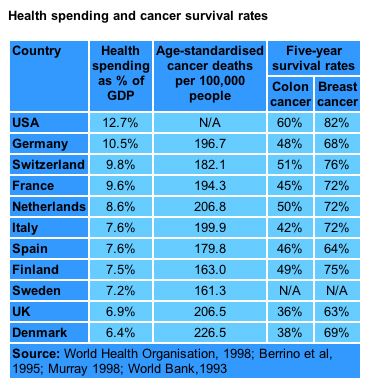
As a follow-up to this post, I wanted to take on the argument that people use against the US's health care system, arguing that it must be worse than other countries socialized approach because it costs so much more.  Well, I am the first to agree that reduced regulation and a better matching of who is paying the cash to who is receiving the services would result in huge cost savings.  However, it may also be true that you get what you pay for, as discussed in Cafe Hayek.  The key chart is shown below:

Survivalrates

One thing I forgot to mention in the previous post was a bit of background of exactly why we have a model where health care is payed for by the employer.  This structure of company-paid health care was not a natural market evolution, but was in fact a direct result of several very distorting government regulations.

Company funded health care plans began in the 1930's and 1940's as a way for companies to try to get around government controls and freezes on wage rates, first instituted with the NRA and later during WWII.  In particular, during the incredibly tight domestic labor markets in WWII, employers struggled with government-mandated wage controls, and used the promise of employer-paid health care as a way to provide higher effective compensation to attract employees, since these non-cash benefits were not counted in the wage freeze calculation.  After the war, the government locked in this practice when the IRS and Congress agreed that company-paid health care was not taxable as regular income, meaning that such health plans were given a strong tax-preference over cash wages.

Finally, if you are not familiar with the appalling experiment in fascism that was the NRA, I wrote about it here.

Sued for Taking a Bath

Via Overlawyered, is the incredible story of Shannon Peterson, who is being sued for taking a bath before work.  Really:

Many people find the sound of running water soothing and peaceful.

Not Marvin and Goldie Smith, who have sued their neighbor over her 5 a.m. baths.

The
couple, 83 and 78 respectively, live on the eighth floor of the Polo
Club Condominiums near the Cherry Creek Shopping Center. They claim the
water pipes they share with the woman below them vibrate so badly they
can't sleep through her early morning baths....

So the Smiths called their son, Sheldon, a
partner in the Holland and Hart law firm. He sent a letter, threatening
Peterson that her "intransigence ... and tortuous conduct have resulted
in incredible sleep deprivation for Mr. and Mrs. Smith. Your obstinacy
has ruled the day. That will now cease."

He then ordered Peterson to stop running water in her bathtub before 8 a.m....The Smiths sued Peterson just before Christmas, citing the "reckless and negligent use of her bathtub."

Unbelievable.

More LA Times Ignorance

Would it be at all possible that the LA Times assign people to the business section that know something about business?

Over the last several weeks of the Lay-Skilling Enron trial, the prosecution has been putting on witnesses to testify that Enron management managed their earnings in quarterly releases by adjusting accounting reserves to increase reported income.  Here is an example:  Many companies, when they book sales, keep a reserve for noncollectable accounts.  Let's say that if a company books $1 million in sales, they might book 3% or $30,000 as a reserve against noncollectable accounts.  This reduces reported income by $30,000.  But the 3% is fairly arbitrary.  What if the bosses suddenly called down and said, you know, I think its only going to be 2.5%.  Then the entries would be changed and suddenly the company has $5000 more income.  And, if they retroactively changed the 3 to 2.5 for the last several quarters, tens of thousands of dollars might be added to this quarter's income.  Of course, in Enron's case, these entries and reserves were orders of magnitude more complicated and arcane.

So what's my beef against the LA Times?  They headline of their story on the activity I just described is:

Witness Says Enron Raided Fund

Orders to dip into reserves to inflate profit violated accounting rules, a former company accountant testifies.

What fund?  They make it sound like Lay and Skilling went into some bank vault somewhere and took money.  These reserves are not wads of cash sitting in accounts - they are accounting entries providing estimates of future expenses to be booked against current revenues.  What is undisputed is that management changed their estimates of these future expenses, which caused these paper reserve accounts to be reduced, increasing paper earnings.  You might reasonably argue that the only purpose for changing these estimates was to manipulate reported earnings in an unlawful way, and that is what the jury has to decide.  But how can you describe this as "raiding" a "fund", unless you want to portray the defendants in the worst possible light.

My guess is that the people who wrote this at the LA Times are the same ones who keep writing about the "Social Security Trust Fund" as if it is an actual pile of cash in a bank vault somewhere, and not money long ago spent by Congress.

Uhaul Indicator of California Health

In today's Opinion Journal, the WSJ editorializes against the proposal to even further raise marginal income tax rates in California, to the highest in the country save in New York City.  The Journal argues that this is chasing productive, high income people out of California:

The
latest Census Bureau data indicate that, in 2005, 239,416 more
native-born Americans left the state than moved in. California is also
on pace to lose domestic population (not counting immigrants) this
year. The outmigration is such that the cost to rent a U-Haul trailer
to move from Los Angeles to Boise, Idaho, is $2,090--or some eight
times more than the cost of moving in the opposite direction.

I had seen this Uhaul metric before.  The logic is that Uhaul has to keep its fleet of trucks and trailers balanced.  If everyone is going one way with them, say from California to Utah, then they are going to end up with an enormous yard full of vehicles in Utah unless they 1)  pay to backhaul the trucks to CA empty, which is really expensive, or 2) increase the price of the route to Utah and decrease the price of the route back until they are in balance or until the price of the preferred direction covers the backhaul costs.

I had never tried this myself.  I always wondered if the examples people use in articles like this are hand-selected or representative.  So I tried, at random, LA to Salt Lake City  (I have Utah on the brain, I guess, because we are going skiing up there next week, woohoo!)  and chose a date far enough in the future I didn't run into any random demand peaks.  A one-way 26-foot truck rental from LA to SLC on May 15 was quoted at $1888.  The same truck from SLC to LA was quoted at $299!  Try it yourself.

Frequent readers of my blog know I am a big supporter of open immigration, but it cannot be a good thing to send a quarter of a million of your best educated and most productive people out every year and backfill them with lower-skilled, under-educated immigrants.