I Was Sortof Right

A couple of years ago I made this prediction:

We will soon see calls to bring a tighter licensing or
credentialing system for journalists, similar to what we see for
lawyers, doctors, teachers, and, god help us, for beauticians
.  The
proposals will be nominally justified by improving ethics or similar
laudable things, but, like most credentialing systems, will be aimed
not at those on the inside but those on the outside.  At one time or
another, teachers, massage therapists, and hairdressers have all used
licensing or credentialing as a way to fight competition from upstart
competitors, often ones with new business models who don't have the
same trade-specific educational degrees the insiders have....

Such credentialing can provide a powerful comeback for industry insiders under attack.  Teachers, for example, use it every chance they get to attack home schooling and private schools,
despite the fact that uncertified teachers in both these latter
environments do better than the average certified teacher (for example,
kids home schooled by moms who dropped out of high school performed at
the 83rd percentile).  So, next time the MSM is under attack from the blogosphere, rather than address the issues, they can say that that guy in Tennessee is just a college professor and isn't even a licensed journalist.

Well, despite all efforts by John McCain, we still have free speech on the blogosphere.  But I was almost right, because another country is considering such a proposal -- In France:

The government has also proposed a certification system for Web sites,
blog hosters, mobile-phone operators and Internet service providers,
identifying them as government-approved sources of information if they
adhere to certain rules. The journalists' organization Reporters
Without Borders, which campaigns for a free press, has warned that such
a system could lead to excessive self censorship as organizations
worried about losing their certification suppress certain stories.

I'm Confused. Why Is This Illegal?

Apparently there was another payola bust.  I'm confused.  Why is this illegal?  I guess in the 1950's I might understand it, when there was only one way to listen to music anywhere outside your home.  But today there are about 20 different ways, including several flavors of radio.  If a radio station overplays the same song to the point of insanity, just listen to something else. 

Paying for placement in overcrowded distribution channels is routine in many industries and certainly not the subject of federal law.  If you don't believe me, try taking your new brand of potato chips over to Safeway and try to get on the shelf.   Now, I know folks would argue that this contributes to Safeway's selection being bland.  But that is also why new competitors, like Whole Foods, have emerged to serve folks who don't like Safeway's selection of products.

By the way, does anyone think its funny that record producers are in the news for paying for play at the same time they are in the news for charging for play?

Update:  More on charging for play:

On March 1, 2007 the US Copyright Office stunned the Internet radio
industry by releasing a ruling on performance royalty fees that are
based exclusively on the number of people tuned into an Internet radio
station, rather than on a portion of the station's revenue. They
discarded all evidence presented by webcasters about the potentially
crippling effect on the industry of such a rate structure, and
rubber-stamped the rates requested by the RIAA (Recording Industry
Association of America).

Under this royalty structure, an
Internet radio station with an average listenership of 1000 people
would owe $134,000 in royalties during 2007 -- plus $98,000 in back payments for 2006. In 2008 they would owe $171,000, and $220,000 in 2009.

Happiness Is: Being Allied With Neither Political Party, And So Not Having to Comment on Ann Coulter

So I won't.  Which doesn't mean I haven't found all the squirming on multiple web sites immensely entertaining.  Jeff Goldstein, as is often the case, is perhaps the most entertaining.  While Jeff will never be invited to speak at a MoveOn rally, on the other hand it is about as easy to lump him in with Pat Robertson as to group "Little House on the Prairie" into a double feature with "Team America World Police."

Though I am not convinced it is an especially apt comparison for the Coulter remark, I did particularly note one observation.  Goldstein's commenter said, in part, this:

I am reminded of the whole "niggardly" thing.  Of course, we KNOW what
it means.  But, you cannot really use it unless you want to be
misunderstood and have your message distracted.

Jeff responded:

This is, of course, quite stunning and more than a bit dangerous to the cause of liberalism.

I mean, look again at what Steve just argued:  "Of course, we KNOW what
it means.  But, you cannot really use it unless you want to be
misunderstood and have your message distracted."

Translation: We know what it means, but we must assume nobody else does.  Therefore, their misunderstanding is to be countenanced and massaged"”which, in effect, empowers ignorance
rather than treating it as ignorance.  It is the perfect example of the
intellectual welfare state:  rather than working to force people to
break out a dictionary, we'd rather provide them with succor because,
well, they can't really be expected to learn things on their own,
right?  Those kinds of people?

I don't read Protein Wisdom all the time, so I am not sure if "intellectual welfare" is a term Goldstein uses a lot.  I coined it independently a few years ago, when discussing social security.

Beware of Prosecutors

Beware of prosecutors:  they don't like to lose.  Scooter Libby today became at least the third high-profile person in recent memory to be successfully prosecuted for lying about something that wasn't a crime. 

Bill Clinton, Martha Stewart, and Scooter Libby were all prosecuted for perjury charges that were really tangential to the original case.  In all three cases, prosecutors, hot to not be left empty-handed when pursuing a high-profile target, fell back on prosecuting perjury charges related to non-crimes once their core case fell apart.  Only Bill Clinton escaped jail, escaping with what was effectively jury nullification -- no one seems to deny he was guilty of perjury, but his jury (the Senate) couldn't bring itself to impose a ridiculously harsh penalty for lying about something entirely unrelated to any crime and which in a reasonable world would not even have been allowable questioning under oath. 

Am I Anti-Science?

I promise, cross my heart, this is my last post on climate change for a while.  I thought my series of posts last week about the funny math of carbon offsets was the last, but Joe Miller at Catallarchy wrote something that caused me some introspection:

Just one caveat, though: I'm really, seriously, profoundly uninterested
in your skepticism about man-made global warming. Personally, I think
that the debate is just about as fruitful as a discussion of the
relative merits of evolution and Genesis as models of the origins of
the universe. It's called scientific consensus, people. You seem to
like it well enough for every other subject. And even if that
overwhelming scientific consensus turns out to be wrong, it's not like
a debate here is going to help with that. When scientists are wrong,
it's up to, you know, like, other actual scientists to settle
the question. A bunch of non-scientists googling studies that say what
we like them to say isn't accomplishing much, really.

Certainly I have always been in favor of facts and science over hysteria.  I criticized the rampant breast implant litigation in the face of science that showed no real long-term harms.  Ditto vaccinations.  So am I being a Luddite by, as an amateur, being skeptical of the scientific "consensus" on global warming?  Certainly climate change hawks want to paint my positions as "holocaust denial."  I had a few thoughts:

  • For what it is worth, I have actually read much of the 2001 IPCC climate report (not the management summary, which is a worthless political document, but the report itself).  Courtesy of JunkScience.com, who has posted some of the 2007 report, I have read key parts of that report as well.  So I have at least informed myself beyond random Google searches.  My original university training was as a scientist, and later an engineer, though neither in climate (physics and mechanical engineering).
  • The media has been known to declare a consensus ahead of its actual existence.  One example that comes to mind is a recent letter that a number of economists wrote supporting a Federal minimum wage increase, which much of the media spun into a "consensus" among economists that a minimum wage increase would be desirable and would not reduce employment.  I don't know Mr. Miller, but my bet is that some of the folks at Catallarchy might dispute this particular scientific consensus.
  • To even imply that there is a single consensus on something as complex and multi-faceted as anthropomorphic global warming is facile.  I will take the movie "An Inconvenient Truth" as a fair representation of what the media perception of the consensus is  (the IPCC report actually does not agree in full, but we will get there in a minute).  Taking that movie as our straw man, the "consensus" or hypothesis is as follows:
  1. The world has been warming for a century, and this warming is beyond any historical cycles we have seen over 1000 years  (ie, the hockey stick)
  2. The last century's warming is almost all due to man's burning of fossil fuels and other releases of greenhouse gasses
  3. In the next 100 years, CO2 produced by man will cause a lot more warming
  4. Positive feedbacks in the climate, like increased humidity, will act to triple the warming from CO2
  5. The bad effects of warming greatly outweigh the positive effects, and we are already seeing them today (polar bears dying, glaciers melting, etc)
  6. These bad effects, or even a small risk of them, easily justify massive intervention today in reducing economic activity and greenhouse gas production

I believe this is a mostly fair representation of the media reporting of the scientific "consensus", with the exception that the media never really goes into step #4, and assigns all the blame for 6-8 degree temperature rise forecasts to CO2.  But this split between #3 and #4 is important to understand the science at all, and is included in the IPCC report, so I will make it. 

This is a complicated string of logic, with multiple assumptions.  I hope you see why declaring a scientific consensus on all points of this hypothesis is facile.  So where is there a scientific consensus on all of this?  My interpretation from the recent IPCC report and other sources is:

  1. The world has been warming for a century, and this warming is beyond
    any historical cycles we have seen over 1000 years  (ie, the hockey
    stick)   
    There is a strong consensus on the first half.  We can argue about urban heat island corrections and ground vs. satellite all day, but the earth has pretty clearly warmed for a hundred years or so, after cooling before that.  The second half of the proposition is trickier.  The 2001 report relied on the Mann hockey stick to make the point that the 20th century is not just warmer but uniquely warmer.  I sense the 2007 report backing off this -- the Mann analysis has a lot of problems, and ongoing climate research continues to point to the great variability and cyclicallity of climate over time.  There is too much historical evidence, for example, of a warm middle ages for Mann to dismiss it with a few tree rings.
  2. The last century's warming is almost all due to man's burning of fossil fuels and other releases of greenhouse gasses.   The 2001 IPCC report implied about half of the century's warming was man-made.  The new report seems to put more of the blame on man.  My sense is this will move over time back to half and half -- the evidence today of increased solar activity is becoming too strong to ignore as a cause along with man-made CO2.  However, I recognize right now that I am out of step with the IPCC and perhaps the "consensus" on this.
  3. In the next 100 years, CO2 produced by man will cause a lot more warming.  CO2 production by man will cause more warming.  How much is the subject of models, which any economist or businessperson can tell you are notoriously flaky.  However, here is one fact that is part of the scientific consensus but you never hear in the media -- the relationship between atmospheric CO2 concentration and warming is a diminishing return.  In other words, the next doubling of CO2 in the atmosphere will have less impact on temperatures than the last doubling.  At some point, the effect of CO2 maxes out, and further increases in CO2 have no effect on temperatures.  My reading of the newest IPCC seems to imply that if the models predict about 6 degrees of warming over the next 100 years, of which about 2 is directly from CO2, while the rest are from positive feedbacks (discussed next)
  4. Positive feedbacks in the climate, like increased humidity, will act to triple the warming from CO2.  OK, this strikes me as the key point in the scientific consensus.  Hypothesized positive feedback loops in the climate are what take the IPCC models from results that are warmer but probably manageable to results that appear catastrophically warmer.  Their models assume that as the world warms a bit from CO2, other effects take hold, and the world will warm even more.  For example, they posit that if the world is warmer, more water evaporates into water vapor in the atmosphere, which is a strong greenhouse gas, which accelerates the warming.  I think it is absurd to say there is a consensus on this point, which is adding 2/3 or more of the warming.  The notion of positive feedbacks in nature offends my intuition --  there are just not that many such processes in nature, or else nothing would be stable -- but then again Einstein's intution was offended by quantum mechanics and he was wrong.  However, using the IPCC's own findings (starting in section 8.6 here) the IPCC admits to there not even being a consensus on the sign (ie if it is positive or negative feedback) of what they describe as by far the strongest feedback process (cloud cover)!  I don't know how you can declare a consensus if you admit you don't even know the sign of the largest effect.
  5. The bad effects of warming greatly outweigh the positive effects,
    and we are already seeing them today (polar bears dying, glaciers
    melting, etc) 
    It would be absurd to declare a consensus here because no one has really done much definitive work.   Most folks, including me, presume that since substantial warming would take us beyond the temperature range for which our bodies and our civilization has been adapted, the net effect would be bad.  But there are positive offsets to the negative effects (e.g. oceans rising) that you never really hear about in the press (longer growing season, for one) but which are in the IPCC report.  Climate scientists themselves have admitted there is no consensus on what effects that we are seeing today are due to warming.  Part of Antarctica (about 2%) shown in Al Gore's movie is warming, but most scientists now think that this may be due to cyclical variations in ocean currents, while most of Antarctica has actually been cooling of late.  Greenland is warming, but glaciers may not be receding as fast as once feared.  Polar bear populations, despite reports to the contrary, are increasing.
  6. These bad effects, or even a small risk of them, easily justify
    massive intervention today in reducing economic activity and greenhouse
    gas production. 
    Many climate scientists express an opinion on this, often definitively, but if one argues that I am not qualified to test the consensus as a layman on global warming, then certainly climate scientists are far from qualified in drawing any conclusions on this topic.  The effects of a worldwide rollback on CO2 production at current technologies could be catastrophic, particularly for a billion people in India and China just on the verge of emerging from poverty.  Even in some of the most dire forecasts for warming, it is a very open question with little consensus as to whether a cooler but poorer world is better.  In fact, one can argue that even the pious Kyoto-signing countries are voting with their actions, rather than their words, on this issue, since they have resisted taking the hard economic steps necessary to meet their targets.

OK, that is more than I meant to write.  My point is that the word consensus is an absurd word to apply to the topic of anthropomorphic global warming.  Some things we understand pretty well (the world is warming, in part due to man-made CO2) and some we understand less well (the effect of feedback loops).  And some issues, like whether the harms from climate change are worth the cost of avoiding them, are entirely outside the purview of climate science.

Update: Strata-Sphere has a funny bit of related snark:

Global warming on Neptune's moon Triton as well as Jupiter and Pluto, and now Mars has some scratching their heads over what could possibly be in common with the warming of all these planets....

I still don't know. Could there be something in common with all the
planets in our solar system that might cause them all to warm at the
same time?

On a serious note, he has some nifty graphs of historic earth temperature reconstructions (including Mann) vs. sunspot activity reconstructions (sunspot activity generally being a proxy for solar output).  Short answer:  Sunspot activity at historical highs, at the same time as historical highs in temperature. 

OOPS

Kevin Drum, six months ago:

THE BEST CARE ANYWHERE....Thanks to innovations introduced
during Bill Clinton's administration, VA healthcare is now among the
nation's best. It's cheaper than either private healthcare or Medicare,
the quality is top notch, and it operates according to strict
performance standards. Sounds like a great model, doesn't it?

That quality government management and incentives system will do it every time.

Folks on the left are already gearing up to blame the current Walter Reed mess on the current administration, thus scoring points off Bush (fine with me) while not having to question the inherently poor quality of government-managed health care systems.

What If They Had Asked the Question This Way?

A CBS poll says about 2/3 of Americans think the government should provide health care for all.  Many in the poll think the government would suck at it (about half said the government would do a worse job, and less than a third think it would do a better job). 

Given how important health care is to people, I find it hard to reconcile these two opinions.  If I had to guess, most people who say they are for government health care implicitly imagine a two-tier system, where they would still get the good care they have today, but poor people who people imagine are without care today (actually they tend to be without insurance, not without care) would get a suckier second tier of health care run by the government.

But I don't think this is a realistic view of what they will get with universal health care.  No government-run universal health care system is ever going to be politically stable with two tiers.  You are going to have to end up with a system that some poor people get better care but the rich and middle class end up with a worse system.  That is the reality of every government run health care system in the world.

I would love to see the answer to this poll question:

"Would you support a system of government-run universal health care that guaranteed health care access for all Americans, but would result in you personally getting inferior care than you get today in terms of longer wait times, more limited doctor choices, and with a higher probabilities of the government denying you certain procedures or medicines you have access to today."

Statistical Insanity

Congrats to Peter Austin for making a great point about medical research, particularly the advocacy-driven risk research we see in the media every day:

PEOPLE born under the astrological sign of Leo are 15% more likely
to be admitted to hospital with gastric bleeding than those born under
the other 11 signs. Sagittarians are 38% more likely than others to
land up there because of a broken arm. Those are the conclusions that
many medical researchers would be forced to make from a set of data
presented to the American Association for the Advancement of Science by
Peter Austin of the Institute for Clinical Evaluative Sciences in
Toronto. At least, they would be forced to draw them if they applied
the lax statistical methods of their own work to the records of
hospital admissions in Ontario, Canada, used by Dr Austin.

Dr Austin, of course, does not draw those conclusions. His point was
to shock medical researchers into using better statistics, because the
ones they routinely employ today run the risk of identifying
relationships when, in fact, there are none. He also wanted to explain
why so many health claims that look important when they are first made
are not substantiated in later studies.

Thanks again to TJIC for the link

Finally, Someone States the Obvious

The media and many politicians have an inventive system that drives them to take the most pessimistic possible interpretation of every economic event (the media to sell papers, politicians to panic us into giving them more control of the economy).   Chinese ownership of US debt securities is one such issue that everyone seems to be in a tizzy about.  Thanks to Don Boudreaux for finally stating the obvious:

In fact,
foreign-government
holdings of U.S. debt arguably make these governments "hostage to the
economic decisions being made in Washington."  The Fed, after all,
could monetize this debt, inflating away its value.  Or Uncle Sam could
repudiate this debt, or unilaterally change its terms in ways
unfavorable to holders.  Or you and your colleagues could implement
economically disastrous policies that drive up long-term interest rates
and, hence, drive down the value of outstanding treasuries.

Finally!  All you have to do to understand this is reverse the situation.  If the US government owned a hundred billion dollars of Venezuelan government bonds, would this really give us power over Hugo Chavez?  Or would it, more likely, given him more power over us, at least in terms of circumscribing our actions?

Time for Francisco d'Anconia

Update from Venezuela:

Even Chavez's own energy officials are getting nervous "¦

Last week, for the 10th time, Chavez announced his plan to
confiscate four Orinoco Belt extra-heavy-oil projects run by six
Western companies"¦

Rather than allow Chavez's state oil company to become the
majority partner in its investment, Exxon could"¦ just walk away - a
possibility that's keeping Venezuelan energy officials up at night.

Rather than let its Cerro Negro operation be turned into a
Chavista workers collective, with Exxon there to pay the bills and
provide the technology and its workers suddenly state employees, Exxon
could just pull out"¦

Courtesy of TJIC, who suggests a similar approach but from a different fiction source.

It's Hard To Be A Libertarian

Sometimes, it is difficult to figure out what the libertarian position on an issue should be, because it is so muddled with a history of government interference.

One such issue is the bill that passed the House (but is unlikely to become law) called the "Employee Free Choice Act."  The bill eliminates the requirement for secret ballot elections for forming unions, in favor of card checks (basically similar to signing a petition).  On its face, it is easy to laugh at the hypocrisy of Democrats, who are the first to claim voter intimidation even in secret ballot elections.  In no other context would the Democrats ever support such a voting change, but many in the party are convinced unions need a boost, and this is their solution.

This is the second pay-off to unions the Democrats have put forward.
Yesterday the House passed HR 800, the curiously misnamed "Employee
Free Choice Act" by a margin of 241-185. This act approves the use of
the very public card check method of certifying a union instead of
using a secret ballot.

As I mentioned here,
that opens the entire process to intimidation - on both sides. A secret
ballot was how it was formerly done and should have been preserved. I
can't imagine how anyone can make the argument, with a straight face,
that the card check system

But wait!  What is the individual rights position here?  Freedom of association means the government should not dictate to a group of people on how they organize.  If a group of even two people want to get together at GM and call themselves a "union" and approach management to negotiate, they should be able to have at it.  Of course, they'll probably get laughed out of the room, but it is odd the government should dictate how they can organize.  In a free society, this is how things should work -- any number of employees should be able to organize themselves.  If they get enough people, then they will have enough clout, perhaps, to be listened to by management.

Unfortunately, we don't live in a free society, and the term "union" comes with a lot of legal baggage.  Recognized unions are granted certain legal powers and rights that an average group of self-organized folks don't.  For example, they are the only private organizations in this country that I know of that have taxation power, and the power to demand absolutely that certain monies be withheld from employee paychecks (even of employees not in the union) and given to them.  Perhaps more importantly, companies can't ignore them - they have to negotiate with a recognized union.  Unions also have informal powers.  For example, the legal system tends to tolerate a lot of violence and physical intimidation by union members (in strikes and such) that it does not tolerate in other contexts  (seventy-five years ago, the situation was reversed and the system tolerated a lot of company violence against workers).

So what do you do?  I have the same problem with immigration policy -- I think a free society would allow free immigration, but we are not a free society and have a myriad of government handouts we just can't afford to give to everyone who shows up at the door.  Anyway, in the case of this bill, given the power we have granted to unions, I don't think the secret ballot election requirement is too unreasonable.  Or maybe we could offer a compromise:  Democrats can get card-check voting in unions as long as they allow the same system for presidential voting in Florida and Ohio.

TerraPass Business Model

I don't have any inside information on TerraPass, the company made famous by providing the $399.75 certificates that offset all your emissions for a year.  I do know that the numbers don't seem to add up, as I wrote here and Protein Wisdom similarly wrote here.

However, I thought about their business model some (since I have been on a role with new business models) and it strikes me that it is brilliant.  Because I am almost positive that they are (legally) reselling the same carbon credits at least three times!

Think of TerraPass not as a company that hands out little certificates, but as a business who makes money through energy projects.  These projects generate electricity without producing CO2 (e.g. wind), or in the case of their cow-poop projects they generate electricity by converting a very bad greenhouse gas (methane) to a less bad one (CO2).

So, for each Kw they generate, there is a certain number of tons of greenhouse gas emissions avoided vs. if they had generated the same Kilowatts with fossil fuels.  (How many tons depends on what fuel you assume the power would have been made with -- my guess is they assume coal, since that gives them the biggest offset, though in fact the marginal fuel in most areas is natural gas in peaking turbines, which produces a lot less CO2).

Anyway, they can claim some number of tons of avoided CO2.  But I am pretty sure they are reselling these abated tons at least three times!  Here is how I think it works:

  1. Their energy projects produce electricity, which they sell to consumers.  Since the
    electricity is often expensive, they sell it as "CO2-free"
    electricity.  This is possible in some sates -- for example in Texas, where Whole Foods made headlines by buying only CO2-free power.  So the carbon offset is in the bundle that they sell to
    electricity customers.  That is sale number one. 
  2. The company most assuredly seeks out and gets
    government subsidies.  These subsidies are based on the power being
    "CO2-free".  This is sale number two, in exchange for subsidies. 
  3. They still have to finance the initial construction of the plant, though.  Regular heartless
    investors require a, you know, return on capital.  So Terrapass
    finances their projects in part by selling these little certificates that you
    saw at the Oscars.  This is a way of financing their plants from people
    to whom they don't have to pay dividends or interest "”just the feel-good
    sense of abatement.  This is the third sale of the carbon credits.

All, by the way, entirely legal, though perhaps not wholly ethical if you really care about reducing CO2 emissions and not just being able to cover your ass to smugly deflect criticism.  This is actually a brilliant way to finance electricity projects, one that Enron wasn't even smart enough to dream up.

And there is nothing wrong with buying these certificates.  The International Star Registry has sold thousands (millions?) of people on the idea that they can have a star named after themselves.  Of course, no actual official body that names stars accepts these as real names, but that's OK, the certificate kind of makes a cool graduation gift (friends of ours did the ISF thing for my father-in-law after he died and my wife really liked it).

Postscript:  By the way, this ignores the ability of such a company to resell the same credits to multiple certificate holders, since the whole CO2 credit thing is pretty damn hard to audit and no one is even trying.  I don't think these guys are doing so, but someone will think of it.

I am So Disapointed

Maggies Farm reports that their site is banned in China.  I tested Coyote Blog at the same site they used.  And much to my chagrin, I am available in China.  I guess I am not trying hard enough. 

Is Jury Nullification Libertarian?

A while back, at our local libertarian discussion group, we spent an evening discussing centralization vs. decentralization of government, and whether one or the other better protects individual liberties. 

Many libertarians argue for decentralization.  The anarchists in the room will argue for the ultimate decentralization, all the way to the individual level, essentially voiding the concept of government altogether.  Others who are more amenable to some government argue for decentralization because it tends to allow for competition, with citizens voting with their feet and wallets for more favorable tax and regulatory regimes.

On the other hand, the US provides historical examples of the benefits of federalism in protecting individual rights.  Certainly the abolition of slavery and later of Jim Crow laws were a positive outcome from the feds, as are the enforcement of Bill of Rights protections on the states.  I would personally love to see a federal system like our own with all legislative power held as locally as possible, but with a federal government whose main purpose domestically was not taxation/regulation/legislation but instead enforcement of a more robust Bill of Rights and nullification of state and local law that violated protected individual freedoms.

Anyway, one topic related to decentralized authority was jury nullification.  Jury nullification is the ability for juries to rule on the law, rather than guilt or innocence.  An example might be "the jury thinks Joe is guilty of smoking pot, but we don't think smoking pot should be illegal, so we are going to let Joe go."  Most state law technically does not allow juries to rule on the law itself, but as a practical matter there is no way juries can be prevented from doing so  (Prosecutors really go non-linear over jury nullification -- I remember Patterico had a long series inveighing against it.)

Anyway, as you might imagine, the libertarians in the room mostly love jury nullification.  Despite being a good anarcho-capitalist, I disagreed. I understood that most of the examples people brought up did indeed demonstrate that jury nullification could be a tool for protecting individual rights.  However, I believe that nullification could equally be a tool of oppression.  For example, in criminal law, take the Enron-Skilling trial.  I am not saying this happened, but one could certainly imagine a properly inflamed jury saying "well, we don't think he is technically guilty beyond a reasonable doubt on the charges based on the evidence here in court, but he's rich and Enron failed and people lost money and we're pissed off, so we will find him guilty.  They would be saying "what he did was not a violation of the law, but it should be, so we are sending him to jail." This is just as much jury nullification as my previous example.

I don't think this kind of anti-individual-rights jury nullificatin happens often in criminal court, but I do think it is happening a lot in civil court.  In fact, I think one way you could summarize what is wrong with torts and litigation in this country is that we are seeing rampant jury nullification in favor of wealth redistribution.  Juries are ignoring the law, the facts of the case, and all reason for one and only one consideration:  "One guy in the room is rich, one guy is not, and I have a chance to take money from the rich guy and give it to the poor guy."  For while it may be hard in America to get 51% of the voters to support substantial increases in wealth distribution, smart lawyers like Peter Angelos and Jon Edwards have figured out that it is not that hard through voi dire to get at least seven or eight such votes in a room of twelve people.

Particularly if you are good at venue-shopping:

In Race, Poverty and American Tort Awards (and here),
Eric Helland and I show that tort awards increase strongly with county
poverty rates especially with minority poverty.  A 1% increase in black
poverty rates, for example, can increase tort awards by 3-10 percent
with a similar increase in Hispanic poverty rates.   Careful forum
shopping can easily raise awards by 50-100%.

Anthony Buzbee, a famed plaintiff's attorney, inadvertently let the
cat out of the bag recently when talking about Starr county in Texas.

"That venue probably adds about seventy-five percent to the value of
the case," he said. "You've got an injured Hispanic client, you've got
a completely Hispanic jury, and you've got an Hispanic judge. All
right. That's how it is."

In other parts of Texas, Buzbee went on, a plaintiff may have the
burden of showing "here's what the company did wrong, all right? But
when you're in Starr County, traditionally, you need to just show that
the guy was working, and he was hurt. And that's the hurdle: Just prove
that he wasn't hurt at Wal-Mart, buying something on his off time, and
traditionally, you win those cases."

The problem with letting juries write law in the jury room is that there are no Constitutional protections at all.  If they want to make the law, at least for that day, read that homeowners are liable for injuries suffered by burglars trying to break into their house, then that is what the law becomes, fair or not.  If they want to make the law read that drug companies shouldn't sell painkillers that have any risk at all, then that is what the law is, and the rest of us 300 million minus twelve people have to live with fewer choices for managing our migraines. 

Coyote Sees the Future

James Dean, reader of both my blog and my book BMOC, sent me a great article about several companies that are pursuing business models surprisingly close to the one I made up for BMOC in my book.

Quick background:  In my novel, I imagined that the company BMOC had recruited the most popular kids at a number of high schools -- kids who were true social opinion makers, so to speak.  I posited that BMOC monetized these relationships by 1) Helping clients of BMOC in the same school become more popular and 2) Seeding these kids with free products (video games, cosmetics, etc.) which would cause other kids who followed their example to go out and buy the same products.  The free products both paid the popular kids for their consulting work helping to make BMOC clients more popular, and acted as a guerrilla marketing tactic for the companies that sell these products.  (The section of the novel explaining the business model in detail is here).

Well, I have not seen anyone pursuing part 1, but apparently a number of companies are pursuing part 2:

Shoppers will be given the opportunity to test products or
services, share them with their friends and, all being well,
recommend them to a wider audience - without a cent being spent on
traditional advertising.

One company, Yooster, predicts it will have 50,000 "influencers"
- the marketing moniker for trendsetters and mavens - on its books
by June, ready to spruik a client's wares solely for the social
kudos of getting the product before it hits the shelves.

The chief executive and founder of Yooster, Piers Hogarth-Scott,
said: "If you are a 20-year-old girl at university and you get the
latest lipstick from Gucci months before it is out on the shelves
and you are able to give it to your friends then you are going to
look good. That gives you immense [social] currency."

You can buy BMOC at Amazon.

Updates on the Smugness Coupons

For RSS readers who probably don't get the updates to posts, I have added a number of updates to my post on smugness coupons, also known as offset certificates.

How Climate Science Works

When I was an undergraduate in physics, and later in engineering, we had this quaint process where we would conduct experiments and generate data, and from these results generate conclusions.

Climate science works differently.  First, political types and activists write the management summary in as alarming and as headlines-grabbing terms as they can, largely without the help or concurrence of the majority of the scientists involved in the study.  Then, they spend months modifying the underlying data, models, and scientific analysis to fit this management summary.

The summary of the most recent IPCC climate survey has already been released.  The body of the study, with the actual facts and models and stuff, has not been released (won't be for months) and carries this warning on the last draft:

"Changes (other than
grammatical or minor editorial changes) made after acceptance by the
Working Group or the Panel shall be those necessary to ensure
consistency with the Summary for Policymakers or the Overview Chapter.
"

Interesting Data on Immigration

Via Kevin Drum, the results from a couple of studies in California:

A study released Tuesday by the Public Policy Institute
of California found that immigrants who arrived in the state between
1990 and 2004 increased wages for native workers by an average 4%.

UC Davis economist Giovanni Peri, who conducted the study, said the
benefits were shared by all native-born workers, from high school
dropouts to college graduates....

Another study released Monday by the Washington-based Immigration
Policy Center showed that immigrant men ages 18 to 39 had an
incarceration rate five times lower than native-born citizens in every
ethnic group examined. Among men of Mexican descent, for instance, 0.7%
of those foreign-born were incarcerated compared to 5.9% of
native-born, according to the study, co-written by UC Irvine
sociologist Ruben G. Rumbaut.

This is great stuff, I hope we see more of it, because it takes on two of the more common arguments against immigration.  In particular, its good to see someone taking on the crime angle, an issue I have suspected all along of being more about racial prejudices than true statistics.  This is a particularly telling table:

Blog_immigration_studies

I previously took on the the meme that immigration causes crime here.  My case for open immigration is here and here.  My proposed plan is here.  Note that I really try to stay away from arguing immigration within the "who is going to pick the lettuce" framework.  I think free movement across borders of people, goods, and services is a basic human right, irrespective of the effect it has on wages or lettuce.

Oddly enough, Drum didn't focus much on the positive results on wages, as he has way too much invested in the whole "erosion of the middle class" thing to acknowledge that immigration might not hurt wages (since if immigration does not hurt wages, neither does free trade or outsourcing).  Mr. Drum says he wants to think about the study.  My prediction is that he will decide the crime study is a good one but the wage study was flawed.

History I Never Knew

Via Maggie's Farm, the heretofore unknown (to me) history of the Republic of West Florida.  Its annexation into the US denied Dickie Scruggs and Trent Lott the chance to be king of their own banana republic.

Smugness Coupon with Enron Accounting

Apparently one of the reasons all those stars at the Oscars were so pleased with themselves is that they all got a smugness coupon in their gift bags (emphasis added):

Hollywood's wealthy liberals can now avoid any guilt they might feel
for consuming so much non-renewable fossil fuel in their private jets,
their SUVs, and their multiple air-conditioned mansions. This year's
Oscar goodie bag contained gift certificates representing 100,000
pounds of greenhouse gas reductions from TerraPass, which describes
itself as a "carbon offset retailer." The 100,000 pounds "are enough to
balance out an average year in the life of an Academy Award presenter,"
a press release from TerraPass asserts. "For example, 100,000 pounds is
the total amount of carbon dioxide created by 20,000 miles of driving,
40,000 miles on commercial airlines, 20 hours in a private jet and a
large house in Los Angeles
. The greenhouse gas reductions will be
accomplished through TerraPass' [program] of verified wind energy, cow
power [collecting methane from manure] and efficiency projects." Voila,
guilt-free consumption! It reminds us of the era when rich Catholics
paid the church for "dispensations" that would shorten their terms in
Purgatory.

Something smells here, and it is not the cow-poop methane.  This 100,000 pound coupon retails for $399.75 (5x79.95) on the TerraPass web site.  First, this rate implies that all 300 million Americans could offset their CO2 emissions for about $100 billion a year, a ridiculously low figure that would be great news if true. 

Lets look at solar, something I know because I live in Arizona and have looked at it a few times.  Here is the smallest, cheapest installation I can find.  It produces 295 CO2-free Kw-hours in a month if you live in Phoenix, less everywhere else.  That is enough to run one PC 24 hours a day -- and nothing else.  Or, it is enough to run about 10 75-watt light bulbs 12 hours a day -- and nothing else.  In other words, it is way, way, way short of powering up a star's Beverly Hills mansion, not to mention their car and private jet.  It would not run one of the air conditioning units on my house.  And it costs $12,000!  Even with a 20 year life and a 0% discount rate, that still is more than $399.75 a year.  For TerraPass's offset claim to be correct, they have to have a technology that is one and probably two orders of magnitude more efficient than solar in Arizona.

[update:  Al Gore's house 221,000 kwH last year.  Call it 18,400KwH per month, that would require about 62 of these solar installations for $744,000.  I don't think $399.75 is really offsetting it]

So if Al Gore and the Hollywood-ites start whipping out these coupons and claiming to be green, be very, very skeptical.  My guess is that TerraPass is less like a real carbon offset and more like, say, the International Star Registry, where you get a nice certificate for the wall and the internal glow of having a star named after you (which, officially, it really is not).  Both the star registry and TerraPass are selling the exact same thing -- fluff.  Actually, TerraPass's certificate is a bit cheaper than the star registry.  Smugness on sale!  Think of it as the "International Earth Good-Guy Registry."

Update:  This type of thing is incredibly amenable to fraud.  If you sell more than 100% of an investment, eventually the day of reckoning will come when you can't pay everyone their shares (a la the Producers).  But if people are investing in CO2 abatement -- you can sell the same ton over and over and no one will ever know.

Also, this is a brilliant way to finance a power station.  Say you want to build a wind power station.  Actual regular investors will, you know, want a return paid to them on their investment.  But TerraPass has apparently found a way to get capital from people without paying any return.  They just give these people a feel-good share of the lack of CO2 emissions and a little certificate for the wall, and TerraPass gets capital they never have to repay to build a power station they likely would have built anyway that they can then in turn sell the power from and not have to give any of the revenues to investors.  Smart.

More thoughts:  My guess is that TerraPass, when it sells the electricity from these projects to customers, is selling it on the basis that it is earth-friendly and causes no CO2 emissions.  This lack of emissions is likely part of the "bundle" sold to electricity customers.  But note that this would be selling the same lack of emissions twice -- once to TerraPass certificate holders, and once to the electricity customers.  I am sure they are both told they are avoiding X tons of emissions, but it is the same X tons, sold twice (at least).  Even Enron didn't try this. 

I really wish I had fewer scruples, because this would be a fabulous business model -- free capital, the ability to sell the same goods multiple times to different people, all the while getting lauded for saving the world in the press and getting invited to the Academy Awards.

Update #2:  LOL. IowaHawk is offering the same thing, but for the discounted rate of $9.95!  And with much better bumper stickers.  He also suggests a multi-level marketing approach.  Here are just two of many choices:

Bumpersticker1

Bumpersticker2

Arizona's Sometime Libertarianism

Arizona has a pretty strong libertarian streak, and we done some pretty good stuff, like electing Jeff Flake to Congress.  But from time to time, this weird code-of-the-wild-west streak comes out, and we elect a ridiculously self-promoting sheriff.  Or we give someone 200 years in jail for having for possessing (not producing) child pornography.  Or we take away the free speech rights of academics.  As to the latter:

The bill, whose chief sponsor is the Republican majority leader in the
Senate, would ban professors at public colleges and universities, while
working, from:

  • Endorsing, supporting or opposing any candidate for local, state or national office.
  • Endorsing,
    supporting or opposing any pending legislation, regulation or rule
    under consideration by local, state or federal agencies.
  • Endorsing, supporting or opposing any litigation in any court.
  • Advocating "one side of a social, political, or cultural issue that is a matter of partisan controversy."
  • Hindering military recruiting on campus or endorsing the activities of those who do.

Is Climate Becoming More Extreme?

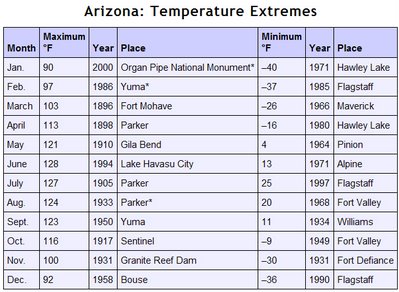
Bruce Hall at Hall of Record has performed a really interesting analysis.  He created a data base for each state which shows in what year that state's monthly temperature records were set.   So for each state, he has the years when the twelve monthly high temperature records were set (e.g. year of highest Arizona Jan temp, year of highest Arizona Feb temp, etc.) and the years when the twelve monthly low temperature records were set.  Here, for example, is his data for Arizona:

Extremetempsarizona

So, for example, the record for the highest July temperature was set in 1905 at Parker, Arizona with a scorching 127 degrees.  The entry in his database would then be Arizona-July:  1905.  He notes that there is a bias in the data toward more recent years, since if the record was set in 1905 and tied in 1983, only the newer 1983 date will show in the data.  I would also observe that this data is uncorrected for urban heat island effects (as cities urbanize they get hotter, and effect that is different than CO2-cause global warming and is usually corrected for in global warming studies).  There is also a bias towards the present in having more measurement points today than 100 years ago:  More measurement points means that, over a state, one is more likely to pick up the true high (or low).

Though I have other problems with the anthropomorphic global warming hypothesis, I have never really doubted that the world has warmed up over the last century.  So even I, a skeptic, would expect a disproportionate number of the all-time high temperatures to be in the last decade, particularly without UHI correction and with the bias discussed above.  The global warming folks would argue that the effect should be doubly pronounced, since they claim that we are seeing not just a general heating, but an increase in volatility (ie more extreme variation around the mean).

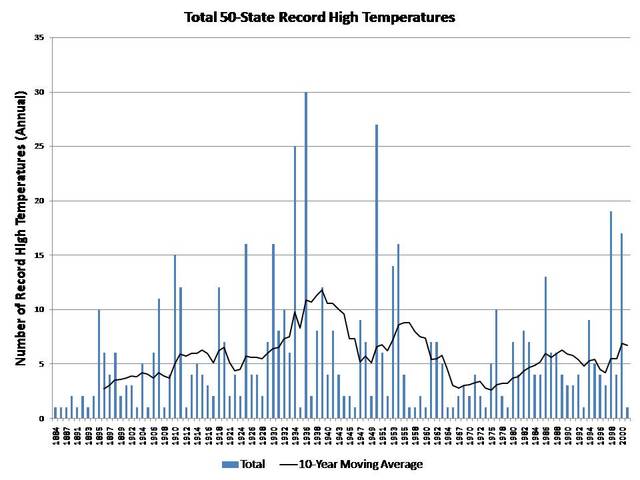
But Hall doesn't find this when he graphs the data.  Take the 600 state monthly high temperature records that exist on the books today (50 states times 12 months) and graph the distribution of years in which these records were set:

Hightempchart

Assuming about 120 years of data, you should expect to see a high temperature record on average in a database of 600 records at 5 per year, which is precisely where we have been of late and well below the record years in the thirties (remember the dust bowl?) and the fifties. It seems to actually show a reduction in temperatures or volatility or both.  Hmm.

Of course, the US is not the whole world -- in fact, all developed land masses are only 25% of the world, so there is a lot not covered by such records.  Also, statisticians are welcome to comment on whether looking only at extremes in a data set is even meaningful.  But this sure isn't what you might expect from, say, watching the Oscar telecast or the nightly news.

Hall also has the low temperature records in his very comprehensive post, which, surprisingly, do show more activity in the last several decades.  He has a follow-up here.  Finally, Hall has summarized his data a different way in this post -- you have to click on the chart to really see it in all its beauty.  Just take a quick look.  I won't steal his thunder by reproducing it here, but suffice it to say it reminded me of some of the best examples in the book Visual Display of Quantitative Information.

Legislating Taste

TJIC has a good example of relying on the government to legislate taste.

More than 30 years after outlawing big flashing signs"¦
Boston wants to bring back some glitz to parts of town deemed too dark
and staid at night.

It's a good thing we've got a single monopolistic authority making aesthetic decisions for everyone.

Saying it wants colorful electronic marquees to create an
atmosphere like Times Square in New York, the Boston Redevelopment
Authority is planning to amend the city's zoning code to permit
electronic signs that make "bold use of graphics" and create a sense of
"animation and motion" and "images that engage the public."

So, basically, the rationale 30 years ago was "some bureaucrat
finds these tacky, so they're forbidden", and now the rationale is
"some bureaucrat likes these, so they're encouraged".

This from the city of Boston, whose government's sense of aesthetics dropped this butt-ugly eyesore of a city hall into the middle of historic downtown Boston:

Govcenter

And, in case you are one who supports government "redevelopment" and mandates on aesthetics but think that it would all work out fine if architectural experts and committees of academics made the decisions, here is the hideous Peabody Terrace at Harvard University, presumably vetted by the finest architectural academic minds in the country:

Peabody

These buildings, where Harvard stuck me for a full year, were transported right out of East Berlin, right down to the elevators that only stopped on every third floor for efficiency sake (efficiency of the builder, obviously, not the occupant).  The interior walls were bare cast concrete and no amount of heat could warm them in the winter.  It was the most depressing place, bar none, I have every lived.  But the "experts" loved them, and wished that this vision could have been forced by urban planners on all of America:

Leland Cott, an adjunct professor of
urban design at the [Harvard] GSD, calls Peabody Terrace 'a model of design
efficiency, economy, and attention to scale.'

Fortunately, someone gets it:

The magazine Architecture Boston has focused attention on the
controversial aspects of Sert's work by devoting its July/August 2003
issue to an examination of Peabody Terrace, expressing the essential
disagreement about the work in the form of a stark conundrum:
"Architects love Peabody Terrace. The public hates it."

In fact, the public's hostility to the structures may be in
proportion to its degree of proximity, with the most intense feelings
confined to those households on the front lines of the town/gown divide....

Otile McManus, in a companion essay, discusses the reactions of many
Cambridge residents, who have described the complex as "monstrous,"
"cold," "uninviting," "overwhelming," and "hostile," and have compared
it to Soviet housing.

Actually, the most intense feeling were by those who lived there, who really, really hated it  (though I will admit there were several third world students who loved it -- must have been nostalgic for them).  The article goes on to accuse detractors of being anti-modernist.  Which is a laugh, since my house is one of the most starkly modern in the area, so modern I could not sell it several years ago.  I am not anti-modern.  I am anti-bad-design.

Wow!  I am kindof amazed at the hostility I still feel fifteen years after the fact.  I had started out just to link TJIC's post, and here I am in full-blown rant mode.  Sorry.

On Being Skeptical of Data That Supports My Point of View

I am pretty convinced that the case for anthropomorphic global warming is being overblown, and part of my reasoning is that other factors, like recent increases in solar activity, are being virtually ignored in the race to place a big fat blame sign on man (and on the US in specific).

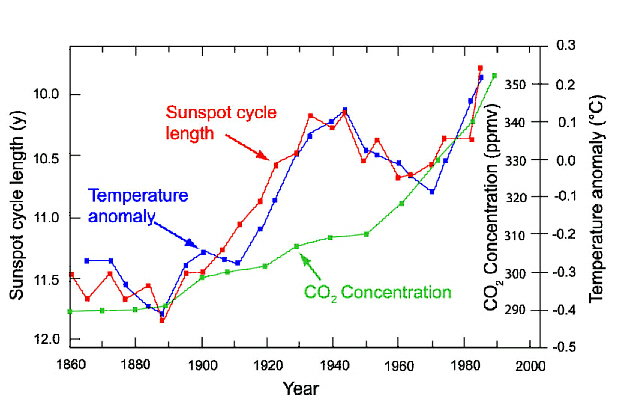
So I was ready to really like this chart, via Q&O via RedState via Hall of Record (click image for larger view):

Globalwarmingaa

Increases in sunspot activity are generally correlated with increases in solar output, so the chart seems to show a correlation between solar output and global temperatures that is much better than the correlation with CO2 concentration.  Now, this still may be correct (I have what is probably a better chart below), but this particular graph is odd in a few ways.  First, the Y-axis scale is "Sunspot Cycle Length" presumably in years (thus the "y").  But how does that make sense?  If it is the length of the trailing cycle, it should go up uniformly then drop to zero, like a sawtooth.  I don't know who a cycle length that seems to average around 11 years can look like that line on that timescale.  I tried to get back to the original, but it was attributed to a presentation that did not seem to be online by a professor that doesn't seem to work in exactly this field of study.  If anyone has any insight on this chart, please comment.

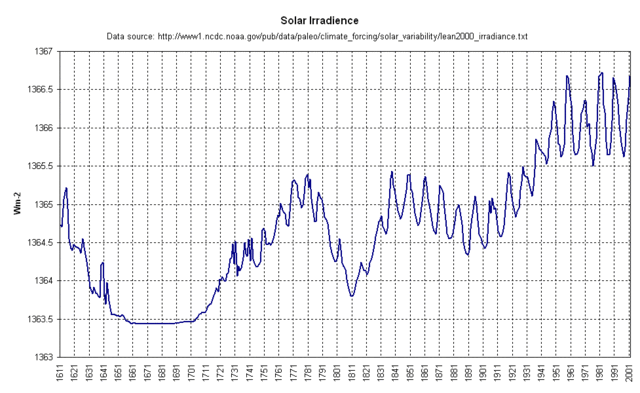
So, as much as this chart would be good news (remember my definition of good news here), I have to be skeptical of it.  I do think the underlying point is a good one:  It is well known that we are in a period of unusually high sunspot activity and solar output.  A better chart may be this one, from this study and via junkscience.com:

Global Warming "Good News"

Regular readers will know I am skeptical that anthropomorphic global warming and its effects will be as bad as generally predicted.  However, if I can work around this bias, I would like to cast the issue as neutrally as I can:  Man-made CO2 will likely cause the world to warm some, and the negative effects of this for man are likely higher than the positive effects.  Under some assumptions, these net negative effects of man-made warming could be astronomical in cost, while under other assumptions they will be less so.  Against this variable outcome, efforts to substantially reduce CO2 production world wide and prevent further increases of atmospheric CO2 concentrations will carry a staggering cost, both in dollars and the inevitable social effects of locking developing countries into poverty they are just now escaping (not to mention loss of individual liberty from more government controls).

The political choice we therefore face is daunting:  Do we pay an incredibly high price to abate an environmental change that may or may not be more costly than the cure?  Reasonable people disagree on this, and I recognize that I may fall in the minority on which side I currently stand on (I think both warming and its abatement costs are overblown, mainly because I have a Julian-Simonesque confidence in man's adaptability and innovation).

Against this backdrop, we have Kevin Drum declaring "More good news on the global warming front:"

Seeking to shape legislation before Congress, three major energy trade
associations have shifted their stances and decided to back mandatory
federal curbs on carbon dioxide and other man-made emissions that could
accelerate climate change.

Here is my news flash:  Having some Washington lobbying organizations switch which side of this incredibly difficult trade off they support is not "good news."  Good news is finding out that this trade off may not be as stark as we think it is.  Good news is finding some new technology that reduces emissions and which private citizens are willing to adopt without government coercion (e.g. sheets of solar cells that can be run out of factories like carpet from Dalton, Georgia).  Or, good news is finding out that man's CO2 production has less of an effect on world climate than once thought.  Oddly enough, this latter category of good news, surely the best possible news we could get on the topic, is seldom treated as good news by global warming activists.  In fact, scientists with this message are called Holocaust deniers.  I wonder why?

Update: LOL