Breathing is Pollution
The Supreme Court has ruled that your breath is a pollutant. And not just because you ate that garlic bread for lunch. From my Princeton classmate Henry Payne:
Dispatches from District 48
The Supreme Court has ruled that your breath is a pollutant. And not just because you ate that garlic bread for lunch. From my Princeton classmate Henry Payne:
Kevin Drum has an interesting hypothesis:
I have a prediction: we are going to learn this year
(or, actually, next year) that there are diminishing returns to money
in presidential primaries. Not only do I have my doubts that the vast
sums of money being raised by the current frontrunners will fund a more
effective campaign than half the amount would, but I wouldn't be
surprised if it leads to less effective campaigns. Sometimes too much money makes you lazy.
1. I tend to agree
2. I wonder if this conclusion would cause Drum to reconsider his support for campaign finance limitations like McCain-Feingold
3. It is incredible how facile the media's coverage of this election has become. Unable or unwilling to tease out real differences between the candidates, the media has resorted to a sports metaphor, treating the race as a money-raising horse race.
Coyote Blog went over a million page views on site meter yesterday. A while back, I would have thought this much cooler than I do today. However, on any given day, 40% or more of my readers are not visiting the site but are reading the RSS feed and thus are not included in these numbers. Yesterday we had 755 people access the RSS feed and about 2100 actually visit the site, a bit skewed from the normal mix because of a couple of articles I had high on Reddit that sent traffic to the site. There is still a real need for someone to figure out how to better track RSS readership. Feedburner has helped a lot, but is not the ultimate solution.
My Princeton college roommate Brink Lindsey, now of Cato, has been raising a moderate rumpus by arguing that the traditional libertarian-Right coalition is stale and that libertarians should look for allies on the left as well. He called it liberaltarianism. Fair enough. I will take a shot at the same plea.
I will use this map of the teaching of evolution in schools by state as a jumping off point. I can't validate whether it is accurate or not, so I won't reproduce it here, but let's accept it as a fair representation of the diversity of approach to teaching evolution by state, even if you don't agree with the implicit value judgments embedded in the chart. I will use it to reflect on two points I have made in the past to try to interest the left in libertarianism.
1. Building complex machinery of state may feel good at first, when "your guys" are in control, but your opposition, or outright knaves, will eventually co-opt the system. As I wrote here:
I am reminded of all this because the technocrats that built our
regulatory state are starting to see the danger of what they created.
A public school system was great as long as it was teaching the right
things and its indoctrinational excesses were in a leftish direction.
Now, however, we can see the panic. The left is freaked that some red
state school districts may start teaching creationism or intelligent
design. And you can hear the lament - how did we let Bush and these
conservative idiots take control of the beautiful machine we built? My
answer is that you shouldn't have built the machine in the first place
- it always falls into the wrong hands....Today, via Instapundit, comes this story about the GAO audit of the decision by the FDA to not allow the plan B morning after pill to be sold over the counter.
And, knock me over with a feather, it appears that the decision was
political, based on a conservative administration's opposition to
abortion. And again the technocrats on the left are freaked. Well,
what did you expect? You applauded the Clinton FDA's politically
motivated ban on breast implants as a sop to NOW and the trial
lawyers. In
establishing the FDA, it was you on the left that established the
principal, contradictory to the left's own stand on abortion, that the
government does indeed trump the individual on decision making for
their own body (other thoughts here).
Again we hear the lament that the game was great until these
conservative yahoos took over. No, it wasn't. It was unjust to scheme
to control other people's lives, and just plain stupid to expect that
the machinery of control you created would never fall into your
political enemy's hands.
2. As public school boards come under sway of the Christian Right, the left should learn to embrace school choice, just as the Christian Right did a generation ago. As I wrote here:
After the last election, the Left is increasingly worried that red
state religious beliefs may creep back into public school, as evidenced
in part by this Kevin Drum post on creationism.
My sense is that you can find strange things going on in schools of
every political stripe, from Bible-based creationism to inappropriate environmental advocacy.
I personally would not send my kids to a school that taught creationism
nor would I send them to a school that had 7-year-olds protesting
outside of a Manhattan bank.At the end of the day, one-size-fits-all public schools are never
going to be able to satisfy everyone on this type thing, as it is
impossible to educate kids in a values-neutral way. Statist parents
object to too much positive material on the founding fathers and the
Constitution. Secular parents object to mentions of God and
overly-positive descriptions of religion in history. Religious parents
object to secularized science and sex education. Free market parents
object to enforced environmental activism and statist economics. Some
parents want no grades and an emphasis on feeling good and self-esteem,
while others want tough grading and tough feedback when kids aren't
learning what they are supposed to.I have always thought that these "softer" issues, rather than just
test scores and class sizes, were the real "killer-app" that might one
day drive acceptance of school choice in this country. Certainly
increases in home-schooling rates have been driven as much by these
softer values-related issues (mainly to date from the Right) than by
just the three R's.So here is my invitation to the Left: come over to the dark side.
Reconsider your historic opposition to school choice. I'm not talking
about rolling back government spending or government commitment to
funding education for all. I am talking about allowing parents to use
that money that government spends on their behalf at the school of
their choice. Parents want their kids to learn creationism - fine,
they can find a school for that. Parents want a strict, secular focus
on basic skills - fine, another school for that. Parents want their
kids to spend time learning the three R's while also learning to love
nature and protect the environment - fine, do it.Yes, I know, private schools to fit all these niches don't exist
today. However, given a few years of parents running around with
$7000 vouchers in their hands, they will. Yes, there will be
problems. Some schools will fail, some will be bad, some with be
spectacular (though most will be better than what many urban kids,
particularly blacks, have today). Some current public schools will
revitalize themselves in the face of competition, others will not. It
may take decades for a new system to emerge, but the Left used to be
the ones with the big, long-term visions. The ultimate outcome,
though, could be beautiful. And the end state will be better if the
Left, with its deep respect and support of publicly-funded education,
is a part of the process.Of course, there is one caveat that trips up both the Left and the
Right: To accept school choice, you have to be willing to accept that
some parents will choose to educate their kids in a way you do not
agree with, with science you do not necessarily accept, and with values
that you do not hold. If your response is, fine, as long as my kids
can get the kind of education I want them to, then consider school
choice. However, if your response is that this is not just about your
kids, this is about other people choosing to teach their
kids in ways you don't agree with, then you are in truth seeking a
collectivist (or fascist I guess, depending on your side of the aisle)
indoctrination system. Often I find that phrases like "shared public
school experience" in the choice debate really are code words for
retaining such indoctrination.In other words, are you OK if Bob Jones high school or Adam Smith
high school exist, as long as Greenpeace high school exists as well?
Or do you want to make everyone go to Greenpeace high school
exclusively?
We had a couple apply for a camp host job the other day, and try to get us to hire them as contractors rather than employees. This is not that unusual, since there are a number of reasons someone might prefer this relationship, most of which involve evading taxes. We, by policy, generally won't play this game, particularly for full time employees.
What was different in this case was that the couple showed up with a ready-made contract. What caught the eye of some of my managers was this clause of the contract:
Applicable Law: This
Agreement and Contract is governed by the Law of God, also known as Biblical
Law, Natural Law, and Christian Common Law, and, barring any conflict with
Natural Law, the Common Law Right of Contract.
Hmmm. So who do we go to with disputes? Moses? Maybe King Solomon?
I found this conjured up a terribly funny image in my mind. JunkScience has a challenge to climate journalists to try the math to test for themselves whether current global warming estimates make any sense. The challenge per se is not funny, but the picture of a journalist... well, read the challenge first:
We believe climate
models are programmed with excessive climate sensitivity based on a
flawed understanding of past ice ages. Moreover, climate models wrongly
magnify potential warming to accommodate positive feedback mechanisms
while comparison with empirical measure shows negative feedback dominates, reducing warming experienced to about half theoretical values.The challenge is for you to actually check the numbers -- see for yourselves whether we are wrong or not. Look up Stefan's Constant or just use 5.67 x 10⁻⁸
(close enough for our purpose but look it up to be sure). The textbook
derivation of globally averaged greenhouse, using Stefan's Constant,
evaluates to roughly 33 °C and 150 Wm-2. The IPCC Third Assessment Report alt: Third Assessment Report (Equation 6.1) states: "The climate sensitivity parameter (global mean surface temperature response ΔTs to the radiative forcing ΔF) is defined as: ΔTs / ΔF = λ." A blackbody-equivalent Earth climate sensitivity parameter (λ) would be 33 / 150 = 0.22 °C per Wm-2. Real world measures (here) indicate Earth responds with only half the efficiency of a blackbody with a lambda (λ) value of just 0.1 °C per Wm-2.Now use it to check the assertion: "Global climate forcing was about 6 1/2 W/m2
less than in the current interglacial period. This forcing maintains a
global temperature difference of 5 °C, implying a climate sensitivity
of3/4 ± 1/4 °C per W/m2. " Either consult your texts for Earth's temperature in Kelvin and any other numbers you need or see the numbers we've used here. Off you go -- we'll wait. If you can show us where we're wrong we'll retract and correct.
Can anyone out there picture your favorite journalist trying to do this? Many journalists followed the tried-and-true career path of: Avoid math altogether --> Become an English major --> Become a journalist as an alternative to playing the guitar in subway stations. Who else would love to see Maureen Dowd taking on this analysis?
Congrats to Rob Nieweg for winning the 2nd Annual Coyote Blog bracket challenge!
| Bracket | Rank | Points | Correct Games | Upset Risk % | Tiebreaker Total Points (diff) | Possible Games |
|---|---|---|---|---|---|---|
| Rob Nieweg | 1 | 112 | 51 | 14.1 | 156 (3) | 51 |
| Lincoln Beachey | 2 | 103 | 49 | 16.3 | 165 (6) | 49 |
| Coleen Eicher | 3 | 103 | 49 | 8.9 | 130 (29) | 49 |
| Jeff Haught | 4 | 101 | 45 | 27.0 | 150 (9) | 45 |
| Michael Lindsey | 5 | 100 | 47 | 18.6 | 126 (33) | 47 |
| Marvin Lewis | 6 | 100 | 46 | 9.0 | 175 (16) | 46 |
| Schimmy | 7 | 100 | 44 | 16.9 | 183 (24) | 44 |
| skunk | 8 | 99 | 48 | 7.8 | 141 (18) | 48 |
| Terry Davis | 9 | 99 | 47 | 12.9 | 111 (48) | 47 |
| Jim Galbo | 10 | 98 | 49 | 7.0 | 143 (16) | 49 |
| Thomas Roeschlein | 11 | 98 | 48 | 11.7 | 131 (28) | 48 |
| Zak Barron | 12 | 98 | 44 | 18.8 | 172 (13) | 44 |
| Will Blakemore | 13 | 98 | 43 | 23.9 | 123 (36) | 43 |
| Craig Limesand | 14 | 97 | 44 | 16.7 | 147 (12) | 44 |
| R. Combs | 15 | 97 | 42 | 19.5 | 145 (14) | 42 |
| Joe Sandusky | 16 | 95 | 48 | 13.5 | 157 (2) | 48 |
| Darren Munford | 17 | 95 | 46 | 15.1 | 141 (18) | 46 |
| Michael Gunter | 18 | 95 | 42 | 14.3 | 158 (1) | 42 |
| Richard Pitchford | 19 | 93 | 47 | 11.7 | 153 (6) | 47 |
| Nicholas Meyer | 20 | 93 | 44 | 13.7 | 165 (6) | 44 |
Almost every piece of government waste paper I have to fill out has the power to irritate me (and doing business in 13 states, I get a lot of such garbage). But the one thing that sets me off more than any other is when I get forms from a state government that say I owe a tax for the "privilege" of conducting commerce. Arizona calls their sales tax a "transaction privilege tax" and Texas calls their franchise tax a "privilege" tax. In fact, the Texas form is covered with the word "privilege" -- for example, the form I am looking at covers the "privilege period" of January-December 2007.
By calling commerce, and by extension property, a privilege that can only be exercised with a license from the government, the government is saying that the right to trade and make transactions with other people flows not from our humanity, but from the government. These "privilege" taxes and licenses are based on the theory that man does not have any inherent right to trade freely with other men, and that ability can only be granted (or taken away) at the whim of our masters in the state government.
The Supreme Court is acknowledged to have the power to strike down laws it deems to be in conflict with our Constitution. But what about laws that violate something more fundamental than the Constitution? What about laws that violate the very theory of government on which the United States was founded? We often think about the Constitution as the top of the legal hierarchy, but I would suggest that sitting even higher than the words of the Constitution is the idea that our rights flow from God, or in a more secular interpretation, from the very fact of our humanity, and what power government has is given to it (and can be taken away) by its citizens, NOT THE OTHER WAY AROUND.
The more correct statement, then, would be that we citizens have given government officials the privilege of regulating and taxing commerce (a privilege, I might add, that they have abused and we should take away).
Update:
"Freedom is not a gift bestowed upon us by other men, but a right that belongs to us by the laws of God and nature." --- Ben Franklin
Rosie O'Donnell is a great example of the failure of scientific education in this country. Of late, Rosie has joined the "truthers," using her show to flog the notion that the WTC was brought down in a government-planned controlled demolition.
I will have to yield to Popular Mechanics for most of the discussion about WTC7. However, I can, from my own engineering training, rebut one point on WTC1&2. (Note again, future commenters, this applies to WTC 1&2. There was a different dynamic at work in WTC 7).
Rosie, as others have, made a point of observing that jet fuel does not burn hot enough to melt steel, and therefore the fire in the main towers could not have caused the structure to yield and collapse. This is absurd. It is a kindergartener's level of science. It is ignorant of a reality that anyone who has had even one course in structural engineering or metallurgy will understand. The argument made that "other buildings have burned and not collapsed" is only marginally more sophisticated, sort of equivalent to saying that seeing an iceberg melts proves global warming. (Note that this is all written by a person who has no faith in government and is at least as suspicious about government motivations at any truther).
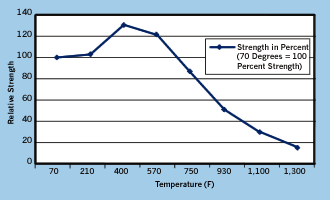
Here is the reality that most 19-year-old engineering students understand: Steel loses its strength rapidly with temperature, losing nearly all of its structural strength by 1000 degrees F, well below its melting point but also well below the temperature of burning jet fuel. For three years I designed piping and pressure vessel enclosures at a refinery. Many of the processes in a refinery crave heat and run better at elevated temperatures. In fact, what refineries can do, and how efficient they can be, is really limited by the strength of steel at high temperatures. Refineries end up being limited to process temperatures no higher than 600 to 800 degrees, and even then these require expensive special metallurgies. Anything higher requires a very expensive vessel lined with some sort of ceramic insulation material.
The strength curve of steel vs. temperature is dependent on the type of steel, but the curve below is about what I remember from my old textbooks. Note by 930 degrees the steel strength has dropped by half and in the next 100 degrees it halves again.
But the proof of what went wrong in WTC1 and WTC2 does not take a college education. You only have to look at building codes. Building codes generally require that structural steel members be coated with a fireproofing material.
As the critical temperature for steel is around 540°C (give or take, depending on whose country's test standards one reads at the time), and design basis fires
reach this temperature within a few minutes, structural steel requires
external insulation in order to prevent the steel from absorbing enough
energy to reach this temperature. First, steel expands, when heated,
and once enough energy has been absorbed, it softens and loses its
structural integrity. This is easily prevented through the use of fireproofing.
You have probably seen it- that foamy tan stuff sprayed on girders before the rest of the building is filled out. In fact, this stuff is not fireproofing per se but insulation. It is there to keep the structural steel cool during a fire, so the steel will not fail. Generally the standards are set in the code that the insulation has to be able to stand X time of fire (generally several hours) and keep the steel below its critical yielding temperatures. Engineers know that a building fire, which burns much cooler than a jet fuel fire, can cause steel members to weaken and fail and the building to collapse. If this were not the case, then why do builders spend billions every year to insulate structural steel building components??
I wrote about this issue in more depth here. In this post, one of the commenters listed a series of building fires and asked, why did these buildings not collapse? The answer is: Because insulation is applied to the building structural steel members to try to prevent the collapse. Even insulation is just a stopgap -- if the fire burns long enough and
hot enough (or if the insulation is stripped off, say by an airplane
shearing through the building) then the steel will heat up and fail. So there are three reasons that some buildings have fires and don't fail while the WTC did fail:
This is in addition to the actual removal of some support columns by the crashing aircraft, which put more load on the remaining structure and thereby hastened the collapse.
postscript: By the way, can anyone tell me why the so called "reality-based"
community, that so often criticizes the Right for theocratic attacks on
science, is so quick to fall for this pseudo-scientific junk?
Update: One other thought: The hallmark of truthers is that they take small abnormalities or uncertainties in the failure analysis and event reconstruction as justification for throwing out the whole explanation of events in favor of an alternate series of events with much, much larger gaps, contradictions, and logical problems (e.g. how did the buildings get wired for demolition without anyone noticing? or, how did the planes manage to crash into the precise floors wired for demolition without dislodging the charges and their wiring? or, how did such a massive conspiracy get pulled off without one leak when the administration can't even competently fire 9 US attorneys?)
Anyone who has ever done root cause analysis of a catastrophic failure knows there are always questions no one can answer when all is said and done. And people who say things like "always happen" or "can never happen" typically don't have any real-world engineering experience.
Update2: One other thought on WTC7, since most of the sites I have visited over the last several days really seem to focus on WTC7. I consider our government capable of all kinds of hijinx, but why WTC7? I would argue that about 0.00001% of the outrage that resulted from 9/11 is attributable to WTC7. How many people not associated with the truthers have even heard of WTC7? In fact, one could argue that the strike on the Pentagon was effectively irrelevant, since no one really even seems to remember that one.
One minor note: I saw on a conspiracy site the claim that all military planes were ordered to stand down on 9/11. I know from personal experience that can't possibly be true. I was in Manhattan during 9/11 and remember well people in the streets hitting the ground in fear every time a military jet rocketed over the city.
I don't buy all this conspiracy theory not because I think well of the government, but just the opposite. I consider the conspiracies posited at these various sites to be orders of magnitude beyond this government's capabilities. Remember Coyote's Law:
When the same set of facts can be explained equally well by
- A massive conspiracy coordinated without a single leak between hundreds or even thousands of people -OR -
- Sustained stupidity, confusion and/or incompetence
Assume stupidity.
Update3: I guess I need to throw out a few more things. This was not meant to be a comprehensive or definitive rebuttal of the 9/11 conspiracy theories. I merely used as a starting point one stupid comment by Rosie O'Donnell on melting, a comment I have heard a lot of times, and that I knew I could refute of my own knowledge. Those who want to get mad at me because I did not refute this or that, sorry, go deal with the book by the Popular Mechanics guys. The only other thing I can contribute other than engineering sanity is the fact I have participated in many engineering failure analyses and the fact that I watched the towers fall live, with my own eyes, from the streets of Manhattan.
Every single engineering failure analysis I have ever participated in, from refinery explosions to airplane crashes, has always left unanswered questions and nagging inconsistencies that had, I am sure, nothing to do with conspiracies. We had many things we could never explain about a heat exchanger fire at our refinery in 1985, but I don't think that those unknowns and uncertainties leave the door open to blame government agents for the fire.
I'll say again, if you want to argue that the WTC buildings were demoed by explosives, you have to explain how the explosives were laid, and, more important, how the explosives and their delicate wiring and detonators survived a plane crashing into the same floors. And by the way, given that the buildings had not external markings showing the floors, how did the people flying the airplanes hit the exact correct parts of the building? For every problem with the core hypothesis I could name 10 problems with the truther alternative. I have no problem with offering an alternative hypothesis to the original thesis, but it is silly to criticize the core thesis for small problems only to replace it with a hypothesis that has problems that are orders of magnitude larger.
I am not sure I have ever seen a better parable about the virtues of industrialization, world trade, and the division of labor than this experiment documented in Wired Magazine (via L. Rockwell at Mises):
When educator and designer Kelly Cobb decided to make a man's suit
only from materials produced within 100 miles of her home, she knew it
would be a challenge. But Cobb's locally made suit turned into a
exhausting task. The suit took a team of 20 artisans several months to
produce -- 500 man-hours of work in total -- and the finished product
wears its rustic origins on its sleeve."It was a huge undertaking, assembled on half a shoestring," Cobb
said at the suit's unveiling one recent afternoon at Philadelphia's Institute of Contemporary Art."Every piece of the suit took three to five pairs of hands to make,"
Cobb added. "Every garment you wear took three to five pairs of hands
to make too, but you don't know whose hands or where."Cobb's suit (see photo gallery)
is a demonstration of the massive manufacturing power of the global
economy. Industrial processes and cheap foreign labor belie the
tremendous resources that go into garments as simple as a T-shirt."It definitely makes you think for a minute before you buy that $10
skirt," said Jocelyn Meinhardt, a New York City playwright who sews
many of her own clothes. "It didn't just grow on the rack at Forever
21. It's too easy to forget that people made it."
Marc Hodak found this gem in a newspaper article about the new Grand Canyon Skywalk:
The Skywalk's builders have said repeatedly that the deck is extremely
durable. It's essentially a huge steel horseshoe, capable of
withstanding 100 mph (160 kph) winds and holding several hundred
200-pound (90-kilogram) people at a time.I had no reason to doubt them. But out on the edge, my mind was
racing: I tried to remember if any government regulatory agency had
checked how well this thing was anchored to the cliff.
Hodak observes:
News writers are notoriously wary of private agents and their
self-interests versus "the government," as if its agents were somehow
endowed with a greater degree of expertise or caring for their fellow
man. They often can't fathom that, even regardless of their economic
interests, the owners and operators would be any less concerned about
their guests tumbling down the side of the Grand Canyon than some
bureaucrat with a tape measure and some forms to fill out. It kind of
leaves me breathless.
Maybe they can bring in the government crew that built the Tacoma-Narrows Bridge.
One of the really bad ideas that drive some of the worst government actions is the notion that wealth is somehow fixed, and that by implication all wealth is acquired at someone else's expense. I am working on my annual tax-day post on the zero sum fallacy, but in the mean time here is a brief quiz.
The quiz consists of matching a description to the owners of these two houses:


One house has hot and cold running water, central air conditioning, electricity and flush toilets. The other does not. One owner has a a computer, a high speed connection to the Internet, a DVD player with a movie collection, and several television sets. The other has none of these things. One owner has a refrigerator, a vacuum cleaner, a toaster oven, an iPod, an alarm clock that plays music in the morning, a coffee maker, and a decent car. The other has none of these. One owner has ice cubes for his lemonade, while the other has to drink his warm in the summer time. One owner can pick up the telephone and do business with anyone in the world, while the other had to travel by train and ship for days (or weeks) to conduct business in real time.
I think most of you have guessed by now that the homeowner with all the wonderful products of wealth, from cars to stereo systems, lives on the right (the former home of a friend of mine in the Seattle area). The home on the left was owned by Mark Hopkins, railroad millionaire and one of the most powerful men of his age in California. Hopkins had a mansion with zillions of rooms and servants to cook and clean for him, but he never saw a movie, never listened to music except when it was live, never crossed the country in less than a week. And while he could afford numerous servants around the house, Hopkins (like his business associates) tended to work 6 and 7 day weeks of 70 hours or more, in part due to the total lack of business productivity tools (telephone, computer, air travel, etc.) we take for granted. Hopkins likely never read after dark by any light other than a flame.
If Mark Hopkins or any of his family contracted cancer, TB, polio, heart disease, or even appendicitis, they would probably die. All the rage today is to moan about people's access to health care, but Hopkins had less access to health care than the poorest resident of East St. Louis. Hopkins died at 64, an old man in an era where the average life span was in the early forties. He saw at least one of his children die young, as most others of his age did. In fact, Stanford University owes its founding to the early death (at 15) of the son of Leland Stanford, Hopkin's business partner and neighbor. The richest men of his age had more than a ten times greater chance of seeing at least one of their kids die young than the poorest person in the US does today.
Hopkin's mansion pictured above was eventually consumed in the fires of 1906, in large part because San Francisco's infrastructure and emergency services were more backwards than those of many third world nations today.
Here is a man, Mark Hopkins, who was one of the richest and most envied men of his day. He owned a mansion that would dwarf many hotels I have stayed in. He had servants at his beck and call. And I would not even consider trading lives or houses with him. What we sometimes forget is that we are all infinitely more wealthy than even the richest of the "robber barons" of the 19th century. We have longer lives, more leisure time, and more stuff to do in that time. Not only is the sum of wealth not static, but it is expanding so fast that we can't even measure it. Charts like those here measure the explosion of income, but still fall short in measuring things like leisure, life expectancy, and the explosion of possibilities we are all able to comprehend and grasp.
More, coming soon...
Update: An example of why this topic is always timely:
Paul Krugman foresees an increasing left-leaning electorate. The cause?
The main force driving this shift to the left is probably rising
income inequality. According to Pew, there has recently been a sharp
increase in the percentage of Americans who agree with the statement
that "the rich get richer while the poor get poorer."
Russel Roberts goes on to tear into this red meat. Read it all.
To win in the Coyote Blog bracket pool.
| Bracket | Rank | Points | Correct Games | Upset Risk % | Possible Games |
|---|---|---|---|---|---|
| Lincoln Beachey | 1 | 103 | 49 | 16.3 | 49 |
| Rob Nieweg | 2 | 102 | 50 | 14.1 | 51 |
| Jeff Haught | 3 | 101 | 45 | 27.0 | 45 |
| Michael Lindsey | 4 | 100 | 47 | 18.6 | 47 |
| skunk | 5 | 99 | 48 | 7.8 | 49 |
| Thomas Roeschlein | 6 | 98 | 48 | 11.7 | 49 |
| Zak Barron | 7 | 98 | 44 | 18.8 | 44 |
| Joe Sandusky | 8 | 95 | 48 | 13.5 | 49 |
| Darren Munford | 9 | 95 | 46 | 15.1 | 47 |
| Michael Gunter | 10 | 95 | 42 | 14.3 | 43 |
The others get passed because they don't have the right teams in the finals, despite a lot of good picks to date. They chose...poorly. Full disclosure, I am in 44th, but I vault up to 27th with a Florida win. Go Gators.
I know it has become a cliche to point it out, but I am still amazed we can go through a whole season and a whole bracket of 65 and get down to the same two teams who were in the football championship game.
After the post below, several have written to ask about the procedure itself. My dad wrote with details, which I believe are from Science magazine:
The drug for treating macular degenerations is ranibizumab, sold under the brand name "lucentis" by genetech, its developer and manufacturer.
It is "a monoclonal antibody - made by using biotech methods, from genetically engineered bacteria that attacks a protein responsible for the leading cause of blindness in seniors. In clinical trials with Lucentis, the eyesight of about 95 per cent of AMD patients either improved or stopped getting worse."
Lucentis was created by tweaking the molecular structure of another, older drug Avastin, which itself was originally approved for colorectal cancer but now has been approved for certain kinds of lung cancer, and has been submitted to Food and Drug Administration to be used against breast cancer and possible kidney cancer as well.
The editors of Science magazine, the widely respected journal of the American Association for the Advancement of Science, selected ten "breakthrough" discoveries of the year last December. No. 6 on the list was the results of the clinical trial results for Lucentis.
PS: My son and I often joke that they have run out of car names. With a name like ranibizumab, they seem to have run out of drug names too. I can must see the ad campaign: "With a name like ranibizumab, it's got to be good."
I am thrilled to have Hawaii 5-0 on DVD. I remembered it as my favorite TV crime drama ever, and so far, it is holding up very well. A couple of other observations:
The good news is that they have, for the first time, a treatment for macular degeneration. My mom got her first treatment yesterday.
The bad news is that it involves getting a hypodermic needle stuck in your eyeball for a direct injection of the drug.
Eeeek. Didn't want to think about that any more today, so I thought I would dump that image on you guys.
Update: For those interested, I have an updated post on the details of the new drug. I joked about the procedure, but in fact it is a god-send, and my mom says that the needle thing is a lot worse in anticipation than in reality. Those with this same problem should definitely look into it.
So, here I am, having risked absolutely everything I own, having gone
with out salary for three years, and I am now being told that if I hire
somebody, and he gets married in Vegas while drunk, then gets a divorce
the next day, I've got to cover the bimbo into the next decade? (Feel
free to add in the gender-reversed variation of that, as well - I'm
equally apalled that I might have to pay for an employee's ex-husband's
meds)....It is a testament to the American character that even when we are
this tightly bound by the chains of the State, we, as a people, still
start new businesses.That, or maybe it's a testament to our stupidity.
The fact that this was predictable does not make it any easier to swallow:
The bill set to reach the House floor today (resembling the Senate
version) would raise taxes an average of $1,795 on 115 million
taxpayers in 2011. Some 26 million small-business owners would pay an
average of $3,960 more. The decreased number of Americans subject to
income taxes would all pay higher taxes, and 5 million low-income
Americans would be returned to the rolls.
It just flabbergasts me that anyone can make the case that the feds don't have enough money, and that there are no spending cuts to be found.
A Judge has ruled that the Kaleidescape movie server (basically a big box that rips and stores DVDs on hard disk) did not violate its licensing agreement with the DVD-CCA:
Kaleidescape argued, first and foremost, that nothing in the DVD-CCA
licensing agreement prohibits the development of products that allow
users to copy their DVDs.Indeed, that's exactly what Judge Leslie C. Nichols ruled today in
the non-jury trial at the Downtown Superior Court of Santa Clara in San
Jose, Calif. There was no breach of contract.
That seems to be good news for those of us who like the server concept and would like to make copies of our DVDs for our own (fair) use. However, the judge seems to have sidestepped the copyright and fair use issues, such that this ruling probably will turn out to be pretty narrow and not constitute a useful precedent.
Because of this ruling, the Judge did not have to get into copyright
issues, so the Kaleidescape ruling has no copyright implications. It is
not a statement on the legality of ripping DVDs.There was the possibility that copyright issues could have come into
play. The DVD-CCA submitted to the Court a particular document, the
"CSS General Specifications," that it asserted was part of the
licensing agreement.The CSS General Specifications document includes wording about
thwarting the "unauthorized copying" of DVD's. The issue of what
constitutes an unauthorized copy could have come up, but Judge Nichols
ruled that the document in fact is not part of the DVD-CCA licensing
agreement.
Jane Galt makes a case against industrial animal husbandry, a position which she argues is not inconsistent with being a libertarian or classical liberal. While I don't get as worked up about such practices as cruel, I don't think it is inconsistent for a libertarian to be so concerned. And I don't rule out that I would be just as worked up if I were more informed about what was going on.
However, what really caught me eye was this:
This is an approximate description of what happens to industrially
farmed chickens . . . lifted, mind you, from a business school case
aimed at helping industrial farms be more efficient, by using rose
coloured chicken contact lenses to cut down on the need for debeaking
'em.
I can attest that this was indeed a real case that we studied at Harvard Business School*. In fact, it so freaked me out at the time as a concept that I included it in my most recent novel. From BMOC [warning, profanity lurks ahead]:
Poor, boring, earnest Julian
was always prepared, because he was always terrified, scared to death
that one night slacking off might somehow destroy his future Career
(always with a capital-C), and therefore future Life, much like the
fear of catching AIDS from a one night stand. Julian participated
(unfortunately) all too much in class, droning on in that irritating
voice of his, advocating positions as spectacularly expected as
Susan's were non-conformist.Julian,
therefore, was not really a candidate to get cold-called to open the
class discussion, particularly this late in the year. However, it
was clear to everyone in the room, particularly the professor, that
Julian longed to open a case. Every day Julian would look at
the professor with this hopelessly wistful expression, only to be
followed by a look of desolation when someone else was chosen.So
today, letting Julian open was in the same spirit as the homecoming
queen giving a pity-fuck on the last day of high school to the geek
who has been mooning and sighing over her for four years. And right
at this
moment, Julian had the same surprised and ecstatic look on his face
that the geek would have.But it was not just the site of
Julian creaming all over himself at his chance to open that had Susan
longing for the piranha button. Some satanic twist of fate had
Julian Rogers earnestly and painstakingly laying out a strategy and
plan for the new product roll out of ... contact lenses for chickens.
Contact fucking lenses for Christ-sake chickens. Right this very
second he was outlining his sales pitch to chicken farmers,
explaining how putting contacts in chicken's eyes will somehow
reduce the number of chickens that have to have their beak cut off.
Did she hear that right? This had to be a joke "“ but no,
everyone seemed to be taking it seriously, and certainly Julian was
taking it deadly seriously.
* I know those anti-capitalists out there will be using this as evidence that business school is crafted to keep us cold and heartless. HBS consisted of studying 2-3 cases per day for about 200 days a year, which means that over two years one might read a thousand business cases. This case was more in the spirit of breaking the monotony of yet another case on brass vs. plastic water meters rather than part of a consistent attempt to make us cold and heartless.
I finally watched the BBC special Global Warming Swindle and have to say that it presents a pretty good counter-hypothesis to the prevailing theory of anthropomorphic CO2 production to explain recent global temperature changes. It also hits some good points on what might be motivating the hard core of the environmental movement beyond just concern about global warming, and why the costs of CO2 control are so high.
I have historically accepted the basic hypothesis of anthropomorphic global warming but have been skeptical of the exaggerated outcomes (Al Gore's 26 foot sea-level rise, for example, which is 17 times more than even the IPCC predicts over the next century) and have posited that a warmer but richer world may well be better than a cooler but poorer one. I have also pointed out the uncertainties in the IPCC analysis that never get mentioned in the press, like the huge uncertainty in the feedback loops that drive much of the temperature change in current models. For example, the IPCC admits they don't even know the sign of the largest feedback loop (clouds), which is a big uncertainty since about 2/3 or more of the warming in the models come not directly from CO2 but from these feedback loops.
Anyway, most of my past skepticism has been within the framework of these IPCC studies. However, this documentary casts off the whole framework, offering a counter-hypothesis of solar activity to explain temperature variations. I thought the most interesting part of the documentary was when they showed Al Gore from An Inconvenient Truth with a multi-thousand year plot of temperature and CO2. The chart certainly looks compelling, but this movie makes the point that while the two lines move together, the CO2 line is lagging the temperature line by five hundred years. Meaning that CO2 levels may be linked to temperature, but the causality may be opposite of that implied by Gore.
The documentary goes on to offer solar activity as an alternative explanation, with graphs of moving curves of solar activity and temperature that seem to show at least as much correlation as Gore's CO2 graphs. They hypothesize that rising temperatures driven by changes in solar
activity heat up oceans over time and cause them to release CO2 into
the atmosphere. I don't think the evidence is definitive, but it certainly casts doubt as to whether we really know what is going on. I always thought it a bit odd that people would search for the causes of changing temperatures without first checking out the sun, sortof like walking in a room that is too hot and trying to fix it without first checking the thermostat. This is particularly true given new evidence that other planets are warming, presumably due to solar activity (unless, of course, it's an Exxon plot).
By the way: Advocates of the anthropomorphic theory are criticizing this movie in part because it does not use Mann's hockey stick temperature chart. Sorry, but if they want to claim the scientific high ground, I think they need to stop tying their argument to this weak study. Statisticians have dumped on it repeatedly (apparently random white noise fed into their model produces a hockey stick) and the evidence for eliminating the Medieval warm period is based on the rings in one or two trees.
From Kevin Drum, who I consider one of the smarter folks on the left (but not this time):
A few days ago, during an email exchange with a
friend, I mentioned that I don't usually tout cost savings as a big
argument in favor of universal healthcare. It's true that a national
healthcare plan would almost certainly save money compared to our
current Rube Goldberg system, but I suspect the savings would be
modest. Rather, the real advantages of national healthcare are related
to things like access (getting everyone covered), efficiency (cutting down on useless -- or even deliberately counterproductive -- administrative bureaucracies), choice
(allowing people to choose and keep a family doctor instead of being
jerked around everytime their employer decides to switch health
providers), and social justice (providing decent, hassle-free healthcare for the poor).
Name one industry the government has taken over in a monopolistic fashion and subsequently increased efficiency or individual choice? Anyone? Buehler? In fact, I am not sure I can name one government program that even provides the poor with decent, hassle-free services.
Lets take the most ubiquitous government monopoly, that on K-12 education.
As to the claim that national health care would "almost certainly save money," that is hard to argue with for this reason: The government, once in charge of health care choices, can simply start denying procedures and care ("rationing"). This is in fact how costs are managed in most socialist medical systems. So while this statement is technically true, it would be very hard for anyone to really believe that for the same quality and quantity of care, the government could do it cheaper.
Patterico has a link to this interesting account of a week in the life of Jarek Molski, who makes a living from filing ADA suits (emphasis added):
For example, in Molski v. El 7 Mares Restaurant, Case
No. C04-1882 (N.D. Cal. 2004), Molski claims that, on May 20, 2003, he
and significant other, Brygida Molski, attended the El 7 Mares
Restaurant for the purposes of dining out. Molski alleges that the
restaurant lacked adequate handicapped parking, and that the food
counter was too high. After the meal, Molski attempted to use the
restroom, but because the toilet's grab bars were improperly installed,
he injured his shoulders in the process of transferring himself from
his wheelchair to the toilet. Thereafter, he was unable to wash his
hands because of the lavatory's design.Although this complaint appears credible standing alone, its
validity is undermined when viewed alongside Molski's other complaints.
In Molski v. Casa De Fruta, L.P., Case No. C04-1981 (N.D. Cal. 2004),
Molski alleges that he sustained nearly identical injuries on the exact
same day, May 20, 2003. In Casa de Fruta, Molski alleges that he and
significant other, Brygida Molski, patronized Casa de Fruta for the
purpose of wine tasting. On arrival, Molski was again unable to locate
van accessible parking. Once inside, Molski again found the counter to
be too high. After wine tasting, Molski again decided to use the
restroom, and again, injured his upper extremities while in the process
of transferring himself to the toilet. Thereafter, he was once again
unable to wash his hands due to the design of the lavatory.This was, apparently, not the end of Molski's day. In Molski v.
Rapazzini Winery, Case No. C04-1881 (N.D. Cal. 2004), Molski once again
alleges that he sustained nearly identical injuries on the exact same
day, May 20, 2003. Molski, again accompanied by Brygida Molski, claims
he visited the Rapazzini Winery for the purpose of wine tasting. Again,
Molski complains that the parking lot lacked adequate handicapped van
accessible parking. Upon entering the establishment, he discovered that
the counter was too high. After tasting wine, he again needed to use
the restroom. In the course of transferring himself from his wheelchair
to the toilet, he injured himself yet again. Thereafter, he was again
unable to wash his hands due to the lavatory's design.The Court is tempted to exclaim: "what a lousy day!" It would be
highly unusual "” to say the least "” for anyone to sustain two injuries,
let alone three, in a single day, each of which necessitated a separate
federal lawsuit. But in Molski's case, May 20, 2003, was simply
business as usual. Molski filed 13 separate complaints for essentially
identical injuries sustained between May 19, 2003 and May 23, 2003. The
Court simply does not believe that Molski suffered 13 nearly identical
injuries, generally to the same part of his body, in the course of
performing the same activity, over a five-day period. This is to say
nothing of the hundreds of other lawsuits Molski has filed over the
last four years, many of which make nearly identical allegations. The
record before this Court leads it to conclude that these suits were
filed maliciously, in order to extort a cash settlement.
Congrats Pinal County, which border phoenix to the southeast, for pushing government intrusiveness to a new level:
At the conclusion of what Pinal County officials said was the longest
code compliance hearing in the county's history, San Tan Flat owner
Dale Bell was ordered to pay an initial $5,000 fine Tuesday for
customers dancing in the open-air portion of the restaurant. He will
also be fined $5,000 for every day people dance at his restaurant
starting Feb. 17.Bell, who does not advertise or encourage dancing at San Tan Flat,
acknowledges that people do dance on weekend nights and it's usually
parents with children or senior couples. He has even put up signs
discouraging it."It's impossible to ... ensure no one breaks out in the waltz or two step," Bell said....
County Attorney Seymour Gruber said dancing outside violates a
county code because it's not happening in an enclosed area with walls
and a roof. The county wants Bell to stop the dancing, limit it to
inside only or get a special use permit which requires public input
from neighboring property owners.
We wouldn't want people dancing without wall or a roof, would we? I mean, there is probably a 0.5% chance they could get rained on or something. If you are thinking this is some grizzled biker joint or a shack of a place, you are wrong. Its actually one year old and quite nice - check out the picture. For those of you in other parts of the country, where the idea of a family honky-tonk may seem odd, this concept is very popular in Arizona.
So why is this government harassment going on? Well I have gotten better at decoding these things, and my sense is that it started with noise complaints, which many commercial establishments get:
There have been no complaints against San Tan Flat for dancing,
but both the county and Bell have received noise complaints about the
live music. The restaurant has not been cited for noise because the
volume has been within acceptable levels.
So the county got noise complaints, and my guess is that one of the complainers had some strong political pull (or else they would never have pursued it this far). Particularly since this is not a population-dense area, and there is little housing directly nearby (see Google satellite map, just click on satellite in the upper right to see all the surrounding, uh, dirt). I mean it's right next to an airport, for god sakes. Thus, wanting to satisfy what could only be a high-profile complainer, the county moved in and pulled out the rubber glove and gave the restaurant a good probing. And, since it is impossible to be in compliance with every stupid ordinance on the books (many conflict, so that you can't be in compliance) the city found something they thought they could make stick. The only issue I can't decode is whether they are trying to use this as a bargaining chip to get operating hour or noise level changes, or if they are using it a s a club to close the place down. It probably depends mostly on how much juice the key complainer has who is driving this.
The good news is that the IJ is on the case.
PS- If you really want to get pissed off, read some of the other economic liberty cases being handled right now by the IJ. Many of them are great examples of a point I have made for years, that state licensing of professions is more about protecting the professions from competition than they are about protecting the consumer. If you haven't seen it, George Will had a great editorial on the same topic, which includes this gem:
In New Mexico, anyone can work as an interior designer. But it
is a crime, punishable by a fine of up to $1,000 and up to a year in
prison, to list yourself on the Internet or in the Yellow Pages as, or
to otherwise call yourself, an "interior designer" without being
certified as such. Those who favor this censoring of truthful
commercial speech are a private group that controls, using an exam
administered by a private national organization, access to that title.This is done in the name of "professionalization," but it really
amounts to cartelization. Persons in the business limit access by
others "” competitors "” to full participation in the business."¦in Las
Vegas, where almost nothing is illegal, it is illegal "”
unless you are licensed, or employed by someone licensed "” to move, in
the role of an interior designer, any piece of furniture, such as an
armoire, more than 69 inches tall. A Nevada bureaucrat says that
"placement of furniture" is an aspect of "space planning" and therefore
is regulated "” restricted to a "registered interior designer." Placing
furniture without a license? Heaven forfend.
Bugs Bunny was never one to knuckle under to arbitrary power. I always like the episode when he protects his home from a freeway development, and eventually the freeway ends up going around his home, which has been turned into a pillar of concrete. I am reminded of all this by this picture from Radley Balko of a woman who would not sell out to developers in China.

