How Public Decisions Get Made

The Anti-Planner has an absolutely fabulous article about a Wisconsin passenger rail proposal, but in fact what the article really is about is how government decisions get made.

According to RTA's latest newsletter,
the KRM would cost about $200 million to start up and would require a
$6.3 million annual operating subsidy. For that it would carry about
1.7 million trips per year, which translates to 6,700 per weekday.

In other words, RTA wants to spend $200 million to take 3,350 people
to and from work each day. The Milwaukee-Racine-Kenosha urbanized areas
have about 750,000 commuters, so RTA's proposal would take less than
half a percent of them to work. But they would all have to pay for it
in the form of some local taxes plus a diversion of a share of federal
and state gasoline taxes to fund the rail line.

By the way, though this post isn't meant to be entirely about rail itself, let's use Coyote's test on this rail proposal.  As a reminder, here is Coyote's test:

Take the total capital charge and compare it to the cost of buying every projected rider at $22,000 Prius.  Then, take the operating subsidy (which is always higher than projected) and see how it compares to the average gas consumption in a year of said Prius's.  If the projected capital charge and subsidy could have bought every rider a car and all the gas they need to drive it, then the rail line is not only an average run-of-the-mill government boondoggle, but a total and complete ripoff.

And, the KRM... FAILS.  And fails miserably.  The $200 million charge would have bought every rider TWO Prius's and still have some money left over, and the operating subsidy, sure to be larger in reality, would buy each rider about 627 gallons of gas a year, which at 30mpg would get them 19,000 miles per year.  But don't worry, KRM, every single new rail system to which I have applied the test has failed (Phoenix, Houston, LA, Albuquerque).

But lets continue:

The planned commuter line would run 14 round trips per day, which
means each train would have about 240 people on board. That's about
five bus loads. So why not just buy five buses for each planned
trainset and move people by bus instead?

The newsletter explains that RTA considered a bus alternative, but
it would attract only a third as many people as the rail line. It would
also cost only an eighth as much to start up, so I always wonder why
don't they just invest three-eighths as much in buses and carry as many
people as the rail line.

But then I noticed that the rail line was projected to have seven
stops between Milwaukee and Kenosha, while the bus line would stop 27
times. As a result, the bus would take almost twice as long as the
train. No wonder it attracted so few people!

The train would average just 38 miles per hour and RTA admits that
it would not go significantly faster than motor vehicles, so there is
no reason why buses could not be run on schedules similar to the train.
So why didn't they consider an alternative in which buses stopped only
seven times?

It turns out they did. The report
from the consultant hired by RTA included a bus-rapid transit
alternative that stopped fewer times than the regular bus alternative.
It included some exclusive busways, so it cost a lot more than the
regular bus alternative, but it would cost only half as much as the
train. Moreover, it was projected to carry as many riders as the train.

Naturally, RTA told the consultant to drop this alternative from further consideration.

The Anti-Planner shoots back what to me looks like a really good proposal:

The consultant had also estimated that the bus-rapid transit
alternative would disrupt traffic more than the trains. But if the
busways (which would move no more than about 5 buses per hour) were
opened to low-occupancy vehicles that pay a toll, they would actually
relieve congestion. Plus, the tolls would pay for most if not all of
the new lanes, and by varying the toll, the lanes would never get
congested so the buses could meet their schedules. This would result in
transportation improvements for both auto drivers and transit riders,
and at a very low cost to taxpayers

Open Your Wallets Again, Arizona

From a reader comes this story of Arizona looking to the public trough to get funds to lure another SuperBowl.  I can say from experience now that Superbowl week is made up mostly of private corporate and celebrity parties that the unwashed locals like myself are either a) not allowed to attend at all or b) can attend only by ponying up $1000 or more.  Not being resentful or a leftist, I couldn't really care less about the parties being near by.  However, my opinion changes real fast if my tax dollars are required to pay for them:

Super Bowl organizers will try to nail down another big game for Arizona, possibly as early as 2012.

But for the state to stay competitive, taxpayers need to shoulder the
majority of game costs, organizers say. And the organizers plan to
lobby for legislation to accomplish that.

The weeklong celebration culminating with Sunday's Super Bowl XLII cost
the local Host Committee about $17 million. The private sector,
including such big contributors as the Fort McDowell Yavapai Nation and
the Thunderbirds, bankrolled more than 80 percent, while state and
local agencies chipped in the balance.

But with a slumping economy making fundraising a challenge, the Arizona
Super Bowl Host Committee, the Arizona Cardinals organization and
Valley business leaders want see that ratio reversed, with public
dollars financing the bulk of the effort.

Don't you love the last sentence?  An exactly equivalent way to state this is "people have other priorities for their own money and refuse to give it up voluntarily, particularly in difficult economic times, so we need the state to take it by force."

No one yet knows how much this year's Super Bowl will fatten state
coffers, though organizers project the game created more than $400
million in spending. An economic-impact study won't be out for at least
a couple of months.

Bullshit.  Every major economic study not conducted by the management of a professional sports team has shown nearly zero impact from such events.  Here is the Seattle NBA team admitting they have no economic impactHere is yet another economic study to the same effect.

Here is my challenge:  Take the Phoenix-area GDP for this Jan-Feb, take out the growth trend line (which can be found in year-over-year comparisons of previous months) and then compare it to the GDP for Jan-Feb 2007.  I bet you whatever you care to bet you cannot find an additional $400 million. 

Understanding What Going Green Means

This photo (via Maggie's Farm) shows life in the United States during a time when the US emitted more CO2 than Hillary Clinton, Barack Obama and other greens want to set as the new emissions cap.  In 1940, the US emitted about 33% of 1990 levels of CO2, vs. the green's target of 20%.
Cartandwagonga1940s

Happy Super Tuesday

I will not be voting today, because in Arizona to vote in the primary one must register with the government as a member of either the Coke or Pepsi party.  I just can't make myself do it.

At the Superbowl

Yesterday, I had what will likely (given ticket prices) be a once in a lifetime experience for me -- I got to take my son to the Superbowl.  Our ability to afford this event really was a result of our living in the same city as the Superbowl.  The obvious reason for this is that we did not incur any significant travel costs and did not have to pay peak demand level hotel pricing.  The less obvious, but ultimately more important, reason was because we could afford to watch the ticket prices on the secondary market up until the absolute last minute.  If your were bringing a group from New York, waiting until Friday or Saturday to buy tickets might have been a bit uncomfortable, given other sunk costs. 

As it turned out, Superbowl ticket prices this year on the secondary market  (e.g. TickCo, Stubhub, et al) followed a parabola.  They were below their peak early-on, particularly since sellers did not have the tickets in hand.  You can buy tickets weeks before the Superbowl, but they will be listed as "for this general area."  You could end up in the front row or the back -- it is a bit of a crap shoot.  So they are cheaper because of this.  The peak pricing came the week before the AFC and NFC championship games when many sellers had tickets in hand and could advertise specific seats.  All along, I was looking for a ticket to just get in the door, so I was looking for the cheapest seats (likely upper deck end zone).  At their peak, there was nothing gong for less than about $3800 (when you included the seller commission or transaction fees, typically 10-20% for this type of ticket).  Beginning the Monday before the game, prices started falling  -first 10%, then 20-30%, and finally as much as 50%.  I jumped in towards the end of the week because a pretty good (or at least better than the worst) seat came up for a good price.  I am told by a friend who showed up on game day at the ticket company office that he got in for less than $1500.

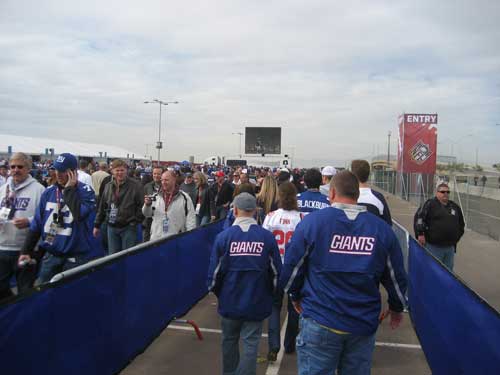
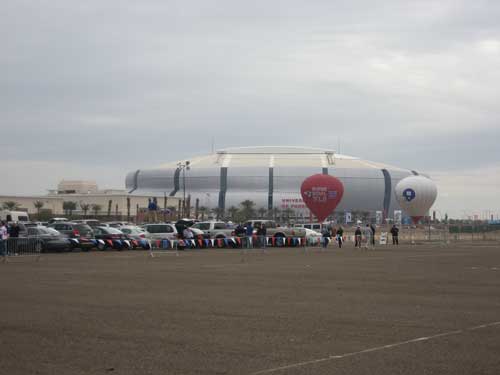
Anyway, here is the stadium - yes it is kind of odd looking.  This was taken about halfway through our walk from the car to the stadium.  We just barely parked in the same county.  We showed up about 6 hours before game time and were in the last half of arrivals:
Sb8_2

The stadium is a taxpayer-funded boondoggle that is a good hour away (on the complete opposite side of a very large city) from old Scottsdale where most of the parties and social activities and player hotels were. 

The security included a ban on any bag over 12x12x12 inches, a pat down, and a metal detector.  And the NFL did a MUCH better job than the TSA.  MUCH.  It is hard to see, but the tent on the left is about 1/4 of the length of the full security screening area.   They had  at least 25 lanes open in parallel.  Despite thousands of people, we had no wait at all (the lines below are all moving briskly and continuously).
Sb7

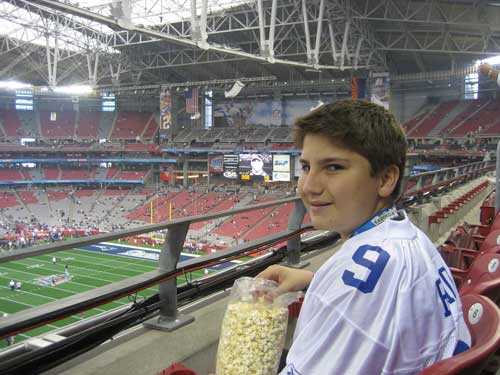
And look!  We must be in the front row!  Well, of the upper deck, but these turned out to be great seats and, having watched prices for weeks, a very good price-value point (in context).  My son braves the wrath of all the surrounding Giants fans by wearing his Cowboys jersey.
Sb6

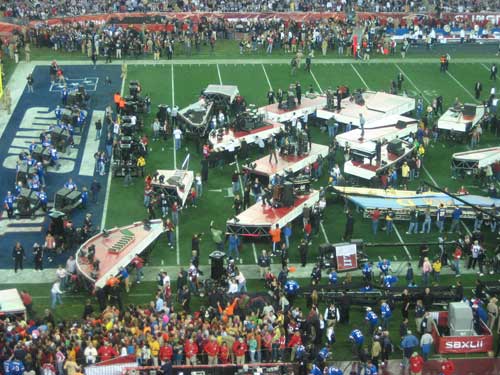
I thought the fast set up and takedown of the stages was pretty amazing, and something you miss on TV.  Here is Tom Petty's stage going out (or in, I can't remember).  The funniest part was the crew of NFL guys who followed along with rags and buckets to dust off the grass after the equipment passed to make sure it looked good for TV.
Sb2

Sb10

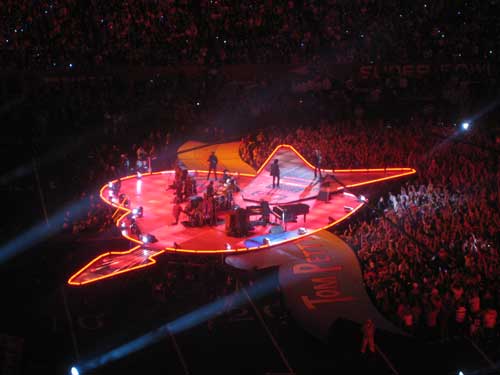
We had a decent view of Tom Petty's back, which once I saw his scraggly beard was probably a good thing.  The crew of screaming fans at the stage was pretty funny.  They ran these folks out for Alicia Keyes, then kicked them out of the stadium, then ran them back in for Tom Petty, and then back out again.  I saw one show on TV last night, and the audience looked young, but to my eye the great mass of the crowd was middle aged women, which I thought was kind of funny.
Sb3

And here is the last play and confetti burst:

It was a great, perhaps historic game, and we loved the whole experience.  Now back to work to pay those bills.

So, here are the [sports-related] events on my must-see list I have tackled:

Baseball all-star game, Superbowl, game at Fenway, game at Yankee stadium, 16th hole at the Phoenix Open, center court at Wimbledon, BCS Championship game, Daytona 500, personally playing golf at St. Andrews, Big 10 home football game, Rose Bowl, Cowboys home game [update: and an original 90s-vintage American Gladiators filming live]

Yet to be tackled:

the Masters, Packers home game, game at Wrigley, NCAA final four, SEC home football game (maybe Tennessee or the cocktail party), maybe at World Series, maybe a World Cup

What else?

More on Public School Spending

Bill Steigerwald has a great editorial in the Pittsburgh Tribune-Review dissecting per-pupil public school spending in Pittsburgh.  Generally, when I quote media articles about school spending, I have to do what should be the obvious analyses myself (as with this pathetic Washington Post piece on school spending).  However, this would be totally redundant for Steigerwald's column.  I encourage you to read it all, but here are some highlights for Pittsburgh schools:

  • Per pupil spending in the public schools is $18,719
  • Quality private schools in Pittsburgh charge from $7,000 to an elite level at $19,500.  Humorously, just over $12,000 will get you a year at the University of Pittsburgh
  • Barely half of this spending goes towards the classroom.  The rest, presumably, goes to funding a probably enormous corps of vice-principals.  (If you ever are at a school board meeting that allows public comment or Q&A, ask how many vice-principals they have in their system).  In Pittsburgh, administrative costs are 72.5% of teacher salary costs, meaning there are likely about 3 administrators for every 4 teachers.  Ugh.
  • Teachers make $86,000 in salary and benefits, or $114,667 if you adjust for the fact they only work 9 months of the year.  Kind of obviates the "teachers are underpaid" myth.

The only other thing I would have called the schools out on is their defense that they have to pay transportation, administration, and debt service out of these costs, as if somehow this made their numbers non-comparable to private benchmarks.  So what?  Do you think my kid's private school evades these costs somehow?  Their school charges about $6,500 for middle school, and they make a profit on this (and do not get any donations).  I am pretty sure they also have to pay for administration of multiple schools (they have a network of 5 schools) and for debt service on the capital costs to build the schools in the first place.  Our schools don't have transportation, but many other private schools do.

I Wish I Knew More of This Story

MaxedOutMamma, who has a very nice economics (and other stuff) blog, drops a few hints about having apparently dropped into a persistent vegetative state at some point in the past.  I wish I knew more of the story - maybe if I had been reading her blog longer.  I have read accounts from several people who have emerged from PVS, and I find them consistently some of the most terrifying stories I have read, though I don't think they are always meant that way when told.

In a really bizarre turn of
events, I came out of the drooling world smarter than when I went in.
No one seems to be able to explain this. I went in with about a 140-150
IQ, and I came out with 160-170. My guess is that I had so little
remaining functional brain left at my worst that I evolved an extremely
efficient method of using what I had, and that as I got more back, the
functionality of the method remained. I may have less working space
then I used to, but the way in which I use it is clearly more
efficient. I do not think in language at all. Everything is mapped into
P-Nat.

Notice: All the World's Major Problems Have Been Solved

Clearly, all the major problems of the world have been solved, because Arlen Specter wants to focus the Senate's time on the New England Patriots' violation of NFL rules for which they were severely punished and which violations in no way tread on any law, just NFL rules.

In a telephone interview Thursday morning, Senator Arlen Specter,
Republican of Pennsylvania and ranking member of the committee, said
that Goodell would eventually be called before the committee to address
two issues: the league's antitrust exemption in relation to its
television contract and the destruction of the tapes that revealed
spying by the Patriots.

"That requires an explanation," Specter
said. "The N.F.L. has a very preferred status in our country with their
antitrust exemption. The American people are entitled to be sure about
the integrity of the game. It's analogous to the C.I.A. destruction of
tapes. Or any time you have records destroyed."

Please, to the friends of Arlen Specter:  It is time for an intervention, before the man hurts himself any more. 

Next Up:  Kay Bailey Hutchison calls Jerry Jones in front of Congress to explain why the Cowboys gave up on the running game in the fourth quarter of this year's playoff game against the Giants.

Fuel Without the Fossil

A number of years ago I read The Deep Hot Biosphere by Thomas Gold because I was working on a novel which included extremophile bacteria.  Gold's premise was that some/many/most underground hydrocarbons were actually produced underground from methane deep in the earth that is converted by underground bacteria to longer-chain hydrocarbons as they move toward the surface.    Many thought gold to be a quack, including most in the oil industry, but I thought his hypothesis at least intriguing enough to test.  Which someone apparently has:

An article in Science today seems to suggest that the abiotic theory is correct. In a fairly dense article entitled "Abiogenic Hydrocarbon Production at Lost City Hydrothermal Field,"
researchers Proskurowski et al., find evidence of the abiogenic
formation of short-hydrocarbon chains in an area where hydrocarbons
would not otherwise be able to form by the biogenic theory. What
Proskurowski et al. identified was the formation of carbon chains 1 to
4 carbon atoms in length, with shorter chains forming deeper, and with
isotopic signatures ruling out biogenic origins. The conclusion of the
article is as follows: "Our findings illustrate that the abiotic
synthesis of hydrocarbons in nature may occur in the presence of
ultramafic rocks, water, and moderate amounts of heat."

My sense is that we may now say a fraction of oil is abiogenic, but are a long way from saying that any serious percentage is of non-fossil sources.  But it is interesting.

I'm Unclear Here

I would prefer not to see warrantless searches without judicial oversight be legal under any circumstances, so I am happy there are roadblocks in the FISA extension.  What I am unclear about, though, are the exact issues surrounding telecom immunity from lawsuits which is apparently what has the thing held up.  By no means do I wish to give telecoms some blanket immunity from the consequences of their handling of private data.  However, it seems odd to want to hold them liable for complying with what would be, under the new law, a legal government order.  Or, is the immunity issue all retroactive to past compliance with government orders when it wasn't so clear if the government orders were legal?

I must say I have some sympathy for businesses, particularly those that are highly regulated as telecom, who bow under government pressure and then get sued for doing so.  For example, as I wrote before, I am required by Arizona law to take actions that the Feds consider illegal.  Its a frustrating place to be.

Anyone who can provide clarity on the issues here (not the FISA issues or wiretapping issues but narrowly on the immunity issue) is encouraged to do so.

The Fascists Have Jumped the Shark

Via the Junkfood Science blog,

It has actually happened. Lawmakers have proposed
legislation that forbids restaurants and food establishments from
serving food to anyone who is obese (as defined by the State). Under
this bill, food establishments are to be monitored for compliance under
the State Department of Health and violators will have their business
permits revoked.

Unbelievable.  And not that this would make it right, but the ban is not even on serving certain types of fattening foods, but on serving any food.  Here is the key part of the law:

Any food establishment to which this section
applies shall not be allowed to serve food to any person who is obese,
based on criteria prescribed by the State Department of Health after
consultation with the Mississippi Council on Obesity Prevention and
Management established under Section 41-101-1 or its successor. The
State Department of Health shall prepare written materials that
describe and explain the criteria for determining whether a person is
obese, and shall provide those materials to all food establishments to
which this section applies. A food establishment shall be entitled to
rely on the criteria for obesity in those written materials when
determining whether or not it is allowed to serve food to any person.

Paybacks are Hell, John McCain

I really try not to be vindictive, but I cannot tell you how happy this story, rife with irony, makes me:

John McCain has a campaign finance problem.
When his campaign was down and out, he agreed to take public funding
for the primaries. Public funding comes with spending limits overall
and by state. Also, a candidate who accepts funding cannot raise money
from private sources. Now that it is possible he will be the
nominee, McCain will want to be free of those fundraising and spending
limits, but he cannot withdraw from the public system. Or perhaps he
could but only with the approval of the FEC, which is not operating
because of a struggle over its nominees. The FEC does not now have a
quorum to meet and regulate. (The lack of a quorum was caused by Barack
Obama's hold on a nominee to the FEC, but never mind).

McCain will want out of the public system because he is probably
close to hitting the limit, and he could not get more money for his
campaign until he received public funding after the GOP convention
during the summer.  His "dark period" would thus be a period without
campaign funding that would run from spring until after the GOP
convention. During that "dark period" Obama or Hillary, both of whom
have not accepted public funding for the primaries, would be able to
continue spending money; some of that spending would be directed
against McCain after Obama or Hillary have secured their party's
nomination.

HAHAHAHAHA.  OMG that is great.  Read it and weep, Mr. McCain-Feingold.  McCain has argued for years that money and speech are not the same thing, and that limiting campaign money is not equivalent to limiting speech.  He can comfort himself with that thought as he goes silent for three or four [update: seven?] months  while his opposition yaps away.

How to Keep State Parks Open in California

Letter I sent to Governor Schwartzenegger in response to his plan to close a number of California State Parks due to budget problems:

I know many people are
probably contacting you to oppose proposed closures of state parks to help meet
budget targets. My message is a bit
different: Closing these parks is
totally unnecessary. 

I own and manage one of the
larger concessionaires in the California State Park (CSP) system. We are the concessionaire at Clear Lake
and Burney Falls. At Burney Falls, for example, we have invested over a million dollars
of our money in a public-private partnership with the state to revamp to the
park. We also operate parks for the
National Park Service, the US Forest Service, Arizona State Parks, Texas
State Parks, and other public authorities.

Traditionally, CSP has
engaged concessionaires to run stores and marinas within parks, but not to run
entire parks. However, in many other
states, our company runs entire parks and campgrounds for other government
authorities, and does so to the highest quality standards. 

So, I can say with confidence
that many of the California State Parks proposed for closure would be entirely
viable as private concessions. For
example, we operate the store and marina at Clear Lake State Park
but
could easily run the entire park and make money doing so, while also paying
rent to the state for the privilege.

I know that there are some
employees of the CSP system that oppose such arrangements with private
companies out of fears for their job security. But it would be a shame to close parks entirely when an opportunity
exists to keep them open to the public, and improve the state budget picture in
doing so. 

Even if California decides to keep these parks open, I would encourage
you to have your staff investigate the possibility of expanding private
operation of state parks. CSP already
has one of the best and most capable concession management programs in the
country, a success you should seek to build on. The infrastructure is already there in CSP to solicit bids for these
projects and ensure that management of them meets the state's quality and
customer service standards.

Even though everything I said here is true, it probably is a non-starter because most state organizations are dead set against such private management.  They would rather close services to the public than establish the precedent of private management. 

Besides, the whole parks closure may well be a bluff.  Unlike private company budget discussions, where it is expected that managers offer up their marginal projects for cuts, the public sector works just opposite:  Politicians propose their most popular areas of spending (parks, emergency services) for cuts in a game of chicken to try to avoid budget cuts altogether.  As I wrote here:

Imagine that you are in a budget meeting at your company.  You and a
number of other department heads have been called together to make
spending cuts due to a cyclical downturn in revenue.  In your
department, you have maybe 20 projects being worked on by 10 people,
all (both people and projects) of varying quality.   So the boss says
"We have to cut 5%, what can you do?"  What do you think her reaction
would be if you said "well, the first thing I would have to cut is my
best project and I would lay off the best employee in my department". 

If this response seems nuts to you, why do we let politicians get
away with this ALL THE TIME?  Every time that politicians are fighting
against budget cuts or for a tax increase, they always threaten that
the most critical possible services will be cut.  Its always emergency
workers that are going to be cut or the Washington Monument that is
going to be closed.  Its never the egg license program that has to be cut.

Update: Here is the form letter the governor's office sent out in response to my letter:

A weakened national economy and auto-pilot state spending has created a projected budget shortfall of $14.5 billion for fiscal year 2008-09. Although state government revenues this coming year are actually forecast to hold steady, the problem is that every year automatic spending formulas increase expenditures.  Left unchecked, next year's budget would need to grow by 7.3-percent, which is $7.6 billion; even booming economies can't meet that kind of increase.  To immediately combat this crisis, the Governor has proposed a 10-percent reduction in nearly every General Fund program from their projected 2008-09 funding levels.  While these reductions are unquestionably painful and challenging, this across-the-board approach is designed to protect essential services by spreading reductions as evenly as possible.

To achieve this difficult reduction, State Parks will be reducing both its permanent and seasonal workforce.  As a result, 48 park units will be closed or partially closed to the public and placed in caretaker status.  By closing parks and eliminating positions, remaining resources can be consolidated and shifted to other parks to provide for services necessary to keep those parks open and operating.  While 48 parks are affected by closures, 230 parks-or 83% of the system-will remain open.

We must reform our state budget process.  Government cannot continue to put people through the binge and purge of our budget process that has now led to park closures.  That's why the Governor has proposed a Budget Stabilization Act.  Under the Governor's plan, when revenues grow, Sacramento would not be able to spend all the money.  Instead, we would set a portion aside in a Revenue Stabilization Fund to stabilize the budget in down years.  If a deficit develops during the year, instead of waiting to accumulate billions of dollars of debt, the Governor's plan would automatically trigger lower funding levels already agreed upon by the Legislature.  Had this system been in place the past decade, we would not be facing a $14.5 billion deficit. 

As Governor Schwarzenegger works with his partners in the Legislature, he will keep your concerns in mind.  With your help, we will turn today's temporary problem into a permanent victory for the people of California.

European vs. American Rail

It seems that one of those cycles the US always castigates itself about is a perception that the Europeans have a better rail system than we do and that we should somehow emulate their system.  Which is why we still have federal subsidies of a half-assed Amtrak system and high-speed rail proposals are circulated breathlessly from time to time. 

By the way, I have been a consultant to French railroad SNCF and I gaurantee we do not want to emulate the European rail system.  First and foremost, the railroads are huge employment boondoggles.  I remember that the SNCF when I was there had something like 100,000 freight cars but 125,000 freight car maintenance people.  I suggested the railroad could assign one individual full time to his own car and still lay off 20% of the work force. 

The main reason we don't have inter-city passenger rail is a simple one that anyone spending 5 minutes with the numbers can understand -- there are distance break points where air travel is more economic than rail, and most US inter-city transit falls into the larger distance ranges.

Anyway, the anti-planner shares a bit of information that is seldom mentioned in the rail discussion that makes the US rail system look a lot more desireable:

Europe has decided to run its rail system primarily for passengers,
while America's system is run mainly for freight. Europe's rail system
has about 6 percent of the passenger travel market, while autos have
about 78 percent. Meanwhile, 75 percent of European freight goes by
highway. Here in the U.S., highway's share of freight travel is only 29
percent, while the auto's share of passenger travel is about 82
percent. So trains get 4 percent of potential auto users in Europe out
of their cars, but leave almost three times as much freight on the
highway.

In fact, the freight rail system is so efficient that to some extent we've obviated the need for the Panama Canal.  Many Asian container ships bound for Europe actually make port in Seattle or Vancouver, offload their containers onto trains which shoot across the country to New York or another eastern port where they are reloaded on ships for the trip to Europe.

By the way, in the same article, don't miss the hilarious proposal in Minnesota to spend taxpayer money for a high speed rail line from the Twin Cities to ... Duluth.  Yeah, that's the ticket.  New York to Boston barely makes it financially, but St. Paul to Duluth is going to be a winner.

Traveling Salesman

The Reference Frame has a video of a dog solving the traveling salesman problem.  I was doing some simulations years ago for a railroad company and actually had a traveling-salesman-like problem to solve with equipment routing.  The best approach I found was simulated annealing.  This algorithm starts out with a totally random solution, and then applies random swaps of route legs and then checks to see if the new route is better or worse than the old route.  So far, similar to any Monte Carlo approach.  But in this algorithm, the solution is allowed to jump to worse solutions, though the size of this jump is reduced over time as the algorithm is run.  This helps prevent the algorithm from getting stuck in local minima.

It is called simulated annealing because it is very parallel to the process of cooling and crystallization in a piece of steel.  When heated steel is plunged into water and cooled quickly, the molecules crystallize and are trapped in a higher energy state, whereas cooling the steel slowly lets the structure stabilize into a much lower energy state.  Metal that is quench cooled is harder but more brittle, metal that is annealed is softer and more ductile.  In the algorithm, the slow reduction in temperature is represented by the declining amount by which the algorithm can jump to a worse solution.

Save XP!

InfoWorld is hosting a petition to Microsoft to save XP and continue to sell it past the middle of this year.  You can sign their petition .  I signed the petition, but the real petition for MS may be the numbers coming in for XP sales, which are still strong.  On this Amazon bestsellers page, as of 2/1/08, places #1,2,3,5 where XP and only #4 was Vista. IT News builds on my Amazon analysis:

Gates, in
Las Vegas Sunday, boasted that Microsoft has sold more than 100 million
copies of Windows Vista since the OS launched last January.

While
the number at first sounds impressive, it in fact indicates that the
company's once dominant grip on the OS market is loosening. Based on
Gates' statement, Windows Vista was aboard just 39% of the PC's that
shipped in 2007.

And Vista, in terms of units shipped, only
marginally outperformed first year sales of Windows XP according to
Gates' numbers -- despite the fact that the PC market has almost
doubled in size since XP launched in the post 9-11 gloom of late 2001.

Speaking
five years ago at CES 2003, Gates said that Windows XP in its first
full year on the market sold more than 89 million copies, according to a Microsoft record of the event....

A survey published by InformationWeek last year revealed that 30% of corporate desktop managers have no plans to upgrade their company's PC's to Vista -- ever.

As de facto IT manager for my company, you can include me in that 30%.  My other posts on Vista here.

Update:  Face-saving suggestion for Microsoft:  Rename XP as Vista Lite or some such.  Then they can keep it and claim 100% acceptance of Vista.

Spam Call of the Day

Me:  Hello?
Caller:  I represent your local yellow pages and need to update our information on your account

BIG RED FLAG:  There are many scam artists out there who take your business information and then treat it like a "buy" order for advertising and bill later.  Beware people calling saying they are just trying to "update your listing."   I have also had folks who actually cut and pasted recordings of my phone calls to paste my answers to questions that have not been asked.

Me:  What city are you representing?
C:  we're local
M:  Local where?
C: here
M:  I have 200 locations across the country, what local area are you representing?
C: we're worldwide -- everywhere.
M:  CLICK (me hanging up)

Wow, telemarketing scripts by Kafka.  Unbelievably, they called again 10 seconds later

M: Hello
C:  We represent Phoenix
M:  OK, Phoenix.  I don't have any operations in Phoenix, just my HQ.  I don't want to be listed in Phoenix
C:  You are already listed
M:  Well that explains why I get calls at my accounting office looking for a camping space.  Please remove me.
C:  Can I have your name please
M:  No you may not.  You said I had an account already.  You should know my name  CLICK

Incredibly, my new favorite Indian pitbull telemarketer calls again

M:  Hello
C:  blah, blah, something, blah blah.
M:  Look, please take this down.  I do not want a yellow pages listing in Phoenix.  I would like my Yellow Pages listing removed in Phoenix.  I do not want to pay you any money.  I do not want to give you any information.  I do not want you to call me any more.  CLICK

I do not want it sam I am.  I do not want green eggs and spam. 

I probably still will get a bill.

Clintons: Welcome to 1905

Bill Clinton is at least honest to some extent in saying that cutting back on CO2 emissions will requires us to throttle back the economy:

In a long, and interesting speech, he [Bill Clinton] characterized what
the U.S. and other industrialized nations need to do to combat global
warming this way: "We just have to slow down our economy and cut back
our greenhouse gas emissions 'cause we have to save the planet for our
grandchildren."

But how much?  Activists try to make the average person feel like the amount is "not much" by spinning out rosy stories of 3rd graders fighting global warming by recycling.  But in fact Bill's wife Hillary makes the degree of cuts clearer:

...[Clinton's] plan would reduce greenhouse gas emissions by 80 percent from 1990 levels by 2050 to avoid the worst effects of global warming...

And recognize, this is the typical figure being cited by global warming catastrophists for "necessary" US cuts.  So how much is 80%?  With current technology, an almost unimaginable cut.  Its hard to get good Co2 data, but here is a chart from some place called the Carbon Dioxide Information Analysis Center that purports to show US historic CO2 production from man-made sources:
Usaco2_2

The chartsmanship sucks here, but 1990 looks like about 1.35 billion metric tons.  20% of that would be 0.27 billion metric tons.  That appears to be the level we hit in about ... 1905.  So, apparently without using nuclear power (since Clinton opposed nuclear expansion in one of the debates, I think in Nevada)  she wants us in the next 42 years to get back to the energy production of about 1905.  Now this is a bit unfair, since efficiencies and GDP per ton of CO2 have improved substantially since 1905.  So to be fair she may only want to take us back to about 1930.

While this is scary, what Clinton and other global warming crusaders want to do to the third world is even scarier.  Right now, close to a billion people who have been in poverty forever are posed, via growth in China, India, and SE Asia, to finally exit poverty.  Global warming crusaders want this to stop.  For example, here is the former World Bank chief economist Nicholas Stern says that India must stay poor:

Mr
Stern, the former chief economist of the World Bank, sends out a very
clear message: "We need to cut down the total amount of carbon
emissions by half by 2050." At current levels, the per capita global
emissions stand at 7 tonnes, or a total of 40-45 gigatonnes. At this
rate, global temperatures could rise by 2.5-3 degrees by then. But to
reduce the per capita emissions by half in 2050, most countries would
have to be carbon neutral. For instance, the US currently has, at 20-25
tonnes, per capita emissions levels that are three times the global
average.

The European Union's emission levels stand at 10-15
tonnes per capita. China is at about 3-4 tonnes per capita and India,
at 1 tonne per capita, is the only large-sized economy that is below
the desired carbon emission levels of 2050. "India should keep it that way and insist that the rich countries pay their share of the burden in reducing emissions," says Mr Stern.

No cars for these folks either!

The Productive Worker Exodus

Well, Arizona nativists are getting what they wanted:  Productive workers who don't happen to have been licensed by the government to work here are leaving in droves  (via Disloyal Opposition)

Unable to find jobs, or fearful that their loved ones will be caught
and deported, illegal immigrants and their legal friends and relatives
are fleeing the state in what the press has dubbed "Hispanic panic." In
a state where illegals make up better than 10% of the workforce,
the exodus promises to have a major impact. The vacancy rate in
Tucson-area apartment complexes favored by illegal immigrants has
jumped dramatically since the law went into effect....

Of course, advocates of the sanctions law will say that this is exactly the result they were hoping for; they want Hispanics to flee the state (usually, they'll claim that they just want the illegal
ones to leave). But with workers leaving Arizona, taking their rent
money, mortgage payments and shopping dollars with them, and with state
employers facing rising labor costs -- if they can even find workers --
the economy is likely to take a major hit. In fact, the University of
Arizona predicts a $29 billion economic loss if illegal workers are successfully purged from the state (full report here in PDF).

Wild West Mentality

Unfortunately, Arizona Sheriffs, including out own egregious Joe Arpaio here in Phoenix, still have a wild west mentality:

On the night of July 29, 2007, Dibor Roberts,
a Senegalese-born American citizen living in Cottonwood, Arizona, was
driving home from her job as a nurse's aide at an assisted living
center located in the Village of Oak Creek, an unincorporated community
near Sedona. Along Beaverhead Flat Road, an unlit, unpopulated route
through the desert, she suddenly saw flashing lights in her rearview
mirror. Fearful of stopping on a deserted stretch of pavement,
especially in light of reports she'd heard of criminals impersonating police,
she decided to proceed to a populated area before stopping the car, the
nearest such area being Cornville, an unincorporated settlement along
the road to Cottonwood. She slowed her car to acknowledge the flashing
lights and continued to drive. Her decision wasn't especially unusual
-- in fact, it's recommended by some police departments....

On Cornville Road, well before the populated area, Sheriff's
Sergeant Jeff Neunum apparently tired of waiting for Roberts to reach a
settled area. While he was, in fact, a police officer, he now proceeded
to justify every fear an American may have about rogue cops. He raced
his cruiser in front of Roberts's car, forcing her off the road. He
then smashed her driver's-side window with his baton and grabbed a
cellphone she was using to check his identity. Accounts vary at this
point. While police deny it, the press has reported that Neunum dragged
Roberts from her vehicle, threw her to the ground, and handcuffed her
while driving his knee into her back.

All of this because she was going 15 miles over the speed limit on a deserted rural road.

The Consumers are Saved!

I could probably start a blog just featuring ridiculous government licensing practices.  As I have written before, licensing generally has little to do with the consumer, and more to do with protecting current incumbents from competition.  Via Radley Balko, this is one of the uglier examples I have seen of late:

Mary Jo Pletz was really, really good at eBay. But now the former
stay-at-home mother and gonzo Internet retailer fears a maximum $10
million fine for selling 10,000 toys, antiques, videos, sports
memorabilia, books, tools and infant clothes on eBay without an
auctioneer's license.

An official from the Department of State knocked on Pletz's
white-brick ranch here north of Allentown in late December 2006 and
said her Internet business, D&J Virtual Consignment, was being
investigated for violating state laws....

The 33-year-old opened her Internet business in 2004 so she could
stay home with her 6-month-old daughter, Julia, who was diagnosed with
a hypothalamic hamartoma brain tumor.

She cooperated when told it was illegal and works at dental offices
in Allentown, Bethlehem and Lehighton as a hygienist to help pay the
bills at home. Julia, whose health stabilized on medication, is
enrolled in day care. Pletz also has a son, Douglas, 7.

But the state has not dropped prosecution. It sent Pletz a complaint in
April and an amended complaint in December. The complaint says she
could be fined $1,000 for each violation of the state law. The April
complaint noted 10,000 sales. Pletz and her attorney, Joseph V. Sebelin
Jr. of Palmerton, did the math - $10 million in possible fines. The
second complaint does not list a number....

Because of the complaint, Pletz worries the state also could revoke
her dental hygienist's license, which she earned by attending community
college for seven years at night.

"I really wish that they will walk away from that one and prosecute
somebody else," said State Rep. Michael Sturla (D., Lancaster), who is
chairman of the House Professional Licensure Committee. "There is every
reason in the world that if she is found guilty, she should be
exonerated," he said.

This latter is the most outrageous of all, and it is a line taken by a number of public officials -- that the concept of prosecuting people who are selling things on eBay is just fine, but they should not have started with someone who has less sympathetic.  Maybe Exxon has an eBay arm.

Sturla has proposed the bill to create the electronic auctioneer's
license. The license would require the Internet seller to buy a $5,000
bond for about $40 a year. This would protect consumers, he said.

Bull.  This would protect competitors.  eBay has numerous controls in place to identify problem sellers.

D&J Virtual Consignment had 11,000 feedback comments on eBay
and 14 were negative, Pletz said, giving her a 99.9 percent
satisfaction rating.

I can say from experience that for some reason they must teach this in
government school -- when in doubt, make service businesses get a
bond.

This is not unique - Ohio tried to do the same thing.  But why is a person who sells on eBay an auctioneer at all?  Isn't eBay the auctioneer?  If I turn my stuff over to Christies to auction off, setting a reserve price in advance and having them take a sales commission, how is that any different than putting the same stuff on eBay.  In Ms. Pletz case, eBay is earning the auction commission.  She is just taking a retail margin.

The New Micro-Fascism

Get ready, because global warming will soon be an excuse for government micro-management of any number of everyday behaviors.  We have already seen California's attempt to have the government take control of your home thermostat.  In England, the target is patio heaters:

Britain's growing café culture and taste for alfresco drinking and
dining may be under threat from MEPs who want to ban the patio heater.

A
vote in Brussels today is expected to call on the European Commission
to abolish the heaters to help to tackle climate change. Such a move
could cost the pub and catering trade dear.

Pubs spent about £85
million on patio heaters after the smoking ban was introduced last
year. Besides forcing smokers into the cold there is concern that a ban
on patio heaters could bring a significant cash loss to pubs, cafés and
restaurants.

By the way, something not mentioned in the article, perhaps because it takes a knowledge of actual science and stuff, is that these heaters tend to burn LPG and propane, which due to their molecular structure produce far less CO2 per BTU than other fossil fuels.

One is left to wonder what pareto-style ranking of CO2 reduction opportunities put patio heaters at the top of the list.  In fact, there is no possible rational analysis that would make this a legislative priority.  It is a great illustration of two points about such technocratic endeavors:

  1. Government cannot correct supposed market irrationalities because governments always act more irrational than private players in the market, no matter who is in charge.
  2. Most legislation supposedly to fight global warming is using global warming as a fig leaf to hide the actual reason for the legislation.  My guess in this case is that the sponsors of this legislation have some other reason for wanting the ban, but dress it up as global warming.  This mirrors the larger issues, there socialists, unrepentant Ehrlich admirers,  and anti-globalization loonies have repackaged themselves as fighting global warming and then, surprise, proposed the same government actions they were pushing for pre-global-warming-hysteria.

Like Bill Gates Complaining About Starbucks Prices

I thought this from

At Montgomery Blair High School in Silver Spring, parents fear cuts in
Montgomery County's proposed $2.1 billion budget will threaten the
math-science magnet program.

Schaeffer puts this in perspective:

The desperate schools of Montgomery County will need to find some way
[to] stretch the $15,246 they have to spend on each of the 137,745 students
in their schools.

This is simply hilarious.  Sometimes it is hard to compare per-pupil spending on an apples to apples basis since each grade tends to be progressively more expensive than the last (high school is more expensive than middle school which is more expensive than elementary school).  Recognize that this is only partially because the education per se is more expensive at each step -- it is more because the expectation of extra-curriculars (sports, theater, etc.) go up at each level. 

However, taking 8th grade as a mean, I can say that my 8th-grader's tuition in a for-profit private school that receives no donations or outside scholarship money is less than half $15,246.  And the education he gets is generally considered the best in the city  (though his school is lighter than some rich-suburb public school on extra-curriculars).

If you have any doubt that local media generally act as cheerleaders for increased public spending, look no further than this.  Note the newspaper quote (from the Washington Post) and then Schaeffer's context:

I have saved the most touching story for last . . .

In Loudoun County, School Board members approved a
budget 14 percent higher than last year's to accommodate an expected
3,000 new students. The county faces a projected $250 million
shortfall, and the 54,000 student system will probably have to look for
new places for savings.

My heart goes out to the Loudoun County administrators. I can't see
how anyone can be expected to educate a child with just $15,000 or to
cover a 6 percent enrollment increase with just a 14 percent increase
in the budget.

The New Stadium Lie

This week, we in Phoenix are supposedly getting our payoff for subsidizing the hapless Arizona Cardinals with a billion dollar football stadium that is used for its intended purpose (football games) for 33 hours per year  (3 hours per game times 11 games:  2 Cardinals pre-season, 8 home regular season, Fiesta Bowl).  In exchange we get a nicer stadium (if I were to want to see a Cardinals game live) but worse TV options (because instead of the best game of the week, we have to see our home team).

The big selling point, the cherry on top of the sundae the NFL uses to push new stadiums, is a Superbowl.  Which is in town this week.  So far, the huge economic stimulus has not really poured into our household, but I guess I need to be patient.  Anyway, the timing seems good to link this article, which comes via the Sports Economist:

If you build it, they will come. This is usually the mantra of those in
favor of publicly financed sports stadiums, including the current
proposal for a new soccer stadium in Chester. In this case they
are visitors whose spending would turn devastated cities and
neighborhoods into exciting destination points. Local schools,
merchants, and residents all would benefit as municipal coffers swelled.

There's only one problem with this scenario. It's not true. Never has been. They
do come, but cities are not saved. Over the past two decades, academic
research has generated literally hundreds of articles and books
empirically challenging the alleged economic wonders of new stadiums,
even when they're part of larger development schemes. I have been
studying and writing about publicly financed stadiums for more than 10
years and cannot name a single stadium project that has delivered on
its original grandiose economic promises, although they do bring
benefits to team owners, sports leagues and sometimes players....

Why, then, given the overwhelming academic research challenging
stadium-centered economic development do political leaders (if not
average citizens) still support such projects? In a just-released
article in the Journal of Sport and Social Issues, my colleagues and I
studied media coverage of 23 publicly financed stadium initiatives in
16 different cities, including Philadelphia. We found that the
mainstream media in most of these cities is noticeably biased toward
supporting publicly financed stadiums, which has a significant impact
on the initiatives' success.

This bias usually takes the form of uncritically parroting stadium
proponents' economic and social promises, quoting stadium supporters
far more frequently than stadium opponents, overlooking the numerous
objective academic studies on the topic, and failing to independently
examine the multitude of failed stadium-centered promises throughout
the country, especially those in oft-cited "success cities" such as
Denver and Cleveland.

I can attest to the latter.  During the run up to various stadium-related referenda, the media was quite rah-rah for the stadium subsidies.  In fact, on radio, several talk show hosts denigrated voters who opposed the stadium subsidies as "stupid old retired people."  I remember calling in to a couple of talk shows opposing the stadium bills and being treated like a Luddite.

My article on sports team relocations and stadium subsidies as a prisoners dilemma game is here.

What He Said

I couldn't have expressed my frustration with the economic illiteracy of the press and the general population better than does TJIC:

Jane Galt has a series of posts
explaining why a competitive free health care market creates new drugs,
and why strict regulation and/or nationalization wouldn't improve
things.

Mostly, this series just makes me sad and tired, the same way
I'd be sad and tired if I saw smart verbal well educated people
spending their time explaining that, no, Jews don't have horns, and
it's a bad idea to drown your neighbors to see if they are witches.

The sheer wasted effort combating idiocy and ignorance, when
these talented people could be doing so much more, if not for the
resting levels of stupidity and ignorance cloaked with self-righteous
anger that permeate the population.

The only proviso I would add is that for those of our political class, I suspect the ignorance may be more willful than actual, since a clear understanding of economics in the general populace might stand in the way of gaining personal power.  I expressed related sentiments here:

Economics is a science.  Willful ignorance or emotional
rejection of the well-known precepts of this science is at least as bad
as a fundamentalist Christian's willful ignorance of evolution science
(for which the Left so often criticizes their opposition).
  In
fact, economic ignorance is much worse, since most people can come to
perfectly valid conclusions about most public policy issues with a
flawed knowledge of the origin of the species but no one can with a
flawed understanding of economics.