Will They Never Learn?

When will attorneys every get a clue?  Trying to strongarm people in the Internet age often backfires, as it did in this case, where lawyers demand comic book retailer Heavy Ink remove copies of a comic book parodying their client.   Thirty seconds spent perusing Heavy Ink founder Travis Corcoran's blog should have convinced them this would not end well.  TJIC's letter is a great example of not being intimidated by lawyers or the law.

Whither Private Property

A man has to tear down a house he built with his own money on his own property because he did not get government bureaucrats' permission to build it.  Don't tell me we are living in a free market economy when the only way to build shelter on your own property is to do it in secret.

Bigger Oil

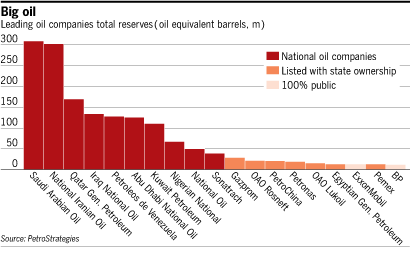
Roger Pielke, Jr. (hat tip to a reader) points to an interesting FT Lex column that should offer some interesting insights to America's progressives:

9c437598-11bb-11df-9d45-00144feab49a

"Big" and "oil" are mentioned so often in the same breath that it is easy to lose perspective. Motorists and environmentalists never tire of berating the dominant supermajors whose petrol stations and share listings make them the public face of the industry, their favourite target being America's ExxonMobil. If market value were the sole magnet for opprobrium then Exxon's executives could breathe a bit easier because PetroChina recently overtook it as the world's most valuable listed energy company.

But there is "Big Oil" "“ last year, Royal Dutch Shell earned more than $1bn a month "“ and then there is bigger oil. No oil major is able to affect energy prices on its own and even Exxon is far smaller than the world's largest energy company. It is not even close. Saudi Aramco's estimated hydrocarbon reserves of 300,000 million barrels of oil equivalent make it 15 times Exxon's size. Exxon comes in about 17th place, with the top 10 being entirely state-owned.

US oil company executives routinely get pulled in front of Congress to defend themselves against charges they are manipulating world oil prices.   Huh? It would be as rational to accuse Grinnell College of manipulating national tuition rates.  Americans can take comfort in the fact that by limiting their ability to seek new oil in the US, we have made sure that oil markets are not controlled by evil publicly traded companies like Exxon and Shell but instead are controlled by entirely more trustworthy entities like the governments of Iran, Saudi Ariabia, Venezuela, Russia, Nigeria, and China.

This chart also supports the one good argument I think there is for peak oil -- that most of the world's oil reserves are controlled by patently incompetent institutions (e.g. governments) that have very bad incentives that make them highly unlikely to invest well.  The only reason these countries are able to produce at all is because western companies are stupid enough to keep walking into this cycle:

1.  US companies invest huge amounts of capital and know-how to build oil industry
2.  Once things are producing, local government steals it all (they call it "nationalization")
3.  Oil fields go into extended decline due to short-term focused and incompetent government management
4.  US companies invited back int to invest huge amounts of know-how and capital
5. repeat

A Proposal to Keep Arizona State Parks Open

Due to budget cuts, Arizona State Parks is closing 13 of its 22 state parks.  This last week, I have been making the rounds of the state government, from the state legislature to the head of Arizona State Parks, with a proposal to keep the 7 largest of these closed parks open, and pay the state money for the privilege.  Unfortunately, we have had only mixed success with a proposal that seems to me to be a win-win for everyone.  Our local newspaper editorialized against my proposal, without even knowing the details  (my response here).  So in this post, I am going to give the details of our proposal, and solicit your feedback, especially those of you in Arizona.  All I ask is that you read the whole thing, and not just leap into the comments section having just read and reacted to (positive or negative) this first paragraph about private operation of public parks.

Background

Our company, Recreation Resource Management (RRM), is over 20 year old, and we operate over a hundred public parks under concession agreement for the US Forest Service, the National Park Service, the Tennessee Valley Authority, California State Parks, and many others.  Traditionally, park concessions used to be limited to private companies running the gift shop or the bike rental inside a park.  And we do some of that (for example we run the store and marina at Slide Rock and Patagonia Lake State parks).  But our preferred niche has always been to run entire parks on a turnkey basis.  We run a huge variety of facilities that largely parallel anything we might find in the Arizona State Parks system -- including campgrounds, day use and picnic areas, boat ramps, hiking trails, wilderness areas and historic buildings.  The largest parks we run are twice as busy as Slide Rock or Lake Havasu and four times as busy as any of the parks we are proposing to manage.  We currently run parks today literally right beside some of these Arizona State parks.  All of this is to say that the parks in Arizona are absolutely normal and typical resources that we manage.

A concession contract works much like a commercial lease.  We sign a contract allowing us to run the park for profit, and then pay the state a rent in the form of a percentage of fee revenues.  The typical operating agreement includes over 100 pages of standards we must conform to, from fee collection to uniforms to customer service to bathroom cleaning frequency to operating hours.

Our Proposal

At all of my meetings this week I made three offers, each of which we were willing to commit to immediately  (we could actually be up and running with about 21 days notice):

  1. RRM offered to keep some or all of six parks open out of thirteen on the current closure list.  These parks are Alamo Lake, Roper Lake, Tonto Natural Bridge, Lost Dutchman, Picacho Peak and Red Rocks (park but not the environmental center).  Not only could these stay open, but we could pay rent as a percentage of fee revenues to the state, money that could be used to keep other operations open.  While these parks represent about half of the closure list by number, by visitation they represent well over 90% of the closure list.  Combined these parks had a net operating loss of $659,000 to ASP, which we propose to turn into a net gain for the parks organization.
  2. RRM offered to operate five parks that are currently slated to stay open but where we could pay rents that are higher than the net revenue figure ASP showed for FY2009.  These parks are Patagonia Lake, Buckskin Mountain, Dead Horse Ranch, Fool Hollow and Cattail Cove.  Combined, this group of parks lost money for ASP in 2009 which we propose to turn into a solid net gain.
  3. While we would need to do more study, RRM suggested it might take on some of the smaller, money-losing parks beyond those mentioned above if they were packaged in a contract with some of the other parks listed above

To avoid problems with the procurement process, we offered to take as short as a 1-year contract to give ASP time to prepare a longer-term bid process.  We also agreed to maintain all current park fees for the next year without change (in contrast to ASP current plans to raise fees), and agreed that no fee could be changed without ASP approval.  The only help we asked for was

  • We perform rules enforcement, but we need law enforcement backup form time to time
  • We perform routine maintenance and keep the park safe and attractive, but many of these parks have substantial deferred maintenance problems that we cannot take on with only a 1-year contract  (but would be willing to invest capital to repair under a longer term arrangement)

And if the ability to keep almost half the parks slated for closure open was not enough of a value proposition, we proposed one additional benefit.  Any parks that are put under private concession management immediately cease to be a political football.  For years, parks organizations have closed and opened parks in a game of chicken with legislators, with the public as the victim.  Parks under private concession management no longer are subject to such pressures, as they are off the budget.  Back in the 1990's, when the new Republican Congress squared off with President Clinton over the budget, the government was shut down for a while, including all federal recreation facilities -- EXCEPT those under private concession management.  We got calls from the media saying, why are you open?  To which we replied -- hey, you have now discovered one benefit of private concession management -- the parks we manage are no longer political pawns.

Reactions

So far we have had really good and positive reactions from Arizona legislators  (I have not been able to see any of the Governor's staff).

The reaction from Arizona State Parks has been more muted.  While they are publicly open to all proposals, in reality this is the absolute last thing most of their organization wants to do  (you should see the body language in some of our meetings, it is a lot like trying to sell beer at a Baptist picnic).  They have not said so explicitly, but from long history with this and other parks organizations I can guess at some of the issues they have:

  1. Distrust of and distaste for private management runs deep in the DNA of the organization.  Many join parks with a sense of mission, seeing unique value to public ownership of parks and lands.  I attempt to explain that this value still exists, that what they are turning over is operations, not management and control, but I don't get very far.  I try hard to give the new management of Arizona State Parks a clean slate, but I can't help but be affected by something I saw their previous director say.  Back in about 2004 we hosted a breakfast at a convention of state parks directors up in Michigan, I believe.  Someone must have forgotten to throw us out of the room, because we witnessed the head of Arizona State Parks stand up in front of his peers and demand that they all hold the line against private management as one of their highest priorities.  It was made clear that state organizations that stepped out of line would incur the wrath of other states.  This summer we participated in a series of meetings in California called by Ruth Coleman, who is the head of the parks organization there and someone I admire.  She was trying to break the organization out of its old culture, but it was very clear in roundtable discussions that the rank and file would rather see the parks closed to the public than kept open using private concession management.
  2. I mentioned earlier that private management brings a benefit to the public of keeping the parks from being a political football.  But the parks organization feels like it needs that football.  Without the threat of park closures, it feels like its budget will be gutted like a fish.  And, now that its budget has been gutted, it still holds out hope its money will be restored and needs the park closures to keep up the pressure.  As long as there is even the slightest hope of budget restoration, a hope which I am pretty sure will "spring eternal," my proposal, no matter how much it makes sense for the people of Arizona, will never be adopted.

Again, these are just guesses.  Renee Bahl of Arizona State Parks has told me they are open to all new ideas, and I will take her at her word.

Libertarian Concerns

Those of you who know me to be a libertarian might wonder how I function in this environment.  The answer is, "with difficulty."  I have a strong philosophic passion to bring quality private management to public services, and this opportunity is a good one.  And I am not adverse to making money while doing so.  But I am adverse to rent-seeking, and there is admittedly a thin line between trying to make positive change and rent-seeking in this case.

I generally avoid this by insisting on short initial contracts (in this case 1 year) to prove out the concept and to allow time for the public agency to figure out how to put this beast through a procurement process that probably was not well designed for this type of thing.   This is what I did when the US Forest Service approached us with an idea to bring private management to the snow play area at Wing Mountain near Flagstaff.  We took it on a one-year contract (which grew to 2 years) and then the contract went out for public bid  - which we won - for 10 years.  We are very good at what we do and are not at all afraid to compete.  The only time I will not compete is when I perceive someone has a political connection that gives them an inside track.  After two or three losses in Florida counties to a company with no experience but a brother-in-law on the County commission, I realized it was just a waste of time to bid on these situations.

Conclusion

Please give your reactions and concerns in the comment section.  For those who disagree with private management of public resources, I will be honest and say you are unlikely to change my mind, as I have dedicated all my time and my life savings to the proposition.  But you may help me better understand and tailor our service to address public concerns.  I will try to keep the FAQ below updated based on what I am seeing in the comments.  If you are in Arizona and know someone you think I should be talking to, drop me an email at the link above.

FAQ

Does your company take ownership of the park? No.  The parks and all the facilities remain the property of Arizona State Parks.  We merely sign an operating lease, with strict rules, wherein we operate the park, keep the fees paid by the public, and pay the state a "rent" based on a percentage of the fee collections.  Even when we invest in facilities, like this store building and cabins, they become the property of the public at the end of the contract.

How can the state afford to pay you if they have no budget? We are not paid by the state, and receive no subsidy.  100% of our revenue is from fees paid by visitors to the park we operate.  If we don't run a good operation that is attractive to visitors, we don' t make any money.

Doesn't the state lose out if you keep all the fees? No.  Mainly because in all the parks we have proposed to take over, the state has net operating losses of up to $200,000 or more a year.  By taking over the park, their losses go away AND they receive extra money in the form of rents we pay.  We are able to do so because we have developed efficient processes for managing campgrounds and have a flexible and dedicated work force.

Are you going to build condos and a McDonald's? No.  The fact that this is such a common question is amazing to me, as we operate over 100 parks in this manner across the country and you would not be able to tell the difference between the facilities we manage and any other public park.  Under the terms of our operating contract, we cannot change fees, facilities, operating hours, or even cut down a tree without written approval form the parks organization.

Are you going to just jack up fees? No.  We have committed in our offers to keep fees flat for the next year.  We cannot raise fees without state approval, and we work hard to keep public recreation affordable.  Last year was a very good year for us because, in a recession, our low-cost recreation options gave many families on a budget a chance to have a quality recreation experience.

Why just a one year contract? We would actually prefer a longer contract, as this allows us to actually make approved capital improvements to parks (for example, we have installed many cabins in public parks we operate).  However, we have offered to take these under an initial contract that is just long enough to allow longer-term contracts to be fairly offered on a competitive bid basis.

Maybe no one trusts you because you are small and unproven? Well, perhaps.  But last year our total fee revenue was nearly $11 million, making us slightly larger than the Arizona State Parks system.  We have a proven record with decades of positive performance reviews from government agencies around the country.   For example, for those of you form Arizona, if you have stayed at a US Forest Service developed campground near Flagstaff, Sedona, Payson, or Tucson,  or sledded at Wing Mountain, you probably have stayed in a facility we operated.  We already operate two concessions in Arizona State Parks, and have a great record working with the organization.
Utterly Without Shame

Via Megan McArdle:

"We need to stand up to the special interests, bring Republicans and Democrats together, and pass the farm bill immediately," Barack Obama

Self-parody in action.

Amazon and Macmillan

I have been kind of amazed at the backlash at Amazon over its showdown with Macmillan Publishing.  As I understand it, Apple, with its new iPad, had adopted a strategy of wooing publishers by offering promises of higher retail prices, an offer Amazon basically refused to match.   This dynamic (with retail discounters pleasing customers but ticking off manufacturers and product suppliers) is not at all new to retail.  I am sure a lot of manufacturers wish Wal-Mart was never invented, but they have to try to play ball with them because Wal-Mart wields so much power with customers, in large part because of their pricing.

In this sense, I have always thought of Wal-Mart and Amazon as my agents, using the power of my and other consumer's volume to pound manufacturers on price.  They serve the same role as, and in fact are more effective than, a buying cooperative or consumers union.

So my agent, Amazon, had to go to the mattresses with a publisher on its pricing.  This happens in all negotiations -- if you are not willing to walk out the door, then at some point there is a limit to your bargaining power.  I was ready to applaud them for it.  Sure, they had selfish interests of their own, but who cares?  That is how capitalism works -- through the alignment of incentives, people who really don't even know me or really care if I live or die work hard to create value for me  (this is the opposite of big government, where people who claim to care about me deeply work really hard to destroy value).

Anyway, the clients that Amazon represents apparently lost faith quickly, and decided they were more freaked out by a couple day blackout than increased retail prices.  Wimps.

Postscript: I understand the debate is a bit more subtle, with Macmillan arguing that they want price flexibility over a range from $6-$16 (or whatever) for e-books rather than a hard cap at $9.99.  Trust me, though, any inference that this approach roughly averages Amazon's approach is so much chin music.  Most sales would be for new books at the high price, with low-volume books at the lower price  (something, by the way, Amazon already does).  The average sales price is higher in the Macmillan approach, and I don't blame them for trying.  And Apples is just trying to differentiate itself, and attempting to lock up publishers into exclusives or sweetheart arrangements fits their proprietary business model.   So I am not crying foul, I simply was rooting for Amazon because I felt my interests as a consumer lay with them in this dispute.   And I am wondering why so many people see it differently.

Welcome to the Acme Corporation. Check Your Rights at the Door

Ilya Shapiro:

Well of course they aren't "” but that's constitutionally irrelevant:  Corporations aren't "real people" in the sense that the Constitution's protection of sexual privacy or prohibition on slavery make no sense in this context, but that doesn't mean that corporate entities also lack, say, Fourth Amendment rights.  Or would the "no rights for corporations" crowd be okay with the police storming their employers' offices and carting off their (employer-owned) computers for no particular reason? "” or to chill criticism of some government policy.

Or how about Fifth Amendment rights?  Can the mayor of New York exercise eminent domain over Rockefeller Center by fiat and without compensation if he decides he'd like to move his office there?

So corporations have to have some constitutional rights or nobody would form them in the first place.  The reason they have these rights isn't because they're "legal" persons, however "” though much of the doctrine builds on that technical point "” but instead because corporations are merely one of the ways in which rights-bearing individuals associate to better engage in a whole host of constitutionally protected activity.

That is, the Constitution protects these groups of rights-bearing individuals. The proposition that only human beings, standing alone, with no group affiliation whatsoever, are entitled to First Amendment protection "” that "real people" lose some of their rights when they join together in groups of two or ten or fifty or 100,000 "” is legally baseless and has no grounding in the Constitution. George Mason law professor Ilya Somin, also a Cato adjunct scholar, discusses this point here.

A Few More Thoughts on Citizen's United

A friend of mine from Princeton days writes:

... and you seem in favor of the Supreme Court decision in Citizens United vs the FEC, I was wondering how you feel about being a customer or supplier or competitor of large businesses who can spend far more than your business to influence the rules of the game.

From what I read, I am sure you have a compelling answer, but I would be scared to death. (Maybe that's why I work for a large corporation [Target] instead of attempting to run my own business.)

I thought this was a pretty good question, and I answered:

  1. I try hard not to make utilitarian arguments to Constitutional and rights issues.  As an example, I am sure we might have less crime if the police were empowered to incarcerate anyone they wanted without trial, but we don't do it that way.
  2. I worry most about corporate lobbying (e.g. by Immelt at GE) and this is unaffected by this ruling - it was legal before and after.   This decision allows corporate advertising, which is public and visible, which I can at least see and react to, as opposed to back room deal making.
  3. Libertarians certainly worry about your question, and why many of us fear that what we are creating in this country is a European-style corporate state, rather than socialism.  To a libertarian, the answer is not less speech, but less government power to pick winners and losers in commerce.

Trial By Ordeal

Peter Leeson has an article on Medieval trial by ordeal that is getting a lot of attention.

Modern observers have roundly condemned ordeals for being cruel and arbitrary. Ordeals seem to reflect everything that was wrong with the Dark Ages. They're an icon of medieval barbarism and backwardness.

But a closer look suggests something very different: The ordeal system worked surprisingly well. It accurately determined who was guilty and who was innocent, sorting genuine criminals from those who had been wrongly accused. Stranger still, the ordeal system suggests that pervasive superstition can be good for society. Medieval legal systems leveraged citizens' superstitious beliefs through ordeals, making it possible to secure criminal justice where it would have otherwise been impossible to do so. Some superstitions, at least, may evolve and persist for a good reason: They help us accomplish goals we couldn't otherwise accomplish, or accomplish them more cheaply.

I guess I agree with the proposition that pervasive shared superstitions allow the populace to be more easily governed, or more rightly, make it easier for rulers to exercise power over the masses through leverage of shared superstition.  Whether it improves our well-being is an entirely different matter, but for a certain type of intellectual (I have no idea if Leeson is among them) more government power = well-being.  The author cites oath-swearing as a modern superstition that allows us to be governed more easily, but I am not sure that is correct as I think the power of oaths today are driven by peer-pressure and mass response to publicly broken oaths as well as perjury laws.  A better example of modern superstitions that allow easier exercise of power include things like global warming catastrophism.

I am not a medievelist, except as a hobby, but I would offer a couple of rebuttals to specific points he makes:

  • I think he overstates the cost savings of ordeals.  There were prominent folks in the Catholic Church that had doubts about ordeals long before they were banned, and ordeals were typically used as a last result when fact-finding and other methods didn't work.  We have to be careful comparing costs.  One lord gathering evidence for a few days might be, as a percentage of the government's resources, as costly then as a 1-year OJ trial is today.
  • Trials were not broken because they were too costly, they were broken because the law was bad.  There was no such thing as a state prosecutor, so all criminal actions were basically private actions, and they tended to have a rough version of loser pays.  For example, if one accused his neighbor of a capital offense, and the neighbor was acquitted, then the accuser suffered the punishment - ie death.   As a result, the state was left without an effective tool to prosecute crime, and in fact most justice was private justice (ie vengeance of family and friends) and never saw a court, ordeal or other sort.
  • I had a great Medievalist professor at Princeton that I am totally blanking on his name right now [update:  William Jordan, now apparently department head at Princeton].  He used to argue, I think compellingly, that all ordeals had an element of discretion.  Sure, you had to grab the rock in the boiling water, but the real test was that your wounds would be bound and then several days later inspected by the clergy to see if it was festering or not.   This is obviously a judgment call, and thus 1. gave the priests the power to be the effective jury for these actions and 2.  gave the priests a substantial amount of power  (as well as money, since they made good coin charging for ordeals).  [update:  A better summary of Leeson's work says that Leeson is arguing the same thing.  See here]

Update: Intriguingly, from a review of Jordan's book  "the Great Famine," a story I also discuss in my climate videos

The early 1300s must have seemed like the end of the world to the unfortunate inhabitants of Europe: brutally severe winters gave way to lightning storms and torrential, crop-destroying rains in spring, followed by cold summers and then bitter winters again. "The whole world was troubled," wrote one Austrian chronicler; yet that was only the beginning. Princeton University historian William Chester Jordan reconstructs the terrible decades when climatological change led to famine, disease, rampant inflation, and social breakdown across the European continent, a time when every prayer for relief was met by even crueler turns of fate.

Damn those 14th century oil companies!

Faith-Based Government Investment

The Tampa Rail blog has responded to my post criticizing Phoenix light rail (which the Tampa folks used as a glowing example of rail success).  Remember I wrote, in part:

Look, I don't think I have ever argued that Phoenix Light Rail was run poorly or didn't have pretty trains.   And I don't know if moving 18,000 round trip riders a day in a metropolitan area of 4.3 million people is a lot or a little (though 0.4% looks small to me, that is probably just my "pre-web" thinking, whatever the hell that is).The problem is that it is freaking expensive, so it is a beautiful toy as long as one is not paying for it.  Specifically, it's capital costs are $75,000 per daily round trip rider, and every proposed addition is slated to be worse on this metric (meaning the law of diminishing returns dominates network effects, which is not surprising in this least dense of all American cities).

Already, like in Portland and San Francisco, the inflexibility of servicing this capital cost (it never goes away, even in recessions) is causing the city to give up bus service, the exact effect that caused rail to reduce rather than increase transit's total share of commuters in that wet dream of all rail planners, Portland.  Soon, we will have figures for net operating loss and energy use, but expect them to be disappointing, as they have in every other city (and early returns were that fares were covering less than 25% of operating costs).

Of course, as with all government issues, the ultimate argument is that I am some sort of Luddite for actually demanding definable results for billion dollar government spending

Sorry Coyote, save for the topic matter I'm afraid I'm just not going to be much fodder for you. We're years past 'it's an expensive tax thing'.

We know that. We know rail like any capital project is expensive to execute and expensive to maintain - in dollars. But anyone who raises the math to me will wind up with the same big 'so what'. Community investment doesn't bother everyone the same way and different people see different value. There's no way you or I cold supernaturally understand the net benefit for or against light rail. We must simply choose to believe and pick our sides.

If you believe that just because rail is expensive they aren't worthwhile, you need to explain every public vote that has gone for implementing and expanding rail systems around the world even though most operations are publicly subsidized.

Gotta run'em well, and, over time, integrate with a city, but LR is a carefree mobility solution in areas where people choose to support and pay for it.

See, they are well past my neolithic argument, into their little post-modernist world where aesthetics and political correctness trump any actual need to demonstrate money is being used well.  Though it is interesting to see him resorting to faith as a justification.

I have two words for this person -- "opportunity cost."  On one hand, the money for this project must be taken out of private hands to build the rail line -- even leaving out the substantial individual liberties questions here, there is still some obligation to demonstrate the money is better used than it would have been in the private hands from which it is taken.  Ditto, by the way, for the stimulus bill.   On the other hand, to the extent that one wishes to spend government money to move people from A to B, one needs to demonstrate that this method is better than others.  I would argue high speed rail fails both tests.

Update: Joel Epstein and I have a go around the same issues in the Huffpo comments.

Show Trial

I would rather not have a trial of KSM than have the show trial it is shaping up to be.  I didn't think anything could be more offensive to human rights than indefinite detention without due process but this may be worse.

SEC Climate Disclosures

From the SEC web site (via frequent contributor LK)

The Securities and Exchange Commission today voted to provide public companies with interpretive guidance on existing SEC disclosure requirements as they apply to business or legal developments relating to the issue of climate change.

I haven't seen anyone explain the reason for this requirement, so I thought I would do so.  Companies know that no real investor is going to pay any attention to these climate disclosures, so to avoid any future action accusing them of not being forthcoming enough, companies are going to go overboard outlining potential risks far beyond what they think is likely.  These exaggerations will protect them from the SEC while at the same time having no effect on their stock price.  Then, alarmists will collate all of these and use them as evidence of the high cost of climate change, saying "see, look at what all these public companies are saying climte change will do to them."  Lacking any evidence of harmful climate change in the actual climate or economy, this is one way to manufacture fake evidence.

By the way, here is the diclosure every oil company should put in their reports:

Notice:  Poplist politicians are very likely to demagogue this company for a wide-range of imagined crimes in an attempt to get re-elected, including crimes against the climate in various forms.   Politicians will attempt to preferentially saddle this company with new taxes and regulations given that this company is not liked by many voters (despite the fact that many of these voters freelydo business with this company).  Politicians will likely continue to try to sieze portions of this company's earnings, despite the fact that those earnings are relatively low given the magnitude of the our investments and the amount of value we add.

On What Freaking Basis?

Tampa Rail writes (hat tip to a reader):

The new Phoenix light rail system is emerging as one of the most successful new systems in the country.  This is especially poignant for Tampa because in scale, project scope, and demographics, Phoenix represents the apogee of operating examples.

Over the course of its first year the system has received high marks in community integration, stunning ridership figures, and respectful financial constraint (making tough decisions on long-term planning that do not inhibit the value of its starter-line status today).  This is exactly what Hillsborough County is shooting for in its own implementation.  A perfect balance of conservative control and benchmarking combined with progressive action and democratic freedom, the latter which may finally come to Hillsborough County in the form of a referendum.  That all good stuff was achieved by such a strikingly similar auto-depenent culture is a great omen.  A starter light rail system can be championed by civic conservatives (Mark Sharpe), and civic progressives (Ed Turanchik) to great outcome....

Both pieces I link to here embarass anti-rail or anti-tax groups who are, as the Phoenix article notes, "muted" if not definetively silenced.  Their arguments against community investement were loud, often intelligent (once one bought into the ideological premise that rail systems must 'pay for themselves' and that community investement is somehow inherently evil - points not firmly established by any means among rationale individuals), and grossly atypical.  I will forever hype on how mechanical, unchanging, and how pre-web these attacks were formulated.

Ooh, how can I overcome my embarrassment?  Look, I don't think I have ever argued that Phoenix Light Rail was run poorly or didn't have pretty trains.   And I don't know if moving 18,000 round trip riders a day in a metropolitan area of 4.3 million people is a lot or a little (though 0.4% looks small to me, that is probably just my "pre-web" thinking, whatever the hell that is).

The problem is that it is freaking expensive, so it is a beautiful toy as long as one is not paying for it.  Specifically, it's capital costs are $75,000 per daily round trip rider, and every proposed addition is slated to be worse on this metric (meaning the law of diminishing returns dominates network effects, which is not surprising in this least dense of all American cities).

Already, like in Portland and San Francisco, the inflexibility of servicing this capital cost (it never goes away, even in recessions) is causing the city to give up bus service, the exact effect that caused rail to reduce rather than increase transit's total share of commuters in that wet dream of all rail planners, Portland.  Soon, we will have figures for net operating loss and energy use, but expect them to be disappointing, as they have in every other city (and early returns were that fares were covering less than 25% of operating costs).

PS- I get a lot of comments that I have some weird anti-train bias.  Actually, I have an n-scale model railroad in one room of my house, and spent a lot of my teenage years traveling along rural rail lines and photographing trains.  I love trains.  I just don't like stupid investments.

PPS- I was just thinking, on the basis the Tampa writer declares the building of Phoenix Light Rail a raving success, I could say the same thing about buying a super-size 100" flat screen TV for $50,000.  It is beautiful.  Everyone who sees it will love it.  It works flawlessly.  Lots of people will be able to enjoy it at one time.  In fact, it is the greatest, most sensible and successful purchase of all time as long as you never mention the cost.  Which is, by the way, why only one person I have ever met has one (I happened to be at a Reason reception the other night and the homeowner had such a beauty on his living room wall).

Update: I try to anticipate every argument in these posts.  The one other argument is that rails takes congestion off roads.  But for most of its length, Phoenix light rail displaced one lane of road in each direction.  These lanes had a capacity as large or larger than what Phoenix light rail carries.  The were also much cheaper to build.  I must say I liked my quote from that post

If running trains requires, as you suggest, draining resources from millions of people just to move thousands, how is it sustainable?

Economic Stimulus

If Obama really wanted to get small businesses to start investing again, he could announce that both cap-and-trade and the health care bill are dead-dead and will not be disinterred this year.   These two bills affect nearly 2/3 of our company's cost structure.  Since we have single digit margins, small changes in the wage and fuel cost lines can completely wipe out our profits.  Not knowing what 2/3 of our costs were going to look like into the future, we have been sitting on our hands.

Unfortunately, this may not be enough.  The third leg of the uncertainty stool is income taxes, and its seems likely that some huge increase almost has to be forthcoming given Congress's predilection for taxes and marked unwillingness to cut spending in any meaningful way.

Here is a very specific example.  We have an opportunity to invest about a half million dollars in a new operation in Texas.  Financing is available.  But in my evaluation spreadsheet, small changes in income tax rates combine with a potential 8% health care tax on wages and an unknown fuel tax increase to move the net present value by enormous amounts.  I am not going to risk a half million dollars on a 20-year investment when the government is considering so much legislation that will arbitrarily move the value of this investment.

This is why Obama's offer of small business financing is meaningless.   In the last decade, government sponsored cheap money lured people into housing "investments" that eventually went upside down.   Are they now luring small businesses into a new trap, encouraging them to take on debt, only to slam the door on them with future increases to their operating costs and taxes?

Conflict of Interest?

I don't know any of the facts of the Toyota recall, so I don't know how pressing the sudden acceleration problems are.  But I found it an interesting conflict of interest that the recall was pressed on Toyota by their competitor:

Transportation Secretary Ray LaHood told WGN Radio in Chicago that the government pressed the company to stop building vehicles linked to the massive recall. LaHood said "the reason Toyota decided to do the recall and to stop manufacturing was because we asked them to."

The US Government, of course, owns a controlling interest of Toyota competitor GM.  One GM dealer had this comment

"Every dog has its day," said Jerry Seiner, who has a group of General Motors and dealers of other brands around Salt Lake City. "Maybe they'll take a second look at us instead of Toyota. . . . When Toyota stumbles, it's our opportunity."

Links Fixed on Climate Presentation

I fixed the links on the powerpoint and pdf dowloads in this post.  Here are the correct links:

Powerpoint presentation with notes pages (.ppt)

Adobe Acrobat .pdf file

The video links are still here.

Catastrophe Denied: The Science of the Skeptic's Position

Once upon a time, Al Gore had a PowerPoint deck. Several years ago, I came to the conclusion that Gore's presentation was deeply flawed, so I made my own PowerPoint deck in response, and have been updating it ever since. Here is the most recent version (UPDATE: Links Fixed)

Powerpoint presentation with notes pages (.ppt)

Adobe Acrobat .pdf file

Then, Al Gore made a movie from his PowerPoint deck. He won an Oscar and a Nobel prize for his movie. Those are a bit out of my reach, so I will have to settle for actually being right. My previous movie showed my PowerPoint deck presented to a live audience, and can still be found online here. I felt the sound quality could be improved and the narration could be tighter, so I went into the "studio" to create a tighter version. The product of this is what I believe to be my best effort yet at explaining, in a comprehensive but simple manner, the science of the skeptic's position to laymen.

I have become a big fan of Vimeo because I don't have to break videos up into 10-minute chunks as on YouTube. The Vimeo version is here and is embedded below:

Other Viewing Options

When I get the time to break this into 9(!) parts, I will post a link here to YouTube.

You can download the 212MB .wmv file here (link on the lower right). Alternatively, it can also be found here. The .wmv is also available via BitTorrent: You can find its page at or the torrent directly .

Download the .iso file (DVD disk image) to make you own playable DVD here (beware: 1.6GB). A free tool to burn the DVD from the image is ImgBurn

The .iso file is also available via BitTorrent: you can find its page at with the torrent .

Finally, you can buy the DVD at cost, here, for $7.50 plus shipping.

How Is This Different From Citizens United

The Washington Post writes, and Paul Cassell agrees, that the Administration screwed up by treating Umar Farouk Abdulmutallab (the underwear bomber) as a regular criminal, and should have considered some sort of administrative detention instead.

The analysis seems spot on to me.  I can't for the life of me figure out why as a society we would want to give Miranda warnings to such a high-value suspect like Abdulmutallab.  While there is debate about the extent to which Miranda warnings reduce the overall confession rate (I think it is significant, while others disagree), surely we can all agree that in the context of Abdulmutallab's interrogation such warning were not going to be helpful in obtaining information about, for example, where he trained and what other attacks might be planned.

Uh, OK, but the law of the land is to give arrested criminals on US soil Miranda warnings and an attorney.  What legislative authority (I think we are supposed to be a nation of laws) exists to do otherwise?  And if such a law did exist, what would the bright-line rule be that should be written in law so real human beings making arrests know when it is OK and when it is not to kidnap someone to Gitmo?  I have struggled to find anyone who can write such a rule -- it always comes out sounding like the old definition of pornography, "I know it when I see it."  Remember, the Patriot Act was used far more for drug and child porn cases than it ever has been for terrorism -- it is very, very hard to circumscribe new police powers, particularly when police so desperately want to keep and hold those powers.

I don't deny from a utilitarian point of view that being able to grab people off the street and lock them up without trial forever might prevent some terrorism, but wasn't it Conservatives, just the other day, that were arguing re: Citizens United that Constitutional protections can't be waived for utilitarian reasons?  I agreed with them then, what changed here?

U.S. v. One 1987 Jeep Wrangler

If you want to be depressed today, read Radley Balko's article in Reason on asset forfeiture.   Despite reforms at the Federal level (which still stop short of justice, in my mind) abusive laws still exist in many states, allowing police departments to seize and keep assets merely on a "probable cause" evidence standard.  The laws are basically a license to steal, as it is almost impossible to reclaim money or property once seized, and police get to keep the money and assets for their own use, so they are going to defend the takings, and the laws that allow the takings, like mother bears.

In a 2001 study published in the Journal of Criminal Justice, the University of Texas at Dallas criminologist John Worral surveyed 1,400 police departments around the country on their use of forfeiture and the way they incorporated seized assets into their budgets. Worral, who describes himself as agnostic on the issue, concluded that "a substantial proportion of law enforcement agencies are dependent on civil asset forfeiture" and that "forfeiture is coming to be viewed not only as a budgetary supplement, but as a necessary source of income." Almost half of surveyed police departments with more than 100 law enforcement personnel said forfeiture proceeds were "necessary as a budget supplement" for department operations.

Many may remember this case, one of the many Balko reviews:

Tiny Tenaha, Texas, population 1,046, made national news in 2008 after a series of reports alleged that the town's police force was targeting black and Latino motorists along Highway 84, a busy regional artery that connects Houston to Louisiana's casinos, ensuring a reliable harvest of cash-heavy motorists. The Chicago Tribune reported that in just the three years between 2006 and 2008, Tenaha police stopped 140 drivers and asked them to sign waivers agreeing to hand over their cash, cars, jewelry, and other property to avoid arrest and prosecution on drug charges. If the drivers agreed, police took their property and waved them down the highway. If they refused, even innocent motorists faced months of legal hassles and thousands of dollars in attorney fees, usually amounting to far more than the value of the amount seized. One local attorney found court records of 200 cases in which Tenaha police had seized assets from drivers; only 50 were ever criminally charged.

One case seems right out of Minority Report:

On February 4, 2009, Anthony Smelley got his first hearing before an Indiana judge. Smelley's attorney, David Kenninger, filed a motion asking for summary judgment against the county, citing a letter from a Detroit law firm stating that the seized money indeed came from an accident settlement, not a drug transaction. Kenninger also argued that because there were no drugs in Smelley's car, the state had failed to show the required "nexus" between the cash and illegal activity. Putnam County Circuit Court Judge Matthew Headley seemed to agree, hitting Christopher Gambill, who represented Putnam County, with some tough questions. That's when Gambill made an argument that was remarkable even for a forfeiture case.

"You have not alleged that this person was dealing in drugs, right?" Judge Headley said.

"No," Gambill responded. "We alleged this money was being transported for the purpose of being used to be involved in a drug transaction."

Incredibly, Gambill was arguing that the county could seize Smelley's money for a crime that hadn't yet been committed. Asked in a phone interview to clarify, Gambill stands by the general principle. "I can't respond specifically to that case," he says, "but yes, under the state forfeiture statute, we can seize money if we can show that it was intended for use in a drug transaction at a later date."

I Thought I Was The Only Curmudgeon Who Obsessed Over This

Via TJIC, I meet this guy on every long distance trip.

Apparently, there are some people who: A) Cannot judge their own speed except in relation to the vehicle directly in front of them, and B) Cannot hold a steady pedal for love nor money. So there we'll be, in the agrarian hinterlands of Indiana or Kentucky; me rolling along in the left lane and passing the occasional car on the right when I notice Mr. Wobbly Throttle a'creepin' up in my mirrors. When he gets close enough I'll signal right and let him pass, which he does, after a fashion, but sort of bogs down once he's just off the port bow. We'll roll in formation like that, me starting to fume, until we come upon a car in the right lane that forces me to turn off the cruise and tuck in behind Wobbly.

As we pass the slower traffic, Mr. Wobbly Throttle, now bereft of vehicles to overtake, starts to slow down. He notices me in his mirror and sometimes darts right, sometimes slows down further and gets passed on the right (traffic gods, forgive me!) I'll hit "Resume" on the cruise control in the left lane, but a mile down the road, sure as God made little green apples, here comes Wobbly again, as though drawn to a magnet in my back bumper. This dance can go on for over a hundred miles, and is pretty well guaranteed to have me chewing the steering wheel in frustration in only a fraction of that distance. For Vishnu's sake, man, pick a speed and hold it!

OMG, Best Thing I Have Seen For A While

Mixed Decision on Government Subidies, Mostly Good News

Unfortunately:

The Arizona Supreme Court today unanimously reversed an appellate court ruling on the CityNorth case, saying it erred when it deemed the city of Phoenix's $97 million subsidy of the shopping center unconstitutional.

I discussed this in great depth in a series of posts, including this one.  The purpose of the subsidy was to try to get Nordstrom's to move their planned store about 1 mile from a development planned in Scottsdale over the line to a development planned in Phoenix  (the public cover story was to provide parking for a park and ride).

Fortunately, the ruling seems to be more procedural than anything else, and seems to slam the door in the face of similar private subsidies in the future:

Indeed, in today's unanimous decision, penned by Chief Justice Andrew D. Hurwitz, the five Supreme Court judges say that indirect public benefits -- like, apparently, beating out Scottsdale for the sale tax from Bloomingdales -- aren't enough to justify a giveaway to a private party.

Previous courts who've held that, they say, have misread precedent.

"In short, although neither [of two Supreme Court precedents] held that indirect benefits enjoyed by a public agency as a result of buying something from a private entity constitute consideration, we understand how that notion might have been mistakenly inferred from language in our opinions," they say. Now that they've clarified, the justices seem to be saying, the appellate court must examine whether the direct benefit the city of Phoenix gets -- aka. those parking spaces -- is enough to justify the giveaway.

For the record, the Supreme Court suggests that the parking garage is not, likely, benefit enough to justify such a tax giveaway.

"We find it difficult to believe that the 3,180 parking places have a value anywhere near the payment potentially required under the Agreement," its opinion finds. "The Agreement therefore quite likely violates the Gift Clause."

Kudos to the Goldwater Institute for continuing to push this issue.

Things That Are Ticking Me Off Today

Overscan.  Yes, I just lost a day of my time to overscan.  Traditional TV sets do not show the entire image they receive from broadcast or DVDs.  They cut off 8-15% of the image around the edges.  This is to make sure there is not black or other border around the image, much like one does in a printing process.  This is fine for an Avatar DVD where one might lose a few leaves in the jungle at the edge, but when I am projecting charts in one of my climate videos, it tends to cut off axes  (when one is working with only 480 vertical pixels (traditional DVD resolutions) it is hard to get detailed charts to project well anyway, but losing resolution to overscan is a further pain.  Making the situation more complicated, DVD's played on a computer or on some (but not all) modern flat screens do have have overscan.

Anyway, I am mostly done, and will post my latest effort here soon.

Exxon is Not the Audubon Society

Kevin Drum writes a post that I would interpret as saying "I really can't dispute the Supreme Court speech decision on principles but I am going to anyway because I don't like the result.  He ends by saying

In the end, I guess I think the court missed the obvious "” and right "” decision: recognizing that while nonprofit corporations created for the purpose of political advocacy can be fairly described as "organized groups of people" and treated as such, that doesn't require us to be willfully oblivious to the fact that big public companies are far more than that and can be treated differently. Exxon is not the Audubon Society and Google is not the NRA. There's no reason we have to pretend otherwise.

This is silly.  Just because people are not organized primarily as an influence group does not mean that those folks, once they are pursuing their goals, don't find the need to try to have influence, or have somehow given up their right to try to have influence.  And whose fault is this anyway if Exxon shareholders feel the need to influence the political process?  If the Left hadn't targeted commerce with a never-ending proliferation of restrictions and wealth-confiscations, commercial enterprises probably would not see much reason to waste money on advocacy.  I can tell you that the last possible thing I want to spend money on in my company is kissing some Senator's ass or buffing up the NY Times ad budget, and would spend money to do so only under a pretty existential threat.

But why is there some mythology that members of Audubon or the NRA somehow have more control of the organization's advocacy than Exxon's shareholders?  Sure, when you join the NRA you probably have a good idea what their positions are going to be, but are you really any less able to predict Exxon's positions on most issues?  As I wrote in his comment section:

When you say "Exxon is not the Audubon society," I am not sure how? I am a stockholder of the first and a member of and contributor to the second. I have bought products from both. I have written both (well, actually I wrote Mobil once but it is the same now as Exxon) about their issue advocacy, each time with equally small effect. It is as difficult as a stockholder of Exxon to even get a disclosure of their issue advocacy and lobbying efforts as it is for Audubon (though I am smart enough to take a pretty good guess at both). Neither allows me, as a shareholder/member/contributor to vote on their advocacy/lobbying, either in terms of amount spent or direction. Each carry substantial influence in particular government realms.

So I am confused how they are different, except perhaps that you are personally sympathetic to one and not the other.

Just to remind you the existential threat that causes corporations to want to speak out in public, I will take an example from Drum himself, when he said:

It means the health insurance industry is scared that we might actually do something in 2009 and they want to be seen as something other than completely obstructionist. That means only one thing: they've shown fear, and now it's time to bore in for the kill and gut them like trouts. Let's get to it.

So I guess Exxon is indeed different from the Audubon Society - no one is trying to gut the Audubon Society like trouts.

Good News / Bad News

Good news:  The nation's mayors spill the beans on what most of us already knew about the Obama stimulus:

About 80 percent of stimulus money has gone directly to state governments, they say. Instead of being used to create new jobs, the bulk of the money has been used to save existing state government jobs -- teachers, law enforcement and others -- and for shoring up sagging state budgets.

Bad news:  Mayors are not ticked off about the propping up of governments, they are just ticked off that their own local government budgets weren't propped up as well.

If more money would flow directly to cities, the mayors' group contends, it could be used for local improvement projects that would create more jobs.

Really?  I don't see the incentives of city government leaders to be anything different than that of state government leaders.  My guess is the money at the city level will be used exactly the same way as it was at the state level.