This is a guest post from Gregg Stevens. His story resonates with me in particular because he is in the same business as I am, running campgrounds. The story begins with the proverbial tree falling in the forest.
I used to think there wasn’t much a hole in the ground could do. The hole could get bigger, or it could get smaller. And that’s about it. But I’ve recently learned that a hole in the ground can not only suck an enormous amount of money, time and energy from a fellow, it can drive him to the edge of madness as well.
I run a small campground on a river in northern California, and one winter day a big old fir tree blew over into the water. It’s fairly common for trees to fall here on the heavily wooded, storm-battered Mendocino Coast. But this particular tree was a bit different than most. For it fell under the benevolent gaze of the California Coastal Commission.
As of tonight, the new SimCitygame is still unplayable due to overloaded servers and numerous bugs even when one is on the server. Today, the manufacturer purposely defeatured the product in a patch to try to get it to work. As I predicted the other day, this product was not ready for market.
Update: Via Game Skinny, this may be an example of some of the worst customer service I have ever seen. The makers of SimCity in a press release tells users they may request a refund. When a customer requests the refund, he is told that he can request it, so the press release is not lying, but they are not going to process it. Unbelievable. Extra credit for the fact that those who bought from Amazon can get a prompt and immediate refund, but those who bought directly from the manufacturer, like me, are stuck.
Further, it is becoming increasingly clear that the multiplayer capabilities that supposedly require the server login are a sham - a very very thin shell of functionality that adds almost nothing to the game but provides the excuse for always-online DRM.
Courtesy of a reader, what happens when the sequester cuts maintenance funding for critical infrastructure?
This is an older video that someone has re-purposed, I think, to make fun of progressives but it is funny none-the-less. It reminds me of the movie Live Free or Die Hard, when the villain sent all of America into a panic because the government might not be immediately available to help with every little thing.
Over the course of 11 years, beginning in the mid-1930s, White acted as a Soviet mole, giving the Soviets secret information and advice on how to negotiate with the Roosevelt administration and advocating for them during internal policy debates. White was arguably more important to Soviet intelligence than Alger Hiss, the U.S. State Department official who was the most famous spy of the early Cold War.
The truth about White's actions has been clear for at least 15 years now, yet historians remain deeply divided over his intentions and his legacy, puzzled by the chasm between White's public views on political economy, which were mainstream progressive and Keynesian, and his clandestine behavior on behalf of the Soviets. Until recently, the White case has resembled a murder mystery with witnesses and a weapon but no clear motive.
Only in academia could folks see a "chasm" between admiration for the Soviets and an American progressive who grew up a supporter of Robert La Follette and later of the New Deal. The problem, I think, is that White seems to have shared the gauzy positive view of Soviet economic progress and success that was also rooted deeply in American academia (not to mention the NY Times). I don't know what the academic situation is like today, but as recently as 1983, for example, I had a professor at Princeton who went nuts at the mere mention of Hannah Arendt's name, apparently for the crime of lumping Stalin's communism in with Hitler's fascism as two sides of the same totalitarian coin.
First, I have always enjoyed the SimCity games. Sure, I know that these games take a planning and technocratic control approach that I find distasteful in real life, but I enjoy playing first-person shooters as well despite being a pacifist.
So I have been extremely disappointed in their implementation of their new version. In this sort of mad rush to be like all the other games out there, SimCity built in a multi-player mode where you play online interacting with neighboring cities run by other players. This is all fine as far as it goes, thought the appeal escapes me so far.
But the true fail is that they require players to log in and play online on their servers, even when playing solo. What was an irritant yesterday became an enormous mess today, as every North American server for the game is full. Run the game, and you immediately get hit with a pop-up window with a counter forcing you to wait in what is at least a 20-minute queue before you can play. There is no offline mode - even if your intent is to play solo, you have to wait for a spot to open up on their multi-player servers.
At this point I would seriously recommend that you wait before buying this game. Combined with other irritants (the game is not available on Steam, you have to use Origins far inferior proprietary clone), and the game's high price, I am sorry I pre-ordered and did not wait for reviews to come in. It may eventually be a good game, but I am not going to pay $70 to stare at a 20-minute count down clock every time I want to play.
Update: Most online games allow players to pre-load the game several days prior to when the servers are turned on. This smooths out the load on the download servers. Apparently Origin did not do this, and the servers for downloads crashed yesterday (these are different from the play servers which are full today). Apparently Origin was still "polishing" the code right up to the hour of launch, which is code for, "this is likely still a bug-filled mess."
Steven Rattner, investment banker and former member of the Obama Administration, is terrified that under a proposed law companies will be able to raise money without investment bankers.
Most troublesome is the legalization of “crowd funding,” the ability of start-up companies to raise capital from small investors on the Internet. While such lightly regulated capital raising has existed for years, until now, “investors” could receive only trinkets and other items of small value, similar to the way public television raises funds. As soon as regulations required to implement the new rules are completed, people who invest money in start-ups through sites similar to Kickstarter will be able to receive a financial interest in the soliciting company, much like buying shares on the stock exchange. But the enterprises soliciting these funds will hardly be big corporations like Wal-Mart or Exxon; they will be small start-ups with no track records.
This is absolutely, classically representative of the technocratic arrogance of the Obama Administration and the investment bankers that inhabit it. I have three quick thoughts:
Rattner's concern for individual investors comes rather late. After all, he was the primary architect of the extra-legal screwing of GM and Chrysler secured creditors in favor of the UAW and other Obama supporters.
God forbid investors get actual, you know, ownership in a company for their capital rather than just trinkets. This is so bizarrely patronizing that I had to read it twice just to make sure I wasn't missing something. But no, he is explicitly preferring that you and I get trinkets rather than ownership (ownership, apparently, to be reserved for millionaire insiders like himself).
We have truly entered the corporate state when leftish opinion makers argue that large corporations like Exxon and Wal-Mart get preferential access to capital and that smaller startups that might compete with them be shut out of the market.
I predict that over that Internet entrepreneurs running such crowd-sourcing sites would develop reputation management and review tools for investors (similar to those at Amazon and eBay). Over time, it may be that these become far more trustworthy than current credit agency reports or investment bank recommendations. After all, which do you trust more -- a 5-star Amazon review with 35 responses or a Goldman Sachs "buy" recommendation on an IPO like Facebook or Groupon? Besides, it would take a very long time, like eternity, for fraud losses in a crowd-sourcing site to equal 1/100 of the investor losses to heavily regulated Bernie Madoff.
I have never understood the argument that allowing same sex marriage would weaken marriage. I couldn't possibly fathom why allowing two men to marry made my marriage worse. This same argument was made by John Stossel arguing with Ann Coulter on his show. Coulter said it was not an issue about one's own marriage getting worse, but about a general loss of respect and strength for the institution as a whole.
I am still not buying it. But I want to help. If we really want to improve the general respect for the institution of marriage, here is my modest proposal: Allow gay marriage and ban Kardashian marriage.
The ultimate argument I get to my climate talk, when all other opposition fails, is that the precautionary principle should rule for CO2. By their interpretation, this means that we should do everything possible to abate CO2 even if the risk of catastrophe is minor since the magnitude of the potential catastrophe is so great.
The problem is that this presupposes there are no harms, or opportunity costs, on the other end of the scale. In fact, while CO2 may have only a small chance of catastrophe, Bill McKibben's desire to reduce fossil fuel use by 95% has a near certain probability of gutting the world economy and locking billions into poverty. Here is one illustration I just crafted for my new presentation. As usual, click to enlarge:
A large number of people seem to assume that our use of fossil fuels is an arbitrary choice among essentially comparable options (or worse, a sinister choice forced on us by the evil oil cabal). In fact, fossil fuels have a number of traits that make them uniquely irreplaceable, at least with current technologies. For example, gasoline has an absolutely enormous energy content per pound of fuel. Most vehicles - space shuttles, and more recently electric cars - must dedicate an enormous percentage of their power production just to moving the weight of their fuel. Not so in gasoline engine cars, something those who are working with electric cars must face every day.
By the way, if you want to see the kick-off of version 3.0 of my climate presentation, it will be at my son's school, Amherst College, this Thursday at 7PM. More here.
Update: By the way, I was careful in the chart to say the two " are correlated". I actually do not think one causes the other. In this case, I think there are a third, and fourth, and fifth (etc.) factors that cause both. For example, economic development leads to (and depends on) increased fossil fuel use and CO2 emissions, and it leads to longer lives.
When I use this slide, my point is to get folks thinking about Bill McKibben's plea to reduce fossil fuel use by 95%. I was looking for one slide to say, hey, maybe if CO2 emissions go away, some other stuff goes away with it. Like technology, hospitals, agriculture, development ... and long lives. McKibben paints this picture of virtually costless energy transformation, which is naive to the point of being malpractice committed against the poor of developing nations.
Had an interesting discussion with my favorite New England liberal this weekend about the Time Magazine article on Hospital pricing and charges. We both found the articles to be excellent. But drew completely different conclusions. She saw this all as a failure of capitalism, a sign of the inherent corruption that occurs that demands more goverment intervention. I saw it as a totally screwed up market, from the dominance of third party payers to government-enforced monopolies (e.g. certificates of need), that killed any incentive of consumers to shop. The entire pricing mechanism is broken, and simply replacing it with a set of fiat prices from the government is not going to make things better.
Megan McArdle has a good interview with Bart Wilson on this very topic. Here is a small excerpt:
Megan: Okay, so let me ask the obvious question: if a whole lot of health care wonks think that government-rate setting would fix health care costs, why should I be skeptical?
Wilson: Who knows the conditions of who values what and the opportunity costs of supplying health care? What set of minds in the government has the knowledge needed to make tradeoffs, to know who is best to supply this service or that one?
The values and costs of healthcare have to be discovered.
Megan: The wonks who favor rate-setting argue that health care simply isn't like any other market. For one thing, there's an information problem: how do I know if I want a heart bypass or not?
Why not let an expert who has read all the studies on heart bypasses make that decision?
Wilson: Right now, the doctor recommends to the patient what the insurance company will pay for. What incentive does the patient have to find alternatives? (None.)
There is the assumption that an expert knows all the alternatives. Doctors are not interchangeable. They know different things.
The function of a market is let us learn who will serve us sufficiently well.
Megan: So let's step back even farther, to 30,000 feet or so, for a second. What does the price do in a market? Why should I want to put a price on my lung transplant?
Wilson: A price is like a symbol at any moment of what millions of people are willing and able to do. All of the technology and services of the doctors have to be weighed against whatever else they could be applied to.
The prices of alternatives to lung transplants are doing the same thing. The difficulty is assuming that a lung transplant is "inelastic". What a price system does is find what part of say, healthcare, is on the margin.
“Inelastic” means that I’m relatively indifferent to the price. The last glass of water in a desert is the quintessential inelastic good; people will pay all they have to get it. Things can be more or less inelastic, which is to say, that demand can be more or less responsive to changes in price. Health care is often thought to be very inelastic.
Megan: But this is precisely the argument that health care wonks make: when I need a lung transplant, I don't have the time, or the emotional ability, to comparison shop. So there's no price discovery mechanism.
Wilson: Does the government know or have the ability to comparison shop for me? Do they know my circumstances?
Also, for some healthcare services, you do have the ability to comparison shop. Those services will then discipline the healthcare market in general.
Kevin Drum quoted this from James Fallows in a post labelled "threat inflation"
As I think about it this war and others the U.S. has contemplated or entered during my conscious life, I realize how strong is the recurrent pattern of threat inflation. Exactly once in the post-WW II era has the real threat been more ominous than officially portrayed
I thought, "wow, someone from the Coke or the Pepsi party is finally going to call BS on all the apocalyptic forecasts from both parties over the sequester." But alas, he was just discussing foreign policy. That is not to say I don't agree with the basic point, that foreign policy prescriptions are often accompanied by exaggerated horror stories of imminent threats -- I just wish they would recognize the same dynamic on the domestic front, whenever the smallest cut in government spending growth rates suddenly mean we are are going to put grandma out on an ice flow to freeze.
I reached drinking age (mercifully 18 in those days) in 1980 and I can tell you from experience that the early 80's were a beer wasteland. Spent a lot of time learning foreign beers at a great little pub I discovered entirely by accident called the Gingerman in Houston (near Rice University). The beer landscape in the US today is awesome by comparison.
My son ordered a book from my Amazon account (the Way of Baseball by Shawn Green) and accidentally had it sent to my house rather than to his dorm. Looking at my shipping costs on UPS to get it up to him, it was cheaper to buy a new copy for him and have Amazon ship it for free with my Prime membership than it was for me to ship the other copy to him. I would love to see what Amazon pays UPS. This is a $24 list price hardback book that Amazon sells for $9.60 and then packages and ships for free.
To start, [San Diego County Sheriff's Office] spokeswoman Jan Caldwell explained to the room full of journalists why it is so important to be nice to her: "If you are rude, if you are obnoxious, if you are demanding, if you call me a liar, I will probably not talk to you anymore. And there's only one sheriff's department in town, and you can go talk to the deputies all you want but there's one PIO."
Here we have the heart of the matter. "Professional" journalists may, indeed, be brilliant, talented, well-trained, professional, with an abiding appetite for hard-hitting but neutral reporting. Yet professional journalists also depend on relationships. Ms. Caldwell calls that fact out, sending law enforcement's core message to the press: if you want access, play the game.
This "professional" press approach to the criminal justice system serves police and prosecutors very well. They favor reporters who hew to it. Of course they don't want to answer questions from the 800-pound bedridden guy in fuzzy slippers in his mother's basement. But it's not because an 800-pound bedridden guy can't ask pertinent questions. It's because he's frankly more likely to ask tough questions, more likely to depart from the mutually accepted narrative about the system, less likely to be "respectful" in order to protect his access. (Of course, he might also be completely nuts, in a way that "mainstream" journalism screens out to some extent.)
Which is why, despite Joe Arpaio's frequent antics that make national news, it falls to our local alt-weekly here in Phoenix rather than our monopoly daily paper to do actual investigative reporting on the Sheriff's office.
It is simply appalling that the officer in this video was acquitted by a judge of assault. It is clear from the video that he punched a woman who did absolutely nothing wrong (he thought she was the one who had thrown the liquid at him in the early frames). But even if she had been absolutely guilty of splashing him with a few drops of beer, his reaction is STILL assault.
This quote is particularly amazing:
Josey testified that the woman refused to drop a bottle of beer she had been holding. He said that he went to knock the bottle from her hand and was “shocked” to see her go down when his hand hit her face. She was originally charged with disorderly conduct but the charges were later dropped.
This is an outright lie. Watch the video. There is absolutely no time for the officer to have ordered the woman to have dropped the beer. Nor would that have been a legal order. Nor is there any evidence of him waiting for her response. He was pissed off that someone "dissed" him and he lashed out like a violent jerk in a biker bar.
I shudder to think how many people in the past were prosecuted and went to jail on the BS word of police officers. Without video, this woman probably would have been successfully prosecuted and convicted. Even with video, the police officer can't be successfully prosecuted. Though I must give Philly a few point here -- a lot of jurisdictions would not have even prosecuted or fired him.
I am the last one to argue that doctors salaries are set anywhere like at a market clearing price. Our certification system, crazy third-party payer systems, lack of price transparency, and absurd arguments over the "doc fix" and Medicare reimbursement rates all convince me that doctor salaries must be "wrong"
The charts he shows have absolutely no correction for productivity, at least as I read the methodology. Per the text, they don't even have correction for hours worked. A McKinsey report several years ago found that US doctors made more, but also saw a lot more patients in a day. GP care cost more than expected vs. other country's experience, but is due mostly to number of visits, not cost per visit.
There is no correction for doctor expenses. Malpractice insurance, anyone? We have the most costly malpractice insurance in the world because we have the most broken system. Doctors pay that out of their salary
US GP salaries in Drum's linked report are actually falling, unlike all the other countries studied. Seem to have fallen 6% in 10 years (page 18), whereas France, for example, has increased more than 10%.
To the last point, I have a hypothesis. When you first overlay a government health care / price control regime, you get an initial savings. Doctors are forced to work for less and they still, out of habit and momentum, abide by past productivity standards. But over time, productivity, like any government-captured function falls. And over time, doctors, like other civil service groups, become better at organizing and lobbying and begin to get increasing pay packages. After all, if teachers and fire-fighters can scare Californians into absurd pay and benefit packages, what do you think doctors will be able to do once they learn the game?
I have written before that trade policy is generally ALL corporate cronyism -- tariffs or restrictions that benefit a narrow set of producers at the expense of 300 million US consumers.
Mark Perry has yet another example, though with a small twist. Most corporations are looking for limits on imports of competing products and/or subsidies for their own products exports. In the case of Dow Chemical, they are looking for limits on exports of key inputs to their plants, specifically oil and natural gas. CEO Andrew Liveris wants to force an artificial supply glut to drive down his input prices by banning the export (or continuing to ban the export) of natural gas. If gas producers can't sell their product? Tough -- let them try to out-crony a massive company like Dow in Washington.
But here is the irony -- there is absolutely nothing in his logic for banning natural gas exports that would not apply equally well to banning the export of his own products. Like natural gas, his products are all inputs into many other products and manufacturing processes that would all likely benefit from lower prices of Dow's products as Dow would benefit from lower natural gas prices.
So here is my proposal -- any company that publicly advocates for banning exports for its purchases must first have exports of its own products banned.
The extent to which the media is aiding and abetting, with absolutely no skepticism, the sky-is-falling sequester reaction of pro-big-government forces is just sickening. I have never seen so many absurd numbers published so credulously by so much of the media. Reporters who are often completely unwilling to accept any complaints from corporations as valid when it comes to over-taxation or over-regulation are willing to print their sequester complaints without a whiff of challenge. Case in point, from here in AZ. This is a "news" article in our main Phoenix paper:
Arizona stands to lose nearly 49,200 jobs and as much as $4.9 billion in gross state product this year if deep automatic spending cuts go into effect Friday, and the bulk of the jobs and lost production would be carved from the defense industry.
Virtually all programs, training and building projects at the state’s military bases would be downgraded, weakening the armed forces’ defense capabilities, according to military spokesmen.
“It’s devastating and it’s outrageous and it’s shameful,” U.S. Sen. John McCain told about 200 people during a recent town-hall meeting in Phoenix.
“It’s disgraceful, and it’s going to happen. And it’s going to harm Arizona’s economy dramatically,” McCain said.
Estimates vary on the precise number of jobs at stake in Arizona, but there’s wide agreement that more than a year of political posturing on sequestration in Washington will leave deep economic ruts in Arizona.
Not a single person who is skeptical of these estimates is quoted in the entirety of the article. The entire incremental cut of the sequester in discretionary spending this year is, from page 11 of the most recent CBO report, about $35 billion (larger numbers you may have seen around 70-80 billion include dollars that were going away anyway, sequester or not, which just shows the corruption of this process and the reporting on it.)
Dividing this up based on GDP, about 1/18th of this cut would apply to Arizona, giving AZ a cut in Federal spending of around $2 billion. It takes a heroic multiplier to get from that to $4.9 billion in GDP loss. Its amazing to me that Republicans assume multipliers less than 1 for all government spending, except for defense (and sports stadiums) which magically take on multipliers of 2+.
Update: I wrote the following letter to the Editor today:
I was amazed that in Paul Giblin’s February 26 article on looming sequester cuts [“Arizona Defense Industry, Bases Would Bear Brunt Of Spending Cuts”], he was able to write 38 paragraphs and yet could not find space to hear from a single person exercising even a shred of skepticism about these doom and gloom forecasts.
The sequester rhetoric that Giblin credulously parrots is part of a game that has been played for decades, with government agencies and large corporations that supply them swearing that even trivial cuts will devastate the economy. They reinforce this sky-is-falling message by threatening to cut all the most, rather than least, visible and important tasks and programs in order to scare the public into reversing the cuts. The ugliness of this process is made worse by the hypocrisy of Republicans, who suddenly become hard core Keynesians when it comes to spending on military.
It is a corrupt, yet predictable, game, and it is disappointing to see the ArizonaRepublic playing along so eagerly.
Across America's business landscape, the gap between the amount that companies expect to owe retirees and what they have on hand to pay them was an estimated $347 billion at the end of 2012. That is better than the $386 billion gap recorded at the end of 2011, but the two years represent the worst deficits ever, according to J.P. Morgan Asset Management.
The firm estimates that companies now hold only $81 of every $100 promised to pensioners.
In general, everything happening on the liability side of the pension equation is working against companies. A big source of the problem: persistently low interest rates, set largely by the Federal Reserve....
Pension liabilities change over time as employees enter and leave a pension plan. For financial-reporting purposes, companies use a so-called discount rate to calculate the present value of payments they expect to make over the life of their plan.
The discount rate serves as a proxy for the hypothetical interest rate that an insurance company would expect on a bond today to fund a company's future pension payments. The lower the discount rate, the greater the company's pension liabilities.
Boeing's discount rate, for example, fell to 3.8% last year from 6.2% in 2007. The aircraft manufacturer said in a securities filing that a 0.25-percentage-point decrease in its discount rate would add $3.1 billion to its projected pension obligations.
Boeing reported a net pension deficit of $19.7 billion at the end of 2012.
The discount rate is based on the yields of highly rated corporate bonds—double-A or higher—with maturities equal to the expected schedule of pension-benefit payouts.
Moody's decision last summer to lower the credit rating of big banks hurt UPS and other companies by booting those banks out of the calculation. And because bonds issued by some of those banks carried higher yields than other bonds used in the calculation, UPS's discount rate fell 1.20 percentage points.
This is obviously not a wildly productive use of corporate funds, to divert ever-increasing amounts of money to pay people who are no longer producing. But at least corporations are acknowledged the problem (I will give credit where it is due -- thanks to accounting rules and government regulations that force a fair amount of transparency here).
It is interesting to note the Boeing example, where their expected rate of return on pension funds fell from 6.2% to 3.8%. Compare that to corrupt government entities like Calpers, which bravely faced this new reality by cutting its discount rate from an absurd 7.75% to a still absurd 7.5%. This despite returns last year around 1%. By keeping the number artificially high, Calpers is hiding its underfunding problem. An interesting reform would be to force Calpers to use a discount rate equal to the average of that used by the 10 largest private pension funds.
Most of the Left wants to measure access to health care by the percentage of people who have health insurance, implying that those without insurance have no access to care. But in fact the uninsured in the US have access to better health care than most other people in the world.
And it will soon become apparent that the converse is not true either - even with insurance, in a top-down rules-driven government-controlled health care system, one may not have access to health care. For example, one of my employees was complaining that she was having trouble with workers comp getting care for her injury. This is a follow-up email I received today from my insurance agent (redacted only for privacy issues):
I talked to [valued employee of my company, call her Jane] this morning regarding her lack of attention from [our workers comp insurer].
I then followed up immediately with [representative of workers comp insurer] working on her account, in Sacramento, CA.
It seems the problem is her injury occurred in CA and she's now in MO. The doctors in MO don't want to see her due to the paperwork and issues required under the CA laws.
Jane advises she gets relief from going to a chiropractor. I told her to keep going and I would get [insurance company] to approve those visits, which [workers comp insurer rep] said she would.
So, it comes down to [our insurance company] trying to find an Orthopedic Doctor who will take her and comply with the CA requirements, which the Drs. don't like.
There is no issues on coverage, it's a political issue.
Already, Medicare and Medicaid patients have trouble finding doctors to treat them. Enjoy the cozy feeling of being "insured" via Obamacare. Let's hope that when you are sick, there is a doctor who will see you.
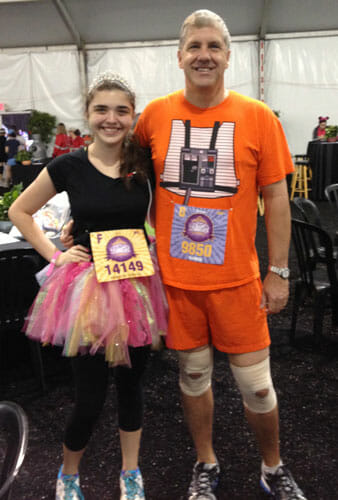
Well, as promised, I wanted to post our race day picture from the half marathon. This was done for my daughter's benefit, who set the goal to run a half marathon about 6 months ago and figured the promise of a Disney trip would be incentive to stay on top of her training.
She schlepped that tutu and that tiara for the whole 13.1, walking only at a couple of the last water stops. This event was 95% women, and attracts a LOT of folks who really don't run the whole thing, so it was a great place for her to begin. It's also pretty laid back, as there are actually character photo ops every mile, though we skipped those. I have not seen our time, but we probably did about 2:45. That's 20 minutes worse than my time five years ago -- it would be nice to say I was holding back to stay with my daughter but in fact she pulled me through the last mile. Muscles and cardio were fine but the knees and ankles really can't take it any more. But I proudly wore this bad boy all day.
If you are interested in this sort of thing, it was a great event, going through two of their parks. The only problem is that it has to take place before the parks are open, so we had to set the wake-up call for 3:15 AM. Uggh. The butt-crack of dawn, as my sister calls it.
And yes, I did help make the tutu, with the aid of this video. It is videos like that that remind me there are whole worlds of which I am virtually unaware. Note the number of views - 1.4 million, on making a tutu.