Posts tagged ‘US’

For All Our Problems...

For all our problems in this country with protecting individual liberties, we at least still have pretty free reign in criticizing public figures.  Unfortunately, the same cannot be said of Canada.  I am not really that sympathetic to all that gets written on these Canadian web sites, but I support their right to say it.

Do not be too complacent, however.  I am absolutely positive that there are many prominent people in this country who are scheming to bring exactly this sort of regime to the US.  In fact, it is already being tested at various college campuses, where a newfound right "not to be offended" has begun to trump free speech, at least so far as offense is defined and felt by the ruling elite on campus.

Bear Stearns Roundup

My friend Scott, who actually worked for Bear Stearns years ago, sent me one of the more down to earth explanations of a liquidity trap that I have heard of late.  Imagine that you had a mortgage on your house for 50% of its current value.  Then suppose that in this alternate mortgage world, you had to renew your mortgage every week.  Most of the time, you are fine -- you still have good income and solid underlying asset values, so you get renewed with a rubber stamp.  But suppose something happens - say 9/11.  What happens if your renewal comes up on 9/12?  It is very likely that in the chaos and uncertainty of such a time, you might have trouble getting renewed.  Your income is still fine, and your asset values are fine, but you just can't get anyone to renew your loan, because they are not renewing anyone's loan until they figure out what the hell is going on in the world.

Clearly there are some very bad assets lurking on company books, as companies are still coming to terms with just how lax mortgage lending had become.  But in this context, one can argue that JP Morgan got a screaming deal, particularly with the US Government bending over and cover most of the riskiest assets.  Sigh, yet another government bailout of an institution "too big to fail."  Just once I would like to test the "too big to fail" proposition.   Why can't all those bankers take 100% losses like Enron investors or Arthur Anderson partners.  Are they really too big to fail or too politically connected to fail?

Anyway, Hit and Run has a good roundup of opinion.

Update:  I don't want to imply that everyone gets off without cost here.  The Bear Stearns investors have taken a nearly total loss - $2 a share represents a price more than 98% below where it was a year or two ago.    What I don't understand is that having bought Bear's equity for essentially zero, why an additional $30 billion guarantee was needed from the government.

Government as Price-Maker vs. Taker

Megan McArdle makes a great point that should be absolutely uncontroversial:

government is much better as a price taker than a price maker.
Government procurement is all kinds of tedious and cluttered with red
tape, but in the end there's no gigantic problem with the government
pencil supply. Defense procurement, on the other hand, is pretty well
agreed to be godawful-expensive for what we get, the only excuse being
that we can't think of another way to buy fighter planes.

That means that government procurement alongside a free market looks a lot
different from government procurement when the government is the only
buyer. Yes, the health care market is extremely screwed up, but the
prices in it do tell you something about demand for various services,
and provide some signals about cost/benefit. You may think that viagra
is a prime example of wasted pharmaceutical R&D spending (though if
you do, I am willing to bet that you are either under forty, or
female), but the fact that a lot of people are willing to pay a fair
amount of coin for it tells you that they probably feel it is improving
their lives in some significant way. Governments can estimate
cost-benefit when the benefit is limited to crude mortality
improvements, but they are pretty much at sea when it comes to
quality-of-life. America's price signals are wildly distorted by its
insurance markets--but they're almost certainly better than no signal
at all.

Europe's governments operate their health care systems in the
context of an existing US market that provides information about demand
for new treatments (and of course I would argue, also the new
treatments). They don't use that price information to set what they pay
for drugs, but it does filter through to their markets--for example,
more widespread use of Herceptin for breast cancer in the US is putting
pressure on the British government to provide it. I think an American
shift to single-payer would be more problematic than the European
example for a variety of reasons related to our government structure.
But one important reason is that if we did, we'd have no where left to
get prices from.

Damned if You Do, Damned if You Don't... Hell, Damned if You Try To Run Any Kind of Business at All

Arizona state law now requires that employers use the federal e-verify system to screen employees for legal immigrant status.  As I mentioned earlier, state law requires that I use this system in ways that are illegal under federal rules, at the risk of losing my business license.

Right now, I am going through a 6000 screen required tutorial that I have to endure before I can use a system that requires me to fill in about 3 blanks and hit enter.  (Of course, since this is a government system, the tutorial has already crashed twice three five times and I have had to restart it each time).  Somewhere in the midst of the training, I reach this admonition:

You may not discriminate against applicants and employees based upon
their citizenship or immigration status with respect to hiring, firing,
or recruitment or referral for a fee. This includes treating citizens
and non-citizens differently during the hiring process, such as
screening out non-citizens or not hiring lawful immigrants based upon
their immigration status.

WHAT?  Personally, I am all for living by this, but isn't this EXACTLY what the law is requiring me to do?  To discriminate against people, and ban my hiring of them, based on their immigration status?  How can I possibly keep my actions legal if I am required to discriminate based on citizenship status but I am also banned from discriminating in hiring based on citizenship status.  How Orwellian can we get?

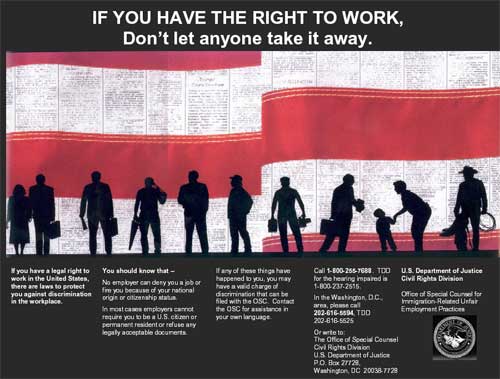
To continue the Orwellian theme, as part of this law by the state of Arizona whose sole purpose is to restrict the classes of people I can and can't hire, I must display this poster:

Ocw_poster

Gee, I would have thought everyone in the world had the right to seek work and to contract with anyone they please for their labor, but in fact the only body taking away the right is the group that made this poster -- ie the government -- which requires that everyone have a special government license called citizenship or a green card before they can sell their labor to willing parties in this country.

Well I wondered, of course, why there were 176 (I counted) training screens just to enter name-social-DOB and hit return.  It turns out that by "agreeing" to join the e-Verify program, which I am forced to do by Arizona law, I have agreed to become a US immigration officer and to do their job for them (without compensation, of course).  Here is an example screen:

There are five options for resolving a case:

  • Resolved Authorized. Select this option when employment is authorized.
  • Resolved Unauthorized/Terminated. Select this option when
    employment is not authorized (SSA Final Nonconfirmation, DHS Employment
    Unauthorized, or DHS No Show), or when a Tentative Nonconfirmation
    response is uncontested AND employment is terminated.
  • Self Terminated. Select this option if an employee quits or
    is terminated for reasons unrelated to employment eligibility status
    while the verification query is in process.
  • Invalid Query. Select this option if a duplicate query was discovered after the query was sent or if a query was sent with incorrect data.
  • Employee Not Terminated. Select this option to notify DHS
    that you are not terminating an employee who received an SSA Final
    Nonconfirmation, DHS Employment Unauthorized, or DHS No Show response
    or who is not contesting a Tentative Nonconfirmation response.

Got that?

Every campaign year we get these debates with all of these stupid questions, including things like "do you know how much a gallon of milk costs" or "Who is the head of state of Mayanmar?"  I would just love to see someone ask Obama or Clinton "In the largest city of your state, can you name all of the city, county, state, and federal licenses, registrations, tax numbers, certifications and registrations you need to be able to legally run a business with 10 employees?"

Update: OMG I have to pass a 33-page test before it will let me use the system.  LOL.  We can't test government-employed teachers for subject competency but we can test employers on government bureaucratic procedures before we allow them to hire anyone.

Update #2:  Well, there is an hour and a half of my life I will never get back.  It would have gone much quicker if they had a server that wasn't powered by a hamster on a treadmill.  Every several pages the server would take a minute or more to respond with the next page, and every twenty pages it would crash my browser completely.  Incredibly, to continue the Orwell theme, there were several questions where a correct answer required one to confirm government propaganda about the program.  Stuff like "The e-Verify helps every employer by...."

I am now fully empowered to, as required by US and Arizona law, discriminate in hiring based on immigration status just so long as I am careful not to discriminate in hiring based on immigration status.

Why Charles Bronson and Dirty Harry Were So Popular in the 1970's

Citizens of the US in the 1970's were in shock at how the crime rate was increasing.  In part, this was a demographic shift as a wave of young males more likely to resort to crime bulged through the system.  But this chart showing the great release of mental patients onto the streets in the 1960's and early 1970's points to another potential cause we seldom hear people discuss.

Bernardharcourtvolokh_graph1

Here are US crime rate stats:
Crime

Open Up Trade with Cuba

Cuba, Castro, Che Guevara, etc all suck.  It is ridiculous to even have to keep making this point against folks who are trying to sanctify them.

That being said, it is way past time to open up Cuba to US trade.  When will we learn that we are doing the Castros work for them?

  • If the US did not go out of its way to limit contact with Cuba, the Castros would have to try to do it.  We are just playing into their hands.  Totalitarian governments have a very dicey time in this era of free communications.  China interacts with the west, and is improving.  North Korea blocks all contact and is not.
  • The economic boycott gives the Castros a fig leaf to hide behind as their entire population wallows in poverty.  Yes, they are poor, and they are poor because of communism, but the Castros are able to blame the failure of their country on the US embargo.

But they have free health care!  They get all the leeches they want.

The Tony Soprano Test

I must say that I find this state Supreme Court decision from Washington State terrifying.  It is interesting that the State of Washington has exactly the same proprietary attitude over the garbage business as does the Mafia in New York:

In a decision released this morning, the Court stated that hauling
construction waste is not a private enterprise and "is in the realm
belonging to the State and delegated to local governments." The court
found specifically that the provision of waste hauling service is a
"government service" and constitutional protections do not apply to
government-provided services.

I don't know the Washington State constitution, so it may indeed mention "construction waste hauling" as an enumerated power of the government.  If it does not, and by "constitutional protections do not apply" they mean the US Constitution, then this is a stunning over-reading of said document.  Nowhere, in the US Constitution at least, is there a provision for the government providing services of any kind, much less construction waste hauling. 

US Poverty Rate

Tyler Cowen links to Lane Kenworthy Saying:

]Poverty comparisons across affluent nations typically use a "relative"
measure of poverty. For each country the poverty line "” the amount of
income below which a household is defined as poor "” is set at 50%
(sometimes 60%) of that country's median income. In a country with a
high median, such as the United States, the poverty line thus will be
comparatively high, making a high poverty rate more likely...

There is actually at least one study out there by a left-leaning think tank that sort of addresses this (though not exactly).  The study first shows US and European income of the bottom 10 percentile vs. the median income of that country.  Not surprisingly, since US median income is so high, the bottom 10 percentile have a low share.  BUT, they then do the numbers a second, time, showing the bottom 10 percentile income in each country all compared to US median income, ie all with the same denominator,  here, the US poor do at least as well as most European countries.  The comparison shows clearly that while the US has more income inequality, it is not because our poor are poorer but because our rich and middle class are richer.   Here is that second study:

Study2

More on the Teens as the New Seventies

For a while, I have been worried that the next decade may well be a return to 1970's economics, with bipartisan commitment to large government, ever-expanding government micro-management of... everything, growth-destroying taxes, and consumer-unfriendly protection of dead US industries.

Now, Megan McArdle points to an article that hints that the stagflation of the 1970's may be back as well.

Inflation and sluggish growth haven't joined in that ugly brew called
stagflation since the 1970s. They may not be ready for a reunion, but
they are making simultaneous threats to the economy and battling one
might only encourage the other.

Among a batch of economic readings today, the Labor Department
reported that import prices jumped 1.7% last month. The data included
troubling signs that consumer products, many imported from China, have
caught the inflation bug. The signs pointing to slowing growth included
a sharp deterioration in consumers' mood, as measured by the
Reuters/University of Michigan Surveys of Consumers, and a worsening
outlook for manufacturers, revealed in the Federal Reserve Bank of New
York's Empire State Manufacturing survey for February. The government
also reported that U.S. industrial production only increased slightly
during January, as colder weather elevated utilities output and offset
sharp declines in the auto and housing sectors. If indeed inflation is
teaming up with slower growth, it means big headaches for policy
makers, in particular Ben Bernanke. The Federal Reserve chief in
congressional testimony yesterday suggested that he is willing to keep
lowering interest-rates if the economy stalls. But, naturally, he will
have less room to do so if those lower rates would accelerate inflation
to unacceptable levels.

A Junior High Science Project That Actually Contributes A Small Bit to Science

Cross-posted from Climate Skeptic

Tired of build-a-volcano junior high science fair projects, my son and I tried to identify something he could easily do himself (well, mostly, you know how kids science projects are) but that would actually contribute a small bit to science.  This year, he is doing a project on urban heat islands and urban biases on temperature measurement.   The project has two parts:  1) drive across Phoenix taking temperature measurements at night, to see if there is a variation and 2) participate in the surfacestations.org survey of US Historical Climate Network temperature measurement sites, analyzing a couple of sites for urban heat biases. 

The results of #1 are really cool (warm?) but I will save posting them until my son has his data in order.  Here is a teaser:  While the IPCC claims that urban heat islands have a negligible effect on surface temperature measurement, we found a nearly linear 5 degree F temperature gradient in the early evening between downtown Phoenix and the countryside 25 miles away.  I can't wait to try this for myself near a USHCN site, say from the Tucson site out to the countryside.

For #2, he has posted two USHCN temperature measurement site surveys here and here.  The fun part for him is that his survey of the Miami, AZ site has already led to a post in response at Climate Audit.  It turns out his survey adds data to an ongoing discussion there about GISS temperature "corrections."

Miami_az_mmts

Out-of-the-mouth-of-babes moment:  My son says, "gee, dad, doesn't that metal building reflect a lot of heat on the thermometer-thing."  You can bet it does.  This is so obvious even a 14-year-old can see it, but don't tell the RealClimate folks who continue to argue that they can adjust the data for station quality without ever seeing the station.

This has been a very good science project, and I would encourage others to try it.  There are lots of US temperature stations left to survey, particularly in the middle of the country.  In a later post I will show you how we did the driving temperature transects of Phoenix.

It Turns Out That I Am Not A Patriot

It turns out, according to Barack Obama, (who hales from the party that doesn't believe in questioning anyone's patriotism) that I am not a "Patriot Employer."  This is from the text of Senate Bill S. 1945 of which he is a co-sponsor  (My snark is interspersed in italics):  Patriot Employers are to be given tax breaks over unpatriotic employers (I presume this means that their tax rates will be raised less in an Obama presidency than those of other folks) with "patriot employers" defined as such:

(b) Patriot Employer- For purposes of subsection (a), the term
`Patriot employer' means, with respect to any taxable year, any
taxpayer which--

        `(1) maintains its headquarters in the United States if the taxpayer has ever been headquartered in the United States,

      OK, I guess I can comply with this.  Though I am not sure the best way to begin an Obama "kindler gentler foreign policy" is to tell the nations of the world that we will be taxing their company's income in the US at a higher rate than our own companies.

        `(2) pays at least 60 percent of each employee's health care premiums,

      So the #1 determinant of patriotism is not commitment to individual rights but paying 60% of employee health care costs.  I guess I am so unpatriotic

      And, just from a practical standpoint, 90% of my employees are seasonal, hired for about 4 months of the year.  To be patriotic, I have to pay their health care costs all year long?  Also, since most of my employees are retired, they are on Medicare or an employee retirement medical plan.  If they pay $0 in premiums and I pay $0 of that, do I get credit for 60%?  Maybe the government can mandate a solution for zero divided by zero, like they did for the value of pi years ago

        `(3) has in effect, and operates in accordance with, a policy requiring neutrality in employee organizing drives,

      I presume neutrality means that in a hypothetical union drive, I do not express my opinion (and likely opposition) to said unionization drive?   I am told that this also entails allowing card checks rather than hidden ballot voting.  In other words, patriotism is being defined here as 1) giving up your free speech rights and 2) opposing hidden ballot voting.  Uh, right.  Besides, if a union organized our company, as unlikely as that would be, I would probably have to do a Francisco d'Anconia on the place.

        `(4) if such taxpayer employs at least 50 employees on average during the taxable year--

        `(A) maintains or increases the number of full-time
        workers in the United States relative to the number of full-time
        workers outside of the United States,

        In other words, we don't want American companies growing overseas.  This could also be called the "give up international market share act."  This implies that it is unpatriotic for US-based Exxon to explore for oil in Asia and that it is more patriotic to let the Chinese national oil company do it.  This implies that it is more patriotic for Coke to lose market share in Germany than to gain it.  This means that it is more patriotic for Mattel to buy its toys in China from Chinese companies rather than run the factories themselves (and thereby be accountable themselves for product quality and working conditions).

        This is beyond stupid.  We LIKE to see US companies doing well overseas.  If we have to import our raw materials, we feel more comfortable if it is US companies doing the extraction.  Don't we?  In the name of patriotism, do we really want to root for our domestic companies to fail in international markets?

        `(B) compensates each employee of the taxpayer at
        an hourly rate (or equivalent thereof) not less than an amount equal to
        the Federal poverty level for a family of three for the calendar year
        in which the taxable year begins divided by 2,080,

        90% of my workers are retired.  They work for me to supplement their income, to live our in nature, and to stay busy.  They need me to pay them based on the poverty line for a family of three, why?  I will tell you right now that if I had to raise wages this much, most of my employees would quit.  Many of them force me to give them fewer hours so they can stay under the social security limits for income.  I discussed what rising minimum wages often force me to do here, but just as an illustration, a $1 an hour across the board wage increase would easily wipe out all the money I make in a year and put me into a loss position.  In which case the lowered tax rate would not do me much good anyway.

          `(C) provides either--

            `(i) a defined contribution plan which for any plan year--

            `(I) requires the employer to make
            nonelective contributions of at least 5 percent of compensation for
            each employee who is not a highly compensated employee, or

            `(II) requires the employer to make
            matching contributions of 100 percent of the elective contributions of
            each employee who is not a highly compensated employee to the extent
            such contributions do not exceed the percentage specified by the plan
            (not less than 5 percent) of the employee's compensation, or

          `(ii) a defined benefit plan which for any plan
          year requires the employer to make contributions on behalf of each
          employee who is not a highly compensated employee in an amount which
          will provide an accrued benefit under the plan for the plan year which
          is not less than 5 percent of the employee's compensation, and

          Uh, I am not sure why it is unpatriotic for an employee to save for themselves, but I think 401k plans are a nice benefit.  I would certainly offer one except for one tiny fact - ALL MY EMPLOYEES ARE ALREADY RETIRED!!  They are over 65.  They are drawing down on their retirement, not contributing to it.

          This is at the heart of the problem with all US labor law.  Folks up in Illinois write laws with a picture of a steel mill in mind, and forget that employment and employees have infinite variations in circumstances and goals. 

          So I am unpatriotic, huh.  But if forcing companies to contribute to emplee retirement plans is patriotic, why is hiring folks once they are retired to give them extra income in retirement unpatriotic?  In fact, maybe I could argue that 100% of the wages I pay go to retirement spending

        `(D) provides full differential salary and
        insurance benefits for all National Guard and Reserve employees who are
        called for active duty, and

          In other words, we of the government are not going to pay our employees (ie reservists on active duty) what they are worth and are not going to give them benefits, so to be patriotic you need to do it for us.  We in Congress are not really very patriotic and don't support the troops, so you need to do it for us.

          All kidding aside, I would do this in my company if it was applicable, but I really resent being piously told to do so by several Senators who don't really model this behavior themselves.

        `(5) if such taxpayer employs less than 50 employees on average during the taxable year, either--...

blah, blah.  Basically the same stuff repeated, though slightly less onerous.

Since when did patriotism equate to "rolling over to the latest AFL-CIO wish list?"

Tornadoes

It is incredible to me that anyone could treat Senator Kerry seriously at this point, but a credulous media seems to be lapping up his accusations that recent tornadoes represent an increase in such storm activity caused by global warming. 

I am way too tired of refuting this stuff over and over to repeat the whole post I put up a while ago about tornado frequency, but you can find it here.  But here is the short answer for those to tired to click through:  Apparent increases in tornado frequency are an artifact of improved technology that can detect more tornadoes.  If one corrects for this by looking only at tornadoes of the larger sizes (3-5) that were consistently detectable with 1950's technology, there has actually been a small decreasing trend in tornado strikes in the US.

This is drop-dead obvious to anyone who knows anything about weather.  However, since it keeps coming up, the NOAA has an explanation quite similar to mine plastered all over their site.

With increased national doppler radar coverage, increasing population,
and greater attention to tornado reporting, there has been an increase
in the number of tornado reports over the past several decades. This
can create a misleading appearance of an increasing trend in tornado
frequency. To better understand the true variability and trend in
tornado frequency in the US, the total number of strong to violent
tornadoes (F3 to F5 category on the Fujita scale) can be analyzed.
These are the tornadoes that would have likely been reported even
during the decades before Dopplar radar use became widespread and
practices resulted in increasing tornado reports. The bar chart below
indicates there has been little trend in the strongest tornadoes over
the past 55 years.

My daughter when she was 9 years old was able to more accurately portray this fact in a class project than did Mr. Kerry.

Warmer and Richer

Over at Climate Skeptic, I discuss a Cato study that finally gets at an issue I have tried to press for years:  That even if one accepts the worst of the IPCC warming scenarios (which I do not) the
cost of CO2 abatement, particularly in terms of lost economic growth, is far
higher than the cost of rising temperatures -- ESPECIALLY for the poor. 

Hurricanes are a great example.  The world is probably warming a bit due to man's CO2, but likely less than the catastrophic rates one sees in the press.  This warming may or may not increase hurricane severity.  But let's assume it does.  Let's say Asia faces an extra cyclone or two each year from global warming. 

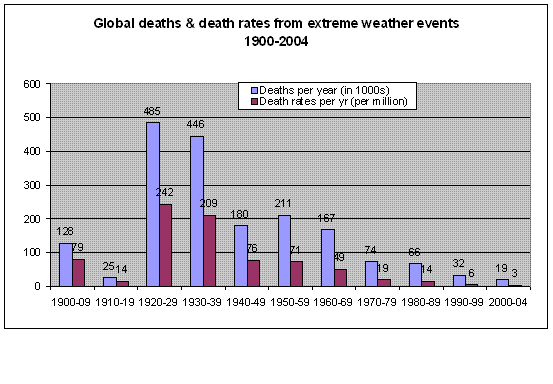
Over time, trends in deaths from hurricanes and severe deaths have shown no correlation with storm frequency or severity.  Death rates from storms track nearly perfectly with wealth:  As wealth has increased in the US, severe storm deaths have dropped to nearly zero;  Where countries are less wealthy, they experience more death.  Bangladesh is not the site of some of the deadliest storms on record because they get hit by the worst storms, but because they are poor.  (figure source)

Figure1

As a result, if we really face this tradeoff (which I doubt) the world still is better off richer with 10 hurricanes than poorer with 8.

Understanding What Going Green Means

This photo (via Maggie's Farm) shows life in the United States during a time when the US emitted more CO2 than Hillary Clinton, Barack Obama and other greens want to set as the new emissions cap.  In 1940, the US emitted about 33% of 1990 levels of CO2, vs. the green's target of 20%.
Cartandwagonga1940s

European vs. American Rail

It seems that one of those cycles the US always castigates itself about is a perception that the Europeans have a better rail system than we do and that we should somehow emulate their system.  Which is why we still have federal subsidies of a half-assed Amtrak system and high-speed rail proposals are circulated breathlessly from time to time. 

By the way, I have been a consultant to French railroad SNCF and I gaurantee we do not want to emulate the European rail system.  First and foremost, the railroads are huge employment boondoggles.  I remember that the SNCF when I was there had something like 100,000 freight cars but 125,000 freight car maintenance people.  I suggested the railroad could assign one individual full time to his own car and still lay off 20% of the work force. 

The main reason we don't have inter-city passenger rail is a simple one that anyone spending 5 minutes with the numbers can understand -- there are distance break points where air travel is more economic than rail, and most US inter-city transit falls into the larger distance ranges.

Anyway, the anti-planner shares a bit of information that is seldom mentioned in the rail discussion that makes the US rail system look a lot more desireable:

Europe has decided to run its rail system primarily for passengers,
while America's system is run mainly for freight. Europe's rail system
has about 6 percent of the passenger travel market, while autos have
about 78 percent. Meanwhile, 75 percent of European freight goes by
highway. Here in the U.S., highway's share of freight travel is only 29
percent, while the auto's share of passenger travel is about 82
percent. So trains get 4 percent of potential auto users in Europe out
of their cars, but leave almost three times as much freight on the
highway.

In fact, the freight rail system is so efficient that to some extent we've obviated the need for the Panama Canal.  Many Asian container ships bound for Europe actually make port in Seattle or Vancouver, offload their containers onto trains which shoot across the country to New York or another eastern port where they are reloaded on ships for the trip to Europe.

By the way, in the same article, don't miss the hilarious proposal in Minnesota to spend taxpayer money for a high speed rail line from the Twin Cities to ... Duluth.  Yeah, that's the ticket.  New York to Boston barely makes it financially, but St. Paul to Duluth is going to be a winner.

Clintons: Welcome to 1905

Bill Clinton is at least honest to some extent in saying that cutting back on CO2 emissions will requires us to throttle back the economy:

In a long, and interesting speech, he [Bill Clinton] characterized what
the U.S. and other industrialized nations need to do to combat global
warming this way: "We just have to slow down our economy and cut back
our greenhouse gas emissions 'cause we have to save the planet for our
grandchildren."

But how much?  Activists try to make the average person feel like the amount is "not much" by spinning out rosy stories of 3rd graders fighting global warming by recycling.  But in fact Bill's wife Hillary makes the degree of cuts clearer:

...[Clinton's] plan would reduce greenhouse gas emissions by 80 percent from 1990 levels by 2050 to avoid the worst effects of global warming...

And recognize, this is the typical figure being cited by global warming catastrophists for "necessary" US cuts.  So how much is 80%?  With current technology, an almost unimaginable cut.  Its hard to get good Co2 data, but here is a chart from some place called the Carbon Dioxide Information Analysis Center that purports to show US historic CO2 production from man-made sources:
Usaco2_2

The chartsmanship sucks here, but 1990 looks like about 1.35 billion metric tons.  20% of that would be 0.27 billion metric tons.  That appears to be the level we hit in about ... 1905.  So, apparently without using nuclear power (since Clinton opposed nuclear expansion in one of the debates, I think in Nevada)  she wants us in the next 42 years to get back to the energy production of about 1905.  Now this is a bit unfair, since efficiencies and GDP per ton of CO2 have improved substantially since 1905.  So to be fair she may only want to take us back to about 1930.

While this is scary, what Clinton and other global warming crusaders want to do to the third world is even scarier.  Right now, close to a billion people who have been in poverty forever are posed, via growth in China, India, and SE Asia, to finally exit poverty.  Global warming crusaders want this to stop.  For example, here is the former World Bank chief economist Nicholas Stern says that India must stay poor:

Mr
Stern, the former chief economist of the World Bank, sends out a very
clear message: "We need to cut down the total amount of carbon
emissions by half by 2050." At current levels, the per capita global
emissions stand at 7 tonnes, or a total of 40-45 gigatonnes. At this
rate, global temperatures could rise by 2.5-3 degrees by then. But to
reduce the per capita emissions by half in 2050, most countries would
have to be carbon neutral. For instance, the US currently has, at 20-25
tonnes, per capita emissions levels that are three times the global
average.

The European Union's emission levels stand at 10-15
tonnes per capita. China is at about 3-4 tonnes per capita and India,
at 1 tonne per capita, is the only large-sized economy that is below
the desired carbon emission levels of 2050. "India should keep it that way and insist that the rich countries pay their share of the burden in reducing emissions," says Mr Stern.

No cars for these folks either!

Aren't These the Same?

I saw these two posts one after the other on Q&O.  One is about Chavez's food regulations in Venezuela, the other is about a government health care plan in California.  One is about government takeover of a critical industry, price controls, supply rationing, and demonizing large private corporations, and the other is about the same thing, but in Venezuela.  Since Chavez is further along with his program, we might see how things are working out for him:

Venezuela's top food company has accused troops of illegally seizing
more than 500 tonnes of food from its trucks as part of President Hugo
Chavez's campaign to stem shortages.

The leftist Chavez this
week created a state food distributor and loosened some price controls,
seeking to end months of shortages for staples like milk and eggs that
have caused long lines and upset his supporters in the OPEC nation.

The
highly publicised campaign has also included government crackdowns on
accused smuggling, with the military seizing 1,600 tonnes of food and
sending 1,200 troops to the border with Colombia....

He also threatened to expropriate companies selling food above regulated prices.

"Anyone
who is distributing food ... and is speculating, we must intervene and
we must expropriate (the business) and put it in the hands of the state
and the communities," Chavez said during the inauguration of a new
state-run market in Caracas.

Yep, sounds about the same.  Fortunately, people in the West can still travel across borders to get health care when government rationed and price-controlled services are not available, as many Canadians and British do. So in the US, when we implement all these same steps, we'll be able to travel to..., travel to...  Where will we be able to go?

I Love Maps

I have always loved maps.  As a kid, I could spend hours looking through an Atlas.  And, even better, my dad had this huge book in his office that had a collection of US maps by county, showing all kinds of crazy demographic and economic information.  I loved that book.   Since then, I have never found it on sale any where, but this map is a good example of the kind of thing it used to include.  Via strange maps, it is a map of leading religions by county.  The map also has a clever way of showing where the plurality is a majority. 

Churchbodies

There's No Shortage, Just A Price You Don't Like

In the absence of government meddling (e.g. price controls) healthy markets seldom create true shortages, meaning situations where one simply cannot obtain a product or service.  One might think there was a shortage, for example, of Superbowl tickets, since there are only a few available and tens of thousands, maybe hundreds of thousands, of people who would like to attend.  But in fact one can Google "Superbowl tickets" and find hundreds available.  You may not like the price ($3500 and up for one ticket), but they are available for sale.

Yesterday, the AZ Republic lamented that there is a shortage of truck drivers nationwide:

Trucking companies across the country are facing a shortage of long-haul drivers....

High driver turnover has traditionally been a problem throughout the
trucking industry. But retirements and growing shipping demand have
made the shortage of long-haul drivers more acute. Fewer drivers means
delayed deliveries and higher delivery costs that could be passed on to
consumers. The
issue is especially crucial for the Phoenix area, which touts itself as
a shipping hub for businesses fed up with the costs and congestion
around Los Angeles-area ports. The Valley also is headquarters to two
of the country's biggest for-hire trucking companies: Swift
Transportation and Knight Transportation....

Trucking experts say the problem goes beyond a labor shortage in the industry. They call it a threat to the economy.

"Our country needs to figure out how to fix this," said Ray Kuntz,
chairman and chief executive of Watkins and Shepard Trucking in Montana
and chairman of American Trucking Associations. "Our economy moves on
trucks."

Here is the key fact:

"¢ Long-haul wages vary by company and are typically based on
experience, safety record and commercial-driver's-license endorsements.
Long-haul drivers with two or more years of experience usually earn at
least $50,000 to $60,000 a year.

"¢ An entry-level driver with no over-the-road experience starts in the high $30,000 range. Team drivers can earn more.

There is no way in a Platonic vacuum to determine if a wage is too high or too low.  But the driver "shortage" gives us a really good hint that maybe these salary levels are no longer sufficient to attract people to the rather unique trucking lifestyle.  I probably could write a similar article about how there is a shortage of Fortune 500 CEO's or airline pilots who will accept a $30,000 starting salary.  The problem then is not shortage, the problem is that wage demands are rising as trucking is out-competed for talent by alternative careers.   In fact, there is not shortage, but a reluctance by trucking firms to accept a new pricing reality in the market for drivers.

By the way, to some extent this "shortage" is indeed an artificial creation of the government.  Under NAFTA, Mexican truckers were long-ago supposed to have been given access to the US market, but overblown safety concerns have been used as a fig-leaf to block the provision as a protection for US truckers and a subsidy to the Teamsters.  If a truck driver "shortage" is really a national economic problem, then let's stop blocking this NAFTA provision.  But my sense is that the trucking companies in this article would freak at this, because they are not really concerned about the national economy but, reasonably, with rising wages hurting their bottom line.  My guess is this article is the front-end of a PR push to get states like Arizona to subsidize ... something.  Maybe truck driver training.  Look for such legislative proposals soon.


Dilemma that's Not Really a Dilemma

When businesses get US Census surveys, they are not the happy smiling documents one gets as an individual.  Stamped all over it is "Your Response Is Required By Law" and when filling it out, one has the suspicion that he is facilitating his own doom by providing government weenies the data ammunition they need to tax or regulate us more. 

The survey asks for total revenues and costs and payrolls cut a bunch of different ways, and takes about 1-2 hours to fill out if one is trying to be accurate.  However, I looked at the survey closer this year and  I noticed that this seven-page survey is for an individual business location

I have nearly 200 campgrounds and other recreational sites.  One of the tricks of our business is we have learned to operate a lot of small dispersed sites in a cost-effective manner.  But now it turns out that to be strictly compliant with the census process, I need to fill out all of this information for each of these sites.  In other words, rather than spend 1-2 hours (the feds say it should take an hour) on one summary report, in fact what I am technically legally supposed to do is fill out two hundred such reports, at a cost of at least 200 hours of my time.  That is 10% of a standard man-year.

So -- do I do it the "right" at the cost of 200 hours of my time or do I do it the way I did it last year?  I won't give my actual answer, which I think the post title telegraphs fairly well, but you can think about yours  (yes, Travis, I know, more rope).

Government is The Biggest Barrier to Alternative Energy

And by the title of this post, I don't mean because they are not throwing enough money and mandates at it.  Here is what I wrote about the alternative energy mandates in the most recent energy bill:

They want 15% of power generation from renewables by 2020.  I am not
sure if this includes hydro.  If it does, then a bunch of Pacific
Northwest utilities already have this in the bag.  But even if
"renewable" includes hydro, hydro power will do nothing to meet this
goal by 2020.  I am not sure, given environmental concerns, if any
major new hydro project will ever be permitted in the US again, and
certainly not in a 10 year time frame.  In fact, speaking of
permitting, there is absolutely no way utilities could finance, permit,
and construct 15% of the US electricity capacity by 2020 even if they
started today.  No.  Way.   By the way, as a sense of scale, after 35
years of subsidies and mandates, renewables (other than hydro) make up
... about .27% of US generation.

Here is an example of what I mean about the permitting process:  10-years a counting between proposal for a wind farm and having a chance to build it.  And I assure you that there is not way this thing will clear remaining regulatory hurdles to be in place even by 2011.

More Command and Contol Health Care in Massachusetts

Well, I can't blame this bit of command and control on Mitt Romney, but it is still a great example of politicians doing exactly the opposite of what is needed to making US health care even more convenient and affordable.

In-store health care services offer cheap primary care, ease the
burden on emergency rooms, and help people who can't afford health
insurance"“or who have insurance but can't find a decent primary care
physician. They also boast stratospheric customer satisfaction ratings. 

So why is idiot Boston Mayor Thoma Menino against them?  Because they're driven by profit!

The decision by the state Public Health Council,
"jeopardizes patient safety," Menino said in a written statement.
"Limited service medical clinics run by merchants in for-profit
corporations will seriously compromise quality of care and hygiene.
Allowing retailers to make money off of sick people is wrong."

This is as opposed to doctors in hospitals, who everyone one knows don't make any money off of sick people.  Seriously, who in their right mind could possibly oppose a free market solution to cleaning out these non-life-threatening type cases from hospital emergency rooms?

Getting the Bureaucrat's Permission to Speak

Ezra Levant has posted YouTube videos of his interrogation by an oily little Canadian bureaucrat called "a human rights officer."  He has done it in a series of post, so go to his site and keep scrolling.  Apparently, in Canada, free speech is not a human right but "freedom from criticism" is, at least for certain politically connected groups  (threatening violence at the drop of a hat also seems to help gain one this "freedom from criticism" right.  Levant is being hauled in by the government for publication of those Danish cartoons that barely register at 0.1 on a criticism meter that goes to 10

This exchange really resonated with me:

Officer McGovern said "you're entitled to your opinions, that's for sure."

Well, actually, I'm not, am I? That's the reason I was sitting
there. I don't have the right to my opinions, unless she says I do.

For all of you who left the US for Canada for more freedom from Bush and the Iraq war, have at it.  Because Bush will be gone and we will be out of Iraq long before Canada (as well as Europe) catch up to the US in terms of its protection of [most] individual rights, like free speech.

via Maggies Farm

Update, from Mark Steyn:

Ms McGovern, a blandly unexceptional bureaucrat, is a classic example
of the syndrome. No "vulnerable" Canadian Muslim has been attacked over
the cartoons, but the cartoonists had to go into hiding, and a gang of
Muslim youths turned up at their children's grade schools, and Muslim
rioters around the world threatened death to anyone who published them,
and even managed to kill a few folks who had nothing to do with them.
Nonetheless, upon receiving a complaint from a Saudi imam trained at an
explicitly infidelophobic academy and who's publicly called for the
introduction of sharia in Canada, Shirlene McGovern decides that the
purely hypothetical backlash to Muslims takes precedence over any
actual backlash against anybody else.

Yeah, this is Going to Work

Via the New York Times:

Prime Minister Wen Jiabao
responded Wednesday to growing public anxiety about inflation by
announcing that China would freeze energy prices in the near term, even
as international crude oil futures have continued to surge....

Last November, China raised gasoline and diesel prices by almost 10
percent, partly to appease officials at state-owned refineries.
Refiners had complained that price controls were forcing them to
swallow the difference between higher prices for crude oil on the world
market and regulated consumer prices at home for refined products. So
refineries cut back production of gasoline and particularly diesel,
causing long lines at fuel stations around the country.

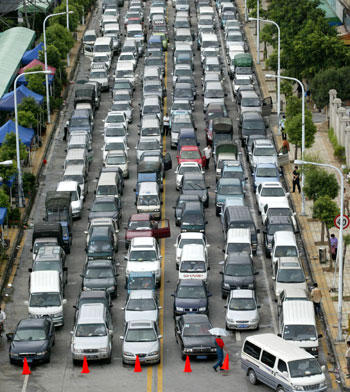
More on past Chinese problems from gas price caps.  Here is a picture of one such past gas line in China. 

China_gas2

    I got my driver's license in 1978, just in time to spend the first few months of my driving life sitting in gas lines with the family car, a result of a series of market distorting actions by the US government.

Meanwhile, I presume the French and Germans will see no problem with this approach:

The Economist says,
of the state of economics education in France and Germany, "I
desperately hope it's not really this bad." Unfortunately, I think it's
really that bad. When the 35 hour work week was proposed, I was talking
to someone in the French consulate who did economics and trade. "Aren't
you worried that this will raise employer's costs and lead to business
failures or higher unemployment?" I asked.

"That's just Anglo-saxon economics" was his rather stunning reply.  Apparently, in France, demand curves do not slope downwards.

Uncovering Some Really Bad Science

Kevin Drum thinks he has a killer analysis supporting government health care.  In a post he titles sarcastically "Best Healthcare In the World, Baby," Drum shares this chart:
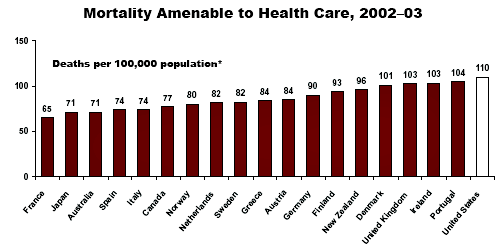
Blog_deaths_amenable_healthcare

The implication is that the US has the worst healthcare system, because, according to this study, the US has the highest rates of "amenable mortality," defined as deaths that are "potentially preventable with timely and effective health care."

I get caught from time to time linking to studies that turn out to have crappy methodology.  However, I do try to do a little due diligence each time to at least look at their approach, particularly when the authors are claiming to measure something so non-objective as mortality that was "potentially preventable."

So, when in doubt, let's look at what the author's have to say about their methodology.  The press release is here, which gets us nowhere.  From there, though, one can link to here and then download the article from Health Affairs via pdf  (the site is gated but I found that if you go through the press release site you can get in for free).

The wording of the study and the chart as quoted by Mr. Drum seem to imply that someone has gone through a sampling of medical histories to look at deaths to decide if they were preventable deaths.  Some studies like this have been conducted.  This is not one of them.  The authors do not look at any patient data.

Here is what they actually did:  They arbitrarily defined a handful of conditions as "amenable" to care.  These are:

Ischemic Heart Disease (IHD)
Other circulatory diseases
Neoplasms (some cancers)
Diabetes
Respiratory diseases
Surgical conditions and medical errors
Infectious Diseases.
Perinatal, congenital, and maternal conditions
Other (very small)

All the study does is show how many people died in each country from this set of diseases and conditions.  Period.  It doesn't determine if they got care or if they in particular could have been saved, but just that they died of one of the above list of conditions.  This study was not an effort to identify people who died when their particular condition should have been preventable or amenable to care;  all it measures is the number of people in each country who died from list of conditions.  If Joe is talking to me and in the next second flops over instantly dead of a massive heart attack, the author's consider him to have died of a disease amenable to care.

We can learn something by looking at the breakdown of the data.  If you can't read the table below, click on it for a larger version
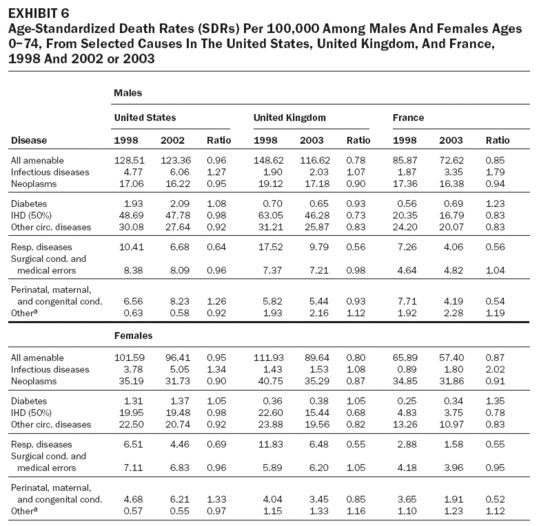
Amenablediseases_2

Let's take the data for men.   The study makes a big point of saying that France is much better than the US, so we will use those two countries.   In 2003, France has an "amenable disease" death rate 56 points lower than the US.  But we can see that almost this whole gap, or 42 points of it, comes from heart and circulatory diseases.  The incidence of these diseases are highly related to diet and lifestyle.  In fact, it is well established that the US has a comparatively high incidence rate of these diseases, much higher than France.  This makes it entirely possible that this mortality difference is entirely due to lifestyle differences and disease incidence rates rather than the relative merits of health care systems. In fact, this study is close to meaningless.  If they really wanted to make a point about the quality of health care systems, they would compare them on relative mortality with a denominator of the disease incidence rate, not a denominator of total population.

But in their discussion, the study's authors reveal themselves to be, if I am reading them right, complete idiots in terms of statistical methods.  The authors acknowledge that lifestyle differences may be a problem in their data.  This is how they say they solved this problem:

It is important to recognize that the development of any list of indicators of amenable mortality involves a degree of judgment, as a death from any cause is typically the final event in a complex chain of processes that include issues related to underlying social and economic factors, lifestyles, and preventive and curative health care. As a consequence, interpretation of findings requires an understanding of the natural history and scope for prevention and treatment of the condition in question. Thus, in the case of IHD, we find accumulating evidence that suggests that advances in health care have contributed to declining mortality from this condition in many countries, yet it is equally clear that large international differences in mortality predated the advent of effective health care, reflecting factors such as diet and rates of smoking and physical activity.16 To account for this variation, we included only half of the mortality from IHD, although, based on the available evidence, figures between, say, 25 percent and 70 percent would be equally justifiable.

I have a very smart reader group, so my sense is that many of you already see the gaffe here.  The author's posit that 50% of heart disease may be due to lifestyle, though the number might be higher or lower.   So to correct for this, they reduce every country's heart disease number (IHD) by a fixed amount of 50%.  WTF??  This corrects for NOTHING.  All this does is reduce the weighting of IHD in the total measure. 

Look, if the problem is that lifestyle contribution to heart disease varies by country, then the percentage of IHD deaths that need to be removed because the deaths are lifestyle related will vary by country.  If the US has the "worst" lifestyle, and the number for lifestyle deaths is about 50% there, it is going to be less than 50% in every country.  The correction, if an accurate one could be created, needs to be applied to the variance between nations, not to the base numbers.  Careful multiple regressions might or might not have sorted the two sets of causes apart, but dividing by 50% doesn't do anything.  This mistake is not just wrong, it is LAUGHABLE, and calls into question the author's qualification to say anything on this topic.  They may be fine doctors, but they don't know squat about data analysis.

There may be nuggets of concern for the US lurking in this data.  I don't know how they measure deaths from surgical conditions and medical errors, but its not good to be higher on this.  Though again, you have to be careful.  The US has far more surgeries than most other countries per capita, so we have more surgical deaths.  Also, medical error data is notoriously difficult to compare country to country because reporting standards and processes are so different.  In the US, when the government measures medical errors, it is a neutral third party to the error.  In Europe, the government, as healthcare provider, is often the source of the error, calling into question how aggressive these countries may be in defining "an error."  Infant mortality data is a good example of such a trap.  The US often looks worse than European nations on infant mortality because it is defined as infant deaths as a percentage of live births.  But the US has the most advanced neo-natal capabilities in the world.  Many pregnancies that would result in a "born dead" in other countries result in a live birth in the US.  Since these rescued births are much more problematic, their death rate is much higher.

There is good news for the US in the study.  The item on this list most amenable to intensive medical intervention is cancer (neoplasms in the study above).  In that category, despite a higher incidence rate than many of these countries, the US has one of the lowest mortality rates as a percentage of the total population, which implies that our cancer mortality in the US as a percentage of cancer incidence is much better than these countries.  This shows our much higher 5-year cancer survival rates.

Update:  I thought this was pretty clear, but some of the commenters are confused.  The halving of IHD numbers was applied to all countries, not just the US.  So the actual male US IHD number is about 100 before halving and the actual French number is about 40.  Again, this halving only reduces the weighting of IHD in the total index; it in no way corrects for differences in incidence rate.