Archive for the ‘Government’ Category.

Good Government Has to Bite?

Today, Instapundit linked to this Howard Kurtz article, with the following line as a teaser:

But seriously, folks, has Congress become something of a joke?

I was excited to read on.  You bet Congress is a joke.  An out of control joke.  But then, in the next paragraph, he says this:

Are these toothless lawmakers no longer capable of passing anything with bite?

Bite?  BITE?!  Everything Congress does bites.  Every single day it does something to increase regulation or paperwork requirements or adds another necessary license or government approval process or tax or subsidy.  I may spend as much as half my time in my business just on government compliance and taxation issues.  Is that really Kurtz's concern, that the Congress does not pass enough legislation with bite??

Later in the article, he says something else I thought I would agree with:

isn't it telling that the one thing lawmakers can agree on is handing
out goodies as opposed any measure that involves the slightest
sacrifice?

Absolutely, I thought.  All Congress does is spend money on useless hurricane "relief" and earmarks and bridges to nowhere  and subsidies for ADM and don't forget that new prescription drug entitlement that will cost a ton of money once someone figures it out.  So given a Congress hell bent on spending like a drunken sailor, what does Kurtz use to illustrate his point of "handing out goodies?"

Of course, there is one issue on which Congress seems poised to act: extending tax cuts

I know that we libertarians have fought this issue and never seem to be able to win, but having the government let private citizens keep more of the money they earned is not "handing out goodies".  Handing out goodies is when you take tax money from one person and give it to another who did not earn it.  Tax cuts are one of the few things that inhibit handing out goodies.  Run far away from anyone who claims that tax cuts are handing out goodies, because it means that they consider your money to be the government's, and what portion you keep is yours not by right but by the grace and goodwill of the Congress who determines how much you get to keep.

More Suing Bloggers

I am seriously late on this one, but I still want to show my support for Lance Dutson, author of the Main Web Report, who is being sued by an advertising firm and harassed by the state government for uncovering some really dumb activities at the state tourism board.  A summary of what he found is here, and the story of the lawsuits is here.

This story rings absolutely true with me.  Given our significant experience with government agencies, I have seen time and time again that when government bureaucrats embark on an activity out of their traditional comfort zones (in this case, Internet pay-per-click advertising, a new activity for most of us) they tend to combine lack of training with total arrogance that they know exactly what they are doing.  Within my company we have dubbed this "condescending incompetence", and we see it all the time.

In this case, Mr. Dutson points out that by bidding up the price in Google adwords of travel-related terms, they are actually hurting Maine travel businesses, both by driving up their advertising costs and by diverting clicks from an actual tourist business to a government site.  And how could any sensible cost-benefit analysis lead to paying over $15 to get one (1) viewer to the government tourist web site?  The answer is, it can't.  The only thing that can drive this behavior is ignorance combined with a skewed incentive system (e.g. some bureaucrat wanted a line in a performance review or PowerPoint chart that said their web site was top-ranked on every key Google search).  And he rightly points out some disturbing conflicts of interest at the advertising agency, as well as the total bonehead maneuver of putting an adult phone-sex number in the ad copy.

By the way, I despise state tourism agencies.  Most of the money they spend is a waste and the rest goes to directly benefit a few cronies.  Most of our local dollars go to high-profile expenditures that gets the governor some extra media buzz but does zero to get anyone new to the state.   And note that I run a business that depends 100% on tourism.  These state expenditures do nothing for me.  In some cases, my customers pay as high as 12% lodging taxes (e.g. tax and bureaucracy hell Mono County, California) to fund tourist boards who don't even advertise the types of operations I run (campgrounds and marinas).

Punish the Victims

In Florida, where there seems to be a substantial problem with people stealing property in the form of shopping carts from local merchants, the government has a solution: Fine the victims.

In theory, stealing a shopping cart is punishable by up to 60 days in
jail and a $500 fine. But police rarely catch anyone in the act.

So local governments across the state are tackling the battle in
other ways, typically requiring stores to keep carts in the parking lot
or pay a fine.

Hallandale Beach recently updated its laws requiring stores to
create plans for keeping carts on their property. Stores bigger than
35,000 square feet, about the size of many grocery stores, can be
required to install theft-prevention devices....Installation costs $20,000 to $30,000, Miller said....

But retailers are fighting back. The way they see it, the rules are
blaming the victim -- punishing stores for other people's stealing.

Thanks to Bob Houk for the link. 

My Worst Vendor -- Guess Who?

Every small business probably has stories about vendors who are particularly difficult to work with.  Let me describe my most difficult and irritating vendor, someone who sells me products that we resell in our stores:

  • Most vendors try to set your retail price for you, but are seldom successful.  Only in countries like Germany that make retail discounting illegal are such attempts universally successful.  However, this one vendor is always successful at setting my retail price.
  • Most vendors allow me a retail gross margin of at least 30-50% of sales to help me to make money on the sale of their product.  They like me to make money, since that gives me the incentive to sell more of their product.  However, this one particular vendor only allows me a 5% gross margin.  Ironically, this products is on of the most difficult and time-consuming for our stores to sell, requiring ten minutes of sales time to gather all the necessary customer information and complete the transaction.  Every single one we sell is a dead loss to us.
  • Every small business has some vendors it struggles with on credit terms.  I usually have to fill out a detailed credit application, and as the owner have to personally guarantee the company's payment on the account.  Sometimes vendors will require a few orders be consummated COD so we can develop a history before they will go to a 30-day invoicing approach.  However, this particular vendor goes even further.  I had to set up a dedicated bank account into which I deposit funds for this vendors products every week.  In addition, I had to obtain a $4000 bond to cover any non-payment in the account, and I have to hold the bond as long as I want to do business with this vendor -- in other words, there is no credit given for a long track record of performance on the account.
  • This particular vendor has an "in" with the State of Colorado, which protects it by allowing no other competitive product to be sold in the state.

Give up?  Well, most of you have probably guessed that this vendor is... the government!  Or specifically, the Colorado Department of Wildlife and the specific product discussed is fishing licenses.  That is why this particular vendor can get away with practices that no company that actually has to compete in the market place would ever attempt, and, in a couple of cases, gets aways with practices that would be illegal for a private company.

When I bought this company, we used to sell fishing licenses at many of our locations.  I have pared this down to only the bare minimum number of locations, like marinas, where customers absolutely expect me to be able to sell them a license.

George W. Bush: Champion of the Left

I've made this point myself, but David Boaz says it great:

So here's your challenge, lefty bloggers: If you don't like the
tree-chopping, Falwell-loving, cowboy president - if you want his
presidency fatally wounded for the next three years - then start
praising him. One good Paul Krugman column taking off from that USA Today story on the surge in entitlements recipients under Bush, one Daily Kos
lead on how Clinton flopped on national health care but Bush twisted
every arm in the GOP to get a multi-trillion-dollar prescription drug
benefit for the elderly, one cover story in the Nation on how Bush has
acknowledged federal responsibility for everything from floods in New
Orleans to troubled teenagers, and maybe, just maybe, National Review
and the Powerline blog and
Fox News would come to their senses. Bush is a Rockefeller Republican
in cowboy boots, and it's time conservatives stopped looking at the
boots instead of the policies.

Revisiting Arthur Anderson's Death Sentance

The firm of Arthur Anderson was put to death by government prosecutors.  Unlike human beings, Anderson was killed without ever receiving a trial, and was dead long before any appeal was mounted.  Many a media tear have been shed for Enron employees who lost their savings in the Enron 401-K, where they invested in Enron by choice, but I have seen few people sympathizing with the tens of thousands of people who lost their savings in the AA collapse, the vast vast majority of whom never touched the Enron account.

Mary Morrison has a nice analysis (pdf) of why Anderson was probably killed unfairly.  Her central argument is that the main fraud at Enron was perpetrated in the off-balance sheet special purpose entities, or SPE's, when third parties put up capital that the SPE called equity, but was in fact really a loan with a verbal (non-written) promise to repay by either the entity or Enron.  By disguising a loan as equity, and by by disgusing related parties as arms-length investors, Enron was able to avoid consolidation of the SPE's with its financial statements.

Ms. Morrison argues persuasively that since Anderson was not the auditor for any of these SPEs, it had no way to uncover the true nature of these sham financing agreements, since these SPEs were effectively different corporations with different auditors.  AA had to rely on signed statements by each deal's principals that the financing for the SPE was as described (which is standard practice in this type situation and is considered to represent adequate due dilligence).  Anderson had no way to know what was going on in the SPE's, and since the SPE's were separate legal entities from Enron, it had no legal right to poke around in these entities and of course no subpoena power.  It had no way to know about the hidden verbal second part of the financing agreements.  She argues AA was a victim of the fraud and of false statements by Enron and the SPE managers and investors. 

It is interesting to note that the prosecution of the Enron case is prosecuting Enron managers right at this minute for making such fraudulent statements to AA and for hiding the nature of the SPE's from AA.  In other words, the prosecution team that first gave AA the death penalty for allegedly conspiring with Enron to hide their problems is now prosecuting Enron managers on the legal theory that AA was innocent and duped by the managers, which was AA's defense before they were wiped out.

Tom Kirkendall has more on AA's martyrdom here.  He also continues his scary series of articles on prosecutorial abuse here.  The pressure brought to bear to prevent defense witnesses from testifying is particularly frightening.  When you read this, you are really left wondering how the auditors for the SPE's, which may include KPMG, escaped unscathed (in fact escaped richer, since they got their share of the now-defunct Anderson's clients) when Anderson was put to death.

What a Jerk

Via ABC News, comes this story of Congressman Randall Cunningham:

Prosecutors call it a corruption case with no parallel in the long
history of the U.S. Congress. And it keeps getting worse. Convicted
Rep. Randall "Duke" Cunningham actually priced the illegal services he
provided.

Prices came in the form of a "bribe menu" that detailed how much it
would cost contractors to essentially order multimillion-dollar
government contracts, according to documents submitted by federal
prosecutors for Cunningham's sentencing hearing this Friday....

The card shows an escalating scale for bribes, starting at $140,000
and a luxury yacht for a $16 million Defense Department contract. Each
additional $1 million in contract value required a $50,000 bribe.

The rate dropped to $25,000 per additional million once the contract went above $20 million.

Separation of Powers

The separation of powers concept, so fundamental in our Constitution to checking government power grabs, seems to be on life support.  The reason I say this is that for separation of powers to work, each branch of the government has to, you know, actually monitor and try to check power grabs in other branches.   What I see today are three branches that have kind of reached some sort of peace treaty, agreeing to let the others run amok as long as it is allowed to do so itself.  To support this hypothesis, I make the following observations:

  • The executive branch continues to try to accumulate power, adding "indefinite detentions without trial" and "warrantless searches" to its arsenal, justifying nearly anything with the blanket argument that "the world is different post 9/11."  The Supreme Court has generally proved itself unwilling to do anything about it, which should be all the more the case in the future since both Bush appointees seem very comfortable with accretions of executive power.  Even the opposition party, though willing to make verbal assaults, seems unwilling to take any real measures.
  • Congress seems perfectly willing to spend their time wallowing in pork and dreaming up new earmarks to satisfy prominent donors.  The current budgeting process is a fiasco, and the executive branch seems unwilling to exercise any adult supervision, including an incredible record of zero vetos is nearly 6 years.  Congress has shied away from working on any issues of any seriousness (e.g. Social Security) which is perhaps good for us, since their only attempt to fix runaway spending in Medicare resulted in them adding an expensive and ridiculously complex drug benefit.  Congress and the President conspired to pass the egregious McCain-Feingold speech limit bill, which effectively helps protect the job of Congressional incumbents and protects them from 3rd party criticism when approaching an election.
  • With Congress unwilling to address any legislative issues of substance, the judiciary seems perfectly happy to take their place, creating new law in hundreds of areas.  And Congress seems willing to let them.  It can only be dangerous for a Congressperson to deal with hot-button issues like gay marriage and abortion - its much better to let the judiciary do it for you.  Often Congressman can get the outcomes they want, without actually having to create a legislative record on the issue that might come up in a campaign.

The whole situation depresses me just writing about it.

Challenging Every Earmark

Senator Coburn, now with John McCain in partnership, are going to challenge every single earmark in the Senate:

In short, Senators McCain and Coburn announced their
commitment to challenge each and every earmark on the floor of the
Senate. In addition to challenging each and every pork project,
Senators Coburn and McCain will also oppose the inclusion in conference
reports of any earmarks that did not pass either the House or Senate.

As
stated in the letter, the practice of inserting earmarks into
conference reports at the last minute "stifles debate and empowers
well-heeled lobbyists at the expense of those who cannot afford access
to power. Decisions about how taxpayer dollars are spent should not be
made in the dark, behind closed doors."

Good.  And with McCain's backing, it may work.  I say this because, for a variety of reasons, McCain has somehow become the "instant moral authority" of the Senate, bringing instant legitimacy and media attention to any issue he jumps on.  I am not sure, for example, that the egregious Campaign Finance Reform Act would have passed without his imprimatur.

Apparently, the defense de jour by pork-loving Senators is to make the claim that "well, earmarks are trivial compared to non-discretionary spending so let's focus on those larger buckets of cost." 

A couple of thoughts.  First, if the Senate can't control spending on bridges serving 50 people, they are never going to do it on Social Security.  Second, this is very disingenuous, since Congress has had years to address these other issues, and all they have done is increase (via the disastrous drug benefit) the costs of these programmed expenses rather than reduce them.  They gave up mid-stream, for example, on doing anything with Social Security.  Third, now is the time to strike while public attention is focused on these practices.  In particular, the current lobbying scandals put special focus on earmarking, since discretionary spending is order of magnitudes more susceptible to political corruption than are the programmed expenses.

Good Editorial on Shadegg

Our local paper today had a pretty good editorial about John Shadegg's run for the speaker's position.  Some of this is just the local paper cheerleading the local boy, but I generally agree with this:

the same party that once hailed the tenets of the "Contract with
America" today judges Shadegg, one of the last remaining advocates of
that contract, an outsider. He is a conservative-minded "underdog" in
the race to lead his party members in the House of Representatives. Can
there be starker evidence than this to explain why Republicans are in
the ethical fix they find themselves in today?

Actually, yes.

Republican abandonment of smaller-government principles only partially
explains the current mess. Their political road to perdition - the
nasty taint of ties to manipulating lobbyists; the corruption-enhancing
business of "earmarking" billion-dollar goodies to each other - is far
uglier in the pubic eye than the ephemeral consequence of those
scandals: the loss of their cost-cutting spirit.

I would only add that I rank the loss of the cost-cutting spirit as a bigger loss than does the Republic.  I do agree that John Shadegg is the best candidate running for the Speaker job.

Why I am Not A Constitutional Scholar...

...Because I have no freaking idea how Gonzales vs. Oregon is not exactly the opposite conclusion as reached in Raich  (The Gonzales decision backs state law vs. federal intrusion, while Raich did the opposite).  And on top of that, everyone on the court seems to have switched sides.  Clarence Thomas appears to be confused too.

Great Coburn Press Release

This came to me via email a few minutes ago from Tom Coburn's office:

U.S. Senator Tom Coburn, M.D. (R-OK) today called on Senate and House leaders from
both parties to make the elimination of earmarking, or pork politics, the
centerpiece of any reforms considered in the wake of the Jack Abramoff
scandal.  Abramoff has described the appropriations committees, and, by
extension, the appropriations process, as an "earmark favor
factory" in which influence and votes are bought and sold.   

"Congress does not need to reform the lobbying industry as much
as it needs to reform itself.  The willingness of politicians to abuse the
appropriations process through earmarking has caused the explosive growth in
the lobbying industry and encouraged the excesses illustrated by the Jack
Abramoff scandal.   It is not enough for our leaders to propose
reforms that might promote the appearance, but not necessarily the practice, of
ethical behavior," Dr. Coburn said. 

"For the American people, the Abramoff scandal is only beginning to
connect the dots between politicians, individual earmarks, lobbyists and
campaign contributions.  Behind each of the 14,000 earmarks Congress
approved last year is a story that many politicians will not want their
constituents to hear.  If Congress fails to enact meaningful reforms that
attack this climate of corruption at its source the public will, and should,
take reform into its own hands in November.

Keep up the good work.  I hope he doesn't find a horse's head in his bed.

Uh oh

Via Jonathon Turley in the USAToday (via Cathy Young)

Despite my agreement with Alito on many issues,
I believe that he would be a dangerous addition to the court in already
dangerous times for our constitutional system. Alito's cases reveal an
almost reflexive vote in favor of government, a preference based not on
some overriding principle but an overriding party.

In my years as an academic and a litigator, I
have rarely seen the equal of Alito's bias in favor of the government.
To put it bluntly, when it comes to reviewing government abuse, Samuel
Alito is an empty robe.

It is at times like this that I find the confirmation process's excessive fixation on abortion to be tremendously irritating.  Alito's judicial philosophy vis a vis executive power is much, much more relevant to the nation and the vitality of the Constitution than is his opinions on Roe v. Wade, particularly given that every President tries to increase the power of the executive branch, but they tend to be most successful in times of war and crisis, which is exactly the times the Court needs to be most vigilant about chopping them back (this is my executive branch as kudzu political theory).  And don't even get me started on Joe Biden using 27 of his 30 minutes to listen to himself talk, further demonstrating that he learned how to ask questions from Sean Hannity.

Update:  I should have linked to this past post, which humorously explains the fixation on abortion.

National Review Endorse Shadegg

The National Review has endorsed our own North Phoenix Congressman John Shadegg for the Speaker of the House.  I second the motion.  Though we don't always see eye-to-eye on some of the "social" issues, Shadegg is one of the few consistent voices for small government left in Congress.

Congressman John Shadegg
of Arizona has jumped into the House majority-leader race. He is a
decided underdog and is taking a personal risk by voluntarily giving up
his leadership slot as head of the Republican Policy Committee to
pursue the majority leadership. But fortune favors the bold, and so do
we. At a time of an ethical crisis, when the Republican majority often
seems to have lost direction, John Shadegg is the right man to clean
house and restore the GOP majority to its core principles. We endorse
John Shadegg for majority leader.

No one doubts Shadegg's talent or his principle. While all three
contenders have conservative voting records, Shadegg is a member of the
class of 1994 who never lost the conservative, reformist spirit of that
watershed year. He voted against No Child Left Behind, and, more
recently, against the prescription-drug bill. He has warm personal
relations with the conference's moderates, and is a fresh face at a
moment that cries out for one.

Update:  I am in full support of this statement:

We are bloggers with boatloads of opinions, and none of us come
close to agreeing with any other one of us all of the time. But we do
agree on this: The new leadership in the House of Representatives needs
to be thoroughly and transparently free of the taint of the Jack
Abramoff scandals, and beyond that, of undue influence of K Street.

We are not naive about lobbying, and we know it can and has in fact
advanced crucial issues and has often served to inform rather than
simply influence Members.

But we are certain that the public is disgusted with excess and with
privilege. We hope the Hastert-Dreier effort leads to sweeping reforms
including the end of subsidized travel and other obvious influence
operations. Just as importantly, we call for major changes to increase
openness, transparency and accountability in Congressional operations
and in the appropriations process.

As for the Republican leadership elections, we hope to see more
candidates who will support these goals, and we therefore welcome the
entry of Congressman John Shadegg to the race for Majority Leader. We
hope every Congressman who is committed to ethical and transparent
conduct supports a reform agenda and a reform candidate. And we hope
all would-be members of the leadership make themselves available to new
media to answer questions now and on a regular basis in the future.

Beyond this statement, I will say that until the government gets out of the game of distributing spoils, of sacrificing one group to the interests of the other, of taking from one person and giving to another, and of controlling how we as individuals make decisions in every aspect of our lives, corruption will never go away in government.  Some men will always be willing to bribe and cheat to use the government to get over on other men, and their victems will be forced to do the same to defend themselves.

California State Government Consumer Fraud

You gotta love the government.  In September, the State of California sent me a check for $81 as a tax refund.  I did not file for the refund -- they sent the check out of the blue.  Since no one human being is smart enough to keep up with all the taxes and user fee formulas in California, I just accepted it, cashed the check and forgot about it.  This refund was for my unemployment taxes, and I just assumed my rate had changed slightly leading to a refund. 

Then, in December, the State of California sent me a notice that the $81 was in error, and I needed to send it back.

OK so far, I guess, though they seem a little Keystone Cops with this.  But here is the good part- they claim I owe interest and penalties for holding their $81 since September, despite the fact they sent me the check out of the blue and it was their error.  LOL.  If this was a lot of money and not just $15 in interest and penalties (equaling a 97% implied APR) I would freak out, but at this level its just kind of funny.  I mean, if I as a company was running this scam with consumers, sending them refund checks and then asking for the money back 3 months later with interest and penalties,I would be going to jail, would I not?

Our Government in Action

A few weeks ago I responded to Economist Philip Verleger, a classic technocrat, who lamented what private industry had done with the auto industry and felt government run by smart people like himself could do better:

Suppose a government plan could revitalize the
automobile industry and the rest of the transportation sector, encouraging it to
leapfrog several generations of technology; suppose this same plan could cut
U.S. dependence on foreign oil to zero; and suppose, finally, that the plan
could develop new technologies that would bump our economy to a higher growth
path and foster U.S. economic leadership in the 21st century. Would that idea be
worth exploring?

I am not sure there are that many adults who don't also believe in Santa Claus who can imagine the government succeeding at this, but in case there are, here are some further thoughts on government efficiency:

But while Harrison County and all but one of its cities hired contractors on
their own, Jackson County and its cities, at the urging of the federal
government, asked the Army Corps to take on the task. Officials in Jackson
County said it was a choice they had regretted ever since.

The cleanup in Jackson County and its municipalities has not only cost
millions of dollars more than in neighboring counties, but it is also taking
longer. The latest available figures show that 39 percent of the work was
complete in Jackson County, while 57 percent was done in Harrison County and its
cities that are managing the job on their own, according to federal records....

Pascagoula and other Jackson County cities are sticking with the corps. But City
Manager Kay Kell of Pascagoula said she was disappointed. Her city had a private
contract to clean debris for $7.80 a cubic yard, but now relies on the corps,
which is paying its contractor $17 to $19 a cubic yard for the same work....

Officials in Jackson County and Pascagoula cite numerous reasons for the
delays.

One is the complexity of the contract the Corps of Engineers has with
Ashbritt, a Pompano Beach, Fla., company that is overseeing the debris
collection in Mississippi
and parts of Louisiana. Its 192 pages include sections on the type of office
paper the company uses and a ban on releasing information to the news media
without the written permission of the Army Corps. (Ashbritt officials declined
to comment for this article.)

Simply getting an agreement from the Army Corps on the exact wording for the
legal release document that residents must sign to authorize contractors to
clear their homes took several weeks, officials said.

Then the Army Corps and its federal partners repeatedly gave new demands,
such as satellite-based measurements on the location of each house, before
large-scale clearing could start, county officials said.

Unfunded Public Retirement Benefits

The NY Times has a fairly scary (though not particularly surprising) article about unfunded retirement obligations of government bodies.

Thousands of government bodies, including states, cities, towns, school
districts and water authorities, are in for the same kind of shock in the next
year or so. For years, governments have been promising generous medical benefits
to millions of schoolteachers, firefighters and other employees when they
retire, yet experts say that virtually none of these governments have kept track
of the mounting price tag. The usual practice is to budget for health care a
year at a time, and to leave the rest for the future.

Off the government balance sheets - out of sight and out of mind - those
obligations have been ballooning as health care costs have spiraled and as the
baby-boom generation has approached retirement. And now the accounting rulemaker
for the public sector, the Governmental Accounting Standards Board, says it is
time for every government to do what Duluth has done: to come to grips with the
total value of its promises, and to report it to their taxpayers and
bondholders.

Its not too surprising to most of us that the government, which is actively putting Enron managers in jail for hiding liabilities off-balance-sheet, turns out to be a far worse offender at the same practice.  The few agencies that have performed the actuarial calculation are coming up with staggering numbers:

Stephen T. McElhaney, an actuary and principal at Mercer Human Resources, a
benefits consulting firm that advises states and local governments, estimated
that the national total could be $1 trillion. "This is a huge liability," said
Jan Lazar, an independent benefits consultant in Lansing, Mich. "If anybody
understands it, they'll freak out."...

Maryland, for example, now spends about $311 million annually on retiree health
premiums. But when that state calculated the value of the retirement benefits it
has promised to current employees, the total was $20.4 billion. And the yearly
cost will jump to $1.9 billion under the new rule, according to an analysis for
the state by actuaries at Aon
Consulting, which advises companies on benefits.

I usually severely discount consultant scare numbers like "$1 trillion", particularly after the year 2000 bug orgy of doomsaying, but if Maryland, an average size state, is facing $20 billion, then a trillion may only account for state governments.  The number may well be higher when you include cities, counties, school districts, etc. 

While this is clearly bad news, there is also a silver lining.  Politicians for years have given away richer and richer public employee retirement benefits because they appeared "free"  (free to a politician being anything that doesn't have to be paid for when he/she is in office).  By changing accounting standards to force acknowledgment of this liability, politicos will at least have to address true costs of any future giveaways.

As a minimum, most public authorities are looking to change benefits for new employees, which is an entirely reasonable response that should have been taken years ago.  Just as past changes in public accounting for pensions caused agencies to shift benefits to 401K's from defined benefit pensions, so this rule-changes in retiree medical care will certainly change benefits packages.

However, that being said, I have a much bigger problem with several state's proposals to retroactively reduce benefits for existing retirees and employees.  These retirement benefits are a contract, and should not be allowed to be changed casually, any more than could an agency just choose to renege on a municipal bond payment.  Sure, the commitments may have been irresponsible, but that does not make them automatically void.  Private companies from time to time get themselves in a similar mess, and the only way for them to relieve themselves of some of this liability is through the bankruptcy process.  Public agencies should be forced to do the same.  They should not be able to use their coercive legislative power to just make these obligations disappear at the stroke of a pen -- they need to go through the pain of a bankruptcy, where all creditors, not just pensioners selectively, will need to share in the haircut.

Government Funded Vacation

I run a recreation business that tends to be seasonal.  Many of the campgrounds we run are at high altitudes, and are closed most of the winter because they are snowed in.  We tend to open them in the spring and close them in fall, meaning we hire people in April or May and their job ends in September or October.  Everyone we hire knows from the time they get their job offer that the job is just seasonal, and they will not have a job past some date.

This arrangement is fine with most of my workers, since they tend to be semi-retired already and work during the summer and take winter off. 

The only state where we have a problem is California.  In California, we have an incredibly large number of employees who register for and get unemployment benefits over the winter, even when they have no intention of working.  Most states require that unemployment seekers be actively looking for work.  I don't know if California checks less or if California employees are more adept at gaming the system, but the state unemployment system there seems to be paying for a lot of my employees' vacations.  I know of several who are getting unemployment and are not even in the country - they are down in Mexico fishing all winter.

As a result, I am in the worst California unemployment category, cleverly labeled "F+".  In New Mexico I pay .03%, in Florida I pay 1.3%.  In California, I pay a whopping 6.2% of wages into the system.  Which leads me to another thought - even if no one was cheating the system, why should I be punished with the worst rating in the state?  The nature of my business is that I can only offer jobs April to September.  The only alternative is not full-time work, but no job at all.  The unemployment system was created for the GM guy who has worked the line for years and gets laid off when the economy goes bad.  But my employees know from the moment I offer the job that they are not going to have a job in November.  Unlike the guy at GM, they get exactly what was promised to them.  If this was unacceptable, if they needed full time work, they should have sought out another job.  Why am I punished with higher taxes because I only have seasonal work to give?  Why, when I only have seasonal work, do I have to fund full-time income?

Give credit where it is due, California has done a pretty good job over the last couple of years cleaning up its workers comp. system.  I would like to see them do something similar with unemployment.

More Arizona Cotton Subsidies

A while back, I wrote the Porkbusters post on Arizona farm subsidies, which are mainly cotton subsidies.  Cotton gets subsidized both with direct farm subsidies as well as price-subsidized water (this is a desert, after all, and unlike Egypt we don't have the Nile running through it).

Porkopolis is on the case with a further potential subsidy, as the US Government is apparently transferring a valuable piece of Phoenix commercial real estate to Arizona cotton growers:

A review of the final bill passed by both the House and the Senate shows that Senators DeWine and Voinovich, along with 97 other Senators,
voted for a provision that transfers a federal facility and surrounding
land to the Arizona Cotton Growers Association and Supima:

SEC.
783. As soon as practicable after the Agricultural Research Service
Operations at the Western Cotton Research Laboratory located at 4135
East Broadway Road in Phoenix, Arizona, have ceased, the Secretary of
Agriculture shall convey, without consideration, to the Arizona Cotton Growers Association and Supima all right, title, and interest of the United States in and to the real property at that location, including improvements.

They've got a very deep investigative report. 

The Senate Gets Its Temperature Taken

Last week, the Senate got its temperature taken, with a vote that very effectively checked the health of the putative "World's Greatest Deliberative Body".  This was not a very invasive test, more like using an oral thermometer than having a colonoscopy.  Never-the-less, the results were stark:  The Senate is very sick.

The test was called the Coburn Amendment, and was a test to see how attached the Congress is to pork barrel spending.  The reason that the test was fairly non-invasive was that it it sought to move the spending from only a few of the most egregious pork projects in the highway bill, and shift the money to infrastructure replacement in New Orleans, a use that garners substantial public support.  The bill was voted down resoundingly, 86-13  (though both of our Arizona Senators voted for it, more credit to them).

This post from Mark Tapscott is a pretty good summary.

The charade [is] of endlessly mouthing the cliches of fiscal responsibility
while taking to record levels the shameful practice of log-rolling - "I'll vote
for your pet spending project no matter how bad it is if you vote for my pet
spending project, no matter how bad it is."

Members of Congress call it
"congressional courtesy." Weary taxpayers don't.

Closely related to
log-rolling is the congressional maxim that "to get along, you have to go
along," especially if you are a freshman or from a small state. Coburn is both a
freshman and from a state with only a handful of electoral
votes.

Senators and Representatives have been log-rolling since the First
Congress, of course, but never before with the intensity of the current GOP-led
Congress. Appropriations bills now routinely gain approval with hundreds or
thousands of "earmarks," which is Hill-talk for pork barrel projects inserted by
individual members to benefit their district or state.

Patty Murray, of Washington, freaked at the prospect of losing her poetry shelter or whatever it is they proposed cutting from the highway bill, and threatened Senator Coburn with excommunication from the go-along-Senators-club.  Coburn's response to the legendarily dimwitted Murray is here.

Murray (recorded):  You know, as the old saying goes, what is good for the goose is good for the gander, and I tell my colleagues, if we start funding for individual projects, your project may be next.  And so, Mr. President, when members come down to the floor and
vote on this amendment, they need to know if they start stripping out this project, Senator Bond and I are likely to be taking a long, serious look at their projects, to determine whether they should be preserved during our upcoming conference negotiations.


Jed Babbin: Well, does that bother you,  Senator? I mean, are you worried so much about Oklahoma projects?
             

Tom Coburn: No. I don't ask for any projects.  I ran on a platform of saying the biggest problem we face in our country is financial and economic, and cultural in Washington, that if we don't change that, I promised you I will not earmark
a thing until the budget is in surplus.
             

JB: Wow.
             

TC: So I don't have any earmarks.
So I don't have any...you know, there's no power over me to withhold
earmarks, because I have none.
             

JB: Well, how tough is it going to be, though, to undo this culture of pork? I mean, the porksters are all around you. I mean, we're not naming names, but you're
                outnumbered there pretty solidly, so...
             

TC: Look, when the American people want things to change, they will change. Just as like in 1994, they changed? It's this year's time. Make them change. You know, hold them accountable. There's Democrats and Republicans up here, but we're all Americans, and we ought to be thinking about the
heritage that has come before us, and the legacy that's going 
to follow us. And the legacy that's going to follow us today is  a millstone around the neck of our grandchildren, because we're going to leave them so far in debt, and we haven't even begun
to talk about how do we fix Medicare, Social Security, and Medicaid.


Ahh, but saving best for last, there is Alaska.  Many months ago, I took some shots at the famous bridge to nowhere, and called Don Young the New Huey Long.  Now, even some Alaska residents are willing to give it up to help New Orleans:

The amendment became a cause celebre on the left and the
right, with watchdog and conservative groups reporting updates on their
Web sites throughout the day. The Club for Growth alerted readers early
yesterday on its Web log, or blog: "As of last night, the opposition is
putting up a big fight. They sense this amendment, if successful, as
establishing a precedent. A precedent where all pork is vulnerable and
no lawmaker is safe."

Later in the day, the Heritage
Foundation circulated a paper, "The Bridge to Nowhere: A National
Embarrassment," and noted, "fiscally responsible members of Congress
should be eager to zero out its funding." Even the Sierra Club backed
the amendment, noting, "We must fix the nation's existing
infrastructure first."

And, there is a curious twist
to the story: Many residents of Alaska appear to support forfeiting the
bridge money for hurricane relief. "This money, a gift from the people
of Alaska, will represent more than just material aid; it will be a
symbol for our beleaguered democracy," reads a typical letter to the
Anchorage Daily News.

Young, who made sure his state
was one of the top recipients in the highway bill, was asked by an
Alaska reporter what he made of the public support for redirecting the
bridge money. "They can kiss my ear! That is the dumbest thing I've
ever heard," he replied.

Anyone want to be that a large portion of Mr. Young's campaign donations come from local construction contractors?

 

GWB the Spending Champ

President Bush has passed even Lyndon Johnson for the title of worst spender in the last 40 years.  While it is probably not a surprise that real military spending has grown an outrageous 8.8% per year during his tenure, it is amazing to see that domestic spending has grown 7.1% (yes, that's real, excluding inflation) per year.  Absolutely shameful.  More here in this Cato report (pdf).

Revised data released during the summer by the Congressional Budget Office (CBO) provide analysts the ability to make side-by-side comparisons of the spending habits of each president during the last 40 years.1 All presidents presided over net increases in spending overall, though some were bigger spenders than others. As it turns out, George W. Bush is one of the biggest spenders of them all. In fact, he is an even bigger spender than Lyndon B. Johnson in terms of discretionary spending.

It is interesting to note that Bill Clinton, who drove Republicans into a frothing hatred, can rightly be classed, along with Reagan, as one of the two most fiscally conservative administrations in 40 years.  Granted the Republican Congress kept him honest on spending and carved off his roughest edges (e.g. Hillarycare) while Reagan had to fight his Congress tooth and nail, but this spending record in the Clinton years combined with his passage of NAFTA and welfare reform make him a far better free market defender than either of the Bushes that bracket him.  I wonder if, in turn, liberals who are driven into a frothing hatred for Bush, will someday come to appreciate the work he has done for them in expanding the size of government and slowing the pace of free trade.

OK, Top This

The Club for Growth has identified one of the most ridiculous pieces of government spending I have seen so far. 

So, you landed a big king salmon this summer? It can't
compare to the colossal king Alaska Airlines plans to land this morning in
Anchorage.

The Seattle-based carrier has painted nearly the full
length of a Boeing 737-400 passenger jet as a wild Alaska king, or chinook,
salmon. The airline has dubbed its flying fish the "Salmon-Thirty-Salmon."

It's a bold promotional move to celebrate wild Alaska
seafood and also the carrier's role in hauling millions of pounds of fresh
salmon, halibut, crab, shrimp and other seafood out of the state each year.

The plane is kind of cool looking, in a creepy sort of way:

Fish

But here is what was buried deep in the article on the "bold" plan:

A local nonprofit agency, the Alaska Fisheries Marketing
Board, gave Alaska Airlines a $500,000 grant to paint the jet. The money came
out of about $29 million in federal funding U.S. Sen. Ted Stevens of Alaska and
his congressional colleagues have appropriated to the marketing board, created
in 2003, to promote and enhance the value of Alaska seafood. The senator's son,
state Sen. Ben Stevens, is chairman of the agency's board of directors.

Maybe they can use the plane to fly the route to New Orleans.  The scary part is the article plays this whole project straight up, as if it is perfectly normal and natural, even bold and innovative.

Spending other people's money, taken from them by force, on projects they don't necessarily support, does not make you bold, or compassionate, or caring, or innovative.  It just makes you a politician.

Interesting Demographic Data on the Army

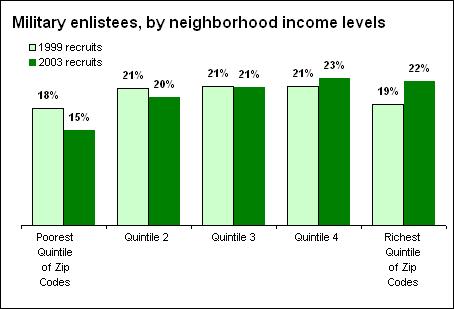
Its always interesting when someone successfully challenges a widely-held assumption.  Like much of America, I have always accepted the notion that the all-volunteer army attracted a disproportionate number of poorer enlistees.  This made sense, since a large part of the recruiting message is one of education and opportunity, which should be powerful inducements to folks trying to get themselves out of poverty.  A few have argued that this is not true, that messages of duty, honor, and country resonate with all classes, but we have all been trained of late by the cynical media that those are dated and powerless concepts.  The main difference in perception about army demographics has been between those who thought the perceived demographic skew was bad and those who thought it just was.  A number folks of late have actually supported a draft due to this perception of a demographic bias.

So it was interesting to see this study by Tim Kane, as unearthed by Mark Tapscott, that tends to explode this myth.  Not having family income data for army enlistees, the study chose as a reasonable proxy the relative wealth of their home zip code.  Based on this methodology, we find that the all-volunteer army actually skews rich rather than poor:

Military_demographics

As with all studies like this, I caveat that I have not seen their methodology, etc. etc.  However, it is interesting in that it is completely opposite of public perception.  Since I didn't really find anything horrible about the old perceived skew, this study doesn't change any of my opinions on the army or the draft, but it will be interesting to see if Charlie Rangel reverses course and starts criticizing the army for being a rich kid's boondoggle.

Louisiana Reconstruction Disaster

If you didn't see it on Instapundit, LSU professor Jeffrey Sadow has a great post on the huge corrupt porkfest that is being proposed in Louisiana:

  • The $250 billion [in proposed federal aid] is not far behind the $350 billion
    estimated spent on the military aspects and their aftermath of the war
    of terror since Sep. 11, 2001 "“ which means in reconstruction terms
    (leaving out the actual war-making expenses), Louisiana actually is
    asking for more than countries with 10 times its population which face
    far more damage.
  • The $40 billion [in proposed Corps of Engineering spending for Louisiana] is ten times the annual
    Corps budget, and 100 times the annual amount typically received by
    Louisiana which gets more such funding than any other state.
  • Also, it is nearly three times the size of the entire request for coastal restoration efforts in the state.
  • He concludes:

    So, let's get this straight. Louisiana, from some of her federal officials through some state officials all they way down to city and other local governments,
    countenanced negligence from benign to irresponsible in ensuring proper
    flood protection and in dealing with hurricanes. And now these same
    people have formulated a plan wanting the country to pay an incredible
    sum of money to the state controlled by people from the state to deal
    with the aftereffects and, apparently, Louisiana's past inability to
    utilize our resources efficiently in other areas?

    The rest of the country is going to look at this and think we're still stuck on stupid.

    Glenn Reynolds also has a long post with other good links on the topic here.  I particularly liked this bit he quotes from John Fund:

    Put bluntly, the local political cultures don't engender confidence
    that aid won't be diverted from the people who truly need and deserve
    it. While the feds can try to ride herd on the money, here's hoping
    folks in the region take the opportunity to finally demand their own
    political housecleaning. Change is past due. Last year, Lou Riegel, the
    agent in charge of the FBI's New Orleans office, described Louisiana's
    public corruption as "epidemic, endemic, and entrenched. No branch of
    government is exempt."

    Louisiana ranks third in the nation in the number of elected
    officials per capita convicted of crimes (Mississippi takes top prize).
    In just the past generation, the Pelican State has had a governor, an
    attorney general, three successive insurance commissioners, a
    congressman, a federal judge, a state Senate president and a swarm of
    local officials convicted. Last year, three top officials at
    Louisiana's Office of Emergency Preparedness were indicted on charges
    they obstructed a probe into how federal money bought out flood-prone
    homes. Last March the Federal Emergency Management Agency ordered
    Louisiana to repay $30 million in flood-control grants it had awarded
    to 23 parishes

    Update: Lots more at Porkopolis

    Louisiana population is 4,468,976, not all of which was
    affected by the hurricane. A reasonable assumption is to say that half the
    population was in the path of the hurricane
    . That would be about 2,234,488,
    but to keep calculations simple we'll round up the affected population to 2,
    500,000. That 2.5 million of affected Louisiana residents will make for an easy
    calculation

    $250 billion divided by 2.5 million affected residents
    results in a disaster relief request of.....(drum rooooooooooll)...$100,000 per person!

    And these juicy details:

    • $100 million for "psychological trauma response early intervention,
      prevention, and disorder treatment by culturally competent counselors and mental
      health professionals for children who are 0 to 5 years of age; see page 38, line
      1.
    • $100 million for mosquito abatement; see page 39, line 12.
    • $1 billion "shall be used for a program to aid the travel and tourism
      industry"; see page 45, line 17
    • $5 million for Project Serv under the Safe and Drug-Free Schools and
      Communities Act; see page 49, line 13
    • NOAA weather radio for every eligible person; see Sec. 526 .

    Occasioning this statement:

    "It's all vital," said Landrieu. "There's not
    anything in here that we would consider a wish list or pie in the sky. This is
    what we really believe is essential."

    This is just the macro-scale version of this, business as usual in Louisiana:

    Police found cases of food, clothes and tools intended for hurricane
    victims in the backyard, shed and rooms throughout the home of a chief
    administrative officer of a New Orleans suburb, officials said
    Wednesday.

    Police in Kenner searched Cedric Floyd's home Tuesday because of
    complaints that city workers were helping themselves to donations for
    hurricane victims. Floyd, who runs the day-to-day operations in Kenner,
    was in charge of distributing the donations.

    The donations, including lanterns, vacuums and clothes with price
    tags attached, had to be removed in four loads in a big pickup truck,
    Kenner police Capt. Steve Caraway said.

    "It was an awful lot of stuff," he said.

    Technorati Tags:  ,

    Porkbuster Letter

    Porkbusterssm

    Here is a copy of the letter I sent to my representative John Shadegg as part of the PorkBusters campaign:


    Representative
    John Shadegg
    Arizona
    3rd District

    306
    Cannon H. O. B.

    Washington,
    DC  20515

    Congressman
    Shadegg:

    I
    am a blogger who lives and runs a business in your district.  I know
    that you were one of only 8 people in Congress to vote against the
    recent pork-laden highway bill, something I congratulated you for on
    my blog.  I now want to encourage you to continue fighting to reign
    in government spending.  I am frankly flabbergasted to see the
    current Republican leadership in Congress working so hard to resist
    fiscal sanity, and am amazed that the Republican Party could have
    drifted so far from its philosophical roots.

    I
    know that there are tremendous pressures on you to play the game with
    everyone else in Congress, and bring home your share of pork to your
    district.  Often those in your district will root for you to cut
    other people's pork but not their own.  Let me say that I am totally
    supportive of your cutting our 3rd district pork first, as
    a message that everyone needs to contribute to the spending cuts the
    President has called for to pay for Katrina-related expenses.  You
    are probably aware that many of us in the blogging world have banded
    together in the "Porkbusters" effort to signal our desire to cut
    pork by identifying our own local earmarks for cuts first.

    Technorati tag:  .