Shareholder Suits

Last week, Tyco's Dennis Kozlowski was found guilty of looting the shareholder's assets for his own personal gain.  Good.  Too many CEO's treat public companies as their own, rather than other peoples' companies for which they have fiduciary responsibility.  And, unlike the Dick Grasso mess I commented on earlier, this was a much clearer case of looting as opposed to just negotiating themselves a good deal.  (updateStephen Bainbridge has a different take here)

According to the Wall Street Journal, which requires a subscription:

The guilty verdicts are in for L. Dennis Kozlowski and Mark H. Swartz. For Tyco International Ltd., the company they looted, there may be more court dates to come.

Tyco was hit with dozens of shareholder lawsuits in
2002 and 2003 as the company disclosed waves of accounting problems
that sank its stock. It has restated results several times, going as
far back as 1998. A July 2003 restatement cut about a billion dollars
from pretax profit over several years.

The convictions
lend credence to the plaintiffs' allegations that Tyco was grossly
mismanaged. The suing shareholders already have a strong leg to stand
on: Tyco's string of past restatements amount to an admission that its
accounting was deeply faulty. Shareholders claim they were deceived by
accounting practices that presented rosy pictures of the performance of
the company and its acquisitions, then suffered losses following the
revelation of allegations against Mr. Kozlowski and the restatements.

I have never been able to justify most lawsuits by shareholders against companies in which they own shares.  Any successful verdict would effectively come out of the pockets of the company's owners who are.. the shareholders.  So in effect, shareholders are suing themselves, and, win or lose, they as a group end up with less than if the suit had never been started, since a good chunk of the payout goes to the lawyers.  The only way these suits make financial sense (except to the lawyers, like Bill Lerach) is if only a small subset of the shareholders participate, and then these are just vehicles for transferring money from half the shareholders to the other half, or in other words from one wronged party that does not engage in litigation to another wronged party who are aggressively litigious.  Is there really justice here?

OK, you could argue that many of these shareholders are not suing themselves, because they are past shareholders that dumped their stock at a loss.  But given these facts, these suits are even less fair.  If these suits are often made by past shareholders who held stock at the time certain wrongs were committed, they are paid by current and future shareholders, who may well have not even owned the company at the time of the abuses, and may in fact be participating in cleaning the company up.  So their argument is that because the company was run unethically when I owned it, I am going to sue the people who bought it from me and cleaned it up for my damages?  Though it never happens, the more fair approach would be for current shareholders to sue past shareholders for the mess they left.

The vast majority of these suits are dreamed up by attorneys for the benefit of attorneys.  They help shareholders not at all.

Postscript: There are a couple of circumstances where these suits are entirely justified.  The two that come to mind are:

  • Suing a particular group of shareholders who somehow got disproportionate rights in the company or disproportionately benefited financially at the expense of other common shareholders.  A good example would be suing the Rigas family at Adelphia Communications for hosing the minority shareholders.  Note, however, I am talking not about suing the company, but suing certain owners who abused minority shareholders to their benefit.
  • Suing to modify certain governance rules that are seen to be unethical or illegal.  I would hope this would be a last resort after trying a number of proxy fights and other remedies, but this can in certain circumstances be the last protection of minority shareholders abused by the majority.

Warning Sign Liability

This is something our company has encountered a couple of times now:  There is apparently danger nowadays in posting warning signs.  Apparently, courts and juries are taking the position that by posting any warning at all, you are communicating to the public that you are taking on the task of warning them about any possible danger.  Then, when someone gets hurt by something you did not warn them about, they can argue that you are liable. Via Overlawyered:

Putting up signs warning visitors of the dangerous rip currents off New Jersey's
Long Beach might seem like an obvious step. "However, Long Beach Township
Attorney Richard Shackleton said there are liability issues to consider.
According to the law, the town does not have to warn people about natural
conditions, and if Long Beach put up a sign and a jury found its warnings to be
inadequate, the town could possibly be found liable for a drowning or injury.
Having no signs, he said, reduces the risk of being sued."

We have similarly had our attorneys and/or insurance inspectors recommend we take down a number of warning signs for this reason.  I have no idea how this outcome can be in the public interest.

Why Won't Ethanol Just Go Away?

Lynne Kiesling points out that, like swallows returning to Capistrano, a new energy bill debate in Congress has brought out the Ethanol advocates.  Lynne takes several good swipes at this stupidity:

I actually just heard John Thune say that ethanol is a clean fuel that will
lessen our dependence on foreign oil. Spare me. Ethanol is neither clean nor a
silver bullet to make us self-sufficient in energy. Ethanol production is
filthy, just as dirty as other manufacturing processes, particularly when you
take into account the appalling effects of fertilizer runoff killing fish in the
Gulf of Mexico when growing the corn for the ethanol. Why don't the Senators
from Louisiana open up a can of whup ass on this one?

Reducing dependence on foreign oil is a specious objective when you recognize
that oil is traded in integrated world markets and we are not low-cost
producers. So even if we reduce our oil consumption the marginal barrel of oil
will still come from somewhere in the Middle East. That won't change. Reducing
our consumption would be likely to reduce oil prices (but only marginally,
because China's demand is the big price driver right now) and would be good from
a conservation perspective, but it won't change the fact that we import oil from
places we don't think we can trust.

What she does not mention, probably because she is tired of repeating the obvious, that most careful studies show that producing ethanol requires as much or more energy than it provides.  In other words, it takes more than a barrel of oil to make the fertilizer, run tractors, harvest the corn, take it to market, and process it into a enough ethanol to replace a barrel of oil. 

To prove this, I would point to a lot of studies from ethanol opponents, but I will instead use data from an ethanol supporter.  From this biofuel support site:

In the US most ethanol is
made from corn (maize). A US Department of Agriculture study concludes
that ethanol contains 34% [sic, see below] more energy than is used to grow and harvest
the corn and distill it into ethanol.

Here are a couple of observations.  First, 34% is incorrect.  The first paragraph of the study they link says 24%, not 34%.  Second, this is the only study I have ever seen that shows the energy balance positive, which may be because it is from the Department of Agriculture and not the Department of Energy.  Third, to get to even this small positive balance, their number is based on the theoretical best number if every single stage of the agriculture and production process uses best known practices.  Using current practices that are actually in place in the production chain, even this study says the energy balance is probably negative.  Fourth and finally, 24% is pathetic.  Supporters imply that one gallon of ethanol replaces one gallon of oil.  It does not -- using these numbers, and factoring the .8 gallon of oil needed to produce that one gallon of ethanol, then one gallon of ethanol replaces at best only .2 gallons of oil.  This means that if we subsidize ethanol 30 cents per gallon (which is probably low) then the effective subsidy per gallon of gasoline replaced, which is what is relevant, is $1.50!  Ouch! And remember, this is based on ethanol's supporters numbers.  Based on most everyone else's numbers, the subsidy per gallon replaced is infinite.

Ethanol subsidies do nothing to add energy to the US market and just pass tax dollars to Archer Daniels Midland and other similar Ag conglomerates.  Stupid, stupid, stupid.  The only thing uglier than these distortions in the energy bill is the scene of Republican and Democratic candidates falling over themselves every four years to support these subsidies in order to compete in the Iowa caucuses.

More Suggestions for Helping Africa

Reason has a good article on helping Africa.  To some extent, their arguments echo the ones I made in my previous post:

Despite political pressures, increasing the U.S. foreign aid budget would be a
mistake. The true cause of Africa's poverty is the continent's long history of
crippling misgovernance"”a problem that is exacerbated by rich countries' trade
protectionism, particularly with respect to agriculture....

The aid is ineffective because of the appalling way in which Africa is
governed. In recent decades, of each dollar given to Africa in aid, 80 cents
were stolen by corrupt leaders and transferred back into Western bank accounts.
In total, Nigerian President Olusegun Obasanjo estimated, "corrupt African
leaders have stolen at least $140 billion from their people in the [four]
decades since independence." All that is left when these regimes eventually
collapse is a massive public debt.

The article discusses how US and European agricultural subsidies really hurt the poorest nations:

While advocates of current market-distorting agricultural policies do not
intend to harm developing nations, the collective effect of U.S. farm policies
is devastating for producers of agricultural goods worldwide. American farm
policies might provide short-term benefits for agricultural producers in the
U.S., but those benefits are more than offset by the cost to American consumers
who pay higher taxes to support the U.S. farmers and higher prices for
agricultural products. Meanwhile, U.S. tariffs, quotas, and export subsidies
exacerbate poverty in regions like sub-Saharan Africa where people are heavily
dependent upon agriculture....

U.S. agriculture policy undermines U.S. efforts to alleviate poverty because
it drives down global agricultural prices, which in turn cost developing
countries hundreds of millions of dollars in lost export earnings. The losses
associated with cotton subsidies alone exceed the value of U.S. aid programs to
the countries concerned. The British aid organization Oxfam charges that U.S.
subsidies directly led to losses of more than $300 million in potential revenue
in sub-Saharan Africa during the 2001/02 season. More than 12 million people in
this region depend directly on the crop, with a typical small-scale producer
making less than $400 on an annual cotton harvest. By damaging the livelihoods
of people already on the edge of subsistence, U.S. agricultural policies take
away with the right hand what the left hand gives in aid and development
assistance.

Aid to Africa

I'm blogging here at about 300 baud so I will have to, for once, keep it brief.  There appears to be a fair amount of momentum building to do "something" about conditions in sub-Saharan Africa, which have sucked, still suck, and will probably continue to suck without some help. 

Unfortunately, many of the usual suspects are pushing the "US does not send enough aid" line as the main failure mode for Africa.  A full fisking of this will have to wait for a better connection, but suffice it to say that we have already dropped billions in direct aid and billions more in loans and loan forgiveness, without much benefit.

Who do you give the aid to?  The vast majority of sub-Saharan governments are full of corrupt looters, who will always find ways to put most of the aid money in their own pocket and those of their cronies.  Just look at what happened to oil for food money in Iraq, and that money had MUCH better oversight than the money that goes to Africa. 

Even when the aid does not come in easily looted currency, but rather in food or vaccines distributed by NGO's, the aid can help support totalitarianism and even genocide in disturbing ways.  The problem in Africa are the same that financial aid faces anywhere,
ie:  NGO's can only go where the dictator allows.  Dictators only allow
NGO's to go to towns or regions that support him, limiting access and
starving out other areas of the country.  Food aid also hurts local
farmers by depressing local prices.  To some extent, well-meaning NGO's
fulfill the role of Carmella Soprano, helping the brutal criminal she
is married to maintain a facade of stability and normality to the
outside world.

Zimbabwe is a classic example.  People are clearly suffering there, but it is just as clear that any aid given to the people there just give comfort and additional power to Robert Mugabe, who has single-handedly engineered the current disaster.

The first thing we need to do in Africa is drop our trade barriers with them.  More than ephemeral aid, they need the chance to build real businesses and real markets, and the US is the only real candidate (the EU certainly won't do it unilaterally).  Its insane to me that a few Carolina-based Senators are so terrified of competition from these nations, and have to date blocked this obvious move.

The second thing we need to do is to find a country and make an example of it.  Lets find a single country that has a reasonably freedom-oriented government with (for Africa) moderate levels of corruption and lets focus our aid and effort at them -- lowered tariffs, aid, pressure for more liberalization, loans, vaccines, the works.  African countries have had negative reinforcement for bad government for years - lets try positive reinforcement, making it clear that democracy and good government can provide an entre to prosperity and to participation in the world community.

More on School Choice

A while back, I made a plea to the left to "come to the dark side" and consider school choice.  In this post, I didn't argue about quality or efficiency improvements, but about diversity:

At the end of the day, one-size-fits-all public schools are never
going to be able to satisfy everyone on this type thing, as it is
impossible to educate kids in a values-neutral way.  Statist parents
object to too much positive material on the founding fathers and the
Constitution.  Secular parents object to mentions of God and
overly-positive descriptions of religion in history.  Religious parents
object to secularized science and sex education.  Free market parents
object to enforced environmental activism and statist economics.   Some
parents want no grades and an emphasis on feeling good and self-esteem,
while others want tough grading and tough feedback when kids aren't
learning what they are supposed to.

I have always thought that these "softer" issues, rather than just
test scores and class sizes, were the real "killer-app" that might one
day drive acceptance of school choice in this country.  Certainly
increases in home-schooling rates have been driven as much by these
softer values-related issues (mainly to date from the Right) than by
just the three R's.

So here is my invitation to the Left: come over to the dark side.
Reconsider your historic opposition to school choice.  I'm not talking
about rolling back government spending or government commitment to
funding education for all.  I am talking about allowing parents to use
that money that government spends on their behalf at the school of
their choice.  Parents want their kids to learn creationism - fine,
they can find a school for that.  Parents want a strict, secular focus
on basic skills - fine, another school for that.  Parents want their
kids to spend time learning the three R's while also learning to love
nature and protect the environment - fine, do it...

Today, Jeff Jacoby, via Cafe Hayek, is making much the same argument:

From issues of sexuality and religion to the broad themes of US history and
politics, public opinion is fractured. Secular parents square off against
believers, supporters of homosexual marriage against traditionalists, those
stressing ''safe sex" against those who emphasize abstinence. Each wants its
views reflected in the classroom. No longer is there a common understanding of
the mission of public education. To the extent that one camp's vision prevails,
parents in the opposing camp are embittered. And there is no prospect that this
will change -- not as long as the government remains in charge of educating
American children....

Imagine how diverse and lively American education would be if it were
liberated from government control. There would be schools of every description
-- just as there are restaurants, websites, and clothing styles of every
description. Parents who wanted their children to be taught Darwinian evolution
unsullied by leaps of faith about an Intelligent Designer would be able to
choose schools in which religious notions would play no role. Those who wanted
their children to see God's hand in the miraculous tapestry of life all around
them would send them to schools in which faith played a prominent role.

Sounds good?  Well, unfortunately, as Cafe Hayek points out, Stacy Schiff in the NY Times recently went off on an anti-choice screed.  Not just anti-school-choice, but anti-all-choice, and readers were writing in in droves to agree!  Jeez, do people really want less choice? And just because you are too lazy to handle responsible decision-making, do you really want to limit my choice as well?  And by the way, who is going to be the official cull-er of choice, and what guarantees do you have that those officials will make the same decisions as you in culling choice?  Virginia Postrel has more thoughts on choice.

The bottom line of choice is that many of those in power do not trust you to make your own choices.  I wrote on distrust of individual decision-making here.  In my article on school choice, I ended with this caution:

Of course, there is one caveat that trips up both the Left and the
Right:  To accept school choice, you have to be willing to accept that
some parents will choose to educate their kids in a way you do not
agree with, with science you do not necessarily accept, and with values
that you do not hold.  If your response is, fine, as long as my kids
can get the kind of education I want them to, then consider school
choice.  However, if your response is that this is not just about your
kids, this is about other people choosing to teach their
kids in ways you don't agree with, then you are in truth seeking a
collectivist (or fascist I guess, depending on your side of the aisle)
indoctrination system.  Often I find that phrases like "shared public
school experience" in the choice debate really are code words for
retaining such indoctrination.

Update: I feel compelled to include this quote from Radley Balko:

Critics of capitalism once predicted that free markets would wreak mass
starvation, depletion of resources, pollution, and death.

They're now reduced to bitching about too many flavors of mustard.

We've won the debate.

Blogging from Wyoming

For the next few days, I will be trying to blog from my parent's ranch in Wyoming.  The ranch is 25 miles by dirt road from a town of 2000 people, so it's tad isolated.  We do have phone service, but for a number of miles the phone lines are just draped over a fence.  On a good day, I get about 16K speed, but that can drop to about 200 baud when the cows are chewing on the line (no, I'm not making that up).

Ranch4s   Ranch2s

The Public Be Damned

You still hear William Henry Vanderbilt's quote all the time today.  Generally, it is used to comment on situations where public companies dishonor themselves by fraudulently providing poor products and services.  Interestingly, doing a Google search on the term, I also see a lot of usage for it as applied to government as opposed to industry.

Anyway, it is ironic that the origins of the quote are very different than the current usage.  Vanderbilt's New York Central had just canceled an experimental high-speed high-service train from New York to Chicago.  A reporter asked him "Don't you run it (the train) for the public benefit?" and Vanderbilt very reasonably replied:

The public be damned.  I am working for my stockholders. If the public want the
train, why don't they pay for it?

In reality, Mr. Vanderbilt was eliminating a product that had proven unpopular in the marketplace.  His notion of fiduciary responsibility is not only appropriate, but in certain contexts can be argued to be legally required, at least today.  If some reporter today was stupid enough to ask the CEO of a failed dot-com this question (ie, why are you going out of business, why don't you just keep losing money for the public good) would we really criticize the CEO for giving the moron a smartass answer?  Accepting that Mr. Vanderbilt's answer was wrong is to accept that Mr. Vanderbilt should be a slave to public opinion, not as expressed by individuals in their purchasing decisions, but as expressed by an ill-defined elite who seemed to support the service for its aesthetic value.  And by the way, how had a service that didn't even exist a decade earlier, and only existed through the creativity of the NY Central, suddenly become an essential public service and expectation?

By the 20th Century, the high speed Chicago to New York express train  was bread and butter to the NY Central and its arch-rival the Pennsylvania.  In the end, cutting this service turned out to be just a temporary suspension of a product ahead of its time.

Remind Me, Why is Dick Grasso on Trial?

Aspiring Governor, self-proclaimed substitute for the SEC, and enemy of Antarctica Eliot Spitzer is about to start a criminal trial against Dick Grasso, former head of the NY Stock Exchange (NYSE). 

And I have no idea why. 

Certainly it has something to do with Mr. Grasso's pay, which Mr. Spitzer thinks was too high.  The NYSE, for those who may be confused, is a private institution owned by some of the richest and supposedly financially savviest people in the country.  The owners or seat-holders select a board of directors, who in turn approved Mr. Grasso's pay package.  I imagine that there are folks who think that the stock exchange is a public institution or uses public money, but it is not and does not, though it does have some quasi-regulatory responsibilities.

The best I can figure it, Mr. Spitzer is arguing that Mr. Grasso somehow tricked these babes-in-the-woods on the board, which include naive and inexperienced people such as CEO's of Fortune 50 companies, heads of investment banks and brokerage firms, and a former US Secretary of State.  Now, I can imagine that the government might have an interest if Mr. Grasso somehow cooked the books to inflate his pay fraudulently.  In fact, the director of HR has admitted he did not give the board all the relevant information, but board members have already said that they did not rely on this person for their information.  Remember that most of the folks on the board themselves get paid in a similar league as Mr. Grasso's pay, so most saw it as a competitive offer, at least until negative publicity caused all the cockroaches to run for cover.

So Mr. Spitzer is starting criminal proceedings against people who he thinks negotiate too well for themselves or are paid more than they are worth.  I am sure glad he wasn't doing this 15 years ago.  I remember getting hired as a new Business school grad at McKinsey & Co. as a consultant for some ridiculous amount of money, and thinking "I can't be worth that!  I don't know anything!  Are they really paying me to tell experienced CEO's what to do?"  Boy, what panic I would have had if I had known there was an AG out there looking to send overpaid people to jail!

The WSJ has a really fascinating editorial that I will link to, though a paid subscription is required (update:  Try this link instead, it may get you there free or maybe here).  The overall picture is one of, if there was a crime at all, the wrong people are on trial.  Here is a taste:

In early June of 2003, when the
membership of the [NYSE] compensation committee changed, the Webb interviews
begin to tell a story of wider board dysfunction. And if there was a
screw loose in this new operation it appears to be not Mr. Langone --
who by all the interview accounts ran a tight ship -- but his
successor, [former New York State Comptroller Carl] McCall. This is a vital point, given that Mr. Spitzer, a
fellow Democrat, did not name Mr. McCall in his lawsuit. What toppled
Mr. Grasso was not the $139 million payment the board approved in
August of 2003 but the later news that Mr. Grasso was owed $48 million
more. Many board members said they didn't know about this payment and
for that many blame Mr. McCall.

The interview notes are rife with comments that Mr.
McCall had little inclination or ability to understand the contract he
took over negotiating. An outside consultant, William Mischell, said
that when he and Mr. Ashen explained the contract to Mr. McCall, "the
meeting . . . lasted somewhere between 15 to 30 minutes, with McCall
making or taking phone calls throughout and not really focusing on the
details." Mr. McCall himself told investigators that "the subject of
executive compensation was entirely foreign to him" -- yet he refused
offers of help to explain the contract to others. When asked why Mr.
McCall was chosen to chair the committee rather than someone more
knowledgeable, Mr. Karmazin told the Webb team that it was an "image
thing" (the NYSE had just instituted new governance standards).

Mr. McCall's excuse for not giving directors
"additional details" about the $48 million or other aspects of the
contract -- which were clearly stated in the text -- is that "he was
not aware of any." That's because, as he admitted, he didn't read the
full document, even before he signed it. Moreover, at least one
director, Van der Moolen's Mr. Fagenson "asked McCall twice to make
certain that all pension plans and other plans were going to terminate
on this date, but stated he never received any updates from McCall on
these issues."

As Mr. McCall went to brief the full board on Aug. 7,
2003, he was given talking points that referenced the extra $48 million
but didn't read these or tell the board. J.P. Morgan Chase CEO William
Harrison noted that Mr. McCall "did not appear to understand the
proposed payout very well. . ." Avon CEO Andrea Jung noted that "McCall
struggled" and that "others were more able to answer questions." Mr.
Karmazin described Mr. McCall as "flustered," and said he did a
"horrible job" of explaining the numbers. Leon Panetta, former Clinton
White House chief of staff, speaking of a later McCall performance, was
blunt: "Carl knew nothing."

The article sums up the Board this way:

The board, which was often
dysfunctional, was stocked with celebrities from diverse
constituencies, many of whom didn't understand the NYSE or take their
responsibilities seriously. Former New York State Comptroller Carl
McCall, who brought Mr. Grasso's contract to fruition, was viewed by
his colleagues as incompetent and, in the words of Goldman Sachs CEO
Henry Paulson, not "financially sophisticated." Former Secretary of
State Madeleine Albright felt she shouldn't "question" the pay; Bear
Stearns CEO James Cayne admitted he "tuned out" of the pay proceedings;
and Van der Moolen Vice Chairman Robert Fagenson suggested the only
real concern was "how this was going to reflect on the Board."

But the interviews also make clear that more astute
board members, such as Mr. Langone, former Viacom President Mel
Karmazin, and former Merrill Lynch Chairman David Komansky, took it
upon themselves to understand Mr. Grasso's contract, and offered strong
arguments for why they'd paid him as they had. "We knew what we were
doing when we paid him. We did it purposely, and we believed it was the
right compensation," Mr. Komansky said in his interview

In this environment, Grasso is culpable, how?

Where Our Founding Fathers Extremist?

Certainly King George III would have considered our founding fathers extremist.  But apparently, they may be considered extremist even today, at least by the left.

In my earlier post on Janice Rogers Brown, I quoted JRB saying:

"Where government moves in, community
retreats, civil society disintegrates. . . . When government advances . . .
freedom is imperiled, civilization itself [is] jeopardized."

I noted that both the NY Times and the People for the American Way use this quote to say that JRB is "extremist".  I said, in response, "I bet I could find about 20 similar quotes in the Federalist Papers or from other contributors to the US Constitution."  Of course, I was too lazy to go looking for quotes, but Gary Galles of the Mises Blog was not.  He has hunted down many examples, but I will quote his work on the JRB quote above:

Janice Rogers Brown: "Where government advances"”and it advances
relentlessly"”freedom is imperiled...When did government cease to be a necessary
evil and become a goody bag to solve our private problems?"
Thomas
Paine
: "Society in every state is a blessing, but Government, even in
its best state, is but a necessary evil; in its worst state, an intolerable
one."
George Mason: "Every society, all government, and
every kind of civil compact therefore, is or ought to be, calculated for the
general good and safety of the community. Every power, every authority vested in
particular men is, or ought to be, ultimately directed at this sole end; and
whenever any power or authority whatever extends further...than is in its nature
necessary for these purposes, it may be called government, but it is in fact
oppression."
Thomas Jefferson: "˜What more is necessary to
make us a happy and a prosperous people?...a wise and frugal Government, which
shall restrain men from injuring one another, shall leave them otherwise free to
regulate their own pursuits of industry and improvement, and shall not take from
the mouth of labor the bread it has earned. This is the sum of good
government..."

Go read them all.  And remember, he is taking all the JRB quotes right off the People for the American Way site, who have posted the quotes to scare us about what an extremist she is.

Mens Underwear Recomendation

OK, this may be a bit bizarre, but believe me, when you live in a climate that routinely remains between 100-114 degrees for five months, comfortable underwear is a must.  I have tried nearly every type and brand, from briefs to boxers, and have recently discovered some new ones that are great.  They are made by Under Armour, which is an entirely familiar clothing line to everyone here in Phoenix because they handle heat and sweat so well.  My kids live in the Heatgear, though I opt for the Loosegear since I no longer have the body for form fitting clothing. 

The underwear is made of that silky under-armour fabric, but is very comfortable and seems to wick sweat away from your body.  The downside is that they are nearly $20 a pair, but they don't shrink and so far have held up well. 

PS- I know my friend Scott in San Francisco tried a pair as well - he may be able to give us a review in the comments of whether he liked them or not.

Final Note: To those of you who suggest "none", you haven't lived in a really hot climate.  "Freefalling" may be OK on a breezy day on the California coast, but in a Phoenix summer or in my birthplace of Houston, you are going to regret it.

Really Random Tangent: Someone sitting with me in my office this morning commented that "the only reason we think it is hot when it is 98 out is because of our clothes.  If we were naked, 98.6 would be the perfect temperature because that is our body heat."  This is actually a misconception and ignores several principals of thermodynamics.

The key fact is that the body generally is a net producer of heat.  To be comfortable and maintain body heat, the body must shed this heat, which humans do in two ways.  First, we transfer heat to the surrounding air from our skin - to do this well, the surrounding temperature needs to be less than our body heat.  The more differential, the more heat transfer.  Air motion (via wind) provides convective heat transfer, which accelerates this process.  Second, we sweat.  When sweat evaporates, it pulls heat from the surrounding air and adjacent body.  Sweating cools us therefore based on evaporation rates, which is one reason why drier climates are more comfortable -- sweat evaporates faster. 

In addition to shedding the body heat we produce, we also have to shed any heat we pick up by radiative transfer.  Radiative heating is the heat we feel on our skin when we are in direct sunlight, and is why one can be cooler in light than dark clothing (dark colors absorb more radiative heat). 

All this means that if we are naked, in the shade, in a dry climate like Phoenix on a breezy day, we are likely to be comfortable at a temperature closer to 98.6.  In the direct sun in a calm, humid climate, even naked, we are going to want a temperature much much less than 98 to be comfortable.

Followup on Income Inequality

Several people say that I have missed the point in my post here - that the issue is
with mobility, particularly in multiple generations.   They argue that
the rich of the next generation are likely to be the kids of the rich
of this generation, that success now depends on education and
connections that only the wealthiest can buy for their kids.   

A couple of thoughts on this.  First, the Times's own data (plus
many other studies) doesn't bear this out, particularly with new
immigrants.  Thomas Sowell addresses this in more depth here and here,
and suggests that the explanation may lie more in values and
aspirations than in purchased stuff.  Marginal Revolution, for example,
had this thoroughly depressing story featuring a study by Harvard economist Roland Fryer on the social pressures in many African-American and Hispanic neighborhoods to under-perform in school.

My other thought on this is that to the extent social mobility is
slowing in this country, our public education system is a major
culprit.  Forget for a moment about quality issues.  Schools have
increasingly emphasized self-esteem over achievement and competition.
Standards are lowered, and the value of exceeding standards or
improving performance is downplayed.  Without other influences,
students will walk out of public schools with a value system vis a vis
achievement and competition and performance that leaves them totally
unprepared for the real world.  I am reminded of one of Bill Gates' pieces of advice to graduates

Rule 8: Your school may have done away with winners and losers, but life HAS
NOT. In some schools they have abolished failing grades and they'll give you as
MANY TIMES as you want to get the right answer. This doesn't bear the slightest
resemblance to ANYTHING in real life.

Kids with parents who have achieved in some way in the world are likely
to overcome this by the example and exhortations of their parents.  But
what happens to kids without this example?  Or kids (lacking voucher
programs) who can't afford to escape the public school system cult of
mediocrity for high-achievement private schools or home schooling?

Ironically, the very people who bemoan income inequality and lack of
mobility are the very same people who have gutted the public education
system.  These are the people who deal with inequality by flattening
down the peaks, which is exactly what they have done in schools,
eliminating valedictorians and substituting social promotions.

Blogs for Everything

In the spirit of Marginal Revolution's "markets in everything" series, I think I will start a "blogs for everything" series.  One of my favorite early on in this series was the Remote Blog, blogging on home theater remote control issues.

In this episode, we feature the Baby Names Blog, from the Baby Name Wizard.  It has pretty interesting features on names and why they go in and out of style.  And make sure to check out their name voyager, a cool java app on name popularity over the last century.

When we named our first child Nicholas, we soon found that we were on the front edge of a huge Nicholas revival.  For our second child, we wanted something less common, so we chose Amelia, which was way out of favor at the time but now appears to be in a revival as well.  The one thing that stands out from the chart is that 50 years ago, there were a few dominant names: John, Mary, etc.  Now, there are no dominant names.  I think this is signaling a change in parents attitude, from wanting their name to be safe and fit in, to wanting their kids' names to be unique and distinctive.  Certainly this was the case for us.

GM Employee Pricing

When I first heard the GM ad campaign to give consumers access to the same discounts their employees get, I had two reactions:

  • I sure hope that they have some alternative employee incentive lined up.  I remember when I applied to GM as an engineer, this car discount was high on the list of how they sold the job.  Now what are employees thinking, since their employment buys them nothing on this dimension?  They are probably thinking they weren't getting much of a discount if GM can offer that discount to everyone
  • If I were a stockholder, I would be selling, because it sure smacks as desperation.  If you think of all the incentives GM has offered over the years, if they are offering an incentive that is unprecedented in their 80+ year history, then you know there must be some panic in the boardroom

Only GM could come up with a program that makes both employees and shareholders upset.  George's Emploment Blawg has more thoughts along these lines.  This all assumes that "same pricing as employees"  means just that -- remember that this is the industry where "invoice pricing" means nothing of the sort.

Many people have analyzed GM's problems.  It is tempting to say that their main problem is that they have not good cars, but I want to be careful not to substitute my preferences for market research.  So, instead, I will point out a couple of facts:

  • GM makes most of its profit from SUV's
  • All the profit in a car line, given high fixed costs, come from the last 10-15% of the cars produced.

So, as gas prices rise and silly tax loopholes are closed [thanks Mark], SUV sales only need to fall 10-15% to wipe out most of GM's profitability.

Han and Chewie: The Early Years

If George Lucas needs any more money, here is my movie idea for him:  Make a movie about Han Solo and Chewbacca in their early years.  How did a Wookie prince become a smuggler?  How did he meet Han?  How did Han win the Millennium Falcon from Lando?  In my imagination, the movie would be more in the spirit of Raiders of the Lost Ark rather than the most recent star wars movie, putting the emphasis on adventure and action over special effects, Republic politics, and endless light-saber fights.  The only real challenge would be casting the young Han Solo part -- who would be willing to try to replace Harrison Ford?

Does anyone doubt that this would make a fortune, particularly if you teamed Lucas with someone to do the writing?  The series would easily lend itself to a serial format, with multiple episodes, though in that format it might make a better TV show than movie.

Han_chewie

PS-  I got started thinking about this because I saw Star Wars III again this weekend.  As an update to my review:  it did not wear very well.  The back third from the (attempted) arrest of Palpatine forward was still engaging, but the front half actually had me squirming in my seat. The dialog still sucks, the initial mission sequence still makes no sense, and the battle with General Grievous is still just one more gratuitous light saber battle and chase scene.

Why Income Distribution Doesn't Matter in This Country

The NY Times has somehow decided that one of America's real problems is widening income distribution, or more specifically, the exponentially increasing wealth of the top tenth of one percent of US earners.  The series seems to be running to about 47 episodes (actually 10), but a key article is here, entitled "Richest Are Leaving Even the Rich Far Behind,"  There are a number of ways to attack this article.  One is to fisk their really abused and misused numbers, which George Reisman does here on the Mises Economics Blog

Lets accept that the very very rich are getting richer.  So lets move from there to the question of...

"so what?"

The Times is a little weak on the "so what".  I presume that in their intellectual-statist readership,  it is an axiom that rich people suck and rich people getting richer sucks more.  However, it is possible to pull out four things the Times extended editorial-masquerading-as-a-news-story finds bad about increasing income inequality:

  • As the rich get richer, there is less money left for the rest of us
  • The process of the rich getting richer reduces opportunities for the rest of us
  • Having very rich people around make the rest of us feel bad
  • The rich are only getting richer because the rest of us are subsidizing them through tax policy

It has been a while since I have really gotten carried away writing about a topic (at least three or four days) so I will now proceed to address each of these in turn and in some detail.

As the rich get richer, there is less money left for the rest of us.  At the end of the day - this is what is in most people's minds when they decry aggregations of wealth.  There are many, many people in the world, even in this country, who think of wealth as a fixed pie, as a zero sum game where one person's victory requires another persons loss.

If we were living in 17th century France, where the rich nobility got that way by taxing the crap out of the working peasantry, this would probably be an adequate view of reality.  Wealth came from the land and its products, whose supply, given no technology improvements for decades, were both relatively fixed.  This zero sum view of commerce led to a mercantilist view of the world economy, where it was thought that wealth was fixed, and that the only thing that could be done to it was to move it around, or tax it, or steal it, or loot it.

But we don't live in 17th century France.  We live in a modern, dynamic capitalist society where wealth is created.  One proof of this is so obvious that it amazes me anyone clings to the implicit zero sum economy assumption:  Compare the US in 2000 to the US in 1900.  We are so much wealthier top to bottom in our society than in 1900 its not even worth spending much time on the proof.  This is not just in real dollar terms, but in things that affect ones life, from average life span to leisure time to entertainment to technology.  People who live in the poorest 20 percentile today have things -- such as a lifespan over 70, access to cancer cures, cars, computers, VCRs -- that not even the richest one half of one percent had in 1900.  The poorest 20 percentile in this country would be the upper middle class or even the rich in many countries of the world today.

Michael Dell and Bill Gates are both in that evil 1/10 of 1% of richest people.  But how did they get that way?  They made their fortunes by providing me with this incredible tool on my desk that was unimaginable when I was born 40+ years ago, but now is pedestrian.  Right now I am typing on a Dell computer using Microsoft Windows, which I bought from the suppliers for a mutually agreeable price in a totally uncoerced manner.  My computer provides me with thousands of dollars of value - in productivity, in entertainment, in the ability to do new things that could never be done before (e.g. blog).  Most of this value I keep for myself; some, about $1200 in this case, went to the suppliers of labor and materials to build and program this thing.  And a small portion, less than $100, went towards the fortunes of Mr. Dell and Mr. Gates who had the vision to build the businesses they did.  The PC I have creates new value all around:  Thousands of dollars of new value for me the user and  hundreds of dollars in the form of jobs and new markets for suppliers.  Mr. Dell and Mr. Gates keep just a small portion of all that value created.  At some level, they are working cheap. And any one of us, had we had the vision, could have piggy-backed on Mr Gate's or Mr. Dell's wealth creation by buying stock in their firms.

The process of the rich getting richer reduces opportunities for the rest of us.  Since the "zero sum" argument is so easy to disprove, proponents of rich=bad have morphed their argument to this one.  This accusation comes up several times in the NY Times series, but is hard to refute mainly because the authors never explain the mechanism that they think is at work here or show any shred of proof.  The articles cite folks such as Warren Buffett, George Soros, and Ted Turner.  But how has their fortune-making reduced my personal opportunities one iota? 

Do I have less opportunity because Warren Buffet has made good investing decisions?  Heck, one can argue that any American has always had the opportunity to gain wealth in direct proportion to Buffet at any time, merely by buying Berkshire Hathaway stock.

How about Ted Turner.  Do I have less opportunities to improve myself because Ted Turner got rich creating CNN?  I guess I could facetiosly argue that by his creating CNN, others can no longer create a 24-hour cable news service because he has locked up the market, but Fox has disproved even this narrow argument.

What about George Soros?  I guess you could argue that from time to time my Sony Walkman was a buck or two more or less expensive because of some currency game he was playing in the markets, but I don't see how my opportunity has been reduced.  A better argument is that Soros's being wealthy might really threaten my opportunity if only because he funds so many statist-socialist causes with his billions.

In fact, this is one of those black-is-white arguments.  The reality is exactly the opposite.  When most rich people get rich (with the exception maybe of Peter Angelos and other tort lawyers) they do so by creating new value and thereby opportunity.  While all these folks may be really wealthy, in reality the wealth they have amassed is but a small percentage of the wealth and value that they created.  Where did the rest go?  To all of us, of course, in the form of jobs, and tools, and longer lifespans, and better entertainment.

Having very rich people around make the rest of us feel bad.  OK, this sounds like a problem for group therapy, but you see it in print all the time.  The disparity of incomes is "troubling" and could lead to "resentment".  If one were living in Venezuela or Nigeria or some country where, like 17th century France, wealth came from looting rather than the free exchange of goods, then I would agree that the income disparity would be troubling.  Shoot, if people were much wealthier than I because they were using the legal system to loot the rest of us, I would be pissed off (ironically, this is the case with the billionaire tort lawyers, but this is the last group that the Times will ever challenge). 

However, in this country, where most of the very rich got that way through hard work and better ideas, the result of free and uncoerced commerce, why be resentful?  Sure, I would love to have a G-V aircraft and hot Swedish wife [ed note:  oops, my wife might read this] like Tiger Woods, but lacking these, I have zero desire to deny them to Tiger.  I don't even begrudge super-tramp Paris Hilton her millions (but she did inspire me to change my will so my kids don't inherit from me until they are well past their majority).  Heck, I have spent whole vacations touring the discarded toys of the super-rich (e.g. mansions in Newport, RI).  What fun would there be without a moving target to aspire to?

So why do the Times and some many intellectualls legitimize this envy?  This type of envy has driven anti-semitism and in fact all sorts of racism through the ages.

The rich are only getting richer because the rest of us are subsidizing them through tax policy.  Around my house, I joke that everything, at least in my family's opinion, turns out to be my fault.  The equivilent at the NY Times is that everything is Bush's fault, and in particular, the fault of Bush's tax cuts.  The Mises article cited above does a pretty good job of fisking the argument that the tax system post-cuts favors the rich.  I took on took this notion here and here.  The Times "analysis" makes two major mistakes:

  • Social Security Tax hide and seek:  The NY Times article shows the very wealthy paying lower marginal rates than lower level earners.  As I pointed out here, this is entirely because they are including social security taxes in their analysis and that the taxes are capped at $90,000.  If you look at only income taxes, then marginal rates do not drop at higher incomes.

The left's argument here is highly contradictory.  When wanting to make the "rich are not paying enough" argument, they include Social Security taxes, knowing that since those taxes are regressive, they make it look like the rich are somehow getting off easy.  However, when discussing Social Security, the don't want to think of them as taxes - because they want Social Security to be insurance with premiums rather than a transfer program with taxes

  • Bracket Creep: The TImes points out that the income tax rate for the super rich is no higher than the rate for the merely rich or even $100,000 earners.  The implication is that the super rich are somehow getting a better deal.  But in fact, the problem is that the definition of rich, vis a vis taxes, has been lowered through the years.  The whole history of the income tax is to sell a tax as applying only to the very very rich, and then broadening the applicability over time.  The federal income tax followed this path, as has the AMT.  More recently, the top rate on California income taxes is seeing the same creep.  The statist trick is to apply a rate to the super rich, then creep it down so eventually it applies to everyone.  Then, they cry that - hey, the super rich aren't paying more than the middle class, so they institute a new higher super rich rate.  Rinse and repeat.

Conclusion.  I will leave you with the lyrics from Rush's The Trees:

There is unrest in the forest
There is trouble with the trees
For the maples want more sunlight
And the oaks ignore their pleas

The trouble with the maples
(and they're quite convinced they're right)
They say the oaks are just too lofty
And they grab up all the light
But the oaks can't help their feelings
If they like the way they're made
And they wonder why the maples
Can't be happy in their shade?

There is trouble in the forest
And the creatures all have fled
As the maples scream `oppression!`
And the oaks, just shake their heads

So the maples formed a union
And demanded equal rights
'the oaks are just too greedy
We will make them give us light'
Now there's no more oak oppression
For they passed a noble law
And the trees are all kept equal
By hatchet,
Axe,
And saw ...

Update:  Several people said I missed the point about mobility, rather than just the rich getting richer.  I respond to this here.

Disaster in Zimbabwe

I am a little late linking this, but the world is in the midst of one of those pure, tightly controlled experiments to demonstrate the true price of socialism.  And, as usual, no one will learn from it.  Via Jane Galt:

It is depressing to look back at history and see how regularly the same
nice-sounding idea--"let's take the land from the rich people who unjustly own
it and give it to those who need it"--turns into tragedy for everyone. It's even
more depressing to realise that despite the seeming predictibility of the
result, lots of people want to do it anyway.

The Atlantic, which she quote in a follow up post, has more detail:

Mugabe decided on what he called "fast-track land reform" only in February of
2000, after he got shocking results in a constitutional referendum: though he
controlled the media, the schools, the police, and the army, voters rejected a
constitution he put forth to increase his power even further. A new movement was
afoot in Zimbabwe: the Movement for Democratic Change"”a coalition of civic
groups, labor unions, constitutional reformers, and heretofore marginal
opposition parties. Mugabe blamed the whites and their farm workers (who,
although they together made up only 15 percent of the electorate, were enough to
tip the scales) for the growth of the MDC"”and for his humiliating rebuff.

So he played the race card and the land card. "If white settlers just took
the land from us without paying for it," the President declared, "we can, in a
similar way, just take it from them without paying for it." In 1896 Africans had
suffered huge casualties in an eighteen-month rebellion against British pioneers
known as the chimurenga, or "liberation war." The war that brought Zimbabwean
blacks self-rule was known as the second chimurenga. In the immediate aftermath
of his referendum defeat Mugabe announced a third chimurenga, invoking a valiant
history to animate a violent, country-wide land grab...

The drop-off in agricultural production is staggering. Maize farming, which
yielded more than 1.5 million tons annually before 2000, is this year expected
to generate just 500,000 tons. Wheat production, which stood at 309,000 tons in
2000, will hover at 27,000 tons this year. Tobacco production, too, which at
265,000 tons accounted for nearly a third of the total foreign-currency earnings
in 2000, has tumbled, to about 66,000 tons in 2003.

Mugabe's belief that he can strengthen his flagging popularity by destroying
a resented but economically vital minority group is one that dictators elsewhere
have shared. Paranoid about their diminishing support, Stalin wiped out the
wealthy kulak farming class, Idi Amin purged Uganda's Indian commercial class,
and, of course, Hitler went after Jewish businesses even though Germany was
already reeling from the Depression. Whatever spikes in popularity these moves
generated, the economic damage was profound, and the dictators had to exert
great effort to mask it.

Overall, the country has gone from a net exporter of food to outright famine.  For this particular experiment, I am happy to live in the control group.  Stay tuned, as this show is likely to hit the road soon and move to Venezuela

What is "Extreme"?

Per the Washington Post:

But Democrats recited a litany of Brown's controversial statements, including
several from a 2000 speech titled "Fifty Ways to Lose Your Freedom." She said
senior citizens "blithely cannibalize their grandchildren because they have a
right to get as much 'free' stuff as the political system will permit them to
extract." Elsewhere, Brown has said: "Where government moves in, community
retreats, civil society disintegrates. . . . When government advances . . .
freedom is imperiled, civilization itself [is] jeopardized."

Sen. Joseph R. Biden Jr. (D-Del.) told reporters that Brown is "one of
the most extreme nominees that has ever come before the United States Senate in
the 32 years I've been a senator."

OK, so I am an extremist.  Take in particular the last quote from Brown - I bet I could find about 20 similar quotes in the Federalist Papers or from other contributors to the US Constitution.  That quote should be over the front door of the ACLU.  This is the second time I have read statements about her that were intended to scare me off but in fact endeared me to her. The first example was here.

Update:  People for the American Way have other JRB comments that are supposed to scare me, but don't.  Here is an example of what scares PFTAW:

In the New Deal/Great Society era, a rule that was the polar opposite of the
classical era of American law reigned...Protection of property was a major
casualty of the Revolution of 1937"¦Rights were reordered and property acquired a
second class status...It thus became government's job not to protect property
but, rather, to regulate and redistribute it. And, the epic proportions of the
disaster which has befallen millions of people during the ensuing decades has
not altered our fervent commitment to statism.

I am starting to wish she was running for office, so I could vote for her.  Reason has similar thoughts here.

Update #2:  Reason has a profile of her here.  Many more great quotes from her, including this gem:

In a dissent in San Remo Hotel v. City and County of San Francisco
(2002), which upheld the city's sweeping property restrictions, Justice Brown
expanded on that theme. "Theft is still theft even when the government approves
of the thievery," she declared. "The right to express one's individuality and
essential human dignity through the free use of property is just as important as
the right to do so through speech, the press, or the free exercise of religion."

Go Janice, go.

Grade Inflation in the Ivy League

The Boston Globe has an article on John Kerry's recently released Yale grades.  Humorously, after all the sturm and drang of him supposedly being an intellectual titan to George Bush's dim-wittedness, his GPA was actually a notch lower than George's at Yale.  Personally, I could care less - grades are important for getting into grad school or that first job out of college.  I can't even imagine GPA coming up much in assessing one's suitability for a job in his forties or fifties.

Anyway, the point I take from this is more about grade inflation that suitability for the presidency.  Both Kerry and Bush got a selection of D's, C's, and B's, and no A's.  And while these may have not been standout grades, they certainly didn't seem to be out of the norm for the time.  My question:  Does any student today who can fog a mirror in the Ivy League today get grades this low?  My guess is no.

Postscript: By the way, Kerry released his military records (which were the source of the Yale grades) and there does not appear to be any ticking time bombs in it.  In fact, there are several pieces of information that would have helped him in the campaign, including commendations from several of his swift boat vet critics.  Why in the hell did he drag his feet on this and give the Republicans a free campaign issue?

More on Federalism and this Supreme Court

Yesterday I wrote that this Supreme Court confused me - I couldn't find a consistent thread in their federalism-related rulings.  Orin Kerr at Volokh has an explanation that makes more sense to me than any other.  He explains where each justice is coming from, and concludes:

The mathematics of federalism on today's Supreme Court, then, is that the four
Justices who do not favor judicial enforcement of federalism constraints only
need one additional vote to form a majority. Conversely, for the Court to rule
in favor of a federalism limitation, common ground must exist that ties together
the differing viewpoints of all five of the right-of-center Justices. The odds
are that the former will happen more often than the latter, which is why
victories for federalism principles have tended to be rare and on relatively
narrow (that is, symbolic)
issues

The Mises Blog informs me that this notion of "affecting" interstate commerce being sufficient to justify federal intervention originated in 1942 with Wickard v. Filburn.  Apparently the majority was accepting Wickard, though Thomas's dissent that I quoted in my earlier post sure points out how Wickard pretty much demolishes the commerce clause.

So Much for Federalism and the Commerce Clause

I tend to be a pragmatic, rather than a dogmatic, federalist.  What I mean by that is that I support federalism for the pragmatic reason that it tends to slow statism, rather than a dogmatic belief that federalism is somehow morally superior.  Generally, federalism has been good for this country, as it has provided a check to states that go nuts on taxation and over-regulation.  The exodus of businesses from the Northeast in the 60's and 70's and from California more recently are examples of this effect at work, as citizens vote with their feet for the regulatory regime they prefer.

The recent decision on medial marijuana, where the Supreme Court ruled 6-3 that federal marijuana laws trump state medical-marijuana statutes seems to be another nail in the federalism coffin.  One can tell immediately that the ruling is all about federalism (rather than drugs) when you have the spectacle of the three most conservative judges supporting state legalization laws and the most liberal judges ruling for continued marijuana illegality under federal law.  Again reading my handy pocket Constitution (courtesy of Cato), it is hard for me to find where the feds have purview over regulating California home-grown pot smoked in California.  By accepting the argument below, the Supreme Court has basically ruled that the feds can pretty much regulate intra-state commerce, since you can probably make a similar argument in any case:

lawyers for the U.S. Justice Department argued to the Supreme Court
that homegrown marijuana represented interstate commerce, because the
garden patch weed would affect "overall production" of the weed, much
of it imported across American borders by well-financed, often violent
drug gangs

By the way, think about that for a minute.  They are arguing that home-grown weed would "affect" the inter-state commerce of "violent drug gangs".  How would it affect it?  It would reduce their commerce!  So the feds are claiming purview over home-grown pot because it would, what?  Unfairly reduce the inter-state trade of violent drug gangs?

Clarence Thomas makes the point succinctly that accepting this argument is the end of the distinction between inter- and intra-state commerce:

Respondents Diane Monson and Angel Raich use marijuana that has never
been bought or sold, that has never crossed state lines, and that has
had no demonstrable effect on the national market for marijuana. If
Congress can regulate this under the Commerce Clause, then it can
regulate virtually anything and the Federal Government is no longer
one of limited and enumerated powers.

Is it just me, or does this Supreme Court seem all over the place in its rulings?  Maybe you constitutional scholars out there can figure it out.

Update:  More from Reason

More thoughts:  The left complains that the right is trying to create a theocracy via the Supreme Court.  The right argues that it just wants to protect constitutional limits on government, which the left wants to exceed.  I have been and still am suspicious of some conservative judges on the court, but I must say that the way the votes fell in this case certainly hurts the "theocracy" argument.  I would start to believe if it wasn't for the fact that in the next case, if recent history is any guide, everyone will likely reverse their positions again.

Advice to Graduation Speakers

This is the time of year that we get both good and bad reports about graduation speakers.  I think we had Maurice Sendak at my graduation, which was OK.  I also remember that the student body got to vote for one person to receive an honorary degree (rather than the usual criteria for giving the other honorary degrees, which seemed to involve donating a building).  We voted for our UPS driver, who really was one of the most important people in our lives at the time, being our main link to home and the outside world.

Anyway, Ace of Spades has some crude but funny advice for graduation speakers.

Government Is the Leader in "Unfair" Business Practices

I am always amazed at our government, which piously goes after business after business for "unfair" business practices, but never seems to apply the same rules to itself.  My latest example:

Today, I was (finally) granted a liquor license for our store and PWC rental business at Lake Havasu, AZ.  Since the approval process takes so long, I am ready at this point to be happy almost no matter what terms I get the license on.  Unfortunately, the state has rigid dates for licenses - they all expire June 30 of each year.  Since it is June 6 (hey, happy D-Day!) I get a license that runs from Jan 1 to June 30, and so have to renew almost immediately.  But here is the really good part:  They will not pro rate the license cost to June 6.  In other words, I have to pay the full $1000+ for the whole 6 month period, even though I am using only a few weeks.  Sleazy.  I wrote more about the whole liquor license process here

PS-  many will suggest that I just wait and go pay on July 1 for my license.  Well, they thought of that too.  There are rules on the application process such that it has to be completed in a fixed number of days.  If I don't buy the license by June 18, the whole 120-day application process starts over again.

Did Google Change Their Ranking Algorithm Again?

Suddenly, over the last several days, this site has seen a huge increase in Google search hits.  These hits are on a wide variety of articles, and not one in particular.  In following back the search terms on some of these hits, its strikes me that my blog is suddenly oddly high on some search terms that have never hit in the past (by this I mean, higher even than the historical over-ranking of blogs that occurs on Google).  I know that Google changes their algorithms from time to time without notice.  Anyone know if this happened recently.

Browser Market Share? Depends on Who You Ask

I have been a marketer for almost 20 years, and one of the classic mistakes in marketing is to rely too much on your own experience and preferences.  Its often easy to fall into the trap of saying "everyone I know would like that" or vice versa, only to find that "everyone you know" are not necessarily representative of the market as a whole.

When I was a consultant at McKinsey & Co., we often asked people we were interviewing questions like "what is the market size for window glass in Mexico".  The key to successfully completing the exercise was to break the problem down into cascading assumptions, each of which could theoretically be researched and checked.  For example, with the window glass problem, a good answer might be:

The glass market is probably made up of housing, commercial buildings, automotive, and other.  Take the housing market.  Assume 80% of the market is new construction.  Assume the population of Mexico is 50 million, and there are 5 people per home, so there are 10 million homes, and lets assume the housing stock is increased by 5 % a year and that each home has 100 square feet of glass..  etc etc.

It was kind of fun to see if they get to the right answer, but the whole point was to see how they could break down and analytical problem.  The reason I bring up this whole episode was sometimes we would ask our recruits, typically Ivy Leaguers, to come up with the market size for annual snow ski sales.  So they would work through the logic that there are 300 million people in the US and x% ski and these people replace their skis on average every 5 years, etc.  However, it always made me laugh that these folks would be guaranteed to miss the number way, way high.  Why?  Because in coming up with the percentage of people that ski, they would look around the room and say, well 80% of my friends ski and so lets assume 30 or 40 or even more percent of Americans snow ski.  In fact, I have not looked up the number lately, but the actual percentage of Americans that ski is something less than 5%.  Recruits intuition was fooled because, at least in terms of skiing, they were surrounded by an anomalous population.

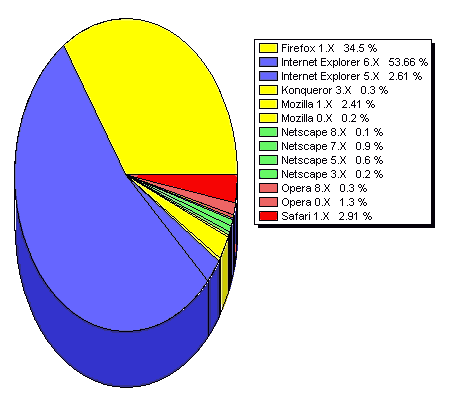
All of this is a long, long, overly long intro into an interesting set of facts around browser share between IE and Firefox.  A while back I wrote that, from my traffic logs for this site, Firefox appears to be killing IE.  In fact, since I posted this, Firefox has gained even more share on this site:

Coyotebrowsershare_1

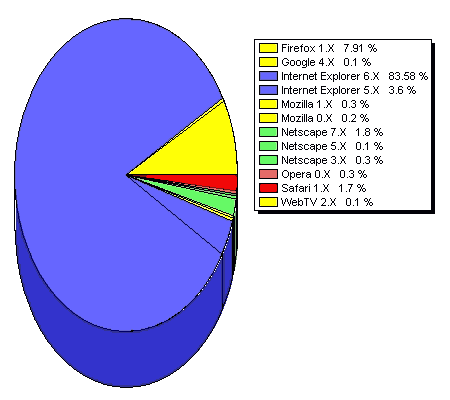
Now, to the issue of this post, one might suspect that my traffic might not be representative of the whole market.  I would argue that blog readers probably are heavier Internet users, more Internet-savvy on average, and therefore more likely to have investigated browser alternatives beyond the one pre-loaded on their PC.  It turns out that I have a way to test this.  I have another group of sites for my business, including sites for Forest Service Campgrounds, Lake Havasu Jetski Rentals, and Campground Jobs.  The readers of these sites tend to be older on average and less computer proficient.  The browser market share at these sites looks like this:

Rrmbrowsershare_1

Wow, that is a huge difference.  Take it from me, its unusual to find a market segmentation that dramatic.  It makes me wonder about all of the talk about blogs replacing the MSM.  How much are we breathing our own exhaust?

Postscript: This is an age-old problem and takes many forms in many businesses.  For example, thousands of farmers have bankrupted themselves in the commodities futures markets making bets on worldwide crop prices based on their local weather and harvest expectations.

Disclosure: Yes, I did take the opportunity to shamelessly Google bomb my own sites.  Sorry.  I don't do it very often, maintaining a pretty solid firewall between my business and blog.