And I Thought OUR Governor Was an Idiot

Cafe Hayek has a fabulous fisking of Missouri governor Matt Blunt's letter to the editor explaining why his call for price controls on gasoline is consistent with his free market principals.  Its all good, I can't pick out any one quote.  Read it all.

But wait!  This just in!  Maybe our governor IS this dumb.

Our great benevolent leader, Janet Napolitano, has stated in press conference
the she is going to investigate these fuel prices of ours. Mostly she was
ruffling her feathers right after Hurricane Katrina shutdown a good 30% of the
domestic supply source. So of course prices increased slightly to account for
the lack of supply. This trend that followed exactly what even very simple
supply and demand theory would predict was not enough to convince miss Gov. J.No
not to call for yet another investigation. No way! She was not going to be
swayed by facts, reality or "assurances from the oil industry" that these were
fair market prices. Nope. An investigation was needed.

A little over a year ago, a pipeline broke and the only source of gasoline into Phoenix was stopped.  Due to EPA regulations, Phoenix requires a special gas blend made in only one refinery coming to us through one pipeline, so it is not surprising that if that source is interrupted, gas might be short here for a while and prices might spike up.  Which they did.  Governor Napolitano at that time blamed the whole situation on the oil industry and called for investigations.  Tellingly, she took only three policy actions:

  • Temporarily waived regulations for a special blend of gas in Phoenix
  • Temporarily waived regulations on truckers that were preventing them from filling in for the broken pipeline
  • Considered circumventing regulations that were preventing a local refinery to serve the Phoenix market from being built.

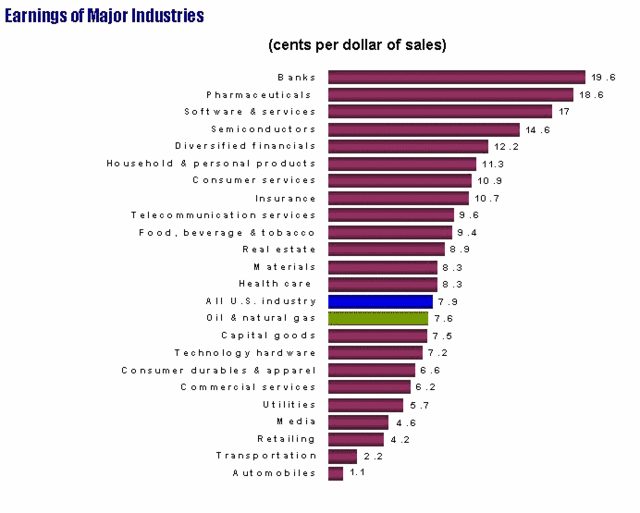
So the rhetoric at the time was "its all the oil companies faults" but the solution was "repeal government regulations".  Hmmmmm.  By the way, the Commons Blog created a nice chart showing how those filthy rich oil companies are making, uh, ahem, lower profits than average for US industry (click to enlarge).  I wish they were more profitable- we would probably have a lot more oil.

Margins1a

My Urban Plan for New Orleans

Cafe Hayek points out that Rep. Earl Blumenauer wants to make sure that New Orleans is rebuilt with a strong urban planning vision.  Since Mr. Blumenauer represents Portland, Oregon, the city beloved of planners that has been planned into having some of the highest priced housing and worst traffic of any city of its size in America, I presume he wants something similar for New Orleans (Portland was also the city that thought it had solved global warming).

Here is my urban plan for New Orleans:  Every person who owns property can build whatever the hell they want on it.  If other people want something else built on that property, and value this outcome enough, they can buy the property from its owner.  This novel concept is called "private property rights" and falls under the broader category of what are called "constitutionally protected individual rights" or even more broadly, "freedom".  It is a concept that used to be taken for granted in this country and but now is seldom even taught in schools. 

For the property owned by the government, well, they are going to build whatever dumbshit thing they want to on it anyway, so I'll just root for their choice to be fairly inexpensive.  We here in Phoenix built a half-billion dollar stadium for the for-god-sakes Arizona Cardinals that is used for its core purpose 3 hours a day for 8 days a year.  It couldn't be worse, could it?

Technorati Tags:  ,

A Nice Irony

With a hat tip to Cafe Hayek, comes this article from the Las Vegas Weekly:

The shade from the Wal-Mart Neighborhood Market sign is minimal around noon;
still, six picketers squeeze their thermoses and Dasani bottles onto the dirt
below, trying to keep their water cool. They're walking five-hour shifts on this
corner at Stephanie Street and American Pacific Drive in Henderson"”anti-Wal-Mart
signs propped lazily on their shoulders, deep suntans on their faces and
arms"”with two 15-minute breaks to run across the street and use the washroom at
a gas station....

They're not union members; they're temp workers employed through Allied
Forces/Labor Express by the union"”United Food and Commercial Workers (UFCW).
They're making $6 an hour, with no benefits; it's 104 F, and they're protesting
the working conditions inside the new Wal-Mart grocery store.

"It don't make no sense, does it?" says James Greer, the line foreman and the
only one who pulls down $8 an hour, as he ambles down the sidewalk, picket sign
on shoulder, sweaty hat over sweaty gray hair, spitting sunflower seeds. "We're
sacrificing for the people who work in there, and they don't even know it."

The union accuses Wal-Mart of dragging down wages and working conditions for
other grocery-store workers across the nation. "Whether you work or shop at
Wal-Mart, the giant retailer's employment practices affect your wages. Wal-Mart
leads the race to the bottom in wages and health-care," says the UFCW's website.
"As the largest corporation in the world, Wal-Mart has a responsibility to the
people who built it. Wal-Mart jobs offer low pay, inadequate and unaffordable
healthcare, and off the clock work."

But standing with a union-supplied sign on his shoulder that reads, Don't
Shop WalMart: Below Area Standards, picketer and former Wal-Mart employee Sal
Rivera says about the notorious working conditions of his former big-box
employer: "I can't complain. It wasn't bad. They started paying me at $6.75, and
after three months I was already getting $7, then I got Employee of the Month,
and by the time I left (in less than one year), I was making $8.63 an hour."
Rivera worked in maintenance and quit four years ago for personal reasons, he
says. He would consider reapplying.

LOL.  Frequent readers will know that I usually feel the need to restate the moral of the story to insure everyone gets it.  I don't think thats necesary here.  More on Walmart and wages here and here.

FEC Suing Club for Growth

In the first of what promises to be the first of a number of lawsuits against 527 groups under the horrendous McCain-Feingold act, the Federal Election Committee is suing the Club for Growth for its television adds in 2000 and 2002.  Essentially, the FEC is attempting to declare the Club for Growth to be under the control of and an arm of the Republican Party, and therefore subject to McCain-Feingold spending and donation limitations. 

This is absurd.  First, current election law and McCain-Feingold are a brazen assault on the first amendment, and shouldn't apply to anyone.  Second, to the extent that they are allowed to be applied to the two major political parties, their reach should be limited as much as possible to allow private citizens full freedom of political speech.

While the Club for Growth often supports Republicans over Democrats, browsing their web site makes it clear that they are by no means a shill for the Republican party.  They are strong supporters of reduced regulation and taxes, and have been just as hard on Republicans of late when Bush, Delay and Company have apparently abandoned these goals.  I have supported The Club for Growth for years and I am by no means a Republican.

Several lefty blogs have gleefully piled on because they don't like the Club for Growth.  This is very very shortsighted.  My sense is that the case against CfG is no better or worse than the case they can have against MoveOn or Soros or whatever.  The CfG suit may well be a Trojan Horse first case to immunize the Bush Administration and the FEC against charges that they are going after the President's critics.  Once immunized, under this theory, lefty organizations will be next. 

Bloggers represent one of the strongest and most vocal constituencies for freedom of speech -- we should be united in opposing this kind of action, whoever it is against.

Update:  More from Reason's Hit and Run

Government: Control over Results

Following up on posts here, here, here, here, and here is yet another in a series on government preference for control over results, this time via Overlawyered.com:

In the midst of administering chest compressions to a dying woman
several days after Hurricane Katrina struck, Dr. Mark N. Perlmutter was ordered
to stop by a federal official because he wasn't registered with the Federal
Emergency Management Agency. "I begged him to let me continue," said Perlmutter,
who left his home and practice as an orthopedic surgeon in Pennsylvania to come
to Louisiana and volunteer to care for hurricane victims. "People were dying,
and I was the only doctor on the tarmac (at the Louis Armstrong New Orleans
International Airport) where scores of nonresponsive patients lay on stretchers.
Two patients died in front of me.

"I showed him (the U.S. Coast Guard official in charge) my medical
credentials. I had tried to get through to FEMA for 12 hours the day before and
finally gave up. I asked him to let me stay until I was replaced by another
doctor, but he refused. He said he was afraid of being sued. I informed him
about the Good Samaritan laws and asked him if he was willing to let people die
so the government wouldn't be sued, but he would not back down. I had to
leave."

In a formal response to Perlmutter's story, FEMA said it does not accept the
services of volunteer physicians:

"We have a cadre of physicians of our own," FEMA spokesman Kim Pease
said Thursday. "They are the National Disaster Medical Team. ... The voluntary
doctor was not a credentialed FEMA physician and, thus, was subject to law
enforcement rules in a disaster area."

So for those of you who draw the conclusion from Katrina that we need more big government rather than less, that would help.... how?

Technorati Tags: 

Kelo Update

After the Supreme Court's Kelo decision that effectively increases the power of local authorities to take whatever poperty they want and hand it over the private developers, a number of outraged politicians began reform efforts to limit takings in their state to true common-carrier public projects.  So what has happened to these efforts?  Virginia Postrel links to this update on California, but I will give you a hint:  They have had about the same level of success that every other effort to limit government power has had of late.

Predictably, local government and redevelopment officials reacted with alarm
that eminent domain could be severely restricted. The California Redevelopment
Association and other advocates geared up to kill the measures and in the
closing days of the legislative session, Democratic leaders ginned up a strategy
to cool off the anti-eminent domain fervor. They unveiled legislation that would
place a two-year moratorium on the seizure of private homes (but not commercial
property), and authorize a study of the practice, thus giving their members a
chance, or so it seemed, to side with the anti-eminent domain sentiment without
doing any real damage to redevelopment agencies.

Quietly, however, the moratorium bills were themselves put on the shelf as
the session ended - with Democrats blaming Republicans. "With every vote, they
tried to derail this prudent response," said Sen. Christine Kehoe, D-San Diego,
who carried one of the moratorium bills.

Kehoe's finger-pointing, however, was more than a little disingenuous since
the stalled bills required only simple majority votes and thus needed no
Republicans to go along. Clearly, this was a Democratic action, not a Republican
one, perhaps just a feint to pretend to do something about eminent domain
without actually doing anything to upset the apple cart.

She also points to this story in San Diego:

First came a report on the San Diego Model School Development Agency's push to
seize and demolish 188 homes in the thriving City Heights neighborhood to build
up to 509 town houses, condos and apartments more to its liking. The 30-acre
site is far from the decaying neighborhood normally targeted in redevelopment,
but blithe agency bureaucrats from the Soviet school of central
planning--knowing they could call the area "blighted" if they chose--didn't
care.

Then came yesterday's jaw-dropping story about National City's plan to use
its powers of eminent domain to force the Daily family to sell a parcel the
family leases to the Mossy family for one of its thriving car dealerships. After
the two sides couldn't agree on a sales price, Mossy representatives made plain
they would move their Nissan dealership--and the $1 million in annual sales and
property taxes it generates for National City--unless the city helped close the
deal. The City Council promptly caved in to Mossy's unsavory hardball tactics
and, in its role as the city redevelopment board, began looking into seizing the
land--after a mysterious epiphany in which members suddenly realized the site
suffered from a heretofore undetected case of "visual blight."

Yep, there's nothing like another large car dealership to fight visual blight.  Maybe San Diego should tear down the Del Coronado hotel and put a car dealership there too.


Fight Arizona Pork

President Bush's call for Katrina spending to be offset by budget cuts has spurred a blogosphere effort to identify local pork urge Congress to cut the pork.  I am 98% behind this effort (the missing 2% being that the effort is spurred by a desire to spend the money somewhere else, rather than sending it back to taxpayers where it belongs).  Glenn Reynolds post that got the ball rolling is here.  His followup posts are here and here.  I will note the irony that I recently compared Don Young (of Alaska bridge to nowhere fame) to Huey Long (of multiple bridges to nowhere fame), given that we are looking to cut Don Young's pork to help Huey Long's old stomping ground.

Porkbusterssm

Edward at Zonitics has already identified one of the most visible chunks of AZ pork, that is our earmarks in the recent highway bill.  These include nearly five million for a couple of pedestrian bridges, plus hundreds of millions for a rail system to run empty trains to compete with our empty buses.  Why does the rest of the country need to pay for Phoenix's growth?  Heck, we just took the money the feds saved us on this junk and spent it subsidizing a stadium for the Cardinals, for god's sakes.   I will note that of the mere 8 people who voted against the highway bill, 2 were from Arizona, including my 3rd district Congressman John Shadegg and libertarian Jeff Flake.  Flake, consistent with his libertarian principles (or in retribution for them?) represents the only district in the country without an earmark in the highway bill.

So, to push the ball forward, I will add another bit of Arizona pork.  I wanted to include some items form the energy bill, but I can't find a state by state impact.  But I can find, thanks to the environmental working group, a nice summary of farm subsidies to Arizona.  Here is a summary for the most recent year they have data:

Rank Program
(click for top recipients, payment concentration and regional rankings)
Number of Recipients
2003
Subsidy Total
2003
1 Cotton Subsidies   1,339   $103,125,972
2 Subtotal, Disaster Payments   1,966   $11,915,428
3 Env. Quality Incentive Program   254   $5,619,853
4 Wheat Subsidies   1,018   $5,192,003
5 Dairy Program Subsidies   128   $4,925,610
6 Livestock Subsidies   1,460   $3,050,869
7 Corn Subsidies   514   $1,500,291
8 Barley Subsidies   729   $660,236
9 Apple Subsidies   17   $271,523
10 Wool Subsidies   1,219   $259,616

And here is the same data but cut by recipient, with just the top 20 included:

1 Colorado River Indian Tribes Farm Parker, AZ 85344 $2,102,881
2 Ak-chin Farms Maricopa, AZ 85239 $1,499,278
3 Gila River Farms Sacaton, AZ 85247 $1,406,582
4 Catron Cotton Co Tonopah, AZ 85354 $1,156,539
5 Tohono O'odham Farming Authority Eloy, AZ 85231 $1,078,480
6 Bia Sacaton, AZ 85247 $1,064,062
7 Eagle Tail Farming Partnership Buckeye, AZ 85326 $1,045,584
8 Tempe Farming Company Maricopa, AZ 85239 $947,811
9 Fort Mojave Tribe Mohave Valley, AZ 86446 $938,843
10 P R P Farms Buckeye, AZ 85326 $899,098
11 G P A Management Group Tempe, AZ 85284 $893,672
12 Gin Ranch 94 Buckeye, AZ 85326 $889,764
13 H Four Farms III Buckeye, AZ 85326 $863,086
14 Brooks Farms Goodyear, AZ 85338 $861,762
15 Green Acres Farms Buckeye, AZ 85326 $812,583
16 Martori Family Gen Ptn Scottsdale, AZ 85260 $788,150
17 Falfa Farms 95 Queen Creek, AZ 85242 $779,426
18 Associated Farming 92 Laveen, AZ 85339 $749,947
19 A Tumbling T Ranches 95 Goodyear, AZ 85338 $709,455
20 Rogers Brothers Farms Ptnshp Laveen, AZ 85339 $706,305

I don't know all these folks, but I can say that all of the first three have extremely profitable casinos they operate.

I am writing my letter now to the my Congressman and Senators, and will post a copy as an update when I am done.  The ubiquitous NZ Bear has a data base he is building of pork identified.

Technorati tag:  .

Supply and Demand in Gasoline

Via Lynne Keisling of the Knowledge Problem comes two good articles on supply and demand in the gasoline markets. 

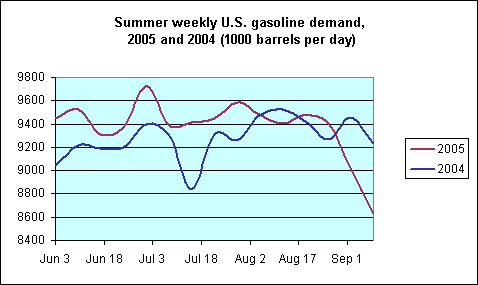
The first is from James Hamilton, who analyzes the effect of gasoline price increase on demand and finds, amazingly to some I guess, that demand has fallen substantially.

Gas_demand_1

We have certainly seen this in the camping and travel business, as visitation has fallen off the map of late, though fortunately it comes right at the end of the season.  It appears that demand has fallen about 10% with the increase to circa $3 gas, about matching the shortfall in US refining capacity post-Katrina.  Does anyone doubt that we would have seen gas lines had prices not risen?

The second article is from Steve Chapman. Apparently, Democratic senators are separately working to make sure that higher oil prices are not allowed to spur either lower demand or higher supply.   First he takes on serial-stupid-statement-making Maria Cantwell who is working the demand-side with her desire to have the US President set retail gasoline prices:

This week, as gasoline prices remained above $3 a
gallon, [Maria Cantwell] proposed giving the president the power to tell retailers
what they can charge at the pump.

A lot of people grew anxious
seeing long lines forming last week, as motorists rushed to fill their
tanks in the aftermath of Hurricane Katrina. But Cantwell apparently
enjoyed the sight well enough that she'd like to make those lines a
permanent feature of the landscape. If so, she has the right approach.
The government does many things badly, but one thing it knows how to do
is create shortages through the vigorous use of price controls.

That's what it did in the oil market in 1979-80, under President Jimmy
Carter. He was replaced by Ronald Reagan, who lifted price caps on gas
and thus not only banished shortages but brought about an era of low
prices.

Cantwell thinks oil companies have manipulated the
energy market to gouge consumers, though she is awaiting evidence to
support that theory. "I just don't have the document to prove it," she
declared. Her suspicions were roused when she noticed that prices
climbed in Seattle--though most of its oil comes from Alaska, which was
not hit by a hurricane.

Maybe no one has told Cantwell that oil
trades in an international market, and that when companies and
consumers in the South can't get fuel from their usual sources, they
will buy it from other ones, even if they have to go as far as Prudhoe
Bay.

If prices rose in Dallas and didn't rise in Seattle, oil
producers would have a big incentive to ship all their supplies to
Texas--leaving Washingtonians to pay nothing for nothing. When a freeze
damages Florida's orange juice crop, does Cantwell think only
Floridians feel the pain?

Then, he turns his attention to Senator Dorgan, who wants to make sure we get no new oil supplies by having the government confiscate "windfall profits"

Sen. Byron Dorgan (D-N.D.), meanwhile, was outraged by
the thought of giant oil companies making money merely for supplying
the nation's energy needs. He claimed they will reap $80 billion in
"windfall profits" and wants the government to confiscate a large share
of that sum through a special federal tax.

But the prospect of
occasional "windfall" profits is one reason corporations are willing to
risk their money drilling wells that may turn out to be drier than Alan
Greenspan's reading list. Take them away, and investors may decide
they'd rather speculate in real estate.

Speaking of real
estate, Americans seem to feel no moral compunction about getting rich
from unforeseen increases in the price of another vital necessity. You
think home sellers in Baton Rouge haven't raised their asking prices in
the last 10 days? You think Dorgan wants to tax their windfall?

It's hard to see why oil companies shouldn't make a lot of money when
the commodity they provide is suddenly in short supply. After all, they
are vulnerable to weak profits or even losses during times of glut.
Back when Americans were enjoying abundant cheap gasoline, the joke was
that the surest way to make a small fortune in the oil industry was to
start with a large fortune.

Oil companies are also subject to
the whims of nature. No one is holding a charity fundraiser for the
businesspeople whose rigs and refineries were smashed by Katrina. No
one will come to their aid if prices drop by half.

Maybe Senator Dorgan can go back and confiscate the windfall profits that Maria Cantwell made in the Internet Bubble, where she made a fortune cashing out to later investors who took a bath.  At least oil companies are creating value with new oil production with their windfall profits:

Calgary"” Penn West Energy Trust is holding
a huge land sale -- looking to sell exploration rights to more than
500,000 hectares of undeveloped territory in Western Canada -- and the
offering has stirred a frenzy among many oil and natural gas companies
hungry for new drilling options.

"Demand is phenomenal," said Moya Little, president of Western
Divestments Inc., the firm brokering the sale. "It's a wide spectrum of
companies, startups, majors, any company that needs to drill."

And more here:

The world's biggest oil producers have significantly
boosted investment in oil exploration for the first time in nearly two
decades.

The Organisation of the Petroleum Exporting Countries,
the cartel controlling 75 per cent of the world's oil reserves, on
Monday revealed its most important members had drilled 7.5 per cent
more wells last year than in 2003 in response to the oil price boom.
Opec's annual statistical bulletin also showed that the number of rigs
in operation within the 11-member cartel rose 18.8 per cent last year
after dropping by almost 6 per cent a year earlier.

What useful purpose is Cantwell using her windfall Internet stock profits for, other than financing her own run for the Senate?  Could the Democratic Party be any more clueless about economics?  Jeez, why is it that our opposition party in this country has to be such a joke?

Technorati Tags:  ,

OK, You Got What You Wanted

Those of you who wanted a strong federal welfare-nanny-state response to New Orleans, you have got your wish:

It is impossible to over-emphasize the extent to which this area is
under government occupation, and portions of it under
government-enforced lockdown. Police cars rule the streets. They (along
with Humvees, ambulances, fire apparatus, FEMA trucks and all
official-looking SUVs) are generally not stopped at checkpoints and
roadblocks. All other vehicles are subject to long lines and snap
judgments and must PROVE they have vital business inside the vast
roped-off regions here. If we did not have the services of an off-duty
law enforcement officer, we could not do our jobs in the course of a
work day and get back in time to put together the broadcast and get on
the air.

This is not poor federal management - this is exactly-what-you-always-get federal management.  Putting a premium on control and process over results is built into their DNA.  My prediction is that those areas outside federal control and allowed to be accessible to private aid and to individuals who want to, yeah I know its crazy, come into the area and take responsibility for fixing their own house rather than waiting for the feds to do it for them will fair much better in the long run.  More on the federal urge for technocratic control here  and here and here and here.

Something about this reminds me of an observation made over and over in interviews with American soldiers from WWII.  They recounted that in German villages, after a battle, the German citizens were out in the streets, starting to clean up and rebuild before the dust had even settled, while in France, villagers would just sit forlornly in the debris and wait for someone to come do something about it.

Update:  I know you are getting tired of these stories, but here is yet another example of the FEMA folks opposing private relief efforts in the name of "control"

Starting right after midnight I began receiving calls from FEMA, HHS,
TRANSCOM and other groups whose acronyms I still cannot explain.  LCDR
Kennedy from FEMA called to understand what I was trying to do.  I told
him.  Fifteen minutes later Mimi Riley, Deputy Director from NDMS
called to beg me in a plaintive and exhausted voice not to carry out
this mission.  She had many reasons "“ you need doctors on the plane,
Chicago is too far from their home, how will we track the patients,
this is a military operation and we were not military. 

I
explained to her that we had two doctors on the plane one of whom was a
retired Air Force Doctor who had run the military hospital in Baghdad
after the invasion.  I thought we could trust him to run an airplane of
people from New Orleans to Knoxville.  We were working with NDMS
hospitals in Tennessee and Chicago so they would have a good tracking
system.  (I guess Mimi never heard of the Great Migration of African
Americans from New Orleans and the south to Chicago after the flood of
1927 and during the Depression.  Many people from New Orleans are more
at home in Chicago than Houston. )

Mimi was unmovable.  We
were not military and that was that.  She tried to sound grateful for
our intentions but she was not going to have outsiders help.  I even
offered to GIVE her the planes and the crews and the hospitals and let
her run it through her NDMS system but she would have none of it.  She
asked me at least to delay until noon the next day and I said I would
try.

A good revamp of FEMA after this is all over would put a heavy emphasis on private action and FEMA's role in aiding rather than controlling and limiting this effort.  Unfortunately, I don't expect that to be the outcome.  I fear that large government technocrats and lefties who are always suspicious of private bottom-up action will control the agenda in framing the FEMA debate.

OOPS:  Did I say that technocrats and lefties distrusted anything but top-down federal power.  I forgot the righties as well (from dubya's speech the other day):

It is now clear that a challenge on this scale requires greater federal
authority and a broader role for the armed forces -- the institution of
our government most capable of massive logistical operations on a
moment's notice.

Sounds like Lyndon Johnson and the Great Society.  As a libertarian, I dread the next election.  Two parties competing to see who can enhance federal power more.  Blech.

Yet another:

The patients and staff at Methodist could have been evacuated before
Hurricane Katrina hit. But instead they were condemned to several days of fear
and agony by bad decision-making in Louisiana and the chaotic ineptitude of the
Federal Emergency Management Agency. Some of the patients died.

Incredibly, when the out-of-state corporate owners of the hospital responded
to the flooding by sending emergency relief supplies, they were confiscated at
the airport by FEMA and sent elsewhere.

Disaster and Government, continued

From the Mises Blog:

For those who maintain that the government "failed" its "mission," I must say
that they are wrong. True, the government with its ham-fisted policies of
blocking relief missions, imposing price controls, and acting in a dictatorial,
but incompetent style, seems to have "failed" in making things better,
especially in the days directly after the storm passed. But, if you understand
that government is a mechanism by which some people impose their will by force
over others, then you would have to admit that the government succeeded and
succeeded beyond its own expectations.

Thus, I leave readers with this question: If you believe that the government
"failed" in the aftermath of Katrina, will the government then have less or more
"authority" when the next disaster strikes? I think all of us know the
answer.

You can always expect government to behave exactly like government. When you
consider your political position, consider whether this institution ought to be
put in charge or disaster relief at all, or the economy, or society, foreign
policy, health care, education, courts, the environment or anything at all.
Katrina and its aftermath is only the latest exhibit in the ongoing historical
documentary in favor of a government-free society

I had similar thoughts here and here.

Thank You, Richard Branson

I have never been a Richard Branson groupie, but I must say for once I am appreciative of his efforts.  Branson has helped to make crystal clear the process by which governments take control of the economy.  The story comes to us via the Mises Economics blog, and starts this way:  According to Branson:

"The big oil companies are making extortionate profits out of the current oil
price," he announced, in his most calculating, populist style.

How anyone who runs the Virgin Megastores can complain about someone else's high pricing is beyond me, but lets let him run a little further:

"The biggest problem with the oil price is the lack of refinery capacity. There
is enough oil for everyone in the world, but the refineries are just not there."

And they are not there because...governments do not allow oil companies to build new refineries.  The government having created the problem, the solution would seem to be for the government to repeal the offending restrictions that caused the problem.  But here is where we get to the great tool of statism:  The problem created by the government is blamed on private enterprise and "market failure" and portrayed as necessitating... more government intervention:

"There has been talk of a windfall tax on big oil companies. Perhaps the
Government should use that money to invest in refinery infrastructure."

Of course, the big oil companies would invest those windfall profits in refining capacity on their own had they been allowed by government, but lets ignore that messy detail.  Ahh, but here is the best part.  Not only does the government now get to invest in refineries, but it gets to do it by channeling the money to the political supporters (i.e. Branson) of those in power, thus cementing their power and control.

According to the paper, Britain's favourite "entrepreneur" aims to put $100
million behind his latest scheme to build an oil refinery for airline fuel. Yes,
the Bearded Wonder is said to be about to launch a new company called - you
guessed it! - "Virgin Oil" within four or five months and is "seeking to attract
funding from other airlines and the Government...."

But, not content with this, our man from the tropical paradise has scented an
easier mark, for Sir Richard has seemingly exploited the crass celebrity-worship
of our New Labour masters, while also playing up to our ineffable Chancellor's
ever present desire to meddle in the markets.

For those of you who have held up Branson as some archetype of entrepreneurship: Stop it.  Here you see a man who is attempting to finance his entry into an industry by getting the government to take money by force from the current competitors in that industry and to give it to him to finance his startup.  I have always suspected Branson of being from the Orrin Boyle school of business and this just proves it.

Technorati Tags: 

Would You Confirm Any of the Judicial Committee?

I had trouble getting going this morning on work -- I had to drop my son off at school at 5AM for a field trip, and I am sitting in my office refusing to address the pile of work in front of me.  So I skimmed over some of the transcripts from the Roberts confirmation hearings.  He seems like a pretty qualified guy, and since he is conservative I expect to agree with him some and disagree with him other times (which is different from my reaction to liberal judges, whom I disagree with some and agree with at other times).

But from reading the transcripts, I was left with one overriding impression:  While I might agree to confirm Roberts to the Supreme Court, I probably would not, if given the chance, confirm many of the Senators on the judiciary committee to their office.  What a bunch of posturing morons.  Many of them seemed like wind up toys reading questions from their staff that they didn't really understand, and all of them come from the Sean Hannity school of interviews, where in a 20 minute interview the questioner talks for 18 minutes.

I Couldn't Have Said it Better

Jeff Taylor at Hit and Run:

It is official. The GOP is now exactly in the same position Democrats
were in circa 1993 -- the disconnected, unapologetic party of bloated
federal government. Only demographic trends and the Democrats'
steadfast refusal to evince a lick of sense will keep 2006 from being
1994 in reverse.

Another Take on Disasters and Government

I gave my take on why this Katrina disaster does not somehow validate statist technocracy, as has been argued, here and here.  I am willing to admit that Colby Cosh says it better:

So let's just recap briefly, shall we? We've got a million or so human beings
living in a low-lying area created in the first place by government engineers.
The local government of New Orleans, apprised of an approaching storm, summarily
orders everybody out of the city about 36 hours too late without lifting a
finger to provide the means to do so. At the last minute it occurs to somebody
to herd those left behind into a large government-built structure, the
Superdome; no supplies are on hand for its inhabitants, and the structure itself
is rendered--according to the government's assessment--permanently useless. Even
though the storm misses the city, government-built levees fail in unforeseen and
catastrophic ways. Many of the New Orleans cops opportunistically quit their
jobs, many more simply fail to show up for work, others take the lead in looting
supplies from storm-stricken neighbourhoods, and just a few have the notable
good grace to shoot themselves in the head. The federal government announces
that assistance is on its way, sometime; local and state authorities--who have
the clear-cut burden of "first response" under federal guidelines nobody seems
to have read--beg for the feds to hurry up while (a) engaging in bureaucratic
pissing-matches behind the scenes and (b) making life difficult for the private
agencies who are beating the feds to the scene. Eventually the federal
government shows up with the National Guard, and to the uniform indignation and
surprise of those who have been screaming for it, the Guard turns out to have a
troubling tendency to point weapons in the general direction of civilians and
reporters. I'm not real clear on who starts doing what around mid-week, but the
various hydra-heads of government start developing amusing hobbies; confiscating
guns from civilians, demanding that photographers stop documenting the aftermath
of America's worst natural disaster in a century, enforcing this demand by
seizing cameras at gunpoint, shutting down low-power broadcasting stations in
shelters, and stealing supplies from relief agencies and private citizens. In
the wake of all this, there is probably no single provision of the U.S.
Constitution left untrampled, the Posse Comitatus Act appears destined for a
necktie party, and the 49% of Americans who have been complaining for five years
about George W. Bush being a dictator are now vexed to the point of utter
incoherence because for the last fortnight he has failed to do a sufficiently
convincing impression of a dictator.

Double Secret Probation

Apparently FIRE has won another victory, this time against Double Secret Probation at Brooklyn College.

NFL is Back, and the Cardinals Still Suck

I enjoy many professional sports casually, attending an event or two every year, but the NFL is by far my favorite.  In the pre-season, there was a lot of hype that maybe the long-time hapless Cardinals would be decent this year.  I knew better, even from the pre-season.   Heck, my 8-year-old daughter knew better.

We went to see the last pre-season game against Denver.  In that game, the Arizona starters played for quite a while against the Denver 2nd team, and got beaten up.  Specifically, they could not run the ball and in turn their defense could not stop the run.  So it was no surprise to see them get blasted in their first regular season game against the Giants. 

The problem with the Cards is this:  They have spent the last several years drafting high-profile position players, including spending a jillion 1st round picks on receivers.  Great teams got that way because they invested in their lines - both O and D, even when such picks might be less popular with the fans on draft day.  The Cards have instead focused on drafting "names" who might help sell season tickets in the new stadium.  This neglect is very apparent today.  It doesn't matter how good your position players are if there are no holes for the backs and the QB is getting plowed to the turf on every play.  This is a 5-11 team that is fortunately playing in the NFL's worst division, so they may eek out 7 wins.  You heard it here first.

By the way, if you are an avid football fan, I recommend two sites to you.  The first is Football Outsiders, who have taken a Bill-James-like approach to football stats, rethinking metrics to provide a better insight into what teams really are good.  Make sure to check out their DVOA rankings - basically they compare every teams performance on every play against other teams in the same situation (e.g. 3rd and 8 on their own 45).  The other site is Greg Easterbrook's always entertaining Tuesday Morning Quarterback column, providing large doses of football clear thinking and haiku.

Environmental Near-Sightedness

Originally, the environmental movement counted many in its leadership with scientific backgrounds who were thoughtful advocates of improving the environment.  Unlike many "conservatives", as a libertarian that thinks more about being for property rights rather than just "pro-business", I understand that emissions guidelines are critical to the proper functioning of free markets:

In fact, environmental laws are as critical to a nation with strong
property rights as is contract law. Why? Imagine a world without any
environmental legislation but with strong property rights. What happens
when the first molecule of smoke from my iron furnace or from my farm
tractor crosses over on to your land. I have violated your property
rights, have I not, by sending unwanted substances onto your land, into
your water, or into your airspace. To stop me, you might sue me. And so
might the next guy downwind, etc. We would end up in an economic
gridlock with everyone slapping injunctions on each other. Since
economic activity is almost impossible without impacting surrounding
property owners, at least in small ways, we need a framework for
setting out maximums for this impact - e.g., environmental legislation.

Unfortunately, while many thoughtful people still call themselves an environmentalist, reasonable and scientific people no longer run the environmental movement.  Increasingly, the environmental movement has been taken over by
anti-growth and anti-technology Luddites as well as anti-free-market
socialists.

As evidence, I offer what has become an effective thirty-year moratorium on refinery construction. Forget for this post the obvious effect this has on gasoline supply stability, particularly with the EPA-mandated proliferation of special local gasoline blends.  Think instead about the true environmental implication:

The opposition to building new refineries ignores the dramatic
technological improvements that have been made since an oil refinery
was last constructed here in 1976. New, clean refineries emit far less
pollution than older refineries, with new scrubbers and design changes
that dramatically reduce sulfur and other emissions. And at the same
time our ability to model and map emission characteristics and
distribution lets us choose the best locations for new facilities "“
where they will have the least possible impact on people and the
environment.

Refineries are dirty places.  There are thousands of seals and flanges and safety valves that are going to leak some hydrocarbons.  But think on this:  Every single refinery in this country was built with at least 30 year old technology.  Sure there have been upgrades, but much of the core is still there.  I was an engineer at a refinery near Houston for 3 years and we had equipment still operating that was 50 years old, and that was twenty years ago and much of it is still there.

So what does this mean?  Imagine if every car in this country was over 30 years old.  Think of the improvements we have made in fuel efficiency and pollution control over the last 30 years- no cars would possess any of this technology.  The roads are full of cars with modern technology that are fuel efficient and relatively clean because we don't moronically prevent them from being replaced with new ones.

But this is exactly the case with refineries.  The single best, most intelligent thing we could do today for the environment, as far as refineries are concerned, is to let about 10 brand new ones be built with all modern technology, and let these newer refineries compete the older ones into closure.  And who is blocking this single most impactfull environmental step?  Environmentalists, of course.

This is not an unusual issue. I wrote about this same issue with new source review rules and Bush's Clear Skies initiative:

New source review is long and complicated, but basically
says that existing power plants don't have to upgrade to new
technologies, but new ones have to go through a very extensive
environmental review and permitting process and have a suite of
government mandated pollution control technologies installed.  OK, that
has all been clear for 3+ decades.  The rub comes when a company
considers upgrading or replacing a portion of a power plant.
For most of the life of the Clean Air Act, the government allowed
utilities to upgrade and modernize plants without having to install the
expensive suite of new controls.  The Clinton administration clamped
down on this, making it harder to upgrade existing plants.  All the
recent hullabaloo has occurred as GWB proposed to go back to the
pre-Clinton rules.

This issue is a great test for environmentalists, because
it separates them into those who really understand the issues and the
science and legitimately want improvement, and those who care more
about symbolism and politics.  Those who like symbolism have cast this
move as a roll-back, and are fighting it tooth and nail.  Those who
care about results know the following:

Experience under the Clinton rules has shown that most old
plants will never be upgraded if they have to go through the planning
process and install the new scrubbing and other technologies.  So, they
will just keep running inefficiently, as-is, until they are finally
shut down.  However, if allowed to be upgraded without review and new
scrubbers, etc., they will become much more efficient.  No, they won't
have the most modern scrubbing technology, but because they are more
efficient, they burn less fuel (coal) to make the same amount of
electricity and therefore will pollute less.  In some cases these rules
even prevent switching to cleaner fuels like natural gas. 

In other words, most scientists, including
scientific-oriented environmentalists, agree that GWB's proposal will
result in less pollution, but environmentalists still oppose it because
they don't like the symbolism of any pollution regulation appearing to
be rolled back.  You can read a lot more about New Source Review and how it actually increases pollution in practice here.

Technorati Tags:  ,

More Thoughts on Price Gouging

In an earlier post, I wrote a defense of price gouging.  Incredibly, one of the best simple summaries of why "profiting off disaster" is actually a good thing comes from the NY Times of all places:

All this, of course, is capitalism at work, moving quickly to get
resources to where they are needed most. And those who move fastest are
likely to do best.

Exactly (by the way, the above is quoted from an Austin Bay post, which was aimed more at criticizing the NY Times for dropping such pro-capitalist sentences from its European version.)

Higher prices for generators and lumber in the disaster area is what tells Home Depot and others that it makes sense to shift lumber and generator inventory to Louisiana from California.  High prices for gas give the following two messages simultaneously and unambiguously to hundreds of millions of people:  "you can make some good money if you can figure out how to get more gas to consumers right now" and "you might want to drive a little less right now". 

Think about that last statement.  Congress has over the last 30 or so years generated numerous energy "plans" and has spent billions of dollars to figure out ways to promote conservation and increased supply.  All of these plans have been expensive failures.  But now, post Katrina, in less than 48 hours, with no one in charge, the market has achieved what Congress could never do.  The least valuable auto-miles will be eliminated, without years of study by Congress to figure out which miles are the least valuable.  The most economic new sources of gasoline will be tapped, without debating in Washington what those sources are.  All bottom-up, with no one ruling the process, by the voluntary self-interested efforts of hundreds of millions of Americans reacting to a simple price signal.

(previous paragraph best read out-loud with someone humming America the beautiful in the background)

Postscript:  Apparently, according to Austin Bay, Texas and more specifically Houston are now the great Satan.   Since I am a white male in my forties who is fairly well-off, still believes in free markets, and was born Houston, Texas, I guess that makes me the ultimate oppressor.

Technorati Tags:  ,

ATM Cards More Expensive to Process than Credit?

Does this make any sense:  It costs us a lot more, for small transactions, to process an ATM / debit card with the pin pad than a credit card.  Bank of America charges a flat 60 cents per ATM card / PIN pad transaction in our stores but charges 10 cents plus 2% on credit cards.  So, on a typical $5 convenience store purchase, BofA charges $0.60 or 12% to process a ATM / debit card but $0.20 or 4% for the credit card.

I understand the difference between value- and cost-based pricing, but in an economy of scale transaction processing business with a lot of competitors, I would think debit would be cheaper to process, even without the credit risk issues. 

Customers give me feedback that I am a neanderthal for not accepting ATM cards with a pin pad at the registers.  This is the reason.  Its cheaper for me to provide an ATM and then have them pay cash - that way they pay the fee, not me.  Also, their fee is lower.  Even if they only take out $20 and pay a $1.50 fee, they are still only paying 7.5% vs. the 12% typical I would be paying.  If anyone knows a company that offers a better deal, the comment section is wide open!

Update:  A couple of notes based on the comments.  First, I do indeed understand that prices are not cost-based.  The notion that pricing should be cost-based is one of the worst economic misconceptions held by the average person (behind the commerce is zero-sum myth).  When prices don't make sense to me, I don't run to the government asking for Senate hearings so corporations can "justify" their pricing, I just don't buy from them. 

Second, to another commenter's point, most card processing agreements and some state laws prevent merchants from passing card processing fees onto consumers in a discriminatory way - ie they can be built into the general pricing but you can't charge one person one price and another a different price for the same item based on what kind of payment they use.

Hurricanes and Big Government

So, unsurprisingly, Paul Krugman and others are arguing that Katrina is a vindication for large-government liberals  (One would think we would love GWB, who has been a better large-government builder than Clinton, but that is another topic).  Anyway, I think it is worth thinking for a second about the federal government and hurricanes.  I will divide the post into two parts:  Preparedness and Response, and show that in fact, large central-government thinking is at the heart of many of the problems that are being faced.

Disaster Preparedness
I cannot come up with any justification for the US Government taking the lead role in local disaster preparation or protection.  The types of disasters are just too wide and varied:  Tidal waves in Hawaii, earthquakes in LA, mudslides in San Diego, fires in the west, tornados in the plains, hurricanes on the gulf coast, blizzards in the north, etc. etc.  And why would anyone want the feds taking over their local disaster plans anyway?  Do you really want to rely on the hope that a national organization has the same priority on your local risks that you do?  The resources, the knowledge, and the incentive to prepare for emergencies are all local, and such preparation should be done as locally as possible.

The only reason locals would even tolerate federal involvement in disaster preparedness is $$$.  Every local politician loves federal dollars.  And even a hardcore libertarian like myself is probably willing to admit that some of the preparedness investments truly are public goods.  Take levees for example.  I am willing to have them as public goods.  However, no one can convince me that levees whose sole purpose in life is to protect New Orleans are federal public goods.  Why do I need to pay for them?  Why don't New Orleans people bear the full cost of their choice to live below sea level?  My family chooses to live in a place that is relatively free of disasters (though if the Colorado River dries up you can come visit our bleached bones as we are consumed by the desert).  Why should I subsidize people's choice to live in a location that sits in mother nature's cross-hairs?

But beyond my cantankerous libertarian desire not to subsidize you, those of you who live in disaster areas should demand to take responsibility for your own preparedness.  The feds are never going to value your safety the same way you do (as evidenced in part by the 40-year ongoing fight for levee funding in New Orleans) and are never going to understand your local problems like you do.  In fact, the illusion of federal responsibility for disaster preparedness is awful.  It gives irresponsible local authorities an excuse to do nothing and a way to cover their ass.  It creates a classic moral hazard and sense of false security.

I have resisted saying this for a week or so out of respect for the plight of individuals still struggling in Louisiana and Mississippi:  If one divides the world into the ants and the grasshoppers (per the classic fable), New Orleans and Louisiana would make the consensus all-grasshopper team.  They have lived in a stew of bad and corrupt government for years, mixed with a healthy dose of Huey Long-style patronage that created expectations that "you would be taken care of".  Their state officials have for years not only been grasshoppers, but have demanded that they be supported by the ants, and seem lost and confused that the ants didn't protect them somehow from Katrina.

Disaster Response
Its probably good to have a national body that can help focus resources from around the nation onto local regions that have been devastated by some disaster.  But here is the key point.  The federal government itself is never, ever going to have the resources stockpiled somewhere to handle a disaster of this magnitude.  They can't have the doctors on staff, the firemen waiting around, the medical supplies in a big warehouse, a field full of porta-potties ready to deploy, etc. etc.  There is just too much needed, and the exact needs are too uncertain.

What they can do, though, is understand that in an emergency, Americans from all over the country are always willing to help, to volunteer their time or skills or money to aid the victims.  More than anything, the Fed's role needs to be to remove barriers from these resources gettting to the the right places as fast as possible, and to backstop these private efforts with federal resources like the military.  Take the example of refugees.  There are over a million from this hurricane.  Of those, at least 90% will be helped privately, either from their own funds or friends or family or private generosity.  Probably more like 95+%, if you include resources offered by local governments.  The feds role then is to help the remaining 5% find food and shelter.  Note, though, that the problem is not dealing with 100% of the problem, it is dealing with the 5% the leaks through bottom-up efforts, while removing barriers that might stand in the way of bottom-up efforts helping the other 95%.

Unfortunately, the feds don't think this way.  Most feds, including Krugman type large government folks, distrust private and bottom up efforts.  They are top-down technocrats, putting an emphasis on process and control rather than bottom-up initiative.  I wrote much much more about the failed technocratic response to Katrina here.  I think one can argue the reason that the refugee situation for 95% of the people worked well is that these folks quickly got out of the sphere of influence of the FEMA folks -- in other words, they got far enough away to escape FEMA control.  Can you imagine what a total disaster would be occurring if FEMA tried to control the relocation of all 1 million people?  But on the LA and MS gulf coast, FEMA is exercising total control, actually preventing private initiative from helping people, and everyone is the worse for it.  I encourage you to read more in this post about valuing control over results, but I will leave you with this one anecdote that sums up the big government technocratic top-down world Mr. Krugman longs for:

As federal officials tried to get some control over the deteriorating
situation in New Orleans, chaos was being replaced with bureaucratic rules that
inhibited private relief organizations' efforts.

"We've tried desperately to rescue 250 people trapped in a Salvation Army
facility. They've been trapped in there since the flood came in. Many are on
dialysis machines," said Maj. George Hood, national communications secretary for
the relief organization.

"Yesterday we rented big fan boats to pull them out and the National Guard
would not let us enter the city," he said. The reason: a new plan to evacuate
the embattled city grid by grid - and the Salvation Army's facility didn't fall
in the right grid that day, Hood said in a telephone interview from Jackson,
Miss.

"No, it doesn't make sense," he said.

Technorati Tags:  ,

My First Wikipedia Post

I find I link to Wikipedia a lot for explanations of terms I use that people may not be familiar with (the most recent being "badger game" in this post).  So, to return the favor of all those who have written the Wikipedia, I wrote my contribution, adding an entry on Workamping.  It required about an hours worth of time invested learning their formatting commands and best practices, but it turned out to be pretty easy.  It was kind of interesting to see the other niche areas I have knowledge about but for which there are no articles yet.  I am currently adding and editing content for model railroading.

Email Marketing

It was fun to see my brother-in-law's company mentioned in the local paper today.  It was even funnier to see that the newspaper-run web site that screwed up the link to my wife's handbag site did the same with his site.

Eric, my brother-in-law, is the SVP of Sales at email marketing firm Constant Contact.  A while back I was half-convinced that email marketing, at least for quality companies, would die under the spam deluge.  It turns out that this is not the case.  There are many companies and organizations engaging his firm to manage their member communications and customer mailing lists.  I know that there are now several companies I do business with that I have white-listed in my spam filter in order to see their special offers and such (for example, 1-800-contacts does a good job of emailing me right about when I need to reorder, and I always like seeing who is coming to town in the Ticketmaster email).

Lawyers Revive the Badger Game

I missed this story the first time around, but apparently a husband and wife team of lawyers has revived the old badger game, but in a more modern form:

According to a story in the San Antonio Express-News,
husband-and-wife legal partners Ted H. and Mary Schorlemer Roberts received
money in a curious sequence of events. Mary, claiming to seek "no strings"
discreet encounters, would seduce men over an Internet dating service. Ted would
then write the men (in legal documents sometimes typed by Mary) and notify them
that he planned to seek intrusive and public civil discovery to investigate
whether the affair brought forward potential causes of action that were flimsy
at best; the men would pay tens of thousands of dollars for a release and
confidentiality agreement.

Read the full Overlawyered update:  it is fascinating to see just where watchdogs set the ethical bar for lawyers (hint: its really low).  Apparently the Bar Association can't decide if they think this behavior by the Roberts is unethical.  Currently the the attorney who blew the whistle on this scam is being investigated, but the scammers themselves are not under investigation.

JRB For the Supreme Court

Captains Quarters suggested that Bush nominate Janice Rogers Brown for the Supreme Court.  Though it will never happen, I am 100% behind this idea.  I never even heard of her until I started reading statements attributed to her by her opponents that were supposed to convince me of her unfitness for the bench.  And you know what, the more I read, the more I liked her.  Also here.

Double-Speak is Alive and Well

This was funny, from labor boss John Sweeney (via Cafe Hayek):

Let's require big, profitable companies such as Wal-Mart to provide health care
to their employees instead of passing the cost along to everybody else, and
let's begin to develop a national health care plan that provides affordable
coverage to all Americans.

This is really, really funny.  Notice that in the first half of the sentence, he decries passing health care costs "along to everybody else" and then in the second half advocates a national health insurance plan that would pass individual health care costs onto... everybody else.  Also note that since Wal-mart, despite Mr. Sweeney's description as being big and profitable, has one of the lowest profit margins in the Fortune 100, it would likely have to raise prices in order to... pass these costs along to everybody else.

What Mr. Sweeney is actually frustrated about is that there are a large number of individuals in the labor force that he does not make decisions for and who do not in turn contribute to his personal power.

Cafe Hayek has more.