Some Shows You May Have Never Seen

One of the great things about working for myself is that when I have a lot of boring tasks, like arranging my new office or filling out sales tax reports, I can watch a movie and get away with it.  Over the last few weeks I have watched three movies or shows you may have never heard of but I thought were great:

  1. Firefly.  Probably the best known of the three, this canceled series is a libertarian favorite. 
  2. Wonderfalls.  Only lasted 4 episodes on Fox, but 13 were in the can when it was canceled.  I bought it solely based on the unbelievable Amazon reviews.  I am on episode 5 and its is great so far.
  3. Interstate 60:  A movie I completely missed when it was in theaters, it was a lot of fun.  Had some of my favorite characters I have seen in a movie in a long time.

$%*#*%&$@#

I hate having to moderate comments.  Yesterday I had a ton of comments on my immigration plan post and we could have had a really good conversation going except I was out of the office and did not moderate the comments through until today.  Unfortunately, in the same time-frame I got 12 spam comments and 145 spam trackbacks from mp3 and pr0n and other sites trying to piggy-back on my Google ranking.  Sorry again for the delay in getting comments approved.  As always, I only moderate contents for spam - anything on topic, no matter how poorly written or how much it expresses dislike for yours truly, goes through.

Good Government Has to Bite?

Today, Instapundit linked to this Howard Kurtz article, with the following line as a teaser:

But seriously, folks, has Congress become something of a joke?

I was excited to read on.  You bet Congress is a joke.  An out of control joke.  But then, in the next paragraph, he says this:

Are these toothless lawmakers no longer capable of passing anything with bite?

Bite?  BITE?!  Everything Congress does bites.  Every single day it does something to increase regulation or paperwork requirements or adds another necessary license or government approval process or tax or subsidy.  I may spend as much as half my time in my business just on government compliance and taxation issues.  Is that really Kurtz's concern, that the Congress does not pass enough legislation with bite??

Later in the article, he says something else I thought I would agree with:

isn't it telling that the one thing lawmakers can agree on is handing
out goodies as opposed any measure that involves the slightest
sacrifice?

Absolutely, I thought.  All Congress does is spend money on useless hurricane "relief" and earmarks and bridges to nowhere  and subsidies for ADM and don't forget that new prescription drug entitlement that will cost a ton of money once someone figures it out.  So given a Congress hell bent on spending like a drunken sailor, what does Kurtz use to illustrate his point of "handing out goodies?"

Of course, there is one issue on which Congress seems poised to act: extending tax cuts

I know that we libertarians have fought this issue and never seem to be able to win, but having the government let private citizens keep more of the money they earned is not "handing out goodies".  Handing out goodies is when you take tax money from one person and give it to another who did not earn it.  Tax cuts are one of the few things that inhibit handing out goodies.  Run far away from anyone who claims that tax cuts are handing out goodies, because it means that they consider your money to be the government's, and what portion you keep is yours not by right but by the grace and goodwill of the Congress who determines how much you get to keep.

One Last Immigration Post

I really wasn't going to post again on immigration - I've said what I have to say and I want to move on before I get too tedious on the subject.  However, I was reading several conservative blogs over the last several days that had a lot of fun pointing out odd signs and screwball supporters of immigration in the recent immigration marches, as a way to mock the those who support immigration (example here).

I agree that immigration supporters have adopted some fellow travellers that they would do better without, particularly the hard-core Marxist remnants who not accidently chose the traditional Marxist-Soviet May Day holiday for their march.

However, I guess two can play at this game.  I would like to walk through some of the key points from a recent emailer to this site.  Below I will address a few of the best passages, but I have included the email in its entirety in the extended post, per the email's instructions.  Really, I encourage you to read the whole thing.  Every paragraph is priceless.

Being born with our rights is fine, HOWEVER the right to live in a PARTICULAR country within a FORMED AND STRUCTURED society of laws that protects those rights IS STRICTLY for THE "CITIZENS" who built that society TO DECIDE who may join them.!

I will call this the nation-as-country-club theory of government.  Basically he is saying that the US is a big country club where most of us get our memberships by inheritance, and we all get to chose the few new members we take in each year.  Of all the theories of government, this is, um, cetainly one of them.  If anything, it reminds me a little of Heinlin in "Starship Troopers" with a society where only those who completed military service are full citizens. 

This is, however, not the theory of government that our country was built on.  In fact, we didn't have any real immigration restrictions in this country for over 100 years after the Contitution was passed.  This model actually has strongly socialist implications.   I will demonstrate that next...

      Liberal Democrats AND SO CALLED LIBERTARIANS (who are really
displaced commis)  will come to be known as the morons who killed the
goose trying to get the gold faster!!!!

Wow!  All along I thought I was a libertarian anarco-capitalist and come to find out I am a displaced commie!  Who knew? 

Let's take an example.  Lets say a person from Mexico wants to rent my house and then go to work for me in my business here in Phoenix.  I believe that I should be able to rent my house to whomever I want and employ whomever I want without government interferance.  The emailer presumably believes that the government should be able to dictate who I can and can't rent my property to, and whom I can and can't employ in my business.  Who is the real socialist here?  I want to let people go wherever they want, and the emailer presumably wants checkpoints demanding to see your paperwork.  Which model looks more like Soviet Russia?

Recently the Arizona state goverment has discussed making it a crime of trespassing for a foreignor to be found anywhere in Arizona without the proper government paperwork.  This law would dictate that if I have a such a foreignor on my property, he is trespassing.  But he has my permission to be on my property, so how is he trespassing?  The only way he can be trespassing is if one assumes that the government, and not me, ultimately own my property.

Of course, half the emails I get still say "but they are illegal - they don't have rights."  OK, here is my counter-example.  Tomorrow, Congress passes a law that says "No one is allowed to criticize any sitting member of Congress for any reason."  What would you do?  I would run to my blog and immediately start posting "Trent Lott sucks;  John McCain sucks;  Hillary Clinton sucks" etc. etc.  Why -- because I still have the right to free speech, even if Congress makes it technically illegal.  Laws and acts of Congress don't change rights.  And if you believe that your rights do flow from Congress, then, well, we better all hold on because we are screwed.

America and the culture it has developed breeds predominantly decent people, these decent people have died to make America (and the world) a better place to live and little by little the world has learned from us and has begun to change for the better.
   Now very silly people act like all the filth sickeness and desease of the world should be welcomed into america?    No No No!!!!

    American society and its culture of law abiding decency must not be overcome by the selfish unwashed unlawful hordes who would come here and destroy what has taken so long for so many to build!!!

This whole cultural assimilation thing always rings hollow for me.  The very timeframe that folks like this get misty-eyed about when this country was built was a time of massive and nearly unfettered immigration.  If you really are concerned about preserving America's traditions and culture (assuming "culture" isn't being used just as a code word to keep non-WASPs out) then I would think you would be strongly pro-immigration.  Immigration is the norm in this country's history, and the current policies are the aberation.  If you really want to live in a country where the government actively defines its role as maintaining the country's culture intact, then you should go to France.

My family, which came over early in this century, was poor, unskilled, and German.  What could be worse from a "cultural" standpoint?  Surely few could argue that for the period from 1875 to 1945 the Germans had one of the top 3 most destructive cultures in the world.  Why would we ever want poor unskilled workers from a militaristic totalitarian culture?  But my family was accepted none-the-less.

By the way, the corruption of our rights and freedoms and government is not coming from the outside - because we already did it to ourselves.  In our original Constitutional framework, government was extremely limited and there was little it could do to influence lives.  In the last 70 years, we have corrupted this framework, trashing Constitutional protections and limitations on government and replacing them with a tyranny of the majority, where 51% can do unto the other 49% in any way they please.  We shot ourselves in the foot before most any current illegal immigrant was even born.

Latinos must be stupid since they dont even have the sense to adopt america!!  Illegals still want to be known as mexicans!!! You know those silly stupid gutless mexicans who allow corruption and filth to be a way of life in mexico??

We fought and died to eliminate that in America but you want to let it back in here??

Wow, I am getting emails from people who have already died!  Anyway, have you ever been to Boston on St. Patricks Day?  The Irish still show a lot of pride in their mother country but they still also consider themselves Americans.  The Irish are a great example -- Easterners in the 19th century rioted in protest of unskilled Irish immigration, but today they are part of the backbone of that American culture you get so misty-eyed about. 

Mexican culture and traditions are one of the things that make Arizona great.  Cinco de Mayo, for example, is a lot more fun than many of our American holidays and many of us anglos have adopted it in the same way most non-Irish have adopted St. Patricks Day.   I am not particularly religeous, but for you conservatives out there I will offer that Mexicans are far more religious than your average American outside of the South.

Oh, and by the way, aren't these "stupid, gutless" Mexicans you don't like actually risking life and limb and arrest to escape the corruption of their home country?

I hope the first victim of a desease from aN ILLEGAL mexican who was never vaccinated is someone you CARE ABOUT!!! jerk!!!!!   

Whoa, you say.  This guy doesn't represent me!  Well, I'll tell you.  I have watched over the last several weeks as conservative blogs have spent a good amount of time picking out the most extreme and unbalanced immigration supporters and using them to mock the pro-immigration position as a whole.  Turn about is fair play.

Update:  I got a second email substantially similar to this one (but with slight variations) from a different email address today, so this is either copied from another source or part of some campaign.   It could even be a mis-direction campaign by immigration supporters, though I doubt it because it is so dead on the tone and content of many other emails and comments I get.

Continue reading ‘One Last Immigration Post’ »

My Immigration Reform Plan

More than any subject on Coyote Blog, my immigration posts have engendered more disapproving comments than anything else I have written.  I won't repeat my position except to say that I don't care if immigration is currently illegal, because my point is that it should be legal.  In short, my stance has been that our rights do not flow from the government but from our basic humanity, and therefore activities like association, employment decision-making, and property purchase should not be contingent on citizenship.  Its one of those arguments where I wish many on my side of the argument would shut up -- If the best argument you can muster for immigration is 'who will pick the lettuce', you are not helping very much. 

For the first 150 years of this country's history, our country was basically wide-open to immigration.  Sure, there were those opposed (the riots in NYC in the 19th century come to mind) but the opposition was confined mainly to xenophobes and those whose job skills were so minimal that unskilled immigrants who could not speak English were perceived as a threat.   It was only the redistributionist socialism-lite of the New Deal and later the Great Society that began to make unfettered immigration unpopular with a majority of Americans, who rightly did not wish to see the world's poor migrate to the US seeking an indolent life of living off of government handouts.

But, as Congress debates a series of immigration plans that make not sense and don't seem internally consistent, I will propose my own.  I hope that this plan will appeal to those who to date have opposed immigration because of the government handout problem.  I am sure it will continue to be unappealing to those who fear competition in the job market or who don't like to be near people who don't speak English very well.  This is an elaboration of the plan from this post:

  1. Anyone may enter or reside in the US. The government may prevent entry of a very short list of terrorists and criminals at the border, but everyone else is welcome to come and stay as long as they want for whatever reason.  Anyone may buy property in the US, regardless or citizenship or residency.  Anyone in the US may trade with anyone in the world on the same terms they trade with their next door neighbor.
  2. The US government is obligated to protect the individual rights, particularly those in the Bill of Rights, of all people physically present in our borders, citizen or not.  Anyone, regardless of citizenship status, may buy property, own a business, or seek employment in the United States without any legal distinction vs. US "citizens"
  3. Certain government functions, including voting and holding office, may require formal "citizenship".  Citizenship should be easier to achieve, based mainly on some minimum residency period, and can be denied after this residency only for a few limited reasons (e.g. convicted of a felony).  The government may set no quotas or numerical limits on new citizenships.
  4. All people present in the US pay the same taxes in the same way.  A non-citizen or even a short term visitor pays sales taxes on purchases and income taxes on income earned while present in the US just like anyone else.  Immigrants will pay property taxes just like long-term residents, either directly or via their rent payments.
  5. Pure government handouts, like Welfare, food stamps, the EITC, farm subsidies, and public housing, will only be available to those with full US citizenship.  Vagrancy and squatting on public or private lands without permission will not be tolerated.
  6. Most government services and fee-based activities, including emergency services, public education, transportation, access to public recreation, etc. will be open to all people within the US borders, regardless of citizenship status, assuming relevant fees are paid.
  7. Social Security is a tough beast to classify - I would put it in the "Citizen" category as currently structured (but would gladly put it in the "available to everyone" category if SS could be restructured to better match contributions with benefits, as in a private account system).  But, as currently configured, I would propose that only citizens can accrue and receive SS benefits.  To equalize the system, the nearly 8% employee and 8% employer social security contributions will still be paid by non-citizens working in the US, but these funds can be distributed differently.  I would suggest the funds be split 50/50 between state and local governments to offset any disproportionate use of services by new immigrants.  The federal portion could go towards social security solvency, while the state and local portion to things like schools and medical programs.

With this plan, we return to the America of our founding fathers, welcoming all immigrants who are willing to take the risk of coming here.  We would end the failed experiment of turning citizenship from a voting right into a comprehensive license that is required to work, own property, or even associate and be present within the US border.  Since immigrants today who are "illegal" pay no income or social security taxes into the system today (they do pay sales and, via rent, property tax), this plan would increase tax revenues while reducing some welfare state burdens.

I think if you asked many prospective immigrants, they would agree to this deal - no handouts, just a fair chance to make a living and a life.  However, immigrant advocacy organizations are hugely unlikely to accept this plan, as most seem today to have been co-opted by various Marxist organizations who are opposed to anyone opting out of the welfare state (it is no coincidence that the recent immigration policy protests all occurred on May Day, the traditional Soviet-Marxist holiday).

Finally, I would like to offer one thought to all those who worry about "absorbing" ten or fifteen million new immigrants.  First, I would argue that we have adopted many more immigrants than this successfully in this country's history, including my grandparents and probably yours.  Second, I would observe that as recently as the last several decades, we managed to absorb 40 million new workers quite successfully, as I wrote here:

Check this data out, from the BLS:

  • In 1968, the unemployment rate was 3.8%.  22.9 million women were employed in non-farm jobs, accounting for 34% of the work force.
  • In 2000, the unemployment rate was 4.0%.  62.7 million women were employed in the work force, accounting for 48% of the total
  • In these years, the number of women employed increased every single year.  Even in the recession years of 1981-1983 when employment of men dropped by 2.5 million, women gained 400,000 jobs

This is phenomenal.  After years of being stay-at-home moms or whatever, women in America decided it was time to go to work.  This was roughly the equivalent of having 40,000,000 immigrants show up on our shores one day looking for work.  And you know what? The American economy found jobs for all of them, despite oil embargos and stagflation and wars and "outsourcing".

Enron Trial Update

My casual, uninformed observation so far has been that for all of its strong-arm tactics and media advantage, the government's case so far in the Enron trial has been weaker than I had been led to expect in the media and publicity run-up.  Tom Kirkendall agrees, and has been all over this case including this recent update.

More Suing Bloggers

I am seriously late on this one, but I still want to show my support for Lance Dutson, author of the Main Web Report, who is being sued by an advertising firm and harassed by the state government for uncovering some really dumb activities at the state tourism board.  A summary of what he found is here, and the story of the lawsuits is here.

This story rings absolutely true with me.  Given our significant experience with government agencies, I have seen time and time again that when government bureaucrats embark on an activity out of their traditional comfort zones (in this case, Internet pay-per-click advertising, a new activity for most of us) they tend to combine lack of training with total arrogance that they know exactly what they are doing.  Within my company we have dubbed this "condescending incompetence", and we see it all the time.

In this case, Mr. Dutson points out that by bidding up the price in Google adwords of travel-related terms, they are actually hurting Maine travel businesses, both by driving up their advertising costs and by diverting clicks from an actual tourist business to a government site.  And how could any sensible cost-benefit analysis lead to paying over $15 to get one (1) viewer to the government tourist web site?  The answer is, it can't.  The only thing that can drive this behavior is ignorance combined with a skewed incentive system (e.g. some bureaucrat wanted a line in a performance review or PowerPoint chart that said their web site was top-ranked on every key Google search).  And he rightly points out some disturbing conflicts of interest at the advertising agency, as well as the total bonehead maneuver of putting an adult phone-sex number in the ad copy.

By the way, I despise state tourism agencies.  Most of the money they spend is a waste and the rest goes to directly benefit a few cronies.  Most of our local dollars go to high-profile expenditures that gets the governor some extra media buzz but does zero to get anyone new to the state.   And note that I run a business that depends 100% on tourism.  These state expenditures do nothing for me.  In some cases, my customers pay as high as 12% lodging taxes (e.g. tax and bureaucracy hell Mono County, California) to fund tourist boards who don't even advertise the types of operations I run (campgrounds and marinas).

Office Move Complete

Wow, was that a hassle.  I just finished moving my corporate office.  Hopefully, now that everything is hooked up again, blogging can resume.

Update: And per the comment, yes I did throw a bunch away, but it is still staggering how much waste paper we have to keep for the government for 3 to 5 to 7 years.  For example, I just got an audit from bureaucracy hell Mono County, California, which wants all my detailed customer campground check-in logs from three and a half years ago. 

A New Record!

Bank of America set a new record today.  It sent me the terms and conditions on their treasury services -- 48(!) full 8-1/2 by 11 inch pages with 10-point font.  Unbelieveable.

The Feeding Frenzy Can Begin

The feeding frenzy that the media has been salivating over for days can begin, now that Exxon-Mobil (XOM) as announced quarterly profits.  They reported net income of $8.4 billion on $88.98 billion in sales, for a net income margin of 9.4%.  Previously I observed that 9.4% for a peak profit in a cyclical industry is pretty average, and that over the last decade oil company profits have been below average for the whole of US industry.

In fact, most investors found these profits to be disappointing.  You know you have a fun CEO job when half the country is pounding on you for profits being too high and the other half are pounding on you for profits being too low.  The fact is that XOM and other large US oil companies don't get the benefit of rising oil prices that they did, say, 40 years ago.  US oil companies no longer own most of their overseas reserves since many of their foreign operations were nationalized by countries in the 1960s  (with the US government refusing to lift a finger to protect these US assets, one of the early instances of the no-blood-for-Exxon argument).  Today, XOM must pay near market rate for much of this crude, either in arms-length purchases or through royalty agreements stacked in the favor of local governments.

So what can you folks who are screaming about high gas prices and obscene oil company profits do?  Well, you could tax all these "windfall" profits away, like Ford and Carter did in the late 1970s.  Of course, you would still be paying $3 for gas, but the profits would go to the US Congress to spend, who I am sure will do an excellent job.  Probably could pay for another bridge in Alaska.  Or, you could somehow ban oil companies from making a profit, and drop gas prices by that 9.4%, or about 28 cents.  This would get you $2.72 gas instead of $3.00 gas.  Feel better?  Of course, in either scenario, oil companies would stop making any investments in refining or oil exploration.  Supplies would quickly begin to fall (I won't go into it now, but take my word for it that refineries and oil wells require constant reinvestment just to keep running at current capacity) and I would bet it would take less than a year for that 28 cents to be right back in gas prices due to shrinking supply.

OK, what else could we do?  Well, we could cap gas prices.  Which is a fabulous idea, as long as no one who drives a car has anything better to do than sit in lines all day.  Or, we could regulate oil like we do telephones and electric utilities.  Highly regulated electric utilities make a net income margin of 7.1%.  If we regulated oil companies down to 7.1%, then this would reduce gas prices from $3.00 to $2.93.  So a huge and inflexible and costly national regulatory structure would save about 7 cents a gallon.  Oh, and since for most of 10 years oil company profits have been less than 7.1%, then, a utility type regulatory environment would likely raise gas prices and profits in most years. And of course you would get all the business flexibility, creativity, and customer service currently demonstrated by your local electric and phone company.

So what government action should a irate gasoline customer demand?  Well, I know this answer goes against years of education that the role of government is to step in and take over when any little aspect of life is not quite what citizens want it to be, but the correct answer is "none".  Its like the line from Wargames:  "A strange game. The only winning move is not to play."

More on why gas prices are still well below their historic peaks here.

I May Offer a Libertarian Summer Internship

Over the last month, blogging has been both light and of lower-quality than I would like because I have been consumed with some growth opportunities in my business.  Frequent readers will know that much of my effort has not been business per se, but completing all the government waste paper needed to start a new business in a new state or industry.  A partial list of some of these tasks are here and here.

I am thinking next summer I may go on campus and find the strongest big government supporter I can find and hire them to do all this government paperwork -- my attempt to create one new libertarian each year.  Not sure how I would find the right person, though approaching local PIRG chapter or Campus Progressives organization might be a good start.

PS- What I would really like to do is hire one Congressman a year into that summer job.

Disturbing Trade News From China

The following is from our Chinese sister publication called Panda Blog:

Our Chinese government continues to pursue a policy of export promotion, patting itself on the back for its trade surplus in manufactured goods with the United States.  The Chinese government does so through a number of avenues, including:

  • Limiting yuan convertibility, and keeping the yuan's value artificially low
  • Imposing strict capital controls that limit dollar reinvestment to low-yield securities like US government T-bills
  • Selling exports below cost and well below domestic prices (what the Americans call "dumping") and subsidizing products for export

It is important to note that each and every one of these government interventions subsidizes US citizens and consumers at the expense of Chinese citizens and consumers.  A low yuan makes Chinese products cheap for Americans but makes imports relatively dear for Chinese.  So-called "dumping" represents an even clearer direct subsidy of American consumers over their Chinese counterparts.  And limiting foreign exchange re-investments to low-yield government bonds has acted as a direct subsidy of American taxpayers and the American government, saddling China with extraordinarily low yields on our nearly $1 trillion in foreign exchange.   Every single step China takes to promote exports is in effect a subsidy of American consumers by Chinese citizens.

This policy of raping the domestic market in pursuit of exports and trade surpluses was one that Japan followed in the seventies and eighties.  It sacrificed its own consumers, protecting local producers in the domestic market while subsidizing exports.  Japanese consumers had to live with some of the highest prices in the world, so that Americans could get some of the lowest prices on those same goods.  Japanese customers endured limited product choices and a horrendously outdated retail sector that were all protected by government regulation, all in the name of creating trade surpluses.  And surpluses they did create.  Japan achieved massive trade surpluses with the US, and built the largest accumulation of foreign exchange (mostly dollars) in the world.  And what did this get them?  Fifteen years of recession, from which the country is only now emerging, while the US economy happily continued to grow and create wealth in astonishing proportions, seemingly unaware that is was supposed to have been "defeated" by Japan.

We at Panda Blog believe it is insane for our Chinese government to continue to chase the chimera of ever-growing foreign exchange and trade surpluses.  These achieved nothing lasting for Japan and they will achieve nothing for China.  In fact, the only thing that amazes us more than China's subsidize-Americans strategy is that the Americans seem to complain about it so much.  They complain about their trade deficits, which are nothing more than a reflection of their incredible wealth.  They complain about the yuan exchange rate, which is set today to give discounts to Americans and price premiums to Chinese.  They complain about China buying their government bonds, which does nothing more than reduce the costs of their Congress's insane deficit spending.  They even complain about dumping, which is nothing more than a direct subsidy by China of lower prices for American consumers.

And, incredibly, the Americans complain that it is they that run a security risk with their current trade deficit with China!  This claim is so crazy, we at Panda Blog have come to the conclusion that it must be the result of a misdirection campaign by CIA-controlled American media.  After all, the fact that China exports more to the US than the US does to China means that by definition, more of China's economic production is dependent on the well-being of the American economy than vice-versa.  And, with nearly a trillion dollars in foreign exchange invested heavily in US government bonds, it is China that has the most riding on the continued stability of the American government, rather than the reverse.  American commentators invent scenarios where the Chinese could hurt the American economy, which we could, but only at the cost of hurting ourselves worse.  Mutual Assured Destruction is alive and well, but today it is not just a feature of nuclear strategy but a fact of the global economy.

Panda Blog goes on to ask that their government end these distorting policies, for the sake of China's future.  I for one kindof hope that they keep subsidizing the stuff I buy over at Wal-mart...

Gas Prices a Crisis??

The media is just longing to make current gas prices into a crisis.  And you can already see them gearing up to bash oil companies for "record" profits (by the way, when reading the profit announcements, pay attention not to just total dollars but to profit margins, then read this).

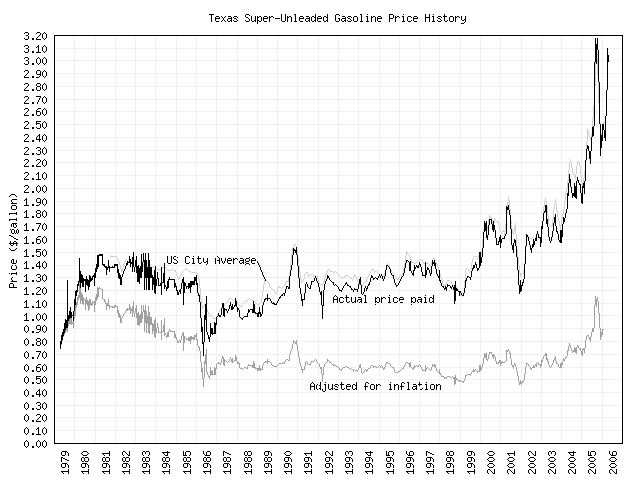
Glenn Reynolds links this gas price chart this morning at Random Useless Data, showing that in real terms, gas prices are still below their peaks, and not at "all-time highs."

Gasprice_1

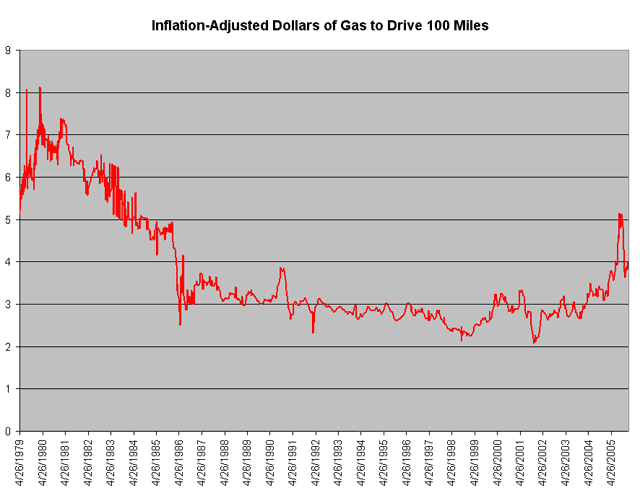
I took this one step further, based on the assumption that it isn't the price per gallon that matters for gas, but the price to drive a fixed mileage, say 100 miles.  Since average automobile fuel economy has continued to improve, in real terms we are far below the peak cost of gasoline.  Using this and this MPG data (for passenger cars) and the inflation adjusted gas prices here, I got this chart (1979 dollars)

Gas_price_100_1

By the way, just so you know my personal incentives, there are very few people out there who run a business whose fortunes are more sensitive to gas prices than my recreation business.  This will not be a very good summer for me, but if we leave the market alone to do its work, things will likely be better in 2007.  Intervention by Congress will pretty much assure that things will get worse.

Some Updates, and an Appology

I have been stuck in rural Colorado a few days, my stay extended by a pretty good spring snowstorm up in the high country.  I was visiting our new Colorado marina.  Finally getting to the airport, I found a backlog of unapproved comments, which I have passed through in mass.  Sorry for the delay, but blame spam-bots.  I hate having to approve comments to filter spam as much as you must hate the delay in seing your comments appear.

The other day in this post I, for the first and last time, wrote that my commenters needed to educate themselves.  I knew this was a stupid thing to write, leading with my chin, as it were.  I have posted all kinds of dumb stuff, and a number of things that I have been informed were outright errors (see the update to that same post, for example).  My commenters are great and often more knowlegeable than I am, so it was a dumb tone to adopt.  My only excuse is that I had about 5 emails in a row that confused the trade deficit with the federal budget deficit and the national debt, and I was ready to scream. 

I'm sorry.

I'll Try Again -- Why The Trade Deficit is Not a Debt

After spending gobs of electrons on this post about the US trade deficit explaining why it is not a debt, and is not even necessarily bad, I got a depressing number of comments and emails like this one:

The trade deficit is a debt. We cannot get the dollars back we have
spendt unless we export to get them back. It is called an external debt
for a reason. It is called a current account debto for a reason.

Aaaaargh.  It is depressing that we can get such economic ignorance, particularly in a self-righteous way.  The crappy media coverage of these issues has people convinced that it just has to be this big old debt out there someone is going to have to repay someday. 

OK, I will try again.  But in response to this specific post, it is only called "external debt" or "current account debt" rather than "deficit" by really, really sloppy media people who have no idea what they are talking about (unfortunately, there are a lot of these).  And a deficit is not a debt, though it can sometimes create a debt.

I try to be very respectful of my readers.  I never delete a comment, unless it is spam/bot stuff or in a few cases where commenters have asked me to.  So it is only with the deepest respect that I say the following:  Please do not bother to comment on this post if a) you do not understand the difference between the federal government deficit and the trade deficit and/or b) you do not understand the difference between an account deficit and a debt.  Seriously.  Just take my word for it that you need to educate yourself a bit first, and then feel free to leap into the debate.  (Update:  This was a poor tone to adopt, see here).

First, A Thought Experiment

This is not meant to constitute proof, but for those who are concerned that the trade deficit is potentially disastrous for our economy, I can only ask, When?  Because we have been running a substantial trade deficit as a nation for over a quarter of a century, and by all accounts, over that same time period, we have had just about the strongest economy in the world.  In fact, I would propose that the causation is more likely just the reverse.  Because we have had a strong economy, with extraordinary wealth creation, we have taken some of that wealth and spent it on goods from other nations.  And because we have the safest nation in the world in which to invest, demand for our local investments tends to shift exchange rates in a way that increase the trade deficit.

In the late 80's and early 90's, everyone was in a panic about Japan.  We were running a massive trade imbalance with Japan.  They were going to buy all of our real estate.  Their government was tipping the scales in their own favor.  They were purposefully depressing the yen to encourage exports.  Blah, blah, etc, etc.  And you know what happened?  They subsequently went into a decade and a half long recession they are only just now climbing out of, and we had one of the strongest economies in history. 

How do the Dollars Get Back?

With a couple of exceptions that don't really change our conclusions, dollars do follow a closed loop.  In other words, if we send them to China or India, they generally eventually come back.   The question is how.  To understand this, it is first important to understand that the balance of trade deficit only measures some monetary flows.  In particular, it looks at the balance between manufactured goods traveling between two countries.  If the US has a $20 billion trade deficit with China, it means that they shipped $20 billion more of manufactured goods to us than we shipped back to them.  It includes some but not all services.  It does not include goods or securities or investments purchased by foreigners that remain on US soil.

To understand how the dollars come back from China in a closed loop is to, in a sense, ask the question of what monetary flows are not included in the trade deficit.  If we have a trade deficit with China, there are a number of things it can do with its extra dollars:

  1. It can do nothing with them - just hold them in a big pile
  2. It can lend the money to people buying their products
  3. It can buy certain US services
  4. It can buy US goods, but not take them out of the US
  5. It can buy US public and private securities and real estate

Lets look at each in turn

1.  China can do nothing with them - just hold them in a big pile

Two words:  In-Sane.  By just holding them, they would effectively be sticking them in a mattress and foregoing any interest or investment income.  It's just not going to happen.  And don't say, well they could just put the dollars in a Chinese bank.  Fine, but the only way the Chinese bank is going to pay interest on dollars in the bank is if they turn around and invest the dollars in dollar-denominated investments.  One way or the other, the money, if it does not buy anything else, will get invested, which we will deal with in point 5.

I know there are paranoiacs that worry that the Chinese, despite the financial disincentives, will hold these dollars anyway in a big vault or something out of spite.  Gee, hurt me, hurt me.  Holding our dollars in a big mattress in Peking does nothing to hurt us.  And dumping them all on the market simultaneously may sound scary to conspiracy theorists, but in practice it would hurt them worse than it would hurt us, and the pain would be relatively short-lived  (just ask the Hunt brothers about this strategy).

2.  China can lend the money to people buying their products

I suppose that for those who don't get the federal deficit and the trade deficit mixed up, this is what they assume is happening, that Americans are borrowing from the Chinese to finance manufactured goods purchases.  The only problem is that it is not happening, at least to a greater extent than any normal purchase-financing arrangements.  Take corporations such as Wal-mart, a huge buyer of Chinese stuff.  Is Wal-Mart going into debt to buy Chinese stuff?  No, and certainly not to the Chinese. 

Well, are individual Americans going into debt to buy Chinese.  Maybe, but the key point is that they are not going into debt because what they are buying is Chinese.  They are going into debt because Americans, for whatever reason good or bad, are saving less and choosing to buy more on credit.  This would be happening if what they were buying was Chinese or American made.  In other words, American consumers may have debt, but that debt would exist even if we had no trade deficit with China.  It is a personal choice people are making that has no relation to the source of goods.

3.  China can buy certain US services

Note that many US services are not included in the trade deficit calculations.  If Chinese companies engage McKinsey & Co. consultants in the US to figure out how to sell more stuff to Wal-mart, those payments for services are probably bringing dollars back to the US from China, but aren't included in the trade calculations.  This really is just a subset of point four:

4.  China can buy US goods, but not take them out of the US

Many, many of the dollars the Chinese end up with come back to us in this way.  As did many of the dollars the Japanese had in the eighties.  If a Chinese company uses dollars not to buy US goods and take them back to China, but buy them and consume them in the US, then this does not show up in the trade numbers.  Chinese and Japanese companies bring their US dollars to the US to build factories and infrastructure.  This is sometimes why it is said that the trade deficit is not a measure of differences in cash flows, but of a difference in where goods are consumed. 

If you flip the equation around, the Chinese have a wicked balance of stuff deficit.  They are sending a lot more manufactured goods to the US than they get back.  I could argue that Chinese workers are getting hosed, since they only get to enjoy a fraction of the goods they produce for themselves, since a large portion of the product of their labor is sent overseas for others to enjoy.  Hmmm, doesn't sound so bad that way.

5.  China can buy US public and private securities and real estate

Of course, what happens with a lot of the US dollars the Chinese find themselves with is that these dollars get invested in US investment vehicles, from real estate to government bonds to private equities.  There are several points that need to be made here:

a.  Just Because Chinese invest in US Government Bonds does not make them or the balance of trade responsible for this debt

As I intimated above, a lot of people get the US federal budget deficit confused with the trade deficit.  Making this confusion worse, the Chinese use a lot of the dollars they earn in trade to buy US Government Bonds that help finance the federal budget deficit.  Now, by buying a lot of government bonds, one might argue that the Chinese lower interest rates and make government borrowing easier, thus making the federal budget deficit worse since there is a ready source of debt financing. 

While there may be a link here, it is tenuous at best.  If the government was a private company, then its borrowing level might rationally fluctuate up and down based on interest rates and capital availability.  But the US Government is not this rational.  It runs a budget deficit primarily because legislators and bureaucrats alike have the incentive to spend other people's money to protect their jobs and power base.  This happens equally at 3% interest rates and 9% interest rates.  It happens equally if guys from Peking or Omaha are buying government bonds.  In fact, one could argue that Chinese reinvestment of their trade dollars in US securities actually marginally reduces the government debt by reducing interest costs.

This same argument holds equally true for Chinese investments in private debt.  Chinese dollars may increase borrowing slightly, but only because the influx of their cash reduces borrowing costs.

b.  Chinese Ownership of US Assets is GOOD

In the Japanese scare of the 1980's, everyone was freaked out that the Japanese were buying up American assets and real estate.  During that time, while I almost never play the race card, it was almost impossible not to come to the conclusion that some racism had to be involved in this fear.  America had welcomed, in fact, had prospered, via foreign investment for years.  For a century, the US has been the safest place for foreigners to put their money,something we should be proud of  -- A sign of strength, not weakness.

But suddenly, everything was different because the new buyers were Japanese.  Note the following:

Despite the notoriety of
Japanese investors, the British have the largest U.S. direct investment
holding"”with the Dutch not far behind"”as has been the case since
colonial times. In 1990 the United Kingdom held about 27 percent of
foreign direct investment in the United States, significantly greater
than Japan's 21 percent. The European Economic Community (EC)
collectively holds about 57 percent. Moreover, according to research by
Eric Rosengren, between 1978 and 1987, Japanese investors acquired only
94 U.S. companies, putting them fifth behind the British (640),
Canadians (435), Germans (150), and French (113).

But no one was complaining about the British, Canadians, Germans, or French.  Only the Japanese.  I have to come to the conclusion that there was some racism involved, with the same primal fears at work that caused us to ship US citizens of Japanese decent off to concentration camps in WWII but we did not do the same of citizens of German or Italian decent.  And in this case, it could not have been security concerns.  Since 1945, Japan is one of the most pacifistic nations in the world- we probably face a bigger security threat from Belgium than we do from Japan.

I get the same feeling today with the China panic that I did twenty years ago with Japan.  Its a race and a culture we don't understand well, so we get xenophobic.  People lament that China is a real security threat, and that certainly is true to an extent.  But ask yourself this - Is China more or less of a threat to hurt us if their economy, their financial prosperity, and most of their assets are tied to the US?  Is China more or less stable now that their people are not starving and they are rapidly developing the largest middle class in the world?

Conclusion

If you are still having trouble understanding, the problem may be that you insist on thinking of economics as zero-sum.  This is the fallacy of 18th century mercantilists, who saw the economy as a big fixed tank, and if more flowed overseas than flowed back, the tank level would fall until the country was bankrupt.  There are at least two key fallacies here:

  1. Wealth is not zero-sum.  It is created.  It is expanded.  Some can even be spent frivolously on big ass plasma TV's from China and we are still wealthier than we were decades ago.
  2. Trading has value in both directions.  As mentioned above, looking at only the currency side of trading misses a lot.  By definition, in a free trade, both sides believe the trade increases the value to themselves, or they would not have made the trade.  So trading per se, no matter what the currency flows, can only lead to wealth creation, not its destruction.

Postscript - New Mercantilism

Lamenting the trade deficit is always a precursor to interfering with free trade.  It is important to note that free trade has always led to prosperity, while protectionism has always led to stagnation. 

Several protectionists today are trying to make the argument that OK, that might have been true in the past, but today is different, and today, free trade is uniquely bad.  Economist Paul Craig Roberts made this argument, that, as Don Boudreaux summarizes it:

the American standard of living is threatened by the world's growing
prosperity, improved education, better governance, and greater fluidity
of capital and resources to move in search of higher returns

Boudreaux, a writer at the fabulous Cafe Hayek, does a good fisking of this argument, but I think I can demolish it even faster.  By this logic, California would be better off if the eastern part of the US was suddenly impoverished and made educationally backwards.  This is absurd.   Sure, the industrial east suffered some temporary dislocations as the south modernized and competed for factories.  But this was only temporarily.  As the south got richer, it wasn't a contest between regions for a fixed number of factories, the number of factories and jobs grew, so that all parts of the country had more. 

Is there anyone who thinks that half of the US would be better off
economically if the other half were turned into a third world nation?  Is there any company executive that thinks they could survive if half their market went away?  So why is half the world better off if the other half is impoverished?  If you are saying, gee, the only reason I can come up with is that zero-sum fallacy Coyote keeps talking about, go to the head of the class.

Update:  In comments and emails, my readership educates me that citizens of German and Italian decent were interned in WWII as well.  While I knew that Germans and Italian POW's were interned in large numbers in the US in WWII, I was not aware of internship of US citizens with German or Italian blood, though the programs for these nationals do seem more limited than the west coast movement of Americans of Japanese decent.   My first and second generation German immigrant family members never reported being harassed in any way, either publicly or privately, during the war and most all served either in the US military or war production industries.  I will still stick by my core point that investment in the US by Asian nationals is not treated the same as investment by European or Canadian nationals.

I have also gotten a number of emails and comments on the differences between various trade and current account deficit indicators.  I tried to avoid getting into all that, assuming, I think rightly, that it would just clutter up the argument and would not substantially affect the conclusion.  Just for the record, though, there are many different metrics, that range from narrow measures of manufactured goods flows to much broader measures of capital and services flow.  You can assume that 90% of the time, the media article you are reading about the deficit probably does not correctly describe the metric it is using.
 

Vioxx and Merck Lose Again

Vioxx went to 3 for 6 in jury verdicts today as Merck lost a case in Texas (WSJ $).  Merck got hit with $7 million in damages plus $25 million in punitive damages, presumably since Merck was so clearly at fault as to be considered to have acted recklessly.  With that in mind, consider a couple of facts in the case:  First, the plaintiff..

died of a heart attack after taking Vioxx for less than a month.

I know what you are thinking.  How, after less than a month of use (and maybe as little as a week), could any plaintiff prove their heart attack was from Vioxx?   I mean, out of the thousands of people who took Vioxx, some statistically were due for a heart attack even had they not taken the drug.  Having one event (the heart attack) follow another (Vioxx use) does not prove causation, after all.  I guess the jury decided that this guy was not at risk for a heart attack otherwise.  Of course, they admitted that:

Mr. Garza, a Vietnam veteran who was 71 years old when he died in 2001,
had a history of smoking, had suffered a prior heart attack in 1981 and
had quadruple bypass surgery in 1985.

But I'm sure that had no bearing on his heart attack.  It must have been from the week of Vioxx.  His lawyers mitigated this by arguing:

he had a stress test shortly before his heart attack that showed he was in good health

Do you know how many men die of heart attacks within months of having a clean stress test?  A lot.

The plaintiffs initially asked for a billion dollars, so I guess if only by comparison the verdict was reasonable.  I wrote more about the danger of making uninformed juries the arbiter of what risk trade-offs we as individuals can take with our medications here and here and here.  I questioned multiple punitive damage awards for the same offense in the context of double jeopardy here.

Employment Opportunities

The Phoenix-based Goldwater Institute is looking for a Director of Administration and a Director of Development.  If you have always wanted to convert your desire for small government into a paying job, this might be your chance.  From their web site:

The Goldwater Institute was founded in 1988 by a small group of
entrepreneurial Arizonans with the blessing of Sen. Barry Goldwater.
Like our namesake, the Goldwater Institute board and staff share a
belief in the innate dignity of individual human beings, that America
is a nation that grew great through the initiative and ambition of
regular men and women, and, that while the legitimate functions of
government are conducive to freedom, unrestrained government has proved
to be a chief instrument in history for thwarting individual liberty.
Through research and education, the Goldwater Institute works to
broaden the parameters of policy discussions to allow consideration of
policies consistent with the founding principles of free societies....

With the legislature introducing thousands of new bills every year,
it's nearly impossible for the average person to know when or where his
liberties are threatened, much less do anything about it. The Goldwater
Institute works on behalf of Arizonans to keep watch on government and
to expand school choice, restore economic liberty, protect private
property, and affirm Arizona's independence against unconstitutional
federal encroachments.

The Peak Whale Theory

After reading this article on the earth running out of resources,  I discovered another article from the archives of the Coyote Broadsheet, a predecessor of this blog written by one of my distant relatives, dated April 17, 1870:

As the US Population reaches toward the astronomical total of 40 million persons, we are reaching the limits of the number of people this earth can support.    If one were to extrapolate current population growth rates, this country in a hundred years could have over 250 million people in it!  Now of course, that figure is impossible - the farmland of this country couldn't possibly support even half this number.  But it is interesting to consider the environmental consequences.

Take the issue of transportation.  Currently there are over 11 million horses in this country, the feeding and care of which constitute a significant part of our economy.  A population of 250 million would imply the need for nearly 70 million horses in this country, and this is even before one considers the fact that "horse intensity", or the average number of horses per family, has been increasing steadily over the last several decades.  It is not unreasonable, therefore, to assume that so many people might need 100 million horses to fulfill all their transportation needs.  There is just no way this admittedly bountiful nation could support 100 million horses.  The disposal of their manure alone would create an environmental problem of unprecedented magnitude.

Or, take the case of illuminant.  As the population grows, the demand for illuminant should grow at least as quickly.  However, whale catches and therefore whale oil supply has leveled off of late, such that many are talking about the "peak whale" phenomena, which refers to the theory that whale oil production may have already passed its peak.  250 million people would use up the entire supply of the world's whales four or five times over, leaving none for poorer nations of the world.

Too bad Julian Simon wasn't around to make a bet on whale oil prices.

Great Example of Zero-Sum Thinking

In perhaps the best example I have seen since Paul Ehrlich of zero-sum thinking, junkscience.com links to this article at the BBC:

A study by the New Economics Foundation (Nef) and the
Open University says 16 April is the day when the nation goes into
"ecological debt" this year.

It warns if annual global consumption levels matched the UK's, it would take 3.1 Earths to meet the demand.

How many times does this sort of stuff have to be wrong before it stops getting printed by "science writers" in the media.  Malthus made the same argument over a century ago, and Ehrlich has been making one bad prediction after another along these lines since the late 60's  The report relies on this concept:

The findings are based on the concept of "ecological
footprints", a system of measuring how much land and water a human
population needs to produce the resources it consumes and absorb the
resulting waste.

Of course, no one mentions that this "ecological footprint" number has changed dramatically with technology, not only in the last 200 years but even in the last 30.  For example, total US Farm acreage has fallen for the last fifty years, while agricultural production has grown between two and five times in the same period.   Its a stupid, meaningless analysis that says that if nothing else changed, and suddenly consumption went up, there would be a crisis.  It relies on the lack of imagination of both the authors (and to an extent, the audience), arguing that since they can't think of any way to grow production any further, it must not be possible.  I can just picture these guys as prehistoric man sitting in a cave making the same pronouncements of disaster for the species, all while their peers are busy outside playing with bone tools under the big black monolith.

More on the zero-sum fallacy here.


I'll Take That Tinfoil Hat Now

I think it was George Carlin (?) who used to ask "Do you know what the worst thing is that can happen when you smoke marijuana?" His answer was "Get sent to prison".  The implication, which I have always agreed with for most drug use, was that it is insane as a society to try to save someone from doing something bad to himself by ... doing something worse to him.

I think of this whenever I get in a discussion about security responses to 9/11.  The worst thing that can happen to this country as a whole  (as differentiated of course from the individual victims of 9/11) is to turn the country into a police state to combat potential future terrorist actions.  I personally would greatly prefer to live with a 1 in 100,000 chance of being the victim of terrorism than find myself living in an America that has abandoned its constitution.  I wrote more on this topic here.

To this end, though I tend to be slow to believe these type of stories, this one (via Reason) about domestic NSA wiretapping is pretty frightening:

AT&T provided National Security Agency eavesdroppers with full
access to its customers' phone calls, and shunted its customers'
internet traffic to data-mining equipment installed in a secret room in
its San Francisco switching center, according to a former AT&T
worker cooperating in the Electronic Frontier Foundation's lawsuit
against the company....

The source is just one low-level guy, so this story is still pretty soft.  I hope the investigation is allowed to play out.

Limiting Free Speech Unifies Congress

Anyone who actually believed that McCain-Feingold was about cleaning up politics rather than just protecting incumbent political jobs can now disabuse themselves of that notion.  It has become clear that election finance laws are pure Machiavellian politics, passed by those who think it will work to their benefit (ie help them in the next election) and opposed by those who think they will be hurt by it.  Principle almost never plays a part any more.

On April 5, House Republicans voted to limit the speech of 527 groups, who up until now were exempt from McCain-Feingold speech restrictions.  Republicans generally supported the restrictions, despite years of saying that money does not tarnish politics, because, well because Democrats were better last election than Republicans at raising money via 527's.  Democrats, who historically as a party have supported campaign finance and speech restrictions and eagerly voted for McCain-Feingold, oppose the legislation for no principled reason except that 527's are working for them.  Democrats will therefore likely prevent this bill from passing the Senate.

George Will has a nice column lambasting the Republican Congress:

If in November Republicans lose control of the House of
Representatives, April 5 should be remembered as the day they
demonstrated that they earned defeat. Traducing the Constitution and
disgracing conservatism, they used their power for their only remaining
purpose -- to cling to power. Their vote to restrict freedom of speech
came just as the GOP's conservative base is coming to the conclusion
that House Republicans are not worth working for in October or
venturing out to vote for in November.

The "problem" Republicans
addressed is that in 2004 Democrats were more successful than
Republicans in using so-called 527 organizations -- advocacy groups
named after the tax code provision governing them. In 2002 Congress
passed the McCain-Feingold legislation banning large "soft money"
contributions for parties -- money for issue-advocacy and
organizational activities, not for candidates. In 2004, to the surprise
of no sensible person and most McCain-Feingold supporters, much of the
money -- especially huge contributions from rich liberals -- was
diverted to 527s. So on April 5, House Republicans, easily jettisoning
what little remains of their ballast of belief in freedom and limited
government, voted to severely limit the amounts that can be given to
527s.

He captures a priceless quote that gets at the heart of why Congressional incumbents love these campaign finance laws:

Candice Miller (R-Mich.) said that restricting 527s would combat
"nauseating ugliness, negativity and hyperpartisanship." Oh, so that is
what the First Amendment means: Congress shall make no law abridging
freedom of speech unless speech annoys politicians.

Props, by the way, to my Representative John Shadegg for his no vote, as well as to my favorite Congressman Jeff Flake, who voted no as well.

Punish the Victims

In Florida, where there seems to be a substantial problem with people stealing property in the form of shopping carts from local merchants, the government has a solution: Fine the victims.

In theory, stealing a shopping cart is punishable by up to 60 days in
jail and a $500 fine. But police rarely catch anyone in the act.

So local governments across the state are tackling the battle in
other ways, typically requiring stores to keep carts in the parking lot
or pay a fine.

Hallandale Beach recently updated its laws requiring stores to
create plans for keeping carts on their property. Stores bigger than
35,000 square feet, about the size of many grocery stores, can be
required to install theft-prevention devices....Installation costs $20,000 to $30,000, Miller said....

But retailers are fighting back. The way they see it, the rules are
blaming the victim -- punishing stores for other people's stealing.

Thanks to Bob Houk for the link. 

Maybe It's Just Too Complicated

The US Congress is considering a federal licensing requirement for all paid tax preparers.  Apparently, even most paid preparers can't get the returns correct:

The senators heard from investigators at the Government Accountability
Office, who found mistakes in virtually every tax return filled out by
commercial chain preparers. The investigators said they looked at a
tiny number of tax returns, and that their conclusions could not be
generalized to the rest of the tax preparation industry.

You know why?  Because I would bet you that the same amount of scrutiny could find errors in every single return submitted.  There is just no way to get it all right.  How about, you know, actually spending some time in Congress making the return easy enough that individuals don't feel the need to seek out paid preparers.  Of course, the real reason for this initiative is that higher-dollar CPA firms and large accounting firms would like Congress to sit on its low-price competition  (note that only chain-type firms were investigated).  As Milton Freedman pointed out long ago about licensing:

The justification offered is always the same: to protect the consumer. However, the reason
is demonstrated by observing who lobbies at the state legislature for
the imposition or strengthening of licensure. The lobbyists are
invariably representatives of the occupation in question rather than of
the customers. True enough, plumbers presumably know better than anyone
else what their customers need to be protected against. However, it is
hard to regard altruistic concern for their customers as the primary
motive behind their determined efforts to get legal power to decide who
may be a plumber.

Of course, the last paragraph of the article demonstrates there is already a solution in place for poor tax preparer service:

Had the IRS found these problems on real returns, many preparers would
have been subject to penalties for negligence and willful or reckless
disregard of tax rules

So why is licensing needed at all?

My Worst Vendor -- Guess Who?

Every small business probably has stories about vendors who are particularly difficult to work with.  Let me describe my most difficult and irritating vendor, someone who sells me products that we resell in our stores:

  • Most vendors try to set your retail price for you, but are seldom successful.  Only in countries like Germany that make retail discounting illegal are such attempts universally successful.  However, this one vendor is always successful at setting my retail price.
  • Most vendors allow me a retail gross margin of at least 30-50% of sales to help me to make money on the sale of their product.  They like me to make money, since that gives me the incentive to sell more of their product.  However, this one particular vendor only allows me a 5% gross margin.  Ironically, this products is on of the most difficult and time-consuming for our stores to sell, requiring ten minutes of sales time to gather all the necessary customer information and complete the transaction.  Every single one we sell is a dead loss to us.
  • Every small business has some vendors it struggles with on credit terms.  I usually have to fill out a detailed credit application, and as the owner have to personally guarantee the company's payment on the account.  Sometimes vendors will require a few orders be consummated COD so we can develop a history before they will go to a 30-day invoicing approach.  However, this particular vendor goes even further.  I had to set up a dedicated bank account into which I deposit funds for this vendors products every week.  In addition, I had to obtain a $4000 bond to cover any non-payment in the account, and I have to hold the bond as long as I want to do business with this vendor -- in other words, there is no credit given for a long track record of performance on the account.
  • This particular vendor has an "in" with the State of Colorado, which protects it by allowing no other competitive product to be sold in the state.

Give up?  Well, most of you have probably guessed that this vendor is... the government!  Or specifically, the Colorado Department of Wildlife and the specific product discussed is fishing licenses.  That is why this particular vendor can get away with practices that no company that actually has to compete in the market place would ever attempt, and, in a couple of cases, gets aways with practices that would be illegal for a private company.

When I bought this company, we used to sell fishing licenses at many of our locations.  I have pared this down to only the bare minimum number of locations, like marinas, where customers absolutely expect me to be able to sell them a license.

Don't Fix Immigration, Fix the Welfare State

Brian Doherty of Reason observes:

The solution to the legal crisis immigration represents won't come through
immigration law itself, which again and again has proven itself useless at
fully stemming the irresistible tides of human desire for a better life. No
matter how much money is spent or how the law is jiggered, it is not immigration
policy that has created unnecessary tears and strains in America's social
order. Rather, the welfare state is at the root of any legitimate claim that
immigration (legal or illegal) is an assault on the American nation. (There
are plenty of illegitimate complaints, based merely on distaste for
the often-imaginary hell of running into Spanish-speaking people in
day-to-day life or seeing some flag not of your nation, but such complaints
are not worthy of consideration.)...

The free market, as it usually does, has created a system of mutually
satisfactory interdependence, all of us serving each other and helping each
other get what we want. The welfare state, in all its manifestations from
medical care to schooling to pure giveaways, creates a negative sum game in
which resources are forcibly redistributed making some a problem, or a
perceived potential problem, to others, and allowing demagogues to obsess
over precious "public" resources scarfed up by the invading Other.

As long as that system is around to breed resentment and anger"”as well
as counter-resentment and counter-anger such as that seen in the streets of
L.A. of late"”immigration will continue as a political crisis, no matter
how many repeat cycles of jiggering with immigration law, or protesting it,
we go through.

California's
Proposition 187,
attempting to limit the provision of government services to illegal
immigrants, was indeed, whatever the motives of its supporters, in spirit on
the right track to a world where any immigrant ought to be, and can be,
welcome; one where they are pure contributors at the same time to their own
well-being and to everyone else's as well. It's the only permanent and just
solution to the immigration conundrum. But it involves a significant
reduction in federal power, money, and authority, rather than an expansion
of it. Strangely, it's a no-go in today's Washington.

I wrote a similar essay on how the New Deal changed our views on immigration.