Many free websites (like newspapers and forums) require an email address to sign up. To make sure you give them a real one, they send you a password or activation code, usually within 60 seconds, by email.
Guerrilla Mail will issue you an email address that is good for 15 minutes. You don't even have to leave the web site, just hit refresh and any emails you receive show up there on the screen and can even be replied to. The only problem is that this will leave you with an impossible list of user ID's, but it is great for, say, forums where I only need to post one time (say with a customer support question).
"And when you look at the internet business, what's dangerous about it
is that people who are clearly unqualified get to disseminate their
piece to the masses. I respect the journalism industry, and the fact of
the matter is ...someone with no training should not be allowed to have
any kind of format whatsoever to disseminate to the masses to the level
which they can. They are not trained. Not experts."
Despite its wackiness, we can still draw some useful observations:
Yet again, we have an industry incumbent calling for some sort of professional licensing, nominally to protect consumers, but in actuality to protect the incumbent's position in the industry. Smith himself couldn't be more explicit about this:
"Therefore, there's a total disregard, a level of wrecklessness that
ends up being a domino effect. And the people who suffer are the common
viewers out there and, more importantly, those in the industry who
haven't been fortunate to get a radio or television deal and only rely
on the written word. And now they've been sabotaged. Not because of me.
Or like me. But because of the industry or the world has allowed the
average joe to resemble a professional without any credentials
whatsoever."
He can't even complete the sentence with the window dressing justification that this is for the consumers before he gets to the real people he is trying to protect, ie traditional media personalities like himself. You know, trained professionals. You could subsititute attorneys, doctors, nurses, real estate agents, funeral directors, massage therapists, hair braiders, fishing guides and any other licensed or unionized professional and find the same speech given somewhere at some time.
Note the implicit disdain for the consumer, or in this case, the viewer or reader. The unstated assumption is that the consumer is a total idiot, a dupe who mindlessly keeps tuning in to inferior news reports from untrained bloggers rather than watching pros like Stephen A. Smith as they should be
Finally, and this may be unfair because I am only partially familiar with Mr. Smith's work, but I will observe that he is an African-American who brings a kind of street style to his reporting. A style that I might guess that a crotchety sports reporter from thirty years ago might easily have defined then as unprofessional. Mr. Smith's career has benefited in part because he has differentiated himself with new style and approach, but now he wants to slam the door on others trying to similarly bring innovation and new approaches to the sports world. Unfortunately, all too typical of professionals of all stripes, particularly since the government has set the expectation over the last 100 years that it is open to using its coercive power to enforcing professional standards in even the most trivial of professions.
I end such a discussion, as always, with Milton Friedman:
The justification offered [for licensing] is always the same: to protect the consumer. However, the reason
is demonstrated by observing who lobbies at the state legislature for
the imposition or strengthening of licensure. The lobbyists are
invariably representatives of the occupation in question rather than of
the customers. True enough, plumbers presumably know better than anyone
else what their customers need to be protected against. However, it is
hard to regard altruistic concern for their customers as the primary
motive behind their determined efforts to get legal power to decide who
may be a plumber.
I wasted a lot of time yesterday with this geometry problem. I have about 12 pieces of paper here that look like a Mondrian retrospective, cutting new triangles and parallel lines. Still don't have the proof yet, so I thought I would see if I could pull some of your productivity down with mine. If you are like me, you will decide that the answer is trivial about twice in the first five minutes, both times discovering you have not actually gotten to the answer.
The Question, as asked (surprisingly) by a global warming believer:
One curious aspect of this result is that it
is also well known [Houghton et al., 2001] that the same models that
agree in simulating the anomaly in surface air temperature differ
significantly in their predicted climate sensitivity. The cited range
in climate sensitivity from a wide collection of models is usually 1.5
to 4.5 deg C for a doubling of CO2, where most global climate models
used for climate change studies vary by at least a factor of two in
equilibrium sensitivity.
The question is: if climate models differ by a factor of 2
to 3 in their climate sensitivity, how can they all simulate the global
temperature record with a reasonable degree of accuracy. Kerr
[2007] and S. E. Schwartz et al. (Quantifying climate change"“too rosy a
picture?, available at www.nature.com/reports/climatechange, 2007)
recently pointed out the importance of understanding the answer to this
question. Indeed, Kerr [2007] referred to the present work and the
current paper provides the "˜"˜widely circulated analysis'' referred to
by Kerr [2007]. This report investigates the most probable explanation
for such an agreement. It uses published results from a wide variety of
model simulations to understand this apparent paradox between model
climate responses for the 20th century, but diverse climate model
sensitivity.
Environmentalists are warning against expanding the production of
biofuels, noting the proposed solution to global warming is actually
causing more harm than it is designed to alleviate. Experts report
biodiesel production, in particular, is causing the destruction of
virgin rainforests and their rich biodiversity, as well as a sharp rise
in greenhouse gas emissions.
Opponents of biofuels read like a Who's Who of environmental
activist groups. The Worldwatch Institute, World Conservation Union,
and the global charity Oxfam warn that by directing food staples to the
production of transport fuels, biofuels policy is leading to the
starvation and further impoverishment of the world's poor.
On November 15, Greenpeace's Rainbow Warrior unfurled a large banner
reading "Palm Oil Kills Forests and Climate" and blockaded a tanker
attempting to leave Indonesia with a cargo full of palm oil.
Greenpeace, which warns of an imminent "climate bomb" due to the
destruction of rich forests and peat bogs that currently serve as a
massive carbon sink, reports groups such as the World Wildlife Fund,
Conservation International, and Flora and Fauna International have
joined them in calling for an end to the conversion of forests to
croplands for the production of biofuels
"The rush to address speculative global warming concerns is once
again proving the law of unintended consequences," said James M.
Taylor, senior fellow for environment policy at The Heartland
Institute. "Biofuels mandates and subsidies are causing the destruction
of forests and the development of previously pristine lands in a
counterproductive attempt to improve the environment.
"Some of the world's most effective carbon sinks are being destroyed
and long-stored carbon is now being released into the atmosphere in
massive quantities, merely to make wealthy Westerners feel like they
are 'doing something' to address global warming. The reality is, they
are making things worse," Taylor noted.
Many government programs have both a stated justification as well as a second, unstated justification which is the real reason that politicians support the program. For example, many regulations are portrayed as pro-consumer when in fact their real utility is in protecting a favored company or political donor from new competition.
This means that when any politician stands up and proposes a new program, a majority of Americans know that they are not going to pay for it. In fact, the situation is even more obvious when you consider new programs at the margin. If you listen to the Democratic debates, nearly every candidate is proposing to pay for his or her expensive programs via new taxes aimed solely at the top 10 or 20% of earners. Every time they propose a program, there is an unstated but increasing clear clause "and 80% of you won't have to pay anything for this." Already, we see many states funding new programs with surcharges on the rich. Here is but one example:
California voters agreed to tax the rich to support public mentalhealth
services.
More than half of them (53.3 percent) voted last month in favorof
Proposition 63, which will impose a tax surcharge of 1 percenton the taxable
personal income above $1 million to pay for servicesoffered through the
state's existing mental health system. Theinitiative will generate an
estimated $700 million a year....
Richard A. Shadoan, M.D., a past president of the CPA, wrotein Viewpoints
in the September 3 issue of Psychiatric News,"The scope of the
program and its tax-the-rich source will provokea debate. But it's an
argument worth having to make Californiaface the neglect of not providing
treatment to more than 1 millionpeople with mental illness."
So what happened? I don't know how many people make a million dollars in California, but it is certainly less than 5% of the population. So the headline should read "53.3% of people voted to have less than 5% of the people pay for an expensive new program." If the 53.3% thought it was so valuable, why didn't they pay for it? Well, it is clear from the article that the populace in general has been asked to do so in the past and refused. So only when offered the chance to approve the program if a small minority paid for it did they finally agree. This is the real reason for progressive taxation. (by the way, these 53.3% will now feel really good about themselves, despite the fact they will contribute nothing, and will likely piss on millionaires next chance they get, despite the fact that they are the ones who will pay for the program).
Ultimate Example of Progressive Taxation
My story today comes from the Roman Empire just after the death of Julius Caesar. At the time, three groups vied for power: Octavian (Augustus) Caesar, Mark Antony, and republican senators under Brutus and Cassius. Long story short, Octavian and Antony join forces, and try to raise an army to fight the republicans, who have fled Italy. They needed money, but worried that a general tax would turn shaky public opinion in Rome against them. So they settled on the ultimate progressive tax: They named about 2500 rich men and ordered them killed, with their estates confiscated by the state.
This approach of "proscriptions" had been used before (e.g. Sulla) but never quite as obviously just for the money. In the case of Octavian and Antony, though nominally sold to the public as a way to eliminate enemies of Rome, the purpose was very clearly to raise money. All of their really dangerous foes had left Rome with the Republicans. The proscriptions targeted men of wealth, some of whom had been irritants to Octavian or Antony in the past (e.g. Cicero) but many of whom had nothing to do with anything. Proscribed men were quoted as saying "I have been killed by my estates."
I wonder how many of today's progressives would be secretly pleased by this approach?
Many government programs have both a stated justification as well as a second, unstated justification which is the real reason that politicians support the program. For example, many regulations are portrayed as pro-consumer when in fact their real utility is in protecting a favored company or political donor from new competition.
This means that when any politician stands up and proposes a new program, a majority of Americans know that they are not going to pay for it. In fact, the situation is even more obvious when you consider new programs at the margin. If you listen to the Democratic debates, nearly every candidate is proposing to pay for his or her expensive programs via new taxes aimed solely at the top 10 or 20% of earners. Every time they propose a program, there is an unstated but increasing clear clause "and 80% of you won't have to pay anything for this." Already, we see many states funding new programs with surcharges on the rich. Here is but one example:
California voters agreed to tax the rich to support public mentalhealth
services.
More than half of them (53.3 percent) voted last month in favorof
Proposition 63, which will impose a tax surcharge of 1 percenton the taxable
personal income above $1 million to pay for servicesoffered through the
state's existing mental health system. Theinitiative will generate an
estimated $700 million a year....
Richard A. Shadoan, M.D., a past president of the CPA, wrotein Viewpoints
in the September 3 issue of Psychiatric News,"The scope of the
program and its tax-the-rich source will provokea debate. But it's an
argument worth having to make Californiaface the neglect of not providing
treatment to more than 1 millionpeople with mental illness."
So what happened? I don't know how many people make a million dollars in California, but it is certainly less than 5% of the population. So the headline should read "53.3% of people voted to have less than 5% of the people pay for an expensive new program." If the 53.3% thought it was so valuable, why didn't they pay for it? Well, it is clear from the article that the populace in general has been asked to do so in the past and refused. So only when offered the chance to approve the program if a small minority paid for it did they finally agree. This is the real reason for progressive taxation. (by the way, these 53.3% will now feel really good about themselves, despite the fact they will contribute nothing, and will likely piss on millionaires next chance they get, despite the fact that they are the ones who will pay for the program).
Ultimate Example of Progressive Taxation
My story today comes from the Roman Empire just after the death of Julius Caesar. At the time, three groups vied for power: Octavian (Augustus) Caesar, Mark Antony, and republican senators under Brutus and Cassius. Long story short, Octavian and Antony join forces, and try to raise an army to fight the republicans, who have fled Italy. They needed money, but worried that a general tax would turn shaky public opinion in Rome against them. So they settled on the ultimate progressive tax: They named about 2500 rich men and ordered them killed, with their estates confiscated by the state.
This approach of "proscriptions" had been used before (e.g. Sulla) but never quite as obviously just for the money. In the case of Octavian and Antony, though nominally sold to the public as a way to eliminate enemies of Rome, the purpose was very clearly to raise money. All of their really dangerous foes had left Rome with the Republicans. The proscriptions targeted men of wealth, some of whom had been irritants to Octavian or Antony in the past (e.g. Cicero) but many of whom had nothing to do with anything. Proscribed men were quoted as saying "I have been killed by my estates."
I wonder how many of today's progressives would be secretly pleased by this approach?
I really wanted to make a serious point about TJIC's post on Medicare overpaying for medical devices. However, that may be nearly impossible because the post selects "penis pumps" as the example medical device, and it is difficult to have a meaningful political dialog over penis pumps:
amount Medicare spent last year on penis pumps so that old can could stand at attention: $21 million
average price/ pump Medicare paid: $450
cost of the identical pump online: $108
Well, I will try anyway. I am sure if someone pointed this out in the Democratic debate as a potential issue with letting the government, famed for buying $800 hammers, run our health care system, they would all have stated piously that such things would not happen under their plan. But how? I mean, this kind of government waste has been going on for time immemorial. It is so closely tied to the unchangeable incentives of government managers that it could rightly be called a feature of rather than a bug in the system.
But I think I have figured it out. This is why most socialized health care systems do not allow one to go out of system to get private care. By banning all private care, the government eliminates all those irritating private analogs that might demonstrate they are inefficient. So, in the example above, the government typically tackles the problem not by reducing the $450 paid by Medicare, but banning the private sales of such devices so no annoying snoop can uncover the fact that a private system could have delivered it for 1/4 the price. Genius!
"I
was also proud to stand up for the ethanol tax exemption when it was
under attack in the Congress -- at one point, supplying a tie-breaking
vote in the Senate to save it. The more we can make this home-grown
fuel a successful, widely-used product, the better-off our farmers and
our environment will be."
Bowing to American pressure on the eve of high-level talks to reduce
economic tensions, China agreed Thursday to terminate a dozen different
subsidies and tax rebates that promote its own exports and discourage
imports of steel, wood products, information technology and other goods.
Thanks a lot. The Bush Administration crows that:
This outcome represents a victory for U.S. manufacturers and their workers
Um, not if they are consumers too, as they all are. And not if their company buys any inputs from Chinese manufacturers.
Napoleon said to never interrupt an enemy when he was making a mistake. I don't consider China an enemy, but it just flabbergasts me that the Chinese taxpayers and consumers see fit to subsidize lower prices for our consumers, and we feel the need to stop them. More here and here.
Thousands of Sudanese, many armed with clubs and knives, rallied Friday
in a central square and demanded the execution of a British teacher
convicted of insulting Islam for allowing her students to name a teddy
bear "Muhammad."
In response to the demonstration, teacher Gillian Gibbons was moved
from the women's prison near Khartoum to a secret location for her
safety, her lawyer said....
They called for Gibbons' execution, saying, "No tolerance: Execution," and "Kill her, kill her by firing squad."
"This an arrogant woman who came to our country, cashing her salary in
dollars, teaching our children hatred of our Prophet Muhammad," he said.
Um, this is a woman who merely went along with a group of small children who named a stuffed animal "Muhammad", a name I would guess a large number of the kids shared. Fortunately, the government is much more reasonable than these extremists. They only fired her from her job, slammed her in jail, after which time they will deport her. But it could have been worse:
The protesters streamed out of mosques after Friday sermons, as pickup
trucks with loudspeakers blared messages against Gibbons, who was
sentenced Thursday to 15 days in prison and deportation. She avoided
the more serious punishment of 40 lashes.
Let's forget all the other issues surrounding ethanol for a moment (we'll mention a really bad one below), and just consider one fact that is beyond dispute. Ethanol has an energy content per gallon that is only about 65% of that of gasoline. So, another way to put it is that it takes a bit over 1.5 gallons of ethanol to replace 1 gallon of gasoline. There is nothing suspicious or sinister about this (ethanol is flawed for other reasons) or at all controversial.
"The number of plants under construction is truly frightening,"
said Ralph Groschen, a senior marketing specialist with the Minnesota
Department of Agriculture who closely watches the state's ethanol
development. The country could go from 7 billion gallons of capacity
now to 12 billion gallons, or about roughly 10 percent of U.S. gasoline
capacity, in a few years, according to Groschen.
You need to understand that you and everyone else are failing at simple math. In 2004 the US consumed just over 140 billion gallons of gasoline. So, already, our media has failed the math test. 12 billion gallons would be 8.6%, but we will give them a pass on rounding that to "roughly 10 percent." But this 8.6% only holds true if gasoline is replaced by ethanol 1:1. Using the actual figures cited above, 12 billion gallons of ethanol is about 7.8billion gallons an a gasoline equivalent, which would make it 5.6% of US gasoline usage in 2004, and probably an even smaller percentage if we were to take the worlds "gasoline capacity" at face value, since surely capacity is higher than production.
I know it seems petty to pick on one paper, and probably would not be worth my time to bother if it was just this one article. But this mistake is made by every MSM article I have ever seen on ethanol. I can't remember any writer or editor ever getting it right.
By the way, if you want more on what is wrong with ethanol, check my past posts.
Biofuels need land, which means traditional food crops are being
elbowed off of the field for fuel crops. Biofuel production is
literally taking the food out of people's mouths and putting into our
gas tanks. Already, increased food costs sparked by increased demand
are leaving populations hungry. The price of wheat has stretched to a
10-year high, while the price of maize has doubled.
Need more
land? Clear cut some forest. Is there a word beyond irony to describe a
plan to mitigate climate change that relies on cutting down the very
trees that naturally remove carbon from the atmosphere? Stupidity,
perhaps? The logic is like harvesting a sick patient's lungs to save
her heart. Huge tracks of Amazon
rainforest are being raised to the biofuels alter like a sacrificial
lamb, and the UN suggests that 98 percent of Indonesia's rainforest
will disappear by 2022, where heavy biofuel production is underway.
Still
need land? Just take it. The human rights group Madre, which is backing
the five-year moratorium, says agrofuel plantations in Brazil and
Southeast Asia are displacing indigenous people. In an editorial
published on CommonDreams last week, Madre Communication Director Yifat
Susskind wrote, "People are being forced to give up their land, way of
life, and food self-sufficiency to grow fuel crops for export."
A web site on which I was registering said "Your password must be alpha-numeric and a minimum of 6 characters." I had an argument about this language with the customer service agent, but I may be wrong. I would interpret this as meaning that all the characters in the password must be from the alpha-numeric set, as opposed to, say, symbol characters. Therefore "asdfasdf", "12345678", and "asdf1234" would all meet the stated test. The customer service agent said that I was totally wrong, and went so far as to inform me their web designer has a PhD in English. Her contention was that alpha-numeric clearly means "must contain both a minimum of one alphabetical character and at least one numeric character." In my example above, only "asdf1234" would therefore qualify. Anyone have an opinion on this, or a definitive source?
If, from this and previous posts, folks out there are drawing the conclusion that I am losing patience with customer call centers, they would be correct.
A labor dispute which has darkened US light entertainment and chat
shows claimed another victim on Wednesday, forcing the cancellation of
a CBS News debate among Democratic White House hopefuls.
The debate, scheduled for Los Angeles on December 10, was nixed
after candidates including Hillary Clinton and Barack Obama said they
would refuse to cross a picket line that the Writers Guild of America
Union had threatened to set up.
"CBS News regrets not being able to offer the Democratic
presidential debate scheduled for Dec. 10 in Los Angeles," CBS said in
a statement.
"The possibility of picket lines set up by the Writers Guild of
America and the unwillingness of many candidates to cross them made it
necessary to allow the candidates to make other plans."
Since the writers have nothing to do with the debate (presumably, unless Hillary's question-writing shills are part of the guild) then their picketing the debate makes no more sense than if, say, the meat packers were picketing. Is the winning candidate going to refuse to enter the White House if any union is picketing out front? As Ed Morrissey points out, this does not bode well for any of the candidates being able to stand up to special interests as president.
Update: Next up, Democratic candidates to commit to not hire anyone for their administration who did not attend a government-run, NEA-unionized high school.
Albert Einstein's dream is now a reality. We have a new unified field theory: Global Warming causes everything bad. Via Tom Nelson and American Thinker, comes this list by Dr. John Brignell of links to articles in the media attributing various bad things to Global Warming. Currently, his list has over 600 items! Some excerpts:
We are rapidly coming up on the first anniversary of Vista, and it has been a very rocky year for Microsoft. New releases of an OS are always difficult, but many users have really turned up their nose on Vista. My experience has been much the same as everyone else's: Applications run slower in Vista (I know because I had a system set up to dual boot and A/B tested a number of applications). Networking, particularly wireless networking, is much less stable than in XP. Good drivers STILL don't exist for many legacy hardware devices, including may graphics cards. I ran into any number of quirks. The most irritating for me was that a laptop communicating with a printer via wireless network would lose connection with the printer every time the laptop was shut down in a way that could only be rectified (as confirmed by MS customer support) by reinstalling the print driver every time I wanted to use it.
Most computer NOOBs probably never noticed, not having anything to compare Vista with and only using their computers for a narrow range of functionality (ie email and internet browsing). However, many of us who are more comfortable with computers and who rely on our computers as an important tool have either avoided buying Vista computers (Dell, for example, still sells a lot of XP computers) and/or have taken the time to roll back their Vista to a dual boot system or even XP only (which I explain here). Which may explain why standalone XP packages are better sellers on Amazon than Vista.
For gamers, most of whom tend to be power users, Vista has been nothing but a negative, slowing games down and requiring use of buggy graphics card drivers (Microsoft crows that they get fewer customer service calls on Vista than XP, which may be, but I can gaurantee, from browsing gaming boards, that gaming companies get swamped with Vista calls from gamers who can't get the game to run on Vista).
Looming over all of this, though, has been one word: Crysis. Gamers have been lusting after this game for over a year, with its promise of knock-out graphics and game-play. To this end, Microsoft did something clever. It updated its DirectX graphics engine in Vista to revision 10, and included in it all kinds of new capabilities that would really make a game look fantastic. MS decided, either for technical or marketing issues, not to ever release these features on XP. If you wanted DirectX 10 games, you had to upgrade to Vista. Over the last year, graphics card makers have been releasing hardware to support DirectX 10. Crysis was set to be the first game that would really take advantage of DirectX 10, and many hardcore gamers upraded to Vista solely on the promise of running Crysis maxed out with the new DirectX 10 features.
Well, Crysis was released a few weeks ago. You may think I am building up to say it sucked, but just the opposite is true. It is absolutely fantastic. Easily the most visually stunning thing I have ever seen running on my PC. First-person shooter games are not really my favorite, but I have thoroughly enjoyed the game. (here is a trailer, but unlike most trailers, the game really looks like this in gameplay, maybe better due to limited resolution on YouTube.) Click below for larger screenshots:
But here is the interesting part. I keep my system state of the art. I have close to the fastest Intel multi-core processor currently made running with two of the newest Nvidia graphics cards (8800GT's) running ganged together in SLI mode (don't worry if you don't know what all that means, just take my word for it that it is about as fast as you can get with stock components and air cooling). Crysis, like most graphics games, can have its settings changed from "low", meaning there is less graphics detail but the game runs faster, through "med" to "high" and "very high". Only in the latter modes do the new features of DirectX10 really come into play. So I ran the calibration procedure the game provides and it told me that I needed to set the game to "medium!" That's not an error - apparently everyone else in my position who have a large monitor with high resolutions had about this experience. I can set the game to higher modes, but things really slow down. By the way, it still looks unbelievably awesome on Medium.
The designers of Crysis actually did something kind of cool. They designed with Moore's law in mind, and designed the highest game modes for computers that don't exist today, but likely will in a few years. So the game (and more importantly the engine, since they will likely sell the engine as a platform for other game makers to build their games atop) has some built-in obsolescence-proofing.
But lets return to Vista and Crysis being billed as a killer app. As it turns out, none of the directX10 features are really usable, because no one can turn the graphics engine up high enough with their current hardware. Worse, in a game where users are trying to eek out any tweek they can to improve frame rates and graphics speed, Crysis runs demonstrably slower on Vista than XP. Finally, those who have run the game in its higher modes withe DirectX 10 features (presumably at the cost of low frame rates) have found the actual visual differences in the DirectX 10 graphics to be subtle. The game boards are a total hoot, as folks who upgraded to Vista solely for Crysis are wailing that their experience on Vista is actually worse than on XP.
In my recent call to your service center, I was forced to navigate a nearly interminable set of menu options (which I listened to carefully since I had been assured that they had recently changed). After I navigated these options, your automated system then gathered data from me. It asked me to give my name, then my telephone number, and finally my account number, which I did.
Here is the reason for my letter, and my advice to you: Once you have collected all my information via an automated system, it is just going to piss me off when your human operator picks up the line and proceeds to ask me for this same information again. I know this seems to be the current industry standard, as practiced by every company from Citibank to Domino's Pizza, but I can assure you it is incredibly annoying and, perhaps worse for you, introduces me to your organization with the initial impression that you do not know what you are doing. So, either find a way to put the information you have gathered up on the customer service agent's screen, or don't have an automated system gather it.
Thank you.
PS- By the way, if you really, really want to start our conversation off on the wrong foot, then you should make it nearly impossible for me to find a menu option that gets me to a real person. You can get double extra credit for disabling "0" as an immediate route to the operator. Oh, and make sure all menus are preceded with long-winded customer service notices that have nothing to do with my problem.
For a while now, I have been fascinated by the contrast between the Left's position on abortion and its position on universal health care.
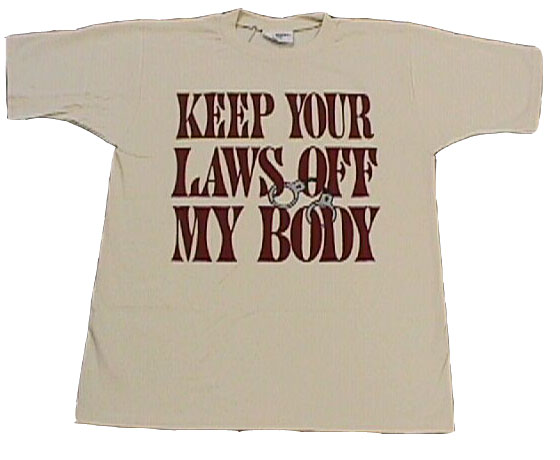
In the abortion debate, the Left was careful to try to establish a broader principal than just support for abortion. Their position was (and still is) that the government should not interfere in a woman's decision-making about her own body. Cool. That's a general principal that any libertarian could love (Note that there are many libertarians who accept this principal but argue that abortion is the one exception to it if one considers the fetus an independent life.) The National Organization for Women have cleverly embodied this general principal in the T-Shirt below:
So now we come to universal health care. And most every leftish plan has the government paying all of our health care bills. Well I can absolutely assure you now, both via common sense and observance of practices in European countries with socialized medicine, that a couple of things follow from universal coverage:
The government will be the final decision maker for what care each person will or will not get, how procedures will be performed, and what drugs will be authorized. If they did not take on these decisions, the system would simply implode financially. The government cannot afford to pay the bills while allowing individuals to still make their own choices about their care.
The government will have a strong financial incentive to change people's individual lifestyles. What they eat, how they exercise, their sexual practices, etc. all have a great influence on future health care costs. Already, we see countries like Britain starting to meddle in these lifestyle choices in the name of reducing health costs. It is why I have termed the health care Trojan horse for fascism.
I don't think even universal coverage supporters would refute these two points except to say maybe "yes, the government will do those things but we promise to be gentle." Here is Jon Edwards:
"I'm mandating healthcare for every man woman and child in America and that's the only way to have real universal healthcare."
"Evertime you go into contact with the helathcare system or the govenment you will be signed up."
During a press avail following the event Edwards reiterated his mandate:
"Basically every time they come into contact with either the healthcare
system or the government, whether it's payment of taxes, school, going
to the library, whatever it is they will be signed up."
When asked by a reporter if an individual decided they didn't want healthcare Edwards quickly responded, "You don't get that choice."
So given that, how does the left hold universal coverage in their head at the same time as they argue that "a woman should make decisions for her own body"? How can the NOW website sell "Keep your laws off my body" T-shirts while promoting universal coverage laws on their home page? How do you reconcile "pro-choice" with Edward's "you don't get that choice."
I am really interested in someone taking a shot at this. And don't tell me that the difference is that in universal coverage, the argument is just over what the government will and won't pay for. I agree not having the government pay for something is not the same as banning it when there are plenty of private alternatives. But in the systems being advocated by Democratic candidates like Edwards, there will be no "other system" -- the government will be the monopoly provider, or at least the monopoly rules-setter. It will be what the government wants to give you or nothing. And there won't even necessarily be another country to which one can run away to get her procedure, because America is that country today where victims of socialist medicine escape to get needed and timely care.
It is good that doom mongers like Paul Ehrlich have been so thoroughly discredited. But could anyone have imagined that not only are we not facing "Population Bomb" style famines, but we are in fact spending billions of dollars of taxpayer money to promote burning food in cars?
I am not sure how anyone thought this was a good idea, since
Every scientific study in the world not conducted by an institution in Iowa have shown that corn-based ethanol uses more energy than it produces, does not reduce CO2, and creates new environmental problems in terms of land and water use.
Sixty seconds of math would have shown that even diverting ALL of US corn production to ethanol would only replace a fraction of our transportation fuel use.
With three new plants
added in November, annual corn demand for ethanol production in
Nebraska passed the 500-million-bushel mark for the first time, using
37% of Nebraska's corn.
How much fuel has this produced?
"Today, that ambitious
directive has become a reality." Sneller says "At current rates,
Nebraska plants will use 514 million bushels of corn annually to
produce 1.4 billion gallons of ethanol. By the end of 2008, Nebraska
plants will process 860 million bushels into 2.3 billion gallons of
ethanol. Distillers grain, a co-product of ethanol production, is
widely accepted and marketed as a superior livestock feed."
This is enough ethanol to replace about a billion gallons of gasoline (since ethanol has less energy content than gasoline). This represents about 0.7% of US gasoline usage. The cost? Well, I don't know how many billions of subsidy dollars have flowed to Nebraska, but there is also this:
Corn prices have
remained virtually unchanged since World War II. Increased demand from
ethanol production has raised average corn prices by 70% and is driving
an economic resurgence in rural Nebraska, according to Todd Sneller,
administrator of the Nebraska Ethanol Board.
So we have spent billions of taxpayer dollars, have diverted about 40% of Nebraska's corn output, and we've raised prices on corn 70% all to replace less than a percent of US gasoline usage. If we could really do the fuel balance on the whole system, we would likely find that total fossil fuel usage actually went up rather than down through these actions.
Never have I seen an issue where so many thoughtful people on both sides of the political aisle united in agreement that a program makes no sense since... well, since farm subsidies. Which, illustratively, have not gone away despite 80 years of trying. As I wrote here:
Companies are currently building massive subsidy-magnets
biofuel plants. Once these investments are in place, there is going to
be a huge entrenched base of investors and workers who are going to
wield every bit of political power they can to retain subsidies forever
to protect their jobs and their investment. Biofuel subsidies will be
as intractable as peanut and sugar subsidies and protections.
Megan McArdle does a pretty fair job of outlining the issues that have split libertarians over the Iraq war. A snippet:
If you are not willing to posit that Americans should stay home even
when millions are being senselessly slaughtered, then you end up in
sticky pragmatic arguments about the possibilities of inherently
untrustworthy state power to counteract even more noxious state power,
and how much in the way of cost we can reasonably be expected to bear
in order to advance liberty. I don't think there's an inherently
libertarian answer to those questions. Libertarians should be
inherently more suspicious of the American government's ability to make
things better than other groups--but by the same token, it seems to me
that they shoul
In the statist's world, your rights are whatever the state says they are. You can really see this concept at work in this breathtakingly bad Canadian decision reported by Eugene Volokh:
Richard Warman, a lawyer who worked as an investigatory for the
Canadian Human Rights Commission, often filed complaints against "hate
speech" sites "” complaints that were generally upheld under Canadian
speech restrictions. Fromm, a defender of various anti-Semites and
Holocaust denials, has been publicly condemning Warman for, among other
things, being "an enemy of free speech." Warman sued, claiming that
these condemnations are defamatory.
Friday, the Ontario Superior Court held for Warman
"” chiefly on the grounds that because Warman's claims were accepted by
the legal system, they couldn't accurately be called an attack on free
speech.
This case leaves one's head just spinning with ironies, not the least because it is a great example of how libel law as practiced in many western countries outside the US is itself a great enemy of free speech. The logic chain used by the judge in this case should make every American appreciative of our Constitutional system and our view of rights as independent of (and if fact requiring protection from) the state:
[25] The implication, as well as the clear of meaning of the words
["an enemy of free speech" and "escalated the war on free speech"], is
that the plaintiff is doing something wrong. The comment "Well, see
your tax dollars at work" also implies that Mr. Warman misused public
funds for this "war on free speech".
[26] The plaintiff was using legal means to complain of speech that he alleged was "hate" speech.
[27] The evidence was that Mr. Warman was successful in both the complaint and a libel action which he instituted.
[28] Freedom of expression is not a right that has no boundaries.
These parameters are outlined in various legislative directives and
jurisprudence. I find Mr. Fromm has exceeded these. This posting is
defamatory.
The implication is that there are no fundamental individual rights. Rights are defined instead by the state and are whatever is reflected in current law. In this decision, but fortunately not in the US, the law by definition can't be wrong, so taking advantage of a law, in this case to silence various groups, is by definition not only OK, but beyond the ability of anyone to legally criticize. There is much more, all depressing. Here is one example of a statement that was ruled defamatory:
Thank you very much, Jason. So, for posting an opinion, the same sort
of opinion that might have appeared in editorial pages in newspapers
across this country, Jason and the Northern Alliance, his site has come
under attack and people who are just ordinary Canadians find themselves
in front of the courts for nothing more serious than expressing their
opinion. This is being done with taxpayers' money. I find that
reprehensible.
OK, so here is my opinion: Not only is Richard Warman an enemy of free speech, but the Canadian legislature that passed this hate-speech law is an enemy of free speech and the Canadian Supreme Court is an enemy of free speech. Good enough for you hosers?
I guess I will now have to skip my ski trip to Whistler this year, to avoid arrest at the border.
Kevin Drum links to a blog called Three-Toed Sloth in a post about why our climate future may be even worse than the absurdly cataclysmic forecasts we are getting today in the media. Three-Toed Sloth advertises itself as "Slow Takes from the Canopy of the Reality-Based Community." His post is an absolutely fabulous example how one can write an article where most every line is literally true, but the conclusion can still be dead wrong because one tiny assumption at the beginning of the analysis was incorrect (In this case, "incorrect" may be generous, since the author seems well-versed in the analysis of chaotic systems. A better word might be "purposely fudged to make a political point.")
He begins with this:
The
climate system contains a lot of feedback loops. This means that the ultimate
response to any perturbation or forcing (say, pumping 20 million years of
accumulated fossil fuels into the air) depends not just on the initial
reaction, but also how much of that gets fed back into the system, which leads
to more change, and so on. Suppose, just for the sake of things being
tractable, that the feedback is linear, and the fraction fed back
is f. Then the total impact of a perturbation I is
J + Jf + Jf2 + Jf3 + ...
The infinite series of tail-biting feedback terms is in fact
a geometric
series, and so can be summed up if f is less than 1:
J/(1-f)
So far, so good. The math here is entirely correct. He goes on to make this point, arguing that if we are uncertain about f, in other words, if there is a distribution of possible f's, then the range of the total system gain 1/(1-f) is likely higher than our intuition might first tell us:
If we knew the value of the feedback f, we could predict the
response to perturbations just by multiplying them by 1/(1-f) "â€
call this G for "gain". What happens, Roe and Baker ask, if we do not
know the feedback exactly? Suppose, for example, that our measurements are
corrupted by noise --- or even, with something like the climate,
that f is itself stochastically fluctuating. The distribution of
values for f might be symmetric and reasonably well-peaked around a
typical value, but what about the distribution for G? Well, it's
nothing of the kind. Increasing f just a little increases G by a lot, so starting with a symmetric, not-too-spread distribution
of f gives us a skewed distribution for G with a heavy right
tail.
Again all true, with one small unstated proviso I will come back to. He concludes:
In short: the fact that we will probably never be able to precisely predict
the response of the climate system to large forcings is so far from being a
reason for complacency it's not even funny.
Actually, I can think of two unstated facts that undermine this analysis. The first is that most catastrophic climate forecasts you see utilize gains in the 3x-5x range, or sometimes higher (but seldom lower). This implies they are using an f of between .67 and .80. These are already very high numbers for any natural process. If catastrophist climate scientists are already assuming numbers at the high end of the range, then the point about uncertainties skewing the gain disproportionately higher are moot. In fact, we might tend to actually draw the reverse conclusion, that the saw cuts both ways. His analysis also implies that small overstatements of f when the forecasts are already skewed to the high side will lead to very large overstatements of Gain.
But here is the real elephant in the room: For the vast, vast majority of natural processes, f is less than zero. The author has blithely accepted the currently unproven assumption that the net feedback in the climate system is positive. He never even hints at the possibility that that f might be a negative feedback rather than positive, despite the fact that almost all natural processes are dominated by negative rather than positive feedback. Assuming without evidence that a random natural process one encounters is dominated by negative feedback is roughly equivalent to assuming the random person you just met on the street is a billionaire. It is not totally out of the question, but it is very, very unlikely.
When one plugs an f in the equation above that is negative, say -0.3, then the gain actually becomes less than one, in this case about 0.77. In a negative feedback regime, the system response is actually less than the initial perturbation because forces exist in the system to damp the initial input.
The author is trying to argue that uncertainty about the degree of feedback in the climate system and therefore the sensitivity of the system to CO2 changes does not change the likelihood of the coming "catastrophe." Except that he fails to mention that we are so uncertain about the feedback that we don't even know its sign. Feedback, or f, could be positive or negative as far as we know. Values could range anywhere from -1 to 1. We don't have good evidence as to where the exact number lies, except to observe from the relative stability of past temperatures over a long time frame that the number probably is not in the high positive end of this range. Data from climate response over the last 120 years seems to point to a number close to zero or slightly negative, in which case the author's entire post is irrelevant. In fact, it turns out that the climate scientists who make the news are all clustered around the least likely guesses for f, ie values greater than 0.6.
Incredibly, while refusing to even mention the Occam's Razor solution that f is negative, the author seriously entertains the notion that f might be one or greater. For such values, the gain shoots to infinity and the system goes wildly unstable (nuclear fission, for example, is an f>1 process). In an f>1 world, lightly tapping the accelerator in our car would send us quickly racing up to the speed of light. This is an ABSURD assumption for a system like climate that is long-term stable over tens of millions of years. A positive feedback f>=1 would have sent us to a Venus-like heat or Mars-like frigidity eons ago.
As readers may know, I was initially very disapointed in the new gen 6 iPod classic I test drove at Best Buy, but I was very happy with the version I tested several weeks later at the Apple Store. I hypothesized that maybe there was an initial software issue that had been patched, but that Best Buy had not gotten its demo models up to date. An engineer associated with Apple wrote me the following:
Regarding the iPod Classic, that sucker was rushed into production.
The hardware was/is just fine. However, the firmware was NOT ready for
prime time. Software resources are very limited at Apple, believe it
or not. If you remember, Apple introduced 3 new models of iPods in
September (Nano, Touch, Classic), which stretched those resources very
thin. Too thin. The Classic firmware is what lagged most. The
sluggishness you noticed was all software, and nothing more. In an
ideal world, the Classic's firmware would have been delayed 2-3 weeks.
However, with Steve Jobs, a scheduled introduction is a scheduled
introduction, so out it went. To Apple's credit, it didn't take long
for a firmware update to correct it. One thing Apple does VERY well is
to issue timely firmware updates.
You may indeed be right in pointing out that store displays are
usually not properly updated, which is the reason that stores like Best
Buy are bad representatives for Apple. If possible in the future,
visit an Apple store for your research. I'm pretty sure they
faithfully do their updates. Apple stores are quite impressively up to
date on everything.
I have reason to believe that this person knows what she or he is talking about, and this explanation certainly matches the facts as I know them. The bottom line is that I can now wholeheartedly recommend the new gen 6 classic iPods. I have had mine for a week and love it, and, contrary to my earlier experience, if anything the menu responsiveness is now better than past generations. By the way, my iPod Touch was amazing on the flight to NY. I played movies for hours and had plenty of battery life. I had brought along this battery pack as a backup, but did not need it.
I am always amazed by the stupid mistakes electronics stores make in demoing products. This iPod mistake at Best Buy is really boneheaded, but even more commonly I see stores making huge mistakes in demoing TVs. I can't tell you how many times I see TV's either 1) displaying a really low quality source on an expensive TV or 2) not adjusting the TV correctly to the source (e.g. stretching a 4:3 image to fit a widescreen TV so that everything looks bloated).
Postscript: I visited the Apple store in Midtown Manhattan, at about 5th and 59th (right by the FAO Schwartz for all you parents out there). First, it was really cool. An all glass cube on the plaza where you enter a glass elevator or glass spiral stairs down to the store itself. Second, the store was an absolute zoo (this was Thanksgiving weekend) with lines just to demo the products. From the looks of it, Apple will have a very nice Christmas. Their entire iPod line is awesome, and for the first time in years they have a desktop that I really like at a nice price point.
In the earlier days of this blog, I used to post links to a lot of insane lawsuits. The lawsuits just keep coming, but I have lost the energy to keep posting such stupidity. And besides, Overlawyered does such a good job and seems to have infinite patience.
But it was worth noting a silly shareholder suit that the media actually seems to have sniffed out for what it is: Pure garbage. For those who are not aware, there are a group of law firms who immediately file suit against any company whose stock drops by more than a few percent. Bill Lerach, soon to be taking up residence in jail, used to keep a whole bullpen of folks on a sort of retainer to hold shares in numerous companies, so he instantly had someone close at hand who could file suit when any stock drops. And since stocks go up and down, often in ways that the company itself has no control over, this leads to a lot of lawsuits.
Recently, the maker of Crocs sandles apparently had an IPO, had its stock price shoot up, and then had its stock price fall back when the company could not sustain its previous torrid growth pace. Al Lewis of the Denver Post takes it from there: (HT Overlawyered, of course)
Anybody who purchased stock in
Niwot-based Crocs Inc. between July 27 and Oct. 31 should not join the
class-action shareholders lawsuit that was recently filed against the
company and its stock-dumping executives.
Instead, they should look themselves in the mirror and admit two things:
I look ridiculous in these plastic shoes.
Anybody
who would pay an average of more than $60 a share for a company that
makes ugly plastic shoes deserves to take a hit in the stock market.
He continues:
Crocs and its officers also allegedly
misrepresented or failed to disclose their distribution problems in
Europe and their rising inventory levels, the lawsuit alleges. They
also failed to disclose that sales of their hole-riddled plastic clogs
were suddenly becoming more of a seasonal item. Imagine that! Sandals
seasonal? Who knew?
By the way, if you really want your head to explode, take a minute a think about shareholder lawsuits. A group of shareholders are suing the company for a fall in the stock price. Who do you think pays? Why, current shareholders! Though I do not accept the "logic" of these suits, if one were to accept their logic, then the most guilty party is the stockholder who sold the plaintiffs their stock just before the drop. But these folks are exactly who will NOT owe any money on the suit. They are no longer owners. The people who will pay will be the owners of the stock at whatever time the suit settles, likely many people who bought in after the plaintiffs did. The only real winner when the shareholders pay themselves such a verdict are the lawyers, who rake off 30%. More on this bizarre situation here.
Update: I will have to think about this more, but it kind of reminds me of a prisoners dilemma game in which the prosecutor gets a monetary bonus that increases with longer prison terms.



 So now we come to universal health care. And most every leftish plan has the government paying all of our health care bills. Well I can absolutely assure you now, both via common sense and observance of practices in European countries with socialized medicine, that a couple of things follow from universal coverage: