Wherein I Actually Praise Republicans

I have been told that the first person in a negotiation that mentions a number will lose.  Something similar is at work with the US federal budget.  When they controlled Congress, Democrats never even proposed a budget for this fiscal year (which began last October, months before they lost control of the House).  Obama's budget is simply a bad joke, a non-effort,  that simply extrapolates current trends without any real change or exercise of control.

Its amazing to me that all the news reports today are about the "risk" Republicans are taking by actually proposing a plan into this vacuum.   It is amazing to me that actually trying to exercise adult supervision when everyone else is voting "present" could be "political suicide," but I have to accept that the political experts know their stuff.

This situation is in fact exactly what Democrats have been hoping for -- they have purposefully hoped to avoid suggesting any solutions in order to force the Republicans to be the first and only ones to the table with suggestions.  Democrats have zero desire to actually close the multi-trillion dollar deficit;  rather, they see it as a huge opportunity that traps Republicans into trying to actually, you know, solve the problem.  These proposed solutions can then be demagogued against to electoral victory.  Or so goes the theory.

So, I want to thank the Republicans for actually producing a budget plan that actually attempts to bring some fiscal sense to the government.  I would have like to see other changes (less defense spending, elimination of Dept. of Education in favor of block grants, zeroing out of all farm and ethanol subsidies, etc) and Ryan's numbers seem screwy, but let us be happy there is at least one adult in Washington.

Peak Poop Theory

Donna Laframboise discusses 18th century transportation issues, and particularly the horse manure problem:

The Superfreakonomics authors draw heavily on the work of Eric Morris, whose urban planning Masters thesis explored the reality of horse-based transportation in 19th-century cities. A user-friendly encapsulation of his research appears in an 8-page article here. (It was published in Access, a U of California transportation publication. The entire issue is available here.)

Morris points out that, by the late 1800s, large urban centers were “drowning in horse manure.” Not only were there no solutions in sight, people were making dire predictions:

In 1894, the Times of London estimated that by 1950 every street in the city would be buried nine feet deep in horse manure. One New York prognosticator of the 1890s concluded that by 1930 the horse droppings would rise to Manhattan’s third-story windows.

The automobile helped solve this growing ecological problem.  Back in 2006, I had considered the same thing with a hypothetical blog post from 1870 which is pretty close to the Times of London article quoted above (which I had never seen):

As the US Population reaches toward the astronomical total of 40 million persons, we are reaching the limits of the number of people this earth can support.    If one were to extrapolate current population growth rates, this country in a hundred years could have over 250 million people in it!  Now of course, that figure is impossible – the farmland of this country couldn’t possibly support even half this number.  But it is interesting to consider the environmental consequences.

Take the issue of transportation.  Currently there are over 11 million horses in this country, the feeding and care of which constitute a significant part of our economy.  A population of 250 million would imply the need for nearly 70 million horses in this country, and this is even before one considers the fact that "horse intensity", or the average number of horses per family, has been increasing steadily over the last several decades.  It is not unreasonable, therefore, to assume that so many people might need 100 million horses to fulfill all their transportation needs.  There is just no way this admittedly bountiful nation could support 100 million horses.  The disposal of their manure alone would create an environmental problem of unprecedented magnitude.

Or, take the case of illuminant.  As the population grows, the demand for illuminant should grow at least as quickly.  However, whale catches and therefore whale oil supply has leveled off of late, such that many are talking about the "peak whale" phenomena, which refers to the theory that whale oil production may have already passed its peak.  250 million people would use up the entire supply of the world’s whales four or five times over, leaving none for poorer nations of the world

To the last point, my article on how John D. Rockefeller and Standard Oil saved the whales is here.

Who Makes the Price-Value Tradeoffs?

I have written a ton in the past on what I consider the fundamental problem in health care:  The taking of price-value tradeoffs out of the hands of consumers, first through encouragement of first-dollar employer plans and now through a Federal government takeover.  For example:

The computer keyboard I am typing on right now costs about $55 on Amazon.com.  Is that a fair price?

At some level, the answer must be “yes.”  Why?  Because I bought it – simple as that.  No one was compelling me to buy this particular model, so if I thought the price too high or the features too skimpy, I would have just passed on the purchase.  If I desperately wanted or needed a keyboard, I might have bought one of literally hundreds of others for sale at Amazon, priced from a low of $1.49 (used) to a high of $2400 (I kid you not).  After shopping through the various options, I chose my keyboard as the best match, for me, of price and features.

For decades, this seemingly prosaic act of individual “shopping” has been steadily eroded in health care with the growth of third party payers, particularly Medicare.   How much did you pay for you last doctor visit?  Your last x-ray?  Your last blood test?  Believe it or not, it is still possible to price-shop medical care — I do it myself, because I have a high deductible health insurance plan under which I pay all but the most bankrupting bills out of pocket.  As an example, three x-rays last month of my son’s ankle would have been billed to my insurance company at over $100, but I asked for their cash price and they pulled a separate book from a hidden place under the counter and quoted me $35.  I got a 70+% discount merely for caring about the price.

But my health plan, which includes this seemingly positive incentive to shop, will soon be illegal as high-deductible insurance plans, as well as medical savings accounts, are effectively banned.  Under Obamacare, virtually all individual payments for medical products and services will cease — the government and a few large, highly regulated insurers will pay for nearly every visit, drug, or procedure.  The government will be making price-value trade-offs for our care, and they will be doing it incredibly imperfectly, because by eliminating individual shopping they have cut off a, excuse the pun, priceless source of information.

And here:

If we are all forced to have the same, low deductible, first-dollar health plans, what incentive is one going to have to stay out of the health care system, even for something minor?  What is to stop you from going to the doctor every day because you are hypochondriacal, or you are lonely, or bored, or just because you want to save on buying your own subscription to Highlights Magazine?  The buffet will be open and everything will be essentially free – what’s to stop people from gorging themselves?

You might say that you are more responsible than that, and perhaps you are.  But think about this:  Twenty years ago we used to all complain about the 2 or 3 pieces of junk mail we might find a day in our mailbox.  That was when the each piece of mail cost real money to send.  Today, junk mail in the form of email is essentially free to send.  How many pieces of junk mail do you get today?  Even if you are not hitting the system up for free health care, you know someone else will be spamming the system, and eventually all of us as taxpayers will have to pay for it.

The only way to stop this behavior is for the government to create a department of “No” to head off this behavior — what Sarah Palin so famously called “Death Panels.”

Both Tyler Cowen and Megan McArdle discuss individual vs. the government in making price-value tradeoffs for health care in the context of Paul Ryan's proposal to voucherize Medicare.

McArdle:

Expect there to be a lot of angry back and forth over this in the next week or so.  But one thing to keep in mind is that this Medicare plan is not effectively very different from what the Democrats claim ObamaCare is going to do:  which is to say, cap the amount of money spent on providing health benefits to those who are not rich enough to opt out of the public system.  The Democrats want to do so by having a central committee of experts decide what our health dollars get spent on; the GOP wants to put those decisions into the hands of consumers.  But this is not an argument about who loves old, sick people more.  Both parties are promising to halt the rapid growth of government health care expenditures, which is definitionally going to fall hardest on old, sick people....

There are also the tradeoffs to consider.  It seems quite likely to me that vouchers are going to be better at controlling health care cost growth than a central committee.  Every committee decision that cuts off a potentially useful treatment (and I'm afraid it can't all be back surgery and hormone replacement therapy) will trigger a lobbying explosion from affected groups.  Each treatment is a decision with a small marginal cost to the taxpayer; it's in aggregate that they become expensive.  Which means that the congressional tendency is always going to be to override--and while there are supposed to be structural barriers against this in the bill, they aren't very strong . . . about like trying to quit smoking by hiding your cigarettes from yourself.

Milestone, Sort of

Last week in the race around New England colleges I missed a milestone of sorts - Coyote Blog crossed over 5 million visits.  I say "of sorts" because with feed readers, many readers of the blog do not hit the visit counter.  In fact, with over 2,000 feed subscribers who check this feed each day, that equates to about 3/4 million visits a year that don't hit the counter.

Nevertheless, all these numbers, however flawed, are far higher than I ever thought I would reach here (way back on September 29, 2004).  Thanks for the support.

PS-  Here was that first scintillating post 6-1/2 years ago:

This blog will often touch on the insanity that is the current American tort system. I don’t think there is any greater threat to capitalism, due process, or democracy than the growing power of the litigation bar.

Via Overlawyered.com, which should be an essential part of your daily blog browsing, comes this story. Apparently, after being sued by Okaloosa County for making defective police cars, Ford refused to sell the county any more of this type car. The County sued again, this time to force Ford to sell it more cars of the type it is suing Ford for being defective:

One of Morris’ attorneys, Don Barrett, has said the sheriff firmly believes the Police Interceptors are defective but he wants to buy new ones to replace aging cars because seeking other vehicles would be more costly.

lol. Unfortunately, in the service business, it is legally more difficult to exclude customers from the premises. We have several well-known customers who come to our campgrounds (plus Wal-mart and any other private retail establishment) desperately hoping to slip and fall and sue. In a future post, I will tell the story of a Florida campground that is being sued by a visitor for sexual dysfunction after the visitor allegedly stepped on a nail in their facility.

The NCAA Labor Cartel

Gary Becker via Ilya Somin:

The toughest competition for basketball and football players occurs at the Division I level. These sports have both large attendances at games-sometimes, more than 100,000 persons attend college football games– and widespread television coverage.... Absent the rules enforced by the NCAA, the competition for players would stiffen, especially for the big stars...

To avoid that outcome, the NCAA sharply limits the number of athletic scholarships, and even more importantly, limits the size of the scholarships that schools can offer the best players....

It is impossible for an outsider to look at these rules without concluding that their main aim is to make the NCAA an effective cartel that severely constrains competition among schools for players. The NCAA defends these rules by claiming that their main purpose is to prevent exploitation of student-athletes, to provide a more equitable system of recruitment that enables many colleges to maintain football and basketball programs and actively search for athletes, and to insure that the athletes become students as well as athletes.

Unfortunately for the NCAA, the facts are blatantly inconsistent with these defenses....

I expressed many of the same thoughts in this article at Forbes.  In addition to making the same points as Becker, I slammed on the whole concept of the "amateur athlete" as an outdated holdover from the British aristocracy and their disdain for commerce:

University presidents with lucrative athletic programs will do about anything to distract attention from just how much money their Universities are making off of essentially unpaid labor.  Their favorite mantra is to claim they are holding up an ideal of “amateurism.”

The whole amateur ideal is just a tired holdover from the British aristocracy, the blue-blooded notion that a true “gentleman” did not actually work for a living but sponged off the locals while perfecting his golf or polo game.  These ideas permeated British universities like Oxford and Cambridge, which in turn served as the model for many US colleges.  Even the Olympics, though,  finally gave up the stupid distinction of amateur status years ago, allowing the best athletes to compete whether or not someone has ever paid them for anything.

In fact, were we to try to impose this same notion of “amateurism” in any other part of society, or even any other corner of university life, it would be considered absurd.  Do we make an amateur distinction with engineers?  Economists?  Poets?

When Brooke Shields was at Princeton, she still was able to perform in the “amateur” school shows despite the fact she had already been paid as an actress.   Engineering students are still allowed to study engineering at a university even if a private party pays them for their labor over the summer.  Students don’t get kicked out of the school glee club just because they make money at night singing in a bar.  The student council president isn’t going to be suspended by her school if she makes money over the summer at a policy think tank.

In fact, of all the activities on campus, the only one a student cannot pursue while simultaneously getting paid is athletics.  I am sure that it is just coincidence that athletics happens to be, by orders of magnitude, far more lucrative to universities than all the other student activities combined.

Sports and Government

The importance of government largess to sports, including publicly-funded stadiums, has been a frequent topic on this blog.  Recently, the CEO of the Fiesta Bowl John Junker was fired for a number of alleged violations related to campaign contributions and favors for politicians.  This story is virtually inevitable.

The Fiesta Bowl benefits enormously from being one of the four BCS bowl games.  In fact, the difference economically between being one of the four BCS bowl games and being one of the numerous other bowls is roughly the difference between the United States and, say, Peru.   To give one a sense, the prize money for winning a BCS bowl is about $18 million.  The prize money for all other bowl games varies from $325,000 to, at most, $4.25 million.

But the Fiesta Bowl would almost certainly not be one of the four BCS bowls were it not for the city of Glendale building a half billion dollar stadium to be shared by our NFL franchise and the Fiesta Bowl.  It would almost be shocking if a few tens of thousands of dollars were not directed to politicians given the stakes on the table.  And it should be no surprise that politicians in Glendale received many of the payments.

Postscript:  Junker's attorney's comments are telling.  This was all about doing what it takes to make the Fiesta Bowl a big player.   And I can tell you, from all the grief I have gotten for defending a Constitutional principle at the expense of holding on to a sports franchise, there is a strong public lobby for the ends justifying the means when sports are involved.  Anyway, here is the quote:

While Junker declined SI.com's request to be interviewed for this story, his lawyer, Stephen M. Dichter, could not resist issuing an e-mailed reminder that it was his client "who took the Fiesta Bowl from a postseason game created so [that] Frank Kush's ASU Sun Devils would have a game in which they could be showcased while they and the rest of the WAC were completely ignored by the national media to its present position as one of the four pillars of the Bowl Championship Series."

A Suggestion for Google

If Google wants to make the world a better place, they should consider throwing all the patents they pick up in this defensive transaction into the public domain.  And even better would be if the could entice Microsoft and Oracle and IBM and a few others to do the same.  The crazy web of really bad software patents is killing the innovation in this industry.

Google may say they are buying these defensively, but let them sit on their books long enough and someone is going to be sorely tempted to start mining them for $.  Just look at how far Micrsoft's position on anti-trust suits have come now that they are suing Google for anti-trust violations.

Mindset of a Slave

I know that this pathetic bit by Kevin Drum was done to death by blogs last week, but I was on the road and still want to get my innings.  For those who have not seen it, Drum said (in a post about Obama and Libyan war):

So what should I think about this? If it had been my call, I wouldn't have gone into Libya. But the reason I voted for Obama in 2008 is because I trust his judgment. And not in any merely abstract way, either: I mean that if he and I were in a room and disagreed about some issue on which I had any doubt at all, I'd literally trust his judgment over my own. I think he's smarter than me, better informed, better able to understand the consequences of his actions, and more farsighted. I voted for him because I trust his judgment, and I still do.

A few thoughts

  1. Leaders on the Left have a strongly arrogant belief that they are smarter than ordinary citizens, and so it is their duty to make decisions for individuals because politicians will do a much better job of running people's lives than ordinary folks would themselves.  I have always supposed that for this governing philosophy to be successful, there had to be a deep parallel desire among the rank and file of the Left to be led, to put their own life in the hands of politicians who can be better trusted to make decisions for them.  This bit from Drum seems to be evidence of that desire.
  2. I know of absolutely no one, politician or otherwise, whose judgement I would generally trust more than my own.  Seriously, this is just pathetic.  Sure there are folks whose judgement I might trust, based on long experience, over my own on narrow issues (e.g. my wife on restaurant choices or my son on who to draft for my fantasy football team).
  3. Drum completely ignores the issue of incentives (as do most folks on the Left).  Even if a politician's judgement were better than mine on a certain issue, could I trust his or her incentives to make the decision based on the same goals I might have?  In the case of Libya, Obama has any number of incentives -- his poll numbers, reelection in 2 years, pressure from members of his own party, his legacy, his image in other countries, finding consensus among his advisors, etc  -- that might affect his decision-making but which I do not share.
  4. What in God's name in Obama's pre-Presidential career provided the basis for Drum's staggering trust in his judgement?  Where have we ever, ever seen this judgement exercised in any meaningful way, particularly on an issue with this many chips on the table?  Even since he has been President, where has this judgement been evidenced?   As I have said any number of times in the last two years, having a really, really good speaking voice is not a proxy for intelligence.
  5. To the extent that Drum voted for Obama based on his foreign policy judgement, Drum's perception of Obama's judgement had to have been based in large part on campaign statements and speeches Obama has made on foreign policy.  And those statements basically said that what Obama is doing now is illegal.  How can Obama have universally good judgement if he promised to do A in the campaign and is doing not-A today.  Both A and not-A cannot simultaneously constitute good judgement.

I Would Love A Place Like This

California Points Gun At Own Head, Pulls Trigger

From the Thin Green Line:

Earlier today, the California Assembly passed a bill that would oblige state utilities to get a third of their energy from renewable sources by 2020. It is one of the most aggressive standards in the world.

The Senate passed the legislation in February, and Governor Brown is expected to sign the bill.

How big a deal is it? Well, according to Peter Miller, a senior scientist at NRDC, "As a result of the RPS program, renewable energy generation in California in 2020 will be roughly equal to total current U.S. renewable generation, and supply enough clean energy to power nearly 9 million homes" or, according to the Union of Concerned Scientists, drive 3 million cars.

This is an absolutely amazing case of wishful thinking.  Note the "will be" in the last paragraph.  Really?  Can I have the other side of that bet?  The California legislature can legislate a unicorn in every garage but that does not mean it will happen by 2020.

Forgetting for a moment the absolutely horrible cost and/or reliability position of most "green" energy technologies, there is no way, absolutely no way, that California can permit and construct a replacement for a third of its electric generation in 9 years.   And I shudder to even think how large of a broken window obsoleting and forcing replacement of a third of electrical generation capacity will be.

A final thought, via Dilbert:

You Thought I Was Joking About Dictator Retirement Island

Via the Guardian

Efforts appear to be under way to offer Muammar Gaddafi a way of escape from Libya, with Italy saying it was trying to organise an African haven for him, and the US signalling it would not try to stop the dictator from fleeing....

A senior American official signalled that a solution in which Gaddafi flees to a country beyond the reach of the international criminal court (ICC), which is investigating war crimes charges against him, would be acceptable to Washington, pointing out that Barack Obama had repeatedly called on Gaddafi to leave.

Must Link

Frequent readers will know why I must link this.

Out This Week

On a college visit trip in New England with my son.  We will be at Cornell, Amherst, Williams, Dartmouth, Bowdoin, Colby, Bates, Brown, Yale, Princeton.  If your best friend is admissions director or the baseball coach at any of these schools and is desperately searching for smart kids from Arizona who blog and hit for power, you are welcome to email me :=)

Two Lame People Who Are Even Lamer Together

Just when I thought I couldn't dislike either actor Steven Seagal or Sheriff Joe Arpaio any more, they team up to set a new low. The short story -- Arpaio sent Seagal in a tank to knock down the walls of a home that was suspected of having cockfighting on the premises.  Really.

Auto Bailouts and the Rule of Law

Todd Zwicki has a great article on the auto bailouts.  Here is a brief excerpt of a long and very comprehensive article.

Of the two proceedings, Chrysler's was clearly the more egregious. In the years leading up to the economic crisis, Chrysler had been unable to acquire routine financing and so had been forced to turn to so-called secured debt in order to fund its operations. Secured debt takes first priority in payment; it is also typically preserved during bankruptcy under what is referred to as the "absolute priority" rule — since the lender of secured debt offers a loan to a troubled borrower only because he is guaranteed first repayment when the loan is up. In the Chrysler case, however, creditors who held the company's secured bonds were steamrolled into accepting 29 cents on the dollar for their loans. Meanwhile, the underfunded pension plans of the United Auto Workers — unsecured creditors, but possessed of better political connections — received more than 40 cents on the dollar.

Moreover, in a typical bankruptcy case in which a secured creditor is not paid in full, he is entitled to a "deficiency claim" — the terms of which keep the bankrupt company liable for a portion of the unpaid debt. In both the Chrysler and GM bankruptcies, however, no deficiency claims were awarded to the wronged creditors. Were bankruptcy experts to comb through American history, they would be hard-pressed to identify any bankruptcy case with similar terms.

To make matters worse, both bankruptcies were orchestrated as so-called "section 363" sales. This meant that essentially all the assets of "old Chrysler" were sold to "new Chrysler" (and "old GM" to "new GM"), and were pushed through in a rush. These sales violated the longstanding bankruptcy principle that an asset sale should not be functionally equivalent to a plan of re-organization for an entire company — what bankruptcy lawyers call a "sub rosa plan." The reason is that the re-organization process offers all creditors the right to vote on the proposed plan as well as a chance to offer competing re-organization plans, while an asset sale can be carried out without such a vote.

In the cases of GM and Chrysler, however, the government essentially pushed through a re-organization disguised as a sale, and so denied the creditors their rights. As the University of Pennsylvania's David Skeel observed last year, "selling" an entire company of GM or Chrysler's size and complexity in this manner was unprecedented. Even on a smaller scale, it would have been highly irregular: While rush bankruptcy sales of much smaller companies were once common, the bankruptcy laws were overhauled in 1978 precisely to eliminate this practice.

At first, the fact that the companies' creditors (and especially Chrysler's creditors, who were so badly mistreated) put up with such terms and waived their property rights seems astonishing. But it becomes less so — and sheds more light on how this entire process imperils the rule of law — when one considers the enormous leverage the federal government had over most of these creditors. Many of Chrysler's secured-bond holders were large financial institutions — several of which had previously been saved from failure by TARP. Though there is no explicit evidence that support from TARP funds bought these bond holders' acquiescence in the Chrysler case, their silence in the face of a massive financial haircut is otherwise very difficult to explain.

Indeed, those secured-bond holders who were not supported by TARP did not go nearly as quietly.

Patent Process Officially Broken

Google awarded a patent for changing the Google logo on particular days with date-relevent doodles.  Really.  From the patent award

A system provides a periodically changing story line and/or a special event company logo to entice users to access a web page. For the story line, the system may receive objects that tell a story according to the story line and successively provide the objects on the web page for predetermined or random amounts of time. For the special event company logo, the system may modify a standard company logo for a special event to create a special event logo, associate one or more search terms with the special event logo, and upload the special event logo to the web page. The system may then receive a user selection of the special event logo and provide search results relating to the special event.

Put a turkey on Thanksgiving in your website banner, and just wait for the Google lawyers to call.  Outstanding.

Get Down In The Mud With The Rest Of Us

I wanted to leave Glendale's proposed $100 million subsidy of the purchase of the Phoenix Coyotes hockey team by Matthew Hulzinger behind for a while, but I had to comment on something in the paper yesterday.

The Arizona Republic, which is an interested party given that a good part of their revenues depend on having major sports teams in town, had an amazing editorial on Tuesday.  Basically, it said that Goldwater, who has sued to bock the bond issue under Arizona's gift clause,  needed to stop being so pure in its beliefs and defense of the Constitution and that it should jump down in the political muck with everyone else.

I encourage you to read the article and imagine that it involved defense of any other Constitutional provision, say free-speech rights or civil rights.  The tone of the editorial would be unthinkable if aimed at any other defense of a Constitutional protection.  Someone always has utilitarian arguments for voiding things like free speech protections -- that is why defenders of such rights have to protect them zealously and consistently.  The ACLU doesn't get into arguments whether particular speech is right or wrong or positive or negative -- it just defends the principle.  Can't Goldwater do the same?

My thoughts on the Coyotes deal are here and her.  Rather than dealing with the editorial line by line, which spends graph after graph trying to convince readers that Darcy Olsen, head of the Goldwater Institute, is "snotty,"  here are some questions that the AZ Republic could be asking if it were not in the tank for this deal

  • How smart is it for the taxpayers of Glendale to have spent $200 million plus the proposed $100 million more to keep a team valued at most at $117 million? (several other teams have sold lately for less than $100 million)  And, despite $300 million in taxpayer investments, the city has no equity in the team -- just the opposite, it has promised a sweetheart no-bid stadium management deal of an additional $100 million over 5 years on top of the $300 million.
  • The Phoenix Coyotes has never made money in Arizona, and lost something like $40 million last year.  Why has no one pushed the buyer for his plan to profitability?  The $100 million Glendale taxpayers are putting up is essentially an equity investment for which it gets no equity.  If the team fails, the revenue to pay the bonds goes away.   The team needs to show a plan that makes sense before they get the money -- heck the new owners admit they will continue to lose money in the foreseeable future.     I have heard folks suggest that the Chicago Blackhawks (Hulzinger's home town team) are a potential model, given that they really turned themselves around.  But at least one former NHL executive has told me this is absurd.  The Blackhawks were a storied franchise run into the ground by horrible management.  Turning them around was like turning around the Red Sox in baseball.  Turning around the Coyotes is like turning around the Tampa Bay Rays.  The fact is that the team lost $40 million this year despite the marketing value of having been in the playoffs last year and having the second lowest payroll in the league.  The tickets are cheap and there is (at least for now) free parking and still they draw the lowest attendance in the NHL.  Part of the problem is Glendale itself, located on the ass-end of the metro area  (the stadium is 45 minutes away for me, and I live near the centerline of Phoenix).
  • If taxpayers are really getting items worth $100 million in this deal (e.g. parking rights which Glendale probably already owns, a lease guarantee, etc) why can't the team buyer use this same collateral to get the financing privately?  I have seen the AZ Republic write article after article with quote after quote from Hulzinger but have not seen one reporter ask him this obvious question.  I have asked Hulzinger associates this question and have never gotten anything but vague non-answers.  A likely answer is what I explained yesterday, that Hulzinger is a smart guy and knows the team is not worth more than $100 million, but the NHL won't sell it for less than $200 million (based on a promise the Commissioner made to other owners when they took ownership of the team).  Hulzinger needed a partner who was desperate enough to make up the $100 million the NHL is trying to overcharge him -- enter the City of Glendale, who, like a losing gambler, keeps begging for more credit to double down to try to make good its previous losses.
  • Glendale often cites a $500 million figure in losses if the team moves.  Has anyone questioned or shown any skepticism for this number?  My presumption is that it includes lost revenue at all the restaurants and stores around the stadium, but is that revenue really going to go away entirely, or just move to other area businesses?  If your favorite restaurant goes out of business, do you stop going out to eat or just go somewhere different?
  • We hear about government subsidies to move businesses from other countries to the US, or other states to Arizona, and these tend to be of dubious value.  Does it really make sense for Glendale taxpayers to pay $400 million to move business to another part of the Phoenix metropolitan area?
  • Why do parties keep insisting that Goldwater sit down and "negotiate?"  Goldwater does not have the power to change the Constitutional provision.  Do folks similarly call on the NAACP to "negotiate" over repeal of Jim Crow laws?  Call on the ACLU to negotiate over "don't ask, don't tell"?  This may be the way Chicago politics works, with community organizers holding deals ransom in return for a negotiated payoff, but I am not sure that is why Goldwater is in this fight.  The Gift Clause is a fantastic Constitutional provision that the US Constitution has, and should be defended.
  • Jim Balsillie offered to buy out the team (and move it to Canada) without public help and to pay off $50 million of the existing Glendale debt as an exit fee.  Thus the city would have had $150 in debt and no team.  Now, it will be $300 million in debt and on the hook for $100 million more and may still not have a team in five years when, almost inevitably, another hubristic rich guy finds he is not magically smarter about hockey and can't make the team work in Arizona.   Has anyone compared these two deals?  Private businesses cut losses all the time -- politicians almost never do, in part because they are playing with house money (ours).

Arizona's Gift Clause

I am becoming increasingly enamored of the Arizona Constitution's "gift clause," even if it has not been enforced evenly in the past.   This sensible Constitutional provision requires that neither the state nor any municipality in it may “give or loan its credit in the aid of, or make any donation or grant, by subsidy or otherwise, to any individual, association, or corporation.”

This has been interpreted by the courts as meaning that if a state or municipal government gives money to a private company, it must get something of value back - ie it pays money to GM and gets a work truck back.  But politicians will be politicians and have stretched this rule in the past out of all meaning, by saying that they are getting "soft" benefits back.  In other words, they could subsidize the rent of a bookstore because reading is important to the community.  Silly?  Not in California:

The city spent $1.6 million in federal grant money to bring Borders into the Pico Rivera Towne Center and to help pay its rent for nearly eight years.

Now the bookstore at 8852 Washington Blvd. is among the 200 Borders stores closing by April in the wake of the company filing for Chapter 11 bankruptcy reorganization.

But the city still faces paying rent on the soon-to-be vacated 18,100-square-foot site, along with other costs associated with 2002 agreements it made with Borders and with Vestar Development Co., which owns the Towne Center....

Officials said the decision to bring a bookstore into the community was a quality-of-life issue.

So the gift clause originally was authored to stop handouts to railroads and such, but certainly should prevent stuff like this.  When it did not, our Goldwater Institute sued, and it was successful in reigning in these gift clause exclusions.  This is the ruling from a suit over a $97 giveaway to a new mall (the giveaway was nominally disguised as a parking lot).

Indeed, in today’s unanimous decision, penned by Chief Justice Andrew D. Hurwitz, the five Supreme Court judges say that indirect public benefits — like, apparently, beating out Scottsdale for the sale tax from Bloomingdales — aren’t enough to justify a giveaway to a private party.

Previous courts who’ve held that, they say, have misread precedent.

“In short, although neither [of two Supreme Court precedents] held that indirect benefits enjoyed by a public agency as a result of buying something from a private entity constitute consideration, we understand how that notion might have been mistakenly inferred from language in our opinions,” they say. Now that they’ve clarified, the justices seem to be saying, the appellate court must examine whether the direct benefit the city of Phoenix gets — aka. those parking spaces — is enough to justify the giveaway.

For the record, the Supreme Court suggests that the parking garage is not, likely, benefit enough to justify such a tax giveaway.

“We find it difficult to believe that the 3,180 parking places have a value anywhere near the payment potentially required under the Agreement,” its opinion finds. “The Agreement therefore quite likely violates the Gift Clause.”

This was a particularly awful subsidy which tried to move a Nordstrom's one whole mile, over the Scottsdale border into Phoenix (update here).

This is the heart of why Goldwater needs to continue to stand strong against the proposed $100 million Glendale subsidy of the Phoenix Coyote's hockey team purchase.  The city of Glendale and the buyer Matthew Hulzinger (who claims the bond issues is totally guaranteed and safe, raising the question of why he could not have gotten private financing instead) have rallied everyone from our local paper to John McCain to to task of excoriating Goldwater for standing up for the state Constitution.  They claim the deal makes a lot of financial sense.

Beyond the cities BS "total impact" numbers, I ask, "so what?"  This is an important Constitutional principle.  As America slides into a European-style corporate state, I can't think of anything more appropriate than drawing the line on corporate welfare here in Arizona (its certainly a more useful endeavor than some of the goofy legislation currently pouring out of our state house).  Heck, I would like to see a gift clause in the US Constitution


Recording Industry Responsible For Entire World Economic Output

Apparently the RIAA has demanded $75 trillion in damages from file sharing site Lime Wire.  Via Overlawyered.

Deceptive Chartsmanship

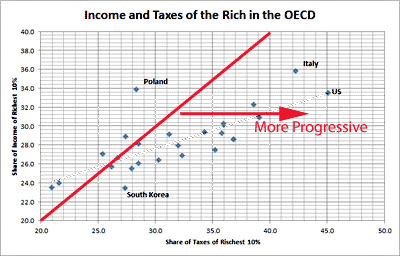
Kevin Drum reports this chart on tax progressivity, with the comment that "the US is more or less right on target."

This is wildly deceptive chartsmanship.  Just because there is apparently a trend line here does NOT mean that all of the countries on that line have equal tax progressivity.   That would only be the case if the line were at 45-degrees.  But in fact, the tax share is increasing by 10 percentage points for every 4 points in income share.   This means that, even for countries on the line, the farther right one goes (on the chart, not politically) the more progressive the tax system is, at least vis a vis the top 10%  (Drum is probably right that you would get different results for the top 1%, but I think he is wrong to say that state tax systems are wildly regressive).

Here is the corrected chart.  The further right of the red line, the more progressive, making the US system (again for the top-10% measure) the most progressive of those on the chart.

It is interesting to note that the original chart tells us one thing -- countries with wider income distributions have the most progressive tax systems.  Which is an interesting and not necessarily expected outcome.  Certainly it seems to refute much of the purpose for such systems in the first place.

Update:  I am guess these are the data points on the chart, with analysis at the always terrific Carpe Diem

Beautiful Photography by Stanley Kubrick

Before he made movies, he apparently was a really good photographer.

Gas Prices

I find it sort of hilarious that it is Conservatives that are demagoguing gas prices and Liberals who are trying to explain that they really are not that high.  Yet another example of the Coke and Pepsi parties swapping political positions based on whose team is in the White House.

But I thought this graph was interesting, and supports a point I have made for years (Via Flowing Data)

I have worked in oil fields drilling miles below the surface and on offshore platforms in mile-deep water.  I have seen the Alaska pipeline under construction and worked in a 400 thousand barrel a day refinery.  And I can say with confidence that no other product on this list even is in the same order of magnitude as gasoline in terms of the capital investment, effort, and technology that does into delivering a gallon of gas.  The ability to deliver gas for even $4.00 a gallon is almost unbelievable.   Yet no other industry on this list or any other list gets 1/100th the grief oil companies do for being rapacious, greedy, and detrimental to society.

Beating A Dead Horse

Apparently the Left is still trying to argue that the stimulus (the process of taking money out of private hands to have it spent by government officials instead) was really a super-fabulous idea and only failed because it was too small.  Here is Kevin Drum:

But another reason [the stimulus failed] is that at the same time the feds were spending more money, state governments were cutting back. The chart below from CBPP tells the story. They have data for all but six states, and on average for 2012, "those 44 states plan to spend 9.4 percent less than their states spent before the recession, adjusted for inflation." That's not just less than last year, it's less than 2008. That wiped out nearly the entire effect of the federal stimulus pacakge [sic].

I have a different take.  A number of states, because they don't own a printing press as does Uncle Sam, actually tried to deal with economic reality and cut their bloated spending, an effort that was largely wiped out by Obama's "stimulus" spending.

Quote of the Day

The President does not have power under the Constitution to unilaterally authorize a military attack in a situation that does not involve stopping an actual or imminent threat to the nation.

--  Barack Obama, December, 2007

NCAA Bracket Challenge Update

Here is the top 10 in the bracket challenge after the first week.  Sadly, both of my brackets are in the bottom half.  Apparently, it is statistically impossible for me to do better than 15th place  (thank God for technology so that hope is dashed and I can no longer fool myself about my future chances).  Even worse, my son made the top 10.  More results here.

Bracket Rank Points Correct
Games
Upset
Risk %
Possible
Games
Kevin Spires #2 1 98 31 26.6 43
strattner2 2 82 35 27.8 48
Chuck Jones #2 3 80 35 15.4 46
Ron Coker 4 75 35 20.3 48
Paul Dubuc 5 73 37 15.8 46
Mark Horn / Barack Obama 6 71 39 5.4 51
Chris Smith 7 70 32 30.9 45
Kevin Spires 8 68 34 17.6 42
Grant Smith #2 9 68 31 46.3 41
Nic Meyer 10 67 33 23.7 41

It is good to see the President take time out of his busy schedule to submit a bracket in our competition.