These Are The Folks Who Are Wrapping Themselves in the Mantle of "Science"

Oops.  Accounting error seriously overestimates benefits of biofuels.  

The European Union is overestimating the reductions in greenhouse gas emissions achieved through reliance on biofuels as a result of a “serious accounting error,” according to a draft opinion by an influential committee of 19 scientists and academics.

The European Environment Agency Scientific Committee writes that the role of energy from crops like biofuels in curbing warming gases should be measured by how much additional carbon dioxide such crops absorb beyond what would have been absorbed anyway by existing fields, forests and grasslands.

Instead, the European Union has been “double counting” some of the savings, according to the draft opinion, which was prepared by the committee in May and viewed this week by The International Herald Tribune and The New York Times.

The committee said that the error had crept into European Union regulations because of a “misapplication of the original guidance” under the United Nations Framework Convention on Climate Change.

“The potential consequences of this bioenergy accounting error are immense since it assumes that all burning of biomass does not add carbon to the air,” the committee wrote.

Duh.  This has been a known fact to about everyone else, as most independent studies not done by a corn-state university have found ethanol to have, at best, zero utility in reducing atmospheric CO2.

It is worth noting that the EU would likely have never made this admission had it solely been under the pressure of skeptics, for whom this is just one of a long list of fairly obvious errors in climate-related science.  But several years ago, environmental groups jumped on the skeptic bandwagon opposing ethanol, both for its lack of efficacy in reducing emissions as well as the impact of increasing ethanol product on land use and food prices.

Weird Coincidences

I spent four days last week trying to get my online backup file restored for Quickbooks, our accounting software.

One morning, we woke up and found our entire QB file corrupted.  I would insert cautions to QB users about such occurrences, but I think everyone already knows the problem.  Such a warning would be like reminding a New York resident about street crime.  We QB users always feel like we are walking on eggshells with QB, ready at any moment for everything to go haywire.  We live with it, because the program is useful and ubiquitous.

So I perform a backup every day, but recently started using the QB online backup facility.  This automatically backs up the file every day.  I still make a local backup from time to time, but I have gotten lazy.  When things went south the other day, my online backup was 10 days old, an eternity in our business.  I sent QB our file to try to execute a repair, but in the mean time I went to the restore command to restore the most recent online backup before the corruption.

Fail.  Fail.  Fail.  Fail.  After four tries, each 3 hours each, I got the idea maybe it was not going to work.  So I called QB and got their Phillipines tech support desk.  They walked me through some steps.  Fail. Fail. Fail.

Through all this time, we were entirely shut down accounting-wise.  Finally, in exasperation, I asked them to just post my backup file on an FTP server somewhere.  After all, we could both see the file exists, and it was just the QB proprietary file transfer protocol that was failing to restore it.  Well, three countries and four departments later, no one could post the file on an FTP server.  Or to my Amazon S3 account.  Or to a password-protected web page.

For God sakes, this is a software company?  Finally, they agreed to have someone at the third party contractor who runs the servers try to put the file on a DVD and mail it to me, LOL.

It was almost exactly at this point that I opened this XKCD comic:

I tell you, sometimes that site is totally dialed into my brain.  (by the way, as I blog, a signed version of this comic on the wall behind my monitor).

PS- eventually the Quickbooks people rebuilt my corrupted file before I could ever get the backup in my hands.  Object lesson here - don't ever give up on the original file, the Intuit guys have twice in my life fixed a file that seemed corrupted beyond all hope of recovery.

Guess the Source

Social Security is a Ponzi Game:

Social Security is structured from the point of view of the recipients as if it were an ordinary retirement plan: what you get out depends on what you put in. So it does not look like a redistributionist scheme. In practice it has turned out to be strongly redistributionist, but only because of its Ponzi game aspect, in which each generation takes more out than it put in. Well, the Ponzi game will soon be over, thanks to changing demographics, so that the typical recipient henceforth will get only about as much as he or she put in (and today's young may well get less than they put in).

Paul Freaking Krugman, 1997.  Incredible how much his beliefs change depending on which party occupies the White House.

Solyndra Bankruptcy Process

I thought this article from Zero Hedge was a pretty good window into the bankruptcy process for those of us unfamiliar with what goes on.  The most interesting point is that by allowing Argonaut to cut ahead of taxpayers as the senior creditor, the Obama Administration virtually ceded control of the bankruptcy process to Argonaut.  Argonaut has put up the debtor-in-possession financing as well, and the combination of these two positions gives it pretty tight control of the process going forward

The plan put forward is a four-week sale of the company. The logic behind this very rapid schedule is that Solyndra is still burning cash at the rate of $1mm a week. How long will the $4mm DIP financing last? Four weeks. The terms of the DIP makes it a sure thing that Solyndra is going to be sold ASAP. That sounds good. But not for the DOE.

The one-month period is a very short time frame. The likely result will be that no serious alternative buyer will appear. Should that happen, the senior creditor will get all of the assets of the company at the end of 30 days. That would be Argonaut. It's possible that Argonaut will end up owning a company that lists $850mm in assets for less than $100mm.

I am not sure taxpayers were ever going to get anything out of this mess -- the combination of a high-cost manufacturing plant with me-too technology in a commoditized business was never going to be wildly valuable -- but the Administrations decision to allow Argonaut to jump the seniority line has pretty much assured that whatever value that might be there will go to Argonaut and not the taxpayers.

Postscript:  Someone might argue that the decision in February to allow Argnaut the senior position was required to get them to put up the $75 million that was necessary at the time to keep operating.  I am positive this is true, given the condition of Solyndra finances at the time.  However, the right answer at the time was to shut the thing down then, while the US had seniority and before Argonaut cleaned out all the assets of value (as they did this summer, selling inventories and receivables to themselves).  The company had no real prospects of ever making money when it was first financed two years ago and certainly did not in February.  The $75 million in February was less financing and more a pre-emptive bid for the company's carcass in the inevitable bankruptcy, and it will likely play out exactly this way.

Update:  I have read that Argonaut may be interested in the $500 million of tax losses.  These are tricky to use, and only Argonaut of all potential buyers could reasonably make use of them.  These might be worth $150 million in avoided taxes, so the $75 million price might make sense.  If Argonaut pulls this off, it would mean that the decision to accept their $75 million in financing is even more costly to the taxpayers.  Not only did they miss out on whatever value might be in the company, but it also created the opportunity for $150 million in tax avoidance that comes right out of Uncle Sam's coffers.

The Three Bubbles

If I asked you what three major American consumer products saw the largest steady price rises in the last decade (as opposed to price volatility, as we see in commodities like gasoline) one might well answer "housing, medical care, and college tuition."

Two or more of each of these share a number of features in common

  • Long, sustained government programs to increase access / ownership / usage
  • Substantial portion of pricing paid by third parties.
  • Easy to obtain, government subsidized debt financing.

The housing bubble has of course burst.  Obamacare, by further disconnecting individual use from the true costs of the services, will likely push health care costs ever higher.  And then there is the college bubble.  I am a bit late on this, but this is truly a remarkable chart:
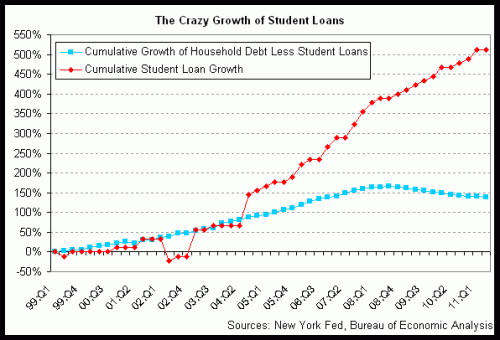
I have already heard the leftish talking point on this, which is that this increase in debt is the fault of (surprise!) private lenders and loan originators.   This is a similar argument to the one made in the mortgage bubble, arguing that all the bad loans are the results of unscrupulous private originators and securities packagers.

And certainly there were many private companies originating awful mortgages and selling them to Fannie and Freddie.   But what we forget in hindsight is that the government was begging for them to do so.  Fannie and Freddie had active programs where they were encouraging mortgages with Loan-to-value of 97% or more.  This kind of leverage is absurd, particularly for American-style no-recourse home mortgages.  Sure, it was crazy to write them, but they were getting written only because the government was asking for them to be written and buying them all up.

In fact, in student loans, almost all of this loan growth is eagerly being underwritten by the Feds, not by private lenders.  Note the only consumer credit line really growing below is the "federal government" line (in red), which is primarily being driven by federally backed student loans.
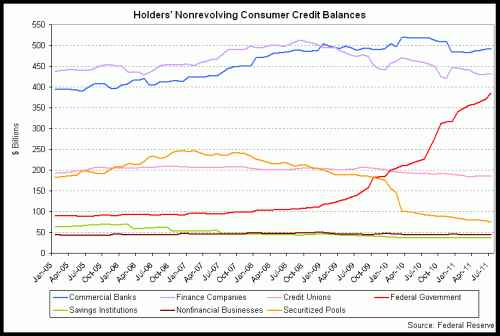
One might argue that this is once again due to private originators going crazy.  But the Feds took over origination of all federal student loans in 2010.  You can see that much of the growth has occurred after the Feds took over origination.  In fact, I think most of us can understand that when the origination decision is shifted from being a business decision to a political decision, student lending standards are certainly not going to get tougher.  We can see that in home lending, where Fannie and Freddie have already returned to most of their worst pre-crash origination standards (here is an example of government promotion of these low down payment programs).

The other day my mother-in-law argued that the student lending business (particularly private lenders) needed reform because some students were being charged exorbitant rates.  Having not been in the market for student loans lately, I wondered if this were the case.  But the first thing that caught my eye was this stat:  The 2-year default rate (not lifetime, but just in the first 2 years) of student loans was 8.8% last year, and 12% if one looks at the first 3 years.  Compare that to credit card default rates which are around 6%.  And recognized that these are apples and oranges, the student loan numbers actually understate lifetime default rates.

Based on that, the interest rate on student loans should be in the twenties.  Against this backdrop, the rates I see online seem like a screaming deal.  Probably too good of a deal.  Which is why so many people are piling into these loans on the explicit promise society has made to them that their college degree will pay off, no matter what the cost.
Beyond the absurd price increases in both public and private education, here is the 900 pound gorilla in the room -- some majors are simply more valuable than others.  A computer programming grad is going to have a lot more earning potential than the average poetry or gender studies major.

What we really need is tiered lending standards based on a student's major.  Banks don't treat the earning potential of a dog-grooming business and a steel mill the same, why treat a mechanical engineering degree the same as a sociology degree?  But, of course, this is never, ever going to happen.

Years ago I had these thoughts along this line, in response to a Michelle Obama rant about the cost of education

This analogy comes to mind:  Let’s say Fred needs to buy a piece of earth-moving equipment.  He has the choice of the $20,000 front-end loader that is more than sufficient to most every day tasks, or the $200,000 behemoth, which might be useful if one were opening a strip mine or building a new Panama Canal but is an overkill for many applications.  Fred may lust after the huge monster earth mover, but if he is going to buy it, he better damn well have a big, profitable application for it or he is going to go bankrupt trying to buy it.

So Michelle Obama has a choice of the $20,000 state school undergrad and law degree, which is perfectly serviceable for most applications, or the Princeton/Harvard $200,000 combo, which I can attest will, in the right applications, move a hell of a lot of dirt.  She chooses the $200,000 tool, and then later asks for sympathy because all she ever did with it was some backyard gardening and she wonders why she has trouble paying all her debt.  Duh.  I think the problem here is perfectly obvious to most of us, but instead Obama seeks to blame her problem on some structural flaw in the economy, rather than a poor choice on her part in matching the tool to the job.  In fact, today, she spends a lot of her time going to others who have bought similar $200,000 educations and urging them not to use those tools productively, just like she did not.

Postscript:  Kids who find they cannot pay their student debts and think bank home foreclosures are the worst thing in the world are in for a rude surprise -- home mortgage default consequences are positively light in this country.  The worst that happens is that you lose the home and take a ding on your credit record.  Student debt follows you for life, with wage garnishments and asset losses.  People walk away from home debt all the time, the same is not true of student debt.

The Terrorists Have Won

Victory courtesy of the freaking TSA.  Making a mockery of the Fourth Amendment for nearly 10 years now.

The Onion, September, 2001

Ten years ago today, we were arguing over whether it was appropriate to even hold professional football and baseball games, much less enjoy ourselves in any way, in the aftermath of 9/11.

No one even contemplated trying to deal with it humorously.  Heck, I am not sure I have seen many attempts even a decade later to do so.  But just days after 9/11, the Onion published an amazing issue dedicated to 9/11.  It was funny without being disrespectful of the victims, and in many ways still on point.  They should have had a Pulitzer for it.  The articles are archived here.

Ten Years Ago Today

Ten years ago, for the first and only time in my life, I invited my wife to come along on a business trip from Seattle to New York.

On 9/11, I was sitting in the restaurant at the W hotel in Midtown Manhattan having breakfast with some bankers. I had recently been hired to see if I could make something out of a startup that was trying to manage aircraft parts sales and inventories over the web. My incredibly ill-timed pitch to the bankers was that the commercial aviation business, which had been somewhat in the doldrums, was on the verge of a turnaround. Oops.

My wife came down to breakfast to tell us something funny was going on in the news. We ended up going to one of the banker's hotel rooms -- he had a penthouse suite with a balcony from which we watched the now-famous and horrible events play out.

The rest of the day was odd to say the least. People on the street flinched whenever a plane flew over. The entire island emptied out, such that in the evening, we walked through Times Square and not a single care came through in 5 minutes. Someone was skateboarding in lazy circles, I suppose just because he could.

For us, 9/11 fortunately was only a hassle. We scrambled to find someone to watch our kids in Seattle, and found the last rent car in the city and ended up driving all the way back to Seattle from New York. We still made it back before air travel resumed.

Many of our friends were not so lucky. As both my wife and I were grads of the Harvard Business School, we knew scores of people who worked in the WTC. Over the coming weeks, word floated in of friends that had died that day, including our friend Steve who did not work there but got talked into going to a training session he really did not want to be at. I actually think of him many times, when I am asked to do tedious business trips I see not value in. I have learned to skip a lot of them. Life is too short.

I Don't Think This is Settled

For those who have read my climate work or seen the video, the key question in climate science revolves around the feedback effects in the climate system to Co2 warming.

Skeptics, like alarmists, generally agree that a doubling of Co2 concentrations might warm the Earth about a degree Celsius, absent any other effects.  But we can imagine all sorts of feedback effects, the most important of which are in water vapor and cloud formation.  Warming that forms more clouds might have negative feedback, as clouds offset some of the warming.  Warming that increases humidity could lead to more warming, as water vapor is a strong greenhouse gas.

The difference, then, between minor warming and catastrophe is in the feedbacks, and most importantly in clouds and water vapor.  All the research the government is funding on whether warming will cause sterility in tree frogs is tangential to this key question.

And this question is far from decided.  I won't get into all the arguments here, but to the extent there is any consensus, it is that man' CO2 is probably causing some warming.  Whether this is a catastrophe or a nuisance depends on feedbacks which are not well understood.

This week there has been a lot of interesting back and forth over a paper by Roy Spencer several months ago arguing that cloud feedback was negative and would serve to limit the total amount of man-made warming.  Just how central this issue is can be seen in the fuss this paper has caused, including editors forced to resign for even daring to publish such heresy, and the speed with which a counter-paper flew through peer review.

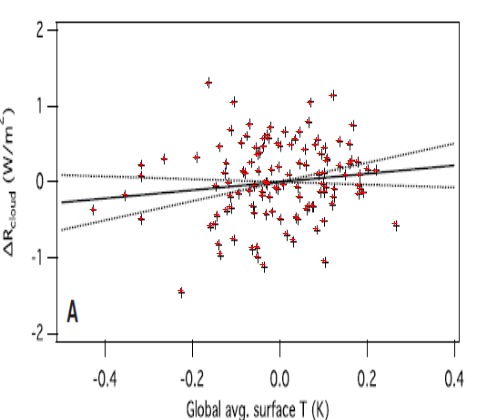
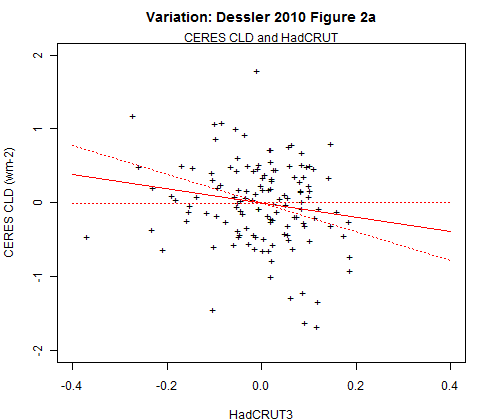
I won't get into the depths of this, except to show two charts.  The first is from Dessler in the alarmist camp, the second is the same chart but using a different data series.  I won't explain the axes,  just trust the relationship between these two variables is key to diagnosing the size and direction of feedback.

So we get opposite results (the slope of the regression) simply by using temperature and radiative flux data from to different agencies.  And note how thin the fit is in both -- basically drawing a line through a cloud.  Neither of these likely has an R-squared higher than about .05.

So there you have it, the most important question in climate - really, the only important question associated with anthropogenic global warming.  Settled science, indeed.

Shopping with Maxed Out Credit Cards

My Forbes column is up this week and it presents some quick reactions to the Obama jobs speech last night.  A brief excerpt:

Overall, I found the package to be an incredible mish-mash of already tried and failed steps to rejuvenate the economy.   Even if I were to buy into the Keynesian stimulus logic, everything in this package is so under-scale as to be rounding errors on the larger economy.  This is basically a smaller version of the last failed stimulus repeated.

This plan is absolutely in the Obama style, offering goodies to many constituencies without a hint of how they will be paid for.  Presidents often offer a chicken in every pot when they are campaigning, but usually are forced into reality once they enter office.  Not Barack Obama.  Time and again, from health care to the most recent budget fight and last night’s speech, Obama wants to be loved for offering perks, and then wants someone else to take the fall for the unpopular steps required to pay for them.  He is like grandma endearing herself to the grandkids by buying them Christmas presents on dad’s maxxed out credit cards, leaving dad to later figure out later how to pay for them or face the ire of the kids by returning the gifts.

When Investors Have Police Forces

I have argued many times that private investors, over the long haul, will make better investment choices than the government, in part because they have better incentives and information to guide their decision-making.  The straw-man argument against this is to point out anecdotes of failed private investments.  Heck, I can do that.  Pets.com famously blew through $300 million of private capital with a corporate strategy that never made much sense to people.

The Pets.com investors were chagrined, and probably learned a lesson from their mistake.  Certainly most of us thought the blame, if blame existed, for the debacle rested on the investors for pouring money into a bad proposition.  Certainly no one accused the management of fraud -- I am sure they were diligently, honestly trying to make the company a success, even if they were misguided as to where that success lay.

As it turned out, everyone, not just the Pets.com investors, learned from the mistake.  The failure was an important driver in an industry-wide rethink as to what a successful Internet business model might look like.  This benefit only came because people were willing to acknowledge not just that the Pets.com investment was flawed, but that it represented a systematic mistake that was being made vis a vis Internet startup investments.

Now, consider solar manufacturer Solyndra.  It failed this week, likely taking with it most of $535 million in taxpayer money that the Obama Administration was so eager to give them that it short-cutted its internal processes to fork over the cash more quickly.

Many of us on the outside would love to see the government rethink such investments in a systematic way, and reconsider if it is even possible for the government to make such investments, and in particular whether "green jobs" investments make any sense at all.

But the likelihood of that kind of introspection happening in the public world is about zero, and my bet is that Obama is going to propose more of the same tonight in his speech.

In fact, the Department of Energy (the source of the loan) and the FBI have today sent armed agents into Solyndra looking for evidence of fraud.   While Zero Hedge argues that fraud would be bad for Obama, in fact I think it would probably be the best possible outcome and one he is hoping for.  If he can say, "wow, you and I both got tricked here by some evil folks we are going to put in jail" it deflects attention from the fact that he put a half billion dollars of taxpayer money into a business plan that never made a lick of sense.

Another me-too solar manufacturer with a factory in California of all places was never going to compete in a global commodity market.  This company's plan was always to sell dollars for 50 cents and to make it up on volume.  I don't see how any investor thought this was going to work.  My guess is that the private investors didn't know much about solar and invested because it had a certain hip-ness to it, or less charitably, they knew it never made sense but hoped that Uncle Sam, once it was already in for a half billion, would keep more money flowing or perhaps agree to buy out their production at above market prices.

There may have indeed been fraud, but as in the case of Pets.com, it is perfectly possible no real internal fraud existed and they ran through a ton of money against a stupid business plan that should never have been funded.  Obama would greatly prefer to call it fraud rather than his own failure of judgement.  As an aside, Fannie and Freddie are pursuing exactly the same course in suing banks, arguing that they were defrauded by the banks in buying mortgages, a fairly laughable proposition in the great scheme of things when one considers Fannie and Freddie were at the forefront of the industry in driving down lending standards and promoting the expansion of the mortgage market.

Something I Have Long Suspected

Benjamin Wallace-Wells via Jesse Walker at Reason

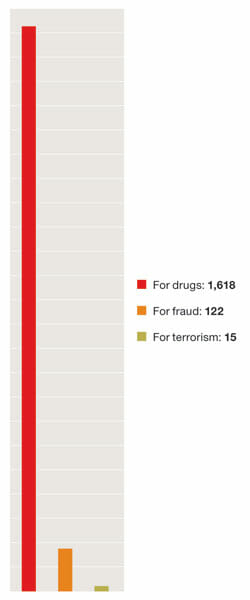
What have Patriot Act "Sneak and Peak" Warrants Been Used For (2006-2009)

Does Anyone in the Media Understand Concentration and Doses

This is an interesting and frustrating article describing the efforts by environmental groups to ban thermal paper with BPA in it.  The argument is that thermal paper receipts touch money, contaminating the paper money supply such that people will have BPA pass into their bloodstream by dermal absorption from money.

Of course, this is only scary if you have absolutely no common sense about doses.  The exposures are simply absurdly small, from a chemical that it is not even clear has long-term harms (the article talks about nano-grams of exposure -- when you start talking nano-grams, you might as well just count individual molecules).  And, as an added bonus, its ban in thermal paper simply pushes manufacturers to use chemicals that are not necesarily safer, just less studied and without the "BPA" name that the media has tarnished so badly.  Incredibly, at least one state, Connecticut, actually followed through on this useless ban scheme.

You don't have to convince me money is dirty -- I am sure any bill in my pocket is crawling with viruses and bacteria and other weird stuff.  Carrying around money is like toting around pieces of clothing someone else has worn for 6 months without washing.  So I am sure the bills in my pocket are icky, but to get worked up about BPA rubbed off from my last Home Depot receipt is just insane.

Rioting for More Charity

I get grief in hard core libertarian circles for supporting a basic, no-frills government safety net.  However, in watching Europe right now, I may change my opinion.  Folks in this country use the European rioting as a sort of threat to warn us that we need to continue to be profligate in government spending or else face the same kind of riots here.  I come to the opposite conclusion -- if people are going to riot when the charity they receive has to be reduced, isn't that a reason not to get them hooked on the charity in the first place?

Update on the State of Race Relations in America

So here is an interesting local story giving us a window into race relations.    First, a black comedian named Katt Williams (I never heard of him either) called a Mexican man a "nigga" and told him to go back to Mexico.   Then a Hispanic woman created a profanity-laced 6-minute video calling Katt Williams "a white supremacist."

Outstanding.  Actually, I think that this has little to do with race relations and more to do with a post-modernist view of language.  I am still working on writing about this phenomenon, wherein certain political phrases have become all-encompassing insults or descriptors of the opposition, wholly stripped of their original meaning.  Thus "Soros-funded" or "Koch-funded" become synonyms for being extreme left or libertarian, rather than actually being supported by any evidence of such funding.  My interest in this topic began with a comment on Kevin Drum's site, where one sympathetic reader smacked Tea Partiers as merely mouthing Republican talking points, and the proceeded to repeat in now-standard terminology every Democratic talking point about the Tea Party.  The juxtaposition was so obvious I thought it might be performance art rather than a real comment.

Solyndra

Most of you will know that the California solar company Solyndra has failed, burning through in less than two years nearly $535 million in taxpayer money.

I wrote in Forbes yesterday that it was a headscratcher why anyone thought this a sound investment

Obama’s investment of taxpayer money into Solyndra is a great example.  It is clear little due diligence was completed before the loan guarantees to Solyndrawere rushed out the door in 2009 in time to meet Energy Secretary StevenChu’s artificial target date for the first loan of Obama’s green jobs program.  A good, well-timed sound bite on the evening news was more important that the actual details of the investment.

But, in fact, little due diligence should have been necessary.  Already in 2009 it was clear that the solar panel industry had commoditized, and low-cost manufacturing would be the key to succefully competing in the market.  Further, European countries whose subsidies and high feed-in tariffs for solar were driving most of the market growth were already in the process of dialing back those incentives.

Surely any reasonable investor would have been leary about entering such a market with an under-scale startup, much less one which chose California of all places to build their plant.  Most rational investors would cite California as a huge liability in a falling-price commodity market, but it was an asset for a company trying to compete in capturing taxpayer dollars, being the home of many of the most powerful politicians most likely to buy into the green jobs boondoggle (of course it did not hurt that Solyndra’s largest investor is a major Obama campaign contributor).

It turns out that the numbers were worse than I imagined, and reading ZeroHedge, it seems like some outright fraud may be involved (hat tip to a reader who I cannot never figure out if he wants to have his name mentioned or not)

What was in the prospectus was, no doubt, the real reason that investor chose to take a ‘pass’ on the deal. There were revenue/expense numbers for the nine months preceding the proposed deal:

Revenue: $58.8mm
Cost of Goods Sold: $108.0mm

That is an absolute complete disaster. This is a low margin business to begin with. At Solyndra they were losing 84 cents for every dollar of sales. Adding in SG&A and CapEx the losses and cash drain had to be very heavy.

Wow, that is really a fail.  Even in the worst run late 90's Internet company I ever encountered, they were not selling dollars for 50 cents.  One wonders what numbers Steven Chu and company saw before they funded this dog, and whether from the very beginning these guys were counting on a steady stream of 9-figure government subsidy checks.

The Political Obsession With Redirecting Private Capital

My new column is up at Forbes, and discusses why politicians, particularly this administration, think they can allocate capital better than the market

The problem is that this top-down override of market capital allocations is almost certain to destroy wealth, because there are at least two problems with it (beyond the obvious liberty and property rights issues).

First, the decisions are being made by, at most, a few hundred government workers.  There is no possible way these workers can ever gather the knowledge and information posessed by millions of private actors making similar investment decisions.  Like monkeys throwing darts, some of the investments will work out, but on average their success rate has to be far lower than the network of individuals in the broader economy.

Second, and probably more important, government decisions-makers have terrible incentives when making these investments.  Seldom, if ever, are government re-allocations of capital made with an expectation of earning a return.  In fact, many of these programs promote themselves explicitly as shifting capital to investments no rational private investor would touch.  These investments are undertaken because they promote some sexy technology, or create jobs among a favored constituency, or even just because they make for a nice bullet point on a politician’s reelection web site.

Obama’s investment of taxpayer money into Solyndra is a great example.  It is clear little due diligence was completed before the loan guarantees to Solyndra were rushed out the door in 2009 in time to meet Energy Secretary Steven Chu’s artificial target date for the first loan of Obama’s green jobs program.  A good, well-timed sound bite on the evening news was more important that the actual details of the investment.

But, in fact, little due dilligence should have been necessary. ....

Green Industrial Policy Fail

This is like the third one in just a few weeks:

Solyndra, a major manufacturer of solar technology in Fremont, has shut its doors, according to employees at the campus.

"I was told by a security guard to get my [stuff] and leave," one employee said. The company employs a little more than 1,000 employees worldwide, according to its website....

Solyndra was touted by the Obama administration as a prime example of how green technology could deliver jobs. The President visited the facility in May of last year and said  "it is just a testament to American ingenuity and dynamism and the fact that we continue to have the best universities in the world, the best technology in the world, and most importantly the best workers in the world. And you guys all represent that. "

The federal government offered $535 million in low cost loan guarantees from the Department of Energy. NBC Bay Area has contacted the White House asking for a statement.

Beyond the whole green jobs boondoggle, trying to compete at low-cost manufacturing of a commodity product in California of all places is simply insane.


My Highest Recommendation

I have pimped the Teaching Company (now called the Great Courses) for years on this blog.  I have done over 20 courses, and am nearly addicted to their offerings.  Nothing bums we out more than to read their catalog and find nothing new I want, except when that happens I order something random I don't think I want and usually love it.  I listen to music a lot less than I used to because I often have a Great Course on my mp3 player instead.

Via Econlog comes a great article about the Great Courses, and make me feel a bit better that I am not alone in my obsession.  Its one of those really interesting stories about an entrepreneur who sticks with his vision, right down to his last dollar.

But it is also a depressing read for someone who may soon be sending his kid to a small liberal arts college.  Some excerpts related to current college education:

the company offers a treasure trove of traditional academic content that undergraduates paying $50,000 a year may find nowhere on their Club Med–like campuses. This past academic year, for example, a Bowdoin College student interested in American history courses could have taken “Black Women in Atlantic New Orleans,” “Women in American History, 1600–1900,” or “Lawn Boy Meets Valley Girl: Gender and the Suburbs,” but if he wanted a course in American political history, the colonial and revolutionary periods, or the Civil War, he would have been out of luck. A Great Courses customer, by contrast, can choose from a cornucopia of American history not yet divvied up into the fiefdoms of race, gender, and sexual orientation, with multiple offerings in the American Revolution, the constitutional period, the Civil War, the Bill of Rights, and the intellectual influences on the country’s founding. There are lessons here for the academy, if it will only pay them heed....

The Great Courses’ uninhibited enthusiasm is so alien to contemporary academic discourse that several professors who have recorded for the firm became defensive when I asked them about their course descriptions, emphatically denying any part in writing the copy—as if celebrating beauty were something to be ashamed of....

So totalitarian is the contemporary university that professors have written to Rollins complaining that his courses are too canonical in content and do not include enough of the requisite “silenced” voices. It is not enough, apparently, that identity politics dominate college humanities departments; they must also rule outside the academy. Of course, outside the academy, theory encounters a little something called the marketplace, where it turns out that courses like “Queering the Alamo,” say, can’t compete with “Great Authors of the Western Literary Tradition.”...

In its emphasis on teaching, the company differs radically from the academic world, where “teaching is routinely stigmatized as a lower-order pursuit, and the ‘real’ academic work is research,” notes Allen Guelzo, an American history professor at Gettysburg College. Though colleges ritually berate themselves for not putting a high enough premium on teaching, they inevitably ignore that skill in awarding tenure or extra pay. As for reaching an audience beyond the hallowed walls of academe, perhaps a regular NPR gig would gain notice in the faculty lounge, but not a Great Courses series. Jeremy McInerney, a University of Pennsylvania history professor, told The Chronicle of Higher Education in 1998 that he wouldn’t have taped “Ancient Greek Civilization” for the company if his tenure vote had been in doubt: “This doesn’t win you any further respect. If anything, there’s a danger of people looking down on it, since many people are suspicious of anything that reeks of popularism.” So much for the academy’s supposed stance against elitism....

Further, it isn’t clear that the Great Courses professors teach the same way back on their home campuses. A professor who teaches the Civil War as the “greatest slave uprising in history” to his undergraduates because that is what is expected of him, says University of Pennsylvania history professor Alan Kors, will know perfectly well how to teach a more intellectually honest course for paying adults.

While I took a fair number of liberal arts courses, being an engineer really sheltered me from this kind of BS.  But my kids interests run more towards liberal arts, and while I am working to enforce the double major approach (you can take whatever major interests you as long as you double it with economics or something useful), I still despair that they really are going to get what they think they will get at college.

This is an AWESOME Idea. I Want to Propose California Do Much More of This

Via Carpe Diem and a whole string of other sites:

"How will California parents react when they find out they will be expected to provide workers' compensation benefits, rest and meal breaks, and paid vacation time for…babysitters? Dinner and a movie night may soon become much more complicated.

California Assembly Bill 889 will require these protections for all “domestic employees,” including nannies, housekeepers and caregivers. The bill has already passed the Assembly and is quickly moving through the Senate with blanket support from the Democrat members that control both houses of the Legislature – and without the support of a single Republican member. Assuming the bill will easily clear its last couple of legislative hurdles, AB 889 will soon be on its way to the Governor's desk.

Under AB 889, household “employers” (aka “parents”) who hire a babysitter on a Friday night will be legally obligated to pay at least minimum wage to any sitter over the age of 18 (unless it is a family member), provide a substitute caregiver every two hours to cover rest and meal breaks, in addition to workers' compensation coverage, overtime pay, and a meticulously calculated timecard/paycheck.

Failure to abide by any of these provisions may result in a legal cause of action against the employer ("parents") including cumulative penalties, attorneys' fees, legal costs and expenses associated with hiring expert witnesses, an unprecedented measure of legal recourse provided no other class of workers – from agricultural laborers to garment manufacturers."

I know this is exactly the kind of thing you would expect me to oppose, but I have decided this is exactly the kind of thing California needs.  I am tired of average citizens passing crazy requirements on business without any concept of the costs and injustices they are proposing, and then scratch their head later wonder why job creation is stagnant.
I want to propose that California do MORE in this same vein.  Here are some suggestions:

  • Every household will have to register for a license to conduct any type of commerce, a license to occupy their house, and a license to hire any employees.  Homeowner will as a minimum have to register to withhold income taxes, pay social security taxes, pay unemployment insurance, pay disability insurance, and pay workers comp insurance.
  • Households should have to file a 1099 for every payment they make to contractors
  • All requirements of Obamacare must be followed for any household labor, including payment of penalties for even part-time labor for which the homeowner does not provide medical insurance
  • No alcohol may be purchased by any individual without first applying for and receiving a state liquor license
  • No cigarettes may be purchased by any individual without first applying for and receiving a state cigarette license
  • No over the counter drugs may be purchased by any individual without first applying for and receiving a state over the counter drug license
  • No eggs may be purchased by any individual without first applying for and receiving a state egg license
  • Any injuries of any type in the household must be reported to OSHA
  • Form EEO-1 must be filed once a year to catalog the race and gender of anyone who did any work in the home
  • Any time one has a dispute in court with another citizen or an employee, they will now be treated the same as businesses in California, which means that the presumption, irregardless of facts, will be strongly in favor of any employee and against the homeowner, and in favor of any other party in any dispute whose net worth is perceived by the jury as less than the homeowner's.
  • At least once a year the home's kitchen must be inspected and certified by both the fire marshal and the health department.  Any deficiencies must be immediately repaired before the kitchen can be used.  All code requirements for commercial kitchens will apply to household kitchens, including requirements for a three-basin washup sink, separate mop sink, and fire extinguishers
  • All homes will be inspected once per year for ADA compliance.  All parts of the home must be wheelchair accessible, even if there are currently no handicapped residents in residence.  Homes more than one-story tall will require an elevator.  All counters must be of the proper height, and all bathrooms must have ADA fixtures.
  • Each home will be required to prominently display all its required licenses as well as state and federal information posters for workers.
  • All homes will be audited at least once every three years to ensure that use taxes have been filed and paid on all out of state Internet purchases
  • Material Safety Data Sheets must be on file for all household cleaning products and other chemicals and available for inspection by the fire marshal
  • All gas tanks (car, lawnmower, portable 5-gallon) will be treated just like commercial gasoline storage tanks, and require monthly leak / loss reporting.  Annually, a complete spill prevention plan must be filed with the state.
  • A stormwater discharge plan must be filed annually with the state
  • Any dropped thermometer or CFL bulb will require homeholder to call out (and pay disposal costs) of a state hazmat team
  • Lifeguards are required at all home pools during daylight hours
  • Households should file property tax returns in the same way that businesses must, listing individually every single piece of personal property they own, from their car to their lawnmower to the pink flamingo in the front yard.
  • Homeowner must track the number of days any guests stay in their house so they can file and pay lodging taxes on a monthly basis
  • Any homeowner who hauls a boat or trailer on US highways must register with the Department of Transportation and receive a DOT number.  They must keep full driver logs and maintenance records available for DOT audit and inspection, and every driver must be drug-tested at least once per year.
  • All food on pantry shelves must meet all state labeling laws
  • At each entrance to the house, a sign warming those entering must be posted warning that certain cancer causing chemicals may be present

Finally, after spending the entire day complying with these rules, the homeowner must read at least 3 posts each day from progressive blogs explaining why anyone who complains about such rules as unreasonable is just a reactionary who doesn't really know how to run his business very well, and they could certainly do better.

Postscript:  Every single item on this list is something my company has been required to do.  I am sure I left a bunch out.

You've Blown Your Trust

Ezra Klein via Kevin Drum asks, fairly reasonably, why with very low US borrowing rates does it not make sense to take infrastructure projects we know we have to do in the next 5-7 years and pull them forward.  If we know we have to rebuild bridge X in 2016, lets do it now when there is so much construction capacity sitting around.

In an idealized Platonic technocratic world that many Lefists still insist on believing we actually live in, trustworthy and knowledgeable agents of the state would work up such a list and we could fund it, happy we have made a good financial decision.  But we don't live in that world, as I wrote in the comments

The reason this does not fly has to do with politician's incentives and trust.  In short, Democrats had their chance to do exactly this.  Two years ago, nearly a trillion dollars of such stimulus was approved and sold to the American people as just this sort of infrastructure spending.

But it was no such thing.  Most of the money went to state and local governments as transfer and stabilization payments to keep unionized government workers, who are reliable Democratic voters, employed.  Congress and the Administration knew that the majority of the public would have been leery about spending it this way, so it was sold as "infrastructure" despite the fact that less than 10%, by my count, could reasonably be called this.

Having sold a trillion dollars of pork, waste and political payoffs as "infrastructure," you should not be surprised that the American public is reluctant to believe that an infrastructure project that just pulls future necessary spending forward is really any such thing.  You have in short blown your trust, which is amazing given just how much of a mandate Obama entered office with.  Note that this is not narrowly a criticism of Democrats, they just happen to be in charge.  No one would trust Republicans either.

And by the way, it takes years to really get infrastructure projects up and running - the environmental reviews and red tape that most of the readers for this site have advocated in favor of for years causes these things to take forever.  Not to mention the engineering and procurement.  Even Obama has admitted that he did not understand that shovel-ready was no such thing, even though many of us warned of exactly this problem the first time around

The money is only "free" in a relative sense if we know we have to spend it anyway in future years.  It is not at all free if we have to take it from some productive private use and redeploy it for some politician's whim that gives him or her a nice bullet point on their re-election web site.  Unfortunately, in the real world we live in, rather than in the technocratic paradise Klein imagines, any such bill will be larded with just such flights of fancy from powerful representatives of both parties.

Update:  Talk about history repreating itself, here is what I wrote in January of 2009.

The infrastructure piece, despite being less than 10% of the bill, allows politicians to call this “investment” and “green energy” and “infrastructure” which sell better with sections of the public than “welfare” and “transfer payments.”  The minority infrastructure pieces allow Congress and Obama to call the bill new and forward looking, rather than the imitation of 1970s legislation that it really is.

Gary Johnson's Invisibility is Very Frustrating

I continue to like everything I see of Gary Johnson.  Unfortunately, I seldom see anything.  For reasons not entirely clear to me, Johnson is being left out of the next Republican debate, despite polling better than many of those invited (and that despite a LOT less pub than folks like Rick Santorum).

I understand why the major media ignores him -- their strategy seems to be to focus on the wackiest Republican candidate, whoever that might be at the time.  My only guess on Johnson is that he ticks off social conservatives who have a lot of power in the party.  This is exactly the type of thing that has me not only indifferent to, but hostile to politics, and why you will almost never see horserace-style reporting of political races here.

Anyway, here is more on Johnson and a Reason video so you can actually see the guy.

Krugman Unintended Irony: Anyone Who Does Not Unquestioningly Believe Authorities is Anti-Science

here.

It's a wonder how, when over "97 percent to 98 percent" of scientific authorities accepted the Ptolomeic view of the solar system that we ever got past that.  Though I could certainly understand why in the current economy a die-hard Keynesian might be urging an appeal to authority rather than thinking for oneself.

When, by the way, did the children of the sixties not only lose, but reverse their anti-authoritarian streak?

Postscript:  I have always really hated the nose-counting approach to measuring the accuracy of a scientific hypothesis.  If we want to label something as anti-science, how about using straw polls of scientists as a substitute for fact-based arguments?

Yes indeed, the number of people in the newly made-up profession of "climate science" that are allowed by the UN control the content of the IPCC reports and whose funding is dependent on global warming being scary probably is very high.  The number of people in traditional scientific fields like physics, geology, chemistry, oceanography and meteorology who never-the-less study climate related topics that wholeheartedly are all-in for catastrophic man-made global warming theory would be very different

 Decide for yourself - see my video on global warming.  Am I anti-science?

Uh, Oh, I May Be a Terrorist Suspect

This is a bit old, but Radley Balko linked this story about a many busted for taking pictures of a refinery

Police Chief Jim McDonnell has confirmed that detaining photographers for taking pictures “with no apparent esthetic value” is within Long Beach Police Department  policy.

McDonnell spoke for a follow-up story on a June 30 incidentin which Sander Roscoe Wolff, a Long Beach resident and regular contributor to Long Beach Post, was detained by Officer Asif Kahn for taking pictures of North Long Beach refinery.

“If an officer sees someone taking pictures of something like a refinery,” says McDonnell, “it is incumbent upon the officer to make contact with the individual.” McDonnell went on to say that whether said contact becomes detainment depends on the circumstances the officer encounters.

McDonnell says that while there is no police training specific to determining whether a photographer’s subject has “apparent esthetic value,” officers make such judgments “based on their overall training and experience” and will generally approach photographers not engaging in “regular tourist behavior.”

This policy apparently falls under the rubric of compiling Suspicious Activity Reports (SAR) as outlined in the Los Angeles Police Department’s Special Order No. 11, a March 2008 statement of the LAPD’s “policy …  to make every effort to accurately and appropriately gather, record and analyze information, of a criminal or non-criminal nature, that could indicate activity or intentions related to either foreign or domestic terrorism.”

Among the non-criminal behaviors “which shall be reported on a SAR” are the usage of binoculars and cameras (presumably when observing a building, although this is not specified), asking about an establishment’s hours of operation, taking pictures or video footage “with no apparent esthetic value,” and taking notes.

First, I think refineries are enormously interesting photography subjects (disclaimer:  I used to work in the Exxon Baytown refinery) and I think they can be downright beautiful at night.

Second, I take pictures of industrial subjects all the time as potential guides for my model railroading.  Incredibly-boring-for-most-people example here.

One-Program Proof Technocratic Government Does Not Work

Ethanol continues to be one of the dumbest, most costly programs ever engaged in by the Federal government

"Today, about 40 percent of all U.S. corn -- that's 15 percent of global corn production or 5 percent of all global grain -- is diverted into the corn ethanol scam in order to produce the energy equivalent of about 0.6 percent of global oil needs.
Corn prices, now close to $7 per bushel, have more than doubled over the past two years (see chart above). And recent harsh weather, including floods in the Midwest and drought in the South, will likely mean a subpar U.S. corn harvest. That, in turn, will mean yet higher prices for corn, which will translate into higher prices for meat, milk, eggs, cheese and other commodities.
Environmental damage:  check
Fails to meets its goals (of reducing fossil fuel use): check
Raises food prices:  check
Raises gas prices: check
Highly regressive costs that hurt the poor most:  check
Benefits accrue to very a small group of the politically connected:  check