Thinking About Greece

Mike Rizzo writes:

A typical sovereign government can secure funds from three “legitimate” places.*What are these sources?

  1. Taxes today.
  2. Taxes tomorrow. In other words we can borrow money today in order to build our bridge and then use future tax revenues to pay for the debt tomorrow. By the way, if the government is in the business of actually producing valuable “public goods” then you can easily think of this as value enhancing.
  3. Printing money. It’s not generally done this way, but in effect the monetary authorities can monetize the borrowing of a sovereign entity (how they do it is beyond the scope of this post). For simplicity, imagine instead that a central bank prints new bank notes from scratch, hands them to the Treasury, and then the Treasury spends them on goods and services. This is just another form of a tax, again beyond the scope of this post.

So, this is what the government budget identity looks like for “normal” countries:

G = T + the change in debt + the change in base money

I think this is a useful simplification, but I wanted to add a couple other refinements  (refinements by the way he did not neglect in his text, just did not put in the formula).  One other source of funds we have seen in Greece is what I would call Aid, which used to be humanitarian aid (think India in the 1970s) but today tends to be bailout money and debt forgiveness.  So we will write the equation

G = Taxes + ΔDebt  + Money Printing + Aid

But due to the Keynesian orientation of many commenters on the Greek and European situation, it becomes useful to expand the "taxes" term into some sort of base income, which I will just call GDP for simplicity, and some sort of tax rate t.  So then we get:

G = GDP x t + ΔDebt  + Money Printing + Aid

The Greeks can't print money (unless the EU does it for them) and at the moment no one in their right mind will lend to them without guarantees from stronger European countries (e.g. Germany).  If we call EU money printing for Greece or EU loan guarantee programs Aid, we get

G = GDP x t + Aid

As Rizzo noted, aid is drying up and Greek tax revenues are going down rather than up, so basically they are screwed.  The only out seems to be for Greece to exit the Euro and then, once on the drachma again, print money like crazy and inflate their way out of the debt.

But expanding the tax term reveals one more policy alternative that is being suggested.   Keynesians seem to believe there is a path out of this situation in Greece (or if Greece is too far gone, certainly in Italy and Spain) where money from some source  (aid, borrowing, whatever) is spent in the economy by the government in some way that is stimulative, thus increasing GDP and therefore taxes and allowing Greece to increase the money available to the government.  Since Aid is currently only be granted tied to "austerity" programs rather than stimulative spending, they feel Germany et al are following exactly the wrong course.

I am incredibly skeptical of this for two reasons, beyond just my general skepticism of Keynesian stimulus.  First, I have heard something akin to this in my personal experience.  For a short time in my life, during the Internet crazy period, I was brought in by some investors to look at their portfolio of languishing Internet plays (e.g. discountshoelaces.com)* and decide if they should keep pouring money in or shut down.  The plan I got from management was always - always - this stimulus approach.  They suggested that rather than cut back, the investors should give them a bunch of new money to really blow out the marketing effort, which would kick start their growth, etc. etc.

The problem was that they never, ever had a lick of evidence beyond just hope that the next $1 million would suddenly do what the last $10 million failed to do.  So we shut most of these efforts down.  Your first loss is your best loss, as they say.

Similarly, I don't think Keynesians can point to any example in history where this actually worked.   A country is drowning in debt, but suddenly a Hail Mary play of adding a huge chunk more to the debt and spending it on civil service worker salaries suddenly turned the tide.  Seriously, do people honestly think this will work?  Or are they just frustrated because they grew up with an assumption that there is always a public policy answer for everything and there just does not seem to be one here.

I have an emerging hypothesis, not backed by any evidence at this point, that the value of the Keynesian multiplier shifts as debt to total GDP increases.  I am not sure in actual practice it is ever above one, but if it were to be above 1 at 20% debt to GDP, it certainly is not going to be the same at, say, 150%.

Current Oil Boom Only A Surprise to Those Who Don't Understand Markets

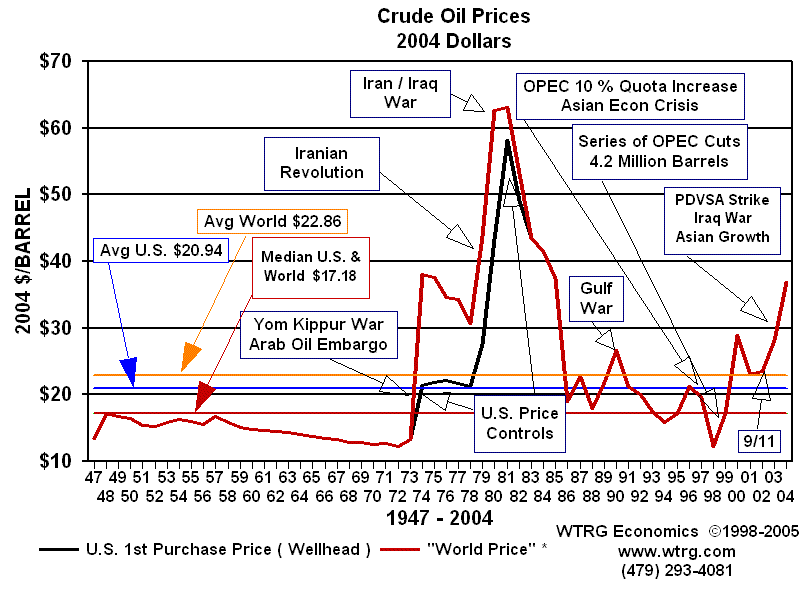
There is nothing surprising or unpredictable about the current oil boom, except perhaps how far it has gotten in the face of an Administration that has done virtually everything it can to stop it  (thank god there is oil and gas under private land).  Your humble scribe, neither an economist nor an expert in oil markets, wrote way back in 2005:

Everything old is new again.  Back in the late 70′s, all the talk was about the world running out of oil.  Everywhere you looked, "experts" were predicting that we would run out of oil.  Many had us running out of oil in 1985, while the most optimistic didn’t have us running out of oil until the turn of the century.  Prices at the time had spiked to about $65 a barrel (in 2004 dollars), about where they are today.  Of course, it turned out that the laws of supply and demand had not been repealed, and after Reagan removed oil price controls and goofy laws like the windfall profits tax, demand and supply came back in balance, and prices actually returned to their historical norms....

 Supply and demand work to close resource gaps.  In fact, it has never not worked.  The Cassandras of the world have predicted over the centuries that we would run out of thousands of different things.  Everything from farmland to wood to tungsten have at one time or another been close to exhaustion.  And you know what, these soothsayers of doom are 0-for-4153 in their predictions. ...

The vagaries of reserve accounting are very difficult for outsiders to understand.  I am not an expert, but one thing I have come to understand is that reserve numbers are not like measuring the water level in a tank.  There is a lot more oil in the ground than can ever be recovered, and just what percentage can be recovered depends on how much you are willing to do (and spend) to get it out.  Some oil will come out under its own pressure.  The next bit has to be pumped out.  The next bit has to be forced out with water injection.  The next bit may come out with steam or CO2 flooding.  In other words, how much oil you think will be recoverable from a field, ie the reserves, depends on how much you are willing to invest, which in turn depends on prices.  Over time, you will find that certain fields will have very different reserves numbers at $70 barrel oil than at $25....

All the oil doomsayers tend to define the problem as follows:  Oil production from current fields using current methods and technologies will peak soon.  Well, OK, but that sure defines the problem kind of narrowly.  The last time oil prices were at this level ($65 in 2004 dollars), most of the oil companies and any number of startups were gearing up to start production in a variety of new technologies.  I know that when I was working for Exxon in the early 80′s, they had a huge project in the works for recovering oil from oil shales and sands.  Once prices when back in the tank, these projects were mothballed, but there is no reason why they won’t get restarted if oil prices stay high.

Postscript:  I really need to find new topics to blog about.  The adjacent article in 2005 included this, a frequent topic on this site.  I had not idea I was writing about this so long ago:

When health care is paid for by public funds, politicians only need to argue that some behavior affects health, and therefore increases the state’s health care costs, to justify regulating the crap out of that behavior.  Already, states have essentially nationalized the cigarette industry based on this argument.

Great Moments In Public Sector Compensation

I can't confirm this by Randal O'Toole is usually pretty much on top of Portland transit issues:

Portland’s TriMet agreed to allow transit workers to retire at age 55 after as little as ten years on the job and gave them and their families free medical care (with a $5 co-pay, no deductible) for life (plus 16 years after the retiree’s death for their families). As a result, health-care costs have grown from $18 million in 2000 to $68 million next year and projected to rise to $153 million–40 percent of the agency’s 2010 operating budget–by 2020.


Only One Reason To Do This

There is only one reason to be concerned that fundraiser attendees might record the session -- because one knows the candidate is giving tailored and mutually contradictory messages to different groups.   Obama has a different speech, I suppose, for the 1% than he does for the 99%.   Which is no big surprise, since it is a practice as old as modern campaigning* and one I am sure both parties engage in.  But it is probably a larger issue for Obama -- when so much of a politician's campaign style rests on demonizing certain groups, groups that are also large campaign contributors, it must be a tricky business tailoring his message.


* footnote:  I leave this in a footnote because I don't want to be seen as breaking Godwin's law by bringing up the Nazis, but its almost impossible to talk about modern campaigning techniques in the age of mass media without mentioning them.  They pioneered many of the techniques used by about everyone nowadays.  One thing they did was to create focused messages for different groups -- tailors or farmers or city people or industrial workers or Catholics or whoever.  They were incredibly cynical in how they did this, even by modern standards, and didn't really care what the message was, and so ended up with wildly contradictory promises, e.g. promising farmers higher prices for their produce and promising urban laborers lower food prices.

OMG, Austerity!

via here

The UK line is particularly interesting, since that is the country that Krugman has declared is austerity-izing itself into a depression. As I have pointed out before, real government spending in UK has been and is still rising.  The percent of GDP of this spending has fallen a bit, but there is nothing about Keynesian stimulus theory that says changes in the percentage of government spending is stimulative, only its absolute value.

Here is one thing I would love to here Krugman et. al. opine on -- at what percentage of government debt to GDP does additional deficit spending become counter-stimulative.   I imagine there is an inverse relationship for deficit-funded stimulus, such that it has a larger effect at lower debt levels with a zero to negative effect at higher interest levels.

Update:  From another source, here is the UK in real $

Surgeon General: Hanging Out With Jimi Dangerous for Your Health

This time capsule of pictures of various music stars hanging out with Jimi Hendrix features a surprising number or people who died young.

Stupid

Apparently an Arizona Catholic High School forfeited their state finals because the other team was playing *gasp* a girl at second base.  I am not really familiar with this sports league they are in -- it must be made up of smaller schools who choose not to join the AIA, which is the league most high schools (including ours) play in.

These are private schools in a private league, so I guess they can do whatever they want, but this just seems bizarre in the extreme.   I would guess that their players were irate.

My son plays in the smaller division of the AIA, and we run into teams that play girls from time to time in baseball and a bunch of schools that play girls on their soccer team (the rule generally is that girls can play on the boys team if there is no girls' equivalent of that sport at the school).  I have never before heard of another Catholic school having a problem with this, and given that this is Arizona, there are a lot of Catholic schools knocking about.

In fact, I always find it kind of cool to see girls out there.  I remember a few weeks ago we were playing a team who had a girl at third base who the boys thought was pretty attractive.  I laughed pretty hard when my son took a big chance to stretch a double into a triple.  I knew exactly what he was doing --he wanted to be on third base!

I suppose this will be a better object lesson for the Catholic boys than any gender-equality propaganda film.   Adopt Victorian attitudes about women, lose the chance to play for a state championship.

Turning Water Vapor Into Pollution

Several years ago I wrote a post about how frequently steam plumes are used as illustrations to articles on pollution.  In the US, if you see a cloud coming out of a smokestack, adds are about 100:1 its steam, not smoke.  Look how many of the results today in Google images for "air pollution" are actually plumes of water vapor.

One trick environmental sites will play is to Photoshop the contrast and darkness of the steam plume to try to make it look smokier.  Here is a good example

This photoshopping of steam plumes to make them look like smoke is prevalent enough that I have written about it a few times.  That is why this image tickled me.  I don't know the artist.  He may be making the opposite plea (e.g. turning smoke to steam) but I'll interepret it the way I like:

Postscript:  This is my all-time favorite image in this category:


This image was used by Battelle labs (update:  still is) to illustrate their air pollution expertise.  The sad-faced girl with the inhaler is classic, but what makes this my favorite is the water vapor plume from the nuclear plant (you can see the nuclear reactor dome).  The water vapor from a nuclear plant cooling tower has only pure water -- it has no combustion products and no particulates that might give this poor girl asthma.  It does not even have any CO2 in it, if that is your particular bogeyman.

Time Magazine Trumpets Another Creepy Non-Trend

Time channels Game of Thrones for its cover

Phoenix Coyotes Sale

Well, it looks like the NHL may have a buyer for the Phoenix Coyotes.  I have not seen all the terms, but the problem in finding a buyer has been this:  based on comps from other recent sales (e.g. Atlanta) the price for sunbelt teams is something like $100 million max, but the NHL has promised its owners it would not sell it for less than $200 million.  The NHL has to find a sucker, and if billionaire buyers are not willing to be a sucker, then they have to find a third party sucker to just kick in $1oo million of present value to make the deal work.

Enter the city of Glendale.  It has tried very hard on multiple occasions to be that sucker, and only was stopped from doing so by efforts of the Goldwater Institute to enforce a state Constitutional injunction on corporate welfare.

Glendale has apparently found a new way to subsidize the transaction by promising to pay an above-market stadium management fee.  I have talked to some sports executives, including one very familiar with this stadium, and they have all said that in a free market, a third party might take the stadium management contract for free, because though it carries operational costs, it also yields offsetting revenues (like stadium rentals for concerts).

By paying an above-market rate for stadium management services, Glendale can provide a corporate subsidy but retain the fiction that this is a service contract rather than crony welfare.  Over the last two years, Glendale has paid the NHL $25 million a year in stadium management fees, a payment everyone understands to actually be a subsidy to keep the team in town.

I presume the new buyer has met the NHL's $200 million price tag.  But that is obvriously overpaying.  So Glendale is going to kick a bunch of money back to the buyer to make it work, in the form of $306 million in stadium management fees.  Via the Sporting News:

Longtime Glendale city councilor Phil Lieberman on Monday, in an interview with Sportsnet.ca, estimated that arena management fees paid by the city to Jamison under terms of the deal would total $306 million over the next 21 years, or an average of $14.6 million. A large chunk of that money, Lieberman says, is front-loaded, with Glendale on the hook for $92 million over the next five years. Nearby University of Phoenix Stadium, home to the Arizona Cardinals of the NFL, carries a $9.2-million management fee annually.

By the way, University of Phoenix Stadium is far larger and more expensive to operate, so one would expect the Coyotes arena management payment to be less than $9.2 million.   And the $9.2 million, since it comes from Glendale as well, likely has a subsidy built in.  But let's for a second assume something like $8 million a year is the high end for what a market rate for such a contract would be.  This would be $168 million over 21 years, implying $138 million minimum in subsidy built into the management contract.  There you go, there is the sucker payment to make up the difference between market value of the team and the NHL's price.

In fact, according to numbers at the WSJ, the city would have been better off leaving the stadium empty and just paying off the note  (and they certainly would have been better taking Jim Balsillie's offer to move the team but help them pay down their note).

The NHL has announced a tentative sale to a group headed by former San Jose Sharks executive Greg Jamison, under terms that would essentially institutionalize Glendale's commitments. Under the proposal that the NHL has laid out for city council members, the city would continue paying an arena-management fee that would average about $14.5 million a year.

On top of the city's average $12.6 million in debt service, that amounts to annual expenses of about $27.1 million—to be offset by anticipated Coyotes-related revenue of $14.2 million, according to projections by Glendale's city management department. That adds up to a projected annual loss for Glendale of $12.9 million.

Of course, Glendale wants to keep the team because it cut a crony deal with a few real estate developers to build a retail and condo complex around the stadium.  Of course, these ventures have also gone bankrupt.  So the city is trying to bail out and keep a bankrupt hockey team to sustain an already bankrupt retail developer.

The logic of course is that Glendale wants to attract retail businesses to Glendale from nearby Peoria and Phoenix.  But in the end, they are just messing up their own goal:

Some Glendale business owners may also oppose the deal, including David Kimmerle, owner of Sanderson Ford car dealership in Glendale. A longtime sponsor and fan of the Coyotes, Kimmerle felt betrayed when Glendale officials recently proposed raising the city's sale tax, in large part to support the cost of the team. The proposed increase would make a $30,000 car on Kimmerle's lot $330 more expensive than in the neighboring suburb of Peoria. "No one is going to pay a premium to shop in Glendale," Kimmerle said. "If it is choosing between the Coyotes or a business that is been in my family since 1955 and employs 500 people, I have to choose my business."

So, which would you bet on:  That retail buyers will choose a location based on prices and taxes, or based on its proximity to a hockey team?  Glendale is betting hundreds of millions of dollars its the latter.  Which is why they are idiots.

Oh, and those Goldwater folks.  Per the Sporting News article:

As for Goldwater Institution opposition to the deal, the league, Jamison and Glendale are aggressively striving to craft a sale that avoids Goldwater opposition and possible legal action.

And how are they doing this?

The NHL, city and Jamison are also not producing public documents on their deal so they can avoid records falling into Goldwater's hands.

Your transparent government at work.  Its not breaking the law if no one can prove it.

Licensing Craziness

Seriously, it takes over $1000, 1460 hours of special education, and the passing of two tests to be a floor sanding contractor in Nevada.  This is an amazing roundup of state licensure requirements, via Reason.  Note the profession at the top of the list of requirements, which by implication is the most dangerous possible activity to customers if it is done poorly.

A reminder from Milton Friedman on professional licensing:

The justification offered is always the same: to protect the consumer. However, the reason is demonstrated by observing who lobbies at the state legislature for the imposition or strengthening of licensure. The lobbyists are invariably representatives of the occupation in question rather than of the customers. True enough, plumbers presumably know better than anyone else what their customers need to be protected against. However, it is hard to regard altruistic concern for their customers as the primary motive behind their determined efforts to get legal power to decide who may be a plumber.

When Julia Tried To Start A Small Business

I already had this column at Forbes in the works, but I could not resist switching the protagonist from myself to Obama's Julia.  Every tax, license, and story here are real ones I have experienced in my business.  Here is just a small sample:

So twelve registration numbers and 12 monthly/quarterly/yearly reports later, surely Julia has fulfilled all her obligations to the government.  Unfortunately, no, because she has not even begun to address licensing issues.  To begin, the County will require that she get an occupancy permit for her campground, which must be renewed annually.  This seemed surprisingly easy, until someone from the County noticed she had removed an old rotting wooden deck from the back of her store that had been a safety issue and an eyesore.   It turns out she was in violation of County law because she did not get a removal permit first.  She was required to get a permit retroactively, which eventually required payments to seven different County agencies and at one point required, for a reason she never understood, the collection and testing of a soil sample.

Because she will be selling packaged foods in her store (e.g. chips and pop-tarts), she also has to get a health department license and inspection.  She had originally intended to keep some fresh-brewed coffee for customers in the store, but it turned out that required a higher-level health license and eight hours training in food handling.  She might have been willing to pursue it, but the inspector told her that to make coffee, she would need to install a three-basin stainless steel wash-up sink plus a separate mop sink in her store, and she decided that coffee would have to wait.

Once through the general health licensing process, she then needed to obtain licenses for individual products.  She wanted to sell aspirin, so she had to get a state over-the counter drug sale license.  She knew that customers would want cigarettes, so she had to obtain a tobacco sales license.  One day as she was setting up, a state inspector noticed she had a carton of eggs in her cooler, and notified her she needed  a state license to sell eggs  (as Dave Barry would say, I am not making this up).  And then there was the problem of beer.

Health Care Trojan Horse

I have written a lot about government-provided health care as a Trojan Horse for government micro-management of individual behaviors.  The logic is that once the government is paying for your health care, your decisions that once only affected yourself now affect public costs.  Here is a great example:

Touting new recommendations from an Institute of Medicine panel on obesity on Tuesday's NBC Nightly News, science correspondent Robert Bazell proclaimed to viewers: "...a sea change in how we perceive obesity. No longer a question of individual responsibility, but a need to change what's called an 'obesity-promoting environment.' Calling on corporations, government and individuals to act."...

Bazell further pushed the findings: "With the cost of treating obesity-related illnesses approaching $200 billion a year, many on the panel say the nation is ready to act."

I wonder how many feminists who were pretended to be libertarian rather than just pro-abortion by arguing "keep government policy out of my body" are all-in on this type of food consumption regulation?  I would bet a lot.

Update:  Here is an idea -- let's deal with the perceived issue of people eating poorly by ... licensing nutritionists to make their advice scarcer and more expensive.  And here too.

Fox Pulls Avengers From Theaters After Just 4 Days

OK, not really.  But it is Joss Whedon.   Being a Firefly fan-boy and one of apparently only 12 people who "got" Dollhouse and liked it, I am happy to see Whedon's success with the Avengers.  I'll be at Comicon this summer (yes, I am that big of a geek and besides my family will be in San Diego anyway on vacation) and I am thinking Whedon is virtually a lock to make an appearance.

I'm Happy About the French Election

Apparently, the fall of the Soviet Union is far enough in the rear view mirror that its time for another object lesson in the real effects of communism.   It's incredible to me that any country would want to actually emulate Greece, but France seems hell-bent to do so.  So all I can say is "way to go, France!  Better you guys than us."

Apparently Obama is already cozying up with Francois Hollande.   These two may be the socialist-corporatist answer to Reagan and Thatcher.  It is interesting that Europe seems to produce an analog to the American President in each generation (or vice versa).    Reagan-Thatcher, Clinton-Blair, now Obama-Hollande.

Measuring the Government

I have not had time to go through this in depth to see what the methodology looks like, but the Heritage Foundation tries to craft an index of government dependency.  I am not sure the Left can really refute the trend, especially since this is essentially what Obama is taking credit for in "Julia."  The difference, of course, is one's evaluation of whether this is good or bad.

Corporations and People

Those who argue that corporations should not have the same rights as individuals (e.g due process, speech, search and seizure) are essentially arguing that individuals should lose all their rights the moment they start cooperating.  This is a seemingly odd position for the Left to take, given their commitment to group and community action.  The only way to reconcile it is to assume that the Left wants all cooperation to occur only via the state.

Beyond Parody

This represents such an entirely different vision of the role of the state from mine that it is hard to believe we are even talking about the same thing.

Great Idea

Great idea, and consistent with my growing skepticism of all published research given a general bias towards positive results.

If you’re a psychologist, the news has to make you a little nervous—particularly if you’re a psychologist who published an article in 2008 in any of these three journals:Psychological Science, the Journal of Personality and Social Psychology,or the Journal of Experimental Psychology: Learning, Memory, and Cognition.

Because, if you did, someone is going to check your work. A group of researchers have already begun what they’ve dubbedthe Reproducibility Project, which aims to replicate every study from those three journals for that one year. The project is part of Open Science Framework, a group interested in scientific values, and its stated mission is to “estimate the reproducibility of a sample of studies from the scientific literature.” This is a more polite way of saying “We want to see how much of what gets published turns out to be bunk.”

I wrote about problems in research publishing here.

We Changed Our Mind. Please Go Smoke

Most of you likely remember the state settlements with tobacco companies.  The settlements were set up to pay states a percentage of future tobacco company earnings and sales.  But just like a profligate homeowner borrowing against his paper equity in his home after housing prices increased, governments wanted to spend the money NOW, not over 20 years.  So they borrowed against future settlement payments.  Except that now, given lower smoking rates (incentives work) the settlement payments are less than they were forecast, and states must find a way to make up the difference and pay their creditors.

The tobacco settlement has created funky incentives for state governments form the very beginning.  Formerly adversaries, the settlement effectively made large tobacco companies partners with state governments, and states have had substantial incentives to promote the business of large tobacco companies and sit on their rivals

Big tobacco was supposed to come under harsh punishment for decades of deception when it acceded to a tort settlement seven years ago. Philip Morris, R.J.Reynolds, Lorillard and Brown & Williamson agreed to pay 46 states $206 billion over 25 years. This was their punishment for burying evidence of cigarettes' health risks.

But the much-maligned tobacco giants have subtly and shrewdly turned their penance into a windfall. Using that tort settlement, the big brands have hampered tiny cut-rate rivals and raised prices with near impunity. Since the case was settled, the big four have nearly doubled wholesale cigarette prices from a national average of $1.25 a pack (not counting excise taxes) in 1998 to $2.10 now. And they have a potent partner in this scheme: state governments, which have become addicted to tort-settlement payments, now running at $6 billion a year. A key feature of the Big Tobacco-and-state-government cartel: rules that levy tort-settlement costs on upstart cigarette companies, companies that were not even in existence when the tort was being committed.

I commented here:

The government has found over time that it is able to sell higher taxes to the voters on certain items if they can portray those items as representing some socially unwanted behavior. These are often called "sin" taxes. The justification for the tax in its beginning is as much about behavior control as revenue generation.  Taxes on cigarettes, alcoholic beverages and even gasoline and plastic grocery bags have all been justified in part by the logic that higher taxes will reduce consumption.

However, a funny thing happens on the way to the treasury.  Over time, government becomes dependent on the revenue from these taxes.  The government begins to suffer when the taxes have their original effect — ie reducing consumption — because then tax revenues drop.  The government ultimately finds itself in the odd position of resisting consumption drops or restructuring the tax so it no longer incentivizes reduced consumption so that it can protect its tax revenue collections.

Oh My God, It's The Speculators

Hey, Obama Administration!  The evil speculators are moving oil prices again.  Time to get after them.  Hello?  Anyone there?  Where did everyone go?

Labor Participation Changes Apparently Not Due to Retirees

Global Warming Ate My House

This has already made the rounds but I can't resist mocking an HBS professors whose classes I assiduously avoided when I was there.  Her house was hit by lightning.  Apparently, this was not the fault of poor lightning protection for her house, but was due to your SUV:

I am not a climate change scientist, but I have come to understand that I am a climate change victim. Our daughter took the lead investigating destructive lightning in Maine. She found that the NASA Goddard Institute estimates a 5-6% change in global lightning frequencies for every 1 degree Celsius global warming. The Earth has already warmed .8 degrees Celsius since 1802 and isexpected to warm another 1.1-6.4 degrees by the end of the century. Maine's temperatures rose 1.9 degrees Celsius in the last century and another 2.24 degree rise is projected by 2104. I learned from our insurance company that while the typical thunderstorm produces around 100 lightning strikes, there were 217 strikes around our house that night. I was shocked to discover that when it comes to increased lightning frequency and destructiveness, a NASA study concluded that eastern areas of North America like Maine are especially vulnerable. Scientists confirm a 10% increase in the incidence of extreme weather events in our region since 1949.

This is one of those paragraphs that is so bad, I put off writing about it because I could write a book about all the errors.

  • The 5-6% lightning strike estimate comes from one single study that I have never seen replicated, but more importantly comes from running a computer model.  Though it may exist, I have found no empirical evidence that lightning activity has net increased with increases in temperature
  • The world has warmed about 0.8C over the last century or two. Congrats.  Infinite monkeys and Shakespeare and all that.
  • We could argue the forecasts, but they are irrelevant to this discussion as we are talking about current weather which cannot be influenced by future warming.
  • Her claim that Maine's temperature rose 1.9C in the last Century is simply absurd.  Apparently she got the data from some authoritative place called nextgenerationearth.com, but its impossible to know since in the few days since she published this article that site has taken down the page.  So we will just have to rely on a lesser source like the NOAA for Maine temperatures.  Here story is from 2009 so I used data through 2009

Annual Averages in Maine:

Oops, not a lot of warming here, and certainly not 1.9C.  In fact, there has not even been a single year that has been 1.9C above the average for the century since the early 1900s.  And 2009 was a below average year.
Well, she said it was in summer.  That's when we get the majority of thunderstorms.  Maybe it is just summer warming?  The NOAA does not have a way to get just summer, but I can run average temperatures for July-September of each year, which matches summer within about 8 days.

Whoa!  What's this?  A 0.3-0.4C drop in the last 100 years.   And summer of 2009 (the last data point) was well below average. Wow, I guess cooling causes lightning.  We better do something about that cooling, and fast!  Or else buy this professor some lightning rods.
And you have to love evidence like this

I learned from our insurance company that while the typical thunderstorm produces around 100 lightning strikes, there were 217 strikes around our house that night

What is this, the climate version of the Lake Wobegone Effect?  If all our storms are not below average, then that is proof of climate change.  Is this really how a Harvard professor does statistical analysis?  She can just look at a sample and the mean and determine from that one sample that the mean is shifting?

Finally, she goes on to say that extreme weather in her area is up 10% from some source called the Gulf of Maine Council on Marine Environment.  Well, of course, you can't find that fact anywhere on the source she links.  And besides, even if Maine extreme weather is up, it can't be because of warming because Maine seems to be cooling.

This is just a classic example of the observer bias that is driving the whole "extreme weather" meme.  I will show you what is going on by analogy.  This is from the Wikipedia page on "Summer of the Shark":

The media's fixation with shark attacks began on July 6, when 8-year-old Mississippi boy Jessie Arbogast was bitten by a bull shark while standing in shallow water at Santa Rosa Island's Langdon Beach. ...

Immediately after the near-fatal attack on Arbogast, another attack severed the leg of a New Yorker vacationing in The Bahamas, while a third attack on a surfer occurred about a week later on July 15, six miles from the spot where Arbogast was bitten.[6] In the following weeks, Abrogast's spectacular rescue and survival received extensive coverage in the 24-hour news cycle, which was renewed (and then redoubled) with each subsequent report of a shark incident. The media fixation continued story with a cover story in the July 30th issue of Time magazine.

In mid-August, many networks were showing footage captured by helicopters of hundreds of sharks coalescing off the southwest coast of Florida. Beach-goers were warned of the dangers of swimming,[7] despite the fact that the swarm was likely part of an annual shark migration.[8] The repeated broadcasts of the shark group has been criticized as blatant fear mongering, leading to the unwarranted belief of a so-called shark "epidemic".[8]...

In terms of absolute minutes of television coverage on the three major broadcast networks—ABCCBS, and NBCshark attacks were 2001's third "most important" news story prior toSeptember 11, behind the western United States forest fires, and the political scandal resulting from the Chandra Levy missing persons case.[11] However, the comparatively higher shock value of shark attacks left a lasting impression on the public. According to the International Shark Attack File, there were 76 shark attacks that occurred in 2001, lower than the 85 attacks documented in 2000; furthermore, although 5 people were killed in attacks in 2001, this was less than the 12 deaths caused by shark attacks the previous year.[12]

A trend in news coverage <> a trend in the underlying frequency. If these were correlated, gas prices would only go up and would never come down.

Coyote at the Privatization Blog

Because I do not have enough to do, I have joined the blogging team at the Privatization blog.  I am excited, because Dru Stevenson is assembling a group who have very different opinions on the topic and it should lead to a good discussion.  My introductory post is here.

In Praise of Prices

It is amazing the number of goofy ideas folks have generated to try to substitute for prices in matching supply and demand.  And none of them ever work.  David Zetland has a good example in the world of water, where politicians are willing to jump through just about any hoop to avoid matching water supply and demand via prices.