Great Moments In Lawsuits

I have mixed feelings about Groupon.  Having been an executive at Mercata 10+ years ago, I recognize that they have gotten further than we did with the group buying model by a) waiting for there to actually be social media and b) delivering electronic goods (coupons) rather than hard goods.  As a customer, I have satisfactorily participated in several groupons and as a business we have used it a couple of times as a promotional program.  As an investor, I was short Groupon for quite a while, convinced that they had no particular barrier to entry for competitors like Amazon who could grab the market if there was enough money at stake.

So, all that aside, I was fascinated by the recent settlement of a class action lawsuit.  Prior to the lawsuit, all customers could get a full refund of their Groupon through a simple contact with Groupon customer service.  After the lawsuit, customers during the class action period can only get a partial refund and then only by going to a separate class website and hassling with forms and doing a lot of waiting.  The plaintiffs will actually get less than they would have had the lawsuit not gone forward, the difference being the millions required to pay off the tort lawyers to go away.

Having just had to pay the fees of a tort lawyer who brought a frivolous suit against our company just to make him go away, I am sympathetic.  Had the plaintiff approached me directly, I might have given her a few bucks just to settle and avoid getting lawyers involved.  But instead the lawyer got part of his fees paid in the settlement and the plaintiff got zip.  Basically just legal blackmail, with the plaintiff as unpaid pawn.

A Great Day in Manhattan for $20

I had a great day on Friday in Manhattan for the price of a $20 subway pass.  I did a lot of wandering around and people-watching, but here are three great free activities:

1.  Central Park.  Probably the greatest urban park in the world.  It is gorgeous, and everyone overlooks it.  If you have never strolled the Ramble, you will not believe you are in the middle of Manhattan.

2.  Walk the high-line park.  Another fabulous piece of landscape architecture, an old elevated rail line running north from about 14th street (just a bit south of the Chelsea Market) along the West Side that has been turned into a park and an amazing escape.  You can stroll the waterfront and urban New York without encountering a single car.  It is also incredibly quiet.  And train-lovers will appreciate that the architects kept a lot of the complex track-work as part of the landscape, almost like industrial art.

3.  Walk the Brooklyn Bridge.   I don't know that there is any similar experience anywhere else.  Something New Yorkers and tourists have enjoyed for over a hundred years.

I couldn't stay until magic hour but the view was still tremendous.

In the evening, I did whip out the wallet again and took my daughter to Ellen's Stardust Diner, near 51st and Broadway.  Total tourist trap.  Terrible food.  But an absolute blast every time.  All the waiters are out-of-work Broadway singers and they take turns singing show tunes for the restaurant as they serve.  We have walked out smiling and feeling good every time we have gone.


Diamond Age

3D desktop printers are really making progress.  My sense is that soon this will be absolutely essential for my hobby (model railroading).

Update:  You don't have to own one, a number of companies emerging that will print your designs for you.  About 5 seconds after I posted the hypothesis that I would soon need a 3D printer for model railroading, I read a model railroad blog post about ordering a custom locomotive shell from this site.  From that site saw an idea I had not thought of - custom Legos!  How often in my young Lego-obsessed days did I long for a special piece of a certain shape that did not exist.  Now, make your own!

Government Pollution and Risk Prioritization

A number of times in the past I have pointed out that government bodies in the US tend to be among the worst polluters.  While we sit around and argue about parts per billion of CO2 in the atmosphere, billions of gallons of raw sewage are being dumped into rivers.  I remember when I lived in Boston, the city just piped sewage out into the harbor.  When it got to disgusting and finally garnered a bit of negative media attention, they solved the untreated sewage problem by ... building a longer pipe and dumping it further out in the  ocean.   I worked at an Exxon refinery for a few years and it was always frustrating the regulatory attention we got on the smallest discharge (in general, the water we discharged had to be cleaner than the body of water we were discharging into) when local municipalities were dumping untreated sewage during storms into the same water, without consequence.

Anyway, here is a post from John Hanger via the Unbroken Window blog

A main goal of this blog is to help its readers prioritize the biggest threats to water quality and to understand that, though gas drilling impacts are real, they are well down the list of the most serious causes of pollution of Pennsylvania’s waters.  A must read is yesterday’s Pittsburgh Post Gazette front page story about the massive amounts of sewer overflows that reach rivers in the Pittsburgh region multiple times each year.
http://www.post-gazette.com/stories/local/region/alcosan-sewer-project-gets-little-public-input-653713/.The annual volume of untreated sewage reaching rivers and streams is reported as 9 billion gallons per year and occurs in 30 to 70 storms annually, according to the Post Gazette.  And the bill for stopping this pollution and cleaning up is a staggering $2.8 billion.To make matters worse, the same problem of untreated sewage flowing into rivers and streams that the Pittsburgh region is confronting is found in many communities across Pennsylvania as well as in New York and other states.  While America’s sewage overflow problem dwarfs the impacts of gas drilling on water quality, it normally attracts little media attention or sustained public concern.  There are no Hollywood stars campaigning to stop these huge amounts of sewage from going into rivers.  There are no HBO movies on the problem.

Normally, this huge source of pollution that threatens public health and safety is ignored or draws a yawn.

Good risk prioritization is virtually impossible in the current state of the media and political dialog.   Mike Rizzo, writing at the blog, makes a good point:

if you asked people if the government should allow an odorless, tasteless, highly explosive gas to be piped into your house, where a small leak in a pipe could cause the entire house to explode, they would surely say No Way! But then ask them if natural gas stoves should be permitted in their homes and to a man they’d all say, “Of Course.”

The New Deal and Black Ghettoization

I have been watching the old PBS documentary series (in that Ken Burns style but I don't think by Ken Burns) and found this an interesting story of government policy fail that I had never heard much about.  Much like segregated train and bus service, racial redlining that is commonly blamed on private enterprise in fact began as government policy

Government policies began in the 1930s with the New Deal's Federal Mortgage and Loans Program. The government, along with banks and insurance programs, undertook a policy to lower the value of urban housing in order to create a market for the single-family residences they built outside the city.

The Home Owners' Loan Corporation, a federal government initiative established during the early years of the New Deal went into Brooklyn and mapped the population of all 66 neighborhoods in the Borough, block by block, noting on their maps the location of the residence of every black, Latino, Jewish, Italian, Irish, and Polish family they could find. Then they assigned ratings to each neighborhood based on its ethnic makeup. They distributed the demographic maps to banks and held the banks to a certain standard when loaning money for homes and rental. If the ratings went down, the value of housing property went down.

From the perspective of a white city dweller, nothing that you had done personally had altered the value of your home, and your neighborhood had not changed either. The decline in your property's value came simply because, unless the people who wanted to move to your neighborhood were black, the banks would no longer lend people the money needed to move there. And, because of this government initiative, the more black people moved into your neighborhood, the more the value of your property fell.

The Home Owners' Loan Corporation finished their work in the 1940s. In the 1930s when it started, black Brooklynites were the least physically segregated group in the borough. By 1950 they were the most segregated group; all were concentrated in the Bedford-Stuyvesant neighborhood, which became the largest black ghetto in the United States. After the Home Owners Loan Corp began working with local banks in Brooklyn, it worked with them in Manhattan, the Bronx, and Queens.

The state also got involved in redlining. (Initially, redlining literally meant the physical process of drawing on maps red lines through neighborhoods that were to be refused loans and insurance policies based on income or race. Redlining has come to mean, more generally, refusing to serve a particular neighborhood because of income or race.) State officials created their own map of Brooklyn. They too mapped out the city block by block. But this time they looked for only black and Latino individuals.

The academics interviewed in the series argued that nearly every black ghetto in the country was created in the 1930's by this program.

Oliver Wendell Holmes' Free Speech Jurisprudence

I found this history from Ken at Popehat to be incredibly useful background on free speech jurisprudence from OW Holmes, particularly of the oft-abused "yelling fire in a crowded movie house."

Perhaps the worst modern threat to free speech is this notion that "hate speech" is somehow a class of speech that should be banned.  Well, I would ask advocates of this position to remember that nearly every bit of political speech is hate speech to someone.  Those who advocate for such a restriction generally imagine themselves defining what is hateful.  Which leads me back to my #1 legal test:  if one supports some sort of government-rule-making legislation, imagine the politician you like the least making the rules.  If that makes you queasy, you shouldn't be supporting that legislation.

How Government Interventions Affect Health Care Supply and Demand

My son is in Freshman econ 101, and so I have been posting him some supply and demand curve examples.  Here is one for health care.  The question at hand:  Does government regulation including Obamacare increase access to health care?  Certainly it increases access to health care insurance, but does it increase access to actual doctors?   We will look at three major interventions.

The first and oldest is the imposition of strong, time-consuming, and costly professional licensing requirements for doctors.  At this point we are not arguing whether this is a good or bad thing, just portraying its inevitable effects on the supply and demand for doctors.
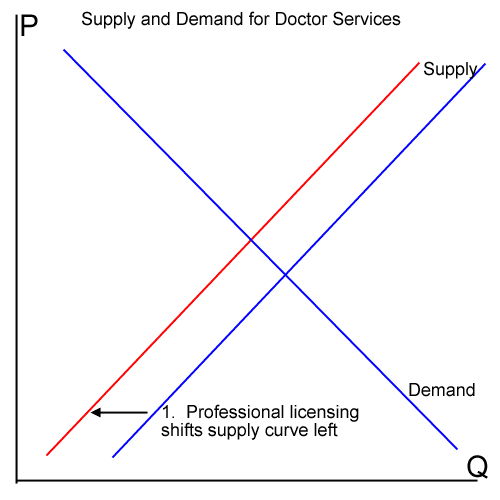
I don't think this requires much discussion. For any given price for doctor services, the quantity of doctor hours available is certainly going to increase as the barriers to entry to the profession are raised.

The second intervention is actually a set of interventions, the range of interventions that have encouraged single-payer low-deductible health insurance and have provided subsidies for this insurance.  These interventions include historic tax preferences for employer-paid employee health insurance, Medicare, Medicaid, the subsidies in Obamacare as well as the rules in Obamacare that discourage high-deductible policies and require that everyone buy insurance rather than pay as they go.  The result is a shift in the demand curve to the right, along with a shift to a more vertical demand curve (meaning people are more price-insensitive, since a third-party is paying).
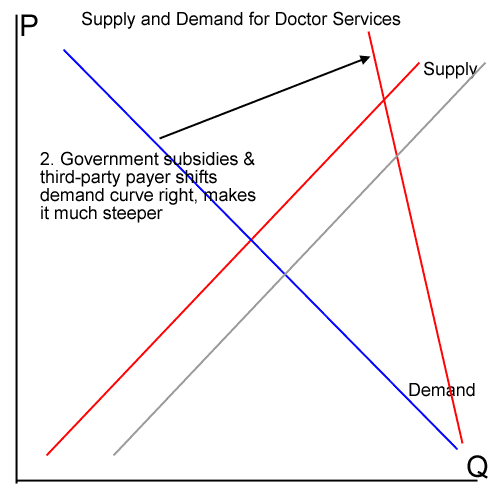
The result is a substantial rise in prices, as we have seen over the last 30 years as health care prices have risen far faster than inflation
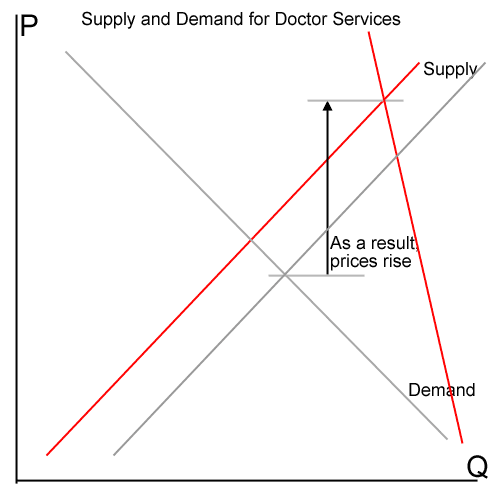
As the government pays more and more of the health care bills, this price rise leads to unsustainably high spending levels, so the government institutes price controls.  Medicare has price controls (the famous "doc fix" is related to these) and Obamacare promises many more.  This leads to huge doctor shortages, queues, waiting lists, etc.  Exactly what we see in other state-run health care systems,  The graph below posits a price cap that forces prices back to the free market rate.
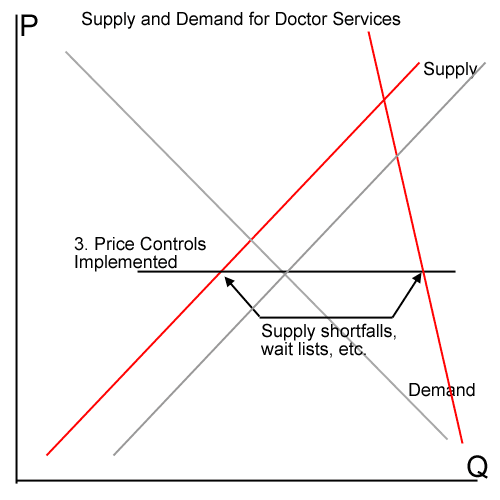
So, is this better access to health care?

I know that Obamacare proponents claim that top-down government operation is going to reap all kinds of savings, thus shifting the supply curve to the right.  Since this has pretty much never happened in the whole history of government operations, I discount the claim.  When pressed for specifics, the ideas typically boil down to price or demand controls.  Price controls we discussed.  Demand controls are of the sort like "you can't get a transplant if you are over 70" or "we won't approve cancer treatments that only promise a year more life."

Most of these do not affect the chart above, since it is for doctor services and most of these cost control ideas are usually doctor intensive - more doctor time to have fewer tests, operations, drugs.  But even if we expanded the viewpoint to be for all health care, it is yet to be demonstrated that the American public will even accept these restrictions.  The very first one out of the box, a proposal to have fewer mamographies for women under a certain age, was abandoned in a firestorm of opposition from women's groups.  In all likelihood, there will be some mish-mash of demand restrictions, determined less by science and by who (users and providers) have the best lobbying organizations.

My longer series of three Forbes articles on this and other economic issues with Obamacare begin here:  Part 1 Information, Part 2 Incentives, Part 3 Rent-Seeking

Update:  Pondering on this, it may be that professional licensing also makes the supply curve steeper.  It depends on how doctors think about sunk cost.

Comparative Advantage

Sometimes I have odd reactions to things.  For example, my immediate reaction to this comic book cover was, "comparative advantage fail."

I am sure that Superman would be a super-productive gardener, but there are likely much better tasks to assign him for which his comparative advantage is much greater.

Eeek! PBS Showed a Skeptic

Apparently PBS planned to air a few minutes with climate skeptic Anthony Watts, which they previewed in a blog post.  This caused a major freak out among its viewers, who are not used to being confronted with views that don't comfortably align with those of their peer group.  Apparently PBS viewers distrust their own judgement so much that they can't let themselves even view skeptical material, I suppose because it is like that alien on Star Trek that drove anyone who looked at it insane.

PBS is apologizing like crazy, and felt the need to link nine past shows and articles where it has totally conformed to the climate gospel, so there is absolutely no cause to question their ideological purity.

Bank Advice

This is a note for small businesses that deposit a lot of cash and small checks, perhaps from a retail operation.  We have found that the fees of the large banks are simply awful for retail deposit accounts.  Bank of America, Wells Fargo, US Bank, and Zions are all fairly large banks who have raised fees as high as $100+ a month just for a checking account into which we make a weekly deposit of cash and small checks. In particular, US Bank has taken over two of our small deposit banks recently, and raised our fee from $7 on one account to over $120 last month.

Even if your main banking relationship is with someone else, look for a small local bank or credit union for deposit accounts.  I have a number of such small banks around the country that charge us zero a month for our deposit account, and at worst up to $10.  Anything more, and you can probably do better.

Kevin Drum Does Not Like Being Called A Moocher

Apparently, he things "moocher" is unfair.  So I will remind you what he wrote a while back:

...for the first time that I can remember, this means that I have a personal stake in the election. It's not just that I find one side's policies more congenial in the abstract, but that one policy in particular could have a substantial impact on my life.

You see, I've never really intended to keep blogging until I'm 65. I might, of course. Blogging is a pretty nice job. But I'd really like to have a choice, and without Obamacare I probably won't. That's because I'm normal: I'm in my mid-50s, I have high blood pressure and high cholesterol, a family history of heart trouble, and a variety of other smallish ailments. Nothing serious, but serious enough that it's unlikely any insurance company would ever take me on. So if I decided to quit blogging when I turned 60, I'd be out of luck. I couldn't afford to be entirely without health insurance (the 4x multiplier that hospitals charge the uninsured would doom me all by itself), and no one would sell me an individual policy. I could try navigating the high-risk pool labyrinth, but that's a crapshoot. Maybe it would work, maybe it wouldn't.

But if Obamacare stays on the books, I have all the flexibility in the world. If I want to keep working, I keep working. If I don't, I head off to the exchange and buy a policy that suits me. No muss, no fuss.

Attempting to remind him of these comments, I commented today:

I'm confused here.  A few weeks ago, didn't you say you support Obamacare because it let you retire early?  You said you could not afford to quit working early without Obamacare, because you would need your work and income to pay for, what to you, is a vital good.   Obamacare allows you to quit working earlier, presumably because other people, rather than you, will pay for at least a part of your health care with their labor.

I understand no one likes the word "moocher."  But you came on these pages really proudly announcing that Obamacare allowed you to retire early while others labored to support your needs.  What word would you suggest as an alternative, then, to describe this behavior?

(Yeah, I can predict the response.  It's not the subsidy you want, just the community rating.  Well, high premiums for 55-year-olds with pre-existing conditions are not some evil conspiracy, they reflect true cost to serve.  Having a government mandate that you pay the premiums of a healthy 25-year-old when you are 60 and sick is still a subsidy, paid for with someone else's labor.  As a minimum, 25-year-old minimum wage workers just entering the work force pay more when they are healthy so you can lead a life of indolence).

2012 Drought in Perspective

I don't know if this is a result of the severity of the drought being overblown or of the continued improvement of farming technology, or a bit of both.   Here is the recent data on 2012:

"As anticipated, lower projected production for both corn and soybeans was reported this month," said AFBF economist Todd Davis. "It will be some time before the long-term effects of the 2012 drought are fully played out. But it appears likely that continued strong worldwide demand for corn and soybeans will lead to higher projected prices."

USDA forecast corn production at 10.7 billion bushels. The average yield for corn was forecast at 122.8 bushels per acre this year, down slightly from the August prediction. Once harvest is complete, if the average corn yield comes in at 122.8 bushels per acre, it would be the smallest average yield since 2003.

I am glad I don't deal day to day with grain yield numbers, because every source I checked seems to be 3-5% off the other sources for historic numbers.  There must be some definitional issues I don't understand with acres vs. net acres.  But taking 2012 equal to to 2003, which is the worst-case way to interpret the above statement, we get this chart:

So, down 15-20% from the last several years, which is not good, but a number that still would be nearly an all-time high until about 2000.  Even at this lower number, US yields will be more than twice the corn yield per acre in the rest of the world.   Disasters are relative, I suppose, but this is a long way from the 1930's.

Enforcing the Emerging Right Not To Be Offended

What I wish Obama had said day one:

I didn't care for this particular YouTube video.  I don't think many in my State Department would agree with it in any way.  But in this country, that does not matter.  In this country, we allow people to speak their minds, whether or not they agree with those of us in office.  No, that's not quite right.  We protect their right to speak particularly when they don't agree with those of us in office.  I have sworn an oath to do so.  Browse YouTube and you will see hundreds of videos charicaturing me personally in ways I find hurtful.  You will find videos supporting and attacking nearly every religion, political party, or idea you can imagine.

Many nations are sometimes awed, overwhelmed, angry, envious at the power and wealth of this country.  But this did not happen by accident.  We are wealthy and successful because we hold ourselves consistently to a set of principles, and among the most important of these is freedom of expression.

Free Speech Asymmetry

I think the fact that there is an asymmetry between how critiques of Islam are received by US intellectuals and how critiques of Christianity are received is so obvious I am not even going to bother to prove it.  Suffice it to say that the same folks who refrained from even printing the fairly tame Danish Mohammed cartoons embrace satire of Christianity that is far more harsh, e.g. the Book of Mormon.

So accepting this asymmetry as nearly an axiom, I want to ask instead:  Is this asymmetry an exception being made for Islam, or an exception being made for Christianity.  In other words:

  • Do these folks support criticisms of all religions except Islam, because Islam is somehow different, perhaps out of a fear of violence?  If so, aren't we just encouraging anyone who is butt-hurt to resort to violence by giving folks with a Molotov cocktail an effective veto over speech?
  • Or, do these folks oppose criticisms of all religions except Christianity, perhaps because Republicans and Texans are Christians and intellectuals really don't like those guys.  In some ways this is parallel to the asymmetric way the "right not to be offended" is enforced on most campuses, with everyone afraid to offend a black woman but with no punishments assessed for offending white males.

Either answer, by the way, is absolutely unacceptable.  People who want to limit speech in a way to favor their own in-group should wonder what might happen when their group is no longer "in".

New Google Feature

THIS is why the Internet was invented.  Google has a new search feature so you can quickly find out how many degrees of separation any actor has from Kevin Bacon

It is hard to push the number much higher, for any reasonable value of "actor."  For God sakes, Charlie Chaplin is a 2.  I got a three with Humphrey Bogart and Butterfly McQueen.  Not even sure how to get a four.

Well, I Was Wrong

I have been a stock market bear for some months now.  I don't really think the US economy is going to double dip on its own, but I felt like Europe and Asia would bring us down.  Well, I simply underestimated both the Fed's and the ECB's willingness to goose financial assets.  If the Fed and ECB are going to inflate our way out of, uh, whatever it is we are in, then I certainly don't want to be holding bonds, particularly at these absurdly low interest rates.  Stocks are not as good of an inflation hedge as some hard assets, but they are a hell of a lot better than most bonds.  I'm  certainly not going to buy back in the current euphoric highs, but I am giving up on trying to predict that market based on fundamentals.  It seems that fundamentals are a suckers game, and you better not be timing the market unless you have an inside line to government policy, because that seems to be what drives the train.

PS-  I wish Milton Friedman were still around.  QE was as much his idea as anyone else's.   I wonder what he would have thought of the results, or of this particular implementation.

Insane Reverse-Privatization at the Arizona DMV

Arizona has always had a pretty intelligent rule that driving schools that have been certified by the state can actually give kids their written and driving tests.    They get a certificate they take to the DMV where they then get issued the physical license.   Kids who can't afford the school can certainly go into the DMV to take the tests, but since our DMV is swamped with insane waits, it is nice to have an alternative.

Until now.  Apparently, for reasons that entirely escape me except perhaps to pander to state employees' unions, all kids must now take their tests, written and driving, at the DMV.  So, the DMV's solution to insane waits is to... increase demand on their services.  Awesome.  Sounds eerily similar to Obamacare's solution to ER waits.

Rename the Chevy Volt to the Chevy Bastiat

Quick - in your last fill up, how much did you pay for gas?  About how many gallons did you use?

If you are like most people, you can probably come pretty close to this.  I paid somewhere just north of $4.00 for about 18 gallons.

OK, second set of questions:  On your last electric bill, how much did you pay per KwH?  How many KwH did it take to run your dishwasher last night?

Don't know?  I don't think you are alone.  I don't know the answers to the last questions.   Part of the reason is that gas prices are posted on every corner, and we stare at a dial showing us fuel used every time we fill up.  There is nothing comparable for electricity -- particularly for an electric car.

I understand some inherent appeals to electric cars.  They are fun to drive, kind of quiet and stealthy like KIT from Knight Rider.  They are really torquy and have nice acceleration.  There is no transmission and gear changing.  All cool and awesome reasons to buy an electric car.

However, my sense is that the main appeal of electric cars is that because we don't see the fuel price on the corner, and because we don't stare at a spinning dial as electrons are flowed into the car, we pretend it is not costing us anything to fill up.  Out of sight is out of mind.  Heck, even experienced car guys who should know better take this attitude.  Popular Mechanics editor Jim Meigs wrote to Glenn Reynolds, re: the Volt:

Others might like the notion of going a month or two without filling the tank

This drives me crazy.  Of COURSE you are filling the freaking tank.  You are just filling the lead-acid (or lithium-ion) one with electrons rather than filling the hollow steel one with hydrocarbon molecules.  The only difference is that you don't stand there watching the meter spin.   But that should not mean that we pretend we are not filling the car and paying a cost to do so.

By the way, if you have read me before, you know I also have a problem with the EPA equivalent mileage standards for electric cars, which basically inflate the numbers by a factor of three by ignoring the second law of thermodynamics.  This fraudulent mileage number, combined with the EPA's crazy-high new mileage standards, represents an implicit subsidy, almost a mandate, for electric cars that gets little attention.  And that will have zero effect on energy usage because the numbers are gamed.


Creative Destruction

I thought this was an interesting example of creative destruction.  Five years ago, Time and Newsweek were running cover stories about the "Blackberry" culture and how ubiquitous the device was in modern business.  Now, people are making fun of it for being outdated tech.  If only we could get the average voter to truly appreciate creative destruction.  We might have fewer bailouts and more economic growth.

By the way, Canada says it won't bail out Blackberry, which is good, but is interesting given that it did bail out the Canadian automotive sector just a few years ago.  In terms of total market value I would guess the Canadian automotive sector is way smaller than Blackberry at its peak.  Only a cynic would suggest the difference is that the auto sector is unionized and therefore politically organized to generate campaign donations and grass roots get-out-the-vote efforts, while RIM is not.  That would imply that bailouts were due to political pull rather than sound and consistent economic reasoning, which I am sure can't possibly be true.

PS- there are still good and valid reasons for enterprises, like the Administration and government agencies, to use the Blackberry over smartphones.  Just because they are out of favor with 16-year-old girls does not mean they don't have utility. Oddly, though, given this particular niche and comparative advantage, RIM seems to be obsoleting its installed base of enterprise servers.   I am not an expert, but I think a lot of enterprises would stick with Blackberry for quite a while just out of inertia and lack of desire to change.  But now that Blackberry is forcing them to rethink their whole enterprise platform anyway, it seems to allow other competitors solutions into play.  Or am I missing something?

Update:  Apparently RIM is saying the previous paragraph is incorrect, that the new servers will support all the old devices ... except for email, calendar, and contacts.  Unfortunately, this seems to encompass the entire Blackberry functionality.  I have had one or two of the devices, and you are a nut if you are trying to surf the web on one as your main usage.

Because They Are Humanitarians

I used to scoff at how Ayn Rand turned the word "humanitarian" in the Fountainhead into a term of derision.  I didn't think it was justified to assume anyone adopting the humanitarian title had to be evil.  Surely, for example, Andrew Carnegie with his philanthropy and opposition to war could be considered a positive humanitarian?

But maybe she was on to something.  At least as far as Greenpeace is concerned:

According to the World Health Organization between 250,000 to 500,000 children become blind every year due to vitamin A deficiency, half of whom die within a year of becoming blind. Millions of other people suffer from various debilitating conditions due to the lack of this essential nutrient.[2]

Golden Rice is a genetically modified form of rice that, unlike conventional rice, contains beta-Carotene in the rice kernel. Beta-Carotene is converted to vitamin A in humans and is important for eyesight, the immune system, and general good health.[3] Swiss scientist and humanitarian Dr. Ingo Potrykus and his colleagues developed Golden Rice in 1998. It has been demonstrated in numerous studies that golden rice can eliminate vitamin A deficiency.[4]

Greenpeace and its allies have successfully blocked the introduction of golden rice for over a decade, claiming it may have “environmental and health risks” without ever elaborating on what those risks might be. After years of effort the Golden Rice Humanitarian Project, led by Dr. Potrykus, The Rockefeller Foundation and others were unable to break through the political opposition to golden rice that was generated directly by Greenpeace and its followers.[5]

To their credit, Bill and Melinda Gates are giving it another try.

You Can't Use Voluntary Action to Try to Stop Government Coersion

Or so says California's Gavin Newsom, in a great Reuters quote found by Zero Hedge:

California Lieutenant Governor Gavin Newsom says he wants the U.S. Department of Justice to investigate "threats" against local communities considering using eminent domain to seize and restructure poorly performing mortgages to benefit cash-strapped homeowners.

Newsom sent a letter on Monday to U.S. Attorney General Eric Holder asking federal prosecutors to investigate any attempts by Wall Street investors and government agencies to "boycott" California communities that are considering such moves.

"I am most disturbed by threats leveled by the mortgage industry and some in the federal government who have coercively urged local governments to reject consideration" of eminent domain," he wrote in a letter, a copy of which was provided to Reuters.

Newsom, a Democrat who was previously mayor of San Francisco, warned the influential Securities Industry and Financial Markets Association in July to "cease making threats to the local officials of San Bernardino County" over the proposed plan to seize underwater mortgages from private investors.

Some towns in San Bernardino County, which is located east of Los Angeles, have set up a joint authority that is looking into the idea of using eminent domain to forcibly purchase distressed mortgages. Rather than evict homeowners through foreclosure, the public-private entity would offer residents new mortgages with reduced debts.

Newsom said in the letter on Monday that while he is not endorsing the use of eminent domain at this time, he wants communities in California to be able to "explore every option" for solving their mortgage burdens "without fear of illegal reprisal by the mortgage industry or federal government agencies."

This quote is so rich with irony that it is just delicious.   Certainly ceasing to do business in a community that threatens to steal all your property strikes me as a perfectly reasonable, sane response.   Calling such a response an actionable threat requiring Federal investigation just demonstrates how little respect California officials, in particular, have for private activity and individual rights.

The third paragraph might be worth an essay all by itself, classifying a voluntary private boycott as illegally coercive while treating use of eminent domain, intended for things like road building, to seize private mortgages as so sensible that it should be sheltered from any public criticism.

A New Way To Film An Event

Wither the camera operator?  I thought this was interesting - super-high-resolution cameras in fixed positions that cover the whole field, with broadcast shot selected as a zoom/clipping window withing the larger picture.

All These Years I Was Driving Right Past...

Apparently, the home in which L. Ron Hubbard invented Scientology is right here in Phoenix.  In fact, it is right by my kids' school and I drive past it almost every day.  In the next few days I will take a camera and snap a picture or two.

I was a fan of Hubbard's "Battlefield Earth"  (the book, not the movie) as a young adult -- it is a classic example of 1950's pulp science fiction -- though I picked it up a few years ago out of nostalgia and found that it did not wear very well.  I do not know much about Scientology, though I wonder why folks who go all-in for it aren't at least a bit suspicious of a religion involving ancient aliens that was cooked up by a science fiction writer.

The whole thing makes for a fascinating story, and I think it would be fabulous book material for someone who is not either a proselytizing Scientologist or an angry ex-Scientologist with an ax to grind.

So How Did It Go?

Since I blogged on the colonoscopy run-up, I supposed I am obligated to close the loop.  As Dave Barry warns, the prep is the bad part.  A day of eating lime jello combined with five or six hours of massive diarrhea.  Uncomfortable, mildly embarrassing, but quite manageable. The good part is that you know it is coming, you can prepare for it, and you know it is going to be over by the end of the day.

The procedure was a breeze.  The drugs are like a time machine.  One minute you are laying down, with the IV inserted and the next minute you are teleported 45 minutes into the future and in recovery with the whole thing done, feeling mellow.  No pain, before or afterwards.

Only two after-effects.  One, they apparently inflate your colon with air, like a bicycle tire tube, so they can see better.  Once I woke up, I passed gas in epic style, reminiscent of Peter Griffin in a Family Guy episode.  Second, I was freaking ravenous, since I hadn't eaten anything solid for 36 hours and anything at all for 12 hours.  That was solved by picking up the largest steak I could find at Whole Foods on the way home.

All is well medically, by the way.

Enjoy the NFL This Weekend, You May Not Have It For Long

I think Walter Olson is dead on with this:

Steve Chapman at the Chicago Tribune looks at the cultural and legal responses to the mounting evidence that professional football inflicts brain damage on many of its players. He quotes my view that if the litigation system carries over to football the legal principles it applies to other industries, the game isn’t likely to survive in its current form.  [sorry for quoting the whole thing Walter, I just couldn't figure out how to excerpt it]

There is a very good chance that the NFL could go the way of Johns Manville or Dow Corning.  Those companies still exist after being sued into bankruptcy, but that is only because they had other businesses to shift into.  The NFL just has football.  And after reading the concussion stories recently, plaintiff's lawyers are going to have a hell of a lot better scientific case than they had with breast implants.    I honestly think it will take an act of Congress to keep the NFL alive, giving them some sort of liability exemption similar to what ski resorts got years ago.

And don't think the NFL does not know this.  If you are wondering why they handed out insanely over-the-top penalties for bounty-gate in New Orleans, this is why.  They are working to establish a paper trail of extreme diligence on player safety issues for future litigation.

As an aside, I find it frustrating that there is not a better helmet solution.

As a second aside, there is a guy here in Phoenix who was showing off an accelerometer for football helmets, with some kind of maximum single g-force or cumulative g-force trigger that would cause a player to be pulled from a game, sort of like how a radiation badge works.  Good idea.  Look for these to be mandatory equipment in high schools in colleges.    Takes the absurd guess work out of concussion diagnosis today, particularly since this diagnosis is done by people (the player and their team) who have strong incentives to decide that there was no concussion.

As a third aside, there are those who argue helmets are the problem.  Just as people drive less safely with seat belts and air bags in cars, helmets lead to less care on the field.  I will say I played rugby for years (without a helmet of course) and never had one concussion, or any head hit anywhere close to a concussion.  In amateur rugby in the leagues I played in, reckless behavior that might lead to injuries was strongly frowned upon and punished by the group.  Teams that played this way quickly found themselves without a game.  There were plenty of ways to demonstrate toughness without trying to injure people.