Archive for the ‘Government’ Category.

Wherein I Actually Praise Republicans

I have been told that the first person in a negotiation that mentions a number will lose.  Something similar is at work with the US federal budget.  When they controlled Congress, Democrats never even proposed a budget for this fiscal year (which began last October, months before they lost control of the House).  Obama's budget is simply a bad joke, a non-effort,  that simply extrapolates current trends without any real change or exercise of control.

Its amazing to me that all the news reports today are about the "risk" Republicans are taking by actually proposing a plan into this vacuum.   It is amazing to me that actually trying to exercise adult supervision when everyone else is voting "present" could be "political suicide," but I have to accept that the political experts know their stuff.

This situation is in fact exactly what Democrats have been hoping for -- they have purposefully hoped to avoid suggesting any solutions in order to force the Republicans to be the first and only ones to the table with suggestions.  Democrats have zero desire to actually close the multi-trillion dollar deficit;  rather, they see it as a huge opportunity that traps Republicans into trying to actually, you know, solve the problem.  These proposed solutions can then be demagogued against to electoral victory.  Or so goes the theory.

So, I want to thank the Republicans for actually producing a budget plan that actually attempts to bring some fiscal sense to the government.  I would have like to see other changes (less defense spending, elimination of Dept. of Education in favor of block grants, zeroing out of all farm and ethanol subsidies, etc) and Ryan's numbers seem screwy, but let us be happy there is at least one adult in Washington.

Beating A Dead Horse

Apparently the Left is still trying to argue that the stimulus (the process of taking money out of private hands to have it spent by government officials instead) was really a super-fabulous idea and only failed because it was too small.  Here is Kevin Drum:

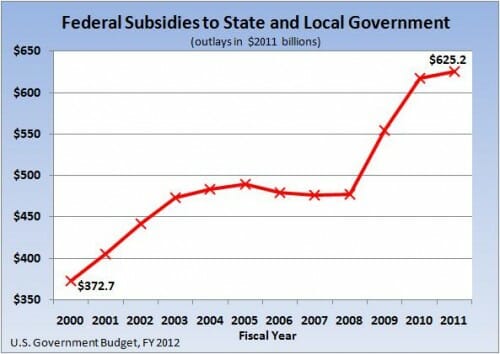
But another reason [the stimulus failed] is that at the same time the feds were spending more money, state governments were cutting back. The chart below from CBPP tells the story. They have data for all but six states, and on average for 2012, "those 44 states plan to spend 9.4 percent less than their states spent before the recession, adjusted for inflation." That's not just less than last year, it's less than 2008. That wiped out nearly the entire effect of the federal stimulus pacakge [sic].

I have a different take.  A number of states, because they don't own a printing press as does Uncle Sam, actually tried to deal with economic reality and cut their bloated spending, an effort that was largely wiped out by Obama's "stimulus" spending.

The Chicago Political Paradigm

Over the last few weeks I have been following the story of the city of Glendale, AZ, in order to protect a previous $200 million public investment in our hockey team, proposing to issue another $100 million bond issue to help subsidize the purchase of the hockey team out of bankruptcy.

The real furor began when the Goldwater Institute, a local libertarian-conservative think tank, said they were considering suing over the bond issue because it violates the gift clause of the Arizona Constitution, which basically bans municipal governments from providing direct subsidies or lending their credit to private institutions.  The gift clause has been frequently breached in the past (politicians do love to subsidize high-profile businesses), but of late Goldwater has successfully challenged several public expenditures under the gift clause.

I won't rehash the whole argument, but I found this bit from Senator McCain interesting

He called on the Goldwater Institute, a Valley watchdog that intends to sue to block the deal, to sit down and negotiate to keep the team

The buyer Matthew Hulsizer and his staff have taken this position throughout the deal -- they have lamented that they are more than willing to "negotiate" with Goldwater, and they are frustrated Goldwater won't come to the table with them.

This claim seems bizarre to me. If Goldwater thinks the deal is un-Constitutional, what is to "negotiate?" I don't know Hulsizer or anything about him, but it strikes me that he is working from a Chicago paradigm, and is treating Goldwater as if it were a community organizer. In Chicago, community organizers try to use third parties to protest various deals, like the opening of a Wal-Mart or a new bank. These third-parties are nominally protesting on ideological grounds, but in fact they are merely trying to throw a spanner in the works in order to get a pay off from the deal makers, almost like a protection racket. The payoff might be money or some concession for the group (e.g. guarantee of X% jobs for this group in project, $X in loans earmarked for group, etc).

Everything I have seen tells me Hulsizer is approaching Goldwater in this paradigm.  Even going out and rounding up the most prominent politician in the state (McCain) to put pressure on Goldwater is part of this same Chicago paradigm.

Here by the way  is what Hulsizer is apparently offering

As one part of the deal, Glendale would sell bonds to pay Hulsizer $100 million, which the Chicago investor would use to purchase the team for $210 million from the National Hockey League.

Hulsizer said he notified Goldwater he would guarantee the team will pay Glendale at least $100 million during its lease on the city's Jobing.com Arena through $75 million in team rent and fees and by covering $25 million in team losses that the city promised to pay the NHL this season, which is included in the hockey team's purchase price.

"We need to move forward now," he said. "I expect that Goldwater and other people who have come out against this deal will hopefully recognize the benefits of it and will now use all of that energy and tenacity and aggressiveness to go out and help us sell these bonds and make hockey work in the desert forever."

Hulsizer said Goldwater had not yet responded to him.

By the way, I hesitate to trust the Arizona Republic to report such deal terms correctly, but if what is reported above is correct, the offer appears to be non-sense

  1. What kind of guarantee is he offering?  Is it a guarantee by the corporate vehicle buying the team, because if it is, this is worthless.   The last team ownership group promised to pay the lease for 30 years -- what does that mean once they went bankrupt?  I am sure Borders Books promised to pay a lot of real estate owners money for leases, and many of them are going to end up empty-handed in the bankruptcy.  If this is a personal guarantee, that is a nice step forward, though not enough because....
  2. The $75 million in rent is largely irrelevant to the new bond issue -- these rents support the old $200 million bond issue.  What they are saying is "issue a new $100 million bond issue for us and we will guarantee you can make 40% of the payments for the old bond issue."   So?  When Balsillie wanted to move the team, he didn't ask for an additional bond issue and agreed to pay off $50 million of the old one as an exit fee.
  3. At the end of the day, if the $100 million is not a subsidy, not at risk, and fully backed by guaranteed cash flows, then Hulsizer should go out and get a $100 million private loan.  Period.

Unfortunately, this might be enough to get the deal through the courts.  Glendale will argue that for the $100 million, they will get $100 million paid against their existing bond issues that would not otherwise be paid if the team folds or leaves town.  This may fly with the courts, unfortunately, but it still sucks for taxpayers.   At the end of the day, nothing about this offer makes the $100 million bond issue any safer.   If the team goes bankrupt, it is lost.  That is an equity risk the city is taking with taxpayer funds, and equity risk for which we are getting no equity.  See here for full discussion of the risks and problems.

Postscript: The following is pure speculation, but I think it is close to correct.  The team is worth about $110 million at best (remember, it has never made money in AZ).  Forbes values it at $117 million but several similar franchises have sold for under $100 million lately.   The reason it is selling for $210 million is that the NHL, which bought it out of bankruptcy, guaranteed its other owners the league would not lose a penny on the team.   But the team has been racking up losses, and the accumulated cost to the NHL is now $210 million.  The NHL is insisting on a price that is $100 million north of where it should be.  In effect, the taxpayers of Glendale are bailing out the NHL for this crazy promise to its owners.

I can just see the negotiation.  Hulsizer, who by every evidence is a savvy financial guy, is not going to pay $210 million for an asset worth $110 million.  Glendale has way too many chips on the table to fold now, so it rides in and says it will contribute the $100 million difference.  In fact, the best evidence this is a subsidy is the difference between the purchase price and any reasonable team value.  Someone has to make up the ridiculous gap between the NHL asking price and reality, and Hulsizer is too smart to do it.   I have been calling this a subsidy of Hulsizer, but in fact this is really a subsidy of the NHL.   The NHL has Glendale by the short hairs, because Glendale knows (from the Balsillie offer, among others) that the only way the NHL can get a $210 million price is from a buyer who wants to move the team.

This, by the way, is EXACTLY the reason I opposed the original stadium funding deal.  Once they built the stadium, and then went further and lured businesses to develop around it, they were wide open to blackmail of this sort.

The problem with doubling down at this point is that the team has never made money and has no real public plan for doing so.  I have talked to NHL executives and none of them see how the turnaround is possible.  So how many years will it be before the new owners tire of their plaything and throw the team back into bankruptcy, so that Glendale will be in the exact same spot except $300 million, rather than $200 million, in debt.
The Paul Krugman Award for Forgetting Everything You Knew About Economics In Order to Shill for Your Favorite Political Party Goes To.....

Obama budget director Jacob Lew, who wrote this lucid statement about the Social Security "Trust Fund" back in 2000

"These [trust fund] balances are available to finance future benefit payments and other trust fund expenditures—but only in a bookkeeping sense. These funds are not set up to be pension funds, like the funds of private pension plans. They do not consist of real economic assets that can be drawn down in the future to fund benefits. Instead, they are claims on the Treasury that, when redeemed, will have to be financed by raising taxes, borrowing from the public, or reducing benefits or other expenditures. The existence of large trust fund balances, therefore, does not, by itself, have any impact on the Government's ability to pay benefits." [bold added]

Needless to say, he has changed his tune now that he is being paid to shout "all is well" as enabler-in-chief of Obama's spending habit.

All You Need to Know About State Fiscal Responsibility

Via Reason

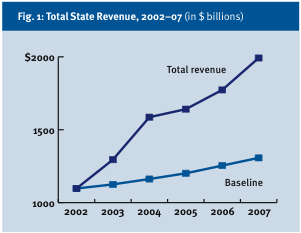
The baseline takes state government budgets and grows them by population growth and inflation.  In other words, baseline spending in 2007 would be the same real level per capita as in 2002.  The Total Revenue line is the actual revenue collections by state governments.  Actual collections grew about 4 times faster than population and inflation in this period.  And states still did not balance their budgets or pay down debt in this period.  Nick Gillespie writes

Had the states kept their outlays constant while allowing for inflation and population growth, they would have been sitting on $2 trillion in reserves when the recession hit. Instead, they were broke heading into the recession and are in even worse position now.

Revenue is IRRELEVANT to fixing state budget problems.  No matter how much money is collected, governments will spend all the money and more.  The only solution I can see is imposition of statutory, perhaps Constitutional, spending caps in each state.

Wisconsin Officials Rushing to Prove Why Public Unions Are A Problem

So the Republicans in Wisconsin eliminated collective bargaining for public unions except on wages.  The Democratic Secretary of State, fully within the law, is delaying making the law official for 10 days.  This 10 days is giving us a great picture of the problem with public unions.

Why?  Because the 10 days was explicitly to allow cities and counties to cut new deals with unions, since all deals before the law is passed are grandfathered.  The fact that many city and county governments are rushing to take advantage of this window just proves that public collective bargaining is broken -- no one is looking after the taxpayers.  I have argued that public unions are basically on the same side of the table with governments in bargaining sessions.  What could be better proof?  If government officials really cared about the taxpayer or their fiduciary responsibility, why in the world would they be rushing to cut above-market deals with government employees when they won't have to do so in just 10 days?  Government officials are colluding with unions to race to transfer more wealth from taxpayers to workers before the window for such subsidies shuts.

Cargo Cult Social Engineering

Glen Reynolds has a great observation on government social engineering.  I hadn't thought about it this way before, but in many ways government drives for things like home ownership are like a cargo cult

The government decides to try to increase the middle class by subsidizing things that middle class people have: If middle-class people go to college and own homes, then surely if more people go to college and own homes, we’ll have more middle-class people. But homeownership and college aren’t causes of middle-class status, they’re markers for possessing the kinds of traits — self-discipline, the ability to defer gratification, etc. — that let you enter, and stay, in the middle class. Subsidizing the markers doesn’t produce the traits; if anything, it undermines them

Seen and Unseen

Every time you see a politician claiming he created jobs with some expenditure of taxpayer money, you have to ask yourself, what would private investors have done with that money had it not been taken away from them?  Via John Stossel

In a new article, "The Myth of Green Energy Jobs: The European Experience", the environmental scientist and a resident scholar at the American Enterprise Institute writes,

"Green programs in Spain destroyed 2.2 jobs for every green job created, while the capital needed for one green job in Italy could create almost five jobs in the general economy."

The Worst Federal Spending?

OK, I know there are lots of strong competitors for the title of worst Federal spending, but transfers to state governments is, to my mind, among the very worst (from here)

Specific problems with this spending include:

  • Terrible accountability, even worse than for most of Federal spending.  Feds appropriate the money but have only limited ways to enforce accountability and almost no ability to track its use
  • Awful incentives, as much of this money is given as matching funds that simply encourage more spending at the state level and create, in difficult budget times, the almost impossible problem of having to cut $2 of spending to save $1 of state appropriations.  Makes matching fund programs almost impossible to cut, though kudos to Wisconsin and Florida for doing the right thing with Federal matching funds for high speed rail
  • Frequently used to undermine the 10th recommended.   Seat belt laws and 55-mile-per-hour speed limits enforced by threats of withdrawal of Federal funds.  Ditto Title IX in state schools.   The Feds are like narcotics pushers, getting the states hooked early on easy money and then using their addiction to these funds in all kinds of abusive ways.

TARP Funds

This is old, I think, but I had never seen it.  Where TARP funds went.

LOLing

I have to agree with Glen Reynolds that this is an awesome quote, from  a member of the teacher's union in Denver:

That’s your problem. You’re an entrepreneur, so you don’t work. You don’t know what work is until you get into an educational area.

Yep, some day I will have to stop loafing around and take on a brutal assistant principal job somewhere.  All I have to worry about is that every dollar I own (and more) is invested in my business and could disappear at any time if I make a mistake.  Thank God I don't have to sit around all day worrying whether the doctor that hands out no-questions-asked disability rulings will still be practicing when I am 45 and ready to retire.

I call this the "Dallas / Dynasty" perception of business, that businessmen just grab a phone call or two, go to a power lunch, and then head home to the mansion.

Update: Apparently this is a common misconception about entrepeneurs

The average number of working hours per week of a successful starting entrepreneur is seventy. This catches the typical American dreamer by surprise.

The teacher day:

Nor do teachers spend all of their time at school in the classroom. In fact, teachers spend fewer hours actually instructing students than many recognize. Stanford's Terry Moe worked with data straight from the nation's largest teacher union's own data - and found that the average teacher in a department setting (that is, where students have different teachers for different subjects) was in the classroom for fewer than 3.9 hours out of the 7.3 hours at school each day.

With several hours set aside at school for course-planning and grading, it strains plausibility that on average teachers must spend more hours working at home than do other professionals.

Not to mention, of course, summer vacation, Christmas break, spring break, fall break.... Oh, and the fact that they have lifetime job security because in public schools they can't be fired for even the most egregious incompetance

Chutzpah Award

Many of my Conservative friends often rail on liberals and liberal politics as being driven by envy.  I find that sort of assignment of motivation to be fairly unhelpful in most debates, though I do understand the case they are making.

In this context, though, I have to say that Kevin Drum gets the Chutzpah award of the week for claiming that Conservative politics are being driven by envy of government workers.  LOL.  I made a response in his comments section that was so obvious I hesitate to even repeat it here, but I will.  He made the point that government did not lay people off because it still had demand for its services

Kevin, you have it backwards because you confuse two terms. Private businesses did not lay people off because people stopped wanting their product, they laid people off because people stopped paying for their product. I am sure everyone still would like a Porche, just no one is paying for them right now. Ditto houses, etc.

Businesses reacted to the reality of less money coming in. They probably had many important things they could have continued doing in R&D or manufacturing streamlining, but the reality was that less money was coming in the door so they reduced their expenses to match.

The public sector issue is not different but identical. Sure, there are still lot of things they would like to be doing, but the fact is that less money is coming in the door. But rather than adjust to that fact, they arrogantly ignored it, running up debt in the taxpayers name so a bunch of deputy assistant principals could keep earning $80,000 a year. That is why folks are angry.

Kevin Drum is one of the few team politics blogs I read from either the Coke or the Pepsi side of the aisle because I think he often makes the leftish case more intelligently than most.  But I have been critical of him all week in his comments section for repeatedly defending public employees unions based on the benefits of private unions.  The two are very different, as pointed out by, well, about everybody who is not specifically beholden to the public employees unions.  Here is just the first one of many I found in my reader.

Public Employee Compensation Packages

I am with Megan McArdle in confirming that the non-pay portions of the typical public employee compensation package is at least as important, and as potentially expensive, as the money itself.  In particular, two aspects of many public employee compensation packages would be intolerable in my service business:

  • Inability to fire anyone in any reasonable amount of time
  • Work rules and job classifications

From time to time I hire seemingly qualified people who are awful with customers.  They yell at customers, or are surly and impatient with them, or ruin their camping stay with nit-picky nagging on minor campground rules issues.  In my company, these people quickly become non-employees.  In the public sector they become... 30 year DMV veterans.  Only in a world of government monopoly services can bad performance or low productivity be tolerated, mainly because the customer has no other option.  In my world, the customer has near-infinite other options.  And don't even get me started on liability -- when liability laws have been restructured so that I am nearly infinitely liable for the actions of my least responsible employee, I have to be ruthless about culling bad performance.

The same is true of work rules.  Forget productivity for a moment.  Just in terms of customer service, every one of my employees has to be able to solve customer problems.  I can't automatically assume customers will approach the firewood-seller employee for firewood.  All my employees need to be able to sell firewood, or empty a trash can when it needs emptying, or clean a bathroom if the regular cleaner is sick, or whatever.

For those who really believe state workers in Wisconsin are underpaid, I would ask this question:  Which of you business people out there would hire the average Wisconsin state worker for their current salary, benefits package, lifetime employment, work rules, grievance process, etc?  If they are so underpaid, I would assume they would get snapped up, right?  Sure.

Bonus advice to young people:  Think long and hard before you take that government job right out of college.  It may offer lifetime employment, but the flip side is that you may need it.  Here is what I mean:

When people leave college, they generally don't have a very good idea how to work in an organization, how to work under authority, how to manage people, how to achieve goals in the context of an organization's goals, etc.   You may think you understand these things from group projects at school or internships, but you don't.  I certainly didn't.

The public and private sector have organizations that work very differently, with different kinds of goals and performance expectations.  Decision-making processes are also very different, as are criteria for individual success within the organization.  Attitudes about risk, an in particular the adherence to process vs. getting results, are entirely different.

I am trying hard to be as non-judgmental in these comparisons as I can for this particular post.  I know good people in government service, and have hired a few good people out of government.  But the culture and incentives they work within are foreign to those of us who work in the private world, and many of the things we might ascribe to bad people in government are really due to those bad incentives.

It is a fact you should understand that many private employers consider a prospective employee to have been "ruined" by years of government work, particularly in their formative years.  This is simply a fact you will need to deal with (it could well be the reverse is true of government hiring, but I have no experience with it).  That is why, for the question I asked above about hiring Wisconsin government workers, the answer for many employers would be "no" irregardless of pay.

Spending Cuts in Perspective

Last week I showed the Obama-proposed cuts as an almost invisible, except under extreme magnification, portion of the total budget.  Unfortunately, proposed Republican cuts (which according to the NY Times and other voices of big government will lead to the end of the world as we know it) are not much better

via Tad DeHaven

Thought on Wisconsin Protests

Collective bargaining was adopted as a key tactic for labor out of the sense that, by banding together in labor negotiations, workers were able to offset a perceived power imbalance vis a vis employers.  But what happens if the management team on the other side of the table in labor negotiations is not actually an adversary?

We have seen in the last week that the Democratic Party is operating, right up to the US President, as a wholly owned subsidiary of the public employee's unions.  In such a case, where state governments are historically dominated by Democrats, is it any wonder that compensation packages for unions have skyrocketed?  They have been negotiating with themselves!

Obama Budget Cuts

A great graphic putting them in perspective.

Progressives Need to Do Some Soul Searching

I was listening on the radio today the brouhaha that is occurring up in Wisconsin.  Basically the Democratic legislators have all left the state en mass (to deny a legislative quorum) and progressives are being bussed in from all other the Midwest to participate in increasingly confrontational protests.

All to protect benefits of government workers.  I understand that many progressives don't accept that taxes cannot be increased infinitely.  But to the extent there are really some reality-based (lol) progressives out there, who actually understand that there is a limit to how much can be spent in a given government budget, they are going to need to do some soul searching to decide how much education or Medicaid spending they are willing to give up to support the pay packages and fat retirements of government workers.

I Think They Screwed Up the Math

The National Journal tries to give real world equivilents to show how large federal spending is.  It's so large that editors can't reality check the numbers very well.  They write

You could cover 10,319 miles with $1 bills.

If you placed 3.73 trillion $1 bills end to end, length wise, it would stretch from Miami to Seattle 3.6 times, leaving you somewhere around Wyoming.

Actually, by my calculator (and that of a reader) if you assume each bill is 6 inches long, you could cover 353.2 MILLION miles.  This is not 3.6 times the distance from Miami to Seattle, but 3.8 times the distance from the Earth to the Sun!

Paying for Incompetance

We and our children will be paying for the recent spate of government fiscal incompetence for literally decades.  This letter I got from our payroll company provides a small but pointed reminder of this.  Here is the key graf:

Can you imagine getting a note in January from Amazon.com, saying their costs last year were higher than they expected and they were going to send you an additional bill?  Or how about BP sending all its customers a note saying that the cleanup costs in the Gulf cost it a lot of money and that they would all get an extra bill for X cents per gallon of fuel they purchased last year from BP?

Update: So in other words, I was hiring people in Florida in August of 2009, and will not find out until sometime in 2011 the true cost of this labor, because only now am I being told what taxes I have to pay on this labor.  And people wonder why businesses are reluctant to hire.  We may think we have a Constitutional ban on ex post facto law, but businessman know this is BS.

Business Relocation Subsidies

I return to an old favorite topic of mine this week, government subsidies for business relocation, in my column at Forbes.com.  An excerpt:

To see this clearer, lets take the example of Major League Baseball (MLB).  We all know that cities and states have for years been massively subsidizing new baseball stadiums for billionaire team owners.  Let’s for a minute say this never happened – that somehow, the mayors of the 50 largest cities got together in 1960 and made a no-stadium-subsidy pledge.  Would baseball still exist?  Sure!  Teams like the Giants have proven that baseball can work financially in a private park, and baseball thrived for years with private parks.  But would baseball be in the same cities?  Well, without subsidies, baseball would likely be in the largest cities, like New York and LA and Chicago, which is exactly where they are now.  The odd city here or there might be different, e.g. Tampa Bay might never have gotten a team, but that might in retrospect have been a good thing.

The net effect in baseball is the same as it is in every other industry:  Relocation subsidies, when everyone is playing the game, do nothing to substantially affect the location of jobs and businesses, but rather just transfer taxpayer money to business owners and workers.

Awesome Idea for Making Fannie and Freddie Go Away

I am in the process of completing a home mortgage.  The process has become awful again, not as bad as it was in the early 90's but harder and more frustrating than in the mid-2000's.  There is one set of rules, and if one's situation does not fit those rules, good freaking luck.  Right now, for example, getting a home mortgage when one is self-employed, even in a pretty large business with a decade of history, is really hard.

So I like this proposal

At the moment there is nobody doing conforming mortgages except Fannie and Freddie. Indeed there is almost nobody doing mortgages of any kind except Fannie and Freddie. If the free market wants the business they can have it. (They just don't want it at this sort of interest rate spread - and I don't blame them.)

All the government need to do is tell Frannie to raise their price a little each quarter. Currently they charge 20-25bps for guaranteeing mortgages. (The free market won't take credit risk at that price.) So it is entirely open to the FHFA (and hence the Treasury) to tell Fannie and Freddie to raise their prices by 5bps. The government will get paid better for the risk they are taking (and what free market ideologue will disagree with that) and the private sector can compete if they want to.

I doubt the free market will. But then in a quarter or two Frannie can raise their pricing by another 5 bps. And a quarter or two later Frannie can raise by another 5bps.

At some stage you will get to a level where the private sector chooses to compete. Frannie should not set its price competitively though. In another quarter they should raise the price another 5bps. And in another quarter they should raise again.

By the way, this is a classic example of not learning from your last mistake.  That spread is absurdly low.  I wouldn't guarantee my best friend's loan for 20bp.  Would you take on the default risk of a $100,000 mortgage for $200 a year?

Post Office: Mail Delivery or Welfare?

The management of the Post Office is a joke, and it is hardly worth the electrons to write more about it.   But I did find this factoid in Tad DeHaven's commentary on the Post Office's hopeless efforts at cost reduction interesting.

Traditional post offices, which number about 27,000, cannot be closed “for solely operating at a deficit” and the closure process is burdensome.

Wow, that is a bad law (though no worse than 10,000 others like it).  This sounds similar to the military base problem, where every facility that needs closure has a Congressperson desperately trying to keep it open against all economic reality, merely as a jobs/welfare program once its true utility is over.   Apparently, the Post Office has an overcapacity problem that rivals the US Military's after the Cold War (and really to be honest after WWII)

Full post offices are more costly to operate than other means of serving customers. The average post office transaction cost 23 cents per dollar of revenue in 2009 while the average transaction at a contract postal unit cost just 13 cents. Post offices used to generate almost all postal retail revenue, but 29 percent is now generated online through usps.com and other alternative channels.

In 2009 post offices recorded 117 million fewer transactions than in 2008. Four out of five post offices are operating at a loss. However, the postal network’s overcapacity has drawn little corrective action from Congress. In fact, legislation introduced in the House with 102 cosponsors would apply the burdensome procedures for closing post offices to other postal outlets as well. Congress is actively working against the modernization of the U.S. postal system.

The amazing thing is that they have tons of extra capacity and still provide poor service.  Just compare the process of mailing a package UPS vs. USPS.  I have a UPS account, I can print my own labels, I get billed automatically, I get package tracking, and I can send the package from the drop box downstairs in my building.

It is almost impossible to do this with the USPS.  To mail anything larger than 13 ounces, to buy postage without an expensive meter, to get a greatly inferior sort of tracking -- all require a grim trek to the post office.

My guess is that just like Pemex is not longer really about producing oil, the USPS mission is no longer primarily about delivering mail, its a welfare program.

PS - my USPS delivery guy is great.  Nicest guy in the world.  The mistake for years in criticizing the USPS has always been about criticizing the people.  Not only is that wrong, but it distracts from the problem.  By implying the problem is bad, surly people, it implies the problem is fixable with new people.  But in fact, the problem, as with all government, is information and incentives .... and in this case Congressional meddling in their mission.

Green Jobs & Public Investment = Corporate Welfare

The recent naming of GE's Jeffrey Immelt to head a presidential commission on, err, something or other seems to have been an occasion for bipartisan gnashing of teeth about what I call the growth of the American corporate state.  I was encouraged by the bipartisan negative reaction from the left, right, and of course the libertarians, the latter of whom have always understood the difference between being pro-capitalism and pro-business.

But all it takes is a nomenclature change of this corporate welfare to "green jobs" or "investment in the future" or "bridge to the future" or similar bullsh*t and suddenly many of the exact same people, at least on the left, are swooning again.  Why is it not obvious that, for example, green energy subsidies are just the same old corporate welfare?

Here is one aggravating example

Despite millions in government grants and subsidies, the Manitowoc company President Barack Obama called a glimpse of the future lost $4.2 million last year and cannot promise shareholders it will be profitable in the foreseeable future....

“We may continue to incur further net losses and there can be no assurance that we will be able to increase our revenue, expand our customer base or be profitable,” the report indicates.

Investors have responded to the company’s volatility, and Orion stock has plummeted in the past four years.  It closed 2007 at $18.82 a share.  By the end of 2010 it was $3.34.

Regardless, President Obama is putting his, and the U.S. taxpayers’, money on companies like Orion.

“It’s important to remember that this plant, this company has also been supported over the years not just by the Department of Agriculture and the Small Business Administration, but by tax credits and awards we created to give a leg up to renewable energy companies,” Obama said at the Orion plant on Wednesday.

The State of Wisconsin has also given its share trying to help Orion to succeed.  Since 2005, the state has given the company $350,000 in community development zone tax credits, $506,000 in economic development funds, and $420,000 from the Wisconsin Energy Independence Fund.  Plus the company got another $260,000 in stimulus funds for a State Energy project.

In addition to direct aid, public policy has also helped the struggling company.  Wisconsin law requires that 10 percent of all electricity sold in the state come from renewable sources by 2015.  Orion knows that without government intervention like that, there would be little prospect for the green economy.

“The reduction, elimination or expiration of government mandates and subsidies or economic or tax rebates, credits and/or incentives for alternative renewable energy systems would likely substantially reduce the demand for, and economic feasibility of, any solar photovoltaic and/or wind electricity generating products, applications or services and could materially reduce any prospects for our successfully introducing any new products, applications or services using such technologies,” the SEC report states.

By the way, in 2010, while the government was pouring taxpayer money into Orion, its founder and CEO was pulling his out, selling (by my count of SEC filings) 130,000 shares, despite equity prices that were at a five year low.    It is dangerous to draw conclusions form insider sales (we don't know what personal financial issues may be driving their actions) but it is interesting that the president and founder is taking the exact opposite point of view on the company's prospects than is President Obama.

Arrogance of the State

I know this is just a trivial example, but somehow it seems to be representative for me of a larger class of legislation - yield to the state!

In 2009, Colorado legislators passed the Yield to Bus Law to help transit agencies that were finding that the inability of buses to get quickly back into the traffic flow after a stop was hurting their on-time performance.

Steamboat Springs Transit helped push for the law after it had to add time to routes to stay on schedule because too often its buses were boxed in by traffic at stops, said Philo Shelton, director of Steamboat's public works department, which runs the 24-bus transit operation....

The hope is that motorists will get in the habit of yielding, thereby minimizing the need for enforcement of the law, officials say.  (via the antiplanner)

That does seem to be the point - produce citizens that are in the habit of yielding to the state.   Because we all know that having the state's bus full of empty seats stay on schedule is far more important than the schedule of all the little people around it.  When government schedules don't work, what do they do?  Change the schedules?  No!  Change the behavior of the citizenry so the schedules can be made to work.  Nothing wrong with the schedules - its all you folks who are broken.

State Bankruptcy Prediction

There seems to be discussion in Washington about creating a legal framework for state bankruptcies.  My guess is that any law that might be passed will simply be a Trojan Horse.

A lot of people (including myself) would like the idea of the tough provisions applied to individuals who are bankrupt being applied to states.  Unfortunately, it is wildly unlikely that this is actually what we will get.  Any such law would likely just be a bailout program renamed "bankruptcy" to make it more palatable to the public, a transfer of obligations from state to federal taxpayers without any real imposition of discipline or cleanup of long-term obligations like pensions.  Heck, this is exactly what happened at GM, and that was just a private company.

Some might assume that a Republican House would be loathe to support bailout provisions for California, but two thoughts come to mind.

First, California, despite being a blue state, has plenty of red Congresspersons who will scream support for a bailout (for a parallel, think ethanol or farm subsidies, where grain state Republicans are among the first to break ranks with their brethren to support government interventionism).

Second, it is not clear that the Administration even needs the Congress any more to dish out money.  It has found so many extra-Constitutional ways to appropriate money without actually having to go to Congress (e.g. use of TARP funds for about anything, use of the Federal Reserve, etc.) that it should be no problem to do this without the House.  Take just one idea -- Imagine California issues a $100 billion in 0.0000005% 100-year bonds that the Fed then buys at face value with printed money (as they have been buying US securities).  Instant bailout, no Congress.