Author Archive

USB C a Big Step Forward

I just got my Nexxus 5x phone I use as a backup and for international travel and it has the new USB-C connection.  Finally, a connection where I don't have to put my glasses on to figure out orientation.  I will say, though, that the Apple thunderbolt connections on its iphones still feels like a better solution, but android has finally gotten close.

I am trying out Google's Project Fi on the phone.  While I lose some coverage vs. my main phone with Verizon, I have always used T-mobile for my backup phone because of its international rate plans, and Project Fi uses T-mobile, so I don't expect a step backwards.   I will report on Project Fi when I get some experience with it.

GOP Debate Strategy Seems Fine

I know that GOP partisans were mad about the questions asked last night.  And I think they were right to be -- the questions looked a lot more like Democratic oppo research gotcha questions than issues Republican voters necessarily cared about in the election.

However, I think it is wrong to criticize Republican party leadership for the debate program.  While it would be nice if some of the questions came from the Right, this is exactly the kind of testing their candidates will get in the general election.  Wouldn't the Republicans like to know if their candidate can't handle the Leftish media headwind or if some gotcha question really turns out to be a solid hit to the vital organs -- before they are stuck with him or her?

This issue is related to one I have thought about for a while -- what I call the only silver lining from the current Progressive domination of college campuses.  It may be an uncomfortable environment for libertarians, but they are going to come out of college (as I did) having endured 4 years of 20 on 1 political arguments.  While progressives will only have experience chatting with other progressives in a warm fuzzy welcoming micro-aggression-free echo chamber.  Which one will be better prepared do defend their ideas in the real world?

Do We Care About Income Inequality, or Absolute Well-Being?

I am going to reprise parts of an article I wrote in Forbes several years ago, because I think the conclusions are particularly relevant given the Democrats' discussion of income inequality and the Scandinavian economic model.

When folks like Bernie Sanders say that we have more income inequality than Sweden or Denmark, this is certainly true. By just about any test, such as Gini ratios, we have a much wider range of incomes.

However, we Sanders implies that this greater income equality means the poor are better off in these countries, he is very probably wrong.  Because the data tends to show that while the middle class in the US is richer than the middle class in Denmark, and the rich in the US are richer than the rich in Denmark, the poor in the US are not poorer than those in Denmark.

And isn't this what we really care about?  The absolute well-being of the poor?

I am not a trained economist or economic researcher, but I have looked for a while for a data source to get at this.  I can find Gini ratios all over the place, but how do I compare the absolute well-being of poor in one country to poor in another?

The first clue that I was maybe on the right track was this chart that actually came from a left-wing group trying to promote the idea of reducing income inequality.  The chart is hard to read (the study is no longer online and all I have is a bad screenshot), but it seemed to show that the poor in the US were no worse off than the poor in Denmark and Sweeden

epi8d (1)


So the data had to be there somewhere.  Finally I found a set of data that seemed to does the trick.  I used data from the LIS Cross-National Data Center.  I cannot vouch for their data quality, but it is the same data set used by several folks on the Left (John Cassidy and Kevin Drum) to highlight inequality issues, so I used the same data source.  I then compared the US to several other countries, looking at the absolute well-being of folks at different income percentile levels.  I have used both exchange rates and purchasing price parity (PPP) for the comparison but my feeling is that PPP is a better approach when we are comparing consumer well-being.

You can click through the Forbes article to see all the comparisons, but I will focus here on Sweden and Denmark since they are very much in the policy-making discussion on income inequality.  As usual, you can click to enlarge:

click to enlarge click to enlarge

What does this mean?  If the data is correct, it means that all the way down to at least the 10th percentile poorest people, the poor in the US are as well or better off than the poor in Denmark and Sweden.  And everyone else, including those at the 20th and 25th percentile we would still likely call "poor", are way better off in the US.

All this talk about reducing income inequality by emulating Denmark is thus not about making the poor better off, but just about cutting the rich and middle class down to size.

Chart of the Day: Median Income, US States vs. European Countries

From Ryan McMaken of the Mises Institute, is your state richer than Bernie Sander's dream country Sweden?  The author has used state-level purchasing price parity adjustments, rather than a single US adjustment, due to large variations in state price levels discussed previously here (click to enlarge)

click to enlarge

Koch on Cronyism

Robert Bradley at Master Resource has a great pair of posts with some of the writings, past and present, of Charles Koch on cronyism.  Part 1 has past writing, part 2 has quotes from Koch's new book.

I find it telling the progressives have chosen the most vocal and one of the most eloquent opponents of cronyism and corporate welfare as their particular bogeyman.

My Testimony to the House Subcommittee on Public Lands

If you are really bored, and I mean for values of boredom approaching "Maybe I should pull out my old Menudo albums and give them a listen," you can watch me and others testify to the Public Lands Subcommittee of the House Natural Resources Committee.

As you will be able to tell, I pretty much never do the Washington thing.  there really being nothing much my business needs up there other than to be left alone (unfortunately a vain hope most of the time).

This case is a bit unique.  Fees and recreation on public lands are governed mainly by a certain piece of legislation called FLREA (I won't bother with all the actual words, everyone just calls it FLREA).  The law governs fees the government can charge for public recreation, passes that provide discounts to these fees, etc.

The Forest Service has a unique program (at least among the Federal Lands agencies involved in FLREA) where private concessionaires don't just run a resort, like in the Park Service, but run an entire "park".  This means that, unique to all the other agencies, the Forest Service actually has private companies charging park entry fees ("day use fees") and camping fees.   In theory this should be relatively easy to manage, and the existence of the concession program has never really been an issue in these proceedings, but sometimes in the rush of legislation we are simply forgotten, and rules are written into the law that are simply unworkable for private companies.  A good example in this law is the long fee approval process that could require 18 months to change a fee -- this provision would be a disaster for us because we often have to react to things like changing minimum wages on a couple months notice.

Postscript:  Yes I know -- Moire fail on the tie

Early Progressive, Race-Based Rational for the Minimum Wage

From the same article, From Eugenics and Economics in the Progressive Era by Thomas C. Leonard, that I quoted in a recent post on immigration comes this bit as well (emphasis added):

Progressive economists, like their neoclassical critics, believed that binding minimum wages would cause job losses. However, the progressive economists also believed that the job loss induced by minimum wages was a social benefit, as it 212 Journal of Economic Perspectives performed the eugenic service ridding the labor force of the “unemployable.” Sidney and Beatrice Webb (1897 [1920], p. 785) put it plainly: “With regard to certain sections of the population [the “unemployable”], this unemployment is not a mark of social disease, but actually of social health.” “[O]f all ways of dealing with these unfortunate parasites,” Sidney Webb (1912, p. 992) opined in the Journal of Political Economy, “the most ruinous to the community is to allow them to unrestrainedly compete as wage earners.” A minimum wage was seen to operate eugenically through two channels: by deterring prospective immigrants (Henderson, 1900) and also by removing from employment the “unemployable,” who, thus identified, could be, for example, segregated in rural communities or sterilized.

The notion that minimum-wage induced disemployment is a social benefit distinguishes its progressive proponents from their neoclassical critics, such as Alfred Marshall (1897), Philip Wicksteed (1913), A. C. Pigou (1913) and John Bates Clark (1913), who regarded job loss as a social cost of minimum wages, not as a putative social benefit (Leonard, 2000).

Columbia’s Henry Rogers Seager, a leading progressive economist who served as president of the AEA in 1922, provides an example. Worthy wage-earners, Seager (1913a, p. 12) argued, need protection from the “wearing competition of the casual worker and the drifter” and from the other “unemployable” who unfairly drag down the wages of more deserving workers (1913b, pp. 82–83). The minimum wage protects deserving workers from the competition of the unfit by making it illegal to work for less. Seager (1913a, p. 9) wrote: “The operation of the minimum wage requirement would merely extend the definition of defectives to embrace all individuals, who even after having received special training, remain incapable of adequate self-support.” Seager (p. 10) made clear what should happen to those who, even after remedial training, could not earn the legal minimum: “If we are to maintain a race that is to be made of up of capable, efficient and independent individuals and family groups we must courageously cut off lines of heredity that have been proved to be undesirable by isolation or sterilization . . . .”

Why I am Suspicious of Immigration Restrictionists -- They Have Been Wrong So Many Times in History

From Eugenics and Economics in the Progressive Era by Thomas C. Leonard (link via Don Boudreaux, I think).

It was a scholarly fashion, circa 1890, to declare the U.S. frontier “closed” and to sound a Malthusian alarm about excess American population growth. But the professional economists who wrote on immigration increasingly emphasized not the quantity of immigrants, but their quality. “If we could leave out of account the question of race and eugenics,” Irving Fisher (1921, pp. 226–227) said in his presidential address to the Eugenics Research Association, “I should, as an economist, be inclined to the view that unrestricted immigration . . . is economically advantageous to the country as a whole . . . .” But, cautioned Fisher, “the core of the problem of immigration is . . . one of race and eugenics,” the problem of the Anglo-Saxon racial stock being overwhelmed by racially inferior “defectives, delinquents and dependents.”

Fear and dislike of immigrants certainly were not new in the Progressive Era. But leading professional economists were among the first to provide scientific respectability for immigration restriction on racial grounds.2 They justified racebased immigration restriction as a remedy for “race suicide,” a Progressive Era term for the process by which racially superior stock (“natives”) is outbred by a more prolific, but racially inferior stock (immigrants).

Note that the authors of the time were not using race as we do -- by "other races" whose immigration into the US was going to destroy us, they meant Southern Italy, Russia, Austria, Hungary, and the rest of Eastern Europe.   Fifty years earlier, they would have meant the Irish.   All of who we would today consider part of the backbone of America.  Why do we have to take these ideas seriously today when they have been wrong so consistently in the past?

New Star Wars Trailer

I didn't see any gratuitous lens flairs until about 1:42 so I am not sure this is really JJ Abrams.  But I must admit that despite the total crapitude of Episodes 1-3, I am excited.

How Deeply Rooted is Cronyism in American Government? 2nd Circuit Calls it The Essence of Politics

A teeth whitening service in Connecticut sued the state, arguing that the state regulatory rule banning anyone but dentists from performing the simple whitening procedure should be overturned because its only purpose was to shield one favored group from competition.

The Court sided with Cronyism, ruling in part:

"Even if the only conceivable reason for the LED restriction was to shield licensed dentists from competition," the 2nd Circuit declared, "economic favoritism" is a sufficient justification all by itself. "Much of what states do is to favor certain groups over others on economic grounds," the court said. "We call this politics."

When I went to school, our system was described to me as "majority rule with minority protections".  The American system was never supposed to allow for the arbitrary sacrifice of one group to another just because the first group can manufacture more votes.

Chicago's Guantanimo

Chicago police's use of a warehouse at Honan Square to detain suspects for secret interrogations just gets worse and worse.

Police “disappeared” more than 7,000 people at an off-the-books interrogation warehouse in Chicago, nearly twice as many detentions as previously disclosed, the Guardian can now reveal....

According to an analysis of data disclosed to the Guardian in late September, police allowed lawyers access to Homan Square for only 0.94% of the 7,185 arrests logged over nearly 11 years. That percentage aligns with Chicago police’s broader practice of providing minimal access to attorneys during the crucial early interrogation stage, when an arrestee’s constitutional rights against self-incrimination are most vulnerable.

But Homan Square is unlike Chicago police precinct houses, according to lawyers who described a “find-your-client game” and experts who reviewed data from the latest tranche of arrestee records obtained by the Guardian.

“Not much shakes me in this business – baby murder, sex assault, I’ve done it all,” said David Gaeger, an attorney whose client was taken to Homan Square in 2011 after being arrested for marijuana. “That place was and is scary. It’s a scary place. There’s nothing about it that resembles a police station. It comes from a Bond movie or something.”

For whatever reason, the story does not seem to be able to generate much national heat, as partially evidenced by the fact that it takes a UK newspapers to show any initiative on the story.  The Right fetishizes law enforcement,  the Left refuses to take on a powerful public union, and the city is run by a mayor with powerful connections to both the President and Hillary Clinton, so essentially no one is interested.

By the way, most of these folks are being held for hours or days due to drug possession arrests (5386 of the 7000+), yet another indicator of why the war on drugs has become so stupid and counter-productive.

Berlin, 1945, In Color

Pretty amazing footage.  Having been to the Brandenburg Gate during the height of the Cold War, it is jarring to see someone driving easily from the British to the Soviet sector (the wall ran right by the Gate, with it just in the Soviet sector).

The West Has A Continuous History of Becoming more Liberal Only Because We Have Changed the Definition of "Liberal"

Kevin Drum writes, "the entire Western world has been moving inexorably in a liberal direction for a couple of centuries."

If this is true, it is only because the definition of "liberal" has changed.   After becoming increasingly less authoritarian and intrusive and controlling for hundreds of years, government is again becoming far more authoritarian and intrusive.  Only with a change in the definition of "liberal" over time can one consider attempting to ban, for example, the eating of certain types of foods as "liberal"

Until a few years ago, I would have said that Drum was right that there is a continuity of liberalization in the social realm.  I celebrate the increasing acceptance of differences, from race to sexuality.  But even here people who call themselves "liberal" are demanding authoritarian limitations on speech and expression, try to enforce a dictatorship of hurt feelings.

The whole post of his is a really interesting insight into the Progressive mind.  Apparently, the (purported) lack of compromise in government is the fault of just one of the two sides.  I am not sure how that is possible, but that seems to be the Progressive position (you will find an equal number of folks on the Right who believe the same thing, though they blame the opposite group).

Essentially, you can see in this post the strong Progressive belief that the default mode of government is to constantly generate new prohibitions, rules, strictures, taxes, regulations, and penalties.  And that anyone who stands in the way of this volume production of new legal entanglements must be overcome, even if one has to break the law to do it.

A few days ago Matt Yglesisas wrote a #Slatepitch piece arguing that Hillary Clinton "is clearly more comfortable than the average person with violating norms and operating in legal gray areas"—and that's a good thing. In a nutshell, Democrats can't get anything done through Congress, so they need someone willing to do whatever it takes to get things done some other way. And that's Hillary. "More than almost anyone else around, she knows where the levers of power lie, and she is comfortable pulling them, procedural niceties be damned."

Unsurprisingly, conservatives were shocked. Shocked! Liberals are fine with tyranny! Today Matt responded in one of his periodic newsletters:

A system of government based on the idea of compromises between two independently elected bodies will only work if the leaders of both bodies want to compromise. Congressional Republicans have rejected any form of compromise, so an effective Democratic president is going to try to govern through executive unilateralism. I don't think this is a positive development, but it's the only possible development.

So Democrats are within their rights to lie, cheat and steal -- to do whatever it takes -- to break through the gridlock.  I wonder:  The worst gridlock this country has ever had was in the 1850's, when no compromise could be found on slavery.   If Democrats are empowered today to lie, cheat, steal to break the gridlock, should they have been similarly empowered in 1850?

Of course, no one would want that.  But it raises an important point.  If you define the game as one with nietzsche-ist / Machiavellian rules, no one ever seems to consider that it is just as likely the other side will win as yours will.  In fact, if you truly represent liberality, I am not sure this kind of anything-goes game is stacked in favor of the truly liberal players.

For folks who think that the end justifies the means here, and that we need to break the rule of law in order to save it, I would offer this paraphrase to an old saying: you can't sell your soul and have it too.

Sigh, FCC Considering Banning Open Source Software Upgrades on Routers

I am a big fan of open source operating system dd-wrt for routers.  I have not bought a router in years that I did not immediately flash from the manufacturer's firmware to dd-wrt.  It is a bit of a headache, but once done I get a router that is a lot more stable (I am also told that it is more secure, but I have no way to judge that).  My router typically runs 6 months without rebooting with no issues, whereas with manufacturer firmware I sometimes have to reboot once a week to make it work.**

The FCC is considering new rules that may cause router manufacturers to lock out third party software like dd-wrt.  The FCC is claiming that "illegally modified equipment" has interfered with doppler radar at airports.  I find it very close to unbelievable that a hacked consumer router was interfering with doppler radar, and in fact the FCC did not specify what kind of equipment was illegally modified.  As is usual, my guess is an agency is using a minute, niche problem in area A as an excuse for blanket, anti-consumer regulation in unrelated area B.  You can sign an online petition to ask the FCC to rethink its approach here.


** To be fair I will add that dd-wrt, typical of a lot of third-party hacker products, is a lot less user friendly than a lot of modern router firmware.  For my streaming system to work at home I have to lock a couple of servers down to a fixed IP address and this is a surprisingly fiddly task on dd-wrt.

The Wrong Way to Sell Wind and Solar

A reader sent me this article on renewables by Tom Randall at Bloomberg.  I would like to spend more time thinking about it, but here are a few thoughts. [Ed:  sorry, totally forgot the link. duh.]

First, I would be thrilled if things like wind and solar can actually become cheaper, without government subsidies, than current fossil fuels.  I have high hopes for solar and am skeptical about wind, but leave that aside.

Second, I think he is selling renewables the wrong way, and is in fact trumpeting something as a good thing that really is not so good.  His argument is that the decline in capacity factors for natural gas and coal plants is a sign of the success of renwables.  The whole situation is complex, and a real analysis would require looking at the entire power system as a whole (which neither of us are doing).  But my worry is that all the author has done is to demonstrate a unaccounted-for cost of renewables, that is the reduction in efficiency of coal and natural gas plants without actually being able to replace them.

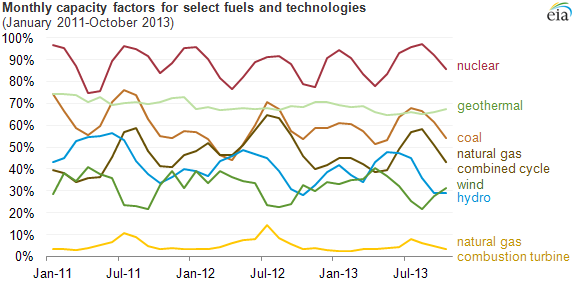
Here is his key chart.  It purports to show the total US capacity factor of each energy mode, with capacity factor defined as the total electricity output of the plant divided by what the electricity output could be if the plant ran full-out 24/7/365.

capacity factors

First, there is a problem with this chart in terms of its data selection -- one has to be careful looking at intra-year variations in capacity factor because they vary a lot seasonality, both due to weather and changes in relative fuel prices.  Also, one has to be hugely suspicious when someone is claiming a long term trend but only shows 18 months of data.   The EIA can provide some of the data for a few years ahead of his table.  You can see it is pretty volatile.

eia1

I won't dwell on the matter of data selection, because it is not the main point I want to make, but the author's chart looks suspiciously like cherry-picking endpoints.

The point I do want to make is that reducing the capacity utilization, and thus efficiency, is a COST not a benefit as he makes it out.  Things would be different if renewables replaced a lot of fossil fuel capacity at the peak utilization of the day (the total capacity of a power system has to be sized to the peak daily demand).  But the peak demand in most Western countries occurs late in the day, long after solar has stopped producing.  Germany, which relies the most on solar, has studied this and found their peak electricity demand is around 6PM, a time where solar provides essentially nothing.   Wind is a slightly different problem, because of its hour to hour unpredictability, but suffice it to say that it can't be counted on in advance on any particular day to provide power at the peak.

This means that one STILL has to have the exact same fossil fuel plant capacity as one did without renewables.  Yes, it runs less during the day and burns less fuel, but it still must be built and exist and be staffed and in many cases it still must be burning some fuel (even if producing zero electricity) to be hot and ready to go.

The author is arguing for a virtuous circle where reductions in capacity factors of fossil fuel plants from renewables increases the total cost per KwH of electricity from fossil fuels (because the capital cost is amortized over fewer kilowatts).  This is technically true, but it is not the way power companies have to look at it.  Power companies have got to build capacity to the peak.  With current technologies, that means fossil fuel capacity has to be built to the peak irregardless of their capacity factor.  If these plants have to be built anyway to cover for renewables when they disappear during the day, then the capital costs are irrelevant at the margin.   And the marginal cost of operations and producing power from these plants, since they have to continue to exist, is around $30-$40 a MwH, waaaay under renewables still.

In essence, the author is saying:  hurray for renwables!  We still have to have all the old fossil fuel plants but they run less efficiently now AND we have paid billions of dollars to duplicate their function with wind and solar plants.  We get to pay twice for every unit of electricity capacity.

Environmentalists are big on arguing that negative externalities need to be priced and added to the cost of things that generate them -- thus the logic for a carbon tax.  But doesn't that mean we should tax wind and solar, rather than subsidize them, to charge them for the inefficiently-run fossil fuel plants we have to keep around to fill in when renewables inevitably fail us at the peak time of the day?

By the way, speaking of subsidies, the author with a totally straight face argues that renewables are now cheaper than fossil fuels with this chart:

solar costs


He also says, "Wind power, including U.S. subsidies, became the cheapest electricity in the U.S. for the first time last year."

I hate to break it to the author, but a Ferrari would be cheaper than a Ford Taurus if the government subsidized it enough -- that means nothing economically other than the fact that the government is authoritarian enough to make it happen.  All his chart shows is that solar is more expensive than coal and gas in every state.

And what the hell are those units on the left?  Does Bloomberg not know how to annotate charts?  Since 6 cents per Kw/hr is a reasonable electricity cost, my guess is that this is dollars per Mw/hr, but it is irritating to have to guess.

You Want to Know Why the Legal System is Broken?

I got a notice in my email that I was potentially a member of a class action against LinkedIn.  What is the case?

The Action challenges LinkedIn's use of a service called Add Connections to grow its member base. Add Connections allows LinkedIn members to import contacts from their external email accounts and email connection invitations to one or more of those contacts inviting them to connect on LinkedIn. If a connection invitation is not accepted within a certain period of time, up to two "reminder emails" are sent reminding the recipient that the connection invitation is pending. The Court found that members consented to importing their contacts and sending the connection invitation, but did not find that members consented to LinkedIn sending the two reminder emails [plaintiffs seem to have other grievances but this is the only one they say the court validated].

You have got to be kidding me.  How much time and money has been spent on this stupidity?

So I wanted to tell them to go screw themselves, and that this was not done in my name and I want nothing to do with it.  Of course there are simple web forms for joining the class and asking for payment, but to be excluded one has to follow a series of detailed instructions and send a snail mail.  Apparently if I do nothing I am part of this fraud whether I want to be or not.  I particularly like the last line of the opt-out instructions (FAQ #9)

This request must include the case number of the Action (Case No. 5:13-CV-04303-LHK), your name, address, email address, phone number and signature, and a statement that you wish to be excluded from the Settlement Class.  If the exclusion request does not include all of this information, or if it is sent to an address other than the above, or if it is not postmarked within the time specified, it will be invalid, and you will remain a member of the Settlement Class and be bound as a Class Member by the Settlement Agreement, if approved.  “Mass” or “class” opt-outs purporting to be made on behalf of multiple persons or classes of persons shall not be allowed.

So mass torts purporting to be made on behalf of a class of persons without even consulting them are A-OK, but mass opt-outs from the class are not allowed.

Postscript:  At first I thought the opt-out headache was the plaintiff's attorney trying to protect their fees, but their fees seem set.  In retrospect, my guess is the difficult opt-out comes from the defense, because opting out leaves one eligible to sue again and having settled this one, I am sure LinkedIn does not want a second class trying to take a second bite of the apple.

Followup #2:  Engadget's reaction to the case:  Oh look, free money!

And the sum is likely to be small, though LinkedIn promised to increase the total amount by $750,000 if individual payouts are less than $10. Still, money is money, so if you're willing to swear that the company spammed folks on your behalf, you can apply for compensation here.

I do not know this author's politics, but I can say from personal experience that the majority of the most breathtakingly amoral statements about money I have heard in real life (ie excluding cartoon lines written by Hollywood for business people) have come from Progressives.

Celebrating Post-Modernism in Journalism and the Media

The date was September 15, 2004.  Trends take years to manifest, but often there is a watershed event at which one can say a tipping point has been reached.  Such was the case when the New York Times ran the headline:

THE 2004 CAMPAIGN: NATIONAL GUARD; Memos on Bush Are Fake But Accurate, Typist Says

"Fake but Accurate" has become, even when the words differ slightly, a common refrain in post-modern journalism.   It is a statement that the narrative matters more than facts, and that the truth or falsity of a narrative would no longer be judged solely on facts and logic.

I have zero opinion about the quality or quantity of President Bush's military service, but the memos in question were unquestionably fake.  They used printing technology that did not exist at the time.  They exactly mirrored Microsoft Word's default settings for font and margin.  The person who supposedly typed the memos said she never did so, and no one could provide any plausible chain of possession for how the documents reached CBS.  So fake.  But CBS and many outlets stuck with the story in the face of all these facts because the narrative was one they so desperately wanted to be true, and fit so well their pre-existing opinions of Bush.  Dan Rather and Mary Mapes have apparently never admitted they were fakes.

Recently, Robert Redford has reinforced this event as a seminal turning point in journalism by making a movie called, of all things, "Truth", which essentially still sticks to the story the memos weren't faked.  He couldn't be more clearly making the point that in post-modern media, "truth" is the narrative, not the facts.

By the way, I find this every day in the climate world, where I hear "fake but accurate" all the time in defense of the narrative of apocalyptic man-made climate change.  I can't tell you how many times that, having demolished some analysis as flawed (e.g. Michael Mann's hockey stick), I am told that, "well, that study may be wrong but it's still accurate."

One of My Favorite Web Sites Coming to An End

Scouting New York is coming to an end, as the proprietor appears to be moving up from film location scouting to perhaps writing and producing his own films in LA.  For which I wish him luck.  But I will miss his long posts on quirky and interesting New York City locations.  His archives are still there, and fans of NYC or urban architecture in general are encouraged to look at his past work.

But of course, he just started Scouting LA

Black Lives Matter Has a Pretty Decent Plan. Too Bad they Don't Seem to Know What to Do With It

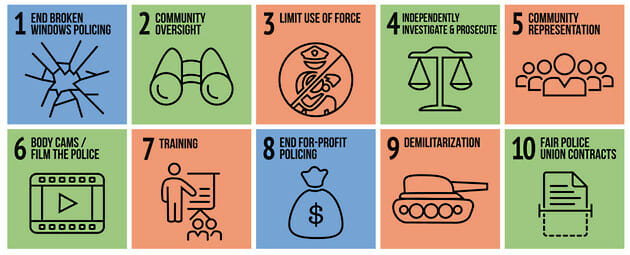
There is much to criticize in how the BLM movement operates, but I can get behind much of the plan they introduced last month.  I don't agree with all of it, but I seldom agree with all of any plan I see proposed from any side of the aisle.

blog_campaign_zero

In discussing the plan, Kevin Drum fails to address the elephant in the room for the Left in making progress on this, and that is the enormous reluctance of Democrats to challenge a public employee union.  And you can bet that police unions will likely be the biggest barrier to getting a lot of this done, even perhaps ahead of Conservative law-and-order groups (you can see the token sop thrown to unions in point 10 of the plan, but it ain't going to be enough).

By the way, there is much that progressive and conservative groups could learn from each other.  Conservative groups (outside of anti-abortion folks) are loath to pursue the public demonstration and disruption tactics that can sometimes be helpful in getting one's issues on the public agenda.  The flip side is that public disruption seems to be all BLM knows how to do.  It can't seem to get beyond disruption, including the unfathomable recent threat to disrupt an upcoming marathon in the Twin Cities.   It could learn a lot from Conservative and libertarian groups like ALEC, that focus on creating model legislation and local success stories that can be copied in other places.  Many of the steps in BLM's plan cry out of model legislation and successful pilots/examples.

Great Wealth is Bad Only When It Comes from Cronyism Instead of Creating Consumer Value

I book marked this long ago when I was in Europe and forgot to blog it.  From the Washington Post

You might be used to hearing criticisms of inequality, but economists actually debate this point. Some argue that inequality can propel growth: They say that since the rich are able to save the most, they can actually afford to finance more business activity, or that the kinds of taxes and redistributive programs that are typically used to spread out wealth are inefficient.

Other economists argue that inequality is a drag on growth. They say it prevents the poor from acquiring the collateral necessary to take out loans to start businesses, or get the education and training necessary for a dynamic economy. Others say inequality leads to political instability that can be economically damaging.

A new study that has been accepted by the Journal of Comparative Economics helps resolve this debate. Using an inventive new way to measure billionaire wealth, Sutirtha Bagchi of Villanova University and Jan Svejnar of Columbia University find that it’s not the level of inequality that matters for growth so much as the reason that inequality happened in the first place.

Specifically, when billionaires get their wealth because of political connections, that wealth inequality tends to drag on the broader economy, the study finds. But when billionaires get their wealth through the market — through business activities that are not related to the government — it does not.

Unintended Consequences, Libertarian Edition: How A Plea for Reduced Regulation Resulted in More Regulation

A few days ago, there was an article in our daily fishwrap that said something I found hard to believe.  It said that the state had initiated a crackdown on unlicensed shipments of wine from out of state at the behest of a letter from the Goldwater Institute.  It even had a picture (at least in the online edition) of Clint Bolick, Goldwater's chief of litigation.

Essentially, most states do not allow or severely restrict direct purchase by consumers of liquor products from out of state.  As usual for such protectionist stupidity, it is claimed to be for the children, but in fact mainly is meant to protect a small, very powerful group of liquor distributors who make a fortune from their state-granted monopoly on liquor wholesaling.  Basically, by some outdated post-prohibition laws, every drop of alcohol in the state must pass through the hands of a couple of companies, who of course extract their toll like Baron's of old with castles on the Rhine.

I simply found it unfathomable that Clint Bolick, a founder of the Institute for Justice (IC) for god sakes, would be pestering the state to more vigorously enforce stupid, outdated, and protectionist licensing laws.  And it turns out I was right.  

Clint Bolick, the Goldwater Institute’s director of litigation, said he sent the state a letter in November 2012 asking it to get rid of a rule that required customers to show up at certain wineries annually in order to get direct shipments to their homes.

Bolick’s letter, which he provided to The Republic and azcentral, said that rule made no sense and would stop Arizonans from joining wine clubs, where wineries send a designated amount of wine to customers each year, sometimes including wines not available to the general public.

“A requirement of annual presence also does not serve any obvious public purpose, given that the purchaser has established age and identity at the time of the order,” he wrote.

Bolick said he met with the director of the department at the time, Alan Everett, who told him the department would start a regulatory review.

So it turns out that Goldwater was trying to ease regulation and make it easier for consumers to have some choice and access to more suppliers.  All good.

But it turns out "regulatory review" means something different to a state regulator.  I suppose it was too much to think that they might have a review to see if their regulations went too far.  In fact, the "regulatory review" seems to have focused on how they could tighten regulations even further.  The result was not the one Goldwater hoped for ... instead of making things easier on consumers, the state went all-in trying to make things even worse for consumers.

Hill said Bolick's 2012 letter made the department question whether the wineries sending club shipments into Arizona were all licensed.

“It was the basis for us starting to ask questions about who is shipping liquor into the state of Arizona that does not hold an Arizona liquor license,” Hill said....

So far, the department has investigated 223 violations at a total of 199 wineries, according to records obtained through the Liquor Department’s website.

Additionally, somewhere between 250 and 300 wineries were found to have not filed their production reports. Once the department receives those, it could cause some or all of those to be found in violation. Some of those wineries, in order to comply with state liquor laws and have their cases closed, might also agree to not ship wine to Arizona.

Customers frustrated that they cannot get their wine shipped anymore are funding a renewed effort to change the state’s shipping laws. Two California-based groups, The Wine Institute and Free The Grapes, said they are work

It is clear that Goldwater, representing consumers, has very little influence on the state agency.  So who does?  Well, you have probably guessed:

Hill said last Thursday the crackdown came at the request of a member of the Arizona wine industry, saying it was an example of government and industry working together.

Ugh, what a happy thought -- government and industry working together to protect incumbents from competition and restrict consumer choice.

Arizona Near Last in Local Food Consumption -- Good!

Our local fishwrap laments:

The local food movement in Arizona needs just that – movement.

While some shoppers enjoy spending their Saturday mornings at local farmers markets, new research indicates Arizona lacks per-capita sales in the local food industry.

The 2015 Locavore Index found that of the 50 states and Washington, D.C., Arizona has the second lowest per-capita sales for local foods.

Here is a scoop for you:  We live in the middle of the freaking Sonoran desert.   It is a terrible place to grow most foods.  In fact, it is an environmentally awful place to grow food.   Local food folks somehow have gotten locked into transportation costs as the key driver of food sustainability that they want to focus on, but transportation costs are 10% or less of most food costs.  A small savings on transportation is absolutely dwarfed, from a productivity and resource use standpoint, by the productivity of the soil and the fit of the climate with whatever is being grown.

Here is one way to think of it -- yes, locally grown food may not have to be transported very far, but every drop of water for food grown here in the Phoenix area has to be brought hundreds of miles from declining reservoirs to grow that food.

The movement seems to imply that locally grown food is more healthy.  Why?  Why is an Arizona tomato healthier than a California tomato?

Finally, the micro-trade-protectionism is pretty funny:

If local Arizonans start buying more local food, the economy may benefit as well.

When buying local grown food, “the money stays here in the local economy, as opposed to buying something in a national chain,” said R.J. Johnson, a sales representative for Blue Sky Organic Farms in Litchfield Park. “You buy something locally, 75 percent of that money stays here in town.”

This is so economically ignorant as to be beyond belief.  If more people are growing food here locally (something that is likely a fairly unproductive task given our climate), what productive tasks are they giving up.  And this is a national effort -- are they really with a straight face telling every single state that they should buy more locally so their money stays at home?  Isn't that just one big zero sum game (actually a negative sum game because you lose benefits of specialization and comparative advantage).

Megan McArdle on "Washington Issues"

I thought this was a pretty good observation:

Why then, do so many people know about the tax treatment of carried interest? Because it is the epitome of a Washington Issue. A Washington Issue is something that sounds terrible, has little meaningful impact on more than a handful of people, and most importantly, allows you to pretend that you are addressing a different, very difficult issue that would impact a large number of people if you actually tried to make meaningful change -- people who might get angry and do something rash, such as voting for your opponent.

The carried interest issue is thus a convenient way for Democrats making stump speeches to claim that they’re really going to do something about inequality and cronyism, and maybe fund some important new spending on hard-working American families. With the entrance of Jeb Bush and Donald Trump into the arena, it is also a way for Republicans to seem tough on rich special interests while simultaneously proposing tax plans that will help affluent Americans hold on to a lot more of their income and wealth.

As with most Washington Issues, my actual level of concern about carried-interest taxation hovers somewhere between “neighbor’s bathroom grout drama” and “Menudo reunion tour.” Nonetheless, I’m beginning to wish that Congress would get rid of it without demanding anything in return, just to force politicians to talk about something that actually matters.

My tax proposal, as a reminder:

1.  Eliminate all deductions in the individual income tax code

2.  Eliminate the corporate income tax.

3.  Tax capital gains and dividends as regular income.

4.  Eliminate the death tax as well as the write-up of asset values at death

"It's Not Right To Make A Profit on Public Land"

The title of this post is based on the single most common complaint I get from government employees when trying to convince them to allow our company to operate their recreation sites.  Let me retell probably my favorite argument I ever had on this topic.  I will confess I cleaned up some of the verbiage in the retelling.  I will further observe that our company soon after mysteriously lost the bidding for the renewal contract, just about the only time we have ever lost such a renewal in over 40 bids.

 I was having a discussion with one of the many US Forest Service District Rangers who do not like having private for-profit companies operating on public lands, even if we save the taxpayer a lot of money by doing so.  He said to me, "It's not right to make a profit on public land."  I thought a minute and responded, "So you work for free?"

He looked at me confused, "What do you mean?"  

I said, "well, if you took a salary, you would be making a profit on public land, wouldn't you? "

He responded that "this was totally different -- a salary is not the same profit.  And besides, my salary is nothing like your huge profits."

I said, "Are you kidding?  My profits on this District are less than half your salary.  And you earn your salary whether visitors are happy or not.  Your salary is guaranteed and unless you are caught having sex with an eight-year-old on your desk, you probably have it until retirement.  My profit is never guaranteed -- I might make it or I might not.   And getting that profit requires investment of tens of thousands of dollars in trucks and such.  And if I don't do a good job, customers stop showing up and I don't make any money at all."

He responded, "but your profits just add cost.  A non-profit doing the same thing, or the government doing the same thing, would save that money."

I said in turn, "that is incredibly naive.   What I do is operate efficiently and at low costs.  So a non-profit or the government does NOT do the same thing, because without the incentive to make a profit they don't operate anywhere near as cost-effectively.  I have never seen an example where the government could operate for less than twice my costs.  So our company can save half the costs of operating the park, which dwarfs the size of my 5% profit margin.  The savings I produce are 20 times my profit -- if anything, I am grossly underpaid.

The New Rich -- Living the High Life Through Your Non-Profit

Several months ago, a lot of folks where shocked to find that the Clinton Foundation only spent $9 million in direct aid out of a total budget of $150 million, with the rest going to salaries and bonuses and luxury travel for family and friends and other members of the Clinton posse.

None of this surprised me.  From my time at Ivy League schools, I know any number of kids from rich families that work for some sort of trust or non-profit that has nominally charitable goals, but most of whose budget seems to go to lavish parties, first-class travel, and sinecures for various wealthy family scions.

But this week comes a story from the climate world that demonstrates that making a fortune from your non-profit is not just for the old money any more -- it appears to be a great way for activists to build new fortunes.

The story starts with the abhorrent letter by 20 university professors urging President Obama to use the RICO statute (usually thought of as a tool to fight organized crime) to jail people who disagree with them in a scientific debate.  The letter was authored by Jagadish Shukla of George Mason University, and seems to take the position that all climate skeptics are part of an organized coordinated gang that are actively promoting ideas they know to be wrong solely for financial enrichment. (I will give the near-universal skeptic reply to this:  "So where is my Exxon check?!"

Anyway, a couple of folks, including Roger Pielke, Jr. and Steve McIntyre, both folks who get accused of being oil industry funded but who in fact get little or no funding from any such source, wondered where  Shukla's funding comes from.   Shukla gets what looks like a very generous salary from George Mason University of $314,000 a year.  Power to him on that score.  However, the more interesting part is where he makes the rest of his money, because it turns out his university salary is well under half his total income.  The "non-profits" he controls pays him, his family, and his friends over $800,000 a year in compensation, all paid out of government grants that supposedly are to support science.

A number of years ago Shukla created a couple of non-profits called the Institute for Global Environment and Security (IGES) and the Center for Ocean Land Atmosphere Interactions (COLA).  Both were founded by Shukla and are essentially controlled by him, though both now have some sort of institutional relationship with George Mason University as well.  Steve McIntyre has the whole story in its various details.

COLA and IGES both seem to have gotten most of their revenues from NSF, NASA, and NOAA grants.    Over the years, the IGES appears to have collected over $75 million in grants.  As an aside, this single set of grants to one tiny, you-never-even-heard-of-it climate non-profit is very likely way higher than the cumulative sum total of all money ever paid to skeptics.   I have always thought that warmists freaking out over the trivial sums of money going to skeptics is a bit like a football coach who is winning 97-0 freaking out in anger over the other team finally picking up a first down.

Apparently a LOT of this non-profit grant money ends up in the Shukla family bank accounts.

In 2001, the earliest year thus far publicly available, in 2001, in addition to his university salary (not yet available, but presumably about $125,000), Shukla and his wife received a further $214,496  in compensation from IGES (Shukla -$128,796; Anne Shukla – $85,700).  Their combined compensation from IGES doubled over the next two years to approximately $400,000 (additional to Shukla’s university salary of say $130,000), for combined compensation of about $530,000 by 2004.

Shukla’s university salary increased dramatically over the decade reaching $250,866 by 2013 and $314,000 by 2014.  (In this latter year, Shukla was paid much more than Ed Wegman, a George Mason professor of similar seniority). Meanwhile, despite the apparent transition of IGES to George Mason, the income of the Shuklas from IGES continued to increase, reaching $547,000 by 2013.

Grant records are a real mess but it looks like from George Mason University press releases that IGES and its successor recently got a $10 million five-year grant, or $2 million a year from the government.  Of that money:

  • approximately $550,000 a year goes to Shukla and his wife as salaries
  • some amount, perhaps $90,000 a year, goes to Shukla's daughter as salary
  • $171,000 a year goes as salary to James Kinter, an associate of Shukla at George Mason
  • An unknown amount goes for Shukla's expenses, for example travel.  When was the last time you ever heard of a climate conference, or any NGO conference, being held at, say, the Dallas-Ft Worth Airport Marriott?  No, because these conferences are really meant as paid vacation opportunities as taxpayer expense for non-profit executives.

I don't think it would be too much of a stretch, if one includes travel and personal expenses paid, that half the government grants to this non-profit are going to support the lifestyle of Shukla and his friends and family.  Note this is not money for Shukla's research or lab, this is money paid to him personally.

Progressives always like to point out examples of corruption in for-profit companies, and certainly those exist.  But there are numerous market and legal checks that bring accountability for such corruption.  But nothing of the sort exists in the non-profit world.  Not only are there few accountability mechanisms, but most of these non-profits are very good at using their stated good intentions as a shield from scrutiny -- "How can you accuse us of corruption, we are doing such important work!"

Postscript:  Oddly, another form of this non-profit scam exists in my industry.  As a reminder, my company privately operates public recreation areas.  Several folks have tried to set up what I call for-profit non-profits.  An individual will create a non-profit, and then pay themselves some salary that is equal to or even greater than the profits they would get as an owner.  They are not avoiding taxes -- they still have to pay taxes on that salary just like I have to pay taxes (at the same individual tax rates) on my pass-through profits.

What they are seeking are two advantages:

  • They are hoping to avoid some expensive labor law.  In most cases, these folks over-estimate how much a non-profit shell shelters them from labor law, but there are certain regulations (like the new regulations by the Obama Administration that force junior managers to be paid by the hour rather than be salaried) that do apply differently or not at all to a non-profit.
  • They are seeking to take advantage of a bias among many government employees, specifically that these government employees are skeptical of, or even despise, for-profit private enterprise.  As a result, when seeking to outsource certain operations on public lands, some individual decision-makers in government will have a preference for giving the contract to a nominal non-profit.   In California, there is even legislation that gives this bias a force of law, opening certain government contracting opportunities only to non-profits and not for-profits.

The latter can have hilarious results.  There is one non-profit I know of that is a total dodge, but the "owner" is really good at piously talking about his organization being "cleaner" because it is a non-profit, while all the while paying himself a salary higher than my last year's profits.