Thoughts on the Fourth of July

I was going to write a Fourth of July post, but it kept looking like my past Memorial Day effort, so, since I am in France and ready to go consume more food, I will take a shortcut this holiday:

Every Memorial Day, I am assaulted with various quotes from people
thanking the military for fighting and dying for our right to vote.  I
would bet that a depressing number of people in this country, when
asked what their most important freedom was, or what made America
great, would answer "the right to vote."

Now, don't get me wrong, the right to vote in a representative
democracy is great and has proven a moderately effective (but not
perfect) check on creeping statism.  A democracy, however, in and of
itself can still be tyrannical.  After all, Hitler was voted into power
in Germany, and without checks, majorities in a democracy would be free
to vote away anything it wanted from the minority - their property,
their liberty, even their life.   Even in the US, majorities vote to curtail the rights of minorities all the time, even when those minorities are not impinging on anyone else.  In the US today, 51% of the population have voted to take money and property of the other 49%.

In my mind, there are at least three founding principles of the
United States that are far more important than the right to vote:

  • The Rule of Law.  For about 99% of human
    history, political power has been exercised at the unchecked capricious
    whim of a few individuals.  The great innovation of western countries
    like the US, and before it England and the Netherlands, has been to
    subjugate the power of individuals to the rule of law.  Criminal
    justice, adjudication of disputes, contracts, etc. all operate based on
    a set of laws known to all in advance.

Today the rule of law actually faces a number of threats in this
country.  One of the most important aspects of the rule of law is that
legality (and illegality) can be objectively determined in a repeatable
manner from written and well-understood rules.  Unfortunately, the
massive regulatory and tax code structure in this country have created
a set of rules that are subject to change and interpretation constantly at
the whim of the regulatory body.  Every day, hundreds of people and
companies find themselves facing penalties due to an arbitrary
interpretation of obscure regulations (examples I have seen personally here).

  • Sanctity and Protection of Individual Rights.
    Laws, though, can be changed.  In a democracy, with a strong rule of
    law, we could still legally pass a law that said, say, that no one is
    allowed to criticize or hurt the feelings of a white person.  What
    prevents such laws from getting passed (except at major universities)
    is a protection of freedom of speech, or, more broadly, a recognition
    that individuals have certain rights that no law or vote may take
    away.  These rights are typically outlined in a Constitution, but are
    not worth the paper they are written on unless a society has the desire
    and will, not to mention the political processes in place, to protect
    these rights and make the Constitution real.   

Today,
even in the US, we do a pretty mixed job of protecting individual
rights, strongly protecting some (like free speech) while letting
others, such as property rights or freedom of association, slide. 

  • Government is our servant.
    The central, really very new concept on which this country was founded
    is that an individual's rights do not flow from government, but are
    inherent to man.  That government in fact only makes sense to the
    extent that it is our servant in the defense of our rights, rather than
    as the vessel from which these rights grudgingly flow.

Statists
of all stripes have tried to challenge this assumption over the last
100 years.   While their exact details have varied, every statist has
tried to create some larger entity to which the individual should be
subjugated:  the Proletariat, the common good, God, the master race.
They all hold in common that the government's job is to sacrifice one
group to another.  A common approach among modern statists is to create
a myriad of new non-rights to dilute and replace our fundamental rights
as individuals.  These new non-rights, such as the "right" to health
care, a job, education, or even recreation, for god sakes, are
meaningless in a free society, as they can't exist unless one
person is harnessed involuntarily to provide them to another person.
These non-rights are the exact opposite of freedom, and in fact require
enslavement and sacrifice of one group to another.

Don't believe that this is what statists are working for? The other day I saw this quote from the increasingly insane Lou Dobbs (Did you ever suspect that Lou got pulled into a room a while back by some strange power broker as did Howard Beale in Network?):

Our population explosion not only detracts from our quality of life but
threatens our liberties and freedom as well. As Cornell's Pimentel puts
it, "Back when we had, say, 100 million people in the U.S., when I
voted, I was one of 100 million people. Today, I am one of 285 million
people, so my vote and impact decreases with the increase in the
population." Pimentel adds, "So our freedoms also go down the drain."

What??
In a society with a rule of law protecting individual rights, how does
having a diluted vote reduce your freedom?  The only way it does, and therefore what must be in the author's head, is if
one looks at government as a statist tug of war, with various parties
jockeying for a majority so they can plunder the minority.  But in this
case, freedom and rule of law are already dead, so what does a
dilution of vote matter?  He is arguing that dilution of political
power reduces freedom -- this country was rightly founded on just the
opposite notion, that freedom requires a dilution of political power.

At the end of the day, our freedoms in this country will only last
so long as we as a nation continue to hold to the principle that our
rights as individuals are our own, and the government's job is to
protect them, not to ration them.  Without this common belief, all the
other institutions we have discussed, from voting to the rule of law to
the Constitution, can be subverted in time.

So to America's soldiers, thank you.  Thank you for protecting this
fragile and historically unique notion that men and women own
themselves and their lives.

Rollover!

Sometime when I was over the Atlantic, we passed 100,000 visitors since I started counting last December.  Thanks to all my readers!

Random Impressions of Paris

After a couple of days here, some impressions:

  • The airline flights that dump you off in Europe at 7am which seemed so convivial when I was consulting are less so when I am a tourist.  We had the experience of arriving at our hotel about 8am, which of course did not yet have a room anywhere near ready.  We had a nice day walking around, but we sure were exhausted by the time we got to our room and had a nap.  Note:  American Airlines 767's have very very uncomfortable business class seats - really a disgrace nowadays.
  • The Louvre is magnificent, but is ridiculously big.  It is impossible to digest.  You really have to find a branch of art, like the Flemish painters, and stay in that area.  The Musee d'Orsay, which focuses on 19th century French art, is much more digestible.  Also, it has a cool location in a train station, which was a very important part of 19th century life.
  • The French smoking thing has been joked about so much it is almost a caricature, but it is still a shock the first time in a restaurant.  We observed many American smokers reveling in their smoking freedom.  I wonder if there is a business opportunity to sponsor smoking trips to Paris, much like those Asia sex trips to Thailand.
  • Wow, the food is expensive!  $50-80 entrees in some places, and for that you can get two slices of tenderloin.  It was good though, and we have yet to have a bad, or even so-so, meal.
  • I would feel safer in a golf cart than some of the cars here.  You can really see the trade-offs with fuel economy we make in the US by having crash test standards.  Over here with no crash tests and $6.00 gas, you get lots of tiny cars.  Mini-coopers look average to large-sized here.
  • The Champs d'elysees was amazing on Sunday afternoon - a sea of people going up the hill.  It looked like those pictures of the start of the NY marathon, but it went as far as the eye can see.  Amazingly, with all this foot traffic past the door, half the businesses were closed that day (welcome to Europe, I guess)
  • There are more shoe stores here than fast food restaurants in Phoenix.  And my wife has stopped in every one of them

Headed off to Paris

I am headed off to Paris this weekend, so blogging may be light the next few days.  I am going to try to blog from France, and try to get a sense for the issues being discussed there post-referendum.  In the mean time, I will leave you with this heartwarming scene from Team America: World Police.

Teamamericaparis

I thought the movie was very funny, though if you don't like South Park-type humor, don't even bother.  I still can't get the Team America theme song out of my head, or at least the main refrain that goes

America... Fuck Yeah!

If I had a baseball team, I would play that at the 7th inning stretch.

Problems at the Nature Conservancy

I tend to divide up environmental regulations into two buckets:

  1. Regulations aimed at curbing emissions that spill out of one person's property (e.g by air or water) to others
  2. Regulations mainly aimed at land use restrictions that affect how someone may use their own land

The first type of law is essential to rational functioning of strong property rights in the modern world.  Otherwise, we would all be suing each other over molecules of pollution that cross our property lines.

The second category, including wetlands and open space and habitat protection, are a threat to property rights (something one could infer just from the fact that many anti-capitalist anti-technology leftists have jumped on the environmental bandwagon, mainly focusing on this second category of limitations).

Here is one of those situations that make me a true minority in this country:  I greatly value wide-open undeveloped spaces and ranges for wild animals, but I don't expect the government to provide them for me nor do I ask other citizens to provide them to me against their will.  Unfortunately, most of the other people in this country who value these things do in fact accept, and even demand, that government provide them.  Every day, landholders are told by various government bodies that they cannot do what they like with their land, because other people who do not own the land like the land the way it is.  These landholders are effectively expropriated of their land, in these cases without even the payment the New London Kelo victims received

This is why I have always supported the private land trust movement, of which the Nature Conservancy is the most well-known example.  These land trusts use private donations to buy out property owners and set aside property for various conservation purposes.  This way, the people who value the conservation of the land pay the price for it, not the person who happens to be owning the targeted land.

I was sad to see, therefore, the Nature Conservancy revealed in Senate hearings as having a number of ethical lapses.  , was all over this story.  They describe the problems found as follows:

*A pattern of dealings with insiders that gave preferential treatment on land deals.

*A pattern of dealings with the companies of board members

*Selling emissions credits, including a $10 million deal with General
Motors while GM's chairman John Smith served on TNC's board.

*Selling emissions credits that it may or may not have even owned,
essentially furthering its own environmental goals (buying land) at the
expense of another environmental goal (reducing greenhouse gases)

*Allowing oil and gas drilling on one of three known habitats of the
Attwater Prairie chicken, bumbling its way through the deal so that it
ended up in court, accused of cheating one of its partners, all while
pocketing over $8 million in royalties.

The report paints a picture
of an organization that had gotten so big, and so successful, that it
lost sight of why it was formed in the first place.

There is a lot of discussion about what reforms will help prevent this problem, and a lot of discussion about eliminating the tax deduction for conservation easements:

It has become clear that some people have been abusing the law that
allows tax deductions for conservation easements. The easement
deduction allows me to sell the development rights to my property to a
land trust. I keep the property the way it is, and everyone who buys it
from me agrees to keep it that way too. If it's wilderness, it stays
wilderness. If it's a ranch, it stays a ranch. In areas with lots of
development, that can be worth a ton of money. The big question, how
much? It's a subjective appraisal, and if both parties want to unfairly
jack up the value, the hearings have shown the IRS doesn't have the
manpower to catch it. And it's led to a cottage industry in easement
tax shelters, including millions of exemptions for golf courses,
driving ranges and backyards. Phony trusts were set up not to protect
land, but to act as tax shelters for the wealthy. As the facts come
out, it's outraging critics, and depressing supporters.

In these deals, one party keeps the land while another party. like TNC, buys the "development rights" and pays the legal bills over time to defend these rights.  Personally, I have not been a big fan of conservation easements.  "Forever" is a very long time, and there are always going to be incentives to cheat -- if not in this generation, then in the next.  Also, such "conditional" property makes me nervous, somehow splitting property rights into two pieces, like a treasury strip.  I can't say I can make a firm philosophic argument against it, but it makes me uneasy. 

I would much prefer land trusts like TNC to forget about being enablers for conservation easements and get back to their original mission - buying land outright for conservation purposes.  By buying it outright, you get away from all the problems of policing private land use of the easements an organization has taken on.

I have decided to continue to donate to the Nature Conservancy.  They do a lot of cool stuff, and philosophically I much rather spend my money to have property purchased for conservation rather than to lobby Congress to force someone to conserve at the point of a gun.  I just hope TNC can get its act together so it can continue to provide a viable private alternative to government coercion.

Anyone Remember the Eighties?

One of the worst parts about living through the eighties was listening to all the angst about Japanese companies "buying America".  I never really understood the issue that people had with foreigners buying American assets (beyond pure xenophobia).  It was all especially puzzling because most of the wailing came from people who are today wailing about American outsourcing.  So its bad when American companies buy productive assets in other countries AND its bad when foreigners buy productive assets in this country?

Anyway, I missed it the first time around, but apparently Paul Krugman is upset that a Chinese company might buy Unocal.  Here are his reasons for concern:

Yet there are two reasons that Chinese investment in America seems different
from Japanese investment 15 years ago.

One difference is that, judging from early indications, the Chinese won't
squander their money as badly as the Japanese did....

The more important difference from Japan's investment is that China, unlike
Japan, really does seem to be emerging as America's strategic rival and a
competitor for scarce resources - which makes last week's other big Chinese
offer more than just a business proposition.

His first is just laugh out loud funny.  We actually have an economist claiming that the world was better in the 1980's because there was a huge market inefficiency (ie, the Japanese overpaid for unproductive assets). 

His second argument seems to be that US supplies of oil are more secure if American companies own them.  This is stupid.  If he means that it is more secure economically, then he should have his economist merit badge taken away for life.  Even he must know that oil is a fungible commodity, and as such trades world wide at a price set by supply and demand.  If more of Unocal's oil goes to China, this replaces other oil coming from somewhere else that is now available on the market.  And, if he means it is safer politically, he forgot to study the last 50 years of history.  Every major oil producer of the world - Saudi Arabia, Mexico, Venezuela, etc are pumping oil that used to belong to American oil companies, but was nationalized and taken from them.  Does Mr. Krugman's statement mean that the left and the NY Times are suddenly more ready to support the property rights of American oil companies overseas? I doubt it.  It is actually an improvement over history that a totalitarian state like China is actually buying American oil assets rather than just expropriating them.

By the way, I call Mr. Krugman's view of national economic success the "monopoly board" view of the world.  In his mind, America and China are playing monopoly, and once China gets St. James Place, America can never own all the oranges.  This is not the way the world works.  When America grew economically in the last century, it did not mean that all the other countries had less opportunity to grow.  In fact, we pulled many countries along with us.  His zero-sum view is just the macroscopic counterpart to the zero-sum based worry about rich people getting richer in this country.

Marginal Revolution and Cafe Hayek both have good analyses of Paul Krugman's neo-mercantilism.

Postscript:  Gee, I hate to play the race card, but why is it we always get a national panic when it is China or Japan buying US assets and not when it is the Dutch, the English or the Canadians (who are far larger investors in US assets and companies than the Chinese)?

Memo to Typepad

After 6 months, I still think TypePad is the best tool out there to quickly start your own blog.  However, and I know this point has been made before, but could you guys please add variations of the word "blogger" and conjugations of the verb "blog" to your spell check dictionary.  Thanks

Giving Citizens "Premium" Rights

In a previous post, I expressed my frustration with the argument over blogs and campaign finance rules:

These past few weeks, we have been debating whether this media
exemption from speech restrictions should be extended to bloggers.  At
first, I was in favorThen I was torn.
Now, I am pissed.  The more I think of it, it is insane that we are
creating a 2-tiered system of first amendment rights at all, and I
really don't care any more who is in which tier....

I
have come to the conclusion that arguing over who gets the media
exemption is like arguing about whether a Native American in 1960's
Alabama should use the white or the colored-only bathroom:  It is an
obscene discussion and is missing the whole point, that the facilities
shouldn't be segregated in the first place.

Currently, in the wake of the recent Supreme Court decision ruling against a Constitutional journalistic privilege to withhold evidence from prosecutors.  Glenn Reynolds has a nice editorial in the USA Today echoing the point that we should not:

claims of privilege turn the press into a
privileged class. If ordinary people witness a crime, they have to talk
about it. If they participate in a crime "” say, by receiving classified
documents "” they have to say where they got them. Journalists want to
be treated differently, but the First Amendment doesn't create that
sort of privilege. Nor should we.

Many people who support these privileges say
that they would be limited to "real" journalists. But who decides when
a journalist is real? If the government decides, isn't that like
licensing the press, something the First Amendment was designed to
prevent? And if journalists decide, isn't that likely to lead to a
closed-shop, guild mentality at exactly the moment when citizen
journalism by non-professionals is taking off? All sorts of people are
reporting news via Web logs and the Internet. Shouldn't they be
entitled to the same privilege?

Press freedom is for everyone, not just professionals. James Madison wrote about "freedom in the use
of the press," making clear that the First Amendment is for everyone
who publishes, not just members of the professional-media guild.

Yes!  It is ridiculous to be creating two classes of citizen.  Why should Giraldo Rivera have different or even enhanced rights over, say, Martha Stewart, who went to jail for not being forthright with investigators?  This is a very disturbing trend in this country.  Already in the last week, the Supreme Court has ruled that developers, Walmarts, and Crate & Barrells have more and different property rights than homeowners, churches, and small retail establishments.

Maybe Raich Lets Congress Fix Kelo

I wrote before that I thought the definition of interstate commerce in Raich was crazy, but maybe there is an upside.  Under this ridiculously broad definition of interstate commerce (where growing marijuana in your backyard for persona consumption was called interstate commerce), couldn't a real estate development with tenants who are multi-state corporations also qualify?

To this end, Eugene Volokh writes that Congress is already considering legislation to control eminent domain for private development in the aftermath of Kelo:

Sen. Cornyn (R-TX) Proposes Limits on Eminent Domain:

Sen. Cornyn is introducing a federal bill (S. 1313, "The Protection of Homes, Small Businesses, and Private Property Act of 2005") that would bar "economic development" takings:

(a) . . .  The power of eminent domain shall be available only for public use.

(b) . . .  In this Act, the term "public use" shall not be construed to include economic development.

(c) . . . This act shall apply to (1) all exercises of eminent
domain power by the Federal Government; and (2) all exercises of
eminent domain power by State and local government through the use of
Federal funds.

Part C is in there to help it pass constitutional muster, but maybe Raich makes this unnecessary.

PS- I am mostly kidding here - I in no way want to condone Raich.

What Climate Change Intevenionists Need to Prove

Advocates for radical government intervention to halt climate change claim that they have "proven" the case for limitations on CO2 emissions beyond the doubt of anyone except contemptible corporate greed-hounds.  As Todd Zwycki quotes Ellen Goodman:

The climate is equally apparent in the struggle over what the Bush
administration calls "climate change" "” and everyone else calls global warming.
The only way to justify doing nothing about global warming now is to
deliberately muddle the science.
It's not an accident that Philip Cooney,
the White House official caught editing reports on greenhouse gases, left for
Exxon Mobil, which has indeed funded doubts.

I have written on the burden of proof that is needed to justify Kyoto-like interventions a number of times, most recently here.  This is what I think has been "proven" sufficiently well.

  1. Proven: Man-made CO2 has increased the concentration of CO2 in the atmosphere (best evidence from ice cores and samplings in Hawaii)
  2. Proven:  Temperatures in the world have risen since 1900. (though perhaps less than typicaly reported due to under-correction for urban heat-island effects).
  3. Proven:  The temperature rise in the first half of the 1900's was not man-made, having occured before substantial man-made CO2 production, and therefore is attributable to some other (disputed and/or unknown) effect.

Here is what is still in doubt, with no consensus:

  1. In Dispute:  How much of the world temperature rise since 1950 was due to man-made CO2 output?   Some unknown phenomena caused a pre-1950 rise, leaving open the question of how much this other phenomena raised temperatures in the latter half of the 1900's and how much was due to man-made CO2.
  2. In Dispute:  How much will the world's temperature rise in the future due to man-made CO2?  Climate is a complex animal, and no honest thinking climate scientist believes they have the right model yet, particularly since none of the most-used models explains history very well.  Also, beyond climate, the economic models that drive CO2 levels in the climate model are hugely flawed, causing the models to way over-estimate man-made CO2 production.
  3. In Dispute:  What are the positives and negatives of global warming for humans?  The negatives are dealt with all too casually, in the sort of unproven scare story day-after-tomorrow unscientific approach that makes good NY Times Sunday Edition reading but does little to introduce any facts.  The positives are never, ever mentioned. "Disinterested" climate scientists never mention that some parts of the world will benefit, in terms of longer growing seasons, or that most of the warming will occur in winter nights in the coldest regions, where warming would be welcome.  Its almost as if they weren't disinterested and had an interest in the answer coming out a certain way.

Wait, we are not done yet.  There is one critical questions that is never even addressed by global warming advocates:

  1. Not Even Addressed:  How do the costs of limiting CO2 emissions, including decreased economic growth and increased poverty, stand up against the dangers?  No one has done a good study of this, though people like Bjorn Lomburg have argued that the cost-benefit is much worse than solving some of the world's other problems.

Basically, the philosophy of environmentalists is that if man changed the world, its worth any cost to reverse it.  Sorry, but this is not sufficient evidence to trash the world economy with new taxes and output restrictions. 

Todd Zwycki, in the article linked above, has a nice analysis:

So the real question to ask here is whether on net, the costs of doing
something about global climate change outweigh the benefits of doing it. This is
the same question we ask (or should ask) about every other intervention into
nature--should we kill the parasites in water so that we can drink it, should we
drain a mosquito-infested swamp to eliminate the risk of malaria, should we
provide a vaccine to kill naturally-occurring smallpox. To imply that if the
science shows we are changing the climate we must do something about it is as
wrongheaded as it would be to say that if we are not contributing to global
warming we should not do anything about it.

On the question of whether global warming would be a net benefit or detriment
to the planet, the evidence I have seen to date suggests that it is
inconclusive. There will be impacts on crop yields, growing locations, forests,
energy consumption, etc., that cut in many different directions. The question of
whether the warming will occur equally throughout the world, or whether it will
occur more strongly in the coldest parts of the world appears to also be
unsettled, and has powerful normative implications for policy. To get bogged
down in the science, and especially in causal questions, seems to me to be
largely beside the point.

Alice Cooper

Arthur Cherenkoff and Glenn Reynolds seemed surprised that aging shock-rocker Alice Cooper had some sensible opinions on foreign policy issues.  Those of us who live in the Phoenix area, however, are not.  Oddly enough, Alice Cooper has become something of an elder statesman in Phoenix, keeping a fairly high profile leading various community and charity events.  Its a little odd living in a town where your most visible community leaders include Alice Cooper and Charles Barkley, especially given the area's attraction to many of the rich and famous as a retirement location, but it seems to work.

One story that comes to mind:  Alice Cooper is a regular at Suns games.  A couple of years ago, my company had some nice season tickets just a few rows up from Mr. Cooper, who had seats in the first row on an aisle.  Just about every game I attended, at least one pair of guys would come down the steps, kneel on the floor next to Alice's seat, and bow down saying "We're not worthy" ala Wayne's World and then head back up the aisle without another word.  Always made me laugh.

Libertarians are Generally Not Moderate

Today, as linked by Hit and Run, the Washingtonian lists a number of blogs that are popular with journalists.  I have no particular problem with the list -- I read many of the same blogs myself.  However, this description of the libertarian blog at Reasons's Hit and Run struck me as odd (emphasis added):

The libertarians behind Reason magazine strike back with
moderate commentary on a variety of topics ranging from public
television to Gwen Stefani's "Hollaback Girl."

I am not sure that many Republicans or Democrats would consider Reason to be moderate.  Its hard to believe that any of us anarcho-capitalist make-government-and-taxes-go-away libertarians would ever be confused with moderates.  Reason has in the last month taken stands against the drug war, against any government intervention into property rights, against the Patriot act, in defense of steroid use, and favoring legalization of prostitution and continued legality of pornography.  Not many red-staters or blue-staters would call that moderate.  It may be consistent, in that it is against statism and for the primacy of individual decision-making, but libertarianism tends to be extreme and uncompromising in these views.  And, while most libertarians are not moderate, most moderates are not libertarians -- those who generally call themselves moderate tend to do so because they pick and choose bits of statism from both political parties. 

But there is an explanation for the word "moderate", and it goes back to the crappy civics lessons we all have gotten.  As I wrote before, those civics lessons were the statist's wet-dream, portraying the range of political thought on a linear scale from socialism on the left to fascism on the right.  In other words, our political choices are defined as running from statist control to... statist control.  In this framework, anyone who is not a commie or a Nazi are put somewhere in the middle, which has been shorthanded "moderates".

This is obviously a stupid framework, and breaks down when libertarians come into the picture.  More modern self-assessment frameworks use grids of at least two dimensions, with at least one dimension being the degree (from none to total) that one accepts state authority over the individual.

Update:  Oops, I missed the fact that some of the Reason writers themselves had much the same reaction

Houses Taken Away and Given to Crate & Barrel

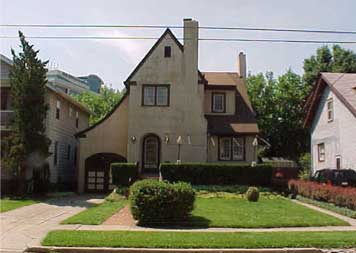
Before you read any further, look at the houses here.  Here is an example:

Picture9

They look like normal, everyday Midwestern houses, right?  I mean, some are kind of small but several look pretty nice and all of them are in good shape with well-kept lawns, etc.

So what do these houses have in common?  They have all been condemned as "blighted" by Norwood, Ohio.  They have been seized from their owners by the city government and now, thanks to the Supreme Court's disastrous Kelo decision, they will be torn down.

OK, what's the real reason?  The real reason is that Norwood, Ohio wants a Crate & Barrel store where these houses are.  They think the Crate & Barrel is a better use of the land, and they are pretty sure that C&B will pay them more taxes than these homeowners, so they are taking people's homes and giving the land to the developer.  More here and here on this story, and Cato has a whole bunch of articles on abuse of the Constitution's takings clause here.  And you can find my Kelo articles here, here, and here.

Time to Thaw Relations With Cuba

First, a couple of disclaimers:  The human rights situation in Cuba still sucks, and Castro still is a reprehensible leader.

That all being said, its time to try a different policy vis a vis Cuba.  While the strict embargo of all things and all people back and forth to Cuba may well have been appropriate in the 1960's to make sure Cuba and the world understood our displeasure with Castro, its not working for us now.  Forty-five or so years later, nothing has really changed in Cuba.  Heck, that's more years than the Cold War with Russia lasted.  And, since the economic blockade has become pretty much unilateral, with the US about the only country in the world still observing it, its hard to see Castro throwing up the white flag any time soon.

The US has made its point -- we think Castro is a brutal totalitarian.  Castro has made his point -- Cuba is not going to fall based on US economic pressure.  Its time to try engagement.  This does not mean that the US sanction the human rights situation in Cuba.  It does mean that we acknowledge that engagement with western ideas through trade and commerce have done more to liberalize countries like China, India, and southeast Asia than any other policy we have tried.

Fareed Zakaria has a nice article in the International Edition of Newsweek advocating just this approach, not just in Cuba, but all over the world:

For almost five decades the United States has
put in place a series of costly policies designed to force Cuba to
dismantle its communist system. These policies have failed totally.
Contrast this with Vietnam, also communist, where Washington has
adopted a different approach, normalizing relations with its former
enemy. While Vietnam remains a Leninist regime in many ways, it has
opened up its society, and the government has loosened its grip on
power, certainly far more than that of Fidel Castro. For the average
person in Libya or Vietnam, American policy has improved his or her
life and life chances. For the average person in Iran or Cuba, U.S.
policy has produced decades of isolation and economic hardship.

Don't
get me wrong. I think the regimes in Tehran and Havana are ugly and
deserve to pass into the night. But do our policies actually make that
more likely? Washington has a simple solution to most governments it
doesn't like: isolate them, slap sanctions on them and wait for their
downfall....

Critics could argue that I'm forgetting the many surprising places
where regimes have fallen and freedom has been given a chance to
flourish. Who would have predicted that Ukraine, Georgia and Kyrgyzstan
would see so much change in the past year and a half? But these
examples only prove my point. The United States had no "regime change"
policy toward any of these countries, and it had relations with all of
them. In fact, these relationships helped push the regimes to change
and emboldened civil-society groups.

Ah, you might say, but these regimes were not truly evil. Well, what
about Mao's China at the height of the Cultural Revolution? Nixon and
Kissinger opened relations with what was arguably the most brutal
regime in the world at the time. And as a consequence of that opening,
China today is far more free"”economically and socially"”than it has ever
been. If we were trying to help the Chinese people, would isolation
have been a better policy?

For years I think we feared to normalize relations with Cuba because we were afraid of looking weak;  however, today, after kicking regimes out of Afghanistan and Iraq and threatening four or five others, I am not sure this is a concern.  Besides, we are normalizing relations with Vietnam, who we actually fought a war against and who are at least as bad at human rights as Cuba. 

I fear that what may be preventing a new policy with Cuba is the electoral college.  Or, more specifically, the crucial status of Florida as a tightly-contested presidential election swing state and the perception (reality?) that there is a large high-profile Cuban population in Florida that opposes normalization, at least as long as Castro can still fog a mirror.


June, 2006: The Follow-on Case to Kelo

Today, on the final day of their 2006 term, the Supreme Court ruled in the Olek vs. New London case:

Washington --  The Supreme Court on Thursday ruled that
local governments may seize people's advertising space -- even
against their will -- for alternate advertisers who promote economic development or higher taxes

It
was a decision fraught with huge implications for a country with many
areas, particularly the rapidly growing urban and suburban areas,
facing countervailing pressures of government budget deficits and free speech
rights.

The 5-4 ruling represented a defeat for some Connecticut
residents whose advertisements in the local paper against recent property tax hikes were rejected by the city council in favor of ads for several pro-taxation groups.

As a result, cities have wide power to replace advertising that might favor lower taxes or oppose certain community projects with messages more in the public interest.

Local officials, not federal judges, know best in
deciding whether speech will benefit the community,
justices said.

"The city has carefully formulated an economic
development that it believes will provide appreciable benefits to the
community, including -- but by no means limited to -- new jobs and
increased tax revenue," Justice John Paul Stevens wrote for the
majority.  "We established in Kelo that local governments have broad power to seize property when that seizure serves to maximize taxation, and certainly this applies equally well to unwanted advertising that might work against maximizing tax revenues."

He was joined by Justice Anthony Kennedy, David H. Souter, Ruth Bader Ginsburg and Stephen G. Breyer.

At
issue was the scope of the Fifth Amendment, which allows governments to
take private property through eminent domain if the property is for "public
use."  The majority observed that using advertising space in favor, rather than against, public policy certainly qualified as "public use".

Fred Olek and several other homeowners in a
working-class neighborhood in New London, Connecticut, filed suit after
city officials announced plans to remove their newspaper advertisements opposing the upcoming ballot initiative to raise property taxes.

New London officials countered
that the tax initiative served a public purpose of boosting
economic growth that outweighed the homeowners' speech rights, even
if the area wasn't located in North Korea or Cuba.

Justice Sandra Day O'Connor, who has
been a key swing vote on many cases before the court, issued a stinging
dissent. She argued that "This makes me so mad, I could, I could... aw, forget it.  I'm retiring this year to a Pacific island anyway, so y'all are free to screw up this country as much as you want".

Justice Scalia wrote a separate dissent, making the argument that "I have no problem with government limitations on speech per se, but given the fact that 3 readers of this paper lived out of state, such powers per Raich reside with Federal and not local authorities"

Local authorities were careful to point out that Olek was fully compensated at market rates for the removed advertising.  Olek shot back that he was in no way compensated for his loss of free speech rights or participation in the democratic process.  Justices in the majority were unpersuaded by Olek's argument, however, pointing out that in Kelo, the homeowners were in no way compensated for their emotional attachment to their homes nor for their loss of the right to dispose of their property as they wished, "so there".

Enormous Defeat for Property Rights

Today, the Supreme Court ruled 5-4 in the Kelo Decision that local officials can seize nearly anyone's private property and hand it over to their favorite developer:

The Supreme Court on Thursday ruled that
local governments may seize people's homes and businesses -- even
against their will -- for private economic dvelopment.

It
was a decision fraught with huge implications for a country with many
areas, particularly the rapidly growing urban and suburban areas,
facing countervailing pressures of development and property ownership
rights.

The 5-4 ruling represented a defeat for some Connecticut
residents whose homes are slated for destruction to make room for an
office complex. They argued that cities have no right to take their
land except for projects with a clear public use, such as roads or
schools, or to revitalize blighted areas.

As a result, cities
have wide power to bulldoze residences for projects such as shopping
malls and hotel complexes to generate tax revenue.

This is a really, really bad decision.  Most of my thoughts on this subject are here.  The Economist, quoted in that post, framed the issue well:

Put simply, cities cannot take someone's house just because they think
they can make better use of it. Otherwise, argues Scott Bullock, Mrs
Kelo's lawyer, you end up destroying private property rights
altogether. For if the sole yardstick is economic benefit, any house
can be replaced at any time by a business or shop (because they usually
produce more tax revenues). Moreover, if city governments can seize
private property by claiming a public benefit which they themselves
determine, where do they stop? If they decide it is in the public
interest to encourage locally-owned shops, what would prevent them
compulsorily closing megastores, or vice versa? This is central
planning.

Sandra O'Connor echoed these thoughts in her dissent, and made the obvious point: This is not about condemning land for the public good.  This, in effect, will be about condemning land for the benefit of those with the most political pull:

Justice Sandra Day O'Connor, who has been a key swing vote on many
cases before the court, issued a stinging dissent. She argued that
cities should not have unlimited authority to uproot families, even if
they are provided compensation, simply to accommodate wealthy
developers....

"Any
property may now be taken for the benefit of another private party, but
the fallout from this decision will not be random," O'Connor wrote.
"The beneficiaries are likely to be those citizens with
disproportionate influence and power in the political process,
including large corporations and development firms."

While Bush, sometimes rightly, gets bashed by the Left for trying to create a corporate state, it is in fact the left side of the Supreme Court that has struck the strongest blow now in that direction.  This decision in a stroke gives local authorities nearly unlimited ability to engage in Soviet-style planning of their local economy.

Find much more at SCOTUSblog here and here.

Update: Professor Bainbridge feels my pain.  Glenn Reynolds has updates here and hereReason's Hit and Run opines:

the majority opinion says, quoting an earlier decision, the "Court
long ago rejected any literal requirement that condemned property be
put into use for the ... public." Which is to say, they've rejected the
notion that "public use" means anything more stringent than:
"legislators want to do this." The Court's view is that any "public
purpose" will do, and such purposes apparently include increased tax
revenue. The straightforward implication is that any taking of
a private residence to hand it over to a business, or just from a poor
person to a wealthy person, will be a taking in service of a public
purpose: As a general rule, the rich pay more taxes than the poor, and
businesses pay more taxes than households.

Arguing with Signposts has a huge roundup here.  And I would love to all get behind this idea from Right Thinking:

Here's a thought: How about the GOP-controlled Congress puts the flag
desecration amendment on the back burner and gets to work on an
amendment limiting the power of the state to seize private property
from citizens?

The Left seems split on the decision.  Half are thrilled by the subjugation of property rights to government whim, while the other half are appalled that "public use" has come to be defined as maximizing property values.  It is a strange place we are in when we have lefties like Kos actively supporting a decision that allows government to take land from citizens so long as a wealthier resident replaces a poorer resident on the land, or so long as a commercial enterprise replaces a non-commercial one.

UPDATE:  Strata-Sphere has a roundup of some of the wacky things that local governments are doing with their newly-confirmed Kelo powers.

Fascism and the Philadelphia Eagles

Living for many years in Dallas, including the three-Superbowl period in the mid-eighties, it was nearly impossible not to jump on the Dallas Cowboy bandwagon.  And, part and parcel (Parcell?) of being a Cowboys fan was hating those NFL east franchises the Giants, Redskins, and the Eagles (the Cardinals were also in the division, but were such a joke that they were not even worth hating, which is ironic since they are now my team here in Phoenix).

When we were driving up to Princeton reunions from Washington DC, my old roommate Brink Lindsey pointed out to me, as we passed the new Philadelphia stadium, that the Eagles were named in the 1930's after the blue eagle of the National Recovery Administration, or NRA.

I found this hard to believe, that anyone would name a sports franchise after one of the worst pieces of legislation in American history, but it seems to be true.  Apparently, naming the team the eagles was part of a larger soviet-style propaganda program:

For a while, there was no escaping the bird. Towns all over the country got on the Blue Eagle bandwagon. A hundred thousand schoolchildren clustered on Boston Common and were led in an oath administered by Mayor James Michael Curley: "I promise as a good American citizen to do my part for the NRA. I will buy only where the Blue Eagle flies." In San Francisco, 8,000 schoolchildren were dragooned into showing their
allegiance by forming themselves into a human Blue Eagle on the outfield in Seals Stadium. In Cleveland, 35,000 enthusiasts gathered in the public square to cheer the unveiling of the Blue Eagle flag while city officials proclaimed the "end of the depression." In Memphis, 125,000 people watched another 50,000 march in the city's traditional Christmas parade; on the final float Santa Claus sat resplendent upon a big Blue Eagle, from which perch he threw candy to children. In a New
Orleans park, NRA celebrants erected an enormous pyramid on which were inscribed the names of more than 7,000 people and businesses who had taken the pledge; on top of the pyramid was a nine-foot eagle made of blue lights, while red and white bulbs spelled out "We Do Our Part." In Philadelphia, citizens were soon cheering for a new professional football team whose name was inspired by the general's icon: the Philadelphia Eagles. In Roanoke, North Carolina, "Shanghai Mickey" offered Blue Eagle tattoos for a mere 50 cents. In Atlantic City, beauty contestants had the Blue Eagle stamped on their thighs.

What's next?  Should we rename the Red Sox the Boston Alien and Sedition Acts?  How about having the Chicago Smoot-Hawley Tariffs?

By the way, for those who are not familiar, the National Industrial Recovery Act of 1933 that formed the NRA was the centerpiece of Roosevelt's New Deal, and was modeled on Mussolini's fascism in Italy (via Sheldon Richman of the Concise Encyclopedia of Economics):

The image of a strong leader taking direct charge of an economy during hard times fascinated observers abroad. Italy was one of the places that Franklin Roosevelt looked to for ideas in 1933. Roosevelt's National Recovery Act (NRA) attempted to cartelize the American economy just as Mussolini had cartelized Italy's. Under the NRA Roosevelt established industry-wide boards with the power to set and enforce prices, wages, and other terms of employment, production, and distribution for all companies in an industry. Through the Agricultural Adjustment Act the government exercised similar control over farmers. Interestingly, Mussolini viewed Roosevelt's New Deal as "boldly... interventionist in the field of economics." Hitler's nazism also shared many features with Italian fascism, including the syndicalist front. Nazism, too, featured complete government control of industry, agriculture, finance, and investment.

And further, from John Flynn's The Roosevelt Myth via Anthony Gregory:

[Mussolini] organized each trade or industrial group or professional group into a state-supervised trade association. He called it a corporative. These corporatives operated under state supervision and could plan production, quality, prices, distribution, labor standards, etc. The NRA provided that in America each industry should be organized into a federally supervised trade association. It was not called a corporative. It was called a Code Authority. But it was essentially the same thing. These code authorities could regulate production, quantities, qualities, prices, distribution methods, etc., under the supervision of the NRA. This was fascism. The anti-trust laws forbade such organizations. Roosevelt had denounced Hoover for not enforcing these laws sufficiently. Now he suspended them and compelled men to combine.

If you are not familiar with the NRA, you need to be if you are going to come to a conclusion about the New Deal and just how statist FDR's aspirations were.  Henry Hazlitt has a long evaluation here. In the end, the NRA was struck down by the Supreme Court, and never revived in large part because it was a disaster for the economy.  Many blame the NRA for strangling the recovery that began in 1933-34 and thus extending the depression. Parts of the law (collective bargaining, minimum wage) were incorporated in other later legislation, but the core concept of organizing industrial cartels with government backing to run industries and set prices, wages, and production levels died, fortunately.

By the way, the countries today that I know of that most closely adhere to the assumptions of the NRA are France and Germany, who expelled the fascists in the forties only to eventually adopt most of their corporatist economics.

Oh Jeez, Not This Again

Via the AP wire:

The
House on Wednesday approved a constitutional amendment that would give
Congress the power to ban desecration of the American flag, a measure
that for the first time stands a chance of passing the Senate as well.

By a
286-130 vote - eight more than needed - House members approved the
amendment after a debate over whether such a ban would uphold or run
afoul of the Constitution's free-speech protections.

Approval
of two-thirds of the lawmakers present was required to send the bill on
to the Senate, where activists on both sides say it stands the best
chance of passage in years. If the amendment is approved in that
chamber by a two-thirds vote, it would then move to the states for
ratification.

Why is it there is so much obsession of late with freakin icons?  The Left gets bent out of shape that some books were mishandled in Cuba and the Right is back on its no flag-burning kick.  The US Flag is a piece of cloth, that has meaning to the extent that one respects what it stands for.  Legislating against burning flags will do nothing to increase respect for what the flag stands for, and in reality helps undermine those values.  No one who loves the US thinks less of our country when they see someone burning flag -- they think less of the flag-burners.

A hundred years ago, the Constitution was modified to allow income taxes, an amendment that was sold to the public as but a small, small exception to constitutional protections.  We see now what has been driven since through this small crack.  Lets not do the same with free speech - we cannot create an exception to our strong Constitutional protections of free speech.

Shareholder Suits

Last week, Tyco's Dennis Kozlowski was found guilty of looting the shareholder's assets for his own personal gain.  Good.  Too many CEO's treat public companies as their own, rather than other peoples' companies for which they have fiduciary responsibility.  And, unlike the Dick Grasso mess I commented on earlier, this was a much clearer case of looting as opposed to just negotiating themselves a good deal.  (updateStephen Bainbridge has a different take here)

According to the Wall Street Journal, which requires a subscription:

The guilty verdicts are in for L. Dennis Kozlowski and Mark H. Swartz. For Tyco International Ltd., the company they looted, there may be more court dates to come.

Tyco was hit with dozens of shareholder lawsuits in
2002 and 2003 as the company disclosed waves of accounting problems
that sank its stock. It has restated results several times, going as
far back as 1998. A July 2003 restatement cut about a billion dollars
from pretax profit over several years.

The convictions
lend credence to the plaintiffs' allegations that Tyco was grossly
mismanaged. The suing shareholders already have a strong leg to stand
on: Tyco's string of past restatements amount to an admission that its
accounting was deeply faulty. Shareholders claim they were deceived by
accounting practices that presented rosy pictures of the performance of
the company and its acquisitions, then suffered losses following the
revelation of allegations against Mr. Kozlowski and the restatements.

I have never been able to justify most lawsuits by shareholders against companies in which they own shares.  Any successful verdict would effectively come out of the pockets of the company's owners who are.. the shareholders.  So in effect, shareholders are suing themselves, and, win or lose, they as a group end up with less than if the suit had never been started, since a good chunk of the payout goes to the lawyers.  The only way these suits make financial sense (except to the lawyers, like Bill Lerach) is if only a small subset of the shareholders participate, and then these are just vehicles for transferring money from half the shareholders to the other half, or in other words from one wronged party that does not engage in litigation to another wronged party who are aggressively litigious.  Is there really justice here?

OK, you could argue that many of these shareholders are not suing themselves, because they are past shareholders that dumped their stock at a loss.  But given these facts, these suits are even less fair.  If these suits are often made by past shareholders who held stock at the time certain wrongs were committed, they are paid by current and future shareholders, who may well have not even owned the company at the time of the abuses, and may in fact be participating in cleaning the company up.  So their argument is that because the company was run unethically when I owned it, I am going to sue the people who bought it from me and cleaned it up for my damages?  Though it never happens, the more fair approach would be for current shareholders to sue past shareholders for the mess they left.

The vast majority of these suits are dreamed up by attorneys for the benefit of attorneys.  They help shareholders not at all.

Postscript: There are a couple of circumstances where these suits are entirely justified.  The two that come to mind are:

  • Suing a particular group of shareholders who somehow got disproportionate rights in the company or disproportionately benefited financially at the expense of other common shareholders.  A good example would be suing the Rigas family at Adelphia Communications for hosing the minority shareholders.  Note, however, I am talking not about suing the company, but suing certain owners who abused minority shareholders to their benefit.
  • Suing to modify certain governance rules that are seen to be unethical or illegal.  I would hope this would be a last resort after trying a number of proxy fights and other remedies, but this can in certain circumstances be the last protection of minority shareholders abused by the majority.

Warning Sign Liability

This is something our company has encountered a couple of times now:  There is apparently danger nowadays in posting warning signs.  Apparently, courts and juries are taking the position that by posting any warning at all, you are communicating to the public that you are taking on the task of warning them about any possible danger.  Then, when someone gets hurt by something you did not warn them about, they can argue that you are liable. Via Overlawyered:

Putting up signs warning visitors of the dangerous rip currents off New Jersey's
Long Beach might seem like an obvious step. "However, Long Beach Township
Attorney Richard Shackleton said there are liability issues to consider.
According to the law, the town does not have to warn people about natural
conditions, and if Long Beach put up a sign and a jury found its warnings to be
inadequate, the town could possibly be found liable for a drowning or injury.
Having no signs, he said, reduces the risk of being sued."

We have similarly had our attorneys and/or insurance inspectors recommend we take down a number of warning signs for this reason.  I have no idea how this outcome can be in the public interest.

Why Won't Ethanol Just Go Away?

Lynne Kiesling points out that, like swallows returning to Capistrano, a new energy bill debate in Congress has brought out the Ethanol advocates.  Lynne takes several good swipes at this stupidity:

I actually just heard John Thune say that ethanol is a clean fuel that will
lessen our dependence on foreign oil. Spare me. Ethanol is neither clean nor a
silver bullet to make us self-sufficient in energy. Ethanol production is
filthy, just as dirty as other manufacturing processes, particularly when you
take into account the appalling effects of fertilizer runoff killing fish in the
Gulf of Mexico when growing the corn for the ethanol. Why don't the Senators
from Louisiana open up a can of whup ass on this one?

Reducing dependence on foreign oil is a specious objective when you recognize
that oil is traded in integrated world markets and we are not low-cost
producers. So even if we reduce our oil consumption the marginal barrel of oil
will still come from somewhere in the Middle East. That won't change. Reducing
our consumption would be likely to reduce oil prices (but only marginally,
because China's demand is the big price driver right now) and would be good from
a conservation perspective, but it won't change the fact that we import oil from
places we don't think we can trust.

What she does not mention, probably because she is tired of repeating the obvious, that most careful studies show that producing ethanol requires as much or more energy than it provides.  In other words, it takes more than a barrel of oil to make the fertilizer, run tractors, harvest the corn, take it to market, and process it into a enough ethanol to replace a barrel of oil. 

To prove this, I would point to a lot of studies from ethanol opponents, but I will instead use data from an ethanol supporter.  From this biofuel support site:

In the US most ethanol is
made from corn (maize). A US Department of Agriculture study concludes
that ethanol contains 34% [sic, see below] more energy than is used to grow and harvest
the corn and distill it into ethanol.

Here are a couple of observations.  First, 34% is incorrect.  The first paragraph of the study they link says 24%, not 34%.  Second, this is the only study I have ever seen that shows the energy balance positive, which may be because it is from the Department of Agriculture and not the Department of Energy.  Third, to get to even this small positive balance, their number is based on the theoretical best number if every single stage of the agriculture and production process uses best known practices.  Using current practices that are actually in place in the production chain, even this study says the energy balance is probably negative.  Fourth and finally, 24% is pathetic.  Supporters imply that one gallon of ethanol replaces one gallon of oil.  It does not -- using these numbers, and factoring the .8 gallon of oil needed to produce that one gallon of ethanol, then one gallon of ethanol replaces at best only .2 gallons of oil.  This means that if we subsidize ethanol 30 cents per gallon (which is probably low) then the effective subsidy per gallon of gasoline replaced, which is what is relevant, is $1.50!  Ouch! And remember, this is based on ethanol's supporters numbers.  Based on most everyone else's numbers, the subsidy per gallon replaced is infinite.

Ethanol subsidies do nothing to add energy to the US market and just pass tax dollars to Archer Daniels Midland and other similar Ag conglomerates.  Stupid, stupid, stupid.  The only thing uglier than these distortions in the energy bill is the scene of Republican and Democratic candidates falling over themselves every four years to support these subsidies in order to compete in the Iowa caucuses.

More Suggestions for Helping Africa

Reason has a good article on helping Africa.  To some extent, their arguments echo the ones I made in my previous post:

Despite political pressures, increasing the U.S. foreign aid budget would be a
mistake. The true cause of Africa's poverty is the continent's long history of
crippling misgovernance"”a problem that is exacerbated by rich countries' trade
protectionism, particularly with respect to agriculture....

The aid is ineffective because of the appalling way in which Africa is
governed. In recent decades, of each dollar given to Africa in aid, 80 cents
were stolen by corrupt leaders and transferred back into Western bank accounts.
In total, Nigerian President Olusegun Obasanjo estimated, "corrupt African
leaders have stolen at least $140 billion from their people in the [four]
decades since independence." All that is left when these regimes eventually
collapse is a massive public debt.

The article discusses how US and European agricultural subsidies really hurt the poorest nations:

While advocates of current market-distorting agricultural policies do not
intend to harm developing nations, the collective effect of U.S. farm policies
is devastating for producers of agricultural goods worldwide. American farm
policies might provide short-term benefits for agricultural producers in the
U.S., but those benefits are more than offset by the cost to American consumers
who pay higher taxes to support the U.S. farmers and higher prices for
agricultural products. Meanwhile, U.S. tariffs, quotas, and export subsidies
exacerbate poverty in regions like sub-Saharan Africa where people are heavily
dependent upon agriculture....

U.S. agriculture policy undermines U.S. efforts to alleviate poverty because
it drives down global agricultural prices, which in turn cost developing
countries hundreds of millions of dollars in lost export earnings. The losses
associated with cotton subsidies alone exceed the value of U.S. aid programs to
the countries concerned. The British aid organization Oxfam charges that U.S.
subsidies directly led to losses of more than $300 million in potential revenue
in sub-Saharan Africa during the 2001/02 season. More than 12 million people in
this region depend directly on the crop, with a typical small-scale producer
making less than $400 on an annual cotton harvest. By damaging the livelihoods
of people already on the edge of subsistence, U.S. agricultural policies take
away with the right hand what the left hand gives in aid and development
assistance.

Aid to Africa

I'm blogging here at about 300 baud so I will have to, for once, keep it brief.  There appears to be a fair amount of momentum building to do "something" about conditions in sub-Saharan Africa, which have sucked, still suck, and will probably continue to suck without some help. 

Unfortunately, many of the usual suspects are pushing the "US does not send enough aid" line as the main failure mode for Africa.  A full fisking of this will have to wait for a better connection, but suffice it to say that we have already dropped billions in direct aid and billions more in loans and loan forgiveness, without much benefit.

Who do you give the aid to?  The vast majority of sub-Saharan governments are full of corrupt looters, who will always find ways to put most of the aid money in their own pocket and those of their cronies.  Just look at what happened to oil for food money in Iraq, and that money had MUCH better oversight than the money that goes to Africa. 

Even when the aid does not come in easily looted currency, but rather in food or vaccines distributed by NGO's, the aid can help support totalitarianism and even genocide in disturbing ways.  The problem in Africa are the same that financial aid faces anywhere,
ie:  NGO's can only go where the dictator allows.  Dictators only allow
NGO's to go to towns or regions that support him, limiting access and
starving out other areas of the country.  Food aid also hurts local
farmers by depressing local prices.  To some extent, well-meaning NGO's
fulfill the role of Carmella Soprano, helping the brutal criminal she
is married to maintain a facade of stability and normality to the
outside world.

Zimbabwe is a classic example.  People are clearly suffering there, but it is just as clear that any aid given to the people there just give comfort and additional power to Robert Mugabe, who has single-handedly engineered the current disaster.

The first thing we need to do in Africa is drop our trade barriers with them.  More than ephemeral aid, they need the chance to build real businesses and real markets, and the US is the only real candidate (the EU certainly won't do it unilaterally).  Its insane to me that a few Carolina-based Senators are so terrified of competition from these nations, and have to date blocked this obvious move.

The second thing we need to do is to find a country and make an example of it.  Lets find a single country that has a reasonably freedom-oriented government with (for Africa) moderate levels of corruption and lets focus our aid and effort at them -- lowered tariffs, aid, pressure for more liberalization, loans, vaccines, the works.  African countries have had negative reinforcement for bad government for years - lets try positive reinforcement, making it clear that democracy and good government can provide an entre to prosperity and to participation in the world community.

More on School Choice

A while back, I made a plea to the left to "come to the dark side" and consider school choice.  In this post, I didn't argue about quality or efficiency improvements, but about diversity:

At the end of the day, one-size-fits-all public schools are never
going to be able to satisfy everyone on this type thing, as it is
impossible to educate kids in a values-neutral way.  Statist parents
object to too much positive material on the founding fathers and the
Constitution.  Secular parents object to mentions of God and
overly-positive descriptions of religion in history.  Religious parents
object to secularized science and sex education.  Free market parents
object to enforced environmental activism and statist economics.   Some
parents want no grades and an emphasis on feeling good and self-esteem,
while others want tough grading and tough feedback when kids aren't
learning what they are supposed to.

I have always thought that these "softer" issues, rather than just
test scores and class sizes, were the real "killer-app" that might one
day drive acceptance of school choice in this country.  Certainly
increases in home-schooling rates have been driven as much by these
softer values-related issues (mainly to date from the Right) than by
just the three R's.

So here is my invitation to the Left: come over to the dark side.
Reconsider your historic opposition to school choice.  I'm not talking
about rolling back government spending or government commitment to
funding education for all.  I am talking about allowing parents to use
that money that government spends on their behalf at the school of
their choice.  Parents want their kids to learn creationism - fine,
they can find a school for that.  Parents want a strict, secular focus
on basic skills - fine, another school for that.  Parents want their
kids to spend time learning the three R's while also learning to love
nature and protect the environment - fine, do it...

Today, Jeff Jacoby, via Cafe Hayek, is making much the same argument:

From issues of sexuality and religion to the broad themes of US history and
politics, public opinion is fractured. Secular parents square off against
believers, supporters of homosexual marriage against traditionalists, those
stressing ''safe sex" against those who emphasize abstinence. Each wants its
views reflected in the classroom. No longer is there a common understanding of
the mission of public education. To the extent that one camp's vision prevails,
parents in the opposing camp are embittered. And there is no prospect that this
will change -- not as long as the government remains in charge of educating
American children....

Imagine how diverse and lively American education would be if it were
liberated from government control. There would be schools of every description
-- just as there are restaurants, websites, and clothing styles of every
description. Parents who wanted their children to be taught Darwinian evolution
unsullied by leaps of faith about an Intelligent Designer would be able to
choose schools in which religious notions would play no role. Those who wanted
their children to see God's hand in the miraculous tapestry of life all around
them would send them to schools in which faith played a prominent role.

Sounds good?  Well, unfortunately, as Cafe Hayek points out, Stacy Schiff in the NY Times recently went off on an anti-choice screed.  Not just anti-school-choice, but anti-all-choice, and readers were writing in in droves to agree!  Jeez, do people really want less choice? And just because you are too lazy to handle responsible decision-making, do you really want to limit my choice as well?  And by the way, who is going to be the official cull-er of choice, and what guarantees do you have that those officials will make the same decisions as you in culling choice?  Virginia Postrel has more thoughts on choice.

The bottom line of choice is that many of those in power do not trust you to make your own choices.  I wrote on distrust of individual decision-making here.  In my article on school choice, I ended with this caution:

Of course, there is one caveat that trips up both the Left and the
Right:  To accept school choice, you have to be willing to accept that
some parents will choose to educate their kids in a way you do not
agree with, with science you do not necessarily accept, and with values
that you do not hold.  If your response is, fine, as long as my kids
can get the kind of education I want them to, then consider school
choice.  However, if your response is that this is not just about your
kids, this is about other people choosing to teach their
kids in ways you don't agree with, then you are in truth seeking a
collectivist (or fascist I guess, depending on your side of the aisle)
indoctrination system.  Often I find that phrases like "shared public
school experience" in the choice debate really are code words for
retaining such indoctrination.

Update: I feel compelled to include this quote from Radley Balko:

Critics of capitalism once predicted that free markets would wreak mass
starvation, depletion of resources, pollution, and death.

They're now reduced to bitching about too many flavors of mustard.

We've won the debate.

Blogging from Wyoming

For the next few days, I will be trying to blog from my parent's ranch in Wyoming.  The ranch is 25 miles by dirt road from a town of 2000 people, so it's tad isolated.  We do have phone service, but for a number of miles the phone lines are just draped over a fence.  On a good day, I get about 16K speed, but that can drop to about 200 baud when the cows are chewing on the line (no, I'm not making that up).

Ranch4s   Ranch2s