Be Prepared

Now that Hurricane Katrina has moved inland, it's time for the next stage of preparation - preparing for the onslaught of global warming activists ready to use New Orleans' devastation to justify government intervention in the economy.  Heck, some global warming activists tried to blame the earthquake induced SE Asian Tsunami on global warming.

For the last couple of years, the meme has circulated that hurricanes are getting worse, and that this is a predictable result of global warming.  More destructive hurricanes may or may not be a result of global warming -- I don't know, and I challenge any climatologist who thinks they can make a definitive prediction on hurricane forces based on a half degree change in global temperatures. 

What is fairly clear is that hurricanes are not actually getting worse.  Damage from them is getting worse, but that is more of a function of building a lot of expensive structures close to the water over the last 30 years.  And it is particularly true in New Orleans, which relies on massive pumps operating 24 hours a day to keep the city above water on a good day.  Patrick Michaels has more on the hurricane meme here, including a disturbing tale of the religion of global warming trumping good science.  Where I am on global warming here.  More on global warming activism overcoming the scientific method here.  I will never forget this quote from Steve Schneider of the NOAA:

We have to offer up scary scenarios, make simplified, dramatic
statements, and make little mention of any doubts we have. Each of us
has to decide what the right balance is between being effective and
being honest.

How to Get an SBA Loan

Note that this article is one in a series of articles on small business how-to's.  Past series have covered how to buy a business, labor audits, sales taxes, and workers comp.

I recently went through the process of obtaining an SBA (Small Business Administration) loan.  These are loans that are what I call "cash flow" loans, secured more by the companies earnings rather than collateral (though collateral may be required, see below).  SBA loans are written by private banks to standards set by the government.  If these standards are met, then bank loans under this program get a partial guarantee from the US government.

Before I go on to describe the process, I feel compelled to note that as a libertarian who does not believe the SBA should even exist and who believes that such loan guarantees are a subsidy program that should be eliminated, I was obviously conflicted by whether to seek out such a loan.  What finally made the decision for me is that this government program has crowded out all other private options.  Banks get about the same rate for an SBA loan as they would for a commercial loan without the guarantee.  Since the guarantee is out there and doesn't cost the bank anything, the bank has no reason not to insist on it?  Therefore, as a small company in the SBA size range, there just are not any banks willing to lend without the SBA guarantee.  This does not mean that in a free market without the SBA there would be no loans - it just means that when such a free subsidy program exists, banks are going to take it.

Types of Loans

The following is a gross simplification, but for a small company, there are basically two types of loans: secured loans and cash flow loans.  Secured loans are by far the most common for small businesses.  I, like nearly every entrepreneur I know, have had to pledge my house at various times as collateral for loans.  While it is fairly easy in today's market for a small company to get an equipment loan (typically lease-finance of a purchase) secured by hard assets, few lenders will provide loans for general business and working capital needs unless they are secured by something tangible -- homes, vehicles, receivables, etc. 

However, most businesses need capital for more things than just to buy hard goods.  Seasonal businesses may need loans to pay the rent in off-seasons, retail businesses need money to grow inventory and pre-pay for new leases, while opening new divisions may require paying salaries well in advance of first revenues.  Unfortunately, most businesses that claim to be business banks have no desire or talent to understand a business well enough to make a cash flow loan.  I am not talking about just Ethyl's Bank, but large banks like Bank of America and Wells Fargo who were stumped when I wanted to discuss some unique financing needs in my business.  I know people with a half million dollars a year in free cash flow out of their business who have trouble getting bankers to make unsecured cash flow loans.  And, as mentioned above, those who do make cash flow loans typically insist on having the SBA guarantee.

How an SBA Loan Works

I will not pretend to be an expert on all the intricacies and rules.  The SBA has a number of programs, offering loans of different lengths of time and for different purposes.  The SBA has programs for both revolving lines of credit as well as standard 10-15 year loans.  Each of these programs has different under-writing criteria, fees, and limitations, which your banker will have to explain to you.  Most SBA loans, including mine, fall under the section 7(a) program.  The SBA site tries to explain some of this.

As stated in the intro, an SBA 7(a) loan actually is issued by a bank, but to SBA underwriting criteria and with an SBA guarantee.  The SBA only guarantees a portion of the loan, something like 50-75% depending on the exact loan type, with the bank taking the rest of the risk.  These loans are issued at a floating rate of prime plus a percentage, and the SBA has rules that caps the rates as well as fees the bank can charge.  The SBA charges a substantial fee, in the 2-3% of total loan value, up front to the borrower for the guarantee.

Banks participate in the program in one of two ways.  Most any bank can originate an SBA loan, collecting all the (very substantial) paperwork needed by the SBA and forwarding it to the SBA for approval.  In addition to the underwriting time at the bank, the SBA can take many weeks to complete this analysis.   A smaller subset of banks have been pre-approved by the SBA to act as their underwriting agent - called a preferred lender or PLP.  This means that they can do the SBA's analysis for them.  This often greatly accelerates the process.  My total time form the bank's first data request to the final loan closing was less than a month, which is very fast.

Choosing the Bank is Critical

From the section above, it should be obvious that you should strongly consider working through a bank that has the preferred lender status with the SBA.  Note that having  or not having this status does not necessarily correlate with bank size.  The "expert" I was hooked up with at Bank of America (my main bank) was useless, and told me in so many words that it would be impossible for me to ever get an SBA loan.  I ended up working with Silver State Bank, a relatively new business bank out of Nevada.  They had the whole process automated, and when combined with a very knowledgeable banker on the front end named Jerry Woods here in Phoenix, the process was as smooth as silk and very, very fast.  In fact, I got the whole loan done in less time than it took BofA two years ago to do my line of credit.

Costs and Other Considerations

SBA loans are not cheap, and I would strongly urge you to pursue secured asset-backed loans as far as you can.  My total fees, including the cost of the guarantee, ran to about 3% of the total loan value.  In addition, I STILL had to put up collateral to back the non-guaranteed portion of the loan.  In retrospect, I think I did a bad job of negotiating with my banker on this.  No matter how good they are, bankers are still bankers and are going to attach every asset that can sit still for collateral whether they really need it or not.  I should have pushed back harder on this issue.  Overall, though, I am excited that I now have the capital to continue to grow my business.

PS-  If you want to enjoy some of this capital at work, come to Lake Havasu and rent a jet ski for a day!  All those other entrepreneurs out there are investing money in dead-end stuff like microchips and improved manufacturing --  Ha!  There is nothing like being able to tear around a big lake on 110HP to really make America competitive!

More Map Fun

Lately I have been playing with Google Earth - I love flying from outer-space right down to my house.  However, this caught my eye yesterday.  As the risk of being the last person who has seen it, A9 (owned by Amazon) has a mapping program that shows pictures of the ground level view wherever you put the cursor.  Not all roads, by any means, are covered, so turn on the "mark streets containing images" box to see with blue lines where they have pictures.  I found the user interface for scrolling the maps around and zooming pretty counter-intuitive, so its kind of immature, but it is an interesting idea to be able to know what your destination looks like and maybe look at landmarks for key intersections.  A9's original product was a yellow pages that showed what your search results looked like and plotted them on a map.

Channeling my Grandparents

You know how when you grew up, your parents and grand-parents always said stuff like "I remember when I was a kid, we didn't even have X", where X was airplanes, or TV's or ice or whatever.  I actually found myself having one of those moments in the OfficeMax store today.  I remember when I got my first hard drive for my IBM PC in the very early 80's.  It was 10MB, cost about $500, and my one thought at the time was "I'll never be able to fill up this thing".

Today at the office supply store at the register I made an impulse purchase for a new USB memory key.  My son stole mine to use to take stuff back and forth to school, and I wanted a larger capacity drive anyway.  So here I was buying a 1GB key, with 100x the storage of that first hard drive in a package about 1/100 of the size of that hard drive, and I was buying it at the cash register from a rack next to the gum.  Pretty cool.

However, I am not going to let scientists totally off the hook.  I am still waiting for my hover car, my jet pack, and my vacation on the moon, which I expected to have long before now.

Cool Web Neighborhood Tool

I played with this tool this weekend, and it makes some pretty cool web relationship maps.  I am not sure it is authoritative, but it is fun.  It maps relationships between sites and pages based on Google forward and back link data.

The Ever-Widening Search For Deep Pockets

I could fill this blog with litigation horror stories, but there is no need when Walter Olson does such a good job.  If you read his blog much, one of the themes than runs through the cases he highlights is the ever widening search in every case to find the deep pockets.  Unfortunately for trial lawyers, the person who is truly at fault, ie the drunk driver that runs down a pedestrian, seldom has deep enough pockets to produce a really satisfying fee.  So you gotta be creative.  This is to be expected.  What is not to be expected is the lengths to which the judicial system goes to validate this search (via Overlawyered):

The state Supreme Court has ruled that store owners can be sued for causing
injuries in a drunken driving accident if they sold gas to an intoxicated
driver.

The court ruled in a lawsuit filed by two men who were severely
injured in 2000 when they were struck head-on by Brian Lee Tarver, who later
pleaded guilty to vehicular assault and driving under the influence.
Before the accident, Tarver bought gas at an Exxon owned by East
Tennessee Pioneer Oil Company.

Fortunately, I guess, Exxon is used to getting sued for damages by drunk drivers

This case I wrote about previously is one of the best examples I have seen of how liability goes to the deep pockets, not the guilty:

Car veers into
truck's lane...and so a jury has ordered the trucking company, Auction
Transport Inc., to pay $22.5 million over the resulting injuries to a
young passenger in the accident, which occurred at rush hour on Kansas
City's I-435. Mary Coleman's car, allegedly sideswiped by a third
vehicle, had careened in front of the truck, but attorneys argued that
the truck driver had been "driving too fast in congested traffic and
not watching the road." The jury found the trucking company responsible
for just less than half the fault of the accident -- a greater share of
fault than the allegedly sideswiping driver -- and Coleman for hardly
any of it.

So, surprisingly enough, three
vehicles involved, two with limited resources and one with deep
pockets.  Guess who is liable - the deep pockets of course, despite the
fact that he was the only driver among the three who stayed in his lane!

Now, here is the thought experiment.  Move the truck with
deep pockets into any of the other two roles.  Imagine first that it
was the car that nudged the plaintiff into the other lane.  Imagine
next that the truck was the one nudged into oncoming traffic and hit
the plaintiff.  In these two cases, if they had gone to trial, who
would have gotten the blame?  I would bet you that in either case, the
truck with the deep pockets would have been given most of the blame in
either of these cases.

So where is the fairness?  Why should blame be based on
bank account size, and not actual actions?  Is there anything more than
coercive wealth transfer going on here?  Does this constitute justice?

More on Gasoline Prices

Lynne Kiesling is on fire, with a series of posts on gasoline pricing over at the Knowledge Problem.  She has posts here and here showing how gasoline purchases have fallen steadily as a percentage of household income, and she also has a nice summary post about the recent runup in prices here.

She is now headed up to the Boundary Waters - hopefully she is camping the Boundary Waters here.

Peoples Republic of Hawaii

Well, our most socialist state is attempting to repeal the laws of supply and demand:

Hawaii issued a list of wholesale price caps for gasoline, the
state Public Utilities Commission said, amid this month's
record-breaking run up in retail gas that saw island residents paying
some of the highest prices in the nation.

This marks the first state cap on gasoline prices since the 1970s
energy crisis, when the average inflation-adjusted price of a gallon of
regular unleaded hit $3.

Hawaii's recently enacted gas cap law goes into effect on September 1, with the pre-tax wholesale cap in Honolulu set at $2.1578

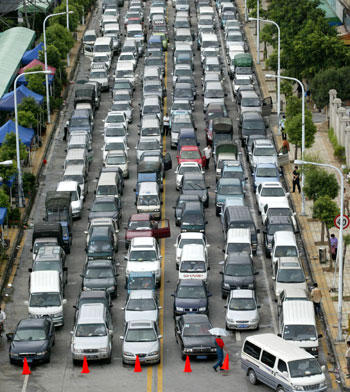
Gee, I bet this will work out really well.  Either the price cap will be set high, such that it is meaningless, or it will be set low, such that Hawaii will likely get this:

China_gas2
update:  given the structure of the price caps, the result could actually be higher rather than lower prices at the pump -- see update #2 below.

It's good to know that Hawaii is looking to China for economics ideas.

The Chinese government and its state-owned oil companies are locked
in battle over artificially low gasoline prices at the pump that has
caused a massive shortage in the southern manufacturing province of
Guangdong....

The crisis
highlights the persistent problems Beijing faces as the economy is
transformed to a more market-based system but that is often retarded by
authorities who fear loosing political control in the face of
full-fledged capitalist rules.

Beyond the obvious run-up in world-wide oil prices and Hawaii's logistical isolation that raises all of the prices on the island, the article on CNN identified one other possible culprit for high prices: the state government

Higher-than-average taxes on gasoline in Hawaii contribute to those
high prices. The state levies a 16 cent per gallon tax, and various
local authorities add on other taxes.

In Honolulu, for example, total state, federal and local gas taxes
amount to about 53 cents per gallon, one of the highest rates in the
United States. The national average, according to the American
Petroleum Institute, is about 42 cents per gallon

It seems like only a few days ago I was pointing how governments have a hard time resisting meddling in oil markets, and that this meddling never works out well.

Even in the US, which is typically more comfortable with the operation
of the laws of supply and demand than other nations, the government has
been loathe to actually allow these laws to operate on oil.  During the
70's, the government maintained price controls that limited demand side
incentives to conserve, thus creating gas lines like the ones we are
seeing in China today for the same reason.  When these controls were
finally removed, a "windfall profits tax" was put in place to make sure
that producers would get none of the benefit of the price increases,
and therefore would have no financial incentive to seek out new oil
supplies or substitutes.  Within a few years of the repeal of these
dumb laws, oil prices fell back to historical levels and stayed there
for 20 years.

Like the gas rationing and price controls in the 1970's, this occurs in a Republican administration (Hawaiian Governor Lingle).  It continue to be difficult to take the Republican Party's professed support for free markets seriously.

Hawaii's Star Bulletin reported that Governor Linda
Lingle (R) is an opponent of the caps. The newspaper said Lingle
believes it would be better to force oil companies to open their books
and show consumers how much money they make at each stage of business.

If she is so opposed to it, why didn't she veto the bill?  And is having government officials marching into private offices to confiscate accounting data really her preferred "free market" alternative?

Update:  Apparently the cap in Hawaii was passed pre-Lingle, and she fought to reverse it, so I will cut her some slack. Lynne Kiesling has more details on the plan, which includes how the cap will be calculated week to week.  Politicians there are calling it a "market-based price cap".  LOL.  Next we will see freedom-based speech limitations and privacy-based telephone taps.  Note that how the cap is calculated does not change the statement I made before:  Either the price cap will be set high, such that it is meaningless, or
it will be set low, such that Hawaii gets gas lines.

PS- Lynn is the economic goddess of energy markets, so if energy and power markets and regulation interest you, I recommend her blog.

Update #2:  Jane Galt makes the good point that the Hawaiian price caps are on wholesale gasoline prices, so while there may be gas shortages at the wholesale level, retail prices may be able to float higher to close the supply gap.  This would ironically lead to higher, not lower prices at the pump, and large profits for gasoline retailers.  Since wholesale sources of gas tend to be out-of-state corporations, and gasoline retailers tend to be smaller, locally owned businesses, I wonder if this is a case of rent-seeking by gas station owners.

What is a Bad Choice?

My Vioxx post below got me thinking about choices, and in particular, how we "grade" other people's choices.

My first thought on this topic is that assessing the "right" choice for an individual, when a decision affects only that one individual, can only be made by that person.  That seems like a dumb and obvious statement, but actually its fairly relevant to public policy nowadays.  Want to ride your motorcycle without a helmet?  Sorry, we think that is a bad decision and we aren't going to let you make it.   Want to reduce excruciating pain even at the risk of future heart problems?  Sorry again, can't let you do that.  Want to let Florida State continue to use your tribe's name (Seminoles) for their mascot?  Sorry, but that is degrading to you, even if you don't know it.  Want to enjoy some french fries (maybe even some Snuffers cheese fries, for those who have ever lived in Dallas) at the risk of a future heart attack - well, you can still do that, but we're working on it.  I wrote much more on this topic here.

Beyond the moral problem I have with having the government limit our ability to make decisions for ourselves, the fact is that we are generally really bad at assessing other people's choices.  I will make the analogy using blackjack.  I remember sitting at a table in Vegas and watching some woman take a hit on 18.  For those who don't know blackjack, trust me - you are always statistically reducing your odds of winning when you hit an 18.  Anyone, the woman draws a three, for a perfect 21, the dealer reaches 20, and she wins the hand.  Several people around the table said to her "great decision to take another card".  No it wasn't!  It was stupid!  It was a bad decision that, in this particular case, she was bailed out of by good fortune, but over the long haul of hitting 18's, she's going home broke.

Lets take a second example.  I buy liability insurance for my company every year.  Because I am in a public contact business, which makes us a particular target of the litigation industry, we pay nearly $100,000 a year for the policy.  Last year, we had no claims.  Does this mean that I made a bad decision buying insurance last year, because it turned out that we had no claims?  No, of course not.  It would be irresponsible in today's litigious environment to engage in unprotected business.   The insurance is a smart decision, even in years without claims.

But juries always assess choices based on the outcomes, not on the inputs the individuals involved were facing when they made the choices.  In the hands of a good litigation attorney, a jury will always find that hitting on a 12 in blackjack and drawing a king was a bad decision, even when the dealer is showing an ace and the odds say you HAVE to draw. 

Which brings us back to Vioxx.  Lets imagine ten thousand people who have excruciating pain, pain that prevents them from actively participating in and enjoying life, that choose to take Vioxx, knowing that there is a tiny risk of heart problems.  9,999 live a better life.  One man dies.  A jury eventually decides that the one man made a bad decision (since he died).  I would argue that the man who died did not make a better or worse decision than the other 9,999.  He made what he thought was a good decision, the same decision all the others made; he just happened to be the one who came out unlucky, but they all knew going in that someone in their group would probably draw the short straw.

Postscript:  Of course, no one ever thinks its going to be them who draws the short straw.  There is a famous story from WWII about a soldier being told with his company that two out of every three of them would likely die in the coming D-Day invasion.  The soldier looked to his comrade on his left, and then the man on his right, and thought "poor bastards".

Another Limitation on Individual Choice

I won't go too much into the details of the recent Vioxx jury verdict.  Professor Bainbridge has a complete roundup which is worth reading, and Reason had an analysis of the merits of the case a while back.  Though its not really the point of this post, I can't resist a few snippets:

Jurors who voted against Merck said much of the science sailed right over their
heads. "Whenever Merck was up there, it was like wah, wah, wah," said juror John
Ostrom, imitating the sounds Charlie Brown's teacher makes in the television
cartoon. "We didn't know what the heck they were talking about."

One juror considered the fact that the CEO, whose company faces thousands of law suits, didn't show up as an admission of guilt:

... [juror] Ostrom, 49, who has a business remodeling homes, was also disturbed
that former Merck Chief Executive Raymond Gilmartin and another top Merck
official gave videotaped testimony but weren't in the courtroom. "The big guys
didn't show up," said Mr. Ostrom. "That didn't sit well with me. Most definitely
an admission of guilt."

And of course there is this now famous gem:

One juror, Ms. Blas, had written in her questionnaire that she
loves the Oprah Winfrey show and tapes it. "This jury believes they're going to
get on Oprah," Ms. Blue told Mr. Lanier. "They only get on Oprah if they vote
for the plaintiff."

Read the Bainbridge post, it has much more.

Anyway, the point of this post is that this verdict represents a very dangerous assault on individual choice.  Recognize that there are many, many activities in life where individuals are presented with the following choice:

If I choose to do X, my life will be improved in some way but I may statiscally increase my chance of an early death.

You may react at first to say that "I would never risk death to improve my life", but likely you make this choice every day.  For example, if you drive a car, you are certainly increasing your chance of early death via a auto accident, but you accept this risk because driving allows you to get so much more done in your life (vs. walking).  If you ride a bike, swim, snow ski, roller blade, etc. you are making this choice.  Heck, everyone on the California coast is playing Russian Roulette with an earthquake in exchange for a great climate, beautiful scenery, and plentiful jobs.

The vast majority of drugs and medical therapies carry this same value proposition:  A drug will likely improve or extend your life in some way but carries a statistical chance of inducing a side effect that is worse than the original problem, up to and including death.  The problem is that we have structured a liability system in this country such that the few people who evince the side effects can claim more money in damages than the drug was worth to all the people it helped.  For example, if a drug helps 999 people, but kills the thousandth, and that thousandth person's family is awarded $253 million in damages (as in this case), the drug is never going to be put on the market again.  Even if the next 1000 people sign a paper saying we are willing to take the one-in-a-thousand risk to relieve the pain that is ruining our lives, they still are not going to get the drug because the drug companies know that some Oprah-loving jury will buy the argument that they did not understand the risk they were taking and award the next death another quarter of a billion dollars.

This exact same effect nearly killed the vaccination industry.  In the end, Congress had to pass legislation  immunizing (ha ha) vaccine makers from lawsuits when known 1-in-10,000 side effects occur.  While I am not a big fan of the FDA, if it is going to exist and put drugs through 20 years of tests and a forest full of paperwork to get approved, I think that approval process should confer some sort of litigation immunity. 

By the way, have you noticed the odd irony here?  Robert Ernst (the gentleman who died in the Vioxx case) is assumed, both by the FDA and the litigation system, to be unable to make informed decisions about risk and his own health.  But a jury of 12 random people who never experienced his pain can make such decisions for him?  And us?

Richard Epstein said it better than me, in the WSJ but I will like to Reason which is free:

I would like to send my message to [plaintiff's lawyer Mark] Lanier and
those indignant jurors. It's not from an irate tort professor, but from
a scared citizen who is steamed that those "good people" have imperiled
his own health and that of his family and friends. None of you have
ever done a single blessed thing to help relieve anybody's pain and
suffering. Just do the math to grasp the harm that you've done.

Right now there are over 4,000 law suits against Merck for Vioxx.
If each clocks in at $25 million, then your verdict is that the social
harm from Vioxx exceeds $100 billion, before thousands more join in the
treasure hunt. Pfizer's Celebrex and Bextra could easily be next.
Understand that no future drug will be free of adverse side effects,
nor reach market, without the tough calls that Merck had to make with
Vioxx. Your implicit verdict is to shut down the entire quest for new
medical therapies. Your verdict says you think that the American public
is really better off with just hot-water bottles and leftover aspirin
tablets.

Ah, you will say, but we're only after Vioxx, and not those good
drugs. Sorry, the investment community won't take you at your word. It
realizes that any new drug which treats common chronic conditions can
generate the same ruinous financial losses as Vioxx, because the flimsy
evidence on causation and malice you cobbled together in the Ernst case
can be ginned up in any other. Clever lawyers like Mr. Lanier will be
able to ambush enough large corporations in small, dusty towns where
they will stand the same chance of survival that Custer had at Little
Big Horn. Investors can multiply: They won't bet hundreds of millions
of dollars in new therapies on the off-chance of being proved wrong.
They know they'll go broke if they win 90% of the time.

Your appalling carnage cries out for prompt action. Much as I
disapprove of how the FDA does business, we must enact this hard-edged
no-nonsense legal rule: no drug that makes it through the FDA gauntlet
can be attacked for bad warnings or deficient design.

More on the Housing Bubble

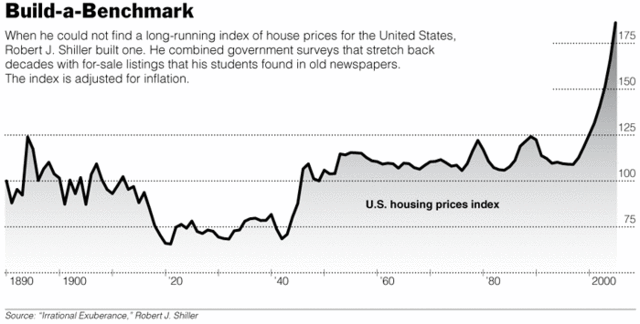
I can't check the guy's methodology, but Robert Shiller claims in the NY Times to have built a better, more accurate measure of housing prices.  You might ask, don't we already have that - I always see things like "median home sales price" in the paper?  The problem with existing metrics is that they don't correct for mix.  If a lot of large houses in the pricey part of town sell, median home prices will rise just given the mix shift of the sample.  What you really want is a price index for equivalent home sales, something that corrects for things like square feet, inflation, and perhaps zip code.  This is what Shiller claims to have done, and the results are dramatic.  He shows that real housing prices have been flat for most of the century, right up until the last decade, where they have increased dramatically.

Housingprices

I can't think of any structural change that would explain this (except maybe a change in relationship between mortgage rates and inflation) so it certainly creates a flashing red light saying "bubble". 

By the way, isn't it interesting that people can see the graph above and immediately think "prices are due to crash" but when they see this very similar chart:

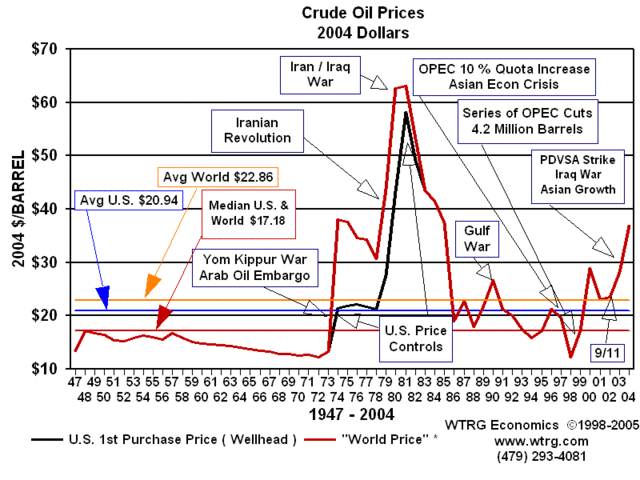
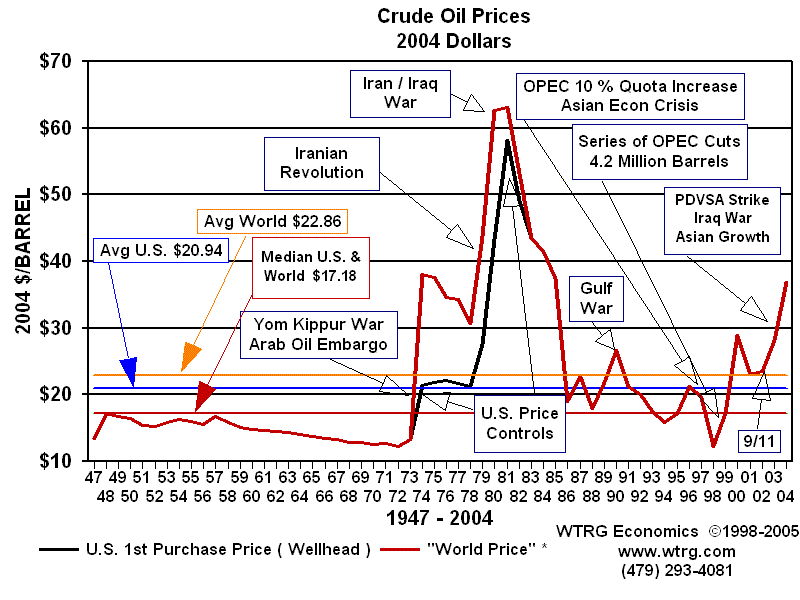
Oilprice1947

...and think that prices will keep going up and up and up.

Hat tip to Marginal Revolution.  Other posts on housing prices here, here and here.  More on oil prices here.

Inside 9/11 Documentary

Last night I watched the four hour Inside 9/11 documentary on the National Geographic channel.  I really enjoyed the show.  They took the plot step by step and at times day by day and minute by minute.  The final "zero hour" segment was tremendously emotional.  Highly recommended - I believe it will be replayed September 8.

More on Peak Oil

Everything old is new again.  Back in the late 70's, all the talk was about the world running out of oil.  Everywhere you looked, "experts" were predicting that we would run out of oil.  Many had us running out of oil in 1985, while the most optimistic didn't have us running out of oil until the turn of the century.  Prices at the time had spiked to about $65 a barrel (in 2004 dollars), about where they are today.  Of course, it turned out that the laws of supply and demand had not been repealed, and after Reagan removed oil price controls and goofy laws like the windfall profits tax, demand and supply came back in balance, and prices actually returned to their historical norms.

Today, as evidenced by the long article on "peak oil" in the NY Times Magazine this weekend, we are apparently once again headed for imminent disaster.  The Freakonomics blog has already chimed in with a partial rebuttal, but I wanted to share some of my own thoughts.

Are the Saudis hiding a reserve shortfall?  Much of the peak oil phenomena consists of Paul Ehrlich type doom-saying that takes pains to ignore the laws of supply and demand.  However, the question of Saudi behavior is an interesting one.  Lets for a moment hypothesize that the Saudis were indeed somehow running out of oil.  One thing the article misses is how bad a thing this would be for the Saudi leadership.  The author notes that the ruling family shouldn't care, since it is already rich, so declining oil revenues won't hurt it.  But that misses the point.  With a large percentage of the world's oil, the Saudis are a country that must be treated with respect and deference.  Without oil, Saudi Arabia becomes that Arab nation that virtually enslaves half its population (ie the females) and that funds much of the world's terrorism, including the 9/11 attacks.  Suddenly, without oil reserves, the Saudi's might find themselves moving up the Bush-Rumsfeld priority list for a little visit from the US military.  I have no way of knowing if the Saudis are hiding anything -- the fact that some Saudi fields are using secondary and tertiary recovery methods (as noted in the article) really does not mean much.  But if they were losing reserves, they sure would have the incentive to hide it.

Reserve accounting is a tricky thing.  The vagaries of reserve accounting are very difficult for outsiders to understand.  I am not an expert, but one thing I have come to understand is that reserve numbers are not like measuring the water level in a tank.  There is a lot more oil in the ground than can ever be recovered, and just what percentage can be recovered depends on how much you are willing to do (and spend) to get it out.  Some oil will come out under its own pressure.  The next bit has to be pumped out.  The next bit has to be forced out with water injection.  The next bit may come out with steam or CO2 flooding.  In other words, how much oil you think will be recoverable from a field, ie the reserves, depends on how much you are willing to invest, which in turn depends on prices.  Over time, you will find that certain fields will have very different reserves numbers at $70 barrel oil than at $25.

Trust supply and demand.  Supply and demand work to close resource gaps.  In fact, it has never not worked.  The Cassandras of the world have predicted over the centuries that we would run out of thousands of different things.  Everything from farmland to wood to tungsten have at one time or another been close to exhaustion.  And you know what, these soothsayers of doom are 0-for-4153 in their predictions.  Heck, they are about 0-for-five on oil alone:

Most experts do not share Simmons's concerns about the imminence of peak oil. One of the industry's most prominent consultants, Daniel Yergin, author of a Pulitzer Prize-winning book about petroleum, dismisses the doomsday visions. ''This is not the first time that the world has 'run out of oil,''' he wrote in a recent Washington Post opinion essay. ''It's more like the fifth. Cycles of shortage and surplus characterize the entire history of the oil industry.'' Yergin says that a number of oil projects that are under construction will increase the supply by 20 percent in five years and that technological advances will increase the amount of oil that can be recovered from existing reservoirs. (Typically, with today's technology, only about 40 percent of a reservoir's oil can be pumped to the surface.)

One of the problems with oil is that governments have a real problem with allowing supply and demand to operate.  I have wondered for a while why Chinese demand has kept growing so fast in the face of rising prices.  The reason is that the Chinese government still is selling gasoline way below market rates, shielding consumers from incentives to reduce consumption.  On the supply side, I also wondered when I was in Paris why gasoline prices as high as $6 per gallon were not creating incentives for new sources of supply.  It turns out that nearly $4 of the $6 are government taxes, so none of this higher price goes to producers or creates any supply-side incentives.  Instead, it goes to paying unemployment benefits, or whatever they do with taxes in France.

Even in the US, which is typically more comfortable with the operation of the laws of supply and demand than other nations, the government has been loathe to actually allow these laws to operate on oil.  During the 70's, the government maintained price controls that limited demand side incentives to conserve, thus creating gas lines like the ones we are seeing in China today for the same reason.  When these controls were finally removed, a "windfall profits tax" was put in place to make sure that producers would get none of the benefit of the price increases, and therefore would have no financial incentive to seek out new oil supplies or substitutes.  Within a few years of the repeal of these dumb laws, oil prices fell back to historical levels and stayed there for 20 years.

But meddling with prices is not the only way the government screws up the oil market.  I laugh when I see people with a straight face say that we have not opened up any big new fields in this country since Prudhoe Bay.  This is in large part because the three most promising oil field possibilities in this country -- ANWR, California coast, and the Florida coast -- have all been closed to exploration by the government.

In addition, the government has, through a series of energy bills that are each stupider than the last, managed to divert valuable energy investment capital into a range of politically correct black holes.  All we seem to get are unsightly windmills in Palm Springs that always seem to be broken and massive ethanol subsidies that actually increase oil consumption rather than decrease it.  It should come as no surprise that  despite government subsidies for a range of automotive technologies like fuel cells and all-electric cars, the winning technology to date has been hybrids, which weren't on the government subsidy plan at all.

Don't Ignore Substitutes.  All the oil doomsayers tend to define the problem as follows:  Oil production from current fields using current methods and technologies will peak soon.  Well, OK, but that sure defines the problem kind of narrowly.  The last time oil prices were at this level ($65 in 2004 dollars), most of the oil companies and any number of startups were gearing up to start production in a variety of new technologies.  I know that when I was working for Exxon in the early 80's, they had a huge project in the works for recovering oil from oil shales and sands.  Once prices when back in the tank, these projects were mothballed, but there is no reason why they won't get restarted if oil prices stay high.  At $65 a barrel, even nuclear starts looking good again, though we would have to come up with a more sane regulatory environment.  Look for venture capital to steer away from funding the next shoelace.com and start looking for energy investments.

Dueling Catastrophes.  As a final note, its funny seeing the New York Times crying "disaster" over the peak oil scenario.  Those who read this blog know that I am skeptical that the harm from man-made global warming is bad enough to justify large, immediate Kyoto-like reductions in hydrocarbon consumption.  However, the New York Times is on record as a big believer in and cheerleader for immediate cuts in hydrocarbon consumption to head off global warming.  So why is peak oil so bad?  Shouldn't they be celebrating an ongoing drop in oil availability, which would force the world to produce less CO2?  Along the same vain, it is funny seeing a publication that has decried over and over again our dependence on Saudi Arabian and other foreign oil at the same time lamenting the fact that Saudi Arabia is running out.  If that's true, won't Saudi reserve declines solve the whole dependence problem, one way or another?

Postscript:  The other day, I found one of Paul Ehrlich's doomsday books from the 70's in a used book store.  When I have a chance, I am going to post some of its predictions, which were treated with breathless respect by most of the media, including the NY Times.
The Health Care Trojan Horse

I get email and comments from time to time that my language deriding government's intervention into every aspect of our lives is overblown and exaggerated.  My answer:  Oh yeah, well how about this:

Mike Huckabee, the Governor of Arkansas, now
requires annual fat reports. These are sent to the parents of every
single child aged between 5 and 17; a response, he says, to "an
absolutely epidemic issue that we could not ignore" in the 1,139
schools for which he is responsible.

I just cannot craft any reasonable theory of government where this is the state's job.   The "obesity" crisis in this country just amazes me.  "Experts" every few years broaden the definition of who is overweight or obese, and suddenly (surprise!) there are more people defined as overweight.  Even presuming it is the state's job to optimize our body weights, is it really the right approach to tell everyone they are too fat?  Having known several people who were anorexic, including at least one young woman who died of its complications, is it really a net benefit to get young people more obsessed with looks and body style?  And what about the kids that are genetically programmed to be overweight?  Does this mean that years of taunting and bullying by their peers is not enough, that the state's governor wants to pile on now?

It is interesting to note that governor Huckabee apparently started this initiative after his own personal battle with weight loss:

[Huckabee] lost 110lb after being warned that his
weight, more than 280lb after a life of southern fried food, was a
death sentence. A chair even collapsed under him as he was about to
preside over a meeting of state officials in Little Rock.

We all have friends who have lost weight or gotten into homeopathy or became a vegan and simply cannot stop trying to convert their friends now that they see the light.  Now we have the spectacle of elected officials doing the same thing, but on a broader scale and with the force of law, rather than  just mere irritation, on their side.  One can only imagine what report cards kids would be carrying home if Huckabee had instead had a successful experience with penis enlargement.  What's next, negative reports for kids with bad acne?  For women whose breasts are too small?  For kids who are unattractive?

As I have argued many times in the past, a large part of the blame for these initiatives is public funding of health care.  Beyond the efficiency and choice arguments, I have tried to point out that publicly funded health care is a Trojan horse for a number of truly intrusive nanny-state government controls of our lives.

It isn't such a stretch to imagine the effect
when people realise "” as residents of Arizona have been told already "”
that about 40 per cent of their healthcare charges are spent treating
the consequences of avoidable obesity.

When health care is paid for by public funds, politicians only need to argue that some behavior affects health, and therefore increases the state's health care costs, to justify regulating the crap out of that behavior.  Already, states have essentially nationalized the cigarette industry based on this argument.

By the way, I am willing to make a bet with anyone that no where near 40% of our healthcare charges in Arizona are due to obesity.  I am positive some advocate made up this number, or created it using some ridiculously broad assumptions, and it has now been swallowed by the credulous and scientifically-illiterate press.

Update: Wow, the solution to obesity!  Government funded shrubbery:

City dwellers living in areas with little greenery and high levels of
graffiti and litter are more likely to be obese than those living in
pleasant areas with lots of greenery, say researchers in a study
published on bmj.com today.

Reason number 6,345 not to ever take "facts" from a "study" reported in the media at face value.

Update #2: More about the health care as a trojan horse for statism  (emphasis added)

BangkokThe World Health
Organization (WHO) has always had a rather expansive notion of what it
means to be healthy. If one looks at the official definition it defines
health as a "state of complete physical, mental and social well-being
and not merely the absence of disease or infirmity." According to that
understanding there isn't much that is not in some way connected with
health.  And for the health promoters at WHO's recently completed Bangkok conference that means that health is the supremely important value that trumps everything else.

After
all, the health promoters argue, it is surely obvious that health is a
necessary condition for any sort of life, so it must follow that for
any truly rational person health must outweigh any other value that
might conflict with it.
But the "obvious" -- especially the obvious of
the health promoter -- is often likely to be untrue. While it may be
true that being alive is in some not very interesting sense necessary
for having a life, it is not at all true that being "healthy,"
especially as defined by WHO, is a necessary condition for having a
good life.


All
of us make trade-offs between optimal health and other values all of
the time. We travel by car for instance, for reasons of economy or
convenience, even though we might recognize that statistically planes
are safer. We smile at Alan Dershowitz's cardiac calculus where a
patient chooses between ten years of inactive life and the risk of
sudden death:


"My
doctor has made a prognosis/That intercourse fosters thrombosis/But I'd
rather expire/Fulfilling desire/Then abstain, and develop neurosis."


My Dumbest Traffic Ticket

Started off my day today by getting the world's dumbest traffic ticket.  I got a ticket for "improper position making a right turn".  Huh?  The cop pulled me over, and asked me if I knew why he was pulling me over, and I said "I have no idea".  At the previous intersection, the two lane road has a very brief dedicated right turn lane.  The officer argued that I did not get all the way over into that lane before I turned right.  You have got to be kidding me - he must be behind in his quota for this month.  Ironically, he issued me the ticket while I was sitting in the very parking lot that my car was broken into 3 months earlier, a crime the police did not lift a finger to investigate.

Look, I am no virgin here.  You could probably nail me for speeding on any given day.  But "improper position making a right turn??"

China and California Following Similar Energy Policies

A couple of years ago, California suffered through a summer of electricity blackouts while the state and  state-protected power monopolies nearly bankrupted themselves.  While California politicians have tried to cover their behinds by blaming Enron for the problems, the real mistake that led to the debacle was allowing the wholesale price of electricity to float higher, while the retail price remained low and fixed.  As a result, as wholesale prices skyrocketed, the State and the power monopolies had to buy high and sell low, causing massive financial losses.  At the same time, consumers saw no change in prices, so they had no incentive to change their behavior and cut back on usage, which they would have done if retail electricity prices had been allowed to rise with the market.

Via Instapundit and Gateway Pundit, comes this article about gas shortages in China and the ensuing lines at retail gas stations, that look worse than anything we suffered through in this country.  The article makes fairly clear what is going on:

The Chinese government and its state-owned oil companies are locked
in battle over artificially low gasoline prices at the pump that has
caused a massive shortage in the southern manufacturing province of
Guangdong.

For weeks skyrocketing global oil prices and rising
demand has led to a fuel-supply crunch as domestic refineries have been
caught short in Guangdong.

Some fear it is only a matter of time before gas-guzzling cities such as Shanghai are hit too.

The
government has blamed recent stormy weather for the shortfall, which is
feasible but not enough to result in the kilometre long queues at
filling stations that drivers in Guangdong have endured for nearly a
month.

As oil prices climbed, a standoff erupted between China's
National Development Reform Commission (NDRC) -- a key economic policy
planning body -- and the country's two largest state oil groups
PetroChina and Sinopec, analysts said Wednesday.

The crisis
highlights the persistent problems Beijing faces as the economy is
transformed to a more market-based system but that is often retarded by
authorities who fear loosing political control in the face of
full-fledged capitalist rules.

I blame Enron.  Anyway, I wrote about gas line and what caused them in the US here.  Some genius also attempted the same policy as China is pursuing in post-war Iraq, with similar results.

My Follow-up to Andy Warhol

As most of you know, Andy Warhol once predicted that "In the future, everyone will be world-famous for 15 minutes."  The statement seems eerily correct given the explosion of talk shows and reality TV, which mainly happened after his statement.

I would like to follow-up on Mr. Warhol's bold prediction with one of my own:

In the future, everyone will be on the TSA's no-fly list

The TSA has the ridiculous policy of stopping everyone with a similar name as a single terrorist subject.  So, once a John Smith comes under scrutiny as a possible terrorist, every John Smith gets turned away at the gate

Sarah Zapolsky's 1-year-old son had better get used to being looked at as a
possible terrorist every time his family gets on a plane.

That's because experts and officials say there's no way the toddler's name
will be taken off the federal no-fly list - even after he and another tot made
headlines for being stopped as potential terror threats.

"His name is the same or similar to someone on the no-fly list," said Ann
Davis, a spokeswoman for the Transportation Security Administration, explaining
that even though a baby is not a threat, someone out there with the same name
is, and the name must be kept on the list.

Hat tip to Hit and Run.

The Danger of Government-Owned Commercial Enterprises

I am always flabbergasted by folks who support government ownership of commercial assets based on the idea that the government is somehow more accountable than private enterprise.  This argument is, frankly, insane.  Commercial entities are held accountable by two things:  1) the ability of a customer not to purchase their product or service and 2) the ability of new competitors to enter the market and take away their customers with a better price-product package.

All enterprises naturally try to resist these pressures.  In the long run, there is not much a private company can do to evade these pressures.  Even bald attempts to monopolize the market have always failed (at least without the support of the government for that monopoly, as in certain utilities).

But government enterprises are entirely different.  The government has the legislative and regulatory power** to stifle competitors to themselves and to compel consumers to use only their product or service.  In other words, the government, uniquely, has the power to totally void the two sources of accountability in the market.

And the government uses this power all the time.  They use it to protect favored airports, to protect cigarette makers who pay them loads of settlement money, to protect wi-fi revenue, and of course to protect the good-old US Post Office. Via Reason, comes this story of the government even making life worse for drivers in order to protect their toll revenues:

When E-470 opened in 2002, some people thought it was a strange
coincidence that, about the same time, the speed limit on nearby Tower Road, a
paved, 2-lane, rural highway, dropped from 55 MPH to 40 MPH. Several apparently
unnecessary traffic signals also appeared. This, in spite of the fact that after
the toll road opened, Tower Road would have even less traffic than it did
before.

Well, it was no coincidence.

The lower speed limit and extra traffic signals, which make Tower Road slower
and less convenient to use, are required by a "non-compete" clause in an
agreement between the E-470 Public Highway Authority and nearby Commerce
City.

The goal is to impede traffic on Tower Road so drivers will decide they are
better off using the toll road. This protects the revenue stream from the tolls,
thereby protecting the interests of the toll road's investors.

Once government gets into a particular sphere, they are never ever going to voluntarily let anyone in, no matter how bad their product or service becomes.

** This power is not really constitutional, and has only emerged post-1930's, but that is another topic.

Update:  Just to anticipate the argument, observant readers will note that several of these examples represent "public-private" partnerships that split returns between private investors and the state.  The wi-fi example and the toll road example are of this type.  The fact that these government endeavors include private money does not change the problem one bit.  The problem is the government using its unique legislative authority to intervene in an industry to protect its own rents, which can occur with the government as a 100% investor or as a minority investor.

Julian Simon Would Have Loved This

When I read this article on waste disposal, via Instapundit, all I could think of was Julian Simon.  For those who may be too young to remember, back in the 80's, after the panic that we were running out of oil was over, but before the current panic that we are producing too much carbon dioxide, there was a panic that we were running out of garbage dump space.  Uh, never mind:

Simply put, operators of garbage dumps are stuffing more waste than
anyone expected into the giant plastic-lined holes, keeping disposal
prices down and making the construction of new landfills largely
unnecessary....

The
productivity leap is the second major economic surprise from the trash
business in the last 20 years. First, it became clear in the early
1990's that there was a glut of disposal space, not the widely believed
shortage that had drawn headlines in the 1980's. Although many town
dumps had closed, they were replaced by fewer, but huge, regional ones.
That sent dumping prices plunging in many areas in the early 1990's and
led to a long slump in the waste industry.

Since then, the
industry and its followers have been relying on time - about 330
million tons of trash went into landfills in the United States last
year alone, according to Solid Waste Digest, a trade publication - to
fill up some of those holes, erase the glut and send disposal prices
skyward again. Instead, dump capacity has kept growing, and rapidly,
even as only a few new dumps were built.

Shortages seldom persist where the human mind is left free to attack the problem, and economic incentives are allowed to operate freely.  I wrote my own post attacking the zero-sum mentality that causes certain people to jump from one shortage-panic to the next. 

My prediction:  Five years from now, we will be seeing the same article on oil and natural gas.  "This oil field in west Texas is over 80 years old, and was thought to be depleted, until $60 oil prices and some new technology...."   You get the idea.

This is Sick

The town of New London, CT, is assessing nearly 5 years back rent on Susette Kelo and other property holders whose land the Supreme Court recently allowed the city to confiscate.  As it stands, if New London has its way, Kelo will not only lose her house, she will also be wiped out financially, all for the crime of owning the land where New London wanted condos and hotels.

The U.S. Supreme Court recently found that the city's original seizure of
private property was constitutional under the principal of eminent domain, and
now New London is claiming that the affected homeowners were living on city land
for the duration of the lawsuit and owe back rent. It's a new definition of
chutzpah: Confiscate land and charge back rent for the years the owners fought
confiscation.

In some cases, their debt could amount to hundreds of thousands of dollars.
Moreover, the homeowners are being offered buyouts based on the market rate as
it was in 2000...

The New London Development Corp., the semi-public organization hired by the
city to facilitate the deal, is offering residents the market rate as it was in
2000, as state law requires. That rate pales in comparison to what the units are
now worth, owing largely to the relentless housing bubble that has yet to burst.

"I can't replace what I have in this market for three times [the 2000
assessment]," says Dery, 48, who works as a home delivery sales manager for the New London Day . He soothes himself with humor:
"It's a lot like what I like to do in the stock market: buy high and sell low."

And there are more storms on the horizon. In June 2004, NLDC sent the seven
affected residents a letter indicating that after the completion of the case,
the city would expect to receive retroactive "use and occupancy" payments (also
known as "rent") from the residents.

In the letter, lawyers argued that because the takeover took place in 2000,
the residents had been living on city property for nearly five years, and would
therefore owe rent for the duration of their stay at the close of the trial. Any
money made from tenants, some residents' only form of income, would also have to be
paid to the city....

An NLDC estimate assessed Dery for $6,100 per month since the takeover, a
debt of more than $300K. One of his neighbors, case namesake Susette Kelo, who
owns a single-family house with her husband, learned she would owe in the
ballpark of 57 grand. "I'd leave here broke," says Kelo. "I wouldn't have a home
or any money to get one. I could probably get a large-size refrigerator box and
live under the bridge."

I want to barf.  Hat tip to Reason's Hit and Run.

Strange Quark Nuggets

Once in a while you read something so new and unexpected about the universe that you don't even know how to react.  That is where I am with this article on strange quark nuggets, smaller than the width of a human hair but weighing tons, burrowing through the earth at 900,000 miles an hour.  Via Instapundit.  Coming soon:  Bad Hollywood movie using the concept.

Fixed Comment Screen (Hopefully)

I have gotten a number of folks telling me that the color choices on the comment preview page made the text very difficult to read.  I was not ignoring these comments, it just took me a while to figure out which stylesheet variables controlled that page.  I think I have it licked, but let me know if you have problems.

Worlds Most Expensive Printer Ink

Today I bought what may be the most expensive consumer printer ink available.  We have a small Pitney-Bowes postage meter that has a little built in ink-jet printer to print out the metered postage symbol (that sort of red looking stuff that replaces the stamp).  One of their little print cartridges doesn't last more than at most a thousand envelopes, which represents at most the equivalent of 50 pages of text for a normal printer.  For this little cartridge with its smidgen of ink, I paid $39.99.  At the same time, I bought two-paks of the HP cartridges I needed (no bargain themselves) for $25 per cartridge, and these cartridges last for hundreds of pages.  I can't directly compare the volume of ink, but my sense is that the P-B cartridge is priced such that it would be over $500 with an equivalent amount of ink to an HP cartridge.  Insane.  And its worse because the P-B postage meter has this annoying tendency to announce the cartridge is almost out of ink before it is even half empty.  We have gone weeks with the meter telling us the cartridge had to be replaced soon.

I am not sure I fully understand the relationship Pitney-Bowes has to the US Postal Service, but to all appearances, they have been handed a virtual monopoly for decades.  For years business have been forced to pay egregious rental rates for P-B equipment with long, long minimum lease periods because the USPS does not seem to be comfortable with competition.  Only the advent of Internet postage in the late 1990's forced P-B to come out with a small business postage meter that you could purchase at relatively low cost.  I am flabbergasted that the US government continues to give them this monopoly.  It is ironic to me that several of the abusive monopolistic practices used by Pitney-Bowes and encouraged by the US government are the same practices Xerox got busted (under anti-trust litigation) years ago by... the US Government.

What Happened to Prior Art?

I wrote below that I am not an economist, but I am really, really not a patent lawyer.  However, I find this story totally mystifying:

Apple Computer may be forced to pay royalties to Microsoft for every iPod it
sells after it emerged that Bill Gates's software giant beat Steve Jobs' firm in
the race to file a crucial patent on technology used in the popular portable
music players. The total bill could run into hundreds of millions of dollars.

Although Apple introduced the iPod in November 2001, it did not file a
provisional patent application until July 2002, and a full application was filed
only in October that year.

In the meantime, Microsoft submitted an application in May 2002 to patent
some key elements of music players, including song menu software.

I have already become suspicious that the patent process as applied to software and online concepts (e.g. the Amazon "1-click" purchase patent) is broken.  For me, this is more evidence.  How can a Microsoft patent filed in May 2002 have any validity if it attempts to patent concepts already embodied in a competitive product on the market in 2001?

I once found myself in the middle of one of these patent battles several years ago.  I was on the management team at Mercata, an online shopping site who's bit of uniqueness was that it had three or four day purchase windows for various products, and the price of the product would fall as more people signed up to purchase it.  Kind of a fun, with some interesting viral marketing potential if it had caught on, but patentable?  I mean, doesn't Adam Smith have prior art on this?

Hat tip to Prof. Bainbridge.

I Don't Know the Economics Term for This

While I sometimes get grouped into economics blogs, I actually don't have a degree in the subject.  I have an MBA, some practical experience, some hobbyist reading, a few undergraduate courses, and, as my wife can attest, a willingness to pretend I know what I am talking about.  Unfortunately, that is not enough in this case.

Over the last 6 months, I have observed an interesting phenomena in the Phoenix area, one which I am sure I am not the first to discover, but I don't have enough background to put a name on it.  Here is what is going on:

Over the last year or two, the Phoenix real estate market has been red hot.  This has caused a lot of individual investors to make local real estate investments (I discussed more about this here).  The preferred type of investment seems to be to buy an old house on valuable land, tear it down, and sell the new house for a profit.

All fine and normal so far.  The interesting part comes when the investor chooses the style and appearance of the new home.  Remember that these are typically highly leveraged investments.  Investors take out a large mortgage, and that mortgage has to be paid every month that the investor cannot sell the home.  It is critical, then, that the investor build a home that is designed in a way to be most likely to sell.

Let's imagine that the pool of possible house buyers have the following preferences (I am making these numbers up):

  1. Tuscan / Mediterranean style, 40%
  2. Santa Fe style, 25%
  3. Santa Barbara style, 20%
  4. New England style, 10%
  5. Ultra modern style, 5%

With only limited information on what is going on in the market around them (ie what others are planning to build) all of these investor-builders pick the most popular style on the list, thereby apparently maximizing their ability to sell the home.  As a result, every tear down / rebuild / remodel I see in our area is a new Tuscan home.  So, while 40% of buyers (or whatever the number is) want Tuscan, 100% of the supply is Tuscan.  By the way, the same thing apparently happened in the last big Phoenix real estate boom back in the 1980's, since nearly every house in our neighborhood that was built in the early eighties was built in what we call the "santa barbara" style.

This is obviously some type of market failure, but I don't know what it is called.  I might call it the "variety failure".  To a large extent, this dynamic is made possible by the fact that many of the investors in the real estate market are only entering the housing market for a single transaction, and are not well informed of the actions of other sellers in the market.  In most other industries, investors need to make money over multiple transactions over many years, which mutes this effect.  For example, there are always farmers who try to plant this year what was earning good money last year, but these players in the market are usually weeded out over time as last year's shortage leads to this year's glut and financial losses.  Also muting this failure nowadays are changes in manufacturing techniques, which allows low cost production of greater variety, as well as expansion of specialty retail space (e.g. category killers like Petsmart or Borders), which allows display of more product variations.