Minimum Wage Hypocrisy

I thought this was amazing, from an article by John Fund on the activist group ACORN.  Most of the article is about allegations of election fraud, but this caught my eye:

Founded by union organizer Wade
Rathke in 1970, Acorn boasts an annual budget of some $40 million and
operates everything from "social justice" radio stations to an
affordable-housing arm. Still run after 36 years by Mr. Rathke as
"chief organizer," it is best known for its campaigns against Wal-Mart,
and for leading initiatives in six states to raise the minimum wage....

Acorn is vulnerable to charges
it doesn't practice what it preaches. Its manual for minimum-wage
campaigns says it intends "to push for as high a wage as possible." But
it doesn't pay those wages. In 2004 Acorn won a $9.50 an hour minimum
wage in Santa Fe, N.M., for example, but pays its organizers $25,000 a
year for a required 54-hour week--$8.90 an hour. This year Acorn had
workers in Missouri sign contracts saying they would be "working up to
80 hours over seven days of work." Mr. Rathke says "We pay as much as
we can. If people can get more elsewhere, we wish them well."

In 1995 Acorn unsuccessfully sued
California to be exempt from the minimum wage, claiming that "the more
that Acorn must pay each individual outreach worker . . . the fewer
outreach workers it will be able to hire." Mr. Rathke acknowledges
higher wages can cost some jobs but that the raises for other workers
are worth it.

I am not sure this hypocrisy even requires further comment.  It is particularly hilarious that he argues that economic arguments against the minimum wage (e.g. that they reduce jobs) apply to a non-profit but not to for-profit companies.

This is also hilarious, for a group that is at the forefront of trying to unionize Wal-Mart:

One of them, Sashanti Bryant of
Detroit, Mich., was a community organizer for Acorn....Ms. Barton
alleges that when she and her co-workers asked about forming a union
they were slapped down: "We were told if you get a union, you won't
have a job." There is some history here: In 2003, the National Labor
Relations Board ordered Acorn to rehire and pay restitution to three
employees it had illegally fired for trying to organize a union.

Tipping Anxiety

I am glad I am not the only one who experiences anxiety over when to tip.  And from my experience, this observation by Scott Adams is dead on:

Now let me digress and add some context before I continue. Those of
you who travel a lot know that if you ask a driver about his life, you
never get a story that sounds like this: "Well, I was a drifter and a
hobo for awhile, but then I got this job driving you around. It's the
highlight of my life."

Instead you usually get something more like this: "After I won the
Nobel Prize I became a dissident in my country and had to flee. I
worked as a nuclear weapons inspector for awhile. Then I did some
software programming, which is easy because I have a doctorate degree
in math. Then I invented The Clapper and retired. Now I just do this
job to help out a friend."

AZ Votes for Recreation Fee Increases

Tonight, it appears that AZ voters will pass Prop 202 to raise recreation use fees in Arizona.  Oh, you say that's not what Prop 202 was for?  It was minimum wage?  That's right.  Prop 202 raises the minimum wage in AZ by 31%. 

I have written about the minimum wage many times.  For a variety of reasons, many seasonal recreation workers in AZ, and in fact in the US, are retired folks who work for minimum wage and a camp site to take care of a facility.  They love the job, and do great work, while filling seasonal jobs that younger folks trying to raise a family can't really take on.  When you take all wage related costs -- wages, payroll taxes, unemployment insurances, workers comp, liability insurance, etc. -- wages drive about 2/3 of recreation costs.  That means that a 31% increase in wages equates to a 20% increase in recreation use fees for camping, boating, day use, etc.

What, you say?  That's not what we meant!  We consumers aren't supposed to pay this extra, you business guys are!  Well, my profit margin is about 5% of revenues, which is a pathetically low number for a service business.  Basically, I do this for fun -- I could probably make a better return investing in government bonds.  So, to avoid bankruptcy, wage increases get passed right through to use fees.  And since the law requires that the minimum wage be increased every year, it means that use fees will have to go up every year (for comparison, we have been able to hold many use fees flat for 3-4 years at a time, despite fuel and other costs).

Sorry.  My employees were happy to work for $5.15 an hour.  They did not ask for a raise.  In fact, I have a waiting list of people who want jobs at $5.15.  It was the voters of Arizona who decided that my employees could no longer legally accept this amount for their labor.  And, unfortunately, it is the voters of Arizona who will have to pay for this raise my employees did not even ask for.

Libertarians are Screwed

There are those of a libertarian bent who want to believe that the current bitch-slapping that Congressional Republicans are being handed right at this moment portends well for libertarians:  I beg to differ.  Don't get me wrong, the Republicans deserve what they get.  But this election should not be taken as a sign that the electorate is going all libertarian.  Forget exit polls and what the news says about why people are voting the way they are -- that stuff is always garbage.  Look past the people races and look to the ballot initiatives.

All over America, I don't think voters are punishing Congress for wielding too much power over their lives.  Because when the voters themselves are being offered legislative power via propositions to use the full coercive power of government to compel their neighbors to do the majority's bidding, they are jumping on the statist bandwagon gleefully.  Minimum wage hikes, smoking bans, new regulations, bans on gay marriage, restrictions on immigrants; heck, we even have ballot initiatives with micro-regulations for animal cage sizes.   They are all passing in Arizona and across the country. 

Currently 77% of Arizonans have voted to make Arizona prisons mini-Gitmo's for illegal immigrants, denying them bail for any crime.  75% want to make sure no Spanish is spoken in the statehouse.  66% want to interfere in employer/employee wage negotiations.  55% want to give bar owners no choice in whether they allow smoking in their own private establishment.

Note that there is no consistent theme of conservatism or liberalism in these issues.   The first two might be seen as "conservative" issues and the second two as "liberal" issues.  But the same 2/3 are voting for each.  This is not a victory for the left or the right, but for big government populism.  The voters are getting a taste of bending their fellow citizens to their whims via the government, and they seem to like it.

Update: I am trying not to get mad, but 75% - 3/4 of the people in this state - are voting to not allow illegal immigrants to collect punitive damage awards.  I'm sorry, I understand that people are frustrated with the immigration topic, but there are certain things that strike me as basic under any notion of equal protection, that should apply irregardless of citizenship status.  Protections we should offer to any human being that happens to be in our borders.  And the ability to seek redress for damages in court should be one of them.

In addition, 57% are currently supporting the initiative to ban probation for meth users, so that even minor meth possession charges will lead to a jail term.  This means that the hugely enlightened and highly successful policy of filling up jails with marijuana users is going to be emulated and applied to meth use.

On the positive side, so far the gay marriage amendment is not passing, and the proposition to put limits on Kelo-type eminent domain takings looks like it will pass.

There just seems to be a huge philosophical muddle behind the voting here.  The electorate votes to limit kelo-type government takings and to require compensation in zoning cases where private land values are reduced, but at the same time votes strongly to ban smoking in bars and to raise the minimum wage, both of which are effectively government actions that takes value away arbitrarily from certain private individuals and businesses.

For years I have lamented tthat the average American has no philosophy -- he or she only has a hodge-podge of inconsistent political views stitched together from his/her parents, from peer pressure of their social group, and from random encounters with the media.  Never have I felt this as strongly as I do tonight.

The Cost of Zoning

After years of getting grief, mostly from the left, for its eschewing of zoning and land-use ordinances that more "enlightened" places like San Francisco and Portland are so famous for, residents of Houston are reaping the benefits of their historical Laissez Faire approach:

Houston's gains are nothing like those seen in the past decade in
the Northeast and California, but that may be the secret to Houston's
success and the reason a bubble is unlikely to develop here. Land here
is abundant, and the city has some of the least-restrictive land-use
and construction rules in the nation. Those factors help supply to keep
pace with demand and keep prices within reach of a broad range of
potential buyers.

"We haven't had a bad year in the past decade," says Lorraine
Abercrombie, chairwoman of the local Realtors group and marketing
director for Greenwood King Properties.

Houston's model is in stark contrast to cities such as Boston and
San Francisco, which have strict zoning, exacting building codes and
laws governing historical preservation. Some economists, including
Edward Glaeser of Harvard University, say excessive regulation in such
cities has slowed construction to the point where demand has
outstripped supply, fueling a run-up in home prices.

In the once-sizzling markets where home prices are falling, housing
costs are double, triple or even quadruple those of Houston. The
danger, says Dr. Glaeser, is such places have priced out today's highly
skilled "knowledge workers," forcing them to live in a more affordable
locale where their contribution to the economy might not be as great.
"These are places where only the elite can live," Dr. Glaeser says.

This issue is one of those great examples of the statist game to enlarge government.  Step 1:  Progressives argue for having government restrict land use and implement tight zoning.  Step 2:  Housing prices skyrocket, enriching the elite and making it tough for ordinary workers to own housing.  Step 3:  Progressives decry that lack of affordable housing represents a 'market failure' that must be addressed with more regulation.  For example, builders in the SF Bay Area are required to sell X number of below market rate 'affordable' homes for every Y homes they sell at market rates.  Step 4:  Builders costs go up from the new regulations, further reducing supply and increasing prices.  And the cycle just repeats, as bad outcomes from government regulation are blamed on free markets, and used to justify more regulation.

Here is a trick to try -- every time you see the word "sprawl" in an article, replace it with "affordable housing."  It makes for interesting reading.

Hat tip to Tom Kirkendall, who runs a great blog in Houston.

Go Vote

There was some discussion at Reason's Hit and Run blog about whether it made sense for libertarians to vote.  Here is my take:  Even if you can't find any of the human beings on the ballot worth voting for, your state probably has a variety of propositions on the ballot.  Unlike a people vs. people races, where both choices can suck, propositions generally have a "right" answer.  On your ballot, someone is probably trying to raise taxes or restrict freedoms, or, if you are lucky, there is a proposition to limit government power in some way.  Whatever the case, it's worth it to vote on them.  I talked about my approach to propositions here.

Here was one eloquent response to the same idea:

Reason is an awesome blog and offers logical, well
articulated points of view. This is why I was so disappointed when I
saw so many staffers (including yourself) not voting in the upcoming
election. The idea that anyone's vote "doesn't count" is ridiculous and
slightly offensive. I will grant you that rarely, if ever, an election
of any sort is decided by a single vote, however in a country where
government is growing out of control on every level the limited
government folks need to show up, not so they can get their candidate
elected, or their issue passed or defeated, but to make their voice
heard. If even 5% voted consistently to limit government, one of the
two pro-government growth parties would have to take notice and at
least modify their platform a little to win those votes back, or risk
having a third player (heaven forbid) be considered as a potential
winner.

I am more frustrated than anyone at the intrusion of
government into nearly every aspect of our lives, and the continued
growth of said intrusion. However, I think it is critical that I show
up at the poles and vote for every limited government candidate, and
vote down every tax-spend-regulate proposition offered.

Update:  Done.  Very easy.  I know there was a lot of hoo-hah about showing ID's at the polls, but it felt pretty natural, especially since it is but one of about 20 transactions I make each week that requires an ID.  I cast votes for members of three different parties, which surely puts me in a minority.

Mourning the Loss of Free Speech Through November 7, 2006

Blackribbon

In a stunning beat down on one of America's longest-held and most sacred principles, your first ammendment rights to criticize incumbent politicians, at least on radio and TV, are suspended from now until the November 7 election.  Congress has decided, and incredibly the Supreme
Court has concurred, that only members of the media, including intellectual giants like Bill O'Reilly and Keith Olbermann, can legally criticize sitting politicians on TV and radio in the runup to the election.  These restrictions also came very, very close to applying to this and all other blogs.  John McCain, Russ Feingold, and everyone who voted for this un-American incumbent protection act need to be voted out of office at our next opportunity. Update:  Nice roundup here.
(This post is sticky -- newer posts are below)

The New Dog

I already described our first Hallmark moment with the new dog.  Here is a picture.  You can see that our home defense needs should now be taken care of.

Dog

My Approach on Ballot Initiatives

Arizona has pages of ballot initiatives (or propositions) up for vote on the ballot tomorrow.  Here is my approach to voting on these initiatives:

  • My default is a no vote on everything.  After all, most of these initiatives are regulations and tax increases that even the legislature, not shy about passing either, has not wanted to take on.   Having a default vote is very helpful - if I am unsure, if there is doubt, if I don't fully understand the issue, then it gets a "no".  Like "not guilty" in a criminal trial, its my default answer.
  • I then look for tax cuts and regulation relief.  There tends to be little of this.  We have one ballot initiative that looks like it will help keep property taxes under control, and one that does a nice job circumscribing eminent domain takings as well as regulating "soft" takings (changes to zoning or land use that make a property less valuable without compensation).  On these I will switch my vote to "yes".
  • I then look at bond issues.  A growing city like Phoenix needs facility expansions, and bond issues are a reasonable way to do so.  However, a lot of crap gets loaded in these.  Typically they will say the bond issue is "for schools" to get everyone to vote for it and then load a lot of garbage in it.  I believe California has some of this going on.  We have no bond issues up for vote in my district but we do have a proposition to increase the size limit of future bond issuances.  I am still thinking about this one, but if I can't get excited about it, it gets the default vote - "no".
  • I will then consider procedural changes in government, but with a heavy bias towards "no" due to the laws of unintended consequences.  I don't understand the procedural changes being suggested in two initiatives on public land use so I will vote no on both.  I will definitely vote no on the proposal to pay people to vote with a lotter ticket.  The proposal to effectively switch Arizona to all absentee balloting with virtually no polls is intriguing, but seems fraught with possibilities for unintended consequences (or secretly intended consequences I don't understand) so I will vote no there too.

It's D-Day

That's Dog-Day.  After 44+ years of leading a dog-free existence, my daughter has talked us into getting a family dog.  We go pick up the dog, a little white Maltese, in a few hours.  Humorous-to-everyone-but-me stories are sure to follow...

Update:  Well, that went well.  On the 60 minute drive from the breeder, the dog barfed twice, including one really nice projectile effort, pooped, peed, and had diarrhea.

Update #2: Here is a picture, proving that being cute can be a survival trait.

Dang, I missed this

CBS's venerable television newsmagazine 60
Minutes
on Sunday will focus on Arizona Republican Rep. Jeff
Flake
's battle against "earmarks" and congressional overspending and
government waste.

CBS News veteran Morley Safer is the correspondent on the piece, which is
expected to include interviews with Flake and his uncle, state Sen. Jake
Flake
, R-Snowflake, from August.

The Flake segment is scheduled to lead the program, which airs locally at 6
p.m. Sunday on KPHO-TV (Channel 5).

For a summary of the segment, which will run on Sunday, November
5th, please click on:
 

Update: A bit of the video is here in the Buried in the Fine Print section about 3-4 videos down.  Go, Jeff, go.


Economics is a Science. Really.

I was going to respond to Kevin Drum's post crowing that the Oregon minimum wage increase didn't do any harm.  But Brian Doss at Catallarchy does a fine enough job that I will outsource to him. Here is a taste:

The 5.4% unemployment rate tells us a bit more; its 1 point higher
than the national average. I'm not going to be as quick as Kevin to
infer causation from correlation here either, but it doesn't seem like
much of a positive spin to say that a rate of unemployment that's 25%
higher than the national average is good because it happened to be 7.2%
back in 2002"¦

Also, the quote seems seriously confused that there is a meaningful
distinction (in this case) between the theoretical and statistical
(what else would employment economists use in their theory?). Despite
that confusion, David Neumark (mentioned in the WSJ article) does lay out a fairly comprehensive, concrete,  statistical study of minimum wage laws and their effects here,
among other things showing that for whatever else a minimum wage does,
the effect is primarily among the teenaged to those in their early 20s,
the sign is negative, and in the long run negative if a minimum wage
prevents a teen or young adult from gaining employment and more
importantly not gaining the habits of employment.

Further evidence of the this kind is summarized by Alex Tabarrok here,
whereby he relates studies showing that 25% of the folk on the mininum
wage (nationall) are teenagers, and 50% of all minimum wage earners are
aged 25 and younger. These are people, Alex notes, that with age and
experience will likely soon earn more than minimum wage anyway, thus as
an antipoverty tool it's fairly weak....

Its a particularly bad antipoverty tool, it has non-trivial effects
on the structure of employment within and across industries, and has
possible non-trivial long term negative effects on low-skill
individuals' abilities to stay employed and to increase their own
productivity and standards of living. All of the things it purports to
want to do can be done by much more targeted, efficient, and effective
policy tools.2 

"˜Liberals' of America, please, I beg of you: save your breath for policies that actually help poor Americans, eh? And it you won't do it for me, can you do it for the children"¦?

There is much more good stuff.

Whenever I read these articles by progressives that basically boil down to "the most basic laws of supply and demand don't apply to labor, which is the most fundamental trade good in the economy," I just have to shake my head.  I am reminded of my advice to progressives:

Economics is a science.  Willful ignorance or emotional
rejection of the well-known precepts of this science is at least as bad
as a fundamentalist Christian's willful ignorance of evolution science
(for which the Left so often criticizes their opposition).
  In
fact, economic ignorance is much worse, since most people can come to
perfectly valid conclusions about most public policy issues with a
flawed knowledge of the origin of the species but no one can with a
flawed understanding of economics.

The "Nature" of Modern Scientific Consensus

I am often told, in emails that vary from friendly to downright threatening, that global warming science is not scientific consensus and my skepticism puts me on par with tobacco company lobbyists.  An upcoming paper in Theoretical and Applied Climatology looks back at a recent peer-reviewed Nature article that purported to provide more evidence for man-made global warming and found the much quoted article by Isabel Chiune in Nature to be complete crap:

What is important here is not the truth or falsity of
the assertion of Chuine et al. about Burgundy temperatures. Rather,
what is important is that a paper on what is arguably the world's most
important scientific topic (global warming) was published in the
world's most prestigious scientific journal with essentially no
checking of the work prior to publication.

Moreover "” and crucially "” this lack of checking is not the result
of some fluke failures in the publication process. Rather, it is common
for researchers to submit papers without supporting data, and it is
frequent that peer reviewers do not have the requisite mathematical or
statistical skills needed to check the work (medical sciences
excepted). In other words, the publication of the work of Chuine et al.
was due to systemic problems in the scientific publication process.

The systemic nature of the problems indicates that there might be
many other scientific papers that, like the paper of Chuine et al.,
were inappropriately published. Indeed, that is true and I could list
numerous examples. The only thing really unusual about the paper of
Chuine et al. is that the main problem with it is understandable for
people without specialist scientific training. Actually, that is why I
decided to publish about it. In many cases of incorrect research the
authors will try to hide behind an obfuscating smokescreen of
complexity and sophistry. That is not very feasible for Chuine et al.
(though the authors did try).

Finally, it is worth noting that Chuine et al. had the data; so they
must have known that their conclusions were unfounded. In other words,
there is prima facie evidence of scientific fraud. What will happen to
the researchers as a result of this? Probably nothing. That is another
systemic problem with the scientific publication process.

Oops.  By the way, accepting the hypothesis that man made CO2 is causing some warming does not require that one also accept Al-Gore-type estimates of catastrophic 6-8 degrees C warming or more in the next 50 years.  In fact, the evidence still is that man-made warming effects will be small, and predictions of massive warming are way out on a scientific limb with little proof.  I discuss these issues in my article on the skeptical middle ground on climate, as well as my earlier primer on an Inconvenient Truth.

My Pumpkin

I had meant to post pictures of my pumpkin, and just forgot.  Here are a couple of my world pumpkin, which I carved by thinning out the pumpkin where the landmasses are, but not carving all the way through, such that the skin over the land was more translucent.

Pumpkin1   Pumpkin2

(click on pictures for larger view).  I didn't have a tripod handy so my long-exposure night photography is kind of shaky.

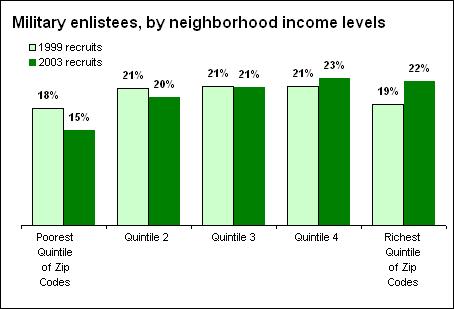
Are Army Recruits Poor and Dumb?

The Republicans are having fun beating on John Kerry again.  The stated reason for their anger is that Kerry implied only the lazy and uneducated dregs of society go into the military.  The real reason for their focus on Kerry is that he was such a terrible, weak candidate last time around, they would love to run against him again, rather than whomever they are actually facing in their Congressional races this year.

I do think Kerry's remark betrayed a general liberal assumption that the army is made up mainly of uneducated southern rednecks and poor urban blacks.  Its hard to get an exact demographic handle on this, because the army does not really ask how much money your parents make when they recruit you.  However, they do ask you what zip code you are from, and this analysis seems to belie the common liberal assumption, showing the army is actually made up disproportionately of recruits from the richest rather than the poorest zip codes

Military_demographics

More on this analysis here.

Update: LOL;  Also this

I Want Hawaii 5-0 on DVD!

Glenn Reynolds had a post on TV series that are coming soon to DVD, and some that other bloggers would like to see.  My vote for most conspicuously missing DVD would be Hawaii 5-0  (Don't be confused by the knock-off on sale on the internet, there is no official release).  I know everyone has their opinion, but I think this was the all-around be TV crime drama ever.  Period.  Aloha.

Warning Signs For Trespassers

Yet another nutty jury has decided that it should be national policy to have warning signs every few feet on a railroad to warn trespassers against danger:

Jeffrey Klein and Brett Birdwell were 17 "when they trespassed onto
railroad property and climbed atop a rail car" because they wanted to
see the view from there. They were shocked by a 12,500-volt wire and
severely injured. The incident took place in Lancaster, Pa. but through
the miracle of forum selection the lawsuit against Amtrak and Norfolk
Southern landed before a jury in Philadelphia, a locality notably more
favorable for plaintiffs than Lancaster. An attorney said the railroads
should have posted signs for the benefit of trespassers warning of the
overhead hazard and also should have had the electricity turned off at
the time.

This is by no means the first such verdict.  I featured another here:

By the way, the exact wording on the complaint against the railroad is even better than I thought:

"The
[engineer] did not stop the train in a timely manner, and failed to
yield the right of way to a pedestrian walking along the tracks in
plain view"

A freight train's topping distance is measured in miles, even with full emergency braking.

She and her attorney's further argue:

that
the railroad was negligent for failing to post signs warning 'of the
dangers of walking near train tracks and that the tracks were actively
in use

Lets leave aside the obvious point
about individual responsibility, and ask what would happen if this were
the legal standard, to have such signs.  To make sure someone saw one,
you would have to have one say every 30 feet.  Since there are just over 200,000 miles of freight railroads in the North America that works out to a bit over 35,000,000 signs that need to be posted.  At $100 per sign this would cost $3.5 billion.

This is Happening Way Too Often

Police are getting way too aggressive with SWAT teams conducting raids for minor drug offenses.  Here is another story from Houston, via Tom Kirkendall:

Based on the evidence in the trash, a regional SWAT team arrived at
the home. Police say they knocked, waited 30 seconds, and then broke in
with guns and a concussion grenade. The house suffered $5,000 damage
and one officer shot and killed Margot's golden lab, Shadow, when
police say it charged toward one of the officers. What did officers
find inside?

"A joint half the size of my pinky fingernail and then one about
this big," she said, showing a length on her finger. "And not anywhere
near this big around."

We have the same problem with our egomaniacal sheriff in Phoenix.

I hope this is True

It would be nice to think that we are this numerous:

These federal intrusions are especially scorned by
independent voters in the Western states where Republicans have been
losing ground, like Colorado, Nevada, Arizona and Montana. Western
Democrats have been siphoning off libertarian voters by moderating
their liberal views on issues like gun control, but Republicans have
been driving libertarians away with their wars on vice and their
jeremiads against gay marriage (and their attempt to regulate that from
Washington, too).

Libertarian voters tend to get ignored by political strategists
because they're not easy to categorize or organize. They don't
congregate in churches or union halls; they don't unite to push
political agendas. Many don't even call themselves libertarians,
although they qualify because of their social liberalism and economic
conservatism: they want the government out of their bedrooms as well as
their wallets.

They distrust moral busybodies of both parties, and they may well be
the most important bloc of swing voters this election, as David Boaz
and David Kirby conclude in a new study for the Cato Institute.
Analyzing a variety of voter surveys, they estimate that libertarians
make up about 15 percent of voters "” a bloc roughly comparable in size
to liberals and to conservative Christians, and far bigger than blocs
like Nascar dads or soccer moms.

I am not sure I believe it - many of the people who claim to be small government turn into statist technocrats when the right issue comes up.

I will say that the Internet and blogging in particular has really brought many libertarians to the surface.  I wrote about the phenomena of libertarians and blogging here.

Airport Dystopia

Nearly every dystopic novel I have ever read usually has an all-powerful state that insists on televisions everywhere in all public and private spaces to spew government propaganda and rebellion-soothing-entertainment at the masses.  (Example:  Richard Bachman / Stephen King's Running Man, which is a much better novel than a movie.)

I am reminded of this every time I go to an airport.  Why is it every airport feels the need to have CNN blaring from televisions spaced out every 20 feet or so.  You can't escape it or turn it off.  Do they really think I am so much of a moron that I can't entertain myself or even sit quietly without video Valium blaring at me every second.  Can't we maybe have some little quiet TV-free rooms, like the smoking rooms spaced around the airport?

I am an active computer gamer and much of the talk in the community is the uproar EA has caused by putting ads in Battlefield 2042.  Much of the discussion is not fact-based, but just panicky rumor-mongering, but one can see how much people don't want advertising pushed at them.  Which is funny to me, because ubiquitous TV in airports seems a much more annoying push than a few ads in a game.

Learning to Eat at the Trough

I am sitting in an industry meeting listening to people tell me all the opportunities, as a tourism-based business, to feed at the public trough and get government funding.  Example topic:  "How to turn your business slowdown into a natural disaster to get disaster-relief funds."  Yuk.  I feel dirty.

Also, my business gets taxed (via sales-tax-like lodging taxes) to support government tourism marketing (in this case, California).  Of course, I don't think any of it returns the money invested in it.  Also, the type of recreation I represent (camping) is totally unrepresented in the ads.  As is typical, these public-private tourism promotion tend to disproportionately benefit the politically connected businesses.

Indoors, not Outdoors

My post on the lack of correlation between air pollution (in the form of ozone and particulates) and asthma has led several people to ask me -- well, what else could possibly be causing the rise in asthma cases?

One "cause" for increases in measured disease rates that almost always plays a role in modern epidemiology is better diagnosis and reporting.  There have been a number of diseases where changes in definitions and better diagnosis have led to an increase in reported cases, while the actual occurance rate has remained constant.  The rise in asthma cases seems to go beyond this effect.

The best guess I have for the increase in
asthma in this country, and the strong positive correlation between
asthma and economic development, is that it has something to do with
indoor pollution.  The spike in asthma cases seems to parallel the rise
in energy prices.  Beginning in the 1970's, we began sealing up houses
tighter and tighter to conserve energy.  Increasing penetration of air
conditioning simultaneously caused people to close the windows.  The spread of office-type service work had brought more people indoors.  I am
convinced its something inside, not outside, that is causing the asthma spike.

Update:  More on the lack of correlation between air pollution and asthma here, this time in California.

Flaw with Firefox 2.0

I still think the inline spell check is worth the price of admission, but there is a flaw I have found in the new Firefox 2.0.  The close tab icon is now on the tab itself, and it is very easy when changing tabs to hit this icon and actually close the tab by mistake.  This needs to be fixed.

Update:  OK, not a flaw, just a configuration setting to be changed.  See comments.  I really love Firefox.

Update #2:  I had horrible loading times in Google reader with the new Firefox.  I am pretty sure it is the browser pre-fetch function, which attempts to pre-load pages linked by the page you are calling up, in case you click on the links.  I recommend you turn it to false.  Once I did so, Reader popped right up.  By the way, I am very much happier with the tweaked version of the new Google reader -- they fixed many of my concerns.

Government Opposes Things That Work Well

As a follow-on to this post on public vs. private schools, I saw this via Neal McCluskey at Cato:

District officials, as well as the president of the
teachers union, bristle at assertions by the Charter Schools
Association that middle and high school charters are significantly
outperforming their district counterparts.

A fairer comparison would be with the district's magnet schools,
which outperform charters, school board member Jon Lauritzen said.

"I think it's basically unfair to compare an entity that is able to
take their entire budget and focus it entirely on their own schools,"
he said. "They have some real advantages over our schools in the
flexibility of actually providing the type of education that a
particular community wants, whereas we are trying to provide a
curriculum that works for everyone all across the school district."

This last paragraph is hilarious on its face.   The average parent must wonder what Mr. Lauritzen is doing with the public school funds in contrast to focusing his entire budget at, you know, the schools, like those evil competitors do.  And what government official would ever be caught dead providing the type of serves that a particular community actually wants.  And this is all in the context that charter schools are, in McCluskey's words, a "pale shade of choice."

So, what does the teachers union and school board members do in the face of competition that they acknowledge works better?  Do they demand the same flexibility in spending and rules in their own schools?  No!  Of course not!  They demand that the schools that work better be eliminated:

It's no wonder that, a few months ago, Mr. Lauritzen proposed a
moratorium on charter schools, and that public schooling's defenders
fight even harder against reforms like vouchers and tax credits. After
all, who could just sit by and watch parents get schools they want when
an old, hopeless system is suffering?

Reason 127 that I Can't Run for Office

I noticed the other day that a Michigan judge, up for confirmation on some federal court (sorry, I can't find the link) was getting challenged by a Midwest Republican Senator for having attended a gay civil union ceremony of some sort.

Oops.  I have attended a gay civil ceremony between two acquaintances of mine.   I can't remember hearing any roar from the foundations of civilization crumbling, though I am told that such will be the result of allowing some form of gay unions. 

I just don't see the problem.  Everyone says that gays marrying is a threat to marriage, but I can't see my marriage becoming any less strong because gay people are marrying.  It would be one thing if the government was forcing such marriage rules on churches, but they are not -- we are talking civil ceremonies here.  Besides, the whole "sanctity of marriage" ship sailed long ago with the advent of easy and frequent divorce.  So, though I would greatly prefer such issues solved in the legislature where they belong, and not by judges, I just sort of shrug at the decision in New Jersey.  Twenty years from now, this debate is going to seem so...  so....  what the hell do we call this decade anyway?  We have the nineties, the teens, and a big blank in the middle.  How can we be nearly 70% through this thing (yes its 70%, not 60%, think about it) and no one has come up with a good name for it?