More Useful Government Regulations

Henry Payne has an interesting tidbit:  The government is now concerning itself with what cars its employees purchase.

Your tax dollars at work. The U.S. Department of Health and Human Services last week sent an email urging its 67,000 employees not to buy SUVs, lecturing that fuel efficiency should be their "top priority" when buying a car.


"Every
new sport utility vehicle on the road produces 60 percent more climate
threatening CO2 emissions than a smaller vehicle," said Energy News,
a quarterly newsletter from a department that has nothing to do with
energy, but everything to do with energy morality apparently.


"The
toll that vehicles take on the environment includes air pollution, oil
spills, pollution of our water supplies, and damage to natural
habitats," continues the HHS sermon. "In order to really cut CO2
emissions, higher fuel efficiency in all vehicles will be essential."

American auto makers were not amused by the recommendation to buy Toyotas or Hondas. 

This surprises me not at all.  A few weeks ago, I had an EPA audit of a marina and store I operate in Colorado (the report in all its glory is here).  In that audit, the Environmental Protection Agency recommended that we begin selling fair trade coffee in our store.  What that has to do with emissions into the lake, I have no idea.  They also recommended that I put an environmental message on our shopping bags, replacing the current boating safety message.  The audit did say that they could not require these two things.  Well, give them some time, they will probably make it a requirement soon.
Serving My Kids Alcohol

Increasingly MADD and the tea-totaling Nazis are after parents who allow kids to drink alcohol at home.

Research published in the Journal of Adolescent Health in 2004 found
that adolescents whose parents permitted them to attend unchaperoned
parties where drinking occurred had twice the average binge-drinking
rate. But the study also had another, more arresting conclusion:
Children whose parents introduced drinking to the children at home were
one-third as likely to binge....

In fact, the American Medical Association has actually put out press releases
lamenting the fact that most teens get their first sip of alcohol from
their parents. I'd say that's exactly who ought to be giving it to them.

While I have no intention of throwing wild parties and getting my kids' friends drunk, I do intend to introduce alcohol as well as a respect for it at the dinner table, just as my parents did.  I am a firm believer that letting you kids drink a bit in the very controlled home environment is the best possible way to take the edginess and mystery out of drinking -- after all, how cool can it be if you do it with your parents.

Environmentalists and the Third World

While we can argue about the projected impacts of man-made global warming (my skeptics site here), it is almost certain than any solution that puts a real dent in CO2 production will bar from the middle class about a billion people who are just climbing out of subsistence poverty.  TJIC notes a particularly odious proposal by environmental groups to encourage human power over industrialization in the third world:

See, first world Volvo-driving environmentalists!  We can help
the Third World! All we need to do is build them human hamster wheels,
so that they can set their children to work pumping water, instead of
using nasty diesel pumps (like we do here in the First World, while our
children attend soccer practice or piano lessons).

Don't miss the really awful animation from the environmentalist's site.

Government Priorities

The government is worried that you will do harm to yourself if you self-medicate pain pills.  So what is their response?  They will throw you in jail for 25 years.  Yeah, much better to have someone rot in jail for a quarter of a century than make a bad decision that only affects himself.

LA Proposes to Institutionalize Red-Lining Poor Neighborhoods

For years, banks have been sued for "red-lining" poor neighborhoods, meaning they were accused of purposefully avoiding doing business in these poor areas.  National retail chains have been accused of something similar, causing poorer the oft-commented-on irony that poorer neighborhoods often have the highest retail prices.

The City of Los Angeles seems to like this practice and wants to pass new legislation aimed at further limiting retail choices in poorer neighborhoods:

"Amid worries of an obesity epidemic and its related illnesses,
including high blood pressure, diabetes and heart disease, Los Angeles
officials, among others around the country, are proposing to limit new
fast-food restaurants -- a tactic that could be called health zoning."
Zoning restrictions on fast-food outlets in towns such as Concord,
Mass. and Calistoga, Calif. are typically based on traffic or aesthetic
concerns, rather than a determination to second-guess what residents
choose to eat. The proposed L.A. restrictions would not be city-wide
but would instead be specifically targeted to the city's poorest
sections in and around South Central. Mark Vallianatos, director of
something called the Center for Food and Justice at Occidental College (more about it), says "bringing health policy and environmental policy together with land-use planning" is "the wave of the future."

Jesus, the Center for Food and Justice?  Another clear leading edge of health care as the Trojan Horse for fascism, which I have been warning against for years.

Drug Prohibition Doing Nothing To Affect Teen Use

One of the arguments for banning adult legal access to drugs like marijuana (and even allergy medications) is that it helps to prevent abuse of these drugs by underage kids.  This would be nice to test in a true control group setting, but we really don't have the opportunity under current laws to do so.  But we can work by proxy.  We can compare drugs that are illicit for everyone, like marijuana, to drugs that are legal for adults but not for minors, like tobacco. 

If drug warriors are correct, teenage tobacco use should be much higher than use of other illicit drugs.  This is particularly true because the proxy is an imperfect one, since the tobacco is a far less intimidating drug to try than, say, heroin.  However, it turns out not to be the case.  The new figures our out from our friendly US Government drug warriors, and it turns out that tobacco use is barely higher among teens than illicit drug use.

For example, the study shows that past month tobacco use among kids 12-17 was 12.9% in 2006, while past month illicit drug use in the same group was 9.8% (tables G.16 and G.7).  That's lower, but certainly not decisively so.  Both of these use numbers have fallen since 2002 at about the same rate.

Even more interesting are the figures for the number of kids 12-17 who had initiated use of certain substances in the past year (table G.26).  In that year, 2.45 million had initiated cigarette use, but 2.79 million had initiated illicit drug use.  Further, when asked if certain substances carried "great risk" in trying to purchase them, 68.7% of underage cigarette smokers said yes (table G.25).   This response was 10 or more points higher than that of teenage occasional users marijuana, cocaine, or even heroin.  In short, teenagers are saying it is more difficult and/or riskier to support cigarette use than it is to support a weekly marijuana, cocaine, or heroin habit -- exactly the opposite of the drug warriors' argument for prohibition  (but consistent with the libertarian argument that bringing these drug sales above ground will make underage purchase more visible and easier to combat).

HT: Hit and Run for the link

More Vista Suckage

The laptop I bought my kids 6 months ago is rapidly becoming the worst purchase I have ever made.  Not because the laptop is bad, but because of a momentary lack of diligence I bought one with Vista installed.  It has been a never-ending disaster trying to get this computer to work.  A while back, I put XP on a partition and my kids spend most of their time on XP since, well, it works.  Vista does not.  It is the Paris Hilton of OS's -- looks pretty but does not work.

In particular, the networking is an enormous step backwards from XP.  The wireless networking was a real pain to get set up in the first place, in contrast to XP and my wife's Mac which both worked and connected from the moment the power switch turned on. 

Now, we are getting two new errors.  First, at random times, the computer will stop being able to connect to the internet.  It will have a good wireless signal, and see other computers on the network fine, and the other computers on the network will see the internet, but Vista does not.  Just rebooted the computer into the XP partition, and XP sees the Internet fine -- its just Vista that is broken.

Second, and perhaps even more inexcusable, I have to reinstall the printer driver in Vista at nearly every log on.  There is a bug in Vista such that laptops that move off the network and come back will find that the network printers are now marked "offline" and there is nothing one can do to bring them online short of reinstalling the drivers.  Really.  I thought I was doing something wrong, but searching the web this is a known problem.  None of the suggested workarounds are working for me.

Vista is rapidly becoming the New Coke of operating systems.  I have had every version of windows on my computer at one time or another, including Windows 1.0 and the egregious Windows ME, and I can say with confidence Vista is the worst of them all by far.  More: corporate demand for upgrading to XP from Vista;  DRM hell in Vista;  how I set up dual-booting on a Vista machine; and what happened to the File menu?

Looks like the XP partition is soon going to be the only partition.  But recognize how serious this step is:  Laptops, unlike desktops, have more model-specific device drivers.  For example, instead of one Nvidia graphics driver for all cards, you tend to need the driver for your specific card in your specific computer model.   The computer I have has never and will never publish XP drivers.  I have found drivers that work for XP for most things, but not for sound.  So I will be giving up a substantial piece of functionality -- sound-- in exchange for never having to swear at Vista again.

Good News: Hansen Releases the Temperature Code

Good news this week:  James Hansen and NASA have now deigned to release for scrutiny their taxpayer-funded temperature aggregation and adjustment code.  I go in more detail and explain why this matters over at Climate Skeptic.

By the way, if you are wondering why I have calmed down a bit on climate of late here at Coyote Blog, it is because I have decided that my climate work really was diluting what I want to do here at Coyote Blog, and it really deserved its own home and audience.  I have begun archiving old posts over at Climate Skeptic, and I will do most of my new posting on climate there.  Those interested in the climate issues are encouraged to bookmark the new site and/or subscribe to its feed.

For a little while, I will still mirror the headlines over here at Coyote Blog (after all, the paint is still so wet over at Climate Skeptic that I don't think Google has found me yet -- a few blogrolls wouldn't hurt, hint, hint.)

Also, in the next few weeks I plan release my own video on issues with catastrophic anthropogenic (man-made) global warming theory.  The core of this video will be based on this skeptics summary post and my 60-second climate overview as well as my free 80-page skeptics primer, of course.

Immigrants and Poverty

Robert Samuelson makes the point I made here:

The standard story is that poverty is stuck; superficially, the

statistics support that. The poverty rate measures the share of

Americans below the official poverty line, which in 2006 was $20,614

for a four-person household. Last year, the poverty rate was 12.3

percent, down slightly from 12.6 percent in 2005 but higher than the

recent low, 11.3 percent in 2000. It was also higher than the 11.8

percent average for the 1970s. So the conventional wisdom seems amply

corroborated.

It isn't. Look again at the numbers. In 2006, there were 36.5

million people in poverty. That's the figure that translates into the

12.3 percent poverty rate. In 1990, the population was smaller, and

there were 33.6 million people in poverty, a rate of 13.5 percent. The

increase from 1990 to 2006 was 2.9 million people (36.5 million minus

33.6 million). Hispanics accounted for all of the gain.

Consider:

From 1990 to 2006, the number of poor Hispanics increased 3.2 million,

from 6 million to 9.2 million. Meanwhile, the number of non-Hispanic

whites in poverty fell from 16.6 million (poverty rate: 8.8 percent) in

1990 to 16 million (8.2 percent) in 2006. Among blacks, there was a

decline from 9.8 million in 1990 (poverty rate: 31.9 percent) to 9

million (24.3 percent) in 2006. White and black poverty has risen

somewhat since 2000 but is down over longer periods

This is not a ding on immigration, as readers will know I am a supporter of open immigration.  But it is an important context to have when evaluating poverty numbers.  The drop in black poverty in these numbers is an ENORMOUS piece of good news that I bet you have not read anywhere.

Immigrants and Poverty

Robert Samuelson makes the point I made here:

The standard story is that poverty is stuck; superficially, the

statistics support that. The poverty rate measures the share of

Americans below the official poverty line, which in 2006 was $20,614

for a four-person household. Last year, the poverty rate was 12.3

percent, down slightly from 12.6 percent in 2005 but higher than the

recent low, 11.3 percent in 2000. It was also higher than the 11.8

percent average for the 1970s. So the conventional wisdom seems amply

corroborated.

It isn't. Look again at the numbers. In 2006, there were 36.5

million people in poverty. That's the figure that translates into the

12.3 percent poverty rate. In 1990, the population was smaller, and

there were 33.6 million people in poverty, a rate of 13.5 percent. The

increase from 1990 to 2006 was 2.9 million people (36.5 million minus

33.6 million). Hispanics accounted for all of the gain.

Consider:

From 1990 to 2006, the number of poor Hispanics increased 3.2 million,

from 6 million to 9.2 million. Meanwhile, the number of non-Hispanic

whites in poverty fell from 16.6 million (poverty rate: 8.8 percent) in

1990 to 16 million (8.2 percent) in 2006. Among blacks, there was a

decline from 9.8 million in 1990 (poverty rate: 31.9 percent) to 9

million (24.3 percent) in 2006. White and black poverty has risen

somewhat since 2000 but is down over longer periods

This is not a ding on immigration, as readers will know I am a supporter of open immigration.  But it is an important context to have when evaluating poverty numbers.  The drop in black poverty in these numbers is an ENORMOUS piece of good news that I bet you have not read anywhere.

Southwest Airlines Seat Selection

Today, I made a pretty rookie mistake in seat selection on Southwest.

I was in the "A" group so was almost certain to be able to get an aisle seat.   From the look of the crowd behind me, it was clear that some, but not all the middle seats would eventually be taken.

I am pretty good at taking up a lot of space even without trying (I am 6-4) but when inspired I can really spread out in my aisle seat to make the middle seat uninviting to the average middle seat shopper.  And an empty middle seat looked like a layup on this flight, since only about 7 or 8 would be filled, and several of the rows around me had really tiny people on the aisle.

But then I glanced at the occupant of the window seat.  AARRGGGHHH!  Sitting there was an extraordinarily attractive young female, dressed quite fetchingly with a bare midriff and a short skirt.  At that moment, I knew I was doomed.  No matter how small I made the middle seat look, some twenty-something guy with minimal self-awareness was going to take that seat to try to hit on the girl at the window.  And sure enough, despite the fact he was as big as me and our shoulders were ordained to fight for space for the two-hour flight, he homed in on the middle seat next to me like a cruise missile.  Worse, I had to listen to him trying to pick the girl up for 2 hours.  I will say it was hilarious for about a third of that time as he tried valiantly to feign interest in the hard-core collectivist-socialist drivel she was selling.  I worried towards the end that he might actually be bonding with her as they both came to quick agreement that all their job prospects seemed to much like "work," but fortunately for my piece of mind she shot him down in flames as we were exiting.

You Better Shop Around

From Kevin Drum:

Marc Cooper spends 20 hours in the hospital and tells his story here.  Price of stay without insurance: $116, 749.  Price with insurance: $4,730.  Only in America, folks.

He's not very clear if this was an emergency situation -- like, did he have a heart attack and get rushed to the hospital in an ambulance -- or an important but non-emergency situation.  I will assume the latter by the tone of Marc Cooper's detailed post.

If so, then my first comment is, indeed only in America would he have gotten this procedure without waiting twelve weeks or without traveling to, say, America to get it done more expeditiously,

Second, I wonder:  Did he ask for a price estimate in advance? Did he ask, as most of
us do with all of our large purchases, for a written estimate or
quotation? Did he get such estimates from two or three competitors? Did
he shop around?

Of course not! Because in a system where someone else is paying the
bills, we have no incentive to shop around. So providers have no
incentive to compete on price or to worry about productivity and cost
control.

Sure, this looks like a rip-off.  But if you went in to buy a car, concerned only with the quality of the
car, and never asked the price and then got a bill for $100,000 a few
weeks later, would you be surprised?  Would anyone give you sympathy if you complained you paid $100,000 for the car but admitted you never asked what the price was?

So this is a dead-obvious outcome from the health care system we
have, where no one has the incentive to shop. By the way, I have a high-deductible policy which causes me to
shop around, because costs come out of my own pocket. I ask questions
like, is that extra CT scan really necessary?

It's incredible to me that given this situation, the solution for
this blog's author and most of his readers is not "we should find a way
to have individuals experience both the cost and benefits of care,
because only they can make these tradeoffs for themselves and shop
around for better options" but is instead "lets just turn it over to
the government, since they do such a good job with Iraq and the mail
and our schools."

Finally, I would point out that the author is making some wild assumptions about an insurance statement he probably does not understand (I say that with confidence since no one understands health insurance statements).  His assumption that the walk-in poor would have had to pay $100,000 for the procedure or would have been left to die are demonstrably untrue, since there is just not that much evidence that either outcome is occuring with any regularity.  That is why health care socialization supporters always talk about the number of people uninsured, which is almost irrelevant, instead of the number of people who don't get care, which is a much much smaller, almost vanishingly small number.

New iPod

The newly announced iPod, which is basically an iPhone without the phone but with all the same screen, interface, wi-fi, etc. looks pretty good.  The only problem I have with it (without having actually held one) is that the storage is pretty thin* at 16GB given that it is such a natural for movies.  Still, I can see having one of these for travel while keeping my current 60GB iPod for my music collection  (and by the way, new, thinner traditional iPods with more memory are also on the way.  160GB, woot!).  This is getting close to what I had hoped the Nokia 770 was going to be, but was crippled by lack of memory.  If they would make a folding wireless bluetooth keyboard work with this, it will be great.

* Spoken by the person who thought he would never fill his first 10BM hard drive add-in card on his first PC

Larry Craig

OK, I have resisted commenting on Larry Craig.  My reactions are:

  1. We are so off topic here it is unbelievable.  For Congress, exercising arbitrary powers over individuals in violation of the intent, if not the letter, of the Constitution:  OK.  Playing footsie in the bathroom: Not OK
  2. Are we really going to have a Congressman resign for tapping his foot in a public bathroom while a man who had $100,000 in cash bribe money found in his freezer still sits in office?
  3. Why is it that Democrats, against their political beliefs, feel the need to criticize Republicans for being gay while Republicans feel the need to criticize Democrats for having large homes and SUVs?
  4. Do we really pay police officers to sit on the toilet for hours and try to catch men who are soliciting consensual sex?  And if so, do they also pay female officers to patrol for the same thing among women?  This is a real threat to us?

David Bernstein has more.  Via TJIC.

Update:  A reader pointed out to me I had a fairly relevant passage in my novel BMOC, when the Senator is confronted with his $50,000 earmark nominally for a "women's consulting company" turned out to be directed at a house of prostitution [edited to remove the more raunchy terminology]:

Taking a deep
breath, [the Senator's aid] said, "Senator, there is a reason that this one is not going
away. I will spell it out: S-E-X. The press doesn't give a shit about a few billion dollars of waste. No one tunes in to the evening news if the
teaser is "ËśGovernment pays too much for a bridge, news at eleven.' The Today Show doesn't interview the
contractors benefiting from a useless bridge."

"However, everybody and his dog will tune in if
the teaser is "ËśYour tax dollars are funding call girls, film at eleven'. Jesus, do you really think the CBS Evening
News is going to turn down a chance to put hookers on the evening news? Not just tonight but day after day? Just watch "“ Dan Rather will be interviewing
hookers and Chris Mathews will be interviewing hookers and for God's sakes
Barbara Walters will probably have a weepy interview with a hooker."

"And you know
what?" Givens continued, his voice rising. "The whole act makes me sick. All
these media types are going to be piously turning up their nose at you and
those women, while at the same time making more money for themselves off those
prostitutes than those women ever made for themselves on their back. It's rank
hypocrisy but it's the facts of life in Washington,
and I shouldn't have to be explaining this to you."

"You guys in the
Senate can get away with a lot, as long as long as a) you don't get caught or
b) the scandal is so boring or complex that it won't sell newspapers. Hell, I saw a poll the other day that a
substantial percentage of Americans to this day don't understand or even
believe what Richard Nixon did wrong. But if you polled those same people, every freaking one of them would
say that they knew and believed that Bill Clinton [fooled around with] an intern. What's the difference? Sex. Bill Clinton was impeached and lost his law license, not because he did
or did not commit fraud with Whitewater Development Corp., but because he lied
about [sex with] a young girl."

Help Me Out on Darfur

Many of the very same folks who are vocal critics of the war in Iraq have "Save Darfur" banners on their web site.  I followed one, and clicked around a lot to find out what the hell they thought should be done.  They have some woman on the home page "running for Darfur" but I am not sure that is much of a practical solution.  I see they also want to send in the UN peacekeepers, but they seem to imply the problem is that the government needs to go, and I have never known UN peacekeepers to overthrow any governments (or to do anything really, other than maybe participate in some of the looting themselves).  And I can't believe that any adult really thinks sending aid money to this area with a rapacious government is going to help one bit.

Isn't the only real solution to send in troops, overthrow the old boss, and hang around for a decade or so until the new boss is stable?  And how is that any different than Iraq.

Seriously, I thought opposition to Iraq was about not engaging in wars we don't have to for mainly humanitarian reasons.  I am very sympathetic to this position, but it means that you are just going to have to watch and weep when the inevitable Darfurs come along.  But all this Darfur stuff is making me think that the opposition to Iraq is more about wars started by our guy vs. wars started by your guy.  I think it is perfectly valid to have a discussion about whether we want to try to take on by military force every bad government in the world (see: Cleaning the Augean Stables).  Unfortunately, I think the discussion is instead devolving into whether we should use our army to attack governments George Bush doesn't like vs. those Bono doesn't like.

Help Me Out on Darfur

Many of the very same folks who are vocal critics of the war in Iraq have "Save Darfur" banners on their web site.  I followed one, and clicked around a lot to find out what the hell they thought should be done.  They have some woman on the home page "running for Darfur" but I am not sure that is much of a practical solution.  I see they also want to send in the UN peacekeepers, but they seem to imply the problem is that the government needs to go, and I have never known UN peacekeepers to overthrow any governments (or to do anything really, other than maybe participate in some of the looting themselves).  And I can't believe that any adult really thinks sending aid money to this area with a rapacious government is going to help one bit.

Isn't the only real solution to send in troops, overthrow the old boss, and hang around for a decade or so until the new boss is stable?  And how is that any different than Iraq.

Seriously, I thought opposition to Iraq was about not engaging in wars we don't have to for mainly humanitarian reasons.  I am very sympathetic to this position, but it means that you are just going to have to watch and weep when the inevitable Darfurs come along.  But all this Darfur stuff is making me think that the opposition to Iraq is more about wars started by our guy vs. wars started by your guy.  I think it is perfectly valid to have a discussion about whether we want to try to take on by military force every bad government in the world (see: Cleaning the Augean Stables).  Unfortunately, I think the discussion is instead devolving into whether we should use our army to attack governments George Bush doesn't like vs. those Bono doesn't like.

Number of the Day

$400,000

Amount the University of Michigan paid Appalachian State to come up and kick its ass.

Postscript:  I remember a while ago there was a item on eBay where you could pay a guy to come to your house and kick your ass.  The whole marketing pitch was hilarious, but I remember the final price was a lot less than $400,000.  Update:  Found the eBay item archived here.

Speaking of Technocrats...

Apparently leading technocrat and Mussolini-style-economic-dictator Robert Reich is at it again, arguing the path to freedom requires more government coercion.  Ronald Bailey reminds us that Reich was the one who advocated the US adopt Japanese MITI-style economic management, just before the American economy took off for 25 years and Japan's spiraled into stagnation.  Now, he is arguing that capitalism is the enemy of democracy:

As Freedom House points out the number of countries that qualify as free rose from just 44 in 1972 to 89 in 2005,
even as capitalism expanded around the globe. It has been hypothesized
that as incomes increase in a country (rise of a middle class), the
demand for democratic governance becomes irresistible. This seems to
have been the pattern in South Korea, Chile, and Taiwan. Will the same
thing happen in China? As a negative leading indicator---whatever Reich
predicts, the opposite occurs-don't be surprised if China becomes a
democracy in the next decade.

Why Aren't Women Fighting the Health Care Trojan Horse?

Reader Robert Hammond, who always sends me good stuff, pointed out this article from the Evening Standard about proposed new health care rules in England.  Frequent readers will know that I have long argued that nationalized or single-payer health care is a Trojan Horse for fascism (and much more here) in the form of micro-management of individual decisions.  If your personal choices that in the past only put yourself at risk now cost other taxpayers money, then those other taxpayers are going to try to redirect your choices.

Failing to follow a healthy lifestyle could lead to free NHS treatment being denied under the Tory plans. 

Patients would be handed "NHS Health Miles Cards" allowing them to earn
reward points for losing weight, giving up smoking, receiving
immunisations or attending regular health screenings.

Like a
supermarket loyalty card, the points could be redeemed as discounts on
gym membership and fresh fruit and vegetables, or even give priority
for other public services - such as jumping the queue for council
housing.

But heavy smokers, the obese and binge drinkers who
were a drain on the NHS could be denied some routine treatments such as
hip replacements until they cleaned up their act.

Those who
abused the system - by calling an ambulance when a trip to the GP would
be sufficient, or telephoning out of hours with needless queries -
could also be penalised.

The report calls for a greater
emphasis on the "citizen's responsibility" to be healthy and says no
one should expect taxpayers to fund their unhealthy lifestyles
.

Here is the real problem:  This is absolutely logical.  There is nothing at all incorrect about the last statement for example.  This is not an abuse or an excess.  This is a completely predictable result of single-payer health care.  Any single-payer is going to have these incentives, but when the single-payer is the government, they not only have the incentives but the full coercive power to do something about it.  I am exhausted with the statist defense against such outcomes that "well, its just the particular individuals in charge -- if we could get the right guys in there, it would work great."  No.  The right guys are never in there, despite technocrats' big dreams, in part because the incentives in place turn even the right guys into the wrong guys. 

One of the reasons we spend so much on health care today is because most of us can do so without any personal financial cost.  Few of us (I am an exception, with a very high deductible policy) actually have to make cost-benefit trade offs in each of our health care purchases like we do in contrast for ... absolutely everything else we buy except health care.   The results are predictable.  We get pissed off when our insurance company denies coverage on some procedure or cost, we is part of the base-level of discontent that health care "reformers" draw on.  But it is stunning to me that people who have discontent with their current insurer feel like things will be better with the government!

Hey, this sounds like a women's issue!

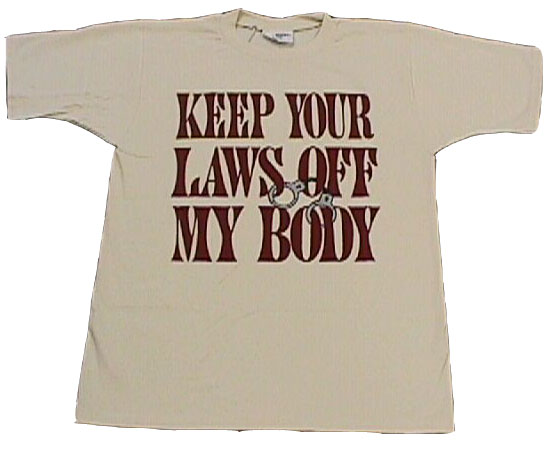
What this article really shows is that by going with a single-payer government system, each of us would be ceding the decisions about our health care, our bodies, and even lifestyle to the government.  So surely women's groups, who were at the forefront of fighting against government intrusion into our decisions about our bodies, is out there leading the fight against government health care.  WRONG!  Their privacy arguments stand out today as sham libertarian arguments that applied only narrowly to abortion.  It's clear that as long as they can get full access to abortion, women's groups are A-OK with government intrusion into people's decisions about their bodies.

So please, dedicated feminists are urged to comment.  How do I relate this T-shirt from the NOW web store:
Tskyl2

With this button from the NOW home page:
Codebluebutton

And a bit of text from their site:

People need and deserve universal, continuous,
and accessible health coverage that is provided by a single payer and
does not require full-time employment and a beneficent employer.
Learn more with our action toolkit....

With the recent release of Michael Moore's new movie, "SiCKO", and the
introduction in Congress of a bill to provide health insurance to all
U.S. residents, the movement for universal single-payer health
insurance is gaining momentum. This toolkit is provided to help you
take action on this important issue....

Health care is a right, not a privilege.

Al Gore's $100 Million Screensaver

This is an interesting study of the intersection of politics and science at NASA:

The new dramatic invention of the inventor of the Internet was to place
a satellite so far that the whole Earth can be observed 24 hours a day.
Isn't it fascinating? Why didn't you think about that? :-) Some
scientists refined the details for him - for example that the satellite
should be located in the L1 Lagrange point. The price? Well, the first
modest estimate was USD 135 million.

If you think about it for a
while, the scientific content of this project is next to nil. It is a
typical idea of a crackpot who has no tools to determine whether a
project is scientifically interesting or not. Already in 1999, during the Clinton-Gore administration, the project - nicknamed GoreSat or Gore's Screensaver - was more or less doomed. NASA Inspector General has also determined that the project is driven by politics, not science. It was found that the budget estimate was underestimated, too.

How
did they ever justify to study that project at all? Did they just tell
NASA that it has appeared in a dream of a prophet? Well, Al Gore wanted
the fresh picture of the whole Earth (well, just one-half, but it's OK)
to be constantly available as a source of inspiration: people could
finally see through the Internet, his other invention, that the Earth
is a little vulnerable child who has a fever. ;-) NASA added some
survey tasks, including measurements of the albedo every fifteen
minutes, that were not really needed and that are effectively performed
by existing devices, for example by CERES.

US Finally Fulfills Treaty Obligations, Maybe

After more than a decade, the US may finally allow Mexican truckers on US highways, something we actually agreed to in NAFTA:

The 9th Circuit Court of Appeals in San Francisco late on
Friday denied an emergency petition sought by the Teamsters
union, the Sierra Club and consumer group Public Citizen to
halt the start of a one-year pilot program that was approved by
Congress after years of legal and political wrangling.

I guess I can understand the Teamsters attempt to have the government shield them from competition -- that has practically become a national sport.  And I presume that the Sierra Club has some environmental concerns with Mexican trucks, though that seems flimsy given trucks must meet US environmental requirements and my guess is that Mexican trucks are at least as fuel efficient as US trucks.   But how can a nominal consumer group possibly justify this action?  Blocking competition in any part of the economy can only increase prices and reduce choices for consumers, particularly in an area like trucking that has almost no impact on the safety of the products actually being shipped.   I wish I could say this was some strange exception, but  consumer groups have for years backed protectionist efforts that do nothing but hurt consumers.

Via Cafe Hayek

The Perfect Political Bludgeon

I am often asked, "why, if the threat of global warming is really so overstated, does the issue have such legs with politicians, media, and activists?"

Answer:  Because it is the perfect political bludgeon.  One of the reasons I felt like high school debate really was broken (I don't know if it has been fixed since) was because every single debate eventually devolved into which side was more likely to cause a nuclear war.  It didn't matter if you were arguing about energy policy or the presidential primary system, no good debate case stopped short of blaming the other side for nuclear war.

Today, with nuclear weapons mostly forgotten (unfortunately not gone), global warming is the new nuclear war. It doesn't matter what you are arguing about:

There was Clare Short, a member of the British Parliament and Secretary
for International Development under Prime Minister Tony Blair until she
resigned in 2003 over the Iraq war. Claiming that Israel is actually
"much worse than the original apartheid state" and accusing it of
"killing (Palestinian) political leaders," Ms. Short charged the Jewish
state with the ultimate crime: Israel "undermines the international
community's reaction to global warming." According to Ms. Short, the
Middle East conflict distracts the world from the real problem:
man-made climate change. If extreme weather will lead to the "end of
the human race," as Ms. Short warned it could, add this to the list of
the crimes of Israel.

Great Moments in Marketing

Whose idea was it to rename Division I-AA college football as the "Football Championship Subdivision?"

Isn't This A Measurement Problem?

I often see the stat that US manufacturing employment has shrunk substantially over the last 50 or so years, usually accompanied by much wailing from the left (yes, the same people who criticized manufacturing work as dehumanizing 40 years ago).

The WaPo, via Hit and Run, says that US manufacturing output is at an all time high, and that the only way to reconcile these two is with technology and productivity.  Which is certainly part of the story, and its refreshing to see someone telling this story and not trying to cast the manufacturing numbers as a reason to slam the borders closed against imports.

But isn't there also a measurement problem here?  Eighty years ago, if a Ford Motor factory needed the windows cleaned, a Ford employee did it.  If it needed the parking lot striped, Ford workers did it.  When it needed the bathrooms cleaned at night, Ford janitors did it.  Today, the same Ford factory needs its windows and bathrooms cleaned, but an outside service contractor likely does the work.  In the economic statistics, haven't these workers migrated from "manufacturing" to "service" without anything real on the ground changing?

Internet Technology Bleg

Back in 2003 when I set up this blog, I knew less than nothing about how to do it.  I mostly did things in a way I am still happy with, but I made one mistake.  In setting up the domain mapping from CoyoteBlog.com to Typepad, I mapped CoyoteBlog.com to my entire Typepad account, not just this blog.  As a result, my permalinks take the form of www.coyoteblog.com/coyote_blog/blahblah.html rather than www.coyoteblog.com/blahblah. 

I now know how to fix it, but when the site republishes, I am pretty sure that anyone who has ever linked to a permalink on the site will get an error, because they will be remapped to the shorter address in the www rather than the /coyote_blog domain.  My question is this, if I access to all the A and MX and CNAME etc. records for CoyoteBlog, is there some way to calls the the www.CoyoteBlog.com/Coyote_blog/ domain to www.CoyoteBlog.com/ ?  If I can do this, I *think* my old permalinks will work.  Maybe. 

I probably will be too scared to try this, unless I can get a good solution for this problem