I am a little late on this, but here is the latest from Brink Lindsey, another member of the Princeton Tower Club libertarian blogger set:
Yet the return to peacetime and prosperity did not result in a shift back toward the status quo ante. The more egalitarian income structure persisted for decades. For an explanation, Krugman leans heavily on a 2007 paper by the Massachusetts Institute of Technology economists Frank Levy and Peter Temin, who argue that postwar American history has been a tale of two widely divergent systems of political economy. First came the "Treaty of Detroit," characterized by heavy unionization of industry, steeply progressive taxation, and a high minimum wage. Under that system, median wages kept pace with the economy's overall productivity growth, and incomes at the lower end of the scale grew faster than those at the top. Beginning around 1980, though, the Treaty of Detroit gave way to the free market "Washington Consensus." Tax rates on high earners fell sharply, the real value of the minimum wage declined, and private-sector unionism collapsed. As a result, most workers' incomes failed to share in overall productivity gains while the highest earners had a field day...
Krugman sees the rise of inequality as a consequence of economic regress"”in particular, the abandonment of well-designed economic institutions and healthy social norms that promoted widely shared prosperity. Such an assessment leads to the conclusion that we ought to revive the institutions and norms of Paul Krugman's boyhood, in broad spirit if not in every detail.
There is good evidence that changes in economic policies and social norms have indeed contributed to a widening of the income distribution since the 1970s. But Krugman and other practitioners of nostalgianomics are presenting a highly selective account of what the relevant policies and norms were and how they changed.
The Treaty of Detroit was built on extensive cartelization of markets, limiting competition to favor producers over consumers. The restrictions on competition were buttressed by racial prejudice, sexual discrimination, and postwar conformism, which combined to limit the choices available to workers and potential workers alike. Those illiberal social norms were finally swept aside in the cultural tumults of the 1960s and '70s. And then, in the 1970s and '80s, restraints on competition were substantially reduced as well, to the applause of economists across the ideological spectrum. At least until now.
The "treaty of Detroit" model, if it ever even existed in the first place, is merely NRA-lite, an echo of the Mussolini-style corporate state FDR tried to create before the war. Read the whole thing - Brink is, as usual, hard to excerpt.
One thing that is seldom mentioned in discussions of income inequality is the absolute wealth of the lower income brackets. The evidence is pretty strong that the lowest income brackets in the US do at least as well as comparable brackets in Europe (especially after you correct for immigration), which have pursued the corporate state model Krugman longs for. Our rich are richer, but our poor are about the same, and unemployment is systematically lower here. So the problem is, what? Just envy?
More on income distribution and mobility here.
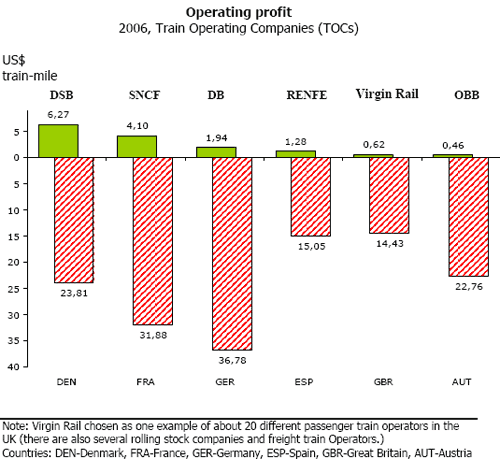 Postscript: I have always been amazed that greens get all misty-eyed at European rail. Sure, its cool to ride a fast train, but the cost of having an extensive passenger rail system is that most of Europe's freight pounds along highways, rather than via rail. In the US, the mix is opposite, with few passengers on trains but much more of our freight moving by rail. I would have thought that preferentially moving freight over rail rather than passengers was a much greener approach.