Watch Out - Your Industry May Be Gutted Like A Trout Next

I have written before about the  demagoguing going on about "health insurance profits" and just how BS those charges are.  Here is Obama yet again:

"There have been reports just over the last couple of days of insurance companies making record profits, right now," Obama said during a prime-time news conference. "At a time when everybody's getting hammered, they're making record profits, and premiums are going up. What's the constraint on that? ... Well, part of the way is to make sure that there's some competition out there."

This follows Pelosi saying:

I'm very pleased that our Chair of our Democratic Congressional Campaign Committee and member of the leadership will be talking too about the immoral profits being made by the insurance industry and how those profits have increased in the Bush years. We all believe in the profit motive; we all want to reward success.  But having that success come at the expense of America's working families "” have that success come by withholding care, when a person becomes ill, is just not right and we're going to take this issue in a new direction.

And pundits saying even crazier stuff, including Kevin Drum (who is actually one of the saner members of the left) writing:

It means the health insurance industry is scared that we might actually do something in 2009 and they want to be seen as something other than completely obstructionist. That means only one thing: they've shown fear, and now it's time to bore in for the kill and gut them like trouts. Let's get to it.

Rick Perry links to several posts debunking this claim, and shows a profit margin consistent with what I have found in my research -- about 3.3% of revenues, which my posts (linked above) showed has fallen over the last several years.  This profitability level ranks 86th(!) on the list of American industries, behind such rapacious industries as auto parts wholesalers and confectioners (see table in his post).  Look out everyone, if this industry is too profitable for this administration, then just about every industry in the country is too profitable.  Heck, this margin is even worse than mine, and I operate in an industry universally described as having "thin margins."

What do you call a man who thinks a 3.3% profit margin is too high?  How about "Marxist."

Update: My guess is that there is some health insurer who due to a merger grew larger and therefore made a higher profit in absolute dollar terms, so my guess is that Obama is not flat out lying.  But he is freaking close, given that he credits such profits to fee increases and denying services rather than business growth.  Profitability should be judged on margins, not total dollars (even better, it really should be judged on return on equity or return on assets employed, but that is rocket science to the economic monkeys wielding bone tools we have in the media).

Cash for Clunkers: $416 Per Ton of CO2 Reduction

Christopher R. Knittel of UC Davis has  a paper (pdf)  looking at likely CO2 reductions from cash-for-clunkers under a variety of assumptions.  The $416 figure per ton of CO2 avoided may actually be low, as it does not include the well-documented rebound effect of people with higher MPG cars driving more miles**.  Also, he admittedly assumes that cars being turned in will have average future driving miles for a car of similar age, though there is anecdotal evidence that in fact the cars being turned in are driven less than average.   Under these assumptions, the cost may be as high as $600-$1000 per ton.

The analysis looks pretty thoughtful, with the proviso (which the author is the first to make) that data on the program and cars bought/turned-in is still sketchy.  The interesting part was that there were no reasonable assumptions that even got the price within an order of magnitude of the $28 per ton clearing price the CBO estimates under cap-and-trade.

As a CO2 reduction program, this is the equivalent of the military's $700 toilet seats.  But of course we all know that no one ever really considered this an environmental or even stimulus bill.   This was always first and foremost 1) another Easter egg subsidy for the middle class and 2) a back door way to subsidize GM and Chrysler to try to make the Administration's investment in them look better.

** This is straight supply and demand -- reduce the cost of miles driven, and people will drive more miles.

More Liquor License Woes

Apparently after 20 months of effort, I am within spitting distance of getting one of two liquor licenses I am applying for in Ventura County, California (the other had to be completely restarted due to some paperwork mistakes).

I had to just laugh at the last remaining hurdle.  A part of the licensing process is to post a public notice at the site.  The ABC called me and said they are holding my application until they get my affidavit of posting -- this is a one page form with my signature stating on what date the facility was posted.

But here is the funny part -- the ABC representative who is calling me actually posted the site herself.  She visited the facility as part of a mandated inspection and then posted the site.  The only way I knew what date the site was posted was by asking her.  So ABC is requiring that I submit a form to tell them what day they themselves posted the site, a date I had to get from them before I could put it on the form to send back to them.

Coming soon:  The Affidavit of Elevated Body Temperature and/or Vomiting that must be submitted before obtaining a doctor's appointment.

I Wondered Why They Weren't Pounding the US

Usually an article like this would blame the US:

Global carbon dioxide emissions in 2008 rose 1.94 percent year-on-year to 31.5 billion tonnes, German renewable energy industry institute IWR said on Monday, based on official information and its own research.

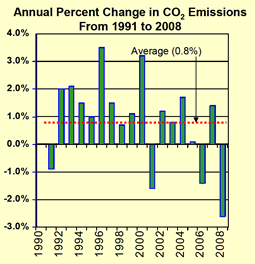
Several other leftish / alarmist sites picked up the story, but still didn't hammer the US, saying only that the US is the largest contributor to total emissions but not whether it contributed significantly to last year's rise.  It turns out there is a reason for this.  US emissions were actually way down, falling far faster than the drop in economic growth:  (from the EIA)

slide01

The story tries to put a positive spin on Europe  (again, the preferred story line is always Europe-good-America-bad):

Carbon dioxide emissions from heavy industry participating in the European Union's Emissions Trading Scheme fell 3.1 percent last year compared with 2007, the EU's executive Commission said in mid-May

This is a carefully worded cherry-picking on one sector of the economy.  I would be willing to bet almost any amount of money that the rest of Europe's economy saw less of a drop or even an increase.  Even so, the cherry-picked sector, the one subject to cap-and-trade, still underperformed the US.  Overall, US emissions have fallen since 2000 without any real regulatory program and just the normal incentives of economic efficiency at work.

The US is NOT the problem when it comes to future emissions growth.

230 MPG?

Update:  230 MPG turns out to be, as I suspected, total BS.  Make sure to check out update at bottom

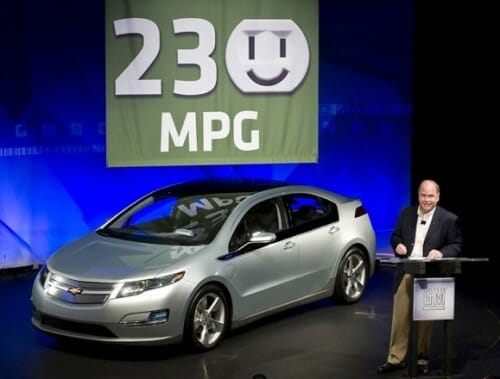
Apparently under new methodology, the Chevy Volt got an MPG rating of 230.

we're told that the Volt has snagged a staggering 230 MPG rating in the city, but we should caution you that it's not as cut and dry as GM would have you believe. The EPA has released "a new methodology for determining a draft fuel economy standard for extended-range EVs like the Volt," and it's that murky measurement system that has blessed Chevy's wonder child with a triple digit MPG rating.

230-mpg-chevy-volt

Forget for the fact that the whole terminology is meaningless, as the vehicle only burns liquid fuel for a portion of its energy needs, so "miles per gallon" is an odd concept.  But one could imagine that one could look at the miles per electrical charge, and then look at the equivalent gallons of gasoline-equivalent BTU's it took to deliver that electricity, and create an equivalent MPG.  In fact, that's the only approach that makes any sense to me.

If so, these numbers imply that it is 10x more efficient to burn hydrocarbons in a large utility plant boiler or gas turbine, convert the combustion energy to electricity, transmit that electricity hundreds of miles, charge up a set of car batteries, and then drive an electric traction motor from the batteries than it is to burn hydrocarbons directly in an internal combustion engine in the vehicle.

If this is really the case, then I have been selling electric cars short and we will all soon be buying them (I prefer the performance of an electric engine so this kind of fuel savings is just icing on the cake).  However, I have my doubts.  While certainly a large power station is much more efficient in using all the BTU's in a fuel than is an internal combustion engine, when one considers losses in the electrical generation and line losses, I find it very very hard to believe the difference is 10x.

But I am sure there is no conflict of interest here, and that it is pure coincidence that GM is owned by the same people who created the new methodology and did the testing, and given that the new methodology was created by the same people who have been pushing electric cars as a policy alternative.

Update: The 230 MPG figure is even more BS than I thought.  Apparently, MPG while running on batteries is treated as infinite!  In other words, electricity is treated as "free" and not costing anthing in terms of fuel. Check out how the math is done

When gasoline is providing the power, the Volt might get as much as 50 mpg.

But that mpg figure would not take into account that the car has already gone 40 miles with no gas at all.

So let's say the car is driven 50 miles in a day. For the first 40 miles, no gas is used and during the last 10 miles, 0.2 gallons are used. That's the equivalent of 250 miles per gallon. But, if the driver continues on to 80 miles, total fuel economy would drop to about 100 mpg. And if the driver goes 300 miles, the fuel economy would be a just 62.5 mpg.

This is entirely consistent with the bizarre way electric cars have always been treated by environmentalists and politicians, as if the electricity is free and they have no  hydrocarbon use or CO2 production.  Which is weird, since we get harangued for our incandescent light bulbs destroying the world when we plug them in but plugging in a whole car does not?

That being said, if one really wanted to move away from hydrocarbon fuels, the smart approach is probably to go with electric cars and then attack electricity generation rather than transportation.  I will feel good plugging in my car because the juice will come from a big honking zero-emissions nuclear plant.

From Nobel Laureate to Political Hack

From the AZ Republic, Paul Krugman is claiming that the administration's stimulus spending, which I don't think has even reached $100 billion of the programmed $1 trillion, has officially averted another Great Depression:

Aggressive stimulus spending by governments helped the world avoid a second Great Depression

but full economic recovery will take two years or more, Nobel Prize-winning economist Paul Krugman said Monday....

"We have managed to avoid a second Great Depression ... but full recovery is at least two years and probably more," Krugman said.

This is just a pure joke.  First, the total additional spending was tiny compared to the size of the world economy.  Second, almost none of the stimulus money has actually been spent -- even the article goes on to say that "Most of the money will flow in 2010."  So is Krugman arguing that just the notion of stimulus spending, without the actual spending, has saved us?  Third, most of the early projects were typically stupid, whatever governments could ram through their procurement processes in a short period of time.   I challenge even the most ardent Keynsian to argue this stimulus was truly structured to target underutilized resources, or whatever their theory is.  I would love to see Krugman stand up in front of a doctoral committee and justify this wild-assed supposition with actual facts and analysis.

But the even more incredible unproven (and in fact entirely non-verifiable) part of the statement was that we were even headed for a second Great Depression anyway.  Many of us from the sidelines said that this looked like a recession similar in magnitude to that of the early 1980's, and in fact that appears to be exactly what we got.  The whole "second Great Depression" meme is merely a giant straw man used first to stampeded ill-conceived spending legislation through Congress with little scrutiny and now to provide a fake alternative against which Obama and company can declare victory.   Krugman is so far in the tank, its impossible for me to even think of him as an economist any more.  The Nobel Laureate who now retails non-verifiable claims.

The fact is that this was a normal recession blown out of proportion first by the Bush and later by the Obama administration.  From the very beginning, it looked much like the recession of the early 1980's or the bank crisis of the early 1990's, and it recovered for the same reason - there are fundamental strengths in the economy.  In fact, the length of the Great Depression was in fact the aberration, caused more by FDR's wild proposals (the worst of which was the National Industrial Recovery Act) which tended to dampen the investment that normally picks up at the bottom of the cycle to take advantage of reduced asset values and input costs.

Other Assertions by Krugman

Interestingly, economist Krugman appears to think that the problem with the financial system is that people can make money in it.  Really?  Gosh, I thought people just invested billions of dollars for the warm feeling it gives them:

He said there was a need to restructure the global financial system and impose tighter regulations to avoid a repeat of the economic crisis, but expressed concern that the momentum for reforms appeared to be easing.

"We do not have the political will to do that just yet ... I suspect clever people can still make a lot of money from the financial system in the next few years," he warned.

I also thought this was funny, in the context of the recent financial mess.  He says:

"Over-reliance on self-regulation is a mistake," he said. "Global regulators should err on the side of investor protection and financial stability rather than rely on a 'buyer beware' regulatory regime."

I must say it is surprising to see Krugman saying this.    Let's think about mortgages, the primary driver of the recent financial difficulties.  In mortgages, the investor is the bank making the loan.  So is Krugman advocating for more protection of mortgage lenders and their insurers like AIG against home buyers who take their money and then don't pay them back?

Update: Oh, and TARP never bought any troubled assets, just was used to bail out a few selected politically connected companies.

66,667% Contingency Fee

Via Overlawyered:

The settlement discussed in this space July 17 "” in which lawyers nabbed more than $25 million in fees and expenses, while fewer than 100 consumers redeemed Ford coupons worth $37,500 "” was covered by the Associated Press last week, which stirred outrage in many quarters [Krauss/PoL, Greenfield, Cal Biz Lit]. As Cal Civil Justice notes, the settlement was purportedly on behalf of owners who suffered no rollover or other mishap. Instead, it sought damages for losses in the vehicle's resale value due to adverse publicity, a nicely circular theory, since the adverse publicity was in good measure propelled by various allies of the plaintiff's bar.

Shame On Executives For Flying Private Jets...

...only those of us in Congress get to fly private jets

Congress plans to spend $550 million to buy eight jets, a substantial upgrade to the fleet used by federal officials at a time when lawmakers have criticized the use of corporate jets by companies receiving taxpayer funds.

The purchases will help accommodate growing travel demand by congressional officials. The planes augment a fleet of about two dozen passenger jets maintained by the Air Force for lawmakers, administration officials and military chiefs to fly on government trips in the U.S. and abroad.

The congressional shopping list goes beyond what the Air Force had initially requested as part of its annual appropriations. The Pentagon sought to buy one Gulfstream V and one business-class equivalent of a Boeing 737 to replace aging planes. The Defense Department also asked to buy two additional 737s that were being leased.

Lawmakers in the House last week added funds to buy those planes, and plus funds to buy an additional two 737s and two Gulfstream V planes. The purchases must still be approved by the Senate. The Air Force version of the Gulfstream V each costs $66 million, according to the Department of Defense, and the 737s cost about $70 million.

Even the richest of private companies blush at the prospect of buying Gulfstream V jets, the absolute top of the line in business jet luxury.  Except, of course, for the ridiculously oversized Boeing Business Jet, of which Congress appears to be buying 3 (the BBJ is the business version of the 737).  I am sure there is one, but I can't think of a single Fortune 500 company, and I have worked for and with a lot of them and flown on their jets, that has even one BBJ.

I can understand why certain officials need to fly private planes just for security, but the average Congressman from Wyoming?  Why won't commercial work.  Andy why, if they must have  a private plane, wouldn't a more reasonably sized Falcon 50 or Citation work just as well?

Update: Several people have found it ironic that the White House threw a fit over $300+ million for funding of new warplanes but hasn't blinked over $500+ million to ferry Congress around in luxury.

Update #2: An example of the BBJ.  This is how you fly, right?

boeing_bbj_int1_lg

Our Opposition Party Sucks

Doesn't anyone speak for sanity any more?

Washington runs on political leverage, and at the current moment few people have more of it than Chuck Grassley. President Obama is desperate to have the Iowa Republican sign on to some version of ObamaCare to give cover to jittery Democrats. So in a remarkable noncoincidence, the Obama Administration decided to roll over last week on one of Mr. Grassley's major concerns: ethanol.

OK, we will give in to your ridiculous use of government power if you will accept our ridiculous use of government power.   Lots more on the complete waste of money and time that is corn-based ethanol here.

Cost of Insurance "Reform"

To some extent, there are signs Obama may be willing to walk back health care "reform" to just insurance "reform," though the two are highly related.  As a minimum, insurance "reform" is likely to include rules that no one can be denied coverage, community rating, and minimum covered service requirements.

These are really, really expensive.  Megan McArdle on the NY experience:

John Cole takes me to task for not knowing that health insurance premia have tripled in New York State.  Indeed, he's right--I should have checked.

But this is not the "gotcha" the left believes.  I erred so low because I was trying to be charitable to the cause of national health care.  You see, the reason that insurance premia are so high in New York State is that New York State enjoys community rating, guaranteed issue, and a very generous bevy of mandatory services.  The result is that the cost of insurance is very, very high.  What I failed to realize was just how radically out of line New York's rules had pushed its health care costs.  The average premium across the United States has increased about 25% since 2004.  In New York, the rate of inflation has apparently been about 16 times that.  I wasn't "aware" that insurance premiums have doubled and tripled over the last seven years, because for the country as a whole, this isn't true.

McArdle is sometimes irritating in bending over backwards to be fair to folks whose views don't deserve such charity and who would not ever extend the same favor back at her.  So it is kind of fun to see her going a bit postal over the last few days.

Paging Frédéric Bastiat

The US Forest Service is using a million dollars of its stimulus money to ... fix broken windows! How appropriate.  But these are not any broken windows -- these are energy inefficient windows for a visitor center that was closed two years ago and for which no budget exists now or in the future to reopen.   Beyond the nuttiness of building a multi-million dollar visitor center, then closing it only a few years after it was built, and then spending a million dollars on its abandoned carcass, no one was available to explain how energy efficient windows will save money in a building that shouldn't be using any energy any more.  Remember, for this spending to truly be stimulative, the money has to be spent more productively than it would have been in whatever private hands it was in before the government took it.

But even forget the stimulus question and just consider the issue of resource allocation.   I work on or near US Forest Service lands in many parts of the country, and know that their infrastructure is falling apart.  Congress loves to appropriate money for new facilities (like shiny new visitor centers), but never wants to appropriate money for capital maintenance and replacements of existing facilities.  So there are plenty of needs for an injection of $274 million in capital improvement money.  And I know that the USFS has had teams of people working for 6 months on their highest priorities.  And after all that work, they allocated  almost a half percent of their funds on upgrading windows in an abandoned building?

Postscript: I have vowed not to write about the US Forest Service because I interact with them so much and such interactions would not be improved by my dissing on them online [I am in the business of privitizing the mangement of public recreation and am constantly working to convince the USFS and other recreation providers to entrust more to private companies.  One thing many people don't know -- the USFS is by far the largest public recreation provider in the world, far larger than the National Park Service or the largest state park systems].  However, I feel on safe ground here, as I think virtually every frontline USFS employee I know would agree with this post and be equally angry.  In recreation at least, this is an organization that begs and pleads to get a few table scraps left over after the National Park Service is done eating, and it is crazy that they spend the few scraps they get this poorly.

Reading the Health Care Bill

Here are some notes on the health care bill from one person who plowed all the way through it.  Some of the interpretations are a bit over the top, but I find it a useful index to help me find relevent sections I want to read in more detail.

Cooking the Books on Cash for Clunkers

From CNN via NRO:

NEW YORK (CNNMoney.com) "” What are people trading their clunkers in for? It depends on who you ask.

The government's results showed small cars as the top choice for shoppers looking for Cash for Clunker deals. But an independent analysis by Edmunds.com disputed those results, and showed that two full-size trucks and a small crossover SUV were actually among the top-ten buys.

The discrepancy is a result of the methods used. Edmunds.com uses traditional sales measurements, tallying sales by make and model. The government uses a more arcane measurement method that subdivides models according to engine and transmission types, counting them as separate models.

For example, the Ford Escape is available in six different versions including two- and four-wheel drive and hybrid versions. The government counts each version as a different vehicle using guidelines from the Environmental Protection Agency. Only the front wheel drive, non-hybrid version made the government's top ten list.

The Ford Escape crossover SUV, instead of being the seventh-most popular vehicle under the program, as the government ranked it, was actually the best seller, according to Edmunds.com. The government pegged the Ford Focus as the top seller.

Trucks tend to be available in more variations than cars. That's because truck buyers have a wider variety of needs than car buyers, General Motors spokesman Brian Goebel said.

"There's just so many different uses for the truck, both retail and commercial, than with car purchasers," he said.

The Edmunds rankings, shown in the NRO link above, actually solve one problem for the Obama administration but create another.  The Edmunds list has far fewer foreign cars, overcoming the criticism the program has gotten (not from me!) for promoting sales of non-American nameplates.  But it creates another problem, in that most of the cars on the Edmunds list are relatively low MPG, obviating the whole point of the program.

Our Post Racial Society

I have never gotten as bent out of shape by reverse discrimination charges as have many Conservatives.  If private organizations, for whatever reasons, choose to relax standards to let certain groups into their businesses or universities in larger numbers, so be it.  I find it outrageous that this is considered "progressive" when done in favor of certain races, and "racist and evil" when done entirely symmetrically in favor other other races, but I am still all in favor of letting private organizations set their own admissions or hiring standards.  Public organizations, of course, are held to a different standard, and my reading of "equal protection" has always been that standards really should not vary across races.

That being said, I found this amazing.  For the reasons stated above, I am not ready to get up in arms about it, but I do think the extent of the asymmetry in standards is much greater than most people would guess.

How You Know You Are Winning An Argument

One thing I have learned from a number of years of being a vocal climate skeptic on the web:  When group A makes an argument, and group B responds only with ad hominem attacks on motivations and funding sources, then group A is winning.  It may not seem that way in the media, mainly because the media has gotten to the point where they accept ad hominem attacks as valid rebuttals to scientific or policy arguments.

Remember that charges of faulty motivations, being funded by evil scheming organizations, or even of racism are effectively admissions of weakness.  People who make such arguments are basically admitting that they cannot argue the issue on its merits, and so must resort to tarring the other side so that they can say the people raising the issue don't deserve a response.

My Definition of Sustainability

I was going to respond to this goofy post on sustainability, but it would just be wasted time for this audience.  I think most of you can spot the errors and non sequiturs.  The heart of the problem is that the folks discussing "sustainability" have far more faith in the goodwill of people who deal with them through force (ie the government) than the folks who deal with them only via mutual consent (e.g. private enterprises).

I have never understood this attitude -- sure, the private guy on the other side of my transaction may be ridiculously wealthy, but he got that way only by being able to provide a service people are willing to buy of their own free will at a price that actually covers his costs**.  No one ever volunteers to consume government services unless they are 1) forced to do so (as in public schools or a government supported monopoly) or 2) the service is heavily subsidized (meaning it doesn't not cover its costs).

Which led me to my definition of sustainability, which I think is particularly important in this time of absurdly skyrocketing government spending.  Sustainability in my world means being able to supply a product or service that people are willing to buy of their own free will for the price I specify or that we negotiate, without any sort of coercion.  And that this price charged covers not only my costs, but covers the capital costs of continuing to improve my offering in order to fend off potential competitors.  And that this price further yields me a profit which pays me for my effort and gives me the incentive to keep providing this product or service.

In a free society, the ultimate measure of sustainability is profits.   Profits are what make the division of labor possible, which in turn is the only approach we have ever found to living above a subsistence level.  Without profits, activity beyond subsistence only occurs through coercion at the point of a gun.  If an activity does not yield us surplus, does not reward us for our time spent, then we only pursue it if our rulers use force to make us do so.

iPods and Dell computers and Big Macs are sustainable.  Government health care and cash for clunkers and the Post Office and Amtrak and about everything run by the State of California are not -- except when the government uses its power of force to grab the money it needs to close their budget gap or restrict individual choices or both.   The Post Office is a great example -- the government uses force to take money via taxes from citizens to cover its operating losses, which the Post Office incurs even though the US has used force to prevent anyone from competing with its first class mail business (particularly the most profitable segment, intracity mail).  And still, I might add, the Post Office is going bankrupt.

Look at Exxon vs. Amtrak.  One runs for profit, and in fact gets excoriated for its profits, while the other is run by the government and is lauded for its beneficence.  Which has proven the most sustainable?

And private enterprise has checks on their behavior that don't exist for monopoly government offerings.  When private businesses screw up, or become senescent, or even corrupt, and fail to cover their costs, they are supposed to go bankrupt.  For all the public handwringing about Enron being a bad example for capitalism, it was in fact a victory for capitalism  --  an unsound, possibly corrupt, business died.  Unsustainable business models, whether they be banks making nothing down mortgages or car companies producing bad cars, fail -- in fact, they are supposed to fail -- and resources are diverted to sustainable companies and businesses.  Except when .... you guessed it .... the government intervenes to prevent this from happening by bailing out bankers and manufacturers alike because those companies are owned by or employ people who helped get the president elected.

This renewal never happens in government.  We still have Amtrak, despite nearly 40 years of losses.  We still struggle with the post office and the DMV.  Heck, we still have state alcohol boards fingerprinting bar owners and running FBI checks on them to make sure we are not Al Capone, a problem that went away with the end of prohibition 3 generations ago.

Postscript: A part of the linked post is also a plea by two progressives for more protectionism.   Clearly, these two folks don't agree with the majority economic opinion that protectionism is bad for all nations.  But let's accept their premise for a moment.  Let's assume, as they do, that trade is a mercantilist zero sum and that protectionism would net boost our economy.   They are essentially advocating that the US, the wealthiest country on Earth, protect its workers to the detriment of poorer workers around the world.  Is this really the progressive position?

Postscript #2: A good question I have been using for people lately who show great confidence in the government's ability to solve problems through coercion:  "Imagine what powers you want to give the government.  Now, imagine your political opponents in the _____ Party wielding those powers.  Are you still happy?  If not, what are you counting on?  Point to the period in history where the same party held the presidency for 30 or forty years straight."  This question works well because almost everyone who favors giving coercive power to the government imagines only themselves or their allies wielding this power.

** Footnote: OK, the guy in private enterprise may also have gotten rich from rent-seeking and government favoritism,  but is that a failure of free enterprise or government?    I would normally have said this was a rhetorical question -- clearly, to me at least, rent seeking is the result of a system that gives government employees power over individual decisions.  In a country of strong personal liberties and limited government,  rent-seeking is much much harder.  But my liberal mother-in-law is totally convinced that rent-seeking is not the fault either of the structure of the government or the individual occupants of government but totally the fault of private businesses, and that only more regulation will stop it.
Regulation Is Almost Always Anti-Competitive

Continuing with a long-running theme here at Coyote Blog, here is another example of government regulation being anti-competitive and having the net result of protecting the margins of powerful, established incumbents against new entrants:

During a recent meeting, the Antiplanner was extolling the virtues of Houston's land-use policies, and a home builder at the meeting said, "Of course, no one here wants our city to be like Houston," meaning no one wanted Houston's land-use regime.

Why not? I asked. "There is too much competition down there. My company can't make a profit," he said. "You have to have some barriers to entry to be able to make money."

Those who accuse free marketeers of being supporters of big business don't realize that big businesses (and often smaller businesses) don't want a free market. In this home builder's case, he wanted enough restrictions on the market to keep out some of his competitors (most likely smaller companies that can't afford to hire lawyers and planners for every project) but not enough regulation to keep his company out

Several years ago my company had to obtain a liquor license in Shasta Country, CA. At one point, the issuance of the license had to be voted on by some group (County commissioners, the planning board, something like that). I was told the reason was that if they issued too many licenses, I would not be able to make money -- really, they were looking after me.

Well, not really.  First, the government seldom has any idea even how a business works.  Perhaps the liquor was a loss leader for my business, and I didn't care to make money on it at all.  Perhaps I had a better marketing concept.

And herein we get to the real flaw -- the implication is that somehow the dangers is to the new entrant in a crowded marketplace, but in fact the reality is often the opposite.   The actual competitive danger is often to incumbents, fat and happy with the status quo and unable to react quickly (due to all kinds of reasons from sunk investment to long held biases) to shifts in customer preferences.  No matter what their stated reason, the true effect of such regulation is to protect current competitors from new entrants, new products, and new business concepts.

I can see the effects of this right here where I am sitting, out near the end of Cape Cod.  Zoning and business regulation here is enormously aggressive - its is virtually impossible to start a new retail establishment here, particularly on virgin land.  As a result, every store and restaurant here feels like it is right out of the 1950s.  You'd hardly know there has been a revolution in retail or service delivery over the past few decades, because businesses here are sheltered from new entrants.  They don't need to adopt better practices or provide better products or services, because they know they are not vulnerable (courtesy of the government) to competitive attacks from new entrants using more modern strategies.

Clunker Rent Seeking

I thought this was pretty illuminating, from Tim Carney via Hit and Run.  He is writing about lobbying efforts for and against an extension of cash for clunkers:

One lobbyist for this bill was Nucor Steel. In Cayuga County, N.Y., Nucor turns scrap steel into sheet metal and other steel products. The clunkers are now becoming a subsidized feedstock for Nucor, which helps explain why Sen. Chuck Schumer, D-N.Y., has led the push for $2 billion extra in clunker cash.

Then there's Enterprise Rent-a-Car also backing the bill, supposedly out of solidarity with automakers. But Enterprise sells its rental cars after a few years. As a rental firm that buys its cars new, Enterprise benefits every time someone else scraps a used car.

On the other side of the lobbying debate were non-dealer auto-repair shops, whose businesses depend on used or older cars, which the owners don't take to the dealer for repair. Also, the Automotive Aftermarket Industry Association opposed the bill.

These are the guys who can sell you the headlight for your 1998 Ford Taurus, or who rebuild an engine out of a junked car.

Shredding old cars saps both their clientele and their supply of old transmissions to rebuild.

My Favorite Quote of the Day

From a Chicago Tribune editorial on the city aldermen blocking Wal-Mart construction in the city, via Carpe Diem:

Organized labor doesn't like Wal-Mart because Wal-Mart doesn't have union jobs. It just has jobs (with an average hourly wage of $12.05 in Chicago). The aldermen, of course, already have jobs. They get paid $110,556 a year and they figure that as long as they keep the labor unions off their backs, they'll keep making $110,556 a year.

Who says the City Council doesn't generate jobs? If you're one of the 50 aldermen, your unemployment rate is 0 percent. But the unemployment rate for the rest of Chicago is above 10 percent. One in 10 Chicagoans is out of work.

Can You Imagine If Oil Companies Did This?

I remember in the 1970s the sight of oil company executives getting dragged before Scoop Jackson's committee in Congress, forced to defend themselves against charges they were holding tankers offshore to drive prices up.  Hilariously, this was at the exact same time oil company executives were testifying in front of a Congress begging legislators to allow them to build the Alaska pipeline.  But demonizing oil companies simultaneously for both decreasing and increasing the supply of oil has been a tradition for decades.

Anyway, I have always found it intriguing how behavior in one industry made unsympathetic by the media can be treated so differently from identical behavior in a more media-cherished industry.  Check this out:

U.S. dairies will remove 86,710 cows from their herds to be sold to slaughterhouses as part of an industry-funded program intended to boost milk prices by curbing output.

The buyout is the third such cull in nine months, the Arlington, Virginia-based National Milk Producers Federation said today in a statement. The most recent buyout completed last month involved 101,000 cows, the most ever for the groups so- called Cooperatives Working Together program, which began in 2003.

Note further that this appears to be acceptable behavior in milk but not in oil, despite the fact that milk is heavily subsidized and the beneficiary of government price supports while oil companies simply pay a whole boatload of taxes.

It turns out there is one other such example in the news, where an industry is destroying hundreds of thousands of units of inventory, with the inevitable result of raising prices (particularly to the poor), all with the facilitation and in fact funding from the Obama Administration.  Can you guess what that is?

Liquor License Hell

A while back I challenged anyone who doubted the burden of regulation to go try to get  a California liquor license.  Today, John Stossel echos the same theme in this post.

"The authority's 26-page "on-premises" application requires owners' detailed financial information, prior employment experience, proof of citizenship and floor-plan details, and it also entails fingerprinting and background investigations. It asks whether music will be played (and if so, what kind) and whether dancing is planned"¦ Such was the complexity of the application process that "I visited the office so many times, it got to the point where the guards stopped asking me for identification," Steve Chahalis said.

I can concur with this experience. In every state I have gotten licenses, I have encountered a bureaucracy that has pretty much forgotten even why it exists or what it is trying to achieve. The Department of Labor can be a pain in the butt, but it at least it has a mission (protect workers from depredations by "the man"), even if that mission is sometimes misguided. But it is impossible to even figure out what problem state liquor boards are trying to protect us from with some of the detailed questionnaires and picayune attention to detailed responses**.

Yet the Times and the bureaucrats have the nerve to blame the businesses: "Restaurant and bar owners are to blame for some of the delays" says the reporter, quoting a state bureaucrat who says: "Ninety percent of the applications are incomplete when submitted."

LOL. Let me give you one example. I had to cancel my entire application, on which I had spent over a year, resubmit a new application, and pay an additional $200 in fees all because on one form (out of scores) there was a typo that showed the address on "Lake Pire Rd" rather than "Lake Piru Rd."   So was this my fault, having a typo in thousands of words of application responses, or the fault of the state liquor board's for not just hand annotating the typo and moving on? If you told me that the main guiding principle of ABC operations was to find a way to reject and send back every single application for even the most trivial of reasons, I could not muster any evidence to disagree with you.

I always complete the applications myself, but I may finally give in on the next California application. In California, the state is full of consultants who will fly your application through the process. Anyone want to guess who these consultants are? If you guessed "retired government alcoholic beverage commission employees," you win. This is the retirement plan they have created for themselves -- make the process so onerous for individuals trying to navigate it that they are forced to use a retired ABC employee as a consultant, after which the process magically goes smoothly.
By the way, this is also another good example of how large corporations are benefited by regulation vs. smaller competitors.  TGIFridays, for example, has a whole department of people who just do liquor licenses.

**Postscript:  Part of the problem is that states are trying to protect us from Al Capone -- thus all the fingerprinting and background checks.  But that problem was solved with legalization.

Report Dissidents to the White House

Several people have emailed me this: Apparently the White House web site is asking that you report anyone writing things on health care that don't match the Administration position so the White House can "keep track".

There is a lot of disinformation about health insurance reform out there, spanning from control of personal finances to end of life care. These rumors often travel just below the surface via chain emails or through casual conversation. Since we can't keep track of all of them here at the White House, we're asking for your help. If you get an email or see something on the web about health insurance reform that seems fishy, send it to flag@whitehouse.gov.

Wow, "disinformation."  You wonder why people ever listen to those counter-revolutionaries and aren't satisfied with just reading Pravda.

Well, we at the global headquarters of CoyoteBlog Enterprises are certainly happy to help.  I sent them this email today:

Thanks for the opportunity to report disinformation where people write things that don't match what the President is saying on health care.  Please check out this document I found on the web -- a number of parts bear very little relationship, and in fact outright contradict, what the President is promising about health care reform.

The link is to a copy of the House health care reform bill.  If you are so inclined, you might wish to offer similar help.

Postscript: My son, who is a big fan of dystopic novels like George Orwell's "1984" might ask if he would get extra credit for turning in a family member.

Update #1: The White House site in question is really ridiculous.  It responds to critiques of what is actually in the bill with statements like "the President has consistently said that if you like your insurance plan, your doctor, or both, you will be able to keep them."  Well duh, of course he has.  But this President, even more than the average President, will say just about anything.

At this point, since the President is purposely uninvolved in the crafting of the legislation and has admitted at times that he doesn't even know the details of what is in it, talking about his promises or preferences is irrelevant.   In fact, nobody is talking about the President's promises and intentions any more, with actual legislation on the table.   They are talking about what is actually in the written bills in the House and Senate.

So the question is, what is in the actual legislation, and does it match Obama's promises, and the current answer is clearly "no."  And will the President veto a health care bill that doesn't follow through on his promises?  Don't make me laugh.  He is going to sign any bill with "health care" in the title no matter what it says -- his advisers have already made that clear by saying that the entire Presidency is riding on having some kind of bill pass that does something with health care.

By the way, in this we can see the White House strategy for passing such controversial bills.  Their hope is to jump directly from the President's "everyone is a winner and there is no cost" rhetoric directly to signed legislation.  They want people focused on his promises, which are enticing, and not the reality of the actual language of the bills, which is ugly and in many ways bear no relationship to the President's rhetoric.  This worked for the stimulus and almost worked for Waxman-Markey and was tried again for health care.

Eeek! The Brits Have REALLY Lost Their Way

I am really left speechless by this.

The Children's Secretary set out £400million plans to put 20,000 problem families under 24-hour CCTV super-vision in their own homes.

They will be monitored to ensure that children attend school, go to bed on time and eat proper meals.

Private security guards will also be sent round to carry out home checks, while parents will be given help to combat drug and alcohol addiction.

Around 2,000 families have gone through these Family Intervention Projects so far.

It actually undershoots the mark to call this "Orwellian," since in "1984" the government monitoring was aimed mainly at combating subversive thought and behavior.  But the Brits are going one better, monitoring families to make sure their kids are eating their vegetables and getting to bed on time.

Incredibly, the oppositions response is that this is... not nearly enough intervention!!!

But Shadow Home Secretary Chris Grayling said: "This is all much too little, much too late.

"This Government has been in power for more than a decade during which time anti-social behaviour, family breakdown and problems like alcohol abuse and truancy have just got worse and worse."

Is there any voice left for individual liberties in England?  Am I missing something here?  This seems simply horrible.  Is there at least due process involved, such that such measures can only be imposed as a result of a criminal conviction (I don't think so, from my reading of the story and comments -- I think this is like Child Protective Services in the US, with a lot of not-subject-to-due-process intervention powers, but maybe my UK readers can fill in more detail).

I liked this from the comments:

These cameras should be in MPs homes so we can see what the scumbags are up too.

Ditto for Congress.  And how about a Lincoln Bedroom cam?

Hat Tip:  Engadget

State Science Institute

A number of folks, including myself but more prominently Megan McArdle, have argued that a big problem with nationalized health care schemes is that these plans threaten drug innovation in the US  (which is really the last remaining source of drug innovation in the whole world).

The argument is that nationalization schemes will likely hammer drug prices through price controls down to marginal cost, eliminating any profit motive for expensive drug development.  Further, new drugs will be hampered by having to convince government health care czars that the drug should be allowed under proposed proscriptive, top-down systems of allowed medical procedures.  Risk-adverse beauracrats faced with inevitable budget overruns are unlikely to take the chances with new procedures that the private world takes every day.  (And if you don't believe that budgets will be immediately overrun, look at cash-for clunkers, where 5 months of funds were used up in 5 days -- people may not like the government, but they will take free money and services in near infinite amounts).

Well, I had thought that the response to this argument from health care "reform" supporters would have been something like "private incentives to develop drugs will still exist because of X or Y."   But apparently, they have given up on that argument and jumped all the way to the argument that even without any private drug companies, Dr. Robert Stadler and the State Science Institute will do all the drug development we need.

Megan McArdle responds in depth here.  I think there is a simpler argument.  Look at something like computers or machine tools.  Innovation in these free markets occurs all over the world, and new inventions and products are as likely to come from Korea or Japan or Germany than from the US.  But in the world of pharmaceuticals and new medical devices, a wildly disproportionate share come in the US, the last semi-free health care market in the world.  And even those new products developped in other countries are funded and capitalized based on their profit potential in the US.

Demanding All The Improvement From Drivers

I have already written how Waxman-Markey, by the way in which it allocated free carbon permits, effectively demands almost all the reduced carbon dioxide over the first decade to come from drivers  (rather than electricity consumers or utilities).  Incredibly, even coal fired power plants get what amount to a free pass, while the increasingly efficient transportation sector must bear all the burdens.

Reuters has more on this phenomenon.   The article focuses mainly on "pain to refiners" but anyone with a modicum of economic sense will know that an industry with a single digit margin is not going to bear the cost of these changes - consumers of transportation fuels will through higher prices and more uncertain availability.

Ailing U.S. oil refiners could face a crippling period of contraction under a House-approved climate change bill, making the country more dependent on imported refined products.

The so-called cap-and-trade bill narrowly passed by the House of Representatives in June would limit greenhouse gas emissions by requiring polluters to acquire permits for the carbon dioxide they spew into the atmosphere.

To soften the blow, industry would initially be granted free permits covering 85 percent of emissions. But the refining industry managed to get only 2 percent of the allowances, leaving them vulnerable to encroaching foreign companies.

The bill is "going to put them out of business," said Phil Flynn, analyst at PFGBest Research in Chicago. "I think you're going to see refiners close down, especially in this environment we're in right now."

Already, a lot of our refined products are imported from foreign refineries, and my guess is that oil companies are going to be building Asian refineries like crazy.