By Hatchet, Axe, and Saw

In case you weren't sure what progressives were after:

The outgoing leader of Greenpeace has issued a call for the suppression of economic growth in the U.S. and Western nations. Under questioning by BBC reporter Stephen Sackur on the August 5, 2009 "Hardtalk" program, Gerd Leipold, the retiring leader of Greenpeace, said "the lifestyle of the rich in the world is not a sustainable model.

Excerpt from NotEvilJustWrong.com: "Leipold told the BBC that there is an urgent need for the suppression of economic growth in the United States and around the world. He said annual growth rates of 3 percent to 8 percent cannot continue without serious consequences for the climate."

"We will definitely have to move to a different concept of growth. ... The lifestyle of the rich in the world is not a sustainable model," Leipold told the BBC.

"If you take the lifestyle, its cost on the environment, and you multiply it with the billions of people and an increasing world population, you come up with numbers which are truly scary," Leipold explained.

Left unexplained by Leipold is how environmental conditions in the US have improved substantially over the last 100 years, not just coincident with but because of economic growth and growing wealth.   Our country looked like China 100 years ago, but growing wealth gave us the ability not only to produce, but to produce much more cleanly.   On virtually every metric you can name, the US is cleaner than it was even 30 years ago.  On many key metrics, like water quality and sulfur dioxide production, we are cleaner even than Europe and certainly cleaner than most Third World nations.

By the way, if you really want to tick someone off at Greenpeace, you should observe that the person most responsible for saving the whales was not anyone at Greenpeace, but was John D. Rockefeller.  Greenpeace may have saved a few by jumping their boat in front of some Japanese or Russian harpoons, but Rockefeller made whaling unprofitable.

Which brings us full circle to the "growth killing the planet" issue.  I made fun of this static view of man and technology here when  I wrote a hypothetical 1870 post on the Peak Whale Theory

As the US Population reaches toward the astronomical total of 40 million persons, we are reaching the limits of the number of people this earth can support.    If one were to extrapolate current population growth rates, this country in a hundred years could have over 250 million people in it!  Now of course, that figure is impossible - the farmland of this country couldn't possibly support even half this number.  But it is interesting to consider the environmental consequences.

Take the issue of transportation.  Currently there are over 11 million horses in this country, the feeding and care of which constitute a significant part of our economy.  A population of 250 million would imply the need for nearly 70 million horses in this country, and this is even before one considers the fact that "horse intensity", or the average number of horses per family, has been increasing steadily over the last several decades.  It is not unreasonable, therefore, to assume that so many people might need 100 million horses to fulfill all their transportation needs.  There is just no way this admittedly bountiful nation could support 100 million horses.  The disposal of their manure alone would create an environmental problem of unprecedented magnitude.

Or, take the case of illuminant.  As the population grows, the demand for illuminant should grow at least as quickly.  However, whale catches and therefore whale oil supply has leveled off of late, such that many are talking about the "peak whale" phenomena, which refers to the theory that whale oil production may have already passed its peak.  250 million people would use up the entire supply of the world's whales four or five times over, leaving none for poorer nations of the world.
Post title from here (lyrics here)

Being Slower and More Beauracratic Than GM Can't Be Good

One of the reasons GM entered bankrupcy was that its slow and ponderous beauracracy couldn't handle the pace of the modern marketplace.  But one thing even than beauracracy could do was produce dealer rebate checks in a timely manner.  When many of your dealers are running on only a thin cash flow margin, even GM knew it was important to get rebate checks to dealers quickly.

So it is a bad sign that the government, who wants to run the auto industry, the banking industry and soon the health care industry, can't seem to process checks in a timely manner:

Some New Mexico auto dealers have backed out of the cash-for-clunkers program and more may do so as the federal government takes its time providing cash reimbursements.

Dealers across the state are owed more than $3.6 million, according to a dealers' group which says that so far Uncle Sam has only written three checks totaling about $14,000....

Dealerships put up the cash for the rebates after being told by the Obama administration they would be paid back within 10 days of the sale.

And here:

Hundreds of auto dealers in the New York area have withdrawn from the government's Cash for Clunkers program, citing delays in getting reimbursed by the government, a dealership group said Wednesday.The Greater New York Automobile Dealers Association, which represents dealerships in the New York metro area, said about half its 425 members have left the program because they cannot afford to offer more rebates. They're also worried about getting repaid....

Schienberg said the group's dealers have been repaid for only about 2 percent of the clunkers deals they've made so far.

Many dealers have said they are worried they won't get repaid at all, while others have waited so long to get reimburse

The problems cited in other analyses are two that I see all the time in dealing with the government:

  1. Obsession with minute paperwork errors, and rejection of applications for the smallest errors.  For a variety of reasons, government clerks in this kind of program seldom have the knowledge, the incentives, or even the ability to parse between errors and omissions that matter and errors and omissions that are irrelevant.   In fact, if the same application comes back 5 times, that's just more job security.  I have discussed this a number of times, as state liquor license boards have rejected our applications repeatedly for ridiculously small, meaningless errors (here and here, for example)

    Here is my prediction:  You will soon see someone inside the government blaming the dealers, saying it is all because they are not following the 300-page process correctly or not filling out the forms correctly.

  2. Absolute unwillingness to write a check.  Some of you know that I am in the odd position of being a libertarian who does a lot of business with the government, a result of my effort to privatize the operation of public recreation.  I am in the position of sometimes paying the government money (I typically don't get paid to operate a facility, I operate it for profit and pay the government a rent or concession fee) and sometime in the position of getting paid.  The government always demands all of its money owed to it well in advance (think of withholding, where you pay the government your taxes months before the true April 15 deadline).  The government only pays in arrears, and sometimes well in arrears.  Last winter, my funding troubles (when my bank holding my line of credit went bust) were aggravated by the fact that the government took 15 months to pay us $175,000 they owed us, at the same time it demanded an additional $500,000 in advance rent payments on the next year.

By the way, since every post related to the government this month must be related to health care in some way, what they government is doing on cash for clunkers is highly related to the difference in overhead costs between Medicare and private insurance companies.

The cash for clunkers processing is taking a long time in part because the government is worried about fraud and wants to make sure every car it pays out on was really qualifying and destroyed properly.  This takes time and manpower and overhead.  But this is exactly what private medical insurance companies spend their overhead on -- making sure that claims are real and justified and are not padded.  Medicare has lower overhead costs, in part because of government accounting hides some overhead, but in part because Medicare does not do any due diligence before it cuts a check.  It gets a form, it sends out a check.  It does little checking to see if the claim is real.

The Older I Get...

It used to be said that it was the young who distrusted police and authority, while as people aged they became more conservative and comfortable with authority and the police, ostensibly because they had more wealth and position to protect.  Al Franken had a sketch on SNL where he explicitly poked fun at this, saying something like "when I was young, I opposed the draft, but now that I am over draft age, I support the draft to protect me, Al Franken... etc. etc."

Oddly enough, I have had exactly the opposite progression.  In high school I was a police-loving, authority trusting, border-closing little conservative, cheering on Clint Eastwood and Charles Bronson in 1970's movies where loan heroes fight against the degradation of police departments by civil libertarian pinko bleeding hearts.

The older I get, and the more experience I gain, the less I trust any authority and in particular the less I trust police officers who are given the power to use force and the authority to cover up its misuse.  Yet another good example.  So Dirty Harry and Death Wish have been replaced in my favorites list by the Wire.

Open Letter to Whole Foods Boycotters

It is good to see that you have found a tangible way to respond to the editorial written by the Whole Foods CEO.  Your ability to pursue such a boycott is one of the great things about a free market. There are literally hundreds of food shopping choices in a large city, with a variety of value propositions from the low-cost but ambiance-challenged Wal-Mart or Target to the farmers market. Its great to see folks exercising their choice in the free market to take their business elsewhere.

Besides, if nothing else, it provides the majority of us entertainment value as we enjoy the irony of people exercising their free choice shopping in the highly competitive and diverse grocery marketplace to boycott someone who advocated maintaining choice and a diversity of options in the health care market. Hope all of you have great success boycotting the single payer medical system you long for when you don't like something it does, and I hope the single one-size-fits-all insurance option you have happens to match your individual preferences.

Anyway, I give you an A for political activism but an F for marketing if you believe Whole Foods customer base is all liberal or progressive. It may be so in downtown SF or Seattle. But most of Whole Foods stores are in places like Scottsdale, and Houston, and Dallas. For a large portion of Whole Foods customers, it is not some progressive statement, but it is simply a premium-priced grocery store selling premium quality foods. Though I suppose the Scottsdale country club mom in her new Jag gets some psychic boost from shopping there, kind of like buying a carbon offset.

Seriously -- I bet that most of Whole Food's most profitable customers just don't care about this progressive stuff. They don't go looking for fair trade coffee, or whatever. They don't care Whole Foods buys all wind power (in Texas, where the market allows this). They don't know how the employees are treated and paid. I shop there and I had no clue as to their HR policies until this week when they have been in the news.

Whole Foods does this stuff because Mackey and most of his team really believe in it. They are truly passionate about it, not like some company like Kraft who creates an organic cheese SKU because the consultants said there was a market niche for it. Really, are there 5 other corporate CEO's in the Fortune 500 whose beliefs and the way they manage more closely match what progressives would want to see? Is there even one? But this is the guy y'all are choosing to go after, this one company out of all the Fortune 500, because he disagreed with the progressive orthodoxy on a single piece of legislation? Jeez, this is like conservatives boycotting Fox News because they put a single liberal pundit on from 2-2:30AM.

Maybe Corporations Are Finally Learning

Obama is offering broadband companies billions of dollars in other peoples money.  However, with a number of high profile examples out there of the control the Administration intends to extract in exchange for the money, the companies are probably are going to turn the money down.

Good.  I wish the government would place ridiculously onerous terms on all its farm and industrial subsidies so that everyone would turn the money down.

Time To Pull Out Those 19th Century Constitutional Law Books

I may just be showing how ignorant I am on the subject, but my sense has always been that state nullification of federal laws is a tool not much tried or used since the first half of the 19th century.  While a number of our Founders, particularly Jefferson, saw state nullification (not the Supreme Court) as the key check on arbitrary or unconstitutional Federal legislation, the whole subject sort of gained a taint, along with states rights, by its association with the South's defense of slavery.

Anyway, state opposition to the Real ID law has been an pretty interesting and frankly, for this libertarian, exciting re-invigoration of this potential check on Federal power.  We have also seen efforts in states like California and Colorado to effectively nullify certain Federal drug laws.  Now Arizona, among other states, is seeking to nullify bits of the proposed Federal health care legislation:

Right on the heels of a successful state-by-state nullification of the 2005 Real ID act, the State of Arizona is out in the forefront of a growing resistance to proposed federal health care legislation.

This past Monday, the Arizona State Senate voted 18-11 to concur with the House and approve the Health Care Freedom Act (HCR2014).  This will put a proposal on the 2010 ballot which would constitutionally override any law, rule or regulation that requires individuals or employers to participate in any particular health care system.

HCR2014, if approved by voters next year, also would prohibit any fine or penalty on anyone or any company for deciding to purchase health care directly. Doctors and health care providers would remain free to accept those funds and provide those services.

Finally, it would overrule anything that prohibits the sale of private health insurance in Arizona.

Five other states "” Indiana, Minnesota, New Mexico, North Dakota and Wyoming "” are considering similar initiatives for their 2010 ballots.

I have zero idea if this is legal or possible, but I am all for trying.   And I say this knowing that as an employer, the legal mess it may create for me could be awful.  I could easily see a situation where it is required under Federal law that we enroll employees but illegal to do so under state law.  I can easily see a situation developing similar to what medical marijuana growers face in California, pulled back and forth between state and federal law.

I Feel Like I'm Taking Crazy Pills

Just as a brief aside, it is sometimes entertaining to be a libertarian without an affiliation to either the Coke or Pepsi party.  It's amazing, from the perspective of standing off to the side on a point of the political spectrum that most civics books don't even acknowledge exists**, how much of political discourse is team-loyalty politics rather than meaningful policy discussion.

The posts that happened to set me off down this path were a pair from Kevin Drum about poor Barney Frank having to meet rowdy protestors and a lament on the frustrations of cloture in the Senate, but I am not particularly singling him or the left out.  In fact, I read Drum because he is less bad on the team politics angle than others.  I force myself to read a couple of political blogs on the left and right to see what they are saying.  A few observations:

  • Both teams are absolutely convinced that they are occupying the high ground and it is the other side that is resulting to personal attacks, negative campaigning, astroturfing, whatever.  Seriously, its really hilarious -- I see exactly the same posts written about "our side is losing because we don't resort to the low tactics of the other side" written by bloggers on both sides of the political spectrum on the same day.
  • Both teams are absolutely convinced that the media does not give their side the coverage or respect they deserve.
  • Both teams are guilty of trying to block dissent through clever rhetorical games without having to actually answer policy critiques.  Team red did it with the Iraq war, saying it was wrong to criticize a President in wartime, a useful concept when it is combined with the theory that the President can declare any time to be wartime.   Team blue takes a different approach, by claiming any opposing argument on subjects like climate or health care are being raised as part of plots funded by nefarious interest groups, and so therefore don't deserve a response.
  • Both teams hold up wacky members of the opposing team's fringes and attempt to portray them as representative of the mainstream opposition.  (OK, I may have been guilty of this once or twice myself)
  • Both teams can be loud and strident where they are energized and ticked off (this is a good thing).  Both teams have recently compared the opposition president to Hitler.   Both teams have been "obstructionist" as the minority in Congress.  Both teams have dreamed of changing the filibuster rules in the Senate while in the majority.  Both teams have freaked at suggestions the filibuster rules in the Senate would be changed while in the minority.  Both teams have promised bipartisanship when they were in the majority and not delivered on it.  Both teams have members who are corrupt.  Both teams have members who have had affairs.
  • Both teams have supposed evil genius schemers in the background (Rahm Emanuel meet Karl Rove).  Both teams have found it convenient to make concerted personal attacks on individual opponents (Sarah Palin meet Bill Clinton).
  • Both teams have promised respect for the Constitution in the Executive office and not delivered on it.  Both teams have promised a less interventionist foreign policy and never delivered on it (people forget GWB first campaigned almost as an isolationist against Clinton's Kosovo interventions).  Both teams have Presidents who are addicted to signing statements.  Both teams have really gone after selected Supreme Court nominees.
  • Both teams have Congressmen who support ethanol subsidies, which thoughtful people agree are stupid.  Both teams have Congressmen who support farm subsidies, which thoughtful people agree are stupid.  Both teams have Congressmen who support trade interventions (e.g. sugar tariffs) which thoughtful people agree are stupid.  Both teams have actively supported ratcheting up the war on drugs, which some thoughtful people may agree with but I think is stupid.  Both teams have voted in the last 15 years for major government interventions in medicine, education, and limitations on personal freedoms in the name of security.  When team blue was in power, it supported a law that was basically the Patriot Act, but had it voted down due to team red opposition.  When team red was in power, it forcefully pushed through the Patriot Act which it had previously opposed, this time against the opposition of team blue members who had previously supported it.

All this is not to say that libertarians are necessarily better people.  If we had a real team that wasn't a political joke, we'd probably engage in similar behaviors.  Of course, the difference is that we would be trying to lower the stakes of the political game rather than continue to raise them.

** Footnote: I don't know about you, but my civics textbooks in elementary school described a 2-dimensional political spectrum that ran from "fascism" on the political right to "communism" at the extreme of the left.  How does a libertarian even place himself on a spectrum that ranges from totalitarian statism to totalitarian statism?   I haven't seen such textbooks lately, so I don't know if this "heads statism wins, tails freedom loses" approach to the political spectrum still exists.

By the way, I have been reading a book called The Vampire Economy by Gunter Reimann, published in 1939.  It is a description of the economic policy of Nazi Germany, a subject that gets very little coverage because, frankly, later Nazi atrocities are such a magnet for attention.

I challenge anyone to read that book and find any substantial point of differentiatoin between Hitler's economy and a strongly socialist country.  And the section on strong-arming the banking industry for political goals was especially entertaining the context of the last 2 administrations.

Hitler approached his later war with Russia as an ideological war to the finish between polar opposites, but in fact it was really a feud between blood brothers.

Full Quote Referenced in the Title from Zoolander: "The man has only one look, for Christ's sake! Blue Steel? Ferrari? Le Tigra? They're the same face! Doesn't anybody notice this?  I feel like I'm taking crazy pills!"

When You Look Up "Ungrateful" In the Dictionary, You Will Find This Lady

Via Overlawyered, from here:

Lisa jumped out of the plane with Robin Rohemo, her tandem partner, and that's when it got really thrilling - the main parachute failed to deploy and Lisa hurtled toward the ground, somersaulting in the air, terrified of imminent and certain death when she'd smash into the [ground] at 100 miles per hour.

Luckily for Lisa, Mr. Rohemo knew exactly what to do during this mid-air free fall. First, he tried to cut the failed main chute off. Failing that, he told Lisa he needed her to stand on his knees and hold on. Lisa's words: "So I am holding as tight as I possibly could standing on his knees as we are falling to our death and I just felt this tremendous pressure pull on my hand ... and I figured we were going to die ...." Rohemo was able to free up the back-up chute, he and Lisa floated down to safety and no one died that day.

Whew, what a thrill. Maybe Lisa should've paid extra for the additional thrill. Instead, because her third and fourth fingers were fractured during the fall, she lawyered up and sued SkyDive claiming that Rohemo - her savior - had wrongfully told her to hold tight to a dangerous area of the parachute he was trying to cut away and then never told her to let go at an appropriate time. This, she and her lawyer claimed, presented Lisa with an enhanced risk not assumed or inherent in a tandem jump.

I don't know enough about parachuting to understand if she should be ticked off her main chute was packed wrong or something, but since that is not the basis of the suit, I assume that was not the issue.  Nevertheless, I would be sending Mr. Rohemo a case of scotch every Christmas for the rest of his life.  Lisa is suing him.

US Medicine -- Best In The World

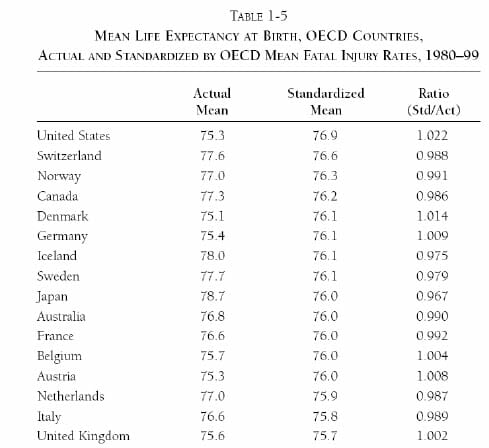
Supporters of government medicine often quote a statistic that shows life expectancy in the US lower than most European nations with government-run health systems.  But what they never mention is that this ranking is mainly due to lifestyle and social factors that have nothing to do with health care.  Removing just two factors - death from accidents (mainly car crashes) and murders - vaults the US to the top of the list.  Here, via Carpe Diem, are the raw and corrected numbers:

lifeexpectancy

The Mark Perry post linked above has links in turn to the study itself and its methodology.  You may have seen stats that say that, using raw data, the US has the best life expectancy once you reach age 65.  This is just another way of correcting out higher accident and murder rates, as these tend to affect younger folks.

My guess is that if one corrected for other lifestyle issues and environmental factors that increase the incidence rates of things like heart disease in the US (discussion here), then the US lead would be even more stark.  If one takes the left at its word that the US starts in a health care "hole" with poor diet, obesity, environmental problems, etc., then the US medical care system, despite starting in a hole, is able to still raise US life expectancies above other countries.

One big reason is cancer survival rates, which dwarf those in Europe.  It is at such leading and expensive edges of medicine where one might expect the US system to get much better results, and it does.

But it is often said that this is only for the rich -- that the poor in the US don't benefit.  Well, this is a difficult proposition to test, as income mobility (which is very real in this country no matter how much the left denies it) makes correlation of income (say by quartile) and life expectancy impossible.  During a person's lifetime, they might inhabit several different quartiles.

A proxy I think the left might accept is one  of race.  If one assumes that African-Americans are among the systematically disenfranchised in the health care system, then it should show up in their stats.  The results are something that gives ammunition to both sides of the debate.

cancer

Clearly, there are two tiers, as African Americans have poorer cancer survival rates than white Americans.  But, for many types of cancer, African-Americans have higher survival rates than they would in many European countries.

This is the endless do-loop of inequality debates.  Is inequality OK if it results the folks lower on the totem pole being better off than in a more egalitarian society.  For me, the answer seems obvious.  Absolute well-being seems far more meaningful than relative well-being.  But I am not necessarily in the strong majority on this.  I had a professor that used to poll his class -- he would ask them if they would prefer a society where the gap between rich and poor was narrower but where the poor were, on an absolute basis, worse off than in the less equal society.  He reported the vote almost always split about 50/50.  (of course the is a purely utilitarian formulation of the question.  Adding in individual liberties issues makes the question far more stark, as to achieve an egalitarian society one must give up both wealth and liberty.)

Moolah for Mainframes

from a reader:

The White House is secretly planning to follow "Cash For Clunkers" with a new scam called "Moolah For Mainframes" that will reward CIOs for replacing mainframes with smartphones and turning data centers into wetlands. The top-secret plans also say the Administration will launch a government-run IT company in 2010 "to keep those greedy private IT companies honest."

Since the White House has already made incursions into banking, the car industry, insurance, mortgages, and healthcare, the Administration sources said that a number of top executives in the IT industry "have become kinda jealous and angry" about the government's lack of direct ownership in the tech business.

Using air quotes liberally, another White House source said, "The President is on "friendly terms" with many "techie CEOs" and he says they feel there's been a "breach of etiquette" with all those other industries getting "stimulus" while the IT industry has had to "battle it out" in the marketplace with only customer revenue to "fall back" on."

Boycotting Whole Foods

I don't tend to shop at Whole Foods because they offer a value proposition that does not appeal to me.  Their prices are too high for products that generally don't seem noticeably better than ones I can get in other stores.  To some extent the placebo effect of having "all natural" on the package does not really work for me, though I do buy most of my fish and meat there  (and not just because I like the irony of buying only meat products from a store populated by vegans).

That said, I like having the choice in stores.  I even drop by a farmers market once in a while, though generally the hassle is not worth it for me.  The same is true in beers -- I am seldom in the mood for something as dark and rich as a Belhaven, I love the explosion of choices in beer we have seen since the dark days of the late 70's/early 80's.  Other people will make different choices.  Cool.

Which makes it all the more ironic that those who benefit from the explosion in retail choice in the free marketplace are using that choice to protest the CEO of Whole Foods for advocating similar levels of choice in health care.  Anyway, I would write more but Radley Balko did a much better job here.

You see, he shared his ideas on health care reform, thinking that you, being so famously open-minded and all, might take to a few of them, or that it at least might start a conversation. I guess he felt he'd built up some cache with you, and wanted to introduce you to some new ideas. His mistake wasn't in intentionally offending his customers. He's a businessman who has built a huge company up from the ground. I'm sure he knows you don't deliberately offend your customers. His mistake was assuming you all were open-minded enough consider these ideas without taking offense"”that you wouldn't throw a tantrum merely because he suggested some reforms that didn't fall in direct line with those endorsed by your exalted Democratic leaders in Washington. In retrospect? Yeah, it was a bad move. Turns out that many of you weren't nearly mature enough to handle it.

Its hard even to understate the how absolutely nuts self-styled "progressives" have gone over this pretty tame and sober editorial in the IBD.  Here is just one example -- this is a mainstream green blogger and not some weird comment to a Kos post.  I honestly thought this was satire at first:

I agree with CEO John Mackey that it's okay to make money by making your green business big. But Mackey crossed the line with an op-ed in the Wall Street Journal this weekend, whose very publication put him in the company of the lunatic right-wing fringe who edit the paper's opinion section.

The op-ed reads like a page from the Republican playbook, touting individual responsibility for one's health. What a load of unorganic crap!

Holy brothers-keeper Batman - He's advocating individual responsibility!!  Here, since I have not reproduced it before, are the "lunatic" ideas of Mr. Mackey:

"¢"‰Remove the legal obstacles that slow the creation of high-deductible health insurance plans and health savings accounts (HSAs).

"¢"‰Equalize the tax laws so that employer-provided health insurance and individually owned health insurance have the same tax benefits.

"¢"‰Repeal all state laws which prevent insurance companies from competing across state lines.

"¢"‰Repeal government mandates regarding what insurance companies must cover.

"¢"‰Enact tort reform to end the ruinous lawsuits that force doctors to pay insurance costs of hundreds of thousands of dollars per year.

"¢"‰Make costs transparent so that consumers understand what health-care treatments cost.

"¢"‰Enact Medicare reform.

"¢"‰Finally, revise tax forms to make it easier for individuals to make a voluntary, tax-deductible donation to help the millions of people who have no insurance and aren't covered by Medicare, Medicaid or the State Children's Health Insurance Program.

The tort reform area is one where Obama is particularly disingenuous. It is just amazing that anyone could write about the cost of medicine being driven by too many useless procedures without once mentioning the words malpractice or defensive medicine.  I wonder if this might explain Obama's silence on tort reform (via maggies farm)

legal

Increased Education Spending Going to Administrators

For years, I have suspected that a lot of increased per pupil spending in public schools has gone to increasing numbers of administrators rather than teachers or facilities.  I just have to compare the administration numbers at my kids private school and those at the local public school and the contrast is just amazing.

Mark Perry demonstrates a similar effect in state-run college education:

This decade has been good for associate vice chancellors at UNC-Chapel Hill. Their numbers have nearly doubled, from 10 to 19, and the money paid to them has more than tripled, to a total of nearly $4 million a year. The university now admits that some of these people were in jobs that were not vital. They represent the rapid management growth in the 16-campus UNC system that has added tens of millions of dollars to annual payrolls.

Now, with a tough economy and sinking tax revenues, UNC officials and state lawmakers say these jobs need cutting first.

Systemwide over the past five years, the administrative ranks have grown by 28%, from 1,269 administrative jobs to 1,623 last year, UNC-system data show. That's faster than the growth of faculty and other teaching positions -- 24% -- and faster than student enrollment at 14%. The number of people with provost or chancellor in their titles alone has increased by 34% the past five years, from 312 in 2004 to 418 last year. The cost was $61.1 million, up $25 million from five years before.

Perry also show similar numbers in his own university in Michigan.

Kudos to the UNC system for at least considering cuts in these bloated administrator positions.  You never see public grade schools systems ever suggest such cuts - when forced to economize, they always suggest cutting something inflammatory like textbooks for high school or crayons for kindergarteners.  One difference is that UNC faces competition from a myriad of other public and private colleges, while most local grade school districts do not.

I would still like to find similar staffing numbers for our local public school district, breaking out teachers from principals, assistant principals, and administrators, but they seem loath to share such detail.

Thought For the Day on Government Management

Via John Stossel:

On that note, economist Justin Ross points out on his blog how, for 44 cents, you could mail a letter via USPS - or buy a kiwi fruit that had to be grown and watered in New Zealand, picked, carefully packaged, and shipped across the world to a store near you.

How to Make a Libertarian Nuts

Show him this chart, via Carpe Diem

jobsbest

I'm Glad I Read This...

I wasn't that familiar with the California Coastal Commission.  I have toyed around with buying some property close to the beach in California to escape Arizona summers.  But once I read this article about their abuses, I have no desire to own California land along the coast.  Because, apparently, you don't actually "own" the land, at least not the way I define it.

The CCC's authority has decidedly grown since its beginnings as a temporary outfit with jurisdiction over 1,000 yards of coastline to an established agency with five miles of nearly absolute power, overriding local decisions and slapping multi-million dollar fines on people building small houses on existing concrete pads that could only be seen from the coast by a Superman with telescopic and X-ray vision.

See, for an example, the story of Kathleen Kenny, one of the stars of Oshen's documentary, now deceased. Kenny beat back local inspectors' assaults on her for building on her own property. She even in 1997 won an unprecedented RICO suit against local government officials for harassing her, a case where she acted as her own lawyer. Despite this, she was never able to shake off the CCC from coming after her for more or less the same offense. It has levied multi-million dollar fines that still hang over the head of her living partner, Arthur Starz.

Indeed, the CCC is still on the march. Even as it's compelling Oshen to kick up his footage, a bill is now being considered in the California state legislature that will give the CCC independent power to levy $5,000-$50,000 "administrative civil penalties" (in addition to any other fines or penalties) for violations of its ukases without having to get a court involved. The agency could then use that money for...more enforcement actions. Another bill would dictate that anyone with an unresolved CCC violation order over their heads could not submit an application for any other development permit from the CCC, on that land or any contiguous land.

Legalize Immigrants From Mexico; Ban Immigrants From California

Until a few years ago, I did business up and down the Pacific Coast.  If I had to rank the business climates of these states, from worst to best, I would informally come up with something like:

  1. (worst) Certain California counties (e.g. Ventura, San Francisco, Santa Barbara)
  2. Oregon
  3. Western Washington
  4. Rest of California
  5. Eastern Washington

So I was interested to see that Oregon may finally be getting the bad press it deserves as a difficult place to do business, though, interestingly enough, this particular article blames it on the Californians:

Some might call this California disease. This refers to a chronic inability to make hard decisions as well as a general disregard for business and economic activity....

With all the influx of Californians, it's not surprising that Oregon shows some signs of California disease. It recently increased its tax rates so that Oregon's highest-income taxpayers face marginal tax rates that match Hawaii's for the highest in the nation. Oregon's land-use planning had been extremely centralized for some time. Indeed, Oregon's land-use planning may be the most centralized in the United States. This makes it harder for communities to control their own destinies, whether they want to grow or not.

Interestingly, I actually wrote about similar effect in the context of immigration into the US.  While I am a supporter of open immigration, my greatest fear is that in the name of individual liberty, we would let in millions of new people who would someday vote against individual liberties.  It seems that may be a more substantial problem with Californian than Mexican immigration.

The good news for the rest of us is that Oregon may preferentially be attracting the slackers

Our analysis of California migrants has shown a gradual reduction in their earnings over what they were earning in the Golden State. There also are less quantifiable impacts. Portland, a city attractive to many unemployed and underemployed younger Californians, could well be becoming the "slacker" capital of the world.

Fortunately, Arizona is so politically un-correct with slacker/socialist/statist/greenie types that we don't get a lot coming here.

Sheriff Joe Launches Coup Against Rest of County Government

It appears that our Maricopa County government (which is the county that Phoenix is in) has risen to new levels of dysfunctionality.  Apparently our Sheriff Joe Arpaio missed his calling as South American general, launching a coup last week against the rest of the county government (for whom he supposedly works).

Maricopa County sheriff's deputies on Wednesday stormed into a county building, seized control of a computer system and threatened to arrest county employees if they tried to stop them, according to county officials.

County management responded by asking a Maricopa County Superior Court judge for a temporary restraining order against the Sheriff's Office.

The system, which provides access to law-enforcement databases, is the subject of a lawsuit between the Sheriff's Office and the Board of supervisors.

It links county computers to Department of Public Safety databases, which store criminal background information. But it also is a server and e-mail platform for several county agencies, including the Sheriff's and County Attorney's offices and the Superior Court.

Its management is the subject of a 2003 interagency agreement. But in light of recent layoffs of system operators due to budget cuts and squabbles among the agencies, the Sheriff's Office felt that sensitive data that should be the sole domain of law enforcement had become too available to the system's civilian administrators, who work for County Manager David Smith and the supervisors....

"The sheriff did not receive permission from - or give notice to - any other elected official or stakeholder agency before barging in with armed officers and demanding that he be given exclusive control," he said.

It turns out that the Sheriff's concern about protecting confidential information could well be a smokescreen.  For years, the Sheriff's office has been, unsuccessfully, attempting to gain access via the courts to records and emails from other departments, information that, coincidentally, resides on the seized servers.

Just as the Sheriff's Office is concerned about civilians' access to records, county management is concerned the Sheriff's Office now has access to information from other county agencies it is investigating, such as the Superior Court. State appellate courts have rebuffed Arpaio's attempts to obtain privileged court e-mails, which would be accessible through the system. Superior Court Judge Joseph Heilman has scheduled a hearing for today regarding the restraining order.

I'm Not That Big on National Mandates, But...

...requiring dash cameras in every police vehicle would be a great idea.  Via Radley Balko, of course, video in his post here.

I do think Ms. Harmon has her lawsuit a bit misdirected.  I don't think Tasers per se are the problem.  If this guy didn't have a Taser, it would just be a nightstick or physical force.  The issue is that many police act as if they are dictators of the local area within their line of sight.

Global Warming Alarmists Have Your Best Interests At Heart

Sent to me by a bunch of readers, from the Atlantic interview with Thomas Schelling:

I sometimes wish that we could have, over the next five or ten years, a lot of horrid things happening -- you know, like tornadoes in the Midwest and so forth -- that would get people very concerned about climate change. But I don't think that's going to happen.

This reminds me of a post from way back, when Kevin Drum wrote:

Seeking to shape legislation before Congress, three major energy trade
associations have shifted their stances and decided to back mandatory
federal curbs on carbon dioxide and other man-made emissions that could
accelerate climate change.

I responded:

Having some Washington lobbying organizations switch which side of this incredibly difficult trade off they support is not "good news."  Good news is finding out that this trade off may not be as stark as we think it is.  Good news is finding some new technology that reduces emissions and which private citizens are willing to adopt without government coercion (e.g. sheets of solar cells that can be run out of factories like carpet from Dalton, Georgia).  Or, good news is finding out that man's CO2 production has less of an effect on world climate than once thought.  Oddly enough, this latter category of good news, surely the best possible news we could get on the topic, is seldom treated as good news by global warming activists.  In fact, scientists with this message are called Holocaust deniers.

Postscript: It is particularly telling of a certain mindset that Schelling specifically wishes bad things to occur in the Midwest.   By most leftish standards, people in flyover country (except maybe Ohio since it is a key swing state) don't really count.

These Are The Folks Who Promise to Streamline Medicine

From Henry Payne:

"In apparent violation of the new cash-for-clunkers law, the Department of Transportation [DOT] is more than 10 days late in paying rebates of at least hundreds of thousands of dollars on dealer claims," reports Automotive News....

The clunkers law signed by President Obama requires that dealers be reimbursed by the government within ten days for the $3,500 to $4,500 credits they've paid to customers. The DOT says it's working through computer problems.

"Very few dealers are getting very little money," said Bob Israel, president of the Louisiana Automobile Dealers Association. "It's not working smoothly at all."

David Wilson, a Toyota dealer in Orange County, Calif., has been paid for only three of 92 claims he submitted before Aug. 2, leaving him in the lurch for $374,000.

North Carolina's Brad Wood has12 unpaid claims since Aug. 1. He's received just $26,000 of the $319,000 in rebates he is owed. "I've never experienced anxiety like this in business before," he says. "If I don't get paid, I will have been working almost free for several months."...

Many deals are also are getting rejections for procedural minutiae that they can't straighten out because the 200 employees DOT has allocated program aren't enough. Employees are inaccessible by phone or e-mail, NADA's Wood says. The problem? Unlike the IRS, for example, which doesn't audit every tax form, all clunkers applications must be reviewed. That's 315,000 forms so far (for a staff of 200). Washington is scrambling to boost the number of employees to 1,000, but that will cost more money in a program already tight for cash.

Read the whole thing.  He goes on to describe the way in which the Feds are setting up dealers as the fall guy for the Fed's failures.

Update: From Carpe Diem, on health care in Britain

1. TELEGRAPH -- A quarter of a million people are waiting more than 18 weeks for treatment on the NHS, new figures show. The figures, published by the Lib Dems, show that 236,316 people are currently waiting more than 18 weeks for a range of treatments including oral surgery, rheumatology and geriatric medicine. This means that nearly 10% of patients are not being treated within the government's waiting list target.

2. TELEGRAPH -- Civitas, the think tank, blames the monolithic nature of the National Health Service for "putting the patient last". It argues that the "customer" of the NHS business model introduced by Tony Blair and continued by Gordon Brown is the health secretary rather than the patient.

By the way, if you are intrested in free markets and economics, you really should be reading Carpe Diem. I could link almost every one of Mark Perry's posts if I had the time.

Coolest Stuff I Have Worked With In A While

Electro-Luminescent wire.

el-wire-light

I am a little late to the game on this stuff -- apparently hobbyists have been using it for crafting.  For example, who wouldn't want a Tron outfit?

To date, I have mostly sheltered readers from the geekiest of my hobbies: model railroading  (Yeah, I know what you are saying -- how can anyone who spends hours a day at a computer writing on arcane bits of business and economics issues possibly be anything but cool?)  This may soon change, as I am starting a new N-scale layout and I will probably inflict some in-progress photos on you folks.  To get an idea just how crazy I am, I build my own track from wood strips and bundles of rail and tiny, tiny spikes -- so we are not just talking about putting the old Lionel out on a green table cloth.

Anyway, for some time I have wanted to build a layout that is primarily meant to be run in the dark as a night scene.  So I am experimenting with a lot of technologies, from florescent paint to tiny LED's to small bulbs to get ideas for various scenes.  The EL wire turns out to be a dead ringer for scaled down neon, so I expect to use a lot in the city part of the layout.

I will leave you with a photo of the layout that probably inspired more people (including myself) into the hobby than any other  -  by the master, John Allen:

s1_020_b4squaw_sep64

If you get intrigued with his work, more photos are here.

I wish I had more pictures of my old work, but they seem to have been lost in a move.  All I have left is a few poor-quality, poorly-scanned under-construction photos of my first layout from years and years ago.

rr3

rr1

Postscript: Can a hobby be geeky if Rod Stewart shares it?  He has built an absolutely stunning layout - one photo below and more herestewart-layout

And yes, the work really is his own, he didn't just pay someone to build it for him.

Explain the Correlation...

I am confused as to why a preference for overpriced organic foods and a preference for government monopoly control of health care are necessarily correlated at the 1.0 level.  But apparently they are.  Maybe its a common desire to overpay for basic necessities?

Art Book Omits Any Pictures of Art

The producers of a book about a series of famous works of art decided unanimously that it was unnecessary to include any pictures of the works of art being discussed.

[The pictures are] freely available on the Internet and can be accurately described in words, Mr. Donatich said, so reprinting them could be interpreted easily as gratuitous.

Can you imagine this being said about a book on, say, Seurat?  Could you describe in words adequately the visual impact of Pissaro, or how it differed from Monet?  No?  Pictures are a visual medium - I would argue that they are failures if they can be adequately and completely described in words alone.

Of course, the quote above is not about an art book, it is a book from Yale University Press about the group of the 12 Mohamed cartoons drawn by that Danish cartoonist.  Someone (actually an entire publishing staff) actually thinks it is a good idea to write an entire book about a set of visual media without reproducing the visual media in the book.  Incredible

Ironically, the cartoons are freely available on the Internet ONLY because some Internet site proprietors have more intestinal fortitude than Yale.  If everyone took the same stance as Yale, they would not be freely available.  And since most of the major media made the same editorial choice not to publish the cartoons at the time of the controversy, the likelihood that a reader has not actually seen the pictures is much higher than, say, for a Seurat book.  In this sense, Yale had a greater, not a lesser, obligation to publish the cartoons in the book.

Besides, to see the cartoons is to say, "WTF is all the fuss about."  I mean they are bland, bland, bland by the scale of either American or European political cartooning.

mohammedcartoons

Seriously, the only reasons someone would want to not publish these cartoons is to help hide just what an astounding over-reaction it was to make much of a fuss over them in the first place.  Seriously, these things are the Emperor's new clothes, except that  a few folks calling them out for being naked still haven't stopped a majority of the intelligentsia from continuing to pretend.

This is also ironic given the really, really low bar Yale has set for art in the past.

We Actually Have A Control Group

It is going to be a really, really, really long four or eight years if the Obama Administration and much of the left insists on declaring that anyone who dares to criticize a black President in racist.  The most recent example, of course, are frequent charges that critics of the health care reform are motivated by racism.

It is already clear that this Administration intends to raise the unverifiable claim to a new state of the art (3 million jobs saved or created!)  But the interesting thing about the health care - racism link is that in this particular case, we actually have a really good control group -- the first term of the Clinton administration.

In 1993, the Clinton administration embarked on a double secret effort to redesign the health care industry under government authority.  As details of the plan leaked out, many folks went nuts.  Commercials aired in key districts attacking various portions of the proposals and raising fears all around.  People were so ticked off that in the 1994 mid-term electi0ns, Democrats lost control of Congress for the first time in many decades, an election trouncing generally credited first and foremost to health care proposals.

Its not like the Obama administration is unaware of this example.  Many if Obama's approaches to the health care legislation this year are intentional changes from Clinton's approach.  Obama's rush to pass legislation that does not really start getting implemented until 2013 by the August 2009 recess was clearly an attempt to prevent opponents from gearing up campaigns against the bill as they did with Clinton's.

But here is the really interesting part.  I could have this wrong, but I could swear Clinton is a member of the White Anglo-Saxon Protestant oppressor race.  If so, the implication is that people went bonkers in 1993-1994 over health care plans for some political reason, but people who go bonkers  in 2009 over many of the same plan points are racist?  Does this pass any kind of smell test?

What is really going on is that a bunch of people who have never held a productive job, being politicians for life, and who have bought into their own "dedicated public servant" marketing are suddenly shocked to find that they and their efforts are not universally appreciated.  When someone has the bubble burst on their manufactured self-image, their reaction is seldom pretty.

Regulation and Choice

If you want to really confuse someone, restate the minimum wage laws this way:

It is generally illegal in the US to accept a job for less than $7.25 an hour.  The minimum wage laws are therefore a substantial constraint on individual liberties

When I say this to most folks, they get confused because laws like minimum wages are usually stated in terms of empowerment of the common man.  The theory is that individuals don't have enough bargaining power to really get what the true clearing price should be for their labor, so the government steps in to prevent evil corporations (ie "the man") from exploiting this power imbalance and paying wages that are too low.

Tell that to my 15-year-old son who is looking for a job.  Sure, he would like to earn some good cash, but the wage scale of a job is way down the list of priorities.  What he really needs is a chance to build basic work skills and knowledge of how organizations function that you and I take for granted.  Further, he would like to get some direct experience with customer contact.  And finally, he wants to demonstrate to future college choices that he can function successfully in a work environment, and that he is motivated enough to keep and hold a job.

As a result, my son would likely gladly take the right job for, say, $3 an hour.  And an employer might jump at this deal, understanding the lower wage helps compensate for the costs of dealing with an inexperienced new employee and the risk of hiring a teenaged boy with distracting amounts of hormones running through his system.  This would be a perfectly rational, consensual, everybody-wins arrangement that is absolutely illegal.  So don't tell me or my family that minimum wage laws are empowering.

The health care analog

Many very similar liberty-reducing regulations exist in the health care world, and more appear to be on the way.  One great example that is entirely similar to the minimum wage issue is minimum coverage rules.  Many states have lengthy lists of conditions that must be covered in any health insurance plan sold in that state.  From acupuncture to mental health to massages to homeopathic treatments, you can find just about every care specialty with a lobbying organization getting its services embodied in state laws as minimum requirements.

Again, supporters of such laws argue that this is empowering for consumers.  Every health care plan you can buy will have a wide array of covered services.  But, they will also all be expensive.  What if I don't want mental health coverage or acupuncture?  Why do I have to pay extra for this stuff to be covered by my policy?  I go to the doctor very, very infrequently - basically only if the condition is critical - so why is it illegal to purchase a health insurance plan that matches my health care use preferences?

Currently I pay for my own health care plan and have insurance that I consider true insurance.  It has a high deductible, and does not cover a bunch of non-critical stuff.  I have no dental coverage, and pay dental all out of pocket, as I do most routine medical expenses   I have medical insurance solely to cover catastrophic medical events that would likely be financially disastrous for me  (I do the same thing with my house and car, paying for routine maintenance with insurance reserved for catastrophes).   Fortunately, Arizona allows me to buy such a policy, though it does have minimum coverage rules that make the policy more expensive than it might be.  In other states, like Massachusetts, my health plan with a high deductible is illegal.  It would also be illegal under the current House and Senate versions of Obamacare.

Medical Insurance and Windshields

I do a lot of back road and highway driving, so windshield repair and replacement are things I deal with fairly frequently.  I've generally always just paid for these repairs out of pocket.   It is a field where if one shops around, there are a lot of good deals.  However, for a while I lived in a state that had a law that said all auto insurance must have windshield replacement coverage.

The effect on my behavior was dramatic.  When living there, I didn't even think about shopping around for a windshield repair.  I just had the dealer do it (surely the high cost supplier) when I had the car in for regular service.  I didn't care what the cost was, it was covered in my policy.  (Ironically, it turns out in retrospect that I should have shopped around -- because no one else in the sate cared about cost, all the windshield suppliers jacked up their prices and then competed by offering kickbacks in various forms to consumers, basically competing on how much of the insurance money they would share with the car owner.  Truly dysfunctional).

I have seen the exact same change in my behavior, but in reverse, in switching to a high deductible medical policy.  Until about 3 years ago, like most Americans, we never even thought about the cost of our medical care.  We weren't paying for it.  But now, as I pay most of our routine expenses, I am amazed at the difference.  When my son needed a CT scan, three phone calls gave us a huge variation in quoted prices.  It turns out, shopping works, even in medical care.

Postscript: I have always wondered why insurance companies didn't create some incentive for shopping.  If I were running such a company, I would be tempted to tell customers - "our reimbursement rate for CT scans in your area is X.  If you get it done for less than X, we will split the savings with you 50/50."  Though I suppose the danger is tht this could morph into a variation of the windshield kickback system.