Corporations and Free Speech

Here is my very simplistic take.  You will have to pardon me for referencing the actual text of the Constitution -- I know this is passe in our modern era (jeez, I am probably a tenther too).  The issue looks pretty straight-forward to me, for two reasons

  • Congress shall make no law ... abridging the freedom of speech.  Doesn't say by whom or for what.  There are no modifiers.  Doesn't say "except when individuals organize themselves into a corporation."
  • Congress shall make no law ... abridging ...the right of the people peaceably to assemble.  So Congress can make no law restricting free speech and it can make no law restricting assembly but somehow it can make laws restricting free speech of people who have assembled?

It's a Tax

Forcing people to pay money or pay a fine on their tax return to buy a product they currently don't buy is a tax.  Particularly when that product will likely be over-priced to the young and healthy not buying it today to subsidize the older folks.

Does Anything Exceed the Commerce Clause Nowadays?

A question has been going around on legal blogs -- "Does a Federal Mandate Requiring the Purchase of Health Insurance Exceed Congress' Powers Under the Commerce Clause?"

My answer is:  Nowadays (not in the original intent) is there anything the Feds can do that exceeds current interpretations of the commerce clause?  In Raich, the Supreme Court decided that a product (marijuana) that was grown in state for personal consumption, like tomatoes in your own garden, and was used legally under state law, can still be regulated under the commerce clause.    As Clarence Thomas wrote in dissent:

Diane Monson and Angel Raich use marijuana that has never been bought or sold, that has never crossed state lines, and that has had no demonstrable effect on the national market for marijuana. If Congress can regulate this under the Commerce Clause, then it can regulate virtually anything and the Federal Government is no longer one of limited and enumerated powers

No kidding.

Unfortunately the theory that this personal use in California could somehow affect marijuana pricing in other states (by growing their own, they reduced demand for out of state weed which might affect prices in Arizona -- again similar to an argument that growing your own tomatoes might affect prices in another state) won the day in the Court.   With the Supreme Court accempting this "butterfly effect" argument  (because truly the demand of one person in a national market is like a butterfly flapping its wings in China and affecting a hurricane in the Gulf of Mexico), anything falls under the commerce clause.

23 Different Health Reform Plans, and Not One Mentions Torts

It is amazing to me that there can be numerous health care plans in Congress plus a jillion speeches on the topic by the President and not once does anyone mention "torts."  Now, I am not one to ascribe all cost problems in the medical field to defensive medicine and tort settlements.  Buthey t certainly are a factor.  It is just stunning that a President can stand up and talk numerous times about "unnecessary tests and procedures" and ascribe all of these to some weird profit motive by the doctors - weird because generally, the doctor gets no extra revenue from these tests, so somehow he or she is motivated by the profits of a third party lab.

But I think the rest of us understand that American tort law, which allows juries to make multi-million dollar judgements based on emotions and empathy rather than facts and true liability, has at least a share of the blame.   Not just the settlements, but the steps doctors go through to try to protect themselves from frivolous suits down the road.  Here are two interesting stories along these lines.  The first from Carpe Diem:

Zurich University Hospital has stopped treating North American "medical tourists," fearing million-dollar claims from litigious patients if operations go wrong. Hospitals in canton Valais have also adopted measures to protect themselves against visitors from the United States, Canada and Britain.

"The directive applies only to patients from the US and Canada who come to Zurich for elective, non-essential health treatments," said Zurich University Hospital spokeswoman Petra Seeburger.

"It is not because treatment is not financed; it is because of different legal systems." In a statement the hospital said it was "not prepared to risk astronomical damages or a massive increase in premiums." Seeburger emphasised that the restrictions only affected people not domiciled in Switzerland.

Apologies to Mark Perry for quoting his whole post, but if you are not reading Mark Perry, you should be.  The second example comes from Overlawyered:

Oh, I miss the days when you got a radiology report that said, "fracture right 3rd rib, no pneumothorax". Because of frivolous lawsuits radiologists have learned to be vague, noncommittal and to pass the buck of possible litigation. So now you get a 2 page report that says "linear lucency in right 3rd rib, clinical correlation recommended, underinflated lung fields cannot exclude underlying interstitial disease and or masses. CT recommended for further evaluation, if condition warrants." along with several other paragraphs of lawyer imposed legalmedspeak"¦.

Wow, Who Would Have Predicted This?

The answer is:  Just about everyone who was not in the tank for the Obama Administration predicted this (from my Princeton classmate Henry Payne):

When Congress gave away $3 billion for buyers to trade in their "clunkers" and buy new cars in August, lawmakers thrilled as buyers swamped showrooms to take advantage of the big discounts. "Cash for clunkers has captured the public's attention . . . (it) has the possibility to truly jumpstart our economy," said Rep. Candice Miller (R., Mich.). Other, more sober analysts, warned that the clunkers program was only stealing from future sales.

September sales are in, and sobriety can take a bow.

Edmunds.com reports that "September's light-vehicle sales rate will fall to 8.8 million units . . . the lowest rate in nearly 28 years, tying the worst demand on record. After the cash-for-clunkers program boosted August sales to their first year-over-year increase since October 2007, demand has plunged. In at least the last 33 years, the U.S. seasonally adjusted annual rate has only dropped as low as 8.8 million units once -- in December 1981 -- with records stretching back to January 1976."

The real popularity of the program was always due to the fact that the government was throwing money away and people rushed to pick it up.  Edwards.com estimated the Feds purchased vehicles with average blue book values of just under $1500 for $3500 to $4500.  That means that the government purchased cars that blue booked at just over a billion dollars for three billion.  I you suddenly offered to buy all of your neighbors' cars for three times what they were worth, you'd be popular too.   It was a $2 billion giveaway, and people rushed to pick the cash up like one of those money drops in the outfield of a minor league baseball game.  In doing so, the government made a trivial change in the overall fleet fuel economy, in the process overpaying for Co2 reduction by a factor of 20.

Update: The study linked above shows the government paying over $400 per ton of Co2 reduced in the Clunkers program.  The 20x factor cited was based on an estimated clearing price of a tone of Co2 in a future cap and trade system.  This is hypothetical, as currently a ton of Co2 offsets trades right now in the US at 20 cents.  At this price, the program overpaid by a factor of 2000.  To be fair, this reflects both estimated pricing as well as a discount for the likelihood of a cap and trade bill passing.

This Looks Very Good

We Phoenicians, who live in one of the best solar sites in the world, have been anxiously awaiting a solar electric technology that makes economic sense.    I have a couple thousand square feet of nice, flat room that is just begging to get be off the grid.  Already, solar is economic for individuals in Phoenix, but only if you are willing to soak American taxpayers and your neighbors for 85% of the costs.  It would be nice if it were, you know, actually economic and not just subsidy bait for tens of thousands of dollars.  I have dug into many analyses that claim that solar has a 5-7 year payback, but never seen one that achieved these returns without substantial subsidies and rebates (beware the term "energy payback" which is not the same thing as investment payback (pdf))

For a while I have said that I thought traditional silicon/germanium IC-like wafer processes for making solar cells was just never going to get there, and that some other technology was necessary.   This might be one such example:

JA Solar, one of the big players in the solar industry, is working with Innovalight to commercialize the latter's method for making silicon-ink-based, high-efficiency solar cells, the companies said this week.

... The solar cells are created by pouring an ink solution incorporated with silicon nanoparticles and then decanting the excess liquid to leave behind a crystalline silicon structure.

At the time of the 2007 announcement, Sunnyvale, Calif.-based Innovalight claimed its method not only resulted in solar cells that were cheaper to produce by as much as half, but that the crystalline structure resulting from the process made its cells more efficient at converting electricity.

Those claims now appear to be validated.

On Tuesday, Innovalight announced that an independent study of its method by the U.S. Department of Energy's National Renewable Energy Laboratory and the Fraunhofer Institute for Solar Energy Systems in Germany confirmed that its silicon ink-based cells "demonstrated a record 18 percent conversion of efficiency."

The 18% conversion efficiency is close to a record for thin films, but must be the "record" for production models, since higher conversions have been achieved in the lab.  18% is very good for a production device, particularly if it is cheaper to manufacture than current cells.

Ezra Klein, There Is A Reason You Can't Get An Answer to Your Question

Ezra Klein writes:

For a long time, I took questions about stifling innovation very seriously. So did a lot of liberals. But then I realized that the people making those arguments wanted to do things like means-test Medicare, or increase cost-sharing across the system, and generally reduce costs in this or that way, which would cut innovation in exactly the same way that single-payer would hypothetically cut innovation: by reducing profits.

I also found that I couldn't get an answer to a very simple question: What level of spending on health care was optimal for innovation? Should we double spending? Triple it? Cut it by 10 percent? Simply give a larger portion of it to drug and device manufacturers? I'd be interested in a proposal meant to maximize medical innovation. I've not yet seen one.

The reason he could not get an answer to this very simple question is that it is stupid.  It is a non-sequitur.  It is, as Ayn Rand used to warn, a statist trying to force the argument to conform to his statist assumptions.

Let's take a different example, because medicine is so screwed up by government intervention that it can be confusing.  Let's imagine ourselves in the computer market in 1974.  The market is dominated by IBM mainframes, and innovation at the time was considered to be the penetration of mini computers (not to be confused with PCs, these were really just smaller mainframes) by DEC and HP.

Let's say that for some reason the US government decides it is fed up with the IBM "monopoly" and the high cost of mainframe computing and it wants to take over.  It feels like there is a lot of waste in mainframes as some people are using them for frivolous reasons while other companies who really need them can't afford them.  They might have created review boards to make sure that they thought each dollar spent on computing hardware and software was "worth it."

So, how much spending is needed to maintain innovation?  We know in hindsight that the PC revolution is looming in the next few years.  And in that context, Klein's question is absurd.  The answer is that spending per se, and even profits, in the mainframe computing market were irrelevant to the coming series of innovations.    The necessary preconditions were that entrepreneurs saw that new technology provided potential new value to consumers, and were allowed the freedom to launch these new products in hopes that the value these new products provided would be sufficiently high that consumers would pay enough for them to return their cost of manufacture and development and return them a profit.  Some succeeded, and some failed, but entrepreneurs were allowed to try, despite most "experts" predicting the PC was a silly toy.

Note that computer innovators were not required to trundle into some government computing board to justify the PC and its price, to justify how much, as Klein would say, needed to be spent on PC's.   If in fact they were forced to do so, if Jobs and Wozniak had to fly to Washington to justify the Apple I to the Computing Spending Decisions Board, they would have almost certainly been shot down.  Or told they could sell it but only for $200 and not their initial price of $2000.  We would have never had a PC revolution in a government single payer computing world, no matter how much, as Klein asks, was "spent" by the government.   It is possible that the government might eventually have greenlighted a PC (years later) just as the increasingly bureaucratic IBM did, but can you imagine how frail the PC revolution would would be if only IBM had ever sold PCs, without the slew of competitors that emerged, and if every innovation had to pass the scrutiny of a government review board before it could be launched?   Only a tiny percentage of PC innovation and of what we think of as a PC today, mostly in the basic architecture, ever came from IBM.

The very problem is that when government runs computers or health care, innovation is seen as a cost.  Klein, by asking the question in this way, is betraying exactly what is fundamentally wrong with a single-payer system.  The single-payer tends to think in terms of trying to deliver the current value proposition (ie the 2009 level of health care technology) as cheaply as possible.  The problem is that in 2039, it will still be focused on delivering the 2009 level of health care technology.  For the government -- a new drug, a new procedure, a new test -- these are all incremental costs, to be avoided.  Klein just wants a number he can plug into budget projections to say, "see, innovation is covered."  Its like Wesley Mouch asking John Galt near the end of Atlas Shrugged to tell him what orders to give.

I wrote about it just the other day.  You can see it in everything the Left writes -- increased spending is equated with increased costs which are therefore bad.  They all say that America's health care spending is rising and our per capita spending is higher than other nations and that this rising spending is somehow a problem to be fixed.  But there is a value side of the equation.  What are we getting from the spending?  When you leave out things the health care system can't do anything about (homicides and fatal accidents) Americans have the longest life expectancy in the world.  We are getting something for that extra money.  It is not just "cost" to be contained.  Is a year of life worth an extra $100,000 spending?  Everyone has a different answer, which is why we typically let each individual make these tradeoffs, and why people are uncomfortable having someone in the Post Office make the tradeoff for them.

But, the left will say, we will put really smart people on this board, who are angels of public service, who will make perfect decisions on the price-value tradeoffs of innovation (have you noticed that all their programs seem dependent on this assumption?)  Back to our computer example, these guys, they would argue, would have been smart enough to have given Jobs and Wozniak the green light.  This is a fantasy.  It never happens.  No matter how good the people, every such government entity is driven by its incentives, and this group's incentives will be to cut spending.  Innovations that result in a net total increase in spending are not going to be well-received.

Further, these boards get politicized, always.  Companies will quickly learn they have a better chance, say, of getting a new breast cancer treatment rather than a new prostrate cancer treatment past the board because the current administration is closely tied to women's groups.  Just look at current government R&D spending, this already happens.  AIDS was under-funded given its mortality because Conservative administrations thought it a disease mainly of groups it found distasteful; today, women's cancers get far more funding than men's due to the strong political activism of women's groups and the success of the pink ribbon campaign.  Drug companies will learn that the quickest way to board approval may not be winning over the board, but getting certain interest groups to lobby the board, or maybe lobby Congress to override the board.  Just look at the promise not to politicize ownership of GM -- that lasted about 2 days before Congress was passing legislation reversing internal GM decisions and GM was making plant closures based on political rather than economic concerns.

But even beyond these problems, there are Hayekian ones as well.  In the mid-seventies, there might have been only a few thousand people who were excited enough to buy an early microcomputer and see its potential.  What are the odds that one of those folks would be on the government review board, particularly since few of them were in the mainstream establishment of the computing field (heck, few of them were over 19 years old).  And even if one were on the board, would they have approved a technology with only a few initial adherents?  The fact is innovation often requires adoption of bleeding edge risk-takers who are willing to try a new technology and iron out its kinks before the mainstream catches on.   The iPod was not the first music player -- a few of us struggled for years before the iPod with large and sometimes hard to use early mp3 players  -- but if these early MP3 players had not existed, the iPod would not exist.

Perhaps most importantly, everyone makes different tradeoffs.  It may make perfect sense for some person in Washington that a biopsy is not required for certain kind of positive cancer test results.  This may make perfect price-value sense to the beauracrat, but I know a number of people who would lose months or years of their life to worry -- worry that could be short-circuited with an inexpensive biopsy.   Or consider a new cancer treatment -- is a year of life worth an extra $100,000 spending?  Would I prefer to extend my life through chemo or increase the quality of life of the time I have left by avoiding chemo?   Everyone has a different answer, which is why we typically let each individual make these tradeoffs, and why people are uncomfortable having someone in the Post Office make the decision for them.

One could say that all of this does not answer Klein's question.  That is because his question, built on the wrong premise, is unanswerable.  I suspect he knows this and is, as Brad Warbiany posited in the link above, just setting up a straw man.  All I can do is try to give a feel what what innovation does require, and help folks to understand that it has little if anything to do with Klein's question.

So, if I had to come up with a pithy one sentence answer, here it would be:

Klein:  What level of spending on health care is optimal for innovation?

Me:  The very fact that you intend to control spending centrally, at any level high or low, is what kills innovation.

Postscript: For a totally different reason, I was reading this article on the Russian T-34 tank, probably the best all-around tank for its time ever made when considering its production volume (the Panther was theoretically a better tank but volume production of the scale of the T-34, not to mention mechanical reliability, eluded the Germans).  Apropos of government boards and innovation was this:

The L-11 gun did not live up to expectations, so the Grabin design bureau at Gorky Factory No. 92 designed a superior F-34 76.2 mm gun. No bureaucrat would approve production, but Gorky and KhPZ started producing the gun anyway; official permission only came from Stalin's State Defense Committee after troops in the field sent back praise for the gun's performance.

This Is Still A Stupid Idea

I probably have posted on the electricity generating speed bump more times than it deserves, but Glen Reynolds linked this story and I am seeing it linked uncritically all over.  Here was the email I dashed off to Instapundit:

The speed bump / power device at the Burger King in New Jersey is the silliest technology I have ever seen and I am amazed that so many people praise it or write uncritically that it provides free power.  Energy is never free, it comes from somewhere.  In this case, the energy is actually stolen from the car.  The electricity power produced is equal to or less than the extra power the car has to expend going over the bump.

This electricity might be "free" if it is used where cars are braking anyway, say on a long down ramp in a parking garage, or on a suburban street or school zone where speed bumps already exist.  But the Burger King example, and in fact most of the examples I have seen of this installation, are just vampiric theft, very similar to what the US Government does in many of its programs, creating a large benefit for a single user and hoping that distributing the costs in small chunks across a wide number of people makes these costs invisible.

I wrote more about the technology here.

More Specious Logic

A while back I wrote:

People often use terrible, specious logic when arguing things political.  I have particularly seen this over the last 6 months.  The argument typically goes like this:

  1. I make a critique of a policy in the Obama administration, say on health care
  2. Sometimes as an opening response, or sometimes when [the] other person is unable to specifically counter what I have said, they respond instead, "well, your guys  fill in the blank ." The latter part might be "got us into Iraq" or possibly "are pushing this birther nonsense."
  3. I respond that  fill in the blank was not something I support(ed) and that if  by "my guys" they mean Republicans, that I was not a Republican, that I do not think the Republicans have an internally consistent position, and that I disagree with many programs and policies typically advocated by Republicans.  And besides, how did this have anything to do with the original conversation?
  4. They respond to me now as if I am somehow cheating.  Confusion reigns.

Michael at Q&O has a good example today, from the White House blog reacting to criticisms that there are too many unaccountable czars running around:

But of course, it's really the hypocrisy here that is noteworthy. Just earlier today, Darrell Issa, a Republican from California and one of the leaders in calling for an investigation into the Obama Administration's use of "czars", had to admit to Fox News that he had never raised any objections to the Bush Administration's use of "czars". Many of these members who now decry the practice have called on Presidents in the past to appoint "czars" to coordinate activities within the government to address immediate challenges.

That addresses the charge, how?  Unbelievably, the White House is resorting to the kindergarten playground argument "well, you started it."

By the way, I had asked before if such an argument had a name.  Its clearly a subset of ad hominem arguments, but I suspected that something so common must have be labeled.  It has:

Tu quoque (pronounced /tuːˈkwoʊkwiː/, from Latin for "You, too" or "You, also") is a Latin term that describes a kind of logical fallacy. A tu quoque argument attempts to discredit the opponent's position by asserting his failure to act consistently in accordance with that position; it attempts to show that a criticism or objection applies equally to the person making it. It is considered an ad hominem argument, since it focuses on the party itself, rather than its positions.

At Least Four New Taxes in Baucus Bill

The Baucus Health Care bill follows in the tradition of many other pieces of recent legislation in raising taxes in ways such that Congress can claim that it didn't actually raise taxes.  Here are four such taxes in the Baucus Bill  (note that no one that I know of has read any actual legislative language, so this is based on the press releases by the bill's authors.  Actual bill language can only be worse).

Employer Penalty is a Tax: In a step right out of Goldilocks, the Baucus bill will impose "penalties" on employers with no employee health care plan as well as on employers who have plans that are "too rich."  Never mind the insanity of the government micromanaging how an employer chooses to structure his compensation package to employees.  These "penalties" are structured as percentages of wages -- the one for having no health care plan was 8% of wages in the last bill.  This is a direct tax on employment, making hiring people more expensive (effectively the same magnitude as doubling the Social Security tax).  So how does this effect the average person?  Think of it this way, for the same wage, you job will be more expensive to a company that it was before the bill, making it less likely you will get hired at that wage.

Insurance Mandate as a Tax: The mandate that everyone must have insurance is a tax on the young and the healthy, as I explained previously:

People focus too much on the penalty itself being a new tax.  But the new tax is actually the requirement that individuals buy a product (in this case a health insurance policy) that they feel has no value (or else they would purchase it of their own free will today).  The government stopped pretending long ago that these younger middle class families will get much value from such a policy.  In fact, if they did get value commensurate with the premiums they will be paying, the mandate would not be achieving its purpose.  The whole point is that healthy people pay more into the insurnace system than they get back to support sick people.  If that payment is mandatory, then it is a tax, even if it is called an "insurance mandate" instead.

In fact, this is made all the more clear when politicians also suggest that cheaper high deductible health insurance plans be banned, as they were in Massachusetts.  Again, the whole point is to get young healthy people to overpay for insurance, and allowing them to buy sensible, cheaper, high deductible insurance defeats the whole purpose.

In fact, the bill's supporters have explicitly discussed requirements that insurance companies raise the price of insurance to the young and healthy to help reduce premiums for the old and, er, politically more active.  This is a redistributive tax, hidden within an insurance rate structure that will be heavily regulated by Congress.  Though don't expect Congress to admit this when young folks start to complain, they will say "blame the insurance companies."  Which is the whole beauty of such a hidden tax.

Corporate Taxes as Consumer Taxes: The plan would place new excise taxes on insurance companies, drug companies, and medical device providers.  But these taxes, particularly in the low margin insurance businesses (Yeah, I know if you only listened to Obama, you would never realize they were low margin but they are) just get passed onto consumers in the form of higher prices.  Congress knows this, but pretends it doesn't happen, so it can tell the economically ignorant that it hasn't raised taxes on consumers, and that rising prices are all the fault of the evil insurance companies blah blah, you know the drill.

Price Controls as a Tax: A large part of the Baucus Medicare savings is instituting price controls on doctors and other medical suppliers --  basically cutting their reimbursement rates.  This, by the way, just confirms what we all have known, that Obama and the Democrats don't have some mysterious win-win way to cut medical costs.  The only levers they have are 1. Price Controls and 2. Denying care.

There is absolutely no difference to a doctor between price controls and a tax.  A cut in the reimbursement rate from $50 to $40 is the same as having a 20% tax put on his $50 reimbursement.  Again, price controls in this context are just a way of hiding a tax.

And this might be the most dangerous tax of all, as such price controls always, by the immutable laws of economics accepted by monetarists and Keynsians alike, reduce available supply.  Doctors, for example, are going to be less willing to stay in the medical profession.  The result is inevitably shortages and long waits, something that should surprise absolutely no one as shortages and queuing are endemic in every government health care system in the world, starting with liberal darling Canada, whose citizens get medical treatment quickly only by crossing the border into the US.

Quickbooks -- Steadily Worse Each and Every Year

A quick note to many small businesses out there that use Quickbooks.  I know that most of us are cynical about annual upgrades from people like Microsoft as they seldom add any new functionality one actually needs, so they are seldom worth the price.  But there is an additional reason not to upgrade Quickbooks.  Every single version, since at least 2004 and up to and including 2009 has been worse than the previous year's version.  Somewhere around 2006 we got data file bloat, where the size of the company data file mushroomed 10-fold.  Around 2008 we got a goofy and intrusive place-a-phonecall-to-India authorization process.  In 2009 most of the online banking features were broken.

It is kind of funny to read Quickbooks reviews on Amazon, with each successive generation getting fewer stars.  Every version is dominated by reviews that begin with "worst quickbooks version yet."   Quickbooks 2009 right now is at about 2 stars, and is buoyed that high only by an aggressive campaign by Intuit employees to post 5-star reviews.  I stopped upgrading my business version around 2006 (and wish we had stopped earlier) but one of the non-profits I do the books for upgraded to 2009 and it is a mess.  Unfortunately, if you use the online banking functions or payroll service (we do not) Intuit forces your company to upgrade as there is apparently a 3-year clock built into the software that shuts down and forces an upgrade.

Its time for those market forces to get to work and make someone rich by bringing out an alternative.  Intuit is right for the plucking, if someone has the right product.

Good News, for Once, on Water

Kevin Drum links this:

The city of Palmdale is running out of water, and as a result prices are going up.  Way up:

"My bill went from $12.80 to $185," [Tracey] Summerford, a Neighborhood Watch captain, told the water board.

"My water bill went from $139 to $468," Sanchez said at that meeting. Since then Sanchez received another monthly bill, one for $324. Together that meant she owed the water district $792, plus a prior balance that brought her total to $924. "That's my two car payments," said Sanchez, who moved into her home in November....I feel discouraged. I feel like we should have stayed in Santa Clarita and lived in our apartment."

I wrote in the comments:

This is really good news. For years California has claimed to have water shortages, but municipal water prices never reflected that shortage. Politicians would prefer to use command and control allocation and rationing powers than just let price do its work.

It is really good to see some California communities price water in line with its scarcity. Under-pricing water has always provided an implicit subsidy for building and farming in certain areas. I wish all California water would be priced on the basis of supply/demand clearing rather than political patronage.

By the way, the author later calls Santa Clarita "the city."  That is pretty hilarious to anyone who has been there.  Santa Clarita sure looks like the burbs every time I have been there.

Strange Brew

Combine 40% French design and engineering, 40% political correctness, 10% Hello Kitty and 10% of WTF to get this new electric concept car from Renault with square wheels called the Twizy.  I don't think this is a put on.

f2

Can This Be Real?

I haven't really written about the various ACORN videos James O'Keefe has been collecting.  As someone with 500 employees, I have substantial understanding for folks who get bitten in the butt by nutty front line employees.  But the volume is starting to look a lot more like a culture of corruption that a few crazy employees.  Did this ACORN employee really just explain how she got away with murdering her husband?  I mean, if she tells this story to people who just walked in off the street, she must have told it to everyone at ACORN she works with.  I have hired a few doozies by accident, but I can guarantee you that people only 10% as nutty as this lady would be out our company's door in minutes after telling such a story.

The only thing I really can say is that O'Keefe missed his chance at a fortune, because this stuff is far more outrageous than anything on reality TV.

Bait And Switch Alert -- Increased Expenditures <> Increase Costs

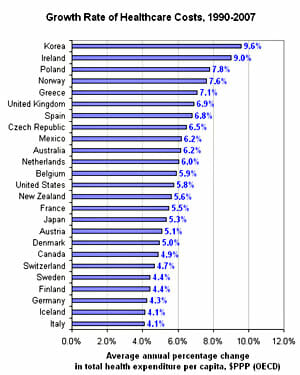
Kevin Drum presents this chart:

Blog_Healthcare_Growth

Look at the top and the bottom of the chart.  The top says "growth of health care costs" while the bottom says "average annual percentage change in total health expenditures."  Drum goes on in his post to use rising expenditures and rising costs interchangeably.  I responded in the comments:

Um, I hate to bring measurement and data integrity into this discussion, but "costs" and "expenditures" are not the same thing.

Total per capita expenditures at Wal-Mart have gone up over the last 20 years by a lot. The cost of items sold at Wal-Mart have not increased by nearly so much. The difference is the volume of purchases.

Let's say 20% of this country was getting no health care. If next year, everything stayed the same but suddenly these 20% could buy the same amount of health care as everyone else, our per capita expenditures would go up by at least 20%. This does not mean the cost goes up. It means we bought more of it. It would be a good thing, not a "cost"

Only from one perpective, that of a single payer, are the words "per capita expenditures" and "costs" the same. In such a scenario, but no other, having people get more health care is an increase in costs, rather than an improvement to the population.

I think this is at the heart of what makes many people worry about single payer health systems -- that increased volume of use is a "cost", so that in turn decreasing supply and volume of use is a reduction in cost. It is this whole way of thinking that equates increased usage with increased costs that makes people suspicious of government run systems, and fear that cost reductions will come through usage restrictions.

We might well expect that in wealthy countries like the US, as the per capita percentage of people's budgets taken up by food and other necessities drops, that health care spending might increase. What better way to spend incremental wealth than on our own health? In anything else - housing, food, travel, whatever -- I would suspect that Mr. Drum would consider increasing per capita spending as a good thing, as a sign of wealth and increasing well-being. Why is health care treated just the opposite?

You Want to Know Why Medical Care Is So Expensive?

You Want to Know Why Medical Care Is So Expensive?  Because the government has passed numerous laws to help medical practitioners enforce their monopoly on numerous medical services.

Today I encountered an egregious example.  1-800-Contacts will not ship my contact lens order.  Seeing that my 1-year prescription was about to run out (but still valid for another week, it expires on the 18th), I ordered a bunch of boxes of my daily lenses to see me through some more months.  The retailer called my eye doctor, who confirmed that the prescription was still valid but that the doctor would only allow me to buy one box because he wanted me to return for an exam soon.  They confirmed this by email:

Thank you for choosing 1-800 CONTACTS. While we were verifying your prescription, your eye care provider informed us that your prescription will be expiring soon. Unfortunately, this means that we are unable to ship your order....

But then we get to the real point

Also, if you would like assistance scheduling a new exam, we can help! We have a network of doctors with convenient locations and hours....

Sincerely,

The Doctor Network Team at 1-800 CONTACTS

So the email is not even from the customer service department.  It is from their doctor network.  Its clear the requirement is all about pumping up the eye doctor business.

I remember a Dilbert cartoon (or maybe it was the Far Side) where one copier repairman was pointing into a copier and telling the other that he should "set this dial for when he wanted to return."  We all have suspected something like this exists in copiers, but for all the dark humor, it really exists in the medical profession.

Why should the government force me to pay the doctor for as many visits as the doctor wants just to be able to purchase contact lenses?  One could argue this is for eye health or some happy BS like that, but we don't require everyone to visit the eye doctor at the doctor's pleasure, just people with bad vision who have daily wear contacts.  There is not, to my knowledge, any correlation between glaucoma and contact lens wearing, so why do I face such a government mandate while someone with 20/20 vision does not?

Further, why can't I self medicate on contact lens selection?  I know people who have been raised to be submissive sheep deferring to the almighty medical degree gasp at such a suggestion, but why not?  Because I have problems with both near and far sightedness, my choice of contact lens strength is a tradeoff anyway.  If I can see well long distance, I can't read anything without reading glasses.  Back off a bit on the far vision, allowing a little blurriness in one eye, and I can read in an emergency without my glasses.  I chose my own lens strength, and my doctor then wrote a prescription for it.  Why can't I just do this on my own, say with a trial kit of lenses from the manufacturer.  (for those who think it might be a size issue, there are only about 3 sizes in this type of lens, and they are far enough apart that once a size is selected, they are likely that size forever).  It's fine if people want to do this under a doctor's supervision, and I would certainly get into the doctor every two or three years, but why must the government mandate I go in more frequently, at the doctor's pleasure, not mine?

This kind of thing exists ad infinitum in the medical profession, with government mandates helping to protect over-educated professionals from lower-cost competition.  Why do I have to go to a dentist's office to get my teeth cleaned?  Why do I need someone with 12 years of medical training to put three stitches in my knee?  Why do I need a fully trained doctor to take me through the basics of a routine physical?  Why does Viagra require a prescription -- I mean, doesn't the doctor just take my word there is a problem, or is there actually a doctor out there who sends in hot nurses to prove whether I have an erectile problem?  OK, I might not begrudge that particular doctor visit.

Three Quarters of A Million Americans Arrested For Marijuana Possession in 2008

In the US last year, 754,224 people were arrested for possession (not dealing or production) of marijuana.  By the logic of US drug laws, all of these folks are better off with an arrest record and possible incarceration that they are from the nominal negative effects of smoking marijuana (FBI report here, via Radley Balko).  These numbers are just insane.  And while the report only gives race numbers for total drug arrests rather than for just marijuana offenses, a hugely disproportionate number are black (over 1/3 of arrests).

And speaking of equal protection, the arrest numbers for gambling are eye-opening (table 43).  75% of all people arrested for gambling last year in the US were black, including 90% of the arrests of those under 18 for this offense.  It seems it is A-OK for whites to play poker at home for money (I'm guilty) or to bet in Super Bowl pools (guilty again) or to clad themselves in polyester and head to the casino boat, but blacks who choose to compete with the state gambling/lottery monopoly will get arrested.  As an aside, I have always laughed at the government piously suing tobacco companies for targeting minorities with their advertising and then using the same techniques themselves to target minorities for their lottery sales.

A Primer on Libertarianism

Democrats: The people in power can't be trusted.  You need to remove them and put our guys in charge

Republicans: The people in power can't be trusted.  You need to remove them and put our guys in charge

libertarians: People in power can't be trusted.  You need to remove their power and be in charge of your own damn self

We Have Got To Get John Scalzi A Movie Production Gig

John Scalzi, via Instapundit

A producer of Creation, the film about Charles Darwin and his wife Emma, starring Paul Bettany and his real-life wife Jennifer Connelly, is griping that the film has no distributor in the US, apparently because so many Americans are evolution-hating mouth-breathers that no one wants the touch the thing; it's just too darn controversial.

Well, it may be that. Alternately, and leaving aside any discussion of the actual quality of the film, it may be that a quiet story about the difficult relationship between an increasingly agnostic 19th Century British scientist and his increasingly devout wife, thrown into sharp relief by the death of their beloved 10-year-old daughter, performed by mid-list stars, is not exactly the sort of film that's going to draw in a huge winter holiday crowd, regardless of whether that scientist happens to be Darwin or not, and that these facts are rather more pertinent, from a potential distributor's point of view. . . . Maybe if Charles Darwin were played by Will Smith, was a gun-toting robot sent back from the future to learn how to love, and to kill the crap out of the alien baby eaters cleverly disguised as Galapagos tortoises, and then some way were contrived for Jennifer Connelly to expose her breasts to RoboDarwin two-thirds of the way through the film, and there were explosions and lasers and stunt men flying 150 feet into the air, then we might be talking wide-release from a modern major studio. Otherwise, you know, not so much. The "oh, it's too controversial for Americans" comment is, I suspect, a bit of face-saving rationalization from a producer

If you think Scalzi is exaggerating, sit and actually write down a synopsis of the plot for "Transformers" and see if you get anything that makes any more sense - just substitute "Jennifer Connelly's bare breasts" with "Megan Fox's bare midriff."

I Finally May Be Understanding Something

This year has been a frustrating year for my business.  As many of you know, I am in the business of privatizing public recreation.  We take over the management of public recreation facilities, and are generally able to run them to the same or better standards as the government for less money.  Whereas before we take over, the government typically loses money on a park, we often can run it at a profit AND pay the government rent for the concession rights.

This year, numerous state parks have been threatened with closure in states all across the country.  In many of these states, I have communicated with everyone I could think of, from the governor to state parks leaders, trying to say that companies like ours could probably keep many of these parks open. I told them I wasn't looking for a sweetheart deal - we weren't afraid to bid against other companies, but it was crazy to close parks that could easily remain open.   We have been told any number of times by numerous state leaders that they would prefer to close the park rather than put it under private concession management.

To some extent, this is due to the pressure of public employees unions, who have every incentive to play brinkmanship and force closure of parks rather than set the precedent of having them managed by a non-union private company.  This is unsurprising.

I also understand that there is a fear of private management of public recreation facilities.  I swear the first think I hear almost every time I present on what we do  is that they fear we would put a billboard or a McDonalds in front of Old Faithful.  I kid you not, this charge is as regular as clockwork.  Fortunately, we manage about 175 public recreation facilities to a pretty high standard, and not one billboard or McDonalds can be found at any of them.  A large part of the bid process for any facility management contract is not just the rate or the rent but also the detailed operating standards to which it will be managed.  So this is a normal, but surmountable hurdle.

But even taking into account these usual sources of resistance, I am always just amazed at how vociferous the opposition is to even experimenting with private management.  States like California are simply hell-bent on closing parks a company like ours could easily keep open for the public (to be fair, Ruth Coleman, head of California State Parks, is very open to new models but she gets absolutely no support either within her organization or in the legislature for such new ideas).

But I think I understand this phenomenon better now after reading Kevin Drum today. This is what Drum wrote in response to the DNC ad, which clearly stretched the truth, claiming that Republicans voted to end Medicare:

Why not just tell the truth: Republicans essentially voted in favor of turning Medicare over to private industry.  With only a few words of explanation, this could easily be more effective than the ad that actually ran.  Like so:

Republicans voted to turn Medicare over to private insurance companies!  You heard right: they want to hand Medicare over to the same companies that [insert two or three insurance company outrages here, maybe a Wall Street reference, something about profits over people, etc.].  Democrats will never do that.  Blah blah blah.

Would that really be any less scary than the ad that actually ran?

So for Drum, and I presume for much of the Left, the suggestion that a government service be managed privately is just as bad as the suggestion that the service be ended. In essence, Drum is saying he would almost rather have no Medicare than Medicare provided privately.

It certainly explains a lot, and puts the phenomenon I see in public recreation into a larger context.

Update: A couple of the comments hpothesize the problem is that many in government and on the left just hate profits and the profit motive in general.  One related story -- I was in a meeting with a large state parks organization where a senior person raised the idea of private park management.  Well, everyone hated the idea, but when it looked as if the leadership might still seriously consider the private option, one person in the room said "well could we at least mandate that they can't make a profit."  There was a lot of head nodding at this.

I didn't go off on this and kept a smile on my face.  But I did lose it in an earlier meeting with the head of some government parks we actually did run.  We were discussing park fee increases for the next year (the state had just raised minimum wages about 30% and we were scrambling to make ends meet).  He said he was uncomfortable with the level of profits we made.  I asked him, "Jim (not his real name) does this state pay you more than $25,000 a year to run this park?"  He nodded.  I said, "then you make more profit in this park than I do, and what is more, you didn't have to invest $100,000 in equipment to get your job, nor do you have to rebid for your job every 5 years, nor does you salary go down if for some reason park visitation decreases."

Sometimes I wish I had stood up in that state meeting and said something similar, as in "Why is the money I make in a park somehow tainted because it is the difference between my revenues and expenses and the result of substantial investments and subject to extraordinary risks, while the virtually guaranteed-for-life salary you make, paid for by the same visitors, is somehow pristine?"

Almost Beyond Parody

There is just so much wrong with this news blurb, entitled "LA Mother Who Beheaded Son Was Allowed To Keep Him Despite Signs of Mental Illness."  Here are just the first four I have thought of:

  • Isn't the boy dead, and if so, why is custody an issue?
  • Why would a mom who assaults her child be allowed to retain custody?
  • Does the "despite signs of mental illness" clause apply to the son or the mother?
  • If the mental illness question applies to the mother, can it even be in question?

The article clears some of this up, barely.

So Much For The Tax Pledge

"I can make a firm pledge"¦.no family making less than $250,000 will see any form of tax increase"¦..not any of your taxes"-Barack Obama, September 12, 2008

Oops, well, so much for that, as Obama imposes a 35% tax on Chinese tires, requiring higher prices be paid by the majority of Americans.  This is a broad-based tax aimed at supporting one narrow American industry, as a payoff to the United Steel Workers who have been sad that the UAW has been getting all the political gravy of late.

Suppose the Chinese government is massively subsidizing tire exports -- that they are taking Chinese taxpayer money and directly applying it to tire exports to reduce prices in the US.  What should our response be?  Mine would be:  Thanks, suckers.  If the Chinese really want to tax their people to subsidize lower US consumer prices, why in the world would we want to stop them?

Oh, and remember that Obama pledge to be all lovey-dovey with the rest of the world instead of that nasty confrontational Bush administration?  Well, forget that too:

HONG KONG -- Just two days after the United States slapped Chinese tire imports with hefty tariffs, Beijing has hit back by saying it would launch an anti-dumping investigation into automobile and chicken products from the U.S.

[...]

The "protectionist" policy that seems to have triggered the Chinese tit-for-tat investigation was an order signed on Friday by President Barack Obama that imposes a 35% tariff on tires imported from China on top of the existing import duty of 4%.

Can anyone say, "Smoot-Hawley."  I am sure happy we all learned from the one unequivocal lesson that every economist, left-right-Keynsian-monetarist, took away from the Great Depression -- that starting an international trade war is the best way to exacerbate a recession.  Obama has  done just about the only thing everyone agrees shouldn't be done in response to a major economic downturn.

Update: More good analysis here

Postscript: I wrote this hypothetical post from the Chinese perspective a couple of years ago:  From "Panda Blog:"

Our Chinese government continues to pursue a policy of export promotion, patting itself on the back for its trade surplus in manufactured goods with the United States.  The Chinese government does so through a number of avenues, including:

  • Limiting yuan convertibility, and keeping the yuan's value artificially low
  • Imposing strict capital controls that limit dollar reinvestment to low-yield securities like US government T-bills
  • Selling exports below cost and well below domestic prices (what the Americans call "dumping") and subsidizing products for export

It is important to note that each and every one of these government interventions subsidizes US citizens and consumers at the expense of Chinese citizens and consumers.  A low yuan makes Chinese products cheap for Americans but makes imports relatively dear for Chinese.  So-called "dumping" represents an even clearer direct subsidy of American consumers over their Chinese counterparts.  And limiting foreign exchange re-investments to low-yield government bonds has acted as a direct subsidy of American taxpayers and the American government, saddling China with extraordinarily low yields on our nearly $1 trillion in foreign exchange.   Every single step China takes to promote exports is in effect a subsidy of American consumers by Chinese citizens.

This policy of raping the domestic market in pursuit of exports and trade surpluses was one that Japan followed in the seventies and eighties.  It sacrificed its own consumers, protecting local producers in the domestic market while subsidizing exports.  Japanese consumers had to live with some of the highest prices in the world, so that Americans could get some of the lowest prices on those same goods.  Japanese customers endured limited product choices and a horrendously outdated retail sector that were all protected by government regulation, all in the name of creating trade surpluses.  And surpluses they did create.  Japan achieved massive trade surpluses with the US, and built the largest accumulation of foreign exchange (mostly dollars) in the world.  And what did this get them?  Fifteen years of recession, from which the country is only now emerging, while the US economy happily continued to grow and create wealth in astonishing proportions, seemingly unaware that is was supposed to have been "defeated" by Japan.

We at Panda Blog believe it is insane for our Chinese government to continue to chase the chimera of ever-growing foreign exchange and trade surpluses.  These achieved nothing lasting for Japan and they will achieve nothing for China.  In fact, the only thing that amazes us more than China's subsidize-Americans strategy is that the Americans seem to complain about it so much.  They complain about their trade deficits, which are nothing more than a reflection of their incredible wealth.  They complain about the yuan exchange rate, which is set today to give discounts to Americans and price premiums to Chinese.  They complain about China buying their government bonds, which does nothing more than reduce the costs of their Congress's insane deficit spending.  They even complain about dumping, which is nothing more than a direct subsidy by China of lower prices for American consumers.

And, incredibly, the Americans complain that it is they that run a security risk with their current trade deficit with China!  This claim is so crazy, we at Panda Blog have come to the conclusion that it must be the result of a misdirection campaign by CIA-controlled American media.  After all, the fact that China exports more to the US than the US does to China means that by definition, more of China's economic production is dependent on the well-being of the American economy than vice-versa.  And, with nearly a trillion dollars in foreign exchange invested heavily in US government bonds, it is China that has the most riding on the continued stability of the American government, rather than the reverse.  American commentators invent scenarios where the Chinese could hurt the American economy, which we could, but only at the cost of hurting ourselves worse.  Mutual Assured Destruction is alive and well, but today it is not just a feature of nuclear strategy but a fact of the global economy.

The Future of Newspapers

I couldn't really get up enough energy to post about the whole Van Jones kerfuffle.  Apparently, as one of Obama's 129 czars, this guy whose job it is to redistribute billions of dollars from one group of individuals to another and issue diktats to be followed by private citizens and businesses, is *gasp* a communist.  Well, no sh*t.  All of these various czars have communist roles so why is it surprising Obama might have picked a communist to hold one of them.  The only surprise was that Van Jones was dumb enough to admit it in print rather than hiding it in leftish double-speak like most of the rest of the administration.

Anyway, all that aside, you gotta love the NY Post, which has no problem dropping any pretense of statesmanship and is perfectly willing to skewer its cross town rival.  This editorial is pretty dang funny.  An excerpt:

Newspaper of record? The Times isn't so much a newspaper as a clique of high school girls sending IMs to like-minded friends about their feuds and faves and raves and rants. OMFG you guys! It's no more objective than Beck is....

The Times continues to treat communism as a cute campus peccadillo like pot smoking or nude streaking. A Times think piece (Sept. 9) worried that Jones' fall was "swift and personal." Being a communist is personal but being the pregnant teen daughter of a vice presidential candidate is public business?

In a quasi-related post, Virginia Postrel says the Washington Post lost $1.10 per copy of their newspaper last quarter.  Wow!

I have to disagree with Ed Driscoll, though.  He like many conservatives argues that this economic problem of newspapers is somehow because the Times has dropped its objectivity.  I am not sure anyone has evidence that is true.  One could make, I think, an equally strong case that the Times should be less objective and go openly partisan.  After all, this notion of politically neutral newspapers is a pretty recent phenomenon in the US.

I actually think the problem with newspapers like the Washington Post is the "Washington" part.  Local business models dominated for decades in fields where technology made national distribution difficult or where technology did not allow for anything but a very local economy of scale.  Newspapers, delivery of television programming, auto sales, beverage bottling and distribution, book selling, etc. were all mainly local businesses.  But you can see with this list that technology is changing everything.  TV can now be delivered via sattelite and does not require local re-distribution via line of sight broadcast towers or cable systems.  Amazon dominated book selling via the Internet.  Many of these businesses (e.g. liquor, auto dealers, TV broadcasting) would have de-localized faster if it had not been for politicians in the pocket of a few powerful companies passing laws to lock in outdated business or technological models.

Newspapers are ripe for a restructuring.  How can one support a great Science page or Book Review section or International Bureau on local circulation?  How much effort do the NY Times, Washington Post, LA Times, SF Chronicle, etc. duplicate every day?  People tell me, "that's what the wire services are for."  Bah.  The AP is 160 years old!  It is a pre-Civil War solution to this problem.  Can it really be that technology and changing markets have not facilitated a better solution?

The future is almost certainly a number of national papers (ala the WSJ and USA Today) printed locally with perhaps local offices to provide some local customization or special local section.  Paradoxically, such a massive consolidation from hundreds of local papers to a few national papers would actually increase competition.  While we might get a few less stories about cats being saved from trees in the local paper, we could well end up not with one paper selection (as we have today in most cities) but five or six different papers to choose from  (just look at Britain).  Some of these papers might choose to sell political neutrality while some might compete on political affiliation.

If I were running the Washington Post, I would think very seriously about creating a national news offering, a USA Today with substance.   If you offered me a Washington Post re-branded as a national paper, with some strong side offerings like the NY Times Science section and a good local sports section and a local news section, I'd toss my Arizona Republic in a second.  Its going to take some good thought as to how to weave together the national offering with locally customized content and to manage local vs. national advertising accounts, but with technology this is doable -- Clear Channel does something similar in radio.

I wonder, in fact, why no one has done this yet -- when you look at the circulation numbers, only the USA Today and WSJ, the two papers pursuing this path, are seeing growth.  My only thought is that news is one of those businesses dominated by passionate people who are tied deeply, emotionally into the industry in a way that makes it impossible to envision or consider new models (aviation is another such business, in my opinion, and the US auto business is probably another).  What we need is for the Post and a few other major papers to fail and then let some really bright, right people from outside the business come and shake it up.  This is, by the way, one of the unsung benefits of bankruptcy, is that it takes assets out of the hands of the people who got the company in the mess to begin with -- a benefit we short-circuited when we spent billions of taxpayer dollars in the auto industry to keep GM and Chrysler assets out of new and potentially more innovative hands.

A Tribute to Norman Borlaug

Norman Borlaug, the founder and driving force behind the revolution in high-yield agriculture that Paul Ehrlich predicted was impossible, has died at the age of 98 95.  Like Radley Balko, I am struck by how uneventful his passing is likely to be in contrast to the homage paid to self-promoting seekers of power like Ted Kennedy who never accomplished a tiny fraction of what Borlaug achieved.  Reason has a good tribute here.  Some exceprts:

In the late 1960s, most experts were speaking of imminent global famines in which billions would perish. "The battle to feed all of humanity is over," biologist Paul Ehrlich famously wrote in his 1968 bestseller The Population Bomb. "In the 1970s and 1980s hundreds of millions of people will starve to death in spite of any crash programs embarked upon now." Ehrlich also said, "I have yet to meet anyone familiar with the situation who thinks India will be self-sufficient in food by 1971." He insisted that "India couldn't possibly feed two hundred million more people by 1980."

But Borlaug and his team were already engaged in the kind of crash program that Ehrlich declared wouldn't work. Their dwarf wheat varieties resisted a wide spectrum of plant pests and diseases and produced two to three times more grain than the traditional varieties. In 1965, they had begun a massive campaign to ship the miracle wheat to Pakistan and India and teach local farmers how to cultivate it properly. By 1968, when Ehrlich's book appeared, the U.S. Agency for International Development had already hailed Borlaug's achievement as a "Green Revolution."

In Pakistan, wheat yields rose from 4.6 million tons in 1965 to 8.4 million in 1970. In India, they rose from 12.3 million tons to 20 million. And the yields continue to increase. Last year, India harvested a record 73.5 million tons of wheat, up 11.5 percent from 1998. Since Ehrlich's dire predictions in 1968, India's population has more than doubled, its wheat production has more than tripled, and its economy has grown nine-fold. Soon after Borlaug's success with wheat, his colleagues at the Consultative Group on International Agricultural Research developed high-yield rice varieties that quickly spread the Green Revolution through most of Asia.

The contrast to Paul Ehrlich is particularly stunning.  Most folks have heard of Ehrlich and his prophesies of doom.   But Ehrlich has been wrong in his prophesies more times than anyone can count.  Borlaug fed a billion people while Ehrlich was making money and fame selling books saying that the billion couldn't be fed -- but few have even heard of Borlaug.   Today, leftists in power in the US and most European nations continue to reject Borlaug's approaches, and continue to revere Ehrlich (just this year, Obama chose a disciple of Ehrlich, John Holdren, as his Science czar).

Continuing proof that the world moves forward in spite of, rather than because of, governments.

Update: More here.

Update #2: Penn and Teller on Borlaug

Things I Didn't Know

As both a computer geek and a WWII buff, I of course know something of Alan Turing's incredible contributions to both.  I also knew he was gay, but didn't think much about it.  What I didn't know was how horribly he was abused by the British government, actions for which the government has now appologized:

In 1952, he was convicted of "Ëœgross indecency' -- in effect, tried for being gay. His sentence -- and he was faced with the miserable choice of this or prison -- was chemical castration by a series of injections of female hormones. He took his own life just two years later.

A lot more at the link.  I am constantly amazed at how we tend to elevate the mediocre while treating the truly great so shabbily.

Postscript: The most entertaining way to learn something about Turing, albeit in fictionalized form, is to read Neal Stephenson's Cryptonomicon, one of my favorite books.  The story is good (not great, but good) but the writing is just fabulous.  Who else could entertain one for page after page on the physics of eating Cap'n Crunch cereal?